
Paperis Articles
Will AI Take Our Jobs? — From Exposure to Job Loss
Between the estimate that 80% of U.S. workers could see at least 10% of their tasks affected by large language models and the employment changes actually measured so far, there are several steps.
Your field's papers, as audio
Pick your fields and journals — Paperis summarizes the key papers and turns them into audio. Listen on your commute.
Start Paperis free →Will AI Take Our Jobs? — From Exposure to Job Loss
The Number That 80% of American Workers Are in the "Zone of Influence"
About 80% of people working in the United States could have at least 10% of their work affected by large language models, AI that reads and writes like ChatGPT. For about 19%, more than half of their work could be affected. This is a calculation released in a study published in 2023 that scanned the U.S. labor market against these models, and it also found that higher-income jobs are more exposed (arXiv:2303.10130).
A working paper is a manuscript released by researchers before undergoing peer review in an academic journal. This calculation was also first released as a working paper on arXiv, and the study was later published in the academic journal Science (2024). Since many studies on generative AI and jobs are still only available as working papers, the tier of each study is indicated alongside it.
The authors' conclusion is that these models exhibit the characteristics of a general-purpose technology used broadly across the economy, and thus can have substantial implications for the economy, society, and policy. This number is easily converted into headlines like "X% of jobs will disappear," but the same authors noted that they do not predict when these models will be developed or when they will actually be deployed (arXiv:2303.10130). There are several steps between being able to be affected and jobs disappearing.
Similar numbers existed 10 years ago. In the mid-2010s, studies emerged stating that a substantial share of jobs in the U.S. and Europe were at "risk of computerization," meaning the risk of being automated, and those studies revived worries about a future without jobs (DOI: 10.1787/5jlz9h56dvq7-en).
This article follows those steps one by one. First, we look at how these numbers are generated, then look at what past automation, especially industrial robots, actually did to jobs, and move on to the results measured since the advent of generative AI. The evidence is mostly data from the U.S. and Europe, and Korean figures appear only in one OECD cross-country comparison. Because the scope of each study is narrow—a single workplace, a single platform, a single country, or a short period—we carry that scope along with the numbers.
Measuring by Whole Occupations Versus by Tasks
A task is the individual piece of work that a job actually does. An accountant's day includes entering numbers, talking with clients, and staring at a mismatched ledger to find the cause.
Studies from the early 2010s that estimated high automation risks bundled these tasks together and judged them at the occupation level. This is the approach proposed by researchers Carl Frey and Michael Osborne, assuming that technology automates entire jobs all at once. A 2016 OECD working paper suggested that this assumption could inflate the risk. That is because even jobs classified as high-risk still retain a significant amount of tasks that are difficult to automate (DOI: 10.1787/5jlz9h56dvq7-en).
That working paper re-measured 21 OECD countries by task units, reflecting the fact that the tasks people do vary even within the same job. The average share of jobs that could be automated was 9%. There were differences across countries, with South Korea at 6% and Austria at 12%, and the authors note that these differences may reflect variations in workplace organization, prior investments in automation, and the education levels of the workers (DOI: 10.1787/5jlz9h56dvq7-en). Depending on whether you measure by the unit of the occupation or the unit of the task for the exact same technology, the scale of jobs at risk of automation changes drastically.
80% of the first section consists of numbers created from the task level from the beginning, and the estimates by task are also large. This is because what is being measured is different. The OECD's 9% is a number measuring whether a job can be automated, whereas AI exposure measures whether a task can be accelerated. AI exposure is a score measuring the share of a job's tasks that can be finished much faster at the same quality using AI. By that paper's calculations, about 15% of all tasks performed by U.S. workers can be accelerated that way using just large language models, and when including software and tools built on top of that, the share grows to 47 to 56% of tasks (arXiv:2303.10130). 47 to 56% is the share of tasks, which is a different figure from the share of jobs.
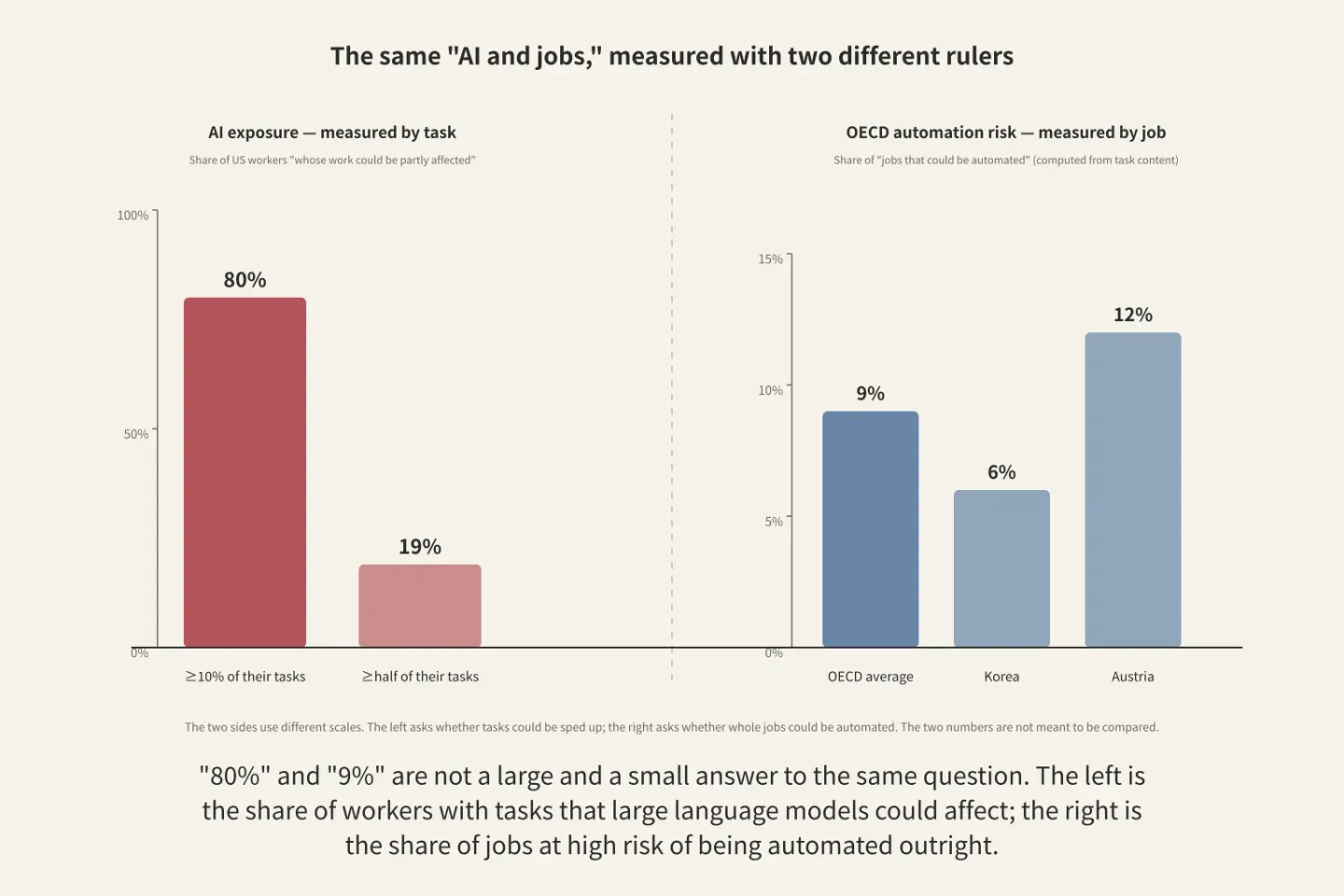
Figure: A diagram drawn by Paperis based solely on the text content
The exposure score measures which tasks AI touches. What happens to the person who was doing that task is not included in that score and must be measured separately as an outcome data point.
Comparing Risk Scores to Actual Outcomes
After 10 years, it became possible to compare those predictions against the actual outcomes. A 2021 follow-up working paper from the OECD looked at what happened to jobs with a high risk of automation over the past 10 years across 21 countries. There was no evidence that jobs vanished on a net basis for countries as a whole, and employment grew in all 21 countries. Looking inside countries tells a different story. Employment in high-risk jobs grew by 6%, falling far short of the 18% in low-risk jobs (DOI: 10.1787/10bc97f4-en).
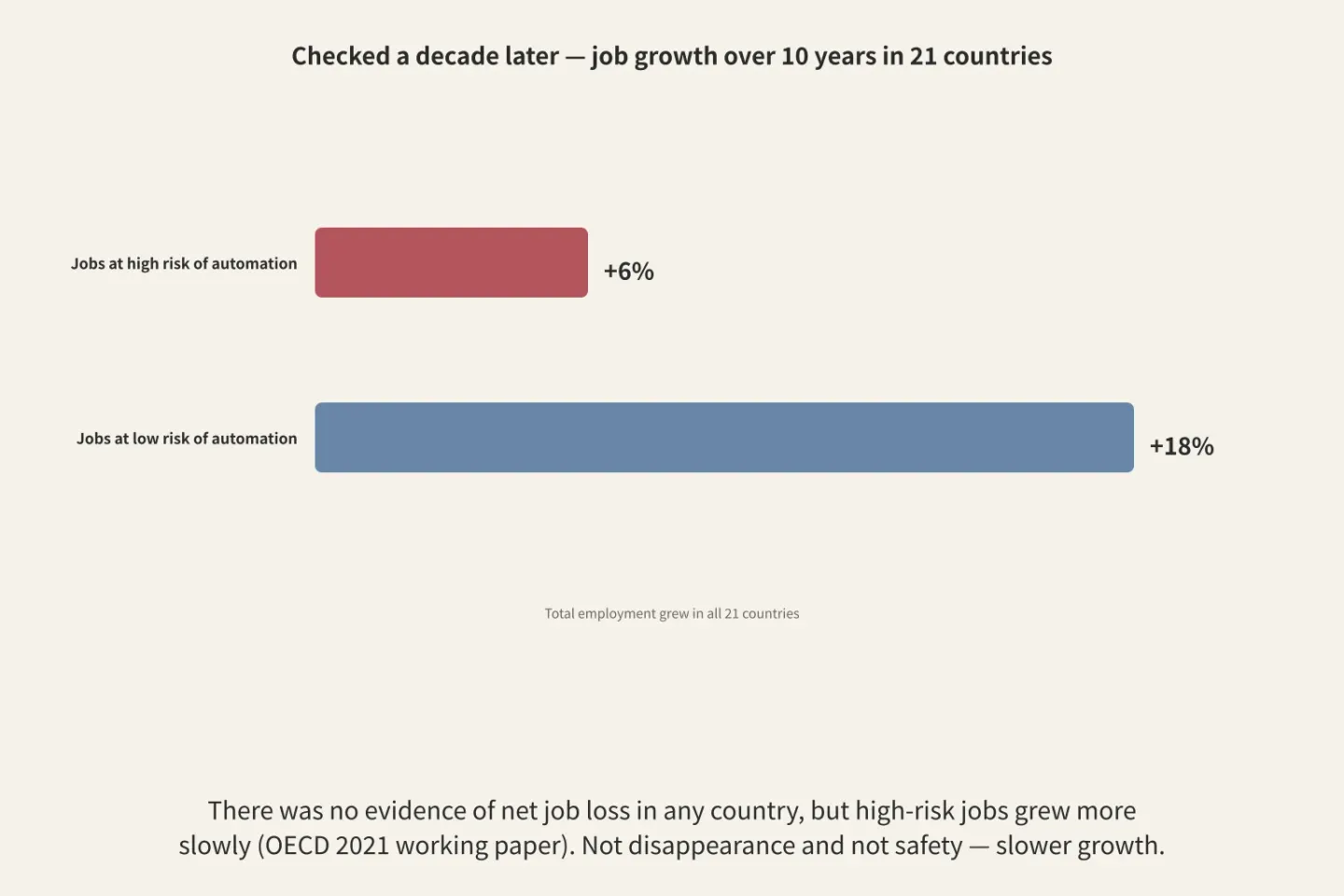
Figure: A diagram drawn by Paperis based solely on the text of the article
Those high-risk jobs that grew slowly were crowded with people with low levels of education. People with low levels of education were already concentrated in high-risk jobs in 2012, and became even more concentrated there afterward. Even so, their employment rate did not drop compared to other education groups, because the number of people with low levels of education shrank alongside the demand for those jobs. The working paper notes that the risk of automation may increasingly concentrate on people with low levels of education in the future, and that the COVID-19 crisis may have accelerated automation (DOI: 10.1787/10bc97f4-en).
A similar comparison exists in the United States. A 2026 working paper from the Federal Reserve Bank of Chicago examined the period from 2019 to 2024 by matching Frey and Osborne's estimates of computerization risk by occupation and an "AI Applicability" score built from Microsoft AI assistant Copilot usage logs with U.S. occupational statistics. Jobs with high AI applicability saw overall growth in employment and wages over this period. Jobs with high or medium computerization risk had weaker employment performance than low-risk jobs, and wages rose across all risk groups. The authors conclude that exposure to AI and automation does not mechanically lead to job losses, at least in the short term, and that measuring exposure at the task level is better read as a signal that jobs are being reorganized rather than as a direct forecast of employment decline (DOI: 10.21033/wp-2026-12).
There are also papers that asked the same question using data from before generative AI emerged. A working paper (arXiv) looking at job-by-job unemployment using U.S. state unemployment insurance records from 2010 to 2020 reports that none of the AI exposure scores used by governments and industries predicted unemployment rates, the risk of unemployment, or job-to-job transition rates. Combining several scores together yielded considerable predictive power, and the authors interpret this as suggesting that each score may capture a different facet of AI's impact, concluding that exposure measures which reflect time and context and are validated against actual outcomes are needed (arXiv:2308.02624).
The OECD's automation risk score pointed to which jobs would grow less, but it did not hold up as a forecast that jobs across entire countries would shrink. No single AI exposure score predicted unemployment on its own, and in the U.S., jobs with high AI applicability actually saw increases in employment and wages. Reading it as "nothing happened" erases the 6% growth in high-risk jobs and the concentration of workers with low education, while reading it as "they will vanish soon" erases the employment growth across the 21 countries.
Two forces when machines take tasks
As of 2019, employment growth in the United States slowed over the preceding 30 years. Economists Daron Acemoglu and Pascual Restrepo explained this slowdown through how tasks are divided between humans and machines (DOI: 10.1257/jep.33.2.3).
Automation makes machines take over tasks previously done by humans. The displacement effect is the force where labor demand decreases as machines take over tasks formerly done by humans. In their theoretical framework, this force allows automation to increase productivity while reducing labor demand, and it always reduces the share of national income that goes to labor (DOI: 10.1257/jep.33.2.3).
There is also a pushing force in the opposite direction. When automation reduces costs, it increases labor demand for tasks that have not been automated, and further demand increases as capital accumulates and existing machines improve. In an NBER working paper, the same authors write that this reaction is incomplete. Even when the reaction is strong, automation increases output per worker more than wages and reduces labor's share of national income. The authors also point out the mismatch between the skills required by new technologies and the skills people possess, along with the possibility that automation is being adopted too rapidly at the expense of other productivity-boosting technologies (DOI: 10.3386/w24196).
What the authors cite as the stronger reaction is new tasks. The reinstatement effect is the force where labor is put back to use as new tasks emerge that humans do better. In their theoretical framework, this force always increases labor's share and labor demand. Using U.S. industrial data to break down the past 30 years, the authors concluded that the slow growth in employment is explained by a faster displacement effect (particularly in manufacturing), a weakened reinstatement effect, and slower productivity growth than in previous decades (DOI: 10.1257/jep.33.2.3).
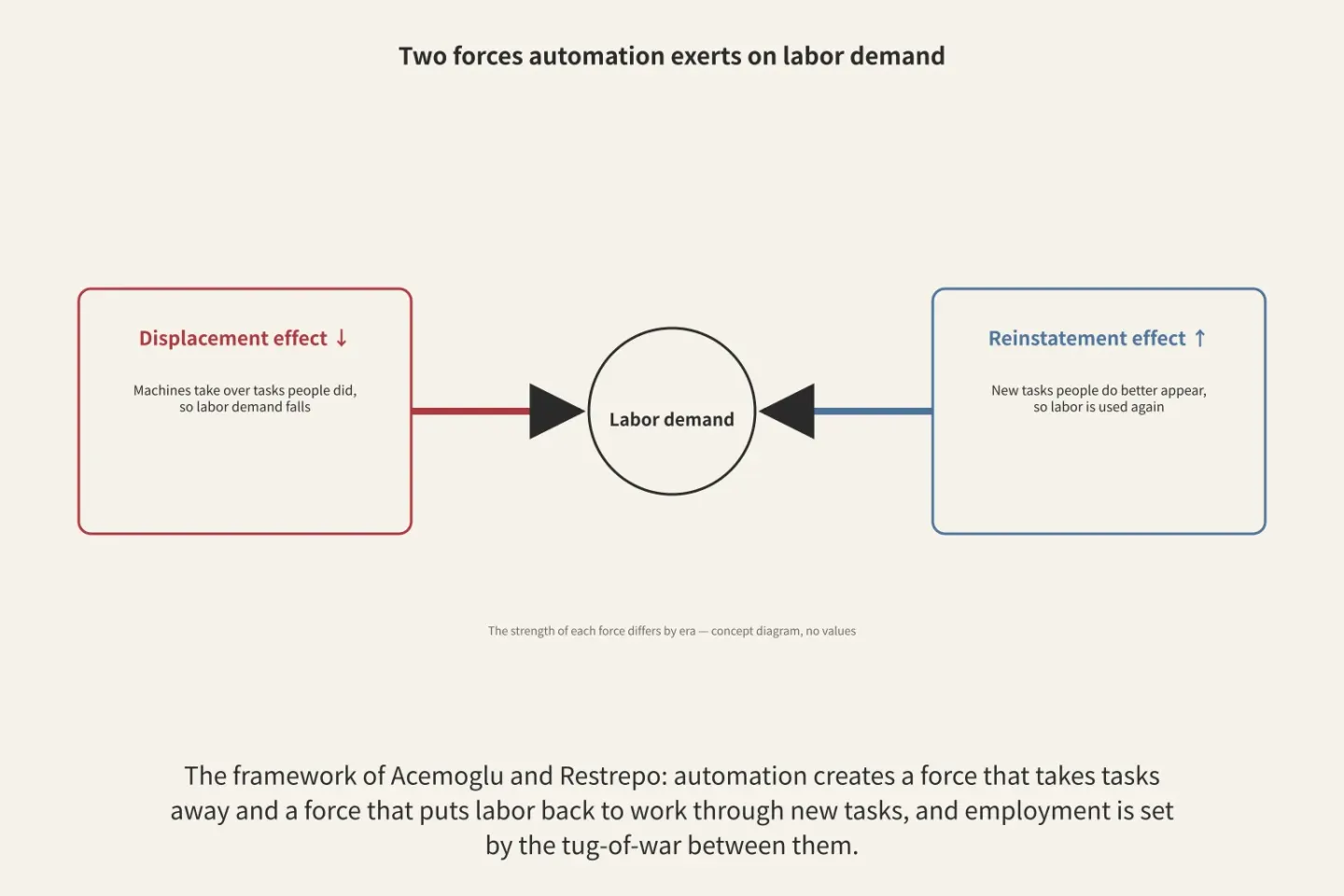
Figure: A diagram drawn by Paperis based solely on the text
Whether new tasks actually emerge can be counted through job titles. Economist David Autor and colleagues gathered 80 years of new job titles and linked them to U.S. Census data and patents. Today, the majority of employment is in job categories that emerged as new after 1940. The fields where new jobs emerged shifted from middle-wage production and clerical jobs between 1940 and 1980, to high-wage professional jobs and subsequently low-wage service jobs after 1980 (DOI: 10.1093/qje/qjae008).
The same study also looked at where new jobs come from. New jobs emerged in response to innovations that complement the output of those occupations and to rising demand, while innovations that automate tasks slowed the appearance of new jobs. The authors' conclusion is as follows. Over the past 40 years, the labor demand-reducing effect of automation innovations has grown stronger, while the labor demand-increasing effect of complementary innovations has not (DOI: 10.1093/qje/qjae008).
That new jobs emerge is a fact confirmed by history, but there is no guarantee that their speed will automatically catch up with the speed of displacement. The outcome of automation is determined by a tug-of-war between two forces, and recent decades in the U.S. have been a period where the displacement side grew stronger and the reinstatement side failed to keep up.
Results Measured by Robots
Industrial robots are a technology that can actually measure the combined result of two forces. Because industries adopt robots to varying degrees, regions where those industries are heavily clustered encounter more robots. Acemoglu and Restrepo compared U.S. local labor markets using this difference. Since 1990, regions that encountered the most robots had shown no different trends prior to that, and for every additional robot per 1,000 workers, the employment-to-population ratio dropped by 0.2 percentage points and wages fell by 0.42% (DOI: 10.1086/705716).
The results for Germany were different. In a Federal Reserve Bank of Minneapolis working paper looking at German administrative data from 1994 to 2014, total employment in regions clustered with industries that use robots heavily did not change because of robots. As manufacturing jobs decreased, business service jobs increased (DOI: 10.21034/iwp.13). The version published in an academic journal by the same research team notes that the share pushed out of manufacturing was completely offset by new jobs in the service sector (DOI: 10.1093/jeea/jvab012).
If you picture German industrial regions that encountered many robots based solely on the results of these studies, it looks like this. Manufacturing workers already working in those regions did not see an increased risk of losing their jobs, and the reduction in manufacturing jobs came entirely from hiring fewer young people just entering the labor market (DOI: 10.21034/iwp.13). Existing workers instead stayed more stably at the same companies, and this came from workers taking on new tasks at the factories where they originally worked (DOI: 10.1093/jeea/jvab012). Many workers adapted by changing occupations at their original workplaces (DOI: 10.21034/iwp.13). Young people also changed their career paths, choosing college instead of vocational training, and people doing jobs that complement robots, such as managers or technical scientists, benefited (DOI: 10.1093/jeea/jvab012). In the same regions, labor productivity rose and labor's share of income fell (DOI: 10.21034/iwp.13).
In a study comparing 8 European countries, the results varied. Robots generally reduced manufacturing employment, but the places where local labor market employment decreased with statistical clarity were Italy, Norway, and the UK, while there was no statistically clear impact in Germany, Sweden, Denmark, Finland, and Spain. The authors examine investments in complementary technologies that create jobs and the return of production that had previously left overseas thanks to robots as explanations for the difference, and find that both are supported to some extent (DOI: 10.1093/icc/dtae012).
Even within the U.S., the direction changed depending on the time period. In a study dividing the years 2005 to 2016 into 5-year blocks, robot exposure reduced employment in the earlier period and increased employment in the later period. Regional wages also fell at first, gradually recovered, and recently rose. Driving this change was the automotive industry, where digitalization and automation not only increased labor productivity but also created new tasks (DOI: 10.1177/00197939221137822).
The exact same robots reduced jobs in some countries and time periods while increasing them in others. And in Germany, the decline in manufacturing jobs came entirely from reduced new hiring, while the risk of unemployment for existing workers did not increase. The burden fell primarily on young people about to start working.
When Generative AI Enters the Workplace — Customer Service and Writing Experiments
The productivity effects of generative AI could be measured in individual workplaces. In a field setting where a generative AI-based conversational assistant tool was introduced with staggered timing to 5,172 customer support agents, the number of issues resolved per hour by agents who started using the tool increased by an average of 15%. The effects varied greatly from person to person. Less experienced and lower-skilled agents improved in both speed and quality, while the most experienced and skilled agents gained a little speed and dropped a little in quality. The tool helped agents learn, customers became more polite, and requests to speak with a manager also decreased (DOI: 10.1093/qje/qjae044).

Illustration: Paperis
Controlled experiments point in the same direction. In an online experiment with a pre-registered analysis plan, 453 college-educated professionals were given writing tasks tailored to their respective occupations, and randomly half of them were allowed to use ChatGPT. The time taken decreased by an average of 40%, the quality of the outputs increased by 18%, and the gap between people also narrowed. People who tried ChatGPT were 2 times as likely to report using it in actual work 2 weeks after the experiment, and 1.6 times as likely 2 months later (DOI: 10.1126/science.adh2586).
In the customer service setting, the less experienced gained the most, and in the writing experiment, the gap between people narrowed. The scope is narrow. The former is a single customer service setting and the latter is an experimental writing task, and both only measured productivity rather than employment. If the same work is done faster, companies might hire fewer people or assign them more work, but which way it goes is not answered by these studies.
Buying and Selling Work by the Task — Where Replacement Has Been Caught
Evidence on the reduced side came out clearly in markets where work is bought and sold task by task. In a study of freelancers on a major online platform, freelancers in occupations heavily affected after ChatGPT and the image generation AIs DALL-E 2 and Midjourney appeared saw both task volume and earnings drop. It was similar when other image generation models came out. Evidence that a good past track record lessened the damage did not appear, and there was even suggestive evidence that top-tier freelancers were affected more heavily. The authors view that generative AI can change the role human skill plays within organizations and reduce overall labor demand (DOI: 10.1287/orsc.2023.18441).
The same trend appears in the way companies spend money. In a working paper (arXiv) looking at payment data from a large U.S. expense management platform from the third quarter of 2021 to the third quarter of 2025, companies that used online labor markets like Upwork and Fiverr heavily before ChatGPT adopted AI earlier and more, and simultaneously reduced outsourced labor spending. For the most exposed companies, when outsourced labor spending dropped by 1 dollar, AI spending increased by about 0.03 dollars. The authors interpret this to mean that costs dropped by orders of magnitude as tasks bought through outsourcing were replaced with AI services. The effects differed by company and appeared gradually. The authors present this as the first direct micro evidence that generative AI is partially replacing human labor in production (arXiv:2602.00139).
The decrease in freelancer platforms is real, but it is a result measured in outsourced tasks bought and sold task by task and is not the same as the result for jobs across the entire company. Scope comes attached as well. The freelancer study is immediately after the launch of a single platform, and the company spending study is the outsourced spending of companies captured on a single payment platform. The places where replacement has been clearly caught so far are tasks bought one by one without an employment contract.
Denmark — Fast Currents, Calm Surface
Economists Anders Humlum and Emilie Vestergaard linked a large-scale AI adoption survey to Denmark's administrative labor market records. The title of the working paper is "Calm Surface, Fast Currents". The currents were as follows: most employers in jobs with high AI exposure pushed for chatbot adoption, workers reported improved productivity, and new tasks related to AI were widespread (DOI: 10.3386/w33777).
The method used to measure the surface is difference-in-differences. Difference-in-differences is a method that compares how much a group that experienced a change and a group that did not each changed before and after, reading the difference between those changes as the effect of the change. The results showed that the effects on earnings and recorded working hours were close to zero at both the worker level and the establishment level, and because the estimates were precise, effects larger than 2% were ruled out up to two years after the launch of ChatGPT (DOI: 10.3386/w33777, working paper).
What moved was the fabric of work. Employers reallocated tasks to accommodate AI, and within that were new tasks like content generation, AI supervision, and AI integration. Workers who adopted AI moved into higher-paying jobs where AI is used more, but not by enough to move average earnings. The authors' conclusion is that technological change alters work long before it shows up in earnings or working hours (DOI: 10.3386/w33777).
Denmark's zero means "there was no effect greater than 2% during the two years after launch," and does not mean there will be none in the future. One country, one type of tool called chatbots, and a two-year period are the boundaries of that number. The authors themselves wrote that the structure of work is already moving.
Signs of reorganization are also visible in US job postings. According to a 2026 working paper from the Federal Reserve Bank of Cleveland in the US, the proportion of US job postings mentioning AI increased significantly from early 2024, and that increase was concentrated in jobs with high exposure to large language models. In highly exposed jobs, job postings that had been relatively declining stabilized, the wages listed in postings rose, and both hiring and turnover increased. The actual wages of newly hired people rose while the wages of continuing workers fell, and the authors suggest this may be because the labor market for those jobs became less tight (DOI: 10.26509/frbc-wp-202624).
If the burden from robots fell mostly on young people just entering the workforce, we need to look at entry-level positions for generative AI as well. The evidence for that is still thin. A working paper (arXiv) that broke down US national job postings into task units and measured AI exposure suggests that 52% of the overall reduction in exposure came from companies changing the types of jobs they recruit for, and 39.5% came from reorganizing tasks within jobs. Senior positions adjusted earlier, mostly by changing the roles they recruit for, while entry-level positions adjusted in a broader way mixing both methods (DOI: 10.48550/arxiv.2605.23159). The fact that entry-level positions are shifting to different paths is as far as this manuscript shows, and it does not answer how much entry-level hiring has decreased.
From Exposure to Job Loss — What Has Been Verified at Each Step
Let us follow the question in the title—namely, how "exposure" leads to "job loss"—step by step using only the results we have seen so far. We place side by side what different studies have verified at each step. These studies did not verify the connection that one step caused the next.
The first step is exposure. Roughly 15% of tasks performed by American workers can be done at the same quality much faster by large language models alone, and 47% to 56% if tools are included (arXiv:2303.10130). Up to this point, these are numbers of possibility.
The second step is adoption. In Denmark, most employers in highly exposed occupations pushed for the adoption of chatbots (DOI: 10.3386/w33777). In experiments, people who tried ChatGPT were more likely to report using it in their actual work 2 weeks and 2 months later (DOI: 10.1126/science.adh2586). Adoption has already spread widely in highly exposed occupations in Denmark.
The third step is task productivity. A customer support setting showed a 15% increase in cases resolved per hour, and a writing experiment showed a 40% reduction in time, with less experienced people gaining the most in the customer support setting (DOI: 10.1093/qje/qjae044; DOI: 10.1126/science.adh2586).
The fourth step is whether employers hire fewer people. The place where this step is clearly verified for generative AI is the task-based freelancing market (DOI: 10.1287/orsc.2023.18441; arXiv:2602.00139). Regarding jobs inside companies, the Danish study measured earnings and working hours rather than hiring itself, and there was no effect exceeding 2% over 2 years (DOI: 10.3386/w33777). In the history of robots, this step appeared in local U.S. labor markets after 1990, and in Germany it appeared in the form of reduced hiring (DOI: 10.1086/705716; DOI: 10.21034/iwp.13). Even in the U.S., the direction changed depending on the period between 2005 and 2016 (DOI: 10.1177/00197939221137822).
The fifth step is new tasks. In Denmark, tasks like AI supervision and AI integration have already emerged (DOI: 10.3386/w33777), and across 80 years of data, the majority of today's employment is in job fields created since 1940 (DOI: 10.1093/qje/qjae008). The experience of the past 40 years does not guarantee how much this step will make up for the fourth step.
In the research seen so far, generative AI is clearly observed at the stages of adoption and task productivity, while the stage of hiring fewer people is clear only in the task-based freelancing market. If one jumps across all five steps using a single exposure score to talk about "job loss," everything still being measured in between is left out.
Raising It Across the Economy — and What We Still Don't Know
How much is the productivity gain of individual workplaces when added up across the entire economy? Acemoglu's 2024 study (released first by the NBER and later published in the academic journal Economic Policy) estimates the effect of task-level cost savings on the broader economy by the share of tasks affected and the average cost savings of those tasks. Total factor productivity is the share of output that grows without putting in more labor and capital, acting as the overall economy's skill at producing more with the same inputs. Incorporating existing exposure estimates and task-level productivity estimates, the total factor productivity increase over the next 10 years will not exceed 0.66% (DOI: 10.3386/w32487).
The author suggests that even this number may be an overestimate. This is because initial evidence came from easy-to-learn tasks, while some future effects will come from difficult tasks where judgment depends on context and there is no objective standard to measure correct answers. Therefore, the 10-year projection drops further to below 0.53%. Regarding distribution, the study predicts that while AI is unlikely to increase inequality as much as past automation technologies, there is no evidence it will reduce labor income inequality either, and it will widen the gap between capital income and labor income. Theoretically, even if AI raises the productivity of low-skilled workers in certain tasks, inequality could actually worsen if it does not create new tasks for them, and some of the new tasks created by AI may have negative social value, such as designing algorithms for online manipulation (DOI: 10.3386/w32487). The author's own evaluation is "not trivial, but not huge."
What statistics are slow to capture is also an open question. A 2026 working paper (arXiv) argues that technological change affects labor demand through two channels—adjustments within existing jobs and the creation of new jobs—with payroll statistics capturing the former right away and the latter with a delay. In the computer age, companies founded after 1978 accounted for 42% of 1998 payrolls, and in industries most exposed to automation, the shrinkage of existing firms appeared before the growth of new firms, with the authors noting that this sequence was pronounced early in the period and suggestive toward the end. In U.S. establishment job flows through the first quarter of 2026, differences driven by language model exposure were not visible on either side, with the authors noting that this result matches what their model predicts while also being indistinguishable from there being no effect at all. The authors also cite results from other studies using exposure to startup tasks showing that new business formation increased by 10 to 20%. The authors' conclusion is that statistics recording new jobs with a delay make substitution appear inflated for several years (DOI: 10.48550/arxiv.2611.17530).
Who benefits is also unsettled. A study measuring two centuries of technology exposure reports that 20th-century technological progress steadily increased demand for occupations with high education levels, high wages, and a high proportion of women. The same study's adjusted model predicts that in a medium-term scenario, AI will reverse this trend, favoring occupations with low education levels, low wages, and a high proportion of men (DOI: 10.1353/eca.2025.a994512). The study in the first section estimated that higher-income jobs have greater exposure, while the OECD viewed the risk of automation as concentrated among lower-educated people. This is a place where answers diverge depending on the technology and methods being measured.
To sum up, there are four things we still do not know. They are whether Denmark's zero will hold up two years from now, whether entry-level positions are shrinking, when new jobs will show up in statistics, and whether the increased share of production will go to labor or capital.
The results measured so far support neither "jobs have disappeared en masse" nor "nothing will happen in the future." The content of work is already changing, and when and how much that change will reach employment and income is still being measured. The number "80% are in the affected zone" is the number that measured that first step, namely which tasks AI touches.
Source Papers
- "GPTs are GPTs: An Early Look at the Labor Market Impact Potential of Large Language Models" (2023) — arXiv:2303.10130 — Roughly 80% of U.S. workers could have at least 10% of their tasks affected, and about 19% could have 50% or more affected. 15% of tasks (47 to 56% including software) could be done much faster at the same quality. LLMs show characteristics of a general-purpose technology with significant economic, social, and policy implications, though the timing of development and adoption is not predicted (citing arXiv version, later published in Science 2024).
- "The Risk of Automation for Jobs in OECD Countries: A Comparative Analysis" (2016) — DOI: 10.1787/5jlz9h56dvq7-en — (OECD Working Paper) An occupation-level approach may overestimate automation potential. On a task level, the average across 21 countries is 9%, with South Korea at 6% and Austria at 12%.
- "What happened to jobs at high risk of automation?" (2021) — DOI: 10.1787/10bc97f4-en — (OECD Working Paper) There is no evidence of a net decrease at the country level across 21 countries; employment growth in high-risk jobs was 6% versus 18% in low-risk jobs. Education level concentration is evident, with future risks concentrated among the less educated.
- "Rethinking Automation Risk: AI Applicability and Occupational Outcomes, 2019–24" (2026) — DOI: 10.21033/wp-2026-12 — Even occupations with high AI applicability show employment and wage growth, computerization high- and medium-risk occupations show weaker employment, and wages rise across all groups. Exposure is a signal of reorganization (Chicago Fed Working Paper).
- "AI exposure predicts unemployment risk" (2023) — arXiv:2308.02624 — In state unemployment insurance data from 2010 to 2020, individual AI exposure scores do not predict unemployment, but ensembles have predictive power (preprint).
- "Automation and New Tasks: How Technology Displaces and Reinstates Labor" (2019) — DOI: 10.1257/jep.33.2.3 — The displacement effect always reduces labor's share while the reinstatement effect of new tasks increases it. Slow U.S. employment growth over 30 years is explained by accelerated displacement, weakened reinstatement, and slowed productivity.
- "Artificial Intelligence, Automation and Work" (2018) — DOI: 10.3386/w24196 — Counterbalancing forces of productivity effects, capital accumulation, and machine improvements are incomplete, with the strongest counterbalancing force being new labor-intensive tasks. Skill mismatches and potential excessive automation are noted (NBER Working Paper).
- "New Frontiers: The Origins and Content of New Work, 1940–2018" (2024) — DOI: 10.1093/qje/qjae008 — Over half of current employment stems from jobs created since 1940. Complementary innovations increase demand while automation innovations decrease it, and over the past 40 years, automation's erosion of demand has grown stronger while complementary effects have not.
- "Robots and Jobs: Evidence from US Labor Markets" (2019) — DOI: 10.1086/705716 — 1 robot per 1,000 workers leads to a 0.2 percentage point drop in the employment-to-population ratio and a 0.42% drop in wages, with no pre-trends prior to 1990.
- "Adjusting to Robots: Worker-Level Evidence" (2018) — DOI: 10.21034/iwp.13 — In Germany from 1994 to 2014, there is no total local employment effect, as business services offset manufacturing declines. Existing workers face no increased risk, and the decline stems solely from reduced hiring of new entrants. Labor productivity increases while labor share decreases (Minneapolis Fed Working Paper).
- "The Adjustment of Labor Markets to Robots" (2021) — DOI: 10.1093/jeea/jvab012 — Manufacturing displacement in Germany is fully offset by new service-sector jobs. The burden falls on young workers just entering the labor market, who shift from vocational training to university, while complementary occupations benefit.
- "Robots and reshoring: a comparative study of automation, trade, and employment in Europe" (2024) — DOI: 10.1093/icc/dtae012 — Across 8 European countries: Italy, Norway, and the UK show employment declines, while Germany, Sweden, Denmark, Finland, and Spain show no significant effects. Complementary technology investments and reshoring partly explain this.
- "The Evolving Impact of Robots on Jobs" (2022) — DOI: 10.1177/00197939221137822 — U.S. robot exposure from 2005 to 2016 led to employment declines in the earlier period and increases in the later period, driven by the automotive industry and the creation of new tasks.
- "Generative AI at Work" (2024) — DOI: 10.1093/qje/qjae044 — Among 5,172 customer support agents, resolved issues per hour increased by an average of 15%. Less experienced agents improved in both speed and quality, while top-skilled agents showed a small increase in speed and a small decrease in quality.
- "Experimental evidence on the productivity effects of generative artificial intelligence" (2023) — DOI: 10.1126/science.adh2586 — Pre-registered experiment with 453 college-educated professionals. Time decreased by 40%, quality increased by 18%, and performance gaps between individuals narrowed.
- "The Short-Term Effects of Generative Artificial Intelligence on Employment: Evidence from an Online Labor Market" (2024) — DOI: 10.1287/orsc.2023.18441 — On a large platform, freelancers in heavily affected occupations saw drops in workload and earnings, with suggestive evidence that past performance does not buffer the shock and that top performers are affected more.
- "Payrolls to Prompts: Firm-Level Evidence on the Substitution of Labor for AI" (2026) — arXiv:2602.00139 — Using firm payment data from Q3 2021 to Q3 2025, every $1 decrease in online labor spending corresponds to about a $0.03 increase in AI spending, providing micro-level evidence of partial substitution (preprint).
- "Still Waters, Rapid Currents: Early Labor Market Transformation under Generative AI" (2025) — DOI: 10.3386/w33777 — Danish survey and administrative data show that while adoption is broad and new tasks have spread, the effects on earnings and work hours are precisely zero (ruling out effects greater than 2% two years after ChatGPT), with task reorganization happening first (Working Paper).
- "The Recent Evolution of AI-Related Labor Demand" (2026) — DOI: 10.26509/frbc-wp-202624 — U.S. job postings mentioning AI increased from early 2024, showing stable postings, wage growth, increased hiring and turnover in exposed occupations, and wage declines for incumbent workers (Cleveland Fed Working Paper).
- "Generative AI and the Reorganization of Labor Demand" (2026) — DOI: 10.48550/arxiv.2605.23159 — 52% of the drop in U.S. job postings exposure is due to hiring reallocation and 39.5% to within-job redesign, with senior roles facing reallocation first and entry-level roles experiencing a broader mix (preprint).
- "The Simple Macroeconomics of AI" (2024) — DOI: 10.3386/w32487 — Predicts a total factor productivity increase of 0.66% or less over 10 years, or below 0.53% when accounting for difficult tasks, along with an expanding capital-labor income gap. Productivity gains among low-skilled workers could also widen inequality, and some new tasks may have negative social value (citing NBER version, later published in Economic Policy).
- "AI and the Two Margins of Work: Why Job Losses Show Up Before Job Creation" (2026) — DOI: 10.48550/arxiv.2611.17530 — Payroll statistics immediately record the scaling down of existing work while recording new work with a delay, showing no differences due to language model exposure through Q1 2026, and statistics that capture new work late exaggerate substitution (preprint).
- "Technology and Labor Markets: Past, Present, and Future; Evidence from Two Centuries of Innovation" (2025) — DOI: 10.1353/eca.2025.a994512 — 20th-century technology increased demand for high-education, high-wage jobs with high proportions of women, while correction models predict AI will reverse this trend.
Sources (23)
- GPTs are GPTs: An Early Look at the Labor Market Impact Potential of Large Language ModelsarXiv:2303.10130
- The Risk of Automation for Jobs in OECD Countries: A Comparative AnalysisDOI 10.1787/5jlz9h56dvq7-en
- What happened to jobs at high risk of automation?DOI 10.1787/10bc97f4-en
- Rethinking Automation Risk: AI Applicability and Occupational Outcomes, 2019–24DOI 10.21033/wp-2026-12
- AI exposure predicts unemployment riskarXiv:2308.02624
- Automation and New Tasks: How Technology Displaces and Reinstates LaborDOI 10.1257/jep.33.2.3
- Artificial Intelligence, Automation and WorkDOI 10.3386/w24196
- New Frontiers: The Origins and Content of New Work, 1940–2018DOI 10.1093/qje/qjae008
- Robots and Jobs: Evidence from US Labor MarketsDOI 10.1086/705716
- Adjusting to Robots: Worker-Level EvidenceDOI 10.21034/iwp.13
- The Adjustment of Labor Markets to RobotsDOI 10.1093/jeea/jvab012
- Robots and reshoring: a comparative study of automation, trade, and employment in EuropeDOI 10.1093/icc/dtae012
- The Evolving Impact of Robots on JobsDOI 10.1177/00197939221137822
- Generative AI at WorkDOI 10.1093/qje/qjae044
- Experimental evidence on the productivity effects of generative artificial intelligenceDOI 10.1126/science.adh2586
- The Short-Term Effects of Generative Artificial Intelligence on Employment: Evidence from an Online Labor MarketDOI 10.1287/orsc.2023.18441
- Payrolls to Prompts: Firm-Level Evidence on the Substitution of Labor for AIarXiv:2602.00139
- Still Waters, Rapid Currents: Early Labor Market Transformation under Generative AIDOI 10.3386/w33777
- The Recent Evolution of AI-Related Labor DemandDOI 10.26509/frbc-wp-202624
- Generative AI and the Reorganization of Labor DemandDOI 10.48550/arxiv.2605.23159
- The Simple Macroeconomics of AIDOI 10.3386/w32487
- AI and the Two Margins of Work: Why Job Losses Show Up Before Job CreationDOI 10.48550/arxiv.2611.17530
- Technology and Labor Markets: Past, Present, and Future; Evidence from Two Centuries of InnovationDOI 10.1353/eca.2025.a994512