Paperis Articles
The Evidence for 92 Degrees — Was There Data Behind Coffee Brew Temperature?
The authors write that no data supporting the 92–96°C range required by the SCA handbook and machine certification were presented. In a UC Davis experiment that held brew strength and extraction fixed, 87, 90 and 93°C differed very little. We look at how far that result reaches.
Your field's papers, as audio
Pick your fields and journals — Paperis summarizes the key papers and turns them into audio. Listen on your commute.
Start Paperis free →The Evidence for 92 Degrees — Was There Data Behind Coffee Brew Temperature?
92 Degrees on the Water Thermometer
Coffee books and the Specialty Coffee Association (SCA) Coffee Brewing Handbook list water temperatures between 92 and 96 degrees. Letting boiled water cool for a moment or matching the markings on a temperature-control kettle often becomes the first step of pour-over. According to the authors, temperature is widely considered a core variable that dictates coffee quality (DOI: 10.1038/s41598-020-73341-4).
This range also appears as an official standard. The handbook notes that 92-96 degree water is necessary for proper extraction, and the SCA drip coffee maker certification criteria require bringing water to 92 degrees within one minute of starting extraction, never dropping below that until the end, and not exceeding 96 degrees. According to the authors, this standard had a major impact on the home brewer market (DOI: 10.1038/s41598-020-73341-4).
That leaves one question. Was there data supporting this range? A 2020 experiment from UC Davis published in Scientific Reports tackled this question directly (DOI: 10.1038/s41598-020-73341-4). This article follows that single paper. To state upfront, the conclusion is not "temperature does not matter." It is a conclusion with conditions attached, and those conditions make up half of this article.
When Asked for Evidence
According to the authors, the SCA handbook and various coffee books list 92 to 96 degrees as optimal, yet they do not present data supporting that range (DOI: 10.1038/s41598-020-73341-4). The abstract says the same thing. The point is that there is little evidence supporting a specific temperature range through rigorous sensory evaluation or consumer preference surveys.
Saying there is no evidence is not the same as saying it is wrong. 92 to 96 degrees might actually be optimal. Because it has not been verified, an experiment was needed to check.
There is one trap in temperature experiments. According to the authors, it is accepted that temperature affects solubility and extraction speed. Changing the temperature can also change the amount of components that come out, so when the taste changes, it is impossible to tell whether it is due to the temperature or the amount of extracted components. Therefore, two scales for measuring taste are needed first.
Concentration is the mass ratio of the components dissolved in a cup of coffee liquid. Extraction yield is the percentage of soluble components initially in the coffee grounds that have been extracted into the water. The two values are connected to each other through the mass ratio of water to coffee grounds (DOI: 10.1038/s41598-020-73341-4). Concentration tells you how strong a cup of coffee is, while extraction yield tells you how much was extracted from the grounds.
These two scales were drawn into a single chart in 1957 by Lockhart in the "Coffee Brewing Control Chart". This chart is still used as educational material in the coffee industry, and the middle zone (concentration of 1.15 to 1.35%, extraction yield of 18 to 22%) is the SCA's "Golden Cup" standard (DOI: 10.1038/s41598-020-73341-4). The authors pointed out that this chart mixes the preference judgment of "ideal" with the scales. What matters in the chart are the two scales of concentration and extraction yield, and temperature is just one of several paths that reach those scales.
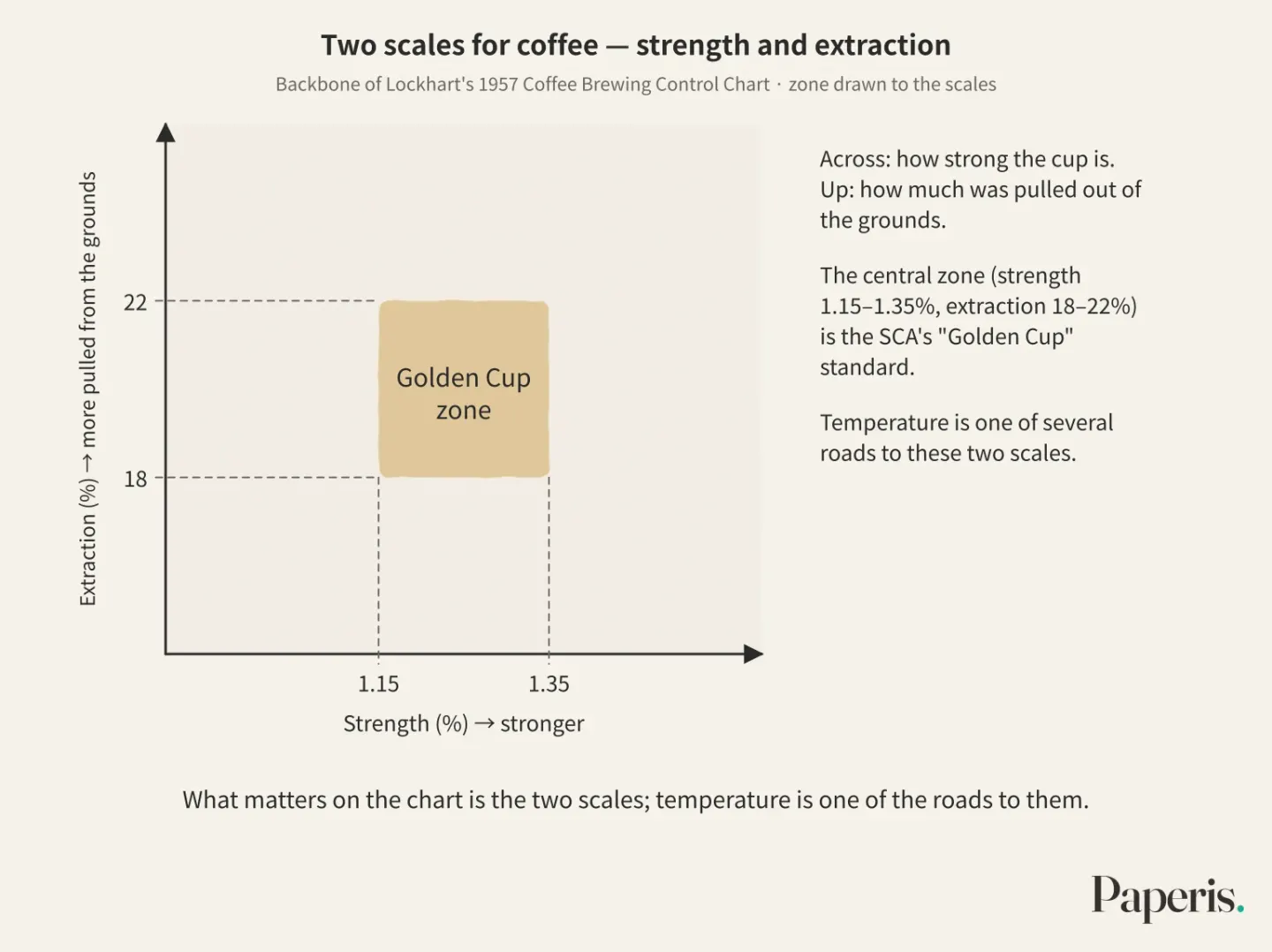
Figure: a diagram Paperis drew using only what the article says
The Experiment That Changes Only Temperature
Therefore, the experiment was designed in a direction that keeps the concentration and extraction yield the same even when the temperature changes (DOI: 10.1038/s41598-020-73341-4).
- Coffee: Washed Arabica from Marcala, Honduras. Beans of mixed varieties were roasted in 29-kilogram batches on the same day several times and blended together.
- Machine: A single commercial drip brewer model (Curtis G4, flat-bottomed basket). It was chosen because temperature and water flow could be programmed.
- Temperature: 87 degrees, 90 degrees, 93 degrees.
- Targets: 9 combinations of three concentration levels (1.0%, 1.25%, 1.5%) and three extraction yield levels (the original text describes the lower side as 16% and the higher side as 20–24%, with detailed values in the supplementary table). Multiplying by the three temperatures makes 27 coffees.
- Number of runs: A total of 270 extractions were used for taste evaluation.
The key is the method used to match them. The authors consider that temperature affects solubility and extraction speed. Therefore, they adjusted the grind size, the water-to-coffee ratio, and the water delivery speed at each temperature to reach the target concentration and extraction yield. The grind size had three levels with average particle sizes of 770 micrometers (fine), 928 (medium), and 1115 (coarse), and the water delivery speed was controlled by the ratio of turning the water on and off (duty cycle). Which settings were used at which temperature are all in the supplementary data tables of the paper (DOI: 10.1038/s41598-020-73341-4).
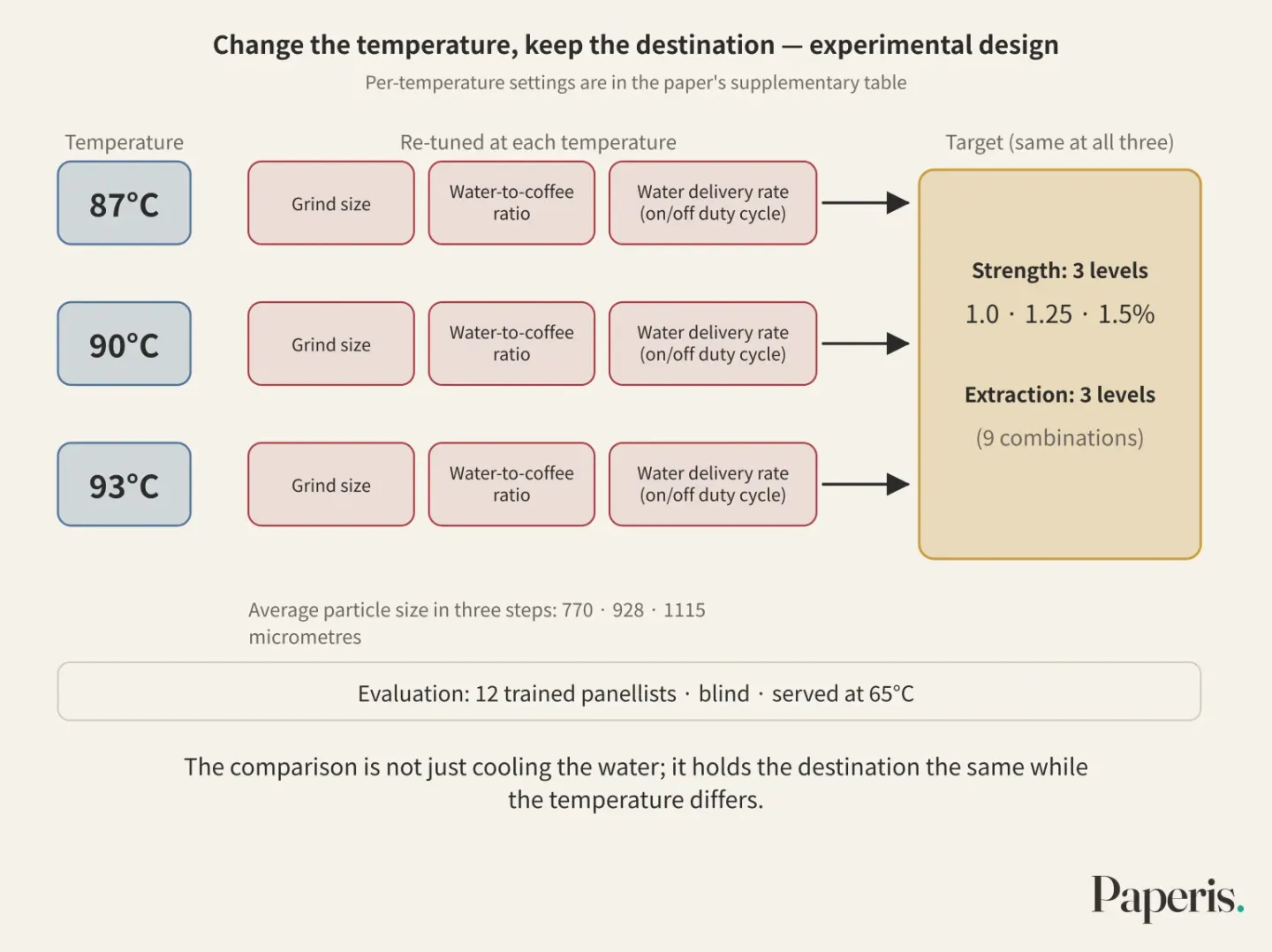
Figure: a diagram Paperis drew using only what the article says
In other words, the temperature comparison in this experiment is not a comparison of "just cooling the water," but a comparison of "reaching the same destination even though the temperatures were different." This point is most important when discussing practical applications later.
The evaluation was conducted by 12 trained panelists. There were 4 men and 8 women aged 19 to 30, and they trained 3 times a week for 4 weeks. 31 taste attributes were scored from 0 to 100 points, and the same samples were tasted three times across 14 sessions without knowing which coffee it was. All coffees were served adjusted to 65 degrees (DOI: 10.1038/s41598-020-73341-4).
Results: The temperature barely moved
The results are summarized in two sentences. Concentration and extraction yield sharply divided the taste, while temperature barely divided it. According to the authors, in a multivariate analysis looking at multiple properties all at once, concentration, extraction yield, and the interaction between the two were significant, but temperature was not (DOI: 10.1038/s41598-020-73341-4). Even in the analysis looking at properties one by one, out of 31 properties, only one—nutty aroma—changed significantly depending on temperature, and that difference averaged 1 point out of 100. The authors wrote that even this single instance might be a result that appeared by chance (Type I error) and needs further verification (DOI: 10.1038/s41598-020-73341-4).
Temperature is not entirely missing. Three interactions involving temperature were significant. Brown spice aroma came from the interaction between temperature and concentration, while earthy aroma and fermented aroma came from the three-way interaction of temperature, concentration, and extraction yield. The size of the difference in each case was less than 5 points out of 100. These three instances were significant only in the analysis looking at properties one by one and were not significant in the multivariate analysis (DOI: 10.1038/s41598-020-73341-4).
Then what divided the taste? The biggest factor was concentration. In a principal component analysis that summarized the significant properties all at once, the first axis explained 72.2% of the total difference, and this axis was divided by concentration (DOI: 10.1038/s41598-020-73341-4). Because the direction of movement differs for each property, they must be looked at one by one.
- Bitterness, astringency, and heavy body grew stronger as the concentration increased. These properties showed a significant difference only in concentration alone, and in the principal component analysis, bitterness also trended toward increasing in the direction of higher extraction yield (DOI: 10.1038/s41598-020-73341-4).
- Acidity responded to both concentration and extraction yield. It was strongest in coffee with high concentration and low extraction yield, and weakest in coffee with low concentration and high extraction yield. Among all measured properties, its range of change was the largest, with an average difference of 20 points between the two extremes (DOI: 10.1038/s41598-020-73341-4). The authors conjecture that this may be because organic acids are components that dissolve out quickly.
- In the principal component analysis, fruity aroma, nutty aroma, and black tea aroma conversely trended toward increasing in the direction of lower concentration. Black tea aroma is a property that responded significantly only to extraction yield in the analysis looking at properties one by one (DOI: 10.1038/s41598-020-73341-4).
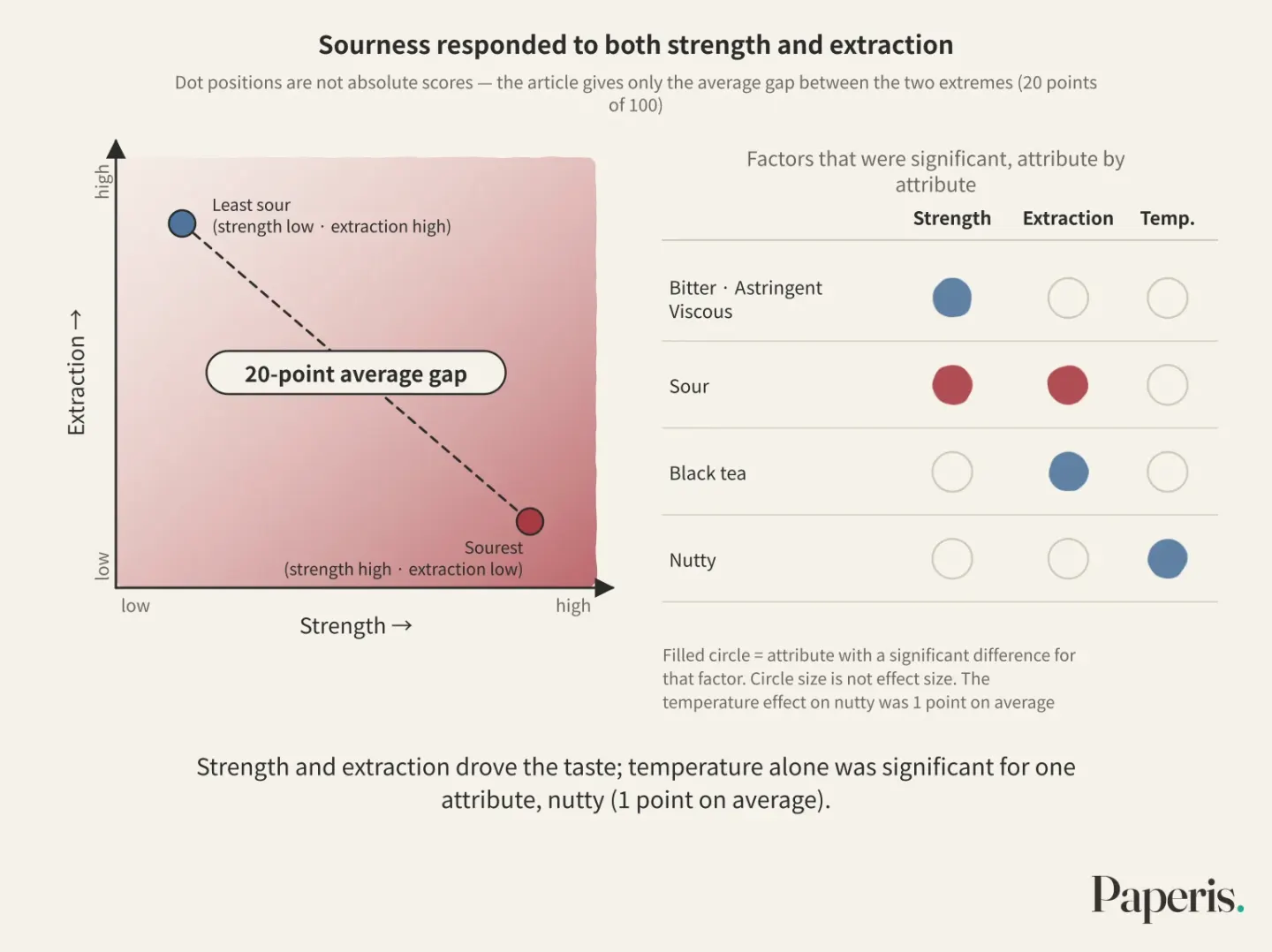
Figure: a diagram Paperis drew using only what the article says
There are also previous studies in the same direction. A previous study by the same authors, cited in this paper, divided coffee into chronological fractions and compared the tastes: bitterness, acidity, and smokiness increased with concentration, while sweetness, fruit, and floral aromas moved inversely to concentration. Research by Frost et al., which looked at concentration and extraction yield across three roast levels, also reported a similar general trend where higher concentration meant more bitterness and acidity, and lower concentration meant more sweetness (Research cited in this paper, DOI: 10.1038/s41598-020-73341-4).
There are also older studies in the opposite direction. The paper introduces research showing that in coffee brewed with distilled water at 65, 80, 90, and 100 degrees, bitterness and acidity generally increased as the temperature rose. However, there is no explanation in the paper that this was a design that separately controlled concentration and extraction yield (Research cited in this paper, DOI: 10.1038/s41598-020-73341-4). What this experiment showed is up to the point that "when concentration and extraction yield are matched to be the same, there was almost no effect of temperature within the 87–93 degree range."
What This Result Does Not Say
We must point out the limitations first. This is because the conclusions are conditional.
- It is one type of coffee and one type of roast. A single Honduras washed coffee was roasted with a total roast time of 11 minutes and 29 seconds and a development time of 2 minutes and 30 seconds. If the origin, processing method, and roast degree differ, there is no guarantee it will be the same (DOI: 10.1038/s41598-020-73341-4).
- It is one commercial brewer model. It brewed an average of about 2.8 kilograms at a time and used a flat-bottomed basket. Both the scale and structure are different from hand-pouring one or two cups of drip coffee. The authors wrote that these results could serve as a reference for hand brewers, but the basis for this is the hypothesis that the relationship between concentration, extraction yield, and taste will be similar across all drip methods. This does not mean that the lack of effect of temperature holds true for hand pour-over as well (DOI: 10.1038/s41598-020-73341-4).
- The range is 87 to 93 degrees. Below 87 degrees and above 93 degrees were not tested, and 94 to 96 degrees, which is the upper part of the SCA range, also falls into this.
- The panel consists of 12 people and used descriptive analysis. Trained individuals scored the intensity of attributes. This was not a preference survey asking which coffee tastes better (DOI: 10.1038/s41598-020-73341-4).
- Serving started about 30 minutes after extraction and lasted for up to 45 minutes. The samples were kept in an insulated container. The authors noted the possibility that the taste changed during that time as a limitation, and stated that they do not know of any data addressing taste changes in coffee left in an insulated container for 30 minutes (DOI: 10.1038/s41598-020-73341-4).
- The drinking temperature was fixed. All samples were served adjusted to 65 degrees, but the authors wrote that if coffees brewed at different temperatures are served and drunk at different temperatures, temperature could play a role in taste (DOI: 10.1038/s41598-020-73341-4).
- Cold brew and espresso are not covered. The authors guessed that espresso would be more sensitive to temperature because it is extracted very quickly at a much higher concentration, and wrote that comparing cold brew and hot extraction is left for follow-up research (DOI: 10.1038/s41598-020-73341-4).
How to Brew at Home
To apply these results to home drip brewing, the order matters. The conclusion is not simply to lower the temperature and leave everything else alone. Every time they changed the temperature in this experiment, they had to readjust the grind size, ratio, and pouring speed. Only after making those adjustments did the taste match. This study did not directly test whether lowering the water from 93 degrees to 87 degrees using the same grounds and recipe changes the extracted amount, so we cannot state it definitively. However, the fact that the authors had to reset the settings every time they changed the temperature points to that possibility.
At home, you cannot see the finish line directly. You need a refractometer to measure concentration. Scales, timers, and grind settings are merely tools to reproduce the path to the finish line. If coffee brewed with the same recipe tastes different, it is a signal that the finish line has changed, and based on the results of this experiment, there is little reason to put temperature at the front of the list of potential causes. Translating the previous results, if the bitterness has increased, there is a possibility the concentration has gone up, and if the sourness is sharp, the concentration is high or the extraction yield is low. However, this is an estimation overlaying laboratory results onto a home recipe, and it has not been confirmed in hand drip brewing.
There are two more points to note. First, the temperature in this paper is the brewer's set temperature. This paper does not tell us what the temperature of water straight out of the kettle becomes on top of the coffee grounds. Second, this experiment used specially formulated water. The results when brewing with tap water or bottled water were not tested.
As an aside, the authors wrote a prospect that heating water less can save energy. There is an estimate that a café's energy use accounts for roughly 45% of carbon emissions in the entire process of producing brewed coffee, and lowering the brew temperature could have a large effect (DOI: 10.1038/s41598-020-73341-4). This is the authors' outlook and not a result verified by this experiment.
If You Put Down the Thermometer
92 to 96 degrees Celsius is the range required by handbooks and machine certification standards, but in the data reviewed by the authors, no data supporting that range was presented. In experiments where strength and extraction yield were matched, 87 degrees, 90 degrees, and 93 degrees were almost indistinguishable, and the authors suggest this result implies certification requirements can focus more on flow rate control across a wide temperature range. The scope where this result applies is limited to a single type of coffee brewed with a commercial drip brewer by trained panelists, more evidence is needed to extend it to hand drips, and until then, the sentence below is a hypothesis.
Put down the thermometer, and if the taste changes, suspect the grind size and ratio first.
Source Papers
- "Brew temperature, at fixed brew strength and extraction, has little impact on the sensory profile of drip brew coffee" (2020) — DOI: 10.1038/s41598-020-73341-4 — Batali·Ristenpart·Guinard, Sci Rep 10:16450. The experimental design, numerical values, results, limitations, and SCA standard descriptions in the main text are based on this single paper (open-access full text).
- Author Correction (2021) — DOI: 10.1038/s41598-021-82505-9 — Sci Rep 11:2676. Only corrected a typographical error in the method water preparation unit. No impact on the numerical values or conclusions of the main text.
- For the Lockhart (1957) chart, the three-roast study by Frost et al., the time-fractionation study by the same authors, and the distilled water temperature comparison (Pangborn) study referred to as "research cited by this paper" in the main text, only the descriptions provided in the original paper were translated, and the original sources were not directly collected.
Sources (2)
- Brew temperature, at fixed brew strength and extraction, has little impact on the sensory profile of drip brew coffeeDOI 10.1038/s41598-020-73341-4
- Author Correction (2021) — Sci Rep 11:2676. 방법 절 물 조제 단위 오타만 수정. 본문 수치·결론에 영향 없음DOI 10.1038/s41598-021-82505-9