Paperis Articles
AI Reasoning Tests — What Were the Sudoku Scores Measuring?
CRAM, a learned version of Hopfield and Tank's 1980s energy, trained at least 1,000 times faster than looped models on hard Sudoku and mazes by the authors' own measurements, and on Sudoku it matched the looped models' best accuracy with at least 282 times less compute. Its learned weights spelled out the Sudoku rules, and a hand-set energy with a single value solved every test puzzle. The authors conclude that energies are promising, and caution against using such easily solved puzzles to test whether looped reasoning scales. It is a preprint not yet peer reviewed, and the authors expect this simple energy on its own would struggle with harder tasks such as ARC, which they did not test.
Your field's papers, as audio
Pick your fields and journals — Paperis summarizes the key papers and turns them into audio. Listen on your commute.
Start Paperis free →AI Reasoning Tests — What Were the Sudoku Scores Measuring?
Small Models Solving Sudoku
A paper published as a preprint in 2025 reported that a model with 27 million parameters achieved near-perfect performance on difficult Sudoku and finding the shortest path in large mazes after seeing only 1,000 training examples. Named the Hierarchical Reasoning Model (HRM), it has a structure where a slow part responsible for big-picture planning and a fast part responsible for detailed calculations send messages back and forth while repeating calculations (arXiv:2506.21734). Parameters are numbers inside a model determined through learning, and these numbers determine how the model calculates inputs to produce an answer. 27 million is a very small size compared to the large language models that power conversational AI.
The TRM (Tiny Recursive Model) released a few months later reduced this structure down to a single small two-layer neural network. The author of TRM reported that with 7 million parameters, it scored 45% on ARC-AGI-1 and 8% on ARC-AGI-2, which was higher than most large language models despite having less than 0.01% of the parameters (arXiv:2510.04871). ARC is a collection of abstract puzzles designed to be solved using only basic knowledge close to what humans are born with, created to measure the general problem-solving ability of machines (arXiv:1911.01547).
Both models belong to the same lineage. A recursive model is a model that produces an answer by repeatedly applying the same layer or group of layers multiple times. The success that small recursive models with millions of parameters achieved in Sudoku and mazes has become a major trend in handling reasoning (arXiv:2611.17309). The stages cited by this paper as examples of such success were Sudoku-Extreme, which collects difficult 9×9 Sudoku puzzles, and Maze-Unique, which finds the single unique path between two endpoints in a 30×30 maze. The maze first reported by HRM was Maze-Hard, a more difficult collection containing loops (arXiv:2611.17309). All three are benchmarks. A benchmark is a collection of test problems prepared so that multiple AI models can solve the same problems and compare scores, and it is usually public.
However, it was not clear why they solve them well (arXiv:2611.17309). One analysis dissecting HRM (a preprint) reported that HRM can fail even on easy puzzles with just one blank space, and can get stuck by "guessing" as its answer the first state that no longer changes even when calculations are repeated. Those authors wrote that HRM looked more like it was "guessing" rather than "reasoning," and reported that with a reinforcement that forces this "guess" to happen multiple times, they raised HRM's Sudoku-Extreme accuracy from 54.5% to 96.9% (arXiv:2601.10679). This means that while the score was high, what that score actually meant was open to question.
On November 12, 2026, researchers Benjamin Hoover, Hugh Blainey, and James Whittington from Prefrontal in London, UK, offered a different answer to these puzzles. An energy function is a function that assigns a single number to each possible answer, designed to give lower values to more desirable answers. The title is "Classical Energy Learns Reasoning 1,000 Times Faster Than Recurrent Models." A preprint is a research manuscript made public before undergoing peer review by fellow researchers. This paper is a preprint that came out a week ago, and all the figures below are values measured directly by the authors on these puzzles.
According to the authors' measurements, CRAM—which adapted the energy function hand-crafted by Hopfield and Tank in the 1980s so that it can learn—solved 99.996% of the Sudoku-Extreme test puzzles after learning for 42 milliseconds on a single GPU, and 100% of the Maze-Unique test mazes after learning for 132 milliseconds. The training time was at least 1,000 times shorter than that of recursive models, and it matched Sudoku-Extreme with the same accuracy as the recursive model at its most accurate while using at least 282 times fewer calculations (arXiv:2611.17309). The authors drew two conclusions from this result: that energy is very promising for the direction of learning reasoning from data, and a warning not to test whether recursive reasoning techniques can scale up to larger problems using benchmarks that are easily solved like Sudoku and mazes (arXiv:2611.17309).
The Valley of 1985
In 1985, American physicists John Hopfield and David Tank published a method for solving the traveling salesperson problem—the problem of finding the shortest path visiting multiple cities once each—using a neural network. They showed that if you rewrite the problem to be solved into the form of “finding the best value under constraints”, tightly interconnected units compute together to quickly produce a good answer (PMID 4027280). The strengths of the connections were set by hand (arXiv:2611.17309).
The foundation for this was the neural network Hopfield introduced in 1982 (PMID 6953413). A Hopfield network is a neural network with units connected to each other such that, even when only a portion of a memory is given, it fills in the rest to recover the whole. Hopfield was awarded the 2024 Nobel Prize in Physics along with Geoffrey Hinton.
The way this family of neural networks finds answers can be written as “lowering energy” (arXiv:2611.17309). If you picture the energy of each answer as the height of the ground, every possible answer is a point on the terrain, and better answers sit at lower elevations. If you release a ball, it rolls down and stops at the bottom of a valley. Every time the neural network repeats a calculation, the ball takes one step down. One step of repeated calculation corresponds to one step of lowering energy (arXiv:2611.17309).
Sudoku is a problem that fits this picture well. A constraint puzzle is a puzzle where the rules to follow are predetermined, and it is solved by finding an arrangement that satisfies all those rules at once. It was already known that puzzles made of constraints, like Sudoku, have an energy where reaching the very bottom solves the puzzle, and Hopfield later applied a hand-crafted energy to Sudoku as well (arXiv:2611.17309).
The method of packing Sudoku rules into energy is simple. The Sudoku energy hand-written in this paper assigns a penalty of a fixed size every time two cells located in the same row, same column, or same 3×3 box have the same number. There are no penalties for other pairs of cells (arXiv:2611.17309). Translated to terrain, a board where the same numbers overlap in the same line more often sits higher up, and a board that breaks not a single rule sits at the very lowest floor.
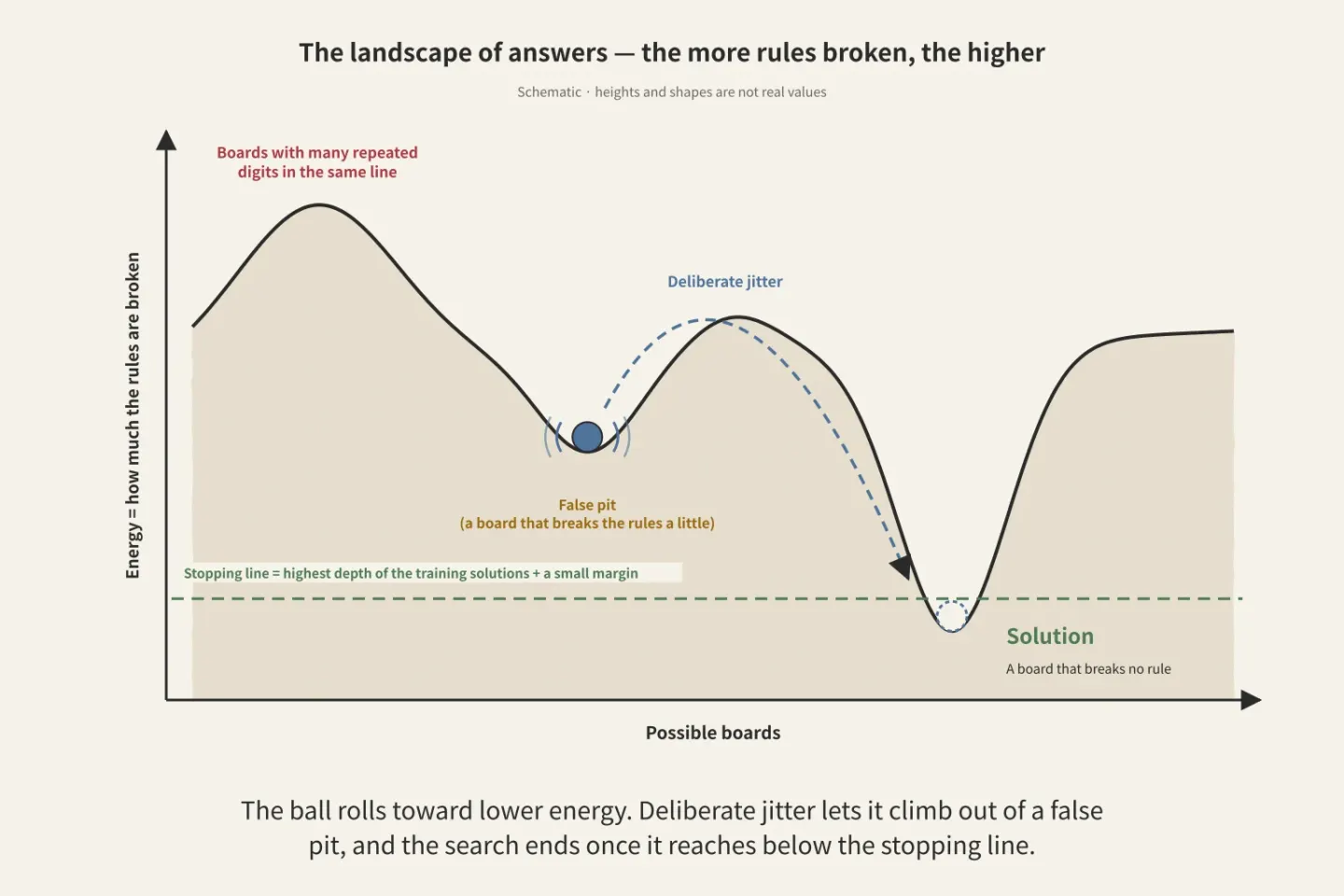
Figure: a diagram Paperis drew using only what the article says
CRAM is what makes these penalties learned from solved puzzles rather than determined by a person. The name is an acronym for "Compact Reasoning Associative Memory". The energy of CRAM takes the form of adding up both the values assigned to individual cells and the values assigned to pairs of cells, and those values are parameters determined through learning. The authors explain that, much like a Hopfield network, CRAM's weights remember “pairs of cells that are allowed to be placed together”, and the act of descending in energy corresponds to completing a puzzle given only clues—in other words, filling in a picture with parts erased (arXiv:2611.17309). The “reviving the whole from a part” performed by the 1982 memory neural network becomes the task of filling in the remaining cells with clues in Sudoku.
Learning by Digging Valleys
Recurrent models learn by tracing their repeated calculations backward. It is a method of sending the amount by which the final answer was wrong back to the earlier stages of calculation to fix the parameters. Because the calculations are long, they usually trace back only the last few steps, and the authors wrote that this is one of the reasons why recurrent models are slow to learn. In the authors' words, recurrent models can be unstable, slow to learn, and use many parameters and calculations even to solve simple puzzles (arXiv:2611.17309).
Learning in CRAM is the job of shaping a landscape. It digs lower the spot where the correct board of a solved puzzle sits, and raises up the spots of other boards that the model is currently rating low. The method mainly used in this paper compares the correct board with "boards where just a single cell has been changed to a different number," and adjusts the numbers so that the correct board comes to sit in a lower spot than those boards. In this process, there is no need to actually roll a ball or retrace the path it rolled (arXiv:2611.17309).
On Sudoku-Extreme, CRAM finished learning by adjusting numbers starting from 0 over 32 iterations using 1,000 puzzles. During learning, CRAM did not receive as input where the rows, columns, and 3×3 boxes were. The 81 cells were simply numbered spots, and the only thing added to the data were boards with swapped number names (arXiv:2611.17309).
The authors compared the same energy trained with five different learning methods. In Sudoku, the method comparing the correct board and a board with one cell changed took 48 milliseconds to solve 99% of the 512 development puzzles. A method tracing back only the final single step like HRM took 4.4 seconds. A method tracing back the entire rolled path was still climbing at an average of 27% after 245 seconds, and solved 48.8% of test puzzles after about 5 hours of learning. In mazes, this method also solved all test mazes (arXiv:2611.17309). Even with the short backward-tracing learning used by recurrent models, this small energy was learned in a few seconds, and the non-backward-tracing learning method cut the time down by tens of times once again from there. The times in this experiment cannot be directly compared with the training times in the table because of different measurement methods (our summary).
This idea itself is not entirely new. Methods of learning the cost for each cell pair in a solved Sudoku already existed. Those methods passed the learned costs to an external exact solver program to find answers, and CRAM replaced that spot with a search that descends its own energy. The authors excluded the method using an external solver program from the comparison group (arXiv:2611.17309).
How to Solve It by Rolling Balls
Let us imagine that a new Sudoku board has arrived. CRAM first locks the cells given as clues. The remaining blank spots start with a board filled with random numbers, and it creates four such boards independently of one another. The four boards are four balls placed somewhere on a terrain (arXiv:2611.17309).
The balls move one cell at a time. At each step, CRAM picks one cell that has a large degree of bumping into its surroundings, and redraws that cell's number in the direction indicated by the current energy. This drawing mixes in randomness on purpose. The authors wrote that this shaking is what allows a ball to escape fake valleys that are lower than their surroundings even though they are not the correct answer, and to wander around searching for different answers (arXiv:2611.17309).
Energy tells us when to stop. The stopping criterion is a line obtained by adding a small margin to the value that had the highest energy among the correct answer boards seen during training. If even one of the four balls drops below that line—meaning it reaches the depth where the correct answers were located—the search ends. If none of the balls reach that point within a set computation limit, it outputs the lowest board and stops (arXiv:2611.17309).
This stopping criterion has never stopped at an incorrect board during tests. A model trained three times solved Sudoku-Extreme test puzzles a total of about 1.24 million times, and missed 51 of them because they failed to reach the threshold within the limit. Five iterative models with stopping rules (HRM, TRM, EqR, TRMP, EBR) use separately trained stopping devices or their own stopping rules, and among the puzzles where those rules stopped, 0.05 to 3.54% were incorrect boards (arXiv:2611.17309).
The computation follows the difficulty of the puzzle. When 10,000 test puzzles were divided by the difficulty rated by the dataset, the median computation used by CRAM increased 22-fold from the easiest bundle to the hardest bundle. One comparison model used the same computation for all puzzles, and another model, EBR, which determines stopping by the gradient of the energy, also showed almost no change in computation according to difficulty (arXiv:2611.17309). The fact that balls roll longer on puzzles with rugged terrain directly manifests as the amount of computation.
This picture also has limitations. The guarantee that "energy never goes up" applies to theoretical calculations without randomness and with time flowing continuously. Actual searches intentionally shake the boards to temporarily pass through higher ones. The authors noted in the appendix that this guarantee does not tell us whether it goes to a single bottom, nor does it tell us that the bottom is the correct answer (arXiv:2611.17309).
Reading the Numbers
The results for four of the seven recurrent models compared by the authors and for CRAM were as follows. The Sudoku accuracy is measured on 410,000 test puzzles, the maze accuracy on 1,000 test mazes, and the training times are all measured on a single GPU of the same type (arXiv:2611.17309).
| Model | Sudoku-Extreme Accuracy (%) | Parameters (Sudoku) | Training Time (Sudoku) | Maze-Unique Accuracy (%) |
|---|---|---|---|---|
| HRM | 54.62 | 27 million | 1.2 hours | 39.97 |
| TRM | 85.73 | 5 million | 2.5 hours | 92.23 |
| EBR | 99.85 | 1.8 million | 2.8 hours | 89.80 |
| TRMP | 99.87 | 32,800 | 9.0 hours | 99.23 |
| CRAM | 99.996 | 7,700 | 0.04 seconds | 100 |
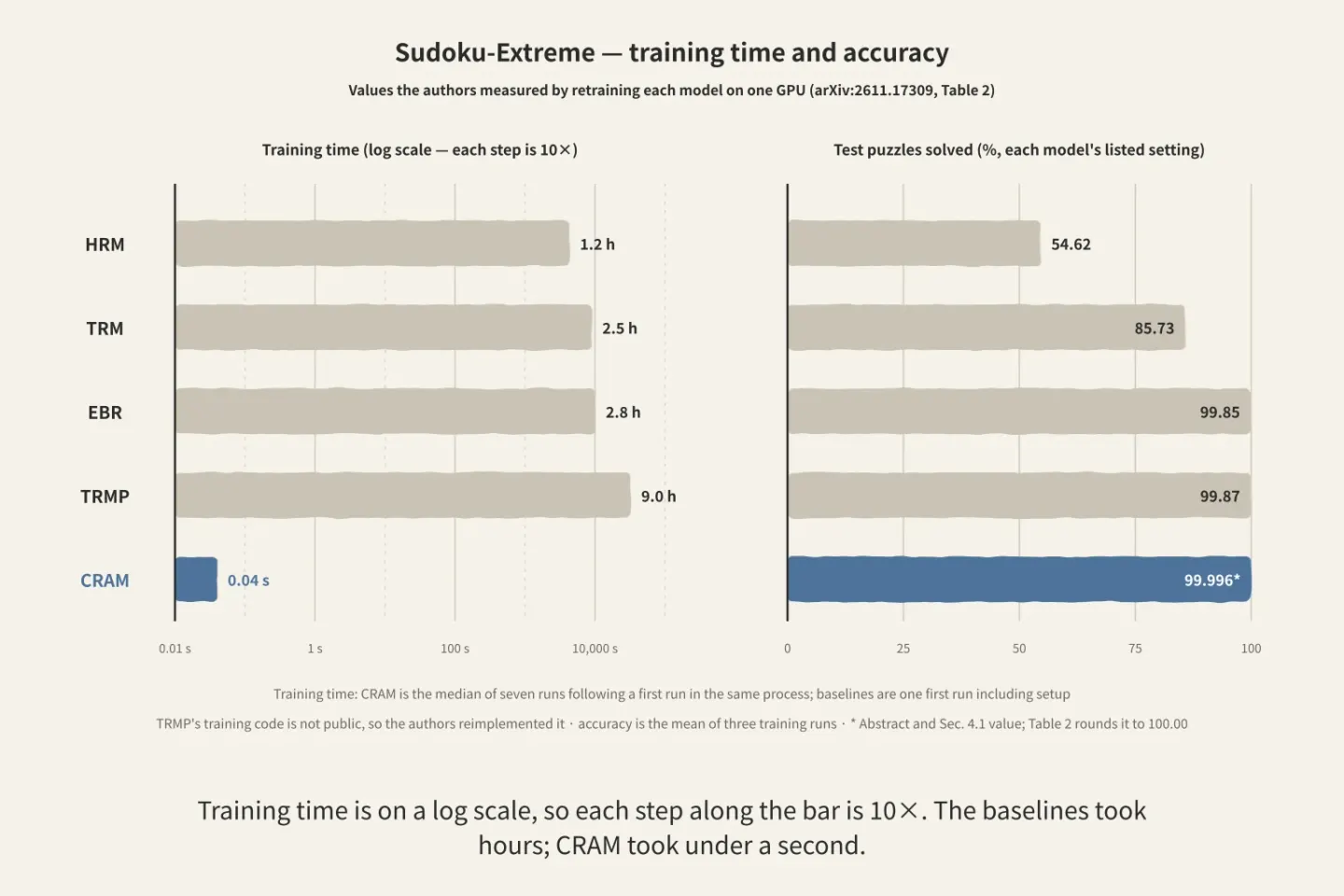
Figure: a chart Paperis drew from the values in Table 2 of arXiv:2611.17309
The recurrent model figures in this table are the average of three runs with changed seed values, after the authors retrained each model directly using the authors' code and training settings. The values from the original papers were substituted only when the retrained scores were more than 2 points lower (two models not included in the table fall into this case), and TRMP, whose training code was not released, was newly implemented as described in the paper (arXiv:2611.17309).
HRM's 54.62% is similar to the 54.5% Sudoku-Extreme starting point in the HRM analysis we saw earlier (arXiv:2601.10679). Another research team that published a variation adding noise to TRM recorded TRM's Sudoku-Extreme starting point as 87.4% and reported raising it to 98.75% by adding noise (arXiv:2605.19943). The maze column is a different story. Since HRM, TRM, and EBR had never produced Maze-Unique scores, these are values measured by the authors by running each model's settings for other mazes as they were (arXiv:2611.17309).
The conditions comparing training times are also not identical. CRAM's time is the median of one run followed by seven more runs within the same program, with a 0.2 to 0.9 second preparation time that only occurs on the first run subtracted out. The comparison models were measured on a single initial run including preparation time, and the preparation time did not exceed 2.2% of the total (3.5% only for the maze TRMP). The authors noted that because training was performed on a shared computing equipment where multiple jobs run together, times could fluctuate (arXiv:2611.17309). Even if all preparation time is added to CRAM in Sudoku, it does not exceed 1 second, and HRM, which had the fastest Sudoku training among the comparison models in the table, is 1.2 hours, so the difference is still thousands of times (our calculation).
The computation required for solving is counted in the number of operations such as addition and multiplication. CRAM used an average of roughly 2 billion operations for a single Sudoku-Extreme problem. EBR, which the authors selected as the recurrent model with the least computation, used about 540 billion operations per problem when it was most accurate (99.86%), and CRAM matched that same accuracy with about 1.9 billion operations. The 282-fold comes from this comparison, and when compared with the most widely used model, it was 128,000 times (arXiv:2611.17309). For parameters, CRAM has 7,700 counting only non-zero values, whereas the comparison models are counts for the entire neural network, so they may be larger than the number actually used (arXiv:2611.17309).
The picture was similar even with fewer data. To solve 98% of the test puzzles, CRAM required 30 different training puzzles, while EBR required 700. However, in the extreme regime where there were fewer than 10 training puzzles, TRM got the most right, and in that range CRAM converged heavily to incorrect boards (arXiv:2611.17309).
For two tasks with multiple answers—namely the N-Queens problem of placing queens on a chessboard so they do not attack each other, and graph coloring of painting neighboring dots in different colors—the picture is less dramatic. CRAM was at a similar level to the best recurrent model, and when extracting just a single answer for N-Queens on an 8×8 board, the accuracy was 100% for EBR and 99.95% for CRAM. Training times here too were split between a few seconds for CRAM and tens of minutes to hours for the recurrent models (arXiv:2611.17309). The 1,000-fold is a training time comparison measured by the authors on the two puzzles Sudoku-Extreme and Maze-Unique, and the 282-fold is a computational comparison when matched to the peak accuracy of the recurrent model on Sudoku-Extreme.
Opening Up the Weights
A Sudoku board has 81 squares, and a square shares its row, column, and 3×3 box with 20 other squares. There are 810 such pairs of squares in total. Even though CRAM received no input telling it where the rows, columns, and boxes were, every time training was run, it assigned a "penalty for identical numbers" to precisely those 810 pairs and left the penalties for all other pairs of squares at 0 (arXiv:2611.17309). By lowering the correct boards and raising boards with a single square changed, the landscape was carved into the shape of the Sudoku rules. The training also included a term that pulled small penalties down to 0 (arXiv:2611.17309).
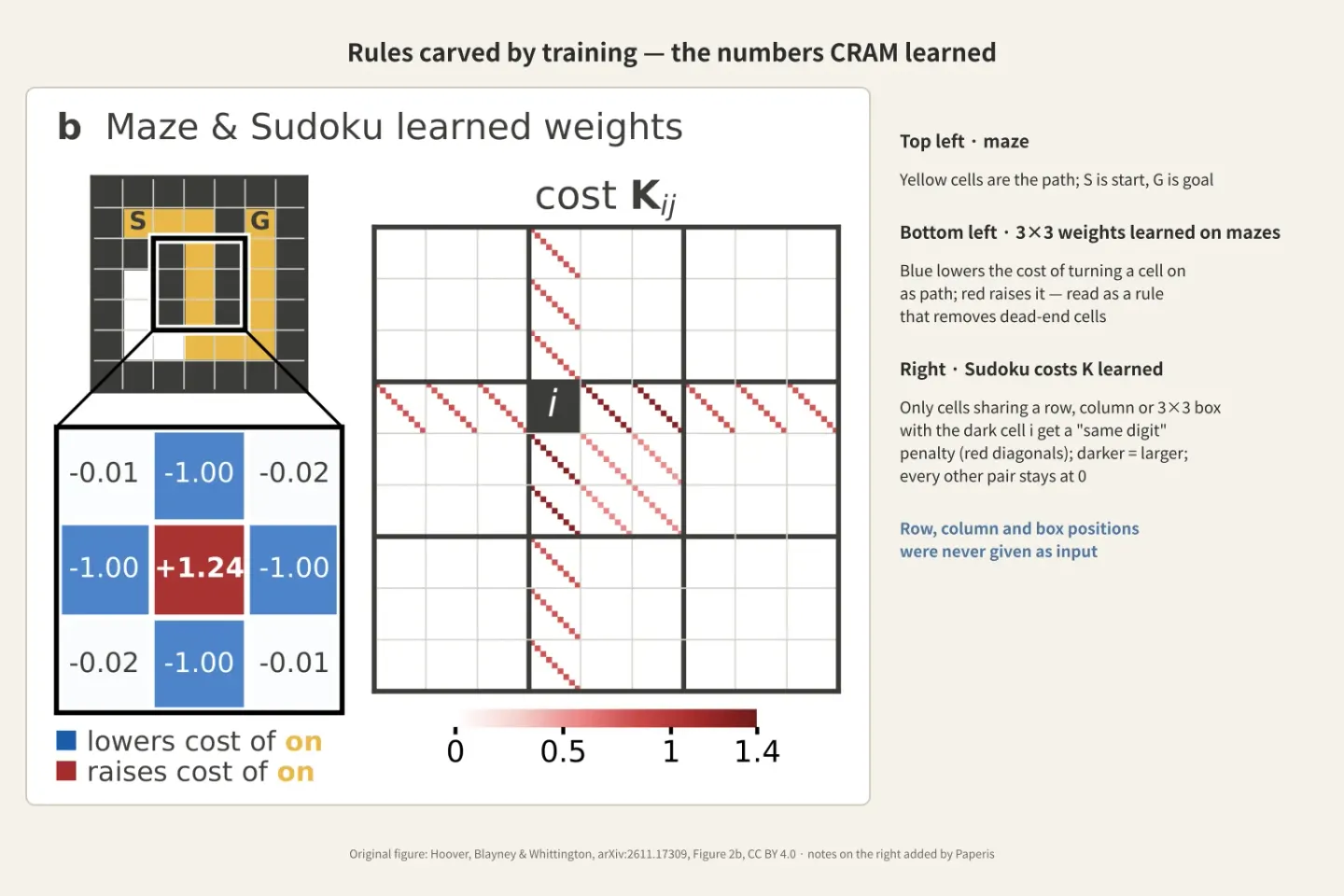
Figure: Hoover, Blayney & Whittington, arXiv:2611.17309, Figure 2b, CC BY 4.0
The same thing happened in mazes. The 18 numbers learned in Maze-Unique were read as a rule that erases one dead-end square at every step of the search. This method, which fills in dead ends from the end until only a single path remains, is a known local rule that always solves any maze that has a single path (arXiv:2611.17309).
If so, the rules can also be written in by hand. The authors also tested CRAM energies where the numbers were manually set based only on the rules of each puzzle. For Sudoku, an energy made of one distinct value, and for mazes, three distinct values, solved every single test puzzle without missing one. On Sudoku, it used up to 19 times fewer calculations than the learned energy, and on N-queens and graph coloring, it was the best model across all metrics (arXiv:2611.17309).
The authors wrote that high scores on this benchmark only show that a few pairwise rules among answer squares were learned. And they called this "a gentle warning against pouring larger iterative models into such reasoning problems" (arXiv:2611.17309). This means that the mere fact that these puzzles score high cannot be read as the capacity to move on to more difficult tasks.
What This Result Does Not Say
The authors wrote that CRAM's simple energy alone will likely struggle to learn more complex reasoning tasks like ARC. The puzzles tested in this paper are all of a kind that can be accurately represented by CRAM's "cell pair penalty" energy. In the authors' explanation, for harder tasks like ARC-AGI-1, it depends on the amount that the model must compute separately from the board where the answer is visible. How far each cell is from the target in a harder maze is an example of such a quantity (arXiv:2611.17309).
Experiments in the appendix show this boundary. In the maze bundle Maze-Hard with loops, dead-end filling did not work, and CRAM alone could not solve a single test maze. When they added a single hidden layer designed so that the value decreases steadily with every step away from the target, 29 parameters solved 999 out of 1,000. However, this layer is a device added with the knowledge that the maze is a distance-dependent task, and the authors wrote that learning such hidden quantities generally without knowing the task design in advance remains an important open research problem (arXiv:2611.17309). The authors themselves wrote that this energy is not the final answer for all reasoning tasks, and added in the same sentence that the advantages of explicit energy are substantial (arXiv:2611.17309).
CRAM is also iterative computation. The basic update formula that lowers CRAM's energy has the same form as a single layer of an iterative model, and the authors introduce lowering energy as a framework that gives principles to iterative computation. Iterative models have been adding energy advantages like stopping mechanisms or stable convergence one by one separately, so the question of this paper was: what if we learn the energy directly from the start? (arXiv:2611.17309). Another research team in the same month released a preprint proposing to make iterative reasoning models into energy-based models, reporting 99.9% on Sudoku-Extreme (arXiv:2611.08977). EBR in the table above is that model.
The scope of comparison is also narrow. This paper retrained and compared iterative models across four types of puzzles—sudoku, mazes, N-queens, and graph coloring—and placed one harder maze from the appendix side-by-side with the original paper's values. Comparisons corresponding to the ARC scores reported by TRM are not in this paper (arXiv:2510.04871; arXiv:2611.17309). Iterative computation itself is also studied outside of puzzles. There is research showing that a language model repeating a few layers multiple times can rival a model that actually stacks the same number of layers (arXiv:2502.17416).
The weight of the evidence is also worth weighing. This result is a single preprint that has not undergone peer review, and both CRAM and the comparison models were trained and measured by the same authors. The authors stated that they made all the code, execution logs, and results behind the tables and figures publicly available. There are no replication results by other research teams yet (arXiv:2611.17309).
What Sudoku Scores Measure
François Chollet, the creator of ARC, argued in 2019 that you cannot measure intelligence by looking at skill in just a single task alone. Skill depends heavily on pre-loaded knowledge and experience, and if you provide infinite prior knowledge or training data, an experimenter can "buy" as much skill as they want, masking the system's own capacity for generalization (arXiv:1911.01547).
The manually written energy of this paper sits alongside that critique. An energy with the Sudoku rules written into it as a single number solved all of Sudoku-Extreme. Just writing the rules into the same search reached a perfect score on this test paper (arXiv:2611.17309).
Even under the same name "Sudoku," what is being measured can differ. In a benchmark gathering variant Sudokus where the rules are twisted so that each puzzle has new constraints attached, the latest large language models solved fewer than 15% of the puzzles without help (arXiv:2505.16135). This benchmark was chosen so that the rules change with every puzzle, making them impossible to solve by memorization. There are no results testing CRAM or small iterative models on this benchmark.
The authors wrote that since these puzzles are easily solved with just a few parameters, the high accuracy here does not point to performance on harder tasks (arXiv:2611.17309). This means that on a test paper solved in under 1 second of training with 7,700 parameters, how many more points a model trained for several hours received does not tell you whether that model can grow into a bigger problem. It also remains that the authors concluded from the same results that energy is a promising path for learning reasoning from data. When you hear the news that "a small model solved a difficult puzzle," you can also ask how many numbers an energy with the puzzle's rules written in by hand uses to solve that puzzle.
Where to Look Next
Neural Networks and Parameters — What It Means to Nudge Hundreds of Billions of Dials covers step-by-step what a parameter is and how training adjusts those numbers little by little. CRAM learned the sparse rules from solved puzzles, and the core idea of making the calculation method learn from examples instead of writing in rules is found in AI Models — A Calculation That Learns From Examples Instead of Rules. Other cases where exam scores and real-world performance diverge continue in How AI Gets Things Wrong — The Test-Taker Who Stumbles Outside the Exam Hall.
Source Papers
- "Classical Energies Learn to Reason 1,000x Faster than Looped Models" (2026) — arXiv:2611.17309 (preprint) — Learned Hopfield and Tank energy (CRAM) solves Sudoku-Extreme at 99.996% and Maze-Unique at 100% with 42 and 132 ms of training, matching recurrent model peak accuracy on Sudoku-Extreme with over 282 times less computation. Energies are promising, but warns not to measure the scalability of recurrent inference with easily solved benchmarks.
- "Hierarchical Reasoning Model" (2025) — arXiv:2506.21734 (preprint) — Reports near-perfect performance on hard Sudoku and large mazes with 27 million parameters and 1,000 training examples, outperforming larger models on ARC.
- "Less is More: Recursive Reasoning with Tiny Networks" (2025) — arXiv:2510.04871 (preprint) — Reports that a TRM with 2 layers and 7 million parameters achieved 45% on ARC-AGI-1 and 8% on ARC-AGI-2, higher than most large language models.
- "Are Your Reasoning Models Reasoning or Guessing? A Mechanistic Analysis of Hierarchical Reasoning Models" (2026) — arXiv:2601.10679 (preprint) — HRM fails even on single-blank puzzles and “guesses” its first fixed point. Reinforcement raises Sudoku-Extreme from 54.5% to 96.9%.
- "Probabilistic Tiny Recursive Model" (2026) — arXiv:2605.19943 (preprint) — Adds noise to TRM, raising Sudoku-Extreme from 87.4% to 98.75%.
- "Energy-Based Reasoners: Your Recurrent Reasoner Should Be an Energy-Based Model" (2026) — arXiv:2611.08977 (preprint) — Replaces recurrent inference with gradient descent on learned energy, reaching 99.9% on Sudoku-Extreme.
- ""Neural" computation of decisions in optimization problems." (1985) — PMID 4027280 — Densely connected analog neuron networks collectively compute good solutions to constrained optimization problems (the traveling salesperson problem) quickly.
- "Neural networks and physical systems with emergent collective computational abilities." (1982) — PMID 6953413 — Content-addressable memory, where whole memories are retrieved from partial cues, emerges as a collective property in systems of many simple connected units.
- "On the Measure of Intelligence" (2019) — arXiv:1911.01547 (preprint) — Skill on specific tasks can be “bought” with prior knowledge and experience, masking generalization. Defines intelligence as skill acquisition efficiency and proposes ARC.
- "Sudoku-Bench: Evaluating creative reasoning with Sudoku variants" (2025) — arXiv:2505.16135 (preprint) — On variant Sudoku puzzles with new constraints added per puzzle, state-of-the-art language models solve under 15% without help.
- "Reasoning with Latent Thoughts: On the Power of Looped Transformers" (2025) — arXiv:2502.17416 (preprint) — A model that loops k layers L times nearly matches a kL-layer model and remains competitive in language models.
Sources (11)
- Classical Energies Learn to Reason 1,000x Faster than Looped ModelsarXiv:2611.17309
- Hierarchical Reasoning ModelarXiv:2506.21734
- Less is More: Recursive Reasoning with Tiny NetworksarXiv:2510.04871
- Are Your Reasoning Models Reasoning or Guessing? A Mechanistic Analysis of Hierarchical Reasoning ModelsarXiv:2601.10679
- Probabilistic Tiny Recursive ModelarXiv:2605.19943
- Energy-Based Reasoners: Your Recurrent Reasoner Should Be an Energy-Based ModelarXiv:2611.08977
- Neural\PMID 4027280
- Neural networks and physical systems with emergent collective computational abilitiesPMID 6953413
- On the Measure of IntelligencearXiv:1911.01547
- Sudoku-Bench: Evaluating creative reasoning with Sudoku variantsarXiv:2505.16135
- Reasoning with Latent Thoughts: On the Power of Looped TransformersarXiv:2502.17416