Paperis Articles
Freddie Mercury — How did Farrokh Bulsara of Zanzibar become the voice of Queen, and what fell out of the story?
On his 35th anniversary: an immigrant's papers, the critics' cold shoulder, a voice measured from recordings, the coverage of 1991, and the film of 2018
Your field's papers, as audio
Pick your fields and journals — Paperis summarizes the key papers and turns them into audio. Listen on your commute.
Start Paperis free →Freddie Mercury — How did Farrokh Bulsara of Zanzibar become the voice of Queen, and what fell out of the story?
November 23, 1991, London
On Saturday, November 23, 1991, Freddie Mercury, the lead singer of the British rock band Queen, issued a brief statement (The Guardian, 1991-11-25). He wrote that "following enormous conjecture in the press," he wished to "confirm that I have been tested HIV positive and have AIDS." He added that he had kept the information private "to protect the privacy of those around me," and that the time had now come "for you and all others around the world to unite with me and all those, worldwide, in the fight against this terrible disease" (The Guardian, 1991-11-25). The following night he died at his home in Kensington, London. A statement released by his publicist listed the cause of death as "bronchopneumonia resulting from AIDS" (The Guardian, 1991-11-25) (The Seattle Times, 1991-11-25). He was 45 years old.
The world heard of his illness from his own lips just one day before his death. For the past two years he had secluded himself in his Kensington home, and that seclusion fueled speculation that he was ill, noted an obituary from 1991 (The Guardian, 1991-11-25). Rumors that he had tested HIV-positive since the mid-1980s had persisted, but he had consistently denied them (English Heritage blue plaque note).
This article reads the before and after of that silence, divided into layers covered by papers and records. These include where he came from, how critics viewed him, what science measured in his voice, how the coverage of 1991 reported his death, and how the 2018 film rewrote that story. The latter part also covers the film's major box office success in South Korea and papers by Korean researchers discussing it. His lyric lines are not quoted, and only song titles are mentioned.
Farrokh Bulsara in Zanzibar
On September 5, 1946, Farrokh Bulsara was born on the island of Zanzibar in the Indian Ocean, just off the East African coast. At the time, Zanzibar was a British protectorate (The National Archives, Mercury's naturalisation papers). He was born in the Zanzibar Government Hospital (BBC, 2018-10-23). Twenty-five years later, in London, he would step in front of Queen under the name Freddie Mercury (Queen official website).
His parents, Bomi and Jer Bulsara, were Parsis (BBC, 2018-10-23). Parsis are a community of Zoroastrian believers whose ancestors came from Persia. His parents had lived in India before coming to Zanzibar. His father, Bomi, was born in 1908 in Bulsar, British India (according to a naturalisation application personally signed by Mercury in 1969), and the family surname "Bulsara" comes from this place name (The National Archives, Mercury's naturalisation papers) (BBC, 2018-10-23). In Zanzibar, he worked with money at the High Court of the British colonial government. The BBC lists his position as cashier, while a 1991 obituary records him as a government accountant (BBC, 2018-10-23) (The Guardian, 1991-11-25).
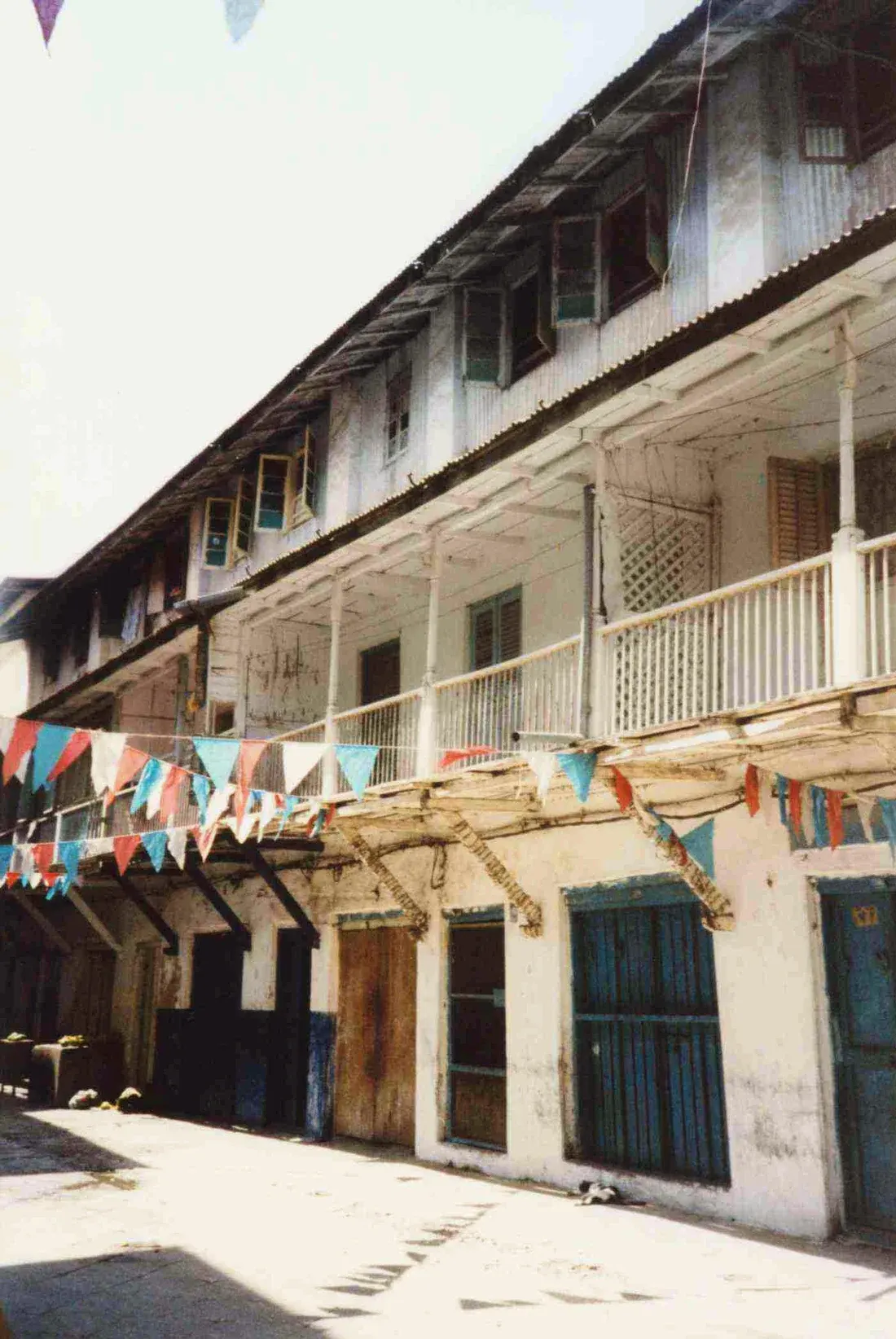
Photo: The house in Stone Town, Zanzibar, where his family lived during his childhood (photographed 1999). · Moongateclimber, via Wikimedia Commons (CC BY-SA 3.0)
His first school was a Zanzibar mission school taught by Anglican nuns. When he turned eight, his parents sent him to India, where he boarded at St. Peter's School in Panchgani, a highland hill station from British India southeast of Bombay (now Mumbai). Although it was a church school, it accepted children of all religions, and there he remained a practicing Zoroastrian (BBC, 2018-10-23). Piano lessons began when he was seven (Queen official website). His immersion in music came during free time spent with relatives and grandparents in Bombay, and he also formed his first band, The Hectics, with friends (BBC, 2018-10-23). According to one biography, he returned to Zanzibar in 1963 to finish his final schooling at a Catholic convent school (BBC, 2018-10-23).
The island he returned to was soon upended. In December 1963, the Zanzibar Act passed by the British government freed Zanzibar from the British Empire, and a month later a revolution overthrew the Sultan. In April 1964, Zanzibar merged with Tanganyika on the mainland, and since then it has been called Tanzania (The National Archives, Mercury's naturalisation papers). The revolution overthrew the ruling Arab elite, with estimates suggesting as many as 17,000 people died (BBC, 2018-10-23). The Bulsara family was one of the British colonial staff families who left the island in the wake of the revolution (The National Archives, Mercury's naturalisation papers).
The family settled in Feltham, Middlesex, west of London, in 1964. The month of their arrival varies across records. The naturalisation papers signed by Mercury himself list a Feltham address starting from May 4, 1964, while explanatory notes from the same institution record his arrival in October of that year (The National Archives, Mercury's naturalisation papers). If going by the papers he signed, he was seventeen; if going by the institution's notes of an October arrival, he was eighteen. On a map, his childhood was already a path moving between islands, continents, and islands, and Feltham was the fourth stop on that path.
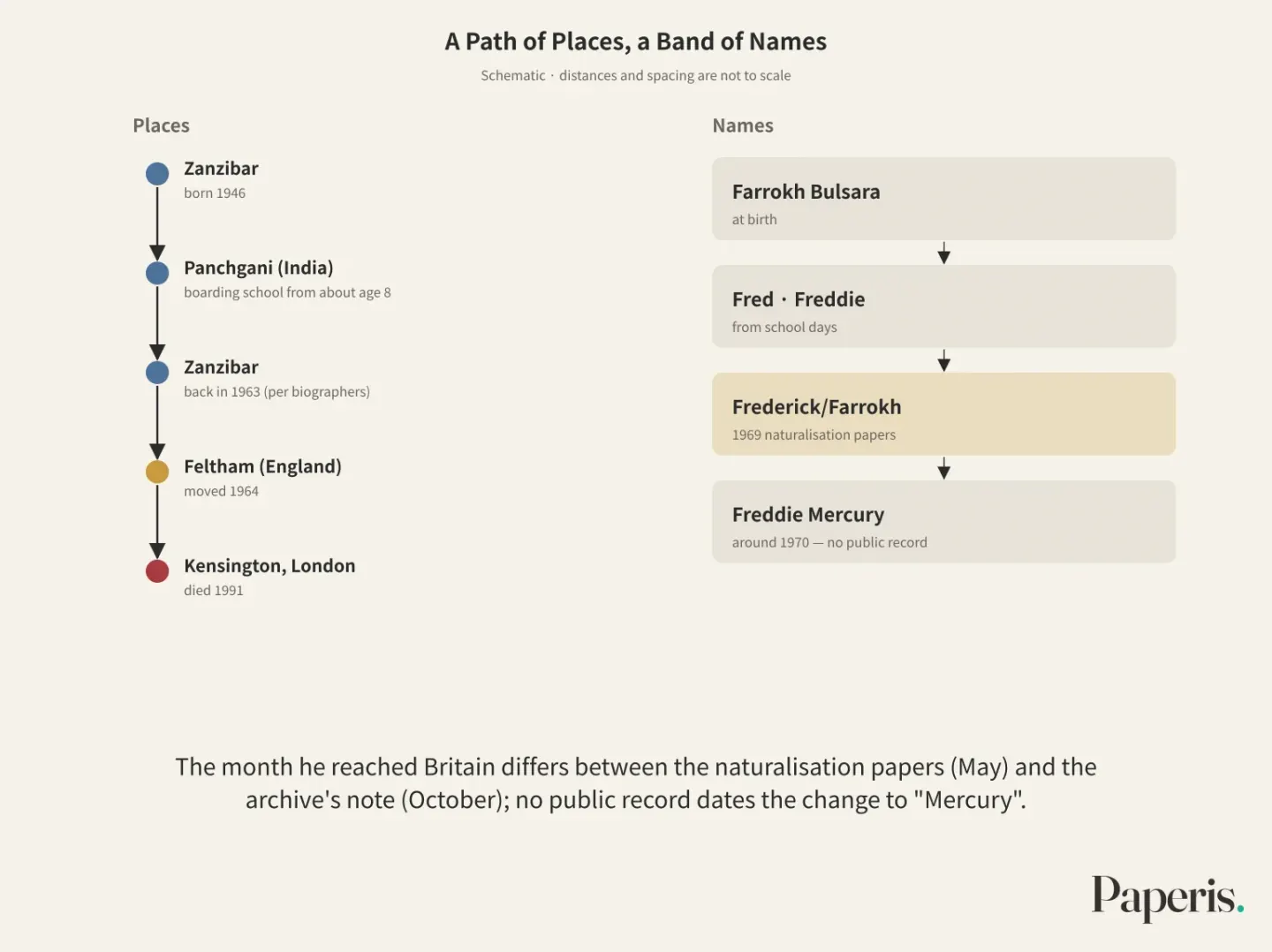
Figure: A path of places and a band of names (schematic). The arrival month differs between the naturalisation papers and the archive's note, and no public record dates the change to "Mercury".
Two Names on a Single Document
On March 21, 1969, a twenty-two-year-old young man living at 22 Feltham Gladstone Avenue signed his British naturalization application. In the name field, "Fredrick/Farrokh Bulsara" were written side by side. In the birthplace field, "Tanzania" was entered in parentheses next to Zanzibar, a country name that did not exist in 1946 (The National Archives, Mercury's naturalisation papers). That year, he completed the graphic art and design course at Ealing Technical College and School of Art, and became a British citizen through naturalization (The National Archives, Mercury's naturalisation papers). While attending school, he moved around various houses in London and covered his living expenses by working several jobs, including washing dishes in the Heathrow Airport kitchen (English Heritage blue plaque note).
There is no official record of when the surname "Mercury" came to be. He was called "Fred" rather than Farrokh even before his family came to London, and signed his letters as "Fred Bulsara" until he changed his name to Mercury in 1970 (English Heritage blue plaque note). The UK National Archives notes that he changed his name with a deed poll around 1970 when he formed Queen, but appears not to have registered it with the High Court, leaving no permanent record in public documents (The National Archives, Mercury's naturalisation papers). Just before becoming Mercury, this application was the official document where he directly wrote down and signed his origins, and the date he changed his name is registered nowhere.
Afterward, he did not reveal his origins and never publicly stated his sexual orientation. Off stage, he was a private, even shy person who did not reveal his Zanzibar roots and never publicly said he was gay, according to the commentary by English Heritage, which manages the London blue plaques (English Heritage blue plaque note). Two obituaries from 1991 included something he had supposedly said at some point. It was that he felt he had created a monster by being too strong on stage, and that while he was outgoing when performing, he was a completely different person inside (The Guardian, 1991-11-25) (The Seattle Times, 1991-11-25). Neither article revealed when or where he said this.
Korean researcher Choi Dae-hee reads this silence through the life of an immigrant. He pointed out that although articles about Mercury poured in after the 2018 film, unlike his controversial sexual orientation, his origins, family, and life as an immigrant in Britain were not significantly highlighted. And he notes that Mercury tried not to reveal his origins and past even to close friends (DOI: 10.34221/KJPS.2021.29.2.6). In another paper from the same year, he considers that Mercury lived in Britain in the late 1960s when prejudice against immigrants was intense, and by not revealing his past and ancestry, he was able to successfully perform "Britishness." He states that the reason for his reluctance to reveal himself is found in the fact that he was a person of color and an immigrant from a British Empire colony (DOI: 10.22446/mnpisk.2021.15.2.003). This is the author's interpretation. Records of Mercury himself stating that reason do not exist in the materials gathered by this article.
Researcher Jang Hyuk-jun views the same life from a different angle. He reads Mercury as someone standing at various boundaries as a migrant, refugee, and sexual minority, and interprets that through repeated migrations an identity not tied to any single place emerged, transforming the anxiety left by that migration into the power to mix cultures and create something new (DOI: 10.17328/kjcs.2019.27.2.003). From the same silence, the two researchers read concealment in one case and mixing in the other. There is only one takeaway. The documents left two names, the people who have explained the space between them are subsequent researchers, and Mercury himself left no explanation.
Queen on Stage, Queen on Paper
Queen's guitarist Brian May remembers the day Mercury put a Jimi Hendrix record on a Dansette record player. When Mercury said, "Listen to this, this is what we should be doing," May asked back, "Well, can you sing?" (English Heritage blue plaque note). May and drummer Roger Taylor were founding members of a band called Smile, and when Mercury joined as lead vocalist, Smile became Queen. Finally, bassist John Deacon joined on March 1, 1971, making them a foursome (Queen official website). According to the music magazine Rolling Stone, Mercury had been a long-time friend of the Smile camp, persistently begged to be let in as a member, and his joining happened only when Smile's bassist left in 1970 (Rolling Stone, 2018-11-01).
The success that followed was fast. He wrote the band's first big hit "Killer Queen" (1974) and their most famous song "Bohemian Rhapsody" (1975) (English Heritage blue plaque note). "Bohemian Rhapsody" almost didn't get released because of its length and unfamiliar format, but it was the song Mercury insisted had to be played (Queen official website), and after its release in October 1975, it stayed at number one on the UK singles chart for 9 weeks (The National Archives, Mercury's naturalisation papers). Live Aid, the charity concert held at Wembley Stadium in London on July 13, 1985, was packed with 72,000 people, and the broadcast screen was sent to over 1.5 billion people in 160 countries (BBC On This Day, 1985-07-13). The UK National Archives evaluates that Mercury's performance that day became a core cultural moment in music history (The National Archives, Mercury's naturalisation papers).
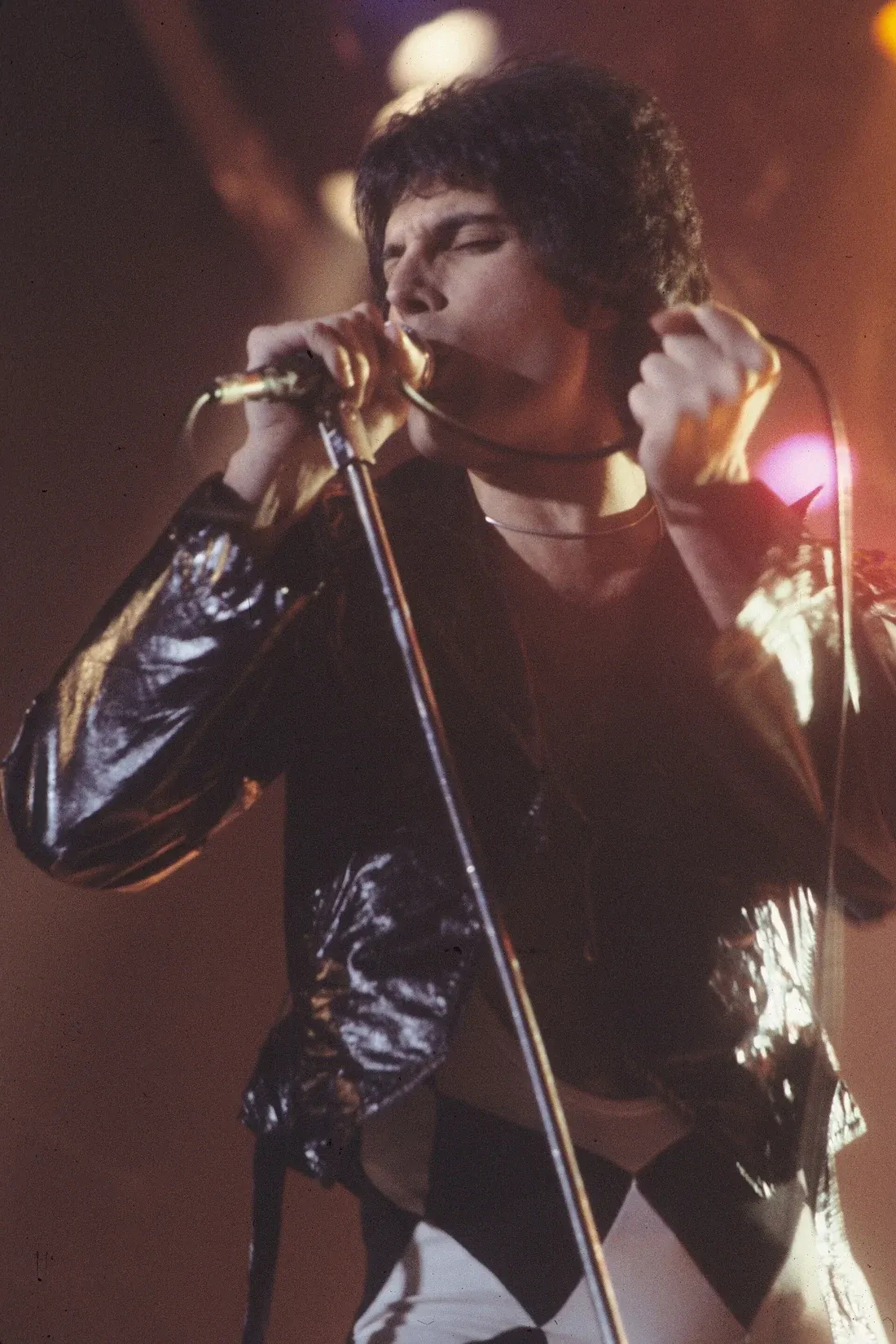
Photo: Freddie Mercury in concert in New Haven, Connecticut, 16 November 1977. · Carl Lender, via Wikimedia Commons (CC BY 2.0)
Paper was different. Ann Jennifer de Boer of McMaster University in Canada scanned US and UK media articles during Queen's 20-year active period in her 1999 thesis, and reported that unlike the global audience accepting the band, the media's evaluation was consistently negative (DOI: 10.71548/14756). She viewed that this cold reception could be part of the reason Queen continues to be left out of survey books and academic texts that organize rock history. She puts forward claims regarding the cause. Mercury's stage persona, the classical music Queen pulled in, and May's guitar playing all "feminized" the band, and by clashing with the conventions of hard rock where the rules of masculinity ruled, they invited the cold shoulder of criticism (DOI: 10.71548/14756). The media's negative evaluation is the record she collected, and that the cause is gender is the claim the paper established.
There is also research that reads stage attire and gestures differently. Camp is an aesthetic putting forward kitsch, excess, and self-conscious parody, which was widely popularized under the name "Camp" by American writer Susan Sontag in a 1964 essay (DOI: 10.31926/but.pcs.2019.61.12.7). Researcher Ileana Botescu-Sireţeanu argues in a 2019 paper that several of Queen's music videos view Mercury's designed visual language of Camp as a healing art form to cope with his own queerness (DOI: 10.31926/but.pcs.2019.61.12.7). This is the author's interpretation of Mercury's inner thoughts, and records of him saying so himself are not in the materials this text gathered. A book by Nick Braae published by Oxford University Press in 2021 professes to be the first book-length musicological study dealing with Queen, connecting Mercury to the discourse of a "queer voice" in the chapter analyzing the singers' voices (DOI: 10.1093/oso/9780197526736.001.0001).
Some 20 years after the 1999 thesis viewed that Queen was missing from academic texts, a musicology monograph dealing exclusively with Queen came out. What to take away from this section is the distinction. The audience's reception and the media's negative evaluation are records, and the reasons for them and the inner thoughts behind the stage are interpretations.
Measuring a Voice Through Recordings
In 2016, four voice researchers measured the voice of a singer who had passed away nearly 25 years earlier (PMID 27079680). Because he could not be examined directly, the material used consisted of publicly available recordings. Auditory judgments and numerical analyses were used together. Mercury's voice is often accompanied by the description "4 octaves." The range that this paper considered reliable from the recordings is narrower than that.
First is speech. Fundamental frequency is the value obtained by counting how many times the slowest repeating vibration in a single sound occurs per second, and is usually heard as the pitch of that sound. The unit is Hertz (Hz). Across six interviews, the median fundamental frequency of his speech was 117.3 Hz, and the researchers noted that this is a value typically seen in a baritone voice (PMID 27079680). This is a judgment regarding speaking pitch. It does not determine the singing voice's vocal range as baritone.
Next is the range of singing. A semitone is one of the twelve steps into which Western music divides an octave, and is the distance from a key on a keyboard to the very next key. As a result of analyzing tracks with only the vocals isolated from band recordings, his singing range appeared to be 37 semitones, from F#2 (about 92.2 Hz) to G5 (about 784 Hz) (PMID 27079680). Since twelve semitones make one octave, 37 semitones is a span of three octaves plus one semitone. There was evidence of higher sounds, vocalizations going up to a fundamental frequency of 1,347 Hz, but the researchers did not consider them reliable (PMID 27079680). His singing range supported by recordings is 37 semitones, a little over three octaves, and "4 octaves" is not supported by these measurements.
Third is vibrato. Vibrato is a singing technique that makes a sustained note waver by rapidly shaking its pitch up and down. When measuring 240 sustained notes from 21 a cappella recordings, his vibrato wavered on average 7.0 times per second. The researchers called this speed "astonishingly high" and noted that it reaches the speed range of a tremor called a vocal tremor (PMID 27079680). When creating a new index to measure how even vibrato is, that waver which sounded irregular to the ear was also irregular in the numbers. The researchers concluded that this irregularity of vibrato is a characteristic that distinguishes his singing voice (PMID 27079680). This means that fast and uneven wavering was a prominent feature of his singing voice.
In the final experiment, the throat examined by the researchers is not Mercury's. Subharmonics are when components that repeat two or three times slower than the fundamental vibration of a note are mixed within that note, causing a sound lower than that note to resonate alongside it. The researchers had a professional rock singer imitate the subharmonic vocalization heard in Mercury's recordings, and filmed the inside of that throat with a high-speed endoscopic camera capturing 4,132 frames per second.
False vocal cords are an extra pair of folds located just above the vocal cords. In the footage, the singer's vocal cords and false vocal cords vibrated in engagement at a ratio of 3 to 1 (PMID 27079680). This is in the manner of one side vibrating three times while the other vibrates once. This 3:1 vibration was filmed in the voice of the imitating singer, and no one has seen Mercury's vocal cords. This goes as far as an experiment showing the possibility that Mercury may have produced sound in that way as well.
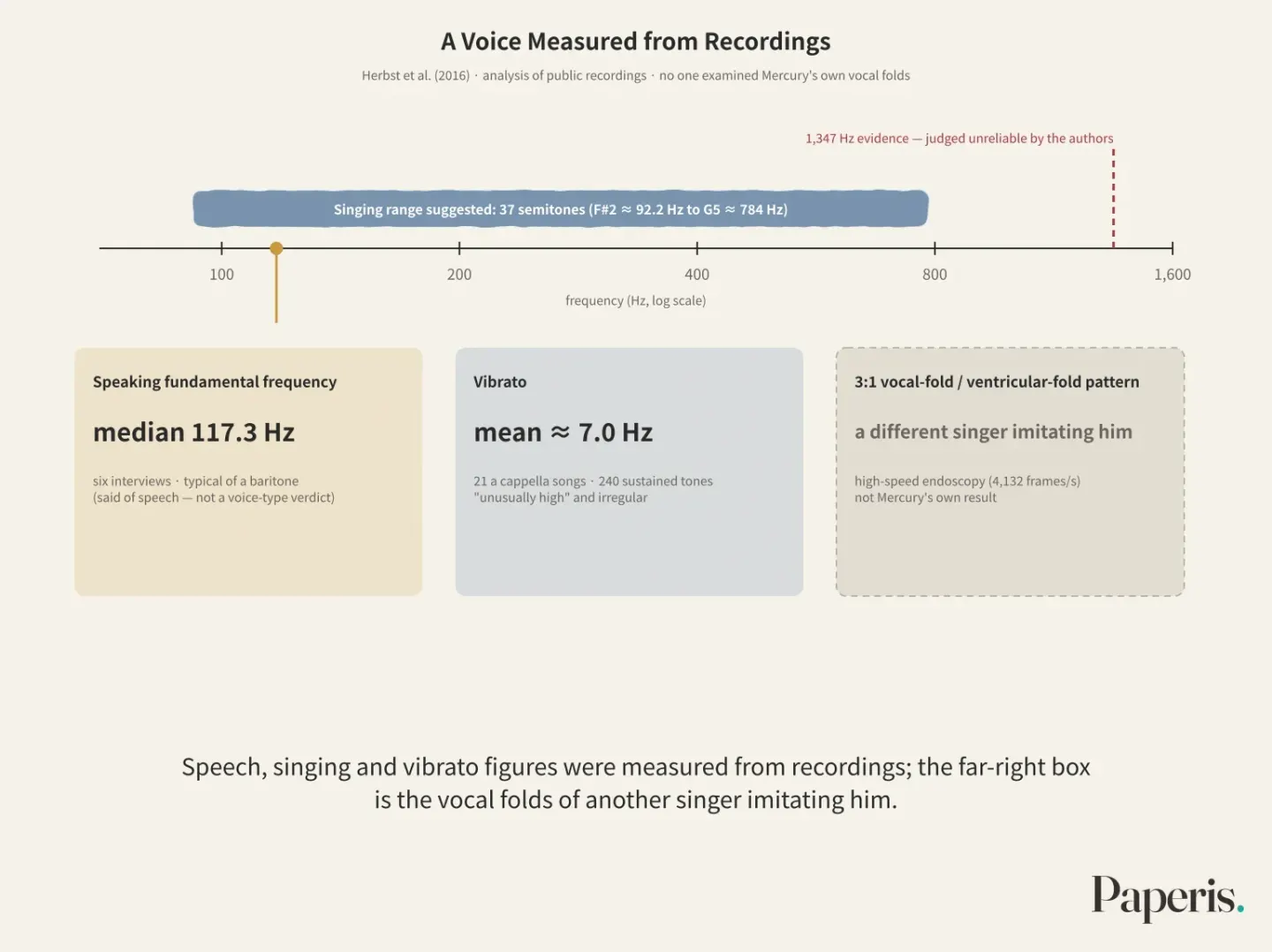
Figure: The voice Herbst et al. (2016) measured from public recordings. The grey box on the right is another singer imitating him, not Mercury.
Therefore, what science can say about his voice is only as much as the recordings left behind. His speech was at a pitch typical of a baritone voice, his singing spanned a little over three octaves, and his vibrato was unusually fast and uneven. Modifiers beyond that are assessments outside of measurement.
Sixteen Days in November 1991
On November 7, 1991, U.S. professional basketball star Earvin "Magic" Johnson held a press conference to announce that he had been infected with HIV and was retiring from professional basketball (PMID 8421454). This came 16 days ahead of Mercury's statement. It was the same virus and two disclosures in the same month, but their shapes were different. Johnson announced his with his retirement at a press conference, while Mercury passed away the day after making his announcement through a short written statement.
Johnson's disclosure became the subject of research. When a sexually transmitted disease clinic in Philadelphia compared users before and after the announcement, the proportion of people who intended to get tested for HIV in the next 6 months rose from 52% before the announcement to 92% after it. The proportion of people who viewed their own risk as high increased from 25% to 34%, but this was not a statistically significant difference. The authors concluded that the announcement was associated with increased interest in HIV and changes in attitudes and behaviors toward reducing risk (PMID 1472415). A 1994 review gathering empirical studies summarized results showing that information inquiries and testing increased, but also noted that most of the effects faded within 3 weeks of the announcement and changes in knowledge or personal risk perception were small (PMID 7702965). The changes created by Johnson's disclosure were large but mostly short-lived.
This article could not find any research in the collected literature measuring what Mercury's disclosure changed regarding testing or awareness. Descriptions stating that his death changed awareness of AIDS belong to the media and institutions. A 2023 Euronews article focuses right from its title on how Freddie Mercury's death changed perceptions of AIDS (Euronews, 2023-11-24). The numbers measured from Johnson cannot simply be pasted onto Mercury.
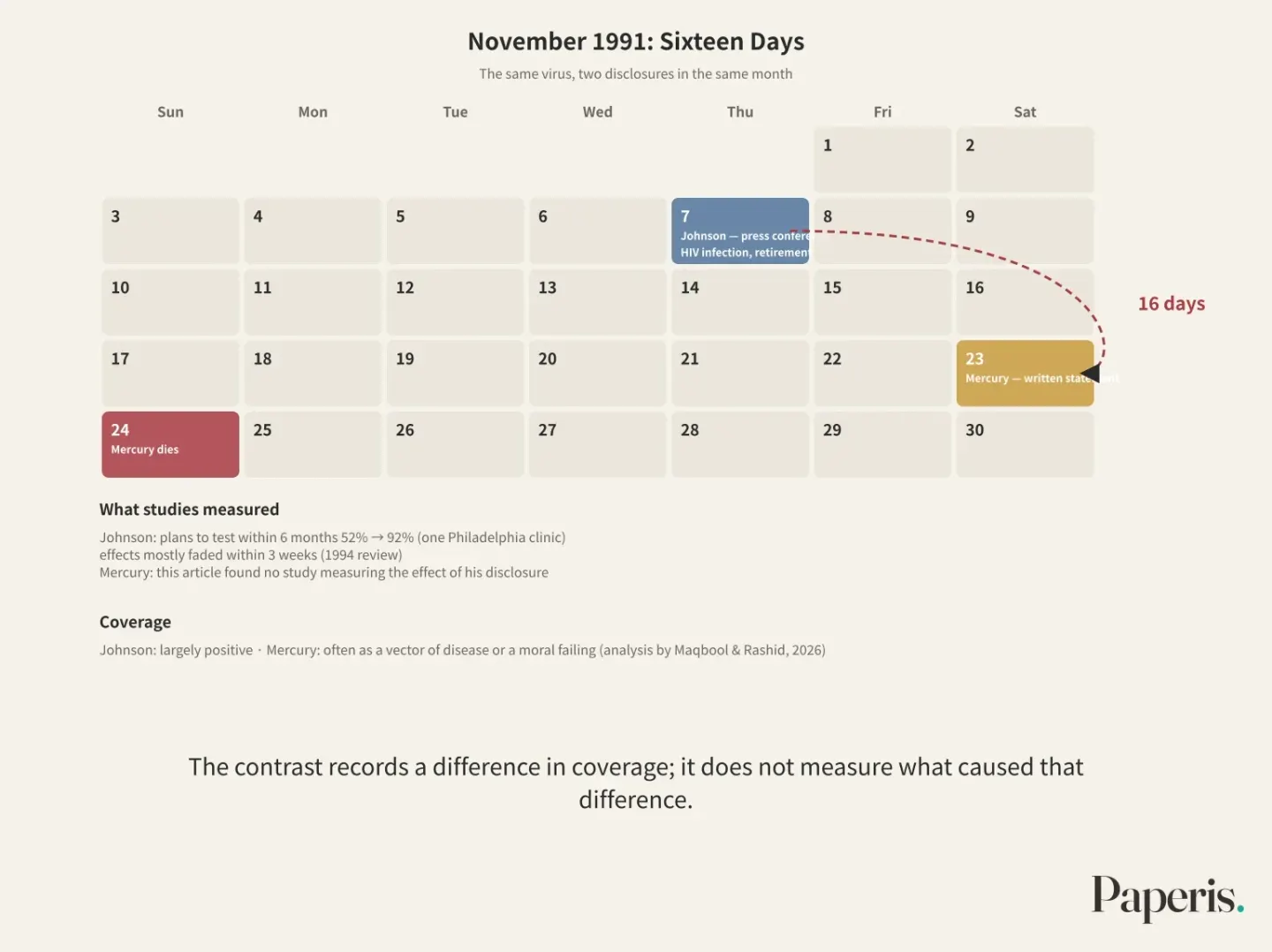
Figure: Sixteen days in November 1991. The contrast below records a difference in coverage, not its cause.
What remains is how the two men were reported on. Since the 1980s when AIDS emerged, social scientists have studied the metaphors used to report and describe the disease, with many studies drawing attention to military language (PMID 15814187). A 2026 paper by Noor Maqbool and Mohamed Rashid published in Discourse & Communication analyzed coverage dealing with Mercury's death. The subjects were British outlets such as The Sun, Daily Star, Mirror, Daily Telegraph, Guardian, and BBC, alongside U.S. outlets including The New York Times, Wall Street Journal, and Los Angeles Times, spanning progressive, conservative, and tabloid media, and the authors also examined how the media's tone changed alongside global discourse on sexual minority rights. According to them, after his death on November 24, 1991, reports frequently linked his death to his sexual orientation and lifestyle, with tabloids like the Star framing his homosexuality as dangerous while other outlets questioned his identity throughout his career (DOI: 10.1177/17504813261447680).
The contrast found by the authors is this. Famous cisgender heterosexuals with HIV and AIDS like Johnson were portrayed positively, whereas queer figures like Mercury were often depicted as vectors of disease and moral failures (DOI: 10.1177/17504813261447680). Based on this, the authors concluded that journalism ethics and responsible representation are needed when reporting on public figures, particularly in areas carrying the stigma of sexual minority identity and health. Because the abstract of this paper does not transcribe which newspapers wrote which sentences, this article also does not rewrite the headlines from 1991. This contrast is a record that the reporting portrayed the two men differently. This paper did not measure causality up to the point of concluding that Johnson received sympathy because he was heterosexual.
On April 20, 1992, the Freddie Mercury Tribute Concert was held at Wembley Stadium, and the AIDS charity Mercury Phoenix Trust emerged from that performance (Queen official website). The Trust introduces itself as being founded in 1992 in his honor, taking on the roles of raising awareness and funding charities in the global fight against AIDS (Mercury Phoenix Trust). It notes that the Trust was founded by Brian May, Roger Taylor, and manager Jim Beach (Mercury Phoenix Trust). The fight against the disease that he asked people to join in his final statement became the work of an organization bearing his name.
What the 2018 Film Moved
Released first in the UK in October 2018, the film "Bohemian Rhapsody" is a biographical drama dramatizing the lives of the four members of Queen, centering on Mercury. The director was Bryan Singer, and after he was fired, Dexter Fletcher took over (DOI: 10.34135/communicationtoday.2023.vol.14.no.1.1) (Deadline, 2019-04-14). Rolling Stone contrasted the film's scenes with the facts immediately after its release (Rolling Stone, 2018-11-01).
First, contrary to the movie, the band did not break up before Live Aid. The members, who had toured continuously for 10 years, were all exhausted and wanted to rest in 1983, but later that year they began working on their next album, "The Works", and their relationship had never fractured. The final concert of that album's tour was a mere 8 weeks before Live Aid. Second, John Deacon was not the original bassist. Third, the record company executive "Ray Foster" who argues with the band is a fictional character. He was roughly modeled after EMI executive Roy Featherstone, but in reality he was an avid fan of the band, and the only factual part was that he thought "Bohemian Rhapsody" was too long to release as a single (Rolling Stone, 2018-11-01).
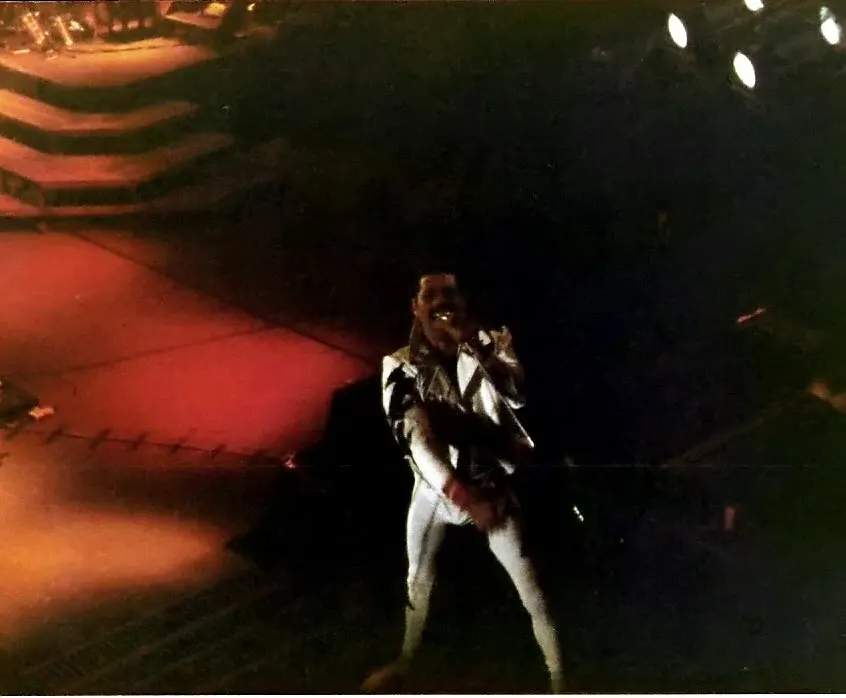
Photo: Freddie Mercury in concert in Frankfurt, Germany, 1984 — a year before Live Aid, Queen were on tour. · Thomas Steffan, via Wikimedia Commons (CC BY-SA 3.0)
The heaviest dramatization is the timing of the illness. Mercury in the movie confesses his HIV-positive status to the band members during Live Aid rehearsals. Rolling Stone writes that the exact time he knew about his illness remains somewhat controversial, but almost everyone places it between 1986 and 1987, and notes that when the band was practicing for Live Aid, he almost certainly did not know (Rolling Stone, 2018-11-01). The movie moved the diagnosis ahead of the 1985 stage, weaving a disease he almost certainly did not yet know about into the narrative of that performance. The timing of the diagnosis remains unsettled to this day.
Critical response and theater response diverged once again. The film received few favorable reviews from critics upon release, but by 2019 tallies, it became the highest-grossing musical biographical film up to that time (DOI: 10.7370/100402). According to a tally by Hollywood media outlet Deadline in April 2019, worldwide box office gross was $900.6 million, and the production budget was $52 million. The top overseas market was Japan at $115.3 million, and sing-along screenings where the audience sings along with the songs fueled enthusiasm particularly in Asia and Latin America (Deadline, 2019-04-14). A 2023 paper reported that this film completely changed how the economic potential of biographical films is viewed, examining through qualitative content analysis the assumption that biographical films using music as a nostalgic narrative tool can gain worldwide popularity (DOI: 10.34135/communicationtoday.2023.vol.14.no.1.1).
There are also studies addressing the devices that make a movie seem like fact. A 2024 paper analyzes the recent convention in biographical films of appending actual archival footage at the end, taking the real footage attached at the end of "Bohemian Rhapsody" as a case, and suggests that this choice can be read as claiming historical authenticity or truth. It also attached the caveat that that footage is not always problematic and varies from film to film (DOI: 10.1093/adaptation/apae026). A movie is a dramatization, and the real footage attached at the end can lend the weight of truth to that dramatization.
Sing-Alongs in Korea
In Korea, cumulative attendance surpassed 9.78 million by mid-January 2019 (Gyeongbuk Maeil, 2019-01-14). Korean researchers immediately tackled this enthusiasm in papers, and their reasons varied.
Shin Won-sun presumes that the film was uniquely popular in Korea compared to other countries, and sees three reasons. The most powerful is the realism that recreated Queen's members and live performances closely resembling the past, the next is the comfort that the story depicting the protagonist's growth, death, and rebirth gave to both the older and younger generations, and the last is the curiosity born of the familiarity of the younger generation who grew up listening to Queen's songs through commercials and broadcasting (DOI: 10.37996/JOG.18.4). Lee So-jin and Hong Sung-gyu look inside the theater. In the sing-along screenings at domestically specialized ScreenX and IMAX auditoriums, the audience sang along, stamped their feet, and clapped, leading to "N-th viewings" of watching the film repeatedly. The authors read this through philosopher Walter Benjamin's concept of the "aura," and concluded that as a result, Queen's aura was recreated (KCI ART002516120). Kim Sa-sook and Kim Gyum-sub introduce "the desire for comfort," "escapism," and "summoning memories" as interpretations offered by domestic and foreign media, and view it as a "newtro" phenomenon where the younger generation discovers the old as if it were new (KCI ART002496397).
The answers of the three papers do not converge into one. The realism of the reproduction, the experience of singing together in the theater, and the different attraction for each generation (memories for the older generation, newness for the younger generation) are simply placed side by side. However, since Japan was number one overseas in terms of monetary amount (Deadline, 2019-04-14), "uniquely" should be understood as the author's premise. Korea was simply one of the countries where it was a particularly big box-office hit.
Amidst that craze, a blind spot pointed out by the aforementioned researcher Choi Dae-hee also remains. The reason he began his research was that the attention poured out after the film concentrated on his sexual orientation, while the life of the immigrant from Zanzibar was not greatly spotlighted (DOI: 10.34221/KJPS.2021.29.2.6). The same film produced research on one side that Queen's aura was recreated, and on the other side, research finding erased layers.
Remaining Questions
Even after 35 years, there are things we do not know. The exact date he was diagnosed with HIV has not been determined. There are no public statements left of what he called his origins and sexual orientation. Today, researchers and institutions variously call him gay, bisexual, or queer, and this article returns those names to the people who wrote them. His voice can only be measured through recordings, and the movement of his vocal cords is only guessed at through videos of imitating singers. We have not yet found research measuring whether his disclosure and death changed people's testing or awareness.
The house where his family lived in Zanzibar is now a tourist attraction (BBC, 2018-10-23). A blue plaque was attached to the wall at 22 Gladstone Avenue in Feltham in 2016. On it, "FREDDIE MERCURY (FRED BULSARA)"—the two names—are engraved together (English Heritage blue plaque note). What papers and records about his life do is closer to sorting out and showing how people have called him, rather than filling in what is inside those parentheses.
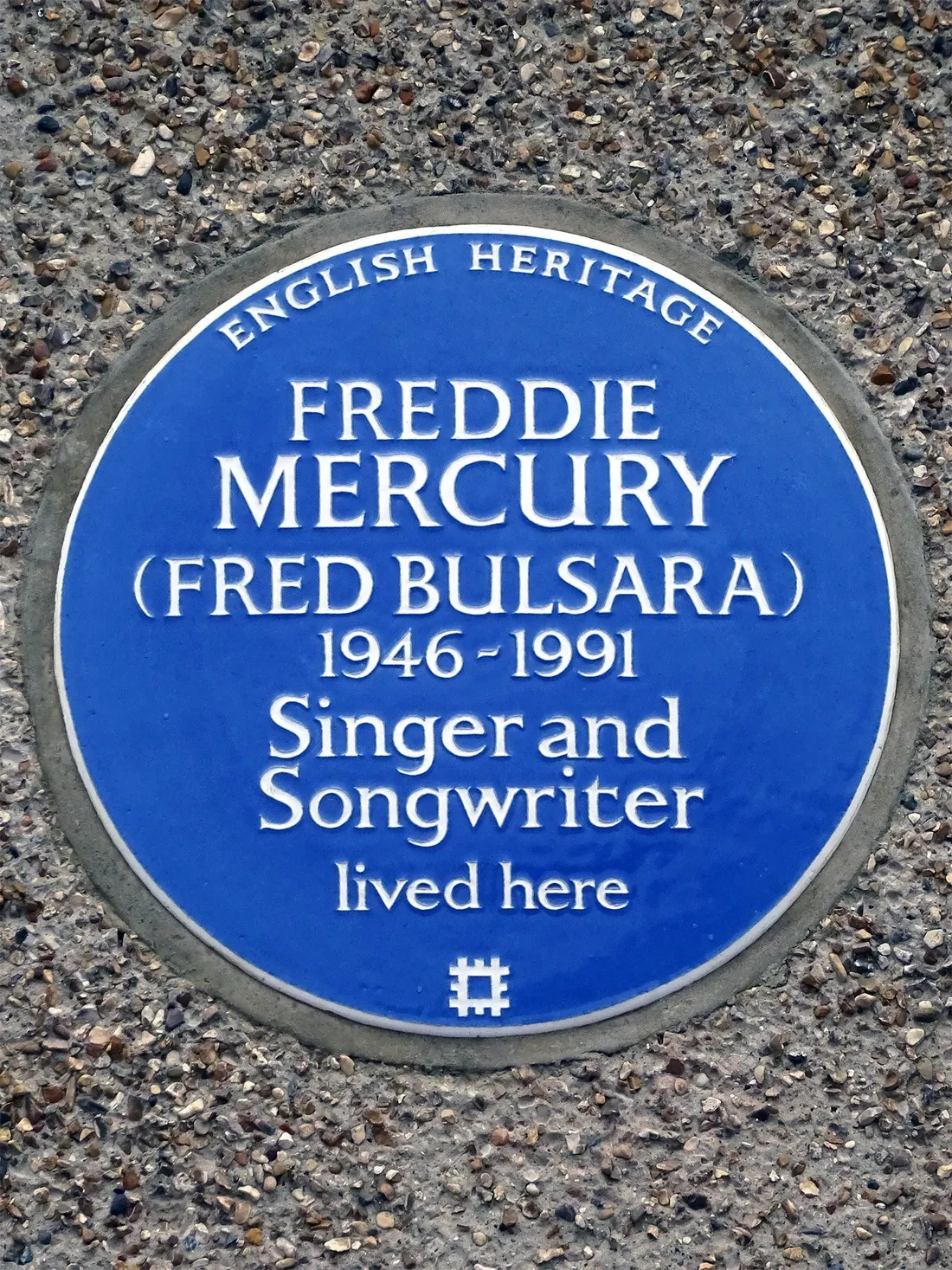
Photo: The English Heritage blue plaque at 22 Gladstone Avenue, Feltham (photographed 2016). · Spudgun67, via Wikimedia Commons (CC BY-SA 4.0)
Archival Materials
- "Freddie Mercury" (Queen Official Site, undated) — https://www.queenonline.com/freddie_mercury — Born in Zanzibar in 1946, piano at age seven, from Smile to Queen, Deacon joined on 1971-03-01, the statement that he insisted on the release of "Bohemian Rhapsody", the 1992-04-20 tribute concert and the Mercury Phoenix Trust.
- "Freddie Mercury's complex relationship with Zanzibar" (BBC, 2018-10-23) — https://www.bbc.co.uk/news/world-africa-45900712 — Born in a government hospital, Parsi parents, a castle from Bulsar, St. Peter's boarding school and The Hectics, return in 1963 (biography citation), 1964 revolution estimates and evacuation, the fact that his family's home became a tourist attraction.
- "Freddie Mercury's naturalisation certificate" (The National Archives) — https://www.nationalarchives.gov.uk/explore-the-collection/stories/freddie-mercurys-naturalisation-certificate/ — Transcription of the naturalization application signed on 1969-03-21 ("Frederick/Farrokh", Feltham address and date, father's birthplace), protectorate, Zanzibar Act, revolution, Tanzania, Ealing graduation and naturalization, unregistered name change, "Bohemian Rhapsody" 9 weeks at number one, Live Aid evaluation.
- "Freddie Mercury — blue plaque" (English Heritage) — https://www.english-heritage.org.uk/visit/blue-plaques/freddie-mercury/ — Plaque inscription, signed "Freddie Bulsara" and 1970 name change, Ealing days and Heathrow kitchen job, "Killer Queen", "Bohemian Rhapsody", May's recollection, private life and mid-1980s rumors.
- "1985: Live Aid concerts" (BBC On This Day, 1985-07-13) — http://news.bbc.co.uk/onthisday/hi/dates/stories/july/13/newsid_2502000/2502735.stm — 72,000 people at Wembley, broadcast to over 1.5 billion people in 160 countries (Queen not mentioned, basis for date and scale).
- "Press coverage 25 November 1991 following Freddie's death" (Guardian 1991-11-25 full article, republished on brianmay.com) — https://brianmay.com/queen-news/2015/10/press-coverage-25-november-1991-following-freddies-death/ — Original statement of November 23 (Saturday), death at age 45, publicist's statement on cause of death, reports of two-year seclusion, listing of father's profession, quotation from "Monster" interview.
- "Freddie Mercury, rock musician" (The Seattle Times, 1991-11-25) — https://archive.seattletimes.com/archive/19911125/1319348/freddie-mercury-rock-musician — Death at Kensington home, statement of "bronchopneumonia resulting from AIDS", quotation from "Monster" interview.
- "Culture Re-View: How Freddie Mercury's death changed AIDS perceptions" (Euronews, 2023-11-24) — https://www.euronews.com/culture/2023/11/24/culture-re-view-how-freddie-mercurys-death-changed-aids-perceptions — Press narrative that his death changed AIDS perceptions (not a measurement study).
- "About us" (The Mercury Phoenix Trust) — https://www.mercuryphoenixtrust.org/site/aboutus — Purpose of 1992 establishment, founders (May, Taylor, manager Jim Beach).
- "Fact-Checking the Queen Biopic" (Rolling Stone, Andy Greene, 2018-11-01) — https://www.rollingstone.com/music/music-news/freddie-mercury-queen-biopic-bohemian-rhapsody-movie-fact-check-746195/ — Circumstances of joining, breakup dramatization, Deacon, Ray Foster and Roy Featherstone, time of diagnosis (1986–1987, almost certainly did not know at Live Aid), final tour show 8 weeks before Live Aid.
- "Bohemian Rhapsody crosses $900 million worldwide" (Deadline, Nancy Tartaglione, 2019-04-14) — https://deadline.com/2019/04/bohemian-rhapsody-crosses-900-million-worldwide-box-office-fox-1202595576/ — Worldwide box office $900.6 million, highest-grossing music biopic of all time, production budget $52 million, UK early release, overseas #1 Japan $115.3 million, Asia and Latin America sing-alongs, director replacement.
- "'Bohemian Rhapsody' weekend audience" (Gyeongbuk Maeil, 2019-01-14) — https://kbmaeil.com/article/201901140241191 — Cumulative 9,785,643 viewers based on the Korean Film Council's integrated ticketing computer network.
Source Papers
- "Zanzibar, Parsi Community and 'Immigrant' Freddie Mercury" (2021) — DOI: 10.34221/KJPS.2021.29.2.6 — Reports that post-movie interest focused on sexual orientation while the immigrant's life was not highlighted, and explores Zanzibar, Parsis, Indian boarding schools, name changes, and the concealment of origins.
- "Reinterpreting the 'Immigrant' Freddie Mercury and Bohemian Rhapsody" (2021) — DOI: 10.22446/mnpisk.2021.15.2.003 — Argues that as a colonial immigrant who migrated at age 17, he concealed his past and ancestry to stage "Englishness," and traces the reason to his status as a person of color and immigrant (author's interpretation).
- "Borderliner Identity and the Possibility of Cultural Convergence and Creation: Through the Life and Music of Freddie Mercury" (2019) — DOI: 10.17328/kjcs.2019.27.2.003 — Interprets the borderliner identity as a migrant, refugee, and sexual minority, along with the potential for convergence and creation in musical forms.
- "On the Margins of the Mainstream: Queen, the Rock Press, and Gender" (1999) — DOI: 10.71548/14756 — A thesis confirming two decades of consistently negative evaluations by the US and British press and arguing that gender sits at the center of that marginalization.
- "Queer in Queen: Camp aesthetics and queer performativity in Queen's music videos" (2019) — DOI: 10.31926/but.pcs.2019.61.12.7 — Reads Queen's music videos through Sontag's concept of camp and argues that the camp visuality designed by Mercury was a therapeutic format for coping with his own queerness (interpretation).
- "Rock and Rhapsodies: The Music of Queen" (2021) — DOI: 10.1093/oso/9780197526736.001.0001 — The first book-length musicological study on Queen, linking Mercury's voice to the discourse of the "queer voice."
- "Freddie Mercury-acoustic analysis of speaking fundamental frequency, vibrato, and subharmonics." (2017) — PMID 27079680 — Analysis of public recordings: median spoken fundamental frequency of 117.3Hz, vocal range F#2 to G5 spanning 37 semitones (evidence for 1,347Hz judged unreliable), average vibrato of 7.0Hz and irregular, and 3:1 vocal fold to ventricular fold vibration in a rock singer impersonator.
- "Sexual risk behaviors of STD clinic patients before and after Earvin "Magic" Johnson's HIV-infection announcement--Maryland, 1991-1992." (1993) — PMID 8421454 — On November 7, 1991, Magic Johnson announced his HIV infection and retirement at a press conference; comparison of 14 weeks before and after the announcement at a Maryland STD clinic.
- "Effect of Magic Johnson's HIV status on HIV-related attitudes and behaviors of an STD clinic population." (1992) — PMID 1472415 — Plans for HIV testing within six months increased from 52% to 92%, high risk perception from 25% to 34% (not significant); associated with increased interest and attitude/behavior changes that reduce risk.
- "Magic Johnson and public attitudes toward AIDS: a review of empirical findings." (1994) — PMID 7702965 — While increases in information inquiries and testing were reported, most effects subsided within three weeks, and changes in knowledge and risk perception were small.
- "Disease metaphors in new epidemics: the UK media framing of the 2003 SARS epidemic." (2005) — PMID 15814187 — Analyzes SARS coverage using the research tradition on metaphors in HIV/AIDS reporting since the 1980s, particularly military language, as a starting point.
- "The shifting terrains of framing sexuality: The difference in discourse around celebrity death, disease, and memory in news media" (2026) — DOI: 10.1177/17504813261447680 — Mercury's death coverage was commonly linked to sexual orientation and lifestyle, portraying heterosexual celebrities like Johnson positively while framing queer figures like Mercury as disease vectors and moral failures; urges journalistic ethics.
- "The Blockbuster Biopic Bohemian Rhapsody as an Expression of Cinema/Music Synergy" (2023) — DOI: 10.34135/communicationtoday.2023.vol.14.no.1.1 — Director Singer, later Fletcher; views this film as having altered perceptions of the economic potential of biopics, and examines music as a nostalgia-driven narrative tool through qualitative content analysis.
- "Linguistic Representations of Homosexual Identity in Bohemian Rhapsody and Rocketman across English and Italian Linguacultures" (2021) — DOI: 10.7370/100402 — Although it received few favorable reviews from critics upon release (at the time of the 2021 paper), it became the highest-grossing music biopic of all time; compares Italian dubbing of homosexual representations.
- "An image too many: the contemporary biopic, the historical body, and the documentary footage trope" (2024) — DOI: 10.1093/adaptation/apae026 — Analyzes "Bohemian Rhapsody" as a case study, arguing that actual documentary footage at the end of a biopic can imply claims of historical authenticity and truth (though not always).
- "Korean Emotional Codes in <Bohemian Rhapsody>" (2019) — DOI: 10.37996/JOG.18.4 — Views the reasons for box-office success in Korea through three lenses: the realism of past reenactment, the comfort of an initiation drama, and curiosity driven by familiarity.
- "The Screening of the Film <Bohemian Rhapsody> and the Reproduction of Aura" (2019) — KCI ART002516120 — Reads domestic ScreenX and IMAX sing-along screenings and repeat viewings through Benjamin's aura, concluding that Queen's aura was reproduced.
- "An Analysis of Storytelling and Cultural Codes in Video Content - Focusing on the Musician Biopic 'Bohemian Rhapsody' -" (2019) — KCI ART002496397 — Introduces media interpretations (comfort, escapism, recalling memories) and views the younger generation's enthusiasm as "newtro."
Sources (16)
- 잔지바르, 파르시 공동체 그리고 '이민자' 프레디 머큐리DOI 10.34221/kjps.2021.29.2.6
- '이민자' 프레디 머큐리와 보헤미안 랩소디의 재해석DOI 10.22446/mnpisk.2021.15.2.003
- 경계인의 정체성과 문화의 융합·창조 가능성: 프레디 머큐리(Freddie Mercury)의 삶과 음악을 통해DOI 10.17328/kjcs.2019.27.2.003
- On the Margins of the Mainstream: Queen, the Rock Press, and GenderDOI 10.71548/14756
- Queer in Queen: Camp aesthetics and queer performativity in Queen's music videosDOI 10.31926/but.pcs.2019.61.12.7
- Rock and Rhapsodies: The Music of QueenDOI 10.1093/oso/9780197526736.001.0001
- Freddie Mercury-acoustic analysis of speaking fundamental frequency, vibrato, and subharmonicsPMID 27079680
- Sexual risk behaviors of STD clinic patients before and after Earvin \PMID 8421454
- Effect of Magic Johnson's HIV status on HIV-related attitudes and behaviors of an STD clinic populationPMID 1472415
- Magic Johnson and public attitudes toward AIDS: a review of empirical findingsPMID 7702965
- Disease metaphors in new epidemics: the UK media framing of the 2003 SARS epidemicPMID 15814187
- The shifting terrains of framing sexuality: The difference in discourse around celebrity death, disease, and memory in news mediaDOI 10.1177/17504813261447680
- The Blockbuster Biopic Bohemian Rhapsody as an Expression of Cinema/Music SynergyDOI 10.34135/communicationtoday.2023.vol.14.no.1.1
- Linguistic Representations of Homosexual Identity in Bohemian Rhapsody and Rocketman across English and Italian LinguaculturesDOI 10.7370/100402
- An image too many: the contemporary biopic, the historical body, and the documentary footage tropeDOI 10.1093/adaptation/apae026
- <보헤미안 랩소디>의 한국적 감성코드DOI 10.37996/jog.18.4