
Paperis Articles
GLP-1 Drugs and the Optic Nerve — How "Four Times" Became "Very Rare"
The European Medicines Agency now lists NAION as an adverse effect of semaglutide — how a large ratio from one clinic's records changed through national registries, meta-analyses, adverse-event reports and a consensus statement, and what remains
Your field's papers, as audio
Pick your fields and journals — Paperis summarizes the key papers and turns them into audio. Listen on your commute.
Start Paperis free →GLP-1 Drugs and the Optic Nerve — How "Four Times" Became "Very Rare"
Two Numbers Released in 2024
In 2024, a study tracing back the medical records of a university hospital's neuro-ophthalmology clinic released two numbers. For a type of optic neuropathy where vision in one eye drops suddenly, the risk for Type 2 diabetes patients prescribed semaglutide was 4.28 times that of patients receiving other classes of diabetes drugs, and for overweight and obesity patients, it was 7.64 times that of those receiving other weight-loss drugs. The subjects were all people who had already visited the neuro-ophthalmology clinic, and the actual rate at which this condition developed over 3 years was 8.9% versus 1.8% in the diabetes group (PMID 38958939).
Semaglutide is the active ingredient in the diabetes drug Ozempic and the weight-loss drug Wegovy. GLP-1 receptor agonists are drugs that bind to GLP-1 receptors to produce the same signals as GLP-1. GLP-1 is a hormone released by the intestines when food enters, and semaglutide is one of the most widely used drugs in this class (PMID 42201355).
The condition examined by the study is named NAION. NAION (non-arteritic anterior ischemic optic neuropathy) is a disease where blood does not flow well to the front end of the optic nerve—which sends visual signals from the eye to the brain—typically causing sudden vision loss in one eye. It often occurs without pain and is the most common acute optic neuropathy in people over 50 (PMID 41839534). There are still no proven medical or surgical treatments or prevention methods (PMID 37987292). Therefore, the number "4 times" sounded heavy.
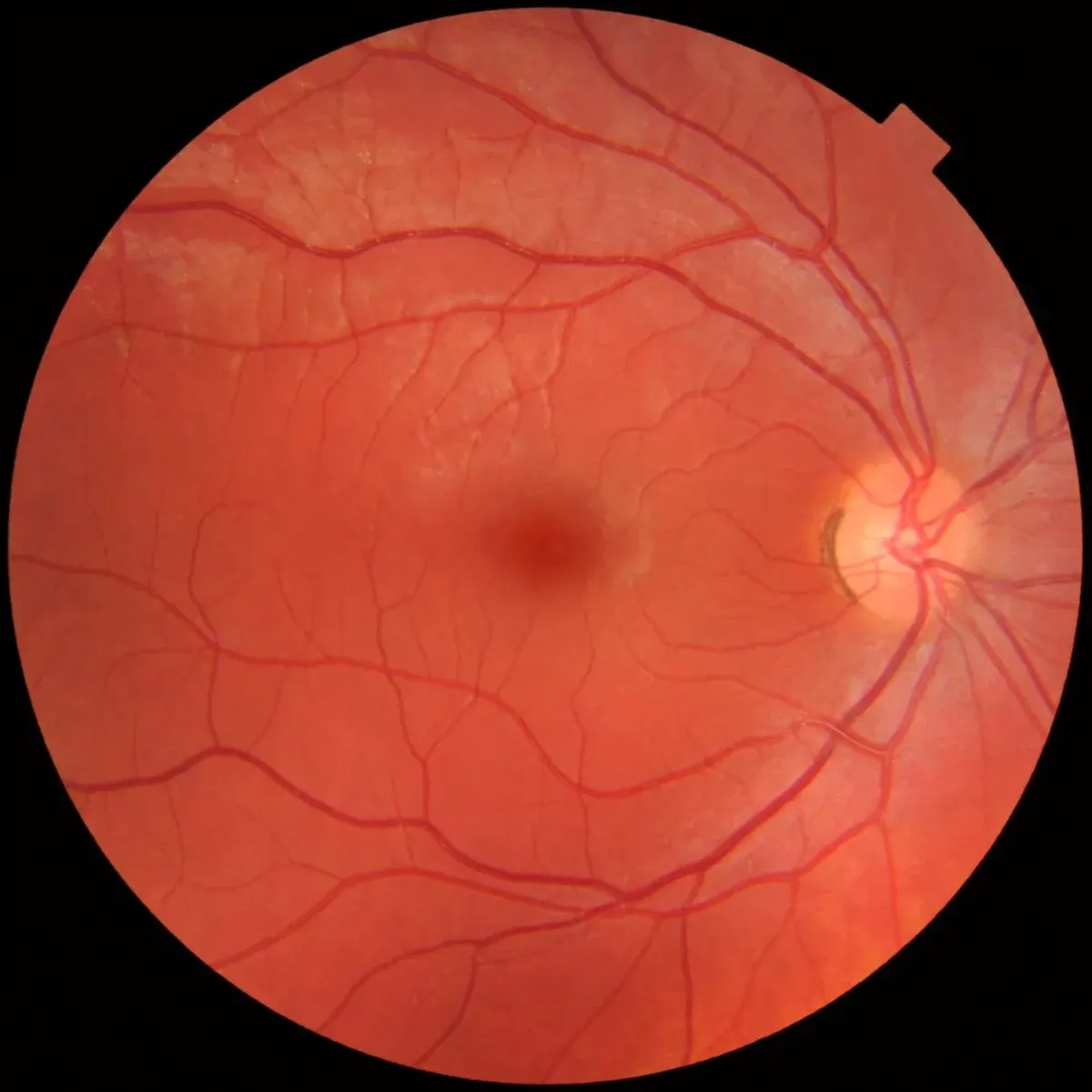
Figure: The inside (fundus) of a healthy right eye. The bright disc on the right is where the optic nerve leaves the eye; NAION arises when blood flow to this front end of the optic nerve falls short. · Mikael Häggström · Wikimedia Commons (CC0)
Over the next two years, nation-level registry studies, meta-analyses, adverse event reporting database analyses, and consensus statements addressing the same question followed one after another. The results did not converge in a single direction. Below, we examine in turn where and how those numbers differed, and what remains. Here we tackle head-on the question that the sibling article "What Do GLP-1 Drugs Do Beyond Weight? — Signal, Association, and Confirmation" briefly covered as a case showing layers of evidence. The evidence is mostly from studies in the US and Europe, with one line added about South Korea. In South Korea, national health insurance coverage criteria for injectable semaglutide went into effect on February 1, 2026, and the number of users may increase (PMID 42978139).
This debate began with a large multiple from a single hospital's records, and that disease is rare but leaves vision loss that is often irreversible (PMID 39696569).
"4x" Was a Number Measured Inside Whom?
In that study, out of 194 type 2 diabetes patients prescribed semaglutide, 17 developed NAION, and out of 516 receiving other diabetes medications, 6 developed it. On the overweight and obesity side, it was 20 out of 361 for semaglutide, and 3 out of 618 for other obesity drugs (PMID 38958939). Because the number of events was in the dozens, the uncertainty range for the 4.28-fold value was wide, spanning from 1.62-fold to 11.29-fold. The authors also noted in the conclusion that, being an observational study, follow-up research is needed to pinpoint causality (PMID 38958939).
To read this number, two values must be separated. Relative risk is a value indicating how many times higher the disease incidence rate is in the group that used the drug compared to the comparison group. Absolute risk is a value indicating out of how many people, how many actually developed the disease. Two out of 10,000 and one out of 10,000 is also a 2-fold difference, and two out of 100 and one out of 100 is also a 2-fold difference. Even if the multipliers are the same, the chance of that event happening in my life differs by a factor of one hundred. Therefore, "how many times" always makes sense only when read together with "out of how many people."
The absolute numbers in the first study were actually large. The 3-year cumulative incidence rate was 8.9% in the semaglutide group and 1.8% in the comparison group (PMID 38958939). Even 1.8% is 18 people out of 1,000. This is a number far removed from the general population. In a survey that re-verified all diagnoses of optic neuropathy from 26 years of medical records of residents in a county in Minnesota, USA, the NAION incidence rate was 10.19 per 100,000 people aged 50 and older (PMID 38358828). There is also an estimate of 2.5 to 11.8 per 100,000 people in men over 50 (PMID 39163055). The two numbers use different yardsticks. The 8.9% and 1.8% from the first study are rates accumulated over 3 years, whereas Minnesota's 10.19 is the incidence rate per 100,000 people, though the abstract does not state what year baseline it is based on.
That difference stems from where the study gathered people. The subjects of this study were records of patients treated by neuro-ophthalmologists. This is a setting where people are gathered who have already been referred because vision or optic nerve problems are suspected. One review therefore interprets that even the NAION incidence rate in the comparison group not using semaglutide was higher by orders of magnitude than the general population, likely because the referral pathway concentrated high-risk NAION patients into the study cohort (PMID 40055951). A multiplier measured within people at high risk cannot be directly transferred to the general population.
"4x" was a relative risk measured with dozens of events among neuro-ophthalmology patients, where high-risk patients appeared to be concentrated.
Count the Entire Country
Denmark followed all 424,152 type 2 diabetes patients from 2018 to 2024. During 1.91 million person-years (the value calculated by watching one person for one year as one person-year), 218 people developed NAION. The incidence rate was 0.228 per 1,000 person-years in the semaglutide group and 0.093 in the non-user group, and the relative risk adjusted for other factors was 2.19-fold (PMID 39696569). Translated to 10,000 people using it for one year, it is 2.28 people for the user group and 0.93 people for the non-user group. The authors concluded that the risk exceeded double, that vision loss is an irreversible disease so this risk must be acknowledged, and that studies to find high-risk groups must follow (PMID 39696569).
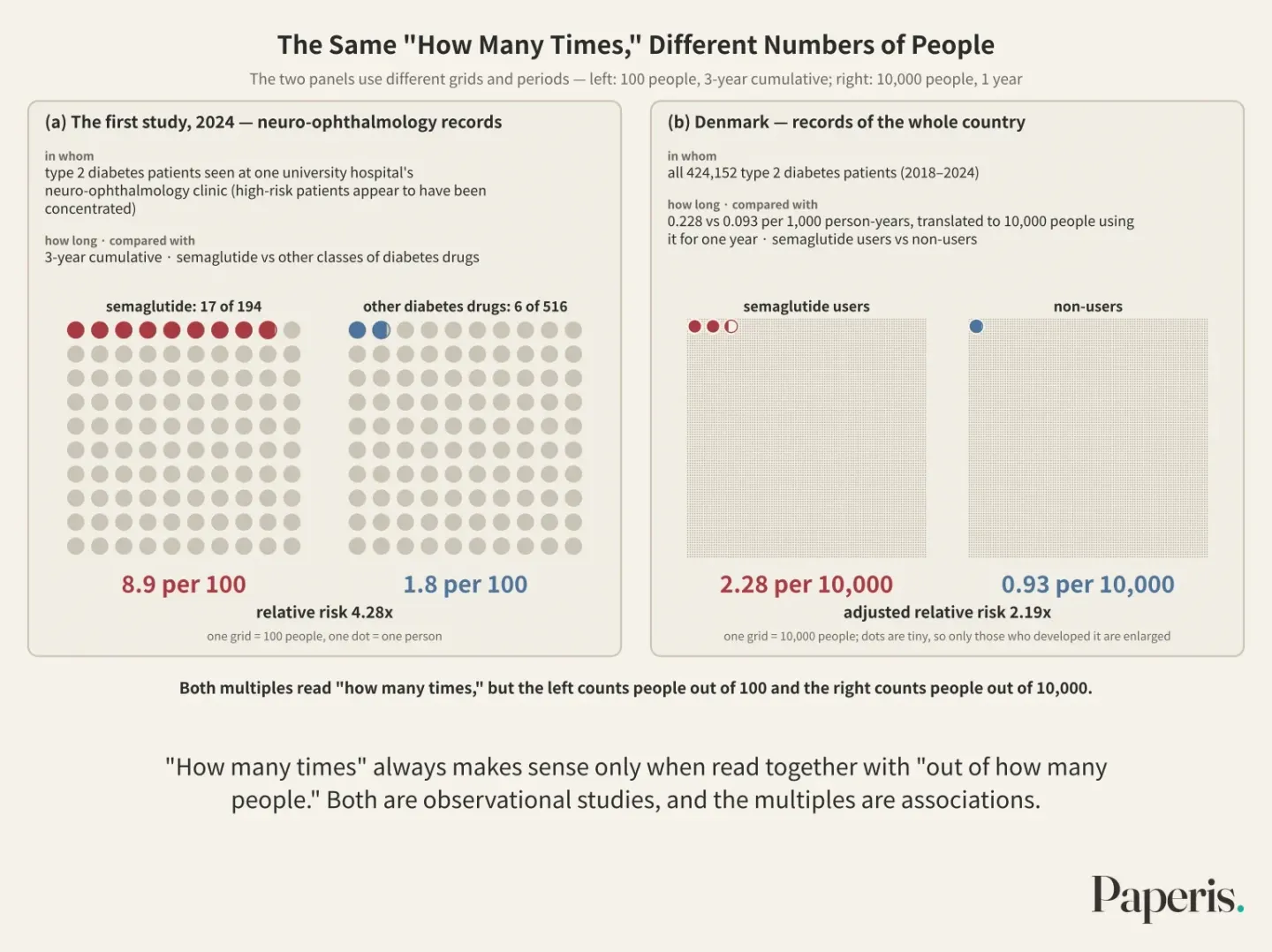
Figure: The same "times as many," different numbers of people. Left: per 100 neuro-ophthalmology patients over 3 years; right: per 10,000 people with type 2 diabetes in Denmark over 1 year. Both are observational studies; the ratios are associations.
Afterwards, records from several countries answered the same question. Because the comparison groups differed from study to study, those columns are left together.
| Data | Comparison Group | Relative Risk | Absolute Number |
|---|---|---|---|
| Danish and Norwegian national records (PMID 40098249) | SGLT2 inhibitors (other diabetes drugs) | 2.81-fold | 1.41 more per 10,000 person-years |
| UK primary care records (PMID 41701611) | DPP-4 inhibitors (other diabetes drugs) | GLP-1 class 2.56-fold | 18.5 vs 7.2 per 100,000 people per year |
| 3 US insurance claims datasets (PMID 41104517) | SGLT2 inhibitors | GLP-1 class 1.85-fold | 0.29 more per 1,000 person-years |
| US electronic health record network, 9 years (PMID 41687959) | Other diabetes drugs | GLP-1 class 1.38-fold | 0.21% vs 0.17% over 9 years cumulative |
| US electronic health records, 2 years (PMID 40788646) | Other diabetes drugs | Semaglutide and tirzepatide 1.76-fold | 0.04% vs 0.02% over 2 years |
All of these studies are observational studies, and the multiples above are all "associations". The direction is largely consistent, but the magnitude is spread from 1.38-fold to 2.81-fold, which is smaller than the 4.28-fold of the first study. When Paperis converts the numbers of studies with differences based on 10,000 people per year, the additional people who developed it in the drug user group are roughly 0.4 to 3 people. This excess is an association seen in observational studies, and is not a confirmed number created by the drug. Also, these numbers all came from records of type 2 diabetes patients. In people who used it for weight loss purposes, even when combining observational studies, the increase in risk was not significant (1.57-fold, range 0.69–3.59), lacking the basis to count absolute numbers (PMID 41475544). The Danish and Norwegian study had a total of 32 events, and the authors concluded that there is an association, but the absolute risk is low (PMID 40098249). The authors of the US insurance claims data study also noted side by side with a relative risk of an 85% increase that the incidence rate and absolute increase were small (PMID 41104517).
The largest data was an international research network pooling 14 databases and 37.1 million type 2 diabetes patients. The incidence rate of NAION in new semaglutide users was 14.5 per 100,000 person-years. When NAION was defined broadly, the risks compared with three different diabetes drugs were all not statistically different, and when defined narrowly, it was 2.27-fold only when compared with one drug (empagliflozin). In an analysis comparing periods with and without drug use within the same individuals, it was 1.32-fold. The authors concluded that the increased risk associated with semaglutide is at a modest level and smaller than previously reported, and that its clinical significance should be investigated further (PMID 39976940).
There are opposing results as well. In an analysis of a US electronic health record network, the 5-year NAION risk in diabetes patients using semaglutide was not higher than the comparison group (PMID 40015592). Another analysis using medical institution records from 21 countries also found no association in either those with diabetes alone, those with obesity alone, or those with both (PMID 39491755). In a study looking at 1.21 million beneficiaries of the US military health system, the probability of NAION in diabetes patients using semaglutide came out lower instead (odds ratio 0.36) (PMID 41217382). Another study compared with the diabetes drug DPP-4 inhibitors also found no meaningful difference in NAION (PMID 42660856). The authors of the 21-country records study and the military health system study wrote that worry about NAION alone may not be a basis to avoid this drug (PMID 39491755, PMID 41217382).
As the scope of counting numbers was expanded to the entire country, the multiples became smaller and scattered. However, several studies that found differences remained, and several studies that found no difference also remained.
Same Question, Different Answers — Analyses That Gathered Studies
Between 2025 and 2026, several analyses emerged that gathered scattered studies on this single question. A meta-analysis is an analysis that pools the results of multiple studies addressing the same question and recalculates them together. One might expect the answers to converge when pooled, but that was not the case for this topic. This is because what was pooled differed.
| Meta-analysis | What Was Pooled | Result | Authors' Conclusion |
|---|---|---|---|
| PMID 41475544 | 8 clinical trials + 8 observational studies, diabetes and weight loss calculated separately | 1.85-fold only in diabetes observational studies (26.7 vs. 18.9 per 100,000 person-years). Diabetes clinical trials 5 vs. 1 event, weight loss showed no significant increase in either observational or clinical trials | Absolute incidence is low. The signal appears only in diabetes observational data and is not supported by clinical trials. Pharmacovigilance must continue |
| PMID 41692115 | 6 observational studies, 4.83 million people | Overall adjusted risk 1.63-fold, not significant. Removing one study makes it significant at 1.92-fold. Diabetes 1.70-fold, obesity 0.47-fold | Does not show a consistent increase. Certainty low to very low. The difference may reflect the disease's underlying risk rather than a drug-specific effect |
| PMID 42612051 | 8 observational studies, 5.92 million people | 1.93-fold. Diabetes 1.84-fold, overweight and obesity not significant | Association is possible. More randomized clinical trials are needed |
| PMID 42166479 | 5 diabetes observational studies | 2.17-fold. Absolute risk is 0.014%, meaning about 1 additional case per 7,000 people per year | Association is possible, and particular caution is needed in individuals with high baseline risk. Certainty of evidence is low |
| PMID 42311413 | 28 observational studies, comparing the entire GLP-1 class to other diabetes drugs | 1.01-fold, no difference | No difference was found, but it is advisable to monitor administration |
| PMID 40810985 | 78 clinical trials, 73,640 people | 3.92-fold (range 1.02 to 15.02) | An association was observed, but data are insufficient to draw a conclusion |
Besides these, there are analyses reporting 3.36-fold at 1 year (PMID 42201355), 2.62-fold (PMID 40962119), and 2.52-fold (PMID 42060879). Conversely, a systematic review that evaluated nine observational studies one by one instead of combining their numbers concluded that "they do not support a causal relationship" (PMID 41938304).
There are four forks in the road. The first is design. Because clinical trials use random assignment to determine who receives the drug, differences in baseline risk are unlikely to interfere, but for rare conditions like NAION, only a few events occur. In the diabetes clinical trials, 5 events versus 1 event is large in terms of a fold change, but hard to distinguish from chance (PMID 41475544). Even the same clinical trial data split into "not significant" and "significant but underpowered" depending on which trials and how many were gathered (PMID 41475544, PMID 40810985).
The second is who the drug was prescribed to. In multiple analyses, the signal appeared on the diabetes patient side and was not significant in users taking it for weight loss (PMID 41475544, PMID 41692115, PMID 42612051). The third is the scope of the drug. Analyses looking at semaglutide alone generally yielded figures between 1.6-fold and the 3-fold range, whereas the analysis grouping the entire GLP-1 class together found no difference (PMID 42311413). However, among individual studies looking at the entire GLP-1 class, some found a difference—such as UK and US data—so this single fork does not explain everything (PMID 41701611, PMID 41104517).
The fourth is the robustness of the results. In one analysis, simply adding and removing a single study flipped whether the result was significant, and the authors read this to mean the results are fragile (PMID 41692115). Because multiple studies used the same large medical records network, there was a risk that the same patients were counted multiple times, so one analysis separately adjusted for this overlap (PMID 41475544).
The direction of the conclusions ranged from "an association is possible" to "does not show a consistent increase" and "does not support a causal relationship." Because what was pooled differed, the answers differed, and what multiple analyses added in common was that the absolute risk is low and the certainty of the evidence is low.
Who Were They Compared With — People at High Original Risk
In a medical record from a county in Minnesota, USA, reviewing 104 people who had experienced NAION, 79.8% had high blood pressure, 74.0% had dyslipidemia, 39.4% had diabetes, and 23.1% had obstructive sleep apnea. All four were more common than in a comparison group of the same age (PMID 38358828). Sleep apnea is a condition where the airway in the back of the throat repeatedly collapses during sleep, causing breathing to stop. In addition, end-stage kidney disease, smoking, obesity, and certain drugs (such as erectile dysfunction medications and the anti-arrhythmia drug amiodarone) are cited as factors linked to NAION (PMID 42857401, PMID 39163055).
This list heavily overlaps with the profile of people prescribed semaglutide. Confounding factors are third factors that make the people who used the drug and those who did not different from the start, thereby producing differences that look like the effect of the drug. It is easy to understand if you picture two people. A person with severe diabetes, heavy weight, and cardiovascular disease is likely to receive semaglutide and also has a high original risk of NAION. A person with mild diabetes receives a different drug and has a low original risk. When comparing the two, differences not caused by the drug can be attributed to the drug. A literature review evaluating nine observational studies pointed to this very thing as the most plausible reason for conflicting results: the fact that people receiving semaglutide have more severe diabetes, obesity, and cardiovascular disease. The same literature review summarized that studies comparing untreated individuals or a broad population consistently yielded high risks, while studies comparing them with other drugs having similar metabolic risks generally yielded no association (PMID 41938304).
A Swedish study tested this suspicion directly. When comparing people who newly started a GLP-1 class drug with people who newly started SGLT2 inhibitors—another diabetes drug—the 1-year risk was 0.04% versus 0.02% (relative risk 1.93 times), and the 5-year risk was 0.12% versus 0.07% (1.69 times). The 5-year value had a range of 0.95 to 3.01, hovering on the borderline from the start. When the researchers narrowed the group to people who were both taking metformin as a baseline drug to more closely match the severity of diabetes, the risk difference shrank substantially (5-year relative risk 1.23 times, range 0.65 to 2.33). The authors concluded that the observed increase in risk may reflect remaining confounding (PMID 42441962).
However, even in studies comparing them with other diabetes drugs in similar situations, a difference sometimes remained. A Danish-Norwegian study showed a 2.81-fold difference compared to SGLT2 inhibitors. Yet, in the same study, a self-controlled case series restricted to semaglutide users was not significant, showing 1.14 times for Denmark (range 0.55 to 2.36) and 2.67 times for Norway (0.91 to 8.99) (PMID 40098249). A British study chose DPP-4 inhibitors as the comparison because they are used as second-line drugs like GLP-1 drugs and have no known association with NAION, yet the result was 2.56 times (PMID 41701611). An international research network analysis comparing periods when the same individuals were on and off the drug also yielded 1.32 times (PMID 39976940). Results from designs that eliminate fixed differences between people did not point in a single direction.
What was counted as NAION also shakes the numbers. In the same international network study, there was no difference when diagnostic codes were defined broadly, but a difference appeared in comparison with one drug when defined narrowly (PMID 39976940). This is why multiple meta-analyses cited diagnostic misclassification as a limitation (PMID 41692115, PMID 42166479).
There are studies where the difference shrank when confounding was reduced further, and studies where the difference remained even in designs that reduced confounding. These two explanations currently stand side by side.
Large Numbers in Reporting Data — How to Read a Signal
In the U.S. Food and Drug Administration's adverse event reporting data, reports listing semaglutide and optic nerve ischemia together numbered 355. The value comparing this combination's reporting proportion with other drugs was 94.45 (PMID 42259643). Starting from the study that first analyzed this data, the signal for semaglutide was stronger than for other GLP-1 drugs (PMID 39922760). In the World Health Organization's international reporting data as well, the same value for semaglutide and NAION came out as 40.18 (PMID 41021211).
Reading this number as a "94-fold risk" is incorrect. Reporting data consists of records voluntarily submitted by doctors, patients, and pharmaceutical companies about problems that occurred after taking a drug. The value above measures how much larger the share of a specific adverse event is within a certain drug's reports compared to reports for other drugs. Since the number of people who took the drug is not in this data, how many out of how many developed it does not come from here. Therefore, the result of such an analysis is called a "signal" and is used as an indication that something is worth checking further. The authors of a reporting analysis comparing semaglutide and tirzepatide also noted that the results are merely patterns of voluntary reporting rather than a comparison of actual risk or causality (PMID 42955519). Among semaglutide reports, 62.7% of the total were concentrated in 2024–2026, while reports for the compared SGLT2 inhibitors and metformin were 17.5%. Because reporting periods are concentrated in recent times, numbers from reporting data are sensitive to which time period is observed (PMID 43047309).
Reporting data still tells us something. The size of the signal differed for each drug. In the same U.S. reporting data, liraglutide had a signal of 4.58 and tirzepatide 2.94—which were present but much smaller than semaglutide—while no signal appeared for dulaglutide, exenatide, and lixisenatide. The authors viewed this as inconsistent with the idea that the effect applies equally across the entire class (PMID 42259643). On the other hand, another review noted that similar signals are being examined in other drugs as well, leaving open the possibility of a class-wide effect (PMID 42543940). Tirzepatide is a drug that binds together to the receptors of GLP-1 and another gut hormone, and another reporting analysis did not find an optic nerve ischemia signal (PMID 40383360). A review compiling evidence by drug summarized that the most consistent signal lies in injectable semaglutide, where the amount entering the body is large, whereas oral semaglutide, liraglutide, dulaglutide, exenatide, and tirzepatide have signals that are absent, inconsistent, or weak. The same review self-stated that the blood concentration threshold it proposed is at the stage of building a hypothesis (PMID 42770962).
A large number in reporting data is an indication to "look closer here." That indication turned on most strongly for semaglutide, and differently for each drug even within the same class.
When Does It Occur? — Different Timelines
In the first study, NAION on the semaglutide side occurred within 14 months of starting treatment, whereas the comparison side was scattered evenly across 3 years (PMID 40055951). The timelines measured by subsequent studies do not match each other.
In the UK study, the risk was highest in the first 6 months of starting use, and decreased the longer it was used (PMID 41701611). Another analysis from Denmark matched the drug use records of 123 NAION patients and 4,920 control subjects backward, showing no clear increase up to 6 months of cumulative use, with the highest risks at 6 months to 1 year (3.63-fold) and 1 year to 1.5 years (3.52-fold). For current users it was 2.28-fold, and the estimate for recent discontinuers was uncertain (PMID 42126975). In the overall Danish cohort, the median time from first prescription to NAION was 22.2 months (PMID 39696569). A US electronic health record study found no significant difference up to 1 year, but differences appeared at the 2-, 3-, and 4-year time points (PMID 40146102).
Three answers—the first half-year, half a year to a year and a half, and 2 years later—have emerged for the same question. There is no absolute number to pair alongside the 3.63-fold of the Danish analysis. Because the design matched patients and comparison groups and then checked drug use backward, how many out of how many individuals developed it is not calculated (PMID 42126975).
Clues as to who had a higher risk are also still at the single-study level. In the UK study, the risk was higher in people under 50, males, those with a smoking history, and those whose glycated hemoglobin (a figure showing the average blood sugar over two to three months) dropped by 1 percentage point or more (PMID 41701611). This result—that it was higher in people whose blood sugar dropped significantly—connects to a hypothesis in the next section.
There is yet no conclusion on timing. Each study had a different timeline, and prospective studies to separate which timeline is correct have not yet been published.
Why the Optic Nerve — What Is Still a Hypothesis
There is one anatomical feature common to eyes prone to NAION. The optic nerve passes through a small opening in the back wall of the eyeball on its way to the brain, and in some eyes, this opening is small, causing nerve fibers to pass through in a tight bundle. An anatomical shape referred to in English as a "disc-at-risk" is cited by one review as the most robust anatomical predictor of NAION (PMID 42857401). There is also a systematic review suggesting caution when using semaglutide in eyes with a small opening, deposits (drusen) accumulated in the opening, or fiber crowding (PMID 40926946).
What the drug does to this opening has not been confirmed. There are three explanations currently on the table. The first is a rapid drop in blood sugar. Noting that long-term treatments lowering blood sugar have previously been reported to link with early worsening of retinal complications (covered separately later) or NAION, one review suggests that semaglutide may fuel this in proportion to its blood sugar-lowering potency. The same review hypothesized that while blood sugar is relatively lowered, blood flow at the optic nerve opening may change, veins may swell, and blood may pool (PMID 40055951). A case series gathering ophthalmic complications in 9 patients using semaglutide or tirzepatide also conjectured that rapid blood sugar correction rather than drug toxicity might be involved, but noted that a causal relationship cannot be determined (PMID 39883468). The finding from the British study in the previous section—that people whose glycated hemoglobin dropped significantly had a higher risk—aligns in direction with this hypothesis (PMID 41701611).
The second is intracranial pressure. One study reported that administering GLP-1 receptor agonists to mice lowered intracranial pressure on day 7, slowed retinal blood flow, and reversed upon discontinuing the drug. The authors hypothesized that as pressure drops, the space inside the membrane encasing the optic nerve narrows, potentially compressing blood vessels. Human data amount to little more than observing a similar trend in retrospective observations of a small number of patients (PMID 42335513). This result is from animal experiments and cannot be translated into causality in humans. Observations pointing in the opposite direction also exist. In an observational study comparing roughly 15,000 pairs of patients with idiopathic intracranial hypertension—a condition of inherently high intracranial pressure—the risk of NAION was actually lower (0.47 times) in the group that used GLP-1 receptor agonists (PMID 41994958).
The third is the response of the blood vessels themselves. Perfusion changes at the optic nerve opening, vasoconstriction via the sympathetic nervous system, and the impact of rapid blood sugar changes on vascular autoregulation have been raised as candidates, but causality has not been proven (PMID 42543940).
All three explanations are hypotheses. There is still no confirmed answer as to why the optic nerve in particular is affected, or why the signal is stronger with certain drugs.
Another Disease — Early Worsening of Diabetic Retinopathy
The place where semaglutide first drew attention for eye problems was the retina. Diabetic retinopathy is a disease where the fine blood vessels of the retina—the membrane inside the eye that receives light—are damaged. Because NAION is a disease of the optic nerve and retinopathy is a disease of the retina, the damaged tissues and the places where the evidence came from are both different.
The signal for retinopathy came from clinical trials. In SUSTAIN-6, a clinical trial designed to look at cardiovascular outcomes, retinopathy complications were 3.0% on the semaglutide side and 1.8% on the placebo side (relative risk 1.76 times). This difference came mostly from patients who already had retinopathy and whose blood sugar improved significantly in the early stages (PMID 43041449). In a meta-analysis combining seven GLP-1 class cardiovascular clinical trials, retinopathy did not increase for the class as a whole (1.09 times), and was 1.73 times only for injectable semaglutide. This increase was concentrated in cases where it was used for more than a year and where glycated hemoglobin dropped by more than 1 percentage point. Based on cardiovascular clinical trial participants, the same analysis calculated that for every 77 people given semaglutide, 1 more case of worsening retinopathy occurs, and 43 people are needed to prevent 1 cardiovascular event. The authors recommended grading the baseline severity of retinopathy with ophthalmology when starting treatment (PMID 36596264).
The phenomenon where retinopathy temporarily worsens when blood sugar drops quickly is called early worsening. Several reviews read this signal as a phenomenon more closely linked to rapid blood sugar improvement than to direct toxicity of the drug on the retina (PMID 43041449, PMID 42978139). In a meta-analysis combining 78 clinical trials, semaglutide neither increased nor decreased retinopathy (1.04 times), and it was judged that there was sufficient sample size for this conclusion (PMID 40810985). Observational studies are mixed. In one study, GLP-1 class users had slightly more non-vision-threatening retinopathy at 11.05% versus 9.98%, and vision-threatening retinopathy and diabetic macular edema (swelling in the center of the retina) also increased slightly at 2.17% versus 1.98%, with retinal procedures at 4.16% versus 3.68%. There was no difference in vision loss or blindness, but the authors stated that blindness diagnostic codes have low reliability (PMID 42660856). Another study looking at patients who already had retinopathy showed rather fewer severe complications such as vitreous hemorrhage and blindness (PMID 40788647).
Open questions remain on the retinal side as well. One review noted that a safe blood sugar lowering speed has never been established, and non-significant results do not prove safety. The same review summarized the direction of current guidelines as checking the retinal status first when intensifying treatment and interlocking diabetes care with ophthalmology care (PMID 42946946). A review written on the occasion of the implementation of Korea's reimbursement criteria also advised retinal specialists to find advanced retinopathy first and not to delay necessary retinal treatments (PMID 42978139).
The two diseases are merely suspected together by a single hypothesis called "rapid blood sugar lowering" (PMID 40055951). Guessing the risk of NAION based on evidence of worsening retinopathy, or guessing retinopathy based on evidence of NAION, means reading both incorrectly.
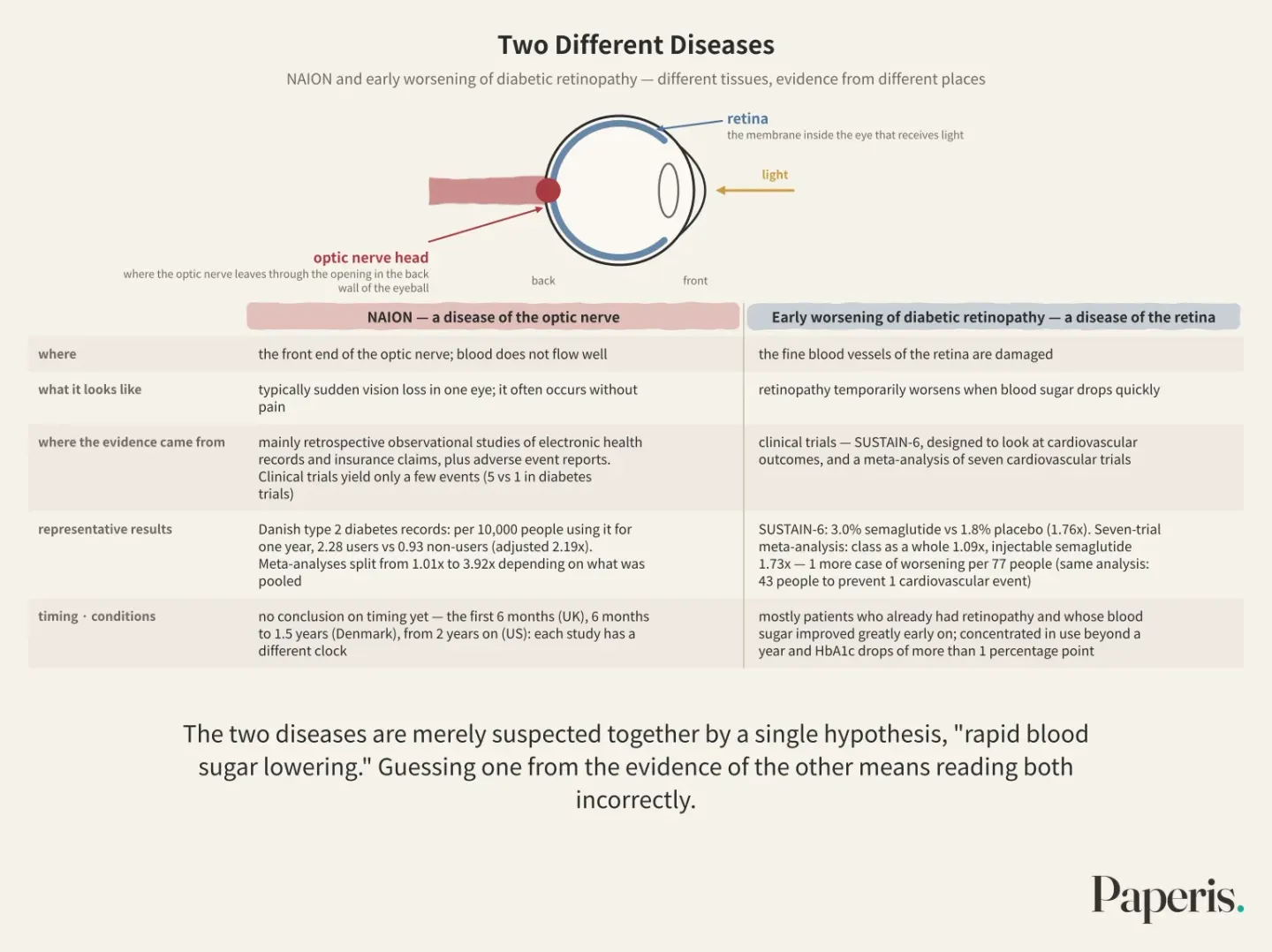
Figure: Two different conditions. NAION affects the optic nerve, early worsening of retinopathy affects the retina, and the evidence comes from different places. What they share is a single hypothesis: a rapid drop in blood sugar.
What "Very Rare" Leaves Behind
The European Medicines Agency has classified NAION as a very rare adverse reaction of semaglutide (PMID 41857480). That review notes that the World Health Organization reached the same judgment, even mentioning the possibility of a class-wide effect (PMID 42543940). "Very rare" in the title comes from here. This phrase carries two meanings together. One is that it is rare, and the other is that a signal remained strong enough for regulatory agencies to recognize it as an adverse reaction. The relative risk has become smaller than in the initial study and the absolute risk is low, but the signal has not disappeared and remains in regulatory decisions.
A consensus statement issued in 2026 by the North American Neuro-Ophthalmology Society and the American Academy of Ophthalmology summarizes the current evidence this way. The evidence is mainly from retrospective observational studies using electronic health records and insurance claims data, and has limitations. Many studies reported a slightly higher risk of NAION with drugs like semaglutide, but some studies found no association, and the overall magnitude of the risk is low. The consensus statement recommends that patients and clinicians decide together whether to start, continue, or stop GLP-1 receptor agonist drugs (PMID 42132708). A 2025 multidisciplinary expert consensus also advised, as one review reports, watching the eyes according to risk level rather than routinely avoiding treatment early in the metabolic changes of high-risk diabetes patients (PMID 42059115).
Another voice stands in the same place. The authors of a meta-analysis combining diabetes observational studies viewed their results as matching current recommendations to discontinue semaglutide in patients diagnosed with NAION, while adding that the certainty of the evidence is low (PMID 42166479). Conversely, one systematic review judged that even accepting the highest relative risk, the absolute risk is very low and the cardiovascular and renal benefits of this drug are greater (PMID 41938304). Both are the judgments of the authors, and neither replaces individual decisions.
Unlike judgments that took time, there is one thing that requires haste. NAION usually presents as a sudden, painless drop in vision in one eye (PMID 41839534, PMID 37987292). A review written on the occasion of the implementation of South Korea's coverage criteria noted that sudden, painless vision loss or visual field defects must be evaluated promptly (PMID 42978139). One review noted that it may be necessary to discuss sudden vision symptoms with the patient before starting treatment (PMID 42857401), and another review argued that if visual abnormalities are reported, the patient should be referred to an ophthalmology clinic early (PMID 42543940). However, because sudden vision loss can be caused by several diseases besides NAION presenting similarly, the cause can only be sorted out through examination and testing (PMID 41839534). 21.2% of people who experienced NAION in one eye later experienced it in the other eye, and the median interval was 1.39 years (PMID 38358828). Reviews pick out checking whether there is a history of NAION and the shape of the optic disc before treatment as things to consider (PMID 42857401, PMID 40055951).
The remaining question is clear. A prospective study that examines the eyes of people taking the drug and people not taking the drug in the same way from the beginning and at scheduled time points is the next step commonly requested by several reviews (PMID 43041449, PMID 42770962). Until that study comes out, what we know is this much. "4 times" was a number measured among neuro-ophthalmology patients who appeared to be concentrated with high-risk patients, and when expanded to the entire country, the multiple became smaller and scattered. Even in the records of type 2 diabetes patients where a difference was found, the excess in the drug-treated group was roughly 0.4 to 3 per 10,000 people per year by Paperis conversion, and this is an association, not a number confirmed as causation. And that signal has not disappeared and remains in regulatory decisions under the name of "very rare".
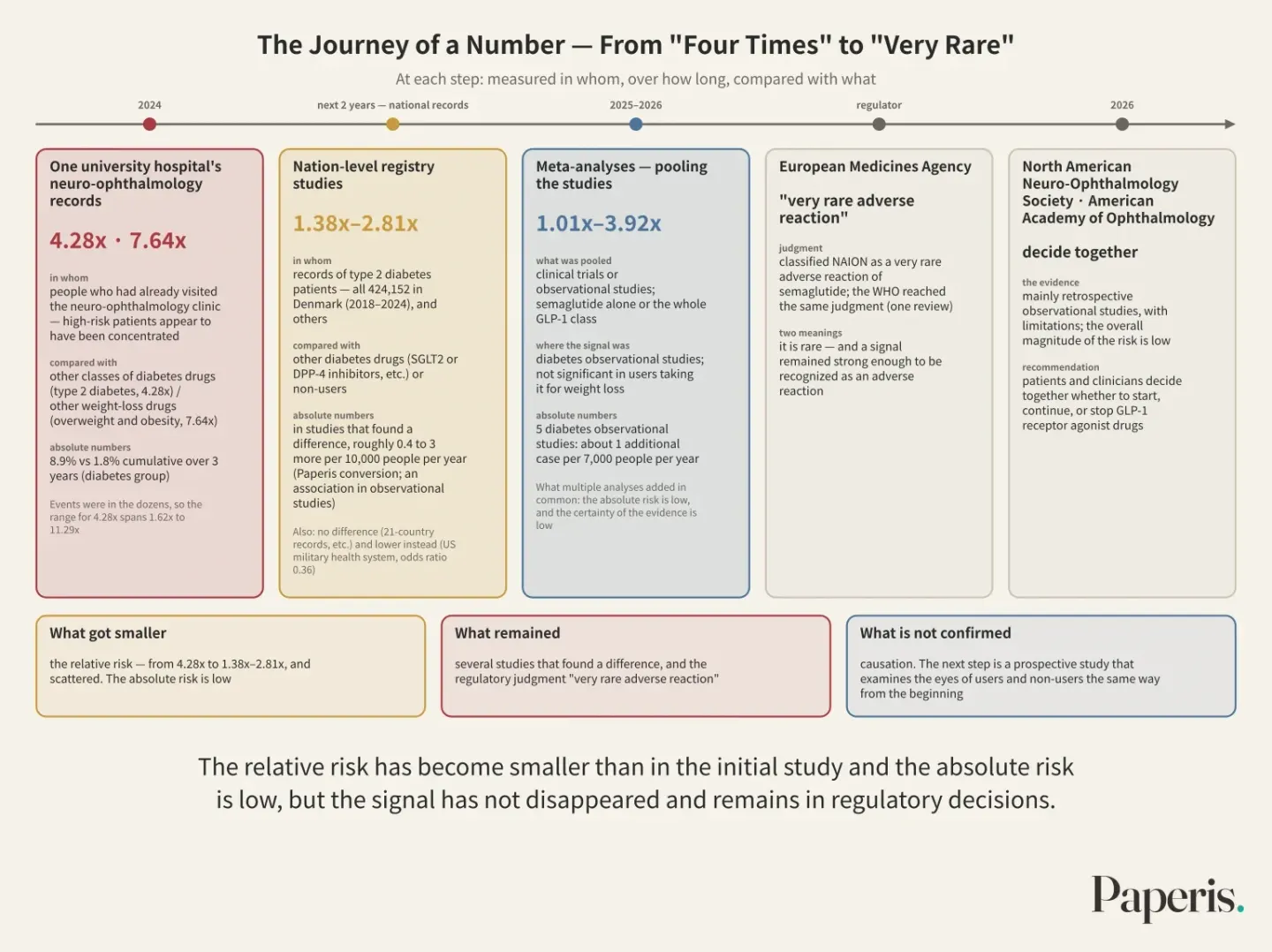
Figure: The journey of a number. The relative risk shrank from the first study and the absolute risk is low, but the signal did not disappear and remains in regulatory judgment. Causation has not been confirmed.
Source Papers
- "Risk of Nonarteritic Anterior Ischemic Optic Neuropathy in Patients Prescribed Semaglutide." (2024) — PMID 38958939 — Neuro-ophthalmology referral patient records, semaglutide HR 4.28 (diabetes) and 7.64 (obesity), 36-month cumulative 8.9% vs. 1.8% and 6.7% vs. 0.8%, follow-up studies needed to confirm causality
- "Semaglutide and risk of Non-Arteritic Anterior Ischemic Optic Neuropathy (NAION) in type 2 diabetes mellitus: A systematic review and meta-analysis." (2026) — PMID 42201355 — Meta-analysis of 8 diabetes cohorts, 1-year HR 3.36, 2-5 years 2.37
- "Non-Arteritic Anterior Ischaemic Optic Neuropathy and Its Masquerades: A Comprehensive Diagnostic Review." (2026) — PMID 41839534 — NAION is the most frequent acute optic neuropathy in people over 50, sudden painless vision loss, need to differentiate mimicking conditions
- "Non-Arteritic Anterior Ischemic Optic Neuropathy (NA-AION): A Comprehensive Overview." (2023) — PMID 37987292 — Overview of NA-AION, unilateral optic disc edema and sudden painless vision loss, no effective treatment or prevention
- "Glucagon-Like Peptide-1 Receptor Agonists and the Eye: Ocular Safety, Retinal Outcomes, and Clinical Implications." (2026) — PMID 42978139 — Korean health insurance coverage criteria implemented in February 2026, NAION is a rare but important signal with low absolute risk, initial worsening of retinopathy, urgent evaluation for sudden painless vision loss
- "Once-weekly semaglutide doubles the five-year risk of nonarteritic anterior ischemic optic neuropathy in a Danish cohort of 424,152 persons with type 2 diabetes." (2024) — PMID 39696569 — 5 years in 424,152 Danish T2D patients, 0.228 vs. 0.093/1,000 person-years, HR 2.19, median 22.2 months, need to acknowledge risk
- "Reexamining the Incidence of Nonarteritic Anterior Ischemic Optic Neuropathy: A Rochester Epidemiology Project Study." (2024) — PMID 38358828 — 26 years in Olmsted County, incidence 3.89/100,000 and 10.19/100,000 in those over 50, hypertension 79.8%, diabetes 39.4%, sleep apnea 23.1%, fellow eye 21.2% (median 1.39 years)
- "Nonarteritic Anterior Ischemic Optic Neuropathy and Semaglutide: What is This All About?" (2024) — PMID 39163055 — Editorial: NAION is rare (2.5-11.8 per 100,000 men over 50), list of risk factors
- "Semaglutide and non-arteritic anterior ischaemic optic neuropathy: Review and interpretation of reported association." (2025) — PMID 40055951 — Review interpreting the first study: high-risk concentration in referral populations, occurrence within 14 months, proportional to blood glucose-lowering efficacy and venous congestion hypothesis, causal inference not possible
- "Use of semaglutide and risk of non-arteritic anterior ischemic optic neuropathy: A Danish-Norwegian cohort study." (2025) — PMID 40098249 — Denmark and Norway, HR 2.81 compared to SGLT2i, incidence difference +1.41/10,000 person-years, 32 events, low absolute risk
- "Glucagon-Like Peptide 1 Receptor Agonists and Risk of Nonarteritic Anterior Ischemic Optic Neuropathy in Patients With Type 2 Diabetes." (2026) — PMID 41701611 — UK CPRD, RR 2.56 compared to DPP-4i, 18.5 vs. 7.2/100,000 at 1 year, highest in the first 6 months, higher in <50 years old, males, smokers, and HbA1c reduction >1%
- "GLP-1RA and the risk of non-arteritic anterior ischaemic optic neuropathy in patients with type 2 diabetes: A population-based study." (2026) — PMID 41104517 — US claims data, HR 1.85 compared to SGLT2i, RD 0.29/1,000 person-years, small incidence and absolute increase
- "Glucagon-like peptide-1 receptor agonists and the risk of nonarteritic anterior ischemic optic neuropathy: Evidence from a global real-world cohort." (2026) — PMID 41687959 — TriNetX 9 years, 0.21% vs. 0.17%, HR 1.38, low absolute risk
- "Semaglutide or Tirzepatide and Optic Nerve and Visual Pathway Disorders in Type 2 Diabetes." (2025) — PMID 40788646 — Semaglutide or tirzepatide 2-year NAION 0.04% vs. 0.02%, HR 1.76, low overall risk
- "Semaglutide and Nonarteritic Anterior Ischemic Optic Neuropathy." (2025) — PMID 39976940 — OHDSI 14 databases and 37.1 million people, 14.5 per 100,000 person-years, no difference with broad definition, 2.27 compared to empagliflozin with narrow definition, SCCS 1.32, smaller increase than previous reports
- "The Effect of Semaglutide and GLP-1 RAs on Risk of Nonarteritic Anterior Ischemic Optic Neuropathy." (2025) — PMID 40015592 — TriNetX, no increase in NAION among diabetes and high-BMI patients using semaglutide or GLP-1 RAs
- "Association between Semaglutide and Nonarteritic Anterior Ischemic Optic Neuropathy: A Multinational Population-Based Study." (2025) — PMID 39491755 — Medical records from 21 countries, no association with diabetes, obesity, or both, avoiding it based on NAION alone may be unjustified
- "Semaglutide Decreases Risk of Non-Arteritic Anterior Ischemic Optic Neuroapthy in Type 2 Diabetic Patients." (2026) — PMID 41217382 — US military healthcare 1.21 million people, NAION OR 0.36 for semaglutide in diabetes, not a reason to withhold use
- "Association of GLP1-Receptor Agonists With Diabetic Retinopathy." (2026) — PMID 42660856 — Compared to DPP-4i, slight increase in retinopathy (11.05% vs. 9.98%), no difference in NAION OR 1.11, no difference in blindness
- "Rate and Risk of Nonarteritic Anterior Ischemic Optic Neuropathy with Semaglutide Use for Diabetes and Weight Loss: A Systematic Review and Meta-Analysis." (2026) — PMID 41475544 — Stratified meta-analysis of 8 RCTs + 8 observational studies, diabetes observation only HR 1.85 (26.7 vs. 18.9/100,000 person-years), no significance in RCTs or weight loss, low absolute rate
- "Semaglutide and the Risk of Nonarteritic Ischemic Optic Neuropathy: A Systematic Review and Certainty of Evidence Meta-Analysis." (2026) — PMID 41692115 — 6 observational studies with 4.83 million people, aHR 1.63 not significant, 1.92 when excluding one study (fragile), diabetes 1.70, obesity 0.47, low to very low certainty
- "Semaglutide-Induced Nonarteritic Anterior Ischemic Optic Neuropathy: A Systematic Review and Meta-Analysis." (2026) — PMID 42612051 — 8 observational studies with 5.92 million people, RE 1.93, diabetes 1.84, obesity not significant, randomized trials needed
- "Semaglutide-associated risk of nonarteritic anterior ischemic optic neuropathy in patients with type 2 diabetes: A systematic review and meta-analysis of observational studies." (2026) — PMID 42166479 — 5 diabetes observational studies, HR 2.17, absolute 0.014% (1 per 7,000 per year), consistent with recommendation to discontinue upon NAION diagnosis, low certainty
- "Ocular disorders during treatment with GLP-1 receptor agonists: a systematic review and meta-analysis of observational studies." (2026) — PMID 42311413 — 28 observational studies, overall GLP-1RA NAION RR 1.01 no difference, monitoring recommended
- "Ocular Adverse Events With Semaglutide: A Systematic Review and Meta-Analysis." (2025) — PMID 40810985 — 78 RCTs with 73,640 people, no increase in eye disorders or retinopathy (1.04), NAION OR 3.92 but lacking sample size and evidence insufficient
- "Does semaglutide increase the risk of non-arteritic anterior ischemic optic neuropathy? A systematic review and meta-analysis of emerging evidence." (2026) — PMID 40962119 — Meta-analysis of 10 studies, pooled HR 2.62, significant after 2 years
- "Glucagon-like Peptide-1 Receptor Agonists and Risk of Nonarteritic Anterior Ischemic Optic Neuropathy: Systematic Review and Meta-Analysis." (2026) — PMID 42060879 — Bayesian meta-analysis of 5 studies, RR 2.52, prominent in diabetes, low to moderate certainty
- "Semaglutide and Non-arteritic Anterior Ischemic Optic Neuropathy: A Systematic Review and Narrative Synthesis." (2026) — PMID 41938304 — Narrative synthesis of 9 observational studies, 4 significant (1.76-4.28), 4 unrelated, 1 protective, indication bias, does not support causality, very low absolute risk
- "Current review of glucagon-like peptide 1 receptor agonists and risk of nonarteritic anterior ischemic optic neuropathy." (2026) — PMID 42857401 — Disc-at-risk is the strongest anatomical predictor, risk factors, relative risk 1.2-4.3, safety signal rather than contraindication, pre-initiation counseling
- "Glucagon-like Peptide-1 Receptor Agonists and Risk for Anterior Ischemic Optic Neuropathy : A Nationwide Cohort Study." (2026) — PMID 42441962 — Sweden compared to SGLT2i, 1 year 0.04% vs. 0.02% (RR 1.93), 5 years 0.12% vs. 0.07%, greatly attenuated when restricting metformin -> potential residual confounding
- "Optic Ischaemic Neuropathy in Incretin-Based Therapy: A Comparative Analysis of Real-World Safety Data." (2026) — PMID 42259643 — FAERS, semaglutide 355 cases ROR 94.45, tirzepatide 2.94, liraglutide 4.58, dulaglutide, exenatide, lixisenatide no signal -> not a uniform class effect
- "Semaglutide: Nonarteritic Anterior Ischemic Optic Neuropathy in the FDA adverse event reporting system - A disproportionality analysis." (2025) — PMID 39922760 — FAERS disproportionality analysis, semaglutide-NAION signal stronger than other GLP-1RAs
- "Multi-database pharmacovigilance assessment of GLP-1 receptor agonist-related ophthalmic risks using advanced signal detection in FAERS and vigibase." (2026) — PMID 41021211 — FAERS and VigiBase, semaglutide NAION ROR 31.46 and 40.18
- "Comparative adverse-event reporting patterns of semaglutide and tirzepatide: a disproportionality analysis of FAERS." (2026) — PMID 42955519 — Semaglutide vs. tirzepatide in FAERS, optic nerve ischemia ROR 15.77, spontaneous reporting pattern only, not risk or causality
- "Semaglutide and optic neuritis in the FDA adverse event reporting system: a comparator-based, time-calibrated pharmacovigilance analysis." (2026) — PMID 43047309 — Semaglutide-optic neuritis in FAERS, 62.7% of semaglutide reports in 2024-2026 (comparison 17.5%), sensitive to reporting timing
- "Association of Glucagon-Like Peptide-1 Receptor Agonists With Optic Nerve and Retinal Adverse Events: A Population-Based Observational Study Across 180 Countries." (2025) — PMID 40383360 — FAERS and VigiBase, semaglutide ION and DR signals, tirzepatide only DR in FAERS
- "GLP-1 receptor agonists and ocular safety- Pharmacokinetic insights into ischemic optic neuropathy and diabetic retinopathy risk: A review." (2026) — PMID 42770962 — Pharmacokinetic review, most consistent signal is high-exposure injectable semaglutide, other drugs none/inconsistent/weak, concentration threshold is a hypothesis
- "Timing and duration of glucagon-like peptide-1 receptor agonist use and risk of nonarteritic anterior ischaemic optic neuropathy." (2026) — PMID 42126975 — Danish nested case-control, use HR 2.13, current use 2.28, cumulative 6 months-1 year 3.63, 1-1.5 years 3.52
- "Semaglutide and Nonarteritic Anterior Ischemic Optic Neuropathy Risk Among Patients With Diabetes." (2025) — PMID 40146102 — TriNetX diabetes, no significance up to 1 year, 2, 3, and 4 years HR 2.39, 2.44, and 2.05
- "Semaglutide and Non-arteritic Anterior Ischemic Optic Neuropathy: A Systematic Review." (2025) — PMID 40926946 — Systematic review of 9 studies, inconsistent results, low absolute risk, caution for small BMO, drusen, crowded disc
- "Ophthalmic Complications Associated With the Antidiabetic Drugs Semaglutide and Tirzepatide." (2025) — PMID 39883468 — 9 cases (7 NAION), causality cannot be determined, hypothesis related to rapid blood glucose correction
- "GLP-1 receptor agonist-induced transient retinal perfusion delay and its potential mediation by intracranial pressure." (2026) — PMID 42335513 — Mice and small retrospective: intracranial pressure reduction and retinal perfusion delay, recovery upon discontinuation, optic nerve sheath hypothesis
- "Risk of Non-Arteritic Anterior Ischemic Optic Neuropathy in Idiopathic Intracranial Hypertension Patients Treated with GLP-1 Receptor Agonists." (2026) — PMID 41994958 — 15,567 pairs of idiopathic intracranial hypertension, GLP-1RA NAION HR 0.47 (low), residual confounding cannot be ruled out
- "Glucagon Agonist Therapies and Vision Loss: Balancing Promise with Prudence in India." (2026) — PMID 42543940 — WHO and EMA acknowledge very rare adverse reaction, candidate mechanisms (perfusion, sympathetic constriction, blood glucose changes) unproven for causality, agree on visual symptoms and early referral
- "Ocular Safety of GLP-1 Receptor Agonists: A Comprehensive Review." (2026) — PMID 43041449 — SUSTAIN-6 retinopathy complications 3.0% vs. 1.8% (HR 1.76), preexisting retinopathy and rapid glycemic improvement, NAION causality cannot be established, individual risk assessment
- "Glucagon-like peptide 1-receptor agonists and A1c: Good for the heart but less so for the eyes?" (2023) — PMID 36596264 — CVOT meta-analysis, class retinopathy RR 1.09, injectable semaglutide 1.73, >1 year and >1% A1c reduction, NNH 77 and NNT 43
- "GLP-1 Receptor Agonists and Sight-Threatening Ophthalmic Complications in Patients With Type 2 Diabetes." (2025) — PMID 40788647 — TriNetX, retinopathy HR 1.07, NAION HR 1.26 not significant, fewer severe complications in preexisting retinopathy
- "Interpreting Diabetic Retinal Outcomes After GLP-1 Receptor Agonist and Tirzepatide Initiation: Clinical Evidence and Its Limits." (2026) — PMID 42946946 — Review interpreting retinal outcomes, safe HbA1c reduction rate undetermined, nonsignificant ≠ safe, checking retinal status and clinical linkage
- "Ocular complications from glucagon-like peptide-1 receptor agonists: Clinical evidence, potential mechanisms, and clinical recommendations." (2026) — PMID 41857480 — Review on eye complications, SUSTAIN-6 retinopathy, EMA classifies NAION as a very rare adverse reaction
- "Glucagon-Like Peptide-1 Receptor Agonists and the Risk of Non-Arteritic Anterior Ischemic Optic Neuropathy: A Consensus Statement by the North American Neuro-Ophthalmology Society and the American Academy of Ophthalmology." (2026) — PMID 42132708 — Consensus statement by NANOS and AAO: retrospective observational evidence, small risk possible or studies showing no association, low magnitude of risk, joint decision on initiation, continuation, and discontinuation
- "Glucagon-Like Peptide-1 Receptor Agonists and Ocular Outcomes: Metabolic Transition, Retinal Vulnerability, and Risk-Stratified Monitoring." (2026) — PMID 42059115 — Review on eye outcomes, initial worsening of retinopathy is a metabolic transition phenomenon, potential NAION signal, 2025 multidisciplinary consensus: risk-stratified monitoring rather than avoidance
Sources (51)
- Risk of Nonarteritic Anterior Ischemic Optic Neuropathy in Patients Prescribed SemaglutidePMID 38958939
- Semaglutide and risk of Non-Arteritic Anterior Ischemic Optic Neuropathy (NAION) in type 2 diabetes mellitus: A systematic review and meta-analysisPMID 42201355
- Non-Arteritic Anterior Ischaemic Optic Neuropathy and Its Masquerades: A Comprehensive Diagnostic ReviewPMID 41839534
- Non-Arteritic Anterior Ischemic Optic Neuropathy (NA-AION): A Comprehensive OverviewPMID 37987292
- Glucagon-Like Peptide-1 Receptor Agonists and the Eye: Ocular Safety, Retinal Outcomes, and Clinical ImplicationsPMID 42978139
- Once-weekly semaglutide doubles the five-year risk of nonarteritic anterior ischemic optic neuropathy in a Danish cohort of 424,152 persons with type 2 diabetesPMID 39696569
- Reexamining the Incidence of Nonarteritic Anterior Ischemic Optic Neuropathy: A Rochester Epidemiology Project StudyPMID 38358828
- Nonarteritic Anterior Ischemic Optic Neuropathy and Semaglutide: What is This All About?PMID 39163055
- Semaglutide and non-arteritic anterior ischaemic optic neuropathy: Review and interpretation of reported associationPMID 40055951
- Use of semaglutide and risk of non-arteritic anterior ischemic optic neuropathy: A Danish-Norwegian cohort studyPMID 40098249
- Glucagon-Like Peptide 1 Receptor Agonists and Risk of Nonarteritic Anterior Ischemic Optic Neuropathy in Patients With Type 2 DiabetesPMID 41701611
- GLP-1RA and the risk of non-arteritic anterior ischaemic optic neuropathy in patients with type 2 diabetes: A population-based studyPMID 41104517
- Glucagon-like peptide-1 receptor agonists and the risk of nonarteritic anterior ischemic optic neuropathy: Evidence from a global real-world cohortPMID 41687959
- Semaglutide or Tirzepatide and Optic Nerve and Visual Pathway Disorders in Type 2 DiabetesPMID 40788646
- Semaglutide and Nonarteritic Anterior Ischemic Optic NeuropathyPMID 39976940
- The Effect of Semaglutide and GLP-1 RAs on Risk of Nonarteritic Anterior Ischemic Optic NeuropathyPMID 40015592
- Association between Semaglutide and Nonarteritic Anterior Ischemic Optic Neuropathy: A Multinational Population-Based StudyPMID 39491755
- Semaglutide Decreases Risk of Non-Arteritic Anterior Ischemic Optic Neuroapthy in Type 2 Diabetic PatientsPMID 41217382
- Association of GLP1-Receptor Agonists With Diabetic RetinopathyPMID 42660856
- Rate and Risk of Nonarteritic Anterior Ischemic Optic Neuropathy with Semaglutide Use for Diabetes and Weight Loss: A Systematic Review and Meta-AnalysisPMID 41475544
- Semaglutide and the Risk of Nonarteritic Ischemic Optic Neuropathy: A Systematic Review and Certainty of Evidence Meta-AnalysisPMID 41692115
- Semaglutide-Induced Nonarteritic Anterior Ischemic Optic Neuropathy: A Systematic Review and Meta-AnalysisPMID 42612051
- Semaglutide-associated risk of nonarteritic anterior ischemic optic neuropathy in patients with type 2 diabetes: A systematic review and meta-analysis of observational studiesPMID 42166479
- Ocular disorders during treatment with GLP-1 receptor agonists: a systematic review and meta-analysis of observational studiesPMID 42311413
- Ocular Adverse Events With Semaglutide: A Systematic Review and Meta-AnalysisPMID 40810985
- Does semaglutide increase the risk of non-arteritic anterior ischemic optic neuropathy? A systematic review and meta-analysis of emerging evidencePMID 40962119
- Glucagon-like Peptide-1 Receptor Agonists and Risk of Nonarteritic Anterior Ischemic Optic Neuropathy: Systematic Review and Meta-AnalysisPMID 42060879
- Semaglutide and Non-arteritic Anterior Ischemic Optic Neuropathy: A Systematic Review and Narrative SynthesisPMID 41938304
- Current review of glucagon-like peptide 1 receptor agonists and risk of nonarteritic anterior ischemic optic neuropathyPMID 42857401
- Glucagon-like Peptide-1 Receptor Agonists and Risk for Anterior Ischemic Optic Neuropathy : A Nationwide Cohort StudyPMID 42441962
- Optic Ischaemic Neuropathy in Incretin-Based Therapy: A Comparative Analysis of Real-World Safety DataPMID 42259643
- Semaglutide: Nonarteritic Anterior Ischemic Optic Neuropathy in the FDA adverse event reporting system - A disproportionality analysisPMID 39922760
- Multi-database pharmacovigilance assessment of GLP-1 receptor agonist-related ophthalmic risks using advanced signal detection in FAERS and vigibasePMID 41021211
- Comparative adverse-event reporting patterns of semaglutide and tirzepatide: a disproportionality analysis of FAERSPMID 42955519
- Semaglutide and optic neuritis in the FDA adverse event reporting system: a comparator-based, time-calibrated pharmacovigilance analysisPMID 43047309
- Association of Glucagon-Like Peptide-1 Receptor Agonists With Optic Nerve and Retinal Adverse Events: A Population-Based Observational Study Across 180 CountriesPMID 40383360
- GLP-1 receptor agonists and ocular safety- Pharmacokinetic insights into ischemic optic neuropathy and diabetic retinopathy risk: A reviewPMID 42770962
- Timing and duration of glucagon-like peptide-1 receptor agonist use and risk of nonarteritic anterior ischaemic optic neuropathyPMID 42126975
- Semaglutide and Nonarteritic Anterior Ischemic Optic Neuropathy Risk Among Patients With DiabetesPMID 40146102
- Semaglutide and Non-arteritic Anterior Ischemic Optic Neuropathy: A Systematic ReviewPMID 40926946
- Ophthalmic Complications Associated With the Antidiabetic Drugs Semaglutide and TirzepatidePMID 39883468
- GLP-1 receptor agonist-induced transient retinal perfusion delay and its potential mediation by intracranial pressurePMID 42335513
- Risk of Non-Arteritic Anterior Ischemic Optic Neuropathy in Idiopathic Intracranial Hypertension Patients Treated with GLP-1 Receptor AgonistsPMID 41994958
- Glucagon Agonist Therapies and Vision Loss: Balancing Promise with Prudence in IndiaPMID 42543940
- Ocular Safety of GLP-1 Receptor Agonists: A Comprehensive ReviewPMID 43041449
- Glucagon-like peptide 1-receptor agonists and A1c: Good for the heart but less so for the eyes?PMID 36596264
- GLP-1 Receptor Agonists and Sight-Threatening Ophthalmic Complications in Patients With Type 2 DiabetesPMID 40788647
- Interpreting Diabetic Retinal Outcomes After GLP-1 Receptor Agonist and Tirzepatide Initiation: Clinical Evidence and Its LimitsPMID 42946946
- Ocular complications from glucagon-like peptide-1 receptor agonists: Clinical evidence, potential mechanisms, and clinical recommendationsPMID 41857480
- Glucagon-Like Peptide-1 Receptor Agonists and the Risk of Non-Arteritic Anterior Ischemic Optic Neuropathy: A Consensus Statement by the North American Neuro-Ophthalmology Society and the American AcaPMID 42132708
- Glucagon-Like Peptide-1 Receptor Agonists and Ocular Outcomes: Metabolic Transition, Retinal Vulnerability, and Risk-Stratified MonitoringPMID 42059115