
Paperis Articles
Why Did Khrushchev Reverse Himself in a Single Day? — Autumn 1956, Hungary and Suez Reread After the Archives Opened
On October 30 the Soviet Presidium unanimously agreed to issue a declaration and pull troops out of Budapest; on October 31 Khrushchev's call to 'reexamine' turned it toward suppression. Suez is in his words. No historian says it was the only reason; they disagree on how much it weighed.
Your field's papers, as audio
Pick your fields and journals — Paperis summarizes the key papers and turns them into audio. Listen on your commute.
Start Paperis free →Why Did Khrushchev Reverse Himself in a Single Day? — Autumn 1956, Hungary and Suez Reread After the Archives Opened
In the autumn of 1956, two crises in Europe and the Middle East overlapped within roughly the same two weeks. Hungary was a communist country where Soviet troops had remained since the Second World War, and a member of the Warsaw Pact, a military alliance led by the Soviet Union. After Nikita Khrushchev, First Secretary of the Communist Party of the Soviet Union, criticized Stalin in a "Secret Speech" at the party congress that February, resistance by workers and citizens erupted in Poland and Hungary between June and October (DOI: 10.34321/19701). On October 23, student demonstrations in Budapest escalated into an uprising, and Soviet troops entered the city the following morning. In Egypt, President Gamal Abdel Nasser announced the nationalization of the Suez Canal Company on July 26, and a standoff with Britain and France had continued for three months. On October 29, Israeli forces attacked Egypt, and on October 31, Britain and France began airstrikes. In the early morning of November 14, Soviet troops marched into Budapest once again.
Regarding these two weeks, three sentences are frequently repeated. Taking advantage of the West being divided over Suez, the Soviet Union crushed Hungary. America encouraged Hungary through broadcasts but did not help. The Suez War was stopped by the principle of opposing aggression held by Dwight Eisenhower, the 34th President of the United States. All three sentences touch on the archival record in some places and diverge from it in others.
The question this article holds onto is one: Why did the Soviet leadership unanimously choose to abandon military intervention on October 30, 1956, yet pivot back to suppression on the 31st? The records of those two days emerged from the Moscow archives in the 1990s. The U.S. State Department's foreign relations volumes, internal reviews of U.S.-funded broadcasts, and secret Suez protocols preserved by Israel were also opened around that time. Regarding the same events, the Soviet Union and the subsequent Hungarian government led by János Kádár called them a "counter-revolution," while the Hungarians who rose up and the West called them a "revolution" or an "uprising." This article calls the event an "uprising," and notes whose words are whose when quoting the parties involved. Without judging which interpretation is correct, each interpretation is identified as belonging to its source.
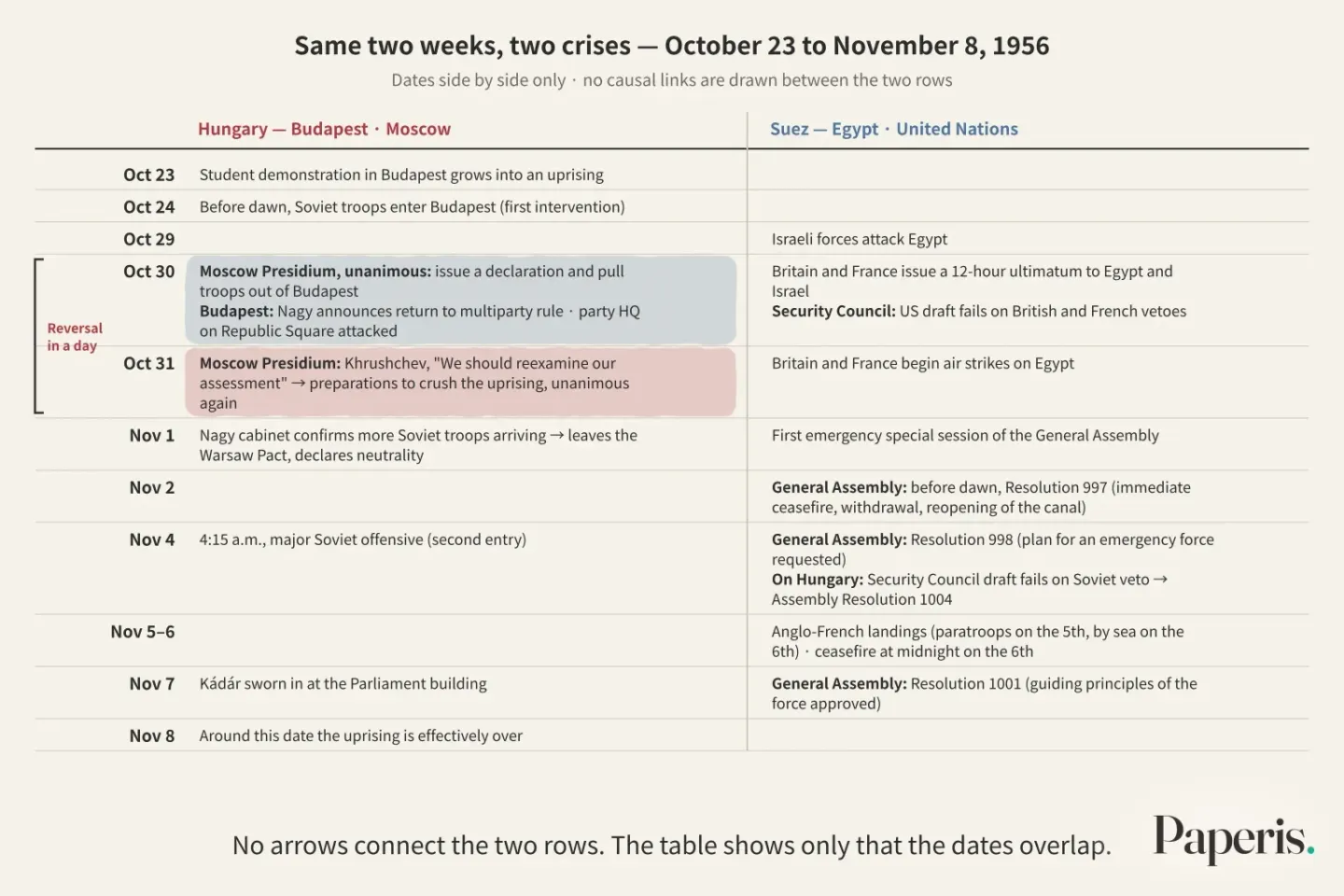
Figure: a diagram Paperis drew using only what the article says
Ten Days Ago — The Warsaw Compromise, the Sèvres Secret Pact
In mid-October, the eyes of the Soviet leadership were first on Warsaw. On October 19, a high-ranking Soviet delegation flew to Warsaw to prevent a change in the Polish party leadership, and Soviet troops stationed in Poland moved toward Warsaw. After a showdown between Khrushchev and Polish party leader Władysław Gomułka, the intervention stopped (DOI: 10.1080/09668130600996549). The Presidium was a meeting where the highest leaders of the Communist Party of the Soviet Union gathered to make major decisions, the name used for the Politburo at the time. Regarding Poland, the Presidium decided to refrain from armed intervention and seek a political compromise (DOI: 10.1177/002200949803300201). A few days later, the same meeting was held again regarding Hungary.
In Hungary, armed clashes spread starting the night of the protest on the 23rd. Soviet troops arrived in Budapest at 4 a.m. on the 24th (FRUS 1955–57 Vol. 25, Doc. 116). Imre Nagy, a reformist communist who served as prime minister from 1953 to 1955, took the prime minister's seat again (DOI: 10.3138/cjh.39.3.515; DOI: 10.1515/9781503626508).
During the same week, a different document was written near Paris. The governments of British Prime Minister Anthony Eden and French Prime Minister Guy Mollet had been confronting Nasser after the nationalization of the canal. From October 22 for three days, British, French, and Israeli representatives met secretly in a private residence in Sèvres (Shlaim 1997). The Sèvres Protocol is a secret document signed on October 24, 1956, in Sèvres near Paris by representatives of Britain, France, and Israel, which set down the sequence where Israel would strike Egypt first and Britain and France would use that as a pretext to enter the canal zone. The signature lines feature Israeli Prime Minister David Ben-Gurion, French Foreign Minister Christian Pineau, and Patrick Dean of the British Foreign Office. The protocol stated that Israel would launch a major offensive on the evening of October 29, the UK and France would "appeal" to both sides to withdraw from the canal the next day, and if Egypt refused, they would enter military operations at dawn on the 31st. Article 6 reads, "This protocol must be kept strictly secret" (The Protocol of Sèvres (Shlaim 1997 Appendix)). Israeli historian Avi Shlaim interprets the passage demanding that only Egypt accept the occupation of key canal locations as having been written in a way that Egypt "could not possibly accept." The date of the war was already on paper five days before the attack.
At the Presidium meeting on the 28th, Khrushchev said, "Britain and France are making a mess in Egypt. We must not get mixed up in the same crowd" (Soviet Presidium Records). This was the day before Israel's attack. American historian Mark Kramer annotates this remark as pointing to a political quagmire rather than a military one. It meant that dragging out Hungary would leave them unable to extricate themselves like the UK and France.
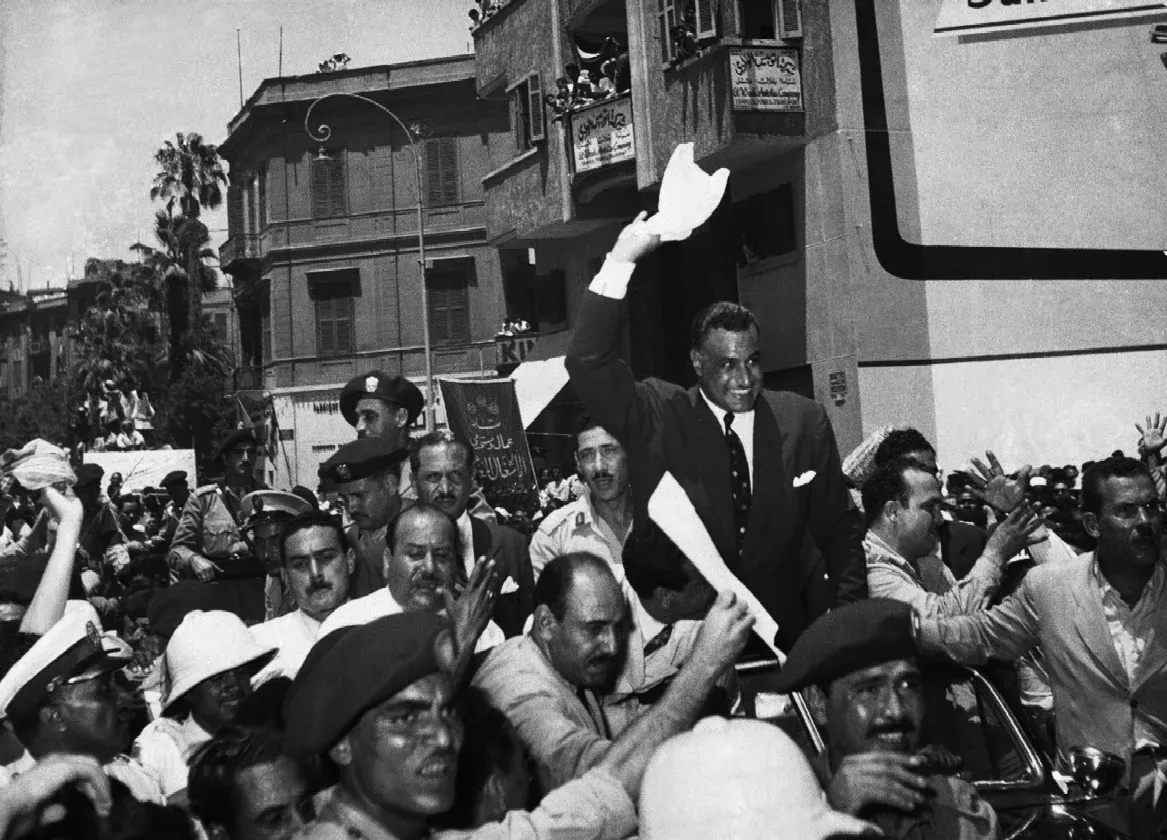
Figure: Nasser cheered in Cairo a few days after announcing the nationalization of the Suez Canal Company (early August 1956) · Photographer unknown, Egypt · Public domain, via Wikimedia Commons
October 30 — Unanimously, "We Issue a Declaration"
On October 30, at the Presidium meeting in Moscow, Defense Minister Georgy Zhukov said, "We must withdraw troops from Budapest, and if necessary, from the whole of Hungary." Presidium member Maxim Saburov stated, "We cannot lead against the will of the people." Khrushchev concluded, "We are unanimous. As a first step, we issue a declaration." (Soviet Presidium Records)
These words survive thanks to the notes of a single man. The Malin Notes are a summary handwritten by Vladimir Malin, Head of the General Department of the Central Committee of the Communist Party of the Soviet Union, during the Presidium meeting, and are the only known contemporary record showing the core meetings of the autumn of 1956. Because they are summary notes, Mark Kramer—who translated the Russian notes into English and added annotations—also appends caveats in his commentary, such as "there are bound to be mistakes or omissions in Malin's writing" and "if it was recorded properly." The quotation marks in this text are translations of that English edition into Korean.
On the same day, the Soviet government issued a declaration. It admitted there had been "egregious mistakes" in relations with East European countries and stated its willingness to negotiate the issue of Soviet troop stationing with Hungary and Warsaw Pact member states. The declaration was published on the 31st in “Pravda”, the official newspaper of the Communist Party of the Soviet Union (NSA Document Collection). Kramer evaluates this decision as "surprising at such a late stage." For a very brief moment, the Presidium may have been willing to accept the collapse of the Hungarian communist regime, and there was a very thin possibility that the events of 1989—when the East European communist regimes fell—could have happened 33 years earlier (Kramer, CWIHP Bulletin 8-9).
However, another part of the meeting on the same day narrowed the scope of the decision. Liu Shaoqi, who was in Moscow leading a Chinese Communist Party delegation, stated "on behalf of the Central Committee of the Chinese Communist Party that troops must remain in Hungary and Budapest," and Khrushchev remarked, "There are two paths. The military path is occupation, and the peaceful path is withdrawal and negotiation." (Soviet Presidium Records (Malin Notes)) Kramer annotates that China likely changed its position after the Soviet decision, and even if it was beforehand, it had no discernible impact on the non-intervention decision of this meeting. The unanimity of October 30 was a decision to issue a declaration, withdraw troops from Budapest, and negotiate the stationing issue. That day, Khrushchev was still placing the two paths side by side.
The 30th in Budapest moved in a different direction. At 2:30 PM, Nagy announced the return to a multi-party system. Anastas Mikoyan and Mikhail Suslov, Presidium members who were visiting Budapest, sent pessimistic reports by phone that day. The contents stated that it was virtually difficult to peacefully clear out the remaining pockets of resistance, and deploying the Hungarian army could lead them to defect to the side of the uprising. Nagy brought up Hungary's withdrawal from the Warsaw Pact to these two men. On the same day, the Budapest party headquarters in Republic Square was attacked by an armed crowd, and retaliatory killings of surrendered State Protection Authority troops took place. By the time the Presidium meeting opened on the 31st, newsreels of those scenes were playing in Moscow. Kramer also notes the caveat that this siege was an isolated case and rather steadied the situation quite a bit (Kramer, CWIHP Bulletin 8-9).
From October 31 to November 4 — "We Must Reexamine the Assessment"
The next day in the same room, Khrushchev spoke first. The English translation of Malin's notes reads as follows (Soviet Presidium Records (Malin Notes); NSA Briefing Book No. 6).
"We should reexamine our assessment and should not withdraw our troops from Hungary and Budapest. … If we depart from Hungary, it will give a great boost to the Americans, English, and French—the imperialists. They will perceive it as weakness on our part and will go onto the offensive. … Our party will not accept it if we do this. To Egypt they will then add Hungary. We have no other choice."
In plain words, it is this. "We must reexamine our assessment and must not withdraw our troops from Hungary and Budapest. If we leave Hungary, the Americans, English, and French—that is, the imperialists—will gain a great boost. They will perceive this as our weakness and go on the offensive. If we do this, our party will not accept it. Then they will add Hungary to Egypt. There is no other choice." Khrushchev also said that "there will be no major war."
The only person who objected on the spot was Saburov. "After yesterday's meeting, all this discussion is meaningless. It would mean that NATO was right." Former Foreign Minister and Presidium member Vyacheslav Molotov said that "yesterday was merely a compromise decision." According to Kramer, Saburov eventually turned to support it as well, and the decision became unanimous once more. The meeting had Zhukov draw up an "action plan" and put forward Hungarian party leader János Kádár and others as candidates for the head of the new government (Soviet Presidium Records (Malin Notes)). On that same day, the 31st, Britain and France began airstrikes on Egypt (UN Peacekeeping Background Document). Also on the 31st, the Soviet leadership met Liu Shaoqi at Moscow Vnukovo Airport as he was returning home to inform him of the reversal, and the Chinese delegation condoned it (Kramer, CWIHP Bulletin Nos. 8-9).
The decision was still shaky. At the November 1 Presidium meeting, Mikoyan, who had just returned from Budapest, tried to reverse the decision to invade (Kramer, CWIHP Bulletin Nos. 8-9). On the same day, Nagy's cabinet in Budapest confirmed that more Soviet troops were entering across the eastern border. Soviet Ambassador Yuri Andropov failed to answer that question satisfactorily, the minutes record. The cabinet decided unanimously, including even Kádár (NSA Briefing Book No. 7, Nagy Government Cabinet Minutes). The Declaration of Neutrality is a declaration made on November 1, 1956, in which Nagy's government withdrew from the Warsaw Pact and stated that it would not belong to any military bloc. At the same time, the government appealed to the United Nations. In the minutes, the confirmation of reinforcements comes first, and the declaration comes after.
On November 2, Veljko Mićunović, the Yugoslav ambassador in Moscow who was with Khrushchev, noted Khrushchev's words in his diary. The British and French are "bogged down in Suez, and we are bogged down in Hungary" (Kramer, CWIHP Bulletin Nos. 8-9). These words remain in the ambassador's diary, and there is no record written by Khrushchev himself. At 4:15 AM on November 4, Soviet troops launched a full-scale offensive. Nagy announced in a 35-second broadcast at 5:20 AM that "our troops are fighting. The government is in place," and then took refuge in the Yugoslav Embassy (NSA Briefing Book). According to Kramer, Khrushchev hinted at the Presidium meeting that same day that, now that the suppression was firmly decided, he could "act more actively" in supporting Egypt (Kramer, CWIHP Bulletin Nos. 8-9).
The uprising was practically over by around the 8th (Kramer, CWIHP Bulletin Nos. 8-9). Kádár took office in the parliament building on November 7. The Nagy government never officially resigned. As soon as Nagy stepped out of the embassy on November 22, having been promised safe passage, he was arrested and moved to Romania (NSA Briefing Book). And he was executed two years later (DOI: 10.5040/9780755620500).
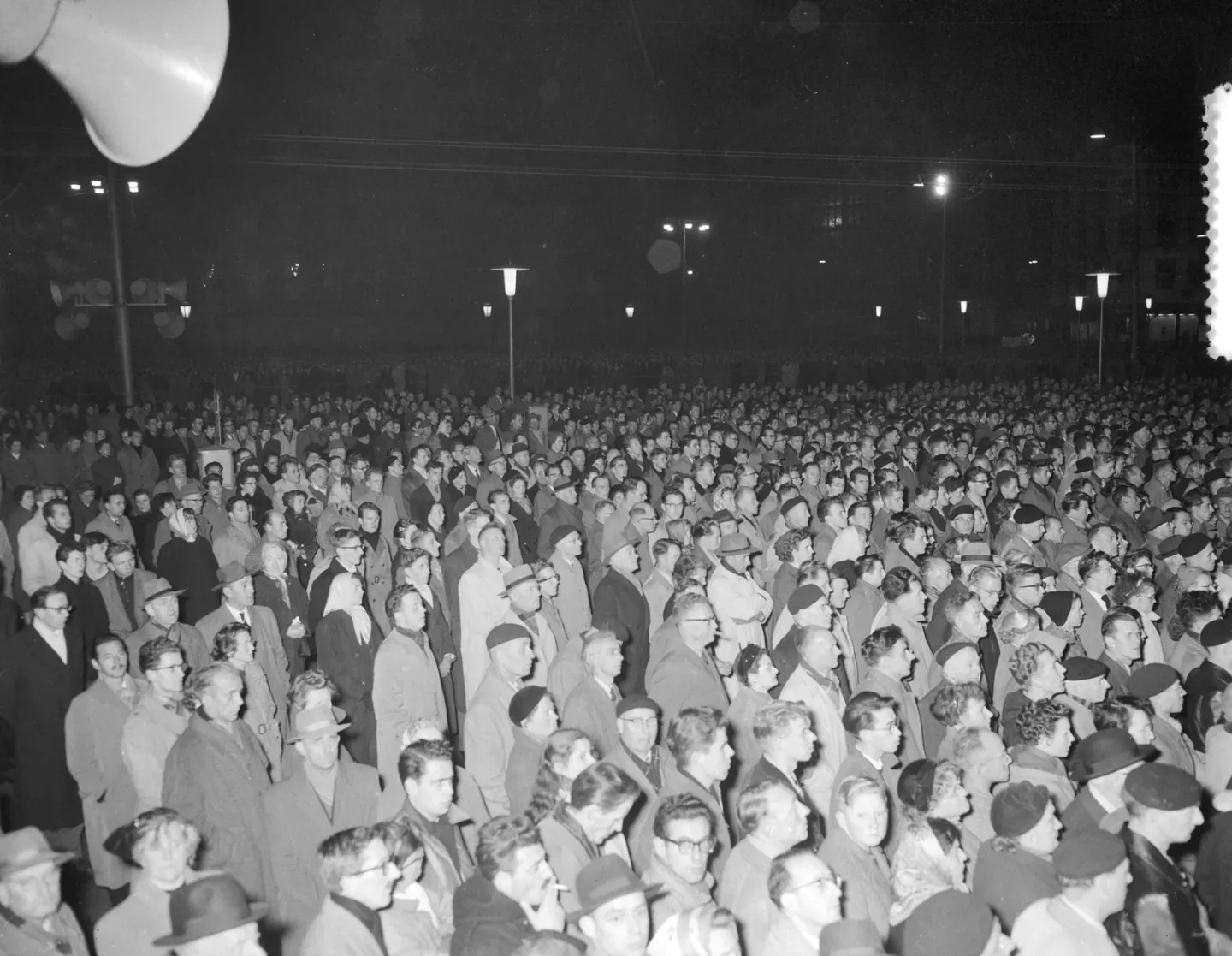
Figure: A commemoration of the Hungarian uprising on Dam Square, Amsterdam, November 5, 1956 · Photo by Daan Noske, Anefo · Nationaal Archief (Netherlands) · CC0, via Wikimedia Commons
The Order the Files Opened — Moscow's Memos, Israel's Copies
In the autumn of 1996, a conference marking the 40th anniversary of the uprising was held in Budapest. At this conference, jointly hosted by Hungary's Institute for the History of 1956, the American private archive the National Security Archive (NSA), and the Cold War International History Project, Malin's notes were introduced, and Kramer's English translation was published in the Cold War International History Project Bulletin (Kramer, CWIHP Bulletin 8–9). The historian Johanna Granville wrote of that shift in 1999: the West had long portrayed the Soviet Union as a “cunning, monolithic block that deftly intervened while the West was distracted by Suez”, but the newly unsealed documents show that the Soviet Union was out of sync even with its Hungarian allies (DOI: 10.5195/cbp.1999.80). Kramer concluded in a 1998 paper that the existing Western accounts required “extensive revision” (DOI: 10.1177/002200949803300201).
The protocol of Suez came out through a different path. Suspicions of collusion circulated right after the war, and US Secretary of State John Foster Dulles already suspected on the very day of October 30 that Britain and France were “almost certainly” conspiring with Israel (FRUS 1955–57, vol. XVI, doc. 425). Eden denied collusion until his dying day. The British copy of the protocol was destroyed on Eden's orders, the French copy vanished, and only the Israeli copy remained in Ben-Gurion's archive. Copying that copy was permitted for a 1996 BBC documentary on the 40th anniversary of Suez, and Shlaim's footnote records that after lengthy negotiations, Israeli politician Shimon Peres authorized the copying (Shlaim 1997). The UK National Archives houses a copy of that original Israeli document (UK National Archives, PRO 22/88). The Protocol of Sèvres came to light through the copy that remained in Israel. The British copy was already gone by then.
The American documents opened earlier. One Korean study of American history reconstructed the Suez crisis using US government documents released starting in 1989 (KCI ART001292381). The broadcaster's internal review document was first made public in a 2002 NSA briefing book (NSA document collection). Chinese Foreign Ministry documents reached the English-speaking world in 2014 through a collection by Hungarian historian Péter Vámos (Vámos, CWIHP e-Dossier 50). The interpretations below all stand upon this sequence.
Why Within a Single Day — Five Readings
In Khrushchev's remarks in the October 31 notes, the line "They will add Hungary to Egypt" is indeed present. The point where researchers are divided is how heavy a weight that sentence carried among the reasons for the turnaround.
The first is Mark Kramer's reading. He views Suez as having given Soviet leaders a strong incentive to resolve Hungary "as quickly and as decisively as possible." At the same time, he notes that the rifts within NATO were not a decisive factor. At the time of the October 31 meeting, those rifts had not yet fully surfaced. However, he adds that those rifts provided, as Khrushchev put it at the time, a "favorable moment" to launch large-scale military operations in Hungary (Kramer, CWIHP Bulletin 8-9). The factors he places alongside this are several: the pessimistic reports of Mikoyan and Suslov, Republic Square, Nagy's announcement of withdrawal from the Warsaw Pact, the fear that anti-communist sentiment would spread to neighboring satellite states, and the power succession struggle after Stalin's death, which was settled only in June 1957. Khrushchev himself later recalled that he regretted making the October 30 decision as soon as it was made. Kramer's concluding sentence runs the front and back together (Kramer, CWIHP Bulletin 8-9).
"The invasion of Hungary undoubtedly would have been approved even if there had been no Suez Crisis, but Soviet fears of 'imperialist' successes in the Middle East and the sudden emergence of a divisive row within NATO clearly expedited Moscow's decision."
Kramer writes, "The invasion of Hungary undoubtedly would have been approved even if there had been no Suez Crisis, but Soviet fears of 'imperialist' successes in the Middle East and the sudden emergence of a divisive row within NATO clearly expedited Moscow's decision." If you translate only the first half, Suez disappears; if you translate only the second half, Suez becomes the cause.
The second is the reading of the 2002 NSA document collection editors. The editors cite four judgments based on the documents: that the uprising threatened communist rule itself, unlike Gomułka's Poland; that following the Suez attack, failing to respond would lead the West to view them as weak; that leaders of neighboring satellite states were wavering; and that party members would not understand. The editors note that on October 31, Khrushchev did not mention news from Budapest, China's view heard the previous day, or the United States' stance, and that his arguments centered primarily on "imperial prestige" and the impact a withdrawal would have on Soviet domestic politics (NSA Document Collection).
The third is Péter Vámos's reading. He writes in 2014, "The central question of why Khrushchev and the party leadership changed their minds between October 30 and October 31 has not been satisfactorily answered to this day." While shifts in the international situation, Suez, and internal Soviet party disputes all played a part, there is "no definitive evidence" regarding China's role (Vámos, CWIHP Working Paper 50). Vámos reads Kaganovich's remark in the November 1 notes—"China said not to pull out troops"—as opposition to withdrawal, distinguishing it from support for intervention.
The fourth is the Chinese side's claim. The Chinese Communist Party's official position in 1960 was that when the Soviet Union intended to withdraw, China advised that a counterattack was necessary, and the Soviet Union agreed "only after hesitating for a long time" (Vámos, CWIHP Working Paper 50). A report from a Japanese research project in 2017 also notes that at the crossroads of October 30, the Chinese Communist Party insisted on the hardline stance of military intervention (DOI: 10.34321/19701). Liu Shaoqi's remarks in the October 30 notes partially support this claim. On the other side are the notes themselves, showing that the Soviet Union was still leaning toward non-intervention on that same day, and Kramer's commentary that it remains unclear when Mao Zedong definitively turned toward supporting intervention. Kramer attaches the caveat "if it was properly transcribed" even to the record of Liu Shaoqi's remarks on October 30. Vámos himself, who transferred the 1960 claim into his document collection, views it in light of Chinese Foreign Ministry documents as likely an attempt to mask the reality that "China merely followed the Soviet decision" (Vámos, CWIHP Working Paper 50). The 1960 Chinese claim can only be conveyed as the assertion of an involved party.
The fifth is the reading of Hungarian historian Csaba Békés. While many researchers have viewed the November 1 withdrawal from the pact and declaration of neutrality as a hasty step that invited the second intervention, Békés views it not as "the cause, but the consequence of the impending Soviet resolve" and a desperate final attempt to save the revolution (DOI: 10.1080/14682740600979261). In his 2022 book, he pulls the timeline even further forward. The first intervention on October 24 was a blunder that escalated sporadic clashes into an anti-Soviet war of liberation, and the second intervention was the "unavoidable consequence" of that first intervention (DOI: 10.5149/northcarolina/9781469667485.003.0005). What Kramer identified as a factor was Nagy "bringing up" withdrawal on October 30, whereas what Békés saw as the result was the November 1 declaration. When the dates are separated, the two readings do not collide.
There is also a reading that examines the impact US-funded broadcasting had on Soviet judgment, which we will look at in the later broadcasting section. British historian Peter Boyle concludes that the link between the two crises was "especially important" in explaining the Soviet decision for armed suppression and the depth of the Anglo-American rift (DOI: 10.1111/j.1468-229x.2005.00350.x). A reading that explains the one-day reversal through Suez alone does not exist in the literature reviewed in this article.
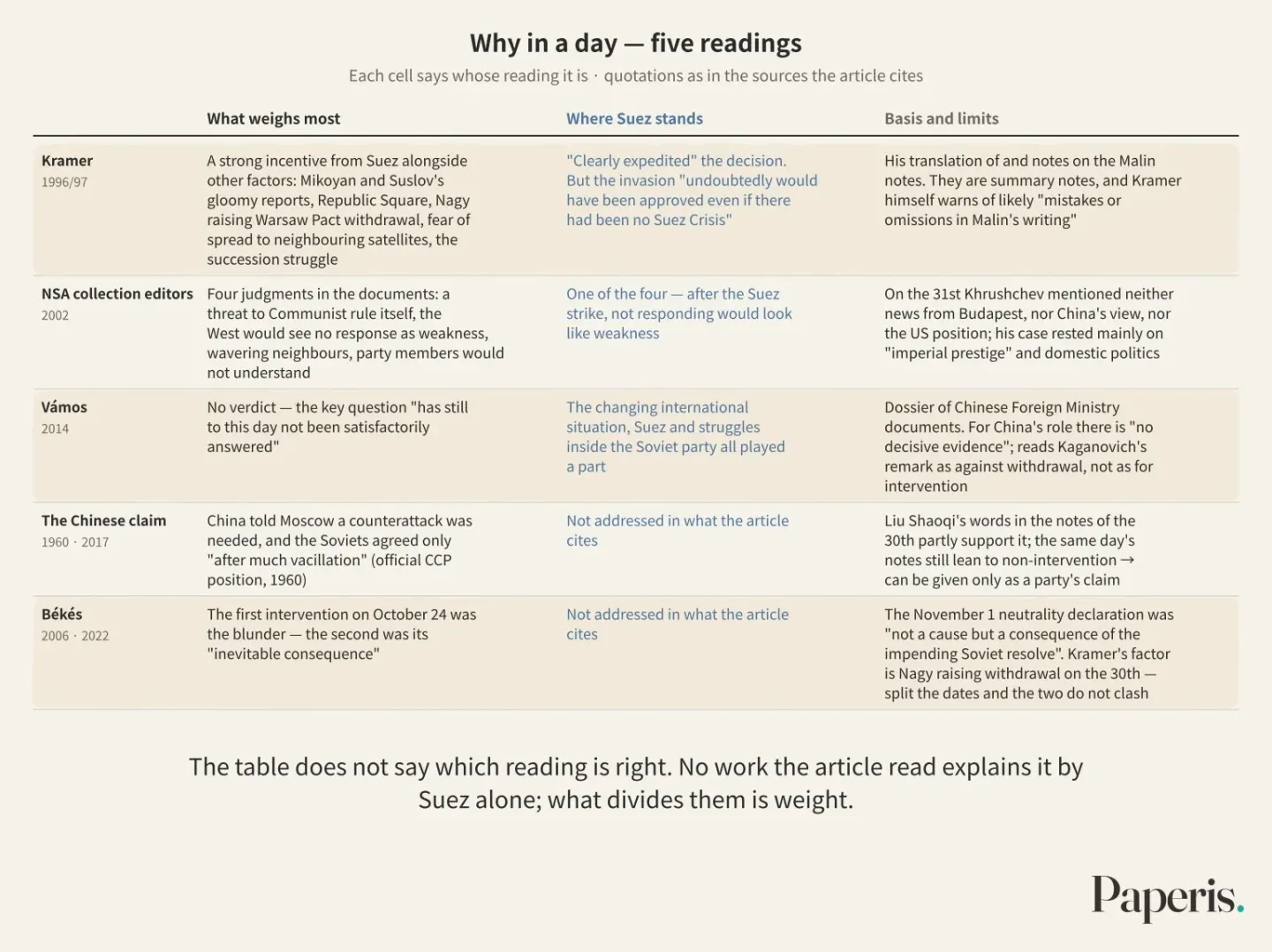
Figure: a diagram Paperis drew using only what the article says
Washington's Line — "We Do Not Look Upon These Nations as Potential Military Allies"
On October 27, Secretary of State Dulles gave a speech in Dallas, Texas. Regarding the Eastern European countries, he stated, "We do not look upon these nations as potential military allies" (FRUS 1955–57, vol. XXV, doc. 128). On the 29th, the State Department instructed the U.S. Ambassador in Moscow to communicate this point to the Soviet leadership, including Zhukov. The cable notes that this paragraph was "the result of intensive review at the highest level here" and added that it should not be publicized as a Washington-originating diplomatic initiative (FRUS 1955–57, vol. XXV, doc. 134). Eisenhower repeated the same words in a national address on the 31st (FRUS 1955–57, vol. XXV, doc. 149). What remains in the U.S. records is a record of an intentional effort to convey to the top leadership in Moscow that even if a new government were established in Hungary, the United States would not turn it into a military alliance.
Intelligence estimates from the same days reveal the calculation. On October 30, a Special National Intelligence Estimate by U.S. intelligence agencies noted that "U.S. actions short of overt military intervention or the obvious preparation thereof are not likely to cause the USSR to take steps which it believes would significantly increase the risk of general war" (FRUS 1955–57, vol. XXV, doc. 137). The assessment was that for U.S. actions short of military intervention, the Soviets would not respond by purposely stoking the risk of war. Whether those actions could actually help Hungary was a different question. At the National Security Council meeting on November 1, Eisenhower suggested treating the satellite issue merely as an intelligence briefing and focusing instead on the Middle East. That morning, Secretary of State Dulles told the president that the satellite policy, which had been the main agenda item of the meeting, was now an academic question because "matters were largely taking care of themselves" (FRUS 1955–57, vol. XXV, doc. 152). This was the day after the Soviet declaration was published in Pravda. According to NSA compilers, internal reviews concluded there was virtually no way to aid the insurgents without risking a world war, and Eisenhower had neither the inclination to go that far nor the desire to disrupt the improving atmosphere with Moscow (NSA document collection).
Hungarian historian László Borhi calls U.S. policy during this period a "dual policy." He argues that while Washington sought a negotiated settlement with the Soviets, it simultaneously encouraged instability within the Soviet bloc (DOI: 10.1162/152039799316976814). Historian Charles Gati, who was a young reporter in Budapest in 1956, assesses that "the United States was all talk and no action" (DOI: 10.1515/9781503626508). Primary documents showing that the November 6 presidential election drove policy are not within the scope of this text. One study concludes from public and private records that Eisenhower did not leave his policy to the mercy of public opinion (DOI: 10.5810/kentucky/9780813169057.003.0006).
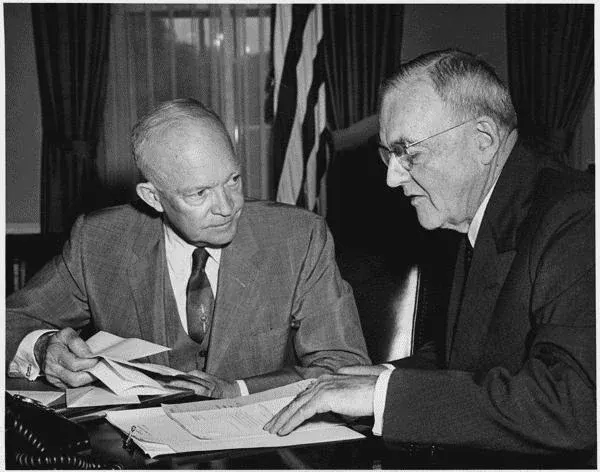
Figure: President Eisenhower and Secretary of State Dulles at the White House, August 14, 1956 · U.S. National Archives (NARA) · Public domain (U.S. federal government work), via Wikimedia Commons
The US-Funded Broadcast — Official Denials and an Internal Review
On October 26, at an interdepartmental meeting in Washington, a CIA attendee reported that all 29 of the broadcasting station's transmitters were operational as of the previous day, stating that "everything we have is directed at maximum power toward Hungary." At the same meeting, one participant warned that "it looks bad if we appear to be directing a rebellion from the outside" (FRUS 1955–57 Vol. 25 Doc. 117). Radio Free Europe was an anti-communist shortwave radio broadcast funded by the US government from Munich toward the communist bloc in Eastern Europe. NSA compilers note this station was "operated by the CIA" (NSA Archive Collection).
The assessment that "we turned our backs" existed at the time as well. On November 9, US Ambassador to the UN Henry Cabot Lodge conveyed the atmosphere at the UN to Eisenhower. The feeling was that the US had egged on Hungarians for a decade through Radio Free Europe and was now turning its back as they fell into trouble. According to a telephone memo, Eisenhower said that was wrong and that "we have never encouraged anybody to revolt" (FRUS 1955–57 Vol. 25 Doc. 178). On November 19, Lodge stated at the UN General Assembly, "I state with the highest authority: the US has never incited anyone to revolt, either through broadcasts or by other means" (FRUS 1955–57 Vol. 25 Doc. 193).
On December 5, a different document emerged from within the broadcasting station. It was a report reviewing Hungarian-language broadcasts from October 23 to November 23 by political advisor William Griffith. The conclusion was that "actual policy violations were few and non-existent in major political commentaries." The same sentence continues that policy application was "mostly crude and unimaginative," and the following sentence notes that the tone was " overheated." The report also points out problematic broadcasts: a broadcast that fairly clearly implied foreign aid would arrive if the resistance forces established a "central military command," tactical advice to cut railway and telephone lines, and a broadcast that called the Nagy government a "puppet government" (NSA Archive Collection Doc. 10, Griffith Review).
What the report picked out as "perhaps the most serious violation" was a foreign press summary by Zoltán Turi on November 4. After citing a British newspaper article, Turi led listeners to believe they could "expect Western military intervention within a few days," and the report notes this violated the entire philosophy of the broadcast. This means that the broadcast refugees and reporters talk about—where Radio Free Europe promised on the weekend of November 4 that help was on the way—was "undoubtedly" this one (NSA Archive Collection Doc. 10, Griffith Review). This broadcast went out on the day Soviet troops re-entered. The internal review concluded that "actual violations were few," while in the same document noting broadcasts that implied foreign aid and led listeners to expect Western intervention. That document was written after the official denial and was made public 46 years later.
Researchers measure the impact of the broadcast differently. Granville specifies that the broadcast did not "cause" the uprising itself, and notes its impact on the Soviet decision to intervene as "probable" (DOI: 10.3138/cjh.39.3.515). A 2000 French study reports that while the broadcast may not have given Nagy sufficient backing, it does not seem to have driven people into armed conflict, revealing the gap between America's declarative strategy and prudent diplomacy (DOI: 10.3406/rhmc.2000.2007). Gati evaluates that the broadcast opposed Nagy while encouraging unachievable demands (DOI: 10.1515/9781503626508). NSA compilers write that the hopes raised by the broadcast and their frustration leave many Hungarians bitter to this day (NSA Archive Collection).
What Stopped Suez — The Veto, the General Assembly, and the Pound
On October 30, Britain and France sent an ultimatum to Egypt and Israel demanding that they stop fighting within 12 hours and withdraw 10 miles away from both sides of the canal. Israel, still far from the canal, accepted, while Egypt refused (UN Peacekeeping Background Document). On the same day, a resolution introduced by the United States was put to a vote in the United Nations Security Council. It was a motion demanding the withdrawal of Israeli forces. The vote was 7 in favor, 2 against, and 2 abstentions, and because the two countries that cast opposing votes were permanent members Britain and France, the resolution failed to pass (FRUS 1955–57 Vol. 16, Doc. 439). The five permanent members can block a Security Council resolution with a single opposing vote. The representative of Yugoslavia proposed a different path. The Uniting for Peace resolution is a General Assembly resolution from 1950 that allows the UN General Assembly to hold an emergency session to address a matter instead when the Security Council is unable to act due to a permanent member's veto.
Following that resolution, the first emergency special session was convened on November 1, and in the early hours of the following day, US-sponsored Resolution 997 was adopted with 64 votes in favor, 5 against, and 6 abstentions. This was a resolution demanding an immediate ceasefire, withdrawal behind the armistice lines, and the reopening of the canal (UN Peacekeeping Background Document; FRUS 1955–57 Vol. 16, Doc. 467). Canadian External Affairs Minister Lester Pearson abstained, arguing that there was no mechanism to build the peace, and the proposal he submitted became Resolution 998 on November 4. It was a resolution requesting the Secretary-General to submit a plan within 48 hours to set up an international emergency force "with the consent of the nations concerned," passing with 57 votes in favor, 0 against, and 19 abstentions. Resolution 1000 (on November 5) established the UN Command, and Resolution 1001 (on November 7) approved its guiding principles (UN Peacekeeping Background Document). The United Nations Emergency Force was created by a UN General Assembly resolution in November 1956 and is the UN's first armed peacekeeping force to supervise the ceasefire at Suez. This force was requested by the General Assembly where the Security Council had dropped the ball (DOI: 10.1093/oso/9780199533435.003.0006), and it was the first time an armed unit was deployed in a UN peacekeeping operation (DOI: 10.1163/19426720-02902009). The first units entered Egypt on November 15–16 with troops from Colombia, Denmark, and Norway (UN Peacekeeping Background Document).
On the same day, the 4th, the Hungarian issue was blocked in the opposite direction. A US resolution demanding the withdrawal of Soviet troops was defeated in the Security Council despite 9 votes in favor due to a Soviet veto (FRUS 1955–57 Vol. 25, Doc. 164). That same day, the second emergency special session was convened under the Uniting for Peace resolution, adopting Resolution 1004 with 50 votes in favor, 8 against, and 15 abstentions, demanding that the Soviet Union immediately halt its attacks on the Hungarian people (FRUS 1955–57 Vol. 25, Doc. 167). The same mechanism was used twice in one week. One led to a ceasefire and withdrawal, while the other neither stopped the Soviet suppression nor brought about a withdrawal (DOI: 10.1093/law/9780198784357.003.0005).
Pressure also came from outside the UN. On October 30, Eisenhower suggested letting the side that started this operation solve its oil problems on its own. To put it another way, they should "boil in their own oil." He believed that they would soon run short of dollars and come asking for help (FRUS 1955–57 Vol. 16, Doc. 435). The records regarding the pound sterling have a different character. British Chancellor of the Exchequer Harold Macmillan wrote in his memoirs that he tried to draw money from the International Monetary Fund (IMF) to protect the pound, and that on the morning of November 6, during a cabinet meeting, he received a US reply stating that the US would not agree until Britain consented to a ceasefire. The editor of the diplomatic papers collection notes that no record of that request and reply could be found in State Department documents and comments that IMF matters were the Treasury's domain, adding that the US approved Britain's IMF drawing in December (FRUS 1955–57 Vol. 16, Doc. 516 Editor's Note). The story that the US Treasury threatened to sell off pound bonds is not found in the primary documents read by this article. The IMF's own case study documents speculative attacks on the pound and notes that all four belligerent countries received IMF assistance (DOI: 10.5089/9781451859751.001).
On the afternoon of November 6, Eden, having spoken with Eisenhower on the phone, stated, "If we are not attacked, we will stop firing at midnight tonight" (FRUS 1955–57 Vol. 16, Doc. 525). The withdrawal of British and French forces concluded on December 22, and on March 8, 1957, the Secretary-General reported the completion of the Israeli military withdrawal to the General Assembly (UN Peacekeeping Background Document). The meaning of these "principles" varies depending on the reader. A Korean study of American history concludes that while Eisenhower guided diplomacy with clear principles, his goal was to protect America's image in the Arab world, which took precedence over relations with Britain, and that viewing Suez through the framework of the Cold War is unjustified (KCI ART001292381).
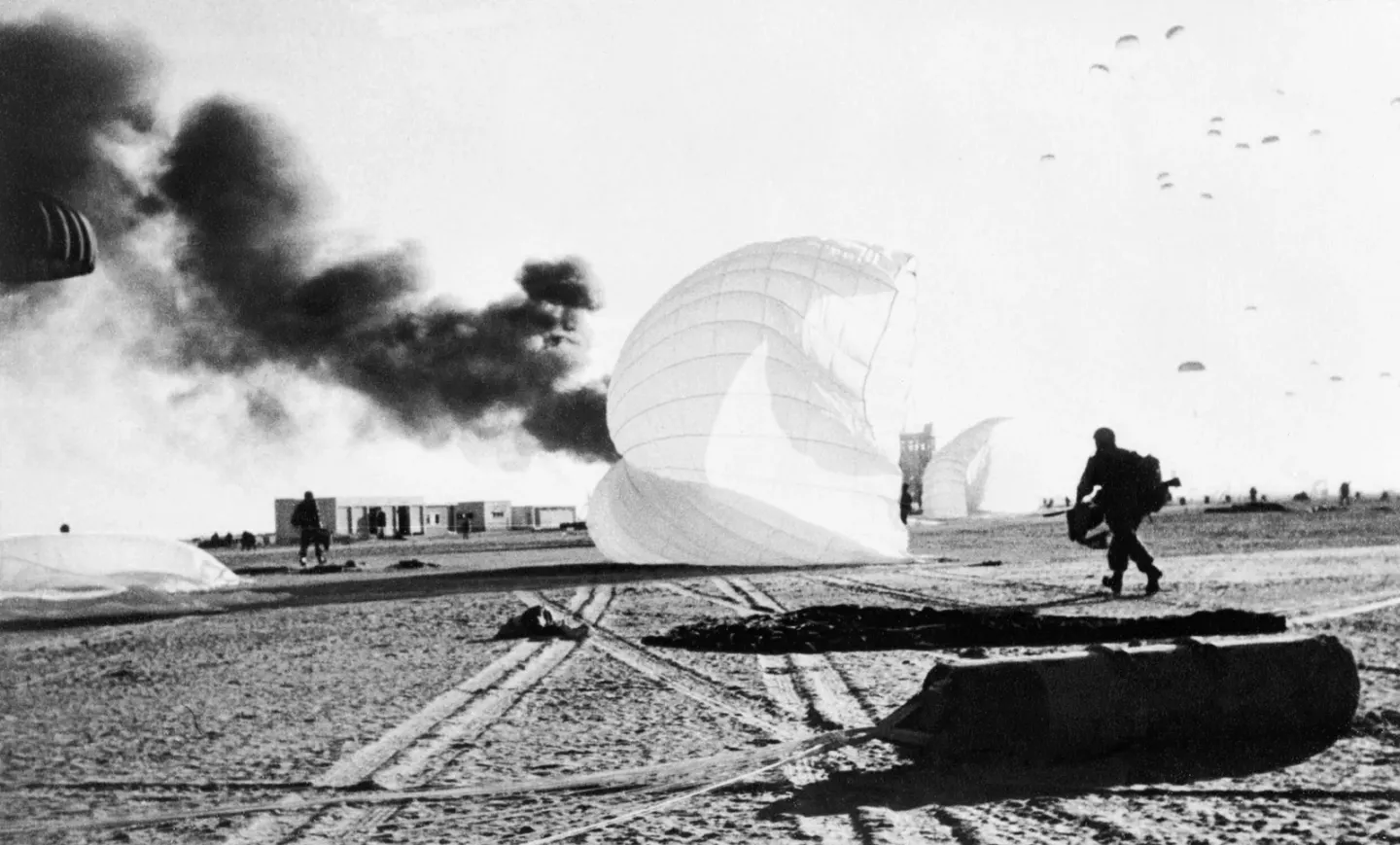
Figure: British 3rd Parachute Battalion landing at El Gamil airfield early on November 5, 1956 · Official photographer, Imperial War Museum (IWM HU 4181) · Public domain, via Wikimedia Commons
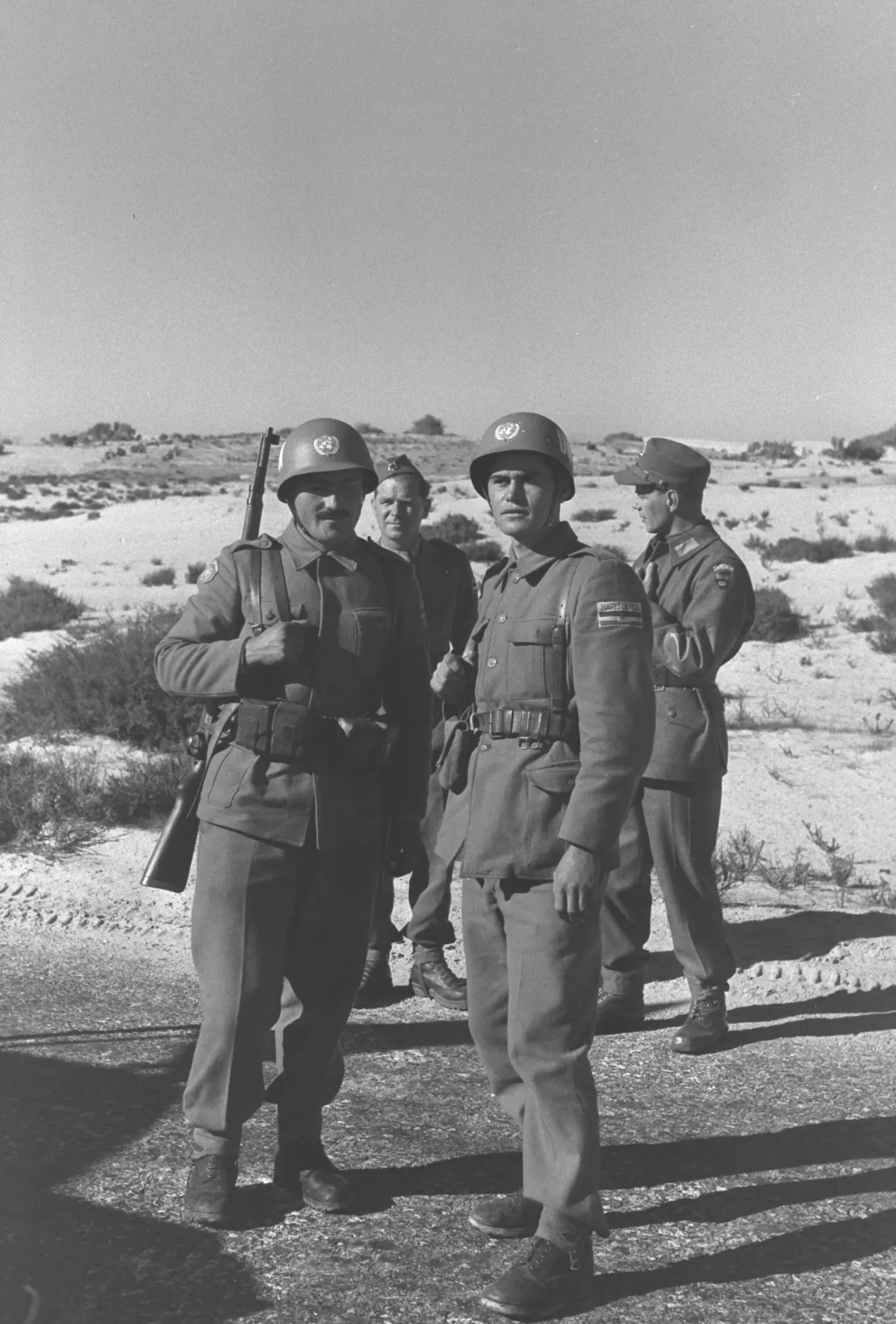
Figure: Yugoslav soldiers of the UN Emergency Force in Sinai, January 15, 1957 · Israel Government Press Office (GPO) · Public domain, via Wikimedia Commons
Numbers — The Range Varies with Each Tally
The death toll in Hungary is estimated to be between roughly 2,500 and 2,700. A 1990 tally by the Hungarian-born historian Gosztonyi, cited by Kramer, lists 2,502 deaths and 19,226 injuries. The same footnote includes 720 Soviet soldier deaths and 1,540 injuries, which is statistics published in 1993 by Russian military historian Krivosheev (Kramer, CWIHP Bulletin 8-9). Data from the Hungarian Central Statistical Office from 1957 counts about 13,000 injured people treated in hospitals through the end of November (Hungarian Central Statistical Office 2024). A 2017 Hungarian English-language press report citing data from the same agency records the death toll at about 2,700. An article introducing data from Hungary's 1956 Institute records about 2,500 deaths on the insurgent side and "at least 200" executions (Heinrich Böll Foundation introductory text). Research on the number of executions diverges between 229 by Szakolczai in 1994 and 600 by Ormos in 1989 (Kramer, CWIHP Bulletin 8-9).
The number of people who left the country by the end of 1956 was about 150,000 (Hungarian Central Statistical Office 2024). The number of people accepted by Austria exceeds 180,000 (DOI: 10.1093/9780191853470.003.0003). An article introducing data from the 1956 Institute records it as about 200,000 (Heinrich Böll Foundation introductory text). The figures diverge because the tally timing (end of November, end of December, the following spring), the tally entity (Hungarian authorities, receiving countries, research institutes), and the criteria for injury (hospital treatment versus overall) differ from one another. Casualties in the Suez Crisis have widely conflicting estimates, and this article has not verified the primary tallies.
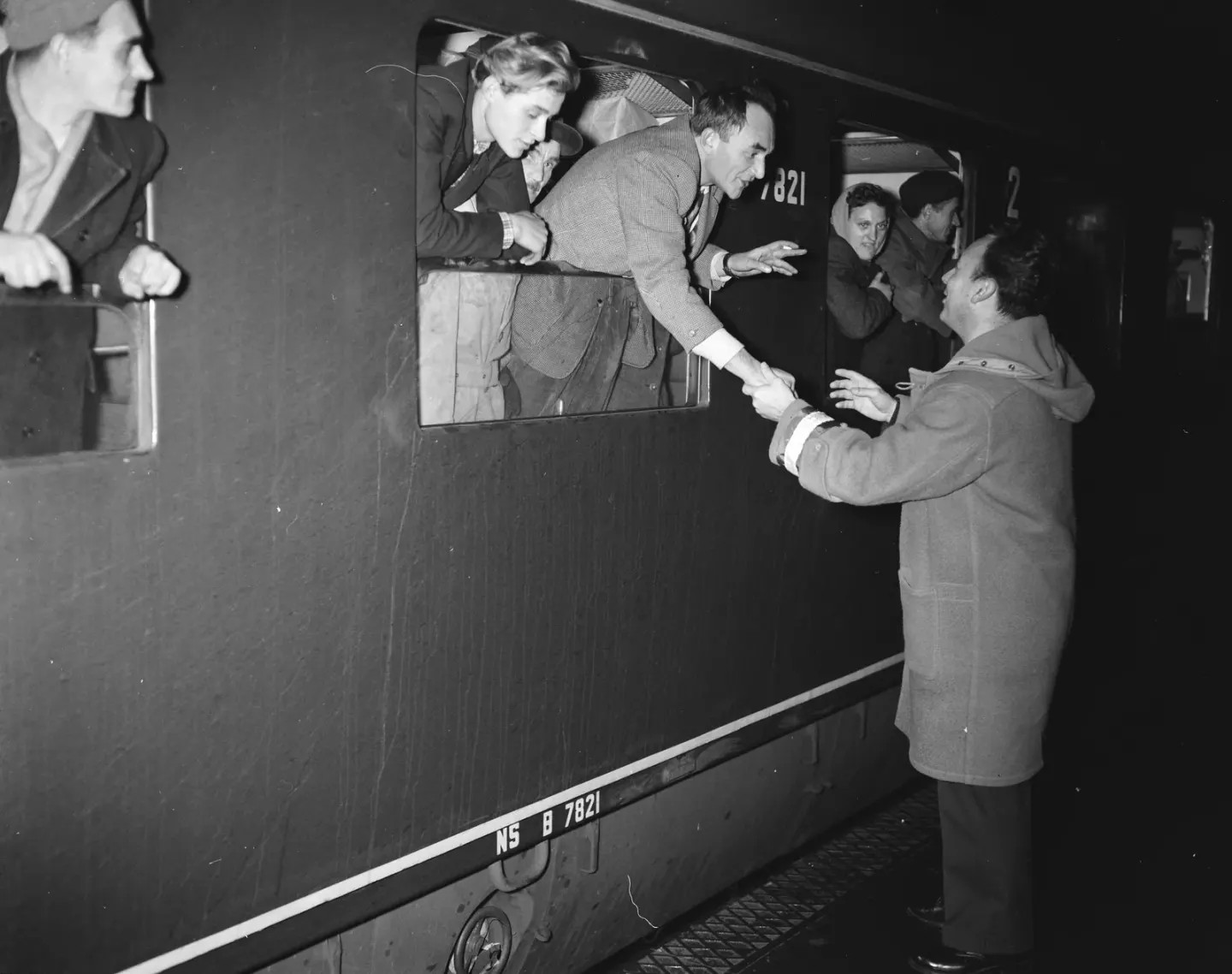
Figure: The third group of Hungarian refugees arriving in the Netherlands, November 25, 1956 · Photo by Wim van Rossem, Anefo · Nationaal Archief (Netherlands) · CC0, via Wikimedia Commons
Where There Was Agreement and Where They Still Diverge
There are four places where the documents overlap. First, the leadership meeting on October 30 was unanimous toward the declaration, withdrawal from Budapest, and a willingness to negotiate, and with Khrushchev's "re-evaluation" on the 31st, preparations for a crackdown began. Second, Khrushchev's remarks on the 31st include Suez, along with prestige and reactions within the party. Third, the United States deliberately tried to convey to Moscow that it would not make the new Hungarian government a military alliance, and internal reviews concluded there was almost no way to help the rebels without risking a world war. Fourth, Suez led to a ceasefire and withdrawal through a General Assembly resolution and the United Nations Emergency Force after the vetoes of Britain and France.
There are also four places where they diverge. First, in the reversal within a single day, how much weight did Suez, the worsening internal situation in Hungary, the movement to withdraw from the treaty, China, and domestic party politics each carry? Second, did Liu Shaoqi's remarks precede the Soviet decision, and when did Mao turn around? Third, how much influence did Radio Free Europe have on the judgments of the Hungarians and the Soviets? Fourth, the number of casualties and refugees.
Malin's notes are a summary memo, and there is no sentence written by Khrushchev himself on that day explaining why he changed his mind on the 31st. The single line this article will carry with it is this: Suez is inside the sentences of the 31st, and there is no record that that single sentence was the entirety of the decision.
Where to Look Next
- "Why Did Stalin Turn in January and Mao Send Troops in October? — 1950, Two Decisions Reread After the Files Opened" — Reads a decision from six years earlier using records from the same Moscow archives.
- "Did Johnson Choose Vietnam, or Was He Pushed? — July 1965, Reread After the Files Opened" — Unlike Eisenhower in 1956 who did not intervene, it reads the US president's decision to escalate intervention.
- "Why Didn't Gorbachev Shoot in 1989? — Eastern Europe, and a Decision Not Taken, Reread After the Files Opened" — The side of 1989 that Kramer wrote "could have happened 33 years earlier."
Case Documents
-
"New Evidence on Soviet Decision-Making and the 1956 Polish and Hungarian Crises" (CWIHP Bulletin 8-9, 1996/97) — https://www.wilsoncenter.org/sites/default/files/media/documents/publication/CWIHPBulletin8-9_p6.pdf — Kramer's commentary and English translations and annotations of Soviet Presidium transcripts (Malin Notes).
-
"The 1956 Hungarian Revolution" (NSA Electronic Briefing Book 76, 2002) — https://nsarchive2.gwu.edu/NSAEBB/NSAEBB76/ — Editor's commentary, Nagy government cabinet minutes, and RFE Griffith review.
-
"Much Listening, Little Speaking: Chinese Foreign Ministry Documents on Hungary, 1956" (CWIHP e-Dossier 50, 2014) — https://wilsoncenter.org/publication/chinese-foreign-ministry-documents-hungary-1956 — Vámosi's commentary on Chinese Foreign Ministry documents.
-
FRUS 1955–1957, Vol. 25, "Eastern Europe" — https://history.state.gov/historicaldocuments/frus1955-57v25 — Dulles speeches, intelligence estimates, NSC, and Eisenhower-Lodge records.
-
FRUS 1955–1957, Vol. 16, "Suez Crisis" — https://history.state.gov/historicaldocuments/frus1955-57v16 — Security Council votes, Eisenhower statements, Eden calls, and IMF editor's notes.
-
"The Protocol of Sèvres, 1956: Anatomy of a War Plot" (International Affairs, 1997) — http://web.archive.org/web/20240916142929/https://users.ox.ac.uk/~ssfc0005/The%20Protocol%20of%20Sevres%201956%20Anatomy%20of%20a%20War%20Plot.html — Shlaim's commentary and English translation of the Protocol of Sèvres.
-
PRO 22/88 Photocopy of the Protocol of Sèvres (UK National Archives) — https://beta.nationalarchives.gov.uk/catalogue/id/C3192018 — Archival record holding a photocopy of the Israeli original.
-
"Middle East – UNEF I Background" (United Nations Peacekeeping) — https://peacekeeping.un.org/sites/default/files/past/unef1backgr2.html — Ultimatum, emergency special session resolution, and the deployment and withdrawal of the United Nations Emergency Force.
-
1956 Infographic (Hungarian Central Statistical Office, 2024) — https://ksh.hu/infografika/2024/1956_2024_infograf_eng.pdf — Casualties and emigrants based on 1957 data.
-
Introduction to the 1956 Institute Oral History Archive (Heinrich Böll Foundation) — https://cz.boell.org/en/node/2293 — Introduction to the scale of deaths, executions, and escapes (secondary source).
Source Papers
- "China's Foreign Policy in Polish Crisis and Hungarian Revolt" (2017, project report) — DOI: 10.34321/19701 — Argument that the Chinese Communist Party insisted on a hardline approach at the crossroads of the 30th after the Polish and Hungarian resistance following the Secret Speech.
- "The Polish – Soviet confrontation in 1956 and the attempted Soviet military intervention in Poland" (2006) — DOI: 10.1080/09668130600996549 — Intervention stopped after the October 19 delegation, Soviet troop movements, and the showdown between Khrushchev and Gomułka.
- "The Soviet Union and the 1956 Crises in Hungary and Poland: Reassessments and New Findings" (1998) — DOI: 10.1177/002200949803300201 — Kramer. Poland reached a political compromise while Hungary was suppressed; Malin's notes require broad revision of Western explanations.
- "Failed Illusions: Moscow, Washington, Budapest, and the 1956 Hungarian Revolt" (2006) — DOI: 10.1515/9781503626508 — Gati. Reformist Nagy, "America is all talk," and RFE fueled unrealistic demands while opposing Nagy (publisher's introduction).
- "In the Line of Fire: The Soviet Crackdown of Hungary, 1956-58" (1999) — DOI: 10.5195/cbp.1999.80 — Granville. Contrary to the image of "the Soviet Union skillfully intervening in the Suez crack," allies were out of sync.
- "미국의 중동정책과 수에즈 위기: ‘수에즈 외교의 진실’에 대한 소고(小考)" (2008) — KCI ART001292381 — US documents released since 1989 show principled diplomacy, a goal of an Arab world image, and the inadequacy of the Cold War framework.
- "The 1956 Hungarian Revolution and the Declaration of Neutrality" (2006) — DOI: 10.1080/14682740600979261 — Békés. The neutrality declaration was a result rather than a cause, a desperate final attempt.
- "Crisis Year, 1956" (2022) — DOI: 10.5149/northcarolina/9781469667485.003.0005 — Békés. The first intervention was a blunder, and the second intervention was the inevitable result of the first.
- "Radio Free Europe's Impact on the Kremlin in the Hungarian Crisis of 1956: Three Hypotheses" (2004) — DOI: 10.3138/cjh.39.3.515 — Granville. Broadcasts "perhaps" contributed to the suppression, but there is no irrefutable evidence, and they did not spark the uprising itself.
- "The Hungarian Revolution and the Suez Crisis" (2005) — DOI: 10.1111/j.1468-229x.2005.00350.x — Boyle. The link between the two crises is particularly important in explaining Soviet decisions and the Anglo-American rift.
- "Rollback, Liberation, Containment, or Inaction? U.S. Policy and Eastern Europe in the 1950s" (1999) — DOI: 10.1162/152039799316976814 — Borhi. A dual policy of negotiated settlement and fomenting instability within the bloc.
- "When Public Opinion Does Not Shape Foreign Policy" (2017) — DOI: 10.5810/kentucky/9780813169057.003.0006 — The 1956 presidential election and the crisis; Eisenhower did not leave policy to public opinion.
- "« Radio Europe libre » et le soulèvement hongrois de 1956" (2000) — DOI: 10.3406/rhmc.2000.2007 — Nagy may not have been sufficiently supported, but he does not seem to have been driven into armed conflict; the gap between declarative strategy and prudent diplomacy.
- "The Security Council, The General Assembly, And War: The Uniting For Peace Resolution" (2008) — DOI: 10.1093/oso/9780199533435.003.0006 — The first peacekeeping force, UNEF, was requested by the General Assembly, not the Security Council.
- "Retaining Flexibility: Dag Hammarskjöld, the 1958 Summary Study, and the History of UN Peacekeeping" (2023) — DOI: 10.1163/19426720-02902009 — UNEF was the first armed UN force.
- "Northwest of Suez" (2000, IMF Working Paper) — DOI: 10.5089/9781451859751.001 — Speculative attack on the pound; all four belligerent countries received IMF support.
- "Imre Nagy: A Biography" (2009) — DOI: 10.5040/9780755620500 — Nagy was executed two years later (book introduction).
- "The Soviet Intervention in Hungary—1956" (2018) — DOI: 10.1093/law/9780198784357.003.0005 — International law neither prevented the Soviet invasion nor brought about withdrawal.
- "Austria" (2026) — DOI: 10.1093/9780191853470.003.0003 — Austria took in more than 180,000 Hungarian refugees.
Sources (18)
- China's Foreign Policy in Polish Crisis and Hungarian RevoltDOI 10.34321/19701
- The Polish – Soviet confrontation in 1956 and the attempted Soviet military intervention in PolandDOI 10.1080/09668130600996549
- The Soviet Union and the 1956 Crises in Hungary and Poland: Reassessments and New FindingsDOI 10.1177/002200949803300201
- Failed Illusions: Moscow, Washington, Budapest, and the 1956 Hungarian RevoltDOI 10.1515/9781503626508
- In the Line of Fire: The Soviet Crackdown of Hungary, 1956-58DOI 10.5195/cbp.1999.80
- The 1956 Hungarian Revolution and the Declaration of NeutralityDOI 10.1080/14682740600979261
- Crisis Year, 1956DOI 10.5149/northcarolina/9781469667485.003.0005
- Radio Free Europe's Impact on the Kremlin in the Hungarian Crisis of 1956: Three HypothesesDOI 10.3138/cjh.39.3.515
- The Hungarian Revolution and the Suez CrisisDOI 10.1111/j.1468-229x.2005.00350.x
- Rollback, Liberation, Containment, or Inaction? U.S. Policy and Eastern Europe in the 1950sDOI 10.1162/152039799316976814
- When Public Opinion Does Not Shape Foreign PolicyDOI 10.5810/kentucky/9780813169057.003.0006
- Radio Europe libreDOI 10.3406/rhmc.2000.2007
- The Security Council, The General Assembly, And War: The Uniting For Peace ResolutionDOI 10.1093/oso/9780199533435.003.0006
- Retaining Flexibility: Dag Hammarskjöld, the 1958 Summary Study, and the History of UN PeacekeepingDOI 10.1163/19426720-02902009
- Northwest of SuezDOI 10.5089/9781451859751.001
- Imre Nagy: A BiographyDOI 10.5040/9780755620500
- The Soviet Intervention in Hungary—1956DOI 10.1093/law/9780198784357.003.0005
- AustriaDOI 10.1093/9780191853470.003.0003