Paperis Articles
Why Do Zebras Have Stripes?
Why? · Zebras
Your field's papers, as audio
Pick your fields and journals — Paperis summarizes the key papers and turns them into audio. Listen on your commute.
Start Paperis free →Why Do Zebras Have Stripes?
The child listens. The parent reads. This page helps you answer the questions your child may ask after the story. You can see the story script with the script button while it plays.
What this story is about
People have asked what zebra stripes are for since the time of Darwin and Wallace (PMID 24691390). This story follows how people tested the question. In one test, the same horses wore coats with different patterns. Then people counted how many horse flies landed. Other tests used horse models, cows, and animal skins. One study copied how lions see. Others measured the heat of the stripes. Others compared the places where zebras live. The answer has two parts. Many tests show that fewer blood-drinking flies land on stripes. But scientists still argue about whether this is why zebras got stripes, and about why the flies get mixed up.
How people found out
Watching on a horse farm. This was on a horse farm in Britain. People watched horse flies near plains zebras and near horses of one color. The flies flew around and briefly touched zebras and horses at about the same rate. But per unit of time, fewer flies landed on zebras (PMID 30785882).
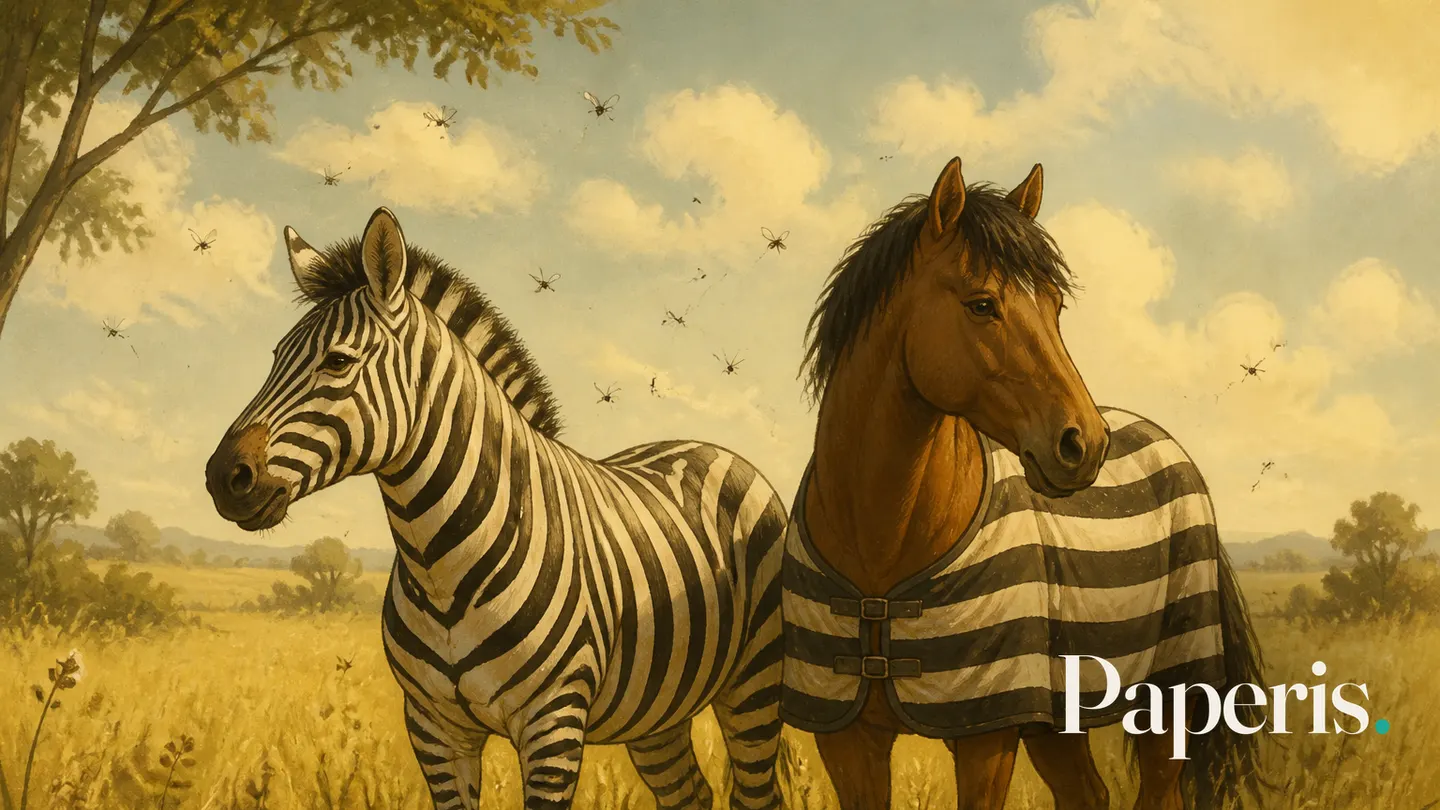
Same horses, different coats. Zebras and horses differ in many ways, not just stripes. So the same horses wore cloth coats, one after another: black, white, and striped. With the striped coat, far fewer flies touched and landed on the coat. This was compared with the same horses in black or white. Attacks on the bare heads did not change with the coat (PMID 30785882). By the design, the heads work as a check. So the difference came from the coat pattern. (This is how this page reads the design. The summary does not say it.) This is the main scene of the story.
Landing on video. In close video studies, flies came toward zebras faster and did not slow down before touching them. Compared with horses, more flies only touched zebras and did not land (PMID 30785882). The writers said that up close, stripes stopped flies from making a controlled landing. But from far away, stripes did not change how flies acted (PMID 30785882). Zebras swished their tails and ran away from flies. Horses twitched their skin more. In the end, very few flies landed on zebras, and few stayed long or tried to drink blood (PMID 30785882).
Other tests. A horse model painted with zebra stripes drew far fewer horse flies than black, brown, gray, or white models. Thinner stripes drew fewer flies. Real zebra stripe widths fell in the range that drew the fewest flies (PMID 22323196). The summary does not say if this width result came from the horse model or from other targets. Also, in the Kenya skin test, stable flies did not choose between the kinds of zebra with the widest and the narrowest stripes (PMID 36329147). So the width results differ between tests. The story leaves the width result out. Even with carbon dioxide and ammonia to pull flies in, striped targets drew fewer flies than one-color targets (PMID 23810990). Six black cows (a breed called Japanese Black) took turns. Some got black-and-white stripes painted on, some got only black stripes, and some got no paint. With black-and-white stripes, the fewest biting flies were on their bodies. The cows also shook their heads and flicked their tails less (PMID 31581218). The black-stripes-only cows were different too, so paint alone does not explain it. In Kenya, people let hungry stable flies (Stomoxys) go inside a fence. Given a choice, the flies strongly liked plain tan impala skins. They landed on striped zebra skins much less (PMID 36329147). These tests point the same way: fewer blood-drinking flies land on stripes. But the cow test used only six cows.
Why do flies get mixed up? We don't know yet. One idea was the "aperture effect." It says straight lines side by side make false motion signals. But horses wore checked coats, and flies stayed away from those, just like stripes. The aperture idea needs lines side by side, so this result goes against it (PMID 32811316). In that test, flies landed less on striped and checked coats than on gray. They flew faster near them and did not come as close (PMID 32811316). In a later test, flies did not like to land on strong, high-contrast stripes. But they did not avoid weak, low-contrast stripes. There was no sign that flies liked coats that reflect more polarized light. The writers' working idea is this. Flies like large dark patches up close. Thin, sharp stripes remove those patches (PMID 36700395). A 2025 model study first said "no clear mechanistic hypothesis remains." Then it worked out that, up close, flies would keep misjudging how stripes move (PMID 39801301). Other studies point to polarized light (PMID 27223616) or to mixed-up heat signals from blood vessels (PMID 35927437, PMID 36356641). The story just says "we don't know yet" and gives two ideas.
Answers people often hear
"To keep flies away" — it is clear that fewer flies land on stripes. The tests above show this. Whether this is why stripes came about is in the "known and not known" part below. There is no proof that stripes chase flies away from far off. Horse flies flew around both animals at the same rate. The difference was only up close (PMID 30785882). The Kenya test did not test distance. But it found that close range was enough for the effect (PMID 36329147). Also, one study found that flies may see the stripes from up to 20 m away (PMID 27223616).
"To hide in the grass or from lions" — the studies that tested this did not support it. One study changed zebra photos. The photos matched how lions, spotted hyenas, and zebras see. In daylight, past about 50 m, big hunters could hardly see the stripes. At dusk, it was past about 30 m. People could still see them. On moonless nights, no animal could see the stripes past about 9 m. Zebras spend most of their time in open land with no trees. There, lions could spot zebras as clearly as other hoofed animals of the same size. So stripes did not seem to hide the zebra's shape. In woods, stripes helped hide body shape a little, but this worked more for people than for hunters. The writers said stripes are very unlikely to be hiding colors against hunters (DOI: 10.1371/journal.pone.0145679). Note that this study did not watch real lions. It used a vision model on photos. A 2014 study that compared stripes and places also gave no steady support for hiding or escaping hunters (PMID 24691390). The story says this inside the story.
"To confuse lions when running" — the proof is weak. In a computer game, people tried to catch moving targets. Striped targets were caught less and missed more than camouflage targets. But when they stood still, striped targets were easy to find (PMID 22117898). These were people, not zebras and lions. A computer model also says moving zebra stripes may make false motion signals (PMID 24368147). A 2026 study said that among many ideas, including confusing hunters, only keeping biting flies away has strong proof (PMID 41295970).
"To stay cool" — results differ, and the direct tests did not support it. In Kenya, on sunny days, people measured two zebras. For seven hours in the middle of the day, black and white stripes were 12–15 °C apart. A zebra skin with no zebra in it got up to 16 °C hotter than the living zebras. The writers said the heat difference may make the air move above the hair and help sweat dry. They said cooling may be the main job of stripes (DOI: 10.1080/00222933.2019.1607600). But in another test, people filled metal barrels with water. They covered them with horse, cow, and zebra skins and many patterns. The barrels stayed outside for four months. Even on hot days, the inside heat of striped and gray barrels was not clearly different (DOI: 10.1038/s41598-018-27637-1). But these barrels do not sweat. So they cannot test the idea from the 2019 study: sweat drying on a living zebra, and black stripe hairs standing up. The 2019 writers used this idea to explain why a bare skin got hotter than living zebras (DOI: 10.1080/00222933.2019.1607600). One lab test used special imaging. More than 1–2 cm above the surface, stripes had almost no effect on air flow. Even the weakest wind, or a very slow zebra step, blew the air flow away (DOI: 10.1038/s41598-021-95105-4). On the other hand, a 2015 study compared plains zebra stripes with 29 things about where they live. Air temperature explained a large part of the stripe differences. But the writers said this link may come from many different causes (PMID 26064590). That summary does not say which way it goes. For example, it does not say "more stripes where it is hot." So the story does not say a direction either. The story says "at least in these tests, the cooling idea did not fit well." In its summary, the story also keeps cooling apart from hiding and says people are "still checking it."
"To know each other (to find mom)" — we found no proof for this. Each zebra has its own stripes. So people can tell zebras apart by their stripes (DOI: 10.1017/9781108917735.004). But one chapter of a book on zebra stripes found no support for a social use. Horses with no stripes still know each other by sight and sound. Zebras groom each other much less than horses do. Stripes are not linked to sex or body size (DOI: 10.7208/chicago/9780226411156.003.0006). The 2014 study also gave no steady support for a social use (PMID 24691390). The story credits this to the book. We did not find a study that tested "finding mom" directly.
Questions your child may ask
"Is a zebra black with white stripes, or white with black stripes?" What we checked is only about the hair. Hairs in the dark stripes have the color melanin. Hairs in the white stripes do not (DOI: 10.1017/9781108917735.004). People often say "the skin is black." We did not find that in the papers we gathered. So the story leaves it out.
"When do the stripes form?" In plains zebras, body stripes form in the third week of life in the womb. Each stripe starts from about twenty cells. In Grevy's zebras, it happens in the fifth week. Their bodies are longer then, so they have more stripes (DOI: 10.1017/9781108917735.004).
"Does every zebra have different stripes?" Yes. People can tell each zebra by its stripes (DOI: 10.1017/9781108917735.004). The three kinds of zebra also have different stripe patterns (DOI: 10.1017/9781108917735.004). Flies may not explain why stripe width differs between kinds. In the Kenya test, stable flies did not prefer the skin with the widest stripes or the skin with the narrowest. The writers think width differences come from something other than biting flies (PMID 36329147).
"Why do flies matter so much?" Biting flies are common all over Africa and have a large effect on the animals they bite (PMID 22323196). The writers of the 2014 study talked about short hair, sickness carried by flies, and blood loss. These may make zebras easy targets (PMID 24691390). The story only says "many flies drink blood" and does not talk about sickness.
What is known and what is not
What is known. Fewer blood-drinking flies land on stripes. This was true for living zebras and horses (PMID 30785882), for the same horses in coats (PMID 30785882, PMID 32811316), for horse models (PMID 22323196), for painted cows (PMID 31581218), and for skins outdoors (PMID 36329147). The effect showed up close (PMID 30785882, PMID 36329147).
Still argued, part 1: Did flies cause the stripes? "Fewer flies land on stripes" and "so stripes came about" are two different claims. A 2014 study compared stripes in zebras and their relatives with where they live. It found a link between a measure of horse fly bother and most stripe measures. It also found a link between belly stripes and where tsetse flies live. It gave no steady support for hiding, escaping hunters, heat, or social use. The writers said "a solution to the riddle" is at hand (PMID 24691390). But a 2015 study looked at plains zebras only, with 29 things about where they live. "In contrast to recent findings," it found no proof that stripes came from escaping hunters or biting flies. Air temperature explained a large part of the stripe differences. The writers think the causes are probably many and complex (PMID 26064590). A 2025 review said keeping biting flies away has the strongest proof today. But this idea alone has trouble with two things. Why do zebras have such strong stripes, but other African animals do not? And why are stripes spread over the body the way they are? An idea about signals to other kinds of animals that herd with zebras could explain these. But no one has tested that idea yet (PMID 40745963). Thick, flat stripes on the rump do not fit the fly idea well. There is some proof they change with the danger from hyenas. A 2026 study showed people photos changed to match lion and hyena vision. People said the rump stripes caught the eye the most (PMID 41295970). This study used human watchers and computer models.
Still argued, part 2: Why do flies get mixed up? This is the last part of "How people found out." The aperture idea was shown wrong (PMID 32811316). There is the "no large dark patches" working idea (PMID 36700395) and some model studies (PMID 39801301). But no one knows for sure yet.
Less argued: hiding. The studies that tested hiding did not support it (DOI: 10.1371/journal.pone.0145679, PMID 24691390).
Still open: cooling. The barrel test and the lab air test did not support cooling (DOI: 10.1038/s41598-018-27637-1, DOI: 10.1038/s41598-021-95105-4). But a barrel does not sweat like a living zebra. So it cannot test the sweat idea. One study measured stripe heat and suggested a cooling job (DOI: 10.1080/00222933.2019.1607600). Another study found a link with air temperature (PMID 26064590). So that question is not closed.
Things to try together
- Thick and thin stripes: how many steps until they look gray? Take two sheets of white paper. Draw thick black stripes on one. Draw thin, close stripes on the other. Put them on a wall. Your child steps back one step at a time. Count the steps until the stripes start to blur into gray. The story does not say which one turns gray first. The lion vision study also used stripe width and brightness to work out how far away stripes can be seen (DOI: 10.1371/journal.pone.0145679). But at home, you are using human eyes. This does not copy lion vision. If the room is too small, draw the lines even thinner and closer.
- (Optional) Where do flies land? In summer, put a striped sheet and a one-color sheet side by side on an outdoor table. From a short distance, count the bugs that land, with your eyes only. Do not catch, touch, or chase the bugs. Do not use food or sweets as bait. If bees come, move away. Flies near your home are not the same kinds as the flies in the studies. So the result may be different. No bugs may come at all. This one is not in the story.
Evidence papers
- "Benefits of zebra stripes: Behaviour of tabanid flies around zebras and horses." (2019) — PMID 30785882 — Fewer horse flies landed on zebras. Horses in striped coats were attacked far less than in black or white coats. Bare heads showed no difference. The effect was only up close.
- "Polarotactic tabanids find striped patterns with brightness and/or polarization modulation least attractive: an advantage of zebra stripes." (2012) — PMID 22323196 — A striped horse model drew far fewer horse flies than one-color models. Thinner stripes drew fewer.
- "Stripes disrupt odour attractiveness to biting horseflies: battle between ammonia, CO₂, and colour pattern for dominance in the sensory systems of host-seeking tabanids." (2013) — PMID 23810990 — Even with carbon dioxide and ammonia, striped targets drew fewer horse flies than one-color targets.
- "Cows painted with zebra-like striping can avoid biting fly attack." (2019) — PMID 31581218 — In six cows, black-and-white stripes gave the fewest biting flies and the least fly-chasing behavior.
- "Zebras of all stripes repel biting flies at close range." (2022) — PMID 36329147 — In Kenya, stable flies strongly chose impala skins over zebra skins, with no choice between zebra skins of different stripe widths.
- "Zebra stripes, tabanid biting flies and the aperture effect." (2020) — PMID 32811316 — Flies avoided checked coats like striped coats, which goes against the aperture idea.
- "Why don't horseflies land on zebras?" (2023) — PMID 36700395 — Flies avoided only high-contrast stripes, with no proof for polarized light. The working idea is that stripes remove large dark patches.
- "Zebra stripes induce aberrant motion analysis in flies through aliasing." (2025) — PMID 39801301 — A model result: up close, flies would misjudge how stripes move.
- "Zebras and Biting Flies: Quantitative Analysis of Reflected Light from Zebra Coats in Their Natural Habitat." (2016) — PMID 27223616 — Light differences between stripes cannot be seen by flies more than 10 m away, which supports a cause not based on polarized light.
- "Sunlit zebra stripes may confuse the thermal perception of blood vessels causing the visual unattractiveness of zebras to horseflies." (2022) — PMID 35927437 — An idea, with indirect support, that heat differences at stripe edges in the sun may confuse how horse flies find blood vessels.
- "Blood-seeking horseflies prefer vessel-imitating temperature gradients on host-mimicking targets: Experimental corroboration of a new explanation of the visual unattractiveness of zebras to tabanids." (2023) — PMID 36356641 — Female horse flies liked a warm hidden wire on host-like targets, which supports the blood vessel heat idea.
- "The function of zebra stripes." (2014) — PMID 24691390 — Stripes were linked to horse fly bother and tsetse fly range, with no steady support for hiding, hunters, heat, or social use.
- "How the zebra got its stripes: a problem with too many solutions." (2015) — PMID 26064590 — In plains zebras, there was no proof about hunters or biting flies, and air temperature explained a large part of stripe differences.
- "Zebra stripes: the questions raised by the answers." (2025) — PMID 40745963 — The fly idea has the strongest proof, but it has trouble explaining why other animals have no stripes and how stripes spread on the body.
- "Perceiving zebra rump stripes "through the eyes of" their predators: A study with human observers." (2026) — PMID 41295970 — Only the fly idea has strong proof. Rump stripes may pull a hunter's eye to the back.
- "Motion dazzle and camouflage as distinct anti-predator defenses." (2011) — PMID 22117898 — In a computer game, people caught moving striped targets less, but found still striped targets easily.
- "Motion camouflage induced by zebra stripes." (2014) — PMID 24368147 — A computer model: moving zebra stripes make false motion signals.
- "Zebra Stripes through the Eyes of Their Predators, Zebras, and Humans" (2016) — DOI: 10.1371/journal.pone.0145679 — Past about 50 m in daylight and 30 m at dusk, lion and hyena vision can hardly see stripes, so hiding is very unlikely.
- "Do zebra stripes influence thermoregulation?" (2019) — DOI: 10.1080/00222933.2019.1607600 — In two zebras, black and white stripes were 12–15 °C apart, and the writers suggested cooling by moving air.
- "Experimental evidence that stripes do not cool zebras" (2018) — DOI: 10.1038/s41598-018-27637-1 — Over four months, striped and gray barrels showed no clear difference in inside heat.
- "A new argument against cooling by convective air eddies formed above sunlit zebra stripes" (2021) — DOI: 10.1038/s41598-021-95105-4 — Air flow above stripes was tiny past 1–2 cm and the weakest wind blew it away.
- "Coat Coloration" (2022) — DOI: 10.1017/9781108917735.004 — Each zebra can be told apart by its stripes. Only dark stripe hairs have melanin. Stripes form in weeks 3 to 5 in the womb.
- "6: Intraspecific communication" (2016) — DOI: 10.7208/chicago/9780226411156.003.0006 — Horses with no stripes still know each other, and there is no support for a social use of stripes.
Sources (23)
- Benefits of zebra stripes: Behaviour of tabanid flies around zebras and horsesPMID 30785882
- Polarotactic tabanids find striped patterns with brightness and/or polarization modulation least attractive: an advantage of zebra stripesPMID 22323196
- Stripes disrupt odour attractiveness to biting horseflies: battle between ammonia, CO₂, and colour pattern for dominance in the sensory systems of host-seeking tabanidsPMID 23810990
- Cows painted with zebra-like striping can avoid biting fly attackPMID 31581218
- Zebras of all stripes repel biting flies at close rangePMID 36329147
- Zebra stripes, tabanid biting flies and the aperture effectPMID 32811316
- Why don't horseflies land on zebras?PMID 36700395
- Zebra stripes induce aberrant motion analysis in flies through aliasingPMID 39801301
- Zebras and Biting Flies: Quantitative Analysis of Reflected Light from Zebra Coats in Their Natural HabitatPMID 27223616
- Sunlit zebra stripes may confuse the thermal perception of blood vessels causing the visual unattractiveness of zebras to horsefliesPMID 35927437
- Blood-seeking horseflies prefer vessel-imitating temperature gradients on host-mimicking targets: Experimental corroboration of a new explanation of the visual unattractiveness of zebras to tabanidsPMID 36356641
- The function of zebra stripesPMID 24691390
- How the zebra got its stripes: a problem with too many solutionsPMID 26064590
- Zebra stripes: the questions raised by the answersPMID 40745963
- Perceiving zebra rump stripes \PMID 41295970
- Motion dazzle and camouflage as distinct anti-predator defensesPMID 22117898
- Motion camouflage induced by zebra stripesPMID 24368147
- Zebra Stripes through the Eyes of Their Predators, Zebras, and HumansDOI 10.1371/journal.pone.0145679
- Do zebra stripes influence thermoregulation?DOI 10.1080/00222933.2019.1607600
- Experimental evidence that stripes do not cool zebrasDOI 10.1038/s41598-018-27637-1
- A new argument against cooling by convective air eddies formed above sunlit zebra stripesDOI 10.1038/s41598-021-95105-4
- Coat ColorationDOI 10.1017/9781108917735.004
- 6: Intraspecific communicationDOI 10.7208/chicago/9780226411156.003.0006