Paperis Articles
The Rocket You Fly Again — From a Drone Ship at Sea to the Tower's Chopstick Arms
On Starship's 15th flight in November 2026, a ship that had orbited Earth was caught by the launch tower's arms for the first time, while the booster on the same flight called off its own catch and was destroyed over the sea. Recovery is not reflight, and the booster's root cause is still under investigation.
Your field's papers, as audio
Pick your fields and journals — Paperis summarizes the key papers and turns them into audio. Listen on your commute.
Start Paperis free →The Rocket You Fly Again — From a Drone Ship at Sea to the Tower's Chopstick Arms
Two Vehicles a Day Apart
At 4:47 PM local time in Texas on November 13, 2026, a large Starship rocket from the private American aerospace company SpaceX lifted off from Pad 2 at Starbase in southern Texas. This was its fifteenth test flight (SpaceX Flight 15 Summary) (Via Satellite Flight 15 Article). The rocket is split into two parts. The first stage is the large body at the bottom of the rocket that pushes the entire rocket up right after launch and falls away just minutes later, and the upper stage is the section sitting on top that carries the cargo the rest of the way to orbit. Starship's first stage is a booster called Super Heavy, and its upper stage is the spacecraft. The booster for this flight was Booster 22 and the spacecraft was Ship 42, and both were third-generation vehicles (CNN Flight 15 Live Coverage) (Space.com Flight 15 Catch Article).
The plan was to recover both vehicles by catching them with the launch tower's arms. SpaceX calls this launch tower Mechazilla, and the two arms that grab the vehicle are nicknamed "Chopsticks" (Space.com Flight 15 Booster Article). SpaceX CEO Elon Musk stated during an October earnings call that catching both vehicles would mean "the first fully recovered orbital launch vehicle," and that success on the next flight was more likely than not (SpaceX Q3 2026 Earnings Call Transcript).
Let us follow the booster side first. The separated booster needs to return to the launch site to be caught by the arms. The boostback burn is the maneuver where the separated first stage flips around, reignites its engines, and burns back toward the launch site against its direction of flight. According to SpaceX's flight summary, the booster restarted 32 of its 33 engines, the boostback burn ended early due to "low propellant mass," and the root cause is under investigation (SpaceX Flight 15 Summary). Following this, while flying on momentum after the boostback, the booster's guidance, navigation, and control system voluntarily aborted the catch and redirected toward an emergency splashdown site in the Gulf of Mexico. The rocket has a final safety mechanism. The flight termination system is a safety mechanism that intentionally destroys the vehicle when the rocket strays outside its designated safety envelope or becomes dangerous. The booster stopped and floated above the water via a landing burn before shutting down its engines, at which point the flight termination system activated (SpaceX Flight 15 Summary). SpaceX's summary did not separately specify why it activated. On the fourteenth booster that came down in the water, SpaceX had also activated this device to demonstrate safety equipment after the landing burn finished (SpaceX Flight 14 Summary). The booster exploded a few feet above the waves roughly six and a half minutes after launch (Space.com Flight 15 Booster Article).
What actually aborted the catch became clearer the next day. SpaceX webcast commentator Dan Huot explained during the November 14 broadcast that guidance, navigation, and control caused the abort and "did what it was supposed to do," having sensed that the booster was not in a position to proceed with a catch (Space.com Flight 15 Booster Article). Musk commented separately on the cause. He wrote on the social media platform X that the issue was "a slight underperformance of the engines," and suggested solutions including increasing engine performance and consistency, and ending the initial ascent burn about one second early (CBS Flight 15 Article) (CNN Flight 15 Live Coverage) (Musk's X Post, Quoted in Wikipedia). In another post on the same day, he added that "as always, initial conclusions are often somewhat wrong" and that reviewing all flight data is required to reach a high-probability final conclusion (Musk's X Post, Quoted in Wikipedia). Engine underperformance is Musk's personal initial explanation, while the company's official description remains "root cause under investigation."
The spacecraft took a different path. After finishing its ascent burn, the spacecraft coasted briefly before reigniting 1 engine to enter orbit, making this the second time Starship reached orbit following the September 28 fourteenth flight (SpaceX Flight 15 Summary) (Space.com Flight 15 Catch Article). The spacecraft deployed 26 Starlink V3 internet satellites for SpaceX, and SpaceX stated it communicated with all of them (SpaceX Flight 15 Summary). During its roughly 22.5-hour flight, it orbited the Earth about 14 times, a count not found in SpaceX's official summary but tallied by the news media (CNN Flight 15 Live Coverage). The returning spacecraft punched through the clouds at 3:20 PM local time on November 14, lit 3 engines to orient itself vertically, and settled down slowly to be caught by the launch tower arms (SpaceX Flight 15 Summary) (Space.com Flight 15 Catch Article).
We must define the scope precisely when asking what is a first. The fifteenth flight is the first time an upper stage that went to orbit was caught and recovered by a launch tower. Vehicles that returned from orbit and were reused existed before. The American Space Shuttle's orbiter landed like an airplane on a runway and flew many times again. And recovery is not reflight. While SpaceX wrote that this flight "changed everything" (SpaceX Flight 15 Summary), CBS News space journalist William Harwood wrote that carrying humans requires demonstrating statistical reliability through many flights, alongside separately showing the ability to automatically refuel Starship in orbit (CBS News Flight 15 Article). SpaceX President Gwynne Shotwell also mentioned upper stage reflight as a goal for "early next year" during the October earnings call (SpaceX Q3 2026 Earnings Call Transcript). A single Flight 15 contains both a first-time recovery and a lost booster together.
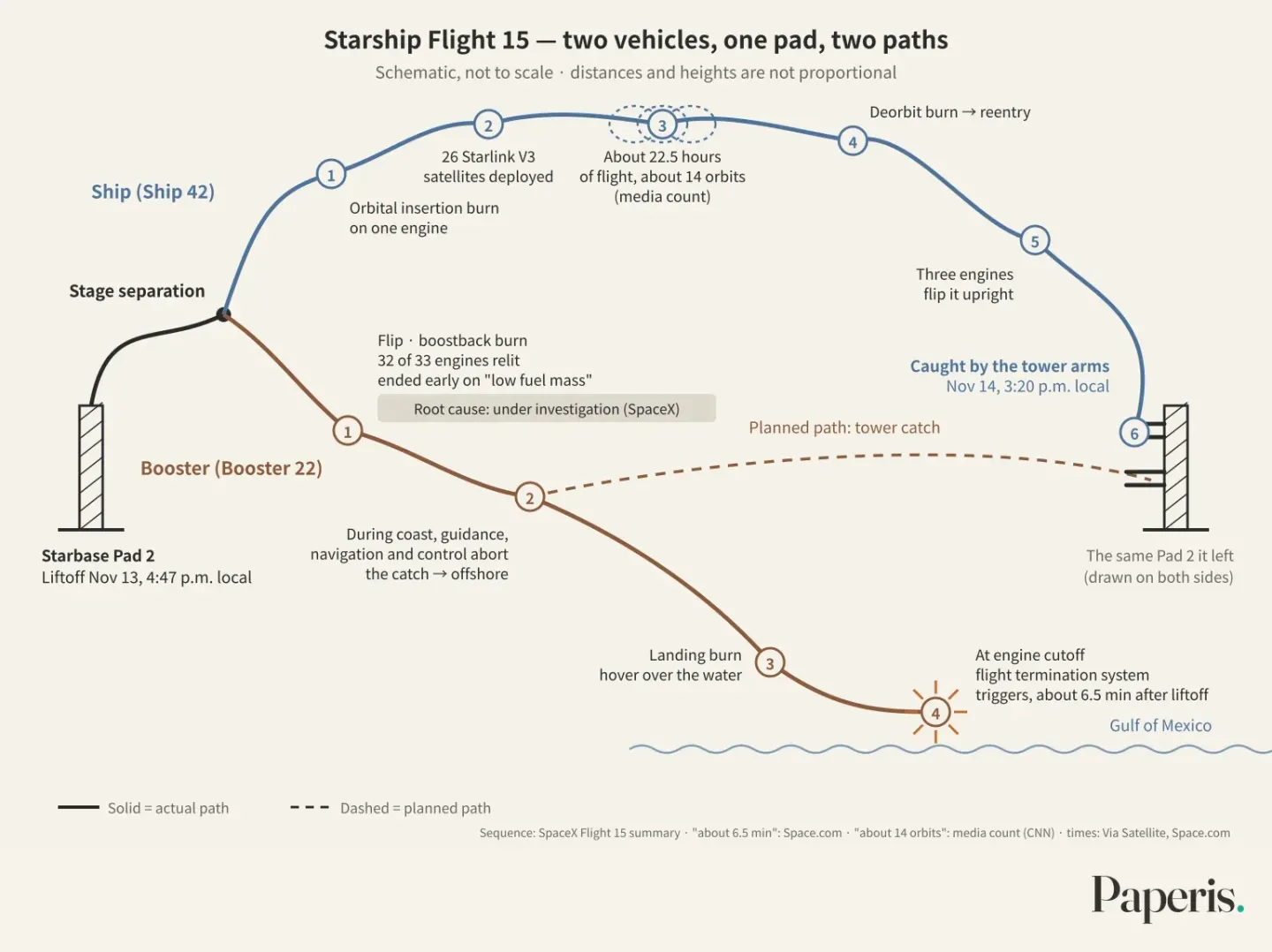
Figure: the two paths of Starship Flight 15 — a schematic, not to scale, Paperis drew using only what the article says
Why We Used to Throw Rockets Away
In 2017, Musk stated that the first stage accounts for "up to 70%" of the cost of a single rocket launch. This is a claim by the company's head and is not an independently verified figure (Spaceflight Now SES-10 Article). For a long time, rockets used that expensive first stage once and threw it away.
There is a calculation behind throwing it away. For the first stage to return, it must keep some fuel, and the payload it can carry decreases by the amount of fuel kept. SpaceX's 2025 customer guide noted that the 22,000 kg that the Falcon 9 can lift to low Earth orbit has a footnote reading "maximum capability of expendable vehicle" (SpaceX "Capabilities & Services"). This means it is the number when throwing away the first stage, and less is loaded when retrieving it. When sending heavy cargo to higher orbits, the first stage flies too fast and too far, lacking enough fuel to return to the launch site. Therefore, the first stages of such launches land on a ship at sea (Spaceflight Now CRS-8 Article).
Reusing a rocket does not automatically make it cheap. The US Space Shuttle was a rocket that retrieved and reused the orbiter and solid rocket motors. According to a 1984 technical report covering the maintenance of the shuttle's solid rocket motors, these motors fell into the Atlantic Ocean by parachute, were salvaged and towed back, serviced, and refilled, and up to that point, 95% of the salvaged parts were judged reusable. However, when the impact of hitting the water was greater than expected, parts were lost (DOI: 10.4271/841530). A single launch of that shuttle cost about $1.5 billion, and dividing it by 27,500 kg to low Earth orbit yields about $54,500 per kg, according to the calculation in a 2018 conference paper by Harry W. Jones, a researcher at the NASA Ames Research Center (Jones 2018, ICES-2018-81).
So when does reuse become cheap? A 2018 analysis concluded that in the long run, fully or partially reusable launch vehicles can make various space businesses break even when combined with "sufficiently low repair and maintenance costs" (DOI: 10.1089/space.2017.0042). A 2015 review reported that component-specific costs and weights determine the profit and loss of reuse, and cited parachutes or mid-air capture methods as economic alternatives to the method of landing on engines (DOI: 10.2514/6.2015-4490). SpaceX itself wrote in the risk factors of its 2026 registration statement (S-1) that if Starship fails to achieve full reusability or rapid reflying, the cost of a single launch could increase (SpaceX S-1 Registration Statement). The condition for reuse cited by studies is that repair costs must be sufficiently cheap, and SpaceX also wrote that costs can rise if it cannot fly again quickly.
The Calculation That Lands a Falling Pillar
In August 2013, at a test site in McGregor, Texas, a test vehicle called Grasshopper rose to a height of 250m, shifted 100m to the side, and settled down. It was a test vehicle with a single engine on a Falcon 9 first-stage tank, and a month earlier it had climbed as high as 325m (NBC Grasshopper article). In its video description, SpaceX noted that this craft, taller than a 10-inch building, is particularly difficult to control, and that such sideways maneuvers are a crucial part of accurately landing a rocket returning from space at hypersonic speeds back at the launch site (NBC Grasshopper article).
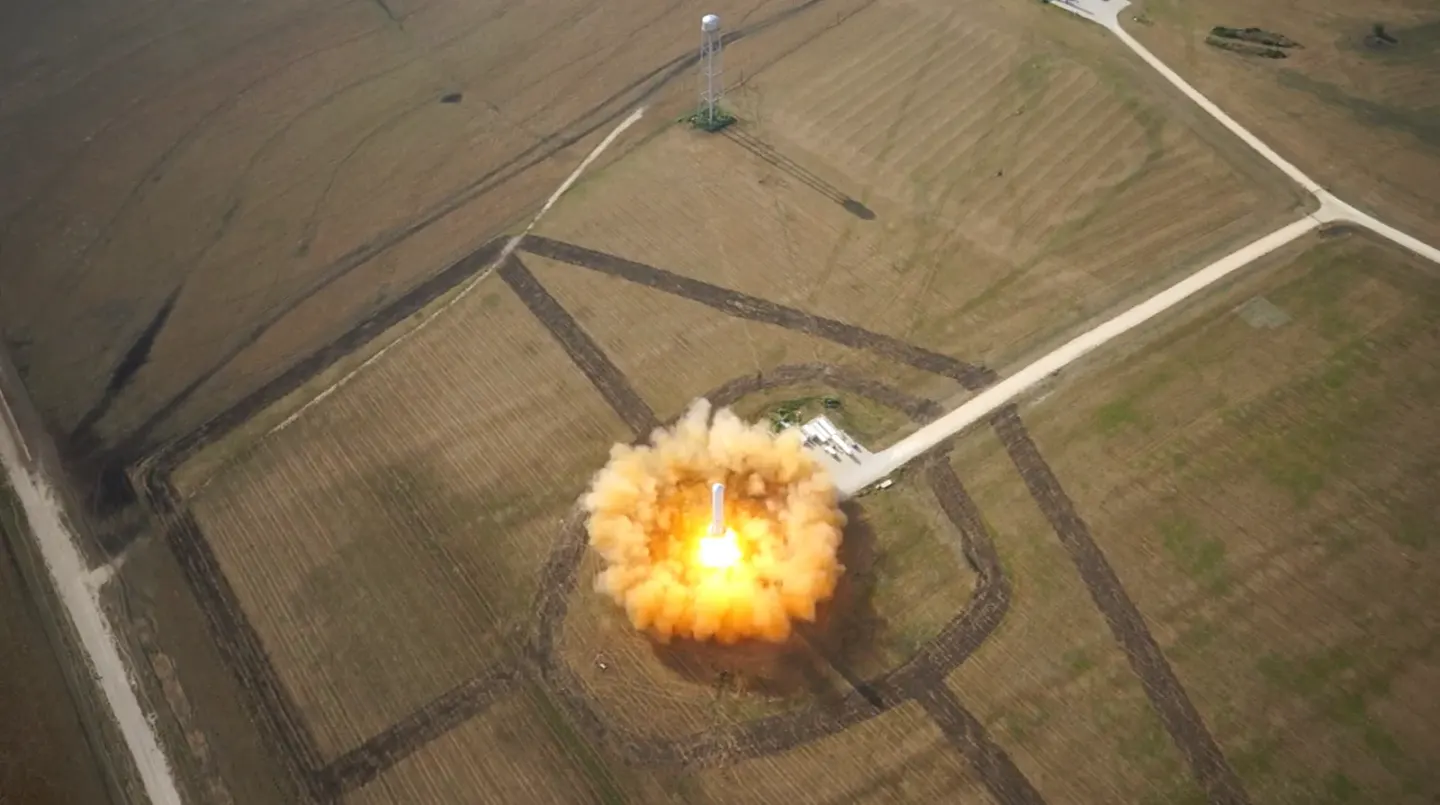
Figure: The Grasshopper test vehicle on its 325 m hop (2013) · CC0, SpaceX · via Wikimedia Commons
There is a name for the final phase this test tackled. Powered descent guidance is the task of calculating, during the final phase of descending with the engines on, the path from the current position and velocity to the landing spot and how to use the engines. The conditions are demanding. Fuel must be used as sparingly as possible, the engine cannot be throttled below a certain minimum thrust, and there are limits to the directions the engine can point. The fact that the engine's thrust has a non-zero lower bound and the directional constraints are the main reasons that make this problem difficult to solve (DOI: 10.1109/tcst.2012.2237346). And that answer must be produced while descending.
The way academia solved this problem was to reformulate it. Convex optimization is a calculation method that sets up a problem in a way that avoids getting stuck on wrong answers halfway through, reliably finding the best answer within a set time. A 2007 paper reformulated the minimum-fuel descent problem for a precision Mars landing as a type of convex optimization. This category has efficient solvers guaranteed to converge, opening up the possibility of running them in real-time inside a spacecraft (DOI: 10.2514/1.27553). A 2013 paper proved that even when the lower bound of engine thrust and directional constraints are converted into a convex form, the optimal solution to the original problem is not lost (DOI: 10.1109/tcst.2012.2237346). This property is called "lossless convexification."
The calculations led to actual flights. However, those flights were not SpaceX's rockets, but rather the Xombie, a small vertical takeoff and landing test rocket built by Masten Space Systems in the United States. In a 2014 report, while moving toward the opposite side of the landing pad from a height of 290m, Xombie calculated an 800m translation path onboard in about 0.1 seconds, and followed that path with meter-level precision (DOI: 10.1109/aero.2014.6836462). A 2016 paper reported that this calculation method (G-FOLD) was used for a total of 8 flights. The first 3 followed paths pre-calculated on the ground, the subsequent 5 calculated them onboard, and excluding one flight unrelated to G-FOLD, the craft followed the planned paths with meter-level precision (DOI: 10.2514/1.g000399). The authors noted that this is considered the first demonstration of running constraint-respecting powered descent guidance onboard a vehicle (DOI: 10.2514/1.g000399).
Since then, this family of methods has expanded. A 2022 tutorial summarized lossless convexification and another approach of refining answers by solving convex problems sequentially, listing rocket landing, atmospheric reentry, and spacecraft docking as applications. This tutorial cites rocket flights by agencies such as NASA, Masten, SpaceX, and Blue Origin as examples where these methods were used (DOI: 10.1109/mcs.2022.3187542). There is also a 2026 study that calculated the minimum-fuel path for boostback burns using this method and verified it with a case study based on a public Falcon 9 mission, though it is still a preprint prior to peer review (arXiv:2609.28759v1). The approach of solving via learning is also being studied. A 2026 study reported that a guidance policy trained with reinforcement learning satisfied all landing conditions in Monte Carlo simulations up to 99.7% of the time when a final correction stage was added, though this is a result within simulation (DOI: 10.2514/1.g009331).
There are also accounts from within SpaceX. Lars Blackmore, the lead landing engineer at SpaceX, wrote in a 2016 symposium article for the U.S. National Academy of Engineering that SpaceX uses a tool called CVXGEN to generate customized flight code to solve convex optimization onboard very quickly (Blackmore 2016, Frontiers of Engineering). This is an account by one of the company's own engineers. However, how the guidance algorithms for the Falcon 9 or Starship are precisely constructed and their code have not been made public. The studies above only show how this field has solved the problem, not SpaceX's flight code.
On land, at sea, and a second flight
In January and April 2015, SpaceX tried to land a first stage on a ship at sea, tipping it over and exploding it both times (Verge 2015 landing article). On the night of December 21 of the same year, the Falcon 9 first stage that finished a satellite launch settled upright onto a landing pad at Cape Canaveral, Florida. It was the first instance of a rocket first stage that lifted cargo to orbit standing upright on land (Verge 2015 landing article). It is not the first time a rocket went up to space and settled upright. The same article noted together the landing of Blue Origin's New Shepard a month earlier at the end of a suborbital flight that did not reach orbit. Therefore, the exact name is "the first landing of an orbital-class rocket first stage".
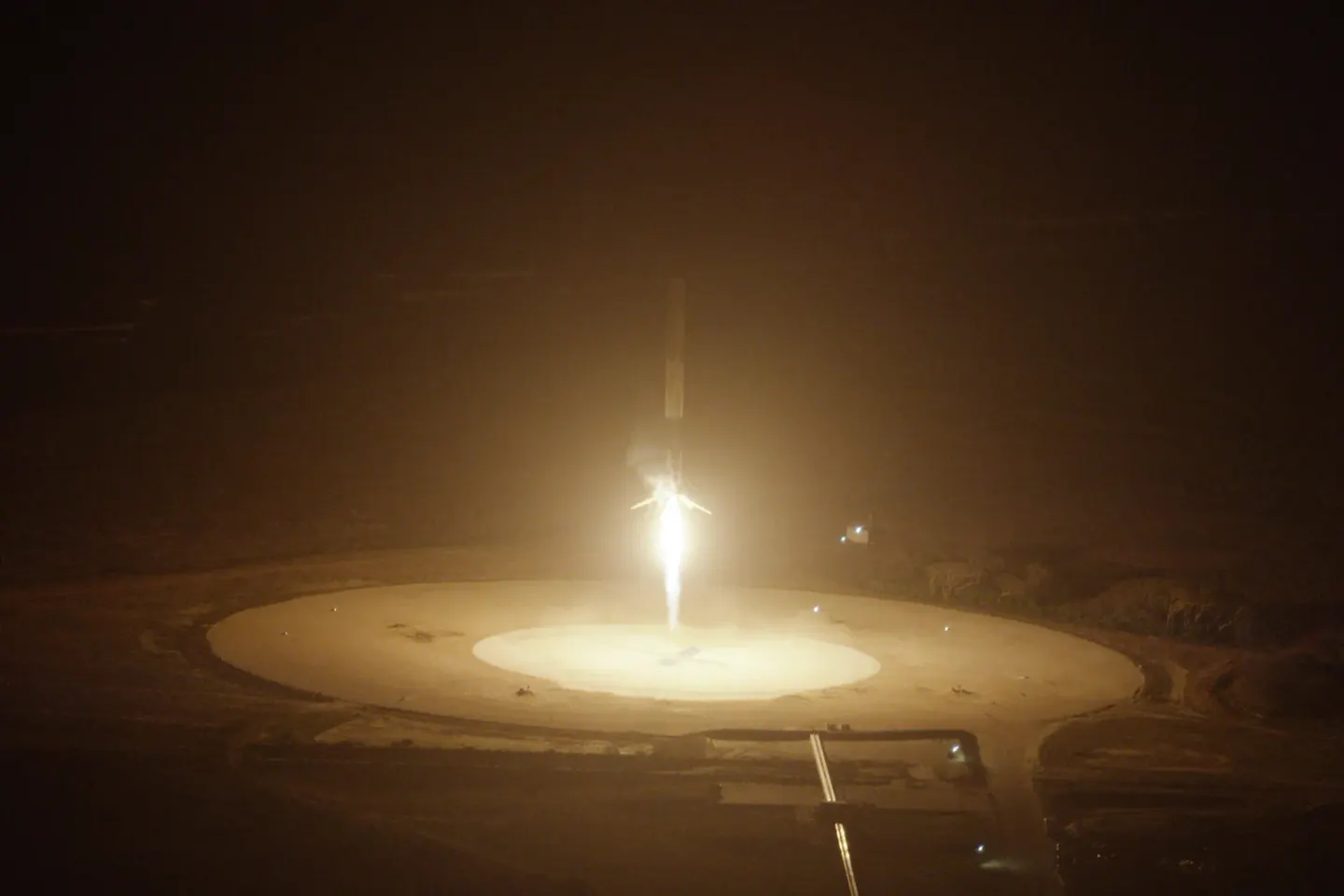
Figure: The Falcon 9 first stage descending to Landing Zone 1 at Cape Canaveral after the ORBCOMM-2 launch, night of December 21, 2015 (local) — the first landing of an orbital-class first stage · CC0, SpaceX · via Wikimedia Commons
The landing at sea was achieved on April 8, 2016. The first stage that completed the International Space Station cargo mission (CRS-8) settled on the droneship "Of Course I Still Love You" in the Atlantic Ocean about 300km northeast of Cape Canaveral. It was the fifth attempt, and the previous four came down too fast or tipped over after landing (Spaceflight Now CRS-8 article).
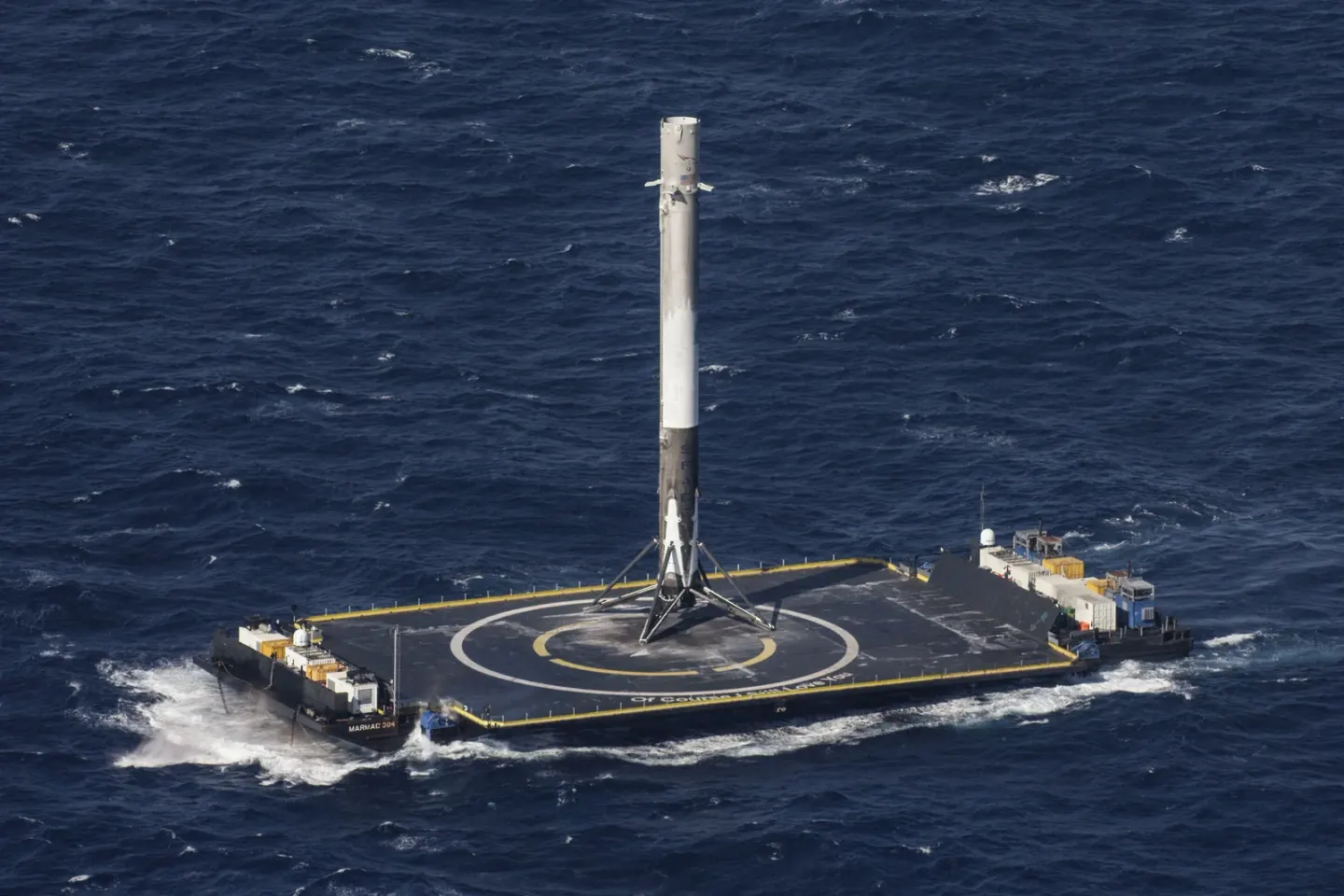
Figure: The Falcon 9 first stage standing on the drone ship "Of Course I Still Love You" after the CRS-8 launch (April 2016) · CC0, SpaceX · via Wikimedia Commons
The falling first stage does not orient itself with engines alone. Grid fins are wings with small squares woven in a grid inside an outer frame, acting as control surfaces that catch the air in each square to steer the falling vehicle. The grid pattern changes performance. In one numerical study, when hexagonal squares were used instead of square ones of the same size, the turning force increased and air resistance decreased, with margins of 2.2% and 1.92% at Mach 0.7, respectively (DOI: 10.1063/5.0176292). The Falcon 9's grid fins were also a weakness. According to a 2017 report, these fins could easily heat up and catch fire during flight, so design improvements were scheduled (Spaceflight Now SES-10 article).
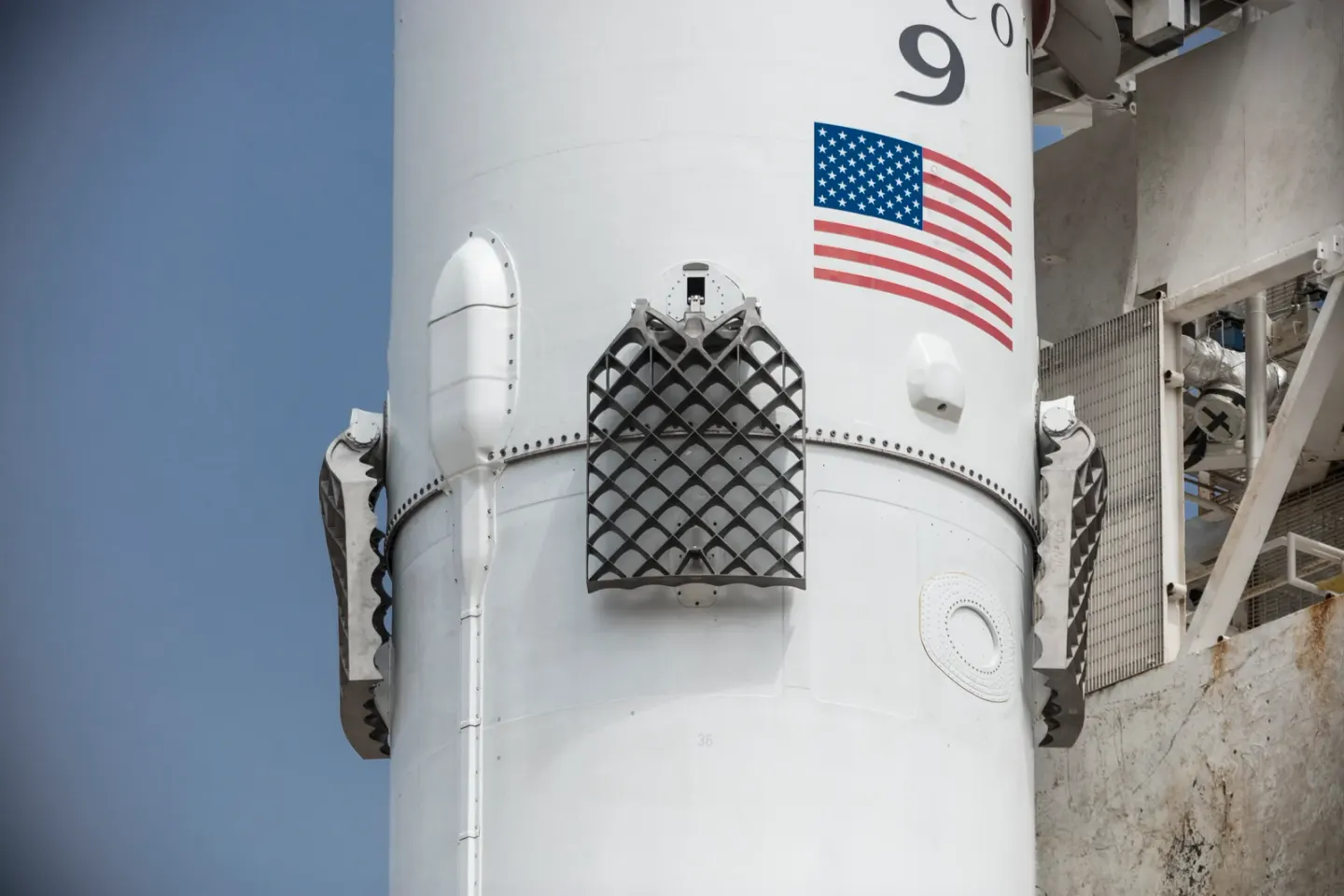
Figure: Second-generation grid fins, first flown on the Iridium-2 mission (June 2017); the Wikimedia Commons description says they are forged titanium · CC0, SpaceX · via Wikimedia Commons
Having a landed first stage fly again was a separate threshold. On March 30, 2017, the first stage recovered from CRS-8 flew again carrying the SES-10 satellite. It was the first reflight of an orbital-class rocket first stage, and SpaceX engineers spent months inspecting parts, replacing some, and conducting ground static fire tests again (Spaceflight Now SES-10 article). The forward fairing that encloses the satellite also followed its own sequence. In the summer of 2019 after a Falcon Heavy launch, SpaceX caught a fairing half for the first time with a net-equipped ship, and on the November 11, 2019 Starlink launch, it reused a fairing for the first time that had been fished out of the Atlantic Ocean by parachute during an April Falcon Heavy mission. The same launch was also the first flight where a first stage flew for a fourth time (Spaceflight Now 2019 fairing reuse article).
The returning rocket also pays a cost in sound. The first stage returns faster than the speed of sound, thus producing a sonic boom. In a study measuring three Falcon 9 landings at the Vandenberg Air Force Base in California, the peak pressure of the landing sonic boom could exceed the peak pressure of the launch noise at distances greater than 1km (DOI: 10.1121/10.0026803). Landing, re-flying, and fairing reuse did not come all at once, and had to be overcome one by one.
The Thirty-Seventh Flight
On August 25, 2026, a Falcon 9 first stage named B1067 completed its 37th flight and touched down on the droneship "A Shortfall of Gravitas" roughly eight and a half minutes after launch. This is the record for the most flights by a single first stage (Space.com B1067 37th flight article).
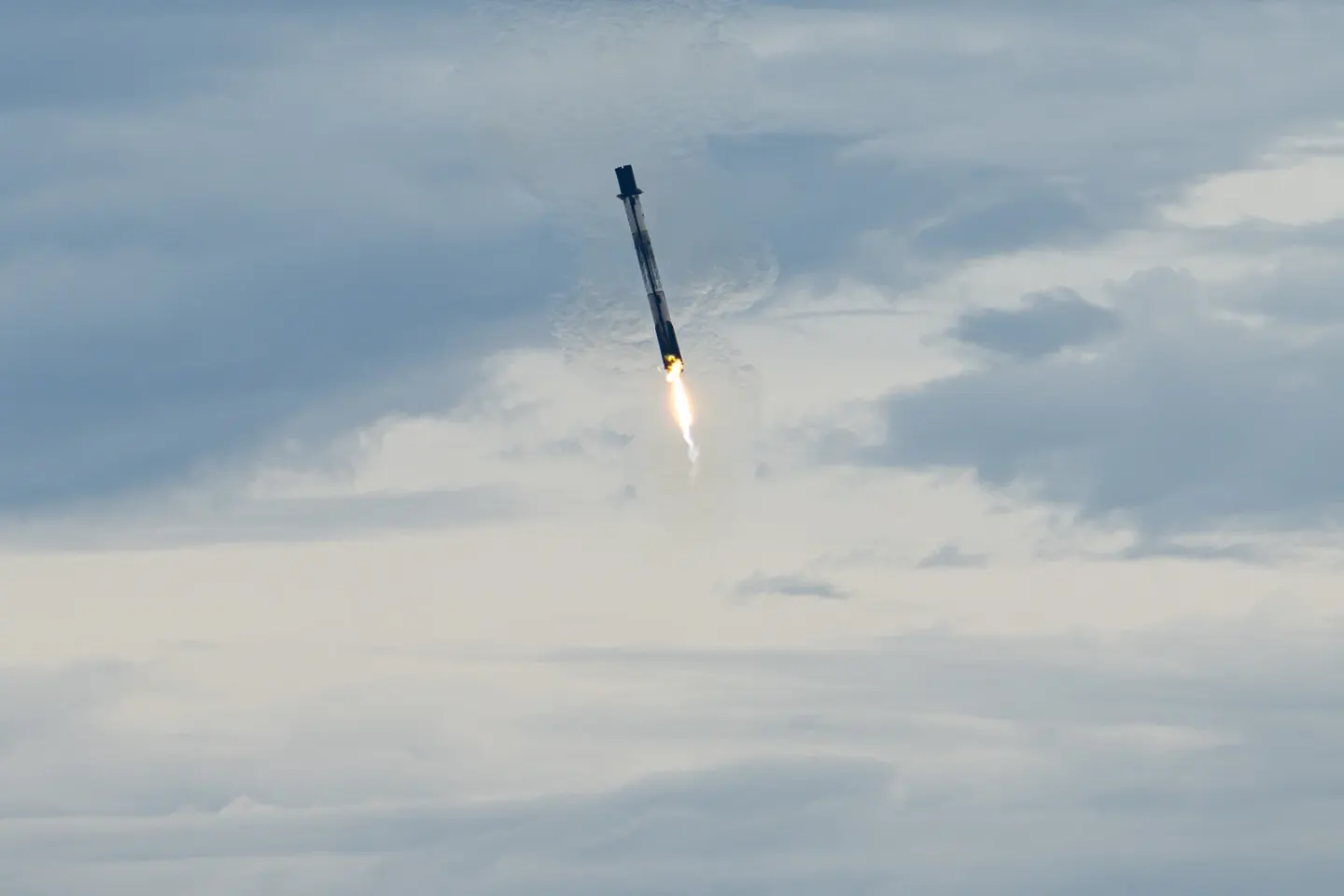
Figure: A Falcon 9 first stage descending to Landing Zone 40 after the Crew-13 launch, October 1, 2026 · Public domain, NASA · via Wikimedia Commons
How routine it has become is told by the company's regulatory filings. SpaceX stated in a 2026 registration statement that it launched the Falcon 9 165 times in 2025, and that 157 of those were first stages that had already flown. It also noted that out of roughly 650 orbital launches up through the end of March 2026, more than 540 used reused rockets, and that the success rate for first-stage recovery attempts in 2025 exceeded 99% (SpaceX S-1 registration statement). All of these are figures published by the company itself, and the counting scopes are mixed even within the same document. For 2025 alone, the sentence "157 out of 165 Falcon 9s" appears alongside the sentence "170 total for Falcon and Starship, with 159 reused first stages" (SpaceX S-1 registration statement).
The problem after something becomes routine is management. The same registration statement writes that increasing reuse lowered internal launch costs, but does not reveal what those costs are (SpaceX S-1 registration statement). What is difficult in a first stage that bundles and uses multiple engines is shown by simulation research. A 2026 conference study calculated that without monitoring the health status of each engine, engine lifespans are mispredicted in 50% to 70% of cases. Mixing onboard monitoring devices with periodic manual inspections yielded the same accuracy within 1% as a method relying on inspections alone, while reducing the number of inspections to one-seventh (DOI: 10.2514/6.2026-2760). This is a calculation run on a hypothetical cluster of engines, not data from a specific company.
Starship: A Design to Recover Both Stages
On May 5, 2021, the Starship SN15 prototype flew to an altitude of roughly 10 km and landed intact for the first time. Earlier prototypes mostly ended in dramatic explosions, and SN15 also had a small fire on one side of its lower section after touchdown, which was put out within 20 minutes (Ars Technica SN15 article). Starship is designed to recover and reuse both the Super Heavy first stage and the upper-stage spacecraft. Super Heavy ascends with 33 Raptor engines (SpaceX Flight 15 summary), and the spacecraft is equipped with 6 methane-burning Raptor engines (CBS Flight 15 article).
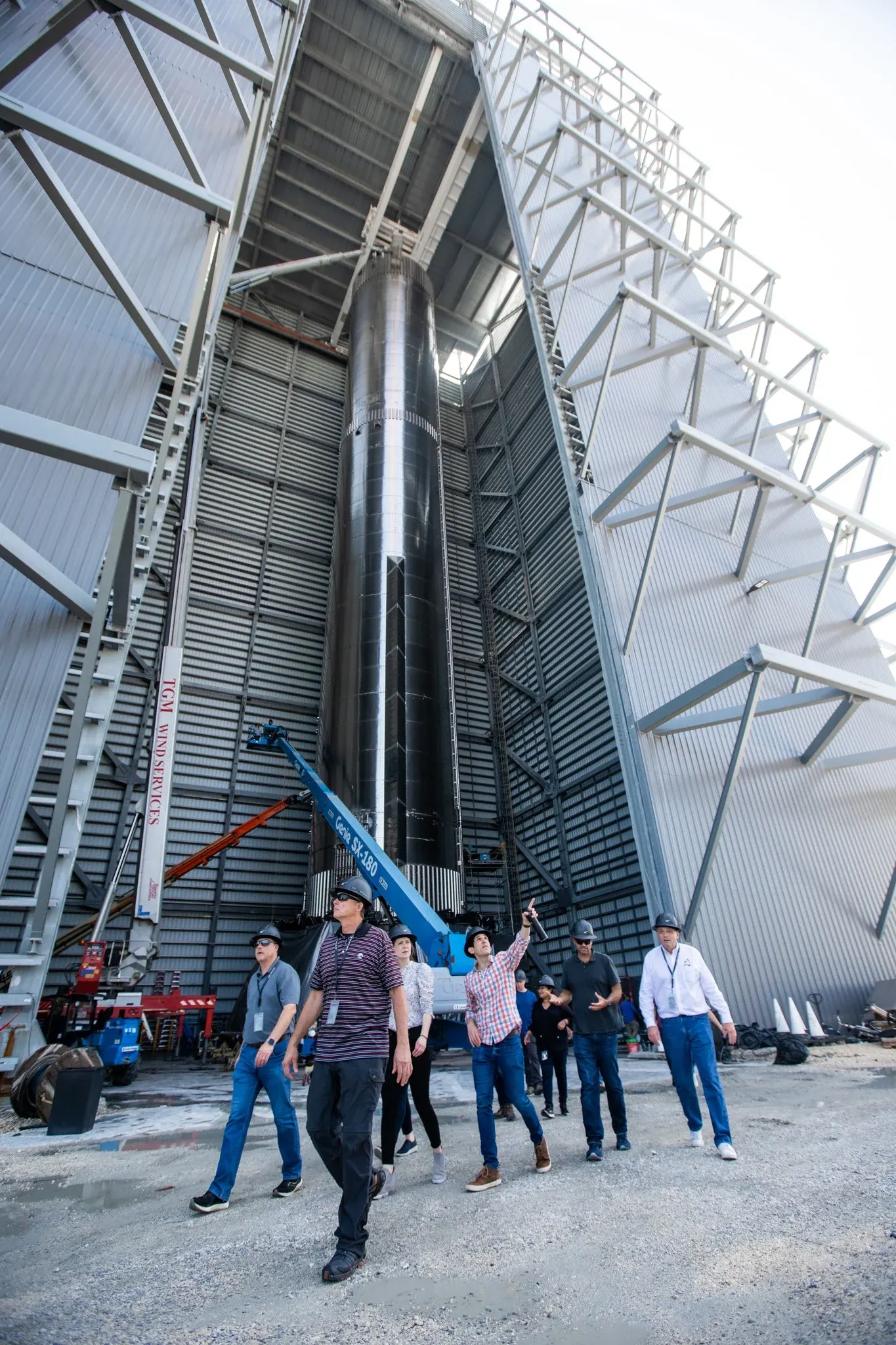
Figure: People looking up at a Super Heavy booster at Starbase (June 2022) · Public domain, NASA · via Wikimedia Commons
The first integrated flight of both stages together took place on April 20, 2023, and the vehicle was lost. The Federal Aviation Administration (FAA), the U.S. government agency that licenses commercial rocket launches and investigates accidents, concluded its investigation and listed 63 corrective actions that SpaceX needed to take, including fixing the vehicle design and launch pad design, along with several root causes (FAA Flight 1 mishap investigation closure announcement).
On October 13, 2024, during the fifth flight, the Super Heavy was caught by the launch tower arms for the first time. SpaceX noted that thousands of conditions had to be met by the vehicle and launch pad before a catch could be attempted (SpaceX Flight 5 summary). A study measuring this flight from 9.7 to 35.5 km away reported that the sonic boom of the returning booster exceeded 10 pounds per square foot at a 10 km distance, and that the long-range noise of the Starship launch was at least 10 times that of a Falcon 9 (DOI: 10.1121/10.0034453). On November 19, during the sixth flight, an automated pre-check of the launch tower hardware caused the catch to be aborted, and the booster landed softly in the Gulf of Mexico (SpaceX Flight 6 summary).
During the seventh (January 16) and eighth (March 6) flights of 2025, the boosters were caught but the spacecraft were lost (SpaceX Flight 7 summary) (SpaceX Flight 8 summary). According to FAA statements reported by the media, the estimated root cause for the seventh flight was that stronger-than-expected vibrations increased stress on the propulsion system hardware and caused a failure (Space.com 7th FAA article), while the eighth was a hardware failure in a single Raptor engine (Aviation Week 8th FAA article).
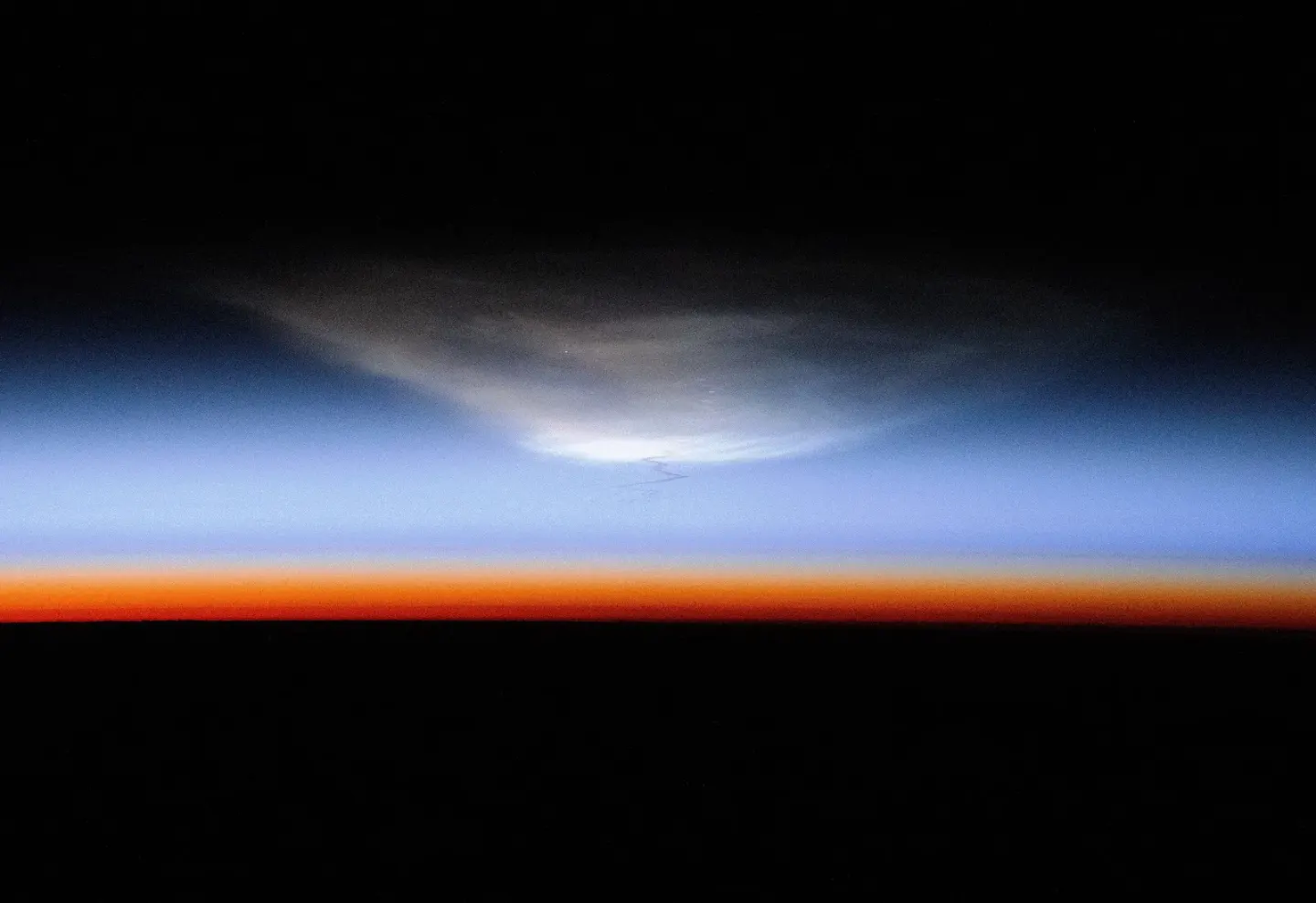
Figure: Streaks of debris seen from the International Space Station after the ship was lost on Starship Flight 8, March 6, 2025 · Photo by Donald Pettit · Public domain, NASA · via Wikimedia Commons
The ninth flight on May 27 was the Starship program's first booster re-flight. The booster that had flown on the seventh flight flew again, and while testing a descent at a steeper attitude instead of a catch, it broke apart in mid-air shortly after initiating its landing burn (SpaceX Flight 9 summary). SpaceX concluded that increased descent loads ruptured internal propellant lines (Space.com 9th investigation article). The spacecraft from the same flight was also lost, and the FAA closed its investigation on August 15, listing the estimated root cause as a failure of a fuel system component (Spokesman-Review 9th FAA article).
SpaceX stated that flights 10 and 11 in 2025 achieved their main objectives, and starting with flight 12 on May 22, 2026, third-generation vehicles and a second launch pad were used. On flights 12 and 13, the booster's boostback burn ended early and it crashed hard into the ocean, and on September 28, during flight 14, the spacecraft reached orbit for the first time (SpaceX Flight 12 summary) (SpaceX Flight 13 summary) (SpaceX Flight 14 summary). Official summaries for flights 12, 13, and 15 all mention "early boostback shutdown," but there is no official conclusion that the causes for the three were the same.
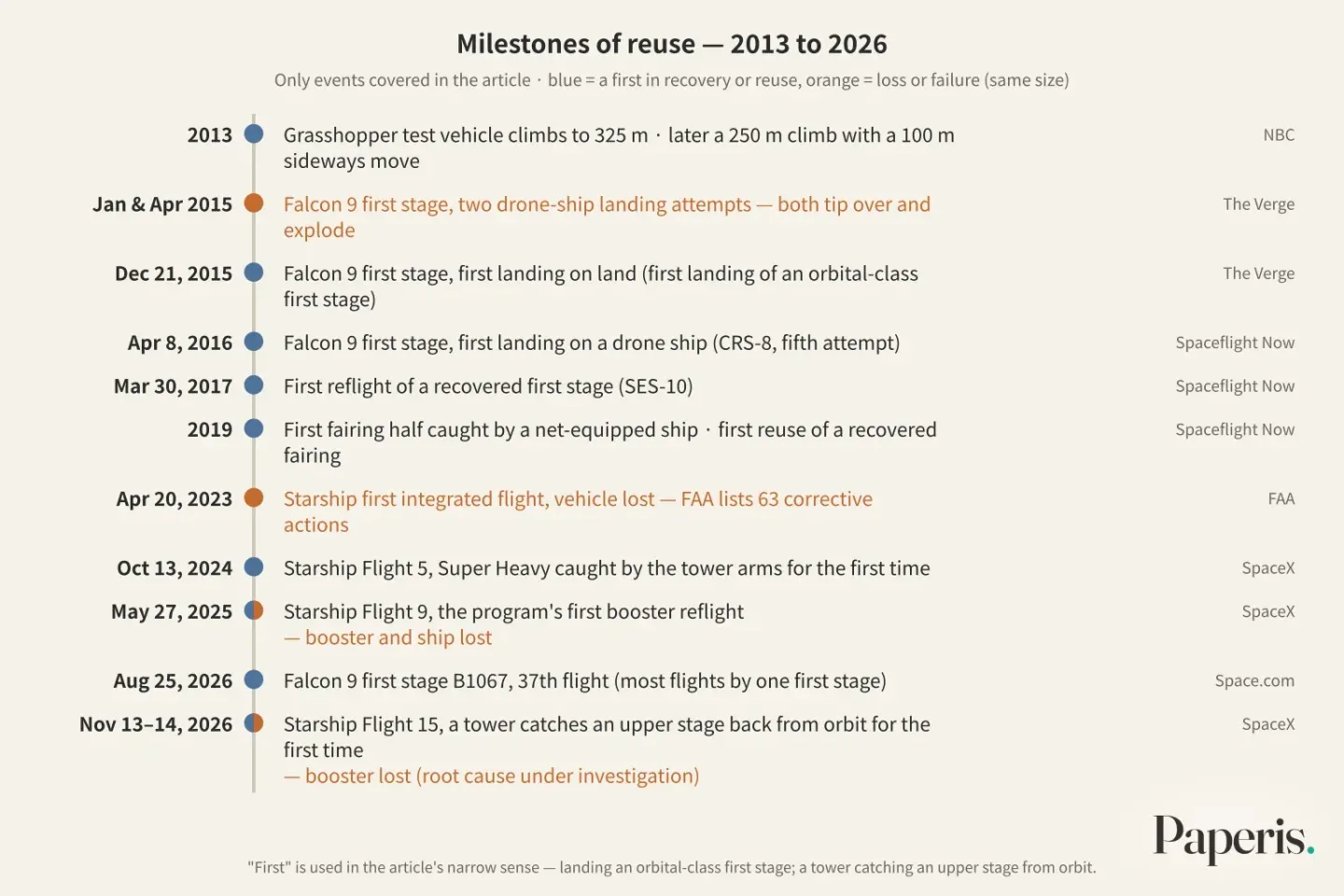
Figure: milestones of reuse — a timeline Paperis drew using only what the article says
There is one more hurdle to clear before the upper stage can be reused. Thermal protection is an outer protective layer that prevents the intense heat generated during re-entry into the atmosphere from entering the vehicle. SpaceX noted that during the 10th flight, it intentionally subjected the thermal protection to stress to push the limits of its performance (SpaceX Flight 10 summary), and listed the development of reusable thermal protection that can withstand repeated high-speed re-entries and rapid maintenance as a risk factor in its registration statement (SpaceX S-1 registration statement). The Space Shuttle's experience illustrates the weight of this task. A 1993 risk analysis calculated that roughly 10% of the total probability of losing a shuttle orbiter came from thermal protection tiles, with 85% of that risk concentrated on 15% of all tiles. The authors concluded that maintenance could be concentrated on those tiles (DOI: 10.1016/0951-8320(93)90062-4). In a 2026 laboratory test, a single tiled thermal protection material was heated four times under identical conditions, and the temperature 40 mm beneath the surface remained consistent within ±1.23°C across the four tests (DOI: 10.3390/ma19020303). This is the result of a laboratory torch test and is not the result of repeated actual spacecraft re-entries.
How Much Did Prices Drop?
The standard price for a Falcon 9 listed in SpaceX's April 2025 customer guide was $69.85 million. It noted that this is the price to lift up to 5.5 tons to a transfer orbit heading toward geostationary orbit, and that the 2025 adjustment reflected inflation (SpaceX “Capabilities & Services”). This is the price paid by customers, not the cost incurred by SpaceX. The difference between the two values is also evident in reuse discounts. Shotwell initially stated in 2016 that customers using reusable rockets would receive a discount of about 10%, while Musk said in 2017 that because massive development costs had to be paid back, the discount would not be as large as the cost savings. The actual discount amount for SES-10 was not made public (Spaceflight Now on SES-10).
The figure of cost per kilogram must be read alongside the calculation method. Jones, who calculated the Shuttle figures earlier, divided the Falcon 9's advertised price of $62 million by its low Earth orbit capacity of 22,800 kg in a 2018 conference paper to arrive at $2,720 per kg, calculating that it dropped about 20 times compared to the Shuttle (Jones 2018, ICES-2018-81). This per-kilogram figure divides the price by the maximum payload of a fully expendable vehicle, so it comes out lower than the per-kilogram price of an actual launch that recovers the first stage. Actual missions do not even fill that capacity completely. A study analyzing launches from 2000 to 2013 showed that 20.4% of launch vehicle capacity flew unused (DOI: 10.1089/space.2016.0011). Jones also made a separate calculation in the same paper. A Falcon 9 Dragon cargo mission to the International Space Station carries 6,000 kg for about $140 million, making it $23,300 per kg, and measured by station cargo, the drop is about 4-fold (Jones 2018, ICES-2018-81). Jones did not attribute this drop to reuse. The point he set for the major drop was the Falcon 9 in 2010, before the first stage was reused, and in the same paper he wrote that reuse has not lowered costs so far, and if Falcon 9's reuse does reduce costs, the magnitude might be about half (Jones 2018, ICES-2018-81).
There is a sentence starting with "According to NASA" in SpaceX's registration statement. It states that the first Falcon 9 in 2010 reduced costs to about $2,700 per kg, which is about 85% lower than the historical average of $18,500 (SpaceX S-1 registration statement). It is not confirmed whether this is an official NASA estimate. Nearly identical figures appear in Jones's conference paper as an individual researcher's calculation. Jones also placed this value at the position of 2010 when the Falcon 9 first flew, but the numbers he actually used were the advertised prices and payload capacities from SpaceX's website in 2018. The $18,500 figure is also the average from 1970 to 2000 in Jones's paper (Jones 2018, ICES-2018-81).
There are also studies that measure global trends as a whole. A 2026 study compiling over 4,400 launches from 1960 to 2025 estimated that the global average cost to send 1 kg to orbit dropped from $87,023 in 1960 to $3,868 in 2025. Every time the cumulative payload sent to orbit doubles, the cost per kg falls by 21.2%, with central forecasts of $1,600 in 2030 and $300 in 2040. The authors wrote that geopolitical shifts, monopolistic behaviors in the commercial launch market, and growing orbital debris could slow this decline (DOI: 10.1093/pnasnexus/pgag217). Because this is a global average, it cannot be directly compared to the figures for a single Falcon 9.
Future prices are still just talk. Musk projected in 2019 that a single Starship launch would cost about $2 million, including about $900,000 in fuel (TechCrunch 2019), and stated in 2022 that he is "highly confident that it will be less than $10 million" (CNBC 2022). The registration statement notes that over $15 billion has been invested in Starship, and that lowering the cost to orbit by over 99% compared to the historical average is a "goal" (SpaceX S-1 registration statement). What has been made public is the price, costs have not been disclosed, and the figures for Starship remain projections and goals.
The Road Ahead
The day when the Starship upper stage flies again has not yet arrived. The goal stated by Shotwell is early next year (SpaceX Third Quarter 2026 Webcast Transcript). The two tasks written by Harwood—statistical reliability built through many flights and the ability to refuel in orbit—also remain (CBS 15th Article). SpaceX is also participating in NASA's crewed lunar lander program. In March 2026, NASA's internal auditing body, the Office of Inspector General, projected that it had allocated about 7 billion dollars to the crewed lunar lander program since 2019 and would spend more than 18 billion dollars by fiscal year 2030. Because it is a fixed-price contract, SpaceX's contract amount increased by only 6%, but it noted that both SpaceX and Blue Origin experienced schedule delays and technical difficulties (NASA Office of Inspector General IG-26-004 Report).
There are also open questions on the booster side. The root cause of the 15th booster is under investigation, and in the 12th and 13th as well, the boostback burn ended early. While landing and reflight had been proven separately during the journey from the droneship at sea to the launch tower arms, the Starship upper stage has now moved past its first recovery.
Where to Look Further
- A 2022 tutorial outlining three methods for solving trajectory problems like rocket landing using convex optimization (DOI: 10.1109/mcs.2022.3187542).
- A 2016 report on actually flying a test rocket with a landing path calculated inside the vehicle (DOI: 10.2514/1.g000399).
- A 2026 study measuring how launch costs have come down from 1960 to 2025 using an experience curve (DOI: 10.1093/pnasnexus/pgag217).
- An open question still is how quickly and with how much maintenance an upper stage returning from orbit can be flown again.
Case Documents
-
SpaceX Flight 15 Summary (2026-11) — Party report. Early booster cutoff, catch skipped, flight termination system, spacecraft orbital flight and catch.
-
SpaceX Flights 5, 6, 7, 8, 9, 10, 12, 13, and 14 Summary (2024~2026) — Party report. Progress by flight (only the end digits of the URL differ).
-
SpaceX 2026 Q3 Earnings Call Transcript (2026-10) — Musk's dual catch plan, Shotwell's upper-stage reflight goal.
-
SpaceX Form S-1 Registration Statement (2026-05-20) — Company filing. Reused launch count, figures per kg "according to NASA", risk factors.
-
SpaceX "Capabilities & Services" (2025-04) — Company pricing sheet. Standard pricing and "fully expendable" footnote.
-
CNN Flight 15 Live Coverage (2026-11-13~14) — Vehicle numbers, tile counts, reporting on Musk's explanations.
-
CBS Flight 15 Article (2026-11) — Journalist Harwood. Musk's explanation, remaining challenges.
-
Space.com Flight 15 Booster Article (2026-11) — Explosion timing, Huo's next-day explanation.
-
Space.com Flight 15 Catch Article (2026-11-14) — Catch time.
-
Via Satellite Flight 15 Article (2026-11-15) — Launch and catch times.
-
Jones 2018, ICES-2018-81 (2018) — Conference paper by a NASA Ames researcher. Shuttle and Falcon 9 calculations per kg.
-
Blackmore 2016, Frontiers of Engineering (2016 symposium, 2017 publication) — First-party account. Landing guidance writing by a SpaceX engineer, convex optimization without seeing the body.
-
FAA First Flight Mishap Investigation Closure Announcement (2023) — Multiple root causes, 63 corrective actions.
-
Space.com Flight 7 FAA Article (2025-03) · Aviation Week Flight 8 FAA Article (2025-06) · Spokesman-Review Flight 9 FAA Article (2025-08) · Space.com Flight 9 Investigation Article (2025) — Media reports on FAA closure statements and SpaceX investigation results.
-
NASA Office of Inspector General Report IG-26-004 (2026-03) — Cost and schedule of the crewed lunar lander program.
-
NBC Grasshopper Article (2013-08) — Grasshopper vertical ascent and sideways translation test.
-
Verge 2015 Landing Article (2015-12-21) — First land landing, prior ocean landing failures.
-
Spaceflight Now CRS-8 Article (2016-04) — First drone ship landing, reasons for landing on the water.
-
Spaceflight Now SES-10 Article (2017-03) — First reflight and refurbishment, grid fin vulnerabilities, discount remarks.
-
Spaceflight Now 2019 Fairing Reuse Article (2019-11-11) — First fairing reuse, first fourth flight of a first stage.
-
Ars Technica SN15 Article (2021-05-05) — Prototype's first intact landing.
-
Space.com B1067 37th Flight Article (2026-08-25) — Most-flown flight record.
-
TechCrunch 2019 Article (2019-11) · CNBC 2022 Article (2022-02) — Musk's Starship cost projections.
-
Musk's X Post, Recited in Wikipedia (2026-11) — Caveat that "initial conclusions may be wrong". Secondary source.
Source Papers
- "Convex Programming Approach to Powered Descent Guidance for Mars Landing" (2007) — DOI: 10.2514/1.27553 — Formulates the fuel-optimal Mars landing descent problem as a second-order cone program (convex). Enables onboard real-time capability with deterministic convergence solving.
- "Lossless Convexification of Nonconvex Control Bound and Pointing Constraints of the Soft Landing Optimal Control Problem" (2013) — DOI: 10.1109/tcst.2012.2237346 — Proves that converting nonconvex constraints on thrust lower bounds and direction into convex relaxations does not lose the optimal solution.
- "ADAPT demonstrations of onboard large-divert Guidance with a VTVL rocket" (2014) — DOI: 10.1109/aero.2014.6836462 — The Masten Xombie calculates an 800m maneuvering path from 290m onboard in about 100ms, achieving meter-class precision flight.
- "Implementation and Experimental Demonstration of Onboard Powered-Descent Guidance" (2016) — DOI: 10.2514/1.g000399 — 8 G-FOLD flights (3 pre-planned on the ground, 5 onboard), achieving meter-class precision except for 1 G-FOLD-unrelated case. The authors consider this the first demonstration.
- "Convex Optimization for Trajectory Generation: A Tutorial on Generating Dynamically Feasible Trajectories Reliably and Efficiently" (2022) — DOI: 10.1109/mcs.2022.3187542 — LCvx, SCvx, and GuSTO tutorial, applied to rocket landing, reentry, and docking.
- "Fuel-optimal Boost-Back Guidance via Successive Convexification with a Terminal Constraint for ReusableLaunch Vehicles" (2026) — arXiv:2609.28759v1 — Preprint. SCvx boost-back guidance validated with Falcon 9 CRS-10-based return cases, reducing computational cost while achieving near-optimal propellant consumption.
- "Transformer-Based Atmospheric Rocket Landing Guidance Using Meta-Reinforcement Learning" (2026) — DOI: 10.2514/1.g009331 — Meta-reinforcement learning guidance policy, satisfying landing conditions up to 99.7% in Monte Carlo simulations (including terminal correction).
- "Refurbishment of the Space Shuttle SRMs - the First Reusable Solid Rocket Motors" (1984) — DOI: 10.4271/841530 — Space Shuttle solid rocket motor ocean recovery and refurbishment, 95% of recovered parts reusable, losses occur during heavy water impact.
- "Launch Cost Thresholds for Economic Activity" (2018) — DOI: 10.1089/space.2017.0042 — Break-even launch costs by space business; reusable launch vehicles enable businesses when accompanied by sufficiently low repair and maintenance costs.
- "Launch Vehicle Recovery and Reuse" (2015) — DOI: 10.2514/6.2015-4490 — Review of reuse history, cost-benefit judgment by part value and weight, non-propulsive alternatives such as parachutes and mid-air retrieval.
- "Numerical study on aerodynamic characteristics of the grid fins with different grid patterns" (2023) — DOI: 10.1063/5.0176292 — Numerical study of grid fin lattice patterns, hexagonal patterns increase normal force and decrease axial force.
- "Measurements of rocket landing sonic booms from three SpaceX Falcon-9 booster landings" (2024) — DOI: 10.1121/10.0026803 — Three Vandenberg Falcon 9 landings, maximum sonic boom pressure at 1 km can exceed maximum launch noise pressure.
- "Complexity Management of Rocket Engines: Discrete Event Simulation of Clustered Engine Reuse" (2026) — DOI: 10.2514/6.2026-2760 — Conference simulation. 50–70% life misprediction without individual monitoring, accuracy within 1% and 1/7th the inspections with hybrid monitoring.
- "Starship super heavy acoustics: Far-field noise measurements during launch and the first-ever booster catch" (2024) — DOI: 10.1121/10.0034453 — Flight 5 far-field noise, return sonic boom exceeds 10 psf at 10 km, more than 10 times that of the Falcon 9.
- "Probabilistic risk analysis and risk-based priority scale for the tiles of the space shuttle" (1993) — DOI: 10.1016/0951-8320(93)90062-4 — Tiles account for about 10% of orbiter loss probability, with 85% of the risk concentrated in 15% of the tiles → maintenance resource allocation.
- "Durability Assessment of Tile-Type Reusable Thermal Protection Materials" (2026) — DOI: 10.3390/ma19020303 — Repeated heating with an HVOF torch, temperature at 40 mm depth repeated 4 times within ±1.23°C. Laboratory sample test.
- "Capability and Cost-Effectiveness of Launch Vehicles" (2016) — DOI: 10.1089/space.2016.0011 — Analysis of 2000–2013 launches, 20.4% waste of launch vehicle capability, 24.5% savings when choosing the lowest-cost launch vehicle.
- "From Sputnik to Starship: Estimating the experience curve of space launch technology" (2026) — DOI: 10.1093/pnasnexus/pgag217 — Over 4,400 launches, global average down from $87,023 to $3,868 per kg, a 21.2% drop for every doubling of cumulative payload, projected at $1,600 in 2030 and $300 in 2040, which monopolies and debris can delay.
Sources (18)
- Convex Programming Approach to Powered Descent Guidance for Mars LandingDOI 10.2514/1.27553
- Lossless Convexification of Nonconvex Control Bound and Pointing Constraints of the Soft Landing Optimal Control ProblemDOI 10.1109/tcst.2012.2237346
- ADAPT demonstrations of onboard large-divert Guidance with a VTVL rocketDOI 10.1109/aero.2014.6836462
- Implementation and Experimental Demonstration of Onboard Powered-Descent GuidanceDOI 10.2514/1.g000399
- Convex Optimization for Trajectory Generation: A Tutorial on Generating Dynamically Feasible Trajectories Reliably and EfficientlyDOI 10.1109/mcs.2022.3187542
- Fuel-optimal Boost-Back Guidance via Successive Convexification with a Terminal Constraint for ReusableLaunch VehiclesarXiv:2609.28759v1
- Transformer-Based Atmospheric Rocket Landing Guidance Using Meta-Reinforcement LearningDOI 10.2514/1.g009331
- Refurbishment of the Space Shuttle SRMs - the First Reusable Solid Rocket MotorsDOI 10.4271/841530
- Launch Cost Thresholds for Economic ActivityDOI 10.1089/space.2017.0042
- Launch Vehicle Recovery and ReuseDOI 10.2514/6.2015-4490
- Numerical study on aerodynamic characteristics of the grid fins with different grid patternsDOI 10.1063/5.0176292
- Measurements of rocket landing sonic booms from three SpaceX Falcon-9 booster landingsDOI 10.1121/10.0026803
- Complexity Management of Rocket Engines: Discrete Event Simulation of Clustered Engine ReuseDOI 10.2514/6.2026-2760
- Starship super heavy acoustics: Far-field noise measurements during launch and the first-ever booster catchDOI 10.1121/10.0034453
- Probabilistic risk analysis and risk-based priority scale for the tiles of the space shuttleDOI 10.1016/0951-8320(93)90062-4
- Durability Assessment of Tile-Type Reusable Thermal Protection MaterialsDOI 10.3390/ma19020303
- Capability and Cost-Effectiveness of Launch VehiclesDOI 10.1089/space.2016.0011
- From Sputnik to Starship: Estimating the experience curve of space launch technologyDOI 10.1093/pnasnexus/pgag217