
Paperis Articles
The Riemann Hypothesis — How Is a Claim of “I Found a Proof” Checked?
On November 20, 2026, a mathematician released a Lean formal proof, saying he believes he found a proof of the Riemann Hypothesis while working with an AI. Several machine checks have passed and the Lean and Mathlib communities have certified it, but a human-readable proof and journal review are still to come.
Your field's papers, as audio
Pick your fields and journals — Paperis summarizes the key papers and turns them into audio. Listen on your commute.
Start Paperis free →The Riemann Hypothesis — How Is a Claim of “I Found a Proof” Checked?
4-Page Note
On November 20, 2026, Levent Alpöge, a mathematician working at the American AI company Anthropic, posted a 4-page note on his website. Alpöge is a number theorist on leave from Harvard University (Nature report). The first sentence of the note is this: "I believe that, working with Claude, I have found a proof of the Riemann hypothesis." Claude is an AI model created by Anthropic. Alpöge wrote that he expects the same method to resolve the generalized Riemann hypothesis, and that with more time, the extended Riemann hypothesis will be resolved as well, adding that he and Claude formalized this argument "without assumptions" (Alpöge's note). The footnotes of the note contained the addresses of fourteen pieces of proof files. The files were written in Lean, a language for writing proofs so that a computer can check them step by step (Alpöge's note).
A manuscript for humans to read was not released alongside it. Alpöge wrote that the argument is "enormously long right now." He noted that while generating a huge document with sufficient detail is routine, posting such an unreadable document is inappropriate, which is why he decided to release only the Lean files. A footnote also mentions that when he made one just for fun, it exceeded 250,000 pages. He stated that he would do his best moving forward to understand this argument, convey that understanding, and write it up properly (Alpöge's note).
He also wrote down what Claude did. According to Alpöge, it was he who steered their work in the direction of combining two very different ideas that were in a simple toy setup, and after guiding him to the correct situation corresponding to that setup, "Claude began to astonish me." He also wrote, "Near the finish line, Claude pulled far ahead of me." He revealed that he had "barely mastered" the field of automorphic forms over higher-rank groups, and wrote that he was putting a completed argument out into the world before fully absorbing the vast area around that mathematics (Alpöge's note). This is a first-person report. His explanation is that a human set the direction and an AI handled much of the near-finish work, and accounts stating that Claude solved it alone do not appear in any primary documents of this event.
In mathematics, the words "found a proof" are followed in turn by machine checking, human understanding, journal peer review, and time. To follow that path, we must first understand what the Riemann hypothesis states.
How Primes Are Distributed
2, 3, 5, 7, 11, 13. Numbers that can only be divided evenly by 1 and themselves are prime numbers. Prime numbers go on forever, but their pattern is jagged. Sometimes they appear close together with a difference of two, like 11 and 13, and other times the gap widens, as 97 follows 89 with a distance of 8 in between. There is no known simple rule that immediately tells you where the next prime number will appear.
Even though each individual one is jagged, a pattern emerges when you look from afar. If you count how many prime numbers exist up to any given number x and plot it on a graph, it becomes a staircase that steps up by one every time you encounter a prime. Mathematicians like Legendre and Gauss predicted that this staircase follows a single smooth curve. The prime number theorem states that the number of primes up to x can be approximated by dividing x by the natural logarithm of x, and as x grows larger, the ratio of that approximation to the actual count gets closer to 1. This theorem was proved by the French mathematician Hadamard and the Belgian mathematician de la Vallée Poussin after work that spanned the entire 19th century (DOI: 10.17877/de290r-52). This means that as numbers get larger, prime numbers become scarcer, but we can predict just how scarce they become.
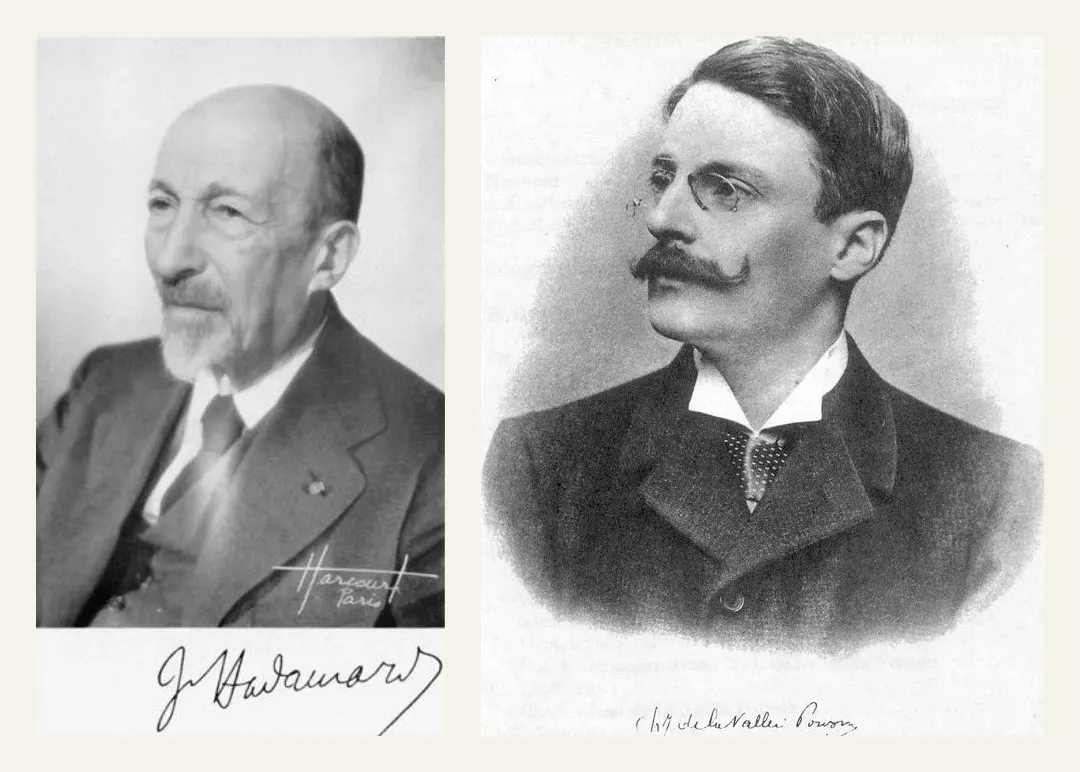
Photo: The two mathematicians who proved the prime number theorem — left, Jacques Hadamard (France); right, Charles-Jean de la Vallée Poussin (Belgium). · Wikimedia Commons (public domain)
There are 168 prime numbers up to 1,000, and if you divide 1,000 by the natural logarithm of 1,000 (roughly 6.9), you get about 145. The prime number theorem states that the ratio of the two approaches 1 as numbers grow larger. There is a curve called the logarithmic integral for a more refined approximation. It is a curve built by stacking up the idea that the probability of a prime number appearing near a given number is roughly 1 divided by the natural logarithm of that number, starting from 1, and it gives about 178 for 1,000. The prime number theorem does not specify how large the gap between these approximations and the actual count can get. The Riemann hypothesis is a hypothesis precisely about this gap—how tightly the error between the number of primes and the logarithmic integral is bounded.
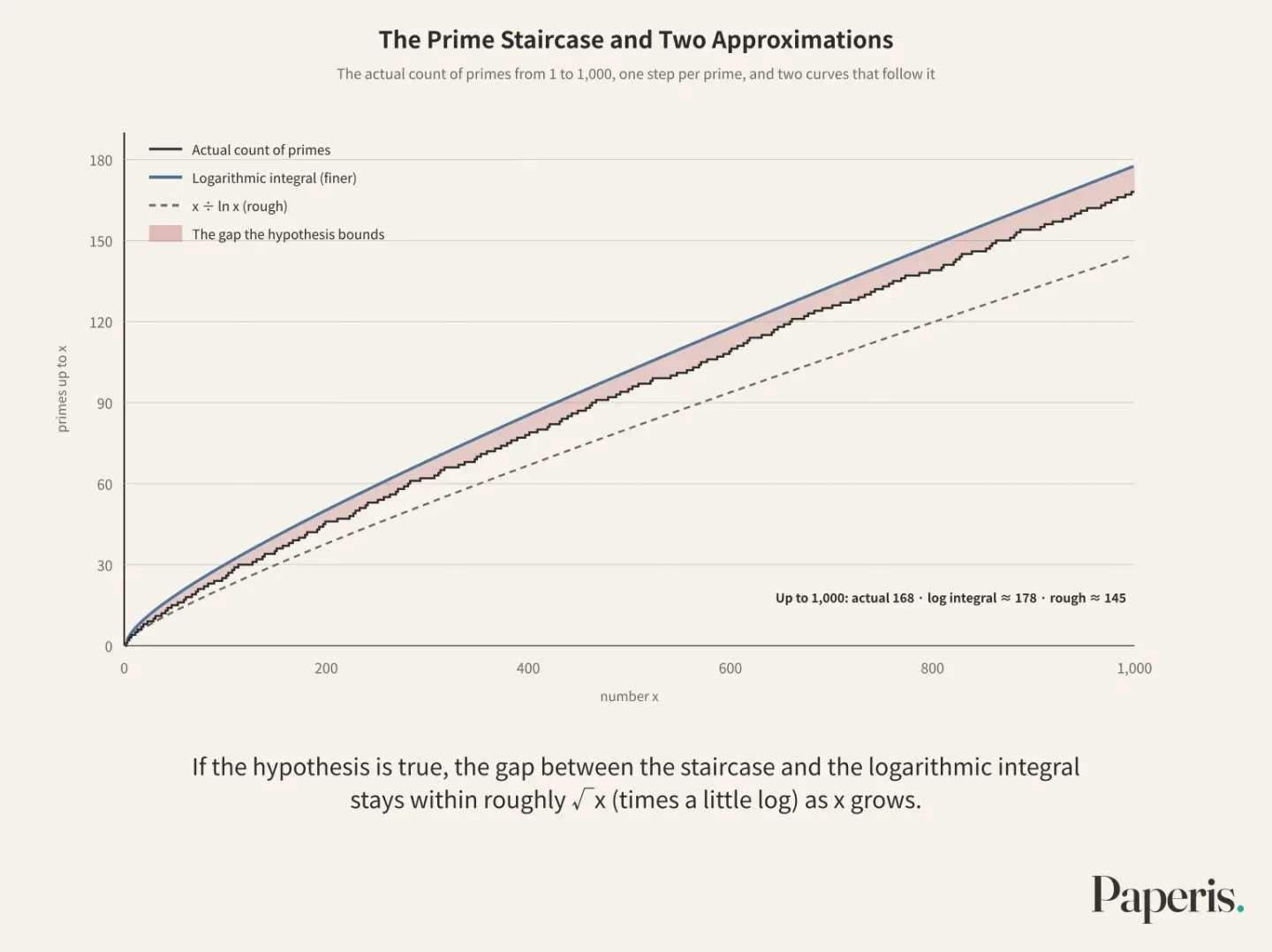
Figure: The prime staircase and two approximations, computed up to 1,000. What the hypothesis bounds is the gap between the staircase and the logarithmic integral.
The Zeroes That Decide the Error
In 1859, the German mathematician Bernhard Riemann obtained an analytic formula giving the number of primes up to a given limit in a “pioneering” paper (Clay problem description). At the very center of that formula sits a single function. The zeta function starts from the sum of the reciprocal of each natural number raised to the s-th power, such as 1 + 1/2ˢ + 1/3ˢ + 1/4ˢ + …, and is defined by extending that sum to where it otherwise loses meaning. Because this sum can be rewritten as a product over each and every prime, the zeta function contains the information of the primes wholesale. The input value s is a point on a plane, determined by two numbers: a horizontal position and a vertical position, where the horizontal position is called the real part. What matters in the Riemann hypothesis is this real part.
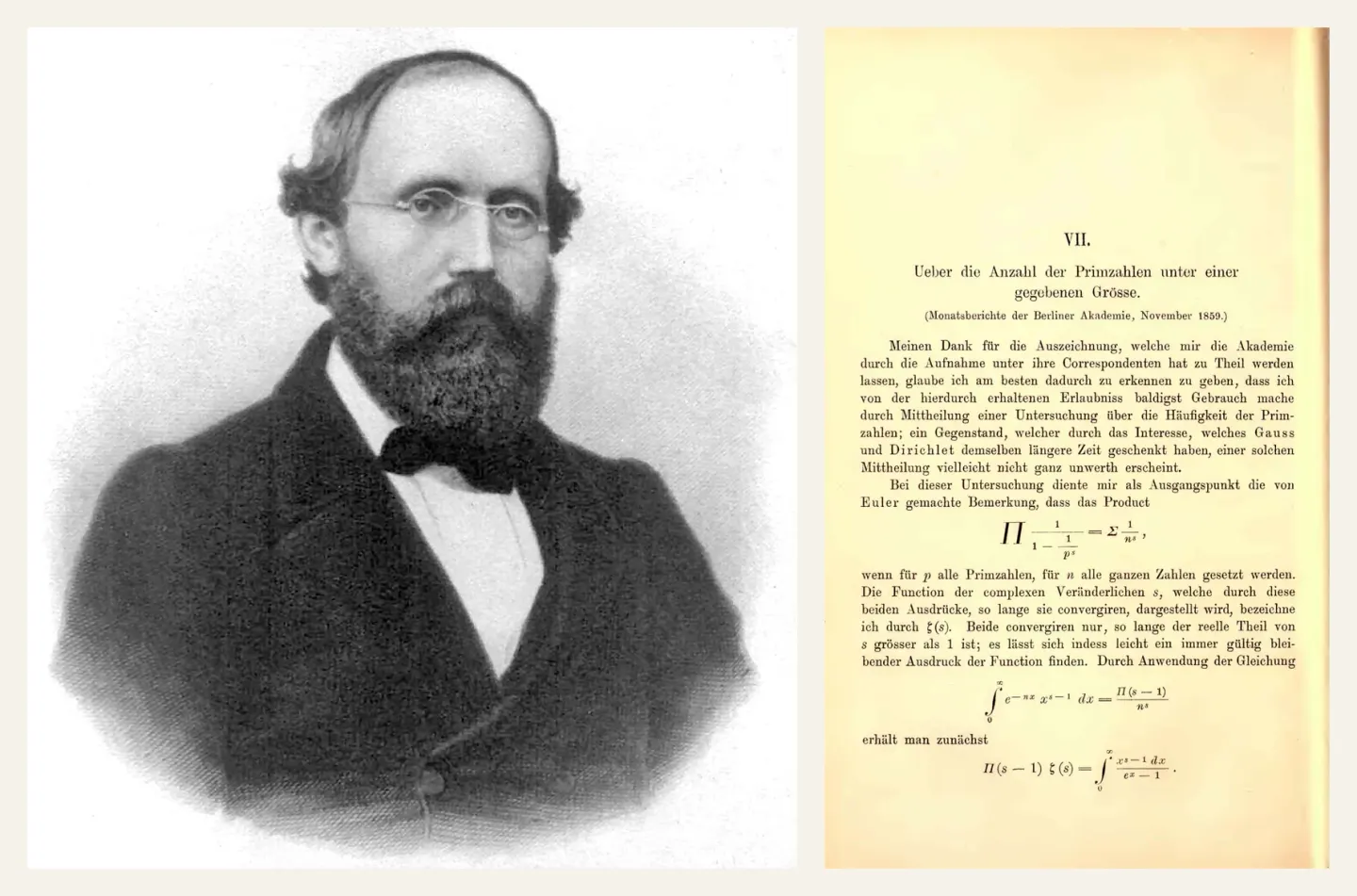
Figure: Left, Bernhard Riemann (photograph, 1863); right, the first page of his 1859 paper "On the Number of Primes Less Than a Given Magnitude" (reprint in his collected works). The first equation is Euler's observation that a product over primes equals a sum over whole numbers. · Wikimedia Commons (public domain)
When you plug a value into a function and the result is 0, that value is called a zero of the function. The zeta function becomes 0 at negative even integers like −2, −4, and −6, and these zeroes with obvious locations are called trivial zeroes (Clay problem description). The non-trivial zeroes are all the remaining values besides these negative even integers that make the zeta function 0. It is proven that all non-trivial zeroes lie within a vertical strip where the real part is between 0 and 1. The critical line is the vertical straight line down the middle of that strip, formed by the points whose real part is exactly 1/2.
Zeroes and primes are connected by Riemann's formula (DOI: 10.1090/s0025-5718-1970-0277489-3). That formula expresses the count of primes as the sum of a smooth main trunk and ripples contributed by each and every non-trivial zero. The farther a zero lies to the right from the critical line, the larger the ripple produced by that zero grows as the numbers get bigger. Therefore, where the zeroes are located determines the error in counting primes. In fact, computational verification that zeroes lie on the critical line and the expansion of zero-free regions are used to estimate errors in functions like the prime-counting function more accurately (DOI: 10.48550/arxiv.1002.0442).
Now the hypothesis can be written in a single sentence. The Riemann hypothesis is the assertion that the non-trivial zeroes of the zeta function all lie on the critical line, meaning their real part is 1/2 (Clay problem description). If this is true, the ripples of all zeroes stay on the smallest side, and the error between the prime count and the logarithmic integral is bounded by roughly the square root of x with a logarithm attached. Riemann himself did not prove this. In the modified function he wrote, the phrase “the roots are real” means that the zeroes lie on the critical line, and Riemann noted that “it is very probable that all roots are real” (Clay problem description).
The weight of this single sentence has been assessed by the mathematical community. In the view of many mathematicians, the Riemann hypothesis and its generalizations are arguably the most important unresolved problem in pure mathematics today (Clay problem description). Here, generalization, or the generalized Riemann hypothesis, is the extension of the same claim to various families of functions that are relatives of the zeta function. The Clay Mathematics Institute in the United States announced seven Millennium Problems carrying prize money in Paris on May 24, 2000, including the Riemann hypothesis as one of them, and this problem was also included in the list of 23 problems addressed by the German mathematician David Hilbert in his Paris address in 1900 (Clay Millennium Problems page).
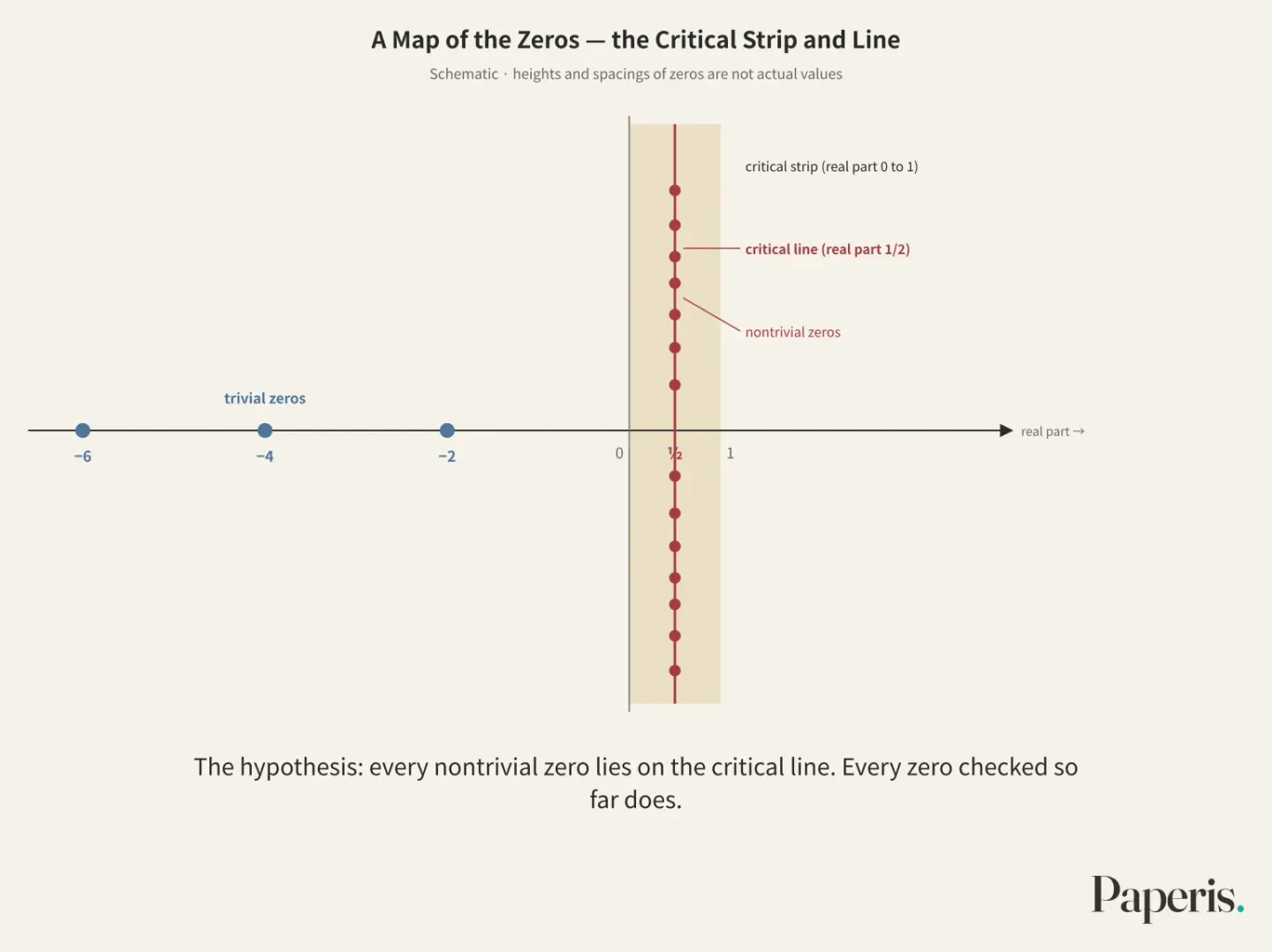
Figure: A map of the zeros (schematic — heights and spacings are not actual values). The hypothesis says every nontrivial zero lies on the critical line.
167 Years of "Probably True"
In 1979, calculation results came out showing that exactly 75,000,000 of the lower non-trivial zeros of the zeta function are all on the critical line and all simple. Simple means that no two zeros overlap in the same spot (DOI: 10.1090/s0025-5718-1979-0537983-2). A 1986 report increased that count to 1,500,000,001, roughly 1.5 billion (DOI: 10.1090/s0025-5718-1986-0829637-3). The Clay Mathematics Institute's problem page writes that it has been verified for the "first 10 trillion" (Clay problem page). Everywhere calculations reached, the zeros were on the straight line.
In the 1970s, clues came from a completely different side. Random matrix theory is a theory dealing with the intervals at which special numbers (eigenvalues) coming from large matrices filled with random numbers line up with each other. Comparing the statistics of the zeros to random matrices dates back to the work of mathematician Hugh Montgomery and physicist Freeman Dyson in the 1970s (DOI: 10.4310/cntp.2008.v2.n3.a1). Montgomery conjectured that the distribution of intervals when pairing non-trivial zeros is the same as the distribution of eigenvalues coming from a type of random matrix. The same statistics also appear in the energy levels of quantum systems that look fiercely chaotic from the viewpoint of classical mechanics (DOI: 10.1088/0951-7715/9/4/006). In the 1990s, assuming the Hardy-Littlewood conjecture, this match was extended to statistics grouping three zeros, four zeros, and an arbitrary number of them (DOI: 10.1088/0951-7715/8/6/013) (DOI: 10.1088/0951-7715/9/4/006). Physicists even pushed calculations forward by assuming the zeros are the energy levels of some quantum system not yet known (DOI: 10.1098/rspa.1985.0078).
Conditions are attached to this match. One of the two strands of results—that the correlation of $n$ zeros is the same as random matrices—holds only for a limited class of test functions, and the other relies on non-rigorous heuristic methods and the Hardy-Littlewood conjecture. Both results are statements about the limit rising infinitely high above the critical line (DOI: 10.4310/cntp.2008.v2.n3.a1). A 2026 review article examined published arguments suggesting the Riemann hypothesis could be false one by one, and concluded that none of them serve as a good reason to doubt the Riemann hypothesis. The grounds cited were theorems from analytic number theory, theorems from random matrix theory, and examples of large random matrices. The same review article notes that even though parts of the zeta function at very high altitudes can be understood, "computational evidence is misleading" (DOI: 10.1090/bull/1890). It is a warning that the appearance seen at heights calculations can reach does not substitute for the appearance at places far higher than that.
There is a precedent for that warning. The Mertens conjecture attracted attention for nearly 100 years because if it were true, the Riemann hypothesis would also be true. In 1985, mathematicians Odlyzko and te Riele showed that this conjecture was false, but that disproof relied on massive calculations about zeros and did not produce a concrete number breaking the conjecture (DOI: 10.1515/crll.1985.357.138). A conjecture stronger than the Riemann hypothesis could turn out to be false, and that falsehood was in a place where calculations could not reach. Even if 10 trillion zeros are on the straight line, it is no guarantee that all the remaining zeros continuing endlessly are as well.
So mathematicians have treated the Riemann hypothesis as "probably true" and piled results on top of it. For example, a 2026 paper assumed the generalized Riemann hypothesis and another conjecture about the correlation of zero pairs together, and derived Montgomery's conjecture on the error in the distribution of primes in arithmetic progressions and other results on top of that (DOI: 10.1007/s00208-026-03383-y). Calculations and statistics piled up for 167 years have made the Riemann hypothesis "probably true," but because not all infinitely many zeros can be checked, it has not become a proof.
Proofs Read by Machines
The proof released by Alfvെന്നു (note: Alfvege) consists of 175,187 .lean files, 17,374,215 lines, and has not a single comment (Lean/Mathlib community verification record). By comparison, Mathlib, the Lean mathematics library built together by mathematicians, is about 2 million lines in total (Rubinstein verification page).
The side reading such proofs is a program before any human. A proof assistant is a program where, if you write down definitions and proofs in a fixed formal language, the computer checks whether every step of the proof truly follows from the previous steps and the rules. Lean is one such assistant. Mathlib is a community project that formalizes classical mathematics in Lean to gather it into a single integrated library, and it has grown through many people building it together in parts (DOI: 10.1145/3372885.3373824).
AI and proof assistants have been paired for a few years. A 2024 study created a tool that runs a large language model inside Lean to suggest the next step when a person does a proof, and wrote that because formal proofs can have their accuracy rigorously checked, there is no room for hallucinations to slip in (arXiv:2404.12534v3). A proof-specialized model released in 2025 reported passing 88.9% on a collection of competition-level problems (the miniF2F test set) and solving 49 out of 658 undergraduate math competition problems (PutnamBench) (DOI: 10.48550/arxiv.2504.21801). There was movement on the Riemann hypothesis side as well. In August 2026, Anthropic announced that an unreleased research Claude raised the long-standing lower bound of "at least this much" for the proportion of zeros on the critical line from 41.6% to 67.2%, while writing that it does not expect the technique to lead to a proof of the Riemann hypothesis (Anthropic research post).
Part of this verification was also executed by AI. Mathematician Michael Rubinstein of the University of Waterloo in Canada and mathematician Andrew Sutherland of MIT in the US wrote on their respective verification pages that they ran checks with the AI agent Claude Code (Rubinstein verification page) (Sutherland verification page). No matter who runs the check, whether to accept it or not is judged by the Lean kernel and separately written checkers.
What Lean Guarantees and What It Does Not
Eight days before this announcement, on November 12, British mathematician Kevin Buzzard of Imperial College London wrote four questions on his blog, noting that while AI-generated Lean code can yield important signals, a few tests must be run first: Does the Lean statement match the human-language statement? Does the code compile? Does the code actually prove the stated theorem? And does the code not exploit a bug in Lean's official checker? (Buzzard's blog). These four questions draw the boundary between what a Lean check does and what it does not do.
First is the check itself. The kernel is a small core program that makes the final decision to accept or reject each declaration making up a proof inside Lean. In this proof, custom commands that skip standard preceding checks were used across 67 files. The community verification log therefore notes that the kernel is the sole checker, that this method is sound because the kernel checks every declaration, and that it is for this very reason re-checked with an independent kernel (Lean/Mathlib community verification record).
Next is the statement. The official Lean documentation notes that one must distinguish between "is there a valid proof of the theorem?" and "what does the theorem statement mean?", and that Lean can establish that a statement has been proven, but cannot establish whether it is the intended statement (Lean Language Reference). This means that even a slight misalignment in the definition of the zeta function inside the code can allow the proof of an off-target statement to pass the check. This proof plugged that gap by reusing the definition of the Riemann hypothesis already present in Mathlib (Rubinstein verification page). That definition means "all zeros of the zeta function, excluding the trivial zeros −2, −4, …, have real part 1/2" (Rubinstein verification page), which has been thoroughly reviewed by Lean and number theory experts (Lean/Mathlib joint statement). Sutherland also performed cross-checks that do not rely on Mathlib's definition of the zeta function. Combined with separately formalized work on an inequality criterion concerning the sum of divisors (the Robin-Lagarias criterion) where holding true is equivalent to the Riemann hypothesis being true, he obtained two theorems mentioning no zeta function without assumptions. However, these theorems also lean on Mathlib's definition of the sum of divisors and the proof of that separately formalized work (Sutherland verification page).
Third are the starting assumptions. Axioms are starting points accepted without proof, and declaring a new axiom within a proof allows one to derive anything. The Lean documentation notes that one should output the list of axioms the proof relies on to verify that only the three axioms built into Lean appear. Unfinished proofs show up as separate axioms, and if other axioms appear, the theorem is valid only under the condition that those axioms are sound, while Lean by its nature cannot check whether new axioms are free of contradiction (Lean Language Reference). According to Rubinstein's log, the five main theorems of this proof rely solely on those three standard axioms (Rubinstein verification page). Why this check is necessary is shown by another preprint. A 2026 AI-assisted study dealing with the ratio of non-overlapping zeros disclosed that it used three axioms outside Mathlib. Those axioms merely record the fact that a search program returned "true," and Lean's kernel does not check the execution of that program itself (arXiv:2610.08965v1).
Fourth are bugs in the checker itself. In a study that built a new external checker for Lean, a soundness bug was discovered and fixed thanks to that verification work (DOI: 10.4230/lipics.types.2025.2). This means that checking programs can also be wrong, which is why the same proof is re-checked using multiple separately written kernels. The official Lean documentation similarly notes that in cases where malice cannot be ruled out, such as unreviewed AI-generated proofs, one should use checking methods involving multiple independent kernels (Lean Language Reference).
Even so, things remain. The community verification log notes that even after passing the check, one must still trust the checkers, Mathlib's definitions, Mathlib's official build cache, the tool that exports the proof, and the isolated execution environment (Lean/Mathlib community verification record). Sutherland likewise notes that what a passed check shows is that the formal statement written using Mathlib's definitions follows from the standard axioms according to the used kernels, relying on those kernels and Mathlib's definitions being as intended (Sutherland verification page). And Lean does not tell us why it is true. Buzzard wrote that even if it passes all tests and is overwhelmingly likely to be a correct proof, that does not mean the corresponding human-readable manuscript contains a correct proof (Buzzard's blog), and Bartosz Naskręcki, who runs the verification dashboard, wrote that the kernel merely certifies that the theorem follows from the axioms without explaining the reason why, and cannot replace mathematicians reading arguments (Naskręcki dashboard).
What a Lean check guarantees is that "the written statement follows from the standard axioms," while whether that statement is the Riemann hypothesis we intended and why it is true are left to other checks. In this case, the former was bridged by comparing statements between Mathlib's existing definitions and two tools, while the latter still remains the task of humans.
Human Verification — Peer Review and the Clay Rules
On the same November 20, another proof proposal was made public. Ravi Vakil, a math professor at Stanford University, wrote on his blog that Alessandro Maria Masullo has a proof proposal for the generalized Riemann hypothesis, that mathematician Brian Conrad spent months reviewing it and providing feedback, and that it has looked fine to him so far (Vakil's blog) (AFP report). He also wrote, "Humans did all of it, no AI." He originally intended to polish the manuscript for a year and show it to enough people before releasing it, but thought that releasing a draft now seemed best (Vakil's blog). Masullo is a mathematician who earned his Ph.D. at Stanford in 2020 under Conrad's guidance (Nature report). About eight hours later, Vakil edited his post to write that several people had pointed out problems they found with the help of different AI models. He wrote that, as always, all problems must be resolved to the community's satisfaction for this proof to be accepted as true, and added that he makes no claim about whether the proof strategy is correct (Vakil's blog).
How human verification works is wrapped up in this matter. When a manuscript is published, readers find and report problems, and the author responds and fixes them. At the end of that is peer review, where an academic journal has experts in the same field read the manuscript to decide whether to publish it. The Clay Mathematics Institute recorded this process in its prize rules. The only solutions for which the Institute can give a prize are those that meet all four conditions: publication in a refereed mathematical publication of worldwide repute or a relaxed condition approved by the board of directors, at least two years having passed since publication, general acceptance in the worldwide mathematical community, and a satisfactory answer to the question posed by the official problem description. The Institute judges alone whether it has been accepted, and does not accept solutions sent directly to the Institute (Clay prize rules). Even when Lean verification finishes, the acceptance spoken of by the Clay rules separately requires publication, review, and a span of two years.
What mathematicians call "confirmation" points to the same side. James Maynard, a number theorist at the University of Oxford and a 2022 Fields Medalist, said that "if fully confirmed, it would be a historical milestone in mathematics," and said that while he suspects the proof will turn out to be correct, it will take time to check the Lean verification. He added, somewhat frustratingly, that actually understanding this proof looks to require quite a bit of work (IBM Think report). Youness Lamzouri, a math professor at University of Lorraine in France, said that if the claim is true it is an immense achievement, stating that understanding could take months or even years and that "mathematics is mostly about understanding why something is true" (IBM Think report). Brian Conrey, introduced as a leading expert on the Riemann hypothesis, welcomed it as one of the biggest events in the history of mathematics, but said he had not yet seen the manuscript, had only seen the notes Alföldy posted on the website, and had requested a copy (AFP report). Andrew Granville, a number theorist at the University of Montreal in Canada, said Alföldy should have prepared a clearer manuscript before announcing it, stating that "what he has put out is a jumble" (Nature report).
Timing and Conflicts of Interest
Alpöge is affiliated with Anthropic (Alpöge's website). Nature reported that this announcement came "days after" Anthropic's initial public offering, and that the company's valuation, initially assessed at $1.5 trillion, fell on November 19. AFP and Scientific American wrote that it was the "day after" the listing (Nature report) (AFP report) (Scientific American report). Alpöge wrote in a note that he had asked Chief Executive Dario Amodei whether he could make the announcement and that there were constraints he had to follow, but did not disclose what those constraints were (Alpöge's note) (AFP report). He wrote that it was entirely his own responsibility if he felt he could not bear to wait any longer, and that while there is an obvious cynical view regarding the timing, it is wrong (Alpöge's note). Granville cited the drop in the company's stock price as a reason for the timing (Nature report). Regarding the motive for the timing, the person involved's denial and the critics' interpretation thus clash, and Anthropic did not immediately respond to requests for comment from Nature and AFP as of the article's publication on November 20 (Nature report) (AFP report). New York University visiting professor Nestor Guillen praised Alpöge for honestly admitting that he does not yet fully understand the proof, saying that the back-and-forth he described shows that AI works "more like a tool" (AFP report).
As of November 22
Below is the record made public up to the afternoon of November 22, 2026 (around 15:00 UTC). Because verification statuses have been changing by the hour, each document includes the timestamp it specifies.
First are the confirmed items. Independent verifier Elliot Arledge recorded at 19:05 UTC on November 20 that all 175,187 modules compiled without failure (Arledge verification record). Rubinstein wrote in his results from 10:10 UTC on November 21 that all modules compiled without errors, that the five main theorems used only the standard set of axioms, that all modules were re-run through the Lean kernel with all 175,187 accepted, and that a separately written Rust kernel checked the 1,484,729 declarations that the five theorems rely on without error (Rubinstein verification page). Sutherland wrote in his update at 14:10 UTC on November 22 that two separately written kernels accepted the entire exported proofs, and that two independent implementations matching statements confirmed that all five theorems match the pre-arranged statements (Sutherland verification page). In a joint statement on November 21, the Lean Mathlib community stated that they are “fully confident that Alpöge's proof of the Riemann hypothesis is correct”, certifying that the statement and proof of the Riemann hypothesis are correct, and that all four of Buzzard's criteria have been met. This statement was endorsed by the Lean development organization and the Mathlib operations organization (Lean/Mathlib joint statement).
Next are the remaining items. In the same November 22 update, Sutherland wrote that running the official comparator end-to-end and re-running the exported proofs through the Lean kernel are “still in progress”. However, he noted that statement matching and axiom checking had already passed in a single run (Sutherland verification page). The community verification repository's own builds are also recorded as being in progress (Lean/Mathlib community verification record). The generalized Riemann hypothesis has a narrow scope. Verifiers wrote that although Alpöge did not limit the scope in his notes, what the Lean theorems cover is restricted to a single family of Dirichlet L-functions (all moduli and all characters) and does not include Dedekind zeta functions, Hecke L-functions, or general automorphic L-functions (Rubinstein verification page) (Sutherland verification page) (Lean/Mathlib community verification record). What the joint statement certified is also the Riemann hypothesis, and the generalized Riemann hypothesis does not appear in the statement (Lean/Mathlib joint statement). The extended Riemann hypothesis is only something Alpöge wrote he “expects” (Alpöge's note).
The human side is only just beginning. Naskręcki's dashboard recorded the status of this proof as “Announced, machine-checked, not yet reviewed” at 23:51 UTC on November 20, and answering the question of whether the mathematics is understood and reviewed with “Not yet”, noted that there is no human-readable proof to date (Naskręcki dashboard). Rubinstein posted a working draft dated November 21, a 164-page explanatory text tailored to the zeta function written for study purposes alongside Claude, Codex, and Gemini. However, he stated that one key inequality was not proved within that exposition but brought over from Lean development, and that it is work in progress (Rubinstein verification page). There is no publication that has undergone journal peer review, and the Clay Mathematics Institute's problem page lists the Riemann hypothesis as “Unsolved” on November 22 as well (Clay problem page). The materials gathered up to November 22 contain no official statement from Anthropic regarding this announcement.
| Stage | Status as of November 22 | Record |
|---|---|---|
| Full Lean source compilation | Passed | Arledge (11-20) · Rubinstein (11-21) |
| Use of standard axiom set only | Passed | Rubinstein · Sutherland · Arledge |
| Do statements match Mathlib's definition of the Riemann hypothesis? | Confirmed by two independent tools | Joint Statement (11-21) · Sutherland |
| Re-checking by multiple independent kernels | Accepted by two or more | Rubinstein (11-21) · Sutherland (11-22) |
| Full run of official comparator and Lean kernel re-check of exported proofs | In progress | Sutherland (11-22 14:10 UTC) |
| Scope of the generalized Riemann hypothesis | Restricted to Dirichlet L-functions | Three verifiers |
| Human-readable proof | None (explanatory draft in progress) | Naskręcki · Rubinstein |
| Journal peer review | Not yet | Naskręcki |
| Conditions of Clay rules | Unmet — problem page is “Unsolved” | Clay (11-22) |
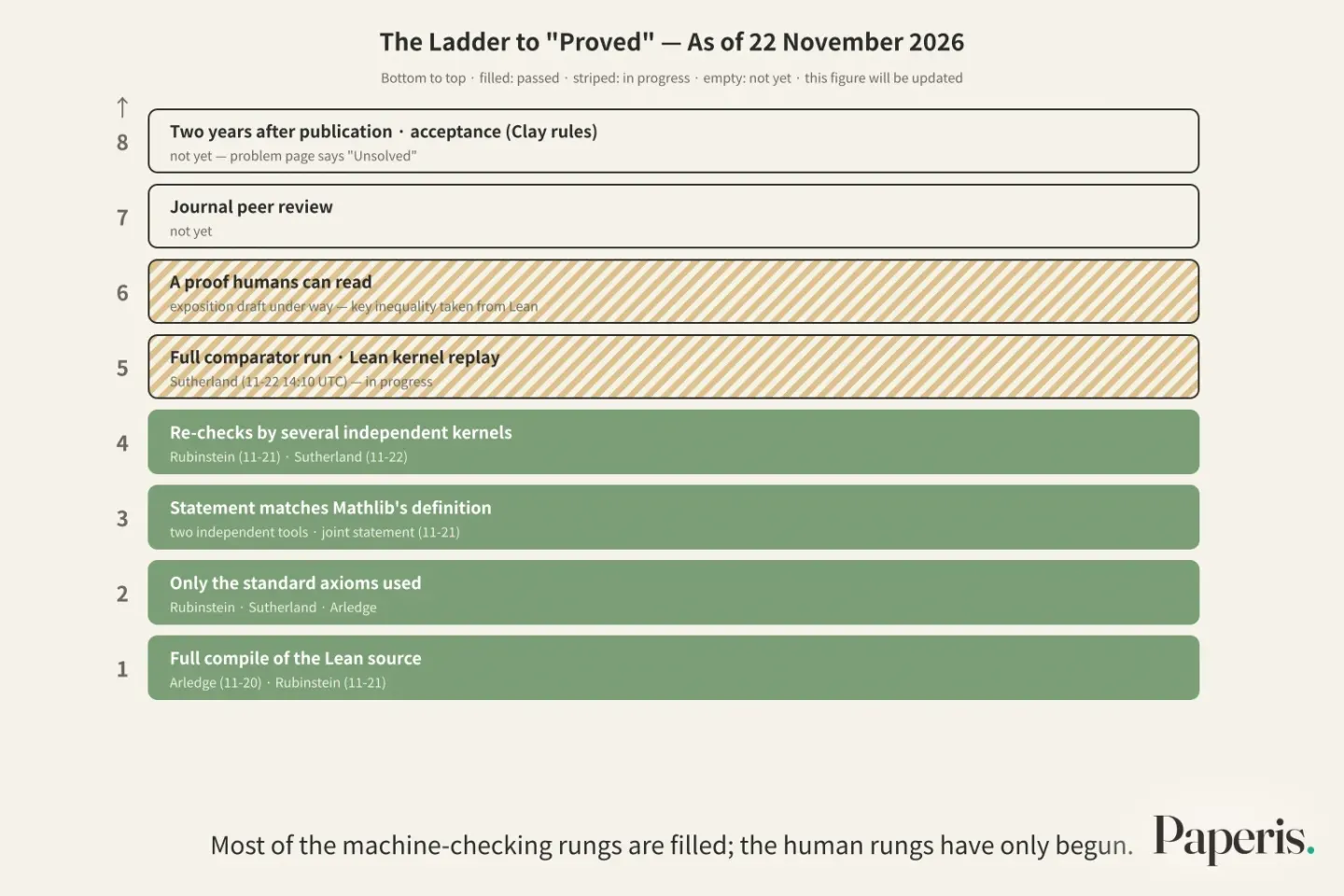
Figure: The ladder to "proved" — as of 22 November 2026. This figure will be updated as things change.
As of November 22, the Lean proof of the Riemann hypothesis has passed several independent checkers, and the Lean Mathlib community has certified that the statement and proof are correct. A human-readable proof and journal review do not yet exist.
Where to Look Further
- A 2026 review that examines arguments doubting the Riemann hypothesis one by one and discusses why computational evidence leads to misunderstandings (DOI: 10.1090/bull/1890).
- A 2008 paper outlining how far the statistics of zeros and random matrices match and what assumptions those results rely on (DOI: 10.4310/cntp.2008.v2.n3.a1).
- A 2020 paper explaining how Lean's mathematical library Mathlib is designed and how it builds together (DOI: 10.1145/3372885.3373824).
- The remaining open questions are when and in what shape a human-readable proof will emerge, and how long it will take the academic community to understand those new ideas.
Case Documents
- Alpöge's note remark.pdf (no date indicated, published 2026-11-20) — https://alpo.ge/remark.pdf — A 4-page note by Alpöge. Claim sentence ("I believe it"), reasons why only Lean was released, self-description of Claude's role, self-mention of the announcement timing, and proof file address.
- Alpöge's website (collected 2026-11-20) — https://alpo.ge — Affiliation (Anthropic) indicated.
- Rubinstein verification page (2026-11-21, result timestamp 10:10 UTC) — https://mrubinst.github.io/grh-lean-verification — Full compilation, standard axiom set, Lean kernel replay, independent kernel (nanoda) check, Mathlib definition unfolding, generalization scope, 164-page commentary draft.
- Sutherland verification page (updated 2026-11-22 14:10 UTC) — https://math.mit.edu/~drew/grh — Results of comparing multiple independent kernels and statements, "still in progress" stage, Robin-Lagarias cross-checking, and premises the check relies on.
- Arledge verification receipt (GitHub rh-verification-receipts) (2026-11-20) — https://github.com/Infatoshi/rh-verification-receipts — Full compilation completion time and independent kernel check results.
- Lean-Mathlib community verification records (leanprover-community/riemann-hypothesis repository README and verification/NOTES.md) (collected 2026-11-22) — https://github.com/leanprover-community/riemann-hypothesis — Scale of the proof, static search results, why the kernel is the sole verification, remaining trust even after passing, and self-build in progress.
- "Joint statement by the Lean and Mathlib communities" — Lean and Mathlib joint statement (2026-11-21) — https://leanprover-community.github.io/blog/posts/riemann-hypothesis/ — Certification of statements and proofs, statement comparison using two tools, and the Riemann Hypothesis being the sole subject of certification.
- Buzzard blog (Xena Project) (2026-11-12) — https://xenaproject.wordpress.com/2026/11/12/and-the-proof-is-checked-in-lean/ — Four questions to ask before trusting AI-written Lean code, and the caveat that it is separate from the manuscript's correctness.
- "Validating a Lean Proof" — Lean Language Reference — https://lean-lang.org/doc/reference/latest/ValidatingProofs/ — Distinction between proven and meant, checking the list of axioms, checking multiple kernels, and remaining assumptions.
- riemann-rev dashboard — Naskręcki dashboard (recorded 2026-11-20 23:51 UTC) — https://nasqret.github.io/riemann-rev/ — "Announced, machine-verified, not yet peer-reviewed", no human-readable proof.
- Anthropic research post (2026-08-10, paper updated 08-13) — https://www.anthropic.com/research/riemann-zeta — Lower bound of the zero proportion from 41.6% to 67.2%, and a statement expecting it not to lead to a proof of the Riemann Hypothesis.
- Vakil blog post (2026-11-20 10:18, updated about 8 hours later) — https://math216.wordpress.com/2026/11/20/hurried-announcement-alessandro-masullo-grh/ — Publication of Masullo's Generalized Riemann Hypothesis proof proposal, reporting of issues, and community acceptance conditions.
- Clay Riemann Hypothesis problem description (Bombieri) — https://www.claymath.org/wp-content/uploads/2022/05/riemann.pdf — Riemann's 1859 formula, Riemann's "very probable", trivial zeros, statement of the hypothesis, and the view that it is the most important unsolved problem.
- Clay Millennium Problems introduction and Riemann Hypothesis problem page (collected 2026-11-22) — https://www.claymath.org/millennium-problems/ · https://www.claymath.org/millennium/riemann-hypothesis/ — Announced on May 24, 2000, list of Hilbert's 23 problems, "first 10 trillion" verified, and marked as "unsolved".
- "Millennium Prize Description and Rules" — Clay prize rules (adopted 2018-09-26) — https://www.claymath.org/wp-content/uploads/2022/03/millennium_prize_rules_0.pdf — Four conditions for winning, direct submissions not allowed.
- Nature report (2026-11-20, updated 11-21) — https://www.nature.com/articles/d41586-026-03812-7 — Alpöge's identity, a few days after the IPO and value decline on November 19, Granville's remarks, Masullo's identity, Anthropic's no response, and partial remarks by Maynard.
- AFP report (published on Phys.org, 2026-11-20) — https://phys.org/news/2026-11-anthropic-claude-math-greatest-riddle.html — Conrey and Guillen's remarks, the day after the IPO, discussion with Amodei, and Anthropic's no response.
- IBM Think report (2026-11-20) — https://www.ibm.com/think/news/anthropic-claude-riemann-hypothesis-math-proof — Maynard and Lamzouri's remarks.
- Scientific American report (2026-11-20~21) — https://www.scientificamerican.com/article/anthropic-mathematician-claims-to-prove-riemann-hypothesis-most-famous-problem-in-all-of-math/ · https://www.scientificamerican.com/article/the-ai-riemann-hypothesis-proof-is-almost-certainly-true-independent-mathematicians-attest/ — The day after the IPO.
Source Papers
- "An Epic Drama : The Development of the Prime Number Theorem" (2008) — DOI: 10.17877/de290r-52 — The raising of the prime number theorem (Legendre, Gauss, etc.) and the proofs by Hadamard and de la Vallée Poussin span the entire 19th century, with the Riemann Hypothesis arising from their techniques.
- "Some Calculations Related to Riemann's Prime Number Formula" (1970) — DOI: 10.1090/s0025-5718-1970-0277489-3 — The relationship between complex zeros and the distribution of primes emerges from Riemann's formula, studied here through large-scale computations.
- "Estimates of Some Functions Over Primes without R.H." (2010) — DOI: 10.48550/arxiv.1002.0442 — Locating the critical line for zeros and expanding zero-free regions improves effective estimates for functions like $\psi(x)$, $\theta(x)$, and $\pi(x)$.
- "On the Zeros of the Riemann Zeta Function in the Critical Strip" (1979) — DOI: 10.1090/s0025-5718-1979-0537983-2 — Exactly 75,000,000 zeros are all simple and lie on the critical line.
- "On the Zeros of the Riemann Zeta Function in the Critical Strip. IV" (1986) — DOI: 10.1090/s0025-5718-1986-0829637-3 — The first 1,500,000,001 zeros all have a real part of 1/2 and are simple.
- "Correlations of eigenvalues and Riemann zeros" (2008) — DOI: 10.4310/cntp.2008.v2.n3.a1 — Starting from the 1970s work of Montgomery and Dyson, the match in n-point correlations relies on restricted test functions (one branch) or non-rigorous heuristic methods and the Hardy-Littlewood conjectures (another branch), yielding lower-order terms via the ratio conjecture.
- "Random matrix theory and the Riemann zeros. I. Three- and four-point correlations" (1995) — DOI: 10.1088/0951-7715/8/6/013 — Three- and four-point correlations are asymptotically identical to GUE, relying on the Hardy-Littlewood conjecture.
- "Random matrix theory and the Riemann zeros II: n-point correlations" (1996) — DOI: 10.1088/0951-7715/9/4/006 — Generalizing Montgomery's pair correlation conjecture to all n-point correlations, connecting to the energy level statistics of strongly chaotic quantum systems.
- "Semiclassical theory of spectral rigidity" (1985) — DOI: 10.1098/rspa.1985.0078 — Calculation example assuming zeros as eigenvalues of an unknown quantum system whose classical limit is chaotic.
- "Currently, there are no reasons to doubt the Riemann Hypothesis: The zeta function beyond the realm of computation" (2026) — DOI: 10.1090/bull/1890 — Review of published arguments casting doubt on the Riemann Hypothesis, concluding that none are good reasons and that computational evidence can be misleading.
- "Disproof of the Mertens conjecture." (1985) — DOI: 10.1515/crll.1985.357.138 — Disproves the Mertens conjecture, which would have implied the Riemann Hypothesis if true, relying on zero computations without an explicit counterexample.
- "Pair correlation of zeros of Dirichlet L-functions: a possible path towards the conjectures of Chowla, Elliott-Halberstam and Montgomery" (2026) — DOI: 10.1007/s00208-026-03383-y — Derives Montgomery's conjecture and others regarding the error in the prime number theorem for arithmetic progressions by assuming the Generalized Riemann Hypothesis and the pair correlation conjecture.
- "The lean mathematical library" (2020) — DOI: 10.1145/3372885.3373824 — The design and community organization of mathlib, an integrated library of mathematics formalized using the Lean proof assistant.
- "Lean Copilot: Large Language Models as Copilots for Theorem Proving in Lean" (2024) — arXiv:2404.12534v3 — A framework running large language models inside Lean to assist human proofs, with the authors noting that formal proofs are rigorously checked leaving no room for hallucinations.
- "DeepSeek-Prover-V2: Advancing Formal Mathematical Reasoning via Reinforcement Learning for Subgoal Decomposition" (2025) — DOI: 10.48550/arxiv.2504.21801 — A Lean 4 theorem proving model, achieving 88.9% on the miniF2F benchmark and 49 out of 658 on PutnamBench.
- "More than 83.9% of the zeros of the Riemann zeta function are distinct and more than 67.35% are simple and on the critical line" (2026) — arXiv:2610.08965v1 — Preprint. AI-assisted research experiment, using an axiom set outside mathlib (a record that a search program returned true) whose execution the kernel does not check.
- "Lean4Lean: Verifying a Typechecker for Lean, in Lean" (2024) — DOI: 10.4230/lipics.types.2025.2 — An external typechecker for Lean 4 written in Lean, discovering and fixing a soundness bug through this verification work.
Sources (17)
- An Epic Drama : The Development of the Prime Number TheoremDOI 10.17877/de290r-52
- Some Calculations Related to Riemann's Prime Number FormulaDOI 10.1090/s0025-5718-1970-0277489-3
- Estimates of Some Functions Over Primes without R.HDOI 10.48550/arxiv.1002.0442
- On the Zeros of the Riemann Zeta Function in the Critical StripDOI 10.1090/s0025-5718-1979-0537983-2
- On the Zeros of the Riemann Zeta Function in the Critical Strip. IVDOI 10.1090/s0025-5718-1986-0829637-3
- Correlations of eigenvalues and Riemann zerosDOI 10.4310/cntp.2008.v2.n3.a1
- Random matrix theory and the Riemann zeros. I. Three- and four-point correlationsDOI 10.1088/0951-7715/8/6/013
- Random matrix theory and the Riemann zeros II: n-point correlationsDOI 10.1088/0951-7715/9/4/006
- Semiclassical theory of spectral rigidityDOI 10.1098/rspa.1985.0078
- Currently, there are no reasons to doubt the Riemann Hypothesis: The zeta function beyond the realm of computationDOI 10.1090/bull/1890
- Disproof of the Mertens conjectureDOI 10.1515/crll.1985.357.138
- Pair correlation of zeros of Dirichlet L-functions: a possible path towards the conjectures of Chowla, Elliott-Halberstam and MontgomeryDOI 10.1007/s00208-026-03383-y
- The lean mathematical libraryDOI 10.1145/3372885.3373824
- Lean Copilot: Large Language Models as Copilots for Theorem Proving in LeanarXiv:2404.12534v3
- DeepSeek-Prover-V2: Advancing Formal Mathematical Reasoning via Reinforcement Learning for Subgoal DecompositionDOI 10.48550/arxiv.2504.21801
- More than 83.9% of the zeros of the Riemann zeta function are distinct and more than 67.35% are simple and on the critical linearXiv:2610.08965v1
- Lean4Lean: Verifying a Typechecker for Lean, in LeanDOI 10.4230/lipics.types.2025.2