Paperis Articles
Solid-State Batteries — Why a Hard Wall Didn't Stop Lithium
Swapping the liquid electrolyte for a solid promises a lithium-metal anode and an electrolyte that does not burn. Yet lithium still crosses the hard solid, entering through flaws, grain boundaries and the voids left behind when lithium is stripped.
Your field's papers, as audio
Pick your fields and journals — Paperis summarizes the key papers and turns them into audio. Listen on your commute.
Start Paperis free →Solid-State Batteries — Why a Hard Wall Didn't Stop Lithium
The Wall Cracked Before Lithium Even Reached It
A small test cell is charging inside an X-ray imaging machine. The cell has a structure where a layer of sulfide solid electrolyte is sandwiched between two sheets of lithium metal. An electrolyte is a substance that fills the space between two electrodes, letting lithium ions pass through while stopping electrons from crossing, and in this cell, a hard ceramic layer takes that place. When current is applied, lithium on one side dissolves into ions, crosses the electrolyte, and piles up again as metal on the opposite electrode. The research team watched this process using X-ray computed tomography and X-ray diffraction (PMID 33888903).
First, a cone-shaped depression and cracks formed near the edge of the electrode where lithium accumulates, close to the electrolyte surface. This is the edge where the electric field concentrates. From that spot, a transverse crack stretched toward the opposite electrode. The lithium pushed the crack open from behind and followed inside, while the front tip of the crack always outpaced the lithium. The crack crossed the entire electrolyte before the lithium reached the other side, and an internal short circuit occurred afterward (PMID 33888903). An internal short circuit is when the positive and negative electrodes inside a cell connect directly across the separator, causing electricity to flow without going through the external circuit. In a battery using liquid, a thin membrane keeps the two electrodes apart, and in this cell, the solid electrolyte layer handles that membrane's job as well.
This solid layer is the material originally expected to serve as a wall preventing lithium from passing through. This article follows where that expectation came from, what the experiment showed, and what remains now.
What Was Said to Improve When Changing to a Solid
All-solid-state batteries are batteries in which the electrolyte between the two electrodes is filled with a solid instead of a liquid. The structure of the cell seen in "The Battery Cell — A Rocking Chair Between Two Electrodes" remains the same, and only the path through which lithium ions travel changes from liquid to solid. The reasons for trying to make this change boil down to two.
First is energy. The negative electrode is the −-side electrode of the cell, where lithium ions cross over and stay during charging. Today's lithium-ion batteries use graphite for the negative electrode, and what all-solid-state batteries aim for is to use a lithium metal plate itself in that place. Lithium metal is the negative electrode material that can hold the most charge per weight and has the lowest potential (DOI: 10.1073/pnas.1600422113). Energy density is the energy that a battery holds per 1 kilogram of weight or 1 liter of volume, and the weight side is written as Wh/kg and the volume side as Wh/L. Using lithium metal as the negative electrode can increase the energy density compared to conventional lithium-ion batteries (DOI: 10.1002/adfm.202411171), and one review paper writes this as "theoretically high energy density" (DOI: 10.1002/batt.202300321). It is a promise to hold more in the same weight, but it is still an expectation established by calculation. What watt-hours measure was covered in "Ampere-hours and Watt-hours — How Much It Holds, How Fast It Gives It Back".
It is difficult to use lithium metal together with a liquid electrolyte. Dendrites are metal strands that grow thinly and long because lithium fails to stack evenly on the negative electrode surface during charging, and in lithium metal negative electrodes, these strands grow well, the reactivity of lithium is excessively large, and the volume changes significantly with each charge and discharge. A 2017 review paper that organized these problems put the introduction of solid electrolytes on the horizon as a direction to fundamentally solve safety issues (DOI: 10.1002/adma.201700007).
Second is safety. Solid electrolytes are non-flammable materials, so it is expected that the safety of the cell will increase (DOI: 10.1002/adfm.202411171). The point of completely eliminating liquid electrolytes that can catch fire is the basis for that (PMID 41081617). Thermal runaway is an event where when the temperature inside the battery rises, a chemical reaction that produces heat occurs, and a loop in which the heat produced by that reaction raises the temperature again and calls forth more reactions continues without stopping on its own. It is that loop seen in "Thermal Runaway — A Staircase Climbed on Its Own Heat". The organic liquid electrolyte's properties of burning, evaporating easily, and corroding are cited as reasons why the thermal problems of lithium-ion batteries are not easily solved (DOI: 10.1002/inf2.12224).
This safety promise has a counter-basis accompanying it. A 2022 review paper writes that because solid electrolytes are non-flammable and hard, the safety of all-solid-state batteries has been taken for granted for the most part, but results have been reported where hazardous gases and intense heat are released as lithium strands form. Citing these reports, the authors raise the problem that the safety of all-solid-state lithium batteries may have been overestimated, and propose methods to evaluate safety (DOI: 10.1016/j.esci.2022.02.008). Another review paper from 2021 also wrote that research on the thermal stability of solid electrolytes is still in its early stages, and the thermal safety of all-solid-state batteries needs further verification (DOI: 10.1002/inf2.12224). That an electrolyte does not burn is a property of a single material, and the evidence does not yet reach the conclusion that the cell as a whole is free from fire.
A third expectation was attached here. When a dendrite reaches the opposite electrode, an internal short circuit occurs. If the solid electrolyte is sufficiently harder than lithium, meaning if the rigidity to withstand twisting forces is large, it was the prediction of the classical elastic model that it could suppress and block the strands (DOI: 10.1021/acsami.8b17223). Suppressing strands with a solid electrolyte and increasing energy with a lithium metal negative electrode have been cited as the "two biggest promises" in this field (DOI: 10.1021/acsnano.1c04864). The cell in the first scene is the site that tested precisely this third expectation.
Three Paths of Solid Electrolytes — What You Gain and What You Give Up
Solid electrolytes vary greatly in their properties depending on the material. The paths studied the most are sulfides, oxides, and polymers, and the three each gain different things and give up different things (DOI: 10.1002/inf2.12224). The first yardstick for comparison is how well ions pass through. Ionic conductivity is a value indicating how easily lithium ions pass through the electrolyte, and the larger it is, the more ions cross in the same amount of time.
Sulfide electrolytes are solids with a skeleton made of sulfur. Among solid electrolytes, they have the highest ionic conductivity, matching or exceeding commercial liquid electrolytes (PMID 32812301). It has been reported as high as about 10⁻² siemens per centimeter (DOI: 10.1002/aenm.201800035). The property of being soft and deformable when pressed is also an advantage. Just by pressing powder grains together, the grains make good contact with each other, reducing resistance without a high-temperature firing process (DOI: 10.1021/acs.accounts.1c00333). What you give up is stability. Sulfides are vulnerable in the air (DOI: 10.1021/acs.accounts.1c00333), have a narrow tolerable voltage window, have unstable interfaces where they meet the electrodes, and lithium filaments form even inside this electrolyte (PMID 32812301).
Among oxides, the one studied the most is the garnet-type oxide. It is noted for having a wide tolerable voltage window, high room-temperature ionic conductivity, and low material cost (PMID 41574893). However, what that voltage window actually is remains a controversial, unresolved issue (DOI: 10.1021/jacs.8b03106). The stumbling block comes from the surface. A thick layer of lithium carbonate forms on the garnet surface exposed to air, and one study reported that this layer is closely linked to high resistance with the electrode, lithium filaments growing rapidly along crystal grain boundaries, and fast degradation during storage. In the same study, when the garnet was reacted with carbon at 700°C to strip away that layer, the resistance between the lithium and garnet dropped to 28 Ω·cm² (DOI: 10.1021/jacs.8b03106). This unit is resistance multiplied by the contact area, allowing cells with different areas to be compared. The fact that it is a hard ceramic and requires grains to be fired and joined at high temperatures leads to cost issues. This story comes up again in the factory section later.
Polymer electrolytes are solids made of long, chain-like molecules like plastic, and lithium ions are transported mostly by riding the wriggling motion of the chains (DOI: 10.1002/ese3.1163). Flexibility is an advantage. One study put a garnet nanofiber net inside a polymer to make a bendable membrane, and the room-temperature ionic conductivity of this membrane was 2.5×10⁻⁴ siemens per centimeter. When placed between two pieces of lithium and made to shuttle lithium back and forth, it blocked filaments for over 500 hours at 0.2 milliamperes per square centimeter and over 300 hours at 0.5 milliamperes (DOI: 10.1073/pnas.1600422113). The conductivity of this membrane is about 40 times lower than the highest value reported for sulfides. Because this is a rough estimate comparing the highest value from another paper with an example of a composite membrane containing garnet fibers, it cannot be read as the difference between the two entire paths. Lithium filaments are also observed in polymer electrolytes (DOI: 10.1021/acsenergylett.9b02660). Recently, a fourth path called halides is also being studied (PMID 39836953).
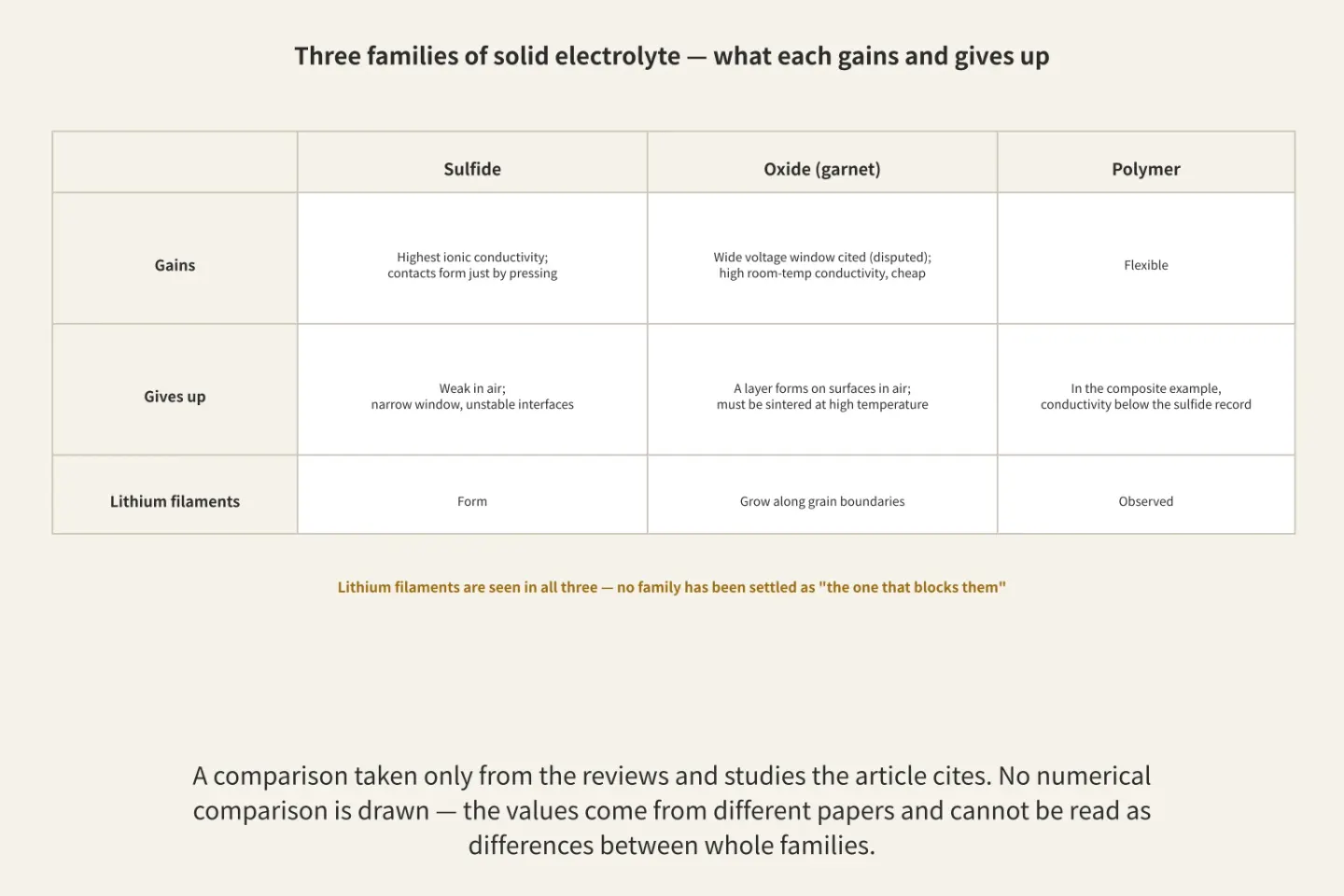
Figure: A diagram drawn by Paperis using only the text content
Choosing among the three paths is a trade-off where gaining one side means giving up the other. And as materials with high conductivity emerged, the locus of the problem shifted. An interface is the surface where two different substances meet. A 2020 review noted that after solid electrolytes with high ionic conductivity appeared, ion movement inside the electrolyte was no longer the bottleneck, and many all-solid-state batteries were tied down by low efficiency, weak output, and short lifespans due to high resistance at the interface (DOI: 10.1021/acs.chemrev.0c00101).
The Twist — Lithium Piercing Through a Solid Wall
Lithium dug into all four types of solid electrolytes: glassy sulfides, crystalline sulfides, garnets with multiple crystal grains, and single-grain garnets. In a 2017 experiment stacking lithium on top of these four, the entry point for lithium was a defect like a surface scratch, and it entered only when a threshold current was exceeded. Eventually, lithium crossed the electrolyte, causing an internal short circuit. This result had nothing to do with the stiffness of the electrolyte, which did not match the classical model that a hard material blocks it. The researchers interpreted that the lithium accumulated inside the scratch creates a force that widens the tip of the crack, thereby growing the crack (DOI: 10.1002/aenm.201701003). The authors concluded that the process of lithium piercing a solid electrolyte is fundamentally different from that in a liquid electrolyte, and its starting point depends on the size and number of surface defects (DOI: 10.1002/aenm.201701003).
This "threshold current" has a name. The critical current density is the threshold where, if the current flowing per 1 square centimeter of electrode area exceeds that value, lithium begins to dig into the electrolyte. The higher this value, the better it withstands faster charging, which is why it is the most frequently cited number when comparing research results.
Ceramics are hard, but they break easily. Brittleness is the property where a material suddenly snaps without stretching or bending significantly. The extent to which lithium filaments extend along cracks depends on how well ceramics resist crack propagation (PMID 37286650). The metric used by the classical model was unyielding hardness, or stiffness (DOI: 10.1021/acsami.8b17223), whereas what determines the extent of crack propagation is toughness, which is resistance to breaking (PMID 37286650). The two are different properties.
Defects are not the only entry points. A perfect solid electrolyte with zero defects could theoretically block filaments, but real solid electrolytes have unstable interfaces, large grain boundaries, voids, and a tendency to leak electrons slightly, and filaments are widely observed in such places (DOI: 10.1021/acsenergylett.9b02660). Grain boundaries are the interfaces where small crystal grains making up a solid are bonded together.
The evidence regarding grain boundaries is as follows. When calculating the grain boundaries of garnet using molecular simulation, the stiffness near the boundary was up to 50% lower than the inside of the grains. The authors suggest that such soft spots may be one mechanism by which soft lithium digs into a seemingly hard electrolyte (DOI: 10.1021/acsami.8b17223, simulation). A 2025 study peered inside a garnet cell using magnetic resonance imaging and reported that filaments form in two distinct pathways. One is a fast-growing filament where lithium deposits unevenly at the interface between the electrode and electrolyte, and the other is a slow-forming filament inside the electrolyte where lithium ions turn into metal at the grain boundaries. Between the two lay a zone where growth seemed to stall, and which one dominated depended on the defect state of the electrolyte and operating conditions (PMID 39890877).
Filaments are also widely observed in solid electrolytes that leak electrons slightly (DOI: 10.1021/acsenergylett.9b02660). A 2021 study observing solid electrolytes with a transmission electron microscope directly witnessed high stress cracking the electrolyte and pushing lithium into the crack, and the authors listed lowering the electronic conductivity of the electrolyte as essential alongside controlling defect size (DOI: 10.1021/acsnano.1c04864). Other studies similarly list the conditions for a solid electrolyte resistant to filaments as being stable upon contact with lithium, having low electronic conductivity, and high ionic conductivity (PMID 33035375). Hardness is merely one condition among many, and a wall built on that alone gets breached through other entry points.
During One Empty and Refill Cycle — Voids and Pores, Two Forked Entrances
The void in the middle of the entrance is created by the cell itself while it works. Let us follow a single cycle of a cell using a lithium metal negative electrode discharging and charging again.
During discharge, lithium in the negative electrode dissolves into ions and leaves the interface. In a lithium cell using a sulfide electrolyte, when the rate of leaving was faster than the rate at which lithium refilled back into the interface, voids formed in the lithium at the interface. These voids accumulated with repeated charging and discharging, increased the local current at the interface, and eventually grew filaments during charging, leading to a short circuit. This happened even when the total current was well below the charging-side critical current density. Numerically, the charging-side threshold was 2.0 milliamperes per square centimeter under both pressures, whereas the discharging-side threshold was 0.2 milliamperes per square centimeter when pressed at 3 megapascals, and 1.0 milliamperes per square centimeter at 7 megapascals (PMID 31358941). The authors conclude that this discharging-side threshold is a major factor limiting the output of all-solid-state cells, and that considerable pressure may be required just to achieve moderate output (PMID 31358941). Even in cells with a metal interlayer on garnet, voids at the interface grew before filaments and were already visible at about two-thirds of the critical current density (PMID 35655030).
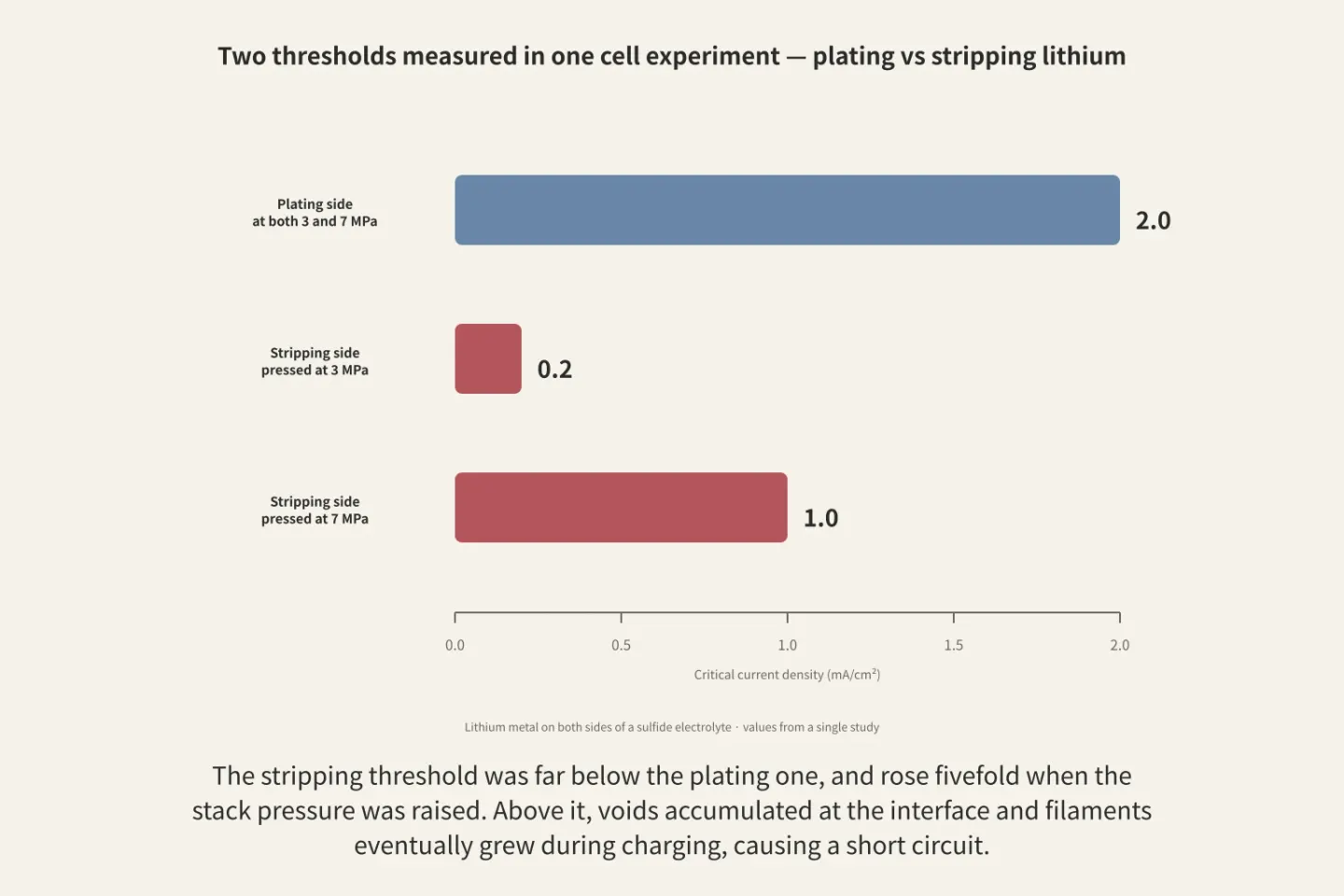
Figure: A schematic drawn by Paperis based solely on the text
A 2023 study divided the process of filament formation on the charging side into two parts. In the initiation stage, lithium travels along fine cracks connected to the surface and accumulates in tiny pores just beneath the surface. Once the pores are filled, the influx of lithium is faster than the rate at which it is slowly pushed back out to the surface, which raises the pressure inside the pores, and that pressure breaks the ceramic. In the propagation stage, lithium wedges open the cracks from behind. The initiation depends on the local strength of the grain boundaries, the size and number of pores, and the current density, while the degree of propagation depends on the ceramic's resistance to the cracks, the length of the filaments, the current density, the applied pressure, and the amount charged at one time (PMID 37286650). The appearance of the front tip of the crack running ahead of the lithium in the first scene is precisely this wedge-opening (PMID 33888903).
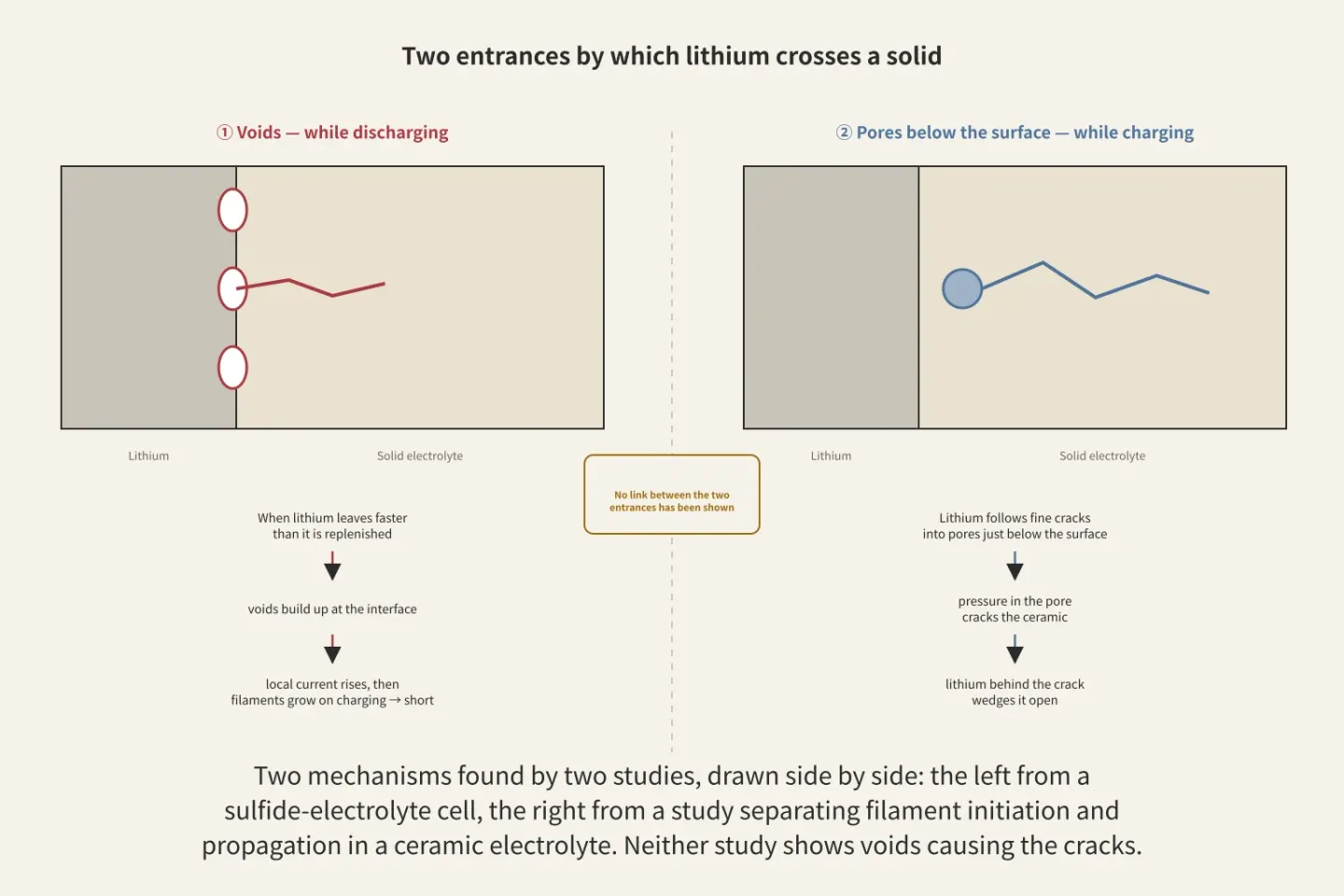
Figure: A schematic drawn by Paperis based solely on the text
This single cycle is an illustration placing two parallel lines of research side by side. The research on the discharge side goes as far as stating that voids in the lithium increase the local current, leading to filaments and short circuits during charging, but does not mention cracks (PMID 31358941). The cracks in the charging-side research originate not from voids in the lithium, but from pores beneath the ceramic surface (PMID 37286650). The link that voids directly produce cracks is absent in both studies.
Press it and it heals, press it and it worsens — Stack pressure
Stack pressure is the pressure that presses a cell from the outside. If gaps are the problem, you can press it to push lithium into the interface. Indeed, in the previous study, the discharge threshold became five times larger when the pressure rose from 3 to 7 megapascals, and the authors interpreted that the main pathway carrying lithium to the interface is deformation where it flows slowly driven by pressure, rather than lithium diffusion (PMID 31358941). A 2019 study reported that a lithium symmetric cell pressed at 5 megapascals at room temperature—roughly 50 times atmospheric pressure—stably shuttled lithium for over 1,000 hours, and that a cell using a sulfide electrolyte and a nickel-based cathode plated more than 4 micrometers of lithium per charge and cycled over 200 times at room temperature. The authors write that this result shows the possibility of using a lithium metal anode even at moderate pressure (DOI: 10.1002/aenm.201903253).
Yet pressure hurts on the other side. The previous 2023 study reported that in a cell where strands have already formed, low pressure suppressed the propagation of cracks, greatly increasing the number of charge-discharge cycles until short circuit (PMID 37286650). To fill gaps, pressing is better; to avoid widening already formed cracks, pressing less is better. One value acts in two directions.
Pressure is also a burden in manufacturing and practical use. To make and maintain solid-to-solid contact, they generally must be manufactured at high pressure and used at high pressure, and a 2024 review writes that this is a major challenge for mass production and practical use (DOI: 10.1002/adma.202413499). A 2021 review on sulfide batteries also noted that the method of applying external pressure to each cell is universally used both when making and when using them (DOI: 10.1021/acs.accounts.1c00333). There is also the critique that most all-solid-state cells are tested at low currents and considerable pressure (DOI: 10.1002/adma.202104009).
Paths to use less pressure are also being tested. A cell with a three-dimensional pattern laser-etched onto the garnet surface withstood a critical current density of 0.7 milliamperes at 1.0 megapascal, and lasted over 500 hours at 0.5 milliamperes (DOI: 10.1002/adma.202104009). The authors suggest that an appropriate metal interlayer can reduce the tendency of gaps to grow without high pressure (PMID 35655030). A hybrid electrolyte mixing ceramics into a polymer framework showed self-healing properties for defects, and a cell paired with a 4.2-volt cathode that adds a buffer layer against lithium and shows almost no volume change during charge cycled more than 3,600 times with almost no pressing (DOI: 10.1038/s41467-024-53869-z). Because a cathode with almost no volume change was chosen, this is a result that sidestepped the cathode-side burden we will see in the next section. All three are single study results from a small cell in one laboratory. The same paper notes that although oxide ceramic electrolytes look advantageous because they are hard in theory, in reality they can barely withstand critical current densities exceeding 1 milliampere per square centimeter (DOI: 10.1038/s41467-024-53869-z).
Contact Surfaces and Factories
The interface on the positive electrode side cracks as well. The positive electrode is the + side electrode of the cell, where lithium ions return and settle during discharge. The positive electrode particles swell and shrink every time lithium moves in and out. Solid electrolytes are much harder than liquid ones and cannot accommodate this change, which can result in the interface separating or the particles and electrolyte breaking (PMID 35252641). A 2025 review covering the interface between nickel-based positive electrodes and sulfide electrolytes mapped out a loop where mechanical stress, chemical reactions, and electrochemical reactions amplify one another, pointing to contact loss, micro-cracks, and increased resistance, and concluded that intrinsic incompatibilities between materials remain, requiring breakthroughs in material design, interface engineering, analysis, and manufacturing alike (PMID 41081617). General aging, where performance decreases with use, was covered in "Battery Aging — Fewer Marbles, Cracked Shelves", and what we look at here is the share arising from solid-to-solid contact surfaces.
When temperature and voltage change, the results change. A model cell with a nickel-based positive electrode thinly coated onto garnet showed no electrochemical degradation when charged and discharged up to 4.3 volts at room temperature, but charging and discharging up to the same voltage at 80°C produced different substances, and so did holding it at 4.3 volts for a long time. On the mechanical side, cracks formed between the positive electrode particles and the interface separated right after the first charge. The authors found that lowering the charging voltage or reducing the temperature could lessen chemical degradation (DOI: 10.1021/acsami.4c04713). The positive electrode side resistance of 92 Ω·cm² from the garnet surface treatment study seen earlier is a value measured at 65°C, and because the interface and temperature conditions differ from the 28 Ω·cm² on the lithium side, they cannot be directly compared (DOI: 10.1021/jacs.8b03106). If you leave out which temperature and which surface the measured value came from, the comparison goes wrong.
The obstacles on the factory side differ by branch. A 2021 review noted that sulfide all-solid-state batteries are still in the research stage and lack established manufacturing methods. It listed as reasons vulnerability in the air, the choice of solvent and binder combinations when making electrodes into a slurry, high interfacial resistance arising from contact between particles, and the difficulty of scaling up electrode fabrication and assembly. The same review also noted progress. For air stability, designs that strengthen the bond between metal and sulfur yielded the most prominent results, though they come at the cost of sacrificing energy density and negative-side interface stability, while the wet process of coating electrodes as a slurry can inherit the know-how and equipment of existing lithium-ion batteries. The authors note that considerable progress has been made so far (DOI: 10.1021/acs.accounts.1c00333). There is also the point that due to extreme sensitivity to moisture, it does not fit today's lithium-ion battery factory equipment. One preprint reported that by attaching water-repellent molecules to the sulfide surface, it maintained a conductivity of over 1 millisiemens per centimeter for up to two days in air at 33% relative humidity (arXiv:2412.04633, not peer-reviewed).
A 2020 model that estimated costs paints a different picture. The sulfide side could be competitive if material compatibility issues are solved and production scale is increased, and the inert gas environment required for sulfides made up only a small share of the total cell cost. For the oxide side, the high-temperature firing process is decisive, so if cost is the decisive criterion, it was deemed difficult to compete (DOI: 10.1002/ente.201901237). This estimate is not actual factory data, but an estimation from a calculation model built from the ground up.
What We Do Not Know Yet, and How to Read the News
The mechanism by which lithium pierces ceramics is still under debate. A 2025 simulation study noted that a lack of direct atomic-level observation of the process is one reason the debate continues, and calculated that a filament bud originating inside a crystal grain usually bends toward the grain boundary and extends along that interface (DOI: 10.1038/s41467-025-57259-x, simulation). The magnetic resonance imaging study we saw earlier also reported that the two mechanisms are intertwined and work together (PMID 39890877). A 2026 garnet review notes that there are still not enough studies systematically organizing the process of filament nucleation and growth (PMID 41574893).
How much the results of a single cell vary is also an open question. One theoretical preprint predicts that if filaments start from the longest pre-existing defect, the conditions under which filaments form across samples should be as widely scattered as the strength of ceramic parts (arXiv:2603.20113, preprint·theoretical). Meanwhile, another preprint testing multiple uniformly manufactured garnet samples statistically confirmed a consistent trend: the higher the current, the shorter the time until a filament forms (arXiv:2410.02127, preprint). The former study reports that defect size determines filament initiation, while the latter interprets that initiation as having electrochemical causes. The two interpretations clash, and both are still preprints.
Record numbers must therefore be read alongside their conditions. One study applying a membrane mixed with lithium nitride and lithium fluoride to a sulfide electrolyte reported a critical current exceeding 6 milliamperes per square centimeter under conditions charging 6.0 milliampere-hours per square centimeter at once, and called this a record (PMID 33035375). Another paper notes that oxide ceramics actually struggle to exceed 1 milliampere (DOI: 10.1038/s41467-024-53869-z), and a garnet cell with reduced pressure achieved 0.7 milliamperes (DOI: 10.1002/adma.202104009). The three have different electrolytes, pressures, and cell structures. These are numbers that cannot be lined up to say which one is ahead.
When you hear news about all-solid-state batteries, asking the following five questions reveals where those numbers stand:
- Which branch of solid electrolyte is it — sulfide, oxide, polymer, or a composite.
- At what temperature was the value measured — room temperature or heated.
- How much was it pressed — what is the stack pressure in megapascals.
- What kind of cell is it — a test cell with two facing lithium sheets, or a cell equipped with a cathode.
- The results of how many samples.
Most of the achievements cited in this article came from lithium symmetric cells or small test cells. The promise of all-solid-state batteries has not turned out to be false, nor is it upheld by hardness alone. The work that remains now is to manage defects, gaps, pressures, and contact interfaces all at once, and there is as of yet no evidence that a single cell in any laboratory has solved all of that.
Source Papers
- "Visualizing plating-induced cracking in lithium-anode solid-electrolyte cells." (2021) — PMID 33888903 — Li/Li6PS5Cl/Li seen through X-ray CT: cone-shaped gold at the electrode edge leading to horizontal cracks, with the gold crossing the electrolyte before lithium and causing a short circuit.
- "Flexible, solid-state, ion-conducting membrane with 3D garnet nanofiber networks for lithium batteries" (2016) — DOI: 10.1073/pnas.1600422113 — Lithium metal's highest specific capacity and lowest potential. PEO-garnet composite membrane blocks strands for over roughly 500 hours at 2.5×10⁻⁴ S/cm and 0.2 mA/cm² and over 300 hours at 0.5 mA/cm².
- "Solid‐State Electrolytes for Lithium Metal Batteries: State‐of‐the‐Art and Perspectives" (2024) — DOI: 10.1002/adfm.202411171 — Safety via non-flammable solid electrolytes, higher energy density via lithium metal anodes. Points to thermal runaway and reversibility as challenges.
- "Electro‐Chemo‐Mechanical Failure Mechanisms of Solid‐State Electrolytes" (2023) — DOI: 10.1002/batt.202300321 — Theoretical high energy density. Failures stem from strands, inactive lithium, unstable interfaces, voids, and cracks.
- "Reviving Lithium‐Metal Anodes for Next‐Generation High‐Energy Batteries" (2017) — DOI: 10.1002/adma.201700007 — Strands, overreactivity, and volume changes of lithium metal in liquids. Envisions the introduction of solid electrolytes as the fundamental solution direction for safety issues.
- "NCM811-Sulfide Electrolyte Interfacial Degradation Mechanisms and Regulation Strategies in All-Solid-State Lithium Battery." (2025) — PMID 41081617 — Safety expected from removing flammable liquids. Concludes that loss of contact, micro-cracks, and increased resistance at the cathode-sulfide interface, along with intrinsic incompatibility, remain.
- "Solid-state lithium batteries: Safety and prospects" (2022) — DOI: 10.1016/j.esci.2022.02.008 — Reports hazardous gases and strong heat release driven by strand formation, suggesting solid-state safety may have been overestimated.
- "Progress in thermal stability of all‐solid‐state‐Li‐ion‐batteries" (2021) — DOI: 10.1002/inf2.12224 — Summarizes the thermal properties of polymers, oxides, and sulfides. Thermal stability research is in its early stages, and thermal safety requires additional verification.
- "Grain Boundary Softening: A Potential Mechanism for Lithium Metal Penetration through Stiff Solid Electrolytes" (2018) — DOI: 10.1021/acsami.8b17223 — Contrary to the elastic model prediction that high stiffness blocks strands, lithium penetrates through grain boundaries. Molecular simulations show boundary stiffness drops by up to 50%.
- "In Situ Visualization of Lithium Penetration through Solid Electrolyte and Dead Lithium Dynamics in Solid-State Lithium Metal Batteries" (2021) — DOI: 10.1021/acsnano.1c04864 — Two promises: strand suppression and high-energy lithium anodes. Stress produces the metal and pushes lithium inward. Defect size reduction and lower electronic conductivity are essential.
- "Lithium/Sulfide All-Solid-State Batteries using Sulfide Electrolytes." (2021) — PMID 32812301 — Sulfides have the highest conductivity among solids, comparable to or higher than liquids. Narrow stability voltage window, unstable interfaces, and strands are challenges.
- "Design Strategies, Practical Considerations, and New Solution Processes of Sulfide Solid Electrolytes for All‐Solid‐State Batteries" (2018) — DOI: 10.1002/aenm.201800035 — Sulfide superionic conductivity up to roughly 10⁻² S/cm and deformability. Air instability and compatibility are challenges.
- "Issues and Advances in Scaling up Sulfide-Based All-Solid-State Batteries" (2021) — DOI: 10.1021/acs.accounts.1c00333 — Deformability makes high-temperature sintering unnecessary. Still in the research phase due to air instability, solvents/binders, interfacial resistance, and scalability. External pressure is universally used for both fabrication and operation.
- "Lithium Dendrite Growth Mechanisms and Inhibition Strategies in Garnet-Type Solid-State Electrolytes: A Review." (2026) — PMID 41574893 — LLZO's wide voltage window, high room-temperature conductivity, and low cost; strand penetration hinders commercialization. Systematic organization of the nucleation and growth process is lacking.
- "Garnet Electrolyte with an Ultralow Interfacial Resistance for Li-Metal Batteries" (2018) — DOI: 10.1021/jacs.8b03106 — Surface lithium carbonate layer is linked to large interfacial resistance, grain boundary strands, and storage degradation. 28 for lithium/garnet and 92 (at 65°C) Ω cm² for garnet/LiFePO4 via 700°C carbon treatment.
- "Ionic conductivity and ion transport mechanisms of solid‐state lithium‐ion battery electrolytes: A review" (2022) — DOI: 10.1002/ese3.1163 — Lithium ions in polymer electrolytes move via chain movement, hopping, and transport.
- "Controlling Dendrite Growth in Solid-State Electrolytes" (2020) — DOI: 10.1021/acsenergylett.9b02660 — A defect-free, perfect solid theoretically blocks strands, but in reality, strands grow from unstable interfaces, large grain boundaries, voids, and partial electronic conductivity. Both in polymers and in inorganics.
- "Building a Better All-Solid-State Lithium-Ion Battery with Halide Solid-State Electrolyte." (2025) — PMID 39836953 — Current status of the halide solid electrolyte branch.
- "Interfaces and Interphases in All-Solid-State Batteries with Inorganic Solid Electrolytes" (2020) — DOI: 10.1021/acs.chemrev.0c00101 — After the advent of high-conductivity electrolytes, the bottleneck shifted from diffusion inside the electrolyte to interfacial resistance. Highlights the mechanics of soft lithium anodes under constant stack pressure.
- "Mechanism of Lithium Metal Penetration through Inorganic Solid Electrolytes" (2017) — DOI: 10.1002/aenm.201701003 — Lithium penetrates through defects when exceeding the critical current density in four types of electrolytes. Independent of stiffness, conflicting with old models. A fundamentally different process from liquids.
- "Dendrite initiation and propagation in lithium metal solid-state batteries." (2023) — PMID 37286650 — Initiation (lithium pressure inside pores causing cracks) and propagation (wedging open from behind) are separate. Low stack pressure suppresses propagation, increasing the number of cycles until short circuit.
- "Dendrite formation in solid-state batteries arising from lithium plating and electrolyte reduction." (2025) — PMID 39890877 — Two mechanisms in garnet cells: inhomogeneous plating at the interface (fast) and grain boundary reduction (slow), with a stagnation zone in between.
- "Solid-State Electrolyte Design for Lithium Dendrite Suppression." (2020) — PMID 33035375 — Conditions: stable against lithium, high interfacial energy, low electronic conductivity, high ionic conductivity. >6 mA/cm² at 6.0 mAh/cm² using a Li3N-LiF coated Li3PS4.
- "Critical stripping current leads to dendrite formation on plating in lithium anode solid electrolyte cells." (2019) — PMID 31358941 — Void accumulation on the stripping side leads to strands during charging. 0.2 and 1.0 vs 2.0 mA/cm² during charging at 3 and 7 MPa in Li/Li6PS5Cl/Li. Substantial pressure may be required.
- "Direct correlation between void formation and lithium dendrite growth in solid-state electrolytes with interlayers." (2022) — PMID 35655030 — Interfacial voids form before strands, at roughly two-thirds of the critical current. Metal interlayers reduce the void tendency without high pressure.
- "Stack Pressure Considerations for Room‐Temperature All‐Solid‐State Lithium Metal Batteries" (2019) — DOI: 10.1002/aenm.201903253 — Over 1000 hours for symmetric cells and over 200 cycles for full cells at room temperature under 5 MPa. Feasibility under moderate pressure.
- "Challenges and Strategies of Low‐Pressure All‐Solid‐State Batteries" (2024) — DOI: 10.1002/adma.202413499 — High-pressure fabrication and high-pressure operation are major challenges for mass production and application.
- "A Morphologically Stable Li/Electrolyte Interface for All‐Solid‐State Batteries Enabled by 3D‐Micropatterned Garnet" (2021) — DOI: 10.1002/adma.202104009 — Most operate at low currents and substantial pressure. 0.7 mA/cm² at 1.0 MPa, and 500 hours at 0.5 mA/cm².
- "A self-healing plastic ceramic electrolyte by an aprotic dynamic polymer network for lithium metal batteries" (2024) — DOI: 10.1038/s41467-024-53869-z — Oxide ceramics practically fail to withstand critical currents above 1 mA/cm². Self-healing hybrid, over 3600 cycles at nearly 0 pressure.
- "Review on Modeling for Chemo-mechanical Behavior at Interfaces of All-Solid-State Lithium-Ion Batteries and Beyond." (2022) — PMID 35252641 — Rigid solids fail to accommodate the volume change of active materials, causing interfacial delamination and fragmentation. Strands are frequently observed despite high stiffness.
- "Electro-Chemo-Mechanical Evolution at the Garnet Solid Electrolyte–Cathode Interface" (2024) — DOI: 10.1021/acsami.4c04713 — NMC622/LLZO: No electrochemical degradation observed at room temperature at 4.3 V, byproducts at 80°C. Cracks and delamination after the first charge.
- "Surface molecular engineering to enable processing of sulfide solid electrolytes in humid ambient air" (2024) — arXiv:2412.04633 (preprint) — Moisture sensitivity is incompatible with current factory equipment. Thiol treatment yields over 1 mS/cm for up to 2 days at 33% relative humidity.
- "Solid versus Liquid—A Bottom‐Up Calculation Model to Analyze the Manufacturing Cost of Future High‐Energy Batteries" (2020) — DOI: 10.1002/ente.201901237 — Cost model: Sulfides can conditionally compete, with small inert gas costs. Oxides require decisive sintering, making competition difficult on a cost basis.
- "Atomic mechanism of lithium dendrite penetration in solid electrolytes" (2025) — DOI: 10.1038/s41467-025-57259-x — Mechanism is still debated. Molecular simulations: stress accumulation destroys the tip of a strand, and nucleation inside grains deflects into grain boundaries to propagate.
- "An Analytical Model of Critical and Subcritical Alkali Metal Dendrite Growth in Ceramic Solid Electrolytes" (2026) — arXiv:2603.20113 (preprint/theory) — The longest existing defect determines the critical current, and sample-to-sample scatter follows a Weibull distribution.
- "Intrinsic Electrochemical Limits Preceding Dendrite Penetration in Ceramic Electrolytes" (2024) — arXiv:2410.02127 (preprint) — Consistent trends in current-dependent strand onset times across numerous uniform LLZTO samples.
Sources (36)
- Visualizing plating-induced cracking in lithium-anode solid-electrolyte cellsPMID 33888903
- Flexible, solid-state, ion-conducting membrane with 3D garnet nanofiber networks for lithium batteriesDOI 10.1073/pnas.1600422113
- Solid‐State Electrolytes for Lithium Metal Batteries: State‐of‐the‐Art and PerspectivesDOI 10.1002/adfm.202411171
- Electro‐Chemo‐Mechanical Failure Mechanisms of Solid‐State ElectrolytesDOI 10.1002/batt.202300321
- Reviving Lithium‐Metal Anodes for Next‐Generation High‐Energy BatteriesDOI 10.1002/adma.201700007
- NCM811-Sulfide Electrolyte Interfacial Degradation Mechanisms and Regulation Strategies in All-Solid-State Lithium BatteryPMID 41081617
- Solid-state lithium batteries: Safety and prospectsDOI 10.1016/j.esci.2022.02.008
- Progress in thermal stability of all‐solid‐state‐Li‐ion‐batteriesDOI 10.1002/inf2.12224
- Grain Boundary Softening: A Potential Mechanism for Lithium Metal Penetration through Stiff Solid ElectrolytesDOI 10.1021/acsami.8b17223
- In Situ Visualization of Lithium Penetration through Solid Electrolyte and Dead Lithium Dynamics in Solid-State Lithium Metal BatteriesDOI 10.1021/acsnano.1c04864
- Lithium/Sulfide All-Solid-State Batteries using Sulfide ElectrolytesPMID 32812301
- Design Strategies, Practical Considerations, and New Solution Processes of Sulfide Solid Electrolytes for All‐Solid‐State BatteriesDOI 10.1002/aenm.201800035
- Issues and Advances in Scaling up Sulfide-Based All-Solid-State BatteriesDOI 10.1021/acs.accounts.1c00333
- Lithium Dendrite Growth Mechanisms and Inhibition Strategies in Garnet-Type Solid-State Electrolytes: A ReviewPMID 41574893
- Garnet Electrolyte with an Ultralow Interfacial Resistance for Li-Metal BatteriesDOI 10.1021/jacs.8b03106
- Ionic conductivity and ion transport mechanisms of solid‐state lithium‐ion battery electrolytes: A reviewDOI 10.1002/ese3.1163
- Controlling Dendrite Growth in Solid-State ElectrolytesDOI 10.1021/acsenergylett.9b02660
- Building a Better All-Solid-State Lithium-Ion Battery with Halide Solid-State ElectrolytePMID 39836953
- Interfaces and Interphases in All-Solid-State Batteries with Inorganic Solid ElectrolytesDOI 10.1021/acs.chemrev.0c00101
- Mechanism of Lithium Metal Penetration through Inorganic Solid ElectrolytesDOI 10.1002/aenm.201701003
- Dendrite initiation and propagation in lithium metal solid-state batteriesPMID 37286650
- Dendrite formation in solid-state batteries arising from lithium plating and electrolyte reductionPMID 39890877
- Solid-State Electrolyte Design for Lithium Dendrite SuppressionPMID 33035375
- Critical stripping current leads to dendrite formation on plating in lithium anode solid electrolyte cellsPMID 31358941
- Direct correlation between void formation and lithium dendrite growth in solid-state electrolytes with interlayersPMID 35655030
- Stack Pressure Considerations for Room‐Temperature All‐Solid‐State Lithium Metal BatteriesDOI 10.1002/aenm.201903253
- Challenges and Strategies of Low‐Pressure All‐Solid‐State BatteriesDOI 10.1002/adma.202413499
- A Morphologically Stable Li/Electrolyte Interface for All‐Solid‐State Batteries Enabled by 3D‐Micropatterned GarnetDOI 10.1002/adma.202104009
- A self-healing plastic ceramic electrolyte by an aprotic dynamic polymer network for lithium metal batteriesDOI 10.1038/s41467-024-53869-z
- Review on Modeling for Chemo-mechanical Behavior at Interfaces of All-Solid-State Lithium-Ion Batteries and BeyondPMID 35252641
- Electro-Chemo-Mechanical Evolution at the Garnet Solid Electrolyte–Cathode InterfaceDOI 10.1021/acsami.4c04713
- Surface molecular engineering to enable processing of sulfide solid electrolytes in humid ambient airarXiv:2412.04633
- Solid versus Liquid—A Bottom‐Up Calculation Model to Analyze the Manufacturing Cost of Future High‐Energy BatteriesDOI 10.1002/ente.201901237
- Atomic mechanism of lithium dendrite penetration in solid electrolytesDOI 10.1038/s41467-025-57259-x
- An Analytical Model of Critical and Subcritical Alkali Metal Dendrite Growth in Ceramic Solid ElectrolytesarXiv:2603.20113
- Intrinsic Electrochemical Limits Preceding Dendrite Penetration in Ceramic ElectrolytesarXiv:2410.02127