
Paperis Articles
AI Co-Scientist — When Hypotheses Are Made to Compete in a Tournament
Generating hypotheses is the easy part; choosing among them is the hard part. Google's Co-Scientist pits hypotheses against each other in debates, scores the winners, and builds new hypotheses from them to compete again.
Your field's papers, as audio
Pick your fields and journals — Paperis summarizes the key papers and turns them into audio. Listen on your commute.
Start Paperis free →AI Co-Scientist — When Hypotheses Are Made to Compete in a Tournament
A Hypothesis That Came Out in Two Days
A team of microbiology researchers had been grappling with a single question for several years. Among the pathways by which bacteria pass genes to other species, there was one particular route that spread broadly across species without restriction, yet its operating mechanism remained unexplained. The researchers had already found the answer through experiments, but had not yet published it.
Keeping those unpublished results hidden, the researchers posed the same question to an AI system created by Google. The hypothesis that the system ranked first matched the mechanism the researchers had verified through experiments (PMID 40930092). The authors on the side that created the system note that the AI produced that hypothesis in two days (PMID 42156544).
This scene is the clearest demonstration of the statement "AI generates scientific hypotheses." However, the difficult part of this statement is not generating them, but choosing among them. If you ask a language model to generate hypotheses, it will produce hundreds of them. The problem is which of those is worth testing.
The CoScientist paper published in Nature in 2026 is a design that places that selection mechanism at the center of the system (PMID 42156544). It pits hypotheses against each other in pairs for debate, awards points to the winning side, and uses the higher-scoring hypotheses as material to generate new hypotheses to compete again. This article follows what criteria that tournament uses to win and lose, who scored the points that came out of it, and what was actually verified outside of those scores.
What They Tried to Do
The first input that goes into Co-Scientist is a research objective written by a scientist in natural language. It can be a single sentence, or it can be a long document containing dozens of constraints and prior papers together. The system reads that objective and turns it into research plan setup. This describes what kind of hypothesis is desired and what makes a good hypothesis. Those criteria later become the judging criteria for the tournament (PMID 42156544).
The basic criteria are five: goal alignment, plausibility, novelty, testability, and safety. Goal alignment is whether it precisely matches the objectives and constraints the scientist wrote, and plausibility is whether there are visible flaws and, if there are points contradicting existing knowledge, whether they are laid out. Testability is whether experiments can actually be run within the scope the scientist set. Scientists can add their own criteria on top of these.
Among the five, the one that reveals the design intent the most is novelty. The novelty the authors talk about is not stopping at gathering and organizing already existing information, and with that criterion, they draw a line from existing deep research tools. Summarizing literature well is already something that works, which means what they aimed for is the side of hypotheses not yet written down in the literature.
What the scientist puts in is not just objectives. They can revise objectives halfway through, leave comments directly on generated hypotheses, and even enter their own hypotheses as players in the tournament. A human's hypothesis entered that way is ranked by the same rules as the hypotheses the system made, and they are sometimes combined with each other. At the end, a ranked list and a research outline are returned to the person, and the person chooses the candidates to experiment on (PMID 42156544).
What Happens to a Hypothesis
What makes Co-Scientist run are six agents with divided roles and a director agent that manages them. An agent is a language model that does not stop at making words, but also holds tools to read the web, open files, and execute commands. The tools that Co-Scientist's agents mainly use are web searches and literature lookups. There is not just one such agent, but many. A multi-agent system is a structure where multiple agents talk back and forth with each other and work together. The six names are generation, reflection, ranking, proximity, evolution, and meta-review, and the director agent manages the work queue and distributes who to run when and how many times. The model that served as the foundation for all agents was Gemini 2.0 (PMID 42156544).
Following a single hypothesis makes this structure visible at a glance. A hypothesis is born in the generation agent. The generation agent searches the web to read papers, runs questions and answers that mimic expert discussions, and assembles a hypothesis by building up intermediate assumptions one by one that would lead to discoveries if true.
The born hypothesis moves to the reflection agent. What the reflection agent does is peer review. First, it quickly scans without tools to discard those with obvious flaws, and for hypotheses that pass, it attaches searches to compare them against the literature. Next is deep verification. It breaks the hypothesis down into constituent assumptions, breaks each assumption down further into smaller assumptions, removes the context, and checks if they are correct one by one. Even if an incorrect assumption comes out, it is not immediately eliminated. It evaluates together whether that assumption is the root of the hypothesis or not.
Hypotheses that survive in this way enter a tournament. The ranking agent pits two hypotheses against each other and raises the score of the winning side. An Elo score is a score that ranks all participants solely based on the results of head-to-head matches; it goes up when you win, goes down when you lose, and goes up more the stronger the opponent you defeat. It is the same score used for chess player rankings. Newly entered hypotheses start at 1,200 points. The referee of the head-to-head match is also a language model, and the judging criteria are novelty, accuracy, and testability. Top hypotheses are pitted against each other through multiple rounds of back-and-forth discussion, while lower hypotheses end with a single comparison. Because the tournament itself consumes a lot of computation, not every hypothesis is matched against every hypothesis. The proximity agent creates a similarity graph of the hypotheses, and the ranking agent looks at that graph to match similar hypotheses first while concentrating matches on new hypotheses and top hypotheses (PMID 42156544).
Figure: Thomas Eakins, "The Chess Players" (1876). A game played two at a time, face to face. · The Metropolitan Museum of Art · Wikimedia Commons (CC0)
Here, one core design point emerges. The evolution agent receives hypotheses that have risen through the tournament and improves them, but instead of fixing existing hypotheses, it makes new ones. It reinforces evidence, combines the strengths of multiple top hypotheses, simplifies them to make verification easy, or conversely invents hypotheses that are intentionally distanced from the top tier. The authors write the reason for this as follows: since new hypotheses must also compete again in the tournament, this prevents flawed improvements from ruining the quality of top hypotheses (PMID 42156544). Improvement proposals cannot push out the original, and whether they win or lose, they are judged by matches.
The last is the meta-review agent. This agent does not look at individual hypotheses, but reads the review comments and discussions of the entire tournament, bundling recurring critiques into a single review. That review is delivered to other agents by being appended to the prompt for the next turn. It creates a learning effect by lengthening the prompt without retraining the model. An example the authors give clarifies that meaning. If 90% of individual review comments for a certain drug candidate pointed out the issue of whether the drug crosses into the brain, the meta-review forces all subsequent review comments to address that item (PMID 42156544).
Therefore, what corresponds to "thinking" in this system is not a single long inference, but a state where matches, reviews, and the introduction of new players run endlessly.
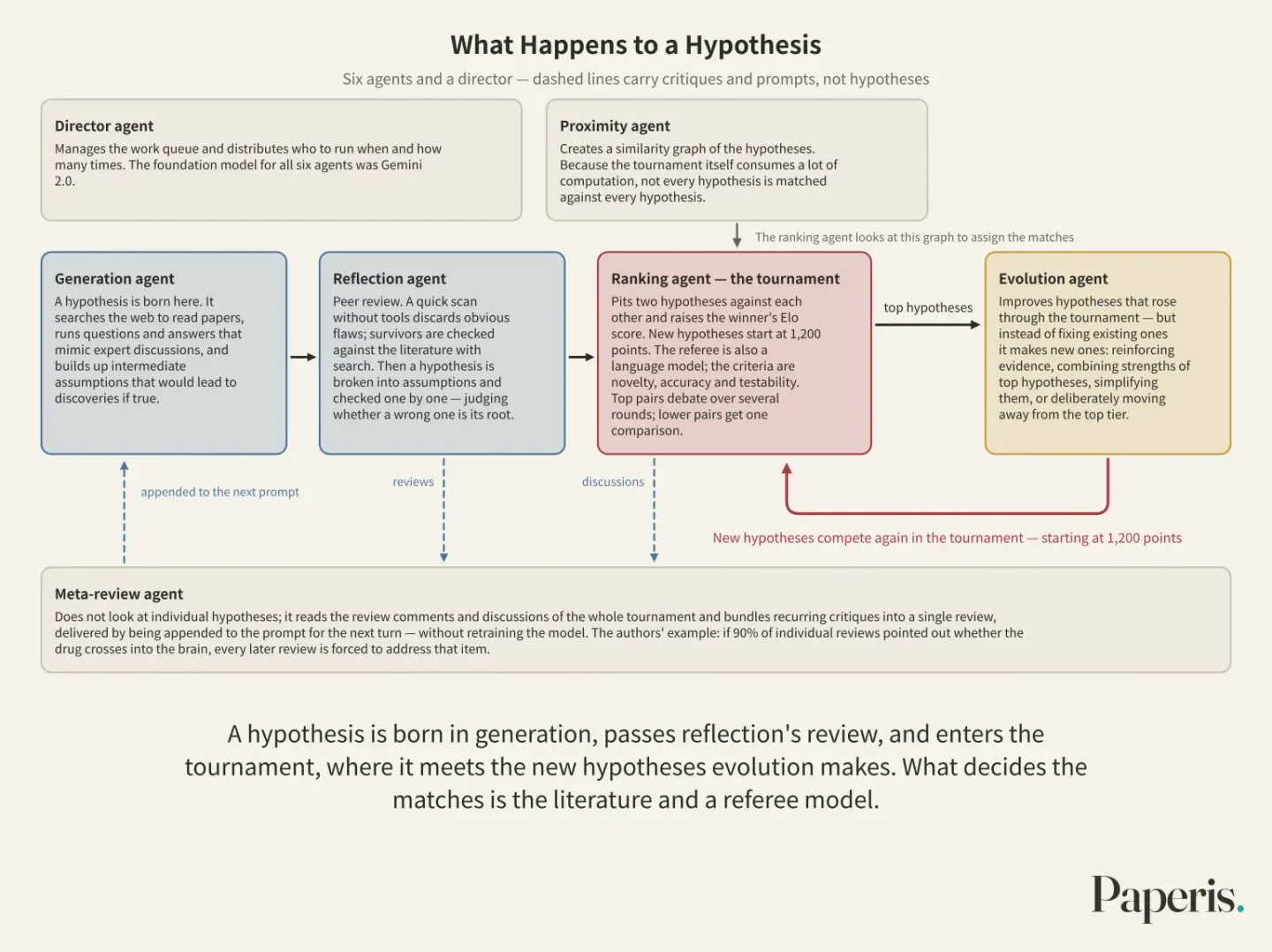
Figure: What one hypothesis goes through. The Evolution agent makes new hypotheses instead of editing old ones, and each new one starts at 1,200 points and competes again in the tournament.
Why Increasing Compute Raises Scores
The claim the authors put forward regarding this structure is that "giving more time yields better results." Here, time is not training time. Test-time compute is a method of making results better by spending more calculation at the stage of producing answers, without newly training the model. In Co-Scientist, spending more calculation means playing more matches and generating more hypotheses to put in.
The measurement method is like this. They put 203 research goals into the system and divide the generation time for each goal into 10 equal column intervals. The first interval is the 10% of hypotheses that came out earliest, and the tenth interval is the 10% of hypotheses that came out latest. For each interval, they measure the average Elo score and the highest score of the top ten hypotheses, and average them across the 203 goals. As it went to later intervals, both values went up (PMID 42156544). Most of the goals were biomedicine, and subjects like math and physics were also mixed in.
The research team also did an analysis comparing the answers of other models by putting them into the same tournament on 15 goals chosen by experts. At the end of that analysis, the authors note that performance measured by Elo showed no signs of plateauing, and they add a condition. If the research goal is solvable and is a problem where a method of exploring and searching works, improvements can continue even if compute is increased further (PMID 42156544).
There is a spot to be careful about when reading this rise. The raised score is a relative score where later hypotheses beat earlier hypotheses inside the same tournament, and the judge that decided those wins and losses is this system's own ranking agent. The authors also note that the Elo score is not a direct optimization target, and they add the interpretation that the score steadily rising nonetheless is something that emerged from the system's feedback loop (PMID 42156544).
To put it another way: The score went up means not "later hypotheses are better than earlier hypotheses" but "later hypotheses played against earlier hypotheses and won." For those two things to be the same, the judge must be properly measuring goodness, and that is a problem that must be checked separately outside the score.
Who Grades the Scores?
So this paper has three different layers of grading. There is the system grading itself, human experts grading, and confirmation at the workbench. The three layers measure different things, and the sample gets smaller the closer you get to outside standards.
The first layer is the system's own automated evaluation. An ablation experiment by the authors shows just how untrustworthy this layer can be. When already published ideas are given to a reviewing agent with its search tool detached, it gave novelty scores of 6.14 out of 10 to those ideas that should have been marked low for not being new. When the search tool was attached to the same agent, the score dropped to 2.38 (PMID 42156544). In this experiment, a grader that did not look up the literature mistook something it saw for the first time as new. Other components were measured in the same way, and turning on the iterative improvement of the evolutionary agent raised the automated evaluation quality score from 4.7 to 5.6. Using scientific debate instructions for the ranking agent instead of simple comparison increased the ranking accuracy of top hypotheses and reduced the bias toward whichever side was shown first (PMID 42156544).
These figures are evidence that the components are doing their jobs. At the same time, they are all scores given by the same kind of referee. This is why the authors placed a second layer.
The second layer is humans. The goals used in the preceding comparison were 15 research goals chosen and created by seven biomedicine experts, and experts directly graded the outputs on 11 of those goals. The experts ranked their preference among answers produced by Co-Scientist and other models at the time, and evaluated novelty and impact on a 5-point scale. Co-Scientist received 3.64 points for novelty and 3.09 points for impact, and its preference ranking averaged 2.36 among four choices where 1 is the most preferred, putting it ahead of the comparison targets. The grading was done without knowing which system produced which output. The authors attached direct caveats to these numbers. They write that this evaluation is subjective expert judgment and not an objective correct answer. In a comparison that set up four language models as referees, Co-Scientist was also the most preferred, and the authors add that all of these evaluations are small in scale, requiring more research to draw reliable conclusions (PMID 42156544).
On a 5-point scale, 3.64 points is somewhere between "a hypothesis that experts have never heard of" and "a slightly modified existing proposal." In the grading criteria used by the authors, the highest score is given to hypotheses that have never been published in any form, and the lowest score is given to the replication of experiments already performed.
There is one comparison that is often mixed up here. While the result that Co-Scientist outperformed other models exists in human grading as well, the main comparison of the paper is scores comparing the best guesses of experts and the answers of other models by putting them together in the same tournament (PMID 42156544). That is, the referee for that comparison is also Co-Scientist's ranking agent. This does not mean that saying it came in first with its own score is wrong; it means that those scores are not an independent standard.
The third layer is experiments. And the third layer has the smallest sample.
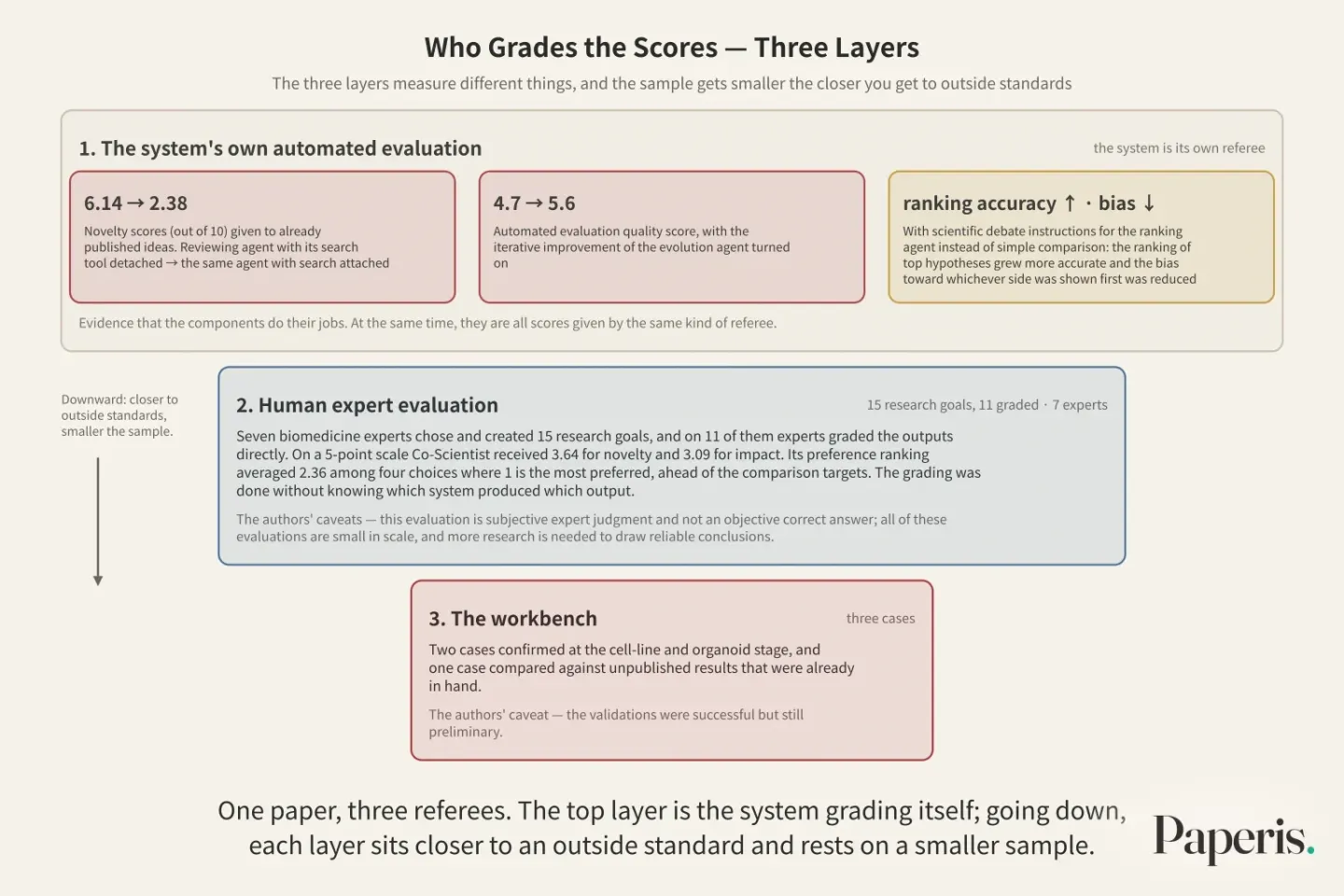
Figure: Who assigns the scores. The top layer is the system grading itself; going down, the yardstick moves outside the system and the sample shrinks.
Three Experiments
The first question was acute myeloid leukemia. Drug repurposing is the work of finding new uses for drugs already approved for other diseases, and this field is well-suited to be treated as a search problem because the list of candidates is finite. People narrowed the space first. The researchers limited Co-Scientist's search scope to about 2,300 approved drugs and 34 cancer types. They handed the top 30 suggested by the system over to expert medical oncologists, and the doctors picked five of them to send to the workbench. Measured across four cell lines and one non-leukemia cell line for comparison, three out of the five lowered cell survival. They also tried the same thing with candidates generated by the system alone without any help, where experts again picked the top three candidates and only one of them yielded the same result. The authors draw a line around the nature of this experiment. They write that this is a check to see if the repurposing procedure runs and is not a substitute for rigorous preclinical and clinical evaluation, and add that results coming from cells do not guarantee an effect inside the body or clinical success (PMID 42156544). Measurements were repeated independently three times, and the authors did not pre-determine sample size statistically and cell survival measurements were not blinded (PMID 42156544). The time spent by humans is also noted. For the goal of finding a new combination therapy in leukemia, the initial prompt writing the goal took less than an hour, and final review and selection of candidates to test after the system ran took about three hours. The authors note that the liver fibrosis and antibiotic resistance tasks also took similar times for preparation and final review (PMID 42156544).
The second question was finding a target to tackle in liver fibrosis, where the liver hardens. What the system produced here was not a drug, but a target hypothesis on which of the proteins that control how genes are turned on and off to aim at, and experts also picked the top three hypotheses. When drugs acting on those targets were measured in liver organoids grown from human cells, two lowered fibrosis markers while showing no cytotoxicity. Organoids are small cell masses made by growing human cells to mimic part of an organ's structure. One of them is vorinostat, and vorinostat is a drug already approved for other diseases (PMID 42156544). Detailed reports of this experiment were published separately (PMID 40946179; PMID 40654780, preprint).
The third is that scene from the front of the piece. cf-PICI is a small gene package tucked into the bacterial genome, a genetic element that hitches a ride on phages, which are viruses infecting bacteria, to move to other bacteria. It was an unexplained mystery how it spreads across species without discrimination. Given minimal background information, Co-Scientist put out the hypothesis that "cf-PICI binds to various kinds of phage tails and broadens the range of hosts it can move to" as the top-ranking one. This hypothesis matched a mechanism the researchers had already confirmed experimentally and not yet published (PMID 40930092). The authors on the system side write that this matched precisely with the main discovery of an independent genomic and experimental study that was underway at the same time. That independent study had not yet finished peer review at the time and was published later (PMID 42156544; PMID 40930093).
The first two cases have the same shape. Humans set the question, the system piled up and ranked candidates, humans picked what to experiment on from among them, and humans experimented. The third case has a different shape. The experiments were already done by the research team, and the system's hypothesis was compared against those unpublished results.
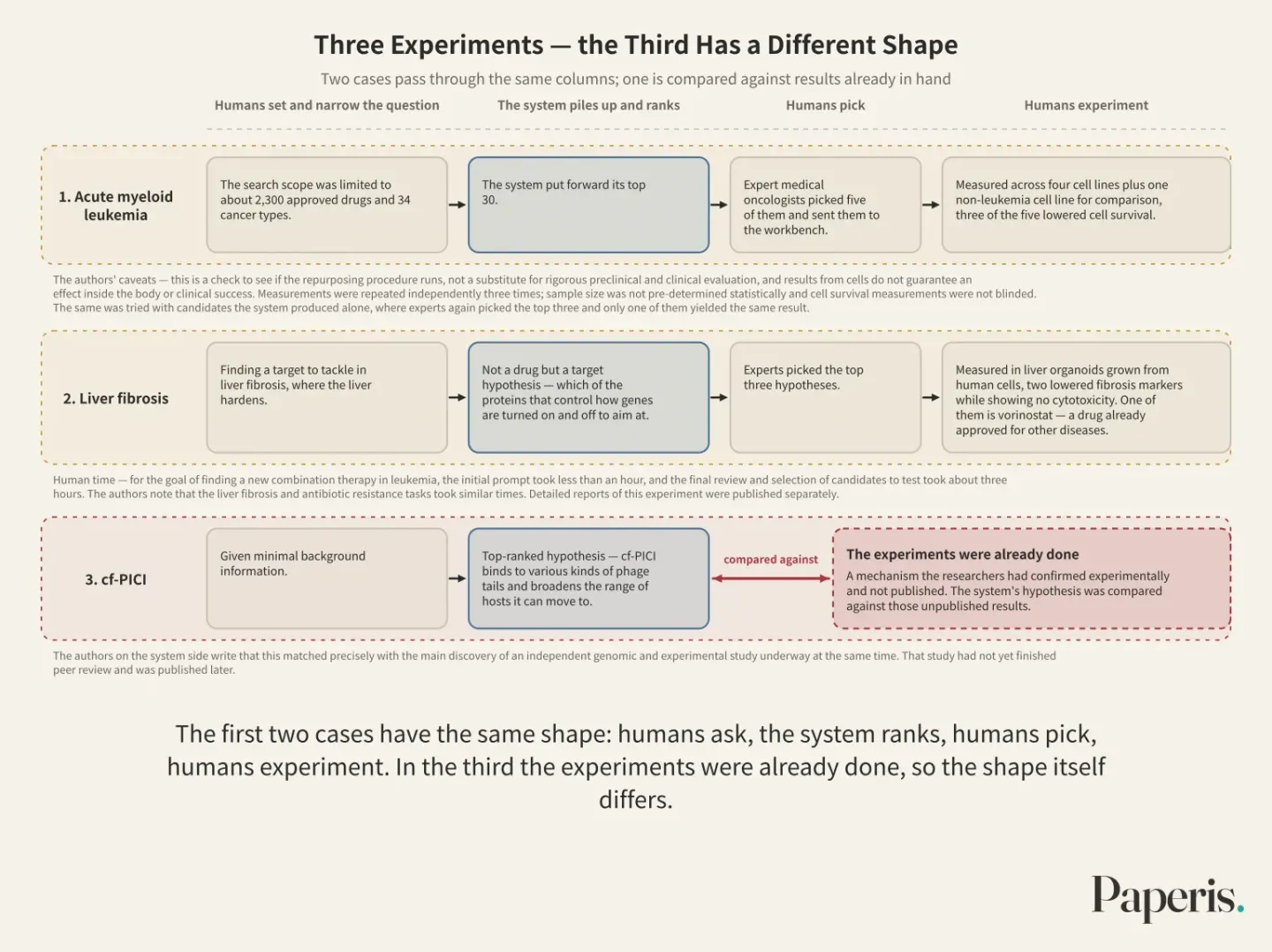
Figure: Three experiments. The first two cases share one shape; in the third the experiment was already done, and the system's hypothesis was matched against its result.
What Is New and What Is Not
Novelty is not decided by the score a system gives itself. It is decided by when and what the literature recorded. For two of the three cases, we can follow that timeline.
Let us look at liver fibrosis. Another computational study suggesting vorinostat as a liver fibrosis candidate came out in 2026. That study did not use Co-Scientist; it was designed via a different route—weaving gene expression analysis of liver blood vessel lining cells, machine learning, and assistant screening by a language model (PMID 42244548, preprint). The report using Co-Scientist is from 2025, and the computational study designed through a different route pointed to the same drug in 2026 (PMID 40946179; PMID 40654780, preprint). Which one came first is answered by the literature timeline. The very fact that different computational routes reached the same drug is helpful information for both designs.
For the bacteria, we must be careful in the opposite direction. A 2023 study already showed that cf-PICI is a lineage that spreads by borrowing only the phage's tail (PMID 36596306). So the broad framework of "borrowing a tail" may have been content within the background knowledge given to Co-Scientist, and what the 2025 discovery added was the detail that those tails are of various types coming from multiple species (PMID 40930093). What the system got right was that added detail.
When we place the two side by side, both "AI built something new out of nothing" and "it merely repeated what was already known" conflict with this paper's record. What is in the record are three things: candidates being built in a space narrowed down by humans, one of those chosen by humans being verified at the cell and organoid stages, and—in one case—a mechanism that the research team had verified through experiments but not published being raised to the top using only the literature.
Where the Limits Lie
The authors listed the limitations themselves first. The system's knowledge relies on open-access literature, which means important prior research hidden behind paywalls may be missing. The more structural side comes next. The authors write that the system does not systematically access negative results (PMID 42156544). Records of things that were tried and failed often fail to become papers in the first place, and that empty space looks like "promising ideas no one has tried yet" to a system that reads literature to build hypotheses. The authors also note the risk of spreading errors from the original literature and the possibility of hallucinations inherited from the underlying model, and state clearly that the validation was successful but still preliminary. As for human-side risks, they mention the potential to dull critical thinking or homogenize research directions, and write that such systems should complement rather than replace human scientific reasoning (PMID 42156544).
Criticism from outside the system targets a different spot. There is a study where 43 experts in natural language processing each took charge of a research idea and ran it themselves for over 100 hours. The ideas were assigned by randomly mixing human-generated ones and language model-generated ones, and after the execution, short papers produced from them were blindly reviewed by other experts. Comparing the pre-execution scores and post-execution scores of the same ideas, the scores of ideas generated by language models dropped more steeply across all categories after execution than those generated by humans. The gap that had widened at the idea stage narrowed, and in some categories the rankings flipped (arXiv:2506.20803, preprint).
There is also a study that re-measured novelty itself. One preprint reports that experts judged 24% of 50 research documents generated by language models as being rewrites or largely borrowed versions of existing research (arXiv:2502.16487, preprint). Another preprint moves the benchmark of evaluation to the future. It gives literature up to a specific point to generate ideas, and then matches them against papers actually published over the following 30 months, scoring them by citation impact. Within that framework, the system attached with literature search scored 2.5 times higher than the system without it, but the language model judge found no significant difference between the two. And that score showed a negative correlation with the novelty graded by the judge (arXiv:2603.15164, preprint). This is the result from 10 research topics, and the authors interpret that language models tend to overestimate ideas that sound novel.
There is also a preprint that looks inside automated research procedures. It categorizes failure types as choosing the wrong benchmarks, data leakage, misusing metrics, and cherry-picking favorable results after seeing outcomes, and reports that several of these actually appeared in two public systems. The authors' recommendation is to require the submission of execution logs and code together, rather than looking only at the final paper (arXiv:2509.08713, preprint).
All four of these studies are preprints, and they did not test Co-Scientist directly but mostly dealt with other systems and research ideas in the AI field. Therefore, Co-Scientist's three cases cannot be written off by these results. What they point to is not the performance of a single system, but the problem of scoring. If the score at the idea stage can diverge from the value after execution, the mere fact that tournament scores went up still leaves things we do not know.
Moving Toward Receiving Experimental Results
On the same day, “Nature” published another system paper doing similar work. It is Robin, made by FutureHouse, and this system tied together an agent that searches through literature and an agent that analyzes data into a single loop. Robin set hypotheses, proposed experiments, and interpreted data coming out of the laboratory for dry age-related macular degeneration, a disease where the very center of the retina inside the eye slowly breaks down, and then produced the next hypothesis based on that interpretation. The authors write that Robin made all the hypotheses, experimental directions, data analyses, and charts in the main body of that report (PMID 42156546).
When you overlap the two systems, the spots where each put in effort become clear. Robin put its effort into closing the loop of receiving experimental results, interpreting them, and connecting them to the next hypothesis, while Co-Scientist put its effort into the side of making hypotheses and having them compete (PMID 42156546; PMID 42156544). Therefore, experimental results do not enter Co-Scientist's tournament. What decides win or loss is the judgment of literature and judge models, and the results from the workbench are checked separately on the outside through human hands after the tournament ends.
The story on Robin's side is covered in "Two Laps with Robin, the AI Scientist — What the Machine Did and What People Did in a Macular Degeneration Experiment".
The picture that remains last is like this. What Co-Scientist does is stack up candidates beneath a question set by humans, and rank which ones to look at first. For the leukemia combination therapy goal, the human time the authors jotted down was less than an hour of preparation and about three hours of final review. What grew short is the time to stack up candidates, and what did not grow short is the time to check whether those candidates are correct.
Source Papers
- "Accelerating scientific discovery with Co-Scientist" (2026) — PMID 42156544 — A Gemini-based multi-agent system generates and critiques hypotheses, has them compete in an Elo tournament, and validated them with humans across three fields: drug repurposing, liver fibrosis targets, and antibiotic resistance mechanisms.
- "AI mirrors experimental science to uncover a mechanism of gene transfer crucial to bacterial evolution" (2025) — PMID 40930092 — When asked a question researchers had kept unpublished, Co-Scientist's top hypothesis matched the mechanism confirmed by experiment, and it critically evaluated the top five hypotheses.
- "Chimeric infective particles expand species boundaries in phage-inducible chromosomal island mobilization" (2025) — PMID 40930093 — It clarified the mechanism by which cf-PICI releases tail-less capsids that combine with phage tails of various species to form chimeric particles, injecting DNA into other species.
- "A widespread family of phage-inducible chromosomal islands only steals bacteriophage tails to spread in nature" (2023) — PMID 36596306 — It reported that the cf-PICI family makes its own capsids and spreads by borrowing only the tails of phages.
- "AI-Assisted Drug Re-Purposing for Human Liver Fibrosis" (2025) — PMID 40946179 — It evaluated drugs targeting proteins that regulate gene expression, proposed by Co-Scientist, in human liver organoids and reported a reduction in fibrotic activity, with one of them already approved for a different indication.
- "AI-assisted Drug Re-purposing for Human Liver Fibrosis" (2025) — PMID 40654780 — As a preprint version of the same study, it reports that two out of three drugs targeting gene-expression-regulating proteins recommended by Co-Scientist lowered fibrotic activity in liver organoids.
- "An LSEC-focused computational drug repurposing platform for liver fibrosis" (2026) — PMID 42244548 — Another computational design focusing on liver sinusoidal endothelial cells, without using Co-Scientist, identified the same drugs as liver fibrosis candidates and evaluated them in animal models (preprint).
- "A multi-agent system for automating scientific discovery" (2026) — PMID 42156546 — Robin bundles a literature search agent and a data analysis agent to automate hypothesis generation and experimental data interpretation, and even proposed and analyzed follow-up experiments.
- "The Ideation-Execution Gap: Execution Outcomes of LLM-Generated versus Human Research Ideas" (2025) — arXiv:2506.20803 — After 43 experts spent over 100 hours executing randomly assigned ideas followed by blind review, language model ideas scored significantly lower across all categories (preprint).
- "All That Glitters is Not Novel: Plagiarism in AI Generated Research" (2025) — arXiv:2502.16487 — Experts compared 50 language model-generated research documents with existing studies and judged 24% to be paraphrased or substantially plagiarized (preprint).
- "HindSight: Evaluating LLM-Generated Research Ideas via Future Impact" (2026) — arXiv:2603.15164 — In a framework matching generated ideas against papers actually published over the subsequent 30 months, the language model judge's novelty score showed a negative correlation with that score (preprint).
- "The More You Automate, the Less You See: Hidden Pitfalls of AI Scientist Systems" (2025) — arXiv:2509.08713 — It sorted out four failure types of automated research procedures, verified them through controlled experiments, and recommended submitting execution logs and code alongside the final paper (preprint).
Sources (12)
- Accelerating scientific discovery with Co-ScientistPMID 42156544
- AI mirrors experimental science to uncover a mechanism of gene transfer crucial to bacterial evolutionPMID 40930092
- Chimeric infective particles expand species boundaries in phage-inducible chromosomal island mobilizationPMID 40930093
- A widespread family of phage-inducible chromosomal islands only steals bacteriophage tails to spread in naturePMID 36596306
- AI-Assisted Drug Re-Purposing for Human Liver FibrosisPMID 40946179
- AI-assisted Drug Re-purposing for Human Liver FibrosisPMID 40654780
- An LSEC-focused computational drug repurposing platform for liver fibrosisPMID 42244548
- A multi-agent system for automating scientific discoveryPMID 42156546
- The Ideation-Execution Gap: Execution Outcomes of LLM-Generated versus Human Research IdeasarXiv:2506.20803
- All That Glitters is Not Novel: Plagiarism in AI Generated ResearcharXiv:2502.16487
- HindSight: Evaluating LLM-Generated Research Ideas via Future ImpactarXiv:2603.15164
- The More You Automate, the Less You See: Hidden Pitfalls of AI Scientist SystemsarXiv:2509.08713