
Paperis Articles
Sentences Written by AI — Where Readers Have Always Stumbled
A preprint counted, in the English writing of 14 AI models (9 to 14 per setting), sentence patterns that psycholinguistic experiments have reported to be associated with human processing difficulty. Most large models used them more often than meaning-preserving paraphrases made by round-trip translation, and against student essays all nine used more inanimate subjects with animate verbs and more rare word pairs. It did not measure human reading speed or comprehension. Its proposed cause, a pressure for compression from math, code and reasoning training, is the authors' hypothesis; a length-penalty experiment on a small model is only a proof of concept.
Your field's papers, as audio
Pick your fields and journals — Paperis summarizes the key papers and turns them into audio. Listen on your commute.
Start Paperis free →Sentences Written by AI — Where Readers Have Always Stumbled
One Sentence Placed Right at the Front by the Authors
Your instinct is right; the convoluted sentence you are currently reading is quietly eating its own reader-patience budget — footnote it.
In plain terms, the sentence tells the reader that their hunch is right: the tangled sentence they are reading is quietly using up its own reader-patience budget, and it should be moved to a footnote.
This sentence is the opening line of a paper posted on the preprint server arXiv on October 21, 2026. Its title is "Why AI-Generated Language Is So Hard to Understand." The three authors are Thomas Hikaru Clark of New York University, and Matthias Martin and Kyle Mahowald of the University of Texas at Austin. It is a single preprint that has not yet undergone peer review (arXiv:2610.29162).
The authors present this sentence as a demonstration, writing that if you see such a sentence somewhere these days, you can suspect it was written by an AI model. Inside the sentence are four patterns that appear unusually often in the writing of the most advanced AI models. They used the noun footnote as a verb, made an inanimate thing the subject of "eating," strung nouns together like reader-patience budget, and dropped the that before a modifying clause. The authors write that all of these patterns are linked to reading strain (arXiv:2610.29162).
The starting point is the widespread feeling that AI writing has become harder to understand lately (arXiv:2610.29162). Instead of measuring that feeling directly, the authors chose a different path. First, they picked sentence patterns known to be linked to reading strain in psycholinguistics—the field that measures the process by which humans understand and produce language through experiments. Next, they counted how often those patterns appear in writing produced by 14 AI models (9 large models and 5 small open models) (arXiv:2610.29162).
This paper counted sentence patterns and did not measure how fast or well humans read that writing. Therefore, this article keeps two links separate. One is the evidence that those patterns are a strain on humans, and the other is the evidence that AI uses those patterns more often. The paper deals only with English writing. The Korean example sentences appearing in this piece were made up to help understanding.
Where Reading Slows Down for Humans
Why are contracts hard to read? One study compared contracts to nine other English genres using a corpus of roughly 10 million words. Contracts had an unusually high frequency of rare jargon, sentences with clauses embedded right in the middle, passive voice, and jagged capitalization. In two follow-up experiments (184 participants), people remembered and understood passages with these forms less well. Experienced readers did too, and sentences with embedded clauses caused the largest drop in memory (PMID 35257980). The authors conclude that this difficulty stems less from a lack of legal knowledge than from the limits of working memory, which has to connect words that are far apart (PMID 35257980). This means that a large share of why contracts are difficult lies in the sentence structure rather than the content.
"Words far apart" have a name. Dependency distance is how many words apart two grammatically connected words, such as a subject and its verb, are within a sentence. Here is an example (an example created for this article): "Minsu brought up that plan everyone opposed in the meeting last week again yesterday." Between "Minsu" and "brought up" sit eight chunks. (This is an invented example to show the meaning. In Korean, verbs come at the end, making the distance between subject and verb naturally wide, and the experiments below dealt with English sentences.)
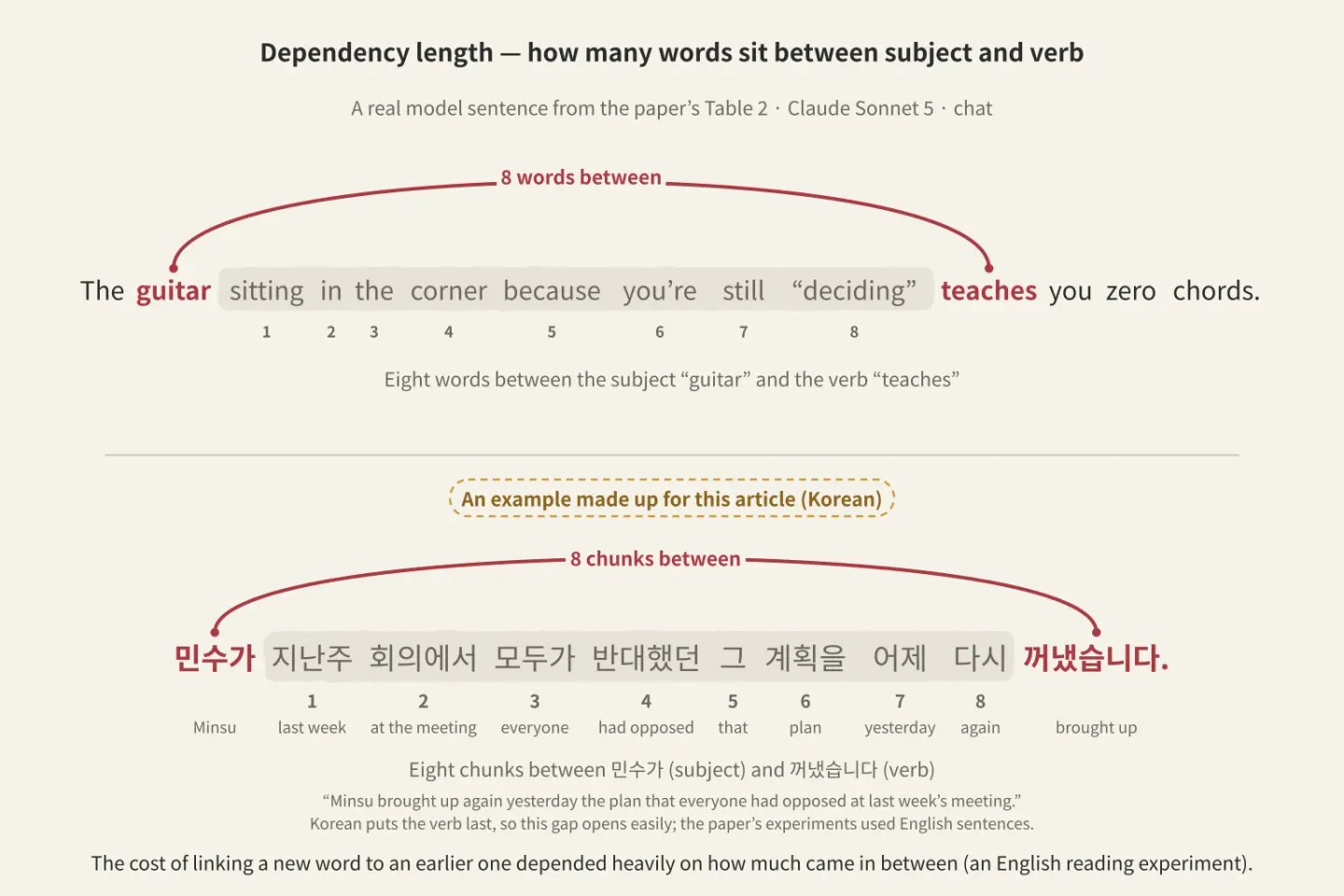
Figure: a diagram drawn by Paperis. English sentence from Clark, Martin & Mahowald, arXiv:2610.29162, Table 2 (CC BY 4.0); the Korean sentence is an example made up for this article
In an experiment where participants read English sentences word by word by pressing a key themselves, the effort required to link a new word to the preceding word was heavily driven by the amount of material sandwiched between them (PMID 21702774). When analyzing sentences actually written and spoken by humans across 37 languages, dependency distances were shorter in every language than in a randomized word arrangement (PMID 26240370). This means humans usually keep connected words close together.
The second stumbling block is unexpected words. Surprisal is a value representing how unexpected the next word was, given the preceding words. The relationship where less expected words take longer to read has been confirmed in reading materials across 11 languages from five language families (arXiv:2307.03667). The authors treat word pairs absent from human text corpora as a proxy for positions where readers will find it hard to anticipate the word (arXiv:2610.29162).
The third is the form of stringing nouns together one after another. Noun stacking is an expression where three or more nouns are strung together so that the preceding nouns modify the final noun. In English, nouns can modify other nouns, which allows very specific meanings to be packed into a short space. Instead, it is easy to get confused about where one chunk ends. An old newspaper headline cited by the authors, "Squad Helps Dog Bite Victim," can be read as "A police squad helps a victim bitten by a dog" or "A police squad helps a dog bite a victim." In prior research reviewed by the authors, such stacking hindered reading (arXiv:2610.29162). Even gluing just two new nouns together can cause a hitch. In three experiments measuring eye movements, the novel combination "dictionary treatment," whose meaning is hard to unpack in isolation, resulted in longer initial dwell times on the final noun "treatment" than the easier-to-unpack "torture treatment." Even when a preceding sentence tipped off the meaning in advance, that help only appeared at a later stage (PMID 23697393). This experiment dealt with two-noun combinations, and what this paper emphasizes is the form stacked three or more deep.
There are three more forms the authors selected. First is using a noun directly as a verb. Like "So yes — calendar it." used by Claude Fable 5 in conversation, "calendar" is used as a verb. Readers understand these novel uses, but research suggests they have to re-parse the sentence structure at the point where the part of speech shifts (arXiv:2610.29162).
Second is attaching verbs normally used for humans or animals to inanimate subjects. "The whole conversation is eating its own tail," used by Claude Opus 5 in conversation, is an example. Readers use whether a subject is animate as a clue when parsing sentences. If this clue is violated without surrounding context, an EEG response associated with re-analyzing sentences can occur (arXiv:2610.29162).
Third is object-position relative clauses, particularly those missing the preceding "that." This is like writing "the book the professor wrote" instead of "the book that the professor wrote." Clauses where the modified noun sits in the object position within the clause are known to be harder to process than those where it sits in the subject position, and that difference shrinks when the modified noun is inanimate or a common form (arXiv:2610.29162). The authors do not cite experiments showing that omitting "that" itself adds processing load. The authors view the omission of "that" as a trace of compression via skipped skippable words (arXiv:2610.29162).
Every one of these forms is grammatically correct in English. The strength of the evidence linking them to human processing load varies by form. Dependency distance and unexpected words are backed by reading-time experiments. Noun stacking has eye-movement experiments dealing with novel two-noun combinations. Using nouns as verbs and inanimate subjects rely on EEG studies, with inanimate subjects resting at the level that a load "can occur." There are no experiments showing that omitting "that" itself adds a load, and the authors treat it as a trace of compression. At least for dependency distance, human-written text leans toward reducing that load.
What Was Compared Against What
The researchers had 14 AI models write texts. Among them, 9 are large models of the current leading tier or the tier right below it. They are Anthropic's four Claudes (Sonnet 5, Opus 5, Opus 5.5, Fable 5), OpenAI's three GPT-5.6s (Luna, Terra, Sol), and the weight-released GLM-5 and Kimi K2.5. The remaining 5 are much smaller open models, choosing versions at different training stages. They are the base and instruction versions of Llama 3.1 8B, and the base, instruction, and reasoning versions of Olmo 3 7B. Not all models entered every situation. All 14 models were used for essays, 12 models excluding the two base versions for conversations, and only the 9 large models for coding (arXiv:2610.29162). A base version is a version that has only finished the first training of learning human text, an instruction version is a version that added training tuned to converse on top of that, and a reasoning version is a version further trained to stretch out its thoughts for a long time before answering.
The situations where text was written are three. First is conversation. Starting with 10 opening lines like "Is learning the guitar at forty a stupid idea?", they exchanged up to 12 turns (113 out of 120 filled the 12 turns), and the 12 AI models had 120 conversations. The human-side speech was written by another AI model (Claude Sonnet 4.6) imitating a human. Second is coding. The 9 large models found and fixed bugs in 5 publicly available Python programs, and the analysis included only what the model said to the human. Third is essays. Across 7 assignments from a collection of American student writing datasets (such as school cell phone rules), each model wrote 10 pieces, totaling 980 pieces (arXiv:2610.29162).
The comparison targets are two. One is human writing with roughly matched genres. Movie and TV subtitles were provided for conversations, and posts from StackExchange, a programmer Q&A site, were provided for coding. For essays, 2,934 pieces written by American 6th-to-12th-grade students that received 5 to 6 points out of a possible 6 on the same assignments were provided. Wikipedia was also compared alongside them (arXiv:2610.29162).
The other is different expressions of the same meaning. Round-trip translation is a method where text is translated into another language and then back into the original language, keeping the meaning the same while changing only the expressions. The researchers translated the sentences written by the models one by one into Japanese using the translation model NLLB-200 and then back into English. Japanese was chosen because going through a language distant from English changes expressions more diversely (arXiv:2610.29162).
The reason round-trip translation serves as a baseline is as follows. If a pattern shrank after the round trip even though the meaning remained the same, it means the model chose that pattern even though there were other expressions that could hold the same meaning (arXiv:2610.29162). There are also limitations. Translation fixes the original text toward more common patterns, reduces the diversity of vocabulary and sentence structures, and erases the writer's style (arXiv:2610.29162). Round-trip translation texts are blander machine-translated texts holding the same meaning, and they serve as a different baseline from writing done by humans.
Finding the patterns was entirely done by machines. A sentence structure analysis program found dependency distance, noun stacking, and clauses with "that" omitted. For positions where nouns were used as verbs and object subject positions, the program chose candidates and a separate automatic classifier judged them (arXiv:2610.29162). Because longer sentences tend to have longer dependency distances as well, when measuring dependency distances, the researchers adjusted the sentence length distribution to match Wikipedia (sentences longer than 30 words were excluded) (arXiv:2610.29162).
Counting It Up
First is the result compared with round-trip translation. Across all three situations of conversation, coding, and essay, almost all large models used more rare word pairs than the round-trip translation versions. Rare word pairs are combinations of two words that never once appeared in human text data, and the researchers also measured average surprise using a simple predictor built from human writing (arXiv:2610.29162). "Every behavioral test was verified red against the original source" is a sentence picked out as such a combination, which Opus 5 used four times in a single coding session (arXiv:2610.29162).
The spots using nouns as verbs, spots attaching human verbs to inanimate subjects, and modifying clauses missing "that" were mostly in the same direction. Conversely, modifying clauses with "that" included were fewer in model writing. The authors read this as a trace of choosing to skip words that can be omitted (arXiv:2610.29162). Noun stacking and dependency distance were also in similar directions in conversation and coding. It was different in essays. Dependency distance stayed the same or became slightly longer after round-trip, and noun stacking differed noticeably in only two models (arXiv:2610.29162).
The differences before and after round-trip translation were generally smaller in essays than in conversation and coding. Rare word pairs, dependency distance, noun stacking, and spots using nouns as verbs were like that. The authors think this may be because essays end with a single prompt, whereas conversations and coding involve multiple back-and-forth exchanges. That long, back-and-forth conversations might encourage more compression is a guess by the authors (arXiv:2610.29162).
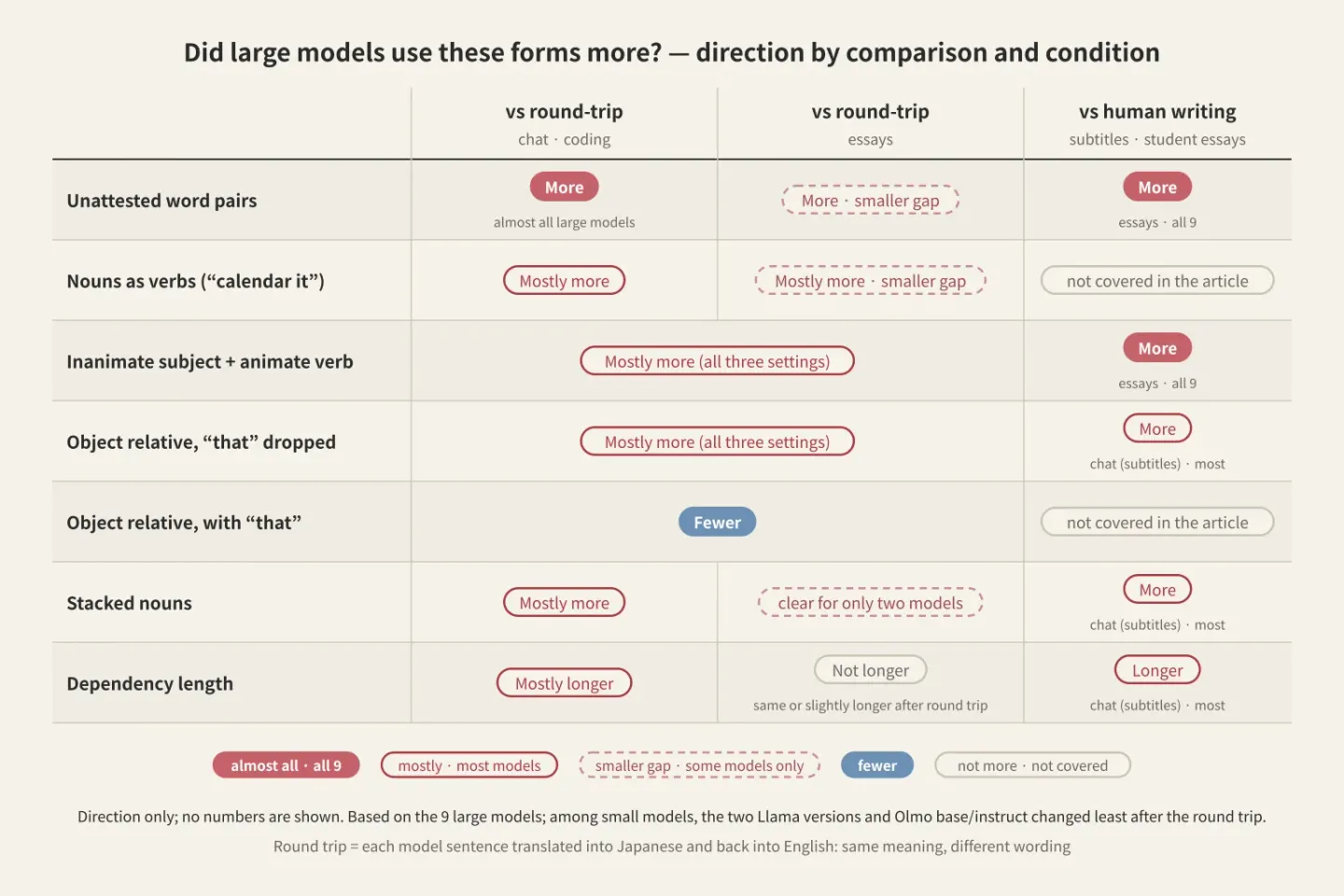
Figure: a table Paperis compiled from the directions stated in the paper’s results (Clark, Martin & Mahowald, arXiv:2610.29162)
Next is the result compared with human writing. All nine large models used spots attaching human verbs to inanimate subjects and rare word pairs more than human writing (arXiv:2610.29162). The human comparison for these two forms came from student essays and matched essay assignments. This is because these two forms were not compared with human writing in conversation and coding (arXiv:2610.29162). In conversation, most large models had longer dependency distances than movie and TV subtitles, and also had more noun stacking and modifying clauses missing "that" (arXiv:2610.29162).
Differences among models were also large. Among smaller models, two versions of Llama and the base and instruction versions of Olmo changed the least after round-trip translation, and were closest to student essays in rare word pairs and verb usage. However, even within the same Olmo, the reasoning version showed a difference as large as the large models. Within Olmo, the difference grew larger as it went from the base version to the instruction version and then the reasoning version (arXiv:2610.29162). This suggests that even with the same base model, the forms can change depending on added training. However, unlike the other versions, the reasoning version was run with basic instructions (arXiv:2610.29162).
There were also cases where it decreased in the next version from the same company. Claude Opus 5.5 was lower in 19 out of 21 comparisons across the three situations in reading burden and connected metrics compared to its predecessor Opus 5. Among those, 8 did not overlap in their 95% confidence intervals (arXiv:2610.29162). The same direction appeared in most large models, but the magnitude differed by model and situation, and could decrease even within the same company.
The Pressure to Write Briefly — The Authors' Hypothesis
One strand of psycholinguistics suggests that human speech is polished for communication. This means striking a balance between what is easy to say and what is easy to understand, and the dependency length minimization we saw earlier is cited as evidence for this (arXiv:2610.29162)(PMID 26240370). If so, models trained on human writing should also write in a human-like form. The authors find the reason they do not in a different stage of training that models undergo.
Modern AI models do not just finish by learning human writing; afterward, they are trained once more with math, coding, and reasoning tasks. Reinforcement learning, used in this type of training, is a method where instead of being told the right answer, the model is given a score for the action it tried, and its behavior is corrected in the direction where the score increases. According to the authors, in this training, a model gets a score if it gets the right answer, but it does not necessarily get a score based on whether that answer was easy to understand (arXiv:2610.29162).
The authors' hypothesis is as follows. Due to training with this goal and the limit on the length of text a model can handle at one time, the model leans toward packing information tightly. That compression clashes with being easy to understand (arXiv:2610.29162). That math, coding, and reasoning training encouraged compression and increased this form is the authors' hypothesis, and it is not a confirmed fact during the training process of large models. The authors also disclose that because they could not look inside large models while they were being trained, they relied on proxy metrics (arXiv:2610.29162).
What is easy for a model and what is easy for a person are different. There is a processing model which views human memory as not holding past words entirely, but anticipating the next word based on faded memories (PMID 32100918). In contrast, models can view an entire very long piece of writing all at once (arXiv:2610.29162). The larger the model, the less accurately it matches human reading times, and that mismatch was greatest at rare words. This is because large models anticipated rare words far better than humans did (arXiv:2402.02255). This means a word that is unsurprising to a model can be surprising to a person.
Training that shortens the reasoning process leading to an answer is actively being researched in practice. Tokens are the units by which language models slice and handle text, sometimes being a single word, and other times being a fragment of a word or a punctuation mark. A length penalty is a device during training that docks points the longer an answer is, leaning the model toward answering briefly. Many studies apply such penalties to reduce reasoning models from stringing out their thoughts for too long. One method reduced average token usage by 50% without a major drop in performance (arXiv:2506.05256), and another method reduced reasoning length by an average of 60% (arXiv:2512.21540). Both studies are preprints, and they only measured length and accuracy, not whether the sentences were easy to read.
The authors also compare this with the method of retraining models using human-graded rankings. In that method, a tendency for longer answers to receive higher scores has been reported. Therefore, the authors view the compression pressure as connecting more plausibly with the side of training where answers are graded by machines (arXiv:2610.29162). There are reports that human-assigned scores are linked to different habits. Words like "delve," "intricate," and "underscore" have increased significantly in scientific paper abstracts over the past few years, and one conference paper pointed to these 21 words as traces of AI use. The model comparison results matched the possibility that training on human scores played a part, and the results of human participant experiments varied by word (arXiv:2412.11385). "Delve" is the frequency of a single word, and what is powerful about this paper is the shape of the sentence structure.
Length Penalty Experiment
To test the hypothesis, the authors chose one much smaller public model, Qwen2.5-1.5B-Instruct, than the large models seen earlier. The task is to translate a short event record noting "who, what, to whom" into a single English sentence (arXiv:2610.29162). For example, upon receiving "sender he, sent thing a photo, receiver us, event send," there are two correct answers.
He sent us a photo. (6 tokens) He sent a photo to us. (7 tokens)
The meaning is the same, and the first sentence is one token shorter. The pairs used for training are four. They are "us a photo / a photo to us" above, adding and dropping "that" in a modifying clause, adding and dropping "that" in a following clause like "knew (that) the answer was wrong," and a control pair of the same length, "picked up the book / picked the book up" (arXiv:2610.29162).
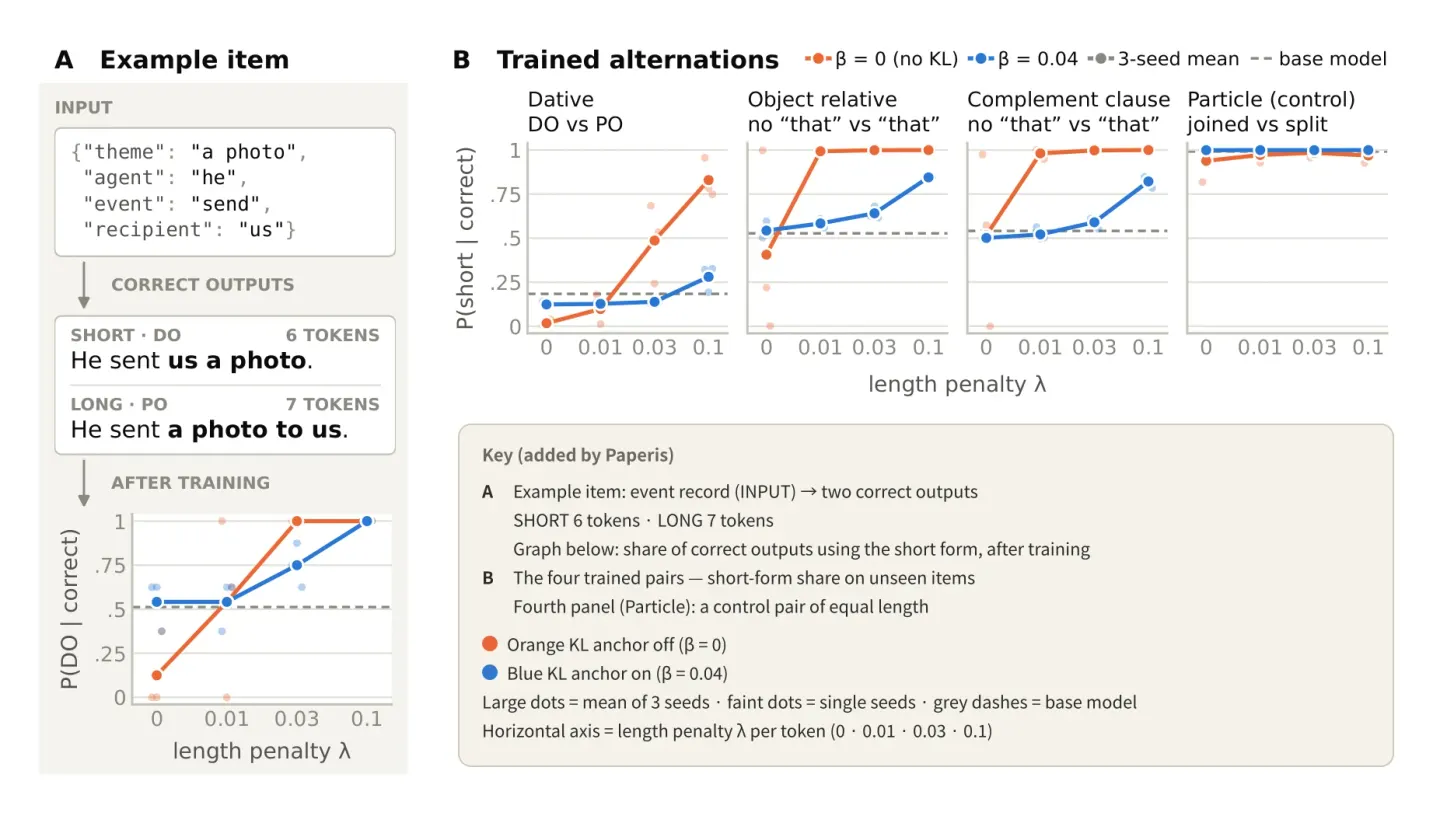
Figure: Clark, Martin & Mahowald, arXiv:2610.29162, Figure 7 A–B, CC BY 4.0. Orange: KL regularization off (β = 0); blue: on (β = 0.04). Key box added by Paperis
The researchers retrained this model using reinforcement learning, applying the length penalty seen earlier. The penalty strengths were four values: 0, 0.01, 0.03, and 0.1 for a single token. The mechanism keeping the model from drifting too far from its original form was divided into cases where it was turned on and turned off, and for each setting, the random setting (seed) was changed three times to train a total of 24 times (arXiv:2610.29162). Answer grading counted both forms as correct. Therefore, whether choosing the shorter side or the longer side, the task is a success either way (arXiv:2610.29162).
As the penalty became harsher, the proportion of choosing the shorter form increased. It also increased even when the anchoring mechanism was turned on, though it rose more slowly. When the mechanism was turned off and the penalty was 0, the proportion of the shorter form varied wildly from 0% to 100% depending on the seed. Under the same conditions, if there was even a slight penalty, all three seeds solidified toward the shorter form. When the mechanism was turned off, in the two learned "that" pairs, the shorter form exceeded 98% as long as the penalty was greater than 0 (arXiv:2610.29162).
Whether it spread to unlearned forms was checked by having the model choose between two forms. In other positions where "that" enters, such as "sure (that)" and "so (that)," the shift toward the shorter form appeared consistently. Among the four more distant forms, only one possessive changed, and that was only when the anchoring mechanism was turned off. The passive voice and "in order to," which indicates purpose, did not change, and "all (of) the" was already clustered on the shorter side even before training (arXiv:2610.29162).
Humans choose such pairs according to context. For instance, the less predictable the upcoming words are, the more they include the omissible "that" (arXiv:2610.29162). In a study where humans were asked to judge which of the two forms is more natural, spreading information evenly and reducing dependency distance well explained that choice (PMID 24077911). Models given a length penalty without the anchoring mechanism converged almost entirely to the shorter form regardless of context, and the authors view this as a departure from human-like speech. They neither instructed the model to compress nor informed it that two forms exist (arXiv:2610.29162).
This experiment is a proof of concept showing that in a small model and a simple task, "shorter means higher score" can alter grammar choices. The authors themselves call this a proof of concept. It is not evidence that large models were actually trained under such pressure. Humans never read those sentences in this experiment. The authors speculate that rewards grading only the correct answer can divorce correct answers from human-like communication, driving models toward speech that is harder to understand (arXiv:2610.29162).
Reading Through a Single Sentence
Returning to the demonstration sentence at the very beginning, we will follow it chunk by chunk from the front.
There are no snags up to “Your instinct is right;”. Next comes “the convoluted sentence”, and the reader waits for a verb, guessing that this is the subject. But “you are currently reading” immediately cuts in. Without a preceding that, there is no signpost that a modifying clause is starting here. Sentence is the object of reading within this clause. Modifying clauses in the object position are generally known to be difficult to process, but that difference shrinks when the noun being modified is an inanimate object (arXiv:2610.29162). Sentence is an inanimate object, so it leans toward the easier side here.
Only after passing those four words does the verb “is quietly eating” arrive. This space where the subject and verb are separated is a position with a long dependency distance, and experiments show that the more intervening words there are, the greater the burden of connecting them becomes (PMID 21702774). At the same time, this verb is “is eating”. Sentences do not eat, so the cue expecting a living subject goes off track here (arXiv:2610.29162).
Next is “its own reader-patience budget”. Three nouns—reader, patience, and budget—stand in a row, and readers must bundle them together on their own to figure out where the chunk ends. The authors point out that this grouping forms an unusual combination of words (arXiv:2610.29162). The authors count unusual combinations like this as a proxy indicator for positions where predictability is low. In the final “footnote it”, a noun changes into a verb (arXiv:2610.29162).
An actual model sentence from the paper's appendix can be counted in the same way. “The guitar sitting in the corner because you're still "deciding" teaches you zero chords.” This is a sentence used by Claude Sonnet 5 in a conversation, which the research team selected as an example of a long dependency distance (arXiv:2610.29162). Eight words are wedged between the subject guitar and the verb teaches, and the entity doing the teaching is an inanimate object, the guitar.
This paper did not measure how slowly humans read this single sentence. Two things are confirmed. One is previous research showing that stumbling blocks like these individually connect to human processing load, and their intensity varies depending on the form. The other is the calculation that these stumbling blocks are placed more frequently in the writing of most large AI models than in round-trip translations. In their conclusion, the authors call forms like this ones that English grammar allows, but which lie outside the distribution of human speech (arXiv:2610.29162).
What This Paper Did Not Measure
The biggest blank spot is the human reader. There is no experiment in this paper where people were made to read the same texts and timed, or made to solve questions testing comprehension. The most this paper can claim is that "forms known to be linked to processing burden appear more frequently in the writing of most large AI models than in rewritten versions."
There are also limits to the measurement method. Finding the forms was entirely done by automated tools, and there is no record in the paper that humans reviewed those judgments. The researchers tested the differences between the original text and the round-trip translation for each model and feature, but they did not correct for comparing multiple times (arXiv:2610.29162). There were only 10 conversation openings and 5 coding programs, and they picked only a few widely used models. The authors also note that they need to run it again with more openings and models (arXiv:2610.29162).
The conversation partner was also not human. The entity playing the human was another AI model (arXiv:2610.29162). Whether the same results would appear in conversations with actual users needs to be checked separately. Round-trip translation was applied only to the models' texts, and the results of putting human texts through the same round trip are not included in the paper. However, the texts of smaller models barely changed after the round trip, showing that translations change as much as the texts differ (arXiv:2610.29162).
The paper dealt exclusively with English texts (arXiv:2610.29162). This paper does not answer whether the same thing happens in Korean AI writing.
There are also findings of a different tone. In a large-scale analysis (a preprint) examining 284 linguistic features across 30 models and 10 writing domains, many of the features proposed as signatures of AI writing varied greatly depending on the model and domain. The one thing that remained consistent across domains was the degree of lexical richness (arXiv:2606.04177). This goes along with the finding in this paper that the differences in essays were smaller than those in conversations. This means it is difficult to generalize the results from one situation to all AI writing.
There are earlier results pointing in the same direction. In a 2023 analysis comparing English news articles with texts from 6 models, human texts had more jagged sentence lengths, more diverse vocabularies, and were polished to have shorter dependency distances (arXiv:2308.09067).
AI altering human writing is reported at other layers as well. In an experiment where 118 participants from India and the US were asked to write texts rooted in their own cultures, the Indian participants who wrote while receiving sentence suggestions from AI shifted toward a Western writing style (arXiv:2409.11360). This experiment looked at how similar texts written by humans with AI assistance become, but it did not measure reading burden.
A model's style can also be shifted by prompts. In a study where ChatGPT was asked to write patient guides for knee meniscus surgery, the reading level of the basic response was higher than the levels recommended by the American Medical Association and the National Institutes of Health (11.4th to 12.1st grade in US school standards). When a standardized prompt to rewrite in simple language targeting a 6th to 8th-grade reading level was added, the reading level dropped by about five grades while accuracy and depth remained the same (PMID 42106008). However, this study covered a single topic and measured reading levels using formulas calculated from sentence length and word length. It did not measure the heavy forms looked at in this paper.
Direct results showing that AI writing is actually easier for people to read than human writing, or that people prefer it more, were absent among the studies reviewed together in this article. Conversely, there were also no direct results showing that people actually read AI writing more slowly. While noting that humans might grow accustomed to these forms if heavily exposed to AI writing, the authors consider that many of the forms evaluated here pose fundamental difficulties for comprehension (arXiv:2610.29162).
The materials to connect the two links in a single experiment already exist. A dataset has been published that records eye movements while 107 native English speakers read texts written by three types of language models, with linguistic features marked on the texts (PMID 40461827). By overlaying the calculations of this paper onto such data, one can examine whether human eyes linger longer on spots with many forms. However, the texts in that dataset were not written by the models looked at in this paper.
The authors' conclusion is as follows. The training objectives that make models proficient in coding and mathematical reasoning do not automatically align with the pressures that have polished human speech. Therefore, they write that we can think of ways to tailor model writing to the needs of human readers in the future (arXiv:2610.29162). In the general discussion, the authors note that training that rewards good communication is of course possible, citing the improvements of Opus 5.5 as an example (arXiv:2610.29162). How Opus 5.5 was actually trained is not covered in the paper.
Where to Read Next
- “How Generative AI Answers — A Sentence Built One Piece at a Time” — Tokens and next-word prediction. How the model connects sentences together.
- “AI Models — A Calculation That Learns From Examples Instead of Rules” — The foundation for the initial learning from human writing and the additional learning added on top.
- “AI Reasoning Tests — What Were the Sudoku Scores Measuring?” — The reasoning training that this paper suggested as a candidate cause, and what those scores measure.
- Contract study (PMID 35257980) — A case where the surface forms, dependency distances, and rare jargon covered in this paper actually reduced readers' memory and comprehension.
- Eye-movement dataset for reading machine-written text EMTeC (PMID 40461827) — Material for the next step of connecting surface-form calculations to human reading.
Source Papers
- "Why is AI-generated language so hard to understand?" (2026) — arXiv:2610.29162 (preprint) — Counted reading load and related traits in conversation, coding, and essay texts across 14 models. Most large models use more than round-trip translation, and 9 models all showed higher inanimate subjects and rare word pairings compared to humans (student essays). Length-penalty reinforcement learning pushes grammar choices of smaller models toward shorter forms (proof of concept). No human reading experiments.
- "Poor writing, not specialized concepts, drives processing difficulty in legal language." (2022) — PMID 35257980 — Contracts have many rare technical terms, center embeddings, and passive voices, and these passages show lower recall and comprehension (N=184), with center embedding causing the largest drop in recall.
- "Consequences of the serial nature of linguistic input for sentenial complexity." (2005) — PMID 21702774 — In 2 self-paced reading runs, the integration burden of a new word heavily depends on the amount of intervening material.
- "Large-scale evidence of dependency length minimization in 37 languages." (2015) — PMID 26240370 — Actual dependency distances are shorter than the random baseline across all 37 languages.
- "Testing the Predictions of Surprisal Theory in 11 Languages" (2023) — arXiv:2307.03667 (preprint) — Across 11 languages from five language families, less expected words lead to longer reading times.
- "Lossy-Context Surprisal: An Information-Theoretic Model of Memory Effects in Sentence Processing." (2020) — PMID 32100918 — A model explaining processing load as surprisal over a memory that fails to fully retain preceding words.
- "Frequency Explains the Inverse Correlation of Large Language Models' Size, Training Data Amount, and Surprisal's Fit to Reading Times" (2024) — arXiv:2402.02255 (EACL 2024 conference paper) — Larger models fit reading times less well, mainly because they anticipate rare words excessively better than humans do.
- "Just Enough Thinking: Efficient Reasoning with Adaptive Length Penalties Reinforcement Learning" (2025) — arXiv:2506.05256 (preprint) — Adaptive length penalty reduces mean tokens by 50% without major performance drops.
- "Leash: Adaptive Length Penalty and Reward Shaping for Efficient Large Reasoning Model" (2025) — arXiv:2512.21540 (preprint) — Adaptive length penalty reduces mean reasoning length by 60%.
- "Why Does ChatGPT "Delve" So Much? Exploring the Sources of Lexical Overrepresentation in Large Language Models" (2024) — arXiv:2412.11385 (COLING 2025 conference paper) — 21 words increased in scientific abstracts due to AI use, comparing model matches with the role of human feedback learning.
- "Information density and dependency length as complementary cognitive models." (2014) — PMID 24077911 — Uniform information density and dependency length minimization together explain judgments choosing the more natural of two sentence forms.
- "A Systematic Analysis of Linguistic Features in AI-Generated English Text Detection Across Domains and Models" (2026) — arXiv:2606.04177 (preprint) — 30 models, 10 domains, 284 features; many proposed markers are context-dependent, with only lexical richness remaining consistent.
- "Contrasting Linguistic Patterns in Human and LLM-Generated News Text" (2023) — arXiv:2308.09067 (preprint) — Human news writing has a wider sentence length distribution, more diverse vocabulary, and more refined dependency distances.
- "Plain-language prompting improves readability of ChatGPT-generated patient education for meniscal surgery without loss of accuracy." (2026) — PMID 42106008 — Default answers exceed the recommended reading level; plain-language prompting lowers it by about 5 school grades while maintaining accuracy (evidence level IV).
- "EMTeC: A corpus of eye movements on machine-generated texts." (2025) — PMID 40461827 — Eye movement dataset of 107 native English speakers reading machine-generated text, including linguistic feature annotations.
- "Online processing of novel noun-noun compounds: eye movement evidence." (2014) — PMID 23697393 — 3 eye movement experiments showing that for hard-to-parse novel noun-noun compounds, first-fixation duration on the head noun is long, and prior context helps only at a late stage.
- "AI Suggestions Homogenize Writing Toward Western Styles and Diminish Cultural Nuances" (2024) — arXiv:2409.11360 (CHI 2025 conference paper) — Controlled experiment with 118 Indian and American participants showing AI suggestions shift Indian participants' writing toward Western styles.
Sources (17)
- Why is AI-generated language so hard to understand?arXiv:2610.29162
- Poor writing, not specialized concepts, drives processing difficulty in legal languagePMID 35257980
- Consequences of the serial nature of linguistic input for sentenial complexityPMID 21702774
- Large-scale evidence of dependency length minimization in 37 languagesPMID 26240370
- Testing the Predictions of Surprisal Theory in 11 LanguagesarXiv:2307.03667
- Lossy-Context Surprisal: An Information-Theoretic Model of Memory Effects in Sentence ProcessingPMID 32100918
- Frequency Explains the Inverse Correlation of Large Language Models' Size, Training Data Amount, and Surprisal's Fit to Reading TimesarXiv:2402.02255
- Just Enough Thinking: Efficient Reasoning with Adaptive Length Penalties Reinforcement LearningarXiv:2506.05256
- Leash: Adaptive Length Penalty and Reward Shaping for Efficient Large Reasoning ModelarXiv:2512.21540
- Why Does ChatGPTarXiv:2412.11385
- Information density and dependency length as complementary cognitive modelsPMID 24077911
- A Systematic Analysis of Linguistic Features in AI-Generated English Text Detection Across Domains and ModelsarXiv:2606.04177
- Contrasting Linguistic Patterns in Human and LLM-Generated News TextarXiv:2308.09067
- Plain-language prompting improves readability of ChatGPT-generated patient education for meniscal surgery without loss of accuracyPMID 42106008
- EMTeC: A corpus of eye movements on machine-generated textsPMID 40461827
- Online processing of novel noun-noun compounds: eye movement evidencePMID 23697393
- AI Suggestions Homogenize Writing Toward Western Styles and Diminish Cultural NuancesarXiv:2409.11360