Paperis Articles
Why Does a Sudden "Bang!" in Music Surprise Me?
Why? · Surprising Music
Your field's papers, as audio
Pick your fields and journals — Paperis summarizes the key papers and turns them into audio. Listen on your commute.
Start Paperis free →Why Does a Sudden "Bang!" in Music Surprise Me?
A child listens. A parent reads. This page helps you answer the questions your child may ask after the story. You can see the story script with the script button while it plays.
What this story is about
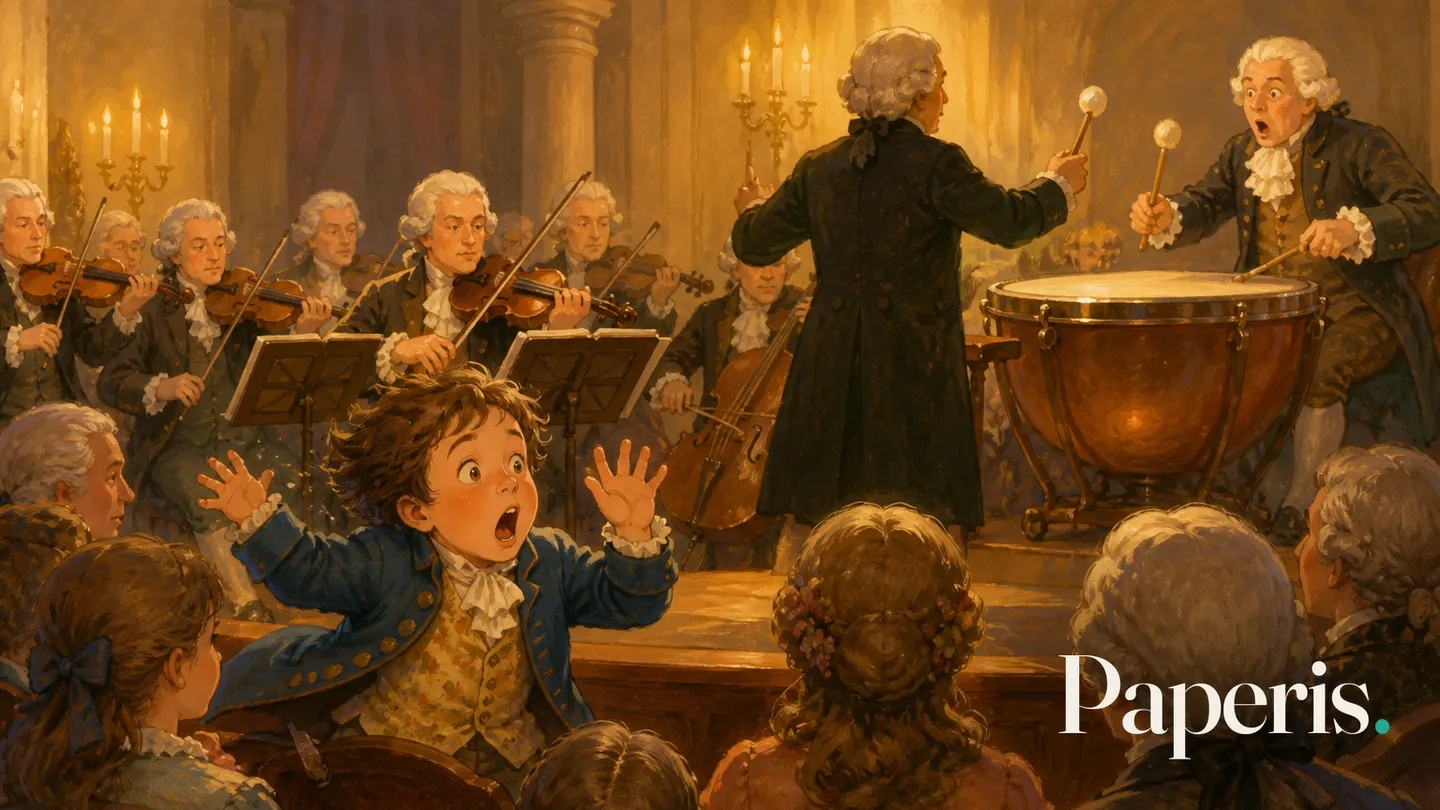
The story starts with the second part (movement) of Joseph Haydn's Symphony No. 94, the "Surprise." Haydn worked in Vienna, Austria. He came to London in January 1791 (DOI: 10.1525/jams.2019.72.2.541). Salomon, a man who ran concerts in London, asked him to come. On this first stay, in 1791–1792, Haydn wrote Symphonies Nos. 93 to 98 (DOI: 10.1017/9781800106611.033). No. 94 is from 1792. Putting Haydn's memory together with the record that Pleyel was hired in London in 1792, it was probably first played that year at his London concerts. This is our guess, not something Haydn says directly (DOI: 10.1093/jrma/100.1.159, DOI: 10.1093/em/can004). Its slow movement has the name "mit einem Paukenschlag" (with a drum stroke). It surprises the audience with a very loud (fortissimo) hit on the timpani drum (DOI: 10.1007/s10746-024-09771-0).
The story follows two paths. One path checks a famous story with old records: "He put in the bang to wake up sleeping people." The other path shows how scientists measured surprise in music. Here is the result. There is a record that Haydn himself said he did not write it to wake people up. Many tests show that the brain guesses what comes next in music and reacts fast to an unexpected note. But a surprise felt good only under some conditions: it depended on how sure the listener was. Which part of the brain makes it feel good is not clear yet.
In the middle of the story, your child hears a short part of the real piece. It is about 20 seconds long. A quiet tune plays again and again, and at about 15 seconds the sound suddenly gets loud.
Clip: Haydn, Symphony No. 94 "Surprise", second movement — a quiet tune, then a loud chord (Boston Symphony Orchestra · conducted by Serge Koussevitzky · recorded 1929 · public domain · Wikimedia Commons)
The clip is a real orchestral recording from 1929 by the Boston Symphony Orchestra, conducted by Serge Koussevitzky (public domain · Wikimedia Commons). It is an old recording, so there is some crackle. The sound gets very loud at the moment of the chord, so the script warns the child before the clip and leaves it as a question whether it sounded like a drum.
How people found out
A record of someone who asked Haydn. Georg August Griesinger wrote about Haydn's life. A 1973 paper calls him the most trustworthy writer on Haydn from that time. He talked with Haydn when Haydn was old. He asked if it was true that Haydn wrote the Andante of the "Surprise" Symphony to wake up English people who fell asleep at his concert. Haydn's answer, in English, reads like this (DOI: 10.1093/jrma/100.1.159).
No, but I was interested in surprising the public with something new, and in making a brilliant debut, so that my student Pleyel, who was at that time engaged by an orchestra in London (in 1792) and whose concerts had opened a week before mine, should not outdo me. The first Allegro of my symphony had already met with countless Bravos, but the enthusiasm reached its highest peak at the Andante with the Drum Stroke. Encore! Encore! sounded in every throat, and Pleyel himself complimented me on my idea.
Other papers agree that Pleyel was hired in London in 1792 by the "Professional Concert" as a rival to Haydn (DOI: 10.1093/em/can004). Pleyel was Haydn's old student. Their London contest took place inside a contest between Salomon and another concert boss (DOI: 10.56620/2587-9731-2021-2-091-144). Haydn was very popular in London. By the end of his second season, huge crowds came to the Hanover Square room. The room held about 800 people. After the concert of May 3, 1792, a woman wrote on her ticket: "1500 people entered the door" (DOI: 10.1525/jams.2019.72.2.541).
We should also say how strong this record is. Griesinger was sent to Haydn in 1799 (DOI: 10.4324/9781315093093-1). So Haydn told this story at least seven years after the first show in 1792. The three early books on Haydn's life (by Griesinger, Dies, and Carpani) mostly agree. But one expert says, about the early books in general (not this story in particular), that there is reason to doubt some of the old man's memories. Also, the writers were not music experts, so we cannot be sure they always understood him (DOI: 10.1093/oso/9780195061772.003.0012). The script says both things: "People think Griesinger wrote things down with care" and "some experts say we should check."
The idea of guessing and surprise. The music thinker Leonard Meyer said this: music makes the listener expect things, and then it gives them or avoids them, for an artistic effect (DOI: 10.1525/mts.2007.29.2.197). Since Meyer (1956), music experts have seen expectation as a main source of feeling in music (DOI: 10.1093/oxfordhb/9780199841578.013.0025). In Meyer's time, many people thought of the mind as a "black box" that we cannot look into (DOI: 10.1525/mts.2007.29.2.197). This is where the script's question comes from: "How can you measure something you cannot see?"
Measuring the brain's "Huh?" One study played pieces of Western classical music. It recorded the brain with MEG. MEG measures very weak magnetic signals from brain activity, from outside the head. Several computer models of music (one was a modern "transformer" network) gave a surprise score and an uncertainty score to each note. Brain activity over the front and sides of the head followed the surprise of each note. This was strongest at about 200 milliseconds and at 300–500 milliseconds after the note began. It was different from simple sound effects or from getting used to a repeated sound (PMID 36562532). The models that best predicted the brain had learned from a lot of music over a long time, not simple "shape" rules. Still, the surprise response mostly showed short contexts of fewer than ten notes. The team found the same result again in a public EEG data set (PMID 36562532). The script's "about 0.2 seconds" uses only the first time point, to keep it simple.
Where do guesses come from? One study used more than 1,000 chords from 739 US Billboard pop songs. People rated how expected each chord was and how pleasant it was. The team compared these ratings with four computer models. "Sensory" models use only the sound just before. "Cognitive" models use long-term knowledge of how music is built. Both kinds added something, and they did not overlap. For how surprised people felt, cognitive models explained more than twice as much as sensory models (PMID 38104601). The authors said the two kinds of guessing work together to shape the pleasure of music (PMID 38104601).
Another study played music to two rhesus monkeys that grew up with no music. It recorded their brain waves and their pupils. The monkeys paid more attention to real music than to mixed-up music. Their brains coded guesses based on the music they had just heard. People used pitch (which note) and timing (when) about equally to guess. The monkeys used timing more than pitch (PMID 38176416). This is a result from two monkeys.
When is a surprise fun? One study used a computer model on 80,000 chords from US Billboard pop songs. It scored each chord for uncertainty (how hard it was to guess just before) and for surprise. Then it compared these with how much people liked the chords. Chords got high "like" scores when the listener was quite sure, and the chord was very different (low uncertainty, high surprise). They also got high scores when the listener was unsure, and the chord was the expected one (high uncertainty, low surprise) (PMID 31708393). In the same study's fMRI, the amygdala, the hippocampus, and the hearing area of the brain followed this mix. The nucleus accumbens, which handles expected rewards, followed only uncertainty. The authors wrote that this challenges current brain models of music pleasure (PMID 31708393). The summary does not say how many people took part.
Another study played 50 real music clips to 24 people. Again, "like" scores showed the same mix (most liked: high uncertainty with low surprise, and low uncertainty with high surprise). This time, the mix showed up in the ventral striatum, a part of the reward system (PMID 37928727). This team had found the same pattern before with short tunes. An independent team (PMID 31708393) found it again with chords, but not in the ventral striatum. The team says this raised new questions about how the brain does it (PMID 37928727). So a surprise is not always fun. It depends on how sure you were.
Answers you may have heard
"He did it to wake up sleeping people." — There is a record that Haydn himself said no. This is the Griesinger record above (DOI: 10.1093/jrma/100.1.159). Griesinger asked "Is it true?" So the story was probably going around while Haydn was alive (this is our guess from the way he asked). But it is a memory told years later, and experts say we should check memories in the early books (DOI: 10.1093/oso/9780195061772.003.0012). We did not find a record that shows whether people really fell asleep at the first show. We searched in two ways (OpenAlex searches for Haydn, the "Surprise," and Griesinger; Crossref searches for the first show and the story). So the script does not say "That is false." It says two things: "There is a record that Haydn himself said no," and "we could not find a record that shows" people were asleep.
"Surprises are fun." — Only under some conditions. In the chord studies, how good a surprise felt moved with how sure the listener was (PMID 31708393, PMID 37928727). The nucleus accumbens reacted to surprises more in people who found the music more pleasant (PMID 30892654). Also, ten tests with 851 people in the US, the UK, and India looked at beauty. The most beautiful moments had strong pleasure, a wish to keep going, going beyond what was expected, and more. But "surprise" was not linked to feeling beauty (PMID 34246875). Beauty and fun are not the same question. Still, it is clear that "surprise = a good feeling" is too simple.
Questions your child may ask
"Did Haydn really do it to wake people up?" There is a record that Haydn said no. He said he wanted to surprise people with something new, and he did not want his student Pleyel to beat him (DOI: 10.1093/jrma/100.1.159). It helps to also say that this was a memory told years later.
"What drum is that?" It is the timpani. This movement is described as surprising the audience with a very loud timpani hit (DOI: 10.1007/s10746-024-09771-0). In his memory, Haydn also called it "the Andante with the Drum Stroke" (DOI: 10.1093/jrma/100.1.159). Our sources do not say which bar it is in or which other instruments play with it, so we left that out.
"If I hear it again, will I still be surprised?" We did not find a study of people who heard Haydn's piece many times. Lab studies measured different kinds of surprise, so there is no one-line answer. In one, the test used chord patterns with rules. A chord that broke a learned rule caused a brain wave response. The size and timing of the response changed with the sound itself, with what people already knew about harmony, and with what they learned during the test (PMID 18665861). In another, the test put rough-sounding (dissonant) sounds at the end often, so people could predict them. This did not change any of the brain wave responses. The authors said the early responses deal with the odd sound itself, not with harmony rules (PMID 34852008). The home activity (telling them first, or not) connects to this question.
"Do monkeys listen to music?" Two monkeys that grew up with no music showed brain responses that look like guessing in real music. Unlike people, they relied on "when" more than "which note" (PMID 38176416). It is a study of only two monkeys.
"Why is this piece famous?" In 1911–1913, the German company Odeon made the first records of complete four-movement symphonies. There were five, and Haydn's No. 94, the "Surprise," was one of them (DOI: 10.1525/jams.2023.76.1.113). In the music for the 1939 film We Are Not Alone, the composer Max Steiner used the tune of the second movement 41 times. Each time he added a new "surprise" (DOI: 10.1558/jfm.23880). Many of the nicknames of Haydn's symphonies were not given by Haydn (DOI: 10.1017/9781800106611.033). Our sources do not show who named this one the "Surprise."
What is known and what is not yet
Known. While we listen to music, the brain reacts to an unexpected note within a few hundred milliseconds, and the reaction follows how surprising the note is (MEG result, found again in EEG data, PMID 36562532). Whether a surprise feels good depends not only on the surprise but also on the uncertainty just before. Two separate teams showed this in behavior, with chords (PMID 31708393) and with real music clips (PMID 37928727). Long-term knowledge of music plays a bigger part in felt surprise than the sound just before (PMID 38104601).
Not yet known. First, how the brain makes the pleasure. Some say the nucleus accumbens (ventral striatum) handles the pleasure of surprise. One study found that it followed only uncertainty (PMID 31708393). Other studies found surprise responses there (PMID 30892654, PMID 37928727). Second, these studies mostly measured surprise in chords and tunes. Our sources do not directly test whether a sudden change in loudness, like Haydn's, works the same way. Third, what a surprise feels like. One paper says a surprise makes the felt strength go up for most experienced listeners. But which kind of feeling it becomes depends on the type of music (the "musical topic"). The paper builds on earlier tests (DOI: 10.31751/723). One test put a full pause before the ending to make a "surprising" version, to check this idea (DOI: 10.1093/oxfordhb/9780199841578.013.0025; the summary gives no result). Fourth, children. The summaries of the studies we cite do not say they studied children. In extra searches (two PubMed searches), we did not find a study of children and music surprise. The script says, "we do not know yet if it is the same for you."
What the child's script leaves out. Our search also found a study on music surprise before and after treatment for depression (with a common drug or with psilocybin), and a study on music surprise in people with dementia. They are far from a children's story, so we left them out. There is also a study on Haydn's musical wit. It says the wit in Haydn's string quartets is mostly playful, and it uses the "Joke" Quartet (Op. 33 No. 2) as an example (DOI: 10.17615/96ye-ad46). This page covers only Symphony No. 94.
Things to try together
- Quiet two times, then one "clap!" Sing a short song very quietly two times. On the third time, clap once at a spot chosen before. Your family can guess the moment or say how surprised they were. A clap is enough. Agree with your child first: no shouting, no clapping near anyone's ears, and not on a sleeping person.
- Tell them first, or not. On another day, say "I will clap in the third song" before you start. One study found that people liked a chord that was very different when they had been sure what came next (PMID 31708393). Another found that making an odd-sounding ending easy to predict did not change brain wave responses (PMID 34852008). Both measured surprise in chords and sounds, not a clap you were told about, so any result is fine.
- Raise a hand at the "Huh?" Play the clip again. Raise a hand when the sound changes. Talk about whether you were surprised at the same moment the second time.
Source papers
- "The London Revision of Haydn's Instrumental Style" (1973) — DOI: 10.1093/jrma/100.1.159 — When Griesinger asked if he meant to wake up sleeping English people, Haydn said no. He wanted to surprise people with something new and not be beaten by his student Pleyel.
- "Joseph Haydn" (1995) — DOI: 10.1093/oso/9780195061772.003.0012 — The three early books on Haydn mostly agree, but there is reason to doubt some of the old man's memories.
- "The Earliest Biographies of Haydn" (2017) — DOI: 10.4324/9781315093093-1 — Griesinger was sent to Haydn in 1799 and wrote down their talks.
- "Pleyel's 'London' symphonies" (2008) — DOI: 10.1093/em/can004 — Pleyel was hired by the Professional Concert in 1792 as a rival to Haydn.
- "Haydn, Mozart and Pleyel: Rivalry And Interinfluences" (2021) — DOI: 10.56620/2587-9731-2021-2-091-144 — Haydn's London contest with his old student Pleyel took place inside a contest between two concert bosses.
- "Colloquy: Attention, Anxiety, and Audition's Histories" (2019) — DOI: 10.1525/jams.2019.72.2.541 — Haydn came to London from Vienna in January 1791. On May 3, 1792, 1,500 people came into a room for about 800.
- "Haydn: Symphony No.100 in G (‘Military’)" (2023) — DOI: 10.1017/9781800106611.033 — Salomon invited Haydn, who wrote Nos. 93–98 on his first London stay in 1791–1792. Many nicknames were not given by Haydn.
- "What is an Antinomic Emotion?" (2025) — DOI: 10.1007/s10746-024-09771-0 — The "with a drum stroke" movement of No. 94 (1792) surprises the audience with a very loud timpani hit.
- "“Listen and Be Amazed!”: Odeon, Künneke, and the First Recordings of Complete Symphonies" (2023) — DOI: 10.1525/jams.2023.76.1.113 — Haydn's No. 94 was one of the first five complete symphonies recorded, in 1911–1913.
- "New Surprises for Haydn’s Surprise Symphony: Max Steiner’s Score for We Are Not Alone (1939)" (2022) — DOI: 10.1558/jfm.23880 — Steiner used the second movement's tune 41 times, each time adding a "surprise."
- "Surprise and Listening Ahead: Analytic Engagements with Musical Tendencies" (2007) — DOI: 10.1525/mts.2007.29.2.197 — It builds tools from Meyer's idea that music makes expectations and then meets or avoids them.
- "Expectation, Musical Topics, and the Problem of Affective Differentiation" (2014) — DOI: 10.1093/oxfordhb/9780199841578.013.0025 — Since Meyer (1956), expectation has been seen as a main source of feeling in music. It tests musical topics as the reason surprises feel different.
- "Perception, Expectation, Affect, Analysis" (2013) — DOI: 10.31751/723 — Surprise raises felt strength for experienced listeners, and the musical topic picks which feeling it becomes.
- "Cortical activity during naturalistic music listening reflects short-range predictions based on long-term experience." (2022) — PMID 36562532 — Brain activity followed note surprise at about 200 ms and 300–500 ms. Long-term learning models fit best, but the surprise showed short contexts of fewer than ten notes.
- "Cognitive and sensory expectations independently shape musical expectancy and pleasure." (2024) — PMID 38104601 — In over 1,000 chords, cognitive and sensory guesses each added something. For surprise, cognitive guesses explained more than twice as much.
- "Neural encoding of musical expectations in a non-human primate." (2024) — PMID 38176416 — Two monkeys raised with no music coded guesses in real music and relied on timing more than pitch.
- "Uncertainty and Surprise Jointly Predict Musical Pleasure and Amygdala, Hippocampus, and Auditory Cortex Activity." (2019) — PMID 31708393 — In 80,000 chords, pleasure followed a mix of uncertainty and surprise. The nucleus accumbens followed only uncertainty.
- "Auditory and reward structures reflect the pleasure of musical expectancies during naturalistic listening." (2023) — PMID 37928727 — With 24 people and 50 music clips, the same pattern was found again, and the ventral striatum showed the mix.
- "Surprise-related activation in the nucleus accumbens interacts with music-induced pleasantness." (2019) — PMID 30892654 — The surprise response in the nucleus accumbens was stronger in people who found the music more pleasant.
- "Beauty, the feeling." (2021) — PMID 34246875 — In ten tests with 851 people, surprise was not linked to feeling beauty.
- "The effects of learning on event-related potential correlates of musical expectancy." (2008) — PMID 18665861 — Chords that broke learned rules caused brain wave responses, which changed with past knowledge and with what was learned in the test.
- "Neural correlates of acoustic dissonance in music: The role of musicianship, schematic and veridical expectations." (2021) — PMID 34852008 — Making dissonant endings easy to predict did not change any brain wave response.
- "The Listening Moment: Ludic Wit in Haydn's String Quartets" (2013) — DOI: 10.17615/96ye-ad46 — The wit in Haydn's string quartets is mostly playful, with the "Joke" Quartet as an example.