Paperis Articles
Who Made Up the Old Fairy Tales?
Why? · Fairy Tales
Your field's papers, as audio
Pick your fields and journals — Paperis summarizes the key papers and turns them into audio. Listen on your commute.
Start Paperis free →Who Made Up the Old Fairy Tales?
The child listens. The parent reads. This page helps you answer the questions your child may ask after the story. You can see the story script with the script button while it plays.
What this story is about
The Grimm brothers' book is called Children's and Household Tales (Kinder- und Hausmärchen). Cinderella, Hansel and Gretel, and Rapunzel were already in its first edition, from 1812 and 1815 (DOI: 10.2307/j.ctt6wq18v). The first book had 86 stories. Three years later, a second book added 70 new ones (DOI: 10.17345/elop201215-61). This story starts from a child's question: "Who made up the old fairy tales?" Then it follows how scholars compared old handwritten notes and many editions. That is how they learned where these stories came from and how they changed.
The answer has three parts. The Grimm brothers did not make up the stories. They gathered them, and then they rewrote them in each edition. The stories came from many more people than "old village grandmothers." In the studies on this page, no one found the first person who made up any of these old tales.
How people found out
It was a book of gathered stories. In the first ten years of the 1800s, the brothers began to gather old stories from written and spoken sources. They saw these stories as signs of an old German literature that might soon be lost. At first, they planned the book as a resource for scholars, with notes on sources and other versions (DOI: 10.3366/ccs.2005.2.1.23). This plan was part of a Romantic idea: old spoken stories were a window into a people's old imagination. Jacob Grimm is named as the scholar who explained this idea best (DOI: 10.1017/9781009667142.008). The first title of the book also says "gathered by the Brothers Grimm" (gesammelt durch die Brüder Grimm) (DOI: 10.4000/feeries.829). The story line "they did not say they wrote the stories. They said they gathered them" comes from this title.
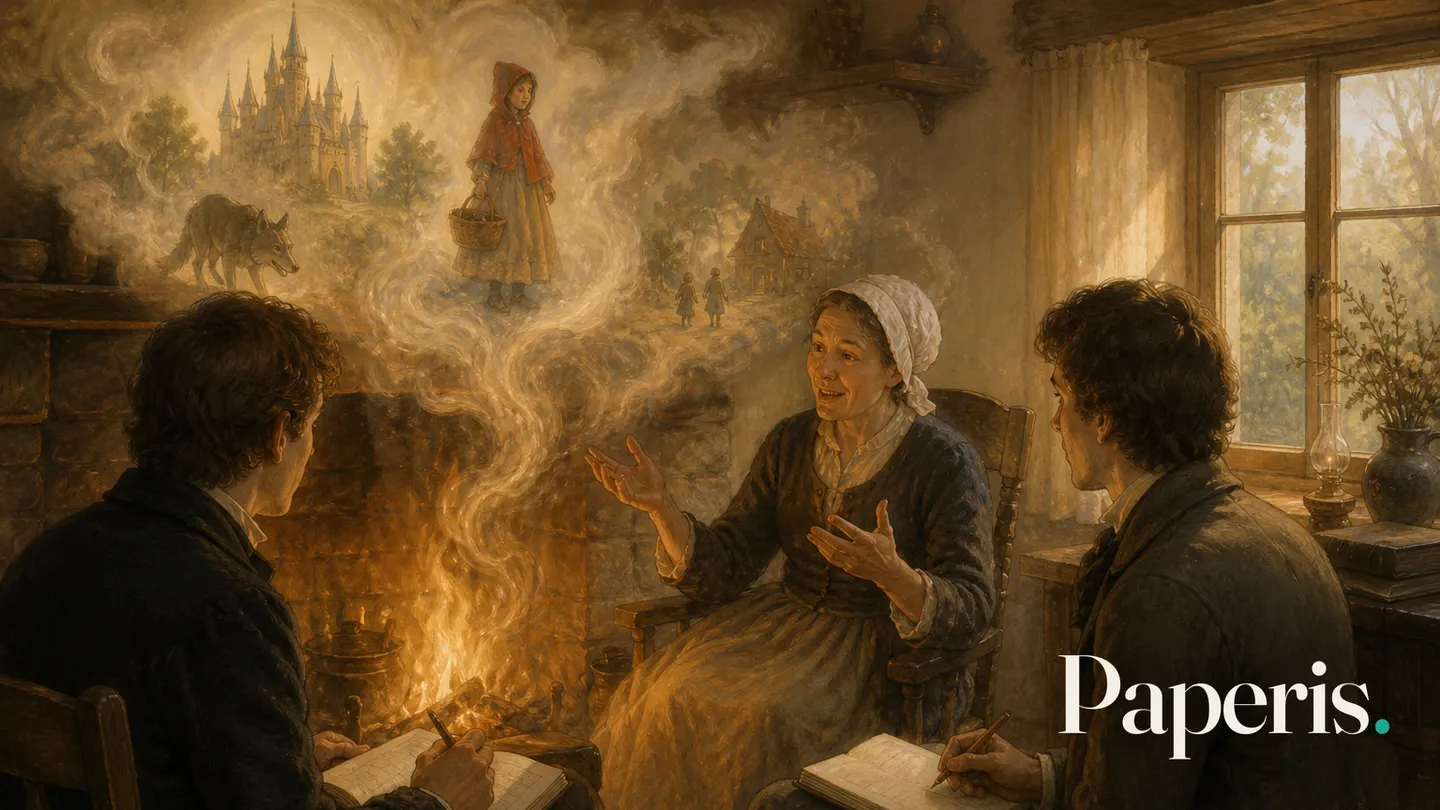
Where they gathered them: friends, young women, and books. The first stories came from the brothers' friends. The friends thought back and told stories they had heard as children. The author says these stories came from childhood memory, full of feeling but with many gaps (DOI: 10.17345/elop201263-72). The stories in the last edition can be sorted by who gave them. Some came from young women in their teens, some from men, and some from one older storyteller, Dorothea Viehmann (DOI: 10.17877/de290r-8217). The third story in the book, "Mary's Child" (Marienkind), came from Gretchen Wild. She was a young woman from a Huguenot family. Huguenots were French Protestants (DOI: 10.4000/feeries.2682). One study names several women from Huguenot families as story givers. It says they helped the brothers shape this kind of story (DOI: 10.5169/seals-1006339). A large handbook on the Grimm tales lists the sources, the earlier written models, and the people who gave each story (DOI: 10.1515/9783110747584-201). So the first book stood on friends' memories and on stories that were already in print.
Dorothea Viehmann: a real storyteller, and a shaped picture. In 1813, Jacob Grimm wrote down a story that Viehmann told, and such papers still exist. A 2026 study showed one more of these papers that no one had known about. (The summary does not say when it was found.) By studying it with two other old papers, the scholar found more of Viehmann's own words, grammar, and local speech (DOI: 10.1515/fabula-2026-0006). The same summary says this newly found story has more rude jokes than her other stories. The script does not tell its plot. A picture of Viehmann is at the front of the book. Together with the brothers' scholarly writing, it backed up the idea that these were true spoken tales. A scholar compared three versions of the picture with the brothers' words about her. The conclusion: the brothers built up an "ideal storyteller" (DOI: 10.1515/fabula-2019-0015). This does not mean Viehmann was fake. It means the way she was shown was shaped.
Facts about her life from one essay (no research summary backs them). According to one writer's essay, she was the daughter of an innkeeper and married a tailor. She was almost sixty when she met the brothers. From the spring of 1813, in Kassel, she told them more than forty stories. In the foreword of the second book (1815), the brothers praised her storytelling. The essay says she was not the "farmer's wife" she is often called (DOI: 10.14321/fourthgenre.26.1.0114). This essay is creative nonfiction. It mixes imagined scenes with the writer's own life story. We found no research summary in our files that backs these details. So the child's script leaves out all of them: innkeeper's daughter, tailor's wife, age, number of stories, and praise in the foreword. In the script, "only half right" rests on three studies. One is about the friends (DOI: 10.17345/elop201263-72). One is about the many story givers (DOI: 10.17877/de290r-8217). One is about the shaped picture (DOI: 10.1515/fabula-2019-0015).
Detective work with word habits. For "The White Bride and the Black Bride" (KHM 135), the brothers wrote down a different source. But a scholar used the "first version" kept with the Grimm papers in Berlin. The scholar compared its typical language with Viehmann's tales, word by word and story idea by story idea. Much evidence pointed to Viehmann as a possible teller. The author found this idea likely from the history of the text and from study of the handwritten copy (DOI: 10.1515/fabula-2023-0015). This is a suggestion, not a final answer. So the script says the scholar "thinks this story may also have come from Viehmann."
Seven editions side by side. During the brothers' lives, there were seven large editions (1812–1857). Wilhelm changed the texts a lot from edition to edition (DOI: 10.17192/openumr/804). The last one, from 1857, had 211 stories (DOI: 10.17345/elop201215-61). Another study counts the same edition as 200 tales and 10 legends (DOI: 10.3366/ccs.2005.2.1.23). So it is 210 or 211, depending on how you count. The script says "more than two hundred." Across the editions, stories were added, taken out, and joined together (DOI: 10.3366/ccs.2005.2.1.23). One study that compared editions found this. From the start, the brothers aimed for the style of spoken language. Texts that came from books took on more and more features of everyday talk as they were edited. Texts that came from spoken sources kept their spoken markers, unchanged, from 1812 to 1857 (DOI: 10.5817/bbgn2025-1-4). That is where the script line comes from: stories from books came to sound more like talking with each edition.
Some stories took a long time to settle. In "The Tale of the Toad" (KHM 105), a child and a snake share a meal from the same bowl. It was written down from spoken telling in Hesse in 1813. But it got its well-known final shape only in the fifth edition, in 1843 (DOI: 10.1515/fabula-2020-0002). The script does not tell how the story ends (with a death).
Stories taken out, parts removed. From the second edition (1819), the stories were rewritten, corrected, and censored. According to this study, Wilhelm took texts first meant for grown-up readers and made them into children's books. He added Christian values and removed sexual hints. Thirty-seven stories from the first edition were taken out of later editions (DOI: 10.12775/rp.2016.004). Puss in Boots and Bluebeard were also taken out at some point in the book's printing history (DOI: 10.1515/9783110747584-201). The summary does not say why. So the script says, "We could not find out why in the studies we read." In Germany, the book moved step by step from a scholars' book to a children's book (DOI: 10.3366/ccs.2005.2.1.23). In English, Edgar Taylor's translation came out in 1823. Mainly because of it, the brothers changed the form and size of their book so more people could read it (DOI: 10.23943/princeton/9780691160580.003.0003).
Answers you often hear
"The Grimm brothers made them up." They gathered them. But the rewriting was their own work. They gathered stories from written and spoken sources (DOI: 10.3366/ccs.2005.2.1.23), and Wilhelm changed them a lot in each edition (DOI: 10.17192/openumr/804). One study of the last edition treats it as a work of art, not as folk poetry, because Wilhelm changed it so much (DOI: 10.17877/de290r-8217).
"They heard them from old village grandmothers." Only half right. The older storyteller Viehmann was real (DOI: 10.1515/fabula-2026-0006). Spoken markers in tales from spoken sources stayed to the last edition (DOI: 10.5817/bbgn2025-1-4). But the first stories came from friends who remembered childhood tales (DOI: 10.17345/elop201263-72). The tellers also included young women and men (DOI: 10.17877/de290r-8217), and women from Huguenot families (DOI: 10.4000/feeries.2682; DOI: 10.5169/seals-1006339). The picture of "an ideal storyteller who passes on spoken tales" was partly made by Viehmann's portrait and the brothers' writing together (DOI: 10.1515/fabula-2019-0015). This "old woman storyteller" picture traveled far. In British India in the late 1800s, people who gathered spoken stories used it to look for the "real" India (DOI: 10.4324/9781003643753-10). The script puts "only half right" and "there really was a grandmother storyteller" in the same paragraph.
"The real Grimm tales are very scary." It depends on the edition and the translation. In the summaries, what the brothers removed was mainly sexual hints (DOI: 10.12775/rp.2016.004). In translations of the 1800s and 1900s, many parts were taken out or changed. The paper that compares them is called "Tales of Violence and Terror" (DOI: 10.1080/1361454042000294087). But the summary does not say that all of these parts were violent. It also does not say that the brothers left violent parts alone. In Korean translations from the 1920s, some cruel scenes were translated word for word, and some were made softer (DOI: 10.1515/fabula-2021-0003). How scary a story feels depends on which edition or translation you read. The script does not describe cruel scenes. It only says the stories changed from edition to edition.
"They are German stories." Plots cross borders. See "The same story in many countries" below.
The same story in many countries
A tale type is an international way of sorting stories: stories with a similar plot go into one group with a number. The one used most today is The Types of International Folktales, updated by Hans-Jörg Uther in 2004. Each country can sort its own stories under these numbers (DOI: 10.3986/9789612547707).
- Number 451 (the girl who looks for her brothers) is one of the most widely told stories in Europe and the Middle East. It is well known from the written versions by the Grimm brothers and Hans Christian Andersen. The study looks at versions from Georgia, the Middle East, North Africa, and Europe. In them, the sister's search comes together with main characters turning into animals (DOI: 10.59277/jef.2026.1-2.01).
- Number 402 (the animal bride) was known to three tellers: Viehmann; Laura Gonzenbach, who gathered Sicilian tales; and Tina Wajtawa, a storyteller from Resia. Their stories mix German, Romance, and Slavic culture (DOI: 10.3986/sms20192209).
- Very old roots. The animal groom and bride type goes back to the 2nd century, to Apuleius's "Cupid and Psyche" (DOI: 10.58885/ijllis.v14i2.23mb). One study compared texts in their first languages. It showed how the words and acts of Venus in the Psyche story moved from book to book. First they went to an ogress in Basile (from Naples). Then they went to Perrault's "Bluebeard" and to a wicked fairy queen in La Force. In the end, they reached the Virgin Mary in "Mary's Child." The authors see these characters as patchwork: writers borrowed pieces from each other and put them together in new ways. They say these books spread across Europe through door-to-door sellers, copied books, collections, and people telling the stories again (DOI: 10.4000/feeries.2682).
- "I heard it from an old servant woman." In Apuleius's book, the Psyche story is told by a donkey named Lucius. He says he heard it from the old servant of a group of robbers (DOI: 10.5169/seals-1006339). The script only says that "I heard it from an old woman" already appears in that very old book. It does not draw a conclusion from this.
- A plot that lived on in two places. "The Tale of the Toad" has a far older record from 1626. There is also a Scottish version that the Grimm book did not shape. In it, the people have names and the place is clear (DOI: 10.1515/fabula-2020-0002).
The Grimm book then went out into the world. By 2021, it was in more than 170 languages. The brothers' own copies, with their handwritten notes and changes, became part of the UNESCO Memory of the World in 2005. Many collectors in other countries made story books for their own countries on this model (DOI: 10.1515/9783110747584-201). A 2012 source counts 160 languages (DOI: 10.17345/elop201215-61). In Korea, people have translated and read the tales since 1910 (DOI: 10.1515/fabula-2021-0002).
Questions your child may ask
"So what did the Grimm brothers do?" They gathered the stories, wrote them down, and rewrote them in each edition. People often say modern folklore study began with them. They gathered German folk stories from living tellers in a planned way. They also put forward an idea about where the stories came from (DOI: 10.4324/9780429050756-1). They were not the first scholars to look at folk stories. But they asked friends, co-workers, and even strangers to gather and share stories, and they set a high standard for gathering (DOI: 10.23943/princeton/9780691160580.001.0001).
"Was Grandma Viehmann real?" Yes. Papers with her stories, written down by the brothers, still exist (DOI: 10.1515/fabula-2026-0006). But the picture at the front of the book and the brothers' words shaped her into an "ideal storyteller" (DOI: 10.1515/fabula-2019-0015).
"Why was Puss in Boots taken out?" We know it was taken out during the printing history (DOI: 10.1515/9783110747584-201). The summaries we read do not say why.
"Was it a children's book from the start?" The summaries do not agree. One study says the first edition was first meant for grown-up readers, and Wilhelm turned it into children's books over the editions (DOI: 10.12775/rp.2016.004). Another says a book first planned for scholars slowly became a children's book in Germany (DOI: 10.3366/ccs.2005.2.1.23). But one paper on translation says the stories were first written down for children and teenagers (DOI: 10.1080/1361454042000294087). The script follows this disagreement. It says three things. The book's name had the word "children" in it. The brothers at first also thought of it as a record for scholars. And scholars do not all agree. In the scary-story paragraph, it only says the first edition had some parts more for grown-ups than today's books.
What we know and what we do not know yet
What we know. The Grimm brothers gathered stories from both writing and speech (DOI: 10.3366/ccs.2005.2.1.23). The first stories came from friends' childhood memories (DOI: 10.17345/elop201263-72). They rewrote the stories a lot over seven editions (DOI: 10.17192/openumr/804). The speech of a real storyteller, Viehmann, is kept in the papers that recorded her (DOI: 10.1515/fabula-2026-0006). Stories of the same type are spread across many places (DOI: 10.59277/jef.2026.1-2.01; DOI: 10.3986/sms20192209).
Not known yet: how much of the first book came "from mouths"? Scholars still argue about this. One essay reports the view of Ruth Bottigheimer, an American fairy tale scholar. In a 2009 book, she argued against an old belief. The belief is that people who could not read, mostly women, made up stories and passed them on by mouth. She argued that many tales in the first book, such as Cinderella and Rapunzel, may have come from older European printed books. The brothers' female friends, who were mostly well-off, could get these books (DOI: 10.14321/fourthgenre.26.1.0114). In scholarly writing too, Bottigheimer is named as a critic who shook the Grimms' authority as folktale collectors. Heinz Rölleke and Jack Zipes are named with her (DOI: 10.1353/mat.2010.a384533). There is evidence on the other side, too. The first edition is described as holding "diverse voices, rooted in oral traditions" (DOI: 10.2307/j.ctt6wq18v). Papers where Jacob wrote down Viehmann's stories still exist (DOI: 10.1515/fabula-2026-0006). And the brothers are named as people who gathered tales from living tellers in a planned way (DOI: 10.4324/9780429050756-1). The study of style (DOI: 10.5817/bbgn2025-1-4) measured how the texts sound. It did not measure where they came from. So we do not use it as evidence in this argument. The script only says scholars are "still arguing." It does not call either side right.
Not known yet: the first maker. In the studies on this page, no one found the first maker of any of these old tales. What the studies show is not the start of a story, but the path a story took as it moved between mouths and books (DOI: 10.4000/feeries.2682).
What the child's script leaves out. Some studies link the brothers' gathering to building a German national identity under Napoleon's rule. Others look at men's and women's roles in the tales. These are in our source files, but they are outside this story's question (who made the stories), so we left them out. We also did not tell cruel or sexual parts, or the endings of some stories.
Things to try together
- Hear an old story from a grown-up and write it down. Ask a grandparent or another grown-up for an old story they heard as a child. Write it down or record it. The Grimm brothers' first gathering also began with friends remembering stories from childhood (DOI: 10.17345/elop201263-72).
- Ask, "Who told you this story?" Writing down who gave a story is the same work scholars do when they list sources (DOI: 10.1515/9783110747584-201). If the answer is "I don't remember well," write that down too.
- Tell it again and compare. A few days later, your child tells the same story to someone else and records it. Then compare it with the first record. What is missing? What is new? This is a home version of how scholars put editions side by side (DOI: 10.5817/bbgn2025-1-4). Tell your child it is fine if a lot has changed.
Evidence
- "The Original Folk and Fairy Tales of the Brothers Grimm: The Complete First Edition" (2014) — DOI: 10.2307/j.ctt6wq18v — An English translation of all 156 stories of the 1812 and 1815 first edition. Rapunzel, Hansel and Gretel, and Cinderella were in it; six later editions changed the tales a lot.
- "200 Jahre Kinder- und Hausmärchen der Brüder Grimm" (2012) — DOI: 10.17345/elop201215-61 — 86 stories in 1812, 70 in 1815, 211 in the last edition of 1857; more than 160 translations; UNESCO Memory of the World in 2005.
- "Aspects of Gender in Translations of 'Sleeping Beauty'" (2005) — DOI: 10.3366/ccs.2005.2.1.23 — The brothers gathered from written and spoken sources and planned a book for scholars; they added, removed, and joined stories, and the book slowly became a children's book.
- "Ancestral Voices" (2026) — DOI: 10.1017/9781009667142.008 — Jacob Grimm explained the Romantic interest in spoken tradition most clearly.
- "Les commentaires paratextuels des Kinder- und Hausmärchen, gesammelt durch die Brüder Grimm" (2012) — DOI: 10.4000/feeries.829 — A study of the book's title ("gathered by the Brothers Grimm") and the notes the brothers added.
- "Le recueil des frères Grimm. L'invention d'un genre littéraire" (2012) — DOI: 10.17345/elop201263-72 — The first gathering was among friends who remembered childhood stories.
- "Die adoleszenten Jungfrauen in den Kinder- und Hausmärchen der Brüder Grimm" (2011) — DOI: 10.17877/de290r-8217 — Sorts the tales by who gave them: teenage girls and young women, men, and the older storyteller Viehmann.
- "Vénus, la Barbe bleue et la Vierge Marie" (2020) — DOI: 10.4000/feeries.2682 — How words and acts moved from Apuleius to "Mary's Child," told by Gretchen Wild, a young woman from a Huguenot family.
- "La (re)configuration des genres dans les littératures européennes : l'exemple des contes" (2009) — DOI: 10.5169/seals-1006339 — Sees European fairy tales as a reshaping of Latin, Italian, and French forms; the donkey Lucius and the "old servant" frame; women from Huguenot families as story givers.
- "Vorwort" [Handbook to the Kinder- und Hausmärchen] (2021) — DOI: 10.1515/9783110747584-201 — Lists sources, models, and story givers; Puss in Boots and Bluebeard were taken out during the printing history; more than 170 languages.
- "Eine unbekannte Märchenerzählung aus dem Munde der Viehmännin" (2026) — DOI: 10.1515/fabula-2026-0006 — A newly found 1813 paper where Jacob wrote down a Viehmann story; more about her words and local speech.
- "Intermediale Wechselwirkung von Text und Bild zur Stilisierung einer idealen Märchenerzählerin" (2019) — DOI: 10.1515/fabula-2019-0015 — Viehmann's portrait and the brothers' writing together built an "ideal storyteller."
- "Back to Ölenberg: An Intertextual Dialogue between Fairy-Tale Retellings and the Sociohistorical Study of the Grimm Tales" (2010) — DOI: 10.1353/mat.2010.a384533 — Names Rölleke, Bottigheimer, and Zipes as critics who questioned the Grimms' authority as collectors.
- "Maundering Women" (2024) — DOI: 10.14321/fourthgenre.26.1.0114 — A creative nonfiction essay. It gives facts about Viehmann's life and reports Bottigheimer's 2009 view.
- "Ein übersehenes Märchen von Dorothea Viehmann" (2023) — DOI: 10.1515/fabula-2023-0015 — Language comparison suggests KHM 135 may also have come from Viehmann.
- "Grimms Märchen im Wandel : sprachliche Phänomene im Auflagenvergleich" (2025) — DOI: 10.17192/openumr/804 — Compares the seven editions, which Wilhelm changed a lot, by language features.
- "Zur editorischen Leistung von Jacob und Wilhelm Grimm" (2025) — DOI: 10.5817/bbgn2025-1-4 — Texts from books took on more spoken features with each edition; spoken markers in texts from spoken sources stayed the same from 1812 to 1857.
- "„The Boy and the Snake"" (2020) — DOI: 10.1515/fabula-2020-0002 — KHM 105 was written down in Hesse in 1813 and got its final form in the fifth edition (1843); there is a 1626 record and a separate Scottish version.
- "O konieczności polskiego przekładu pierwszego wydania „Baśni dla dzieci i dla domu" braci Grimm" (2016) — DOI: 10.12775/rp.2016.004 — From the second edition (1819), tales were rewritten and censored; 37 first-edition tales were taken out.
- "Hyping the Grimms' Fairy Tales" (2014) — DOI: 10.23943/princeton/9780691160580.003.0003 — Taylor's 1823 translation led the brothers to change the form and size of their book.
- "The untranslated grimms: Kinder- und Hausmärchen. Tales of Violence and Terror" (2004) — DOI: 10.1080/1361454042000294087 — Compares parts that were taken out or changed in translations of the 1800s and 1900s.
- "Grausamkeiten in Grimms Kinder- und Hausmärchen" (2021) — DOI: 10.1515/fabula-2021-0003 — In Korean translations of the 1920s, cruel scenes were translated word for word or made softer.
- "Transnational Transcultural Translation" (2025) — DOI: 10.4324/9781003643753-10 — The Grimms' "old woman storyteller" picture traveled to collectors in British India.
- "Tipni indeks slovenskih pravljic" (2015) — DOI: 10.3986/9789612547707 — A Slovenian tale-type index that follows Uther's 2004 international system.
- "Eastern and Western Versions of Folktales about The Girl Seeking Her Brothers" (2026) — DOI: 10.59277/jef.2026.1-2.01 — ATU 451 is one of the most widely told stories in Europe and the Middle East.
- "Interculturalism in the Fairy Tales of Dorothea Viehmann, Laura Gonzenbach, and Tyna Wajtawa" (2019) — DOI: 10.3986/sms20192209 — All three tellers knew ATU 402 and ATU 425 stories.
- "A Comparative Analysis of Fairy Tales and Fairy Tale Writers with an Emphasis on Tina Wajtawa" (2025) — DOI: 10.58885/ijllis.v14i2.23mb — The animal groom and bride type goes back to Apuleius in the 2nd century.
- "Grimms Märchen in Korea" (2021) — DOI: 10.1515/fabula-2021-0002 — The history of Grimm tales translated and read in Korea since 1910.
- "Frontiers of Folklore: An Introduction" (2019) — DOI: 10.4324/9780429050756-1 — Modern folklore study is often said to begin with the Grimms, who gathered from living tellers in a planned way.
- "Grimm Legacies" (2014) — DOI: 10.23943/princeton/9780691160580.001.0001 — The brothers were not the first to study folk tales, but they set a high standard for gathering.
Sources (30)
- The Original Folk and Fairy Tales of the Brothers Grimm: The Complete First EditionDOI 10.2307/j.ctt6wq18v
- 200 Jahre Kinder- und Hausmärchen der Brüder GrimmDOI 10.17345/elop201215-61
- Aspects of Gender in Translations of 'Sleeping Beauty'DOI 10.3366/ccs.2005.2.1.23
- Ancestral VoicesDOI 10.1017/9781009667142.008
- Les commentaires paratextuels des Kinder- und Hausmärchen, gesammelt durch die Brüder GrimmDOI 10.4000/feeries.829
- Le recueil des frères Grimm. L'invention d'un genre littéraireDOI 10.17345/elop201263-72
- Die adoleszenten Jungfrauen in den Kinder- und Hausmärchen der Brüder GrimmDOI 10.17877/de290r-8217
- Vénus, la Barbe bleue et la Vierge MarieDOI 10.4000/feeries.2682
- La (re)configuration des genres dans les littératures européennes : l'exemple des contesDOI 10.5169/seals-1006339
- VorwortDOI 10.1515/9783110747584-201
- Eine unbekannte Märchenerzählung aus dem Munde der ViehmänninDOI 10.1515/fabula-2026-0006
- Intermediale Wechselwirkung von Text und Bild zur Stilisierung einer idealen MärchenerzählerinDOI 10.1515/fabula-2019-0015
- Back to Ölenberg: An Intertextual Dialogue between Fairy-Tale Retellings and the Sociohistorical Study of the Grimm TalesDOI 10.1353/mat.2010.a384533
- Maundering WomenDOI 10.14321/fourthgenre.26.1.0114
- Ein übersehenes Märchen von Dorothea ViehmannDOI 10.1515/fabula-2023-0015
- Grimms Märchen im Wandel : sprachliche Phänomene im AuflagenvergleichDOI 10.17192/openumr/804
- Zur editorischen Leistung von Jacob und Wilhelm GrimmDOI 10.5817/bbgn2025-1-4
- „The Boy and the SnakeDOI 10.1515/fabula-2020-0002
- O konieczności polskiego przekładu pierwszego wydania „Baśni dla dzieci i dla domuDOI 10.12775/rp.2016.004
- Hyping the Grimms' Fairy TalesDOI 10.23943/princeton/9780691160580.003.0003
- The untranslated grimms: Kinder- und Hausmärchen. Tales of Violence and TerrorDOI 10.1080/1361454042000294087
- Grausamkeiten in Grimms Kinder- und HausmärchenDOI 10.1515/fabula-2021-0003
- Transnational Transcultural TranslationDOI 10.4324/9781003643753-10
- Tipni indeks slovenskih pravljicDOI 10.3986/9789612547707
- Eastern and Western Versions of Folktales about The Girl Seeking Her BrothersDOI 10.59277/jef.2026.1-2.01
- Interculturalism in the Fairy Tales of Dorothea Viehmann, Laura Gonzenbach, and Tyna WajtawaDOI 10.3986/sms20192209
- A Comparative Analysis of Fairy Tales and Fairy Tale Writers with an Emphasis on Tina WajtawaDOI 10.58885/ijllis.v14i2.23mb
- Grimms Märchen in KoreaDOI 10.1515/fabula-2021-0002
- Frontiers of Folklore: An IntroductionDOI 10.4324/9780429050756-1
- Grimm LegaciesDOI 10.23943/princeton/9780691160580.001.0001