Paperis Articles
Why Do Onions Make Us Cry?
Why? · Onions
Your field's papers, as audio
Pick your fields and journals — Paperis summarizes the key papers and turns them into audio. Listen on your commute.
Start Paperis free →Why Do Onions Make Us Cry?
The child listens. The parent reads. This page helps you answer the questions your child may ask after the story. You can see the story script with the script button during play.
What this story is about
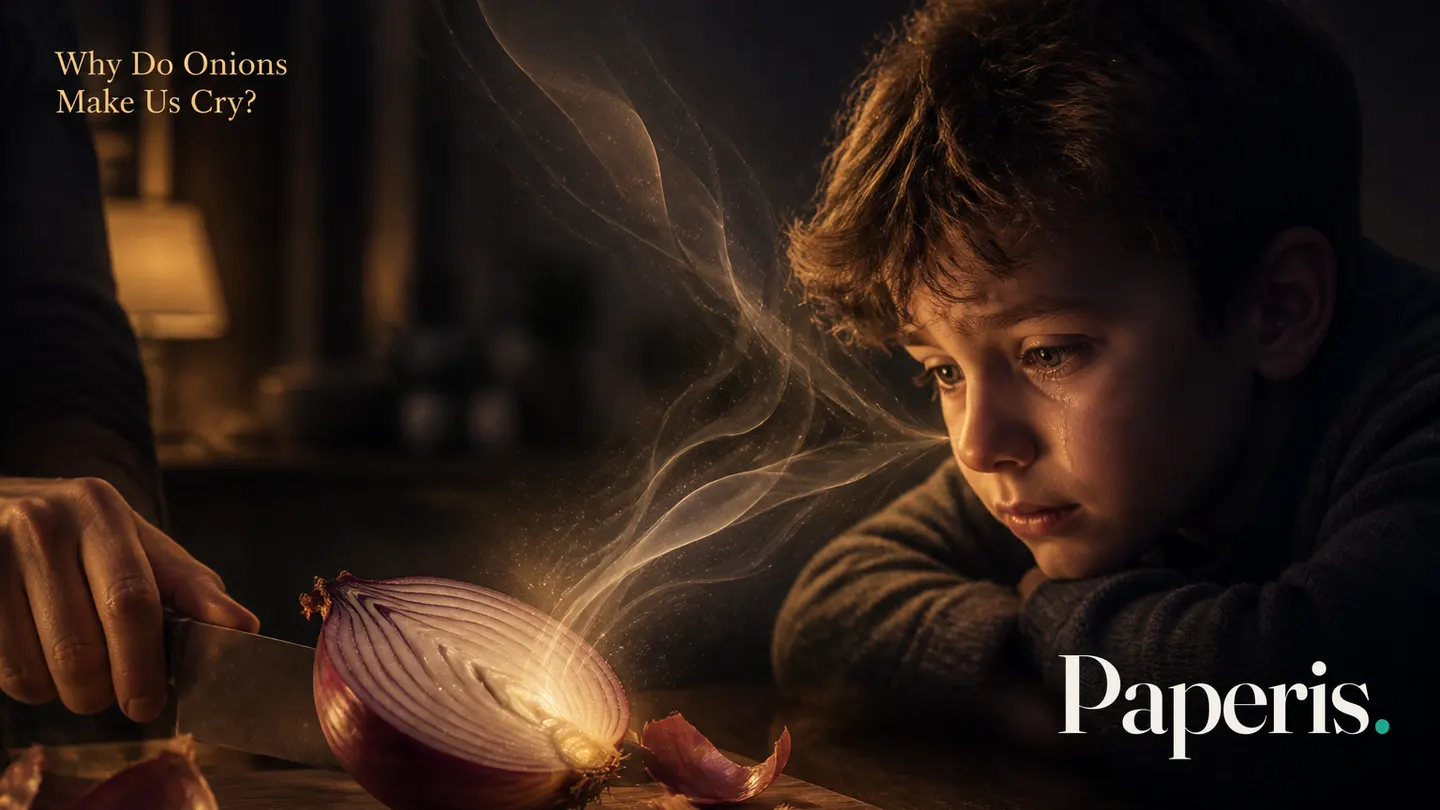
When a grown-up cuts an onion, a child standing close by can feel their eyes sting. But a whole onion in a basket does nothing. This story follows how people found out why. It looks at the raw stuff and the enzyme that stay apart in onion cells. It looks at the tear stuff that people long thought came by itself. And it looks at how a second enzyme was found. Here is the answer. When you cut an onion, the cells break. The first enzyme (alliinase) changes the raw stuff. Then the second enzyme (lachrymatory factor synthase) turns that into the tear stuff (PMID 27048847). The tear stuff flies into the air and makes the eyes sting. The eyes make tears as a reflex (PMID 28708375, PMID 20577855). We could not find tests of common kitchen tips in the papers for this story. We also do not know well why some people cry more than others.
How people found out
The raw stuff and the enzyme stay apart. Onions and garlic get their taste and smell from sulfur gases. These gases come from a raw stuff that is stable and has no smell. Two enzymes, alliinase and lachrymatory factor synthase, break it apart (PMID 15234988). In a whole plant, the raw stuff is kept in the main part of storage cells. Alliinase is an enzyme of the vacuole, a small bag in the cell. When the plant is hurt, the two meet (PMID 31106832). The story's "in another place, inside a small bag, there is a worker" comes from this. That summary does not say if the two are in the same cell, so the story does not say "the same cell." But one study from 2024 found more. Many alliinases have no tag that sends them to the bag. The team thinks these stay in the main part of the cell. Their tests fit the idea that these make some products (isoallicin) even when the cells are not hurt. In the same study, more products were made when the cells broke, because of the alliinase in the bag (PMID 39722878). That summary does not say how this links to the tear stuff. This chemistry is said to be part of the onion's chemical defense against germs and animals (PMID 28708375).
An old belief and a clue. For a long time, people believed the tear stuff (lachrymatory factor, propanethial S-oxide) formed by itself, with no enzyme. It was thought to come from 1-propenesulfenic acid, which alliinase makes. Later, Takahiro Kamoi, a researcher at the same company (House Foods Group, Yotsukaido, Chiba, Japan), wrote a short paper of three pages that looks back on it. It tells the finding with "we." It says this. While they studied color change in Allium plants (the onion family), they got a clue. In a not fully clean sample of onion alliinase, there should be an unknown enzyme that made the tear stuff. They then reported finding this new enzyme, lachrymatory factor synthase (DOI: 10.1080/10426507.2019.1603704; the author and company come from Crossref). Lachrymatory factor synthase was found in 2002 (PMID 22451383). The first paper is a short report in Nature in 2002 (volume 419, page 685): "Plant biochemistry: an onion enzyme that makes the eyes water." Imai S and six others wrote it. The first author worked at House Foods Corporation in Japan (PMID 12384686). It has no summary in PubMed, so we checked only its title, year, and company. So the story gives only the year, the journal, the country, and "a food company team." The details of how they found it come only from the summary of the 2019 short paper. We did not check if the 2019 author was on the 2002 team.
Two enzymes, one after the other. The tear stuff is made from the raw stuff (PRENCSO) by alliinase and then by lachrymatory factor synthase. It gives fresh onions their tear power and their sharp taste (PMID 27048847). This enzyme moves parts inside 1-propenesulfenic acid to turn it into the tear stuff. So one team says it should be called a "sulfenic acid isomerase" (PMID 21840558).
Check 1: make the enzyme low. One team used RNA interference in six onion plants. This made the gene for lachrymatory factor synthase much quieter. The enzyme's work dropped by up to 1,544 times. Cut onions made clearly less tear stuff. Instead, more 1-propenesulfenic acid turned into another thing (di-1-propenyl thiosulfinate). Many sulfur gases made after that also went up a lot (PMID 18583530). Another study used a mass test on "tearless" onions with lachrymatory factor synthase made low. It found less tear stuff in the air above them (PMID 23350988). The story says "other things were made instead" and "went down a new path." That comes from these results.
Check 2: in a test tube. A team mixed clean alliinase, clean lachrymatory factor synthase, and the raw stuff. The tear stuff was made (PMID 22972339). The goal of this study was to learn how a proton moves in the work. The same study showed the enzyme works only on the product of one form of the raw stuff (the E form) (PMID 22972339). Two amino acids (Arg71 and Glu88) were found to be needed for the enzyme to work (PMID 22451383).
Check 3: the shape of the enzyme. In 2017, a team found the crystal shape of lachrymatory factor synthase. They drew the part where the work happens and gave an idea of how the work is done. The team says this fills a long gap in our idea of how onions make the tear stuff (PMID 28708375). This is the team's own view. So the story says, "They said this filled a gap."
The tear stuff comes through the air. The tear stuff is a gas. It causes the well-known eye sting when people cut onions (PMID 28708375). One team checked the air above fresh cut onions for 120 minutes with a fast mass test (PTR-MS). From 0 to 10 minutes after cutting, the signals were mostly from the tear stuff and the bits it breaks into. After that, propanethiol and dipropyl disulfide were the main ones. These were at their highest at 60 minutes. The team thinks propanethiol is the main source of onion smell (PMID 23443367). This is one study. It does not mean "no tears after 10 minutes." That summary did not measure people's tears.
The eye makes tears as a reflex. Tear glands are run by a nerve reflex. It starts in sense nerves in the front of the eye. These nerves must react to things that sting or may hurt (PMID 23994439). A reflex is something your body does on its own, without thinking. The story does not say "tears come to wash the stuff away." The summary only tells the path of the reflex.
Reflex tears and age: a test with 91 people. One team wanted to study how reflex tears and eye feeling change with age. They made onion tear stuff in a lab to use as the sting. They let it reach one eye of 91 healthy grown-ups. They timed how long each person could stand the sting. They also checked how much the line of tears grew. People in their twenties reached their limit faster than all other age groups. Their tear line grew more than in people in their forties and over fifty. The team says this test showed that reflex tears and eye feeling get weaker with age. Two older eye tests could not show this (PMID 20577855). This study was not made to check if the tear stuff causes tears. It used the tear stuff as the sting, and the summary gives no other sting to compare. The people were grown-ups, from their twenties to over fifty. It is not a result about children. So the story does not compare it with a child's eyes.
Answers you often hear
"Onion juice jumps into your eyes." Not the only way. Eyes sting even with no juice. The tear stuff is a gas, so it travels through the air (PMID 28708375, PMID 23443367). No summary looks at juice getting into the eyes, so we do not say juice can't do it. The story says, "Even if the knife does not touch your eyes, and even if no onion juice jumps into them, the gas can still reach…"
"Onions are hot." The same stuff does both. The tear stuff gives fresh onions both their tear power and their sharp taste (PMID 27048847). Onions picked for making no tears also had no sharp taste (PMID 27048847).
"Onions do it to keep safe." This fits what scientists say. This chemistry is said to be part of a chemical defense against germs and animals (PMID 28708375). This is about how onions came to be. It does not mean the onion "wants" to do it.
"Put it in the fridge first / wear swim goggles / put it in water first." We found no tests. We looked eight times, four in PubMed and four in OpenAlex, with other search words. We did not find a test of whether these tips make people cry less. Not finding a test does not mean the tips do not work. The story says, "we can't say they are right, and we can't say they are wrong."
"There are onions that don't make you cry." Yes, people have made them. See "How did they make them? Can we buy them?" below.
Questions your child may ask
"How did they make tearless onions? Can we buy them?" There are three ways. (1) One team shot neon ions at seeds (20 Gy). They grew seeds from each new onion's own flowers, again and again. They picked onions by checking tears and taste by hand, or by using a machine to measure the tear stuff. In the third round, they found two. In the next round, 20 bulbs from each were checked by 20 people. There were no tears and no sharp taste. The tear stuff was about 7.5 times lower than in normal onions. The team says the low tear stuff came from low alliinase. The alliinase mRNA was less than 1% of a normal onion. The summary does not say they measured lachrymatory factor synthase in these onions. No new genes were added (PMID 27048847). (2) Another team used RNA interference to make lachrymatory factor synthase low. New genes were added to these onions (PMID 18583530). (3) In 2026, a team used CRISPR/Cas9 to change the gene for lachrymatory factor synthase. The enzyme's work was lower in the leaves and bulbs. But the plants grew badly and made no seeds. The team thinks the long time in the lab may be the cause. Tear-free onions are still their final goal (PMID 42877233). The summaries for this story do not say if such onions are sold in shops now.
"What is an enzyme?" An enzyme is a worker that changes one thing into another thing. The story says this twice. In the onion story, there are two workers. Alliinase breaks the raw stuff. Lachrymatory factor synthase turns its product into the tear stuff (PMID 27048847).
"Why does Mom cry a lot, but Dad cries less?" We do not know well. Little is known about who gets onion tears and how much. One preliminary study asked 1,001 people (598 women, average age 44) how much they cry when they cut onions. It also tested their smell and nose feeling. People with more onion tears said they smell better, breathe better through the nose, and feel more nose sting and burn. But there was no clear link with the real smell tests (PMID 42257213). This is a link with answers people gave about themselves. It does not tell the cause. In the 91-person test, younger grown-ups felt the sting faster (PMID 20577855).
"What if my eyes sting?" The story only says, "do not rub them. Step back and tell a grown-up." This is not from the papers. We put it in to keep children safe in the kitchen.
What is known, and what is not yet known
What is known. The tear stuff is made when the raw stuff goes through alliinase and then lachrymatory factor synthase (PMID 27048847, PMID 22972339). When the second enzyme is made low, there is less tear stuff (PMID 18583530). The tear stuff is a gas (PMID 28708375). When a made form of it reaches the eye, reflex tears can be measured (PMID 20577855). The shape of the enzyme and how it works are also known (PMID 28708375).
What is not known yet. We do not know well why onion tears differ from person to person (PMID 42257213). In this story, we could not check kitchen tips like the fridge, goggles, or water. Tearless onions made by gene editing do not yet grow well and make seeds (PMID 42877233).
About the evidence. The details of the finding scene come from one short paragraph in a short paper by a researcher at the same company, looking back (DOI: 10.1080/10426507.2019.1603704). The 2002 paper has no summary, so we checked only its title, year, and company (PMID 12384686). The test that made the enzyme low used six plants (PMID 18583530). The test with people was one study of 91 people (PMID 20577855). The air test was also one study (PMID 23443367). The survey was a preliminary study (PMID 42257213).
Things to try together
- A grown-up uses the knife. The child only watches. Smell a whole onion before cutting. Then smell the cut onion on a plate. Help your child stay back, not too close, and wave the air with a hand to smell. The gap between a whole onion and a cut onion shows that "cutting breaks the cells, and the enzyme meets the raw stuff" (PMID 31106832).
- Smell it again after about one hour. The gases above fresh cut onions were not the same right after cutting and about one hour later (PMID 23443367). But that study used a machine, not people's noses. So we can't say what your child smells is the same as that result.
- A family "tear survey." Ask who cries the most when they cut onions, and write it down. It is a small home copy of the preliminary study that asked 1,001 people (PMID 42257213).
- Help your child never put onions near the eyes, and never put the tear stuff into the eyes on purpose. Right after the 91-person test, the story says, "That was a test in a lab by scientists. We never put onions near our eyes."
Sources
- "Discovery of overlooked enzyme in onion and its application" (2019) — DOI: 10.1080/10426507.2019.1603704 — A short paper by a researcher at the same company (House Foods Group), looking back. People thought the tear stuff came with no enzyme. While studying color change, they got a clue of an unknown enzyme in a not fully clean alliinase sample, and found lachrymatory factor synthase.
- "Plant biochemistry: an onion enzyme that makes the eyes water." (2002) — PMID 12384686 — No summary. Only the title and company were checked: Nature 419:685, Imai S and six others, first author at House Foods Corporation, Japan.
- "Identification of amino acid residues essential for onion lachrymatory factor synthase activity." (2012) — PMID 22451383 — Lachrymatory factor synthase was found in 2002. Arg71 and Glu88 are needed for it to work.
- "Production and characterization of tearless and non-pungent onion." (2016) — PMID 27048847 — The tear stuff comes from alliinase and then lachrymatory factor synthase. Onions from neon-ion seeds made no tears and no sharp taste. The team says this came from low alliinase.
- "Silencing onion lachrymatory factor synthase causes a significant change in the sulfur secondary metabolite profile." (2008) — PMID 18583530 — In six plants, the enzyme dropped by up to 1,544 times, the tear stuff went down, and other sulfur gases went up.
- "Enzyme That Makes You Cry-Crystal Structure of Lachrymatory Factor Synthase from Allium cepa." (2017) — PMID 28708375 — The tear gas is part of a chemical defense. The crystal shape of the enzyme filled a long gap.
- "Proton transfer in a reaction catalyzed by onion lachrymatory factor synthase." (2012) — PMID 22972339 — Clean enzymes and the raw stuff made the tear stuff in a test tube.
- "First insights into the mode of action of a "lachrymatory factor synthase"--implications for the mechanism of lachrymator formation in Petiveria alliacea, Allium cepa and Nectaroscordum species." (2011) — PMID 21840558 — The onion enzyme should be called an isomerase, because it moves parts inside the sulfenic acid.
- "S-Alk(en)ylcysteine sulfoxides in the genus Allium: proposed biosynthesis, chemical conversion, and bioactivities." (2019) — PMID 31106832 — The raw stuff is in the main part of the cell. Alliinase is in the vacuole. They meet when the plant is hurt.
- "Biosynthesis of the flavour precursors of onion and garlic." (2004) — PMID 15234988 — A raw stuff with no smell is broken by two enzymes into sulfur gases.
- "Understanding the defense mechanism of Allium plants through the onion isoallicin-omics study." (2024) — PMID 39722878 — An idea that alliinase in the main part of the cell makes some products without harm, and more products are made by alliinase in the vacuole when cells break.
- "Fast phenotyping of LFS-silenced (tearless) onions by desorption electrospray ionization mass spectrometry (DESI-MS)." (2013) — PMID 23350988 — Less tear stuff was found above onions with the enzyme made low.
- "Investigation of volatiles emitted from freshly cut onions (Allium cepa L.) by real time proton-transfer reaction-mass spectrometry (PTR-MS)." (2012) — PMID 23443367 — From 0 to 10 minutes after cutting, tear stuff signals were the main ones. Smell gases were highest at 60 minutes.
- "The role of corneal afferent neurons in regulating tears under normal and dry eye conditions." (2013) — PMID 23994439 — Tears are run by a nerve reflex that starts in the sense nerves of the front of the eye.
- "Using synthesized onion lachrymatory factor to measure age-related decreases in reflex-tear secretion and ocular-surface sensation." (2010) — PMID 20577855 — A test of 91 people with made tear stuff showed that reflex tears and eye feeling get weaker with age.
- "Severity of Onion Tearing and Chemosensory Sensitivity: A Preliminary Investigation." (2026) — PMID 42257213 — A preliminary study of 1,001 people. Onion tears were linked to how well people said they smell, but not to real smell tests.
- "Generation of lachrymatory factor synthase-suppressed onion (Allium cepa L.) by Agrobacterium-mediated gene transfer for CRISPR/Cas9 genome editing." (2026) — PMID 42877233 — Gene-edited onions had low enzyme work, but grew badly and made no seeds.