Paperis Articles
Quantum Dots — Grains That Turn Bluer as They Shrink, and Whether They Can Shine Without Cadmium
Shrink a semiconductor crystal to a few nanometers and its size sets its color. The use papers record as commercial is the color-conversion film behind TV backlights, while screens where quantum dots emit on their own appear in these papers only as lab prototypes. Evidence on cadmium toxicity comes from cell and animal studies, and cadmium-free indium phosphide has closed much of the gap in red and green, while blue and safety after aging remain open.
Your field's papers, as audio
Pick your fields and journals — Paperis summarizes the key papers and turns them into audio. Listen on your commute.
Start Paperis free →Quantum Dots — Grains That Turn Bluer as They Shrink, and Whether They Can Shine Without Cadmium
The Same Material, Different Colors
We make a particle 1.6 nanometers in diameter out of a semiconductor called indium phosphide, and grow it layer by layer with the same material until it reaches 3.6 nanometers. A nanometer is 1 billionth of a meter. A 2017 synthesis study shifted the light emitted by the particles from a cyan-blue of 488 nanometers to a red of 641 nanometers by changing the size like this (DOI: 10.1021/acs.chemmater.7b02204). The material is the same; what changed is mainly the size.
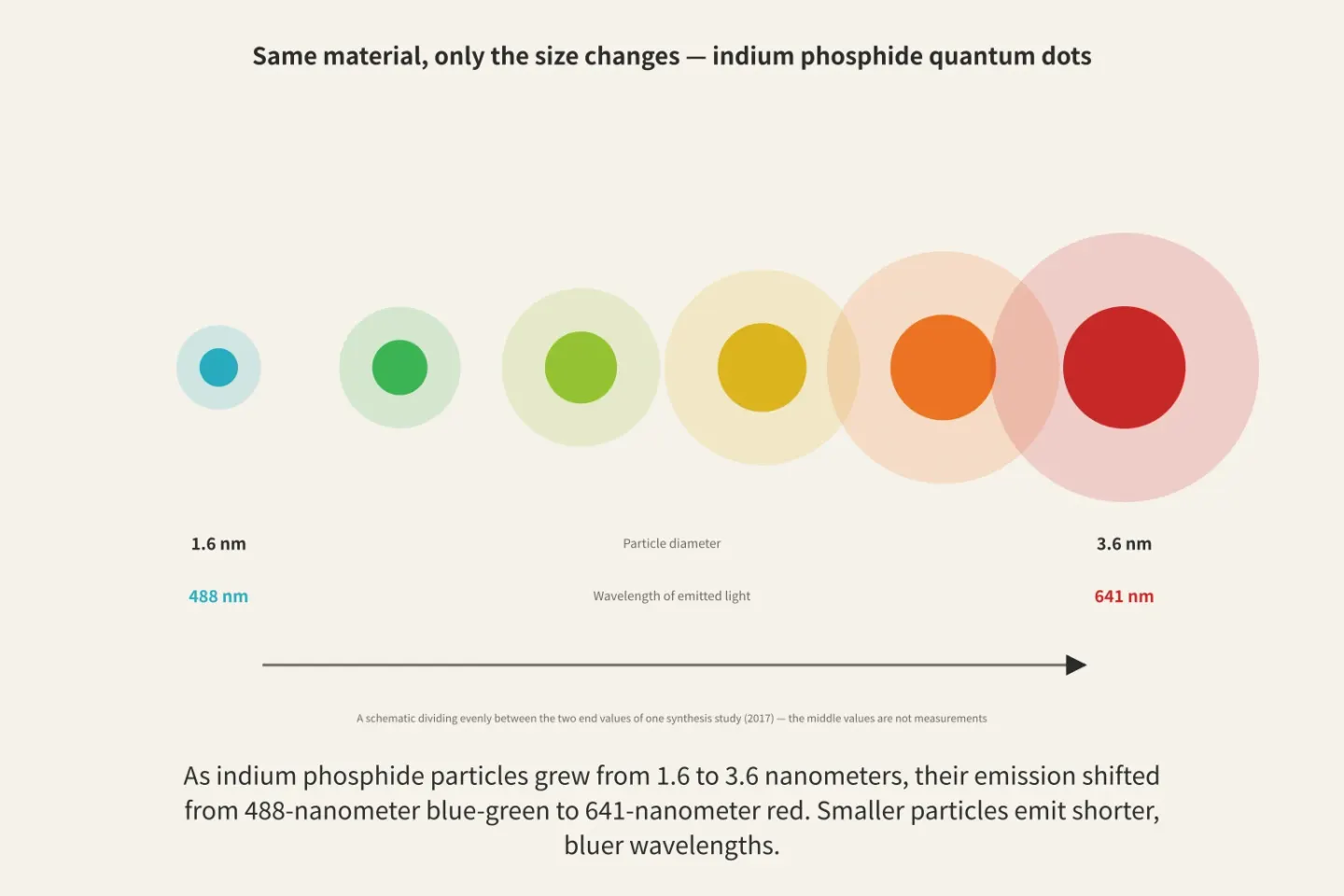
Figure: A schematic drawn by Paperis based solely on the text
A quantum dot is a semiconductor crystal particle several nanometers in diameter, and the color of light it emits changes depending on its size. A semiconductor is a material somewhere between a metal, which conducts electricity well, and glass, which hardly conducts it at all, so electricity either flows or is blocked depending on the conditions. The basics of that were covered in "Semiconductors and the p-n Junction — An Empty Space in a Full Parking Garage, a Line Crossed Only One Way". Quantum dots have been studied as fluorescent particles whose color can be chosen by setting their size, and their uses range from solar cells and optical devices to cell imaging and ultra-sensitive detection (DOI: 10.1021/ar9001069).
In home appliance stores, you can see TVs with names like "Quantum Dot". Just from that name, you cannot tell what quantum dots are actually doing inside the screen. This article follows two questions. Exactly how far have quantum dots come in screens and devices today? And how dangerous is the cadmium that has long been used in quantum dots, and how far have cadmium-free materials caught up? The basis is the abstracts of journal papers, and company announcements are reported in the companies' own words.
Why Smaller Means Bluer
Electrons inside a semiconductor cannot stay at just any energy level. The band gap is an energy range within that material where electrons cannot stay at all. In terms of the parking garage from the sibling article, it is the height from the full first floor to the empty second floor. A hole is the vacant spot left behind when an electron moves away.
When an electron that went up to the second floor settles back down into a hole on the first floor, it can release energy equal to that height as light. A light-emitting diode is a diode made so that electrons and holes meet at the junction to produce light, commonly called an LED. The larger the released energy, the further the light goes toward the blue end, and the smaller it is, the further it goes toward the red end.
In bulk semiconductors, this height is fixed for each material. The situation changes when a crystal shrinks down to a few nanometers. The quantum confinement effect is a phenomenon where electrons and holes are confined in a small space the size of the crystal, and the smaller the crystal, the wider the band gap. This is similar to how the shorter you hold a guitar string, the higher the pitch. The narrower the confined space, the higher the lowest energy an electron can have. However, while guitar sound is determined solely by the string's length, a quantum dot's color is determined by layering the size effect on top of the material's original band gap.
American chemist Louis Brus treated this effect mathematically in 1984. In semiconductor crystals as small as about 50 angstroms in diameter, or roughly 5 nanometers, the properties of electrons differ from bulk materials, and the state where electrons have taken in energy and moved up takes on characteristics close to molecules (DOI: 10.1063/1.447218). Brus put forward an approximation formula showing how the energy of the lowest state to which electrons can move up by absorbing energy changes depending on the crystal size. This formula calculates values using only the properties of the bulk material, without any adjustable parameters fitted to the results (DOI: 10.1063/1.447218). This means that if you just know the material's properties and size, you can estimate that energy in advance.
Thanks to this effect, researchers can shift the light of quantum dots from ultraviolet to visible, near-infrared, and mid-infrared light by changing their size and shape (DOI: 10.1021/ar9001069). Even indium phosphide, which has a band gap of 1.35 electron volts in bulk form, can be made to emit deep red or near-infrared light by controlling its size (DOI: 10.1002/adom.202300612). The smaller the crystal, the wider the band gap, and the more the light shifts toward the blue end. The color of a quantum dot has its rough range determined by the material, and a specific point within that range is decided by its size.
Growing Uniform Particles
If size determines color, when the particles inside a single bottle are uneven in size, their color also blurs. Indium phosphide quantum dots have lagged behind cadmium selenide quantum dots in light width and efficiency. One research team points to small clumps that linger during synthesis as the main culprit behind particle size scattering, and notes that this presents an opportunity to make colors more distinct (DOI: 10.1002/sdtp.12481).
Growing the particles uniformly was done in solution. Colloidal quantum dots are quantum dots grown while floating in a solution. Solution synthesis for colloidal quantum dots such as cadmium selenide advanced significantly over the 20 years leading up to 2015 (DOI: 10.2109/jcersj2.123.1). The 2023 Nobel Prize in Chemistry went to three people—Alexei Ekimov, Louis Brus, and Moungi Bawendi—for discovering and synthesizing quantum dots.
A single particle usually does not end with just one layer. A core-shell structure is a structure in which the light-emitting particle (the core) is wrapped in a different semiconductor shell. The composition of the shell and surface molecules is used to protect quantum dots from external factors such as oxygen, water, and heat (DOI: 10.1002/adma.201804294), and the thickness of the shell reduces energy leaking into neighboring particles or losing energy without emitting light (PMID 31776489). Later in this article, the shell returns to the center of a safety issue.
Particles grown in solution can be applied like ink by coating or printing to make devices. A 2016 review summarizes that the properties of materials made from quantum dots are controlled not only by atomic composition, but also by size, shape, surface treatment, and the interactions exchanged between particles. The same review notes that this surface property is the key to making cheap, large-area, flexible devices from solution, while challenges remain to be solved along that path (PMID 27563099). When it comes to making quantum dots into devices, the surface is just that important.
Quantum Dots in TVs Are Usually Light-Converting Films
The first place quantum dots entered the market was as the backlight of liquid crystal displays (LCDs). Color conversion is a method where quantum dots absorb light from a blue LED and re-emit it as green and red light. LCDs create images by having liquid crystals block or pass the light shining from behind, and putting quantum dots into this backlight broadens the range of colors the screen can produce (DOI: 10.1149/2.012302jss).
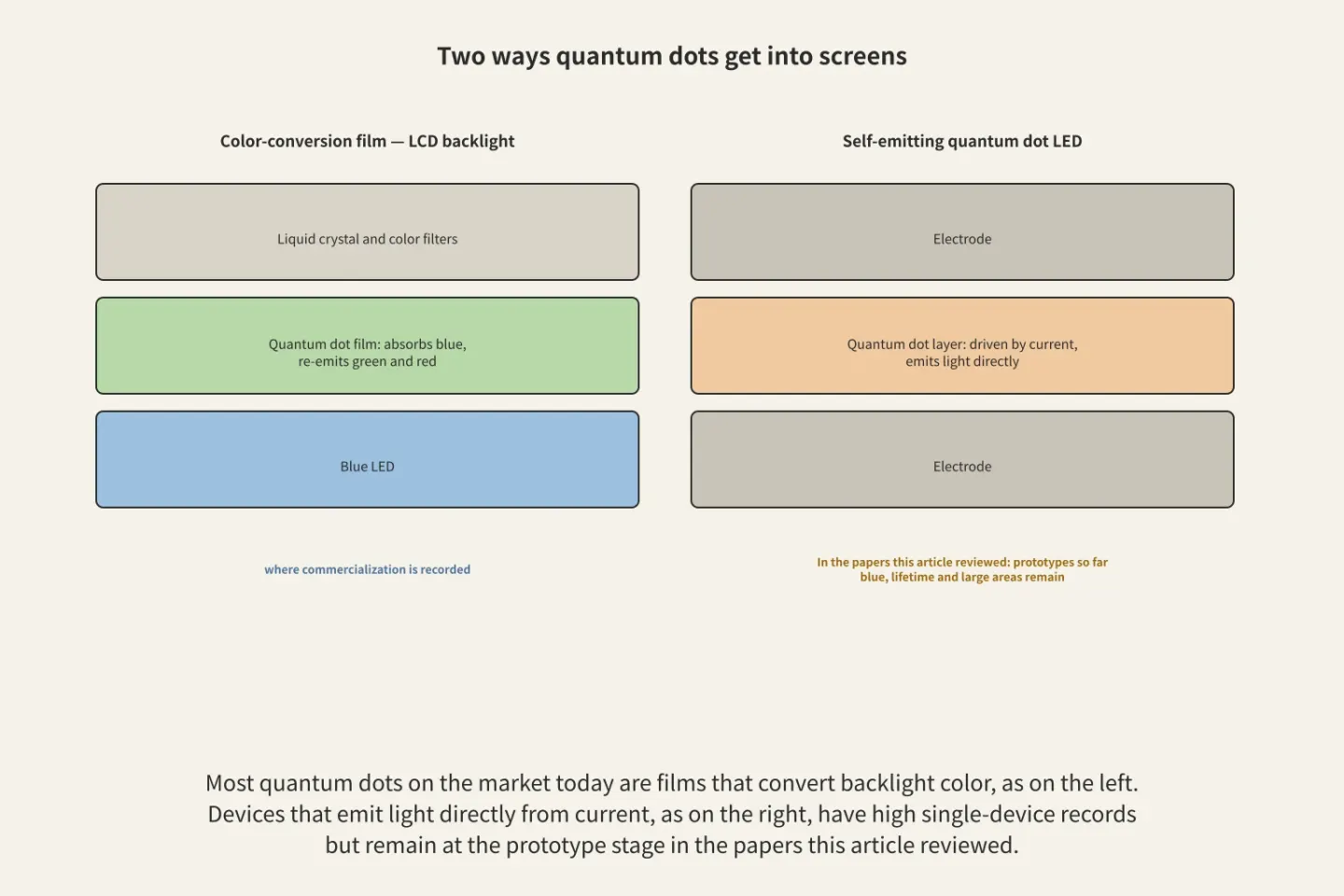
Figure: A diagram drawn by Paperis based solely on the text
A 2012 paper noted that after 25 years of scientific research and more than 10 years of commercialization efforts, quantum dots were right on the verge of being widely used in displays (DOI: 10.1149/2.012302jss). A 2016 review summarized that quantum dots used for LCD backlights had already reached a commercial level, and that the next big challenge was making them emit light directly with electricity (DOI: 10.3390/ma9080672). A 2017 review also records that quantum dots used as backlight color conversion materials drove the growth of quantum dot TVs (DOI: 10.1002/adma.201607022). The role of quantum dots recorded by papers as commercialized is a film that changes blue light into other colors.
The color benefit was evaluated through calculation. Calculated with actually measured light spectra of quantum dots, a backlight made with a blue LED and green and red quantum dots could produce 115% of the color gamut in a standard color space while maintaining the same energy efficiency as conventional backlights (DOI: 10.1364/oe.21.026269). The same study also found that there is a fundamental trade-off between screen efficiency and color gamut. This means there is a point where trying to widen the colors requires giving up some efficiency (DOI: 10.1364/oe.21.026269).
LCD screens also have ceilings unrelated to quantum dots. A 2017 study analyzed how backlight wavelength, light width, and color filters determine the color gamut of LCD screens, calculating that there is an insurmountable theoretical limit even if the light width is narrowed down to 1 nanometer. That research team added polarization-handling components to create a new backlight that reduced mixing between the three primary colors, and experimentally achieved 95.8% of a next-generation standard color space using a film of a different crystal material emitting green light and red quantum dots (DOI: 10.1038/lsa.2017.43). Another prototype from 2018 reported replacing the color filter spots entirely with an indium phosphide quantum dot film, increasing overall efficiency by 2.42 times compared to an LCD screen using conventional phosphor backlights and color filters (DOI: 10.1002/adom.201701239). The breadth of colors a screen produces is determined by the entire screen design, including color filters and the backlight, alongside quantum dots.
Quantum dots inside films must endure for a long time. Quantum dots are damaged by oxygen, water, heat, and ultraviolet rays, and researchers have prevented this by changing the composition of shells and surface molecules or embedding quantum dots inside polymers (DOI: 10.1002/adma.201804294). That review forecasts that a better understanding of degradation principles and the creation of more stable quantum dots and devices will allow quantum dots to play an important role in displays (DOI: 10.1002/adma.201804294). Stability remained an ongoing homework assignment in 2019 as well.
Quantum Dots That Shine by Themselves
The next step is screens where the quantum dot itself becomes a pixel without a backlight. A quantum dot light-emitting diode is a light-emitting diode made by passing an electric current through a quantum dot layer so that the quantum dots emit light directly, commonly abbreviated as QLED in papers. Performance is mainly compared by efficiency. External quantum efficiency is a value indicating what percentage of light particles escape outside compared to the number of electrons injected into the device.
Quantum dot light-emitting diodes containing cadmium recorded external quantum efficiencies of 20.5% for red, 21.0% for green, and 19.8% for blue around 2019 (PMID 31776489). A study in the same year made quantum dots with an indium phosphide core wrapped in a zinc selenide and zinc sulfide shell without cadmium. The particles emitted back nearly 100% of the light they received, and a device made with these quantum dots achieved a theoretical maximum external quantum efficiency of 21.4% and a peak brightness of 100,000 candelas per square meter in units of brightness. A lifespan of 1,000,000 hours was presented at a brightness of 100 candelas per square meter (PMID 31776489). The authors conclude that this performance is comparable to top-tier cadmium devices and can soon be used in commercial displays (PMID 31776489). The abstract does not reveal what colors this device emits.
Since 1 million hours is more than 114 years, you cannot keep them turned on and measure them for that long, so it has to be a value extrapolated from short measurements. The abstract does not state the method and the definition of lifetime. Also, this lifetime is a value measured at 100 cands per square meter, in other words, at 1/1,000th of the maximum brightness produced by the same device. Around the same time, an indium phosphide device by another research team reported an external quantum efficiency of 6.3% in green light as its highest record (DOI: 10.1002/adom.201801602), and other green light devices in 2021 achieved 7.06% and 5.42% (DOI: 10.1002/adfm.202008453) (DOI: 10.1109/led.2021.3119322). In 2022, research came out that modified the hole-injecting layer to achieve 20.4% in an indium phosphide device, and its authors also started from the premise that the performance of indium phosphide devices lags far behind cadmium devices (DOI: 10.1007/s12274-022-5268-4). Efficiency records are the value for a single best-made device, but a screen requires three colors to endure together for a long time across a large area.
A study in 2026 produced results that narrowed that distance. In indium phosphide quantum dots, the shell grew on only specific crystal faces, fixing the problem of failing to trap electrons well, achieving an external quantum efficiency of 23.50% and increasing device lifetime by 107.5 times. A transistor is a tiny switch turned on and off by electricity. It is that component covered in "A Transistor Is a Switch — A Tiny Faucet You Open and Close with Electricity". The research team made a prototype of an active-matrix display with a transistor for each pixel using these quantum dots, and showed still and moving images on it (DOI: 10.1038/s41467-026-69050-7). The problem that study wrote down as its starting point is the difficulty of realizing a completely cadmium-free quantum dot light-emitting diode display (DOI: 10.1038/s41467-026-69050-7).
Between making a single pixel well and building a screen, there is a manufacturing process. A 2017 review paper covered the process of arranging red, green, and blue pixels with high resolution over a large area, while separately highlighting the core challenges that active-matrix quantum dot displays must overcome (DOI: 10.1002/adma.201607022). A 2022 study printed cadmium-free quantum dot inks using an inkjet to fabricate red, green, and blue pixel arrays measuring 60 micrometers wide by 160 micrometers long, preventing the ink from dissolving the underlying layer to preserve lifespan (DOI: 10.1002/jsid.1133). In 2025, in a bendable device, three-color cadmium-free quantum dots achieved an external quantum efficiency of over 15% and maintained over 90% performance even after being bent 5,000 times (DOI: 10.1002/adma.202420575). Both studies are laboratory prototypes, and the authors of the inkjet study describe their results as a bridge toward the commercialization of cadmium-free displays.
The color that has fallen farthest behind is blue. Red and green indium phosphide devices have improved significantly, but blue indium phosphide devices are facing major difficulties, and the causes are cited as the low performance of the blue indium phosphide quantum dots themselves and a lack of device research (DOI: 10.1002/adom.202202036). A 2025 review paper also summarizes that the performance of cadmium-free and lead-free blue devices noticeably lags behind red and green and that reports are scarce (DOI: 10.1002/lpor.202502575). A 2025 preprint covering cadmium-free blue zinc-selenium-tellurium devices yielded results suggesting a causal relationship between oxygen vacancies forming in the oxide layer carrying electrons during operation and device degradation (arXiv:2509.12598, preprint). That the light-emitting operation of such blue devices lacks an agreed-upon understanding yet is the starting point of that preprint.
How Dangerous Is Cadmium?
Cadmium is a heavy metal with known toxicity, and the majority of quantum dots used in high-performance display devices contain cadmium or lead (DOI: 10.1002/lpor.202502575). All toxicity evidence in this section comes from experiments on cells, bacteria, rats, and monkeys.
In cell experiments, cadmium ions released from quantum dots were pointed to as the primary source of toxicity. Quantum dots with a cadmium telluride core coated with single layers of cadmium sulfide and zinc sulfide shells showed almost no toxicity to cells, and the researchers view this as evidence that the zinc sulfide shell provides protection (PMID 22078811). The same researchers note that the amount of cadmium ions inside the cells could not fully explain the toxicity, and that where the quantum dot particles are located inside the cells and the nano-sized effect itself also contribute to the toxicity (PMID 22078811). There is also a review collecting the toxicity and pathways caused by cadmium quantum dots in liver cells, kidney cells, lung cells, nerve cells, and fibroblasts (PMID 30961689).
In animals, the results are mixed. In one study administering cadmium-selenium quantum dots to rats, the quantum dots spread to multiple organs and accumulated mainly in the liver, damaging liver tissue. In that study, the liver toxicity of the quantum dots was greater than an equivalent or larger amount of cadmium ions, and the authors conclude that the impact of quantum dots can stem from both the toxicity of the particles themselves and the cadmium ions released from the quantum dots (DOI: 10.1371/journal.pone.0024406). In a study using quantum dots for imaging in monkeys, the quantum dots accumulated in lymph nodes, bone marrow, liver, and spleen for up to three months without side effects. A 2013 commentary introducing this result notes that such long retention itself raises safety concerns (PMID 22775328).
Environmental experiments show what conditions determine outcomes. Quantum dots with intact surface coatings slowed bacterial growth but did not kill the bacteria. When weathered under acidic conditions of pH 4 or below or alkaline conditions of pH 10 or above, the organic surface coatings fell off, releasing cadmium and selenium ions in under a minute and greatly increasing the bacteria-killing power. The presence of organic matter such as humic acid or proteins in soil reduced metal absorption and lowered toxicity (DOI: 10.1021/es8023385). The authors conclude that based on limited evidence, quantum dots are potentially safe when used for their intended purpose in near-neutral conditions, but even moderately acidic or alkaline conditions can cause localized harm (DOI: 10.1021/es8023385).
This evidence all comes from laboratory cells, bacteria, and animals, and none of these data measure how much humans are exposed to quantum dots through devices. That 2013 commentary suggests examining the pathways through which humans could be exposed to quantum dots in the workplace and the environment, and integrating toxicity, genetic, and imaging studies to establish comprehensive guidelines (PMID 22775328). The same commentary cites observations where cadmium quantum dots—even at extremely low concentrations ranging from nanomolar to picomolar levels—damaged cell genes, altered how genes are turned on and off, and acted like estrogen. The authors write that these observations strongly suggest that even trace amounts can produce long-lasting effects, and furthermore effects extending to the next generation. They also consider that if quantum dots partially degrade over time in the environment or inside the body, they could produce small but cumulative harmful effects (PMID 22775328). Results directly measuring transgenerational effects are not in this abstract, and are inferences drawn by the authors from cell observations. In several experiments, toxicity increased when shells or surface coatings broke down and cadmium was released, but there are also results—like the rat experiment—where released cadmium alone could not explain the effects, leading researchers to conclude that the particles themselves may also be a cause, and none of these are data measuring human exposure.
What Do You Give Up When You Remove Cadmium?
Cadmium is an element whose use is restricted in the European Union and some other countries (DOI: 10.1364/prj.428843). A 2015 review noted that producing full-spectrum visible light from light-emitting elements and color-conversion films still could not avoid using toxic cadmium, and that less toxic alternatives were needed (DOI: 10.2109/jcersj2.123.1). Meanwhile, Samsung researchers stated in a 2018 conference presentation that their company had released ultra-high-definition TVs using cadmium-free quantum dots as its main product line starting in 2015. That presentation notes that even if there is an EU regulatory exemption, one must remain mindful of the environmental risks involved in mass-producing cadmium materials and using them in consumer electronics (DOI: 10.1109/iedm.2018.8614647). The launch timing and product composition are statements from the company involved.
The most promising candidate to replace cadmium is indium phosphide. The trade-off was color purity. Around 2017, the emission linewidth of indium phosphide quantum dots was 45 to 50 nanometers for green and over 50 nanometers for red, whereas a width narrower than 35 nanometers was considered desirable for commercial displays (DOI: 10.1021/acs.chemmater.7b02204). The narrower the emission linewidth, the purer the color. That study narrowed the linewidth to 36 nanometers for green (DOI: 10.1021/acs.chemmater.7b02204), and another study from 2021 achieved 33 nanometers through size-selective purification (DOI: 10.1021/acs.chemmater.1c00348). In 2022, results of synthesis on a kilogram scale while maintaining good luminescence properties were also published (DOI: 10.35848/1882-0786/aca9ba).
Depending on the application, the weight of the same weakness differs. While a narrow emission linewidth is key for displays that require a wide color gamut, the penalty paid for the wider linewidth of indium phosphide is small in lighting (DOI: 10.1364/prj.428843). That study built a white LED using red indium phosphide quantum dots and conventional phosphors that achieved an efficiency of 132 lumens per watt and a color rendering index—which indicates how closely an object's colors resemble those under natural light—of about 90 (DOI: 10.1364/prj.428843).
Safety concerns also remain for indium phosphide. In a 2019 study that tested seven types of indium phosphide-based quantum dots, freshly made quantum dots had virtually no cytotoxicity, and among them, one type with a shell was less toxic than the bare core alone. When weathered rapidly in an accelerated aging test chamber, the quantum dots decomposed and distinct cytotoxicity appeared (DOI: 10.1016/j.impact.2019.100168). While concluding that indium phosphide-based materials are a safer alternative to cadmium selenide, the authors write that to ensure safety, the structure of the quantum dots must be preserved as much as possible with sturdier shells. That safety research on indium phosphide quantum dots is still in its infancy is also the starting point of that study (DOI: 10.1016/j.impact.2019.100168). The condition that shells must hold up for safety remains even when cadmium is removed.
The Side That Receives Light — Solar Cells and Photodetectors
Quantum dots are used not only to emit light, but also to absorb light and turn it into electricity. The same property of being able to choose the range of light they absorb by their size is used here. However, quantum dots with good performance in solar energy conversion mostly contain toxic metals like cadmium or lead, and a 2024 review brings together heavy-metal-free quantum dots for solar cells, making fuel with sunlight, and light-concentrating devices (PMID 38923167).
Devices that put quantum dots into a wide plate like a building window to gather light to solar cells at the edge of the plate are also studied. Quantum dots can have their absorption and emission ranges chosen and withstand light well, making them good to use in this plate, but quantum dots commonly used now contain cadmium and lead, so an eco-friendly quantum dot plate is needed, which is the summary of a 2019 review (PMID 31065522). Quantum dots made of silver, bismuth, and sulfur instead of lead and cadmium made a first breakthrough in solar cells in 2016, but progress since then has been relatively slow, and many of the basic properties of these materials are still unknown (DOI: 10.3390/nano14161328).
On the photodetector side that senses light, image sensors, health-measuring devices attached to the body, and machine vision are cited as applications. The reason is that they can be made into low-cost, large-area, bendable devices because they can be produced from solution (DOI: 10.1002/lpor.71313). The evidence on this side is a summary from a review and does not speak to the state of products.
Illuminating the Inside of the Body
In biomedical imaging, quantum dots are brighter than traditional fluorescent dyes and fade less when exposed to light for a long time. Another advantage is that they can absorb a wide range of light and turn on multiple colors at once (DOI: 10.1146/annurev-anchem-060908-155136). That 2013 review notes that the potential toxicity of quantum dots remains a major concern in living bodies and clinical imaging. On the other hand, in diagnostics that look at samples outside the body, cadmium toxicity is no longer an issue, leading to the forecast that the most clinically meaningful uses in the near future will be molecular diagnostics and pathology tests using multi-colored quantum dots (DOI: 10.1146/annurev-anchem-060908-155136).
A 2026 review, 13 years later, summarizes research on quantum dot-based biosensors, imaging, and cancer treatment, while separately analyzing the bottlenecks blocking quantum dots on their path from laboratory innovation to routine clinical use (DOI: 10.1002/advs.75491). Biodegradable silicon quantum dots inside the body have been used in cases of cancer cell imaging and drug delivery in living bodies (DOI: 10.1093/bulcsj/uoad002). Quantum dots that illuminate the inside of the body are still standing before the threshold of the clinic.
The Store's Two Screens
Now we stand in front of the TV in the home appliance store again. Following the facts cited in this article, let us trace those screens.
If it is a liquid crystal screen that uses quantum dots in its backlight, a blue LED shines from behind the screen, and a quantum dot film turns part of that light into green and red. This spot is where papers record commercialization. Whether the quantum dots inside the film are cadmium-based or indium phosphide-based cannot be known by the name "quantum dot" written on the box. Either way, quantum dots are vulnerable to oxygen, water, heat, and ultraviolet light. The studied toxicity grew in experimental quantum dots used by dissolving them in water, under conditions where the shell or coating breaks down. The results of testing quantum dots inside a screen film as they are are not among the grounds of this article.
If that screen produces a wide range of colors, the design of the color filters and the backlight, along with the narrow light of the quantum dots, determines that breadth. There is a trade-off with efficiency in widening colors further, and efficiency also depends on the backlight and filter design, so one cannot say based on color alone that it is a screen that uses less electricity.
We turn off the screen and think about after long use. Under the studied conditions, toxicity appeared under conditions that break down the shell or coating, such as strong acid or alkali weathering or accelerated weathering in climate testing devices. How much quantum dots inside a discarded screen actually encounter such conditions cannot be answered by the evidence of this article.
If another screen placed next to it advertises that every single quantum dot is a screen that shines with electricity, what can be verified with the evidence of this article is up to laboratory prototypes. Cadmium-free red and green devices have greatly narrowed the gap with cadmium devices, and blue lags behind.
What We Still Do Not Know
As of the 2025 review, cadmium-free blue quantum dot devices lag behind red and green, and the path to bridging that gap remains open. We also cannot judge just from abstracts how many years of actual screen use the lifetimes reported in laboratories will translate to. Data measuring whether indium phosphide quantum dots maintain their structure even after products are discarded at the end of their lifespan, or how much humans are exposed to quantum dots at work and in daily life, are likewise not included in the evidence for this article. In vivo imaging still faces a bottleneck in moving to clinical trials.
There are three directions for further reading: the causes of degradation in blue cadmium-free devices, measurements of what leaches out from aged quantum dot films and discarded products, and how extensively quantum dots are actually used in settings with lower toxicity concerns, such as in vitro diagnostics.
Source Papers
- "Electron–electron and electron-hole interactions in small semiconductor crystallites: The size dependence of the lowest excited electronic state" (1984) — DOI: 10.1063/1.447218 — In crystallites of roughly 50Å, electronic properties diverge from bulk, presenting a size-dependent approximation for the lowest excited state energy without tuning parameters (theory).
- "Semiconductor Nanocrystals: Structure, Properties, and Band Gap Engineering" (2009) — DOI: 10.1021/ar9001069 — Tuning emission from ultraviolet to mid-infrared by changing size and shape via quantum confinement, applied in solar cells, optical devices, imaging, and detection (review).
- "Deep‐Red InP Core‐Multishell Quantum Dots for Highly Bright and Efficient Light‐Emitting Diodes" (2023) — DOI: 10.1002/adom.202300612 — Tuning bulk bandgap 1.35 eV indium phosphide to deep red and near-infrared via size, 680 nm quantum dots, device external quantum efficiency 6.5%.
- "Tunable, Bright, and Narrow-Band Luminescence from Colloidal Indium Phosphide Quantum Dots" (2017) — DOI: 10.1021/acs.chemmater.7b02204 — Indium phosphide size 1.6–3.6 nm, emission 488–641 nm. Emission width green 45–50, red 50 or more, commercial displays prefer under 35. Achieved green 36 nm, air and thermal stability.
- "4‐1: Invited Paper: Role of Phosphorus Oxidation in Controlling the Luminescent Properties of Indium Phosphide Quantum Dots" (2018) — DOI: 10.1002/sdtp.12481 — Indium phosphide lags behind cadmium selenide in emission width and efficiency, persistent intermediate clusters are the main source of size dispersion, opportunity for color purity improvement (conference invited paper).
- "Colloidal semiconductor quantum dots; syntheses, properties and applications" (2015) — DOI: 10.2109/jcersj2.123.1 — 20 years of progress in solution synthesis, cadmium remains inevitable for full-color emission, less toxic alternatives needed (review).
- "Highly efficient and stable InP/ZnSe/ZnS quantum dot light-emitting diodes" (2019) — PMID 31776489 — Cadmium device records 20.5/21.0/19.8%, indium phosphide quantum yield roughly 100%, external quantum efficiency 21.4%, 100,000 cd/m², lifetime 1 million hours at 100 cd/m², shell thickness suppresses energy transfer, author conclusion that it can soon be used in commercial displays.
- "Building devices from colloidal quantum dots" (2016) — PMID 27563099 — Tuning properties via size, shape, surface, and interactions, surface is the key to cheap, large-area, flexible solution-processed devices, remaining challenges (review).
- "Quantum Dots for LED Downconversion in Display Applications" (2012) — DOI: 10.1149/2.012302jss — After 25 years of research and over 10 years of commercialization efforts, LCD color conversion is right on the verge of widespread adoption, widest color gamut.
- "Engineering of Semiconductor Nanocrystals for Light Emitting Applications" (2016) — DOI: 10.3390/ma9080672 — Quantum dots for LCD backlights are already at commercial levels, next challenge is electroluminescence (review).
- "Quantum‐Dot Light‐Emitting Diodes for Large‐Area Displays: Towards the Dawn of Commercialization" (2017) — DOI: 10.1002/adma.201607022 — Backlight color conversion drove quantum dot TV growth, precursors to QLED commercialization and challenges for active-matrix displays.
- "Wide color gamut LCD with a quantum dot backlight" (2013) — DOI: 10.1364/oe.21.026269 — CIE 1931 115% color gamut at the same energy efficiency, fundamental tradeoff between efficiency and color gamut.
- "Stability of Quantum Dots, Quantum Dot Films, and Quantum Dot Light‐Emitting Diodes for Display Applications" (2019) — DOI: 10.1002/adma.201804294 — Oxygen, moisture, heat, and UV degradation, protected by shells, surface molecules, and polymers, outlook for an important role when stability is improved (review).
- "High‐Efficiency Green InP Quantum Dot‐Based Electroluminescent Device Comprising Thick‐Shell Quantum Dots" (2019) — DOI: 10.1002/adom.201801602 — Green indium phosphide device external quantum efficiency 6.3% (highest reported at the time).
- "Green InP/ZnSeS/ZnS Core Multi‐Shelled Quantum Dots Synthesized with Aminophosphine for Effective Display Applications" (2021) — DOI: 10.1002/adfm.202008453 — Green indium phosphide device 7.06%, color conversion film lifetime exceeding 1,000 hours.
- "Boosting Efficiency of InP Quantum Dots-Based Light-Emitting Diodes by an In-Doped ZnO Electron Transport Layer" (2021) — DOI: 10.1109/led.2021.3119322 — Green indium phosphide device 5.42%, indium phosphide performance lags far behind cadmium devices.
- "Efficient solution-processed InP quantum-dots light-emitting diodes enabled by suppressing hole injection loss" (2022) — DOI: 10.1007/s12274-022-5268-4 — Indium phosphide device 20.4% via improved hole transport layer, starting point a large gap compared to cadmium devices.
- "Electron confinement-enhanced green InP-based quantum dots for active-matrix LEDs displays" (2026) — DOI: 10.1038/s41467-026-69050-7 — Green indium phosphide 23.50% and 107.5x lifetime via suppressed facet-selective shell growth, active-matrix display prototype, hurdle for fully cadmium-free displays.
- "Advances, Challenges, and Perspectives for Heavy‐Metal‐Free Blue‐Emitting Indium Phosphide Quantum Dot Light‐Emitting Diodes" (2022) — DOI: 10.1002/adom.202202036 — Red and green progress, blue indium phosphide devices face major difficulties (review).
- "Progress and Future Prospects in Eco‐Friendly Blue Quantum Dot Light‐Emitting Diodes for Next‐Generation Display Applications" (2025) — DOI: 10.1002/lpor.202502575 — Cadmium-free and lead-free blue device performance lags noticeably and reports are few (review).
- "Oxygen vacancy formation in ZnSeTe blue quantum dot light-emitting diodes" (2025) — arXiv:2509.12598 — Preprint. Oxygen vacancy formation in the oxide layer during blue device operation is causally linked to degradation.
- "The cytotoxicity of cadmium-based quantum dots" (2012) — PMID 22078811 — Cadmium ions released in cells are the main cause, applying cadmium sulfide and zinc sulfide shells layer by layer makes them nearly non-toxic, but ions alone do not explain it and nano effects also contribute.
- "Research Advances on Cytotoxicity of Cadmium-Containing Quantum Dots" (2019) — PMID 30961689 — Summary of toxicity and mechanisms in liver, kidney, lung, nerve, and fibroblast cells (review).
- "CdSe Quantum Dot (QD)-Induced Morphological and Functional Impairments to Liver in Mice" (2011) — DOI: 10.1371/journal.pone.0024406 — Liver accumulation and damage in mice, greater liver toxicity than an equal or greater dose of cadmium ions, author conclusion that the cause may be both the particles themselves and released cadmium ions.
- "Quantum dot cytotoxicity and ways to reduce it" (2013) — PMID 22775328 — Accumulation up to 3 months with no side effects in monkeys, persistence itself a concern, observation of genetic, epigenetic, and metalloestrogen effects at nano- to picomolar concentrations strongly suggesting intergenerational effects, effects accumulating after breakdown, exposure routes and comprehensive guidelines needed (commentary).
- "Quantum Dot Weathering Results in Microbial Toxicity" (2008) — DOI: 10.1021/es8023385 — Growth stunting only if organic coating is intact, ion release and sterilization within 1 minute upon weathering at pH ≤ 4 or ≥ 10, humic acids and proteins mitigate toxicity, potentially safe for original use in neutral conditions based on limited evidence.
- "Going beyond the limit of an LCD’s color gamut" (2017) — DOI: 10.1038/lsa.2017.43 — Theoretical limit of conventional LCD color gamut impassable even with a 1 nm emission width, Rec. 2020 95.8% with polarization-split backlights (experiment).
- "Color‐by‐Blue QD‐Emissive LCD Enabled by Replacing RGB Color Filters with Narrow‐Band GR InP/ZnSeS/ZnS QD Films" (2018) — DOI: 10.1002/adom.201701239 — Replacing color filters with indium phosphide quantum dot films, 2.42x overall efficiency compared to conventional phosphor-backlit LCDs (prototype).
- "Inkjet‐printed multi‐color arrays based on eco‐friendly quantum dot light emitting diodes with tailored hole transport layer" (2022) — DOI: 10.1002/jsid.1133 — Cadmium-free RGB inkjet pixels 60×160 μm, lifetime maintained by suppressing ink erosion, a bridge to commercialization.
- "Surface‐ and Spatial‐Regulated Cd‐Free Quantum Dots for Efficient, Mechanically Stable, and Full‐Color Flexible Light‐Emitting Diodes" (2025) — DOI: 10.1002/adma.202420575 — Cadmium-free three-color flexible devices over 15% efficiency, retaining over 90% after 5,000 bends, comparable to cadmium devices.
- "Efficient, high-CRI white LEDs by combining traditional phosphors with cadmium-free InP/ZnSe red quantum dots" (2021) — DOI: 10.1364/prj.428843 — Cadmium is a restricted element under the EU and others, sacrifice in emission width is small in lighting, 132 lm/W, Ra roughly 90 white LED.
- "Environmentally Friendly Quantum Dots for Display Applications" (2018) — DOI: 10.1109/iedm.2018.8614647 — Samsung research presentation at a conference. Environmental risks of heavy cadmium use despite EU exemptions, cadmium-free quantum dot TVs launched since 2015 (first-party presentation).
- "Importance of Surface Functionalization and Purification for Narrow FWHM and Bright Green-Emitting InP Core–Multishell Quantum Dots via a Two-Step Growth Process" (2021) — DOI: 10.1021/acs.chemmater.1c00348 — Green indium phosphide emission width 33 nm after size-selective purification.
- "Highly luminescent and narrow-band-emitting InP/ZnSe/ZnS quantum dot synthesis by halide modified shell reaction" (2022) — DOI: 10.35848/1882-0786/aca9ba — Improved luminescence using zinc chloride, kilogram-scale synthesis.
- "Physicochemical alterations and toxicity of InP alloyed quantum dots aged in environmental conditions: A safer by design evaluation" (2019) — DOI: 10.1016/j.impact.2019.100168 — Freshly made indium phosphide family shows virtually no cytotoxicity, distinct toxicity after weathering, stronger shells needed, safety research is in its infancy.
- "Heavy-Metal-Free Colloidal Quantum Dots: Progress and Opportunities in Solar Technologies" (2024) — PMID 38923167 — Many high-performance quantum dots for solar applications contain cadmium and lead, summary of heavy-metal-free quantum dots (review).
- "Eco-Friendly Colloidal Quantum Dot-Based Luminescent Solar Concentrators" (2019) — PMID 31065522 — Advantages of quantum dot solar concentrators, commonly used quantum dots contain cadmium and lead, eco-friendly quantum dots needed (review).
- "Advancing Silver Bismuth Sulfide Quantum Dots for Practical Solar Cell Applications" (2024) — DOI: 10.3390/nano14161328 — Progress relatively slow after initial breakthrough in 2016, many basic properties unknown (review).
- "Recent Advances of Colloidal Quantum Dot Photodetectors for Emerging Optoelectronic Applications" (2026) — DOI: 10.1002/lpor.71313 — Image sensors, wearable health monitors, machine vision, cheap, large-area, flexible solution-processed devices (review).
- "Semiconductor Quantum Dots for Bioimaging and Biodiagnostic Applications" (2013) — DOI: 10.1146/annurev-anchem-060908-155136 — Brighter and less photobleaching than dyes, in vivo clinical translation faces major toxicity concerns, cadmium not an issue in in vitro diagnostics → molecular diagnostics and pathology core applications in the near future (review).
- "Quantum Dots for Biomedical Biosensing, NIR‐II Bioimaging, and Phototherapy: Materials Design, Signal Transduction, and Translational Barriers" (2026) — DOI: 10.1002/advs.75491 — Summary of biosensors, imaging, and therapy, and analysis of clinical translation bottlenecks (review).
- "Bright silicon quantum dot synthesis and LED design: insights into size–ligand–property relationships from slow- and fast-band engineering" (2024) — DOI: 10.1093/bulcsj/uoad002 — Biodegradable silicon quantum dot examples for in vivo cancer cell imaging and drug delivery, color determined by synthesis method as well as size (review).
Sources (42)
- Electron–electron and electron-hole interactions in small semiconductor crystallites: The size dependence of the lowest excited electronic stateDOI 10.1063/1.447218
- Semiconductor Nanocrystals: Structure, Properties, and Band Gap EngineeringDOI 10.1021/ar9001069
- Deep‐Red InP Core‐Multishell Quantum Dots for Highly Bright and Efficient Light‐Emitting DiodesDOI 10.1002/adom.202300612
- Tunable, Bright, and Narrow-Band Luminescence from Colloidal Indium Phosphide Quantum DotsDOI 10.1021/acs.chemmater.7b02204
- 4‐1: Invited Paper: Role of Phosphorus Oxidation in Controlling the Luminescent Properties of Indium Phosphide Quantum DotsDOI 10.1002/sdtp.12481
- Colloidal semiconductor quantum dots; syntheses, properties and applicationsDOI 10.2109/jcersj2.123.1
- Highly efficient and stable InP/ZnSe/ZnS quantum dot light-emitting diodesPMID 31776489
- Building devices from colloidal quantum dotsPMID 27563099
- Quantum Dots for LED Downconversion in Display ApplicationsDOI 10.1149/2.012302jss
- Engineering of Semiconductor Nanocrystals for Light Emitting ApplicationsDOI 10.3390/ma9080672
- Quantum‐Dot Light‐Emitting Diodes for Large‐Area Displays: Towards the Dawn of CommercializationDOI 10.1002/adma.201607022
- Wide color gamut LCD with a quantum dot backlightDOI 10.1364/oe.21.026269
- Stability of Quantum Dots, Quantum Dot Films, and Quantum Dot Light‐Emitting Diodes for Display ApplicationsDOI 10.1002/adma.201804294
- High‐Efficiency Green InP Quantum Dot‐Based Electroluminescent Device Comprising Thick‐Shell Quantum DotsDOI 10.1002/adom.201801602
- Green InP/ZnSeS/ZnS Core Multi‐Shelled Quantum Dots Synthesized with Aminophosphine for Effective Display ApplicationsDOI 10.1002/adfm.202008453
- Boosting Efficiency of InP Quantum Dots-Based Light-Emitting Diodes by an In-Doped ZnO Electron Transport LayerDOI 10.1109/led.2021.3119322
- Efficient solution-processed InP quantum-dots light-emitting diodes enabled by suppressing hole injection lossDOI 10.1007/s12274-022-5268-4
- Electron confinement-enhanced green InP-based quantum dots for active-matrix LEDs displaysDOI 10.1038/s41467-026-69050-7
- Advances, Challenges, and Perspectives for Heavy‐Metal‐Free Blue‐Emitting Indium Phosphide Quantum Dot Light‐Emitting DiodesDOI 10.1002/adom.202202036
- Progress and Future Prospects in Eco‐Friendly Blue Quantum Dot Light‐Emitting Diodes for Next‐Generation Display ApplicationsDOI 10.1002/lpor.202502575
- Oxygen vacancy formation in ZnSeTe blue quantum dot light-emitting diodesarXiv:2509.12598
- The cytotoxicity of cadmium-based quantum dotsPMID 22078811
- Research Advances on Cytotoxicity of Cadmium-Containing Quantum DotsPMID 30961689
- CdSe Quantum Dot (QD)-Induced Morphological and Functional Impairments to Liver in MiceDOI 10.1371/journal.pone.0024406
- Quantum dot cytotoxicity and ways to reduce itPMID 22775328
- Quantum Dot Weathering Results in Microbial ToxicityDOI 10.1021/es8023385
- Going beyond the limit of an LCD’s color gamutDOI 10.1038/lsa.2017.43
- Color‐by‐Blue QD‐Emissive LCD Enabled by Replacing RGB Color Filters with Narrow‐Band GR InP/ZnSeS/ZnS QD FilmsDOI 10.1002/adom.201701239
- Inkjet‐printed multi‐color arrays based on eco‐friendly quantum dot light emitting diodes with tailored hole transport layerDOI 10.1002/jsid.1133
- Surface‐ and Spatial‐Regulated Cd‐Free Quantum Dots for Efficient, Mechanically Stable, and Full‐Color Flexible Light‐Emitting DiodesDOI 10.1002/adma.202420575
- Efficient, high-CRI white LEDs by combining traditional phosphors with cadmium-free InP/ZnSe red quantum dotsDOI 10.1364/prj.428843
- Environmentally Friendly Quantum Dots for Display ApplicationsDOI 10.1109/iedm.2018.8614647
- Importance of Surface Functionalization and Purification for Narrow FWHM and Bright Green-Emitting InP Core–Multishell Quantum Dots via a Two-Step Growth ProcessDOI 10.1021/acs.chemmater.1c00348
- Highly luminescent and narrow-band-emitting InP/ZnSe/ZnS quantum dot synthesis by halide modified shell reactionDOI 10.35848/1882-0786/aca9ba
- Physicochemical alterations and toxicity of InP alloyed quantum dots aged in environmental conditions: A safer by design evaluationDOI 10.1016/j.impact.2019.100168
- Heavy-Metal-Free Colloidal Quantum Dots: Progress and Opportunities in Solar TechnologiesPMID 38923167
- Eco-Friendly Colloidal Quantum Dot-Based Luminescent Solar ConcentratorsPMID 31065522
- Advancing Silver Bismuth Sulfide Quantum Dots for Practical Solar Cell ApplicationsDOI 10.3390/nano14161328
- Recent Advances of Colloidal Quantum Dot Photodetectors for Emerging Optoelectronic ApplicationsDOI 10.1002/lpor.71313
- Semiconductor Quantum Dots for Bioimaging and Biodiagnostic ApplicationsDOI 10.1146/annurev-anchem-060908-155136
- Quantum Dots for Biomedical Biosensing, NIR‐II Bioimaging, and Phototherapy: Materials Design, Signal Transduction, and Translational BarriersDOI 10.1002/advs.75491
- Bright silicon quantum dot synthesis and LED design: insights into size–ligand–property relationships from slow- and fast-band engineeringDOI 10.1093/bulcsj/uoad002