
Paperis Articles
"Silent Night" — Where Did the Story of the Broken Organ Come From?
A broken-organ story with no documentary basis, a song that spread as a "Tyrolean song" without its creators' names, testimony from the 1914 truce, and a count of 300 languages it is said to have been translated into
Your field's papers, as audio
Pick your fields and journals — Paperis summarizes the key papers and turns them into audio. Listen on your commute.
Start Paperis free →"Silent Night" — Where Did the Story of the Broken Organ Come From?
Christmas Eve 1818, By the Salzach River
In 1816, after the Napoleonic Wars, the Salzach region was divided between Bavaria and Austria. As the Salzach River became the border, the riverside village of Oberndorf was separated from Laufen, the administrative center across the river (Silent Night Association). Oberndorf had a newly established St. Nicholas parish, and Joseph Mohr was the assistant priest of that parish. Franz Xaver Gruber, a school teacher from the neighboring village of Arnsdorf, had been serving concurrently as the organist of this parish since 1816 (Silent Night Association, Gruber Introduction).
On December 24, 1818, Mohr handed a poem to Gruber. It was a poem that Mohr had written two years prior while working as an assistant priest in Mariapfarr in the Lungau region (Silent Night Association). Gruber set it to music within the day, and the song was sung for the first time that night during the Christmas Mass. Mohr sang tenor and played the guitar, while Gruber sang bass. The listeners were mainly the boatmen and shipbuilders of the Salzach River, and it is recorded that the song received "everyone's applause" (Silent Night Association). The final line was repeated by the choir, and perhaps by the congregation as well (Appraisal by Musicologist Hochradner).
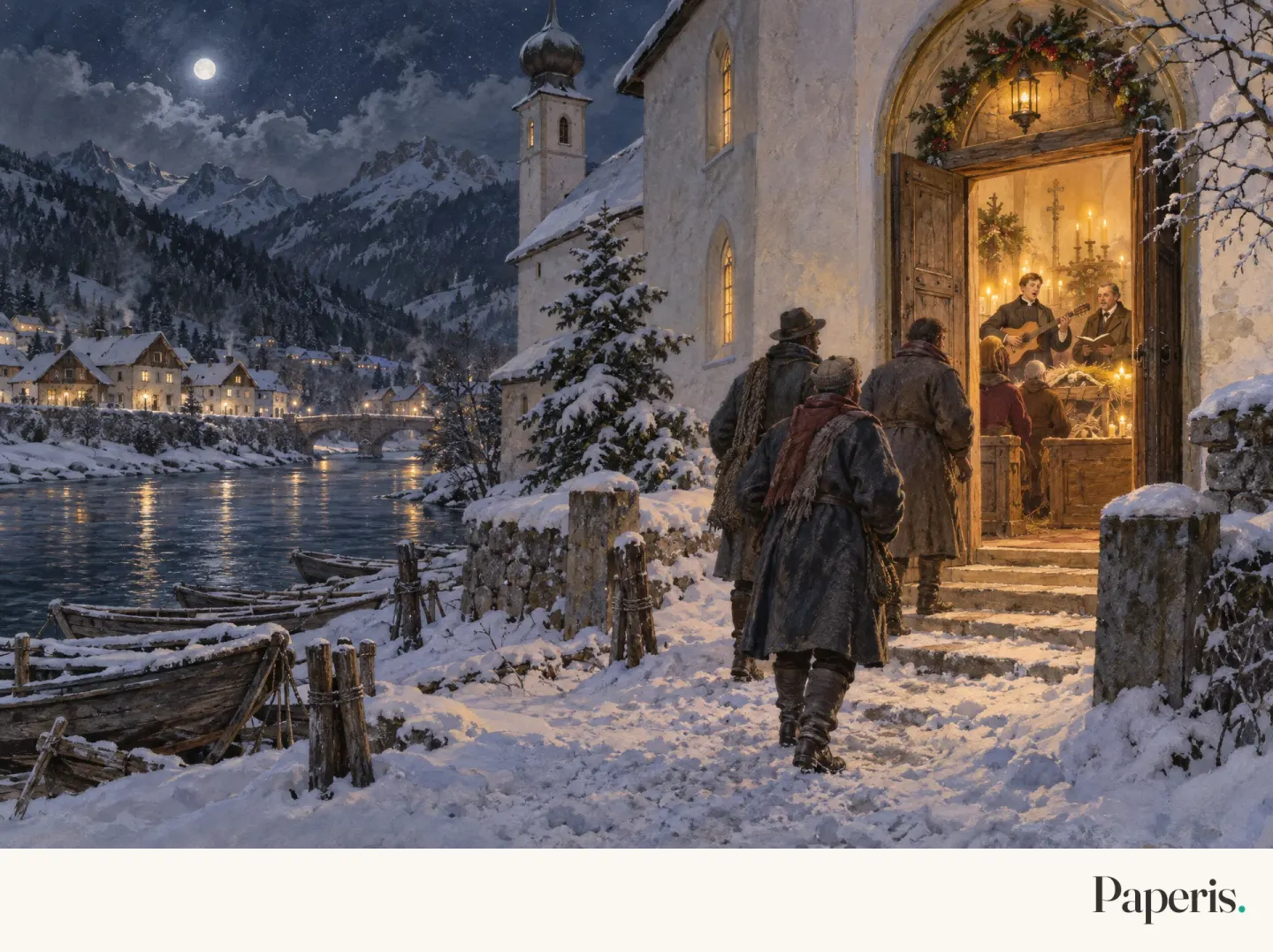
Figure: An imagined view of the first performance on Christmas Eve 1818 — the record says Mohr sang tenor and played guitar, Gruber sang bass, and the congregation was mostly boatmen and boatbuilders · Paperis illustration
The lyrics begin with "Stille Nacht", meaning "Silent Night". The first line is followed by "Alles schläft, einsam wacht" (All is asleep, lonely is awake), and the stanza ends with "Schlaf in himmlischer Ruh" (Sleep in heavenly peace). In Korea, it is sung under the title "Silent Night, Holy Night".
The musical score from that day in 1818 does not survive. An autograph score is a musical score written directly by the composer's own hand. Among the scores handwritten by the composer, the oldest surviving one is an autograph score written by Mohr around 1820–1825. From the transcribed edition of this score, we listen to the first four measures as a synthesized sound. The two parts move side by side in harmony, swaying along in a 6/8 meter that counts two groups of three beats per measure. The guitar accompaniment was filled in by the transcriber, so it does not play the exact accompaniment written by Gruber.
Clip: Gruber, "Stille Nacht" — bars 1–4 from a transcription of Joseph Mohr's autograph (c. 1820–1825), two voices with guitar (synthesized timbre; guitar part realized by the transcriber; score input Mutopia Project, public domain)
In the transcribed edition of Mohr's autograph score, the melody in the third and fourth measures ("Alles schläft, einsam wacht") briefly grazes a semitone lower before returning.
A widely spread story is attached to this first performance. It is the story that the church organ broke down because mice chewed through the organ's bellows, prompting Mohr and Gruber to hurriedly create a song with a guitar accompaniment. Where in the records is this story found? Other stories are also attached to this song. There is the story that it was a song passed down among the people of the Tyrol region without the composers' knowledge, the story that this song stopped the sound of gunfire on a Christmas night in the trenches of 1914, and the number of languages it has been translated into, which is 300.
When Did the Story of the Organ and the Story of the Mice First Appear?
The story of the broken organ began circulating in 1909. It first appears in a writing by a person named Josef Gottlieb that year (Official Salzburg State Website, Myths and Legends). This was 91 years after the first performance. The part about mice chewing on the air bellows was attached even later. The official Salzburg State website notes that this part first appeared in the writings of mid-20th-century author Herta Pauli (Official Salzburg State Website, 2020 German Edition). The story of the mice is not from an 1818 document, but a detail invented by an author's writing that came out more than 100 years later.
The Silent Night Association, the academic organization that has studied this song, notes that many legends and romantic stories formed around the first performance, and classifies the explanation that "the church's old small organ could not be played" as a conjecture (Silent Night Association).
What the Records Say — Mohr's Sheet Music and Gruber's 1854 Account
There are two records of that day. The first is the sheet music. Gruber's original score written on December 24, 1818, is known to have been in D major, 6/8 time, with two solo voices, a choir, and a guitar accompaniment, but its whereabouts are unknown (Silent Night Association, Song and Music). Including that missing original score, eight examples of "Silent Night" in the handwriting of Mohr and Gruber are known (Silent Night Association, Song and Music).
Among them, only one was written by Mohr. It was discovered and made public in 1995, and is now in the Salzburg Museum. It bears no date and is believed to have been written around 1820–1825. The title is "Weynachts Lied (Christmas Song)", in D major, 6/8 time, for two voices and guitar, with six stanzas. At the bottom left, "Lyrics by Joseph Mohr, Assistant Priest, 1816" is written, and at the top right, "Melody by Franz Xaver Gruber", settling who created this song through this score. The "1816" written here is interpreted as the year the lyrics were written, not the year the score was written (Silent Night Association, Song and Music). At the head of the score, "Largo (slowly)" is written.
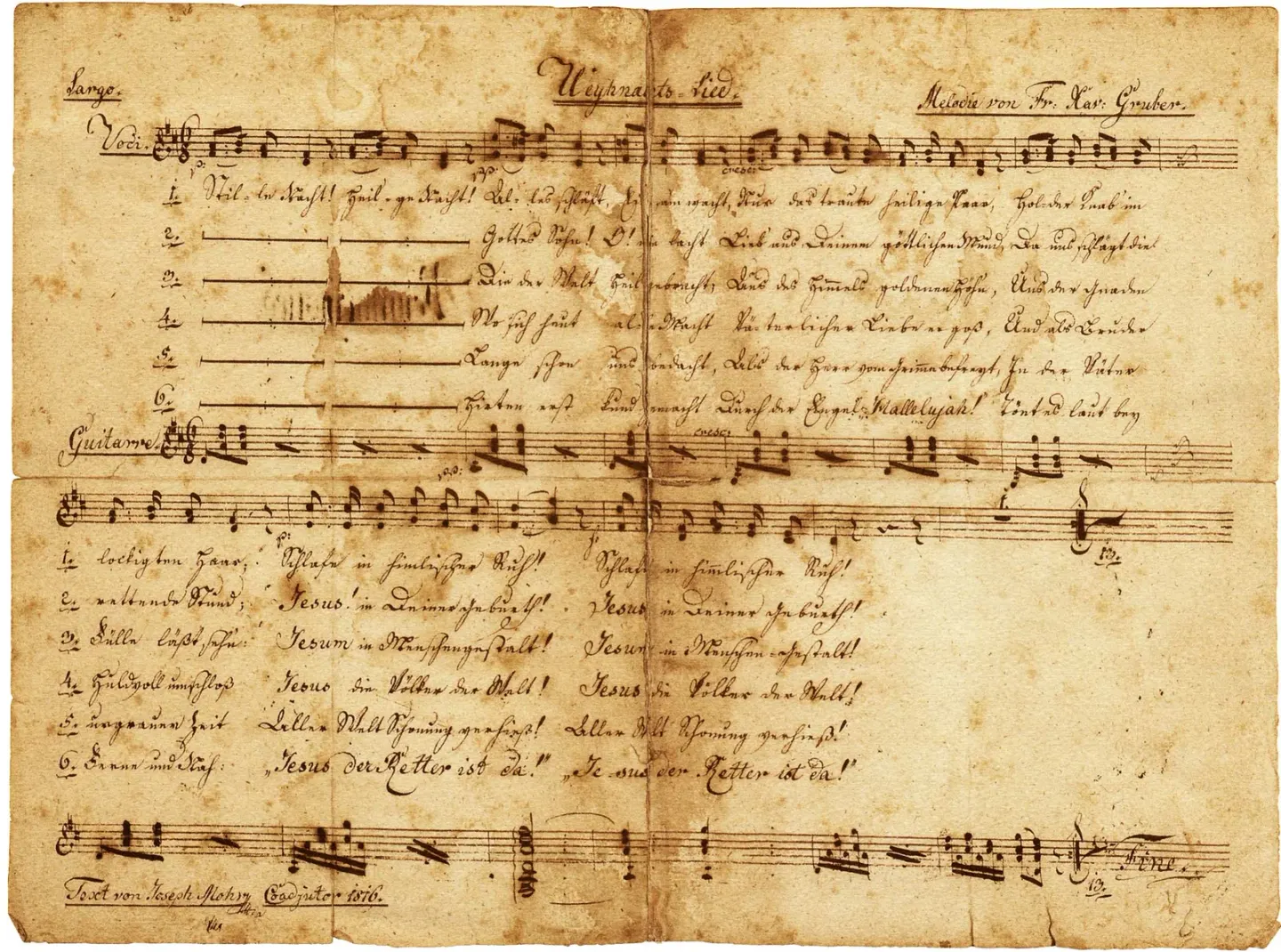
Figure: Joseph Mohr's handwritten score of "Silent Night", now in the Salzburg Museum. Top left reads "Largo", top right "Melody by Franz Xaver Gruber", bottom left "Words by Joseph Mohr, assistant priest, 1816" — 1816 is the year the words were written (c. 1820–1825) · Public domain, via Wikimedia Commons
The second is a text written by Gruber. This text came about from an inquiry. At that time, the song was widely sung, but the names of its creators were forgotten, and by 1854, even in Salzburg, an investigation was needed to find the names (Silent Night Association, Spreading to the World). That year, the Berlin Royal Court Orchestra asked the St. Peter's Abbey in Salzburg who had composed this song. The court orchestra seems to have thought of the composer Johann Michael Haydn, who had been close to St. Peter's Abbey. In response, Gruber wrote "Authentic Occasion of the Composition (Authentische Veranlassung)" on December 30, 1854, and the draft and fair copy remain in the Silent Night Archive at the Keltenmuseum Hallein. Musicologist Thomas Hochradner of the University of Salzburg Mozarteum regards this text as the only official firsthand account of the events of that day (Hochradner Expert Opinion). However, it is a memoir written 36 years after the event.
Gruber wrote as follows. On December 24, 1818, Assistant Priest Mohr handed him a poem and asked him to write a melody "for two solo voices together with choir and for a guitar accompaniment (für 2 Solostimmen sammt Chor und für eine Guitarre-Begleitung)" (Gruber, 1854 Account). In Gruber's account, the guitar accompaniment was part of the planned instrumentation from the very beginning of the request. The same account does not state why the song was created (Silent Night Association).
In a 2010 expert opinion recommending the inscription of this song on the Austrian Intangible Cultural Heritage list, Hochradner wrote that while the view that the organ was out of commission has persisted with unusual tenacity, "the documents contain nothing whatsoever indicating an organ breakdown" (Hochradner Expert Opinion).
There is also no record that the organ was fine. The official website of the Province of Salzburg states that the organ was played but was in need of repair, though it does not disclose the documentary basis for that judgment (Official Website of the Province of Salzburg, 2020 German Edition). Organ-related events confirmed by Silent Night Association materials date from a few years later. Karl Mauracher, an organ builder from the Zillertal, repaired the organ in Arnsdorf where Gruber was stationed in 1821, provided an estimate for the Oberndorf organ in January 1824, and newly built the Oberndorf organ in 1825. These records do not tell us the state of the organ on Christmas night in 1818. The Silent Night Association notes that the possibility that he was already there in 1819 cannot be ruled out (Silent Night Association, Spreading to the World).
Then why the guitar? The records do not answer. The guitar was a very rare accompaniment instrument in church music at that time (Hochradner Expert Opinion), mostly used in inns and taverns (Official Website of the Province of Salzburg, Myths and Legends). Hochradner believes the guitar was chosen because the song was performed near the end of Mass in front of the crèche, that is, the set-up depicting the birth of the baby Jesus (Hochradner Expert Opinion). This is a conjecture he himself framed with phrases like "must have been". To sum up, no document records a breakdown. According to Gruber's account, the guitar was included in the initial request, but that request also arrived on the same day, and why it was a guitar is not recorded. What state the organ was in that night and why the guitar was chosen still remain only as conjectures.
A Song Disconnected From Its Name — How It Became the "Tyrolean Song"
Early surviving manuscripts from 1822 to the 1840s mostly come from around where the creators were active. There is also a record that it was included with seven stanzas in the hymnal of an organist and teacher in Waidring, Tyrol, dated July 22, 1819, but that book does not survive today (Silent Night Association, Spreading Across the World).
The path the song took to the Ziller Valley in the western Tyrol region is not fully known. Gruber wrote in an 1854 account that a "well-known Ziller Valley man" brought the song to Tyrol, and the Silent Night Association considers that person to be the organ builder Mauracher (Silent Night Association, Spreading Across the World). In the Ziller Valley, there were families of singers who traveled through various countries. The association notes as a "transmitted story" the accounts that the Rainer family from Fügen sang this song at the Fügen church on Christmas in 1819, or sang it in 1822 before Austrian Emperor Francis I and Russian Tsar Alexander I. The association writes that it is unknown whether singing families had this song in their repertoire in the 1820s (Silent Night Association, Spreading Across the World).
The first documented performance where Ziller Valley singer families are confirmed to have sung this song is a performance in Leipzig, Germany, on December 15, 1832. The Leipziger Tageblatt reported that the Strasser siblings from Laimach sang "Beautiful Christmas Song, Silent Night, Holy Night" at the request of a newspaper reader (Silent Night Association, Spreading Across the World). The siblings were merchants who had come to the Leipzig New Year's Fair in 1831 to sell gloves and made extra income through singing, and the reader's letter requesting the performance in that newspaper was anonymous (Hochratner Expert Report).
In the early 1830s, the first printed sheet music appeared. The song was published without the creators' names and heavily altered in a music book titled "Four Genuine Tyrolean Songs (Vier ächte Tyroler Lieder)" issued by the Frise publishing house in Dresden and Leipzig (Silent Night Association, Spreading Across the World). The key was changed to C major, and only three of the six stanzas remained in the order of stanza 1, stanza 6, and stanza 2 (Hochratner Expert Report). A folk song is a song whose creator is unknown, sung and passed down among the people of a region. The official Salzburg state website summarizes that as the Ziller Valley singer families popularized the song and printed editions featured it as a "genuine Tyrolean song," the misunderstanding arose that this song was a Tyrolean folk song (Official Salzburg State Website, 2020 German Edition). This happened while both creators were still alive.
The song also crossed the Atlantic. The next generation of the Rainer family toured the United States from 1839 to 1843, and it is said they sang this song on Christmas in 1839 in front of the Alexander Hamilton monument in the graveyard of Trinity Church in New York. The association views this as likely the first performance on American soil, but that page contains no citation of contemporary documents (Silent Night Association, Spreading Across the World). American family choirs that American poet Walt Whitman praised in 1845 as democratic "music of the nation" also directly modeled themselves after the Rainer family, according to a music history study (DOI: 10.1515/9783839475133-017).
At the 1873 Vienna World's Exhibition, the sheet music for this song was placed under the title "Chorale of Salzburg" in an exhibition recreating a North American school classroom. By around 1900, it was sung on every continent, following Catholic and Protestant missionaries (Silent Night Association, English History). The song finally took root in its hometown of Salzburg in 1866 when it was included in the official church hymnal (Silent Night Association, Spreading Across the World). Both the 1854 inquiry from Berlin and the label "Tyrolean folk song" stemmed from the circumstances in which the song spread without a name (Official Salzburg State Website, 2020 German Edition). The song traveled further and went ahead of its creators' names.
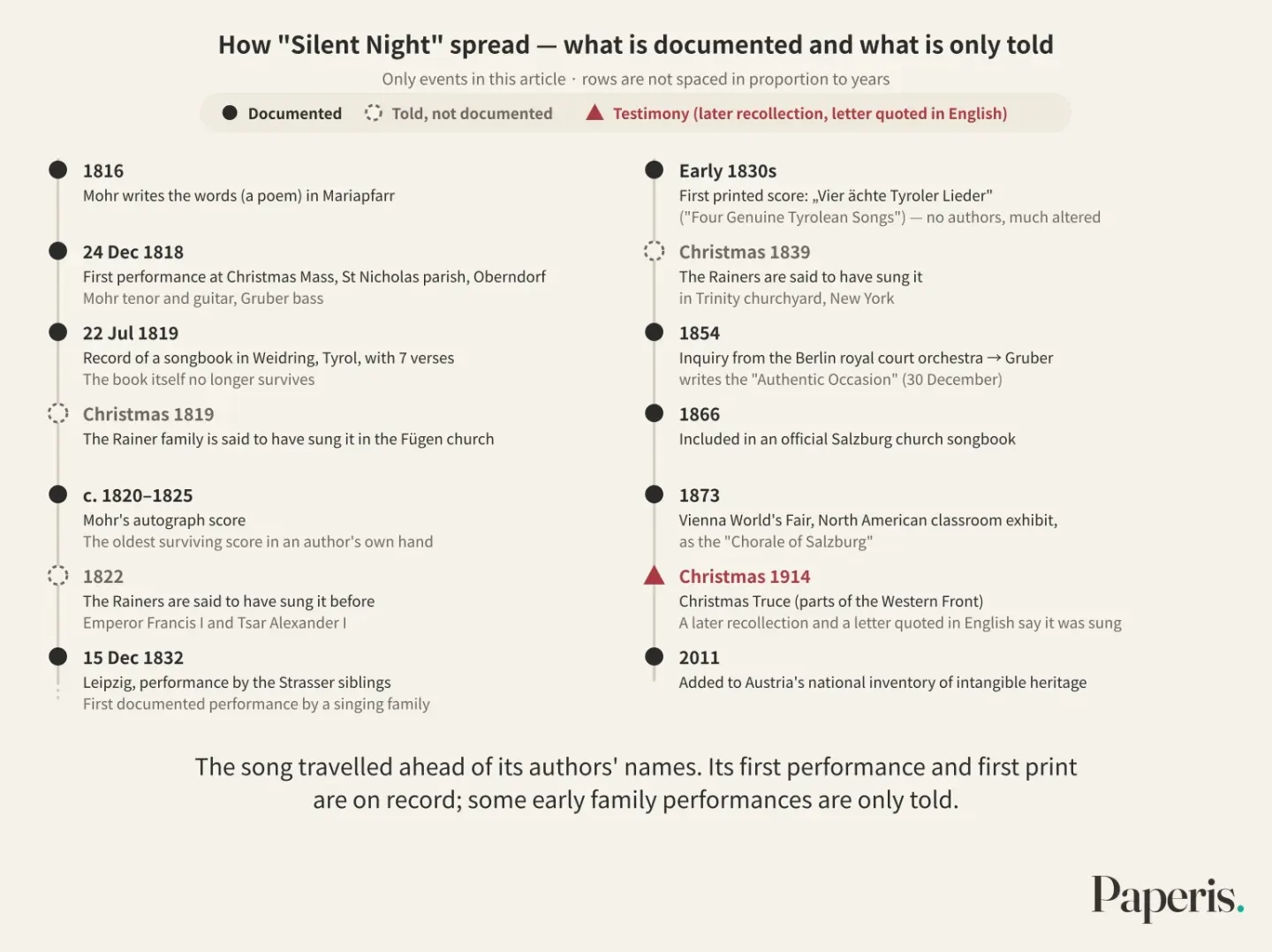
Figure: a diagram Paperis drew using only what the article says
The Melody We Sing Today Is Not the Melody of That Day
Gruber himself did not leave this song in just one form. He rewrote the song for various instrumentations, and his autograph scores are basically in D major. One exception is the 1836 orchestral version arranged for the parish church in the city of Hallein, scored for four vocal parts, flute, clarinet, bassoon, horns, strings, and organ, which was transposed to E-flat major because of the wind instruments (Hochratner Appraisal, Silent Night Association, Text and Music). The seventh Gruber autograph in the Silent Night Association catalog (around 1860) is a version for soprano, alto, and quiet organ accompaniment (Silent Night Association, Text and Music).
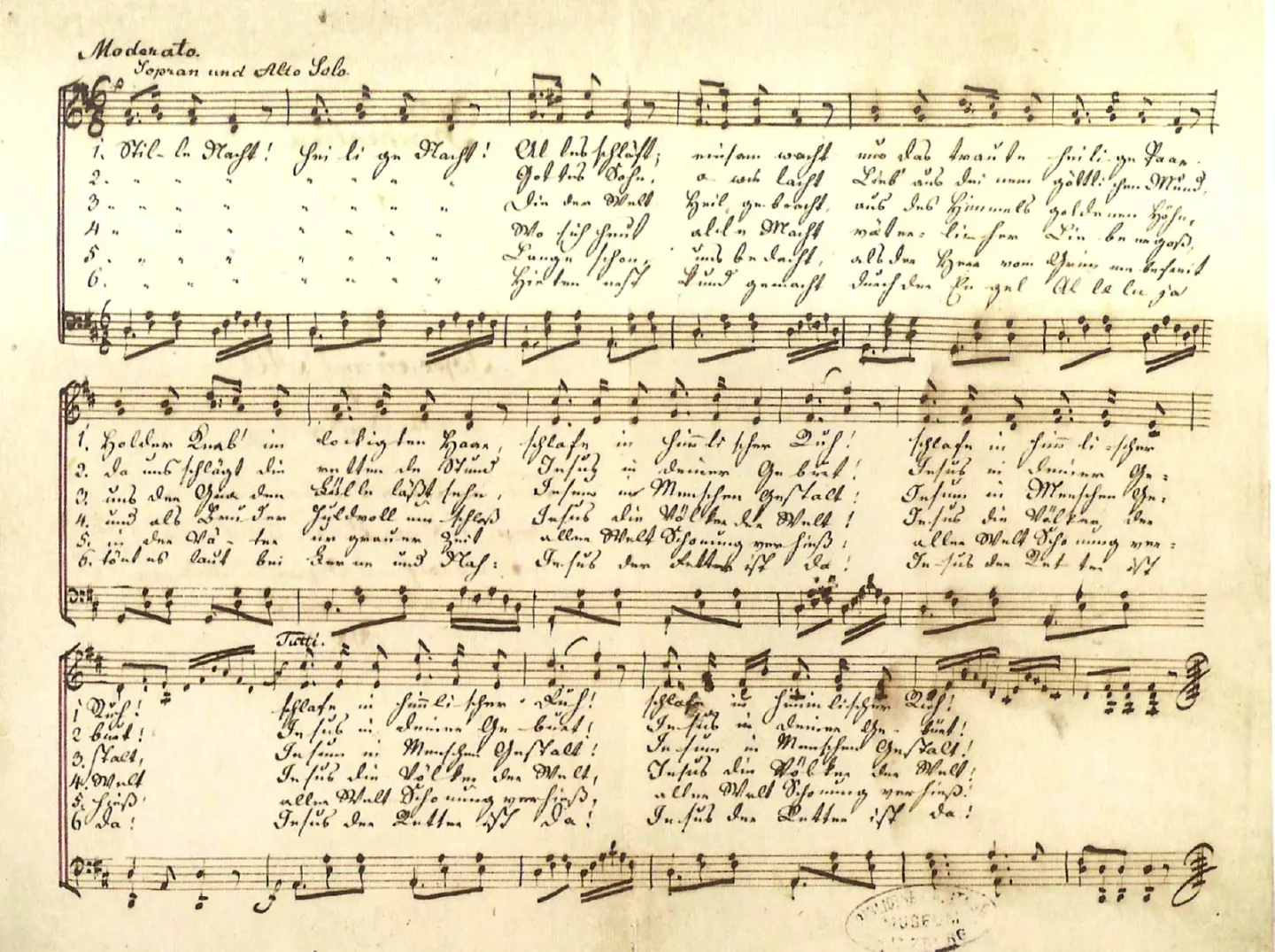
Figure: Franz Xaver Gruber's handwritten "Silent Night", the seventh Gruber autograph in the Silent Night Society's list, set for soprano, alto and quiet organ accompaniment (c. 1860) · Public domain, via Wikimedia Commons
The version we sing today took a path different from any of Gruber's versions. According to Hochratner, both the lyrics and the melody of a revised version refined shortly afterward by Johann Hinrich Wichern, the director of a shelter in Hamburg, became more popular. This version spread first to German Protestant regions, and decades later returned in its altered form to southern Germany and Austria, overwriting the version originally handed down (Hochratner Appraisal).
Hochratner picked out the final line as the most noticeable difference. It is the first note where "Schlaf in himmlischer Ruh" begins. The tonic is the note from which the scale starts, and the central note that feels most stable and restful when the piece clearly lands on it. In D major, "D" is the tonic, which sits at the solfege syllable "Do." The original version starts the final line on the seventh note (the 7th) counting the tonic as 1, while the altered version starts on the ninth note (the 9th), which is the second note one octave higher (Hochratner Appraisal). Translated into solfege, the final line of the original version begins on "Ti," right below high "Do," while today's version begins on "Re," which goes past high "Do." This holds true even when comparing the score of the version transcribed from Mohr's autograph with the score of the hymnal version commonly sung today.
Let us listen to the two versions in turn. First is the final line of the version transcribed from Mohr's autograph. We left out the guitar and played only the two vocal parts.
Clip: Gruber, "Stille Nacht" — bars 9–12 (last line) from a transcription of Mohr's autograph, two voices only, D major (synthesized timbre; score input Mutopia Project, public domain)
Next is the final line of the hymnal version commonly sung today, using the two vocal parts above. Transposition is the act of moving all the notes of a melody up or down by the same interval. The score for this version is written in B-flat major, so we transposed it to D major and matched the tempo to the previous clip so that you can compare their pitches.
Clip: "Silent Night" as commonly sung today (hymn version), bars 9–12 (last line), upper two voices only — transposed from B-flat major to D major and matched in tempo for comparison (synthesized timbre; score input Mutopia Project, public domain)
Both clips use the exact same synthesized tone color. Which other notes Wichern's revision changed besides the final line cannot be discerned from the sources this article relies on. What is clear is that the "original version" of this song is not fixed as a single entity. The original score disappeared, the composer left behind multiple versions, and the version we sung today belongs to a lineage refined by someone else.
1914 Songs Sung at the Front Line
The Christmas Truce is an event from around Christmas in 1914 where British and German soldiers on parts of the Western Front spontaneously stopped shooting and mingled. The truce was not observed everywhere on the Western Front, and fighting continued in other places, resulting in casualties even on Christmas Day (The Week, citing the Imperial War Museum).
There are testimonies that this song was sung that night. Private Albert Moren of the British 2nd Queen's Regiment recalled the German soldiers' singing across the way like this: "And then they sang 'Silent Night', 'Stille Nacht'. I'll never forget it. It was one of the highlights of my life." (The Week, Moren's recollection). These words are not from letters of the time but from later recollections, excerpted and passed down in books collecting truce testimonies. The British government gazette The Gazette also passes on the same recollection (The Gazette). On the German side, a German soldier named Josef Wenzel wrote in a letter sent to his parents that there is a passage reading, "When the British troops sang carols, we responded with 'Stille Nacht, heilige Nacht'" (History in the Margins, citing an English translation of Wenzel's letter). This letter has been verified only through English-translated citations, and the original German text has not been seen.
Other songs were also sung during the same truce. Graham Williams of the London Rifle Brigade recalled that when the British troops started "O Come, All Ye Faithful", the German troops immediately joined in singing the same hymn in Latin as "Adeste Fideles" (The Week, Williams's recollection). In a letter written at the time, Captain Edward Hulse of the British army noted that the joint sing-along ended with "Auld Lang Syne", which men from England, Scotland, Ireland, Prussia, and Württemberg all joined in singing (English Wikipedia, Christmas Truce — re-citing Hulse's letter). There are also several accounts stating that the two sides trading carols was the beginning of their mingling. Williams recalled that it went on with the German troops singing a carol and then the British troops singing one (The Week, Williams's recollection), and there are also summaries stating that the truce began when German soldiers set up candles and Christmas trees in their trenches and sang carols, to which the British soldiers replied with their own carols (History in the Margins). The line supported by the testimonies is only that exchanging songs was part of the truce, and that "Silent Night" was sung as one of those many songs in a few spots along the front line. The narrative reduced to "this single song opened the truce" is larger than these records.
Popular works dealing with the truce have also told stories different from historical research. The 2005 film Joyeux Noël depicts a scene where Christmas Eve carols open the truce (DOI: 10.3986/traditio2018470113). A study analyzing four children's picture books about the truce concluded that rather than being historical research, these books are moral tales conveying thoughts on humanity (DOI: 10.1177/1470357220981698).
Research on why the truce happened paints a picture different from popular belief. A doctoral dissertation examining letters and diaries of British soldiers who participated in the truce, official battalion combat logs, and newspapers of the time concluded that the truce came not from a rebellion against the war, but from the soldiers' professional ethics, the stalemate of trench warfare, the poor weather of the Western Front, the situation of no major battles, and Christmas memories from home. In the author's phrasing, the causes were rain and mud, curiosity, the lack of personal enmity toward the enemy, and homesickness. No soldiers who participated in the truce were punished, and no units subsequently refused to shoot at the enemy. The same study reviewed data from 1914 to 2013 and concluded that today's conventional truce story was shaped over decades (DOI: 10.13023/etd.2016.495).
The Figure of "300 Languages"
"Silent Night" is known to have been translated into more than 300 languages. The Silent Night Association writes "300 languages and dialects" on its German page and "over 300 languages and dialects" on its English page, citing the Wallace Bronner collection in Frankenmuth, Michigan, USA as its basis (Silent Night Association, Spreading Worldwide, English History). The Austrian Commission for UNESCO also writes "around 300 languages" (Austrian Commission for UNESCO).
This figure has two limitations. The first is that it is a combined count of languages and dialects. The second is that the basis is a single collector's holding, and there is no list documenting all the editions by language. Earlier tallies also remain. As summarized by the German Wikipedia citing a 2018 history book on this song, the list published by Bronner himself in 1994 featured 177 languages, and that list counted Kannada twice and Braille as a language. As the same encyclopedia records, citing a regional German newspaper article, Father Keller stated that his collection reached over 230 editions in 1995 (German Wikipedia — citing research books and newspapers). These two are secondary compilations where we have not directly inspected the original texts. Because collections grow over time, we cannot discount today's "300" merely because the figure from 30 years ago was smaller. The "300" is a figure that counts even dialects and lacks a complete list of editions by language, and the tally from about 30 years ago was 177 languages and around 230 editions. The records support the fact that this song is sung in a great many languages, but a list to verify how many one by one does not yet exist.
The Stories Attached to a Song Are Also Part of Its History
The stories attached to this song each originated at different times. The "Tyrolean folk song" first appears in print in the 1830s, the guess that it was "a piece by Michael Haydn" is first recorded in an inquiry in Berlin in 1854, the broken organ comes from a writing in 1909, and the mouse appears in a writer's text from the mid-20th century. There is research showing that the truce story itself took on its current shape over decades (DOI: 10.13023/etd.2016.495). Reception history is the study of how a work has been interpreted, changed, passed down, and forgotten by people after its release. Even the incorrect stories are records showing how people have listened to this song.
Some things are definitely still unknown. The reason for choosing the guitar, the exact route the song took to Zillertal, and whether the singer's family sang this song in the 1820s are not settled by records. Two testimonies from 1914 are later recollections and quotes from letters translated into English.
In 2011, "Silent Night" was entered into the Austrian National Inventory of Intangible Cultural Heritage in the category of "Social Practices," as a custom across all of Austria (Austrian Commission for UNESCO). This inventory is a national list of Austria introduced by the Austrian Commission for UNESCO, and it is different from UNESCO's Representative List of the Intangible Cultural Heritage of Humanity. Hochratner's text noting that the organ story has "no documentary basis" was precisely one of two expert appraisals attached to this listing application. The document proposing to put the song on the heritage list corrected the song's most famous story.
Research measuring this song for why it captivates people year after year does not exist among the evidence this article relies on. There is only general research on music and memory. Autobiographical memory is memory of things I directly experienced, of when, where, and what happened. In an experiment where participants listened to 30 songs and looked at 30 celebrity faces, autobiographical memories evoked by music were more vivid than memories evoked by faces, and contained more sensory details such as sounds and appearances (PMID 26259098). In a study where 31 people kept a diary for 7 days, memories evoked by music surfaced on average about once a day, came to them spontaneously during daily life such as commuting or doing chores, and frequently carried positive or mixed emotions like happiness or longing (DOI: 10.1177/0305735619888803). That Christmas songs evoke Christmas memories is a hypothesis testing this general theory on this song, not a measured result.
On the "Myths and Legends" list of the official Salzburg state website, there is also an entry stating that in the Alpine region there is a rule that this song must be sung only on December 24th, preferably only on Christmas Eve. The website rates the truthfulness of this entry from "0 to 100%" (Official Salzburg State Website, Myths and Legends). In other countries, it is a song heard on the radio throughout the weeks leading up to Christmas, but there they try to sing it only one night a year, just like on that day in 1818.
Where to Look Further
- Research asking adults and babies whether an unfamiliar song sounds like a lullaby is covered in Brahms's "Lullaby" — Does a Lullaby From a Faraway Place Still Sound Like One?.
Historical Sources
-
"Geschichtliches — Stille Nacht! Heilige Nacht!" (Silent Night Society, accessed 2026-11-19) — 1816 poem, Gruber's 1854 record citation, first performance, organ story being a conjecture, Mohr's autograph.
-
"Franz Xaver Gruber" (Silent Night Society, accessed 2026-11-19) — https://www.stillenacht.at/geschichtliches/franz-xaver-gruber — Arnsdorf teacher, Oberndorf organist from 1816.
-
"Text und Musik" (Silent Night Society, accessed 2026-11-19) — https://www.stillenacht.at/text-und-musik — List of original score (lost) and multiple autograph score editions.
-
"Verbreitung in alle Welt" (Silent Night Society, accessed 2026-11-19) — https://www.stillenacht.at/geschichtliches/verbreitung-in-alle-welt — Early manuscripts and spread path (singing family performances, printed editions, hymnals), "300 languages and dialects".
-
"History — Spreading of the song" (Silent Night Society English edition, accessed 2026-11-19) — Spread via Vienna World's Fair and missionaries, "more than 300 languages and dialects".
-
"Empfehlung zur Aufnahme in die nationale Liste des Immateriellen Kulturerbes" (Thomas Hochradner, 2010-12-30; published by Austrian UNESCO Commission "Expertise Hochradner") — https://www.unesco.at/fileadmin/Redaktion/Kultur/IKE/IKE-DB/files/432.doc — One of two expert appraisals attached to the national list registration application. No documentary evidence for organ breakdown, Berlin inquiry, differences between printed editions and revised editions.
-
"Silent Night – the Christmas carol" (Austrian UNESCO Commission, accessed 2026-11-19) — https://www.unesco.at/en/culture/intangible-cultural-heritage/national-inventory/news-1/article/silent-night-the-christmas-carol — Austrian National Inventory of Intangible Cultural Heritage listing (social practices), "roughly 300 languages".
-
"Mythen und Legenden" (Salzburg State official "Silent Night" site, 2020-11-29 archived version) — https://web.archive.org/web/20201129194644/https://www.stillenacht.com/de/das-lied/mythen-und-legenden/ — Origin of the organ and mouse story, "Tyrolean song" misunderstanding, purpose of the Berlin inquiry.
-
"Myths and legends" (Salzburg Regional Tourist Board, accessed 2026-11-19) — https://www.salzburgerland.com/en/myths-and-legends/ — Current English edition with the same content as the German version above, explanation that the guitar was mainly an inn instrument, Alpine region December 24 rule item (truth degree "0–100%").
-
"World War 1: the Christmas truce of December 1914" (UK Government Gazette The Gazette) — https://www.thegazette.co.uk/all-notices/content/287 — Relaying Private Moren's same memoir ("hearing the Germans sing Silent Night").
-
"WWI Christmas truce: soldiers' memories of the brief peace" (The Week) — https://theweek.com/world-news/first-world-war/61816/wwi-christmas-truce-soldiers-memories-of-the-brief-peace — Private Moren's memoir (excerpted from Brown & Seaton, Weintraub's truce books), Williams's carol exchange and "Adeste Fideles" memoir, citing Imperial War Museum explanation that the truce was not across the entire front.
-
"The Christmas Truce, 1914" (History in the Margins) — https://www.historyinthemargins.com/?p=2741 — Citing English translation of German soldier Josef Wenzel's letter (German original unconfirmed), summary that the truce began by exchanging carols.
-
"Christmas truce" (English Wikipedia) — https://en.wikipedia.org/wiki/Christmas_truce — Recitation of Captain Hulse's contemporary letter ("Auld Lang Syne"). Secondary source.
-
"Stille Nacht, heilige Nacht" (German Wikipedia) — https://de.wikipedia.org/wiki/Stille_Nacht,_heilige_Nacht — Various counts of translation languages (Bronner, Keller) and "there is no complete list". Secondary source.
Source Papers
- "The Christmas Truce: Myth, Memory, and the First World War" (2016, Doctoral dissertation) — DOI: 10.13023/etd.2016.495 — Analysis of British soldiers' letters, diaries, battalion war diaries, and newspapers. The truce stemmed not from defiance, but from professionalism, trench-warfare identity, bad weather, the absence of major battles, and memories of Christmas at home; no soldiers were punished and no units refused to fire. Data from 1914–2013 shows that the conventional narrative of the truce was constructed over decades.
- "The Christmas Truce of 1914 in the Film Joyeux Noël (2005)" (2018) — DOI: 10.3986/traditio2018470113 — Analysis showing the film depicts the truce beginning with the singing of carols on Christmas Eve.
- "A beautiful and devilish thing: children's picture books and the 1914 Christmas Truce" (2021) — DOI: 10.1177/1470357220981698 — Four picture books about the truce are moral stories conveying a vision of humanity rather than historical research.
- "Vom Sound der ›Neuen Welt‹ zum Sound der ›Heilen Welt‹: Oder: Von der »Rainer Family« bis zu Toni Praxmairs »Kitzbuehel Tyrolean Singers«" (2024) — DOI: 10.1515/9783839475133-017 — The direct model for the American family choir praised by Whitman (1845) was the Austrian Rainer Family.
- "Music evokes vivid autobiographical memories." (2016) — PMID 26259098 — Comparing 30 songs and 30 faces, autobiographical memories brought up by music are more vivid and contain more sensory details.
- "Music-evoked autobiographical memories in everyday life" (2019) — DOI: 10.1177/0305735619888803 — A 7-day diary study of 31 people showing it happens on average once a day, during commuting or housework, vividly and involuntarily, evoking positive or mixed emotions (such as longing).
Sources (6)
- The Christmas Truce: Myth, Memory, and the First World WarDOI 10.13023/etd.2016.495
- The Christmas Truce of 1914 in the Film Joyeux Noël (2005)DOI 10.3986/traditio2018470113
- A beautiful and devilish thing: children's picture books and the 1914 Christmas TruceDOI 10.1177/1470357220981698
- Vom Sound der ›Neuen Welt‹ zum Sound der ›Heilen Welt‹: Oder: Von derDOI 10.1515/9783839475133-017
- Music evokes vivid autobiographical memoriesPMID 26259098
- Music-evoked autobiographical memories in everyday lifeDOI 10.1177/0305735619888803