
Paperis Articles
Brahms's "Lullaby" — Does a Lullaby From a Faraway Place Still Sound Like One?
Over ten thousand adults and children guessing what unfamiliar songs are for, 144 infants who relaxed more to foreign lullabies than to other songs, and a community where no evidence of infant-directed song was found
Your field's papers, as audio
Pick your fields and journals — Paperis summarizes the key papers and turns them into audio. Listen on your commute.
Start Paperis free →Brahms's "Lullaby" — Does a Lullaby From a Faraway Place Still Sound Like One?
"Sleep Well," A Song from 1868
German composer Johannes Brahms's "Wiegenlied" (Lullaby), Op. 49, No. 4, is a song released in 1868. A lullaby is a song sung to soothe or put a baby to sleep. This piece bears that very name right from its title. The Austrian duet "S'is Anderscht" (Alexander Baumann, 1842) served as the catalyst for writing this piece (DOI: 10.1525/ncm.2005.28.3.185). A musicology paper discussing this piece noted that the back-and-forth movement of the chords mimics the sensation of rocking a baby, and that because the song sounds so simple, it actually bypassed the attention of analysis (DOI: 10.1525/ncm.2005.28.3.185). This is a musicologist's interpretation, not a study that experimented on listeners. Nor does it mean that clip below confirms that interpretation. It is a piece for voice and piano, in E-flat major with a 3/4 time signature. The first line of the German lyrics is "Guten Abend, gut' Nacht," which translates to "Good evening, sleep well" in Korean. At the beginning of the sheet music is the performance direction "Teneramente, con moto," meaning "tenderly, with motion."
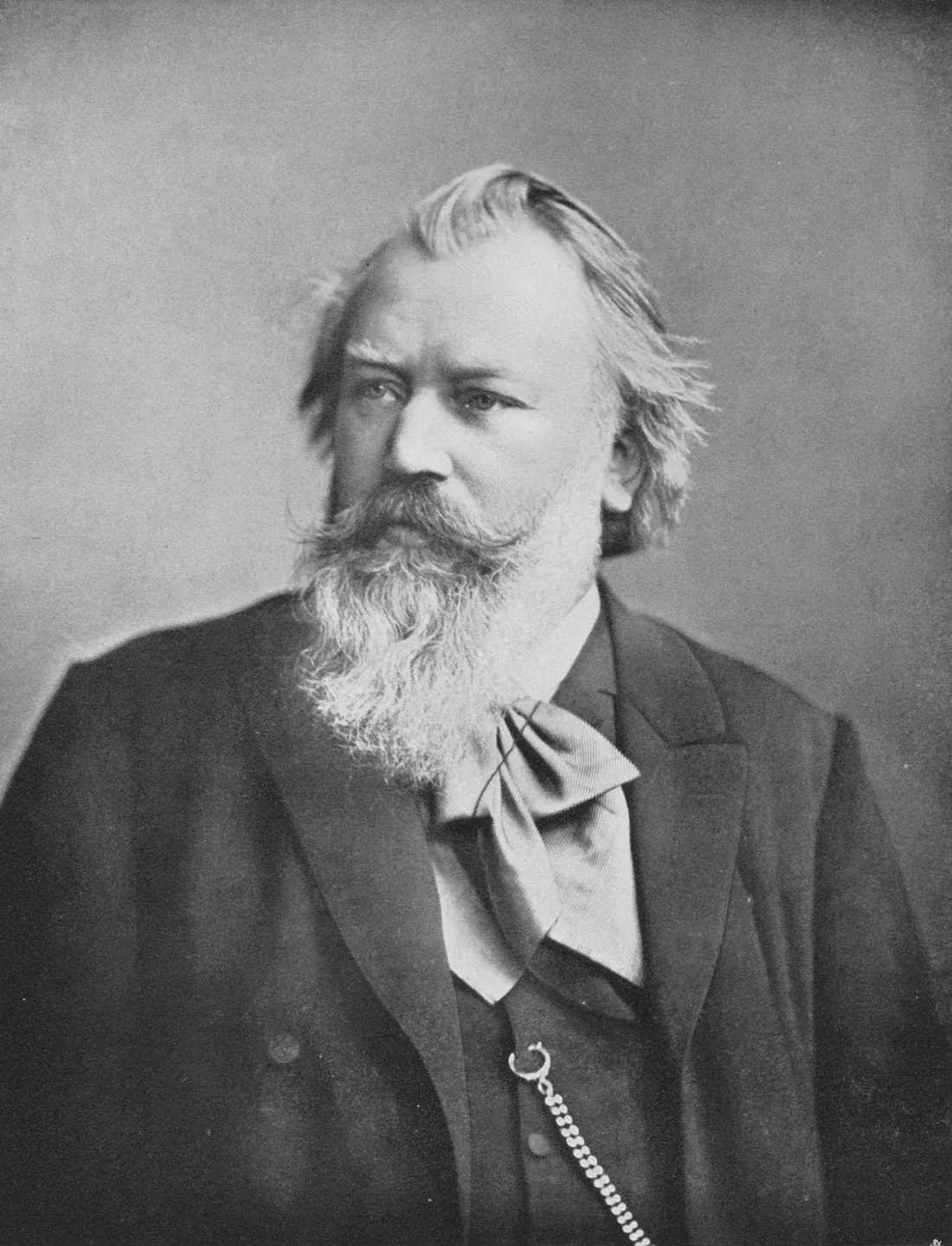
Johannes Brahms · photograph by C. Brasch, Berlin (1889) · public domain · Wikimedia Commons
Let us listen to the first ten measures transcribed from the original sheet music. Both the vocal melody and accompaniment were generated using a synthesized piano, and we set the tempo (quarter note = 66). The piano plays one measure alone, and the vocal melody enters at the end of the second measure.
Clip: Brahms, Wiegenlied (Lullaby), Op. 49 No. 4, bars 1–10 — melody and accompaniment (synthesized piano and voice-like timbre; score input Mutopia Project, public domain)
The line that enters after one measure of piano is the vocal melody that corresponds to the lyrics "Good evening, sleep well" in the sheet music. The song ends at measure 18.
This raises a question. If someone who does not know German and does not know this piece is a lullaby listens to it, will they hear it as a lullaby? Lullabies are often described as a musical genre found everywhere in humanity, and are also cited as clues to glimpse the origins of music (DOI: 10.1177/10693971241272406). That description splits into two questions: Do people recognize lullabies from countries they are hearing for the first time as lullabies, and do such songs really exist in every society?
People Who Guess the Use of Songs They Hear for the First Time
Let us suppose that a Korean person who has never encountered the music, language, or culture of the North American Blackfoot people listens to a Blackfoot lullaby. One research team gives an example that this person is far more likely to judge that song as "a song used to soothe a baby" rather than "a song used when dancing" (PMID 36222671). This example relies on cross-cultural studies in which people or songs from various societies are placed side by side to compare commonalities and differences. Cross-cultural studies are research that compares the commonalities and differences of people or songs from multiple societies in one place.
The first experiment was gathered via the internet. 750 internet users from 60 countries listened to music excerpts for 14 seconds each and scored how well each song fit six uses, such as "used to soothe a baby." The songs were dance songs, lullabies, healing songs, and love songs randomly selected with evenly distributed regions from field recordings of 86 societies, most of which were small-scale, including hunter-gatherer, pastoral, and subsistence agricultural societies. The experimental design and analysis plan were registered in advance. Even though the listeners knew nothing about those societies and the excerpts were very brief, they accurately and reliably inferred the uses from the song forms alone, across cultures (PMID 29395919). The abstract did not specifically note which of the four categories were guessed correctly or to what extent.
A second experiment in the same paper adds a caveat to this result. When 1,000 internet users from the US and India separately evaluated three contextual features (such as the singer's gender) and seven musical features (such as melody complexity) of the same excerpts, these contextual features also predicted the use scores from the first experiment. However, there was a portion that the musical features and the actual uses of the songs explained separately from that. The authors wrote the conclusion that this result supports the idea and "fits" that there is a universal connection between the form and use of songs (PMID 29395919). This means that people's judgments were mixed with cues other than the music itself, such as who was singing.
The authors of the next study directly pointed out the limitation that the participants in the previous experiments were almost entirely English speakers, and expanded the sample. 5,516 industrialized society participants whose native language is 28 languages, and 116 participants from small-scale societies with limited access to global media who speak three non-English languages, listened to unfamiliar songs sung in unfamiliar languages. Both groups correctly identified the uses of dance songs, lullabies, and healing songs, but failed to guess love songs. Even when the language or place of living of the listener and the singer were close, the correct response rate increased only very slightly (PMID 37676911). The authors concluded that the uses of three common song types are mutually intelligible across cultures, and that the diversity of music is also rooted in several universal perceptual phenomena (PMID 37676911).
Using age as a proxy for musical experience, they also compared whether experience shapes that judgment. 5,033 children aged 4 to 16 gathered online listened to dance songs, lullabies, and healing songs from 70 cultures and chose where the songs were originally used. The children reliably matched the uses, and the difference between the youngest 4-year-olds and the oldest 16-year-olds was very small. It closely aligned with the judgments of 98,150 adults who listened to the same songs (similar online experiments) (the correct response rates of adults are not specifically noted in the abstract), and the sound features that predicted the judgments of both groups were similar (PMID 36222671). The authors wrote that "long-term musical experience is not always required" to guess the use of a song (PMID 36222671).
Across the three experiments, people generally guessed the uses of unfamiliar songs, and in the experiment that reported results by category (5,516 people and 116 people), lullabies were also correctly identified. However, the samples were mostly people gathered via the internet, and there were categories that were not guessed correctly, such as love songs. Among the evidence this article relies on, there is only one experiment that used Brahms's "Lullaby," and even that experiment did not have participants choose among uses (which we will cover in the last section). When applying this result to the Brahms piece, it becomes an assumption that even people who do not know German might choose this piece closer to a lullaby than a dance song. Because most of the field recordings played by the studies were from small-scale societies while the Brahms piece is a Western art song, this difference also remains in the assumption.
What Lullabies Sound Like
There is research exploring whether there is a common shape to infant-directed speech. This research did not look at lullabies alone. The researchers gathered 1,615 sounds recorded by 410 people across 21 societies, spanning urban, rural, and small-scale communities (PMID 35851843). There are four categories: speech directed to infants, speech directed to adults, songs sung to infants, and songs sung to adults. Infant-directed songs are songs sung by adults toward infants to be heard by them. Whether a recording was directed at infants was reliably distinguished by classification using only acoustic features, and while the shapes of those sounds differed between speech and song, they differed in consistent ways (PMID 35851843).
The same researchers had 51,065 people from 187 countries listen to those recordings via an English website and try to guess whether they were infant-directed sounds. Accuracy was higher than chance, some of it was predicted by common acoustic features, and it was hardly shaken by how close the languages of the singer and listener were (PMID 35851843). An earlier conference abstract reporting a similar scale of recordings (411 people across 20 societies) noted that a single person recorded all four categories, and that this abstract distinguished infant-directed songs and speech from adult-directed ones particularly in vowel acoustic structure, overall rhythmic structure, and pitch range (DOI: 10.1121/1.5101469). Because it is a conference abstract, it is a lower tier of evidence than a formal paper.
As prior studies have synthesized, dance songs tend to be loud and rhythmically strong, whereas lullabies tend to be quiet and melodic (PMID 37676911). Research analyzing song recordings from various societies around the world also found that acoustic features predicted the primary use of those songs (PMID 31753969).
What happens when the same song is sung in two ways? Mothers of 6-month-old infants each chose a single song and sang it in a lullaby style and a play-song style, respectively. Play songs are songs sung while playing with an infant to liven the mood. Adult evaluators who listened to the recordings distinguished the two styles 100% of the time. The play-song style sounded brighter, more interrupted, more rhythmically distinct, imbued with laughter, and with prominent consonants, whereas the lullaby style sounded breathier, smoother, and more soothing (PMID 10082023). Even by watching silent videos of the infants, adults guessed which side the infant was listening to better than chance, and analyzing the videos showed that infants directed their attention inward toward themselves during the lullaby style and outward during the play-song style (PMID 10082023). The authors interpreted that songs can be used to regulate an infant's state.
Another study listening to parents' songs reported discrepancies between the songs parents chose and the way they actually sang them, viewing this as lending weight toward classifying songs sung to infants by their function rather than their song title (PMID 9606951). The experiments on the two styles above also yield results where the same song sounds different depending on how it is sung, which can be placed alongside this interpretation. Separately, in a study analyzing over 14,000 vowels from nursery rhymes, lullabies, and folk tales delivered directly by mothers to 6-month-old infants, what separated excited interactions from calm interactions were primarily pitch, sound duration, and how much the two fluctuated (PMID 34972287).
So, can we pinpoint in a musical score what makes a lullaby a lullaby? When folk lullabies from various cultures and matched control songs were played to adults, adults picked lullabies as simpler songs whether the recordings were heard as field-recorded, filtered to make the lyrics unintelligible, or synthesized with identical piano timbres. Yet when analyzing the song structures, musical features separating lullabies from other songs did not emerge, but melodic features predicting adults' judgments in recognizing lullabies did (DOI: 10.1177/0305735692201002). This means that while a line separating lullabies from other songs in terms of musical scores was not found in this analysis, clues of melody predicting people's judgments were found.
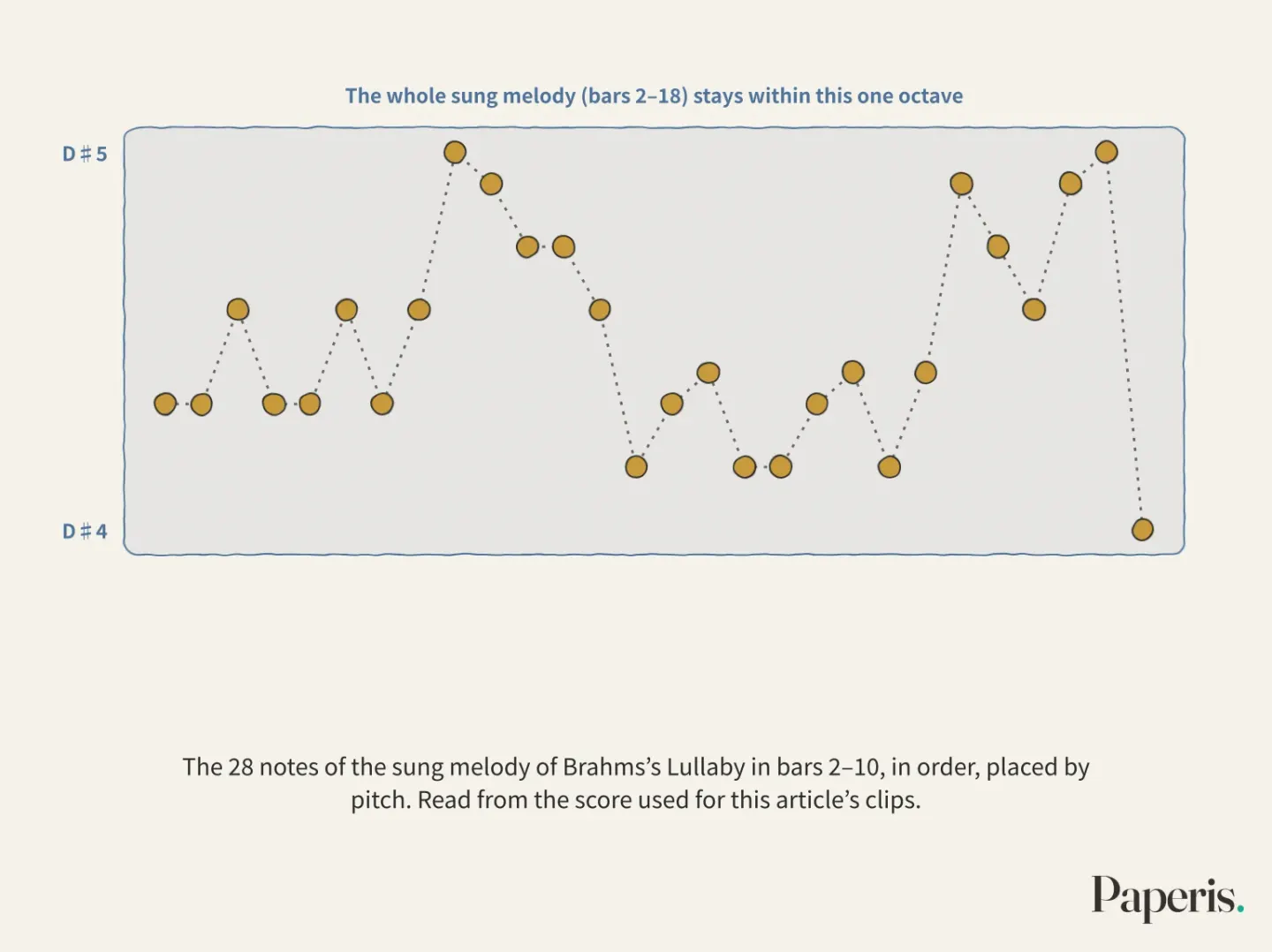
Let us place these two musical score facts of Brahms' piece next to these results. An octave is the distance to a pitch vibrating twice as fast, where two notes sound similar enough to be called by the same name. The vocal melody of this piece stays within one octave from the lowest to the highest note, with 1 to 6 notes per measure. Listening without the accompaniment, hearing only the vocal melody with a synthesized "ah" voice timbre without lyrics. The tempo is the same as the previous clip.
Clip: Brahms, Wiegenlied (Lullaby), Op. 49 No. 4, bars 2–10 — melody only (synthesized piano and voice-like timbre; score input Mutopia Project, public domain)
Starting from the upbeat at the end of measure 2 through measure 10, it was a vocal melody moving up and down within a single octave. The previous studies measured the sound of recorded songs, whereas the score or performance of this piece was not measured. Therefore, that this melody is close to the "quiet and melodic" lullaby side mentioned by the studies is an assumption tested against this piece, not a measurement result. Sound volume cannot be compared because our clip is adjusted for listening. Bringing in the results showing that the style of singing made a difference, even the same Brahms piece can sound different depending on how it is sung. Our clip is a synthesized sound with a fixed tempo, so it does not capture that difference.
How an Infant's Body Reacts
What an adult guesses and how an infant reacts are different questions. There is an experiment where 144 American infants were played eight pairs of unfamiliar foreign lullabies and non-lullabies chosen from another foreign society. The researchers measured infant arousal using heart rate, pupillometry, and galvanic skin response. Arousal is the degree to which the body and mind are awake and excited. Galvanic skin response is a change where sweat glands in the palms open slightly when the body is tense or excited, making the skin conduct electricity better.
As measured by these indicators, infants relaxed more when listening to lullabies than when listening to other foreign songs, and this response was consistent throughout the first year of life (PMID 33077883). Pointing out that the response remained the same throughout the first year and that infants have much less musical experience than adults, the authors suggested that this response is not the product of musical experience. When parents were asked to choose a song to soothe a crying baby, they overwhelmingly chose lullabies, even though the songs were unfamiliar. The authors' conclusion is that infants “may be born” to respond to features common to lullabies across cultures (PMID 33077883). This experiment compared unfamiliar lullabies to other unfamiliar songs, and it was not an experiment measuring whether infants fall asleep.
There are also results on the other side. A review summarizing laboratory research noted that playing recordings of play songs to 6- to 9-month-old infants kept them content or neutral for much longer than playing recordings of infant-directed speech or adult-directed speech. When 10-month-old infants were fussy or crying and highly excited, singing by mothers seen and heard led to better soothing than mothers' speech. And in Western infants, play songs were more effective than lullabies at lowering arousal (PMID 25773634).
Although what was measured is different, play songs also came out ahead in concert hall settings. When 50 pairs of infants aged 6 to 18 months and their caregivers watched a short performance featuring both lullabies and play songs, play songs captured the infants' attention more. Smiles were also more frequent during play songs, especially under conditions where caregivers reacted together (PMID 35713569). Both measured attention and smiles, not whether arousal was lowered. In an experiment measuring preference through head turns, 6- to 7-month-old infants preferred versions of lullabies sung lower and versions of play songs sung higher (PMID 20036776). In an experiment measuring 24 infants using the same method, infants preferred faster versions of play songs, but no preference according to tempo emerged for lullabies (PMID 21639609).
These results compared different things. The 144-infant experiment compared lullabies to other foreign songs to measure bodily relaxation, and the experiments summarized in the review looked at how much Western infants' arousal dropped by comparing play songs to lullabies. Therefore, the two cannot be summarized as either “lullabies soothe infants” or “play songs soothe them better”. An infant's body reacted even to unfamiliar lullabies, but which song soothes which infant better and when is not settled by these pieces of evidence. Nor did these studies test methods for putting infants to sleep.
How Song and Speech Differ to an Infant
Sixty-six 6- to 10-month-old infants raised in English-speaking homes in London, Ontario, were played infant-directed speech and infant-directed song by Russian- and English-speaking mothers. The infants listened significantly longer to song than to speech (PMID 27796032). Fifteen hearing 2-day-old infants born to deaf parents also preferred recorded infant-directed Japanese and English play songs over adult-directed versions. The authors interpreted this preference as present at birth and not dependent on specific prenatal or postnatal experience (PMID 10442868). This is a single study with a sample of 15.
Speech and song elicited different responses from infants. When 6- to 8-month-old infants faced their own mothers, the infants made more eye contact, vocalized more, and moved more when the mother spoke than when she sang. Only during speech did the infants' eye contact and vocalizations increase alongside the number of the mother's questions and pauses (DOI: 10.1159/000447640). The authors interpreted speech as eliciting an early form of turn-taking, and brain responses partly supported that interpretation. Behavior was measured in 26 infants and brain responses in 14.
The rhythm of song also guided infants' gazes. When hearing infant-directed song, infants as young as 2 months old synchronized their gazes at the singing caregiver's eyes to the song's rhythm, and that synchronization doubled in strength by 6 months. When the song's rhythm was disrupted experimentally, this synchronization was also disrupted (PMID 36322755). In a study tracking 299 infants six times from 3 to 12 months of age and measuring gaze, the proportion of time infants spent looking at the mouth of an adult on a screen who was speaking or singing to them increased over the first year, and that increase was greater for song than for speech. Properties of song such as a slower tempo and a less jagged rhythm partly contributed to that difference (PMID 36527322). Infant-directed speech may sound song-like, but it is not music. In an analysis of 1,696 recordings across three cultures, infant-directed speech with exaggerated intonation was no closer to musical scales than normal speech was (PMID 40595905).
Both speech and song change when directed at infants, but in these experiments, song held attention longer and locked gazes through rhythm, while speech elicited more turn-taking. What each study measured differed, and these findings do not tie those differences into a single principle.
Are Lullabies in Every Society?
Music was present in every society observed. As a result of gathering ethnographic records tracking musical behavior across a representative sample of world societies, music was linked to uses such as infant care, healing, dance, and love. Differences in music were greater within a single society than between societies (PMID 31753969). This result means that music was present in every society observed, which is a different statement from saying that lullabies were in every society.
There is an ethnographic literature review examining lullabies themselves. When the literature was scanned starting from a standard sample evenly drawn from world societies, if lullabies are broadly defined as "any song sung to soothe a child," they were nearly universal. However, if narrowly defined as a distinct category of song sung to babies, they were neither nearly universal nor a statistical universal. Among Native Americans, there were more societies with few or no lullabies than in other regions (DOI: 10.1177/10693971241272406). The authors' conclusion is that the act of singing to soothe a child is nearly universal, but there are considerable differences across cultures (DOI: 10.1177/10693971241272406). The definition of a lullaby established at the beginning of this article leans toward the broad side. A review-like paper dealing with songs sung to babies (university repository version) also viewed that these songs have persisted over a long period, noting that there are distinct differences across cultures and that those differences stem from socio-economic conditions and how babies are perceived as beings (DOI: 10.32920/25412983).
The records of a single community go further back. In 122 months of fieldwork from 1977 to 2020, researchers found no evidence of dance or songs sung to babies among the Northern Aché of northern Paraguay. Excluding church songs introduced by missionaries, Northern Aché adults sang alone, and their singing styles were limited to just a few. Given various pieces of evidence, it is possible that these two behaviors disappeared after population decline in the ancestral generation lowered cultural complexity (PMID 40306280). The authors wrote that this observation does not contradict the universal psychological capacity to perform dance and songs sung to babies, but that cultural transmission is crucial for sustaining those behaviors (PMID 40306280).
Research practices surrounding infant-directed speech face the same question. There is criticism that the portrayal of "infant-directed speech" as universal, optimal, and invariant across cultures may stem from a bias caused by under-examining the cultural contexts where infants and caregivers meet (DOI: 10.1177/1354067x221147683). This criticism dealt with speech and did not directly address song.
Even though people generally recognized lullabies from unfamiliar countries as lullabies, lullabies were "nearly" universal even when broadly defined as songs sung to soothe a child, but not when narrowly defined as a separately distinguished category of song. Even with the broad definition, it does not mean they exist in all societies, and no evidence of songs sung to babies was found in the Northern Aché fieldwork.
So What Did We Learn
Three things remain. First, 5,516 participants from industrial societies and 116 from small-scale societies mostly guessed lullabies among unfamiliar songs, and having close languages or living locations only bumped up correct rates very slightly. 5,033 children aged 4 to 16 also stably matched the uses of three types of songs mixed with lullabies. Second, infant-directed songs and speech in recordings from 21 societies were separated purely by acoustic features, and 144 American infants relaxed more in their bodies when listening to unfamiliar foreign lullabies than when listening to other foreign songs. Third, the act of singing to soothe a child is broadly nearly universal, but the separately distinguished genre of a lullating song is not, and there are records of communities where 122 months of field research yielded no evidence of songs sung to infants.
What we do not know is also clear. What makes people recognize a lullating song was not fully solved by sheet music analysis, and contextual features like who is singing also mixed into judgments. Direct comparison results between lullabies and play songs (Western infants, review) pointed to play songs for lowering arousal, and the 144-infant experiment compared other foreign songs rather than play songs. Which side calms which infant better and when is not settled by these evidences. The infant experiments this article relied on measured heart rate, pupils, skin conductance responses, attention, and preference, plus pain scores during blood draws, and did not put them to sleep. The story of measuring sleep with machines continues in "The Goldberg Variations — Feeling Rested, and Sleep on the Machine".
Returning to Brahms's "Lullaby", there is one trial in the list of evidence that actually played this piece to infants. From July to October 2019, 59 infants aged 0 to 12 months who underwent intravenous blood draws at a pediatric blood draw room of a university hospital in Turkey were randomly divided into three groups of white noise, Brahms's "Lullaby", and control, and pain and crying time before, during, and after the procedure were measured using the Neonatal Infant Pain Scale (NIPS). The average pain scores of the white noise group and the Brahms's "Lullaby" group were significantly lower than those of the control group during and after the procedure. Even before the procedure, the averages of the two groups were lower than the control, but the abstract did not note whether that difference was significant. Crying time was significantly shorter after the procedure than the control group. The authors concluded that white noise and Brahms's "Lullaby" played during blood draws reduced infant pain (PMID 36239565). It is a single trial from one hospital, and the abstract does not state the headcount per group. What this trial measured was pain scores and crying time during the procedure, and it neither measured whether it sounded like a lullaby nor put them to sleep. White noise also went in the same direction and was lower than the control, so whether this result is due to the lullaby-like sound of this piece cannot be sorted out by this trial.
Experiments that played this piece under this article's question of "Does it sound like a lullaby?" are not among the evidence this article relied on. If results that studies obtained from other songs and other people are applied to this piece, the assumption emerges that even people who do not know German could pick this piece toward the lullaby side, and this piece's melody might be close to the quiet and melodic side those studies talked about. Whether that assumption is correct can only be known by playing this piece and measuring.
Source Papers
- "Brahms's "Wiegenlied" and the Maternal Voice" (2005) — DOI: 10.1525/ncm.2005.28.3.185 — Opus 49, No. 4 (1868), inspired by Baumann's Austrian duet “S'is Anderscht” (1842), interpreted as the back-and-forth movement of chords imitating rocking (musicology essay).
- "Lullabies and Universality: An Ethnographic Review" (2024) — DOI: 10.1177/10693971241272406 — Broadly defined, it is nearly universal; narrowly defined, it is neither a near-universal nor a statistical universal, with many Native American societies having few lullabies.
- "Children infer the behavioral contexts of unfamiliar foreign songs." (2023) — PMID 36222671 — 5,033 children aged 4–16 across 70 cultures, showing negligible improvement with age and a strong correlation with judgments by 98,150 adults.
- "Form and Function in Human Song." (2018) — PMID 29395919 — 750 people from 60 countries inferred purposes from 14-second excerpts across 86 societies (pre-registered), and contextual features such as singer gender also predicted judgments.
- "Universal interpretations of vocal music." (2023) — PMID 37676911 — 5,516 people across 28 languages + 116 people from small-scale societies successfully inferred dance, lullaby, and healing songs, but failed at love songs.
- "Acoustic regularities in infant-directed speech and song across cultures." (2022) — PMID 35851843 — 1,615 recordings of 410 people across 21 societies classified infant-directedness by sound, beating chance across 51,065 people in 187 countries.
- "Acoustical regularities in infant-directed vocalizations worldwide" (2019, abstract) — DOI: 10.1121/1.5101469 — Differences found in vowel sound texture, rhythm structure, and pitch range.
- "Universality and diversity in human song." (2019) — PMID 31753969 — Music exists in every observed society, sound features primarily predict its use, and variation is greater within societies.
- "Distinctive messages in infant-directed lullabies and play songs." (1999) — PMID 10082023 — The same song performed in two ways, with raters distinguishing them 100%, directed inward or outward to the baby's attention.
- "Parents' sung performances for infants." (1997) — PMID 9606951 — Mismatch between song choice and performance style, classified by function rather than name.
- "Acoustic signatures of communicative dimensions in codified mother-infant interactions." (2021) — PMID 34972287 — Roughly 14,000 vowels; pitch, duration, and their fluctuations distinguish excited versus calm interactions.
- "Lullabies and Simplicity: A Cross-Cultural Perspective" (1992) — DOI: 10.1177/0305735692201002 — Lullabies judged simpler, though structural analysis found no distinguishing features.
- "Infants relax in response to unfamiliar foreign lullabies." (2021) — PMID 33077883 — 144 US infants relaxed in response to 8 unfamiliar foreign lullabies measured by heart rate, pupil dilation, and skin conductance, consistent across the first year of life.
- "Musical affect regulation in infancy." (2015, review) — PMID 25773634 — Play songs maintain a satisfied state better than speech, and in Western infants, play songs are more effective than lullabies at reducing arousal.
- "A concert for babies: Attentional, affective, and motor responses in an infant audience." (2023) — PMID 35713569 — 50 pairs aged 6–18 months, with play songs eliciting greater attention and smiles.
- "Does the message matter? The effect of song type on infants' pitch preferences for lullabies and playsongs." (2010) — PMID 20036776 — At 6–7 months, infants preferred low-pitch performances for lullabies and high-pitch for play songs.
- "Examining infants' preferences for tempo in lullabies and playsongs." (2011) — PMID 21639609 — 24 infants preferred faster versions for play songs, with no tempo preference for lullabies.
- "Infants Prefer Infant-Directed Song Over Speech." (2017) — PMID 27796032 — 66 infants aged 6–10 months listened to songs longer than speech.
- "Preference for infant-directed singing in 2-day-old hearing infants of deaf parents." (1999) — PMID 10442868 — 15 infants at two days old preferred songs directed at babies.
- "Mother-Infant Face-to-Face Interaction: The Communicative Value of Infant-Directed Talking and Singing" (2016) — DOI: 10.1159/000447640 — At 6–8 months, talking elicited more eye contact, vocalization, and movement.
- "Music of infant-directed singing entrains infants' social visual behavior." (2022) — PMID 36322755 — Starting at 2 months of age, eye-gaze matched song rhythms, doubling by 6 months.
- "Infant-directed song potentiates infants' selective attention to adults' mouths over the first year of life." (2023) — PMID 36527322 — Following 299 infants from 3 to 12 months, mouth-watching increased more during song than speech, partly driven by slower tempo and less erratic rhythms.
- "Music is scaled, while speech is not: A cross-cultural analysis." (2025) — PMID 40595905 — 1,696 samples, showing speech directed at infants is also not closer to musical scales than normal speech.
- "The Effect of White Noise and Brahms' Lullaby on Pain in Infants during Intravenous Blood Draw: A Randomized Controlled Study." (2023) — PMID 36239565 — 59 infants aged 0–12 months at a Turkish university hospital assigned to white noise, Brahms' lullaby, or control, with NIPS pain scores significantly lower in both intervention groups during and after the procedure, and shorter crying times post-procedure (single trial).
- "Loss of dance and infant-directed song among the Northern Aché." (2025) — PMID 40306280 — Field survey of 122 months, finding no evidence of dance or infant-directed song, playing a decisive role in cultural transmission.
- "Infant-Directed Singing From a Dynamic Multimodal Perspective: Evolutionary Origins, Cross-Cultural Variation, and Relation to Infant-Directed Speech" (2024, preprint) — DOI: 10.32920/25412983 — Persistence of the tendency to sing to babies, with cultural variations depending on socio-economic conditions and views on infancy.
- "Reification of infant-directed speech? Exploring assumptions shaping infant-directed speech research" (2022) — DOI: 10.1177/1354067x221147683 — Potential bias stemming from under-examining cultural contexts.
Sources (27)
- Brahms'sDOI 10.1525/ncm.2005.28.3.185
- Lullabies and Universality: An Ethnographic ReviewDOI 10.1177/10693971241272406
- Children infer the behavioral contexts of unfamiliar foreign songsPMID 36222671
- Form and Function in Human SongPMID 29395919
- Universal interpretations of vocal musicPMID 37676911
- Acoustic regularities in infant-directed speech and song across culturesPMID 35851843
- Acoustical regularities in infant-directed vocalizations worldwideDOI 10.1121/1.5101469
- Universality and diversity in human songPMID 31753969
- Distinctive messages in infant-directed lullabies and play songsPMID 10082023
- Parents' sung performances for infantsPMID 9606951
- Acoustic signatures of communicative dimensions in codified mother-infant interactionsPMID 34972287
- Lullabies and Simplicity: A Cross-Cultural PerspectiveDOI 10.1177/0305735692201002
- Infants relax in response to unfamiliar foreign lullabiesPMID 33077883
- Musical affect regulation in infancyPMID 25773634
- A concert for babies: Attentional, affective, and motor responses in an infant audiencePMID 35713569
- Does the message matter? The effect of song type on infants' pitch preferences for lullabies and playsongsPMID 20036776
- Examining infants' preferences for tempo in lullabies and playsongsPMID 21639609
- Infants Prefer Infant-Directed Song Over SpeechPMID 27796032
- Preference for infant-directed singing in 2-day-old hearing infants of deaf parentsPMID 10442868
- Mother-Infant Face-to-Face Interaction: The Communicative Value of Infant-Directed Talking and SingingDOI 10.1159/000447640
- Music of infant-directed singing entrains infants' social visual behaviorPMID 36322755
- Infant-directed song potentiates infants' selective attention to adults' mouths over the first year of lifePMID 36527322
- Music is scaled, while speech is not: A cross-cultural analysisPMID 40595905
- The Effect of White Noise and Brahms' Lullaby on Pain in Infants during Intravenous Blood Draw: A Randomized Controlled StudyPMID 36239565
- Loss of dance and infant-directed song among the Northern AchéPMID 40306280
- Infant-Directed Singing From a Dynamic Multimodal Perspective: Evolutionary Origins, Cross-Cultural Variation, and Relation to Infant-Directed SpeechDOI 10.32920/25412983
- Reification of infant-directed speech? Exploring assumptions shaping infant-directed speech researchDOI 10.1177/1354067x221147683