
Paperis Articles
Van Gogh's Blossoming Chestnut Trees — One Line from 1936
A chestnut study painted in Auvers, the owners it passed through over 136 years, and the one line questioned six days before the sale
Your field's papers, as audio
Pick your fields and journals — Paperis summarizes the key papers and turns them into audio. Listen on your commute.
Start Paperis free →Van Gogh's Blossoming Chestnut Trees — One Line from 1936
November 2026, New York
On the evening of November 18, 2026, the fifth painting to come up at the auction house Sotheby's in New York, USA, was "Tree Blossoms with Chestnuts," painted by Dutch artist Vincent van Gogh in May 1890 in Auvers-sur-Oise, France. The hammer came down at 165 million dollars, which, combined with the buyer's premium, made the 190.4 million dollars the new auction record for a Van Gogh painting (ARTnews). In the final six days leading up to the painting going to auction, things happened. On November 12, heirs of the German publishing family who were former owners of the painting sent a letter to Sotheby's challenging the 1936 sale (The Art Newspaper). On the 17th, the day before the auction, Sotheby's announced that the current owners, the Blaquier Arrieta family of Argentina, and the heirs had reached an agreement, the terms of which were not disclosed (The Art Newspaper).
This article looks at a single painting four times. The few days in Auvers where the painting was born, the record of its changing owners thereafter, how we treat one line from 1936 in that record today, and what the auction price tells us and does not tell us.
A Few Days After Arriving in Auvers
On May 16, 1890, Van Gogh left the asylum in Saint-Rémy in the south of France and headed to Auvers-sur-Oise, not far from Paris (Kröller-Müller Museum). The editors who compiled Van Gogh's letters date his arrival in Auvers to Tuesday, May 20 (Van Gogh Letter 873). The first drawing he left in Auvers was a study of an old thatched roof beyond a field of blooming peas (Van Gogh Letter 874).
A few days later on Sunday, May 25, Van Gogh wrote a letter to his brother Theo and his wife Jo. Chestnut trees appear in that letter (Van Gogh Letter 875).
J'ai un dessin d'une vieille vigne dont je me propose de faire une toile de 30 puis une étude de maronniers rose et une de maronniers blancs.
I have a drawing of an old vineyard which I intend to make into a size 30 canvas, and then a study of pink horse chestnuts and one of white horse chestnuts.
The editors of the letters identify the "study of pink horse chestnuts" as this auction piece, and the "study of white horse chestnuts" as its pendant painting currently housed at the Kröller-Müller Museum in Otterlo, the Netherlands (Van Gogh Letter 875). The two paintings are designated by the numbers F 751 and F 752. A catalogue raisonné is a complete collection of a painter's works with numbers assigned to each one. The F stands for de la Faille, who published Van Gogh's catalogue raisonné in 1928, and this painting was number 751 in that edition (Sotheby's Catalog). "Châtaigniers" in the auction title means chestnut tree, but the letter, a collector's ledger from 1909, and a Paris exhibition catalog from 1896–97 all record them as "horse chestnuts" (Sotheby's Catalog, The Art Newspaper). This article follows the auction title in calling it "Blossoming Chestnut Tree," but the trees pointed to by these three records are horse chestnuts.
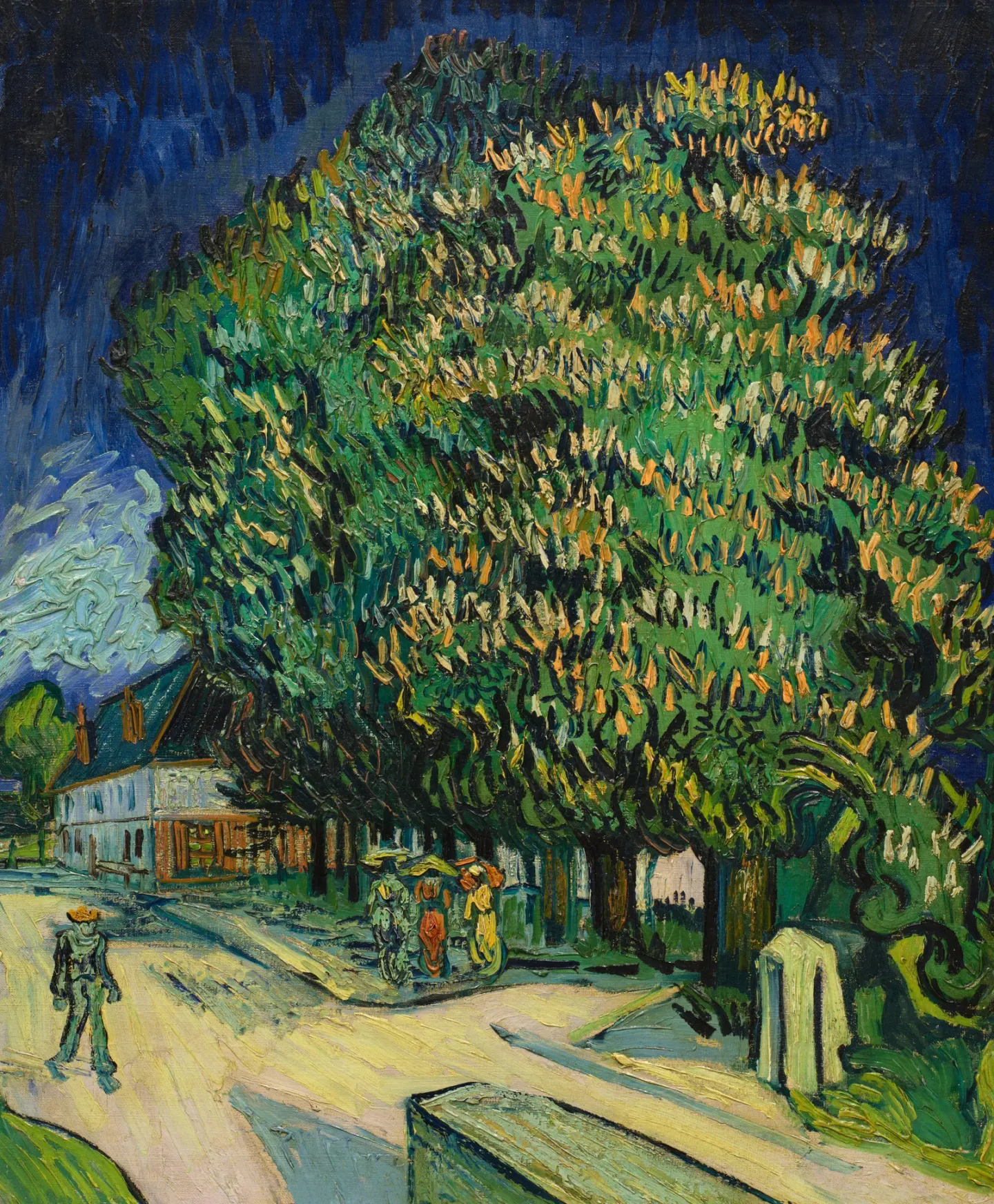
Figure: Vincent van Gogh, Blossoming Chestnut Trees (F 751, May 1890) · Sold at Sotheby's New York, November 2026 · Public domain, via Wikimedia Commons
In the same letter, Van Gogh described Auvers as "far enough from Paris to be a real countryside," and wrote that he saw—or thought he saw—"a tranquility like that of Puvis de Chavannes." He also mentioned that there were no factories and that it overflowed with beautiful greenery (Van Gogh Letter 875). The letter also includes weather notes saying, "It rained yesterday and today and stormed, but seeing these effects again is not a bad thing," and the editors matched this rain with French meteorological records to determine the date of the letter as the 25th (Van Gogh Letter 875).
It is difficult to pin down the exact day the painting was made. The Sotheby's catalog notes that it was painted on May 24, 1890, while a study cited in the Sotheby's literature section dates it to the 25th (Sotheby's Catalog). In an unmailed letter written on May 24, Van Gogh stated that he had "four painted studies and two drawings," and the editors include the two chestnut tree paintings in that group of four (Van Gogh Letter RM20). The Kröller-Müller Museum dates the pendant painting to May 22–23 (Kröller-Müller Museum). What is consistently supported by various records is simply "late May, a few days after arriving in Auvers."
The two paintings differ when it comes to people. The French collector Gustave Fayet recorded this painting as one containing a "house on a path where passersby walk," whereas the Kröller-Müller pendant has no people in it (The Art Newspaper). The location is the road in front of the Auvers station, and the distant building in the painting is still a bar and tobacconist today (The Art Newspaper). Looking at the painting, a blooming tree stands beneath a deep blue sky, and three women holding Japanese parasols gather underneath it. Martin Bailey, writing in The Art Newspaper, interprets the figure in blue with a straw hat on the left as reminiscent of the painter himself (The Art Newspaper).
The brushwork of the pendant painting is explained in detail by the museum. The greenery of the tree was spread with flat brushstrokes, and the texture of the leaves was built up with short, straight, dark blue brushstrokes. Thick dark blue outlines were wrapped around several of the white inflorescences to enclose the flowers like gables, the sky was painted with overlapping zigzag brushstrokes, and the lower part of the canvas was left unpainted (Kröller-Müller Museum). The museum calls this an experiment in brushwork. Though not dealing with these two paintings directly, automated analysis comparing them with painters of the same period showed that Van Gogh's brushwork exhibited a rhythm where regular shapes repeated densely, a characteristic maintained throughout his French period from 1886 to 1890 (DOI: 10.1109/tpami.2011.203).
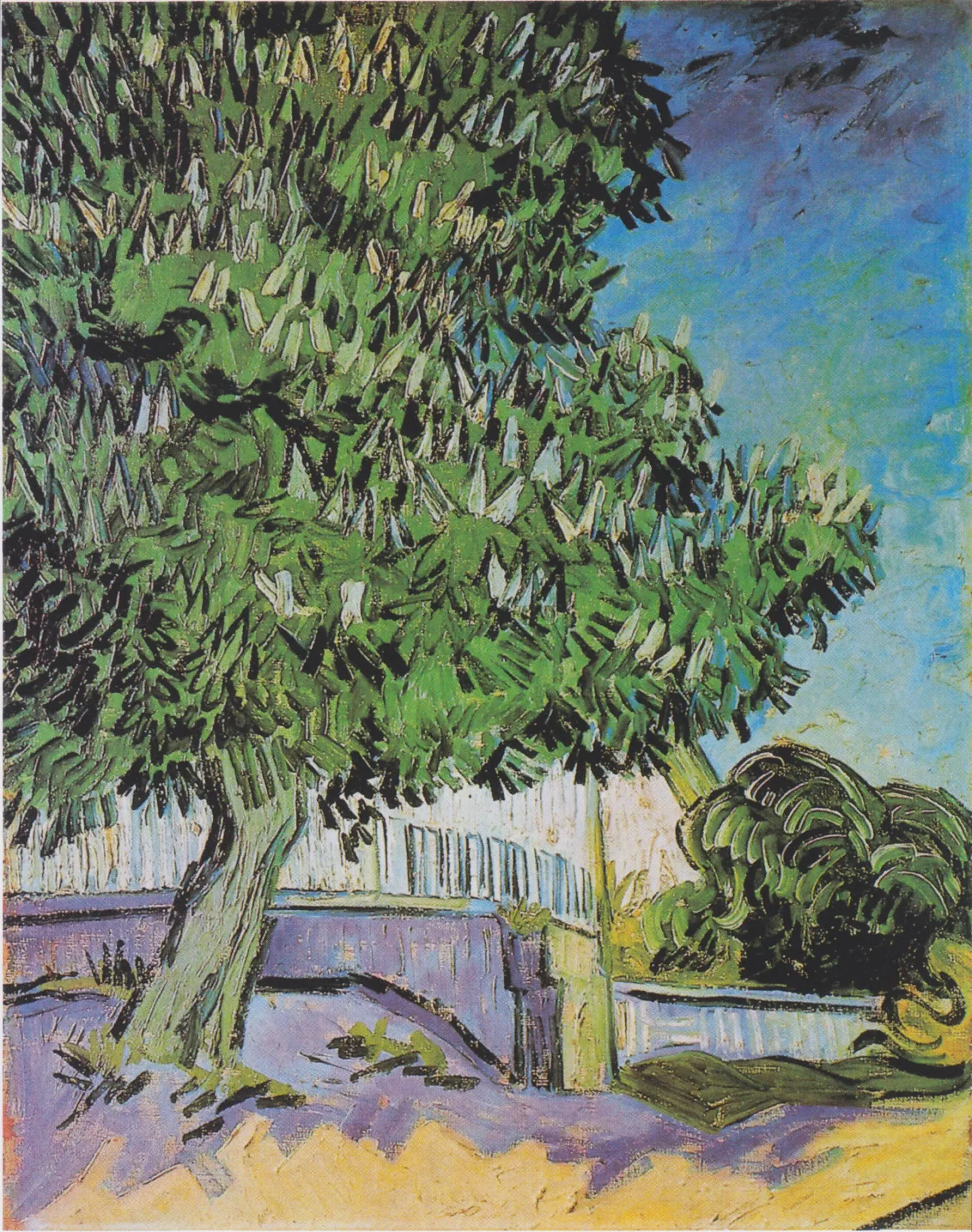
Figure: Vincent van Gogh, Blossoming Chestnut Trees (F 752, May 1890) · Kröller-Müller Museum, Otterlo · Art-book reproduction · Public domain, via Wikimedia Commons
Bailey wrote that this painting evokes the optimism Van Gogh likely felt after leaving the asylum nine days prior, and surmises that hours after painting it, the weather turned foul and he may have painted the still life “Blossoming Chestnut Branches” using a broken branch (The Art Newspaper). Both are his interpretations. What the records tell us with certainty is a single line in a letter and two paintings.
A Résumé of Fifteen Lines
At the end of an auction catalogue, the owners who have passed this painting through their hands are listed in fifteen lines (Sotheby's Catalogue). Provenance is a record of whose hands a work of art has passed through from the time it was made to the present day. Each line contains who got it, where, when, and from whom. The résumé mentioned in the title of this article is this list.
The first line is his brother Theo, and the second line is Theo's wife Jo van Gogh-Bonger and their son. After the brothers passed away in quick succession, Jo took charge of Van Gogh's estate from 1891 onward, publishing letters, holding exhibitions, and making strategic sales to individuals and influential art dealers (DOI: 10.5040/9781350299610). This painting went to the Berlin art dealer Paul Cassirer in September 1905. Cassirer was the driving force behind creating the market for Van Gogh's paintings in Germany during the reign of Wilhelm II, and German Jews made up an unusually high proportion of Van Gogh collectors in Germany before 1914 (DOI: 10.1093/jhc/fhp012). Afterwards, the painting went to the French aristocrat the Prince de Wagram in March 1906, and then to Druet's gallery in Paris (Sotheby's Catalogue).
The next line was only brought to light in 2026. Provenance research is the work of verifying the links in a chain of ownership one by one using documents such as gallery ledgers, diaries, letters, and exhibition records to fill in the blanks. Triggered by work on the catalogue for the Fayet exhibition at the Louis Vuitton Foundation in Paris, a line in Fayet's ledger from January 9, 1909, surfaced showing he bought "Blossoming Chestnut Tree" from Druet for 3,800 francs. That was about 750 dollars at the time. Fayet was one of the most important collectors of modern art just before the First World War, and before November of that year he passed this painting on to the Bernheim-Jeune gallery in Paris (The Art Newspaper). This link was absent from all Van Gogh literature until then (The Art Newspaper). An article written by the same outlet three weeks earlier had listed Fischer four years later immediately after the Prince de Wagram (The Art Newspaper), but in the résumé after the ledger emerged, three lines for Druet, Fayet, and Bernheim-Jeune sit in between (Sotheby's Catalogue).
Exhibition records also shore up this résumé. This painting hung in the Van Gogh exhibition at the Vollard Gallery in Paris in 1896–97 and the Van Gogh exhibition at the Stedelijk Museum Amsterdam in 1905. Because records are not always correct, a 1914 exhibition at the Cassirer Gallery in Berlin mistakenly attached the title "Chestnut Trees at Arles" and the date 1888 to it (Sotheby's Catalogue). This is why provenance research cross-checks documents sheet by sheet. Provenance research from the Nazi era does one more thing on top of this. It recovers erased names and experiences and puts them back into the historical record (DOI: 10.2307/jj.9474316).
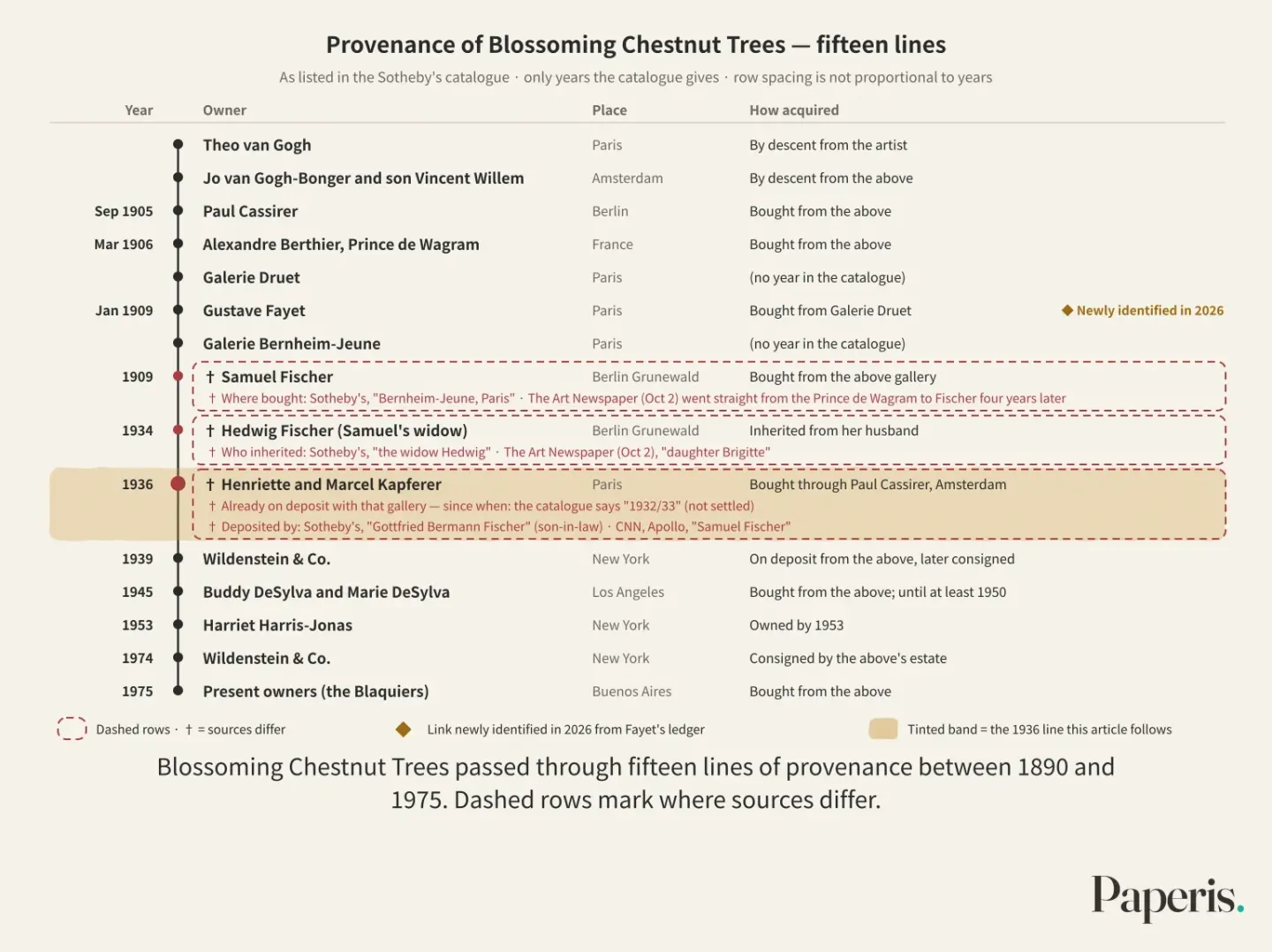
Figure: a diagram Paperis drew using only what the article says
1936, Amsterdam
The person who bought this painting in 1909 was Samuel Fischer and his wife Hedwig (The Art Newspaper). Samuel Fischer was a Jewish publisher in Berlin who founded the publishing house that published books by Thomas Mann and Hermann Hesse (NPR). The Sotheby's catalog records that the couple bought it at the Bernheim-Jeune gallery in Paris (Sotheby's Catalog).
In 1932 or 1933, the Fischer family consigned this painting along with two Cézanne paintings to the Paul Cassirer Gallery in Amsterdam, Netherlands (ARTnews). The art dealer who ran the gallery was Walter Feilchenfeldt (Apollo). Sotheby's has not settled on a single year for the consignment, and 1933 was the year Adolf Hitler's Nazi party took power in Germany and began the persecution of Jews. The person who consigned it also varies depending on the source. The Sotheby's catalog lists the son-in-law Gottfried Bermann Fischer, while CNN and Apollo list Samuel Fischer (Sotheby's Catalog, CNN, Apollo). The painting was left at the gallery for nearly three years, during which time it went out to exhibitions at the Museum Boijmans Van Beuningen in Rotterdam in 1933–34 and the Kunsthalle Bern in 1934 (Sotheby's Catalog).
Samuel Fischer passed away in 1934. The publishing house was taken over by his son-in-law Gottfried, and the Nazis began banning many of the authors published by this house. The family moved the publishing house to Vienna, Austria in 1936 (ARTnews). Sources also differ on who inherited the painting in 1934. The Sotheby's catalog lists the widow Hedwig, while an October article in The Art Newspaper lists the daughter Brigitte (Sotheby's Catalog, The Art Newspaper).
In June 1936, the Cassirer gallery sold this painting on behalf of the Fischer family to Paris collectors Henriette and Marcel Capéret. At that time, the painting was still in the Netherlands (CNN). Marcel Capéret was the head of the French subsidiary of the oil company Royal Dutch Shell (The Art Newspaper). The price was 68,000 Swiss francs, which was roughly 22,000 dollars at the time. This figure was disclosed to ARTnews by Sotheby's, stating it was confirmed from the Cassirer gallery's records, and Sotheby's considers this to have been a high price for a Van Gogh painting at the time (ARTnews). None of the materials collected in this article independently verify this number.
Two years later in 1938, when Nazi Germany annexed Austria, the family fled again, and the Nazi secret police, the Gestapo, confiscated their home, study, and remaining art collection in Vienna (ARTnews). Because the 1936 sale took place in the Netherlands, which was outside Nazi control, the heirs of Fischer had almost no legal basis to claim compensation after the war ended (CNN).
The skeleton of this single line is a sequence. Consigning the painting happened before the family left Germany, selling it happened after they left, and the place it was sold was outside Nazi rule. The 1936 line is a transaction where a family that left Germany under persecution sold a painting in the Netherlands, outside Nazi control, for 68,000 Swiss francs. Sotheby's views this price as a high one for a Van Gogh painting at the time, while the heirs' side views it as an undervalued price. The subsequent debate unfolds over how to read these three conditions.
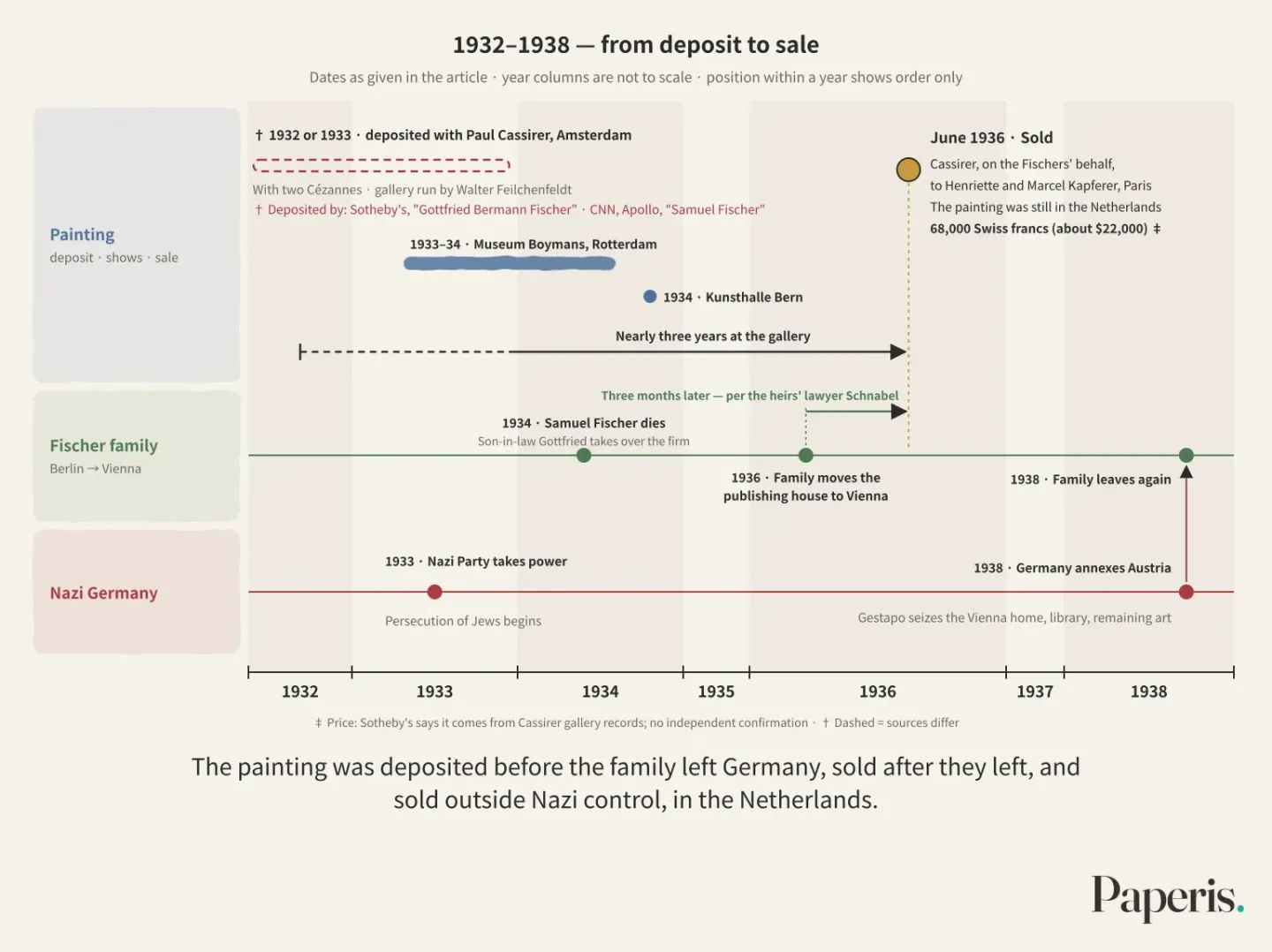
Figure: a diagram Paperis drew using only what the article says
The lines following that are relatively quiet. The painting was entrusted to the Wildenstein Gallery in New York starting in 1939, was with Hollywood composer and film producer Buddy DeSilva by 1945, and was owned by New York collector Harriet Harris Jonas by 1953 at the latest. It was bought by the Blaquier couple of Buenos Aires in 1975 (Sotheby's Catalog, The Art Newspaper). The couple built their wealth in the sugar business, and their children put the painting up for sale after Nelly Arrieta de Blaquier passed away in 2020 and Carlos Pedro Blaquier in 2023 (The Art Newspaper). Before the touring exhibition leading up to the 2026 auction, the last time the painting was publicly exhibited was at the Guggenheim Museum in New York in 1964, and after that, there were only very poor-quality color reproductions (The Art Newspaper).
Between Confiscation and Sale
The paintings taken by the Gestapo in Vienna in 1938 and the painting sold in Amsterdam in 1936 belonged to the same family. The former was seized, while the latter was sold through an art gallery. The question of this section is how today's rules treat these two cases.
The Washington Principles are 11 principles to solve the problem of Nazi-confiscated art, endorsed by the governments of 44 countries at the Washington Conference in the United States in 1998. The principles state that they are "non-binding principles," and note that because legal systems differ from country to country, each operates within its own laws. The eighth principle states that if the pre-war owners or heirs of art confiscated by the Nazis and not returned are identified, a "fair and just solution" must be found promptly, and that the solution may vary depending on the facts and circumstances of each case. The fourth principle states that in determining whether art was confiscated, one should consider that the passage of time and the circumstances of the Holocaust create unavoidable gaps in provenance (Washington Principles). The subject addressed by the 1998 original text is "confiscated" art.
It was not clear whether sales fell within that scope. A forced sale refers to a transaction where the owner received a price for the property, but gave it up unavoidably due to Nazi persecution. A 2007 paper pointed out that it was unclear whether the ethical guidelines of U.S. museums applied to restitution claims for such sales. The author argued that the scope of the guidelines should be expanded to include sales involving Nazi interference, as well as private sales between individuals to flee or survive persecution (DOI: 10.1017/s0940739107070063). A declaration issued in Terezín, Czech Republic, in 2009 specified "forced sales and sales under duress" as a form of persecution damage between 1933 and 1945. The Terezín Declaration also states that it has no legal binding force in itself (Terezín Declaration).
In March 2024, "Best Practices" were released that refine how to practically apply the Washington Principles. Section C thereof states that art sold by persecuted individuals between 1933 and 1945 may be treated as equivalent to an involuntary transfer, depending on the circumstances of the sale, taking into account the historical and legal context of each case. The Best Practices describe themselves at the outset as guidelines that are "not legally binding, but morally significant" (2024 Best Practices). A commentary in a collection of international law materials evaluates that these Best Practices have broadened the core criteria compared to previous documents (DOI: 10.1017/ilm.2025.10104). A 2026 essay (working paper) argues, based on international law prohibiting wartime plunder and public policy respecting private property, that the restitution remedies established by the Best Practices should not be dismissed as insignificant soft law (DOI: 10.2139/ssrn.6387078). Still, the Best Practices themselves state that they are not legally binding.
The standards of the court are different. Luke Nikas, a lawyer for Sotheby's, argues that New York law distinguishes between the terrible general situation of Jews under the Nazis and transactions where the buyer actually pressured the seller (ARTnews). According to ARTnews's summary, in the 2018 Zukerman v. Metropolitan Museum of Art case, a federal judge ruled that a 1938 sale fell short of the legal standard for duress, and in the 2024 Bennigson v. Guggenheim Foundation case, a New York judge also ruled that economic pressure amid persecution, without the buyer's assistance, does not constitute duress. In both cases, the appellate courts upheld the dismissals, but for a different reason: that the heirs had brought their claims too late (ARTnews).
The problem of late claims has been addressed by the U.S. Congress. The Holocaust Expropriated Art Recovery Act of 2016, abbreviated as the HEAR Act, allowed claims that had previously been dismissed without a judgment on the merits due to varying state statutes of limitations to be filed within 6 years of actually discovering the location of the artwork (DOI: 10.70167/fxpt6245, DOI: 10.7916/d8-j6bq-p383). In April 2026, Congress amended this law to eliminate the defense that defeated claims on the grounds of being too late. It did not change the definition of a forced sale (ARTnews). Judd Grossman, a lawyer unaffiliated with the case, evaluates that the scales have tilted heavily toward the claimants (ARTnews).
Placing the two standards side by side reveals where this painting stands. The non-binding principles state that sales by persecuted individuals can be viewed as involuntary transfers depending on the circumstances, while the New York jurisprudence introduced by Nikas inquires about the buyer's pressure. Christopher Marinello, founder of the art recovery firm Art Recovery International who is not involved in this case, stated that forced sale claims are slightly more difficult to prove, but carry the same weight as confiscation claims (NPR).
Over Six Days
On Thursday, November 12, Gunnar Schnabel, reported as a restitution researcher and lawyer in Berlin, sent a letter to Sotheby's on behalf of the Fischer heirs (The Art Newspaper, ARTnews). Sotheby's stated that they were first contacted that morning (ARTnews). In an email obtained and reported by the New York Times and covered by ARTnews, Schnabel demanded two things of Sotheby's: that the family received a fair market price, and that the family would have sold the painting even if the Nazis had not come to power. Otherwise, he wrote, "the auction cannot take place." He also stated that his clients were prepared to work toward a fair and just resolution in accordance with the Washington Principles (ARTnews).
The heirs argue that financial pressure caused by Nazi persecution forced the family to sell the painting (ARTnews, CNN). They cited two grounds: the sale took place three months after the family left Berlin for Vienna, and the family had to pay the Reich Flight Tax (The Art Newspaper, JNS). The Reich Flight Tax was a heavy tax levied by Nazi Germany on the property of people leaving the country (CNN). The payment of the flight tax was a finding uncovered by Schnabel's research, as reported by the New York Times. Most reports stop at the fact that the family had to pay that tax, without connecting it to the purpose of selling the painting. Ynet reported that the heirs' lawyer argued that the family had to sell at a loss in 1936 after leaving Berlin (ynet).
Nykas, the lawyer for Sotheby's, had a different basis. The painting was sold to an independent buyer for a fair market price, and the family kept other paintings afterward, which were then seized by the Nazis in 1938. He also stated that after the war, the family sought out and recovered works forcibly sold in 1938, but did not look for works like this one sold in 1936. Nykas said he saw a booklet published by Gottfried after the war listing the paintings the family wanted back, and that this painting was not in it (ARTnews). That booklet has not been made public.
Sotheby's official stance came out on November 16. It stated that while investigations so far had not confirmed that the painting was sold under duress, they would engage in good-faith conversations with the family to find a mutually satisfactory resolution (CNN). The Blahnik family expressed the same sentiment, stating that while duress was not confirmed, they welcomed the talks (ARTnews).
There is also a record from 2007. That year, when Christie's auctioned a Cézanne painting belonging to the Fischer family that had passed through the same Amsterdam gallery, Gisela Berman Fischer, Gottfried's daughter and handler of the family's art claims, stated in writing that while she did not object to the sale, she reserved the right to contest other paintings she believed were sold under duress. Sotheby's told ARTnews that they looked into that Cézanne sale but were unaware of this reservation (ARTnews). ARTnews noted that it may be difficult to prove 90 years later in a transaction that "it would have been sold even without the Nazis" (ARTnews).
On Tuesday, November 17, Sotheby's announced that the Blahnik-Arrieta family and all legal descendants of Hedwig and Samuel Fischer had reached an agreement. The statement said that, considering the painting's complex Nazi-era history and the suffering endured by the Fischer family during the Holocaust, the two families reached a mutually satisfactory resolution, and the painting would be sold in accordance with the agreement (The Art Newspaper). The Fischer heirs stated that this agreement allowed them to acknowledge the family's suffering during the Nazi era and honor Gisela's history of seeking justice for the family, while the Blahnik-Arrieta family expressed happiness at reaching an amicable resolution (The Art Newspaper).
This is as much as has been made public. The terms of the settlement remain undisclosed due to confidentiality (NPR), and it is not known whether the heirs received financial compensation (ARTnews, The Art Newspaper). Sotheby's confirmed that the settlement resolved the ownership claims and that the buyer receives clean title (ARTnews). The settlement resolved the question of ownership of the painting, but did not rule on whether the 1936 sale took place under duress (ARTnews).
Disputes against museums have often ended in settlements. According to a 2014 overview, nearly all World War II-related claims entering American museums were resolved amicably, with only a few going to lawsuits, and in the rare cases that went to verdicts, the museums won all of them (DOI: 10.1177/155019061401000314). This overview dealt with museum collections, and privately owned items put up for auction fall outside that scope. Academic discussions also continue regarding what constitutes a fair and just resolution. A 2018 study comparing restitution committees in the Netherlands and the United Kingdom analyzed that committees in both countries oscillate between policy judgments relying on morality and legal judgments weighing individual property rights (DOI: 10.1017/s0940739118000103). A 2019 paper argued against using morality as a yardstick because it is ambiguous, suggesting that a new conceptual framework is needed and citing claimant narratives that claimants care more about reconciliation and procedural fairness than the recognition of moral rights (DOI: 10.1017/s0940739119000316).
The Price the Hammer Fell On
The hammer came down at 165 million dollars after about five minutes of bidding. The painting was reported to have gone to a bidder inside the salesroom, William Acquavella, head of Acquavella Galleries (The Art Newspaper). Sotheby's did not disclose the buyer, and his name was reported by the Wall Street Journal and separately confirmed by ARTnews (ARTnews).
There are two figures. The 165 million dollars is the price the auctioneer knocked the hammer down at, and 190.4 million dollars is that amount plus the buyer's fee (ARTnews). Sotheby's official estimate was "upon request" (Sotheby's Editorial), and the reported estimate was roughly 180 million dollars on the hammer, or about 207 million dollars with the buyer's fee added (The Art Newspaper). The hammer price fell short of the reported estimate of 180 million dollars, while the total with the buyer's fee at 190.4 million dollars became the auction record for a Van Gogh painting (The Art Newspaper). NPR reported that it was over 10 million dollars higher than the estimate (NPR), which is a calculation comparing the fee-inclusive price against the hammer-only estimate. The previous record was 117.2 million dollars for "Orchard with Cypresses" sold at Christie's in 2022, and before that, "Portrait of Dr. Gachet" at 82.5 million dollars in 1990 held the record for 32 years (ARTnews).
An auction guarantee is when an auction house promises the seller a minimum amount regardless of the auction outcome. Sotheby's guaranteed this painting, and the amount was not disclosed (CNN). The Art Newspaper noted that because there was a guarantee, the painting was bound to sell (The Art Newspaper). There are also figures showing this painting is in a rare spot. According to Bailey's catalog, out of roughly 50 Auvers landscapes by Van Gogh, only 8 remain in private hands (The Art Newspaper). All 12 pieces of the Blakyeyrieta collection totaled 358 million dollars on the hammer that same night (412 million dollars with fees), falling short of the roughly 450 million dollar estimate, and 6 of the 12 pieces sold below their low estimates (The Art Newspaper).
Art market research reports several general trends regarding estimates and prices. A 2002 overview summarizing auction studies (an NBER working paper) notes that experts' estimates hit market prices quite accurately but do not make the best use of publicly available information (DOI: 10.3386/w8997). A 2005 study looking at 30 years of auction data found that estimates for expensive paintings were consistently set high, and the researchers saw this as consistent with explanations that the auction house's conflicts of interest interfere with estimates, and that some investors easily trust those estimates (DOI: 10.1111/j.1540-6261.2005.00803.x). A 2025 study interviewing 14 art dealers, auction house personnel, and collectors in the contemporary art market suggests that prices are formed through negotiations over factors like reputation, emotional resonance, provenance, and strategic withholding of information, rather than a set formula (DOI: 10.35692/07183992.18.2.4). These studies are general rules derived from numerous transactions and do not explain why 165 million dollars happened for one painting on one night.
Where to Look Further
How this painting was sold in 1936 remains open. The basis of the heirs' side and the basis of Sotheby's side are only known as much as each has been made public, and the settlement did not adjudicate between the two.
As a piece that looks deeply into one of Van Gogh's paintings from the paint side, there is "Van Gogh's Sunflowers — The Shadow Settling on the Yellow". It traces why, where, and how much the yellow of the sunflowers painted in Arles in 1888 changes. If this article followed the outside of the painting, namely the owners and documents, that article follows the inside of the painting.
Case Documents
-
"Sotheby's lot 5 — Vincent van Gogh, Châtaigniers en fleurs" (2026-11) — Canvas, dimensions, creation date, provenance, exhibition and literature history, sale by agreement.
-
"Châtaigniers en fleurs" Sotheby's editorial (2026) — https://www.sothebys.com/en/articles/editorial-pricing-the-priceless-how-to-value-vincent-van-gogh — Official estimate "Estimate on Request".
-
Van Gogh letter 873 (1890-05-20) — https://vangoghletters.org/en/let873 — Editor's note: Arrival date in Auvers, Tuesday, May 20.
-
Van Gogh letter 874 (c. 1890-05-21) — https://vangoghletters.org/en/let874 — First thatched roof study in Auvers.
-
Van Gogh letter 875 (1890-05-25) — https://vangoghletters.org/en/let875 — "Study of pink chestnuts and study of white chestnuts", editor's identification of the work, basis for confirming the date.
-
Van Gogh letter RM20 (1890-05-24, unsent) — https://vangoghletters.org/en/RM20 — "Four painted studies and two drawings" and editor's identification of the work.
-
Kröller-Müller Museum "Blossoming chestnut trees" KM 105.479 — https://www.krollermuller.nl/en/collection/vincent-van-gogh-blossoming-chestnut-trees-km-105-479 — Discharge from the asylum on May 16, date of companion picture F 752 (May 22–23) and brushstroke description.
-
"Van Gogh's Blossoming Chestnut Trees …" The Art Newspaper, Martin Bailey (2026-10-02) — https://www.theartnewspaper.com/2026/10/02/the-story-behind-the-180m-van-gogh-up-for-auction-this-november — Scene and location in the painting, 8 privately owned works out of 50 Auvers landscapes, last exhibited in 1964, the Blachère couple, Caillac, estimate and guarantee, Bailey's interpretation.
-
The Art Newspaper, Martin Bailey (2026-10-23) — https://www.theartnewspaper.com/2026/10/23/newly-identified-the-most-expensive-van-gogh-was-once-owned-by-a-highly-distinguished-early-collector — Ravoux's ledger books and Bernheim-Jeune sale — A new link absent from Van Gogh literature.
-
The Art Newspaper (2026-11-17) — https://www.theartnewspaper.com/2026/11/17/sothebys-makes-last-minute-deal-with-jewish-heirs-to-sell-180m-van-gogh-painting — Schnabel letter on November 12, claim of sale three months later, announcement of agreement and three-page statement.
-
The Art Newspaper (2026-11-19) — https://www.theartnewspaper.com/2026/11/19/van-gogh-painting-sells-for-record-7778m-after-nazi-loot-claims — Hammer price and price including fees, bidding contest, buyer, overall collection results.
-
ARTnews "Eleventh-Hour" objection article (c. 2026-11-15) — https://www.artnews.com/art-news/news/sothebys-van-gogh-180-million-restitution-claim-1936-sale-1234806093/ — Fischer family history, consignment and 1936 sale, heirs' demands and Sotheby's counterarguments, New York case law, HEAR Act amendment.
-
ARTnews settlement article (2026-11-17) — https://www.artnews.com/art-news/market/sothebys-van-gogh-restitution-settlement-fischer-heirs-1234806294/ — Undisclosed terms, compensation status unknown, no ruling on duress, clean title.
-
ARTnews auction results article (2026-11-18) — https://www.artnews.com/art-news/market/van-gogh-auction-record-sothebys-chataigniers-en-fleurs-2026-1234806413/ — Bidding outcome, guarantee, comparison against estimate, buyer reporting context, previous record.
-
CNN (2026-11-17, syndicated from local broadcaster, updated post-settlement edition) — https://keyt.com/lifestyle/entertainment/cnn-style/2026/11/17/van-gogh-auction-to-go-ahead-despite-last-minute-claim-the-180m-painting-was-sold-under-duress-in-nazi-era/ — June 1936 sale and painting's location (Netherlands), meaning of flight tax, lack of post-war legal basis, meaning of guarantee.
-
CNN (Published 2026-11-17, containing November 16 statement, syndicated) — https://www.cp24.com/news/world/2026/11/17/van-gogh-auction-to-go-ahead-despite-last-minute-claim-the-us180m-painting-was-sold-under-duress-in-nazi-era/ — Sotheby's official statement.
-
NPR Morning Edition (2026-11-18) — https://www.npr.org/2026/11/18/nx-s1-6044204/van-gogh-auction-record-painting-history — The Fischers and the publishing house, Marinello interview, undisclosed settlement terms.
-
Apollo (2026-11) — https://apollo-magazine.com/sothebys-van-gogh-chataigniers-en-fleurs-restitution-claim/ — Consigned to Walter Feilchenfeldt in Amsterdam, 1936 sale.
-
JNS (2026-11) — https://www.jns.org/news/culture-and-society/jewish-heirs-seek-to-halt-sothebys-sale-of-180-million-van-gogh — Schnabel: Sale three months after emigration, payment of flight tax.
-
ynet (2026-11-16) — https://www.ynetnews.com/culture/article/sy9twiu0gg — Heirs' conveyed claim that it was "sold at a loss".
-
"Washington Conference Principles" (1998-12-03, posted by U.S. Department of State, verify original via Looted Art Commission reprint) — https://www.state.gov/washington-conference-principles-on-nazi-confiscated-art/ — 11 principles, non-binding, principles 4 and 8.
-
"Terezin Declaration" (2009) — https://www.state.gov/prague-holocaust-era-assets-conference-terezin-declaration/ — Posted by U.S. Department of State (verify original via Looted Art Commission reprint). Explicitly notes "forced sales and sales under duress".
-
"Best Practices for the Washington Conference Principles" (2024-03-05, posted by U.S. Department of State, verify original via Looted Art Commission reprint) — https://www.state.gov/best-practices-for-the-washington-conference-principles-on-nazi-confiscated-art/ — Non-binding, section C (treating sales by persecuted persons as equivalent to involuntary transfers depending on the circumstances).
Source Papers
- "Rhythmic Brushstrokes Distinguish van Gogh from His Contemporaries: Findings via Automated Brushstroke Extraction" (2011) — DOI: 10.1109/tpami.2011.203 — Automated brushstroke statistics show that van Gogh's brushstrokes possess a rhythm in which tightly packed, regular shapes repeat, and this characteristic was maintained throughout his French period from 1886 to 1890.
- "Jo van Gogh-Bonger" (2022) — DOI: 10.5040/9781350299610 — Jo managed the estate starting in 1891, building van Gogh's fame through the publication of letters, exhibitions, and calculated sales to individuals and influential art dealers.
- "The art dealer and collector as visionary: Discovering Vincent van Gogh in Wilhelmine Germany 1900-1914" (2009) — DOI: 10.1093/jhc/fhp012 — Berlin Jewish art dealer Paul Cassirer was a leading figure in the Wilhelmine German market for van Gogh, and the proportion of Jewish collectors among van Gogh collectors before 1914 was unusually high.
- "Nazi-Era Provenance of Museum Collections" (2024) — DOI: 10.2307/jj.9474316 — The methods and materials of Nazi-era provenance research, recovering erased names and experiences to place them back into the historical record.
- "Expanding the Scope of Museums' Ethical Guidelines With Respect to Nazi-Looted Art: Incorporating Restitution Claims Based on Private Sales Made as a Direct Result of Persecution" (2007) — DOI: 10.1017/s0940739107070063 — Arguing that it is unclear whether museum ethical guidelines apply to claims involving coerced sales, and that they should include even private-party sales made for the purpose of fleeing or surviving persecution.
- "Best Practices for the Washington Conference Principles on Nazi-Confiscated Art" (2025) — DOI: 10.1017/ilm.2025.10104 — The 2024 best practices are not legally binding but serve as an important moral benchmark, proposing additional measures and broadening key standards compared to previous documents.
- "Taking The Profit Out Of War: Why International Law Requires Restitution Of Nazi-Looted Art" (2026, working paper essay) — DOI: 10.2139/ssrn.6387078 — Arguing that because international law and public policy require restitution, best practices should not be dismissed as mere soft law.
- "The Greatest Art Theft in History: How Bipartisan Legislation Attempts to Redress Nazi-Looted Art" (2025) — DOI: 10.70167/fxpt6245 — The HEAR Act of 2016 establishes a unified six-year statute of limitations from the time of discovering the location, allowing claims previously dismissed due to expired state statutes of limitations to be litigated on their merits.
- "Navigating the Ambiguities and Uncertainties of the Holocaust Expropriated Art Recovery Act of 2016" (2019) — DOI: 10.7916/d8-j6bq-p383 — An analysis showing that while the HEAR Act established a nationwide six-year statute of limitations from "actual discovery," the ambiguity of its wording creates new litigation issues.
- "Nazi Era Claims and Art Museums" (2014) — DOI: 10.1177/155019061401000314 — Nearly all World War II-related claims against U.S. art museums are resolved amicably, with lawsuits being a minority and museums winning all rare cases that went to a judgment.
- "Restitution Policies on Nazi-Looted Art in the Netherlands and the United Kingdom: A Change from a Legal to a Moral Paradigm?" (2018) — DOI: 10.1017/s0940739118000103 — An analysis showing that Dutch and British restitution committees oscillate between morality-centered policy judgments and individual ownership-centered legal judgments.
- "The Conflation of Morality and "the Fair and Just Solution" in the Determination of Restitution Claims Involving Nazi-Looted Art" (2019) — DOI: 10.1017/s0940739119000316 — Opposing the use of morality as the yardstick for a fair and just solution, arguing that claimants are more interested in reconciliation and procedural fairness than in the recognition of moral rights, and that a new conceptual framework is needed.
- "Art Auctions: A Survey of Empirical Studies" (2002, NBER working paper) — DOI: 10.3386/w8997 — An overview of research on auction price formation, noting that expert estimates predict market prices very accurately yet fail to process public information optimally.
- "Vested Interest and Biased Price Estimates: Evidence from an Auction Market" (2005) — DOI: 10.1111/j.1540-6261.2005.00803.x — A consistent upward bias in auction estimate prices for expensive paintings over 30 years, consistent with agency problems and the gullible tendencies of some investors.
- "Understanding price formation in the art market through expert interviews" (2025) — DOI: 10.35692/07183992.18.2.4 — In-depth interviews with 14 individuals revealing that prices are formed through negotiations intertwined with reputation, appraisal, provenance, market segmentation, and strategic withholding.
Sources (15)
- Rhythmic Brushstrokes Distinguish van Gogh from His Contemporaries: Findings via Automated Brushstroke ExtractionDOI 10.1109/tpami.2011.203
- Jo van Gogh-BongerDOI 10.5040/9781350299610
- The art dealer and collector as visionary: Discovering Vincent van Gogh in Wilhelmine Germany 1900-1914DOI 10.1093/jhc/fhp012
- Nazi-Era Provenance of Museum CollectionsDOI 10.2307/jj.9474316
- Expanding the Scope of Museums' Ethical Guidelines With Respect to Nazi-Looted Art: Incorporating Restitution Claims Based on Private Sales Made as a Direct Result of PersecutionDOI 10.1017/s0940739107070063
- Best Practices for the Washington Conference Principles on Nazi-Confiscated ArtDOI 10.1017/ilm.2025.10104
- Taking The Profit Out Of War: Why International Law Requires Restitution Of Nazi-Looted ArtDOI 10.2139/ssrn.6387078
- The Greatest Art Theft in History: How Bipartisan Legislation Attempts to Redress Nazi-Looted ArtDOI 10.70167/fxpt6245
- Navigating the Ambiguities and Uncertainties of the Holocaust Expropriated Art Recovery Act of 2016DOI 10.7916/d8-j6bq-p383
- Nazi Era Claims and Art MuseumsDOI 10.1177/155019061401000314
- Restitution Policies on Nazi-Looted Art in the Netherlands and the United Kingdom: A Change from a Legal to a Moral Paradigm?DOI 10.1017/s0940739118000103
- The Conflation of Morality andDOI 10.1017/s0940739119000316
- Art Auctions: A Survey of Empirical StudiesDOI 10.3386/w8997
- Vested Interest and Biased Price Estimates: Evidence from an Auction MarketDOI 10.1111/j.1540-6261.2005.00803.x
- Understanding price formation in the art market through expert interviewsDOI 10.35692/07183992.18.2.4