Paperis Articles
Van Gogh's Sunflowers — The Shadow Settling on the Yellow
Why, where and how much is the yellow in the Sunflowers, painted in Arles in 1888–89, changing? We follow chrome yellow, a new industrial pigment of the day, the mock-up paint experiments that traced its darkening to light-driven reduction of chromium, and the X-ray maps, made in selected areas, that show where the yellow the researchers call light-sensitive lies.
Your field's papers, as audio
Pick your fields and journals — Paperis summarizes the key papers and turns them into audio. Listen on your commute.
Start Paperis free →Van Gogh's Sunflowers — The Shadow Settling on the Yellow
1888 Arles, Sunflowers in a Vase
In the summer of 1888, the small city of Arles in southern France. The Dutch painter Vincent van Gogh had been staying and painting here since February of that year. In August, he began painting sunflowers placed in a vase. One of the pieces painted then is Van Gogh's first painting of sunflowers against a yellow background, and is currently in the National Gallery in London, UK (DOI: 10.5117/9789463725323_ch04). In January of the following year, Van Gogh repainted this picture, and that painting is now in the Van Gogh Museum in Amsterdam, Netherlands.
The sunflowers in Amsterdam is a painting that Van Gogh started by keeping the London painting by his side and transferring its composition onto a blank canvas with charcoal. Even though he had carefully decided the composition, areas needed touching up near the end of the work. Van Gogh attached a painted strip of wood to the top edge of the canvas, extending the background above the topmost flower. The provenance of the canvas fabric has also been revealed. By automatically analyzing the threads of the fabric with a computer, it was found that this canvas came from a single roll of linen ordered by Van Gogh, and Van Gogh cut up that roll and used it across the sunflowers and other paintings (DOI: 10.1017/9789048550531.005). The sequence of choosing the cloth, transferring the composition with charcoal, applying paint, and adding the wooden strip remains within the painting.
This article asks a single question about that one sunflower painting in Amsterdam. Why, where, and how much does the yellow of this painting change? From here on, "Sunflowers" refers to this Amsterdam version unless specified otherwise.
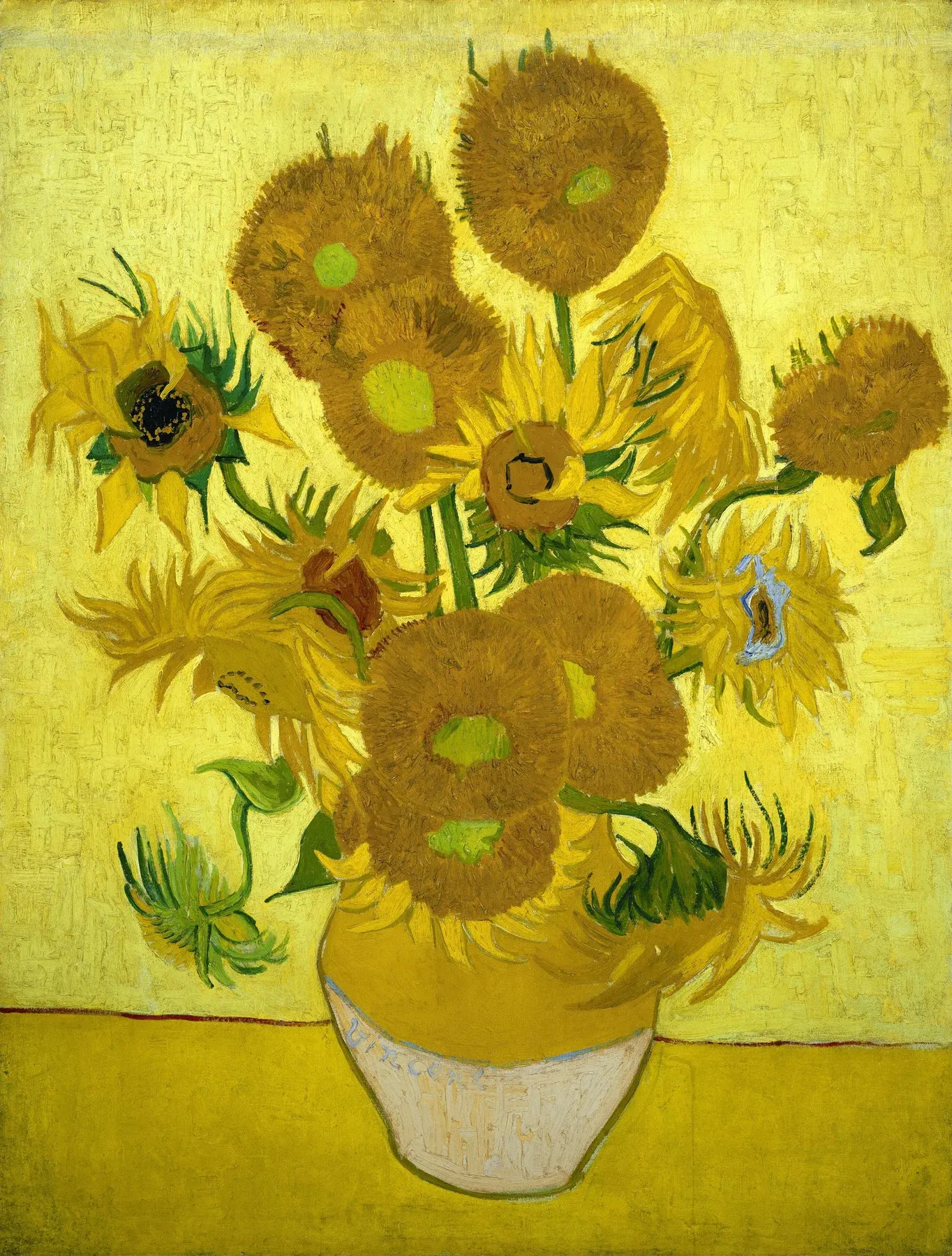
Vincent van Gogh, Sunflowers (1889) · Van Gogh Museum, Amsterdam · public domain · Wikimedia Commons (Google Arts & Culture)
The New Yellows
The colors in a painting come from paint. Pigments are the fine powders that give paint its color. Because the powder alone will not stick to a canvas, it must be mixed into something. A binder is the substance that holds the pigment particles together and anchors them to the surface; in oil paint, this job is mostly done by oil pressed from flax seeds. Van Gogh's Sunflowers is an oil painting, and much of that yellow came from a single pigment.
Chrome yellow is a yellow pigment made from compounds containing lead and chromium. The basic form is lead chromate, and variations where sulfur takes the place of some of the chromium are collectively called chrome yellow (DOI: 10.1002/anie.201713293). Chrome yellow became popular with artists after its introduction in the 19th century (DOI: 10.1039/c1ra00614b). A book discussing the color changes in sunflowers notes that chrome yellow was used prominently and in large amounts in this painting (DOI: 10.1017/9789048550531.006).
Chrome yellow was an industrially synthesized pigment, and there were several ways to make it. Old recipe records provided for research by the renowned period art supplier Winsor & Newton described multiple methods for making chrome yellow, and one research team recreated 19th-century chrome yellow by following those records. The recreated pigment matched well with the company's tube paints from the same era and with samples taken from a painting by the Portuguese painter Amadeu de Souza-Cardoso (DOI: 10.1039/c1ra00614b). The researchers believe that to understand why chrome yellow darkens, one must first know how it was actually made back then.
Under the same name, there are actually multiple substances. Chrome yellow can be compounds with different compositions, and even with the same composition, the arrangement in which the atoms are stacked—in other words, the crystal structure—varies, with each type having a different tendency to degrade. After one research team created standard paints from synthetically produced chrome yellows and compared them with old paint tubes and microscopic samples taken from the yellow, orange, and light yellow areas of 12 paintings by van Gogh, it turned out that van Gogh actually used multiple types of chrome yellow (DOI: 10.1021/ac302158b). Whether these 12 paintings include Sunflowers is not mentioned in the abstract.
Van Gogh wrote in his letters that the new colors were unstable. In April 1888, he wrote to his brother Theo: "The colors which the Impressionists have brought into fashion are all unstable, all the more reason to use them boldly, too raw, time will soften them too much." At the very top of the paint list he ordered in the same letter were "three chromes (orange, yellow, lemon)" (DOI: 10.1017/9789048550531.006). The letter continues: these colors could rarely be found on the palettes of Dutch painters like the Marises, Mauve, and Israëls, but were on the palette of the French painter Eugène Delacroix. Delacroix deeply cherished lemon yellow and Prussian blue—two of the most disapproved-of colors—and van Gogh wrote that he had achieved great things with them (DOI: 10.1017/9789048550531.006). These new synthetic pigments from the late 19th century provided artists with a new means of expression through intense colors and the full use of contrasting tones (DOI: 10.1017/9789048550531.006).
The authors of the book that introduced this letter believe that van Gogh, like other artists of his day, knew that chrome yellow had a strong tendency to darken when exposed to light, yet he happily continued to use it until his passing in July 1890 because of effects he could not get anywhere else (DOI: 10.1017/9789048550531.006).
Chrome yellow was a collection of various yellows with different compositions and structures, and van Gogh wrote in a letter that the new colors popularized by Impressionism were unstable, stating that they should therefore be used even more boldly.
How the Shadow Forms
A 2011 paper notes in its introduction that the darkening of areas painted with chrome yellow is widely observed in several of Van Gogh's paintings, with famous examples being several versions of Sunflowers (DOI: 10.1021/ac1025122). A similar thing happens in paintings by other artists. Chrome-containing yellow pigments were also used by the French painter Georges Seurat, and another paper from the same year notes as the research background that paintings such as Sunflowers and Seurat's A Sunday on La Grande Jatte are visibly darkened (DOI: 10.1039/c1ra00614b). Neither description specifies which version or which area. To find the cause, the researchers first used models instead of paintings. They artificially aged chrome yellow oil paint samples.
On the surface of the aged sample, a very thin altered layer with a thickness of 1 to 3 micrometers formed (DOI: 10.1021/ac102424h). 1 micrometer is 1 thousandth of 1 millimeter. To measure such a thin layer on its own requires a very fine X-ray beam, so the researchers performed part of the measurements at a synchrotron. A synchrotron is a large-scale accelerator facility that accelerates electrons in a circular orbit to nearly the speed of light to produce very bright and fine X-ray beams. By shining those X-rays, it is possible to identify what elements are in the paint and what chemical state they are in at very tiny spots.
What those measurements found was a change in chromium. Reduction is a process in which an atom gains electrons and its chemical state changes. The chromium in chrome yellow is in a state called hexavalent, and when reduced, it becomes trivalent. In this 2011 model experiment, this change was particularly pronounced in a single aged sample made from paint taken from an old paint tube from around 1914. About two-thirds of the chromium on the surface had been reduced from hexavalent to trivalent, and the measurement results matched the formation of a compound identical to the green pigment viridian (DOI: 10.1021/ac102424h).
The researchers write that through this model experiment, they identified for the next time that reduction is the cause of chrome yellow darkening. Next, they looked at the paint from actual paintings. Reduced chromium appeared in some spots even in micro-samples of original paint taken from two other paintings by Van Gogh (DOI: 10.1021/ac1025122). These two paintings are not Sunflowers.
A 2012 study investigated using replica paints how much the composition and crystal structure of chrome yellow alter the degree of darkening. When chrome yellow oil paints made directly with varying compositions and crystal structures were artificially aged, the only ones that darkened significantly were paints that met both conditions together. These were paints where sulfur accounted for over 40% of the chromium sites, and a crystal arrangement different from the sulfur-free basic form exceeded 30% by weight. In the outer layer of the sample that changed the most, a maximum of about 60% of the chromium had turned trivalent, while the chemical state of the sulfur remained unchanged (DOI: 10.1021/ac3021592). The researchers who have continued this body of work summarize the preceding results as follows. This darkening is initiated by light, and varies depending on the composition and crystal structure of the pigment (DOI: 10.1021/ac502841g).
The binder also plays a part. In a 2019 experiment where replica paints made by mulling chrome yellow powder into linseed oil or water-based acrylic emulsion were aged naturally and by exposure to light, the reduction of chromium occurred through the interaction between the pigment and the binder. Reduction was more pronounced in oil, and in the process, the organic matter on the oil side was also oxidized. Within the acrylic binder, chrome yellow showed better resistance to light, and the more soluble the pigment was, the greater the tendency for chromium to be reduced (DOI: 10.1021/acsomega.8b03669).
Now we follow a single layer of yellow paint that has received light. Chrome yellow grains are mulled in linseed oil and applied to the canvas, and light falls on them. According to the researchers' summary, the darkening is initiated by light (DOI: 10.1021/ac502841g), and the reduction of chromium occurs through the interaction between the pigment and the oil (DOI: 10.1021/acsomega.8b03669). In the aged model, the result was seen on the surface of the paint layer, in a thin layer of 1 to 3 micrometers, where trivalent chromium compounds formed (DOI: 10.1021/ac102424h). The researchers name this reduction as the cause of the yellow darkening (DOI: 10.1021/ac1025122). The "shadow" referred to in the title of this article is this alteration settling over the yellow. All four links in this chain came from replica paints and samples from paintings that are not Sunflowers.
The cause of chrome yellow darkening is the reduction of chromium exposed to light, and in the 2012 replica paint experiment, the only paints that darkened significantly were those where sulfur accounted for over 40% of the chromium sites and a crystal arrangement different from the sulfur-free basic form exceeded 30%, and reduction was more pronounced in paints mulled in oil than in acrylic.
Traces Found Inside Sunflowers
The traces found in the models and other paintings also turned up in the sunflowers themselves. In 2015, researchers performed spectroscopic measurements in-situ at multiple points on the painting without touching it, and analyzed two tiny samples taken from the painting using synchrotron X-rays (DOI: 10.1002/anie.201505840).
Two types of chrome yellow were present together in the sunflowers. One is lead chromate without sulfur, which is a type that resists light well. The other is a type where sulfur occupies roughly half of the chromium sites, which researchers introduce as a type known to be easily reduced upon receiving light. However, this type has a different crystal structure from the paint that darkened significantly in the previous reproduction paint experiments. This type from the sunflowers has the same structure as the lead chromate without sulfur (DOI: 10.1002/anie.201713293), whereas the paint that darkened significantly in the experiment had over 30% of a different structure (DOI: 10.1021/ac3021592). Therefore, the results of that experiment cannot be directly applied to this yellow in the sunflowers, and that experiment alone does not allow us to say whether this yellow is more or less vulnerable. Furthermore, trivalent chromium compounds resulting from reduction appeared at the boundary between the paint and the varnish (DOI: 10.1002/anie.201505840). The researchers presented this as solid evidence that the chrome yellow in the sunflowers had chemically changed, and wrote that the spots with the highest risk of color change due to chemical alteration should be selected and monitored carefully in the future (DOI: 10.1002/anie.201505840). The micro-samples that served as the basis are two, and the value measuring how much the entire painting darkened is not in this abstract.
The spot where the alteration products emerged was directly beneath the varnish. Varnish is a thin, transparent protective coating applied over a fully dried painting. As was often his custom around this time, Van Gogh left Sunflowers unvarnished. Today, this painting has multiple layers of varnish, and that varnish has turned yellowish, making the painting look glossy. The researchers believe it originally had the subtle sheen of pure oil paint. According to records, in 1927 the restorer Jan Cornelis Traas applied varnish along with a canvas lining treatment to reinforce the back, and he touched it up again in 1961, though records of what he did do not survive. In the latter half of the 20th century, wax was applied to some areas to deaden the glossiness or stabilize the ground layer, and those areas now look matte instead. The researchers believe that this accumulated history of interventions, combined with the natural aging of the materials Van Gogh used, has greatly influenced the current appearance of this painting (DOI: 10.1017/9789048550531.007). The yellow of Sunflowers visible to our eyes today contains both the changes in the chrome yellow and the yellowed varnish.
Could the later-applied protective coating have caused this alteration, then? Results measuring this separately in the sunflowers are not among the evidence gathered in this article, and other works and reproduction samples provide clues. They looked at micro-samples taken from two other paintings by Van Gogh that received later varnish, and a wax-applied relief made by Paul Gauguin, a French painter of the same era as Van Gogh. All three were works that originally lacked a protective coating. Trivalent chromium products were found embedded as particles inside the protective coating and were also evenly distributed on the paint surface. The researchers explain this by suggesting that the friction from brushing on the protective coating may have lifted and scattered chromium compounds on the surface that had already been reduced by light-induced alteration. Even in reproduction samples covered with a varnish contaminated with sulfur compounds and aged with light, evidence that the varnish induces reduction did not appear (DOI: 10.1021/ac502841g). These results came from works other than Sunflowers and from reproduction samples.
The color changing in the sunflowers is not only yellow. Geranium lake, a red pigment Van Gogh enjoyed using alongside chrome yellow, has a strong tendency to fade when exposed to light, and the chapter of the book covering color changes in Sunflowers discusses both together (DOI: 10.1017/9789048550531.006).
Caution is also needed in the measurement process. Synchrotron X-rays are extremely bright, and in the chrome yellow and chromium compound samples exposed to that light, the chemical state of the chromium and the arrangement of surrounding atoms changed, and the crystal structure collapsed. The degree of damage depended on the composition of the pigment, as well as whether a binder was present and what kind of binder it was, and the damage could be reduced by appropriately controlling the dose of X-rays and measuring in a vacuum and at very low temperatures (DOI: 10.1021/acs.analchem.0c03251). This means that the X-rays measuring the chemical state of chromium can alter that chemical state. The researchers believe that to protect samples and avoid misreading results, this sensitivity must be understood for each pigment. This abstract does not say that previous sunflower measurements were wrong, but discusses measurement methods that reduce damage. Non-destructive measurement methods have also been refined. Three paintings from the Van Gogh Museum were analyzed in-situ using Raman spectroscopy with laser light, and confirmed with micro-samples taken from the same paintings, identifying which chrome yellow was used in each painting. Using a 785-nanometer laser prevented the pigment from decomposing due to the laser light, making this wavelength advantageous (DOI: 10.1002/jrs.4548). Which paintings these three are does not appear in the abstract.
In the sunflowers as well, chrome yellow known to be easily reduced by light and chromium compounds resulting from reduction were actually confirmed.
A Map of Weak Yellows
It is difficult to speak for the entire painting with just two microscopic samples. Over roughly the last decade up to 2019, methods have emerged to broadly scan a painting's surface with X-rays and map it. One maps where elements are, and the other maps where crystals are (DOI: 10.1107/s205327331909555x). An X-ray diffraction map is a map drawn by scanning a painting's surface cell by cell with X-rays and reading the pattern in which crystals deflect X-rays at set angles to determine what crystals are present at each location. An abstract from a 2019 lecture introducing this method notes that this map can make subtle chemical changes happening on or immediately beneath the painting's surface visible for the first time. To know how deep those changes occur, microscopic analysis of paint cross-sections using synchrotron X-rays is still needed alongside it (DOI: 10.1107/s205327331909555x).
In 2018, this X-ray diffraction map was drawn for several zones of Sunflowers. The map revealed two types of chrome yellow. One is lead chromate, which is stable against light, and the other is a type where sulfur occupies roughly half of the chromium sites, which the researchers call vulnerable to light. The light-vulnerable type appeared in large parts of the painting. It was present in the pale yellow background, the bright yellow petals, and even the green stems and the center of the flower. In over half of the chrome yellow sites in the surveyed zones, this light-vulnerable type was present (DOI: 10.1002/anie.201713293). The researchers read these sites as places that have already darkened in the past or carry a higher risk of darkening in the future.
Imagine standing in front of the painting and viewing this map overlaid on it. The pale yellow background at the very back, the bright yellow petals coming forward, the green stems, the center of the flower. Across these four locations—which look different to the eye as yellow and green—the map marks the same light-vulnerable chrome yellow. This means that the places where shadow can settle are not limited to the yellow petals but extend all the way to the green stems.
The same map also shows Van Gogh's hand. Elongated crystals of light-vulnerable chrome yellow were clearly lined up along the direction in which Van Gogh moved his brush (DOI: 10.1002/anie.201713293). Beyond recording "what it was painted with," the map also records "which way the brush passed." The pigments of Sunflowers and their mixtures were mapped across the entire painting and compared with the London version (DOI: 10.1017/9789048550531.005), and the commonalities and differences in how the two paintings came to have different color compositions were addressed in that comparison.
In the surveyed zones, light-vulnerable chrome yellow was present in more than half of the chrome yellow sites in Sunflowers, and the researchers read those sites as places with a high risk of having already darkened or darkening in the future.
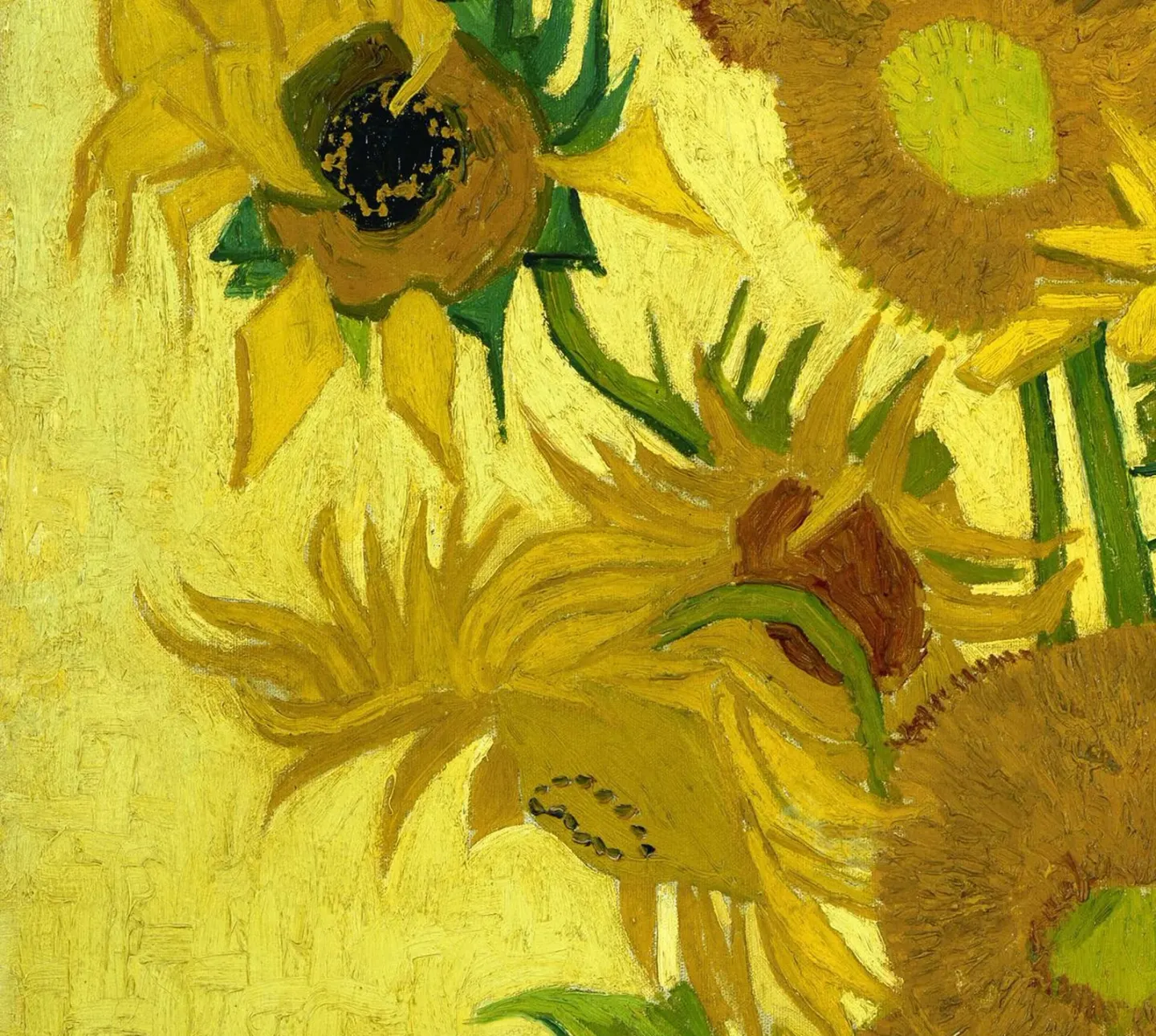
Detail: petals, background and stems · Vincent van Gogh, Sunflowers (1889) · Van Gogh Museum, Amsterdam · public domain · Wikimedia Commons (Google Arts & Culture)
Choosing the Light That Touches a Painting
One destination for this knowledge is the light that touches a painting. A book dealing with sunflowers discusses color changes caused by light, and notes that to safely protect other paintings painted with materials similar to this one in the future, appropriate lighting guidelines must be established (DOI: 10.1017/9789048550531.005). The specific brightness or exhibition time of those guidelines do not appear in the abstracts that this article relies on.
Museum lighting is changing from halogen lamps to LEDs, and the two lights have significantly different color compositions (DOI: 10.1080/00393630.2016.1189997). A 2016 study exposed a sulfur-containing chrome yellow pigment to varying colors of light to measure how much and which light changed the color. Contrary to the expectation that light with shorter wavelengths would be more harmful, given light of the same energy, ultraviolet light (394 nanometers), blue, and blue-green changed colors to a similar degree (DOI: 10.1080/00393630.2016.1189997). This is the result that not only invisible ultraviolet light, but also visible blue and blue-green light act similarly on sulfur-containing chrome yellow.
In the same experiment, conventional LED lighting with tweaked light composition showed 30% less color change than halogens. It is a simulation result that by adjusting the light composition of LEDs tailored to each artwork, harm can be reduced by 45% in specific cases (DOI: 10.1080/00393630.2016.1189997). This was an experiment done with pigments rather than paintings, and 45% is a value obtained through calculation. What a single light does to a person inside a room was covered in "Light — How One Window and One Curtain Change a Room", but in front of a painting, the same light reaches both the viewer and the painting.
How Dark Is the Shade
Let us imagine standing in front of this painting at the Van Gogh Museum today. When we place what different studies found in different places side by side, it looks like this. On the surface of the painting are multiple layers of varnish that were not originally there, turning yellowish and making the painting look glossy (DOI: 10.1017/9789048550531.007). A study analyzing two micro-samples found reduced trivalent chromium compounds at the boundary between the paint and the varnish (DOI: 10.1002/anie.201505840). In X-ray diffraction maps of several areas, light-sensitive chrome yellow was present in the background, petals, stems, and flower centers, and its crystals were lined up in the direction the brush had moved (DOI: 10.1002/anie.201713293). These abstracts do not state how these three are stacked on top of one another in a single spot.
The evidence leans toward the side that the change is real and must be watched. Two papers from 2011 write in their introduction background descriptions that the yellowing darkening is observed in sunflowers of various versions (DOI: 10.1021/ac1025122) and that paintings like Sunflowers are distinctly darkened (DOI: 10.1039/c1ra00614b). They do not record which version it is or how much it has changed since then. In this painting, clear evidence of chemical change and the sites with the highest risk appeared, and the research team's recommendation is to monitor them carefully in the future (DOI: 10.1002/anie.201505840). A 2019 binder study calls the darkening of chrome yellow a phenomenon threatening many 19th- to 20th-century paintings, including the Sunflowers in Amsterdam (DOI: 10.1021/acsomega.8b03669).
What is missing is the size and the speed. The abstracts this article relies on for evidence do not contain measured values of which spot on which version has darkened visibly and by how much, or how fast it is darkening further under current lighting. The "about two-thirds of the chromium" from the 2011 model experiment was measured on the surface of a single sample made with tube paint from around 1914, and the "up to about 60%" from the 2012 experiment was measured on the outer layer of the sample that changed the most among the reconstituted paints, so they cannot be translated into figures for Sunflowers.
The measurements tell us what this painting is painted with and where it is changing, but they do not answer why Van Gogh chose that yellow. There are two more places to look. Expanding cross-sectional analyses to see how deep into the paint the alteration goes, and lighting guidelines tailored to paintings created with materials similar to this one.
In Sunflowers, two micro-samples analyzed in 2015 yielded products of chemical change in the yellow right beneath the varnish, and high-risk spots were mapped out, leading the research team to recommend careful monitoring going forward, but the evidence gathered in this article lacks figures on how darkly that change is currently visible to the eye or how fast it will darken further.
Source Papers
- "Chemical Mapping by Macroscopic X‐ray Powder Diffraction (MA‐XRPD) of Van Gogh's Sunflowers: Identification of Areas with Higher Degradation Risk" (2018) — DOI: 10.1002/anie.201713293 — X-ray diffraction mapping of several zones of the sunflowers, showing two types of chrome yellow: one light-resistant and one light-sensitive (with about half as much sulfur), where the sensitive type is located in the background, petals, stems, and flower center, accounting for over 50% of the chrome yellow spots, with elongated crystals aligned in the brushstroke direction, interpreted as areas with a high risk of darkening in the past and future.
- "Evidence for Degradation of the Chrome Yellows in Van Gogh's Sunflowers" (2015) — DOI: 10.1002/anie.201505840 — Synchrotron analysis of multiple non-contact measurement points and two micro-samples, identifying two types of chrome yellow and trivalent chromium compounds between the paint and varnish, pointing out the highest-risk areas and recommending monitoring.
- "Disclosing the Binding Medium Effects and the Pigment Solubility in the (Photo)reduction Process of Chrome Yellows" (2019) — DOI: 10.1021/acsomega.8b03669 — Reconstructed paint experiments showing that reduction occurs through the interaction between the pigment and the binder, is more prominent in oil, and is more light-resistant in acrylic, with a higher reduction tendency as solubility increases, describing this as a phenomenon threatening many paintings, including the Sunflowers.
- "Degradation Process of Lead Chromate in Paintings by Vincent van Gogh … 2. Original Paint Layer Samples" (2011) — DOI: 10.1021/ac1025122 — Observation that the darkening of chrome yellow spots is seen in multiple paintings and multiple versions of the Sunflowers by Van Gogh, with the authors stating that they revealed for the first time using a model that reduction is the cause, and finding reduced chromium in original paint samples from two other Van Gogh paintings.
- "Degradation Process of Lead Chromate in Paintings by Vincent van Gogh … 1. Artificially Aged Model Samples" (2011) — DOI: 10.1021/ac102424h — A 1 to 3 μm altered layer in artificially aged model samples, where about two-thirds of the chromium on the surface of a paint tube sample from around 1914 changed from hexavalent to trivalent, matching viridian.
- "Degradation Process of Lead Chromate … 4. Artificial Aging of Model Samples of Co-Precipitates of Lead Chromate and Lead Sulfate" (2012) — DOI: 10.1021/ac3021592 — Significant darkening only in paints with 40% or more sulfur and exceeding 30% of a specific crystal structure, with up to about 60% of chromium in the outer layer becoming trivalent while the sulfur state remains unchanged.
- "Degradation Process of Lead Chromate … 3. Synthesis, Characterization, and Detection of Different Crystal Forms of the Chrome Yellow Pigment" (2012) — DOI: 10.1021/ac302158b — Chrome yellow comprising multiple compounds and crystal structures with differing tendencies to alter, showing through samples from old paint tubes and 12 paintings by Van Gogh that Van Gogh used multiple types.
- "Degradation Process of Lead Chromate … Part 5. Effects of Nonoriginal Surface Coatings" (2014) — DOI: 10.1021/ac502841g — Summarizing prior results (initiated by light, varying by component and crystal structure), finding trivalent chromium inside and outside the protective layer in two varnished Van Gogh paintings and a relief sample by Gauguin, explained as being scattered by brushstroke friction, with no evidence that the varnish caused reduction in a contaminated varnish model.
- "Chrome yellow in nineteenth century art: historic reconstructions of an artists' pigment" (2011) — DOI: 10.1039/c1ra00614b — Popularity after introduction in the 19th century, reproduced using Winsor & Newton manufacturing records, matching well with painting samples from tube paints of the time and the Dr. Gachet painting.
- "Can LEDs help with art conservation? – Impact of different light spectra on paint pigment degradation" (2016) — DOI: 10.1080/00393630.2016.1189997 — Experiments with sulfur-containing chrome yellow pigments showing that ultraviolet, blue, and cyan cause similar discoloration at the same energy level, with customized LEDs causing 30% less discoloration than halogens, and simulations showing 45% less in specific cases.
- "Damages Induced by Synchrotron Radiation-Based X-ray Microanalysis in Chrome Yellow Paints and Related Cr-Compounds" (2020) — DOI: 10.1021/acs.analchem.0c03251 — Synchrotron X-rays altering the chemical state and arrangement of chromium and breaking down the crystal structure, varying by component and binder, and mitigated by dose control, vacuum, and low temperature.
- "Examining old paintings with new X-ray methods: a fresh look at and below the surface" (2019, lecture abstract) — DOI: 10.1107/s205327331909555x — Elemental mapping (MA-XRF) and crystal mapping (MA-XRPD) making subtle chemical changes below the surface visible for the first time, with depth supplemented by cross-sectional micro-analysis.
- "Methods and Materials of the Amsterdam Sunflowers" (A chapter with the same title, two editions in 2019 and 2025 — counted as one source) — DOI: 10.1017/9789048550531.005 · DOI: 10.5117/9789463725323_ch04 — Abstract of the 2025 edition: The London version is Van Gogh's first painting of sunflowers against a yellow background and is housed in the National Gallery, London. Introduction to the 2019 chapter: transferring the composition with charcoal with the London version nearby, wooden strips added at the top, comparing the pigment map with the London version, and the need for lighting guidelines.
- "Chemical Alteration and Colour Changes in the Amsterdam Sunflowers" (2019, book chapter) — DOI: 10.1017/9789048550531.006 — A painting notably rich in chrome yellow, where the geranium lake faded and the chrome yellow darkened, with the authors interpreting that Van Gogh used it despite knowing its flaws, citing a letter sent to Theo in April 1888.
- "6. Structure and Chemical Composition of the Surface Layers in the Amsterdam Sunflowers" (2019, book chapter) — DOI: 10.1017/9789048550531.007 — No original varnish, currently multiple layers of yellowed varnish, Traas's varnish and consolidation treatment in 1927, unspecified treatment in 1961, and some wax in the late 20th century.
- "Raman study of different crystalline forms of PbCrO4 and PbCr1−xSxO4 solid solutions for the noninvasive identification of chrome yellows in paintings: a focus on works by Vincent van Gogh" (2014) — DOI: 10.1002/jrs.4548 — Analyzing three paintings from the Van Gogh Museum (not named in the abstract) using non-invasive Raman spectroscopy to distinguish chrome yellow types, finding the 785 nm laser advantageous as it causes no laser-induced decomposition.
Sources (17)
- Chemical Mapping by Macroscopic X‐ray Powder Diffraction (MA‐XRPD) of Van Gogh's Sunflowers: Identification of Areas with Higher Degradation RiskDOI 10.1002/anie.201713293
- Evidence for Degradation of the Chrome Yellows in Van Gogh's SunflowersDOI 10.1002/anie.201505840
- Disclosing the Binding Medium Effects and the Pigment Solubility in the (Photo)reduction Process of Chrome YellowsDOI 10.1021/acsomega.8b03669
- Degradation Process of Lead Chromate in Paintings by Vincent van Gogh … 2. Original Paint Layer SamplesDOI 10.1021/ac1025122
- Degradation Process of Lead Chromate in Paintings by Vincent van Gogh … 1. Artificially Aged Model SamplesDOI 10.1021/ac102424h
- Degradation Process of Lead Chromate … 4. Artificial Aging of Model Samples of Co-Precipitates of Lead Chromate and Lead SulfateDOI 10.1021/ac3021592
- Degradation Process of Lead Chromate … 3. Synthesis, Characterization, and Detection of Different Crystal Forms of the Chrome Yellow PigmentDOI 10.1021/ac302158b
- Degradation Process of Lead Chromate … Part 5. Effects of Nonoriginal Surface CoatingsDOI 10.1021/ac502841g
- Chrome yellow in nineteenth century art: historic reconstructions of an artists' pigmentDOI 10.1039/c1ra00614b
- Can LEDs help with art conservation? – Impact of different light spectra on paint pigment degradationDOI 10.1080/00393630.2016.1189997
- Damages Induced by Synchrotron Radiation-Based X-ray Microanalysis in Chrome Yellow Paints and Related Cr-CompoundsDOI 10.1021/acs.analchem.0c03251
- Examining old paintings with new X-ray methods: a fresh look at and below the surfaceDOI 10.1107/s205327331909555x
- Methods and Materials of the Amsterdam SunflowersDOI 10.1017/9789048550531.005
- Methods and Materials of the Amsterdam SunflowersDOI 10.5117/9789463725323_ch04
- Chemical Alteration and Colour Changes in the Amsterdam SunflowersDOI 10.1017/9789048550531.006
- 6. Structure and Chemical Composition of the Surface Layers in the Amsterdam SunflowersDOI 10.1017/9789048550531.007
- Raman study of different crystalline forms of PbCrO4 and PbCr1−xSxO4 solid solutions for the noninvasive identification of chrome yellows in paintings: a focus on works by Vincent van GoghDOI 10.1002/jrs.4548