Paperis Articles
A Red Nova in Andromeda — Seven Years of Brightening, and Was the Companion Swallowed?
AT 2025abao in the Andromeda galaxy. A Nature paper (Karambelkar and 44 co-authors) finds that a roughly 7-solar-mass aging giant's seven-year gradual brightening since 2018 is best explained by a companion of about 0.7 solar masses spiraling through the giant's outer envelope and losing energy to friction, which the authors call the first direct observation of frictional drag energy dissipation in common envelope evolution. They suggest the companion merged with the core after the October 2025 eruption, leaving this to be tested by future observations, and narrow the efficiency α to between 0.01 and 0.4. Of two other papers on the same star, a peer-reviewed analysis proposes a merger scenario, while a preprint's models have a 1.4-solar-mass companion surviving for at least 400 days; the two papers share an author. The companion has not been seen directly.
Your field's papers, as audio
Pick your fields and journals — Paperis summarizes the key papers and turns them into audio. Listen on your commute.
Start Paperis free →A Red Nova in Andromeda — Seven Years of Brightening, and Was the Companion Swallowed?
Seven Years in Andromeda
On the outer edge of the Andromeda Galaxy, there is an aging star roughly seven times as heavy as the Sun. A paper in Nature records that this star's brightness showed no change from photographic plates taken in 1989 until it began brightening in 2018. From 2018 onward, the star slowly brightened for seven years, and in October 2025 it produced an outburst in red light that grew roughly 100 times brighter in 25 days (arXiv:2611.23470). The outburst was first noticed on October 17, 2025, and three days later it was added to the catalog of newly appearing astronomical objects under the name AT 2025abao (arXiv:2611.23470). In this article, we abbreviate and call it "Bao," taking the end of its name. The authors set the distance to the Andromeda Galaxy at 0.77 megaparsecs, which converts to about 2.5 million light-years (our conversion).
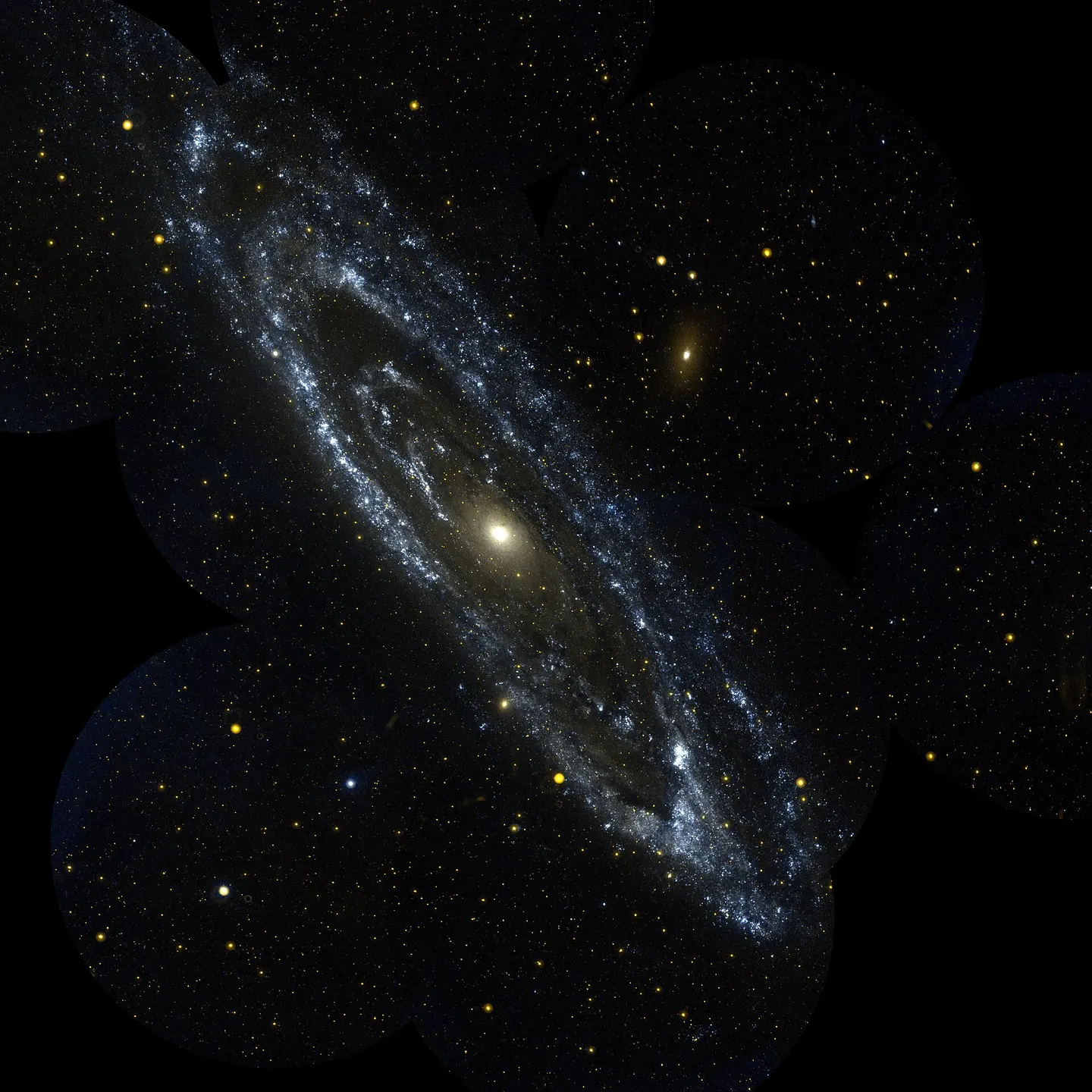
Figure: The Andromeda galaxy in ultraviolet, a mosaic from the GALEX space telescope — the colours differ from what the eye sees, and Bao’s position is not marked · Public domain, NASA/JPL-Caltech · via Wikimedia Commons
In November 2026, Nature published a paper following Bao from start to finish. The first author is Viraj Karambelkar, an astronomer working as a NASA Hubble Fellow at the Columbia Astrophysics Laboratory in the United States, and 45 researchers from the United States, Europe, India, Japan, and elsewhere wrote it together (arXiv:2611.23470). The authors' interpretation is as follows. A small companion star orbited within the outer layers of the giant star, losing energy to friction, and that energy created the brightening over seven years. The authors call this the first direct observation of such frictional energy loss. They then propose that the companion star merged with the core of the giant star, and the energy released at that time blew off roughly the outermost 10% of the giant star's outer layers (arXiv:2611.23470).
There are two more papers dealing with the same star. One has passed peer review and been published in an academic journal, proposing a scenario where the two stars merge (arXiv:2602.13678). The other is a pre-peer-review manuscript, and model calculations suggest the two stars survived without merging for at least some time (arXiv:2610.05769). The same researchers are co-authored on both papers. This article reads through the Nature paper step by step, and places all three papers side by side at the end.
The Path Where Two Stars Draw Closer
A binary is a pair of stars held together by each other's gravity, orbiting side by side. There are many binaries in the sky where two stars orbit very close to each other. Some pairs consist of two white dwarfs, which are the spent cores of dead stars, and others orbit each other while emitting gravitational waves. For such close binaries to form, the orbits of two stars that started far apart must rapidly shrink (arXiv:2611.23470).
One pathway proposed for this is the common envelope. A common envelope is a state where one star in a binary swells up large enough to swallow its companion, wrapping both stars in a single outer layer. This idea was introduced at a conference in 1976 to explain how close binaries form (arXiv:2611.23470; arXiv:2001.03337), and today it is considered a crucial step in the birth of various celestial objects, from certain types of supernovae to black hole binaries (arXiv:2001.03337).
The companion star inside this outer layer orbits by plowing through the gas. Frictional drag is the force where an object moving through gas gets held back by the surrounding gas and loses speed, with the lost kinetic energy turning into heat that warms the gas. The result of this is spiral-in. Spiral-in is the motion where a companion star loses energy as it orbits and gradually digs inward, drawing closer to the center of the other star in a swirling pattern. The big picture of the theory is that if the energy lost by the companion is large enough to blow away the entire outer layer, two tightly bound stars are left behind, and if it falls short, the two stars merge into one (arXiv:1209.4302; arXiv:2611.23470).
This process has remained an unsolved problem for a long time. A review paper summarizing common envelope evolution called this process an "important, long-standing, and largely unconquered problem" (arXiv:1209.4302). A paper in Nature notes at the outset that spiral-in within such binaries has never been directly observed (arXiv:2611.23470). Whether we can use telescopes to watch a scene drawn only in theory from start to finish is the question this paper asks.
The Merger Seen Before, V1309 Sco
We have seen the moment two stars merge from both before and after. This is V1309 Sco, discovered in Scorpius in our galaxy in September 2008. This star had been steadily captured since August 2001 in sky observations with a different purpose, and looking back through those records, its appearance before the outburst was a binary system where the two stars touched outer surfaces and orbited each other once every roughly 1.4 days. The time it took to complete one orbit grew shorter each year, and the two stars eventually merged into one. This study noted that it was the first time direct observation showed that touching binaries truly merge into one (arXiv:1012.0163).
The outburst of V1309 Sco belongs to a group called red novae. Red novae are explosions thought to occur when two stars merge into one, characterized by initially brightening to a blue hue and then cooling to red over several months. The authors of “Nature” note that it has been established that this group forms when a star and its companion merge, dumping energy all at once into a common envelope (arXiv:2611.23470). Another research team wrote that while the possibility of a large outburst from a single massive star cannot be completely ruled out, they lean more toward the common envelope being blown away, and that the two stars may have ultimately merged (arXiv:1906.00812).
However, previous red novae failed to show the interior before the merger. Past cases brightened significantly over tens to hundreds of orbits before the outburst, and this brightening is thought to be caused by gas flowing out from the approaching two stars and wrapping around the binary. That gas covered the entire binary, making it impossible to directly see the companion star digging inward (arXiv:2611.23470). There is also an interpretation that the gas flowing out in this manner ultimately obscured the binary in V1309 Sco as well (arXiv:1307.4088).
The types of the protagonist stars were also different. The large stars in previous red novae were all stars in their prime or just stepping out of that phase, and the outer layers of such stars are tightly bound, so it is thought that when a companion star enters, they have no choice but to merge (arXiv:2611.23470). Bao's large star is an asymptotic giant branch star. An asymptotic giant branch star is an aged star reaching the end of its life that has swollen greatly, with outer layers reaching hundreds of times the diameter of the sun and an interior that churns and mixes as if boiling. Such loosely bound outer layers can theoretically be blown away by a companion star, making it the very starting point drawn by the textbook common envelope evolution (arXiv:2611.23470). An independent research team also noted that Bao is an exception, unlike most red novae originating from yellow stars (arXiv:2602.13678).
Therefore, the scope of the "first" mentioned by the “Nature” authors is narrow. The event of two stars merging itself had already been seen from before and after in V1309 Sco. What is called a first this time are two things. One is directly seeing the process where frictional drag in the giant's loose outer layer robs the companion star of its energy (this is the case when reading the 7 years of brightening that way), and the other is following the textbook-drawn starting point of a binary continuously from beginning to end (arXiv:2611.23470).
What They Used to Look
Bao's record is scattered across several telescopes over decades. The authors gathered photographic glass plates from 1989 and 1993, multiple all-sky survey records from 2005 onward, data scheduled and conveniently captured by the infrared all-sky space telescope SPHEREx in July and December 2025, observations by the James Webb Space Telescope on December 24, 2025, and light bands (spectra) obtained from telescopes in various countries between October 2025 and February 2026 (arXiv:2611.23470). The slow brightening itself was already reported in April 2025 by a previous paper from the same first author, which noted two possibilities at the time: either the result of an accompanying companion star or the result of a temporary surge in nuclear reactions inside an aging star (arXiv:2611.23470).

Figure: An imagined scene of examining an old glass photographic plate — the authors gathered decades of records, starting with plates from 1989 and 1993, to establish that the star had long been quiet · Paperis illustration
The temperature and size are not directly measured values. They are values obtained by fitting the brightness measured at various wavelengths to models of the stellar atmosphere and dust shell. The quiet large star fitted in this way had a surface temperature of roughly 3,650K, a radius of roughly 350 times that of the Sun, and a total light output of roughly 18,000 times that of the Sun, which matches an early-stage asymptotic giant branch star of roughly 7 solar masses when compared to stellar life cycle models. This star was blowing out about 1/100,000 of a solar mass per year in wind, which is far greater than the amount expected for a solitary star at the same stage (arXiv:2611.23470).
Brightening Over Seven Years
Seven years is the period during which it slowly brightened from early 2018 to the autumn of 2025, right before the eruption. During that time, the visible light brightness rose in two stages, with each stage taking about 1,000 to 1,500 days to grow 2 to 3 times brighter. Following that, for about 300 days, the visible light quickly dimmed to roughly half, while the infrared light continued to grow brighter by more than five times (arXiv:2611.23470). Independent modeling studies record this period as "eight years" based on the infrared records (arXiv:2610.05769).
Looking at the model-fitted values, during the brightening the surface temperature stayed almost the same at around 3,800K, and the star grew brighter as it swelled. During the 300-day dimming phase, the temperature dropped to about 3,500K. When SPHEREx captured images in July 2025, the star's radius was roughly 860 times that of the Sun, and the light it emitted was about 100,000 times that of the Sun. The surrounding dust also increased significantly, meaning that assuming a typical dust-to-gas ratio, gas equivalent to roughly one-tenth of the Sun's mass was pushed outward (arXiv:2611.23470).
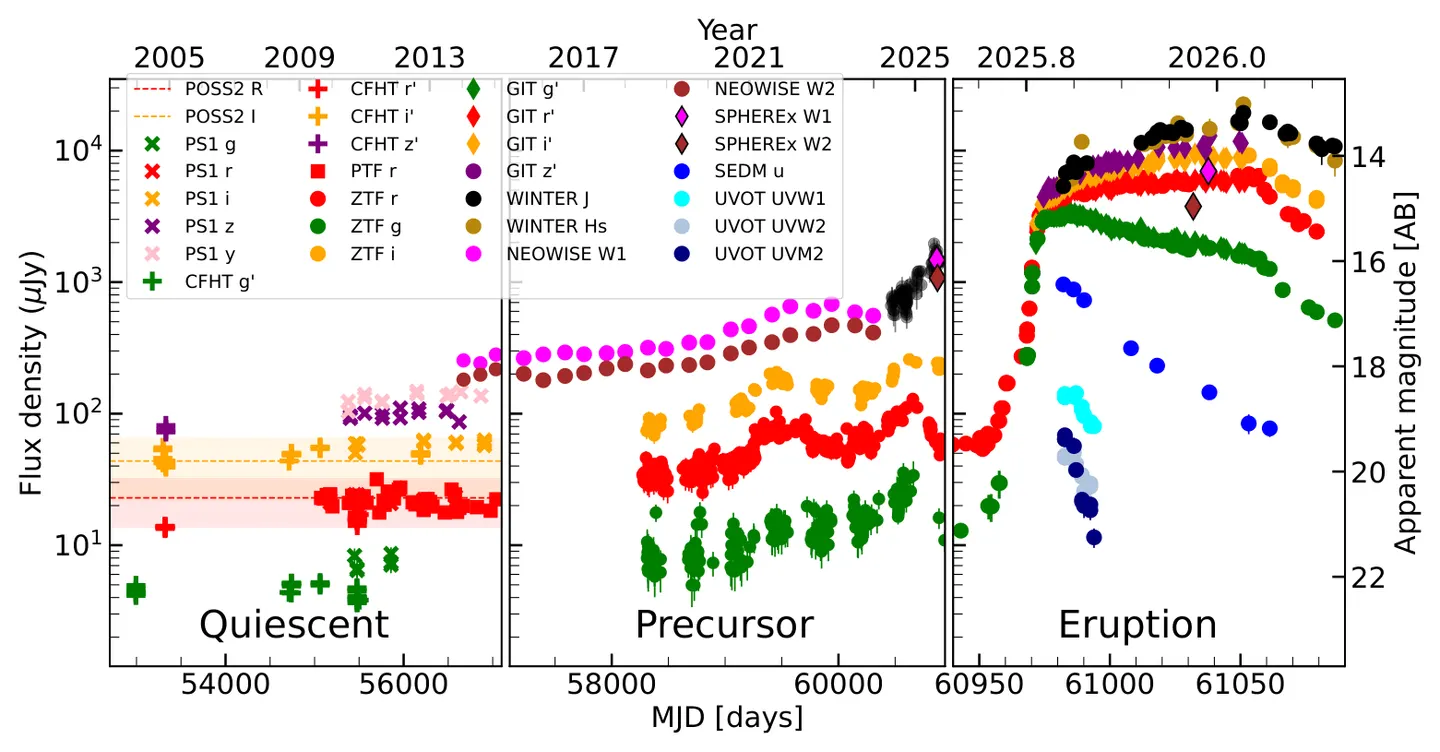
Figure: Karambelkar et al., Nature 2026 (arXiv:2611.23470), Fig. 1, CC BY 4.0. Bao's multiband light curve. From left: quiescent (2005–2015), precursor (2015 to early 2025) and eruption (late 2025 to early 2026) — the panels are continuous but use different time scales. The middle panel starts in 2015; the seven-year brightening in the text begins in early 2018. Labels as in the original
Compared to other red novas, two things are different. Previous cases brightened by several magnitudes—the scale of brightness before an eruption—whereas Bao brightened by only about 1 magnitude, or roughly 2.5 times in brightness (the multiple is our conversion). Also, seven years amounts to fewer than ten orbits if we assume the companion star orbits near the large star's outer envelope. One orbit near the envelope takes about 280 days, and it gets longer if the orbit is farther out. For V1309 Sco and the 2015 Andromeda red nova, the slow brightening continued for more than 100 orbits (arXiv:2611.23470).
What Caused the Brightening
First, we test the explanation of previous red novae. If it brightened due to the kinetic energy of gas flowing out from the two stars, assuming the gas flows out at 1/100 of a solar mass per year and at 0.2 times the speed needed to escape the star, that power is about 10³⁶ ergs per second. Even if we fill that speed to the maximum, it is about 10³⁷ ergs. The share by which Vao became brighter exceeds 10³⁸ ergs per second, so it falls short by a factor of ten to one hundred. Vao's large star is so bloated that its surface gravity is weak, and the speed required for gas to escape the star is as low as about 85 kilometers per second, so the energy carried by the flowing-out gas is also small. Even if we generously assume the amount of flowing-out gas to be as much as a solar mass per year, this explanation falls short (arXiv:2611.23470).
Next is friction. When a companion star with about 0.7 times the solar mass orbits close to the surface of the large star, calculating the energy lost to frictional resistance using a standard formula yields about 3×10³⁸ ergs per second, which matches the observed brightening. The time it takes to use up all that energy is about 1,000 days, or about five orbits, which also matches the duration of a single brightening (arXiv:2611.23470). The mass of the companion star was calculated separately through two paths. Comparing the amount of dust accumulated around the stars during their quiet days with the predictions of a binary model gives a mass ratio of the two stars of about 0.1 (0.05 to 0.2), and the magnitude of the brightening also yields a value between 0.05 and 0.2. Both are estimates that went through models (arXiv:2611.23470).
Now let us follow the companion star. In 2018, it is calculated that the companion star was orbiting at a distance of about 1.5 times the radius of the large star, plowing through the dilute gas on the outermost surface. Each time it plows through the gas, the heat generated by friction appears to travel up the boiling, churning outer layer to the surface and escape as light. The star bloated to about 2.5 times its initial size while keeping its temperature almost the same, and over 90% of the energy generated by friction became light. Near the end of this slow phase, the companion star was at about 0.9 times the radius of the large star, meaning just inside the outer boundary, and the energy that had escaped as light up to that point was about 10⁴⁶ ergs (arXiv:2611.23470). The distance is a value calculated by attributing all the increased brightness to friction.
The energy lost to friction grows rapidly the deeper the companion star goes inward. Therefore, the star can no longer slowly bloat and keep pace, and the authors view the final roughly 300 days, when the temperature dropped, as the period when the companion star rapidly plunged deep into the outer layer. This duration matches the hundreds of days produced by simulations dealing with the common envelope of an asymptotic giant branch star (arXiv:2611.23470). Vao's seven years are best explained as the phase where the companion star slowly dug into the outer layer near the surface of the large star, and the authors wrote that this is the first direct observation of the energy dissipation of frictional resistance caused by common envelope evolution (arXiv:2611.23470).
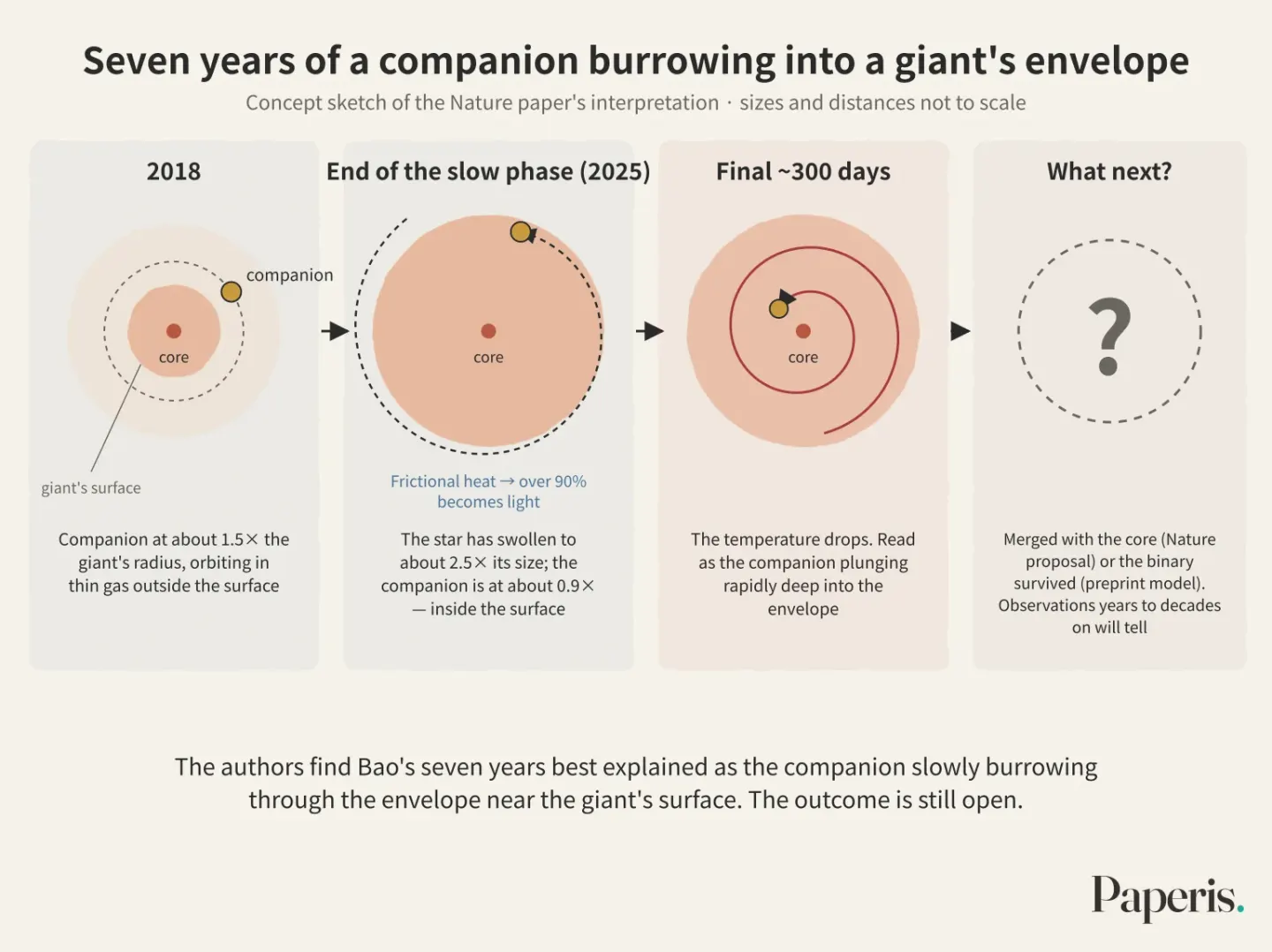
Figure: a diagram Paperis drew using only what the article says
Ejection at the End of the Plunge
In the October 2025 eruption, the star grew roughly 100 times brighter in red light over 25 days, and its surface temperature suddenly jumped to about 8,000K. Over the following 80 days, the brightness stayed flat and the temperature cooled to roughly 3,000K. The light emitted at its brightest was about 1.5 million times that of the sun, and the surface from which the light emerged spread outward at roughly 330 kilometers per second (arXiv:2611.23470). This sequence—first blue, then red, with molecular absorption lines appearing—is precisely the hallmark of a red nova (arXiv:2611.23470).
Calculated from the time it took to brighten, the gas that flew off quickly during the eruption is about 0.1 to 0.2 times the mass of the sun. The speed of the gas, measured by the breadth of the light emitted by hydrogen, dropped from roughly 900 kilometers per second to 150 kilometers per second, which is read as fast gas colliding with gas that had been pushed out ahead and sweeping up roughly five times its own mass. The authors figure that this gas spread unhindered toward the poles while being blocked by surrounding gas toward the equator. The roughly $3\times10^{47}$ ergs of energy released by the collision is enough for the roughly $4\times10^{46}$ ergs that escaped as light during the flat 80 days (arXiv:2611.23470).
The energy ledger shows the reverse of the previous stage. The energy released as the companion star plunged toward the center is about $10^{48}$ ergs, of which about 1% went out as light, and a similarly small amount—about $10^{46}$ ergs—was spent tearing the gas away from the star's gravity. Almost all the rest was used to push the escaped gas quickly (arXiv:2611.23470). In the slow stage, most of the energy became light, and in the final plunge, most of it became motion. The authors note that this matches the expectations of theory for common envelope evolution within a churn-like, boiling outer layer (arXiv:2611.23470).
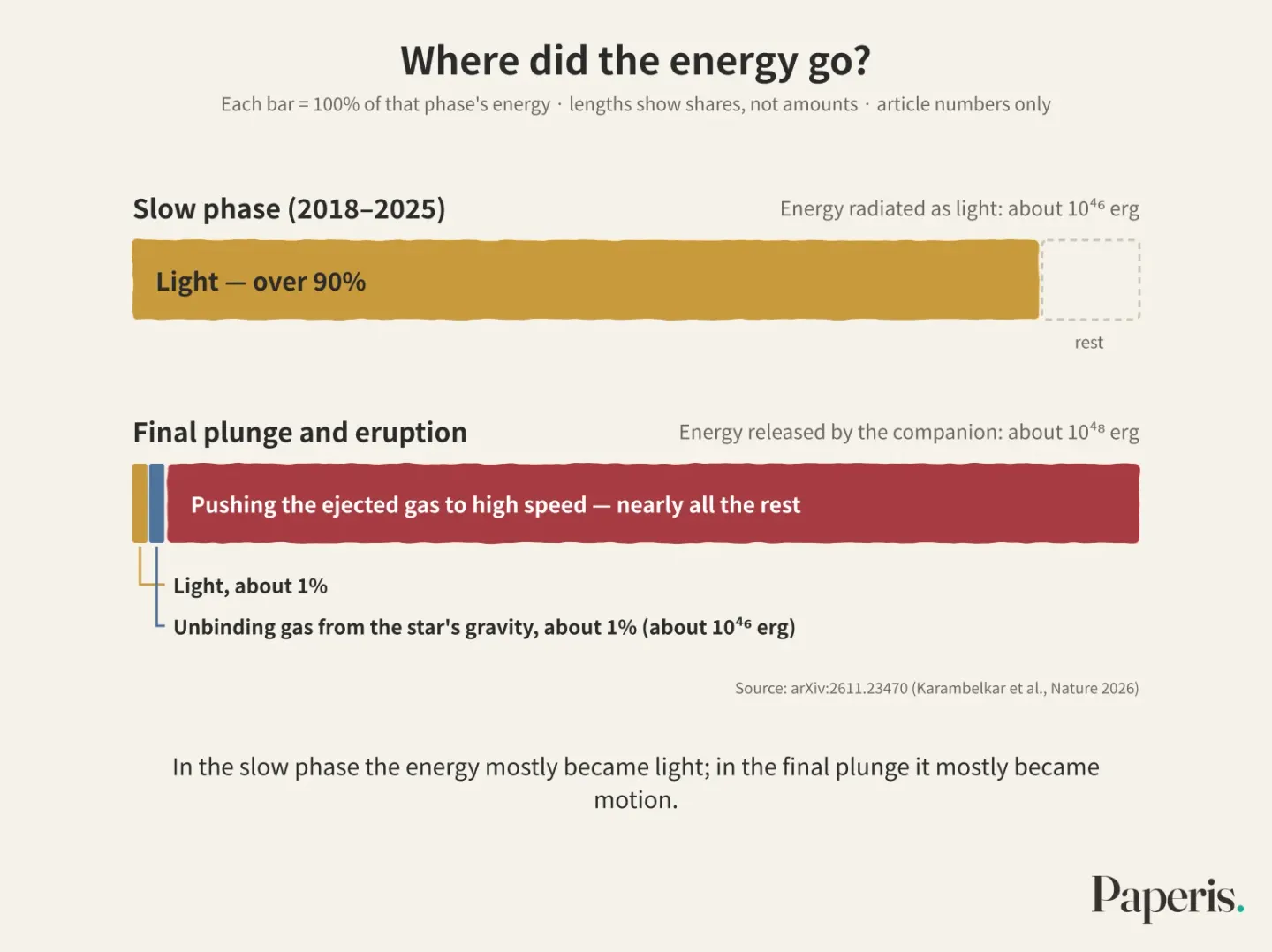
Figure: a diagram Paperis drew using only what the article says
Where Did the Companion Star Go?
The authors of Nature offer four grounds for the idea that the companion star merged with the core of the primary star. First, if the orbital energy lost by the companion serves as the main energy source, the companion must penetrate to a distance of about 3 times the solar radius to supply the kinetic energy of the blown-off gas—roughly 10⁴⁸ ergs—and that location overlaps with the helium core of the primary star. Second, the ejected mass, combining the brightening and the outburst, is 0.2 to 0.4 solar masses, which is only about 10% of the outer layer, meaning most of the outer layer remained intact. Third, the appearance of the outburst closely resembles other red novae known to be mergers. Fourth, the transition from a slow change to a sudden brightening points to an event where energy was released all at once within the outer layer (arXiv:2611.23470).
The authors' conclusion is "we propose a merger," with the caveat that it can be directly tested by future observations (arXiv:2611.23470). The authors also listed tests to distinguish surviving binaries. If the surviving binary continues to expel gas, the radius of the surrounding dust shell will hardly increase, whereas if it was a merger, the shell expands in accordance with the outburst velocity. If the surviving companion continues to plunge inward at a distance of 10 solar radii, it will emit about 10³⁷ ergs per second, which is comparable to the initial brightness of the star and can be distinguished by observations decades later. Based on the gas velocities observed so far, one can only say that the power injected by the surviving binary is less than 10⁴⁰ ergs per second (arXiv:2611.23470).
Suppose we point telescopes back at VELA later. Infrared observations a few years from now will favor the merger scenario if the surrounding dust shell expands outward at the velocity of the outburst. If a binary survives inside the outer layer and continues to expel gas, the dust shell is very likely to remain almost unexpanded. Moreover, due to the energy continuously supplied by the plunging companion, the star may remain brighter than it was initially. The surviving outer layer may also exhibit pulsations in which it swells and shrinks significantly, the authors noted (arXiv:2611.23470). However, because the remnant star of another red nova remained brighter than its initial state even 10 years after the outburst, the authors believe the difference in brightness can be discerned through observations decades later (arXiv:2611.23470).
Laying the three papers side by side, we get this:
| Nature (Karambelkar et al.) | Reguitti et al. | Chen et al. | |
|---|---|---|---|
| Evidence Grade | Published in journal | Published in journal | Preprint |
| Companion Mass (Sun=1) | About 0.7 | Not addressed | About 1.4 |
| What caught the companion for 7 years | Friction with outer-layer gas near the surface (calculated from 1.5 to 0.9 radii) | Introduces previous interpretation, does not calculate separately | Drag of outer winds (assumed starting distance 480 to 380 solar radii, calculated) |
| Ejected Mass (Sun=1) | 0.2 to 0.4 | About 0.63 | About 0.57 |
| Outburst Gas Energy (ergs) | About 10⁴⁸ | 1.6×10⁴⁸ | About 1.25×10⁴⁷ |
| Outcome | Proposes core merger | Proposes binary core collision scenario | Has not merged up to 400 days after common envelope onset (conditional thereafter) |
The paper with Andrea Reguitti, an astronomer at the INAF-Padova Observatory in Italy, as its first author analyzes the outburst in detail and presents a picture where the cores of the two stars collided, injecting energy into the outer layer and driving fast gas outward in the polar directions. According to this paper's calculations, the ejected gas is about 0.63 solar masses and the kinetic energy is 1.6×10⁴⁸ ergs. This picture is a "proposed scenario" by the authors. The authors noted that confirming what remains through infrared observations a few years from now is crucial, and added that several other red novae showed red giants surviving even after a merger. Whether the two stars have fully merged can be confirmed by further monitoring the brightness variations of the remnant star, and they also noted that another red nova, V838 Mon, brightened very slowly again quite late, casting doubt on whether it was a complete merger. This paper states that the ejected mass largely agrees with the values from a separately published model (under review) by Tianshu Wu, Zhuo Chen, Reguitti, and others (arXiv:2602.13678).
The preprint with Zhuo Chen of the Institute for Advanced Study, Tsinghua University, in China as its first author remodels everything from the brightening through the post-outburst phase. It was written by 12 authors from various Chinese institutions as well as Italy and Japan, and includes Reguitti—the first author of the Reguitti paper—and coauthor Yongzhi Cai. In short, Reguitti is both the first author of the paper proposing the merger scenario and a coauthor of the survival model preprint. In the model of this preprint, a companion star with a mass of about 1.4 times the Sun slowly approaches within the dense winds emitted by the primary star, creating the 7-year brightening, and then plunges headfirst into the outer layer. It then calculates that the common envelope begins and the cores of the companion and primary star do not merge, orbiting in an eccentric path until at least 400 days later.
While the authors note that VELA could be the first captured instance of a close binary forming, they also add that if the companion penetrates further before the outer layer is blown away, it could be torn apart. They acknowledge themselves that this is the result of a one-dimensional model and that there is no direct observational evidence of seeing the companion star (arXiv:2610.05769). The arXiv preprint references of the Nature paper do not include this preprint (verified by us).
To sum up, the two analyses published in academic journals favor the merger scenario, while one preprint that calculates the outcome through modeling favors survival up to at least 400 days. The points where the three papers diverge are the mass of the companion, how the capture of the companion over 7 years was calculated (friction with outer-layer gas near the surface versus drag from outer winds), the ejected mass, and the energy of the outburst gas. The final difference is especially weighty. The Nature paper's ground that "it must penetrate to the core" rests on an energy of about 10⁴⁸ ergs, whereas the value in the survival model preprint is roughly ten times smaller (our comparison). Observations to settle the outcome will arrive anywhere from a few years to decades from now.
What α Tells Us
When calculating the fate of a common envelope in advance, astronomers often use a single number. α is the fraction of the orbital energy lost as the companion spirals in that is used to strip away the outer layer, meaning 0 means none of it is used and 1 means all of it is used. In this calculation method, if the orbital energy multiplied by α is greater than the energy required to strip the outer layer, the binary is considered to survive by shedding the outer layer (arXiv:2611.23470).
When applied to Bao, it looks like this. The orbital energy lost by the companion as it plunges down to the helium core is about 8×10⁴⁷ ergs, and the energy required to strip away the outer layer outside of that is about 1.6×10⁴⁷ ergs. If α is close to 1, the binary should have survived by shedding its outer layer within a distance of 20 times the solar radius. If they merged, α must be less than about 0.2, and factoring in the uncertainty of the companion's mass, the upper limit is 0.4. Since stripping away the outer 0.2 to 0.4 times the mass took about 10⁴⁶ ergs, α is greater than 0.01. Therefore, 0.01 ≲ α ≲ 0.4 (arXiv:2611.23470). This upper limit rests on the interpretation that they merged.
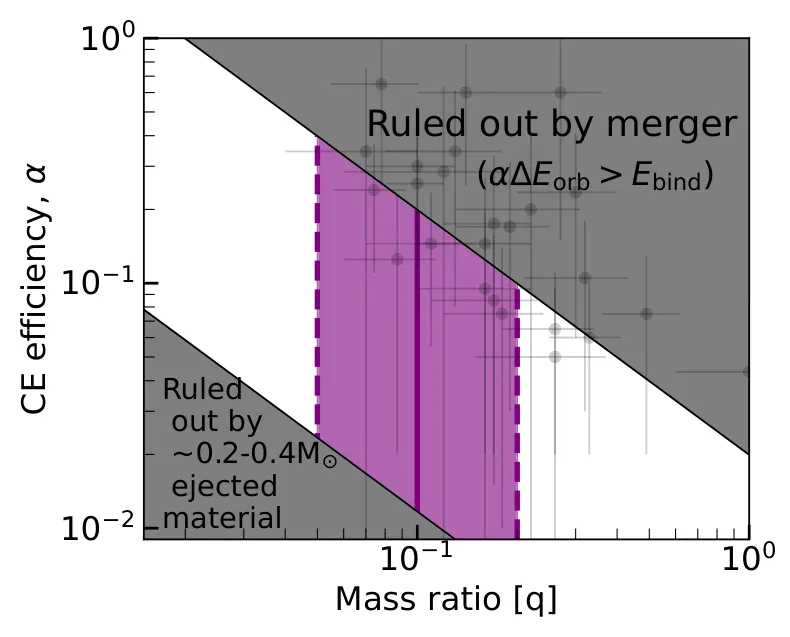
Figure: Karambelkar et al., Nature 2026 (arXiv:2611.23470), Fig. 4, bottom-right panel, CC BY 4.0. Mass ratio q versus common-envelope efficiency α. The upper grey region is excluded assuming the merger interpretation; the lower grey region is excluded by the ejected mass (0.2–0.4 solar masses). The purple band is the inferred mass ratio; black points are α values from post-common-envelope binaries. Labels as in the original
This range does not conflict with the value of about 0.1 to 0.3 obtained by working backward from binary stars that survived passing through a common envelope (arXiv:2611.23470). The authors also noted the limitations of the calculation method in the same place. This method assumes that orbital energy is mainly used to strip away the outer layer, but in Bao, only about 1% of the orbital energy was used for that work, and most of it was used to rapidly push a small fraction of the outer layer. The authors concluded that while the α calculation method is a useful tool for calculating fates in advance, it does not capture the full physics of the common envelope (arXiv:2611.23470).
What V838 Monocerotis Leaves Behind
The common envelope is a core stage in the formation of close white dwarf pairs, and among them are pairs that the future space-based gravitational wave observatory LISA will catch (arXiv:2611.23470). The authors note that the shape of V838 Monocerotis's ejected gas spreading toward the poles and being blocked at the equator confirms the long-standing hypothesis that butterfly-shaped planetary nebulae can be forged by a binary's common envelope (arXiv:2611.23470).
There are also binary stars believed to have formed from a starting point similar to V838 Monocerotis. One study has calculated, for a pair consisting of a white dwarf of 1.08 solar masses and a star of 0.66 solar masses, that the larger star went through a common envelope when it was 6 to 7 times the mass of the Sun. The authors note that if the merger of V838 Monocerotis is confirmed, it would mean that such pairs must undergo a common envelope at a later stage when the star is more swollen than V838 Monocerotis (arXiv:2611.23470).
The greatest significance lies in the method. Decades of multi-wavelength records allowed the start and end of a common envelope to be connected in a single star. The authors expect that the Vera C. Rubin Observatory and the Nancy Grace Roman Space Telescope will routinely find such events within about 15 megaparsecs, in roughly 100 galaxies similar to the Milky Way (arXiv:2611.23470). One modeling study predicted that the Rubin Observatory will see 20 to 750 red novae per year (arXiv:1912.07771).
What We Still Do Not Know
No one has yet seen a companion star directly. The companion's mass is a value obtained by putting the amount of dust and the magnitude of brightening into models, and depending on the model, it varies twofold, such as 0.7 times and 1.4 times (arXiv:2611.23470; arXiv:2610.05769). Both models calculate that the companion was initially on the far outer side of the larger star. What varies is whether what took away the companion's energy was the friction of gas in the outer layer near the surface or the drag of the wind blown out by the giant star, and whether the companion penetrated deep into the inner side of the outer layer by the end of the 7 years. What was seen is the star's brightening; neither the companion nor the friction was seen directly. The phrase "first direct observation" stands upon the interpretation of Nature, which reads the 7-year brightening as friction from the outer layer gas.
The conclusion is also open. The Nature paper proposed a merger and wrote down testing methods, and the manuscript that calculated survival is a one-dimensional model up to 400 days. The point that small undulations within the brightening (two cycles of about 84 days) could be traces of an eccentric orbit also remains to be examined with future models (arXiv:2611.23470). And all of this is the record of a single star.
Where to Look Further
The path from a star aging and swelling to its center remaining as a white dwarf is covered step by step in "The Life of Stars — A Star's Arms Holding Up Its Own Weight, the Floor It Falls To". Neighboring galaxies like Andromeda and how to measure their distances can be found in "Galaxies and the Universe — Farmhouses on a Widening Field, Old Light Arriving from Every Side".
Source Papers
- "An inspiral of a star inside a common envelope with its giant companion" (2026) — arXiv:2611.23470 (Published in Nature) — AT 2025abao in the Andromeda Galaxy. The interpretation that a companion star of roughly 0.7 solar masses spiraled inside the outer layer of an asymptotic giant branch star of about 7 solar masses, creating a 7-year brightening (the first direct observation of frictional energy dissipation in a common envelope), followed by a proposed merger with the central core, and an estimate that roughly one in ten parts of the outer layer was blown off. 0.01 ≲ α ≲ 0.4.
- "AT 2025abao: The fourth luminous red nova in M 31" (2026) — arXiv:2602.13678 (Published in a journal) — Ejection observations of AT 2025abao, the fourth luminous red nova in Andromeda. A rare case originating from an asymptotic giant branch star, proposing a scenario depicting a collision of two central cores and an equatorial disk, and suggesting that late-time infrared observations will determine the outcome.
- "Unravelling the Nature of AT 2025abao: From Precursor to Final Fate" (2026) — arXiv:2610.05769 (Preprint) — Modeling results showing that a companion star of about 1.4 solar masses approaches within the wind to create the brightening, and that a common envelope begins and orbits on an eccentric path without merging for up to 400 days (after which it depends on whether the outer layer is blown off first).
- "V1309 Scorpii: merger of a contact binary" (2010) — arXiv:1012.0163 — The first direct observational demonstration that a contact binary before the eruption had a decreasing orbital period and merged into one.
- "Burying a Binary: Dynamical Mass Loss and a Continuous Optically-Thick Outflow Explain the Candidate Stellar Merger V1309 Scorpii" (2013) — arXiv:1307.4088 — The interpretation that gas flowed out to the outer Lagrangian point of V1309 Sco and ultimately shrouded the binary, and that this flow explains the slow brightening.
- "Luminous Red Novae: Stellar Mergers or Giant Eruptions?" (2019) — arXiv:1906.00812 — A collection of data on luminous red novas. While it does not completely rule out eruptions of single massive stars, it supports common envelope ejection and merging.
- "Common Envelope Evolution: Where we stand and how we can move forward" (2012) — arXiv:1209.4302 — A review article summarizing the physics of common envelope evolution. An old and largely unsolved problem, examining the foundations of energy accounting.
- "Observational Constraints on the Common Envelope Phase" (2020) — arXiv:2001.03337 — The common envelope was proposed early on to explain the origin of close binaries and is related to everything from Type Ia supernovae to black hole binaries, but is still not well understood.
- "Luminous Red Novae: population models and future prospects" (2019) — arXiv:1912.07771 — Estimating the frequency of luminous red novas in our galaxy using population models, and predicting the number of observations in the era of the Rubin Observatory.
Sources (9)
- An inspiral of a star inside a common envelope with its giant companionarXiv:2611.23470
- AT 2025abao: The fourth luminous red nova in M 31arXiv:2602.13678
- Unravelling the Nature of AT 2025abao: From Precursor to Final FatearXiv:2610.05769
- V1309 Scorpii: merger of a contact binaryarXiv:1012.0163
- Burying a Binary: Dynamical Mass Loss and a Continuous Optically-Thick Outflow Explain the Candidate Stellar Merger V1309 ScorpiiarXiv:1307.4088
- Luminous Red Novae: Stellar Mergers or Giant Eruptions?arXiv:1906.00812
- Common Envelope Evolution: Where we stand and how we can move forwardarXiv:1209.4302
- Observational Constraints on the Common Envelope PhasearXiv:2001.03337
- Luminous Red Novae: population models and future prospectsarXiv:1912.07771