Paperis Articles
The Life of Stars — A Star's Arms Holding Up Its Own Weight, the Floor It Falls To
A star is a ball of gas whose own weight is held up by the pressure of hot gas, kept hot by nuclear fusion at its center. Its color tells its surface temperature, its lifespan and ending are set almost entirely by its mass, and how far the core falls once that support gives out decides whether a white dwarf, a neutron star or a black hole is left.
Your field's papers, as audio
Pick your fields and journals — Paperis summarizes the key papers and turns them into audio. Listen on your commute.
Start Paperis free →The Life of Stars — A Star's Arms Holding Up Its Own Weight, the Floor It Falls To
Shiny Dots in the Night Sky
When you walk down a dark street with a child and get asked, "What are those shiny dots?", you are left speechless. The clue is in the day. Among those shiny dots are a group just like the sun at noon. Only the sun is close enough to look like a round disk, and the rest of the same group are so far away that they look like dots even through the largest telescopes on Earth (OpenStax Astronomy 2e 18.3).
This article follows how that group is born, shines, grows old, and ends. We set up one person lifting a barbell as a guide. The barbell constantly presses downward, and the person holding it supports that weight with the strength of their body. As long as strength remains, the posture stays the same, and when strength runs out, the barbell sinks. Where the sunken barbell stops depends on the floor beneath it.
A Hot Ball of Gas That Shines on Its Own
A star is a hot ball of gas that produces energy through nuclear fusion at its center and shines on its own. The Sun is one such star. The inside of the Sun is extremely hot, and its material moves in much the same way as a hot gas (OpenStax Astronomy 2e 16.3).
We unpack the terms in the definition. Mass is a measure of the amount of matter in an object. An atomic nucleus is a tiny clump at the center of an atom, where almost all of the atom's mass is gathered. Nuclear fusion is the process by which two light atomic nuclei combine into one and release energy. What atoms look like is covered in "Atoms and Radiation — A Drizzle That Never Stops, a Rain Gauge for How Wet We Get".
At the center of the Sun, hydrogen slowly decreases while helium piles up in its place. This happens only when the central temperature exceeds 12 million K (kelvins), and the hydrogen hot enough to be used for nuclear fusion will eventually run out (OpenStax Astronomy 2e 16.3).
How long would a star last if it burned like firewood? Even a chunk of coal the size of the Sun would stop shining at its current brightness in just a few thousand years. Yet the Earth has had water for nearly 4 billion years, and the Sun has been warming the Earth the entire time (OpenStax Astronomy 2e 16.1). What powers that long span of time is nuclear fusion at the center. What makes a star shine is nuclear fusion where atomic nuclei combine, which is a different process from burning firewood.
Weight and the Force That Supports It
Gravity is the force by which objects with mass pull on one another. In a giant mass of gas like a star, the gravity created by its own mass pulls every layer inward toward the center.
What supports that weight is the gas itself. The force with which gas particles constantly collide and push is pressure, and the hotter it is, the stronger that force is. At any depth inside a star, this pressure exactly matches the weight of the entire layer above it, which is why the star maintains its size for a long time. Because heat constantly leaks out to the outside, there must be a new energy source inside the star that continuously supplies that heat, and that is nuclear fusion (OpenStax Astronomy 2e 16.3).
To use a barbell as an analogy, the weight of the layers above is the barbell, the arms holding it up are the pressure of the hot gas, and what supplies strength to the arms is nuclear fusion. There are also ways in which the analogy falls short. A star does not have a separate barbell and lifter; its own body is the barbell, and each layer holds up the layers above it. There is also no separate "floor" like the ones that will appear later, so the compressed material itself holds its ground. The life of a star is a contest of endurance between its own weight and the gas heated by nuclear fusion holding up that weight.

Color Tells Us Surface Temperature
On a faucet, a red mark means hot water and a blue mark means cold water. Stars are the reverse: the redder they are, the less hot they are, and the bluer they are, the hotter they are. That is why we read the temperature of a star's surface, or its exterior, from its color. A star being far away does not change its color, and we only need to account separately for cases where dust between stars dyes the light red (OpenStax Astronomy 2e 17.2).
We Read Brightness Together With Distance
The stars in the night sky all have different brightnesses, and most are so dim that they can only be seen with a telescope. But "bright" has two meanings.
Luminosity is the total amount of energy a star puts out in all wavelengths of light for 1 second, which is how bright the star actually is. Sirius, which shines brightly in the night sky, has a luminosity about 25 times that of the Sun. Because stars send out light equally in all directions, only a very small share of it reaches Earth (OpenStax Astronomy 2e 17.1). Apparent brightness is the amount of a star's energy that hits a fixed area on Earth in 1 second, which is how bright the star looks to our eyes.
Just by looking at a single star that appears dim, we cannot tell whether it is a star that is close by but has low luminosity or a star that is far away but has high luminosity (OpenStax Astronomy 2e 17.1). Conversely, if we know both the luminosity and the apparent brightness, we can calculate the distance to that star (OpenStax Astronomy 2e 19.3). We have to look at apparent brightness together with distance to know the actual brightness.
Putting Stars on a Single Sheet
A star's surface temperature and luminosity are linked to each other. This relationship was discovered independently in 1911 and 1913 by the Danish astronomer Ejnar Hertzsprung and the American astronomer Henry Norris Russell. The H-R diagram is a graph that plots the surface temperature of stars on the horizontal axis and their luminosity on the vertical axis, with stars marked as dots. The name comes from the last names of the two men, and by convention, the horizontal axis gets hotter toward the left (OpenStax Astronomy 2e 18.4).
When you plot the dots, 90% of stars lie along a single, diagonally slanting band. Main-sequence stars are stars that lie on this band of the H-R diagram, representing stars in the phase of life where they stably shine by converting hydrogen into helium at their center. Their position on the band is also an order of mass, so heavier stars are placed toward the upper left where they are hotter and brighter, and lighter stars are placed toward the lower right. The fact that 90% of stars are on this band means that stars spend about 90% of their lifetimes in this phase (OpenStax Astronomy 2e 18.4). The Sun is also a main-sequence star currently passing through this phase (OpenStax Astronomy 2e 22.1).
Born in Cold Clouds
A nebula is a cloud of gas and dust floating between the stars. Because stars are made of gas, finding where a star is born requires looking at clouds where gas has gathered densely and coldly. The inside of such a giant cloud is so cold it is no more than 10 to 20K, and a portion of it collapses to form a star (OpenStax Astronomy 2e 21.1).
The lump that will become a star cannot yet undergo nuclear fusion, and it shines with the energy released as it shrinks. When the lump becomes dense enough to trap that heat, its rapid contraction stops (OpenStax Astronomy 2e 21.2). Then, when it starts hydrogen nuclear fusion at the center, it takes its place on the main sequence (OpenStax Astronomy 2e 22.1). In terms of weightlifting, the arms holding the weight were already there, and this is when a place finally arises to supply strength to those arms.
A Lifetime Decided by a Single Mass
The heavier the barbell someone lifts, the more force they must use, and the sooner they tire out. Stars are the same way. Heavy stars burn through their fuel faster and end sooner. The heavier the weight of the upper layers that the center must support, the higher the pressure at the center needs to be, and that pressure comes from a higher temperature. But nuclear fusion is very sensitive to temperature, so a star with a hot center burns its fuel much faster (OpenStax Astronomy 2e 22.1).
The difference is huge. A star with the mass of the Sun stays on the main sequence for roughly 10 billion years, but the heaviest stars finish this period in just a few million years (OpenStax Astronomy 2e 22.1). Light stars are far more common in the sky than heavy stars (OpenStax Astronomy 2e 22.4). A star's properties are determined above all by its mass (DOI: 10.1146/annurev-astro-052622-031748).
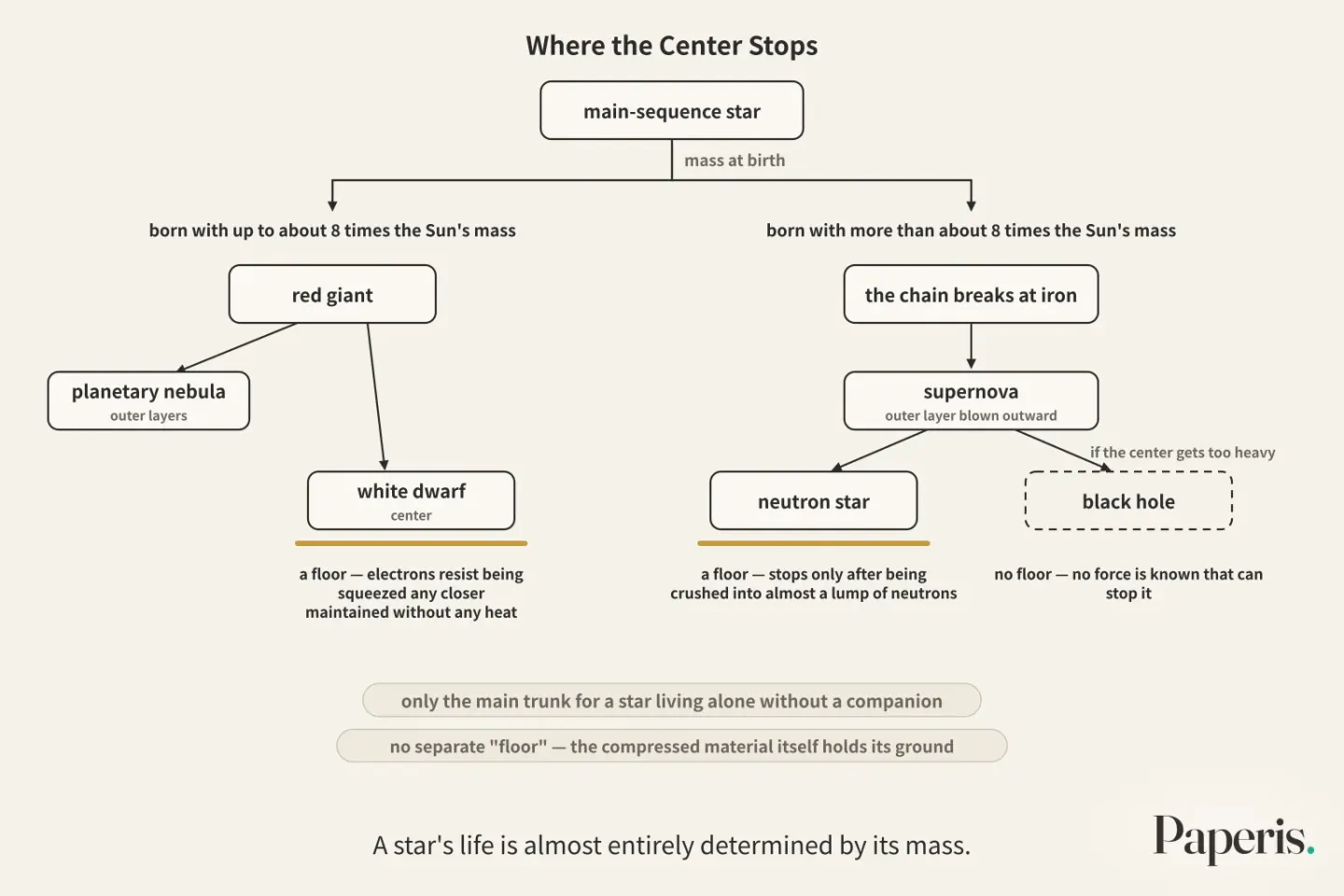
The Sun is about 4.5 billion years old now. Several billion years still remain before the Sun leaves the main sequence and begins to swell into a giant, and thanks to this long period of stability, life on Earth has gained plenty of time to evolve (OpenStax Astronomy 2e 22.1). A star's life is almost entirely determined by its mass. We say "almost" because the fork in the road after leaving the main sequence also depends on what the star is made of and whether it has a companion star nearby (OpenStax Astronomy 2e 22.4). This article follows only the main trunk for a star living alone without a companion.
The End of a Sun-like Star
When the hydrogen in the center runs out, only helium is left there, and the center—where nuclear fusion has stopped—collapses under gravity and heats up. That heat warms the layer of hydrogen surrounding just outside the center, and nuclear fusion takes place in that layer this time. As a result, the outer layers of the star swell up greatly, and the swollen surface cools down, turning red in color (OpenStax Astronomy 2e 22.1).
A red giant is a star whose old outer layers have swollen greatly, making the surface cool and red. The actual color is closer to an orange tint, and if a red giant were placed in the Sun's position, its outer atmosphere could reach Mars's orbit or beyond it (OpenStax Astronomy 2e 22.1). This picture—where the center collapses while the outer layers actually swell—is a scene that the weightlifting analogy cannot capture. Because lighter stars are far more common, the Sun and most other stars walk this path (OpenStax Astronomy 2e 22.4).
When the collapsed center reaches 100 million K, three helium nuclei combine to become carbon, and adding one more helium to that carbon creates oxygen as well. Two helium nuclei sticking together breaks apart immediately, so three must meet almost all at once to remain as carbon. A star the size of the Sun cannot heat its center enough to move on to the next step (OpenStax Astronomy 2e 22.4).
A greatly swollen star has a weak hold on its outer gas, losing that gas into space, and that gas spreads out around the star as a shell. When the hot core left behind is later exposed, the wind and ultraviolet light coming from it heat that shell so that it glows (OpenStax Astronomy 2e 22.4). A planetary nebula is a glowing shell formed when the outer-layer gas sent out by an old star is heated by the hot core left in the center. Despite the name, it has nothing to do with planets (OpenStax Astronomy 2e 22.4).
When nuclear fusion ends completely, the heat that was holding everything up cuts off, and the center collapses once more. This time, there is a floor. In matter compressed nearly 1 million times denser than water, electrons fiercely resist being squeezed any closer together, and this resistance is maintained without any heat (OpenStax Astronomy 2e 23.1). A white dwarf is what remains when the center of a star that has finished nuclear fusion shrinks down to be very small and dense, and it slowly cools down without making any more energy. The remaining mass must be smaller than about 1.4 times the mass of the Sun to stop at this floor, and according to evidence so far, even stars born with up to about 8 times the Sun's mass lose enough mass during their lifetime to fall below this line. The Sun is expected to lose about 45% of its initial mass and become a white dwarf (OpenStax Astronomy 2e 23.1). Based on observations up to 1989, white dwarf masses were clustered in a narrow range averaging around 0.6 times the mass of the Sun (DOI: 10.1017/s0074180900139178). A white dwarf radiates its remaining heat over billions of years before finally losing its light (OpenStax Astronomy 2e 23.1).
The End of a Heavy Star
For stars born with more than about 8 times the mass of the Sun, the story changes. These stars have an outer layer so heavy that it presses down harder on the center, starting with carbon and making progressively heavier elements (OpenStax Astronomy 2e 22.5). An element is a substance made of atoms with the same number of protons in their nuclei, which cannot be broken down into simpler substances by chemical change. For a star with more than about 10 times the mass of the Sun, iron eventually accumulates in the center, surrounded by layers of increasingly lighter elements (OpenStax Astronomy 2e 23.2).
The chain breaks at iron. Up until iron, every time atomic nuclei were fused together energy was released, but fusing iron actually requires energy input (OpenStax Astronomy 2e 22.5). The supporting force cuts out at the center, and even the floor of a white dwarf cannot hold this weight. In less than a second, a center the size of Earth collapses to less than 20 kilometers across, and the matter stops only after being crushed into almost a lump of neutrons (OpenStax Astronomy 2e 23.2). A neutron is a particle making up the atomic nucleus that carries no electrical charge, and its mass is nearly the same as a proton. A neutron star is a celestial body the size of a small city left behind when the collapsed center of a heavy star packs densely together with neutrons. It is an extremely dense object, with about 95% of its interior made of neutrons (OpenStax Astronomy 2e 23.4).
Here the barbell analogy stops. A dropped barbell just sits on the floor, but in a star, very tiny particles pouring out all at once during the collapse carry immense energy to the outer layer, blowing that outer layer outward. The shock of stopping alone is not what causes the explosion. Most of the star's mass excluding this newly formed neutron star center—at least five Suns' worth of material—is scattered into space (OpenStax Astronomy 2e 23.2).
A supernova is a massive explosion where a star bursts all at once at the end of its life and shines very brightly. The typical case, as we just followed, is a heavy star collapsing and bursting because it can no longer hold itself up (OpenStax Astronomy 2e 23.2), and there is another branch where a white dwarf that has taken on a lot of material from a companion star explodes (OpenStax Astronomy 2e 23.3). The name comes from the Latin word nova, meaning "new," but it is actually the light a star emits when it ends. Supernova SN 1987A, which was visible to the naked eye in 1987, exploded about 160,000 light-years away (OpenStax Astronomy 2e 23.3). A light-year is the distance light travels in one year; despite the name, it is a unit for measuring distance, not time. The story of the time it took for that light to arrive is covered in "Light and Telescopes — A Letter That Arrives Late, a Fingerprint in the Envelope".
Weight with No Floor
If the center gets too heavy, even neutrons cannot hold out. The upper mass limit of a neutron star is calculated to be roughly 3 times that of the Sun, but the exact value is not yet known, and since no force is known that can stop a heavier center, it is believed to become a black hole (OpenStax Astronomy 2e 23.2). A black hole is an astronomical object whose mass is packed into such a tiny space that not even light can escape. If the mass stays the same while only the size shrinks, the distance from the surface to the center decreases, and the gravity felt at the surface grows stronger (OpenStax Astronomy 2e 24.5).
A black hole is ultimately just mass crowded into one spot. Because gravity is created by mass, the pull felt from far away is no different from when that mass was a star, and the only thing that changes is the location very close to that mass (OpenStax Astronomy 2e 24.5). The common picture of a vacuum cleaner sucking in everything around it is wrong for this reason. The force with which a black hole pulls from a distance is the same as the star before it collapsed, and only things that get very close fail to escape.
Though black holes cannot be seen, their location is pinpointed by the fact that a companion star orbiting nearby is being pulled by something too heavy to be a neutron star. Several companion stars with definite black holes have been found in this way (OpenStax Astronomy 2e 24.6).
The Material Left Behind
We believe that during the first few minutes of the universe, only the two simplest elements—hydrogen and helium—and a very small amount of lithium were formed (OpenStax Astronomy 2e 22.5). Most of the heavier elements were made by stars (OpenStax Astronomy 2e 23.2): inside stars, and in the explosions and collisions at the end of a star's life. The story of those first few minutes is covered in "Galaxies and the Universe — Farmhouses on a Widening Field, Old Light Arriving from Every Side".
Nuclear fusion inside stars can make most elements up to around iron, and we believe that most elements heavier than that are produced through reactions where neutrons are added to atomic nuclei (DOI: 10.1098/rsta.1988.0056). There are broadly two paths for adding neutrons: a slow path and a rapid path (DOI: 10.1051/epjconf/202327501006). The slow path mainly occurs as light or intermediate-mass stars, up to about 8 times the mass of the Sun, grow old (DOI: 10.1017/s1743921318006166).
The rapid path makes about half of the elements heavier than iron, and gold, silver, platinum, thorium, and uranium come from here. However, it is not yet fully understood where in the universe that path takes place. In the collision of two neutron stars observed in 2017, traces of this path were caught, confirming neutron star collisions as one such site. This review notes that it remains an open question whether that single event explains the traces left in the oldest stars, and that there are strong clues pointing to additional sites (DOI: 10.3390/universe11070229).
The elements that are created do not stay only inside stars. Light or intermediate-mass stars return those elements to the space between stars through the outer layers they shed, while heavy stars do so through supernova explosions (DOI: 10.1017/pasa.2014.21). The composition of the Sun bears traces of multiple generations of stars that had already vanished before the solar system formed (DOI: 10.1051/epjconf/202327501006). Inside old meteorites are "stardust" grains from winds blown out by stars and from the remnants of supernovae before the solar system formed, allowing us to examine them directly in the laboratory (DOI: 10.1146/annurev.earth.26.1.147).
Where the Carbon in Our Bodies Came From
We trace the path backward. Our bodies, too, are made of the same materials that make up the Solar System. Those materials are the gathered dust of matter that stars blew out or slowly shed and returned to the space between them (DOI: 10.1098/rsta.1988.0056). Because there was no carbon at the beginning of the universe (OpenStax Astronomy 2e 22.5), the carbon in that matter was made and sent out by some star.
The pathway for how it gets sent out is also grounded in evidence. The wind that aging stars blow outward mixes with newly made atoms from the middle of those stars (OpenStax Astronomy 2e 22.4). In stars lighter than roughly 10 times the mass of the Sun, their insides and outsides mix a few times as they age, and astronomers observe carbon increasing on the surface; these stars then shed the elements they made along with their outer layers (DOI: 10.1017/pasa.2014.21). One representative site where carbon is made is inside old stars, at the place where three helium nuclei meet almost all at once (OpenStax Astronomy 2e 22.4).
Returning to the child on the night path, we can now answer a few things. Those twinkling stars are suns very far away. Red stars are less hot and blue stars are hotter. The heavier a star is, the shorter it lives. And the carbon inside that child's body was also made and sent out by some star long ago.
Where to Look Next
What atomic nuclei and the particles inside them are is covered by “Atoms and Radiation — A Drizzle That Never Stops, a Rain Gauge for How Wet We Get”, and elements and the periodic table by “Elements and Molecules — 118 Pieces of Type, Tens of Millions of Words.” Gravity that holds stars together continues in “Force and Motion — A Swinging Strap, a Body That Keeps Going”, and temperature and the Kelvin scale in “Heat and Temperature — Water That Only Flows Downhill, a Pump That Lifts It Back Up.”
Among other parts of this series, “Light and Telescopes — A Letter That Arrives Late, a Fingerprint in the Envelope” covers light-years and how to spread out and read starlight by color; “The Solar System — Bowls Thrown on One Wheel, Crumbs Left on the Floor” covers the planets around the Sun and the disk they formed from; and “Galaxies and the Universe — Farmhouses on a Widening Field, Old Light Arriving from Every Side” covers the beginning of the universe and the ratio of light elements.
Source Papers
- "Astronomy 2e — 16.1 Sources of Sunshine: Thermal and Gravitational Energy" (2022) — OpenStax Astronomy 2e 16.1 — If the Sun were made of coal, its present brightness could only last for a few thousand years; geological evidence shows that water existed on Earth's surface starting roughly 4 billion years ago.
- "Astronomy 2e — 16.3 The Solar Interior: Theory" (2022) — OpenStax Astronomy 2e 16.3 — Proton nuclear fusion requires a core temperature exceeding 12 million K; material inside the Sun behaves like a hot gas; as hydrogen decreases and helium accumulates in the core, hydrogen hot enough to fuse eventually runs out; gas pressure rises with temperature; gravity and gas pressure oppose each other at every point inside a star; a star must contain a new energy source (nuclear fusion).
- "Astronomy 2e — 17.1 The Brightness of Stars" (2022) — OpenStax Astronomy 2e 17.1 — Luminosity is the total energy emitted across all wavelengths in one second; Sirius is about 25 times brighter than the Sun; stars emit equally in all directions, so Earth receives only a tiny share; the definition of apparent brightness; most stars are visible only with a telescope; one cannot tell whether a dim star is close and faint or distant and strong.
- "Astronomy 2e — 17.2 Colors of Stars" (2022) — OpenStax Astronomy 2e 17.2 — A star's color indicates its surface temperature (blue-white is hot, red is cool); color is independent of distance (except for reddening by interstellar dust).
- "Astronomy 2e — 18.3 Diameters of Stars" (2022) — OpenStax Astronomy 2e 18.3 — Except for the Sun, all stars are so distant that they appear as points even through the largest ground-based telescopes.
- "Astronomy 2e — 18.4 The H–R Diagram" (2022) — OpenStax Astronomy 2e 18.4 — Hertzsprung in 1911 and Russell in 1913 independently discovered the temperature-luminosity relationship; it is named the Hertzsprung–Russell diagram; the horizontal axis conventionally plots hotter temperatures on the left; 90% of stars lie on the main sequence band; the main sequence is an order of mass (heavier stars are toward the upper left); stars spend 90% of their lives in the main sequence phase.
- "Astronomy 2e — 19.3 Variable Stars: One Key to Cosmic Distances" (2022) — OpenStax Astronomy 2e 19.3 — Knowing luminosity and apparent brightness allows astronomers to calculate distance.
- "Astronomy 2e — 21.1 Star Formation" (2022) — OpenStax Astronomy 2e 21.1 — Stars are made of gas and are found in dense, cold (10–20K) clouds of gas and dust, where a portion of the cloud collapses to form a star.
- "Astronomy 2e — 21.2 The H–R Diagram and the Study of Stellar Evolution" (2022) — OpenStax Astronomy 2e 21.2 — Newly forming stars derive their energy from gravitational contraction rather than nuclear reactions.
- "Astronomy 2e — 22.1 Evolution from the Main Sequence to Red Giants" (2022) — OpenStax Astronomy 2e 22.1 — Entering the main sequence (contraction stops, core hydrogen fusion begins); heavy stars use up fuel quickly and thus have short lifespans (mass → pressure → temperature → fusion rate); the heaviest stars last a few million years, while a star of solar mass lasts about 10 billion years; the Sun is about 4.5 billion years old and has billions of years left before becoming a giant; a long period of stability gave life time to evolve; after core hydrogen is depleted, the star contracts, fuses in a shell, and its outer layers expand and cool; red giants actually glow with an orange hue and can reach out as far as Mars's orbit.
- "Astronomy 2e — 22.4 Further Evolution of Stars" (2022) — OpenStax Astronomy 2e 22.4 — Lighter stars are far more numerous, so the Sun and the vast majority of stars follow the same path; the fork after the main sequence depends on mass, composition, and companion stars; at 100 million K, three helium nuclei meet almost simultaneously to form carbon (two nuclei break apart quickly), and carbon plus helium forms oxygen; Sun-like stars cannot reach the next stage; mass loss from bloated stars, along with stellar winds and ultraviolet light from hot stars, makes shells glow; planetary nebulae have nothing to do with planets; newly forged atoms from the core are mixed into the winds of dying stars (Cosmic Recycling).
- "Astronomy 2e — 22.5 The Evolution of More Massive Stars" (2022) — OpenStax Astronomy 2e 22.5 — The universe contained only hydrogen, helium, and a tiny bit of lithium in its first few minutes; stars created most of our chemical abundance; stars with more than about 8 solar masses fuse carbon into heavier elements, while iron fusion requires an input of energy.
- "Astronomy 2e — 23.1 The Death of Low-Mass Stars" (2022) — OpenStax Astronomy 2e 23.1 — White dwarf density is nearly 1 million times that of water; the pressure that resists electrons being pushed any closer together is maintained without heat; the final mass must be less than about 1.4 times that of the Sun; evidence shows that stars of up to about 8 solar masses also lose mass and end up as white dwarfs; the Sun will lose about 45% of its mass; white dwarfs cool over billions of years.
- "Astronomy 2e — 23.2 Evolution of Massive Stars: An Explosive Finish" (2022) — OpenStax Astronomy 2e 23.2 — Stars with roughly 10 times the Sun's mass or more develop an iron core (8 to 8–10 times develop an oxygen, neon, and magnesium core); iron absorbs energy when fused; within a second, an Earth-sized core collapses to less than 20 km and becomes a lump of neutrons; the shock wave alone cannot cause an explosion, so neutrino energy blows off the outer layers, releasing at least the equivalent of 5 suns; supernovae come in at least two types; the upper mass limit for neutron stars is about 3 times that of the Sun (with no exact value known), and no known force can halt a collapse beyond that limit; supernovae and neutron star collisions are where heavy elements are made.
- "Astronomy 2e — 23.3 Supernova Observations" (2022) — OpenStax Astronomy 2e 23.3 — Supernovae announce the death of a star; "nova" is the Latin word for "new"; Type Ia events occur when a large amount of material piles onto a white dwarf; SN 1987A was about 160,000 light-years away and visible to the naked eye.
- "Astronomy 2e — 23.4 Pulsars and the Discovery of Neutron Stars" (2022) — OpenStax Astronomy 2e 23.4 — Neutron stars are extremely dense objects, about 95% of which consist of neutrons, with a diameter comparable to a small city.
- "Astronomy 2e — 24.5 Black Holes" (2022) — OpenStax Astronomy 2e 24.5 — A black hole is an object from which light cannot escape; if an object keeps the same mass while shrinking in size, its surface gravity increases; its gravity far away remains the same as that of the original star, producing strange effects only at very close range.
- "Astronomy 2e — 24.6 Evidence for Black Holes" (2022) — OpenStax Astronomy 2e 24.6 — Black holes are found through their influence on companion stars; an invisible companion weighing more than about 3 solar masses paired with infalling matter that emits X-rays; because neutron stars also emit X-rays, astronomers must analyze them carefully, and several systems confirmed to contain black holes have been discovered.
- "The Physical Origin of the Stellar Initial Mass Function" (2024) — DOI: 10.1146/annurev-astro-052622-031748 — A review paper explaining that because a star's properties are determined largely by its mass, the initial mass distribution is crucial to the structure of the universe.
- "Properties and Evolution of White Dwarf Stars" (1989) — DOI: 10.1017/s0074180900139178 — A conference review showing that the mass distribution of white dwarfs is very narrow, with an average around 0.6 solar masses and extremes of 0.43 and 1.05.
- "Nucleosynthesis and the origin of the elements" (1988) — DOI: 10.1098/rsta.1988.0056 — Stellar nuclear fusion builds elements up to around iron, while heavier elements are made primarily through neutron addition; stellar mass loss returns processed material to the space between stars, gathering the raw materials for the solar system.
- "Neutron captures in stellar nucleosynthesis" (2023) — DOI: 10.1051/epjconf/202327501006 — The two main processes for elements heavier than iron are slow and rapid neutron capture; the composition of the Sun carries the traces of generations of stars that have already vanished.
- "Nucleosynthesis in stars: The Origin of the Heaviest Elements" (2018) — DOI: 10.1017/s1743921318006166 — Slow neutron capture (the s-process) occurs in low- and intermediate-mass stars of up to about 8 solar masses.
- "Recent Advances in Understanding R-Process Nucleosynthesis in Metal-Poor Stars and Stellar Systems" (2025) — DOI: 10.3390/universe11070229 — Rapid neutron capture accounts for about half of the elements heavier than iron (including gold, silver, platinum, thorium, and uranium); its exact site remains unclear, though GW170817 confirmed neutron star collisions as one site; whether that source alone is sufficient remains an unresolved question, with strong clues pointing to additional supply sources.
- "The Dawes Review 2: Nucleosynthesis and Stellar Yields of Low- and Intermediate-Mass Single Stars" (2014) — DOI: 10.1017/pasa.2014.21 — Stars of less than about 10 solar masses accumulate carbon and other elements on their surfaces through repeated mixing, expelling them into space via winds in low- and intermediate-mass stars, and via supernovae in heavy stars.
- "STELLAR NUCLEOSYNTHESIS AND THE ISOTOPIC COMPOSITION OF PRESOLAR GRAINS FROM PRIMITIVE METEORITES" (1998) — DOI: 10.1146/annurev.earth.26.1.147 — Primitive meteorites contain stardust grains originating from stellar outflows and supernova remnants that predate the formation of the solar system, which are studied in laboratories.
Sources (26)
- Astronomy 2e — 16.1 Sources of Sunshine: Thermal and Gravitational Energy
- Astronomy 2e — 16.3 The Solar Interior: Theory
- Astronomy 2e — 17.1 The Brightness of Stars
- Astronomy 2e — 17.2 Colors of Stars
- Astronomy 2e — 18.3 Diameters of Stars
- Astronomy 2e — 18.4 The H–R Diagram
- Astronomy 2e — 19.3 Variable Stars: One Key to Cosmic Distances
- Astronomy 2e — 21.1 Star Formation
- Astronomy 2e — 21.2 The H–R Diagram and the Study of Stellar Evolution
- Astronomy 2e — 22.1 Evolution from the Main Sequence to Red Giants
- Astronomy 2e — 22.4 Further Evolution of Stars
- Astronomy 2e — 22.5 The Evolution of More Massive Stars
- Astronomy 2e — 23.1 The Death of Low-Mass Stars
- Astronomy 2e — 23.2 Evolution of Massive Stars: An Explosive Finish
- Astronomy 2e — 23.3 Supernova Observations
- Astronomy 2e — 23.4 Pulsars and the Discovery of Neutron Stars
- Astronomy 2e — 24.5 Black Holes
- Astronomy 2e — 24.6 Evidence for Black Holes
- The Physical Origin of the Stellar Initial Mass FunctionDOI 10.1146/annurev-astro-052622-031748
- Properties and Evolution of White Dwarf StarsDOI 10.1017/s0074180900139178
- Nucleosynthesis and the origin of the elementsDOI 10.1098/rsta.1988.0056
- Neutron captures in stellar nucleosynthesisDOI 10.1051/epjconf/202327501006
- Nucleosynthesis in stars: The Origin of the Heaviest ElementsDOI 10.1017/s1743921318006166
- Recent Advances in Understanding R-Process Nucleosynthesis in Metal-Poor Stars and Stellar SystemsDOI 10.3390/universe11070229
- The Dawes Review 2: Nucleosynthesis and Stellar Yields of Low- and Intermediate-Mass Single StarsDOI 10.1017/pasa.2014.21
- STELLAR NUCLEOSYNTHESIS AND THE ISOTOPIC COMPOSITION OF PRESOLAR GRAINS FROM PRIMITIVE METEORITESDOI 10.1146/annurev.earth.26.1.147