Paperis Articles
Galaxies and the Universe — Farmhouses on a Widening Field, Old Light Arriving from Every Side
The Milky Way is our own galaxy seen from inside, and galaxies recede because space itself is stretching. Running that expansion backward leads to a hot, dense beginning — yet what dark matter and dark energy, by current estimates about 95% of the universe, actually are is still unknown.
Your field's papers, as audio
Pick your fields and journals — Paperis summarizes the key papers and turns them into audio. Listen on your commute.
Start Paperis free →Galaxies and the Universe — Farmhouses on a Widening Field, Old Light Arriving from Every Side
A Hazy Band Across the Night Sky
If you look up at a clear night sky from a mountain or beach without artificial lights, you can see a whitish band wrapping all the way around the sky. It looks like a cloud, but stars are clustered along this band, so the band is the overlapping light of a very large number of stars (OpenStax Astronomy 2e 25.1).
This article sets out from that band, goes beyond it, and travels back in time to the beginning of the universe. At the end, it arrives at a few questions that no one yet knows the answer to.
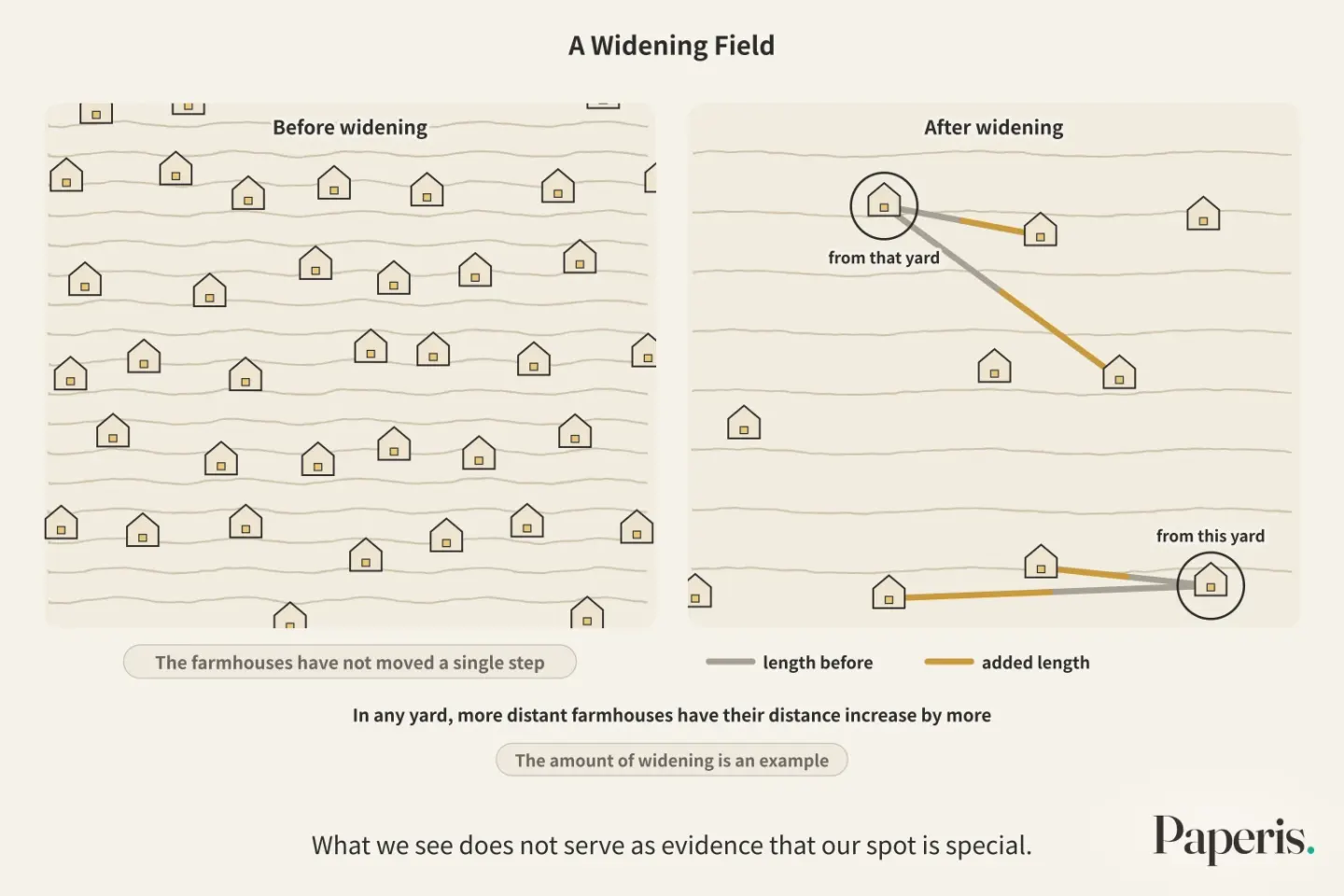
As a guide, we will carry a field of imagination. Let us imagine an endless field with farmhouses scattered sparsely here and there, and that the ground of this field is expanding slowly and evenly everywhere. The farmhouses have not moved a single step, yet the distance to neighboring farmhouses grows longer. And if all the farmhouses in the field turned on their lights at once on a certain night, standing in any yard, the light would come from all directions. These two scenes contain the two biggest facts about the universe. Because it is an analogy, there are also points where it differs from the universe, and those differences will be clarified at the appropriate places.
Our Galaxy — A Band Seen from Inside the Disk
A galaxy is a massive collection of countless stars, gas, and dust held together by gravity. Every star visible to the naked eye in the night sky belongs to a single galaxy (OpenStax Astronomy 2e 1.6). Gravity is the force that pulls objects with mass toward each other. Our galaxy is the galaxy that the Sun belongs to, containing roughly 200 billion to 400 billion stars. The Sun is just one of them (OpenStax Astronomy 2e 25.1).
The brightest part of our galaxy is a thin disk about 100,000 light-years in diameter and about 2,000 light-years thick (OpenStax Astronomy 2e 25.1). A light-year is the distance light travels in one year; contrary to its name, it is a unit of distance, not time. Even the star closest to the Sun besides itself is over 4 light-years away (OpenStax Astronomy 2e 1.4). Because the thickness is only one-fiftieth of the diameter, it is an extremely flat disk.
The Sun is located inside this disk, roughly 26,000 light-years away from the center (OpenStax Astronomy 2e 25.3). Therefore, we cannot look down at the disk from the outside, but instead sit inside the disk and look across. In directions following the disk, stars pile up layer upon layer, while in directions leaving the disk, stars are sparse. That stacked starlight becomes a band looping all the way around the sky (OpenStax Astronomy 2e 25.1). The Milky Way is how the disk of our galaxy appears as a band looping across the sky when viewed sideways from within it. The Milky Way is the name of the band visible in the sky, and our galaxy is the entire collection of stars that creates that band.
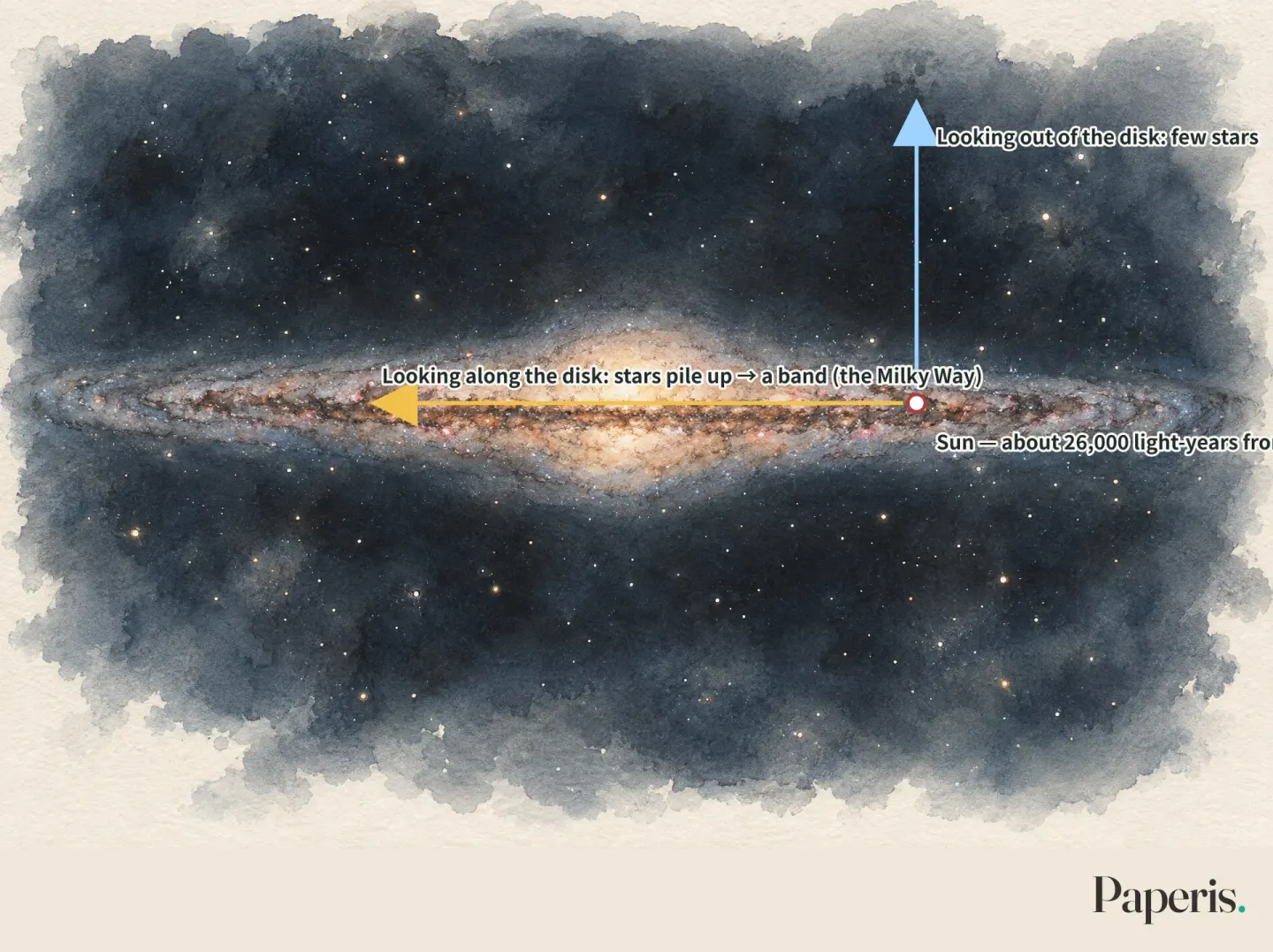
Illustration: Paperis (lines and labels drawn from the article)
The Sun does not sit still inside this disk, either. Rotation is when a celestial body spins on its own axis passing through its body, and revolution is when one celestial body travels around another. Even though the Sun revolves around the galactic center at about 200 kilometers per second, it takes roughly 225 million years to complete one orbit. Since the Earth formed, the Sun has made this circuit only about 20 times (OpenStax Astronomy 2e 25.3). The Milky Way is what such a vast collection looks like when viewed from the inside.
Countless Galaxies
In the sky toward Andromeda, a single faint smudge is visible even to the naked eye (OpenStax Astronomy 2e 28.1). Whether that smudge was a cloud inside our galaxy or a different cluster of stars outside it was not settled until 1924. When the astronomer Edwin Hubble found stars whose brightness periodically rose and falls within that smudge and measured their distance, the distance far exceeded the size of our galaxy (OpenStax Astronomy 2e 26.1). This is because if you have a star whose true brightness is known, you can calculate its distance from how much the brightness entering your eye has decreased (OpenStax Astronomy 2e 26.4). Andromeda was a different galaxy outside our galaxy, and the distance we know today is about 2.5 million light-years (OpenStax Astronomy 2e 26.1).
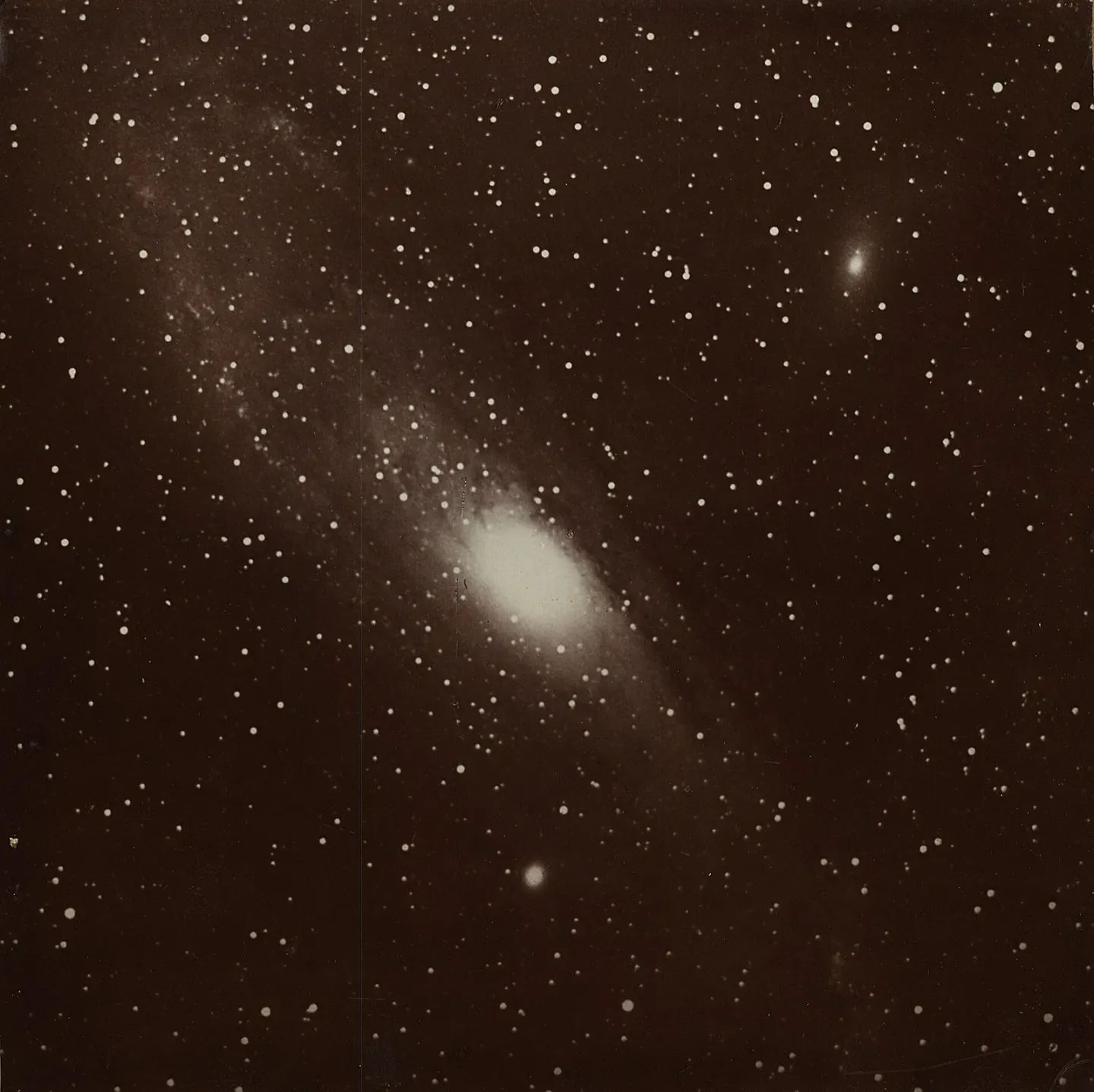
Isaac Roberts's 1888 photograph of the 'Andromeda Nebula' · Isaac Roberts, 29 December 1888 · ETH-Bibliothek Zürich · Wikimedia Commons (public domain)
Galaxies are classified by their shapes. Spiral galaxies are galaxies with flat disks wrapped in spiral arms, and new stars are still being born in those arms today. Both our galaxy and Andromeda are large spiral galaxies (OpenStax Astronomy 2e 26.2). Elliptical galaxies are galaxies where stars gather in a round or elongated ball shape without arms. Large and bright galaxies usually fall into one of these two shapes, and many small galaxies do not have a regular shape (OpenStax Astronomy 2e 26.2).
Galaxies also form groups. Our galaxy belongs to a small cluster where about 60 galaxies are gathered (OpenStax Astronomy 2e 28.3). Galaxy clusters are large groups where many galaxies are bound by gravity, and large ones harbor thousands to tens of thousands of galaxies. The closest large galaxy cluster is located about 50 million light-years away toward the direction of Virgo (OpenStax Astronomy 2e 28.3).
Because light always travels at the same speed (OpenStax Astronomy 2e 1.4), light coming from a distant galaxy is light that left that place a long time ago. The most distant galaxies seen so far are visible by the light that left more than 13 billion years ago (OpenStax Astronomy 2e 28.1). Since the universe has an age, no matter how distant a place is, we cannot see places from which light has not had time to reach us during that age. The observable universe is the range within which light could reach us from the beginning of the universe until now. Within that range alone, there are more than 2 trillion galaxies (OpenStax Astronomy 2e 28.1). Our galaxy is one of those 2 trillion.
Galaxies Drifting Apart — Space Is Stretching
Almost all galaxies are moving away from us. The exceptions are close neighbors. Neighbors in the same group, like Andromeda, move around and even approach us instead, and galaxies and galaxy clusters hold themselves together with gravity to maintain their sizes (OpenStax Astronomy 2e 26.5). A spectrum is a band that spreads out light by wavelength, in other words, by color. Redshift is when the spectral lines of light coming from a celestial body appear shifted toward the longer-wavelength side, in other words, the red side. Starting in 1912, the astronomer Vesto Slipher spread out the light of hazy spiral patches—things that would later be revealed to be galaxies—and the result he first announced in 1914 was that most of that light was shifted toward the red side (OpenStax Astronomy 2e 26.5).
There was a rule to the speed at which they moved away. In 1931, Hubble and his colleague Milton Humason showed that the speed at which a galaxy recedes is directly proportional to its distance (OpenStax Astronomy 2e 26.5). The Hubble-Lemaître law is the relationship that the farther a galaxy is, the faster it recedes in proportion to its distance. It was long called the "Hubble law," but the International Astronomical Union proposed calling it this to include the contribution of the astronomer Georges Lemaître, who had proposed an expanding universe before him (OpenStax Astronomy 2e 26.5).
Does that mean we are at the center of the universe? Models that describe the universe assume that on a large scale, the universe is the same everywhere, and in that case, the rate of expansion must also be the same everywhere (OpenStax Astronomy 2e 29.2). In such a universe, an observer situated in any galaxy sees more distant galaxies receding faster (OpenStax Astronomy 2e 26.5). Going back to the field, when the ground expands evenly, standing in any farmhouse's yard makes more distant farmhouses have their distance increase by more. What we see does not serve as evidence that our spot is special.
Cosmic expansion is the process by which the space itself between galaxies stretches, causing the galaxies to move away from each other. Galaxies are not scattering by running through space that stays put, but are carried by stretching space as they move apart from one another (OpenStax Astronomy 2e 29.2). Other parts of this series dealing with light and telescopes explained redshift as the motion of celestial bodies, but the redshift of distant galaxies is mostly due to space stretching while the light travels, causing the wavelength of the light to stretch as well (OpenStax Astronomy 2e 29.2). The longer the path the light has traveled, the more it has stretched and the further it is shifted toward the red side (OpenStax Astronomy 2e 29.2).
The field analogy also has its limits. Real ground does not expand, and a field is a single layer of ground, so the directions in which it expands are only front-and-back and left-and-right. The space of the universe stretches evenly in every direction.
If You Turn Time Backward
If you turn the expanding universe backward, the space between galaxies narrows and the universe becomes increasingly dense. The universe was much hotter when it was dense and has cooled as it has expanded (OpenStax Astronomy 2e 29.3). The Big Bang is a name that jointly refers to the very beginning when the hot, dense universe began to expand, and the explanation that the universe has since cooled and widened.
Because of its name, it is easy to picture the Big Bang as an explosion that went off at a single point in empty space, but you must not picture it that way (OpenStax Astronomy 2e 29.4). What stretches is space itself, and the expansion started everywhere at once. Therefore, there is nowhere that can be pointed to as the spot where the Big Bang happened (OpenStax Astronomy 2e 29.2). No matter how wide a field is, it ends somewhere, but the universe has neither an edge nor a center (OpenStax Astronomy 2e 26.5). The Big Bang is not an explosion that went off at one point in space, but an expansion that started everywhere at once.
The age of the universe, calculated from the speed of expansion and how that speed has changed, is roughly 13.8 billion years, with a margin of error of around 100 million years. Because the universe cannot be younger than the oldest celestial bodies within it, this age can be tested against the ages of stars. The oldest stars in our galaxy are estimated to have formed about 12 billion to 13 billion years ago, which does not conflict with the age calculated from expansion (OpenStax Astronomy 2e 29.1).
So what was before the Big Bang? With current theories, we cannot go back past the very first fraction of a second, and at that moment even the concept of time breaks down (OpenStax Astronomy 2e 29.3). Science does not yet have an answer to this question.
Conversely, there is plenty of evidence for what happened after the Big Bang. Receding galaxies are the first piece of evidence, and the other two are the elements left behind by the first few minutes and the ancient light coming from the entire sky.
Elements Left Behind by the First Few Minutes
During the first few minutes, the universe was hot enough for nuclear fusion to happen. Nuclear fusion is when two light atomic nuclei merge into one and release energy. About 3 minutes after the expansion began, the temperature of the universe was still roughly 70 times higher than the middle of the Sun, but this heat did not last for a few minutes. The only elements that formed in plenty during that time were hydrogen, helium, and a little bit of lithium (OpenStax Astronomy 2e 29.3). Elements heavier than that are made later inside stars, and that story is in "The Life of Stars — A Star's Arms Holding Up Its Own Weight, the Floor It Falls To".
Then how do we know that the beginning really happened? Helium is the clue. The helium produced during the first 4 minutes is estimated to be about 10 times that produced by all generations of stars since then (OpenStax Astronomy 2e 29.3). This means that helium was already plentiful before stars even formed, and its source was the hot beginning.
An Ancient Light Coming From All Over the Sky
In the mid-1960s, Arno Penzias and Robert Wilson at America's Bell Labs encountered a persistent noise in their radio antenna (OpenStax Astronomy 2e 29.4). The strange part was that the noise was coming not from one side of the sky, but from every direction at once. What could come from all directions in the exact same way?
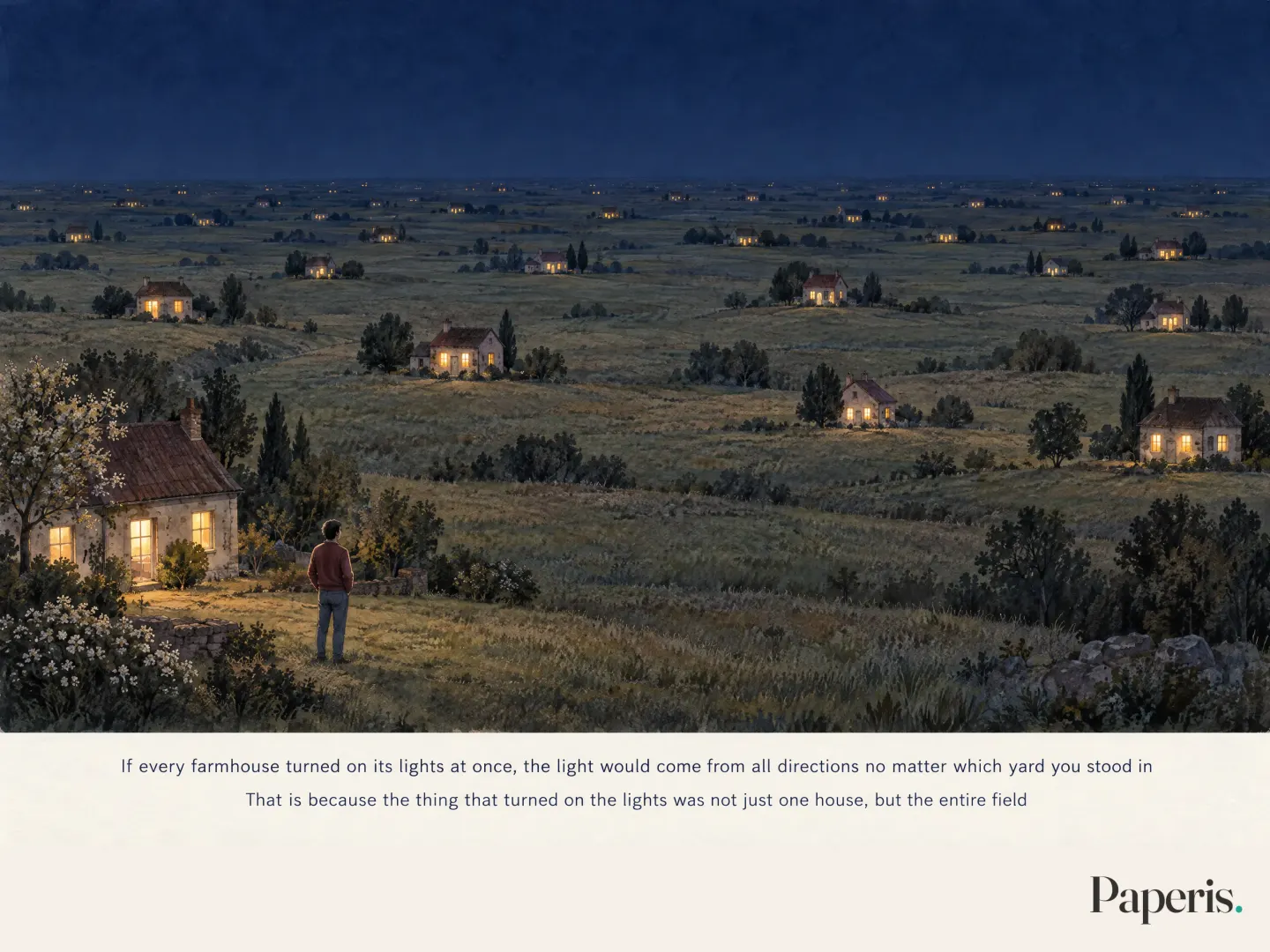
We think of a night in the fields. If every farmhouse turned on its lights at once, the light would come from all directions no matter which yard you stood in. That is because the thing that turned on the lights was not just one house, but the entire field. The universe is the same way. The hot beginning was everywhere in the universe, so the light left over from back then also comes from everywhere. Just as the light comes similarly from all sides if you stand in the middle of a field, this light also comes from every direction in the sky at almost the exact same temperature (OpenStax Astronomy 2e 29.4). However, while the farmhouse lights are lamps turned on house by house, this light is the light given off by all the hot matter that evenly filled the universe long before galaxies formed (OpenStax Astronomy 2e 29.4).
That light was freed when the universe was roughly hundreds of thousands of years old. Before atoms formed, light could not go far, and the light that was first freed when atoms formed has been traveling to us ever since. While it has been traveling, the universe has grown a thousand times larger, so the wavelength of the light has also stretched a thousand times, and that is why it now arrives as invisible, cold microwaves (OpenStax Astronomy 2e 29.4). The cosmic microwave background is the faint microwave radiation coming evenly from all over the sky today, created when light freed when the universe first became transparent was stretched by expansion. The light of the field comes as its initial color, but this light was stretched and cooled along its journey.
That coldness is written in numbers. Absolute temperature is measured with absolute zero set at 0, and its unit is the kelvin (K). The temperature of this light is 2.73K, less than 3 degrees away from the bottom where it cannot drop any further (OpenStax Astronomy 2e 29.4). Early measurements by the COBE satellite launched in 1989 confirmed that the intensity of this light across different wavelengths matches precisely the shape of light emitted by an ideal object at 2.735K (DOI: 10.1093/oso/9780192864062.003.0009). The fact that it is light matching a single temperature so precisely is evidence that the present universe grew out of a hot, uniform state (OpenStax Astronomy 2e 29.4).
It is not perfectly uniform. Depending on the direction of the sky, the temperature differs by about 1 part in 100,000, and those tiny patches are the seeds from which today's galaxies and galaxy clusters grew (OpenStax Astronomy 2e 29.4).
Three different pieces of evidence—moving away galaxies, light elements left by the first few minutes, and background radiation across the entire sky—all point to the same hot, dense beginning. The current standard model, the simplest model explaining the observations, accounts for the appearance of the background radiation, the amounts of deuterium, helium, and lithium, and the acceleration of expansion all together. This model assumes that general relativity, the theory of gravity, holds true everywhere in the universe (OpenStax Astronomy 2e 29.5).
The Invisible
There are three ways to weigh a cluster of galaxies. They are the speed at which galaxies inside the cluster move, the degree to which light from background galaxies is bent by the cluster's gravity, and X-rays emitted by hot gas within the cluster. All three different methods consistently point to an invisible mass roughly 10 times greater than the visible matter (OpenStax Astronomy 2e 28.4).
The same thing can be seen in our galaxy. Just like the Sun we looked at earlier, groups of stars on the outer edges of the galaxy orbit the center, and among them, some are orbiting faster than the Sun while the gas on the outside does not slow down either. The gravity of visible matter alone cannot hold that speed in place, so invisible mass must be spread out far beyond the Sun's orbit. The same thing is seen in other galaxies (OpenStax Astronomy 2e 25.3).
Dark matter is matter that does not emit light and is thus invisible, revealing itself only through how its gravity alters the movement of surrounding stars, gas, and light. Everything we know about dark matter has been obtained by measuring the gravitational effects it produces in objects the size of galaxies or larger (DOI: 10.23943/princeton/9780691148342.003.0003).
We do not know what it is. We can calculate how much ordinary matter making up atoms exists based on the leftover amount of deuterium created in the first few minutes (OpenStax Astronomy 2e 29.3), but that amount falls short of filling the dark matter (OpenStax Astronomy 2e 29.5). There are candidates called new particles that have not yet been discovered on Earth, and multiple experiments are running to find them, but no experiment has definitively caught such a particle so far (OpenStax Astronomy 2e 29.5). A peer-reviewed preprint published in 2026 also describes the same situation (DOI: 10.2139/ssrn.7254238). Although evidence that dark matter exists has piled up in various ways, we still do not know what it is made of.
Another surprise came from the rate of expansion. Astronomers expected the expansion to slow down gradually due to gravity between galaxies (OpenStax Astronomy 2e 26.5). Type Ia supernovae, one branch of exploding stars, have an intrinsic brightness that is nearly constant, making them useful for measuring distant distances. In 1998, two research teams looked at Type Ia supernovae in distant galaxies and reached the conclusion that the expansion has actually been speeding up (OpenStax Astronomy 2e 29.1). A 2012 conference presentation summarizing this discovery stated that, as the simplest explanation, a form of energy not yet detected accounts for more than 70 percent of the universe (DOI: 10.1017/s174392131400461x). As the supernova sample grew more than ten times larger than at first and other observations supported it together, this discovery became more solid, and a 2020 study re-examining two analyses that raised objections concluded that the evidence for acceleration is firm (DOI: 10.3847/1538-4357/ab7a16).
Dark energy is the name given to something that makes the universe's expansion faster and faster. Though we have given it a name, nobody knows where the energy speeding up the expansion comes from. One candidate is the energy inherent to empty space itself, and the value calculated for this using quantum mechanics differs from the value needed to explain observations by at least 120 digits (OpenStax Astronomy 2e 29.1). Interpretations suggesting that dark energy changes over time have also emerged, but the strength of that evidence varies greatly depending on which supernova datasets are used together. One analysis reports that the difference may stem from measurement errors in the supernova data, and some lean toward dismissing this possibility (DOI: 10.1093/mnras/staf301).
According to current calculations, among the things that make up the universe, the ordinary matter we know is about 5 percent, dark matter is about 27 percent, and dark energy is about 68 percent. What is contained inside stars is about 0.5 percent of the entire universe, which is about one-tenth of even the ordinary matter (OpenStax Astronomy 2e 29.5). Add up everything that shines in the night sky, and it is still a very tiny fraction of the universe.
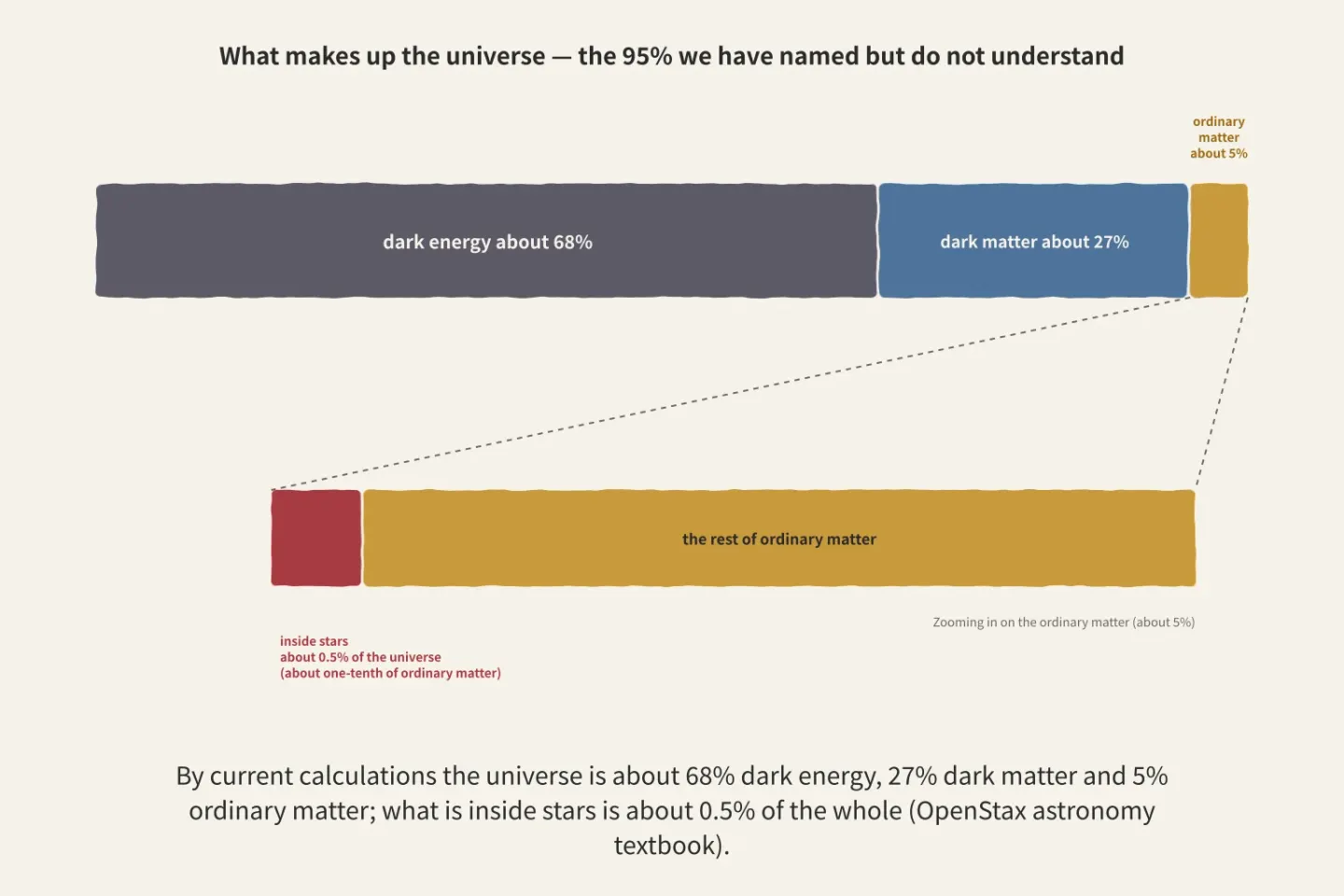
Figure: a diagram Paperis drew using only what the article says
There is also an unresolved problem in the rate of expansion itself. The Hubble tension is a problem where the expansion rate of the universe measured directly in the nearby universe does not match the value calculated from traces of the early universe. The value obtained by measuring the distances to nearby galaxies using stars and supernovae is around 73, and the value calculated based on the cosmic microwave background according to the standard model is 67 to 68 (both use the same unit). The two values began to diverge around 2009, and the margins of error for both sides are small enough not to exceed 2 percent (DOI: 10.1093/oso/9780192864062.003.0011). A peer-reviewed preprint published in 2026 summarizes that while various explanations have emerged ranging from hidden problems in measurement methods to new physics, none have achieved consensus or replaced the standard model (DOI: 10.2139/ssrn.7207418).
What is under dispute is the precise rate of expansion and the identities of the two invisible ingredients. That the universe is expanding and that there was a hot, dense beginning are conclusions taken as premises by both sides of this dispute, and all observations to date support this model (OpenStax Astronomy 2e 29.5). 95 percent of the universe is something whose name we have given but whose identity we do not know, and that ignorance does not detract from the evidence for expansion and the Big Bang.
Where to Look Further
- "Light and Telescopes — A Letter That Arrives Late, a Fingerprint in the Envelope": Light-years, why distant starlight is light from the past, and redshift caused by the movement of nearby celestial bodies.
- "The Life of Stars — A Star's Arms Holding Up Its Own Weight, the Floor It Falls To": How stars create elements heavier than helium, and supernovae.
- "Force and Motion — A Swinging Strap, a Body That Keeps Going": The principles of gravity and motion that bind galaxies and determine the orbits of stars.
- "Elements and Molecules — 118 Pieces of Type, Tens of Millions of Words": What elements like hydrogen, helium, and lithium left behind in the first few minutes are.
- "Atoms and Radiation — A Drizzle That Never Stops, a Rain Gauge for How Wet We Get": Atomic nuclei and neutrons, and isotopes such as deuterium.
- "Heat and Temperature — Water That Only Flows Downhill, a Pump That Lifts It Back Up": Absolute temperature, which records the temperature of background radiation, and absolute zero.
Source Papers
- "Astronomy 2e — 1.4 Numbers in Astronomy" (2022) — OpenStax Astronomy 2e 1.4 — A light-year is the distance light travels in one year, light always has the same speed, and the closest star is 4.25 light-years away.
- "Astronomy 2e — 1.6 A Tour of the Universe" (2022) — OpenStax Astronomy 2e 1.6 — Galaxies are clusters of hundreds of billions of stars (the basis for the definition of a galaxy).
- "Astronomy 2e — 25.1 The Architecture of the Galaxy" (2022) — OpenStax Astronomy 2e 25.1 — Our galaxy has 200 billion to 400 billion stars, is a thin disk about 100,000 light-years across and about 2,000 light-years thick, stars are concentrated in a flat structure wrapping around the sky, and figuring out its overall shape inside a dusty disk took decades.
- "Astronomy 2e — 25.3 The Mass of the Galaxy" (2022) — OpenStax Astronomy 2e 25.3 — The Sun is about 26,000 light-years from the center, moving at about 200 km per second to make one revolution in about 225 million years; some star clusters in the outer parts orbit faster than the Sun and the gas does not slow down, so unseen mass is widely distributed, and the same is true for other galaxies.
- "Astronomy 2e — 26.1 The Discovery of Galaxies" (2022) — OpenStax Astronomy 2e 26.1 — In 1924 Hubble found variable stars in Andromeda and measured their distance to show it is a separate galaxy, with its current distance at about 2.5 million light-years.
- "Astronomy 2e — 26.2 Types of Galaxies" (2022) — OpenStax Astronomy 2e 26.2 — Large galaxies are often spiral or elliptical, while small ones are often irregular; new stars form in the arms of spiral galaxies.
- "Astronomy 2e — 26.4 The Extragalactic Distance Scale" (2022) — OpenStax Astronomy 2e 26.4 — Distances are measured using celestial bodies whose true brightness is known, and recent methods agree within about 10%.
- "Astronomy 2e — 26.5 The Expanding Universe" (2022) — OpenStax Astronomy 2e 26.5 — Slipher's (observed from 1912, first published in 1914) redshift of spiral nebulae, Hubble-Humason's (1931) distance-velocity proportionality, Lemaitre's prior proposal and proposal of the Hubble-Lemaitre law name, uniform expansion looks the same to any observer, the universe has no edge or center, galaxies and galaxy clusters bound by gravity do not stretch and approaching galaxies are neighbors in the same group, and expansion is expected to decelerate.
- "Astronomy 2e — 28.1 Observations of Distant Galaxies" (2022) — OpenStax Astronomy 2e 28.1 — Galaxies seen by light that left more than 13 billion years ago, more than 2 trillion galaxies in the observable universe, and only a few galaxies like Andromeda are visible to the naked eye.
- "Astronomy 2e — 28.3 The Distribution of Galaxies in Space" (2022) — OpenStax Astronomy 2e 28.3 — The Local Group to which our galaxy belongs (about 60), large galaxy clusters have thousands to tens of thousands of galaxies, and the Virgo Cluster is about 50 million light-years away.
- "Astronomy 2e — 28.4 The Challenge of Dark Matter" (2022) — OpenStax Astronomy 2e 28.4 — Galaxy speeds, gravitational lensing, and X-ray gas all show that galaxy clusters contain more than 10 times more dark matter than visible matter.
- "Astronomy 2e — 29.1 The Age of the Universe" (2022) — OpenStax Astronomy 2e 29.1 — The age of the universe is about 13.8 billion years (with an uncertainty of about 100 million years), the universe cannot be younger than the oldest celestial bodies, and the oldest stars formed about 12 billion to 13 billion years ago; accelerated expansion was discovered in 1998 using type Ia supernovae, the energy source is unknown, and the theoretical value of vacuum energy differs by at least a factor of 10^120.
- "Astronomy 2e — 29.2 A Model of the Universe" (2022) — OpenStax Astronomy 2e 29.2 — Expansion is the stretching of space itself, starting everywhere at once so there is no site of the Big Bang, and redshift is the wavelength of light stretched as it travels through stretching space.
- "Astronomy 2e — 29.3 The Beginning of the Universe" (2022) — OpenStax Astronomy 2e 29.3 — The denser it is, the hotter and the more it expands and cools; at the very first fraction of a second there is no theory and the concept of time breaks down; hydrogen, helium, and a little lithium in the first few minutes; helium in the first four minutes is 10 times that of subsequent stars; deuterium reveals the density of ordinary matter.
- "Astronomy 2e — 29.4 The Cosmic Microwave Background" (2022) — OpenStax Astronomy 2e 29.4 — The Big Bang should not be thought of as an explosion at a single point in space; Penzias and Wilson's noise in all directions; a fireball is everywhere, so the residual light is everywhere too; atoms formed hundreds of thousands of years later and it became transparent, light stretched a thousandfold into microwaves, at 2.73K; a single-temperature blackbody spectrum = evidence of a hot and uniform state; temperature differences of one part in 100,000 are the seeds of structure.
- "Astronomy 2e — 29.5 What Is the Universe Really Made Of?" (2022) — OpenStax Astronomy 2e 29.5 — Ordinary matter is about 5%, dark matter is about 27%, and dark energy is about 68%, with stellar interiors at 0.5% of the critical density; judging by deuterium, ordinary matter does not exceed 5% so it cannot be dark matter, and candidate particle detection experiments have yet to yield results; the simplest model assuming general relativity explains the background radiation, light elements, and acceleration, and observations to date support the model.
- "Dark Energy and the Accelerating Universe" (2025) — DOI: 10.1093/oso/9780192864062.003.0009 — Initial COBE results confirm that background radiation follows the 2.735K blackbody radiation law.
- "The Hubble Tension" (2025) — DOI: 10.1093/oso/9780192864062.003.0011 — Around 2009, early-universe-based predictions (67-68) and late-universe measurements (about 73) diverged with similar uncertainties.
- "Evidence for Dark Matter from Astronomy" (2022) — DOI: 10.23943/princeton/9780691148342.003.0003 — What we know about dark matter comes from measuring its gravitational effects on celestial bodies of galaxy scale and larger.
- "Dark Matter : Current Evidence and Future Detection Methods" (2026) — DOI: 10.2139/ssrn.7254238 — (Preprint not peer-reviewed) Rotation curves, gravitational lensing, background radiation, and large-scale structure point to dark matter, but definitive evidence of dark matter particles is still lacking.
- "Supernovae, the Accelerating Cosmos, and Dark Energy" (2012) — DOI: 10.1017/s174392131400461x — Discovery of accelerated expansion in 1998 using type Ia supernovae, with the simplest explanation being undetected dark energy making up over 70% of the universe.
- "Is the Expansion of the Universe Accelerating? All Signs Still Point to Yes" (2020) — DOI: 10.3847/1538-4357/ab7a16 — With samples now more than ten times larger, the discovery of acceleration is more robust, and errors in analyses that argued against it are pointed out.
- "Evolving dark energy or supernovae systematics?" (2025) — DOI: 10.1093/mnras/staf301 — The strength of evidence for time-varying dark energy depends heavily on the supernova sample used together.
- "The Modern Crisis in Cosmology: A Critical Review of the Hubble Tension and its Proposed Solutions" (2026) — DOI: 10.2139/ssrn.7207418 — (Preprint not peer-reviewed) Neither measurement nor theoretical solutions for the Hubble tension have yet achieved consensus.
Sources (24)
- Astronomy 2e — 1.4 Numbers in Astronomy
- Astronomy 2e — 1.6 A Tour of the Universe
- Astronomy 2e — 25.1 The Architecture of the Galaxy
- Astronomy 2e — 25.3 The Mass of the Galaxy
- Astronomy 2e — 26.1 The Discovery of Galaxies
- Astronomy 2e — 26.2 Types of Galaxies
- Astronomy 2e — 26.4 The Extragalactic Distance Scale
- Astronomy 2e — 26.5 The Expanding Universe
- Astronomy 2e — 28.1 Observations of Distant Galaxies
- Astronomy 2e — 28.3 The Distribution of Galaxies in Space
- Astronomy 2e — 28.4 The Challenge of Dark Matter
- Astronomy 2e — 29.1 The Age of the Universe
- Astronomy 2e — 29.2 A Model of the Universe
- Astronomy 2e — 29.3 The Beginning of the Universe
- Astronomy 2e — 29.4 The Cosmic Microwave Background
- Astronomy 2e — 29.5 What Is the Universe Really Made Of?
- Dark Energy and the Accelerating UniverseDOI 10.1093/oso/9780192864062.003.0009
- The Hubble TensionDOI 10.1093/oso/9780192864062.003.0011
- Evidence for Dark Matter from AstronomyDOI 10.23943/princeton/9780691148342.003.0003
- Dark Matter : Current Evidence and Future Detection MethodsDOI 10.2139/ssrn.7254238
- Supernovae, the Accelerating Cosmos, and Dark EnergyDOI 10.1017/s174392131400461x
- Is the Expansion of the Universe Accelerating? All Signs Still Point to YesDOI 10.3847/1538-4357/ab7a16
- Evolving dark energy or supernovae systematics?DOI 10.1093/mnras/staf301
- The Modern Crisis in Cosmology: A Critical Review of the Hubble Tension and its Proposed SolutionsDOI 10.2139/ssrn.7207418