Paperis Articles
The Oegyujanggak Uigwe — Shelved in Seoul, Registered in Paris
During the French campaign of 1866, French troops took some 340 books, including the uigwe royal protocols, from the Oegyujanggak library on Ganghwa Island, and 297 of them remained at the Bibliothèque nationale de France. Park Byeong-seon identified them in a Versailles annex in 1975. After one volume in 1993, a 2009 Paris administrative court's dismissal of a claim and a 2010 summit agreement, all 297 came to Seoul in 2011 on a loan renewable every five years. The French government calls the arrangement a long-term loan, BnF staff called it a de facto restitution contrary to law, the Korean government described it as a de facto return in the form of a loan, and a Korean encyclopedia calls it an unfinished recovery.
Your field's papers, as audio
Pick your fields and journals — Paperis summarizes the key papers and turns them into audio. Listen on your commute.
Start Paperis free →The Oegyujanggak Uigwe — Shelved in Seoul, Registered in Paris
Autumn 1866, Ganghwado
The Byeongin Disturbance (Byeongyangyo) was an event in the autumn of 1866, the year of Byeongin, when a French fleet entered Joseon waters twice, occupied Ganghwado, and then withdrew; "Yangyo" means a disturbance caused by Western powers. On October 16 of that year, troops that disembarked from French warships occupied Ganghwabu on the island of Ganghwado at the mouth of the Han River (Encyclopedia of Korean Culture "Byeongin Disturbance"). At that time, Joseon was ruled by Heungseon Daewongun, the king's father, on behalf of the young King Gojong. Early that year, the Daewongun regime issued an order banning Catholicism, and nine out of twelve French missionaries who had entered secretly were captured and executed (Encyclopedia of Korean Culture "Byeongin Disturbance") (DOI: 10.1353/ks.1999.0011). Several thousand Joseon believers also died (Encyclopedia of Korean Culture "Byeongin Disturbance"). Among the three who survived, Father Félix-Clair Ridel, a French missionary, slipped away to China, informed Rear Admiral Pierre-Gustave Roze, commander of the French fleet in Chinese waters, of this matter, and urged a retaliatory expedition (Encyclopedia of Korean Culture "Byeongin Disturbance").
This article traces the journey of the Joseon royal books that crossed from Ganghwado to France during that incident until they arrived in Seoul in 2011, examining the documents of both Korea and France side by side. It was published to coincide with this autumn, which marks the 160th anniversary of the Byeongin Disturbance.
A book has two places. One is the shelf where the book sits, and the other is the ledger where the book is recorded as belonging to someone. The books this article will follow are currently on a shelf in Seoul and listed in a ledger in Paris.
Whose Expedition Was It?
The expedition was decided locally in China. The Encyclopedia of Korean Culture records that the military punitive expedition was decided by the local commander Roze, stationed there, without direct intervention from the French government (Encyclopedia of Korean Culture "Byeonginyangyo" (Western Disturbance of 1866)). A 1999 American academic journal article summarizes that this decision has often been read as a hasty response by the French diplomat in Beijing, Chargé d'Affaires Bellonet. That paper argues that this decision is better understood not merely as an internal Korean affair, but within the broader context of France's Far Eastern, and particularly Chinese, policy. This attack, aimed at retaliation and concessions, ended in miserable failure, which the paper evaluates as having cut off French missionary activities in Korea for 10 years (DOI: 10.1353/ks.1999.0011).
There were two expeditions. First, from September 18 to October 1, Roze sailed up the river to Yanghwajin and Seogang in Seoul with 3 warships, measured the waterways, made 3 maps, and returned. The second expedition departed on October 11. The encyclopedia records it as 7 warships and 1,000 troops (Encyclopedia of Korean Culture "Byeonginyangyo" (Western Disturbance of 1866)), while some materials put it at 800 troops (Wikipedia "French expedition to Korea"). Regarding the purpose of the expedition, researchers are divided between those who view it as retaliation for the killing of missionaries and those who see it as aiming for trade and diplomatic relations (KCI ART002286876).
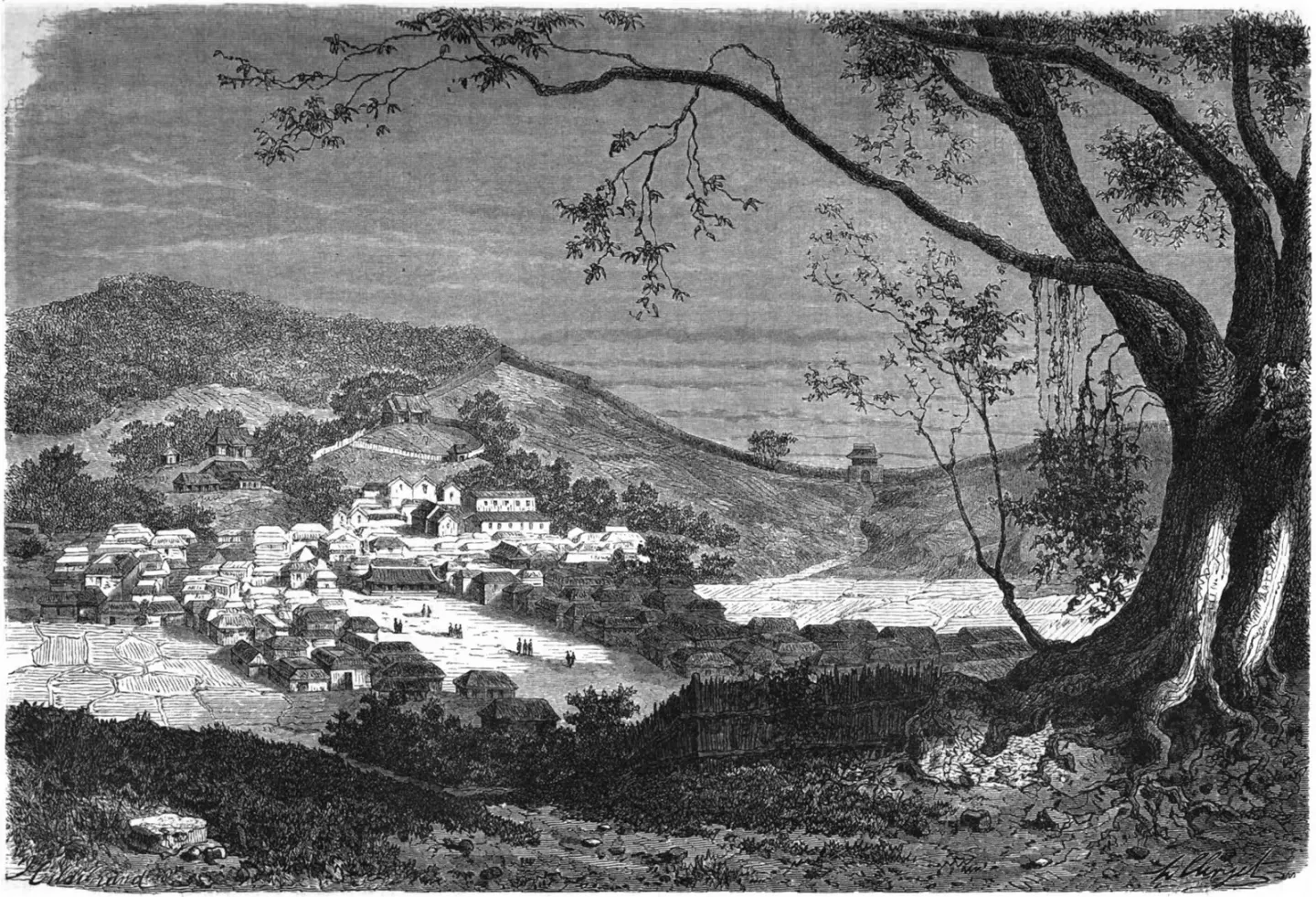
Figure: "Vue de Kang-hoa" (View of Ganghwa) — engraving after a drawing by Henri Zuber, a French naval officer on the 1866 expedition · Le Tour du monde, 1873 · Public domain, via Wikimedia Commons
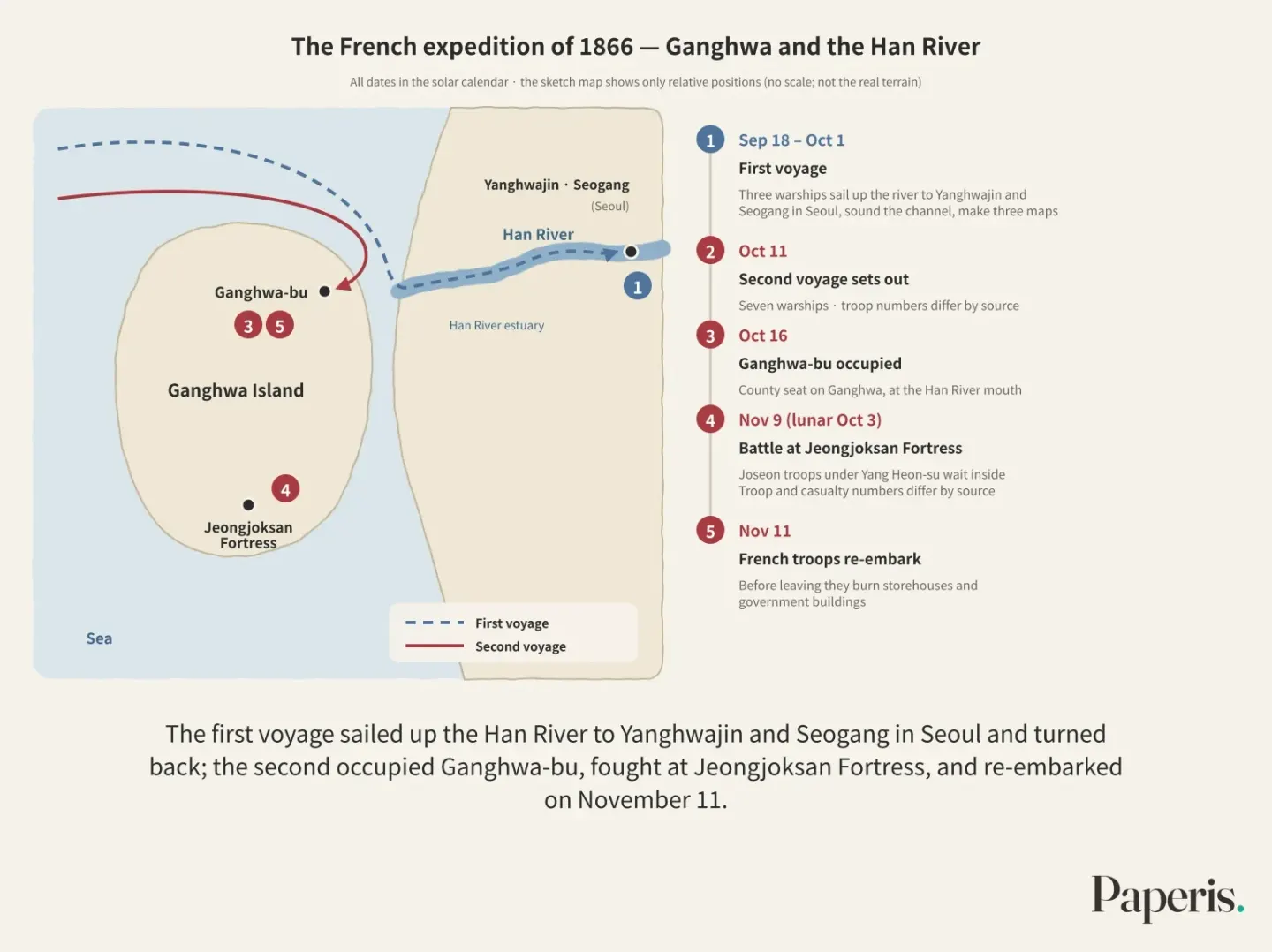
Figure: a diagram Paperis drew using only what the article says
Mount Jeongjok Fortress, and the Burned Government Office
The day the battle broke out at Mount Jeongjok Fortress in Ganghwado was November 9, 1866, which fell on the third day of the tenth lunar month. Troops led by the Joseon commander Yang Heon-su had entered the fortress, and when the French forces split up to enter the East Gate and South Gate, the Joseon soldiers hidden on both sides opened fire simultaneously. Yang Heon-su's report that day notes, "They had 6 dead and our army had 1 dead" (Veritable Records of the Joseon Dynasty, 3rd year of King Gojong, Oct. 3).
The number of deaths varies depending on who counted. The next day's report adds accounts told by villagers to raise the French death toll to around 50 (Veritable Records of the Joseon Dynasty, 3rd year of King Gojong, Oct. 5). The encyclopedia records French casualties as 60 to 70 including 6 killed in action, and Joseon losses as 1 killed and 4 wounded (Encyclopedia of Korean Culture "Byeonginyangyo"). English Wikipedia cites an article published in the 1883 French military magazine Le Spectateur militaire to list the French casualties for the entire expedition as 3 killed and about 35 wounded, and Korean Wikipedia translates this as a French military record (Wikipedia "French expedition to Korea"). This article was unable to verify that original piece. Troop numbers also differ greatly: the encyclopedia records 160 French soldiers and 549 Joseon soldiers, while the French military history writing records 300 French soldiers and 3,000 Joseon soldiers (Vernet, Revue historique des armées 2003).
The French forces boarded their ships in the early hours of November 11, having burned down warehouses and government offices beforehand (Vernet 2003). Ganghwa's damage report immediately after the withdrawal notes that royal halls such as Jangnyeongjeon and Mannyeongjeon, the guesthouse for hosting visitors, and government office buildings were all reduced to ashes, and more than half of the private houses burned as well. However, this article does not mention the name of the royal archive that we will see later (Veritable Records of the Joseon Dynasty, 3rd year of King Gojong, Oct. 6).
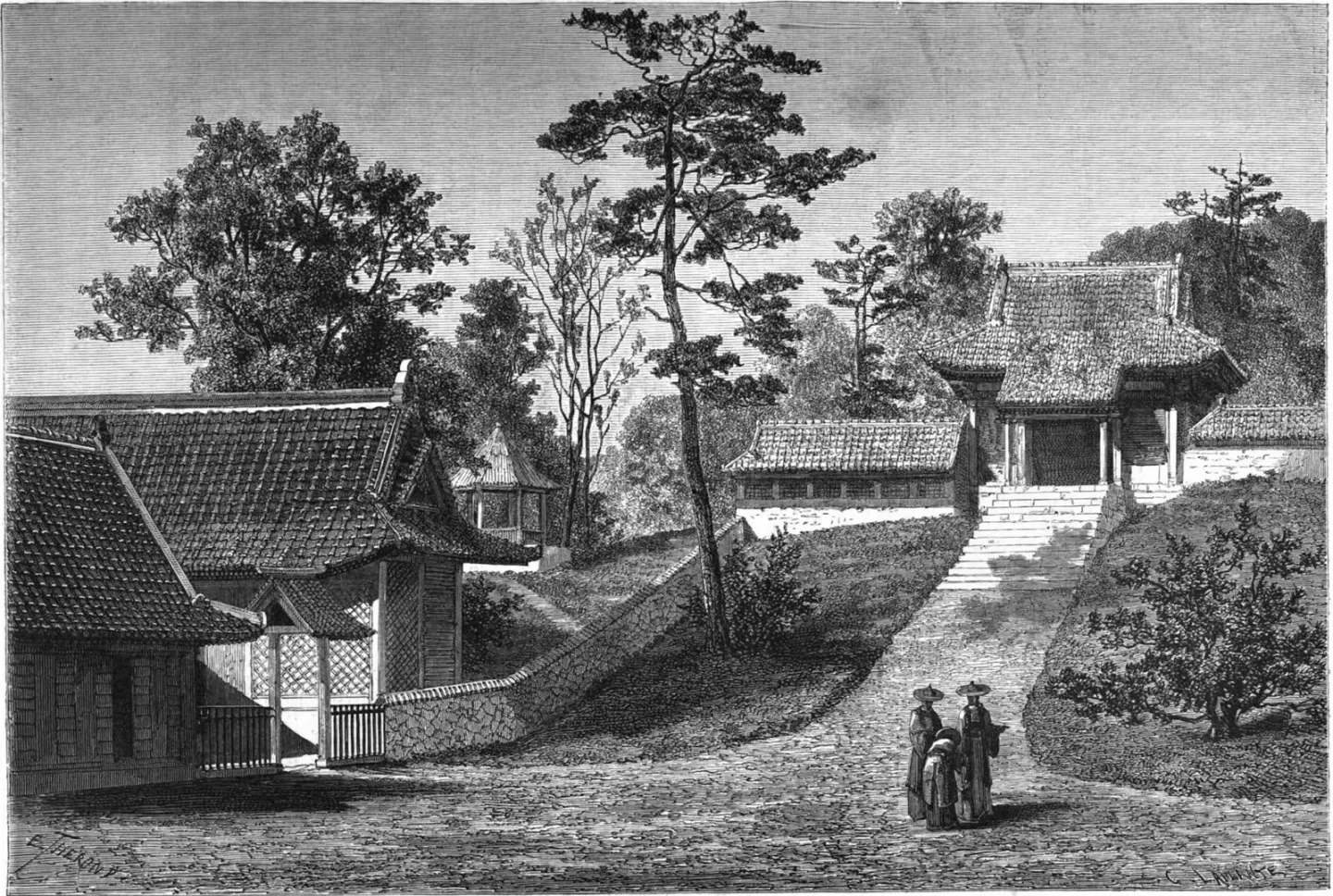
Figure: "Yamoun du gouverneur à Kang-hoa" (The governor's office at Ganghwa) — engraving after a drawing by Henri Zuber, a French naval officer on the 1866 expedition · Le Tour du monde, 1873 · Not confirmed to show the royal library building · Public domain, via Wikimedia Commons
Diplomats including Bellonet, the charge d'affaires in Beijing, viewed the expedition as a failure, but the French government officially considered it a success (Encyclopedia of Korean Culture "Byeonginyangyo"). A 2025 study views that the initial goal to strike Seoul ended up as a localized plunder of Ganghwado due to unrest in Cochinchina and unexpected navigational difficulties on the west coast, and that the Joseon army deployed troops sequentially to key points and pursued a strategy of holding out for a long time (KCI ART003192693). A 2017 paper reviewing the history of research on the 150th anniversary notes that Admiral Roze's withdrawal should not be mistaken for a rout (KCI ART002286876).
Joseon-side records left that the enemy was defeated at Mount Jeongjok Fortress, the French government considered the expedition a success, and the records from both sides differ even on the numbers of casualties and troops.
Books in Ganghwa
The Oegyujanggak was a branch of the Gyujanggak established on Ganghwa Island by King Jeongjo in 1782 to store royal family-related books (Encyclopedia of Korean Culture "Oegyujanggak Uigwe"). The Gyujanggak was a royal library inside the palace, and the Oegyujanggak was its branch located on an island outside Seoul.
Uigwe is an abbreviation for "models for ceremonies," meaning a report-style book that recorded events held by the royal family and the state from preparation to completion in text and illustrations (Encyclopedia of Korean Culture "Oegyujanggak Uigwe"). It noted the course of events, costs incurred, people involved, ceremonial procedures, and rewards given afterward. Among the books that were in the Oegyujanggak, it is this Uigwe that this article will follow. Uigwe were produced from 1395 to 1928, and those remaining today date from after 1601 (KCI ART002191118). Uigwe from the early Joseon dynasty were all lost during the Japanese Invasions of Korea (Imjin War).
There were two types of illustrations. One depicts the items used in the event with accompanying descriptions. The other, banchado, is a long procession painting that depicts the people who set out for the event in the order of the procession. Who stood in which position on the day of the event remains through these paintings.
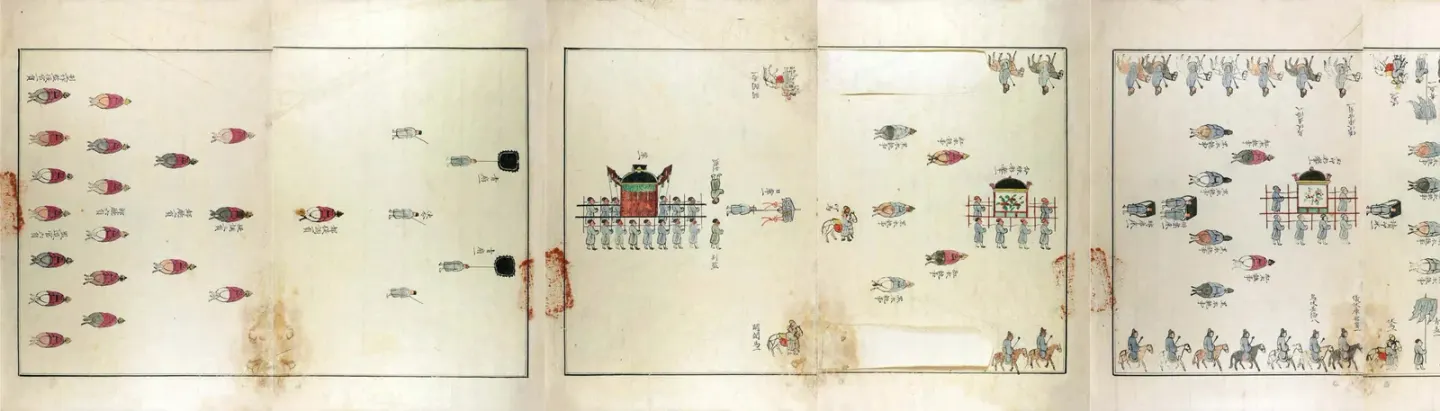
Figure: An example of a banchado in a uigwe — opening section of the procession painting in the 1721 uigwe for the investiture of the future King Yeongjo as royal heir · A Kyujanggak copy held by Seoul National University's Kyujanggak Institute, not one of the Oegyujanggak uigwe that came back from France · Image joined from several pages · Public domain, via Wikimedia Commons
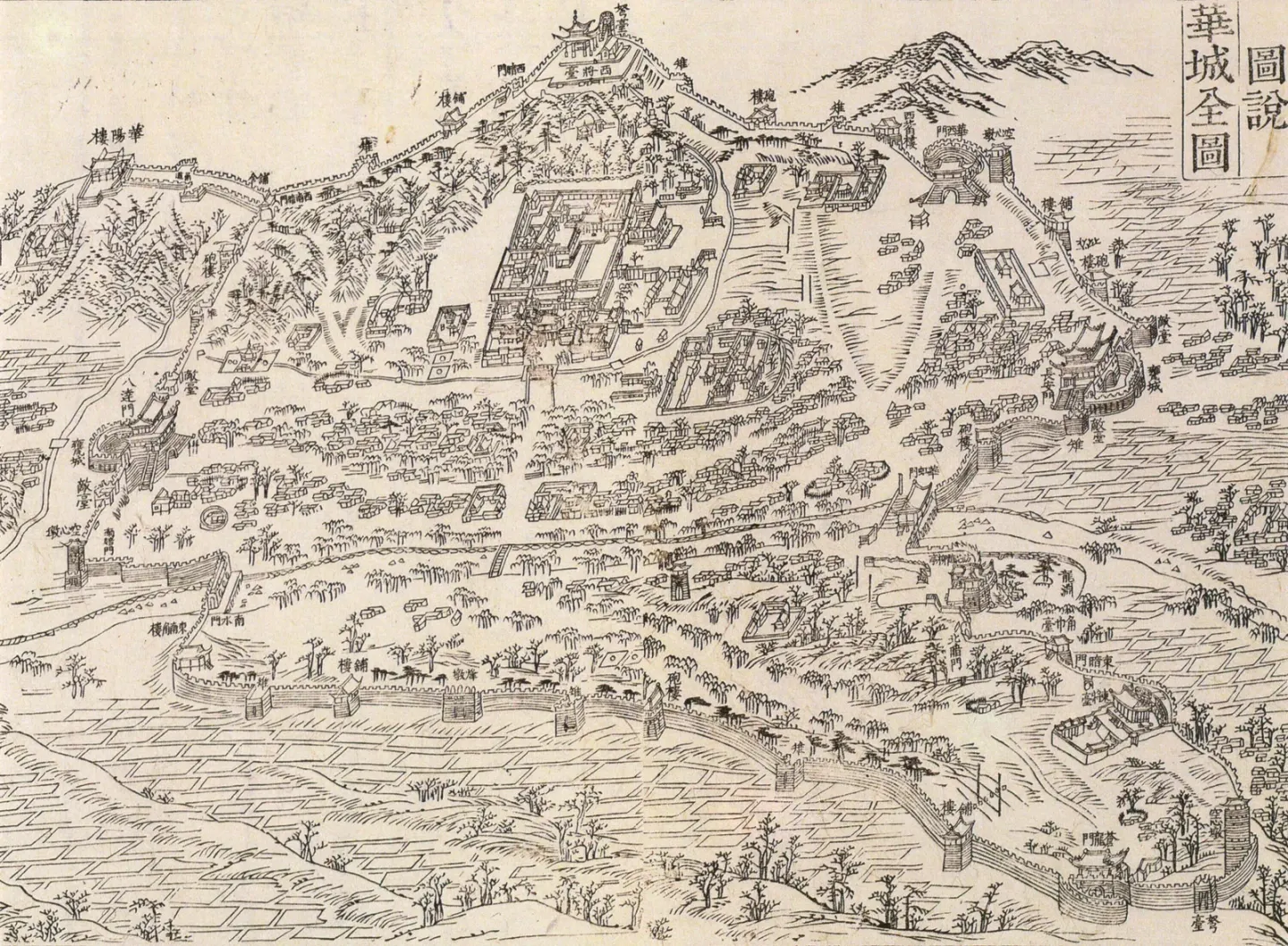
Figure: "Complete Map of Hwaseong" from the Hwaseong Seongyeok Uigwe — an example of a uigwe illustration labelled and explained · A printed edition issued in 1801, different in kind from the handwritten copies made for the king that were kept at Oegyujanggak · Public domain, via Wikimedia Commons
Multiple copies of Uigwe were made at once. Eram-yong refers to a single copy specially made for the king to read directly. Combined with the Eram-yong copy and duplicate copies to be distributed to government offices and historical archives, 5 to 9 copies were made; the Eram-yong was sent to the Gyujanggak, and the rest were sent to the Uijeongbu (State Council), Chunchugwan (Office of Annals), Yejo (Ministry of Rites), and the Taebaeksan, Jeoksangsan, Odaesan, and Jeongjoksan archives (Encyclopedia of Korean Culture "Oegyujanggak Uigwe"). The practice of making separate Eram-yong Uigwe already existed during the reign of King Gwanghaegun, as confirmed by a 2013 study using records such as the Ganghwabu Oegyujanggak Hyeongjian (KCI ART001807712). Unlike duplicate copies that used red hemp-cloth covers, the Eram-yong Uigwe in the Oegyujanggak were bound with green high-grade silk covers (Munhwa Ilbo 2022).
Most of the Oegyujanggak Uigwe were Eram-yong copies, and books of which no other copies existed elsewhere were mixed among them. A unique copy is a book of which no other copies remain, so only that single volume is passed down. In 2011, the Ministry of Culture, Sports and Tourism announced that out of 297 books, 30 unique copies were not present in South Korea (Ministry of Culture, Sports and Tourism Press Release 2011.5.26), and the "Uigwe" entry in the encyclopedia counts the unique copies as 29 books (Encyclopedia of Korean Culture "Uigwe").
Uigwe were records that preserved royal events in text and illustrations, and those in the Oegyujanggak were mostly single copies for the king to view.
Taken Books, Burned Books
French military history writings record that Commander Ozリ, who found the “Royal Archives” building in the Ganghwa government office district, immediately had a list made to send to France, and that next to it were an armory and 19 boxes of pure silver lumps (Vernet 2003). The original list made by Ozリ has not been verified by this article.
The number of books taken varies slightly depending on the source. A 2011 French Ministry of Foreign Affairs announcement records that 297 Joseon royal handwritten manuscripts were moved to France during the 1866 expedition and entrusted to the Imperial Library of the time, now the National Library of France (BnF) (French Foreign Ministry statement, Feb 7, 2011). A Korean encyclopedia records that roughly 340 books including the Uigwe were taken (Encyclopedia of Korean Culture, “Oegyujanggak Uigwe”), and another entry in the same encyclopedia records 345 volumes (Encyclopedia of Korean Culture, “Byeonginyangyo”). The French-language Wikipedia adds 43 printed volumes to the 297 handwritten manuscripts, and a 2010 Korean newspaper reported that out of 340 items, the whereabouts of 43 items were still unknown (Seoul Shinmun, Nov 13, 2010). Adding 297 and 43 gives 340.
The books taken number roughly 340, and among them, 297 have been confirmed at the BnF.
Some of the remainder scattered along other paths. The Gisajinpyorijinchanuigwe (1809) in the British Library was bought by the British Museum from a dealer in Paris in 1891, and appears to have broken away from the bundle of manuscripts that came to France in 1866–1867 (“International Journal of Korean Art and Archaeology” 2010).
The number of burned books is even more uncertain. The Encyclopedia of Korean Culture records that as the Oegyujanggak pavilion burned down due to the arson of the French army, upwards of 5,000 books vanished together (Encyclopedia of Korean Culture, “Oegyujanggak Uigwe”). The primary basis matching this number against Oegyujanggak's storage list has not been verified by this article. There is also word-of-mouth testimony that French soldiers left behind books with only text and picked only colored Uigwe to take, but this has not been confirmed by primary French-side records (Digital humanities teaching wiki (student course paper, 2019)).
The terms used to call this event also differ. Korean encyclopedias, the press, and government policy briefings mostly write “plunder” (Encyclopedia of Korean Culture, “Oegyujanggak Uigwe”) (Korea.kr policy briefing, Feb 8, 2011), and a 2024 article introducing the National Museum of Korea's dedicated exhibition hall writes “unauthorized removal” (Aju Business Daily, Nov 14, 2024). The French Ministry of Foreign Affairs announcement writes « emportés », which means “took” (French Foreign Ministry statement, Feb 7, 2011). Even within France, museologist Jean-Michel Toblem wrote “the pillaging of the French army in 1866 (pillage)” (Hérodote 2010.11.28). The statement “France views the Uigwe as spoils of war” is a summary of the French position by a Korean civic group representative in a 2008 interview, and that expression has not been confirmed in French government documents (JoongAng Ilbo 2008). This article relays these terms along with the people who used them, and when stating facts, uses “took”.
The "Chinese Books" in the Versailles Annex
The clue that the books were at the BnF lay in the three-volume Bibliography of Korea (1894–1897), published in the late 19th century by the Frenchman Maurice Courant. Courant noted in this work that manuscript copies of the Uigwe had entered the BnF (UNIGE ArThemis case summary).
Park Byeong-seon (1923–2011), a Korean who had been working at the BnF since 1967, identified these Uigwe in 1975 in a BnF annex warehouse in Versailles. The books had been classified as Chinese books (Encyclopedia of Korean Culture, “Park Byeong-seon”). An obituary article recounts that the catalyst was a colleague's remark, "There are many old Chinese-like books in the annex that you've been looking for" (Kyunghyang Shinmun, Nov 23, 2011).
Afterwards, Park left the library. The obituary writes that she was effectively dismissed for revealing the secret, while the encyclopedia states that she submitted her resignation in 1979 (Kyunghyang Shinmun, Nov 23, 2011) (Encyclopedia of Korean Culture, “Park Byeong-seon”). Outside the library, Park wrote descriptive explanations of the Uigwe for 10 years starting in 1980, and with the support of the Academy of Korean Studies, published Uigwe of the Joseon Dynasty in 1985 to organize the bibliographic details for each book (Encyclopedia of Korean Culture, “Park Byeong-seon”) (Encyclopedia of Korean Culture, “Oegyujanggak Uigwe”).
Once the catalog came out, demands for their return followed. In 1991, Seoul National University officially requested their return from France (KCI ART001270280), and in July 1992, the Korean Embassy in France made a formal request (Trafficking Culture “Uigwe”).
It was 1975 in a BnF annex warehouse that the whereabouts of the books became known, and a catalog of what was inside emerged 10 years later.
One Volume from 1993
In September 1993, French President François Mitterrand visited South Korea. Encyclopedias record this visit alongside South Korea's purchase of the French high-speed rail, the TGV. Mitterrand handed the first volume of the upper book of the Uigwe of the Royal Wedding of Crown Prince Hyegyeong to President Kim Young-sam (Encyclopedia of Korean Culture "Oegyujanggak Uigwe") (Jeonbuk Ilbo 2022.11.2). While he brought both upper and lower books, oral tradition holds that only one book was handed over because a BnF librarian who accompanied him refused to hand them over (Digital Humanities Educational Wiki (Class Assignment Document, 2019)). The lower book entered the country in 2011 (Jeonbuk Ilbo 2022.11.2).
The two countries read the legal nature of that single volume differently. The BnF views this book as a "long-term loan," citing as its basis the fact that the temporary export permit has been regularly renewed. The same BnF explanation summarizes the South Korean interpretation as a "return" (The Art Newspaper). This book is listed in the BnF's ledger under the number "Coréen 2495" and appears once more as number 95 in the supplementary list of the 2011 agreement (Korea-France Agreement Full Text).
During the same visit, the two presidents agreed to resolve the issue on the principle of "exchange and loan." Subsequent negotiations stalled over how to realize that principle (KCI ART001039642). The French side's argument was that the books France had held for over a century had already become French cultural assets, and under French law, cultural assets cannot be handed over, so a special law would be needed to release them. The South Korean side's argument was that since the French military took them by force, ownership could not arise simply from holding them for a long time, and they must be returned to their original owner (KCI ART001039642). A 2011 paper summarizes the South Korean argument as the stance that unconditional return is the only justified path (DOI: 10.18206/kapdh.33.1.201108.235).
In 2000, experts from both countries drafted an agreement based on exchange, but it was not ratified (UNIGE ArThemis Case Summary). A critical paper from 2003 views the South Korean delegation's agreement during the negotiations of October 2000 and July 2001—to trade Uigwe strictly for Uigwe—as an agreement that was unfulfillable from the start. This was because the books in France were royal reading copies and many were unique editions, whereas the books to be offered in exchange were not royal reading copies (KCI ART001270280). Opinions were divided within France as well. A 2016 study analyzes that the BnF and the Ministry of Culture insisted on an exchange of equal value and equal quantity, while the Ministry of Foreign Affairs pushed back, prioritizing diplomatic cooperation (DOI: 10.15617/psc.2016.06.19.2.141).
The single volume from 1993 was recorded as a return in South Korea and as a long-term loan at the BnF, and was listed again on the loan list of the 2011 agreement.
The Ruling of the Paris Administrative Court
In 2007, the South Korean civic group Culture Solidarity filed a lawsuit in the Paris Administrative Court. The claim requested that the Minister of Culture's refusal on January 2, 2007, to release the Uigwe from public property be annulled and that the Uigwe be returned. The court dismissed the case on December 18, 2009. The main reasoning of the judgment is as follows. First, the Uigwe belongs to the state's public property as part of the BnF collection, and the basis for this lies in the fact that state organs have held it and made it accessible to the public for 140 years, while the circumstances of how it was acquired do not affect this judgment. Second, the Uigwe constitutes a "national treasure" as defined by the French Heritage Law. Third, although the 19th-century treaties cited by the plaintiff show that the issue was emerging around that time, the submitted documents do not reveal that such international custom was in force as law back in 1866. The court also wrote that the 1954 Hague Convention and the 1970 UNESCO Convention cannot be invoked for property held before those conventions took effect, that the minister had no obligation to release the Uigwe from public property unless there were other legal provisions, and that whether restitution is appropriate is not a matter for a judge to handle in this lawsuit (Paris Administrative Court Judgment n° 0701946).
In the judgment text, the word "pillage" appears only in the section detailing the plaintiff's arguments. The Paris Administrative Court held that the circumstances under which the Uigwe entered the country had no bearing on its judgment, and ruled that the Uigwe is an inalienable state public property (Paris Administrative Court Judgment n° 0701946). In 2010, a South Korean newspaper wrote that "even while the fact of pillage was recognized by the court" (Seoul Shinmun 2010.11.13), and the English-language case compilation Trafficking Culture also contains a sentence stating that the court recognized pillage (Trafficking Culture "Uigwe"), but both do not match the judgment text.
The principle of inalienability is a French legal principle stating that public collections held by the state cannot be sold or transferred to others. The University of Geneva's case compilation views that this principle is not an absolute wall preventing restitution in French law. It notes that exceptions can be made either through administrative procedures to declassify the public property status of a collection after going through an academic committee's opinion, or by creating a separate law (UNIGE ArThemis Case Summary).
Which era's law should be applied to the events of 1866 is also a subject of debate. A 2022 South Korean legal paper writes that the Byeonginyangyo must be examined under the international law of the time the event occurred (DOI: 10.22853/caujls.2022.46.3.165). Opinions diverge again on how to interpret the law of that era. A 2021 working paper, dealing generally with the removal of cultural properties during 19th-century wars, argues that customary international law prohibited wartime looting from the 19th century onward and made restitution the primary remedy (DOI: 10.2139/ssrn.3781004). The University of Geneva's case compilation views that around 1866 there was no international custom prohibiting the looting of an enemy's cultural property and that the general rule was rather to take the defeated party's property, while also noting that documents like the Uigwe appear to be subject to special norms prohibiting confiscation and requiring their return (UNIGE ArThemis Case Summary). The materials gathered in this article cannot determine whether the 1866 removal was legal or illegal under the law of that time.
Seoul in 2010, Paris in 2011
During the Group of 20 (G20) Summit held in Seoul on November 12, 2010, President Lee Myung-bak and French President Nicolas Sarkozy issued a declaration of intent to send the Uigwe to Korea on a loan renewable every five years (French Foreign Ministry statement, Feb 7, 2011). Korean newspaper reports noted that in August of that year, the South Korean government dropped the term "permanent loan" and shifted toward a standard loan format, and that the final sticking points were phrases proposed by Korea such as "renewed automatically" or "termination of the loan shall be by bilateral agreement." The same reports recount that the phrases were ultimately dropped, and the summit concluded with France verbally clarifying that it had no intention of ever taking them back (Seoul Shinmun, Nov 13, 2010).
On February 7, 2011, the two governments signed the agreement in Paris. The French side was signed by the Director for Asia and Oceania at the Ministry of Foreign Affairs, and the South Korean side by the Ambassador to France, and the agreement took effect on the day of signing. The preamble of the agreement stated that these manuscripts are part of the identity of the South Korean people and form the basis of Korea's memory (Korea–France agreement, full text). The core provisions are five.
- Article 1 — France lends all 297 volumes of the Uigwe to Korea, the loan period is 5 years, and it can be renewed.
- Article 3 — Korea assumes the obligation to lend the books for exhibitions in France, such as the 2015–2016 Korea-France Year of Bilateral Exchange.
- Article 4 — This measure is of a one-time nature, cannot be repeated under any other circumstances, and shall never constitute a precedent. It also provides a final answer to any disputes that may have existed between the two countries surrounding demands for the return of cultural property.
- Article 6 — The BnF digitally copies all 297 volumes so that the two countries share the files, and Korea bears all costs.
- Article 10 — The agreement is valid for 5 years and can be renewed for 5-year periods by written notification sent by each contracting party through diplomatic channels.
(Korea–France agreement, full text)
The language used in the agreement text is "a loan renewable on a 5-year basis," and there is no clause for automatic renewal. "Permanent loan" is also not a term in the agreement. The books are housed by the National Museum of Korea in Seoul (Article 2), and BnF curators may freely view the books (Article 5) (Korea–France agreement, full text). The materials collected in this article did not allow us to confirm how the "final answer" in Article 4 affects future demands, such as for the remaining 43 volumes.
The books arrived in four batches. On April 14, 75 volumes; on April 29, 73 volumes; on May 12, 75 volumes; and on May 27, 73 volumes entered the storage facility of the National Museum of Korea (Ministry of Culture press release, May 26, 2011). This totals 296 volumes. This number is obtained by subtracting the one volume that had already arrived in 1993 from the 297 volumes in the agreement. The silk covers that the BnF had detached and stored separately in the 1970s for conservation reasons also arrived together at this time (Korea Herald 2011).
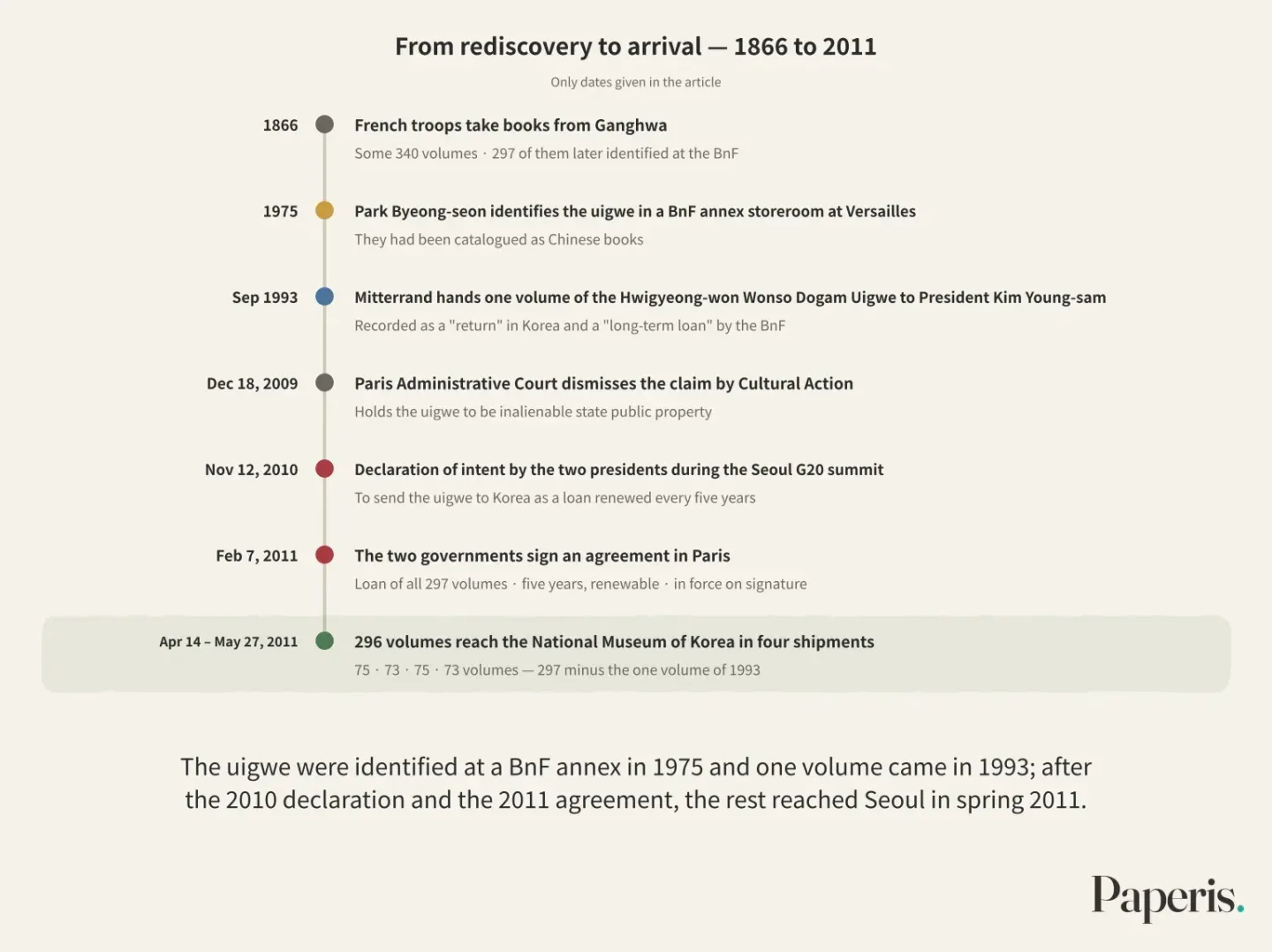
Figure: a diagram Paperis drew using only what the article says
The Same Agreement, Different Names
The French government called this agreement a loan. In an interview with the French daily Le Monde, President Sarkozy stated that this arrangement did not violate the law prohibiting the permanent removal of national collections, saying, "On this point, we will not back down, and the Koreans have agreed to accept a long-term loan," and added that the promise made by Mitterrand in 1993 must now be kept (The Art Newspaper). At the relevant UNESCO committee, the French delegation also stated that this agreement was merely a renewable loan rather than a return, and that ownership remained with the BnF (UNIGE ArThemis Case Summary).
Opposition emerged from within the BnF. On November 18, 2010, about 30 staff members, including Denis Bruckmann, Director of Collections, and Thierry Delcourt, Director of the Manuscript Department, issued a statement. The statement noted that this decision was made against the opinions of the library and the Ministry of Culture, that it was "dressed in the guise of a 5-year renewable loan but is a de facto return that violates the law," and that it risked shaking the principle of the inalienability of public collections (BnF Staff Statement 2010.11.18). They also raised the point that most of the Uigwe have other copies in Korea (BnF Staff Statement 2010.11.18). Art historian Didier Rykner called this decision "completely illegal" (The Art Newspaper).
There were also those in favor within France. Former Minister of Culture Jack Lang reportedly interpreted this matter personally as a long-term deposit, stating that it was unimaginable for the French government not to renew this decision and that "they will be there for a long time, by your side" (UNIGE ArThemis Case Summary). Toblem wrote that the renewable loan at least preserved the principle of inalienability in form (Hérodote 2010.11.28).
The South Korean government used the word "return" while clarifying the format of a loan. On the day the agreement was signed, the spokesperson for the Ministry of Foreign Affairs and Trade explained that it was "a format of a 5-year renewable loan, through which the Oegyujanggak books effectively return to the Korean side" (Policy Briefing 2011.2.8), and Ministry of Culture, Sports and Tourism press releases used the terms "repatriation" and "recovery" (Ministry of Culture, Sports and Tourism Press Release 2011.5.26) (Ministry of Culture, Sports and Tourism Press Release on 3rd Batch Arrival). In May 2011, the Vice Minister of Culture, Sports and Tourism stated in a briefing that "all 296 volumes subject to return have come back to the country" (Seoul Shinmun 2011.5.26). A 2010 Korean newspaper evaluated it as a "win-win" negotiation where Korea gained practical benefits and France gained diplomatic face, describing it as a "effectively permanent loan" that did not need to be returned to France (Seoul Shinmun 2010.11.13). A 2011 diplomatic history paper viewed it as a successful negotiation that broke a 20-year deadlock, assessing that both countries understand this loan can be interpreted as a de facto return (DOI: 10.18206/kapdh.33.1.201108.235). Conversely, the Encyclopedia of Korean Culture writes that it is an "incomplete repatriation" given that they returned via a 5-year renewable loan format, and notes that because there is no ownership, they cannot even be registered as Korean cultural heritage (Encyclopedia of Korean Culture "Oegyujanggak Uigwe"). In an interview in April 2011, Park Byeong-seon expressed worry, saying, "It's a loan, not a return," and asking what would happen if renewal failed in 5 years when administrations change (Seoul Shinmun 2011.4.12).
The French president called the same agreement a "long-term loan," BnF staff members called it a "de facto return that violates the law," the South Korean government called it "a loan format but a de facto return," and a Korean encyclopedia called it an "incomplete repatriation."
A 2011 paper evaluating this agreement from a legal perspective concludes that this compromise satisfies neither side. The BnF holds only legal ownership—in the author's words, "perhaps uselessly"—while being unable to keep books that had been part of its collection for over 140 years by its side, and Korea holds the physical objects but is not recognized as having ownership of its own country's heritage (DOI: 10.1017/s0940739111000245). This article does not judge whether this loan is a de facto return or a failure of return. That the books are lent and their storage is in Seoul are the words of the agreement text, and that ownership remains with the BnF is the interpretation stated by the French delegation. The fact that the bookshelves and the ledgers are in different countries is as far as this article verifies with documents.
The Bookshelf Today
On November 15, 2024, the National Museum of Korea opened a dedicated exhibition hall for the Oegyujanggak Uigwe within its permanent exhibition galleries (Aju Business Daily 2024.11.14). A study from that year suggested that most of the 297 returned volumes are royal reading copies with high research value, yet public interest remains lacking, and proposed a permanent exhibition (KCI ART003072235).
Another chain of events continues in the ledgers. The Joseon Uigwe were designated as Treasures, a type of state-designated cultural heritage, in 2016, covering 1,757 items and 2,751 volumes (KCI ART002191118). Multiple sources record that the Oegyujanggak Uigwe were not designated as a state-designated heritage of Korea because ownership remained with France (Encyclopedia of Korean Culture "Oegyujanggak Uigwe") (Trafficking Culture "Uigwe"). At the time, the Vice Minister of Culture, Sports and Tourism stated in 2011 that designation was possible, but a matter to be reviewed long-term considering diplomatic relations with France (Seoul Shinmun 2011.5.26). This article could not directly verify whether the Oegyujanggak Uigwe were omitted from the original 2016 designation list. The 159 volumes of Uigwe received from the Imperial Household Agency of Japan in the same year of 2011 are housed at the National Palace Museum of Korea (Encyclopedia of Korean Culture "Uigwe").
UNESCO Memory of the World is another area prone to mistakes. The "Uigwe: The Royal Protocols of the Joseon Dynasty," inscribed on the UNESCO Memory of the World register in 2007, consisted of 546 types and 2,940 volumes housed at Kyujanggak, and 287 types and 490 volumes housed at Changgyeonggung's Jangseogak (Memory of the World Nomination Form 2006). The 2007 Memory of the World inscription did not include the Oegyujanggak Uigwe. At that time, those books were in Paris, and the nomination form mentions Oegyujanggak only as a single line in the custodial history through which the Kyujanggak Uigwe passed (Memory of the World Nomination Form 2006).
The clock of the agreement also ticks. The agreement took effect on February 7, 2011, and operates in 5-year increments, making arithmetically 2016, 2021, and this year, February 2026, the renewal points. Official materials found by this article could not confirm whether renewal notices were actually exchanged (Korea-France Agreement Full Text).
France subsequently opened other paths as well. In 2017, French President Emmanuel Macron stated his support for returning African cultural heritage to Africa, and on December 24, 2020, the French parliament passed a law returning 27 items to Benin and Senegal. A 2022 paper covering these events notes that passing the law was not smooth, and opinions remain divided over whether to use case-by-case legislation or general laws for each issue (DOI: 10.4467/2450050xsnr.22.023.17036). The materials gathered by this article contain no instance of such exceptional legislation being applied to the Oegyujanggak Uigwe. Regarding Jikji, housed in the same BnF and cited as the world's oldest extant metal-type printed book, a 2026 paper views it as a more complex case than the Uigwe because there is no evidence it was acquired illegally and the principle of inalienability applies (KCI ART003369268).
The 297 volumes taken from Ganghwa in 1866 now sit on the shelves of the National Museum of Korea in Seoul, are listed in the ledgers of the BnF, and an agreement renewed through written notification every 5 years connects the two.
Where to Look Next
The period from the treaty signed on the same Ganghwa Island 10 years after the French Campaign against Korea up to 1945 continues in "From the Treaty of Ganghwa to Liberation — The Front-Door Key That Passed into Other Hands". Another case where a legal system ultimately stopped short of judging the circumstances of removal and instead wrapped up the dispute with a settlement is found in "Van Gogh's Blossoming Chestnut Trees — One Line from 1936". It looks at how a painting in a private collection handled the question of a forced sale during the Nazi era through the non-binding Washington Principles and a private settlement just before auction.
Case Documents
-
"Encyclopedia of Korean Culture, 'Byeonginyangyo'" (Academy of Korean Studies) — https://encykorea.aks.ac.kr/Article/E0023142 — Standard Korean accounts of the Catholic persecution and missionary executions, the two expeditions, Mount Jeongjok Fortress, and the withdrawal.
-
"Encyclopedia of Korean Culture, 'Oegyujanggak Uigwe'" (Academy of Korean Studies) — https://encykorea.aks.ac.kr/Article/E0071554 — Accounts of the establishment of Oegyujanggak, the meaning and production methods of Uigwe, their removal and destruction, and evaluations as an "incomplete repatriation."
-
"Encyclopedia of Korean Culture, 'Park Byeong-seon'" (Academy of Korean Studies) — https://encykorea.aks.ac.kr/Article/E0071550 — Her identification of the Uigwe in an annex of Versailles and her subsequent cataloging work.
-
"Encyclopedia of Korean Culture, 'Uigwe'" (Academy of Korean Studies) — https://encykorea.aks.ac.kr/Article/E0043136 — The history of Uigwe, current domestic holdings, and designation as treasures.
-
"Verditable Records of the Joseon Dynasty, 3rd year of King Gojong, October 3" (1866, lunar calendar) — https://sillok.history.go.kr/id/kza_10310003_003 — Yang Heon-su's initial report on the battle at Mount Jeongjok Fortress.
-
"Verditable Records of the Joseon Dynasty, 3rd year of King Gojong, October 5" (1866, lunar calendar) — https://sillok.history.go.kr/id/kza_10310005_002 — The following day's report incorporating villagers' accounts.
-
"Verditable Records of the Joseon Dynasty, 3rd year of King Gojong, October 6" (1866, lunar calendar) — https://sillok.history.go.kr/id/kza_10310006_002 — Reports of damage in Ganghwa following the withdrawal.
-
"Vernet, Revue historique des armées" (2003) — https://souvenir-francais-asie.com/2009/04/27/coree-laffaire-de-kwang-hwa-de-1866/ — The expedition's progress from the French perspective, the discovery of archives, cataloging, and withdrawal.
-
"French Ministry of Foreign Affairs Announcement" (2011-02-07) — https://plone.unige.ch/art-adr/cases-affaires/affaire-manuscrits-coreens-2013-france-et-coree-du-sud-1/gouvernement-francais-communique-de-presse-republique-de-coree-signature-d2019un-accord-sur-les-manuscrits-royaux-coreens-de-la-dynastie-joseon-7-fevrier-2011/view — News of the agreement signing and the French government's phrasing regarding the 1866 removal.
-
"Full Text of the Korea-France Uigwe Loan Agreement (Decree 2011-527)" (Signed 2011-02-07) — https://plone.unige.ch/art-adr/cases-affaires/affaire-manuscrits-coreens-2013-france-et-coree-du-sud-1/decret-ndeg2011-527-portant-publication-de-laccord-entre-la-franc-et-la-republique-de-coree-16-mai — Loan duration, storage location, non-precedent clause, digitization, renewal method, and attached inventory.
-
"Paris Administrative Court Ruling n° 0701946" (2009-12-18) — https://plone.unige.ch/art-adr/cases-affaires/affaire-manuscrits-coreens-2013-france-et-coree-du-sud-1/association-action-culturelle-tribunal-administratif-de-paris-2009 — Dismissal of the plaintiff's claims, rulings on public property and national treasures, and assessments of contemporary international custom.
-
"BnF Staff Statement" (2010-11-18) — https://plone.unige.ch/art-adr/cases-affaires/affaire-manuscrits-coreens-2013-france-et-coree-du-sud-1/la-petition-declaration-personnels-bnf-sur-manuscrits-coreens-18-novembre-2010 — Statement by BnF staff opposed to the loan decision.
-
"Wikipedia, 'French expedition to Korea'" — https://en.wikipedia.org/wiki/French_expedition_to_Korea — Total casualties and the troop count of 800 (secondary source, used exclusively for these two figures).
-
"The Art Newspaper Article" (2010) — https://plone.unige.ch/art-adr/cases-affaires/affaire-manuscrits-coreens-2013-france-et-coree-du-sud-1/the-art-newspaper-sarkozy-criticised-for-loaning-french-manuscripts-to-korea-23-decembre-2010 — Sarkozy's remarks, the BnF's account regarding a single volume in 1993, and opposing public opinion.
-
"UNIGE ArThemis Case Summary, 'Manuscrits Uigwe'" (University of Geneva) — https://plone.unige.ch/art-adr/cases-affaires/affaire-manuscrits-coreens-2013-france-et-coree-du-sud-1 — Event chronology, negotiations, potential exceptions to the principle of inalienability, and perspectives on contemporary international law.
-
"UNESCO Memory of the World Nomination Form, 'Uigwe: The Royal Protocols of the Joseon Dynasty'" (2006) — https://plone.unige.ch/art-adr/cases-affaires/affaire-manuscrits-coreens-2013-france-et-coree-du-sud-1/registre-de-la-memoire-du-monde-les-uigwe-protocoles-royaux-de-la-dynastie-joseon-mars-2006/view — Sponsoring institutions and number of books.
-
"Ministry of Culture, Sports and Tourism Press Release" (2011-05-26) — https://www.mcst.go.kr/kor/s_notice/press/pressView.jsp?pSeq=11391 — Four rounds of arrivals and the number of unique copies.
-
"Policy Briefing Video Article" (2011-02-08) — https://www.korea.kr/news/policyNewsView.do?newsId=148705961 — Explanations by the spokesperson for the Ministry of Foreign Affairs and Trade on the day the agreement was signed.
-
"Ministry of Culture, Sports and Tourism Press Release (Arrival of the 3rd Batch)" (2011-05) — https://www.mcst.go.kr/kor/s_notice/press/pressView.jsp?pSeq=11350 — The third arrival and the use of the term "repatriation process."
-
"Seoul Shinmun Article" (2010-11-13) — https://www.seoul.co.kr/news/politics/diplomacy/2010/11/13/20101113800001 — Final negotiation sticking points following the summit agreement and remaining books.
-
"Seoul Shinmun Article" (2011-04-12) — https://www.seoul.co.kr/news/life/2011/04/12/20110412020012 — Interview with Park Byeong-seon.
-
"Seoul Shinmun Article" (2011-05-26) — https://www.seoul.co.kr/news/life/2011/05/26/20110526800020 — Explanation of the return by the Vice Minister of Culture, Sports and Tourism and cultural property designation issues.
-
"Kyunghyang Shinmun Obituary for Park Byeong-seon" (2011-11-23) — https://www.khan.co.kr/article/201111232151425 — The clue in Courant's records, circumstances of the discovery, and departure from the library.
-
"Hérodote Article" (2010-11-28) — https://www.herodote.net/Manuscrits_coreens_diplomatie_et_inalienabilite-article-1218.php — Assessment by a French museologist.
-
"JoongAng Ilbo Article" (2008) — https://www.koreajoongangdaily.com/lifestyle/the-battle-to-retrieve-koreas-old-records/11593456 — A South Korean civic group representative's use of the word "spoils of war."
-
"International Journal of Korean Art and Archaeology, vol. 4" (2010) — http://www.ijkaa.org/v.4/0/174/96 — Acquisition history of the Uigwe held by the British Library.
-
"Digital Humanities Educational Wiki, 'Bitter Return: The Oegyujanggak Uigwe'" (2019) — https://dh.aks.ac.kr/Edu/wiki/index.php/씁쓸한_귀환,_외규장각_의궤 — A document written by students for an Academy of Korean Studies educational wiki (citing Namuwiki and Wikipedia). Used exclusively for the 1993 librarian refusal account and colored Uigwe accounts (secondary level or below).
-
"Jeonbuk Ilbo Article" (2022-11-02) — https://www.jjan.kr/article/20221102580244 — Return of the lower volume of Hwigyeongwon-wonsodogam-uigwe.
-
"Munhwa Ilbo Article" (2022) — https://www.munhwa.com/article/11325061 — Silk covers of the royal reading copies of Uigwe.
-
"Korea Herald Article" (2011) — https://www.koreaherald.com/article/10343908 — Return of separately stored silk covers.
-
"Trafficking Culture, 'Uigwe'" — https://traffickingculture.org/encyclopedia/case-studies/uigwe/ — Timeline including the 1992 embassy request, descriptions of designation status as non-heritage, and the erroneous description that "the court recognized looting."
-
"Aju Business Daily Article" (2024-11-14) — https://www.ajunews.com/view/20241114233535243 — Opening of a dedicated exhibition hall at the National Museum of Korea.
Source Papers
- "Bellonet and Roze: Overzealous Servants of Empire and the 1866 French Attack on Korea" (1999) — DOI: 10.1353/ks.1999.0011 — The attack, aimed at retaliation and concessions, ended in failure and cut off missionary work for 10 years. The decision is better understood within the broader context of France's Far Eastern and Chinese policies.
- "병인양요 연구의 사학사적 검토 : 150주년을 맞이하여" (2017) — KCI ART002286876 — Roze's objective is divided between the theory of punishment and the theory of trade, and the withdrawal must not be mistaken for a rout.
- "프랑스의 병인양요 도발 과정과 조선의 군사적 대응" (2025) — KCI ART003192693 — The expedition fell short of the goal of capturing Seoul and amounted only to a localized seizure of Ganghwado, while Joseon deployed troops sequentially to key points to wage a war of attrition.
- "조선시대사 연구와 의궤" (2016) — KCI ART002191118 — Uigwe were produced from 1395 to 1928, with extant ones dating from 1601 onward. Designated as Treasures in 2016, numbering 1,757 items and 2,751 volumes.
- "외규장각 어람용 의궤의 형태적 특징에 관한 기초적 연구" (2013) — KCI ART001807712 — Confirms through the Oeguyanggak Uigwe and Hyeongjian that Uigwe for royal reading were already compiled during the reign of King Gwanghae.
- "파리 소재 외규장각 도서 반환 협상의 문제점" (2003) — KCI ART001270280 — Negotiations began following Seoul National University's request in 1991. Criticizes the 2000 and 2001 agreements for Uigwe-for-Uigwe exchanges as unexecutable.
- "파리 국립도서관 소장 외규장각 도서반환 협상경과, 쟁점 및 평가" (2007) — KCI ART001039642 — Agreement reached in 1993 on the principle of exchange and loan. France argued against transfer and for the need of special legislation, while Korea argued that they were plundered and thus not subject to acquisition by prescription.
- "프랑스 소재 외규장각 도서반환 협상 과정 및 평가" (2011) — DOI: 10.18206/kapdh.33.1.201108.235 — The 5-year renewable loan is evaluated as a successful negotiation that broke a 20-year deadlock, with the understanding that the two countries could interpret it as a de facto return.
- "프랑스 정부 부처 간 갈등에 있어서 시민단체의 역할: 외규장각 의궤 반환 사례를 중심으로" (2016) — DOI: 10.15617/psc.2016.06.19.2.141 — The BnF and Ministry of Culture pushed for equivalent-value exchanges, whereas the Ministry of Foreign Affairs pushed back, prioritizing diplomatic cooperation.
- "병인양요와 그에 관련된 국제법적 문제" (2022) — DOI: 10.22853/caujls.2022.46.3.165 — The Byeongin Yangyo must be examined under the international law of the time, namely the principle of inter-temporal law.
- "The Right to Restitution of Cultural Property Removed as Spoils of War during the Nineteenth-Century International Warfare" (2021, working paper) — DOI: 10.2139/ssrn.3781004 — Argues that customary international law prohibited wartime looting and made restitution the primary remedy starting from the 19th century.
- "“INALIENABLE” ARCHIVES: KOREAN ROYAL ARCHIVES AS FRENCH PROPERTY UNDER INTERNATIONAL LAW" (2011) — DOI: 10.1017/s0940739111000245 — Legally a 5-year renewable loan rather than a permanent return, and this imperfect compromise satisfies neither side.
- "국립중앙박물관 외규장각 의궤의 상설전시 활용 가능성 연구" (2024) — KCI ART003072235 — Proposes a permanent exhibition as most of the 297 returned volumes are for royal reading but suffer from a lack of public interest.
- "Colonial Booty and Its Restitution – Current Developments and New Perspectives for French Legislation in This Field" (2022) — DOI: 10.4467/2450050xsnr.22.023.17036 — 27 items returned to Benin and Senegal under the law of December 24, 2020. Opinions are divided between case-by-case legislation and general law.
- "Des Uigwe au Jikji - limites et alternatives au précédent restitutionnel dans les relations franco-coréennes" (2026) — KCI ART003369268 — The Uigwe overcame barriers through political will and diplomacy, whereas Jikji is more complex due to the absence of evidence of illegal acquisition and the principle of inalienability.
Sources (7)
- Bellonet and Roze: Overzealous Servants of Empire and the 1866 French Attack on KoreaDOI 10.1353/ks.1999.0011
- 프랑스 소재 외규장각 도서반환 협상 과정 및 평가DOI 10.18206/kapdh.33.1.201108.235
- 프랑스 정부 부처 간 갈등에 있어서 시민단체의 역할: 외규장각 의궤 반환 사례를 중심으로DOI 10.15617/psc.2016.06.19.2.141
- 병인양요와 그에 관련된 국제법적 문제DOI 10.22853/caujls.2022.46.3.165
- The Right to Restitution of Cultural Property Removed as Spoils of War during the Nineteenth-Century International WarfareDOI 10.2139/ssrn.3781004
- INALIENABLEDOI 10.1017/s0940739111000245
- Colonial Booty and Its Restitution – Current Developments and New Perspectives for French Legislation in This FieldDOI 10.4467/2450050xsnr.22.023.17036