Paperis Articles
From the Treaty of Ganghwa to Liberation — The Front-Door Key That Passed into Other Hands
In 1876 Joseon opened its doors with the Treaty of Ganghwa, and tried to change from within through the Gapsin Coup, the Donghak Peasant Uprising and the Gabo Reform. In 1905 the Protectorate Treaty took away its diplomatic rights, and in 1910 annexation handed the country to Japan. The Government-General resurveyed the land and forcibly mobilized people for war. Whether the 1905 treaty had legal force, and what the Land Survey Project really was, are questions scholars answer in opposite ways. On the colonial economy, 'how much growth was there?' and 'whose growth was it?' are different questions, and the answer to each depends on what is estimated and how. Colonial historiography, written to justify rule, is now an object of study rather than evidence, and the frameworks that overcame it are themselves being re-examined.
Your field's papers, as audio
Pick your fields and journals — Paperis summarizes the key papers and turns them into audio. Listen on your commute.
Start Paperis free →From the Treaty of Ganghwa to Liberation — The Front-Door Key That Passed into Other Hands
February 1876, Ganghwa Island
In September 1875, the Japanese warship Unyo caused an incident, and after several months of negotiations, Joseon and Japan signed a treaty on Ganghwa Island in February 1876 (DOI: 10.18496/kjhr.2019.02.63.45). The Joseon representative was not a diplomat, but a military officer named Shin Heon (KCI ART002585405). Around that time, Joseon was in a period when the Daewongun, who had held power, stepped down and King Gojong began ruling the country directly (KCI ART002585405), and until then Joseon was in a tributary relationship with the Qing Dynasty (DOI: 10.4324/9781315104676-3), and interacted with Japan through the Waegwan in Busan (DOI: 10.21490/jskh.2021.5.83.161).
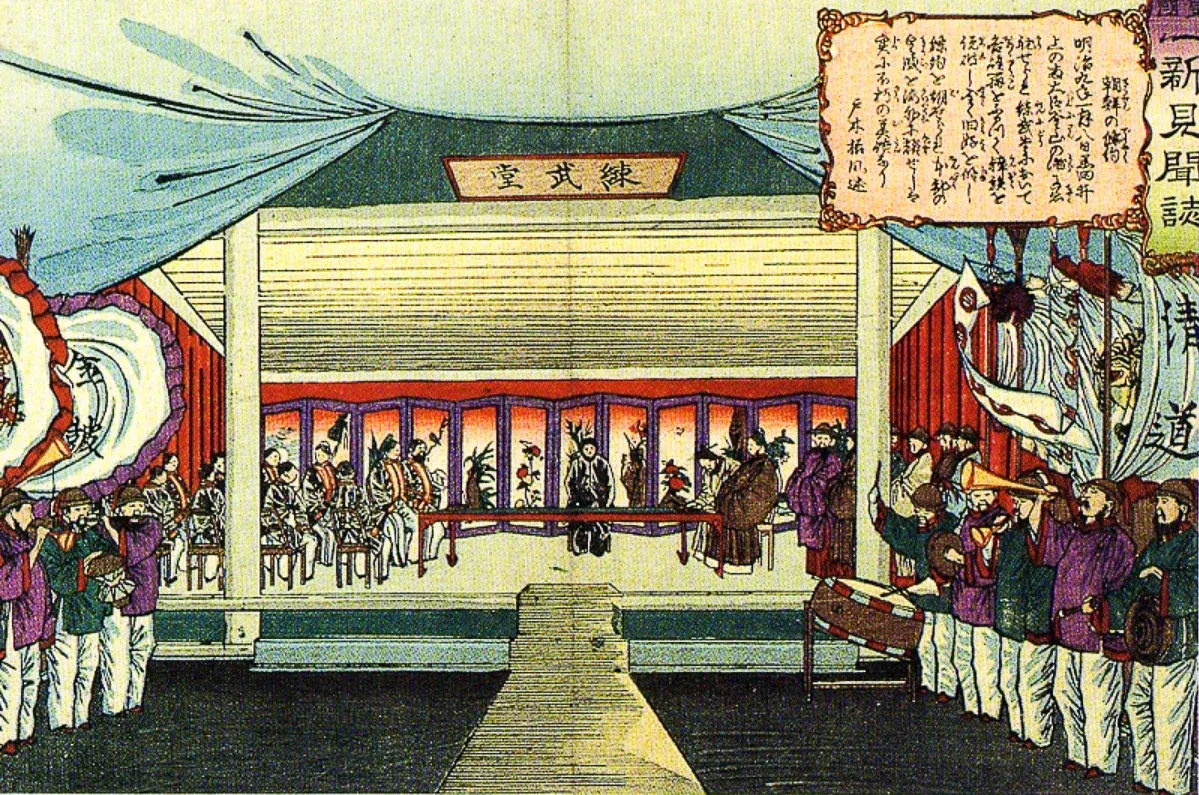
A Japanese print from 1880 depicting the signing of the treaty on Ganghwa Island in 1876 · Wikimedia Commons (public domain)
This article is written about the nearly 70-year period in Korean history from this treaty in 1876 to liberation in 1945. If the previous piece, "From Jeong Do-jeon to the Sangpyeong Coin", looked at the founding of Joseon through the first half of the 19th century, this article begins with Joseon meeting the world beyond the sea.
Think of the front door key of a house. Opening the door and welcoming a guest inside is different from handing the key over to someone else. When the person holding the key remodels the house, whether new water pipes were laid, which room those pipes lead to, and where outside the house they connect must be asked separately.
The Treaty That Opened the Doors
The Treaty of Ganghwa was a treaty concluded between Joseon and Japan in 1876, officially named the Japan-Joseon Treaty of Amity, and was the first modern treaty that Joseon signed. Afterwards, Busan, Wonsan, and Incheon were opened to Japanese merchants and immigrants (DOI: 10.5040/9781474207775.0084). This opening of ports is commonly called gaehang.
The treaty contained clauses favorable to only one side. One study suggests that Japan's right to survey Joseon's coasts was a deeply unequal provision that later became an important stepping stone for Japan's invasion of Joseon (DOI: 10.21490/jskh.2021.5.83.161).
Answers vary to the question of just how forced the treaty was. It has been known as an unequal treaty forcibly concluded by Japan with gunboats at the forefront (KCI ART002088484), and English-language general surveys also write that Joseon was forced by Japan to open its doors (DOI: 10.4324/9781315104676-3). There has also been an understanding that it arose from the Joseon government's autonomous will to open the country (DOI: 10.18854/kpsr.2017.51.5.008). Research that re-examines the negotiation process suggests that the negotiations were not purely a matter of Japanese coercion, that Joseon's opinions were reflected quite a bit in the text, and that the treaty was closer to one concluded through deception rather than force (KCI ART002088484). Some studies view that Joseon's ruling class chose an open-door policy themselves to avoid war and led the negotiations to a peaceful conclusion (KCI ART002585405). Another study argues that Japan had neither the capability nor the will to wage war, calling this treaty an "imperfect unequal treaty," and attributes this outcome not to the Joseon government's response, but to Japan's own dilemma (DOI: 10.18854/kpsr.2017.51.5.008).
The fact that the Treaty of Ganghwa contained unequal provisions and the question of just how forced that treaty was are two different matters.
From Above, From Below
The people who participated in the coup of 1884 were centered around people from the "Sanghan" class. They regarded independence from the Qing and "Enlightenment" after 1883 as urgent tasks for the country (KCI ART000928314). People who put forward enlightenment are called the Enlightenment Party.
The Gapsin Coup was a coup d'état carried out in 1884 by members of the Enlightenment Party such as Kim Ok-gyun to overthrow the government and sever the relationship of subordination to the Qing Dynasty. Previous research suggests that this coup was made possible not just by leaders, but by the hopes and actions of many people (KCI ART000928314). The coup failed.
Ten years later, a movement stirred from below. The Donghak Peasant Revolution was a movement launched in 1894 by peasants who based their thoughts on Donghak, a religion founded by Choe Je-u, demanding punishment of the extortion by local officials and a remedy for the livelihood problems caused by the collapsed tax system. The peasant army put forward a reform proposal listing things to be fixed (KCI ART001593406).
According to the summary of one study, after suppressing the peasant army with the help of the Japanese military, the Joseon government concluded that reforms were necessary to prevent uprisings, and under Japan's pressure, it began reforms by partially accepting the demands of the peasant army (DOI: 10.20457/SHA.93.10). The Gabo Reform was a reform promoted by the Joseon government starting in 1894, and is counted as the first modern reform of Korean society. Government-owned slaves and private slaves that remained unresolved in 1801 were legally abolished by the Gabo Reform of 1894. However, the form of slavery continued thereafter, with government slaves remaining in some regions, and women in particular remained objects bought and sold in the form of slavery amidst the demand for people to do household chores (DOI: 10.22511/women..44.202606.233).
It is commonly evaluated that the first stage of the Gabo Reform was relatively autonomous while the second stage was heavily influenced by Japanese interference, and the tension between autonomy and external coercion is a central issue in the study of this reform (DOI: 10.20457/SHA.93.10). Many reforms remained only as decrees and became dead letters, and were even abolished when the country was lost (DOI: 10.35636/ktr.2017.17.1.004).
The Korean Empire is the name of the country ruled by Gojong as emperor starting from October 13, 1897. The Korean Empire broke away from the influence of the Qing and carried out modernization projects focused on a new school system and industrial development (DOI: 10.4324/9781315104676-3).
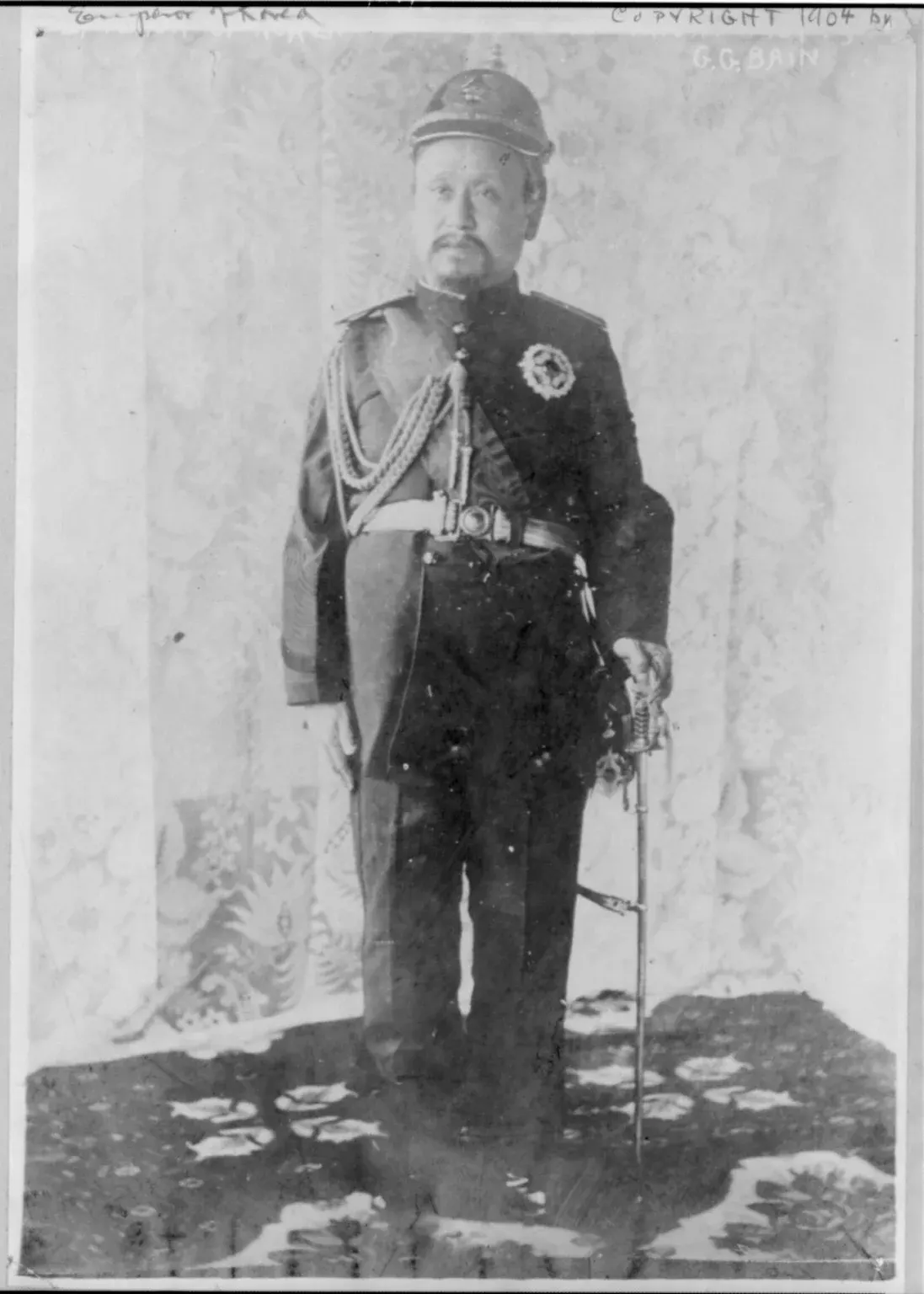
Gojong, around 1904 · Library of Congress, via Wikimedia Commons (public domain)
Reform was attempted through coups, peasant uprisings, and government decrees, and each time it was entangled with the powers of the Qing and Japan.
A Door to the Outside, and the Whole House
Around February 1904, when the Russo-Japanese War began, the Japanese military entered and occupied Korea (DOI: 10.18496/kjhr.2025.11.90.63). The Eulsa Treaty is a treaty concluded by Japan and the Korean Empire on November 17, 1905, making the Korean Empire a protectorate of Japan, and is also called the Eulsa Agreement or the Second Korea-Japan Agreement. Through this treaty, the Korean Empire lost its diplomatic rights (DOI: 10.25232/ku.2021.55.283). The word "Nyak" in the Korean term for the treaty means a treaty forced upon a party.
Emperor Gojong sent special envoys to an international conference in Hague in 1907, and Japan responded by forcing Gojong to step down (DOI: 10.18496/kjhr.2025.5.88.59).
Two months before the annexation, Japan established a military police system that tied Korean police together under the military police, known as the heongbyeong. This was intended to suppress anti-Japanese unrest, which was the biggest obstacle to the annexation (KCI ART001217608). And on August 29, 1910, it annexed the Korean Empire and made it a colony (KCI ART001248994). One international law study views this annexation as the result of an illegal occupation that continued from the Russo-Japanese War (DOI: 10.18496/kjhr.2025.11.90.63).
Was the Treaty Valid?
The validity of the Eulsa Treaty yields conflicting answers to the same question. As summarized by a 2005 study, South Korean historians and international law scholars argue that the treaty is void, whereas Japanese scholars do not accept this view (KCI ART000972999). The Japanese government maintains that it was legal under international law at the time the treaty was concluded (KCI ART002074906).
Those who view it as void base their position primarily on three grounds: that it was concluded by applying threats to the nation's representative, that there was no ratification by the emperor, and that formal requirements such as full powers were not met (KCI ART002074906). A study advancing the invalidity theory notes that the Minister of Foreign Affairs of the Korean Empire was coerced into signing by Hirobumi Ito, who commanded troops, and that Gojong did not ratify it (KCI ART001482975). Between 1998 and 2000, Korean and Japanese scholars debated the form and procedure in the Japanese magazine Sekai. Professor Lee Tae-jin argued for invalidity on the grounds that there was no ratification or full powers document and that the official treaty name was not used, while Professor Unno countered that the form of a treaty does not determine its validity and that some treaties take effect without ratification. A study that reexamined this debate in light of international law writings of the time concludes that, despite some errors, Lee Tae-jin's core argument—that a major treaty could not be handled without ratification and full powers—was sufficiently valid even under the laws of that era (KCI ART001371576).
Even within the South Korean academic community, which views the treaty as void, judgments differ depending on the grounds. One study concludes that it is difficult to regard Japan's provision of money to Korean figures as a cause that would invalidate the treaty under the laws of the time (KCI ART001513676). Another study points out that judging illegality based on the international law established during the imperialist era could lead to the paradox of justifying Japan, yet still views the validity of this treaty as having been an international dispute even at the time (DOI: 10.17326/jhsnu.83.2.202605.177).
The validity of the Eulsa Treaty is an issue where the South Korean and Japanese academic communities give opposing answers to the same question. Within the side that views it as void, there are studies arguing that defects in ratification and form hold up even under the law of the time, alongside studies arguing that bribery is difficult to serve as grounds for invalidity.
Governor-General and Military Police
The Government-General of Chōsen was the supreme ruling body established by Japan to govern colonial Korea after the annexation in 1910. The Governor-General was appointed by the Emperor of Japan and could only be a general or admiral in the army or navy (DOI: 10.2307/2385698).
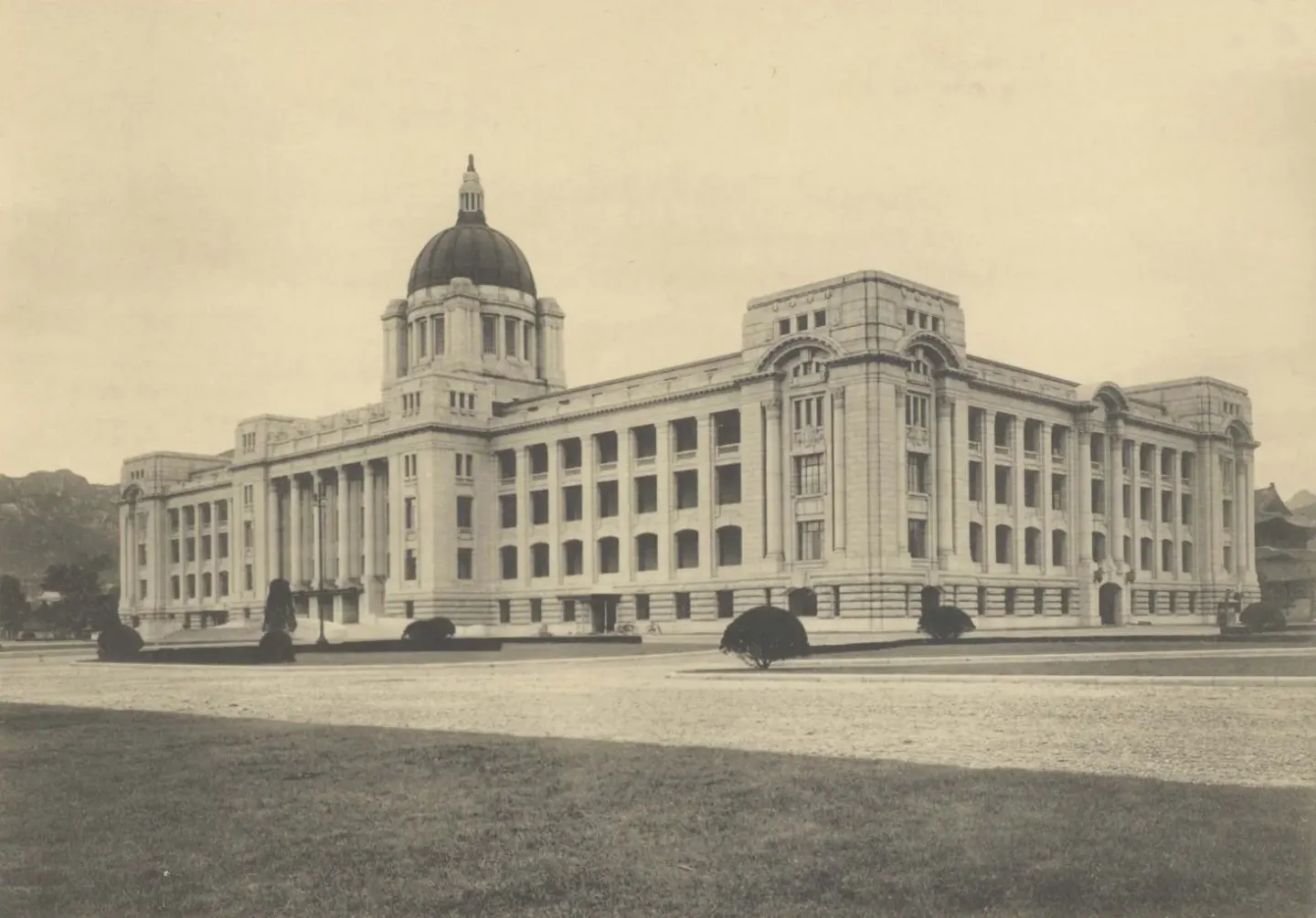
The Government-General building, 1929 · Seoul · Wikimedia Commons (public domain)
Military rule is the name referring to the method by which the Government-General of Chōsen governed Korea in the 1910s, putting the military and military police at the forefront. Religion was also discriminated against and controlled, to the extent that Cheondoism was not recognized as a religious organization and suffered severe oppression (DOI: 10.18021/chk..47.201709.31).
Measuring the Land
The Land Survey Project was an operation conducted by the Japanese Government-General of Korea between 1910 and 1918 to survey the land of Joseon, determine an owner for each plot of land, and record it in official ledgers. Its purpose was to establish modern land ownership rights, collect more land taxes, and enable colonial finances to sustain themselves (DOI: 10.18347/hufshis.2024.95.67).
The principle was one owner per plot of land. Research comparing this with Taiwan's land survey suggests that, unlike in Taiwan, Joseon abolished a right called "dojigwon" without compensation and secured vast amounts of state-owned land, laying the groundwork for Japanese individuals to acquire land. That study notes that dojigwon was handled without compensation because of its low social status and small area, which intensified ownership disputes, infringed upon peasants' rights, and subsequently became one of the backgrounds for the March First Independence Movement of 1919 (DOI: 10.18347/hufshis.2024.95.67).
According to research examining dispute documents from Changwon County, Gyeongsangnam-do, in disputes over state-owned land, the survey authorities placed more importance on state land ledgers than on residents' documentary evidence, ruling mostly in favor of state ownership, while in disputes between Japanese individuals and residents, ownership by the Japanese was recognized. As a result, that study concludes that Japanese individuals became large landowners while residents were reduced to subsistence farmers or landless peasants (KCI ART001556784). In some areas of Gyeonggi and Jeonnam provinces, disputed land surrounding state-owned plots exceeded 2% of all registered land parcels (KCI ART001152194). There is no single evidence-backed number collected in the papers gathered for this article that tells us exactly how many land ownerships changed nationwide.
Answers diverge when asked what this project actually was. One side views it as Japan exploiting Joseon people by increasing land taxes and creating state-owned land to build a colonial foundation, while the other side views it as establishing modern land ownership rights to make buying and selling land easier and accelerating capitalization. A 2008 study dealing with the project's records summarizes that the two views are sharply opposed, while itself concluding that the project served as a stepping stone for the domination of Joseon (KCI ART001248994). Research that views it as having rapidly institutionalized modern ownership rights also leaves open the question of whether that was the decisive factor in Korea's modernization (KCI ART001961037). As a third path, some research argues that the project belatedly endorsed the private ownership concepts of peasants that had already grown from the late Joseon dynasty through the Korean Empire (DOI: 10.22629/kabh.2013.28.1.003).
While it is undisputed that the Land Survey Project newly recorded land owners in ledgers, answers diverge on whether it was an act of dispossession or the establishment of modern ownership rights; recent comparative studies suggest that both objectives coexisted while noting the handling method devoid of compensation.
March 1, 1919
In January 1919, King Gojong passed away. On March 1, two days before the funeral, a declaration was issued in Seoul to achieve independence through peaceful methods, and protests spread rapidly (DOI: 10.2307/2385698). The March 1st Movement was a protest that began in Seoul on March 1, 1919, spreading nationwide to shout for Joseon's independence. One commentary calls this the first nationwide-scale protest against Japanese rule (DOI: 10.1017/s002191181900007x).
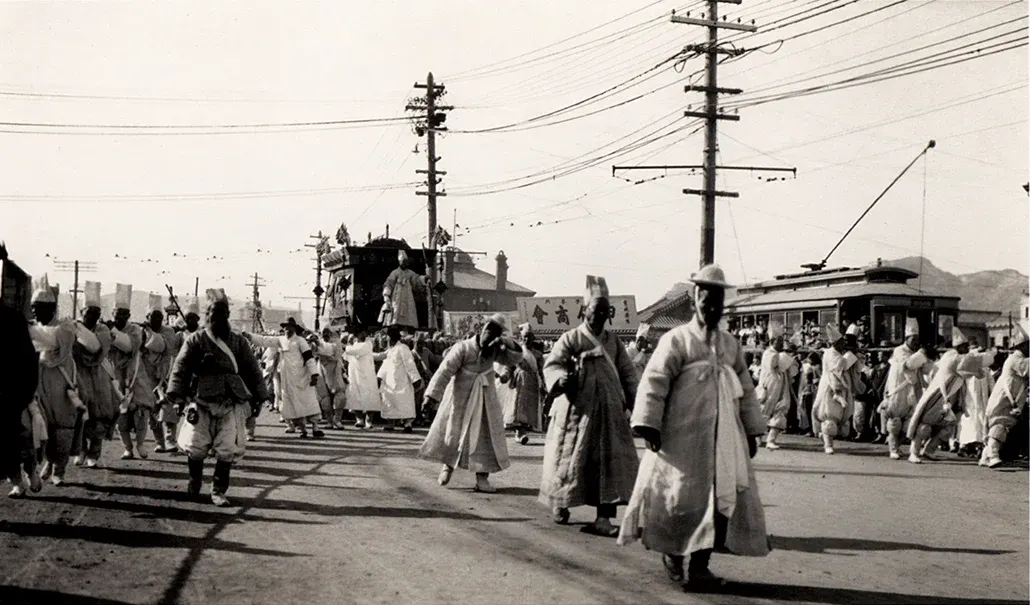
Gojong's funeral procession, March 1919 · Seoul · photo by Albert W. Taylor, Wikimedia Commons (public domain)
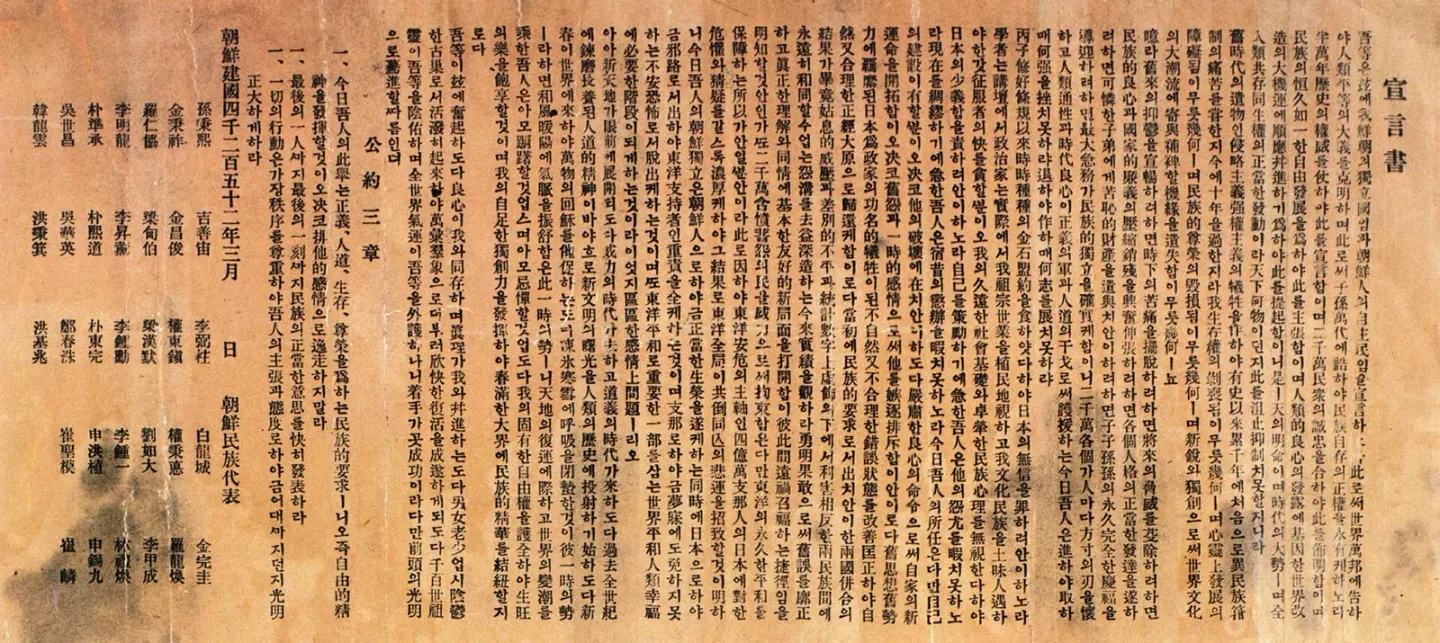
The Declaration of Independence of March 1, 1919 · Wikimedia Commons (public domain)
This movement was planned jointly by Christianity, Cheondogyo, and Buddhism (DOI: 10.18021/chk..47.201709.31).
The movement was suppressed. The Japanese military recorded their own soldiers who died during the suppression as "killed in action" to award them medals, and a study examining those records reads this to mean that Japan carried out the suppression of the March 1st Movement on par with wartime operations (KCI ART003168469). Participants from Jangan-myeon and Ujeong-myeon in Gyeonggi Province were charged with rebellion after a massive wave of arrests and went through a trial lasting roughly 600 days (DOI: 10.15799/kimos.2022..80.002). Yu Gwan-sun, a student who participated in the protests in Seoul, died at the age of seventeen on September 28, 1920, after repeatedly suffering beatings and torture in prison (DOI: 10.1017/s002191181900007x).
The Provisional Government of the Republic of Korea is a government established by independence activists after the March 1st Movement. One study notes that this government was formed on April 11, 1919, by merging the Korean National Assembly on Russian soil, the Shanghai Provisional Government, and the Hansong Government secretly organized domestically (DOI: 10.31930/JAS.2024.12.67.4.7). The relationship between the time of the merger and the date of establishment is not separately clarified by the sources of this text.
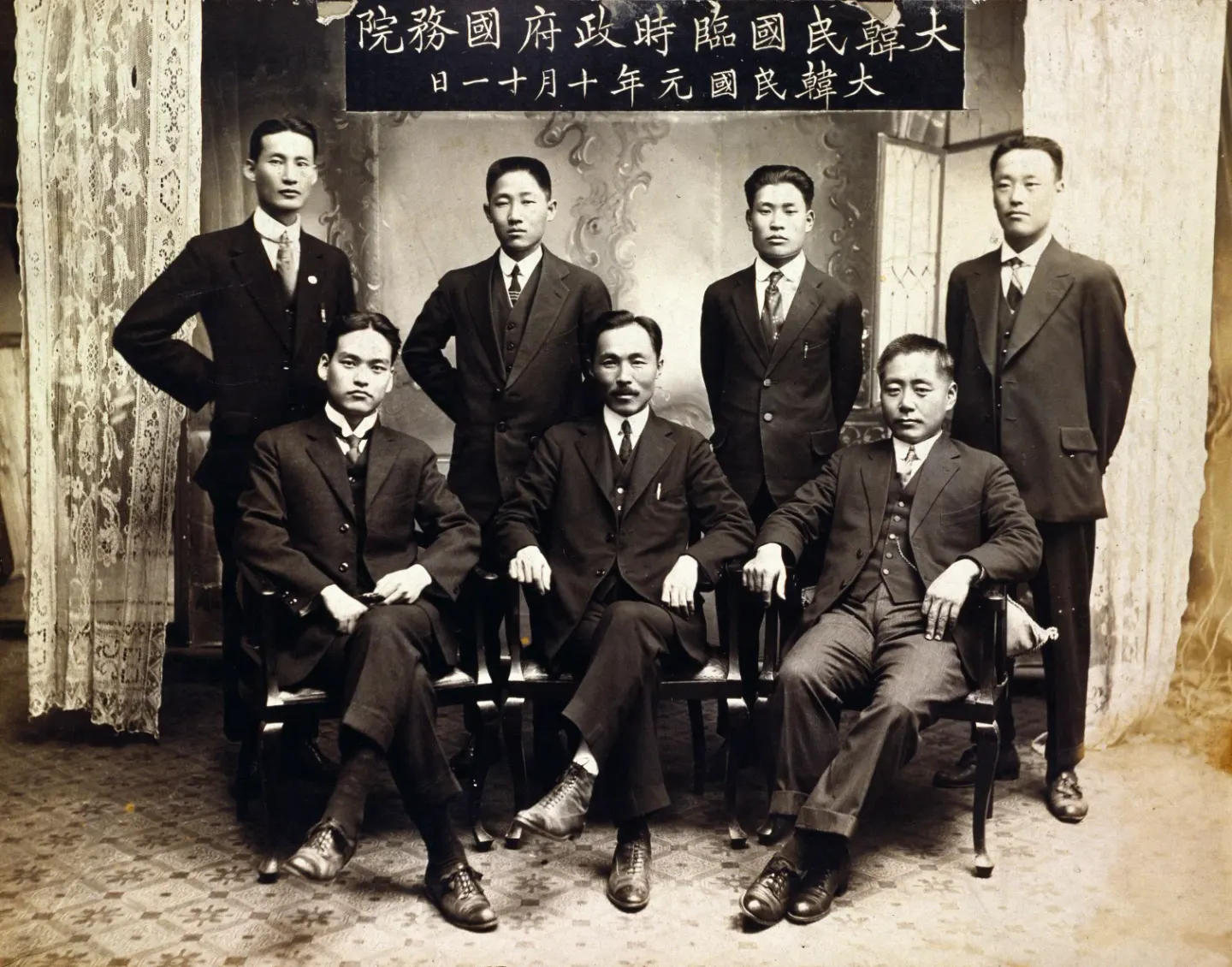
The State Council of the Provisional Government of the Republic of Korea, October 11, 1919 · Wikimedia Commons (public domain)
What the March 1st Movement changed is viewed differently by each study. English-language historian Michael Robinson argued in 1982 that, contrary to the emphasis of postwar historians, this movement failed to change the reality of colonial rule and that subsequent nationalist movements also failed to recreate a scale of that magnitude. However, he notes that it prompted Japan to adjust its colonial policies (DOI: 10.1353/jks.1982.0001). Another research book views this movement as the catalyst that made "nation" the dominant identity by which people bound themselves together (DOI: 10.4324/9781315544717).
There are studies arguing that the March 1st Movement changed the methods of the ruling side and the self-understanding of the ruled, as well as studies emphasizing that it failed to change the reality of rule.
Named "Culture"
Cultural rule is the name given to the outwardly softened ruling method put forward by the Japanese Government-General of Korea in the 1920s following the March First Movement. Within strict limits, Koreans gained the right to publish, organize groups, and participate in governance, even if only in name (DOI: 10.1353/jks.1982.0001).
The Government-General placed five high-ranking Korean officials in positions to gauge public sentiment, but without making laws or giving them the power to resolve grievances, so research views this as a propaganda tool. Still, residents used the opportunity to express their grievances, and research concludes that the experience led to the political and social movements of Koreans after the mid-1920s (KCI ART001712795).
From April 1920 to June 1937, torture-murder cases by the police confirmed through newspaper articles numbered 40, and the victims' charges were minor crimes like theft or regulatory violations in nearly half the cases. Research reads this as evidence that the police at the time did not view Koreans as equal human beings with rights (DOI: 10.31929/namdo.2022.47.7).
The weight of economic policy was also on the Japanese side. The Rice Production Increase Plan started in 1920 had its primary purpose in solving Japan's rice shortage, and after Japan invaded Manchuria in 1931, Joseon was mobilized for war through industrialization centered on the war industry (DOI: 10.4324/9781315104676-3).
The Last Decade Bound to War
Japan started the Second Sino-Japanese War in 1937 and promulgated the National Mobilization Law in 1938 (KCI ART002691034). The Imperial Subjects policy is a policy implemented around the time of the Second Sino-Japanese War by the Japanese Government-General of Korea, stating they would make Korean people subjects of the Japanese Emperor, in other words, Japanese people. Schools emphasized Japanese history and removed Korean history (KCI ART001606081). In actual school settings, the use of the Korean language was banned, and the labor mobilization of female students was also expanded to tasks such as increasing food production starting in 1941 (DOI: 10.37924/JSSW.96.5).
Women were forcibly mobilized inside and outside the country under names like the Labor Service Corps and the Women's Volunteer Labor Corps. The methods used to gather the Women's Volunteer Labor Corps branched out in various ways, ranging from government agency mediation and recruitment, voluntary support, propaganda through schools and organizations, employment fraud, to coercion and intimidation (KCI ART002691034). A thesis dealing with how Japan mobilized labor from Korea and Taiwan views that although Japan put forward the same legal framework and slogans of assimilation, the essence of the mobilization was extremely coercive and brutal, and because of that, the resistance of colonial residents grew stronger toward the end of the war (DOI: 10.14288/1.0088545).
Japan forcibly mobilized Koreans in various forms such as laborers, soldiers, military-attached personnel, and comfort women, and the full picture is in the process of being revealed by analyzing roster data one by one (DOI: 10.35647/kjna.2023.44.191). As the basis for this article, the total scale of mobilization is not written down as a single number.
Who Left the Records?
Most records from this period were left by only one side. A study comparing the Joseon side's materials from the 1876 treaty negotiations with Japanese records notes that content protested by Joseon appears only briefly or not at all in the Japanese records, viewing that both countries selected and left records according to their own interests (DOI: 10.18496/kjhr.2019.02.63.45).
Numbers also face the same question. Statistics relied upon by studies measuring the colonial economy include materials produced by the colonial ruling apparatus (KCI ART002107426), and there is criticism that early statistics of the Japanese Government-General of Korea have various problems (KCI ART001056161).
Was There Growth, and Whose Share Was It?
According to a 2010 study's overview, the exploitation theory, the colonial modernization theory, and a third perspective criticizing the debate structure between the two have been leading the discussion, with interest shifting toward the third perspective (DOI: 10.25024/kj.2010.50.4.69).
Colonial modernization theory is a perspective viewing that the Joseon economy grew during the Japanese colonial period and that modern economic growth began at this time. According to reviews in critical studies, this view argues that there was no exploitation during this period and that the economy transitioned to capitalism (DOI: 10.15856/jakpah.2019.47.47.107). Because the original texts from the modernization side are not in this article's evidence base, their arguments are conveyed through the summaries of critical studies. Exploitation theory refers to the standpoint emphasized by the Korean historical academia, viewing this period above all as a time of deprivation (DOI: 10.16976/kahe.2010..12.7).
Three distinct questions are mixed here. To put it in terms of a house key: Were new water pipes installed during remodeling? To whose room and where outside the house did those pipes lead? And was that remodeling the reason this house grew larger later on?
First, answers diverge on the same question of how much the economy grew. Colonial modernization theory cites gross domestic product (GDP) estimates to argue that Joseon at the time was one of the fastest-growing regions in the world. The critical side considers such arguments hard to sustain, arguing that the growth rate was pushed artificially high because problems in the early Japanese Government-General statistics were not sufficiently corrected, and because the assessment looked only up to 1940, the peak year, while excluding the end of the war when the economy collapsed (KCI ART001056161). A study that examined colonial-era data compiled by the Nakseongdae Institute of Economic Research through the lens of macroeconomics answers that growth did occur (DOI: 10.22841/kjes.2017.65.1.001).
Second, answers also diverge on whose share that growth was. Colonial modernization theory views that per capita income and consumption of Joseon people also increased, even though income inequality by ethnicity grew (KCI ART001056161). Other research notes that the modernization side's population estimates pushed up the per capita GDP growth rate by setting the population growth rate for 1915–1924 too low, and that correcting this makes the deterioration of the Joseon people's living standards more pronounced (KCI ART002155172). The preceding study that answered growth did occur also notes that while there were changes in the proportions of consumption spent on food and clothing and in the agricultural population proportion, they remained very high, implying that the living standards of people at the bottom did not change significantly (DOI: 10.22841/kjes.2017.65.1.001). There is also research viewing that policies encouraging Japanese migration created a "dual society" where Japanese people and the small upper class of Joseon people split from the large lower class of Joseon people in housing, education, and medical care (DOI: 10.25024/kj.2010.50.4.69).
Third, colonial modernization theory traces the roots of high-speed growth after liberation back to the colonial period (KCI ART002024750), while the aforementioned macroeconomic study is negative about this. It views that not many production facilities remained in South Korea and most disappeared through liberation and war, and that while human capital from the colonial period was not negligible, it was not enough to drive high-speed growth (DOI: 10.22841/kjes.2017.65.1.001).
The two perspectives sometimes criticize each other as ideological. Colonial modernization theory criticizes exploitation theory for failing to see the facts due to nationalist ideology (DOI: 10.15856/jakpah.2019.47.47.107), and a sociological study criticizes modernization theory's figures as estimates relying on assumptions and guesses, echoing the statistics of the colonial rule apparatus and thereby repeating that apparatus's intentions (KCI ART002107426). One history education study points out that while the standpoint of Korean historical academia emphasizing exploitation cannot be problematic, school classes assume exploitation as a fact that needs no questioning and conceal the problem of perspectives (DOI: 10.16976/kahe.2010..12.7).
Colonial modernity theory views modernity in the colonial period as a mixture of control and resistance, incorporation and consent, and is a perspective trying to move beyond the very debate structure of exploitation versus development. One study explains this perspective as an attempt to surpass both the internal development theory—which views Joseon as having developed on its own—and the tendencies of modernization-following and nationalism shared by colonial modernization theory (DOI: 10.23296/minmun.2017..64.371). Against this perspective, there are criticisms that it treats the national issue lightly by putting modernity first (DOI: 10.25024/kj.2010.50.4.69) and that it blurs the violence of colonialism (DOI: 10.18219/ddmh..96.201612.9).
Regarding the colonial economy, "How much growth was there?" and "Whose share was that growth?" are different questions, and the answers to both questions diverge depending on what is estimated and how.
Colonial Historiography as an Object of Study
The ruling side also wrote history. Published by the Japanese Government-General of Korea in the 1920s, the common school Korean history textbook thoroughly recorded modern Korean history from the Ganghwa Island Treaty to the annexation from Japan's perspective, and described Japan's invasion as being for Korean independence and peace in the East (KCI ART001930756).
A historical view created to justify colonial rule, like the Government-General's textbook, is called colonial historical view, or colonial historiography. High school history textbooks immediately after liberation could not break away much from colonial historiography and thus highly evaluated the role of foreigners even in their descriptions of the open-port period, but they began to overcome this around the time of the 2nd curriculum (KCI ART002417205). The theory of immanent development was formed within the trend of the national history academia trying to overcome colonial historiography, but there is also research showing that Gapsin Coup interpretations leaning on it were used as a narrative in textbooks during the Park Chung-hee regime to justify mobilization for "Fatherland Modernization" (KCI ART003322126).
Takeo Suzuki, a professor at Keijō Imperial University who was deeply involved in the Government-General's economic policy, beautified colonial rule in a piece written for a Japanese Ministry of Finance research project in 1946, arguing that Korea could finally modernize thanks to Japanese rule. A historiographical study analyzing this piece views it as the writing that became the starting point of so-called colonial modernization theory after 1945 (KCI ART001951056). The basis put forward by current colonial modernization theory is national accounts estimation (KCI ART002107426), and this starting-point evaluation is the interpretation of that historiographical study.
Colonial historiography is history written by those who justified rule, is now an object of study rather than a basis, and although textbooks and research since liberation have overcome it, the framework of that overcoming is also being re-examined.
1945
Japanese rule collapsed as World War II came to an end (DOI: 10.5040/9781474207775.0084).
We look at the front door key again. In 1876 the door was opened, in 1905 the key to the door facing outward passed into other hands, and in 1910 the key to the entire house passed into other hands. The side that held the key resurveyed the land, built factories, and dragged family members out of the house during the war. Where those construction projects led, into whose rooms and to where outside the house, is still asked separately by each study. That period ended when the side holding the key lost the war. What happened afterward belongs to another piece in this series, "After Liberation".
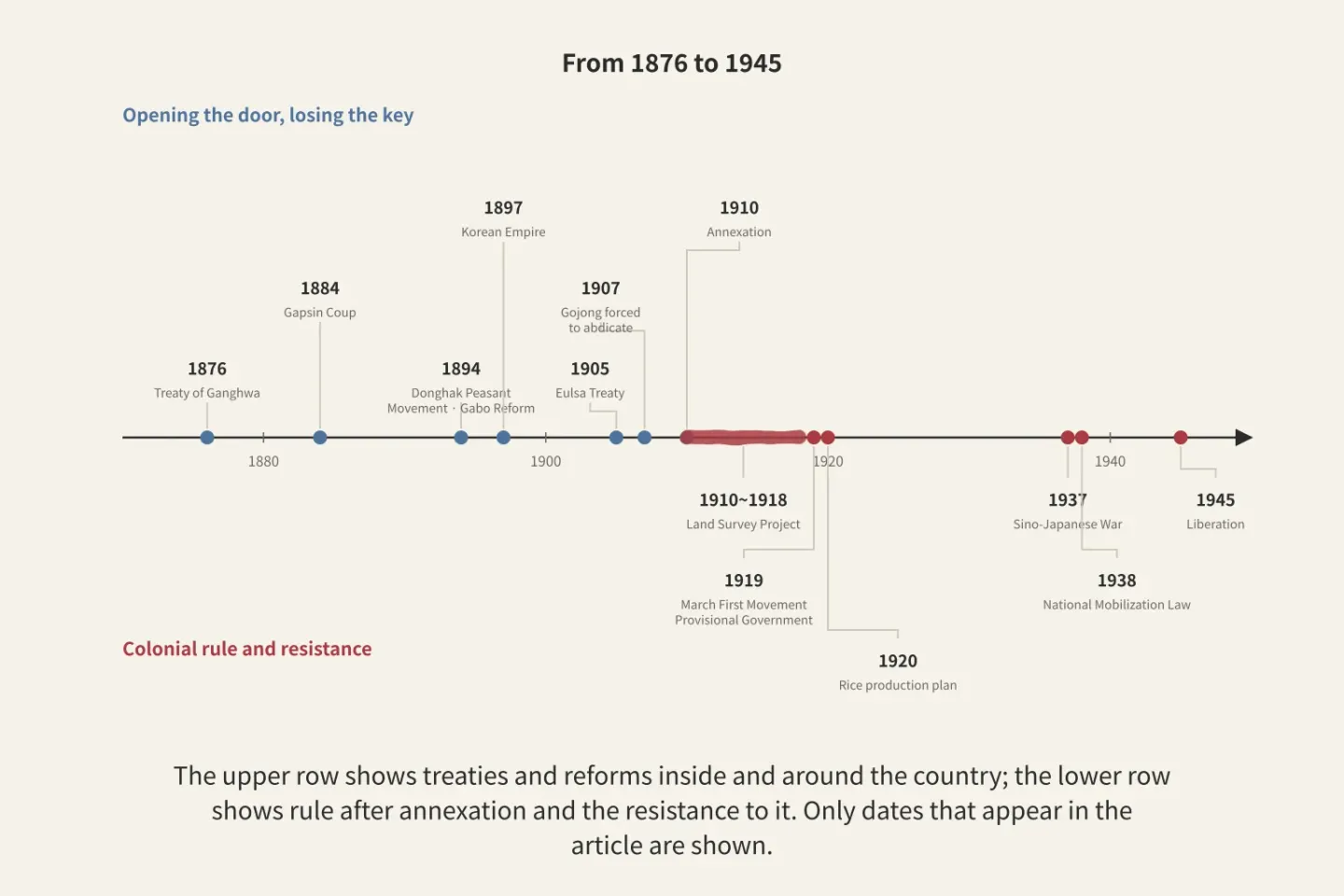
Figure: a timeline Paperis drew using only the dates in this article
Where to Look Further
How to trust and read records left by one side, such as treaties, trial records, and statistics, is covered in more detail in the method episodes of the "How Do We Know the Past?" series. The way a central power binds and rules multiple peoples and lands leads into the empire episode of "Big Words of History". The slavery system, the late Joseon economy, stagnation theory, and sprout theory can be found in the earlier episode of this series, "From Jeong Do-jeon to the Sangpyeong Coin", while the division and war, industrialization and democratization after liberation can be seen in the next episode, "From Liberation to the June Democratic Struggle".
Source Papers
- "The Conclusion of the Korea-Japan Treaty of Amity Viewed Through“Byeongja Yurok”" (2019) — DOI: 10.18496/kjhr.2019.02.63.45 — Joseon-side documents from the Ganghwa Island incident of September 1875 to the treaty in February 1876. Because Joseon's protests are sparse or absent in Japanese records, both nations selectively recorded events based on their interests.
- "The Open-Door Policy Promotion by the Ruling Faction of Gojong's Direct Rule and the Conclusion of the Korea-Japan Treaty of Amity" (2020) — KCI ART002585405 — Following the fall of Daewongun and the start of Gojong's direct rule, the ruling elite pushed for an open-door policy to avoid war, and Shin Heon, a military officer rather than a diplomat, was put forward as the negotiation representative.
- "Reconstruction of the Process of Concluding the Korea-Japan Treaty of Amity in 1876: Based on 'Simhaengilgi' and Several Unpublished Documents" (2017) — DOI: 10.18854/kpsr.2017.51.5.008 — Kuroda Kiyotaka served as the plenipotentiary envoy. Japan lacked the capacity and will for war and used appeasement and deception, making the treaty an "imperfect unequal treaty" due to that dilemma.
- "Korea in transition 1876–1945" (2017) — DOI: 10.4324/9781315104676-3 — Joseon, which previously traded only with Qing China as a tributary state, was forced to open its doors to Japan in 1876, leading to the Daehan Empire's modernization projects, the Rice Production Increase Plan in 1920 (to solve Japan's rice shortage), and war-industry-centered industrialization after 1931.
- "Korea, 1876–1945" (2018) — DOI: 10.5040/9781474207775.0084 — The opening of ports in Busan, Wonsan, and Incheon, the First Sino-Japanese War of 1894–95 and the Russo-Japanese War of 1904–05, Gojong's move to the Russian legation followed by the establishment of the Daehan Empire on October 13, 1897, his forced abdication in 1907, the annexation in 1910, and the collapse of colonial rule through World War II.
- "The First Coastal Survey of the Korean Coast by the Japanese Warship Hosho after the Conclusion of the Korea-Japan Treaty of Amity and Its Significance" (2021) — DOI: 10.21490/jskh.2021.5.83.161 — The right to coastal survey was a highly unequal poison pill clause found in no treaties with Western powers, which later served as a stepping stone for aggression.
- "Was the Korea-Japan Treaty of Amity a Product of Gunboat Diplomacy?" (2016) — KCI ART002088484 — Joseon's first modern treaty. It was not entirely coercive and reflected Joseon's opinions as well, making it closer to a treaty concluded through deception than through force.
- "The Enlightenment Thought and Perception of the Coup by Participants in the Gapsin Coup" (2004) — KCI ART000928314 — Participants in the coup started from practical knowledge and came to regard independence and enlightenment as urgent national tasks after 1883.
- "The Reform Proposals for the Abrogation of Misrule as the Goal and Direction of the Gabo Donghak Peasant Movement" (2011) — KCI ART001593406 — A peasant movement based on Choe Je-u's Donghak ideology. Punishing corrupt officials and resolving livelihood issues caused by the corruption of the three administration taxes were top priorities, and their platform was the Reform Proposals for the Abrogation of Misrule.
- "The Reality of Japanese Interference in Joseon's Domestic Reforms during the Gabo Reform Period and the Response of the Enlightenment Government" (2025) — DOI: 10.20457/SHA.93.10 — The Gabo Reform is recognized as the first modern reform; amid evaluations that the first stage was relatively autonomous while the second stage saw heavy Japanese interference, the tension between autonomy and external coercion is a central issue. The peasant war was suppressed with the support of the Japanese military.
- "A Study on the Relationship between Tax System Reforms in the Gabo Reform and the Donghak Peasant Movement" (2017) — DOI: 10.35636/ktr.2017.17.1.004 — Article 16 of the Accounting Act and the Reform Proposals for the Abrogation of Misrule provision "Prohibition of Nameless Miscellaneous Taxes" were connected, but many reforms remained merely on paper and were rendered ineffective.
- "The Persistence of the Status of Servants (Nobi) and the Subjugation of Women after the Gabo Reform" (2026) — DOI: 10.22511/women..44.202606.233 — Public and private slaves (nobi) were legally abolished in 1894, but the form of servitude persisted, and women remained targets of sale and subjugation amid domestic labor demand.
- "International Customary Law and the Eulsa Treaty around the Russo-Japanese War of 1904–1905" (2025) — DOI: 10.18496/kjhr.2025.11.90.63 — The invasion and occupation by the Japanese military around February 1904. The Eulsa Treaty (November 17, 1905) was invalid due to illegal occupation, and the annexation of 1910 was the result of that illegal occupation.
- "The Abolition of the Gamriseo and the Jurisdiction of Buyun over Foreign Affairs after the Eulsa Treaty" (2021) — DOI: 10.25232/ku.2021.55.283 — Due to the loss of diplomatic rights under the Eulsa Treaty, the duties of the Gamriseo were transferred to the Residency-General's Isacho (Ijin-bu office/branch).
- "Gojong's Diplomatic Response around the Eulsa Treaty and the Hague Peace Conference" (2025) — DOI: 10.18496/kjhr.2025.5.88.59 — Gojong sent an appeal letter to Nicholas II and dispatched Yi Jun, Yi Wi-jong, and Yi Sang-seol to Hague, to which Japan responded with forced abdication.
- "A Study on the Japanese Military Gendarmerie in Korea Before and After the Korea-Japan Annexation Treaty - Focusing on the Issue of Military-Police Unification -" (2007) — KCI ART001217608 — Following Terauchi's appointment, a gendarmerie-police system was established two months before the annexation.
- "The Land Survey Project and Records Management of Japanese Imperialism" (2008) — KCI ART001248994 — The annexation on August 29, 1910. The Land Survey Project is fiercely contested between the exploitation theory and the establishment-of-modern-property-rights theory.
- "A Brief Study on the Ratification Issue Regarding the 1905 Eulsa Treaty" (2005) — KCI ART000972999 — Korean scholars view it as invalid, while the Japanese side does not recognize it. It questions whether the lack of ratification alone is a basis for questioning validity, considering the intent of whether ratification was required to be the core issue.
- "A Reexamination of the International Legal Problems of the Eulsa Treaty" (2015) — KCI ART002074906 — Grounds for invalidity include lack of ratification, duress against the national representative, and missing full power letters. The Japanese government maintains that it was legal under the international law of the time.
- "Reexamination of the Process of Japan's Forced Annexation of Korea - A Legal Study on the Illegality and Invalidity of the Korea-Japan Treaties -" (2010) — KCI ART001482975 — The Minister of Foreign Affairs was coerced into signing by Ito, who commanded troops, and there was no ratification by Gojong. The 1963 UN International Law Commission report cited it as a case of invalidity by duress.
- "The Validity of the 'Treaty' Related to the Annexation of Korea from an Intertemporal Legal Perspective: Focusing on the Format and Procedure of Treaty Conclusion" (2009) — KCI ART001371576 — In the 1998–2000 Sekai debate, Yi Tae-jin argued it was invalid due to formal and procedural flaws, while Unno countered that form does not determine validity.
- "The Validity of the Treaty Related to the Annexation of Korea and the Bribery of National Representatives" (2010) — KCI ART001513676 — In light of the laws of the time, Japan's provision of money is difficult to be regarded as a cause for treaty invalidity.
- "Debates Surrounding the Validity of the Eulsa Protection Treaty - Russo-Japanese Diplomatic Conflict Reflected in the Issue of the Exequatur of the Russian Consul-General in Korea" (2026) — DOI: 10.17326/jhsnu.83.2.202605.177 — Determining illegality based on the international law standards of the time may lead to a paradox of justifying Japan, but validity was a subject of debate even back then.
- "Japanese Rule in Korea after the March First Uprising. Governor General Hasegawa's Recommendations" (1997) — DOI: 10.2307/2385698 — The Governor-General was appointed by the Emperor and restricted to army or navy generals, with Terauchi being the first. Following Gojong's death, a peaceful independence declaration took place on March 1, two days before his funeral, and spread nationwide.
- "The Religious Policy of the Japanese Government-General and Trends in the Korean Religious Community during the Rule of Terror" (2017) — DOI: 10.18021/chk..47.201709.31 — Religious discrimination and control policy, suppression of Cheondogyo, and suicide of Daejonggyo founder Na Cheol. The March 1st Movement was planned through a coalition of religious communities.
- "Torture-Homicide Cases during the Japanese 'Cultural Rule' Period as Seen Through Newspaper Articles (1920–1936)" (2022) — DOI: 10.31929/namdo.2022.47.7 — Torture was intensified after the abolition of the flogging decree. From April 1920 to June 1937, 40 torture-homicide cases were confirmed through newspaper articles, with nearly half of the charges involving misdemeanor offenses.
- "A Comparative Study of the Land Survey Projects in Taiwan and Korea under Japanese Rule - Focusing on the Continuity and Differences of the Two 'Projects' -" (2025) — DOI: 10.18347/hufshis.2024.95.67 — The Joseon project from 1910 to 1918 aimed at modern property rights, increased land tax revenue, and financial self-sufficiency; the abolition of customary eminent domain rights (dojigwon) without compensation and massive acquisition of state-owned land intensified disputes and infringed upon peasants' rights, serving as one of the backgrounds of the March 1st Movement.
- "Types and Characteristics of Ownership Disputes in the Changwon Land Survey Project" (2011) — KCI ART001556784 — State land disputes prioritized cadastral ledgers and actual conditions, leading to most being judged as state-owned, while preemptive purchase land disputes recognized Japanese ownership, resulting in Japanese individuals becoming large landowners and residents becoming subsistence or landless farmers.
- "An Essay for Typologizing State Land Disputes in the Land Survey Project" (2005) — KCI ART001152194 — In some areas of Gyeonggi and South Jeolla provinces, state land dispute plots exceeded 2% of all parcels.
- "A Study on the 'Capitalization Process' of the Japanese Land Survey Project in Joseon" (2015) — KCI ART001961037 — While viewing the institutionalization of modern property rights as having been achieved in a short period, it leaves as a future task whether that was the decisive element of modernization.
- "On the Joseon Land Survey Project" (2013) — DOI: 10.22629/kabh.2013.28.1.003 — Immanent modernization theory: The land survey project retrospectively endorsed and institutionalized already mature concepts of private ownership.
- "1919 in Korea: National Resistance and Contending Legacies" (2019) — DOI: 10.1017/s002191181900007x — Yu Gwan-sun participated in the March 1 demonstration and died at age seventeen on September 28, 1920, after imprisonment and torture, and the March 1st Movement was the first nationwide anti-Japanese demonstration.
- "The Normative Meaning of 'Inheritance of the Legal Tradition of the Provisional Government of the Republic of Korea'" (2024) — DOI: 10.31930/JAS.2024.12.67.4.7 — The Provisional Government was formed on April 11, 1919, through the integration of the Korean National Council, the Shanghai Provisional Government, and the Hansung Provisional Government.
- "Ideological Schism in the Korean Nationalist Movement, 1920-1930: Cultural Nationalism and the Radical Critique" (1982) — DOI: 10.1353/jks.1982.0001 — The March 1st Movement failed to change the reality of colonial rule, but it prompted policy adjustments by Japan, creating rights to publication, association, and nominal participation within strict limits.
- "Korean National Identity under Japanese Colonial Rule: Yi Gwangsu and the March First Movement of 1919" (2018) — DOI: 10.4324/9781315544717 — The March 1st Movement served as a catalyst for the nation to emerge as the dominant group identity.
- "The Establishment and Activities of Civil Administration Inspectors in the Early Period of Cultural Rule" (2012) — KCI ART001712795 — Five high-ranking Korean officials were appointed as civil administration inspectors, but without legal status or resolution authority, serving merely as propaganda tools; however, residents expressed grievances, and that experience led to movements after the mid-1920s.
- "The Forced Mobilization of Women during the Wartime General Mobilization Regime and Tasks for Fact-Finding" (2021) — KCI ART002691034 — The Second Sino-Japanese War in 1937 and the National Mobilization Law in 1938. Women's mobilization took various forms, including employment mediation, recruitment, voluntary support, propaganda, employment fraud, and coercion and intimidation.
- "The Imperialization Education Policy and Changes in History Education" (2011) — KCI ART001606081 — For imperialization (turning Koreans into Japanese), emphasis was placed on Japanese history education while Korean history education was excluded.
- "The Deterioration of School Education during the Imperialization Policy Era and Female Students' Wartime Mobilization" (2024) — DOI: 10.37924/JSSW.96.5 — The use of the Korean language was banned in wartime schools, and female student labor mobilization expanded to increased food production and other tasks starting in 1941.
- "Japan’s wartime use of colonial labor: Taiwan and Korea (1937-1945)" (2009) — DOI: 10.14288/1.0088545 — A dissertation. Despite assimilation slogans, mobilization was extremely coercive and brutal, and resistance grew toward the end of the war.
- "Forced Mobilization of Joseon Seamen by the Japanese Army during the Wartime Regime as Seen Through the 'Military Civilian Seamen Roster'" (2023) — DOI: 10.35647/kjna.2023.44.191 — Analysis of forced mobilization roster data is still ongoing, and individual crew member cards are used to approach the actual conditions.
- "A Review of Criminal Case Records of the March 1st Movement in Jangan and Ujeong Districts" (2022) — DOI: 10.15799/kimos.2022..80.002 — The “Incident Records” amount to approximately 3,447 pages across 9 volumes.
- "Issues in Colonial Modernization Theory" (2007) — KCI ART001056161 — Modernization theory claims rapid growth and an increase in per capita income and consumption for Koreans using GDP estimates, but it overestimates growth rates by failing to revise early Government-General statistics and only covers up to 1940.
- "Japanese Rule and Colonial Dual Society in Korea" (2010) — DOI: 10.25024/kj.2010.50.4.69 — Three perspectives: exploitation theory, modernization theory, and modernity theory. Modernity theory treats the national issue lightly, viewing colonial society as a multi-layered dual society intertwined with ethnicity and class.
- "The Colonial Modernization Debate and Ways of Teaching History" (2010) — DOI: 10.16976/kahe.2010..12.7 — While the position of Korean historical academia emphasizing exploitation cannot be problematic, classes present it as an ontological fact, concealing the problem of perception.
- "A Review of Population Estimates from 1910 to 1925 - Focusing on Problems in Population Estimates of Colonial Modernization Theory -" (2016) — KCI ART002155172 — The population growth rate between 1915 and 1924 was estimated low, which inflated the per capita GDP growth rate; upward adjustment makes modern growth even harder to sustain.
- "Colonial Modernization Theory through the Eyes of Macroeconomics" (2017) — DOI: 10.22841/kjes.2017.65.1.001 — It implies that while there was economic growth during the colonial period, the living standards of the grassroots did not change significantly, and it is negative about the view that it was the cause of high growth.
- "A Policy Evaluation Perspective on Colonial Modernization Theory: An Exploratory Study" (2019) — DOI: 10.15856/jakpah.2019.47.47.107 — Modernization theory criticizes exploitation theory for failing to see the facts based on anti-colonial historiography and nationalist ideology.
- "The Domination of Quantitative Methods and Its Results: A Methodological Review of Colonial Modernization Theory" (2016) — KCI ART002107426 — The quantitative evidence of modernization theory consists of estimates relying on assumptions and conjectures, repeating the statistics of the colonial administration to reiterate arguments faithful to its intent.
- "A Tentative Study on Korean Modern Fiction and Colonial Modernity - Focusing on Yeom Sang-seop's "Mansejeon" -" (2017) — DOI: 10.23296/minmun.2017..64.371 — Colonial modernity theory attempts to move beyond the modernization-following and nationalist tendencies of immanent development theory and modernization theory to examine modernity where control and resistance, and co-optation and consent are mixed.
- "Colonial Modernity and Everyday Violence" (2016) — DOI: 10.18219/ddmh..96.201612.9 — It rearranges the framework of colonialism, which became vague in colonial modernity theory, by focusing on everyday violence.
- "A Review of the Expansion of Elementary Education during the Cultural Rule Period under Japanese Rule and the Depiction of Korean Modern History in 'Ordinary School National History'" (2014) — KCI ART001930756 — The Government-General's “Ordinary School National History” wrote Korean modern history thoroughly from a Japanese perspective and described aggression as being for Joseon's independence and peace in the East.
- "Takeo Suzuki's Colonial Joseon Modernization Theory" (2014) — KCI ART001951056 — Suzuki, who was involved in the economic policy of the Government-General, glorified colonial rule in a 1946 writing and claimed that modernization was achieved only through Japanese rule, and this writing became the starting point of post-1945 colonial modernization theory.
- "The Characteristics of Figures Introduced in National History Textbooks after Liberation - From Daewongun's Rule to the Gapsin Coup -" (2018) — KCI ART002417205 — National history textbooks immediately after liberation failed to escape colonial historiography significantly, but overcame this after the 2nd curriculum.
- "'Fatherland Modernization' and the Gapsin Coup - Political Reconstruction of the 'Gapsin Coup' and 'Kim Ok-gyun' Narratives from Post-Liberation to the Park Chung-hee Regime" (2026) — KCI ART003322126 — Immanent development theory was formed as part of the national history academia's overcoming of colonial history.
- "The Reality of Casualties and the Meaning of 'Reward' Records during the Japanese Military's Suppression of the March 1st Movement" (2024) — KCI ART003168469 — The records awarding fallen Japanese soldiers as "killed in action" indicate that the suppression of the March 1st Movement was carried out equivalent to wartime operations.
- "A Review of the Assumptions of Developmental Statism and Colonial Modernization Theory Seen Through the Colonial Origins of Administrative Officials: Focusing on an Overview and Logit Analysis and Propensity Score Matching Analysis of 1960 Central Public Officials" (2015) — KCI ART002024750 — The colonial origin of administrative officials is an important assumption of developmental statism and colonial modernization theory, and the analysis of high-ranking officials in 1960 refutes that assumption.
Sources (31)
- 『丙子擾錄』을 통해 본 조일수호조규 체결DOI 10.18496/kjhr.2019.02.63.45
- 1876년 조일수호조규 체결과정의 재구성 : '심행일기(沁行日記)'와 몇 가지 미간문헌에 기초하여DOI 10.18854/kpsr.2017.51.5.008
- Korea in transition 1876–1945DOI 10.4324/9781315104676-3
- Korea, 1876–1945DOI 10.5040/9781474207775.0084
- 조일수호조규 체결 후 일본 군함 호쇼(鳳翔)의 조선 해안 최초 측량과 그 의의DOI 10.21490/jskh.2021.5.83.161
- 갑오개혁기 일본의 조선 內政改革 간섭의 실상과 開化派 정부의 대응DOI 10.20457/sha.93.10
- 갑오개혁과 동학농민운동의 조세제도개혁 관련성에 관한 연구DOI 10.35636/ktr.2017.17.1.004
- 갑오개혁 후 노비 형식의 지속과 여성의 예속DOI 10.22511/women..44.202606.233
- 1904~1905년 러일전쟁 전・후 시기국제관습법과 을사늑약DOI 10.18496/kjhr.2025.11.90.63
- 을사늑약 이후 監理署의 폐지와 府尹의 외국인 업무 관할DOI 10.25232/ku.2021.55.283
- 을사늑약과 헤이그평화회의 전후 고종의 외교적 대응DOI 10.18496/kjhr.2025.5.88.59
- 을사보호조약의 효력을 둘러싼 논쟁 - 주한 러시아 총영사의 인가장 문제에서 나타난 러일 외교 갈등DOI 10.17326/jhsnu.83.2.202605.177
- Japanese Rule in Korea after the March First Uprising. Governor General Hasegawa's RecommendationsDOI 10.2307/2385698
- 무단통치기 조선총독부의 종교정책과 한국 종교계의 동향DOI 10.18021/chk..47.201709.31
- 신문 기사를 통해 본 일제 ‘문화통치기’ 고문치사 사건(1920~1936)DOI 10.31929/namdo.2022.47.7
- 일제하 대만과 조선의 토지조사사업 비교연구 - 두 ‘사업’의 계승성과 차이점을 중심으로DOI 10.18347/hufshis.2024.95.67
- 조선 토지 조사 사업에 관하여DOI 10.22629/kabh.2013.28.1.003
- 1919 in Korea: National Resistance and Contending LegaciesDOI 10.1017/s002191181900007x
- ‘대한민국임시정부의 법통 계승’의 규범적 의미DOI 10.31930/jas.2024.12.67.4.7
- Ideological Schism in the Korean Nationalist Movement, 1920-1930: Cultural Nationalism and the Radical CritiqueDOI 10.1353/jks.1982.0001
- Korean National Identity under Japanese Colonial Rule: Yi Gwangsu and the March First Movement of 1919DOI 10.4324/9781315544717
- 황국신민화 정책기 학교 교육의 변질과 여학생의 전시동원DOI 10.37924/jssw.96.5
- Japan’s wartime use of colonial labor: Taiwan and Korea (1937-1945)DOI 10.14288/1.0088545
- 「군속선원명표」를 통해서 본 전시체제기 일본 육군의 조선인 선원 강제동원DOI 10.35647/kjna.2023.44.191
- 장안·우정면 3·1운동 형사사건 기록 검토DOI 10.15799/kimos.2022..80.002
- Japanese Rule and Colonial Dual Society in KoreaDOI 10.25024/kj.2010.50.4.69
- 식민지 근대화 논쟁과 역사교육의 방안DOI 10.16976/kahe.2010..12.7
- 거시경제학의 눈으로 본 식민지 근대화론DOI 10.22841/kjes.2017.65.1.001
- 식민지근대화론에 대한 정책평가론의 시각: 탐색적 연구DOI 10.15856/jakpah.2019.47.47.107
- 한국 근대소설과 식민지 근대성 시론적 연구-염상섭의 「만세전」을 중심으로DOI 10.23296/minmun.2017..64.371
- 식민지 근대성과 일상 폭력DOI 10.18219/ddmh..96.201612.9