
Paperis Articles
How Far Does Self-Defense Go? — Korea's Criminal Act Article 21 and the Line the Courts Draw
The statute says an act that repels a present, unjust attack to a reasonable degree is not punished. Where to cut off "present" and "degree" is the heart of Korea's self-defense debate; the US evidence after abolishing the duty to retreat serves as a comparison.
Your field's papers, as audio
Pick your fields and journals — Paperis summarizes the key papers and turns them into audio. Listen on your commute.
Start Paperis free →How Far Does Self-Defense Go? — Korea's Criminal Act Article 21 and the Line the Courts Draw
The Thief in the Dawn Living Room
At dawn, a young man encountered a burglar in his own living room (DOI: 10.21795/kcla.2015.27.3.261). He struck the intruder who had broken into his house, and the burglar fell into a brain-dead state before eventually passing away (DOI: 10.21589/ajlaw.2016.10.2.147). In the process, he also kicked the fallen burglar's head several times (DOI: 10.35148/ilsilr.2018..41.287). One paper dealing with this case notes that at the time, the burglar had stopped stealing but was still trying to move (DOI: 10.35148/ilsilr.2018..41.287). This case became known as the so-called "Burglary Brain-Death Incident," and the Supreme Court ruling (2016Do2794) was handed down in May 2016 (DOI: 10.35148/ilsilr.2018..41.287). Since the full text of this judgment is not among the materials for this article, the details of the ruling follow the summaries of papers discussing it.
The court viewed his actions as an attack devoid of an intention to protect, recognizing them neither as unpunishable defense nor as excessive defense that could reduce a sentence. The circumstances he faced merely served as a factor to be considered when determining the sentence (DOI: 10.35148/ilsilr.2018..41.287). The Supreme Court divided his actions into the initial assault and the subsequent assault, reasoning that the infringement had ended with the initial assault, making the subsequent assault an active attack (DOI: 10.23102/kaccs.2020.28..001). A 2015 paper already noted that regarding this case, a large gap existed between the court's judgment and the public's legal sentiment, sparking controversy (DOI: 10.21795/kcla.2015.27.3.261).
This article is written against the backdrop of Supreme Court precedents and domestic academic debates interpreting the provision (Article 21 of the Criminal Act) regarding how far South Korean criminal law goes in not punishing acts intended to protect oneself or others. American law and empirical studies are brought in later for comparison. The question is singular: on the same night, in the same house, exactly where does defense end and attack begin, and who draws that line and how?
One Article Line, Three Pieces
Article 21 of the Criminal Act consists of three paragraphs (Criminal Act Article 21).
① An act performed to defend one's own or another's legal interest from a present unlawful infringement shall not be punished if there is a justifiable reason. ② If the defensive act exceeds the proper degree, the punishment may be reduced or exempted depending on the circumstances. ③ In the case of paragraph ②, if the act was committed because the person felt fear, was startled, became excited, or was flustered at night or under other anxiety-inducing states, the person shall not be punished.
Self-defense is an act performed to protect interests such as one's own or another's life, body, or property from an ongoing unlawful infringement, and is an act that is not punished if there is a justifiable reason. Paragraph 1 establishes this. The Supreme Court reads self-defense as a ground that eliminates the unlawfulness of the act itself (Supreme Court 2020Do6874). This means it becomes an act that was not unlawful from the beginning.
The article is divided into three pieces. Domestic research also summarizes the establishment requirements into three: that the infringement is present, that there is an intention to protect, and that the defensive act is justifiable (DOI: 10.21717/ylr.35.1.7).
The first piece is "a present unlawful infringement". The presentness of an infringement is the requirement that the unlawful infringement to be stopped must exist “now”. "Unlawful" also carries weight. The Supreme Court stated that self-defense is not recognized for lawful infringements that are not unlawful (Supreme Court 2013Do2168). The facts of the case in that same ruling are as follows. In June 2009, when six members of a labor union occupying and staging a sit-in at a factory came outside, combat police officers surrounded them with shields and prevented them from moving. The lower court viewed this as an unlawful arrest that did not follow procedures prescribed by law. The defendant, who was the chairman of the labor committee of a certain organization visiting the scene, protested this and was pushed back by a shield, and pulled and pushed the shield, injuring two officers. After considering the point that the degree of force used by the defendant did not appear to be greater than the force the officers used against the defendant, the lower court judged the defendant's acts to be self-defense to protect the personal liberty of the union members. In this case, the Supreme Court dismissed the prosecutor's appeal, ruling that that judgment was justifiable (Supreme Court 2013Do2168). The same ruling noted that an act to protect not only one's own interests but also another's interests becomes self-defense if there is a justifiable reason (Supreme Court 2013Do2168).
The second piece is "to defend", meaning the intention to protect. A commentary on the burglar brain-death case summarizes that the court rejected self-defense by seeing that this intention was missing (DOI: 10.35148/ilsilr.2018..41.287), while another commentary cites the judgment that the infringement had already ended with the initial assault (DOI: 10.23102/kaccs.2020.28..001).
The third piece is "a justifiable reason". Justifiability is a requirement asking whether the defensive act was socially acceptable in that situation. The Supreme Court lists the following to be included in that judgment: what and how much was threatened by the infringement, what the method of the infringement was, how urgent the infringement was, and what and how much the opponent loses due to the defensive act. All of these specific circumstances must be weighed together (Supreme Court 2013Do2168).
If even one of the three pieces is missing, self-defense does not stand. The disputes this article will follow are concentrated on two of those pieces: “now” and “degree”.
When Does "Now" End?
On March 21, 2018, the stage is the headquarters office of a company that makes label stickers. Four months prior, the CEO had reassigned packaging department workers to the sales department and outsourced packaging work on the grounds of declining sales, and labor-management conflict had intensified. That day, the CEO told about 20 workers waiting in the office that if they had no intention to work they should go home, and tried to head outside. Three workers were sitting on the floor in the narrow pathway leading to the exit (Supreme Court 2020Do6874).
The CEO kicked the flank of a worker sitting in front of the exit once, stepped on their thigh once, and then pushed the shoulder of another worker who was blocking the path. As that worker fell, the CEO fell along with them and landed on top of them, and the pinned worker screamed. While the CEO shouted "Don't touch my body," the defendant, who had been a packaging department worker, grabbed the clothes near the CEO's shoulder, and when another worker helped the CEO stand up, grabbed those clothes and shook them. The defendant was indicted for assault over this incident (Supreme Court 2020Do6874).
The first and second instances were guilty. The lower court reasoned that when the defendant shook the shoulder, the CEO's injurious act had already ended, so the defendant's action went beyond passive resistance into active attack (Supreme Court 2020Do6874).
In April 2023, the Supreme Court measured "now" differently. It stated that the immediacy of an infringement is not determined by whether a single infringing act has formally ended, but refers to the period until the infringement situation ends. It explained that if an infringement situation is not broken due to continuous acts, or if there are objective grounds for an additional infringement to occur immediately even if temporarily interrupted, the entire infringement situation can be seen as not having ended even if some of the acts among them have already finished. It added that defense includes not only purely blocking forms but also actively counterattacking forms (Supreme Court 2020Do6874).
Applying this criterion to the case, the Supreme Court acknowledged that there was some room to view the aggression as already ended, much like the lower court did. However, because the situation involved the CEO pushing through people in a tight space and getting tangled up with a worker right in front of the exit, it viewed that there was a limit to judging the termination of the infringement based solely on the injurious act against a single worker. It stated that the defendant's action could also be viewed as an attempt to rescue the pinned colleague—instead of directly helping up the CEO who had yelled not to touch their body, grabbing the clothes within reach and pulling them up so that the CEO could stand (Supreme Court 2020Do6874).
The Supreme Court did not finalize the defendant's action as self-defense. Ruling that the lower court had misunderstood the legal principles regarding the immediacy and proportionality of the infringement and thus failed to conduct necessary deliberation, it overturned the portion concerning the defendant and sent the case back for a new trial. In the same ruling, the CEO's appeal—having been indicted together on charges regarding the workers and found guilty in the lower court—was dismissed (Supreme Court 2020Do6874). The procedure of overturning a lower court ruling and sending it back is covered in "Korea's Three-Tier Courts and the Supreme Court — The Three Steps a Case Climbs, and Sometimes Comes Back Down".
Academia reads what this ruling changed in the following ways. One paper notes that while the Supreme Court had not previously provided any significant explanation of what the immediacy of an infringement is, it explicitly stated it in this ruling (DOI: 10.17257/hufslr.2023.47.2.67). One commentary evaluates that this ruling broadened the recognition scope of self-defense by using the objective circumstances at the time of the act as the standard (DOI: 10.23894/kjccl.2026.28.1.003). Another paper, while viewing the easing of requirements positively, draws a line by noting that unlike persistent risks leaning on objective circumstances, "preventive" defense leaning on subjective judgment still leaves room to deny immediacy (DOI: 10.21717/ylr.35.1.7). Another paper supporting the ruling considers it difficult to ease and recognize immediacy up to habitual assault situations where violence frequently repeats. The reason is that if self-defense is abused, legal order could be severely shaken. However, the same paper adds that even if an aggression has temporarily stopped, immediacy should be recognized if a situation of additional infringement is about to happen right away, and that the criteria of the 2023 ruling alone can expand cases where self-defense is recognized in habitual assault situations (DOI: 10.17257/hufslr.2023.47.2.67).
Measuring the end of "now" not by a single movement but by the entire infringement situation is the standard of the 2023 ruling, and how far that standard will broaden remains divided even within academia.
Excess Defense
From the night of August 28, 1985 until the dawn of the next day, in a house in Seoul. A thirty-three-year-old older brother had long been drunk and violent toward his family, behavior that worsened after he hurt his head in a car accident. That night he demanded money for alcohol from his mother and threw an electric fan, causing the mother, younger sister, and younger brother to flee into the main bedroom and lock the door. He hit and kicked the door for nearly five hours until, around 5:00 AM, the bedroom door was nearly smashed to pieces (Supreme Court 86Do1862).
Unable to bear it any longer, the mother stepped out onto the wooden floor, whereupon he pulled a kitchen knife from the kitchen, held the knife close to his mother's face while saying, "I will stab you to death first and kill all the family members," causing the mother to faint. The younger brother, trying to grab the knife, had his neck grabbed by him, making it hard to breathe. At that moment the younger sister, who was the defendant, rushed over, wrapped her hands around his neck to choke him, and pushed him backward, and even after they fell together, she continued to press down on his neck frantically while straddling his body. Only when the younger brother shouted, "Older sister, why are you doing this?" did she let go, but the older brother was already suffocated and not moving (Supreme Court 86Do1862).
Paragraphs 2 and 3 of Article 21 of the Criminal Act deal with cases where defense exceeds the proper degree. Excess defense is when a situation of legitimate self-defense begins, but the defensive act goes beyond that degree. The court may reduce or exempt punishment depending on the circumstances, and if the limit was exceeded at night or in another state of anxiety due to fear, terror, excitement, or panic, there is no punishment (Article 21 of the Criminal Act). One paper notes that thanks to this structure, the Korean Criminal Act sets excess defense relatively broadly compared to other countries, but the courts have recognized excess defense extremely restrictively since the enactment of the Criminal Act (DOI: 10.21589/ajlaw.2016.10.2.147). A 2015 paper counted 4 cases where the Supreme Court recognized excess defense since the enactment of the Criminal Act in 1953 (DOI: 10.21795/kcla.2015.27.3.261).
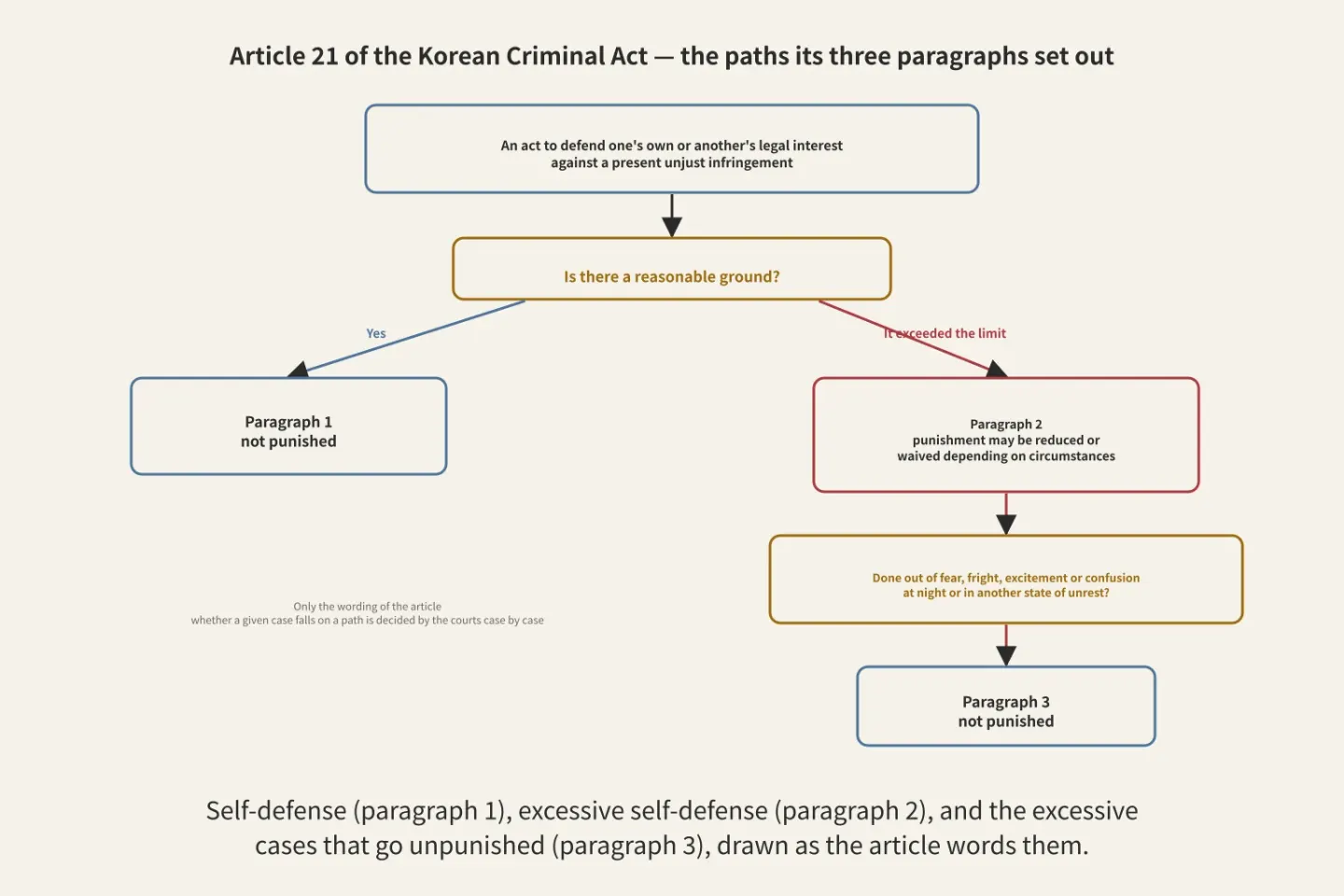
Figure: A diagram drawn by Paperis using only the text of the body
The Seoul High Court divided this act into two parts. Up to choking and knocking him down was a reasonable act to protect the lives and bodies of the mother and younger brother. Continuing to press down on his neck even after the older brother fell and could no longer continue his attacks was an act that lost reasonableness. However, because a series of acts occurring within a very short time must be viewed as a single act as a whole, it falls under excess defense in Article 21, Paragraph 2, and it judged that the act was committed due to fear, terror, excitement, and panic in the anxious state where a person holding a knife at night threatened the family. The Supreme Court dismissed the prosecutor's appeal, stating that this judgment was acceptable (Supreme Court 86Do1862). The summary attached to the head of the judgment records this ruling as an example where excess defense originated from such an anxious state and was judged unpunishable (Supreme Court 86Do1862). How to read the conclusion of a judgment and its reasons separately is covered in "How to Read a Court Judgment — A One-Line Answer and Its Reasons".
Placing the two cases side by side reveals the center of the debate. In the 1986 case, the Supreme Court accepted the lower court's ruling that bundled the choking after the opponent collapsed together with the initial defense as a single mass (Supreme Court 86Do1862). In the 2016 case, the Supreme Court separated the additional assault against the fallen burglar from the initial assault (DOI: 10.23102/kaccs.2020.28..001).
Academia is divided over this boundary. One paper argues that in the burglar brain death case, the unlawful state of entry into the house had not been resolved and the burglar continued trying to move, so the contemporaneity of the infringement and the intent to protect were recognized, and even if not, the entire series of acts closely connected in time and place should have been viewed as defense, recognizing at least excess defense (DOI: 10.35148/ilsilr.2018..41.287). Another paper also views that in cases where counterattacks are repeated in a special space like a house, if the initial counterattack was justified, it is necessary to recognize it as excess defense even if a little time has passed after subduing the opponent (DOI: 10.21589/ajlaw.2016.10.2.147). A paper standing on the opposite side argues that there was no imminent serious danger to life or body at the time of the additional assault, so it cannot be excess defense, and that it is reasonable to strictly evaluate whether it was objectively a reasonable defense (DOI: 10.23102/kaccs.2020.28..001). A 2026 study dealing with a situation where a special education teacher responds to attacks by a student with disabilities analyzes three judgments (86Do1862, 2016Do2794, 2020Do6874) together, proposing a criterion to judge acts following the end of an infringement not by whether the defender knew the infringement had ended, but by whether the same defensive process continued (KCI ART003374851).
Whether to view acts after the opponent has fallen as an extension of the initial defense or as a new attack after the defense has ended is at the very center of the excess defense debate.
Half of the Saying "Korea Doesn't Allow It"
According to a 2025 study, the perception that "self-defense is hard to have recognized in Korea" is the legal sentiment of citizens conveyed through news reports, and is the consensus among expert researchers as well. The same study points out that this perception focuses only on court rulings and misses the fact that there are a considerable number of cases where self-defense was recognized at the investigative stage. Through this study's analysis, past investigative practice showed cases where self-defense was boldly recognized and ended in non-prosecution in homicide cases involving weapons, and this tendency appeared in cases where investigative agencies recognized self-defense after the Criminal Act went into effect. Within the recognized cases collected by this study, self-defense was recognized when a person used a weapon to fight back and caused the death of an assailant who had attacked them with a weapon first, and there were no cases where failing to retreat from the spot was viewed unfavorably. Within the same sample, cases where an intruder who broke into one's home at night was attacked first with a weapon and died were all recognized as excess defense, and a special provision applying non-punishment on the grounds of ruling out accountability was applied. In the samples where women stabbed or seriously injured rapists with weapons, self-defense was recognized in all cases and they were not prosecuted (DOI: 10.17007/klaj.2025.74.2.010). This is the tendency of recognized cases that ended at the investigative stage, and there are also cases where neither self-defense nor excess defense was recognized in court, such as the burglar brain-death incident where a burglar who broke into a house at night was beaten (DOI: 10.35148/ilsilr.2018..41.287).
When a case ends at the investigative stage, it does not remain as a court ruling. One study highlights as a problem that because of the system where prosecutors can choose not to indict after considering the circumstances, there is a limit to how much self-defense case law can accumulate (KCI ART003401115). There is also a contrasting picture. A domestic study comparing Korea with the United States views that Korea does not have laws granting broad privileges and authority to the defending person like many U.S. states do, and that "reasonable grounds" is interpreted more narrowly than the U.S. "reasonably believed threat." It is this study's evaluation that the Supreme Court has emphasized the principle of proportionality without presenting clear criteria for reasonableness, and as a result, the number of accepted self-defense claims was small (DOI: 10.17251/legal.2022.35.2.265).
Proposals to amend the law have also been made. A 2026 study proposes three things: aligning the judgment of immediacy regarding imminent and recurring infringements with reality and reviewing the possibility of preventive defense, changing the reduction or exemption in excess defense—which courts can currently choose—into a mandatory reduction or exemption, and establishing a provision presuming self-defense in situations that create grave risks to life and limb, such as home invasion or rape. The same study adds that the expansion of self-defense must not lead to results that indiscriminately permit private retaliation (KCI ART003401115). There is also a proposal to explicitly state defense that continues even after the infringement has ended during the course of defense in the excess defense provision (DOI: 10.21795/kcla.2025.37.1.161). On the other hand, a paper supporting 2020Do6874 notes that amendments to the self-defense provisions must undergo thorough review and public comment (DOI: 10.17257/hufslr.2023.47.2.67).
The two pictures—narrow if you look only at rulings, and broader if you look all the way to the investigative stage—exist together, and a tabulation combining the two into a single table is not among the materials of this article.
The United States Widened It in the Opposite Direction
In 2005, the Florida legislature created a new self-defense law (DOI: 10.1017/s1742058x19000092), and following that, the majority of U.S. states expanded the right to use lethal force outside the home (PMID 33621113). The rule before this expansion was the opposite. The duty to retreat is the requirement that if one can safely withdraw, one must retreat before using lethal force. American self-defense law includes this requirement, with the home as its exception (DOI: 10.17251/legal.2022.35.2.265). The castle doctrine is the principle that inside one's own home, one can defend oneself, one's home, and one's property against intruders without retreating, using lethal force if necessary. According to research tracing its legal lineage historically, between 2005 and 2008 alone, 23 states newly passed such laws (DOI: 10.1177/0734016809332095).
Stand-your-ground laws are U.S. state laws that allow a person to stand their ground without a duty to retreat outside the home, anywhere they have a right to be. One compilation counts 28 states with such laws (DOI: 10.17251/legal.2022.35.2.265), while another tally adds 8 states where court rulings achieve virtually the same effect to the 27 states that established it by statute (DOI: 10.1177/07340168221124453).
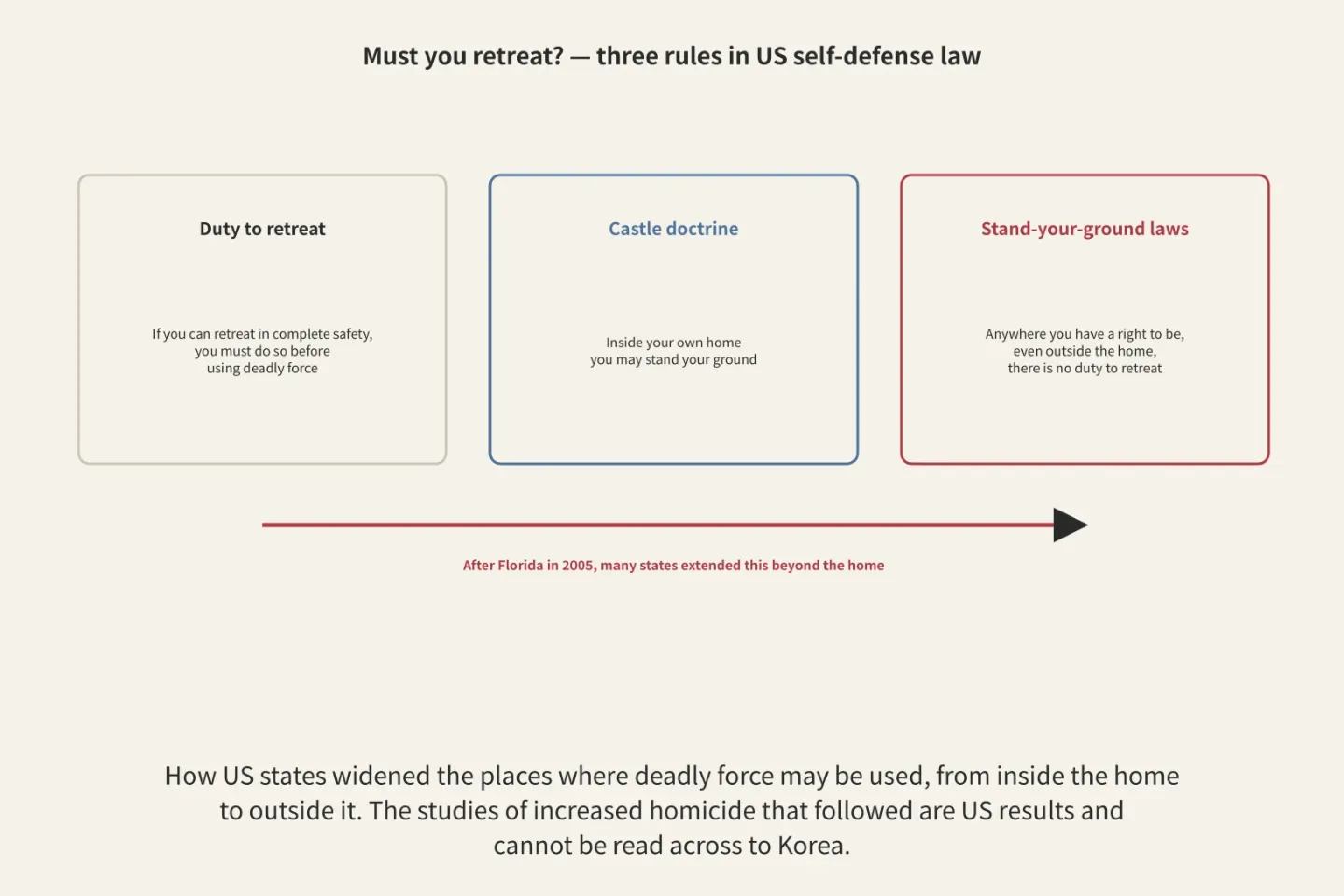
Figure: A diagram drawn by Paperis based solely on the text
Proponents claimed these laws deter crime, whereas opponents argued they justify vigilante justice (DOI: 10.1177/07340168221124453). What the studies measured are crime and homicide after the laws changed. The designs, locations, and periods are noted together.
- Taking advantage of the timing of more than 20 states changing their laws between 2000 and 2010, an economic study comparing the before-and-after changes in states that changed their laws with changes in states that did not found no deterrent effect on burglary, robbery, and aggravated assault, and reported an 8% net increase in reported homicides and non-negligent manslaughters (DOI: 10.3368/jhr.48.3.821). The working paper version of that study notes that most of the increased homicides were classified as homicides by police (DOI: 10.3386/w18134).
- Another economic study comparing states that changed their laws and those that did not using state-level monthly data estimated that these laws cause at least 30 deaths every month, and presented evidence linking them to an increase in firearm-related hospital admissions (DOI: 10.3368/jhr.52.3.0613-5723r2).
- A study comparing pre- and post-law trends using monthly data from 1999 to 2014 in the single state of Florida found that the homicide rate increased by 24.4% and the firearm homicide rate by 31.6% following implementation. There was no change in four comparison states lacking this law, and the suicide rate, which should have been unrelated to the law, also did not change (PMID 27842169).
- A study comparing 23 states that enacted the law between 1999 and 2017 with 18 states that lacked it found that law implementation was associated with a 7.8% increase in the monthly homicide rate and an 8.0% increase in the firearm homicide rate, with the magnitude of increase being largest in Southern states like Alabama, Florida, Georgia, and Louisiana at 16.2% to 33.5%. There was no change in the suicide rate, which should have been unrelated to the law (PMID 35188553).
There are other findings. A study analyzing data from 1980 to 2018 found no strong relationship in either direction between these laws and crime, suggesting that the costs and benefits of these laws would stem from expanding legal and ethical protections for individuals who act in self-defense rather than from increases or decreases in crime (DOI: 10.1177/07340168221124453). A study comparing each of the 14 states that passed laws in the first wave against a synthetic comparison group using 1991–2012 data found that firearm deaths increased in only three states: Florida, Alabama, and Michigan. Those three states had imposed a duty to retreat prior to the law, and when narrowed to homicide and non-negligent manslaughter, Florida was the only place where an effect emerged (DOI: 10.1080/00343404.2017.1371846). In Texas, following the 2007 implementation of the castle doctrine law and a November shooting in Houston that year which widely publicized the law, residential and commercial burglaries in Houston decreased significantly, whereas those in Dallas did not. The authors view this result, seen in the two cities' daily data for 2007–2008, as a deterrent effect that varies by location (DOI: 10.1177/0011128712466886).
A 2021 systematic review brought these studies together. It identified 25 papers covering U.S. expanded self-defense laws, all of which were evaluated as having "serious" or "critical" risk of bias due to confounding factors. Across state averages, violent crime ranged from no change to a small increase, while Florida studies showed a 24% to 45% increase in firearm homicides and overall homicides. Racial disparities also emerged, wherein self-defense claims were dismissed more frequently when the victim was White, particularly when the asserter was a minority. The authors concluded that the existing evidence contradicts the claim that expanded self-defense laws deter violent crime nationwide, and associates them with increased violence in at least some contexts, including Florida (PMID 33621113).
These figures cannot be directly transposed to South Korea. All 25 papers gathered by the review dealt with U.S. laws (PMID 33621113), and handguns are one of the most common means used for self-defense in the United States (DOI: 10.17251/legal.2022.35.2.265). What the studies measured is the change in homicides appearing after a bundle of laws that eliminated the duty to retreat and expanded immunity in a society where handguns are commonly used for self-defense. The U.S. expansion laws also included provisions presuming that individuals reasonably believed imminent harm was present (DOI: 10.3386/w18134), a mechanism resembling the proposal for presumed lawful self-defense in South Korea examined earlier. However, the figures from U.S. research are not estimates of what would happen if South Korean criminal law were amended.
The "Present" of the Person Being Beaten
In 1985, the younger sister in that home took action at the moment her brother was holding a knife and choking their younger brother (Supreme Court Decision 86Do1862, [Dec 23, 1986]). Cases involving victims of domestic violence become most difficult under the law when they are not such moments. One paper notes that Korean case law has rejected self-defense and excessive defense in domestic violence victims' counterattacks without considering their specific circumstances, citing reasons such as the defense exceeding limits and being unacceptable under social norms, or—particularly when not facing the abuser—the absence of the immediacy of the infringement (KCI ART002392933). The Supreme Court strictly applied the point at which the infringement ended in the so-called "violent husband assault brain-death case," refusing to recognize immediacy for an assault that occurred immediately after the infringement, whereas in a case involving the murder of a stepfather, it left room for immediacy to be recognized by stating that if an infringement has already occurred and its repetition in the future is deemed likely, the infringing situation can be viewed as ongoing, according to one paper (DOI: 10.21717/ylr.35.1.7).
The same paper states that the United States adopts theories explaining the psychology of battered women to broadly recognize self-defense even in non-confrontational situations, but notes that the situation differs because Korean criminal law requires the immediacy of the infringement objectively rather than from the defender's subjective belief. At the same time, it argues that even if a counterattack is murder and does not involve facing the abuser, it is reasonable to relax the interpretation of the immediacy of the infringement and closely judge proportionality by considering the specific circumstances of a domestic violence victim's counterattack. As a legislative measure, it proposes introducing a provision for preventive self-defense into the Act on Special Cases Concerning the Punishment of Domestic Violence Crimes (KCI ART002392933).
There are two branches of theories attempting to broaden the "present." One turns its gaze toward the abuser. Because the state in which a domestic violence perpetrator tramples on the victim's freedom of will and human dignity continues, the crisis hanging over the victim's life persists even when the abuser is asleep, according to this framework (DOI: 10.14819/krscs.2016.26.1.6.139). There is also a 2025 paper that suggests reinforcing this framework with the concept of coercive control (DOI: 10.36220/kjv.2025.33.2.149). The other focuses on interpreting immediacy strictly, noting that if it is standardized violence that has recurred whenever the same conditions are met, one can objectively foresee that the infringement will happen again "soon" (DOI: 10.38133/cnulawreview.2025.45.2.105).
On the other side, these arguments are raised. One concern is that relaxing immediacy itself could lead to the abuse of self-defense, shaking the legal order. This paper is also open to expanding cases of recognition within the standards of the 2023 ruling (DOI: 10.17257/hufslr.2023.47.2.67). There is also criticism that domestic arguments relying on the U.S. battered woman theory failed to first examine whether that theory is scientifically accepted and whether it can enter the Korean criminal law system without friction (DOI: 10.22826/jpl.2009.7.2.360). Even within the United States, writings defending the imminence requirement argue that in civil society, the use of force is entrusted to the state, and exceptions are granted to individuals only in the face of imminent threats where the state cannot intervene in time (DOI: 10.1525/nclr.2007.10.3.342). Conversely, those who view the abusive relationship as a long-unfolding process of murder argue that once the abuser's remorse vanishes, imminence becomes a constant state (DOI: 10.5040/9798216012580).
The United Kingdom has criminalized coercive control—which traps a partner—as a form of domestic violence, but there are still no cases where self-defense was recognized in incidents where a wife subjected to such abuse killed her husband, and it is instead treated as a statutory mitigating ground reducing murder to manslaughter (DOI: 10.36220/kjv.2025.33.2.149). A domestic paper reviewing this notes that it appears largely no different from South Korea, which resolves the issue through sentencing, but points out that South Korea does not accept the concept of coercive control itself, meaning situations that would be recognized as severe abuse in the U.K. might be mistaken as not being abuse in Korea (DOI: 10.36220/kjv.2025.33.2.149).
Those who want to protect immediacy say we should permit individual force only at moments when the state cannot arrive in time, while those who want to broaden it say that moment never ends inside an abused home.
Open Questions
The standard from the 2023 ruling came from a labor-management conflict case, and its conclusion was also not the confirmation of self-defense, but an order for a new trial (Supreme Court 2020Do6874). Whether this standard will be used in domestic violence or home invasion cases cannot be known from the data in this article.
An aggregation counting cases where self-defense was recognized at the investigation stage together with court rulings is also not in the data of this article. Although there is criticism that this perception is based only on court rulings (DOI: 10.17007/klaj.2025.74.2.010), measuring the true scale of the statement "Korea does not grant self-defense" requires such an aggregation.
Whether to amend the law is also open. There are proposals to establish a presumption of self-defense and mandatory reduction or exemption of punishment (KCI ART003401115), as well as a cautious view that thorough review must come first (DOI: 10.17257/hufslr.2023.47.2.67). While several studies on U.S. empirical data have reported increases in homicides, other studies have found no strong relationship with crime, and a review indicated that the risk of bias due to confounding is severe (PMID 33621113). Because it is also a figure from a society where handguns are commonly used for self-defense, it cannot substitute for the answer to the debate on the Korean side.
The legal provisions draw a line with two phrases: "current unlawful infringement" and "substantial reason," and actually drawing that line is the judgment in each individual case. In Korea, that line lies somewhere between the dawn in that house in 1985 and the living room at dawn in the thief brain-death case, and the 2023 ruling explicitly clarified the standard for measuring the "now" between the two phrases (DOI: 10.17257/hufslr.2023.47.2.67).
Source Papers
- Article 21 of the Criminal Act (Self-Defense) — Korea Legislation Research Institute, National Law Information Center original text (Enforced 2026.10.2) — Three clauses on self-defense, excess in defense, and exemption from punishment for nighttime panic
- Supreme Court 86Do1862 (1986.11.11) — Full text of the judgment — A younger sister who choked her brother during his knife attack; the lower court's view treating the series of acts as a single instance of excess in defense not punishable under paragraph 3 was accepted, and the prosecutor's appeal was dismissed
- Supreme Court 2013Do2168 (2017.3.15) — Full text of the judgment — The lower court's decision upholding injury inflicted in response to an unlawful arrest as self-defense; no self-defense against lawful infringement, includes defense of another's legal interests, and factors for assessing proportionality
- Supreme Court 2020Do6874 (2023.4.27) — Full text of the judgment — The immediacy of an infringement lasts until the entire infringing situation concludes; includes counter-attack defense; lower court decision reversed and remanded (Defendant 2), Defendant 1's appeal dismissed
- "'The Burglar Brain-Death Incident' Is Excess in Defense" (2015) — DOI: 10.21795/kcla.2015.27.3.261 — The gap between judicial rulings and public legal sentiment, 4 cases of recognized excess in defense by the Supreme Court since 1953, arguing for the introduction of a habitation defense legal doctrine
- "A Critical Review of Case Law Narrowly Interpreting the Concept of Excess in Defense" (2016) — DOI: 10.21589/ajlaw.2016.10.2.147 — Korean criminal law sets a broad standard for excess in defense, but courts recognize it extremely narrowly; repeated counter-attacks within a home need to be recognized as excess in defense
- "A Critical Review on Self-Defense and Excess in Defense in Light of the So-Called 'Burglar Brain-Death Incident' Ruling" (2018) — DOI: 10.35148/ilsilr.2018..41.287 — Courts rejected both self-defense and excess in defense due to a lack of defensive intent, reflecting it only in sentencing; the author views recognizing at least excess in defense as reasonable
- "The Meaning and Recognition Criteria of Excess in Defense as Seen Through the Burglar Brain-Death Incident" (2020) — DOI: 10.23102/kaccs.2020.28..001 — The Supreme Court separated the initial and additional assaults, viewing the additional assault as an active attack; the author considers a strict interpretation reasonable
- "The Possibility of Expanding the Concept of 'Immediacy of Infringement' as a Requirement for Self-Defense" (2025) — DOI: 10.21717/ylr.35.1.7 — 2020Do6874 is positively evaluated for relaxing immediacy; room for denying preventive self-defense; contrasted with the abusive husband brain-death incident and the stepfather murder case
- "Criteria for Determining the 'Immediacy of Infringement' in Self-Defense" (2026) — DOI: 10.23894/kjccl.2026.28.1.003 — 2020Do6874 expanded the scope of recognition using an objective prior judgment standard
- "A Short Essay on the 'Immediacy of Infringement' Among Self-Defense Requirements" (2023) — DOI: 10.17257/hufslr.2023.47.2.67 — The Supreme Court's first explicit statement, endorsed; easing situations of habitual abuse is difficult; statutory amendment requires thorough review
- "A Criminal Law Study on Teachers' Defensive and Restraint Actions in Special Education Settings" (2026) — KCI ART003374851 — Analysis of three rulings, proposing the defense process identity theory
- "Can Murder Constitute Self-Defense?" (2025) — DOI: 10.17007/klaj.2025.74.2.010 — Analysis of cases where self-defense was recognized at the investigative stage, identifying four tendencies in past practice
- "An Essay on Measures to Expand Self-Defense in Our Criminal Law" (2026) — KCI ART003401115 — Limits to building case law due to prosecutorial discretion; proposes actualizing immediacy, mandatory reduction or exemption, and a presumption of self-defense, while guarding against vigilante retaliation
- "Contents and Direction of Amendment of the Excess in Defense Provision: Reimagining Quantitative Excess in Defense" (2025) — DOI: 10.21795/kcla.2025.37.1.161 — Proposal to include ex post facto quantitative excess in defense in statutory text
- "A Study on the Exercise of Deadly Force as a Means of Self-Defense and Second Amendment Rights in the United States" (2022) — DOI: 10.17251/legal.2022.35.2.265 — Overview of the duty to retreat, Castle Doctrine, and Stand Your Ground; Korea has no equivalent law and proportionality is interpreted more narrowly
- "The State of the Castle" (2009) — DOI: 10.1177/0734016809332095 — The legal genealogy and legislative spread of the Castle Doctrine
- "ORIGINATING STAND YOUR GROUND" (2019) — DOI: 10.1017/s1742058x19000092 — Analysis of the 2005 Florida legislative process
- "No Retreat: The Impact of Stand Your Ground Laws on Violent Crime" (2022) — DOI: 10.1177/07340168221124453 — 1980–2018, no strong relationship in either direction with crime
- "Does Strengthening Self-Defense Law Deter Crime or Escalate Violence? Evidence from Expansions to Castle Doctrine" (2013) — DOI: 10.3368/jhr.48.3.821 — No deterrent effect, 8% net increase in homicides
- "Does Strengthening Self-Defense Law Deter Crime or Escalate Violence? Evidence from Castle Doctrine" (2012, working paper) — DOI: 10.3386/w18134 — Elements of the law (including presumption of reasonable belief), increased homicides are mostly homicides under police classification
- "Stand Your Ground Laws, Homicides, and Injuries" (2016) — DOI: 10.3368/jhr.52.3.0613-5723r2 — Difference-in-differences, estimated at least 30 additional deaths per month, increase in gunshot wound hospitalizations
- "Evaluating the Impact of Florida's 'Stand Your Ground' Self-defense Law on Homicide and Suicide by Firearm" (2017) — PMID 27842169 — Florida interrupted time series, homicides increased by 24.4% and firearm homicides by 31.6%, no change in comparison states or suicides
- "Analysis of 'Stand Your Ground' Self-defense Laws and Statewide Rates of Homicides and Firearm Homicides" (2022) — PMID 35188553 — 41 states, homicides increased by 7.8% and firearm homicides by 8.0%, greatest in the South
- "Stand Your Ground laws, homicides and gun deaths" (2017) — DOI: 10.1080/00343404.2017.1371846 — Synthetic control, only 3 out of 14 states showed increased firearm deaths
- "The Deterrent Effect of the Castle Doctrine Law on Burglary in Texas" (2012) — DOI: 10.1177/0011128712466886 — Houston decreased, Dallas did not
- "Effects of Laws Expanding Civilian Rights to Use Deadly Force in Self-Defense on Violence and Crime: A Systematic Review" (2021) — PMID 33621113 — All 25 papers on the US; high risk of confounding bias; average change ranges from none to a slight increase, Florida up 24–45%, conflicting with deterrence claims
- "A Critical Review on the Establishment of Self-Defense for Victims of Domestic Violence" (2018) — KCI ART002392933 — Case law denies immediacy in non-face-to-face situations; Korea objectively requires immediacy; proposal for preventive self-defense legislation
- "Battered Women and Self-Defense — Focusing on the Killing of a Sleeping Domestic Violence Husband" (2016) — DOI: 10.14819/krscs.2016.26.1.6.139 — Continuing offense structure
- "A Study on the Immediacy of Infringement in Self-Defense — The Significance of 'Continuing Risk' in Counter-Attack Incidents by Domestic Violence Victims" (2025) — DOI: 10.38133/cnulawreview.2025.45.2.105 — Continuing risk of stereotyped violence amidst strict interpretation
- "Interpretation Theory of Reasonableness as a Requirement for Establishing Self-Defense in the United States" (2009) — DOI: 10.22826/jpl.2009.7.2.360 — Scientific acceptance of battered woman syndrome and preliminary review of consistency with Korean criminal law needed
- "Self-Defense, Imminence, and the Battered Woman" (2007) — DOI: 10.1525/nclr.2007.10.3.342 — Defending the imminence requirement (state monopoly on force)
- "Self-Defense and Battered Women Who Kill" (2002) — DOI: 10.5040/9798216012580 — Imminence as a constant once remorse disappears
- "The Killing of an Abusive Husband by a Battered Woman under Coercive Control and the Problem of Self-Defense" (2025) — DOI: 10.36220/kjv.2025.33.2.149 — The UK also has no cases recognizing self-defense, handled as a mitigating factor; Korea does not accept coercive control
Sources (27)
- 도둑뇌사사건은 과잉방위이다DOI 10.21795/kcla.2015.27.3.261
- 과잉방위의 개념을 제한적으로 해석하는 판례에 대한 비판적 고찰DOI 10.21589/ajlaw.2016.10.2.147
- 이른바 '절도범 뇌사 사건' 판결에 비추어 본 정당방위⋅과잉방위에 관한 비판적 고찰DOI 10.35148/ilsilr.2018..41.287
- 도둑뇌사사건을 통해 본 과잉방위의 의미와 인정기준DOI 10.23102/kaccs.2020.28..001
- 정당방위 요건으로서 '침해의 현재성' 개념의 확장 가능성DOI 10.21717/ylr.35.1.7
- 정당방위에서의 침해의 현재성을 판단하는 기준DOI 10.23894/kjccl.2026.28.1.003
- 정당방위 요건 중 '침해의 현재성'에 대한 소고DOI 10.17257/hufslr.2023.47.2.67
- 살인이 정당방위가 될 수 있는가DOI 10.17007/klaj.2025.74.2.010
- 과잉방위 규정의 내용과 개정 방향: 양적 과잉방위의 재구상DOI 10.21795/kcla.2025.37.1.161
- 미국에서 정당방위 수단으로서 치명적 위력의 행사와 수정헌법 제2조 권리에 대한 연구DOI 10.17251/legal.2022.35.2.265
- The State of the CastleDOI 10.1177/0734016809332095
- ORIGINATING STAND YOUR GROUNDDOI 10.1017/s1742058x19000092
- No Retreat: The Impact of Stand Your Ground Laws on Violent CrimeDOI 10.1177/07340168221124453
- Does Strengthening Self-Defense Law Deter Crime or Escalate Violence? Evidence from Expansions to Castle DoctrineDOI 10.3368/jhr.48.3.821
- Does Strengthening Self-Defense Law Deter Crime or Escalate Violence? Evidence from Castle DoctrineDOI 10.3386/w18134
- Stand Your Ground Laws, Homicides, and InjuriesDOI 10.3368/jhr.52.3.0613-5723r2
- Evaluating the Impact of Florida's 'Stand Your Ground' Self-defense Law on Homicide and Suicide by FirearmPMID 27842169
- Analysis of 'Stand Your Ground' Self-defense Laws and Statewide Rates of Homicides and Firearm HomicidesPMID 35188553
- Stand Your Ground laws, homicides and gun deathsDOI 10.1080/00343404.2017.1371846
- The Deterrent Effect of the Castle Doctrine Law on Burglary in TexasDOI 10.1177/0011128712466886
- Effects of Laws Expanding Civilian Rights to Use Deadly Force in Self-Defense on Violence and Crime: A Systematic ReviewPMID 33621113
- 피학대여성과 정당방위 — 잠자는 가정폭력 남편의 살해를 중심으로DOI 10.14819/krscs.2016.26.1.6.139
- 정당방위에서의 침해의 현재성에 관한 연구 — 가정폭력 피해자의 반격행위 사건에서 '계속위험'의 의의DOI 10.38133/cnulawreview.2025.45.2.105
- 미국의 정당방위 성립요건인 합리성의 해석론DOI 10.22826/jpl.2009.7.2.360
- Self-Defense, Imminence, and the Battered WomanDOI 10.1525/nclr.2007.10.3.342
- Self-Defense and Battered Women Who KillDOI 10.5040/9798216012580
- 강압적 통제 피학대여성의 가해 남편 살해와 정당방위의 문제DOI 10.36220/kjv.2025.33.2.149