Paperis Articles
Audiobooks — Does a Page Turned by Ear Count as Read?
Hold the claim that listening isn't reading up against comprehension research, and the pooled difference across 46 studies spanning age groups sits near zero and is not statistically significant. Reading pulled ahead when readers set their own pace and when questions required inference, and in one study of 8- and 9-year-olds, hearing new words did not teach their written forms.
Your field's papers, as audio
Pick your fields and journals — Paperis summarizes the key papers and turns them into audio. Listen on your commute.
Start Paperis free →Audiobooks — Does a Page Turned by Ear Count as Read?
"That's Not Reading"
A person on the morning subway finishes listening to a long novel through earphones and says, "I read a book this month." The colleague in the next seat smiles and replies, "You listened to that, you didn't read it." This brief conversation contains a long-running debate. Regarding whether listening to an audiobook can be counted as reading, one side says the two are the same, while the other counters that they are two different ways of receiving information and different aesthetic experiences (DOI: 10.1016/j.poetic.2025.102021).
This debate is not settled on one side even among people who enjoy listening to audiobooks. In a focus group study that gathered 34 people who regularly listen to audiobooks to talk, participants did not view listening as either worse or better than reading, and each showed different perspectives. While some remarks suggested that listening to audiobooks is sometimes rated higher than reading—with better comprehension of content, visualization of scenes, and immersion—not all listeners experienced this, and the participants themselves described a clear difference between reading and listening (DOI: 10.1016/j.poetic.2025.102021). Because these are subjective impressions reported by the 34 people themselves, what and how much they actually understood must be measured separately.
The statement "audiobooks are not real reading" blends two claims. One is the claim that listening leads to less comprehension, and the other is the claim that listening and reading are different experiences. The latter is something the listeners above also acknowledge. This article mainly deals with the first claim, namely comprehension. Furthermore, the comprehension of someone who already knows how to read and the reading development of a child learning letters for the first time are different issues, so they are addressed separately.
Stripping Letters from Reading
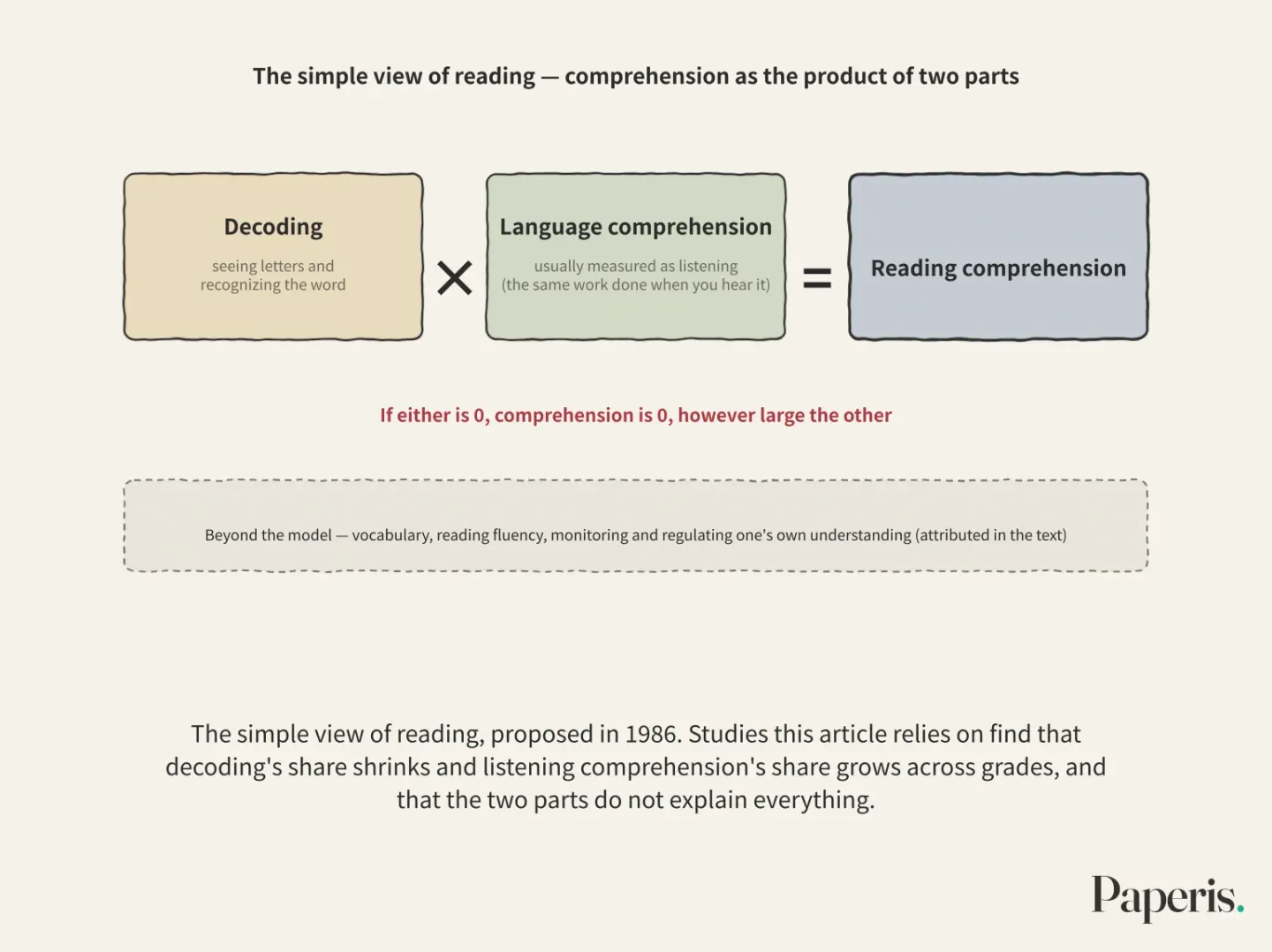
The act of reading can be divided into two stages. Decoding is the act of looking at letters and recognizing what word they form. Once the words are recognized, what remains is understanding the sentences and stories made of those words, and this second task must be done in the exact same way when listening to the same content aloud. The simple view of reading model is an explanation that sees the power of reading and understanding text as the product of decoding and linguistic comprehension. Here, linguistic comprehension is commonly measured as listening comprehension. The word "product" has a specific meaning. If either of these two is zero, text comprehension becomes zero no matter how large the other is. A child who understands spoken language well cannot understand text if they cannot recognize the letters, and a child who can read letters aloud fluently cannot understand the text if they do not understand those words.
Whether the "product" must strictly be a multiplication was tested separately. In a study of 40 third-grade students, whether decoding and listening comprehension were multiplied or added did not make a meaningful difference in the results, and together the two accounted for 48% of the difference in text comprehension scores, with the speed of rapid letter naming explaining an additional 10% (DOI: 10.1080/02702710050084428).
This model was introduced in 1986. In a study tracking six years from age four to nine, differences in text comprehension scores at age seven were almost entirely explained (99.7%) by combining linguistic comprehension, decoding, and the interaction and curve effects of the two, and the researchers viewed this as strong support for an expanded version of the simple view of reading model (DOI: 10.1037/edu0000321). As grade level increases, the weight of the two parts changes. In a study comparing grades 1 to 3, the impact of decoding decreased as grade level rose, while the impact of listening comprehension grew (DOI: 10.1002/rrq.99). In a study looking at 271 students in grades 4, 7, and 9, the share explained by decoding was smaller in grades above the 4th grade, and the share of listening comprehension grew between the 4th and 7th grades before remaining steady through the 9th grade. In the same study, the share explained by the model as a whole decreased as grade levels rose, and vocabulary skills and reading fluency explained a substantial additional share outside the model (DOI: 10.1111/j.1467-9817.2009.01401.x). This means that the more familiar recognizing letters becomes, the more the success or failure of reading depends on the ability to understand spoken language, though the two factors alone do not explain everything.
There are also children whose second factor breaks down separately. In a meta-analysis of 86 papers covering children who recognize letters properly but have poor text comprehension, these children also lagged in spoken language skills such as vocabulary and listening comprehension. However, the difference in spoken language skills (effect size −0.78) was not as large as the difference in text comprehension (−2.78) (DOI: 10.3102/0034654317749187). In a study followed from age five, the language skill weaknesses of children classified into this group at age eight were already present when they entered school and persisted thereafter (DOI: 10.1111/j.1469-7610.2010.02254.x). This is evidence that difficulty in text comprehension goes hand in hand with weaknesses in the ability to understand spoken language.
In adults, too, the two abilities move together. In adults, the skill of understanding text correlated highly with the skill of understanding spoken language, and also correlated highly with the skill of understanding picture stories that have neither text nor speech (DOI: 10.1037/0278-7393.16.3.430). In a meta-analysis gathering 108 correlation datasets, the correlation between content knowledge and comprehension was identical at 0.41 for both listening comprehension and reading comprehension. However, in the experimental data from the same meta-analysis, instruction teaching content knowledge raised reading comprehension (0.44) but failed to raise listening comprehension (0.13) (DOI: 10.1037/bul0000502). Even though the magnitude of the correlation is the same, the side that moved when taught was only reading comprehension.
Brain imaging shows a similar picture. In a study where participants' brain activity was recorded and compared while they listened to or read the same story for several hours, the representations of word meanings evoked by listening and reading were nearly identical across most of the cortical regions responsive to meaning, and a model built from one type of data accurately predicted the responses to the other (PMID 31427396). However, the exact locations and amounts of activation appearing when understanding the same sentences with the eyes and ears differed across multiple regions, and the authors of that study interpreted this as indicating several subtle differences in the processing underlying listening and reading. The way the burden increased as sentence structures grew complex was very similar across both pathways (DOI: 10.1002/hbm.1036). The representations of meaning overlap almost entirely, but there are differences in the processing that leads to them.
This model does not explain all of reading. A review article summarizing research over the 35 years since the model was introduced notes that reading difficulties include causes not bundled into decoding and listening comprehension, that the two factors overlap with each other, and that an active process of self-monitoring and regulating comprehension plays a major role in reading (DOI: 10.1002/rrq.411).
There is one takeaway from this section. The more familiar recognizing letters becomes, the more text comprehension overlaps with the power to understand spoken language, but the two factors alone do not explain everything. Even in adults, text comprehension and speech comprehension correlate highly.
Bringing 46 Papers Together
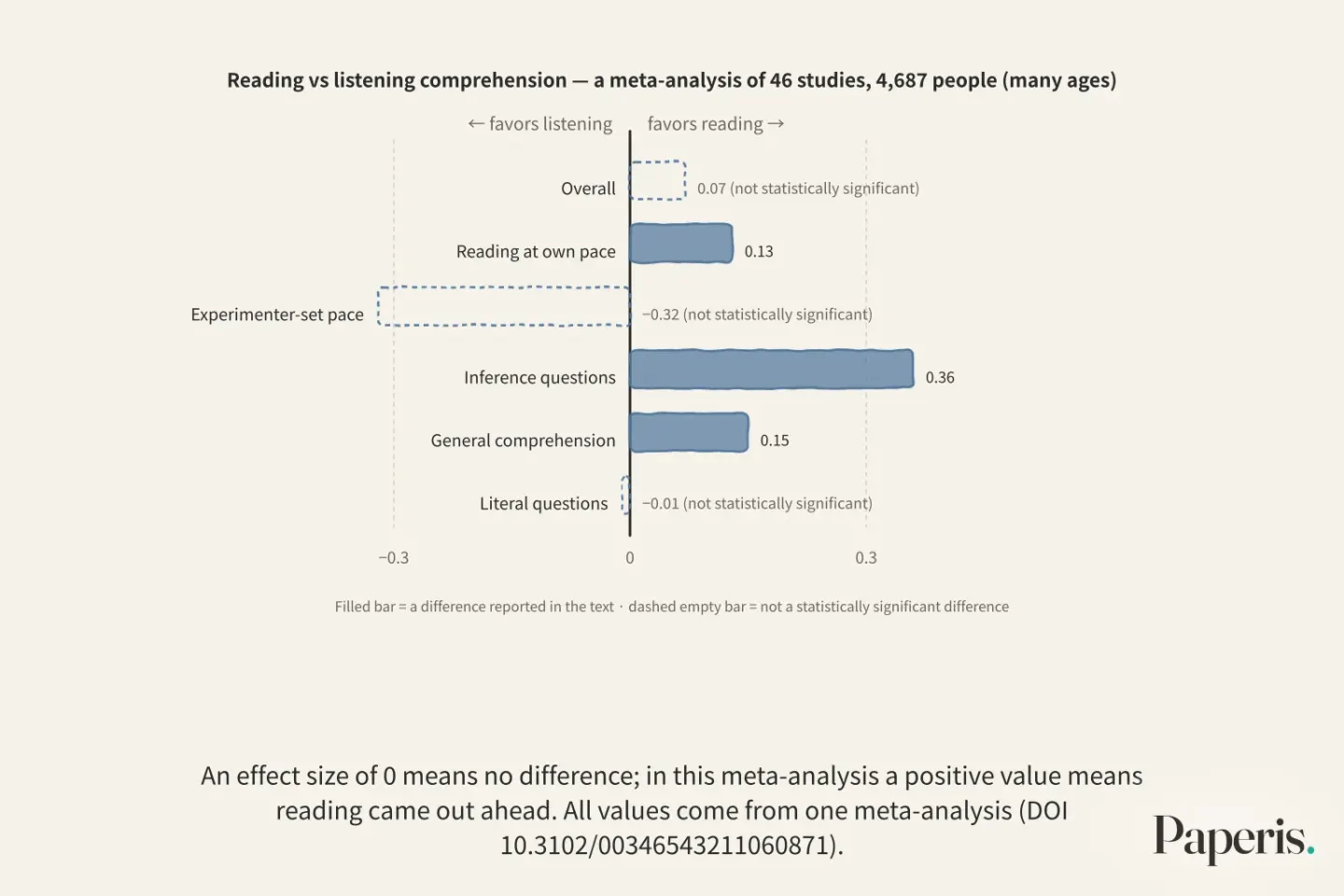
There are many experiments comparing understanding by giving the same text to a group that reads with their eyes and a group that listens with their ears. A meta-analysis is a method that gathers the results of multiple studies on the same question and recalculates them all at once. There is a meta-analysis that gathered 46 such comparative studies with 4,687 participants. The people included in the comparison span various age groups (DOI: 10.3102/00346543211060871).
To read the results, you need to know one number. Effect size is a value comparing the difference between the averages of two groups against the spread of their scores, a number that lets studies using different tests be placed side by side and compared. If it is 0, there is no difference, and in this meta-analysis, a positive number means reading was better.
The overall combined effect size was 0.07, and the difference in comprehension between reading and listening was not a statistically meaningful difference (DOI: 10.3102/00346543211060871). When combining 46 papers spanning various age groups, the comprehension difference between reading and listening was close to 0, but depending on the conditions, reading had the edge. Those conditions are two.
The first is who determines the pace. The self-paced condition is an experimental condition where the reader decides for themselves the speed at which they flip through the text. The experimenter-paced condition is a condition where the experimenter sets the speed in advance. When reading was under the self-paced condition, reading was slightly better (0.13), and when it was under the experimenter-paced condition, the number tipped slightly toward listening (−0.32), but it was not a statistically meaningful difference (DOI: 10.3102/00346543211060871).
The second is what is being asked. Inference questions are questions that cannot be answered by what is written directly in the text, requiring you to connect the dots to guess the answer. Literal questions are questions that directly ask about the contents written in the text. When asking about inferences, the advantage of reading was 0.36, when asking about overall comprehension it was 0.15, and when asking about literal content it was −0.01, showing no statistically meaningful difference (DOI: 10.3102/00346543211060871). Looking at the averages, the difference between those who listened and those who read was almost 0 for questions asking about written content, while readers pulled ahead for questions connecting between the lines and questions asking about overall comprehension.
Looking closely at one such comparative experiment, it goes like this. In an experiment where 91 participants were randomly divided into three groups and given the preface and one chapter of the same nonfiction book via a digital audiobook, electronic text, and both together, there was no statistically meaningful difference among the three groups either in the comprehension test taken immediately afterward or in the test taken 2 weeks later (DOI: 10.1177/2158244016669550). In another experiment targeting college-educated adults, preferences where participants classified themselves as an "auditory learner" or "visual learner" failed to predict whether they would comprehend better from audiobooks or electronic text (DOI: 10.1037/a0037478).
In foreign languages, the picture changes. In a registration report study where 86 Chinese learners at an upper-intermediate English proficiency level received different passages of a novel through reading only, listening to a recording while looking at the text, and listening only, both reading conditions yielded better comprehension than the listening-only condition. The skill of parsing speech sounds word by word and the skill of decoding text aided comprehension, but they did not interact with the conditions in the way theory predicted (DOI: 10.1111/lang.12721). Results stating that "they are similar" are results tied to specific subjects, languages, and conditions.
Where They Differ
We start with speed. Silent reading is roughly twice as fast as normal speech, so the hypothesis that the two speeds are equal has received little attention (DOI: 10.1037/xhp0000932). One experiment gave the same participants matched texts, comparing their self-paced reading speed against their comprehension of speech played at various rates. When speech was played at 270 words per minute, comprehension did not drop, but it dropped steeply at 315 words per minute, and the average speed for reading the same text silently was 269 words per minute. The researchers concluded that listening and reading follow the same time constraints (DOI: 10.1037/xhp0000932). These numbers are measured as words per minute.
In this experiment, there was a point where listening fast reduced comprehension, and the most efficient listening speed was similar to the speed of reading the same text silently. The researchers interpreted this to mean that listening and reading follow the same time constraints, and this experiment did not push reading to be that fast. In the meta-analysis mentioned earlier, the advantage of reading appeared when readers controlled the pace. Placing the two results side by side suggests that who controls the pace matters more for the difference than the speed itself, and the meta-analysis authors interpreted that lower-level skills along with the affordances of each medium alter the comparison between reading and listening (DOI: 10.3102/00346543211060871). Text allows readers to set the pace by pausing their eyes or returning to previous sentences. Whether the difference changes when listeners can also change the pace or rewind was not separately measured in the sources this article relies on.
Next is attention. Mind wandering is when attention drifts away from the task at hand to unrelated thoughts. One experiment had the same participants go through three conditions in sequence—reading aloud, listening to someone else read, and reading silently—and asked them what they were thinking about at intervals. Mind wandering was most frequent during listening, memory for the content was worst, and interest in the text was lowest. Mind wandering was lowest during reading aloud (PMID 24348444). This is a single experiment, and its authors noted that this result could have important implications for people trying to enjoy the convenience of audiobooks and podcasts.
Another experiment, instead of pitting listening and reading against each other, looked at what happens when text or speech is made harder to take in. They gave 175 participants a Sherlock Holmes novellas via eyes or ears, and superimposed noise over the text or speech for half of them. People who experienced noise in both formats experienced more frequent mind wandering and lower scores on subsequent comprehension tests, and part of this effect came from reduced motivation to read and listen (PMID 37227554). This experiment did not compare which format, listening or reading, had more frequent mind wandering. The earlier finding that mind wandering is most frequent during listening remains intact.
There are also reports that the way of thinking changes. Across five experiments with 1,243 participants ranging from simple general knowledge questions to complex syllogisms presented either by voice or in writing, people answered more intuitively when reasoning with auditory information, and this effect appeared in both English and Chinese. The researchers suggested that people think more intuitively when listening and more analytically when reading (PMID 36355770). This is a result obtained from reasoning tasks rather than the comprehension of a whole book, and the interpretation is a proposal by the researchers.
Now we return to the commute scene. There is a person listening to a chapter of nonfiction on the subway and another person reading the same chapter on paper. Looking at the average of 46 studies across various age groups, the difference between reading and listening on factual recall questions was close to zero (−0.01). For questions requiring inference, the average tilted toward reading by 0.36, and if the paper reader set their own pace, the average still favored reading in that condition as well. There is also one experiment where mind wandering was most frequent on the listening side. Whether this average holds up in places like the subway was not measured by these sources. Nowhere in this scene is there a conclusion that "listeners did not understand," nor is there a conclusion that "they are always identical."
With Ears and Eyes Together
How about listening to a recording while looking at the text? Reading-while-listening is a method where you follow the same text with your eyes while simultaneously listening to its recording. In a meta-analysis (pre-print before peer review) gathering 30 papers and 1,945 participants, the comprehension advantage of reading-while-listening compared to reading-only was an overall 0.18, which the researchers called a trivial advantage. This advantage appeared limited to studies where the experimenter set the reading speed (0.41), and there was no statistically significant effect in self-paced reading (0.06). The researchers wrote that while it can help comprehension for people struggling with reading and accidental vocabulary acquisition for foreign language learners, there are still too few studies to generalize (DOI: 10.31219/osf.io/ku6tv).
In the previous study on Chinese English learners, contrary to the pre-registered hypothesis, comprehension was lower when reading-while-listening than when reading silently (DOI: 10.1111/lang.12721). In another meta-analysis covering students with reading difficulties, the average effect size of tools similar to text-to-speech tools—which have people read along with text while listening to the sound—was 0.35. The researchers stated that such tools can help comprehension, while writing that more research is needed on what drives the effect (DOI: 10.1177/0022219416688170). These numbers are values from comparisons involving different targets and people compared to the previous numbers.
The pros and cons of providing both pathways together depended on who was reading what. In the 30-paper pre-print, the advantage was trivial and absent in self-paced reading, it was actually a disadvantage in one study of foreign language learners, and results showed it can be helpful for students with reading difficulties.
A Different Story for Children
Most of the comparison results seen so far are averages combining multiple age groups. For children who are first learning letters, there is something separate to look at. For that child, decoding is a skill still being learned.
There is an experiment where 71 children aged 8 to 9 were given stories containing unfamiliar words through one of three methods: listening, reading, or listening and reading combined. The sounds of the words were learned in all three conditions, but the visual forms of the words were learned only in the condition where the letters were seen. Listening to the sounds alone did not create a memory of the letter forms. The meanings of the words were learned the most in the condition where listening and reading were combined (PMID 29154028). In this experiment, listening could not take the place of learning letter forms.
The idea that listening could serve as an easy venue for practicing comprehension was also tested. In three experiments where Dutch second-graders were read or listened to stories while being asked inference-driving questions, the researchers predicted that questions would impair comprehension in reading and help in listening, but no such results emerged. The researchers left open the question of whether listening is a good pathway for cultivating inference (DOI: 10.1007/s11145-023-10463-x). In a training study where the same comprehension skill was taught to 159 fourth- and fifth-graders (aged 9 to 11) using listening materials and reading materials respectively, both trainings were effective, but the training done with reading materials produced a larger and longer-lasting improvement (DOI: 10.1111/bjep.12022).
In comprehension as well, children showed a different pattern. In a study where 33 third-graders and 40 fifth-graders read or listened to short stories, reading was better for both comprehension measures, and reading was significantly higher than listening, especially in inferences connecting adjacent sentences (DOI: 10.1111/1460-6984.12620). There was no significant difference between the two methods in inferences guessing by connecting background knowledge. It is a single study with a small sample, and the researchers noted that the spoken presentation method may lower comprehension compared to the written presentation method.
Learning letters and comprehension are different questions. Letter forms were shown by a single 8-to-9-year-old word experiment, and in comprehension, two studies looking at 8-to-11-year-old children yielded results where reading was better. The "similar" of averages combining multiple age groups cannot be directly transferred to a child's letter learning.
What We Still Don't Know
There are clues that results may vary depending on the language and script. In a 46-paper meta-analysis, in writing systems where sound-to-letter correspondence is regular, reading and listening were more similar (0.001), while in irregular writing systems they were less similar (0.10), but the researchers described this only as "some indication" (DOI: 10.3102/00346543211060871).
Individual differences also remain less understood. In a study of 200 native English speakers performing tasks to understand accelerating speech and text (preprint, not peer-reviewed), individual differences were large, and listening scores and reading scores correlated highly. How much people usually encountered text predicted performance in both reading and listening (DOI: 10.31234/osf.io/ex9rk).
The evidence this article relies on does not include experiments comparing the comprehension or memory of people who read versus listened to an entire novel over several weeks. The single experiments seen above measured a single book chapter, a short story, a novella, or excerpts of a novel using set test questions. The degree to which listeners are absorbed in a story or their aesthetic experience remains at the level of impressions reported by focus groups. The participants in that study mainly listened to literature to relax, and noted that audiobooks, unlike reading, give the feeling that someone is by one's side, and that this feeling plays a particularly large part when feeling lonely or sick. The same participants also reported clear differences between reading and listening (DOI: 10.1016/j.poetic.2025.102021).
What Are You Reading For?
The common belief that "audiobooks are not real reading" splits into two branches when tested against evidence. If it means "you always understand less when listening," the average difference across 46 papers spanning various age groups (0.07) was not statistically significant, and in one experiment dividing 91 people, there was no statistically significant difference between a group that listened to a nonfiction chapter and a group that read it, either immediately or two weeks later. In another experiment, listening too fast reduced comprehension at a certain point, but the most efficient listening speed was similar to reading speed. If it means "the difference depends on conditions," several parts are correct. Reading led on average when readers controlled the pace, and on questions connecting between the lines or asking about overall comprehension. In the experimental data of the meta-analysis, instruction teaching content knowledge improved only reading comprehension and did not budge listening comprehension. In one study of foreign language learners, the listening-only condition lagged behind, and there is a single experiment where mind wandering was most frequent during listening. And in an 8- to 9-year-old word experiment, listening could not substitute for learning letter shapes.
Where the averages of the 46 papers split were who controlled the pace and what was asked, and other differences appeared for foreign language learners and children learning letters. In grasping written facts, the average difference between the two was almost zero, while reading was better on average for questions asking for inference and overall comprehension. The answer to whether pages turned by ear count as reading depends on what you are reading for. The authors of the 46-paper meta-analysis concluded that while the results can guide which medium to choose, both sound and text options are necessary for accessible education (DOI: 10.3102/00346543211060871).
Source Papers
- "Media, modality, and motivation in literary-aesthetic experience: exploring auditory and visual reception of literature" (2025) — DOI: 10.1016/j.poetic.2025.102021 — Focus group of 34 regular audiobook listeners; listening is not viewed as inferior or superior with diverse perspectives, some note comprehension and immersion benefits, primarily for relaxation, social presence.
- "Pathways to reading comprehension: A longitudinal study from 4 to 9 years of age" (2018) — DOI: 10.1037/edu0000321 — 99.7% of variance in age 7 reading comprehension explained by language comprehension and decoding (including interaction), supporting the simple view of reading.
- "Learning to Read: Should We Keep Things Simple?" (2015) — DOI: 10.1002/rrq.99 — Grades 1–3, decoding impact decreases and listening comprehension impact increases as grade level rises.
- "Investigating differences in general comprehension skill" (1990) — DOI: 10.1037/0278-7393.16.3.430 — Adult reading comprehension skill highly correlates with spoken language and picture story comprehension skills.
- "Content knowledge and comprehension: A meta-analytic review of correlational and causal associations" (2025) — DOI: 10.1037/bul0000502 — 108 correlational datasets, content knowledge-comprehension correlation r = .41 for both listening and reading.
- "The Representation of Semantic Information Across Human Cerebral Cortex During Listening Versus Reading Is Invariant to Stimulus Modality" (2019) — PMID 31427396 — fMRI during several hours of listening to versus reading the same story, semantic representations nearly identical, cross-prediction.
- "fMRI investigation of sentence comprehension by eye and by ear: Modality fingerprints on cognitive processes" (2001) — DOI: 10.1002/hbm.1036 — Location and amount of activation differ by medium, subtle processing differences.
- "The Science of Reading Progresses: Communicating Advances Beyond the Simple View of Reading" (2021) — DOI: 10.1002/rrq.411 — Causes outside the simple view of reading, overlap between the two components, self-regulation processes.
- "Listening Ears or Reading Eyes: A Meta-Analysis of Reading and Listening Comprehension Comparisons" (2021) — DOI: 10.3102/00346543211060871 — 46 studies, 4,687 participants, overall g = 0.07 (non-significant), self-paced reading 0.13, inference 0.36, general 0.15, literal −0.01, script transparency moderation, both sound and text options needed.
- "Does Modality Matter? The Effects of Reading, Listening, and Dual Modality on Comprehension" (2016) — DOI: 10.1177/2158244016669550 — 91 participants, audiobook, e-text, and simultaneous, no difference in immediate or 2-week-delayed comprehension.
- "Matching learning style to instructional method: Effects on comprehension" (2014) — DOI: 10.1037/a0037478 — College-educated adults, learning style preferences do not align with audiobook versus e-text learning outcomes.
- "Listening, Reading, or Both? Rethinking the Comprehension Benefits of Reading-While-Listening" (2025) — DOI: 10.1111/lang.12721 — Registered report of 86 Chinese English learners, reading-while-listening < silent reading, both reading conditions > listening-only.
- "A lingering question addressed: Reading rate and most efficient listening rate are highly similar" (2021) — DOI: 10.1037/xhp0000932 — Listening comprehension maintained at 270 wpm, plummets at 315, reading speed averages 269 wpm, same time constraints.
- "The way we encounter reading material influences how frequently we mind wander" (2013) — PMID 24348444 — Within-subject design, mind wandering highest, memory lowest, and interest lowest during listening, minimum during reading aloud.
- "When there is noise on Sherlock Holmes: mind wandering increases with perceptual processing difficulty during reading and listening" (2023) — PMID 37227554 — 175 participants, noise increases mind wandering and decreases comprehension across both formats, motivation partially mediates.
- "Listening speaks to our intuition while reading promotes analytic thought" (2023) — PMID 36355770 — 5 experiments, 1,243 participants, English and Chinese, more intuitive performance with heard information.
- "Reading while listening meta-analysis" (2023, preprint) — DOI: 10.31219/osf.io/ku6tv — 30 studies, 1,945 participants, overall g = .18 (trivial), 0.41 only in experimenter-paced, 0.06 non-significant in self-paced.
- "Does Use of Text-to-Speech and Related Read-Aloud Tools Improve Reading Comprehension for Students With Reading Disabilities? A Meta-Analysis" (2017) — DOI: 10.1177/0022219416688170 — Students with reading difficulties, average effect size .35.
- "Listening while reading promotes word learning from stories" (2018) — PMID 29154028 — 71 children aged 8–9, letter forms learned only in text-seen condition, meanings maximized in simultaneous condition.
- "Assessment of inference-making in children using comprehension questions and story retelling: Effect of text modality and a story presentation format" (2021) — DOI: 10.1111/1460-6984.12620 — Grades 3 and 5, reading advantage, reading > listening in local bridging inferences.
- "Fast reading and fast listening: Evidence for individual differences in sentence comprehension" (2026, preprint) — DOI: 10.31234/osf.io/ex9rk — 200 native English speakers, large individual differences, listening and reading scores highly correlated, print exposure predicts both.
- "THE COMPONENT MODEL OF READING: SIMPLE VIEW OF READING MADE A LITTLE MORE COMPLEX" (2000) — DOI: 10.1080/02702710050084428 — 40 third graders, no difference between product and sum, 48% explained, letter-name naming speed adds 10%.
- "Simple but complex: components of the simple view of reading across grade levels" (2009) — DOI: 10.1111/j.1467-9817.2009.01401.x — 271 students in grades 4, 7, and 9, model explanatory power decreases in higher grades, decoding share decreases, listening comprehension share increases from grade 4 to 7, vocabulary and fluency add explanation.
- "The Comprehension Problems of Children With Poor Reading Comprehension Despite Adequate Decoding: A Meta-Analysis" (2018) — DOI: 10.3102/0034654317749187 — 86 studies, spoken language deficit d = −0.78, reading comprehension deficit d = −2.78.
- "A longitudinal investigation of early reading and language skills in children with poor reading comprehension" (2010) — DOI: 10.1111/j.1469-7610.2010.02254.x — Non-phonological spoken language weakness in 8-year-old poor comprehenders was present since school entry and persistent.
- "Stimulating inference-making in second grade children when reading and listening to narrative texts" (2023) — DOI: 10.1007/s11145-023-10463-x — Dutch second graders, hypothesis that inference questions are more beneficial in listening not supported.
- "Improving reading comprehension in reading and listening settings: The effect of two training programmes focusing on metacognition and working memory" (2013) — DOI: 10.1111/bjep.12022 — 159 students in grades 4 and 5, both trainings effective, reading-based training larger and longer-lasting.
Sources (27)
- Media, modality, and motivation in literary-aesthetic experience: exploring auditory and visual reception of literatureDOI 10.1016/j.poetic.2025.102021
- Pathways to reading comprehension: A longitudinal study from 4 to 9 years of ageDOI 10.1037/edu0000321
- Learning to Read: Should We Keep Things Simple?DOI 10.1002/rrq.99
- Investigating differences in general comprehension skillDOI 10.1037/0278-7393.16.3.430
- Content knowledge and comprehension: A meta-analytic review of correlational and causal associationsDOI 10.1037/bul0000502
- The Representation of Semantic Information Across Human Cerebral Cortex During Listening Versus Reading Is Invariant to Stimulus ModalityPMID 31427396
- fMRI investigation of sentence comprehension by eye and by ear: Modality fingerprints on cognitive processesDOI 10.1002/hbm.1036
- The Science of Reading Progresses: Communicating Advances Beyond the Simple View of ReadingDOI 10.1002/rrq.411
- Listening Ears or Reading Eyes: A Meta-Analysis of Reading and Listening Comprehension ComparisonsDOI 10.3102/00346543211060871
- Does Modality Matter? The Effects of Reading, Listening, and Dual Modality on ComprehensionDOI 10.1177/2158244016669550
- Matching learning style to instructional method: Effects on comprehensionDOI 10.1037/a0037478
- Listening, Reading, or Both? Rethinking the Comprehension Benefits of Reading-While-ListeningDOI 10.1111/lang.12721
- A lingering question addressed: Reading rate and most efficient listening rate are highly similarDOI 10.1037/xhp0000932
- The way we encounter reading material influences how frequently we mind wanderPMID 24348444
- When there is noise on Sherlock Holmes: mind wandering increases with perceptual processing difficulty during reading and listeningPMID 37227554
- Listening speaks to our intuition while reading promotes analytic thoughtPMID 36355770
- Reading while listening meta-analysisDOI 10.31219/osf.io/ku6tv
- Does Use of Text-to-Speech and Related Read-Aloud Tools Improve Reading Comprehension for Students With Reading Disabilities? A Meta-AnalysisDOI 10.1177/0022219416688170
- Listening while reading promotes word learning from storiesPMID 29154028
- Assessment of inference-making in children using comprehension questions and story retelling: Effect of text modality and a story presentation formatDOI 10.1111/1460-6984.12620
- Fast reading and fast listening: Evidence for individual differences in sentence comprehensionDOI 10.31234/osf.io/ex9rk
- THE COMPONENT MODEL OF READING: SIMPLE VIEW OF READING MADE A LITTLE MORE COMPLEXDOI 10.1080/02702710050084428
- Simple but complex: components of the simple view of reading across grade levelsDOI 10.1111/j.1467-9817.2009.01401.x
- The Comprehension Problems of Children With Poor Reading Comprehension Despite Adequate Decoding: A Meta-AnalysisDOI 10.3102/0034654317749187
- A longitudinal investigation of early reading and language skills in children with poor reading comprehensionDOI 10.1111/j.1469-7610.2010.02254.x
- Stimulating inference-making in second grade children when reading and listening to narrative textsDOI 10.1007/s11145-023-10463-x
- Improving reading comprehension in reading and listening settings: The effect of two training programmes focusing on metacognition and working memoryDOI 10.1111/bjep.12022