Paperis Articles
The Shakespeare Authorship Question — Was the Swan of Avon Alone?
Since the mid-nineteenth century, doubters have argued that Shakespeare was really someone else. We look in turn at the tributes printed in the 1623 First Folio, the grounds the doubters cite in education and testimony, a 2008 paper's analysis of the class assumptions beneath them, the co-authorship that style-counting research found and how firmly each name is established, and the explanations offered on both sides for why the doubt endures.
Your field's papers, as audio
Pick your fields and journals — Paperis summarizes the key papers and turns them into audio. Listen on your commute.
Start Paperis free →The Shakespeare Authorship Question — Was the Swan of Avon Alone?
A Book From 1623
William Shakespeare was born in Stratford-upon-Avon, a small town in central England, and worked in London as an actor and playwright (DOI: 10.1525/rep.2005.89.1.1). He passed away in 1616, and his theater company, the King's Men, continued to stage his plays afterwards (DOI: 10.1080/00144940.2024.2418926). The First Folio is the first collected edition of his plays, published in 1623, seven years after Shakespeare's death. At the very front of the book is a long commemorative poem written by his fellow playwright Ben Jonson (DOI: 10.1093/oso/9780198183945.003.0011). The title of the poem is "To the memory of my beloued, the Avthor Mr. William Shakespeare: And what he hath left vs", which translates into Korean as “사랑하는 저자 윌리엄 셰익스피어 씨를 기리며, 그리고 그가 우리에게 남긴 것”. The four lines below are pulled line by line from various parts of this long poem.
I, therefore will begin. Soule of the Age! And though thou hadst small Latine, and lesse Greeke, He was not of an age, but for all time! Sweet Swan of Auon! what a sight it were
— Ben Jonson, First Folio (1623)
The fourth line is the beginning of a sentence that continues into the next line, and "Auon", "Soule", and "Latine" in the original text are old spellings for what are now written as Avon, Soul, and Latin. The third line, "He was not of an age, but for all time!", was a bold statement in 1623. Up to that point, no one had asserted so definitively that Shakespeare's talent would endure across eras, and this phrase became undisputed common sense by the late 18th century, only for that very assessment of him as a "genius for all ages" to become a point of contention again by the late 20th century (DOI: 10.1093/oso/9780198183945.003.0011). The same poem contains both praise and limitations. While calling him the soul of the age, Jonson also noted that he did not know Latin and Greek very well. Jonson evaluated Shakespeare more harshly in other writings, making it a difficult question even for researchers to determine where his true sentiments lay (DOI: 10.1177/0184767816643271).
The front matter of the same book also includes a dedicatory poem by Leonard Digges (1588–1635).
And Time dissolues thy Stratford Moniment,
— Leonard Digges, First Folio (1623)
The two poems literally record the names "Auon" and "Stratford". The fact that contemporary poets recorded these names at the front of his collected works, seven years after Shakespeare's death, is what these lines directly tell us. How heavily to weigh these lines as evidence in the authorship question, and how those who propose alternative authors read these passages, do not appear in the sources this article relies upon.
Where the Doubts Began
The authorship controversy is the dispute over whether the plays and poems passed down under Shakespeare's name were truly written by him. Doubts arose in earnest during the mid-19th century, starting with the work of a researcher named Delia Bacon (DOI: 10.1111/j.1741-4113.2008.00549.x). Around the same time, the idea also emerged that Shakespeare's plays were actually written by a group of intellectuals working together (DOI: 10.36253/jems-2279-7149-14292).
The anti-Stratfordian theory is the claim that someone other than Shakespeare from Stratford-upon-Avon wrote those works. Skeptics have put forward many candidates. Francis Bacon, an English philosopher and statesman; Christopher Marlowe, a contemporary playwright of Shakespeare's; and the Earl of Oxford stand out as the most prominent (DOI: 10.1111/j.1741-4113.2008.00549.x). This earl is Edward de Vere, 17th Earl of Oxford (DOI: 10.2190/eqdp-mk0k-dfck-ma8f). Some people have even named Queen Elizabeth I (DOI: 10.31829/2767-2964/jell2021-2(1)-104).
The ingredients of the doubt fall roughly into three strands. The first is education. What grounds the doubting side uses for itself can be seen in their writings. Two anti-Stratfordian argumentation papers published in the Journal of Scientific Exploration in 2020 and 2023 serve as examples, and this journal is a non-mainstream publication outside academic consensus. The 2020 paper takes the view that there is currently no consensus on who the author was, and asserts that Shakespeare of Stratford could not even spell his own name consistently and may have been illiterate. The same paper singles out as a puzzle to be solved the points that the author of the works was well-versed in Europe and its languages, particularly Italy, and knew the lives and laws of monarchs and nobles in detail, and names the Earl of Oxford as the foremost among the alternative candidates (DOI: 10.31275/20201671). The blurb of a book defending the Shakespearean side similarly summarizes the opposing side's premise with the notion that "the true author must have been a soldier, a scholar, a lawyer, a courtier, and a traveler to Italy" (DOI: 10.5040/9798400623653).
The second is testimony and records. The 2023 anti-Stratfordian paper argues that there are no contemporary records mentioning him as a writer during his lifetime, and that neither he nor his family ever stated that he was a writer, making this silence the foundation of the authorship controversy (DOI: 10.31275/20233103). The book blurb on the defending side also notes that there are gaps in the biographical records of Shakespeare, which continues to perplex literary researchers (DOI: 10.5040/9798400623653). The blurb of another book dealing with Shakespeare's biography introduces that while new biographies come out every year, newly revealed documentary evidence is very scarce (DOI: 10.1515/9781789206890). The argument of the 2023 paper leans on this silence of the records. That records are scarce and that the remaining records point to someone else are two different claims.
The third is social status. There is an analysis that a socially conservative force lies behind the authorship controversy, dictated by the assumption that "aristocrats must have written these plays" (DOI: 10.1111/j.1741-4113.2008.00549.x).
These doubts have captivated generations of curious readers, among whom novelists Henry James and Nathaniel Hawthorne, as well as psychoanalyst Sigmund Freud, are counted (DOI: 10.1111/j.1741-4113.2008.00549.x).
The People Who Count Styles
The recent conclusions that several early Shakespeare plays were co-written with other playwrights come mainly from calculations counting styles (DOI: 10.5325/style.50.1.0065). Stylometry is a method that uses a computer to count the habits of word usage left behind in a writing to gauge who wrote it. How often very common functional words like "and", "the", and "of" in English are used, where rare words and word combinations appear, and how the rhythm of poetry is handled are all targets of the count (DOI: 10.5325/style.50.1.0065).
This method was also used to test one of the claims about author replacement. The side that views the Earl of Oxford as the author dates the plays differently from the Stratford side (DOI: 10.2190/eqdp-mk0k-dfck-ma8f). A 2004 study summarized that in previous studies, the Stratford-side chronology received stronger support from stylistic analysis than the Oxford-side chronology (DOI: 10.2190/eqdp-mk0k-dfck-ma8f). This study added one more test to that. When checking via both chronologies whether the themes of the plays aligned with the political situations around the time they were written, a meaningful correlation emerged when the Stratford-side chronology was adjusted later by two years, whereas no correlation emerged for the Oxford-side chronology no matter how it was delayed (DOI: 10.2190/eqdp-mk0k-dfck-ma8f). It is a single study and a test standing on the premise of a previous study that "artistic creation responds to prominent political events". It carries only as much weight as one accepts that premise.
Several tests distinguishing the styles of Shakespeare and Christopher Marlowe have also emerged. A 1998 study built a test suite with function words and character frequencies that distinguish Marlowe and Shakespeare, producing results that the first acts of several Shakespeare plays may have mixed writing by Marlowe (or Peele) and that Shakespeare may have revised writing previously written by another playwright (DOI: 10.1093/llc/13.1.15). Also, a 2008 study reported in a demonstration showing the feasibility of an algorithm combining multiple artificial neural networks that it correctly sorted test works by Shakespeare and Christopher Marlowe (DOI: 10.1093/llc/fqn022). These studies start by placing Shakespeare and Christopher Marlowe as the owners of two different styles, and report that the distinction is actually measured. The starting point differs from one branch of the anti-Stratfordian theory that Christopher Marlowe wrote Shakespeare's entire body of work. However, how reliable such distinctions are for authors with few surviving works like Christopher Marlowe remains disputed, as seen below.
There are also books on the Shakespeare side that directly address the authorship question. A 2013 book written by 23 scholars is introduced as covering why and how the authorship question arose in light of biographical, textual, and bibliographical evidence (DOI: 10.1017/cbo9781139084352). A 2005 book claims to have conclusively proven that Shakespeare is the author by dismantling the claims of other candidates one by one (DOI: 10.5040/9798400623653). Since what this article could view for both items were book introductions, the individual documentary evidences contained therein cannot be reproduced here. Anti-Stratfordian argumentative writings exist, but results supporting any single other candidate as the author of the entire works from the side of archival and stylistic research are absent from the evidence this article relies upon.
Hands of Many
Henry VIII and The Two Noble Kinsmen contain the hands of two dramatists together, Shakespeare and John Fletcher (DOI: 10.1093/acprof:oso/9780199269167.001.0001). Fletcher is a dramatist universally recognized to have co-written two or more plays with Shakespeare (DOI: 10.1080/00144940.2024.2418926). What studies counting stylistic features actually found in Shakespearean plays were these multiple hands (DOI: 10.1017/cbo9781139084352.011). Authorship attribution research is the study of using evidence to sort out who wrote which part of writings that remain anonymous or whose authors are doubted. Collaboration is the work of two or more dramatists dividing or sharing a single play.
A 2004 study, based on records from the Elizabethan, Jacobean, and Caroline theaters, summarizes that all major dramatists and most minor dramatists participated in writing and staging plays through collaboration (DOI: 10.1093/acprof:oso/9780199269167.001.0001). The same book presents evidence that Shakespeare co-wrote Titus Andronicus with George Peele, Timon of Athens with Thomas Middleton, Pericles with George Wilkins, and Henry VIII and The Two Noble Kinsmen with John Fletcher (DOI: 10.1093/acprof:oso/9780199269167.001.0001).
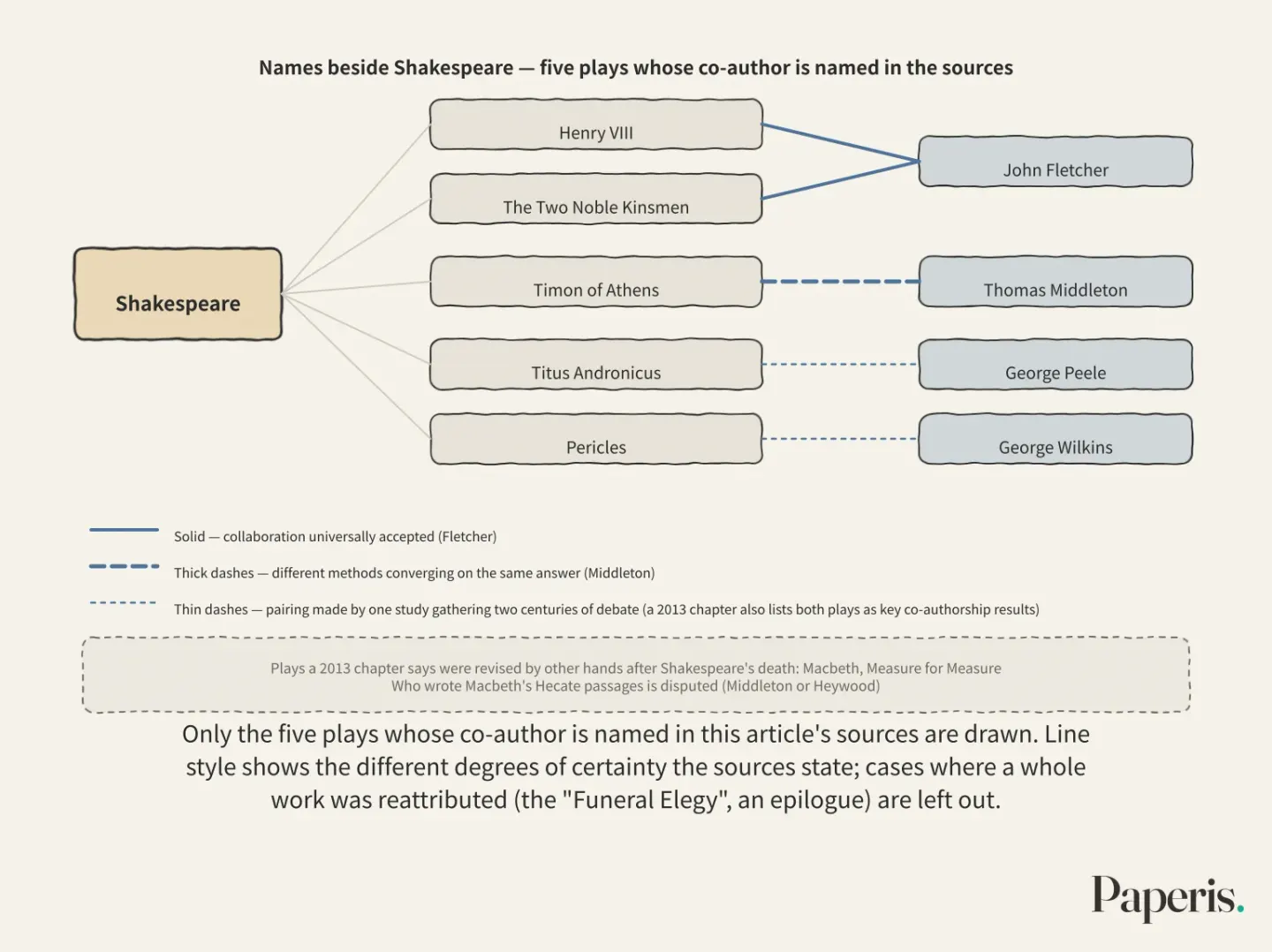
A 2013 chapter widens this list. It counts as core results Titus Andronicus, Henry VI, Parts 1 and 2, Edward III, the revision of Sir Thomas More, Timon of Athens, Pericles, Henry VIII, and The Two Noble Kinsmen, and notes that Macbeth and Measure for Measure were revised by other hands after Shakespeare's death (DOI: 10.1017/cbo9781139084352.011). While stating that some conclusions are still in the realm of speculation, the author of this chapter says that the outline of collaboration itself is no speculation. The conclusion of this chapter is that Shakespeare collaborated frequently at the beginning and end of his career, and occasionally in between (DOI: 10.1017/cbo9781139084352.011).
Following a single play, Timon of Athens, shows what collaboration looks like. From the 1840s to the 1990s, different methods like counting rhythms and tracking words converged on the same conclusion, and all attributed a substantial share of this play to Middleton. The author of that study goes so far as to write that Shakespeare scholars who still deny this point risk losing their scholarly credibility (DOI: 10.1093/acprof:oso/9780199269167.003.0004). A 2016 study re-examined the patterns of imagery appearing in this play to support the division lines of the previous research, and suggests that the sequence of Shakespeare writing first and Middleton writing later is not enough on its own, so sequential writing and simultaneous writing were mixed (DOI: 10.13128/jems-2279-7149-18090). Middleton was a dramatist with a knack for cynical scenes of the city, and this study notes that this is frequently cited as the reason the two men worked together (DOI: 10.13128/jems-2279-7149-18090). There are studies suggesting that Middleton's hand also entered when the King's Men revised old plays to put them back on stage after Shakespeare's death, with Macbeth and Measure for Measure cited as examples (DOI: 10.1080/00144940.2024.2418926).
The sentence "Shakespeare wrote several plays with a colleague" leaves Shakespeare in the author seat and adds a name beside him. The sentence "Someone other than Shakespeare wrote it" changes the name in the author seat. What collaboration research has confirmed is the former sentence, not the latter. All the dramatists whose names were raised by collaboration research were placed beside Shakespeare. However, the certainty of those names is not equal. Fletcher is counted as the single dramatist universally recognized to have co-written two or more plays with Shakespeare (DOI: 10.1080/00144940.2024.2418926). Middleton's share in Timon is summarized as the result of converging methods (DOI: 10.1093/acprof:oso/9780199269167.003.0004). The names Peele and Wilkins are attributions for which a study bundling two centuries of discussions provides the evidence, based on the sources this text relies on (DOI: 10.1093/acprof:oso/9780199269167.001.0001). That Titus Andronicus and Pericles are collaborations is also counted as a core result by a 2013 chapter (DOI: 10.1017/cbo9781139084352.011). One study considers that both the trend of shifting entire works to others and the trend of carving out parts of plays as collaborations had the paradoxical effect of blurring the author in "Shakespeare's plays" (DOI: 10.36253/jems-2279-7149-14292).
What Is Still Argued at the Margins
Unlike the broad outlines of co-writing, those boundaries are still under dispute today. John Fletcher is counted as the only playwright universally acknowledged to have co-written two or more plays with Shakespeare, and Middleton is a name evaluated as likely to emerge as an even more important co-writer (DOI: 10.1080/00144940.2024.2418926).
Marlowe is a prime bone of contention. In 2016, the editors of the New Oxford Shakespeare attributed parts of Henry VI to Marlowe based on stylometric analysis (DOI: 10.1093/llc/fqaa041). A 2020 study that independently retested the basis for this—zeta testing, a calculation widely used in stylometric analysis—concluded that the test is overly swayed by the genre of the plays, and that for an author like Marlowe who has few surviving works and a skewed genre, there is not enough data to yield reliable results (DOI: 10.1093/llc/fqaa041). Another study used a different calculation, and unlike the New Oxford Shakespeare, found no trace of Marlowe's hand in Henry VI, Part 3, while even producing results that made core works known to have been written by Marlowe seem un-Marlowe-like (DOI: 10.1093/llc/fqy001). This result was immediately met with a counterargument. The criticism was that the testing environment and text preparation were flawed, the impacts of play dates and genres on style were ignored, and external evidence was discarded, and this counterargument concludes that its results and conclusions cannot be accepted (DOI: 10.1093/llc/fqy040).
Some studies point out the limitations of the data itself. Almost no handwritten manuscripts by playwrights survive, most commercial theater plays have vanished, and the texts we read are mixed with the hands of compositors, printers, and editors. A 2024 study therefore argues that no matter how sophisticated the attribution techniques are, they can only be as reliable as the data that goes into them (DOI: 10.4312/elope.21.1.229-245).
There are also disputes of a different kind from co-writing. These are instances where attribution is overturned over whether an entire piece is Shakespeare's. The poem "A Funeral Elegy" was included in textbooks as a Shakespearean work, but began to be dropped as some experts came to see it as John Ford's poem (DOI: 10.1353/sib.0.0011). A short epilogue written to be recited by an actor for a 1599 performance before Queen Elizabeth was included in the New Oxford Shakespeare, but a study concludes it was written by Thomas Dekker (DOI: 10.21825/aj.v7i2.9735). The Hecate passage in Macbeth is viewed by most researchers as not Shakespeare's, though it has long been considered Middleton's, and a 2024 study suggests Thomas Heywood (DOI: 10.1093/notesj/gjae138). These boundary disputes are fought over the edges of the Shakespearean canon—namely, to whom parts of certain plays or a single short poem belong.
Why Doubts Linger
Some studies attempt to explain why the authorship debate has lasted for more than 150 years. After stating its disagreement with skepticism, a 2008 paper reads the authorship debate through three frames: a form of conspiracy theory, a backlash against the flow of literary study becoming a professional career inside universities, and a wish that Freud called the "family romance," in which a child desires more glamorous parents than their current ones (DOI: 10.1111/j.1741-4113.2008.00549.x). The same paper views the authorship debate as socially conservative in that "an aristocrat should have written it," and radically interpretive in that "the message of the works was so dangerous that the real author had to be hidden" (DOI: 10.1111/j.1741-4113.2008.00549.x).
A 2021 paper directly names the motives. This paper concludes that the authorship debate has been driven by elitist sensibilities, individual ambition, academic anxiety, and the cult of Shakespeare (DOI: 10.31829/2767-2964/jell2021-2(1)-104). The same paper also writes that the evidence for Shakespeare as the author is persuasive but not decisive. It is a single paper whose academic journal weight we have not verified in this article.
There is also criticism in the opposite direction. A 2020 chapter argues that the near-total exclusion of the authorship debate from academia is an internal threat to academic freedom. According to this chapter, the tone of calling skeptics conspiracy theorists or comparing them to Holocaust deniers while failing to engage with the substance of their claims risks blocking paths of inquiry that could be useful. The author concludes that this taboo unjustly infringes upon the academic freedom of Shakespeare scholars as well as those targeted by the words (DOI: 10.1108/s2055-364120200000034012). Those who have doubted Shakespeare's authorship have cited the names of prominent scholars who belittled them (DOI: 10.3138/flor.16.011). The preface of an anti-Stratfordian book published in 1908 quoted Sidney Lee, then chairman of the Shakespeare Birthplace Trust, mocking the Baconian theory as a "foolish craze" (DOI: 10.3138/flor.16.011). One study considers that the anti-Stratfordian rebuttal campaign led by British bibliographer A. W. Pollard from 1916 to 1923 left an influence on the subsequent editing of Shakespeare's plays (DOI: 10.3138/flor.16.011).
A 2025 chapter connects these two extremes with a single line. The more important the writing, the more political the authorship question becomes, and scholars more easily accept arguments that confirm what they already believe. According to this chapter, the Baconian theory of the 19th century is connected to the long-standing debate between humanist philology and the Catholic Church, and that conspiracy theory conversely gave birth to the orthodox theory in the 20th century that "all plays in the First Folio were written by Shakespeare alone." The author of this chapter views that the absolutism of "written entirely by oneself" was just as logically flawed as the absolutism of the Baconian or Oxfordian theories (DOI: 10.1093/oxfordhb/9780198852414.013.0052). This chapter considers that orthodoxy to still lie beneath the disputes surrounding new research on co-authorship (DOI: 10.1093/oxfordhb/9780198852414.013.0052). One research monograph arguing for co-authorship summarizes the discussions surrounding Henry VIII and The Two Noble Kinsmen as follows. The results finding shared work with Fletcher were denied by researchers on the single-authorship side, whom the book calls "conservatives," and a next generation using stronger analytical tools reaffirmed the initial division (DOI: 10.1093/acprof:oso/9780199269167.003.0006).
What Remains
There is a part of this common belief that is correct. Among the plays bound together under Shakespeare's name, several were not written by him alone, and the 20th-century orthodox view that "he wrote them all by himself" has also been evaluated as having flaws. The scarcity of biographical records is acknowledged even by the promotional blurbs of books on the defender side. There is also ground to consider parts of it incorrect. One single study that examined the connection between the themes of the plays and political situations failed to find that connection in the timeline of the Earl of Oxford's side. The scope, however, is this. While anti-Stratfordian argumentative writings exist, results supporting another candidate as the author of the entire works from the side of archival and stylistic research are absent from the sources this article relies upon. What collaborative authorship studies have found were colleagues sitting beside the author's seat.
A 2008 paper suggests that the probing energy of the authorship debate might be most usefully directed toward collaborative authorship studies (DOI: 10.1111/j.1741-4113.2008.00549.x). The open questions in the sources this article relies on also lie in that direction. It is viewed as highly likely that Shakespeare co-authored the lost play Cardenio, and whether he wrote Henry VI, Part 3 entirely by himself is also doubted (DOI: 10.1017/cbo9781139084352.011). Whether the tools measuring Marlowe's share are reliable is also under dispute.
The question "Who wrote it?" has been attached to other works as well. "Frankenstein — How Far Did Her Husband's Hand Reach?" and "The Tale of Hong Gildong — Where Does the One Line Naming Heo Gyun Come From?" asked the same question about other books.
In 1623 Jonson called him "not of an age, but for all time!". Four hundred years later, the archival and stylistic research this article relies on has not erased that name, but has instead written the names of his colleagues beside it. Fletcher is a widely acknowledged name, Middleton is a name pointed out in Timon of Athens through various methods, and Peele and Wilkins are names paired by a research book binding two centuries of discussion in the sources of this article. In the archival and stylistic research this article relies upon, the names found beside the Swan of Avon were the names of colleagues who wrote together, and the name of a single person to replace him did not emerge.
Source Papers
- "Shakespeare as collaborator" (2013) — DOI: 10.1017/cbo9781139084352.011 — Core co-authorship list (Titus, Henry VI 1 & 2, Edward III, revised Thomas Middleton, Timon, Pericles, Henry VIII, The Two Noble Kinsmen); some conclusions are speculative, but the outlines are not; Macbeth and Measure for Measure were post-mortem adaptations.
- "Shakespeare beyond Doubt: Evidence, Argument, Controversy" (2013) — DOI: 10.1017/cbo9781139084352 — Candidates (Bacon, Marlowe, de Vere); a book where 23 scholars address the authorship question through biographical, textual, and bibliographical evidence (book introduction).
- "Shakespeare, Co-Author" (2004) — DOI: 10.1093/acprof:oso/9780199269167.001.0001 — Evidence of co-authorship with Peele, Middleton, Wilkins, and Fletcher; all major contemporary playwrights worked in collaboration.
- "Timon of Athens with Thomas Middleton" (2004) — DOI: 10.1093/acprof:oso/9780199269167.003.0004 — Different methods from the 1840s to the 1990s converge on a substantial share for Middleton.
- "Henry VIII and The Two Noble Kinsmen with John Fletcher" (2004) — DOI: 10.1093/acprof:oso/9780199269167.003.0006 — The pattern of Shakespeare "conservatives" denying this and new tools reaffirming it.
- "'Not of an Age' Jonson, Shakespeare, and the Verdicts of Posterity" (1997) — DOI: 10.1093/oso/9780198183945.003.0011 — Jonson's dedicatory poem at the head of the First Folio; bold claims in 1623 became common sense by the late 18th century.
- "'My Shakespeare, rise': Ben Jonson's celebration of his Shakespeare" (2016) — DOI: 10.1177/0184767816643271 — The tension between the praise in the dedicatory poem and the harsh critique in Timber, or Discoveries.
- "The Shakespeare Authorship Debate Revisited" (2008) — DOI: 10.1111/j.1741-4113.2008.00549.x — Skepticism since Delia Bacon, the framework of conspiracy theories, anti-professionalism backlash, and family romance; aristocratic conservatism; suggesting a shift toward co-authorship research.
- "Shakespeare Disintegrated: Authoriality, Textuality, Co-Authorship, Biography" (2023) — DOI: 10.36253/jems-2279-7149-14292 — From the mid-19th-century collective authorship theory to the dissolution of co-authorship.
- "The Shakespeare Authorship Question: A Case Study in Bourdieuian Class Maintenance" (2021) — DOI: 10.31829/2767-2964/jell2021-2(1)-104 — Candidate Elizabeth I; the evidence is persuasive but not definitive; motives are elitism, ambition, academic anxiety, and cultism.
- "With Swinish Phrase Soiling Their Addition: Epistemic Injustice, Academic Freedom, and the Shakespeare Authorship Question" (2020) — DOI: 10.1108/s2055-364120200000034012 — A critique of near-total academic exclusion and the rhetorical use of conspiracy theorist and Holocaust denier analogies.
- "Shakespeare, More or Less: A.W. Pollard and Twentieth-Century Shakespeare Editing" (1999) — DOI: 10.3138/flor.16.011 — Sidney Lee's ridicule, Pollard's 1916–1923 rebuttal campaign, and their impact on editing.
- "The Politics of Attribution" (2025) — DOI: 10.1093/oxfordhb/9780198852414.013.0052 — The politicization of attribution and confirmation bias; the 20th-century single-author orthodoxy spawned by the Baconian theory is also logically flawed.
- "The Case for Shakespeare" (2005) — DOI: 10.5040/9798400623653 — Acknowledging gaps in biographical records; examining the premise of "soldier, scholar, lawyer, courtier, Italian traveler"; concluding with Shakespeare as the author (book introduction).
- "Shakespeare and His Biographical Afterlives" (2022) — DOI: 10.1515/9781789206890 — New biographies come out every year, but new documentary evidence is extremely scarce (book introduction).
- "What Is a Co-Author?" (2005) — DOI: 10.1525/rep.2005.89.1.1 — Shakespeare's dual identity as both actor and playwright.
- "A Tale of Two Fools: Middleton, Shakespeare, and Co-Authorship in Timon of Athens and King Lear" (2024) — DOI: 10.1080/00144940.2024.2418926 — Fletcher is a universal consensus; Middleton's post-mortem adaptation for the King's Men in 1616.
- "Shakespeare and Middleton's Co-Authorship of Timon of Athens" (2016) — DOI: 10.13128/jems-2279-7149-18090 — Image patterns support the division lines; a mix of sequential and simultaneous writing.
- "Arden of Faversham and Shakespeare's Early Collaborations: The Evidence of Meter" (2016) — DOI: 10.5325/style.50.1.0065 — Verifying early co-authorship shares through vocabulary, function word frequencies, rare phrases, and meter.
- "Thematic Content and Political Context in Shakespeare's Dramatic Output, with Implications for Authorship and Chronology Controversies" (2004) — DOI: 10.2190/eqdp-mk0k-dfck-ma8f — Previous research leans more toward the Stratford chronology; thematic-political correlations only appear in the Stratford chronology (with a 2-year lag).
- "Heterogeneous authorship in early Shakespeare and the problem of Henry V" (1998) — DOI: 10.1093/llc/13.1.15 — Testing function words and letter frequencies to separate Marlowe and Shakespeare.
- "An algorithm for automated authorship attribution using neural networks" (2008) — DOI: 10.1093/llc/fqn022 — A neural network committee correctly predicted test works by Shakespeare and Marlowe.
- "Big data or not enough? Zeta test reliability and the attribution of Henry VI" (2020) — DOI: 10.1093/llc/fqaa041 — Zeta is swayed by genre and lacks data for small canons.
- "Christopher Marlowe: Hype and Hoax" (2018) — DOI: 10.1093/llc/fqy001 — Finding no Marlowe in Henry VI 3, and that Marlowe's core works do not feel like Marlowe.
- "Marlowe and overreaching: A misuse of stylometry" (2018) — DOI: 10.1093/llc/fqy040 — A critique of the above study for ignoring test design, text preparation, chronology, genre, and external evidence.
- "Authorship Attribution and the Material Realities of Early Modern Play Texts" (2024) — DOI: 10.4312/elope.21.1.229-245 — Scarce manuscripts, the loss of most plays, and compositor intervention mean techniques are only as reliable as the data.
- "Authors of the Mind: Some Notes on the QSUM Attribution Theory" (2005) — DOI: 10.1353/sib.0.0011 — The attribution of a funeral elegy to Shakespeare and its reattribution to Ford.
- "The 'Dial Hand' Epilogue: by Shakespeare, or Dekker?" (2018) — DOI: 10.21825/aj.v7i2.9735 — Concluding that the epilogue included in the New Oxford Shakespeare is by Dekker.
- "The Date and Authorship of the 'Hecate Passages' in Macbeth" (2024) — DOI: 10.1093/notesj/gjae138 — Passages mostly viewed as non-Shakespearean; proposing Heywood instead of Middleton.
- "Behind the Mask – An Inquiry into the Shakespeare Authorship Question" (2020, Journal of Scientific Exploration — a fringe academic journal) — DOI: 10.31275/20201671 — Anti-Stratfordian arguments: lack of consensus, claims of Shakespeare's possible illiteracy, and the Earl of Oxford as the leading candidate.
- "The Shakespeare Authorship Question: A Forensic Examination" (2023, Journal of Scientific Exploration — a fringe academic journal) — DOI: 10.31275/20233103 — Anti-Stratfordian arguments: claiming silence in that contemporaries did not mention him as a writer.
Sources (31)
- Shakespeare as collaboratorDOI 10.1017/cbo9781139084352.011
- Shakespeare beyond Doubt: Evidence, Argument, ControversyDOI 10.1017/cbo9781139084352
- Shakespeare, Co-AuthorDOI 10.1093/acprof:oso/9780199269167.001.0001
- Timon of Athens with Thomas MiddletonDOI 10.1093/acprof:oso/9780199269167.003.0004
- Henry VIII and The Two Noble Kinsmen with John FletcherDOI 10.1093/acprof:oso/9780199269167.003.0006
- 'Not of an Age' Jonson, Shakespeare, and the Verdicts of PosterityDOI 10.1093/oso/9780198183945.003.0011
- 'My Shakespeare, rise': Ben Jonson's celebration of his ShakespeareDOI 10.1177/0184767816643271
- The Shakespeare Authorship Debate RevisitedDOI 10.1111/j.1741-4113.2008.00549.x
- Shakespeare Disintegrated: Authoriality, Textuality, Co-Authorship, BiographyDOI 10.36253/jems-2279-7149-14292
- The Shakespeare Authorship Question: A Case Study in Bourdieuian Class MaintenanceDOI 10.31829/2767-2964/jell2021-2(1)-104
- With Swinish Phrase Soiling Their Addition: Epistemic Injustice, Academic Freedom, and the Shakespeare Authorship QuestionDOI 10.1108/s2055-364120200000034012
- Shakespeare, More or Less: A.W. Pollard and Twentieth-Century Shakespeare EditingDOI 10.3138/flor.16.011
- The Politics of AttributionDOI 10.1093/oxfordhb/9780198852414.013.0052
- The Case for ShakespeareDOI 10.5040/9798400623653
- Shakespeare and His Biographical AfterlivesDOI 10.1515/9781789206890
- What Is a Co-Author?DOI 10.1525/rep.2005.89.1.1
- A Tale of Two Fools: Middleton, Shakespeare, and Co-Authorship in Timon of Athens and King LearDOI 10.1080/00144940.2024.2418926
- Shakespeare and Middleton's Co-Authorship of Timon of AthensDOI 10.13128/jems-2279-7149-18090
- Arden of Faversham and Shakespeare's Early Collaborations: The Evidence of MeterDOI 10.5325/style.50.1.0065
- Thematic Content and Political Context in Shakespeare's Dramatic Output, with Implications for Authorship and Chronology ControversiesDOI 10.2190/eqdp-mk0k-dfck-ma8f
- Heterogeneous authorship in early Shakespeare and the problem of Henry VDOI 10.1093/llc/13.1.15
- An algorithm for automated authorship attribution using neural networksDOI 10.1093/llc/fqn022
- Big data or not enough? Zeta test reliability and the attribution of Henry VIDOI 10.1093/llc/fqaa041
- Christopher Marlowe: Hype and HoaxDOI 10.1093/llc/fqy001
- Marlowe and overreaching: A misuse of stylometryDOI 10.1093/llc/fqy040
- Authorship Attribution and the Material Realities of Early Modern Play TextsDOI 10.4312/elope.21.1.229-245
- Authors of the Mind: Some Notes on the QSUM Attribution TheoryDOI 10.1353/sib.0.0011
- The 'Dial Hand' Epilogue: by Shakespeare, or Dekker?DOI 10.21825/aj.v7i2.9735
- The Date and Authorship of the 'Hecate Passages' in MacbethDOI 10.1093/notesj/gjae138
- Behind the Mask – An Inquiry into the Shakespeare Authorship QuestionDOI 10.31275/20201671
- The Shakespeare Authorship Question: A Forensic ExaminationDOI 10.31275/20233103