Paperis Articles
Paper and Screen — The Same Text, a Slightly Different Score
How true is the saying that you understand better on paper? Three meta-analyses of experiments that had people read the same text on paper and on screen found an average that tilts slightly toward paper — but the gap grew or nearly vanished depending on conditions such as the kind of text and time limits — and, in a separate meta-analysis, scrolling.
Your field's papers, as audio
Pick your fields and journals — Paperis summarizes the key papers and turns them into audio. Listen on your commute.
Start Paperis free →Paper and Screen — The Same Text, a Slightly Different Score
Ten-Year-Olds and Family Physicians
In 2015 in Norway, 1,139 ten-year-old students took a reading comprehension test twice. They took it once on paper and once on computer, and the two test papers were two parallel, matched editions. Which edition was on which medium, and which side was taken first, was staggered and assigned to each student. The average score was lower on the digital test, and nearly one-third of the students did better on paper than on computer. The drop in scores on screens was most pronounced among high-achieving female students (DOI: 10.1016/j.compedu.2020.103861).
Earlier in the autumn of 2000, 114 family physicians in Scandinavia read a review article published in a trauma medicine journal for 10 minutes. Whether they read it on paper or on a screen, and whether in their native language or in English, was decided by chance like a coin toss, and as soon as they finished reading, they answered six open-ended questions asking for 13 key facts. The median score was 4 for both the doctors who read on paper and those who read on screens, with no statistically significant difference. The factor that split the scores was language. Doctors who read in their native language scored higher than those who read in English (PMID 12038931).
In one experiment scores went down on a screen, and in the other the medium did not change the scores. The two experiments differ in their subjects (ten-year-old children and physicians), texts, and testing methods. Therefore, the results of one cannot refute the other, nor can we know from just these two which pattern is more common. This article follows research pooling experiments that had people read the same text divided between paper and screen, separating the parts where the claim "you understand better when you read on paper" is supported by evidence from the parts where it is not.
Two Beliefs
An introduction to a book published in Italy describes today's reader like this: a "distracted" reader who endlessly scrolls through information-packed screens, reads in a hurried skim, and runs the risk of never fully grasping the meaning. The same introduction refuses to push this worry to either extreme. Standing between two opposing views—the "myth of shallowness" and the "myth of depth"—it states that it will avoid both uncritical optimism about the present and nostalgic idealization of a vanished past (DOI: 10.36253/978-88-5518-501-1). On one side is the belief that paper preserves deep understanding; on the other, the belief that if the text is the same, the vessel does not matter.
Beliefs and actual scores can move independently. A 2010 doctoral dissertation had people read the same text on an e-reader, a palm-sized handheld device, and paper, reporting that the medium did not matter for basic reading comprehension. The same dissertation notes that the more uncomfortable people felt with technology and reading tasks, the more they clung to the belief that they would do better on paper, regardless of their actual performance (DOI: 10.12794/metadc28390). Although it is the result of a single thesis, it clearly shows that "I feel paper is better" and "I actually understand better on paper" are different questions. What this article follows is the latter, actual scores.
The Average Gathered by Meta-Analyses
A meta-analysis is a method that gathers the results of multiple studies addressing the same question and recalculates them all at once. When individual experiments yield different answers, much like Norwegian children and Scandinavian doctors, a meta-analysis places those answers on a single scale.
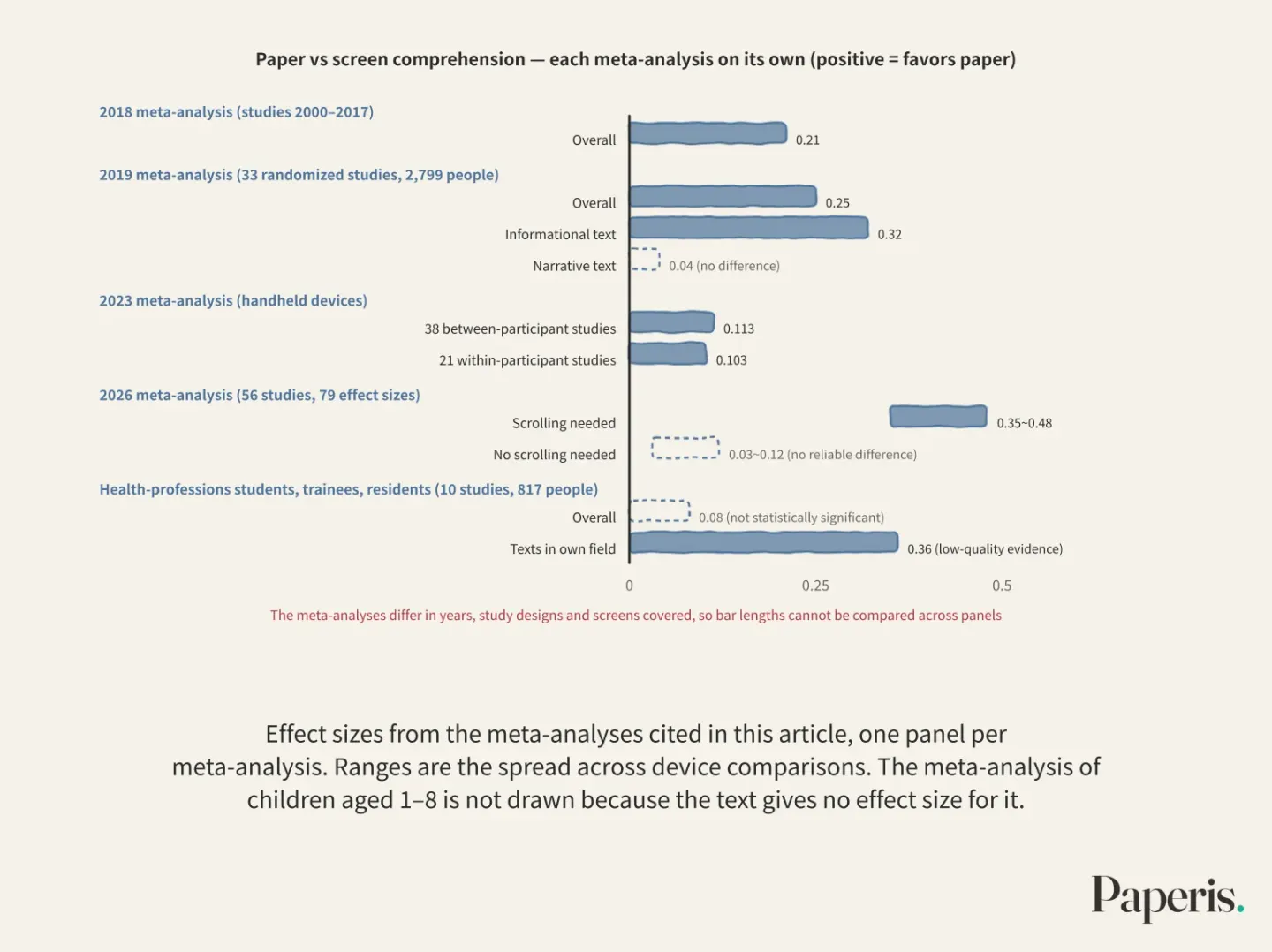
A meta-analysis published in 2018 gathered studies published between 2000 and 2017 that had participants read similar texts on paper and digital devices. It included 38 studies that divided participants into two groups and 16 studies where a single person read using both mediums, totaling 171,055 participants. Both designs showed a modest advantage for paper (DOI: 10.1016/j.edurev.2018.09.003). Even the title of the paper is "Don't throw away your printed books".
How large this advantage is can be measured with a single value. An effect size is a value that compares the difference between the averages of two groups to the spread of their scores, serving as a number that allows studies using different tests to be placed side by side and compared. In this meta-analysis, the paper advantage was an effect size of 0.21. This means the average scores of the two mediums differed by about one-fifth of the spread of scores among people. It also means that the difference from person to person within the same medium is much larger than the difference between the mediums.
Another meta-analysis published the following year narrowed its criteria further. Among studies published between 2008 and 2018, it included only experiments where the choice of reading medium was left to chance and participants possessed basic reading skills. Gathering 33 studies comparing reading performance involving 2,799 people, the results showed that performance when reading from a screen was lower than on paper, with an effect size of 0.25 (DOI: 10.1111/1467-9817.12269).
Most of the studies included in the previous meta-analyses used computer screens. Therefore, a meta-analysis in 2023 separately gathered handheld devices like tablets. This meta-analysis summarized the results of the previous meta-analyses as "the tendency to understand texts slightly less when reading them on a screen compared to print," and used the name given to it. The screen inferiority effect is the name for the tendency to understand texts slightly less when reading them on a screen than on paper. This effect remained even on handheld devices. With an effect size of 0.113 across 38 studies that divided participants and 0.103 across 21 studies where individuals read both, the authors write that a small effect leaning toward print consistently emerged. The authors discuss the need to continue fostering paper reading in schools while also finding effective ways to use handheld devices for reading (DOI: 10.1037/edu0000830).
These three numbers were not measured with the same ruler. They cover different inclusion years, differ in whether they included only experiments that randomized reading mediums, and involve different types of screens. Therefore, they cannot be directly compared in a way that says 0.25 is greater than 0.21. What the three meta-analyses tell us together is the direction and approximate magnitude. When experiments having people read the same text on paper and screens are gathered across these three meta-analyses, the average leans toward paper, but the difference is small.
How Conditions Change the Size
An average alone cannot tell you “when”. A moderator is a factor that changes for whom and under what conditions a relationship between a cause and an effect appears. Meta-analyses have found several moderators that increase or decrease the difference between paper and screens.
The first is the type of text. Informational texts are written to convey facts and knowledge, such as textbooks and explanatory essays. Narrative texts tell about characters and events following the order in which things happen, such as novels and fairy tales. In a 2019 meta-analysis, the screen disadvantage had an effect size of 0.32 for informational texts, while for narrative texts, it was 0.04, showing no difference. The authors note that the screen disadvantage may have been limited to informational texts (DOI: 10.1111/1467-9817.12269). In a 2018 meta-analysis as well, the paper advantage appeared consistently in studies using informational texts or a mix of informational and narrative texts, but did not appear in studies using only narrative texts (DOI: 10.1016/j.edurev.2018.09.003). The results differed depending on whether the text used in the experiment was an informational text or a narrative text.
The second is time. In the 2018 meta-analysis, the paper advantage grew larger when reading time was restricted compared to when readers were allowed to read at their own pace (DOI: 10.1016/j.edurev.2018.09.003). On the other hand, in the reading times measured separately by the 2019 meta-analysis, there was no reliable difference between paper and screens (effect size 0.08) (DOI: 10.1111/1467-9817.12269).
The third is scrolling. A meta-analysis published in 2026 used a method that grouped four devices—computers, tablets, e-readers, and smartphones—so they could be compared with paper and with one another. Combining 79 effect sizes from 56 studies using independent samples, the order of greatest help to comprehension was paper, tablet, e-reader, computer, and smartphone. When reading required scrolling, paper was clearly better than digital devices (effect size 0.35 to 0.48), whereas when no scrolling was necessary, there was no reliable difference between paper and any device (0.03 to 0.12). The condition of reading on a tablet without scrolling ranked as the best among the compared digital conditions (effect size 0.03) (DOI: 10.1007/s10639-025-13843-8). According to these results, the single word "screen" encompasses conditions that are nearly identical to paper alongside conditions that are considerably less favorable than paper.
The fourth is the reader. In a meta-analysis pooling handheld devices, the screen inferiority effect was sometimes larger for college students than for elementary and secondary students, and for participants evaluated individually rather than in groups (DOI: 10.1037/edu0000830). In a meta-analysis pooling 10 controlled studies involving 817 health professions students, trainees, and residents, the overall difference was only 0.08 in favor of paper, which was not statistically significant. The authors conclude that based on current evidence, the difference is negligible or nonexistent. However, when looking exclusively at texts related to their own majors, students who read on paper understood better (0.36), and the authors note that the quality of the evidence is low and must be confirmed by more rigorous studies (PMID 34301544).
The fifth is the passage of time. In the 2018 meta-analysis, the paper advantage grew larger in more recently published studies (DOI: 10.1016/j.edurev.2018.09.003). When studies from 2000 to 2017 are arranged in order of publication, the difference moved toward growing larger rather than shrinking.
The difference between paper and screens shifts depending on the conditions. It grew larger in places with informational texts, time limits, and scrolling, and was barely visible for narrative texts in two meta-analyses targeting adults and students, or for screens without scrolling in one meta-analysis.
In Children
A study of first-graders notes at the outset that most previous paper-and-screen research involved college students (DOI: 10.1016/j.caeo.2025.100243). Evidence regarding children cannot be directly measured against adult results because of differences in age and book formats.
There is a meta-analysis pooling 39 studies and 1,812 participants aged 1 to 8, comparing story comprehension and vocabulary learning between digital and print books. Children scored lower on story comprehension with digital books that differed from print books only in being transferred to a screen. When an adult guided the child alongside reading a print book, it was more effective than various features added to digital books read by children alone. On the other hand, digital books featuring elements tied to the story content performed better than print books. A dictionary built into the book had no effect or was even detrimental to story comprehension, but it helped with vocabulary learning (DOI: 10.3102/0034654321998074). Even for the same "screen," what was placed on top of it changed the outcome.
Results do not converge at other ages. The ten-year-olds in Norway from the introduction had lower averages on digital tests (DOI: 10.1016/j.compedu.2020.103861). In a study where 58 first-graders with a mean age of 6.8 years read the same text on paper, laptops, and tablets, no screen inferiority effect appeared with either digital medium, and comprehension of key points in explanatory texts was actually better on tablets (DOI: 10.1016/j.caeo.2025.100243). A study involving 75 students in grades 3 to 5 participating online compared screen-only conditions without paper: scrolling conditions yielded similar scores to clicking-to-turn conditions, while comprehension scores were lower in the condition with hyperlinks that displayed definitions when hovering the cursor over words (DOI: 10.1111/1467-9817.12468). These three studies differ in age, tests, and comparison groups, so one does not overturn the other. For children, neither "screens are disadvantageous" nor "there is no difference" can be generalized from this evidence.
An eye to gauge self-understanding
There is one more thing besides the score. Metacognition is the ability to gauge for oneself what and how much one knows. Deciding "I've understood this much" after reading falls under this.
A 2019 meta-analysis also compared how well this judgment matches actual performance. Across 11 studies and 698 people, readers judged their own performance more accurately when reading on paper than when reading on screens, with an effect size of 0.20 (DOI: 10.1111/1467-9817.12269). The authors write in their conclusion that readers can be more efficient and better aware of their own performance when reading on paper than on screens. The description in the conclusion is "may be".
There is also the story of overconfidence that "people falsely believe they know better on screens." The abstract this article relies on only goes as far as saying that judgments were less accurate on screens, and does not say whether those judgments skewed higher or lower than reality. The direction of overconfidence is a part not confirmed by this evidence.
There are also results showing that metacognition was related to comprehension regardless of the medium. In a study of 58 first-year students, comprehension monitoring ability—measured by the ability to spot inconsistencies in a text—was related to gist comprehension and literal comprehension regardless of the medium, and the authors write that text comprehension was aided by metacognition regardless of the medium (DOI: 10.1016/j.caeo.2025.100243). A conference paper published in 2015 randomly assigned 92 participants to read three explanatory texts; the group that read on paper took more notes and spent more study time, but the difference in comprehension scores was negligibly small (DOI: 10.1177/1541931215591069). This is the result of a single experiment showing that scores can be the same even when reading behaviors differ.
Why It Happens
Within this evidence, there are several results worth placing alongside candidate explanations for the paper advantage, and no study cited in this article has ruled in any single one as definitive.
The first candidate is memory for scrolls and locations. Readers can recall quite accurately roughly where on a page a piece of information was located, and this phenomenon was first reported in the 1970s. In an experiment investigating this phenomenon, college students read a baseball-themed text across paper, computers, and mobile phones, in both page-divided and scrolling formats. The page-divided format generally outperformed the scrolling format in both comprehension and location memory, and the authors note that this aligns with the theory that spatial memory plays a role in reading (DOI: 10.1080/0163853x.2025.2476326). This can be placed alongside the results of a 2026 meta-analysis showing that the difference from paper grew larger when scrolling was required (DOI: 10.1007/s10639-025-13843-8). The authors of a Norwegian study also pointed to scrolling or digital reading habits as plausible factors for the difference, though this is the authors' estimation (DOI: 10.1016/j.compedu.2020.103861). On the other hand, for 3rd- to 5th-grade children, the scrolling condition was not worse than the clicking condition (DOI: 10.1111/1467-9817.12468). Because the target groups and comparison methods differ, these results cannot be seen as refuting the scrolling explanation for adults.
The second candidate to place alongside is rereading. However, this study is a correlational study that looked only at reading on screens without comparing it to paper, so it is a stretch to set it up as a candidate cause for the paper advantage. In a correlational study observing college students reading informational texts on tablets or smartphones, the behavior of deliberately returning to previous paragraphs to re-verify information independently predicted the degree of macro-level text comprehension, even after accounting for working memory capacity, reading skill, and reading time (DOI: 10.1080/19388071.2022.2155271). That relationship operated entirely through how much of the read content students produced in their reports. This study did not measure whether people reread less on screens than on paper. What this study shows is a relationship where readers who reread on screens achieved greater macro-level comprehension, and being correlational, it does not speak to causation.
The third candidate is metacognition and time pressure. The introduction of the 1st-grade study summarizes that prior meta-analyses suggest the screen inferiority effect may be linked to individual differences in metacognition (DOI: 10.1016/j.caeo.2025.100243). The finding that self-judgments were more accurate on paper (DOI: 10.1111/1467-9817.12269) and the finding that the paper advantage grew larger when time was limited (DOI: 10.1016/j.edurev.2018.09.003) are facts that can be placed alongside this explanation. However, the causal claim that metacognition actually drives that difference is not confirmed in this evidence.
Two Afternoons of One Person
Let us apply the conditions found by the meta-analysis to one person's day. One office worker reads a business report on a smartphone within a short, fixed time limit in the afternoon. On another afternoon, they read a novel in a print book without a time limit.
In the first afternoon, several conditions overlap that meta-analyses have reported as increasing the advantage of paper. The text is informational (DOI: 10.1111/1467-9817.12269), the reading time is short and fixed (DOI: 10.1016/j.edurev.2018.09.003), it requires scrolling, and the device is a smartphone, which is placed at the very bottom of the ranking (DOI: 10.1007/s10639-025-13843-8). The novel on the second afternoon is a narrative text, placing it on the side where two meta-analyses showed no difference between paper and screens.
There are also things this scene does not tell us. The meta-analyses measured the conditions one by one separately. We cannot know from this evidence whether the differences accumulate when a text is informational, time-limited, and requires scrolling all at once. Since most paper-screen studies targeted college students (DOI: 10.1016/j.caeo.2025.100243), it is also not confirmed by this evidence whether it translates directly to an office worker's day. The scene merely shows where these conditions lie; it does not predict how much that person understood on that day.
What We Still Don't Know
Which way the misjudgment leans is one of them. While there are results showing people's judgments of their own accuracy were higher on paper, whether people overestimate or underestimate their understanding on screens is not mentioned in the abstract this article relies on (DOI: 10.1111/1467-9817.12269).
The reason the paper advantage has grown larger in more recent studies is also like that. A 2018 meta-analysis reported such a trend (DOI: 10.1016/j.edurev.2018.09.003), but its abstract does not reveal the reason.
The weight of the evidence is also uneven. The results separated by scrolling conditions came from a single 2026 meta-analysis (DOI: 10.1007/s10639-025-13843-8), the spatial memory research is a single experiment, and the rereading research is a single correlational study. The health-related meta-analysis notes itself that the quality of evidence is low (PMID 34301544). Another meta-analysis introduction posted to a public repository in 2025 states that it will compare paper and screens not only for reading comprehension but also for character decoding, spelling, and writing, but that introduction contains no results (DOI: 10.17605/osf.io/7wt3m).
So What Do We Know
There is a true part to the saying, "You understand better when you read on paper." Three meta-analyses from 2018, 2019, and 2023 all showed the average tilting toward paper, and the 2026 meta-analysis also placed paper at the very front of the ranking that aids comprehension. That tilt grew larger with informational text, time limits, and screens that required scrolling. In a meta-analysis gathering children aged 1 to 8, story comprehension was lower for books simply moved to digital, and ten-year-old children in Norway scored lower on digital tests. Though it is a measurement different from comprehension scores, there is also a result showing that people gauged their own grades more accurately when reading on paper.
There is also a false part. The overall averages of the three meta-analyses lie between 0.1 and 0.25 in effect size, and the authors of the 2023 meta-analysis gathering handheld devices call the preceding results "slight" and their own result a "small" effect. The authors of a meta-analysis gathering health-related students, trainees, and residents concluded that there was little to no difference overall, and reported a paper-side result (0.36) only for texts related to their major (quality of evidence: low). In the 2018 and 2019 meta-analyses, narrative texts showed no difference between paper and screen, and in the 2026 meta-analysis, screens that did not require scrolling had no reliable difference from paper (0.03 to 0.12). In the meta-analysis of children aged 1 to 8, digital books with devices interlocking with the story content performed better than paper books, even though the same text was not transferred as-is. Individual experiments include cases where there was no difference, such as first-grade children and Scandinavian family doctors, and cases where scores were lower on screens, like ten-year-old children in Norway. There is a small average difference between paper and screen, and where that difference grows and where it disappears tells us much more than conventional wisdom does.
Source Papers
- "Reading from paper compared to screens: A systematic review and meta‐analysis" (2019) — DOI: 10.1111/1467-9817.12269 — 33 randomized controlled experiments (2,799 people), screen scores g=−.25, informational texts −.32, narrative texts −.04, no reading time difference (.08), judgment calibration more accurate on paper (.20).
- "Don't throw away your printed books: A meta-analysis on the effects of reading media on reading comprehension" (2018) — DOI: 10.1016/j.edurev.2018.09.003 — Studies from 2000–2017, 171,055 people, paper advantage g=−0.21, moderated by time limits, text types, and publication year.
- "Reading comprehension on handheld devices versus on paper: A narrative review and meta-analysis of the medium effect and its moderators." (2023) — DOI: 10.1037/edu0000830 — Handheld devices, g=−0.113/−0.103 small print advantage, larger effects among college students and individual assessments.
- "Decoding digital reading: a network meta-analysis of comprehension across devices" (2026) — DOI: 10.1007/s10639-025-13843-8 — 56 samples, paper > tablet > e-reader > computer > smartphone, when scrolling is required g 0.35–0.48, when unnecessary 0.03–0.12.
- "A Comparison of Children's Reading on Paper Versus Screen: A Meta-Analysis" (2021) — DOI: 10.3102/0034654321998074 — Ages 1–8, 1,812 children, books with mere digitization showed lower comprehension, features intertwined with stories performed better than paper.
- "A Meta-Analysis of the Effect of Paper Versus Digital Reading on Reading Comprehension in Health Professional Education." (2021) — PMID 34301544 — 10 papers, 817 people, overall SMD −0.08 not significant, major-related texts −0.36, low quality of evidence.
- "Assessing children's reading comprehension on paper and screen: A mode-effect study" (2020) — DOI: 10.1016/j.compedu.2020.103861 — 1,139 ten-year-olds in Norway, digital test averages lower, most pronounced among high-achieving female students.
- "Reading from paper, computers, and tablets in the first grade: The role of comprehension monitoring" (2025) — DOI: 10.1016/j.caeo.2025.100243 — 58 first-graders, screen inferiority effect not detected, comprehension monitoring ability supports understanding regardless of the medium.
- "Scrolling and hyperlinks: The effects of two prevalent digital features on children's digital reading comprehension" (2024) — DOI: 10.1111/1467-9817.12468 — 75 students in grades 3–5, lower comprehension under hyperlink conditions, scrolling similar to clicking.
- "Paper or screen, mother tongue or English: which is better? A randomized trial." (2002) — PMID 12038931 — 114 families, no difference between paper and screen, mother tongue scores higher than English.
- "Paper vs. Screen: Effects on Reading Comprehension, Metacognition, and Reader Behavior" (2015) — DOI: 10.1177/1541931215591069 — Conference paper, 92 people, paper involved more margin notes and time, but comprehension differences were negligible.
- "Impact of prior knowledge and presentation on the place-on-the-page effect" (2025) — DOI: 10.1080/0163853x.2025.2476326 — College students, page-segmented formats yielded better comprehension and spatial memory than scrolling.
- "The Role of Strategic Backtracking When Reading Digital Informational Text for Understanding" (2022) — DOI: 10.1080/19388071.2022.2155271 — Correlational study, backtracking independently predicts integrated comprehension.
- "Comparing the Readability of Text Displays on Paper, E-Book Readers, and Small Screen Devices" (2010) — DOI: 10.12794/metadc28390 — Doctoral dissertation, basic comprehension independent of medium, people with greater discomfort cling more to paper beliefs.
- "Il lettore 'distratto': Leggere e comprendere nell'epoca degli schermi digitali" (2022) — DOI: 10.36253/978-88-5518-501-1 — Book (introduction), stating an intent to stand between "The Shallows" and "The Myth of Depth".
- "Paper and Screen: a meta-analysis of the differences in literacy tasks across the two modalities" (2025) — DOI: 10.17605/osf.io/7wt3m — Meta-analysis registration protocol, no results.
Sources (16)
- Reading from paper compared to screens: A systematic review and meta‐analysisDOI 10.1111/1467-9817.12269
- Don't throw away your printed books: A meta-analysis on the effects of reading media on reading comprehensionDOI 10.1016/j.edurev.2018.09.003
- Reading comprehension on handheld devices versus on paper: A narrative review and meta-analysis of the medium effect and its moderatorsDOI 10.1037/edu0000830
- Decoding digital reading: a network meta-analysis of comprehension across devicesDOI 10.1007/s10639-025-13843-8
- A Comparison of Children's Reading on Paper Versus Screen: A Meta-AnalysisDOI 10.3102/0034654321998074
- A Meta-Analysis of the Effect of Paper Versus Digital Reading on Reading Comprehension in Health Professional EducationPMID 34301544
- Assessing children's reading comprehension on paper and screen: A mode-effect studyDOI 10.1016/j.compedu.2020.103861
- Reading from paper, computers, and tablets in the first grade: The role of comprehension monitoringDOI 10.1016/j.caeo.2025.100243
- Scrolling and hyperlinks: The effects of two prevalent digital features on children's digital reading comprehensionDOI 10.1111/1467-9817.12468
- Paper or screen, mother tongue or English: which is better? A randomized trialPMID 12038931
- Paper vs. Screen: Effects on Reading Comprehension, Metacognition, and Reader BehaviorDOI 10.1177/1541931215591069
- Impact of prior knowledge and presentation on the place-on-the-page effectDOI 10.1080/0163853x.2025.2476326
- The Role of Strategic Backtracking When Reading Digital Informational Text for UnderstandingDOI 10.1080/19388071.2022.2155271
- Comparing the Readability of Text Displays on Paper, E-Book Readers, and Small Screen DevicesDOI 10.12794/metadc28390
- Il lettore 'distratto': Leggere e comprendere nell'epoca degli schermi digitaliDOI 10.36253/978-88-5518-501-1
- Paper and Screen: a meta-analysis of the differences in literacy tasks across the two modalitiesDOI 10.17605/osf.io/7wt3m