Paperis Articles
Speed Reading — A Thousand Words a Minute on a Screen You Can't Look Back At
If you could just get rid of eye movements, could you read several times faster and understand just as much? What the eyes actually do on a page, and what experiments that flash words in one spot showed about speed and understanding — sorted, evidence and all.
Your field's papers, as audio
Pick your fields and journals — Paperis summarizes the key papers and turns them into audio. Listen on your commute.
Start Paperis free →Speed Reading — A Thousand Words a Minute on a Screen You Can't Look Back At
Words One by One in the Center of the Screen
A single word pops up in the center of a smartphone screen, disappears, and the next word appears in the exact same spot. Your eyes just need to stay fixed on that one point. Apps claiming that reading this way can dramatically boost your speed have gained popularity, and the companies making them say that comprehension does not drop even when reading like this (PMID 29461715). Rapid Serial Visual Presentation is a method where words are displayed one by one in rapid succession in a single place on the screen, allowing you to read without moving your eyes.
These apps are a new edition of an old promise. Speed reading is the task of reading at a faster pace than usual without losing comprehension, or training designed to let you do so. Speed reading training courses have existed since at least 1959, and they regained popularity with the advent of apps for smartphones and digital devices (PMID 26769745). The logic of the app developers is simple. They claim that eliminating the eye movements that naturally occur while reading can significantly increase reading speed (PMID 29461715).
This common belief contains two claims. One is that moving your eyes less makes you faster, and the other is that even when you get that fast, comprehension remains the same. The former claim is partially supported by experiments. The latter claim does not align well with the evidence this article relies on.
Most of the experiments this article relies on did not specify the language of the text in their abstracts. The ones that did specify the language are a study on German elementary school students and studies on Chinese, which are noted each time. Because there are no studies in the evidence this article relies on that measured eye movements when reading Korean, the character counts and speeds presented below are not directly transferred to Korean.
The eyes do not slide, they leap
While reading this sentence, your eyes feel as though they are sliding smoothly along the line. In reality, your eyes repeatedly stop and leap. A fixation is the moment the eyes pause briefly in one place to look closely at it. A saccade is the movement where the eyes quickly leap from one fixation spot to the next. And sometimes they go backward. A regression is the movement where the reading eyes leap backward toward letters they have already passed.
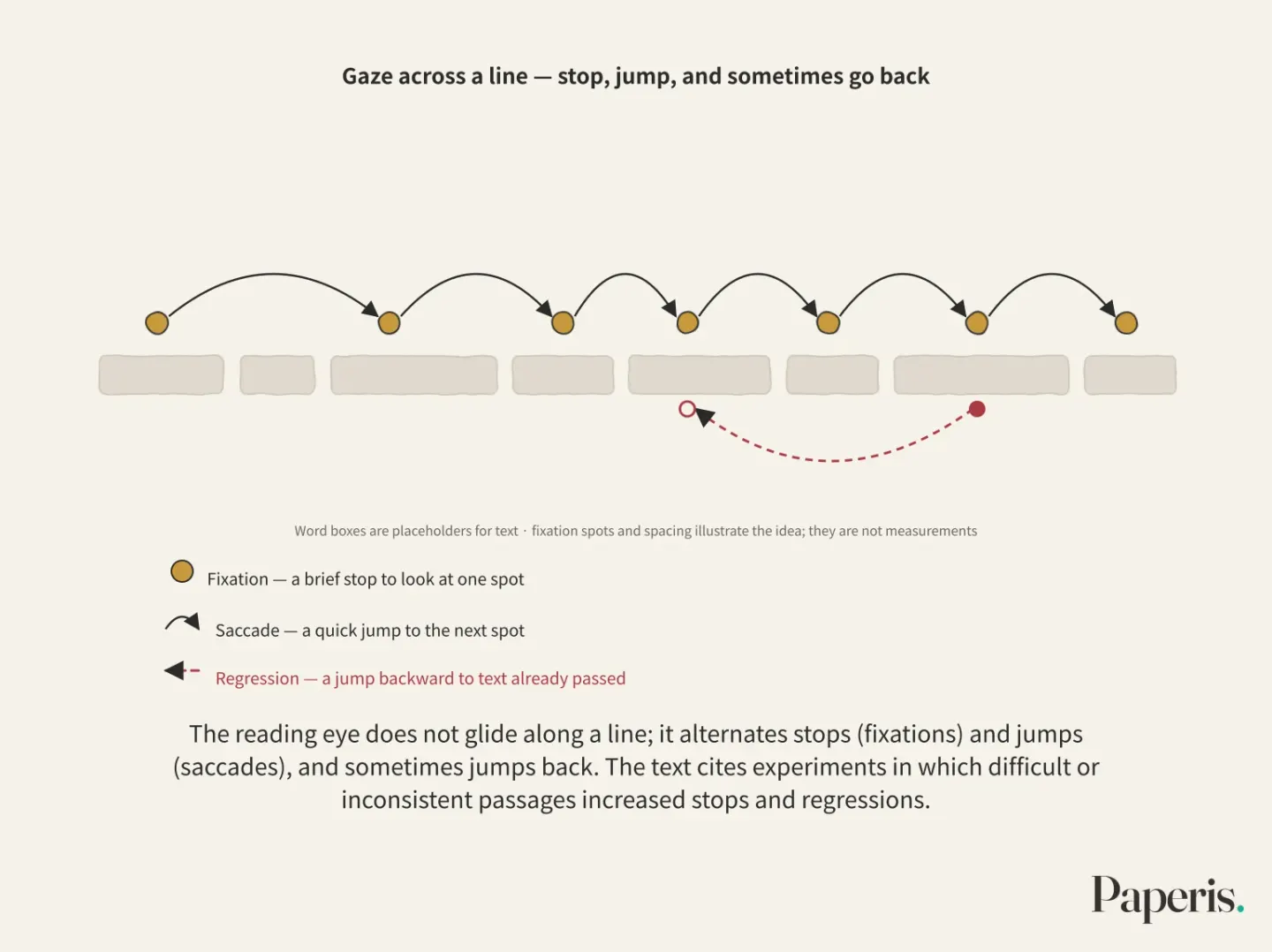
These pauses and leaps do not happen at random. A review summarizing 20 years of eye movement research made it a central theme that eye movement data reflect the cognitive processes occurring in the mind at that very moment (PMID 9849112). Two experiments show this in action. When a text was difficult, reading time increased, and in particular, the number of fixations increased. When there was a passage in the text that did not make sense, readers lingered longer on that spot. In both cases, the probability of making a regression also went up (DOI: 10.1207/s1532799xssr1003_3). This means that the rhythm of the eyes changes depending on the difficulty of the text and whether it makes sense.
There are also models trying to explain this relationship. One model proposes that word recognition, visual processing, attention, and the control of eye muscles together determine when and where the eyes move. The researchers who put forward that model compared it with other models and concluded that their model provided the broadest explanation (DOI: 10.1017/s0140525x03000104). Although it cannot be viewed as a confirmed fact, the point that it explains the timing of when the eyes move to the next spot by tying it together with word recognition connects directly to the flow of this article.
During reading, the rhythm of the eyes moves together with the tasks of recognizing words and comprehending the text. If you view eye movements merely as extra baggage attached to reading, this relationship remains hidden.
The Span Visible at Once
How many characters are visible when the eye pauses once? Perceptual span is the range from which useful information can be extracted from text during a single fixation. What this span depends on is crucial for evaluating speed-reading promises.
One experiment compared fast readers and slow readers. People who read about 330 words per minute had a wider perceptual span than those who read about 200 words per minute (PMID 21169577). Looking solely at the fact that fast readers have a wider span, the expectation that widening the span makes one faster seems plausible.
However, the span is not a fixed size. In two experiments, when the words at the fixation location were difficult—that is, when they were infrequently used or had complex sentence structures—readers extracted less information from the text beyond them. The researchers concluded that the perceptual span is variable and tied to attention (DOI: 10.1037/0278-7393.16.3.417). In a study of 127 German elementary school students measured twice over a one-year interval, the perceptual span widened significantly only between the second and third grades. The researchers interpreted this result as indicating that the perceptual span widens as a consequence of word reading becoming somewhat established (PMID 26950508). Because this is children's data, it is not directly extended to adults. However, it led to the interpretation that a wide span in children may be a consequence rather than a cause of word reading.
The span also differs depending on the writing system. When reading Chinese sentences, the perceptual span spanned one character to the left and three characters to the right of the fixated character (DOI: 10.1037/0096-1523.24.1.20). This figure is specific to Chinese and does not carry over to Korean.
There is also research suggesting that visual-side limitations are real. One research team proposed that the number of characters recognizable at a glance sets a fundamental limit on reading speed, and estimated that number to be at least 10 characters in the center of the visual field. This study measured reading speed by flashing words in a single location (PMID 11248262). This proposal—that limits also exist in the eye and vision—and the earlier finding that the span narrows depending on the difficulty of word processing come from different conditions. The two findings can be placed alongside each other, but they cannot be combined into one.
Fast readers see a wider area at once. Yet based on this evidence, that span widens and narrows depending on how easily words are processed.
Tying Down the Eyes
If eye movements slow down reading speed, an experiment that ties down the eyes altogether might provide the answer. Rapid Serial Visual Presentation is precisely such an experimental tool.
In 1992, a research team showed the same text in two ways to 13 people with normal vision. One was the full paragraph spread across a page as usual, and the other was Rapid Serial Visual Presentation. When reading aloud in medium-sized text, the average speed was 1,171 words per minute for Rapid Serial Visual Presentation and 303 words per minute for the page text. In an experiment where participants read silently and answered multiple-choice comprehension questions for each passage, everyone was faster with Rapid Serial Visual Presentation, and 6 out of the 13 people scored 75% or higher on comprehension questions at 1,652 words per minute, the highest speed the experiment could measure. The researchers interpreted that planning and executing eye jumps sets the upper limit of normal reading speed (DOI: 10.1016/0042-6989(92)90032-e). This is the closest evidence to the first claim of the conventional view, namely that tying down the eyes makes reading faster. However, the abstract does not separately state the comprehension scores compared to the page text, making it difficult to say from this experiment alone that comprehension remained the same.
A 2018 experiment tested the exact method used by apps. Sixth-grade and twelfth-grade level texts were read using fixed text as usual, and Rapid Serial Visual Presentation at 700 words per minute and 1,000 words per minute. Reading speed had the biggest impact on comprehension, and the fixed text had higher comprehension scores than both Rapid Serial Visual Presentation conditions. Within Rapid Serial Visual Presentation, slower speeds were better for questions asking about literal content, while faster speeds were actually better for questions asking about inference. Working memory is the ability to briefly hold and manipulate what one has just seen or heard in the mind, but the participants' working memory capacity did not predict comprehension scores (PMID 29461715). The result that faster speeds were better for inference questions does not fit the simple picture that faster speed means worse comprehension, and this abstract did not explain why, nor did it disclose the number and characteristics of the participants.
One of the things that Rapid Serial Visual Presentation takes away is regression. A 2014 experiment compared a condition where participants read as usual with a condition where the words that the reader's eyes had passed were immediately covered up. In the covered condition, words could only be read once and regressions were effectively blocked. Once regression became impossible, comprehension dropped, and this effect was not limited only to ambiguous sentences with two possible meanings. The researchers concluded that regression contributes to understanding what has been read, and questioned whether speed-reading apps that eliminate eye movements are actually useful (DOI: 10.1177/0956797614531148). A review article summarizing regression divides this movement into two. Large regressions are meant to reprocess preceding text to fix comprehension, and small regressions are meant to fix a spot where the eyes landed incorrectly to properly recognize a word. The same review noted that college-student-level readers often do not regress even when regressing would improve comprehension (PMID 31735836). This means that while regression is a movement that aids comprehension, readers do not use it every time they need to.
There is also a 2019 experiment that looked specifically at Rapid Serial Visual Presentation in ambiguous sentences. Participants read ambiguous and unambiguous sentences using Rapid Serial Visual Presentation and the method of showing the whole sentence at once, and answered comprehension questions targeting the ambiguous parts. In ambiguous sentences, the impact of Rapid Serial Visual Presentation on response time became greater. The effect on response time varied depending on working memory and vocabulary, and accuracy was influenced by working memory and cognitive control (PMID 30612265). This means that the burden of a single-word screen is not the same for every sentence or every person.
Two small-screen experiments yielded different results. In a 2003 experiment involving 16 participants using a mobile device prototype, Rapid Serial Visual Presentation formats increased reading speed by 33% compared to the usual method in short texts, with no significant differences in comprehension and perceived workload. In long texts, there were no differences in either speed or comprehension, and Rapid Serial Visual Presentation formats significantly increased workload (DOI: 10.1016/s0953-5438(03)00039-0). In a 2007 cellphone experiment also involving 16 participants, the page format was read significantly faster than Rapid Serial Visual Presentation, with no significant difference in comprehension (DOI: 10.1145/1329469.1329493).
While there were conditions where tying the eyes to a single spot made reading faster, the results showing that speed increased while maintaining the same level of comprehension were inconsistent, and blocking the path for regressions led to a drop in comprehension.
A Single Sentence on a Screen You Cannot Look Back At
Let us place the preceding facts upon a single sentence. Imagine reading one sentence with a passage in the middle that can be read in two ways—once as text unfurled like paper, and once as a screen where words appear one at a time in a single spot.
When readers encountered a passage that did not make sense in the unfurled text, readers in the experiment lingered longer in that spot and the probability of going back also went up (DOI: 10.1207/s1532799xssr1003_3). The abstract did not divide which kind of going back this was. A review summarizing these regressions divides the large ones among them into movements to reprocess the preceding text to correct understanding (PMID 31735836).
On the single-spot screen, words that have already passed do not remain on the screen. In an experiment that hid past words so that going back was impossible, comprehension dropped, and this effect was not limited to ambiguous sentences (DOI: 10.1177/0956797614531148). In another experiment, the effect of single-word sequential presentation on response time was greater for ambiguous sentences than for unambiguous sentences, and its abstract discussed this result in terms of processing depth and cognitive resources (PMID 30612265). Meanwhile, single-word sequential presentation designed to let readers control their own speed and go back was efficient and useful on small screens, unlike the previously tested methods, but readers disliked that method (DOI: 10.1518/001872099779577264).
The facts in this scene come from different experiments, and one experiment does not consecutively prove the results of another. Still, the direction overlaps. Screens where you cannot look back reduce eye movements, while also blocking the movements used to correct understanding.
What Remains and What Falls Away When Reading Fast
Among the evidence this article relies upon, the one that covers speed reading most broadly is a 2016 review. This review organized what science knows about the reading process and evaluated what it means for people who want to take speed reading training and buy speed reading apps (PMID 26769745). At the center of the conclusion is a trade-off. The speed-accuracy trade-off is a relationship where the faster you do something, the lower the accuracy, and the more time it takes to be accurate. The review judged that it would be difficult for readers to increase their reading speed two to three times from about 250 words per minute to 500–750 words per minute while understanding the text as well as when reading at a normal speed (PMID 26769745). This is the judgment of the review's authors, and there is no meta-analysis addressing the same question in the evidence this article relies on.
A 2000 experiment that had people read text on a screen at normal and fast speeds showed a speed-accuracy trade-off. Looking at question types, overall, questions recalling details had lower accuracy than questions asking for a higher level of understanding, and questions asking about text structure were the most difficult (DOI: 10.1111/1467-9817.00115).
A 1982 experiment that had people read stories and newspaper articles from 225 words per minute up to 600 words per minute looked at the main thread. Even when skimming at 600 words per minute, readers built a mental skeleton containing a significant portion of the story's important information and a few details. As reading speed increased, verbatim memory—that is, recognizing the exact surface words of the text—decreased. The researchers concluded that the basic process of skimming is similar to normal reading, but instead of reduced surface-level processing, readers rely more on general knowledge and predictive reading (DOI: 10.1037/0278-7393.8.5.400).
Here is where one part of conventional wisdom is correct. Skimming is reading quickly by passing over details without catching them all, in order to rescue only the main thread of the text. The 2016 review noted that if meticulous understanding of a text is not the reader's goal, speed reading or skimming can get a moderate level of understanding while moving through the text faster (PMID 26769745). The review judged that skimming is useful, but the price in the 1982 experiment and the review was a partial loss of understanding.
Reading One Page in Three Ways
In one experiment, people read a single page of text under four instructions: read normally, read carefully, skim, and check for spelling (DOI: 10.16910/jemr.11.1.1). We follow the first three as a single scene.
Reading normally serves as the baseline. When given the instruction to read carefully, total reading time grew longer and rereading increased, while comprehension scores were higher. When given the instruction to skim, the jumps grew longer, the average duration of a single fixation shortened, skipped words increased, total reading time was shorter, and that time was distributed evenly across the page. Comprehension scores were lower (DOI: 10.16910/jemr.11.1.1).
While comprehension scores in this experiment were lower when skimming, the abstract did not divide what was missed (DOI: 10.16910/jemr.11.1.1). What was missed was looked at by a previous 1982 experiment. In that experiment, as speed increased, memory for the surface details of the text declined, but the main plot was established to a significant degree even at 600 words per minute (DOI: 10.1037/0278-7393.8.5.400). The two experiments were conducted with different texts and different people, and the gaps of one experiment cannot be filled by the results of the other.
What We Still Don't Know
There are also results showing that eye-side limits can be expanded through training. A 2019 experiment randomly divided 26 people with normal vision into two groups of 13, and trained only one group for four days to recognize three-letter groups. After training, the range recognizable at a glance widened, and Chinese sentence reading speed increased by 50.8%. The researchers concluded that this range may be a common sensory limit that can be overcome with practice (PMID 31136652). It is a small single experiment in Chinese. This abstract notes that there is previous evidence that the range recognizable at a glance and reading speed also increased through perceptual learning in alphabetic texts (PMID 31136652). Those preceding studies are not directly included in the evidence this article relies on, and this abstract did not record the results of measuring comprehension. Whether the same results appear in Hangul, and while maintaining comprehension, cannot be known from the evidence this article relies on.
The difference between the 1992 experiment and the 2018 experiment is also a remaining question. In the earlier experiment, rapid serial visual presentation was very fast, and some participants got 75% or more of the comprehension questions right at top speed. In the later experiment, fixed text was better for comprehension. The two abstracts do not disclose texts and participants in the same way, so the conditions cannot be compared head-to-head, and the 1992 experiment did not record comprehension scores compared to page text in the abstract. Whether the two results conflict, and if they conflict, what divided them, has no answer in the evidence this article relies on.
The big conclusion of this article relies on one 2016 review and individual experiments. Experiments that report participant counts in their abstracts range in size from 13 to 127 people, and the rest did not disclose participant counts. Meta-analyses, which gather the results of multiple studies addressing the same question and recalculate them all at once, are not in the evidence this article relies on. Data from people who read Hangul is also absent.
What Have We Learned
We return to the first two claims. The claim that moving your eyes less makes you faster has some truth to it. Rapid serial visual presentation greatly increased reading speeds on short texts or under specific conditions (DOI: 10.1016/0042-6989(92)90032-e; DOI: 10.1016/s0953-5438(03)00039-0). However, a 2007 experiment that had people read on mobile phones found the opposite, with the page format being faster (DOI: 10.1145/1329469.1329493), and a 2003 experiment involving long texts found no difference in speed (DOI: 10.1016/s0953-5438(03)00039-0). The claim that comprehension stays the same even when you get faster does not fit the evidence well, aside from one short-text experiment. The comprehension results from the 1992 experiment were not compared against page text, so they do not count for either side. In an experiment with 16 people reading short texts on a mobile device, speeds increased by 33% with no significant difference in comprehension (DOI: 10.1016/s0953-5438(03)00039-0), but in an app-based experiment, static text was better for comprehension (PMID 29461715), blocking the way to look back lowered comprehension (DOI: 10.1177/0956797614531148), and a review judged that it would be difficult to keep the same comprehension while pushing speeds up two to three times (PMID 26769745).
The conclusion that reading more slowly is always better also does not come from this evidence. The review noted that unless deep comprehension is the goal, skimming can achieve moderate comprehension while getting through text much faster (PMID 26769745), and in the app-based experiment using rapid serial visual presentation, slower speeds were better for literal comprehension while faster speeds were better for inferential comprehension (PMID 29461715). The trade-off between speed and accuracy is a conclusion summarized by a 2016 review (PMID 26769745), and a 2000 screen-reading experiment framed its results with these exact words (DOI: 10.1111/1467-9817.00115). There are also several experiments where comprehension on the faster side was lower. In a 1982 experiment, memory for recognizing the surface details of the text dropped as speed increased (DOI: 10.1037/0278-7393.8.5.400), a 2018 single-page experiment found that skimming was fast with low comprehension scores while close reading had high comprehension scores but took more time (DOI: 10.16910/jemr.11.1.1), and a 2018 app-based experiment found that static text was better for comprehension than rapid serial visual presentation (PMID 29461715). There are also results where the same trade-off was not seen. In the mobile device short-text experiment, speeds increased with no significant difference in comprehension (DOI: 10.1016/s0953-5438(03)00039-0), and in the 2007 mobile phone experiment, the page format was faster with no significant difference in comprehension (DOI: 10.1145/1329469.1329493).
What did the review point to as a way to get faster while maintaining comprehension? The authors of the 2016 review pointed to reading practice and ways of becoming a more proficient language user—such as expanding vocabulary—as paths to reading faster while maintaining high comprehension, and they viewed language ability as central to reading speed (PMID 26769745). Experiments directly testing this judgment before and after training are not present in the evidence this article relies on. At the same time, studies suggesting that eye saccades and the number of letters recognized at a glance set the limits of speed are also present within the evidence this article draws upon. The judgment that reading speed is bound primarily by language processing belongs to the review, and how large a share eye and visual limitations account for cannot be separated out using only the evidence this article relies on.
Source Papers
- "Modern Speed-Reading Apps Do Not Foster Reading Comprehension." (2018) — PMID 29461715 — Fixed text was better for comprehension than rapid serial visual presentation at 700 and 1,000 words per minute. Slower speeds were better for literal comprehension, and faster speeds for inferential comprehension.
- "So Much to Read, So Little Time: How Do We Read, and Can Speed Reading Help?" (2016) — PMID 26769745 — Review. Speed-accuracy trade-off, getting two to three times faster while maintaining the same comprehension is difficult, skimming yields medium-level comprehension, and language skills are central to reading speed.
- "Don't Believe What You Read (Only Once): Comprehension Is Supported by Regressions During Reading" (2014) — DOI: 10.1177/0956797614531148 — Masking past words to prevent regressions reduced comprehension.
- "Eye movements, the perceptual span, and reading speed." (2010) — PMID 21169577 — Faster readers (roughly 330 words per minute) had a wider perceptual span than slower readers (roughly 200 words per minute).
- "Eye movements in reading and information processing: 20 years of research." (1998) — PMID 9849112 — Review. Eye movement data illuminate momentary cognitive processes.
- "Regressions during Reading." (2019) — PMID 31735836 — Review. Large regressions and small regressions; college-level readers do not frequently make regressions even when it would be helpful.
- "Psychophysics of reading. XX. Linking letter recognition to reading speed in central and peripheral vision." (2001) — PMID 11248262 — Suggestion that the number of letters recognized at a glance is the fundamental limit on reading speed, at least 10 letters in the central field of view.
- "Reading without saccadic eye movements" (1992) — DOI: 10.1016/0042-6989(92)90032-e — 13 participants, rapid serial visual presentation at 1,171 versus 303 words per minute for a page (reading aloud), with 6 participants showing over 75% comprehension at 1,652 words per minute.
- "One page of text: Eye movements during regular and thorough reading, skimming, and spell checking." (2018) — DOI: 10.16910/jemr.11.1.1 — Thorough reading had high comprehension scores, whereas skimming was fast and had lower comprehension scores.
- "Eye Movements as Reflections of Comprehension Processes in Reading" (2006) — DOI: 10.1207/s1532799xssr1003_3 — Difficult text increased fixations, lingered longer on inconsistent spots, and increased regressions.
- "The E-Z Reader model of eye-movement control in reading: Comparisons to other models" (2003) — DOI: 10.1017/s0140525x03000104 — Model. Word recognition, visual processing, attention, and eye control jointly determine eye movement.
- "The perceptual span and oculomotor activity during the reading of Chinese sentences." (1998) — DOI: 10.1037/0096-1523.24.1.20 — The perceptual span for Chinese is 1 character to the left and 3 characters to the right.
- "Effects of foveal processing difficulty on the perceptual span in reading: Implications for attention and eye movement control." (1990) — DOI: 10.1037/0278-7393.16.3.417 — When the word at the fixation point is difficult, less information is gathered beyond it; the perceptual span varies and is tied to attention.
- "Development of the perceptual span in reading: A longitudinal study." (2016) — PMID 26950508 — 127 German elementary students; the perceptual span widened significantly only between grades 2 and 3, interpreted as a result of word reading becoming established.
- "Cognitive processes in skimming stories." (1982) — DOI: 10.1037/0278-7393.8.5.400 — Even at a 600 words per minute skimming speed, much of the main plot remained, and higher speeds reduced surface memory of the text.
- "The effects of reading speed and reading patterns on the understanding of text read from screen" (2000) — DOI: 10.1111/1467-9817.00115 — Speed-accuracy trade-off in screen reading; detailed recall was less accurate than high-level questions.
- "Towards an improved readability on mobile devices: evaluating adaptive rapid serial visual presentation" (2003) — DOI: 10.1016/s0953-5438(03)00039-0 — 16 participants, short texts showed a 33% increase in speed with no difference in comprehension; long texts showed no difference and increased burden.
- "Eye movement study of reading text on a mobile phone using paging, scrolling, leading, and RSVP" (2007) — DOI: 10.1145/1329469.1329493 — 16 participants, the paging format was faster than rapid serial visual presentation with no difference in comprehension.
- "Designing an Interface to Optimize Reading with Small Display Windows" (1999) — DOI: 10.1518/001872099779577264 — Self-paced rapid serial visual presentation allowing regressions was efficient, but readers disliked it.
- "Rapid Serial Visual Presentation Interacts with Ambiguity During Sentence Comprehension." (2019) — PMID 30612265 — In ambiguous sentences, rapid serial visual presentation had a large effect on response times, involving working memory, vocabulary, and cognitive control.
- "Perceptual Learning of Visual Span Improves Chinese Reading Speed." (2019) — PMID 31136652 — 26 participants (13 in training), Chinese sentence reading speed increased by 50.8% after 4 days of training, comprehension not in the abstract.
Sources (21)
- Modern Speed-Reading Apps Do Not Foster Reading ComprehensionPMID 29461715
- So Much to Read, So Little Time: How Do We Read, and Can Speed Reading Help?PMID 26769745
- Don't Believe What You Read (Only Once): Comprehension Is Supported by Regressions During ReadingDOI 10.1177/0956797614531148
- Eye movements, the perceptual span, and reading speedPMID 21169577
- Eye movements in reading and information processing: 20 years of researchPMID 9849112
- Regressions during ReadingPMID 31735836
- Psychophysics of reading. XX. Linking letter recognition to reading speed in central and peripheral visionPMID 11248262
- Reading without saccadic eye movementsDOI 10.1016/0042-6989(92)90032-e
- One page of text: Eye movements during regular and thorough reading, skimming, and spell checkingDOI 10.16910/jemr.11.1.1
- Eye Movements as Reflections of Comprehension Processes in ReadingDOI 10.1207/s1532799xssr1003_3
- The E-Z Reader model of eye-movement control in reading: Comparisons to other modelsDOI 10.1017/s0140525x03000104
- The perceptual span and oculomotor activity during the reading of Chinese sentencesDOI 10.1037/0096-1523.24.1.20
- Effects of foveal processing difficulty on the perceptual span in reading: Implications for attention and eye movement controlDOI 10.1037/0278-7393.16.3.417
- Development of the perceptual span in reading: A longitudinal studyPMID 26950508
- Cognitive processes in skimming storiesDOI 10.1037/0278-7393.8.5.400
- The effects of reading speed and reading patterns on the understanding of text read from screenDOI 10.1111/1467-9817.00115
- Towards an improved readability on mobile devices: evaluating adaptive rapid serial visual presentationDOI 10.1016/s0953-5438(03)00039-0
- Eye movement study of reading text on a mobile phone using paging, scrolling, leading, and RSVPDOI 10.1145/1329469.1329493
- Designing an Interface to Optimize Reading with Small Display WindowsDOI 10.1518/001872099779577264
- Rapid Serial Visual Presentation Interacts with Ambiguity During Sentence ComprehensionPMID 30612265
- Perceptual Learning of Visual Span Improves Chinese Reading SpeedPMID 31136652