Paperis Articles
Does a Basic Income Make People Work Less? — What Unconditional Cash Experiments Showed, and What They Could Not
Work fell in the U.S. negative income tax experiments and in a three-year trial in two U.S. states, while employment barely changed in Finland and Alaska. In the U.S. trial, subjective well-being fell back to control-group levels after the first year, and no experiment tested a payment given to everyone, forever, out of taxes.
Your field's papers, as audio
Pick your fields and journals — Paperis summarizes the key papers and turns them into audio. Listen on your commute.
Start Paperis free →Does a Basic Income Make People Work Less? — What Unconditional Cash Experiments Showed, and What They Could Not
Two Common Beliefs
Programs that give cash to poor people are often dogged by the worry that the money will kill the desire to work. This is the exact concern that policymakers and citizens frequently voice about government cash-transfer programs for poor households in developing countries (DOI: 10.1093/wbro/lkx002). The worry that the money received will leak away on alcohol and tobacco is never far behind either (DOI: 10.1086/689575). There are strong hopes on the other side as well. As basic income gains attention as an alternative to automation and precarious jobs, the argument arises that unconditional money creates the breathing room to pursue entrepreneurship and learning even if it slightly reduces work, making the labor market more dynamic. A 2026 analysis pooled experimental data from multiple countries and reached this conclusion, noting that while work decreased slightly for a short period, entrepreneurship and income increased (DOI: 10.54254/2754-1169/2026.ld31635).
A basic income is cash given to everyone regularly, on an individual basis, unconditionally, regardless of how much wealth they have or whether they work. No study has yet measured the effects of introducing a literal basic income nationwide. A scoping review that surveyed studies from upper-middle-income and high-income countries notes that not a single study dealt with an intervention fully satisfying this definition, and that there were only studies of similar interventions (PMID 32113520). Therefore, what this article follows are experiments that resemble a basic income. A guaranteed income is cash given monthly without conditions for a set period, narrowing the target to low-income groups, a name primarily used by experiments in the United States.
Many of these experiments were designed as randomized controlled trials. A randomized controlled trial is a study design that divides participants into two groups by chance and compares the outcomes. Because the group that received the money and the group that did not were split by chance, any difference between the two groups can be read as being caused by the money.
The outcome this article examines most closely is labor supply. Labor supply is a combined term for whether people go out to work and, if they do, how long they work. In statistics, it is captured as the proportion of people who are working or looking for jobs, and the number of hours worked in a week.
This article mainly covers overseas experiments in places like the United States, Canada, Finland, and Kenya, and briefly looks at Korean cases in the penultimate section. It does not cover the pledges of specific political parties or politicians, nor does it judge whether one should be adopted. As we follow along, we will see that both common beliefs hold on to only one side of the experimental results.
1970s United States — The Negative Income Tax Experiments
Beginning in 1968, the U.S. federal government conducted four negative income tax experiments (DOI: 10.4324/9781315239934-5). A negative income tax is a system where people with incomes below a set line are given money instead of paying taxes, and the money given decreases as earnings increase. It was a popular form of income guarantee in the 1960s and 1970s, and the core question guiding the design of all four experiments was labor supply (DOI: 10.4324/9781315239934-5).
A 1985 paper that gathered the results of the four experiments to produce a consensus estimate noted that even though the treatment content and evaluation methods varied greatly across experiments, the results were remarkably consistent. On average, husbands reduced their work by an amount equivalent to about two weeks of full-time work, wives and single-headed households by about three weeks, and young people by about four weeks. This summary does not clarify whether this is on an annual basis or for the entire experimental period. The magnitude of the estimated responses was quite similar to estimates from non-experimental studies (DOI: 10.2307/145685). Work decreased, and that magnitude was measured in units of a few weeks rather than units of quitting work altogether. Neither erasing this reduction to zero nor exaggerating it into "not working" is consistent with these results.
During the same period in Canada, a different question was added later. The MINCOME guaranteed annual income experiment, conducted in Dauphin, Manitoba, from 1974 to 1979, was designed to measure the effect on working hours. Decades later, a study used public health insurance administrative data to track about 12,500 residents of Dauphin and surrounding areas and compare them with a control group of similar conditions, finding that hospitalizations decreased by 8.5% during the experimental period (PMID 23764242). Counterarguments were also raised regarding the hospitalization data from the same experiment. A 2022 re-analysis that re-examined a 2011 analysis of MINCOME's health effects points out that Dauphin's hospitalization data showed a statistically significant downward trend compared to the comparison regions even before the experiment began. The authors conclude that, compounded by the short pre- and post-experiment observation periods, the MINCOME data cannot support the claim that a guaranteed annual income reduced medical costs (DOI: 10.3138/cpp.2021-025). This re-analysis targeted the 2011 analysis and did not re-examine the analysis that produced the 8.5% figure above. Even good results are shaken if the starting line of comparison is skewed.
Finland — When the Cutting Rules Changed
Starting in January 2017 for two years, Finland randomly selected 2,000 unemployed people receiving unemployment benefits and gave them 560 euros every month (KCI ART002542305; DOI: 10.4337/9781839104855). There was neither an income test nor an asset test (DOI: 10.4337/9781839104855). This experiment replaced a minimum-level unemployment benefit with a basic income of the exact same size (DOI: 10.1257/pol.20200143). The amount of money received stayed the same, and what changed was the rule by which that money was cut. Unemployment benefits shrink when you work and earn income, but this basic income stayed the same even if you worked. There are also criticisms about whether this experiment can be seen as an unconditional basic income, and whether it is closer to a negative income tax or an earned income tax credit (KCI ART002542305).
What this experiment targeted was the welfare trap. The welfare trap is a state where if you work and your earnings increase, your benefits are cut by that much, so even if you work, the money left in your hands hardly increases. The experiment lowered the share taken away by taxes and cut benefits when starting full-time work by 23 percentage points. Even though the incentive to work grew by this much, the number of days employed in the first year did not change statistically. Even though all job search obligations were removed, participation in re-employment services remained high (DOI: 10.1257/pol.20200143). The authors conclude that the employment effect is small at best. The result in the first year was that people neither reduced nor increased their work.

Figure: How much is taken back once you start working — that calculation is what the Finnish experiment changed
The second year cannot be read cleanly. At the beginning of 2018, when the second year of the experiment started, a new system called the employment activation model that required activities and imposed sanctions on the unemployed was suddenly introduced (DOI: 10.1177/13882627221104501). Because of that, it became impossible to discern how and why the employment rate changed (KCI ART002677944). One analysis evaluates that the research design of the experiment was constrained from the start for political reasons, and this sanction model made the scientific power of the experiment even weaker (DOI: 10.1177/13882627221104501).
Outcomes other than work gathered in one direction. In the survey around the end of the experiment, the group that received the basic income answered that their life satisfaction was higher and their health was better than the control group, that they had less psychological distress and depression, and that cognitive abilities like memory and concentration were also better. Healthcare service usage was not different between the two groups (DOI: 10.4337/9781839104855). In a study using registry data, the local election voter turnout of unemployed people who received the basic income was on average about 3 percentage points higher, and among people on the borderline of whether to vote or not, it was 6 to 8 percentage points higher. This effect continued in national elections after the experiment ended, and the authors point to the experience of receiving money unconditionally raising trust in politics and a sense of efficacy as the mechanism (DOI: 10.1111/ajps.12915).
What Finland showed is that if you give the unemployed the same money but do not cut it, employment in the first year remains almost the same and self-reported quality of life improves. The evaluation that the goal of raising the employment rate fell short of expectations followed (KCI ART002677944). The target of this experiment was the unemployed, and the size of the money was the same as the benefit they originally received.
Alaska — To All Residents, Every Year
Since 1982, every resident of Alaska has received an annual cash dividend from the Alaska Permanent Fund (DOI: 10.1257/pol.20190299). In that it selects no targets and sets no end date, Alaska is the closest case to the "to everyone, forever" of a basic income. Instead, there is no randomly divided control group. Researchers weighted and mixed data from other states showing trends similar to Alaska's to create a "synthetic Alaska without the dividend" and compared it to the actual Alaska.
As a result, the dividend had no effect on employment, and part-time jobs increased by 1.8 percentage points, or 17% in proportional terms. Industries that do not trade with other regions—in other words, industries that buy and sell within that local area, like restaurants—saw better employment movements (DOI: 10.1257/pol.20190299). The authors consider this result to match the explanation that cash stimulated the local economy. The general equilibrium effect is an effect where, when money is poured into a region all at once, store sales, jobs, and prices move together, spreading even to people who did not receive the money. The authors' conclusion is that universal and permanent cash payments do not clearly reduce overall employment (DOI: 10.1257/pol.20190299).
A study looking at the same dividend through a different method reaches a different conclusion. This study used the timing of the dividend payouts and the year-to-year variation in dividend size to examine changes in the months immediately following the dividend, finding both the force of an increase in those seeking workers and the force of a decrease in those willing to work. Working hours decreased slightly for women, especially those with young children, and men's probability of employment rose in the months following the dividend. These authors estimate that combining the two, for every $1,000 increase in the dividend per person, labor market activity decreased by 0.8% on an annual basis (DOI: 10.1002/pam.22455). The two studies use different data and time units, and their conclusions about Alaska also diverge: one finds "no effect on overall employment," while the other finds a "small net decrease."
Developing Countries — Laziness Stereotypes and Alcohol and Tobacco
In developing countries, government programs that select poor households and give them cash are common. A study reanalyzing seven randomized controlled trials of government-run cash transfer programs across six countries found no systematic evidence that cash transfers reduce work (DOI: 10.1093/wbro/lkx002). Worries about alcohol and tobacco were also checked against data. After reviewing 19 studies with quantitative evidence and 11 studies asking respondents directly and conducting a meta-analysis, cash transfers tended to reduce alcohol and tobacco spending by an average of 0.18 standard deviations. The direction was the same in Latin America, Africa, and Asia, and in both conditional and unconditional transfers (DOI: 10.1086/689575). Even in the United States, in an experiment where 1,000 low-income mothers with newborns were randomly divided and given $333 or $20 a month for several years while their children were young, after one year there was no significant difference between the two groups in the use of alcohol, tobacco, and opioids and household spending on alcohol and tobacco, and the share of the difference in money received by the two groups spent on alcohol and tobacco was estimated to be less than 1% (PMID 35513842).
An experiment in Kenya widened the question to the village level. Rural Kenyan villages numbering 653 were randomly divided, and about 1,000 dollars was given at once to some 10,500 poor households. Putting that money together amounted to over 15% of the local gross domestic product. Consumption and assets of the households that received the money increased significantly, the benefits spilled over in a very positive direction to neighboring households that did not receive money and to local businesses, and prices rose very slightly. The authors estimate the local multiplier at 2.5. This means that 1 dollar of distributed money increased economic activity in the region by 2.5 dollars (DOI: 10.3982/ecta17945). The general equilibrium effects guessed at in Alaska were measured by Kenya through a randomized experiment. However, this money was given all at once, which is different in shape from a basic income given endlessly every month. According to a 2026 case study synthesizing other studies, in Kenya's GiveDirectly experiment, business activity, net income, and savings increased while overall labor supply did not decrease. The original studies for this synthesis are not in this article's reference list, and the grade of the case study itself is unconfirmed (DOI: 10.65161/ojssc26.recawjz3qaf7qstzi).

Figure: When cash flows into a village, it also reaches the shops and workplaces of neighbors who did not receive it
The evidence in this section does not support the stereotype that "giving money to poor people makes them lazy and buy alcohol." The subjects were mostly uniformly poor households.
A Three-Year Experiment in Two US States
In two US states, 1,000 low-income individuals received $1,000 per month unconditionally for three years. A control group of 2,000 individuals received $50 per month over the same period. The researchers measured the use of working time in detail using surveys, administrative records, and a smartphone app (DOI: 10.1093/qje/qjag042).
Work decreased in this experiment as well. Compared to the control group, personal income excluding the received funds decreased by about $1,900 per year, and labor market participation was 4.2 percentage points lower. Participants' working hours decreased by 1 to 2 hours per week, and participants' spouses or cohabitants reduced their hours by a similar amount. Among the increased time uses, leisure increased the most. The researchers asked in detail about job convenience and conditions, but there was no effect on job quality, and the confidence intervals were narrow enough to rule out even small improvements. Spending increased overall, and at the very front of that were goods and services that are quickly consumed and done with. There was no significant effect on degree attainment, and estimates were generally larger among younger participants. Subjective happiness indicators were higher than the control group in the first year of payments and then returned to the control group's level (DOI: 10.1093/qje/qjag042).
Synthesizing the results, the authors conclude that the decrease in labor supply is moderate, and that decrease does not appear to be made up for by other productive activities (DOI: 10.1093/qje/qjag042). This conclusion differs from the picture painted by a systematic literature review. That 2020 review gathered empirical cases dealing with the relationship between basic income and work, finding no evidence that labor supply decreased substantially, and instead finding evidence that labor supply increased among adults overall (DOI: 10.3390/su12229459). In that review, the groups where hours decreased were women caring for young children, young people continuing their studies, and groups like the elderly and the sick, and the authors consider that the increases in supply from other people largely made up for those decreases. The three-year experiment in two US states came out after that review, and here, the reduced labor does not appear to be made up for by other productive activities. There were 4.2 percentage points more people who did not enter the labor market than in the control group, and working hours decreased by 1 to 2 hours a week. Neither "they do not reduce work" nor "they do not work" captures these numbers as they are.
The results of similar US experiments also vary. In Stockton, California, 131 individuals who received $500 per month from February 2019 to January 2021 experienced less income volatility, lower psychological distress, and better energy and physical functioning than a control group of 200 (PMID 37037977). According to the secondary synthesis of the 2026 case study seen earlier, long-term employment effects were not statistically significant in the Stockton experiment (DOI: 10.65161/ojssc26.recawjz3qaf7qstzi). In a randomized controlled trial where the City of Los Angeles gave $1,000 unconditionally for 12 months to 3,202 individuals in 2022, health effects were quantitatively mixed, while recipients stated in interviews that they spent more time on preventive health behaviors (PMID 40633007).
Canada's Ontario basic income pilot project was halted earlier than scheduled. A study examining participants in the Hamilton region reports that labor market participation decreased slightly and various quality-of-life indicators improved. The authors list as hypotheses for why the quality-of-life results came out relatively favorable: the fact that this program was designed to reduce the payout by 50 cents for every $1 increase in earnings, the fact that the payout was more generous than existing public assistance, the absence of conditions, and the design targeting broad welfare (DOI: 10.1515/bis-2020-0034). Another study covering the same pilot project reported that both working and non-working recipients reported clear gains, with those who continued working from before through the project answering that they improved the most (DOI: 10.1515/bis-2020-0005). This rule of reducing by 50 cents has the same shape as the negative income tax seen earlier.
Results outside of work are not all in one direction either. A review re-reading post-2000 studies from high-income countries regarding mental health selected 7 peer-reviewed studies and 8 government reports. Multiple studies evaluating unconditional payments consistently reported clear improvements in psychological well-being, and the authors list time spent with family and friends, reduced stigma, and hope for the future as candidate mediating factors. At the same time, they conclude only that the expectation that basic income benefits mental health is "at least partially" correct, noting that future studies should be conducted at the regional level, with sufficient sample sizes, and over considerably long periods. Among the reviewed studies, none evaluated a truly universal payment (PMID 34534779). Among other results from the 1,000-mothers experiment seen earlier, there was no difference between the two groups in child health, sleep, or medical utilization as evaluated by the mothers. Fresh vegetable and fruit intake, measured once at age two, was higher in the group that received more, and the authors add that health effects may only reveal themselves after the children grow older (PMID 37773497).
Where Results Diverge — What Experiments Fail to Test
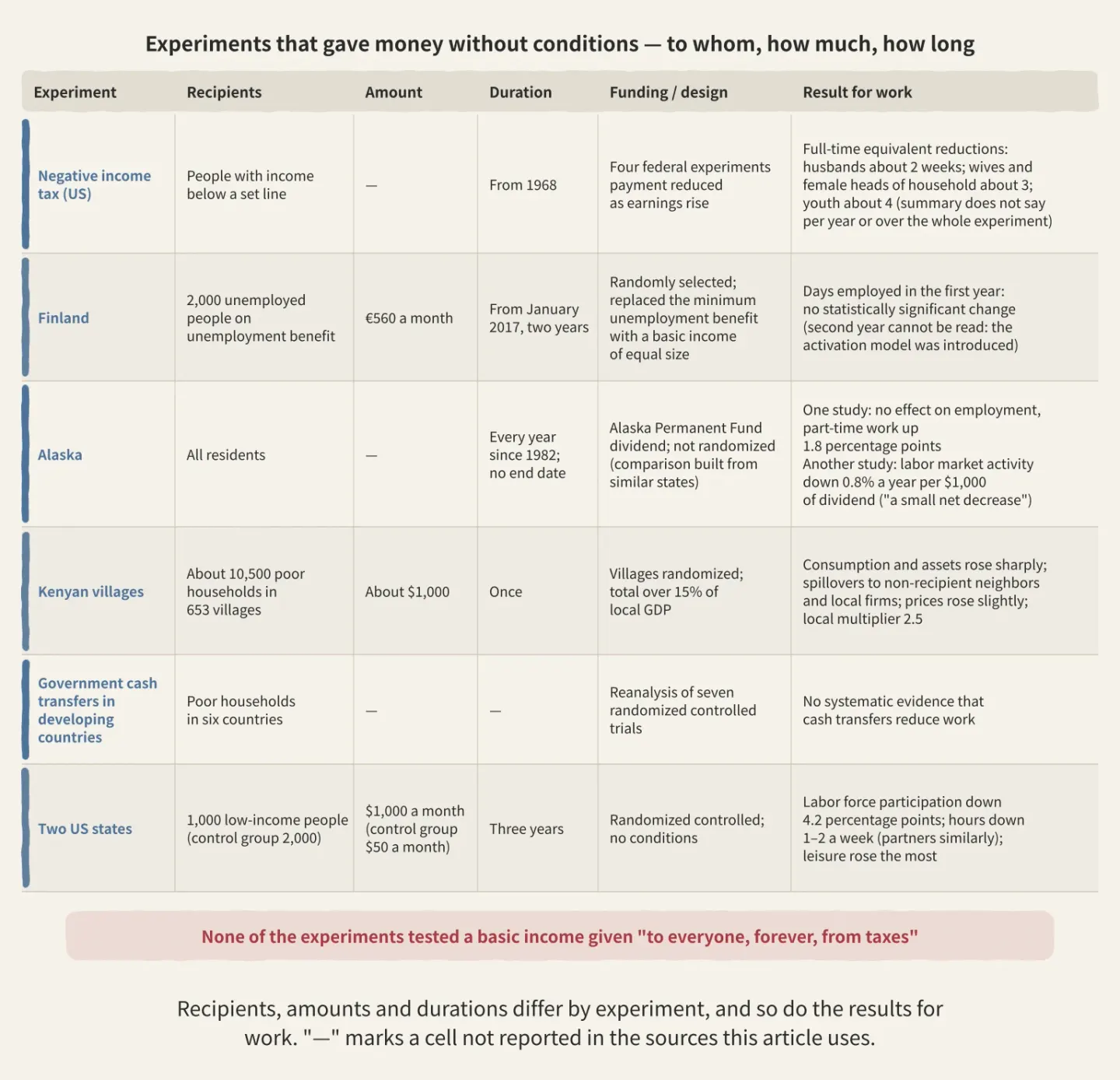
Figure: a diagram Paperis drew using only what the article says
When you place the experiments side by side, their designs differ even before their results do. At least three things vary from experiment to experiment. First is the size and nature of the money. Finland replaced the unemployment benefits participants were already receiving with the same amount of money, while the experiments in two U.S. states newly added $1,000 a month for low-income individuals. The two experiments tested different things: one tested the effect of changing the rules for cutting benefits, and the other tested the effect of having more money. Second is the duration. It was a single lump sum in Kenya, two years in Finland, three years in two U.S. states, and only Alaska has no end. Third is the target group. Unemployed people, low-income individuals, households in poor villages, and all residents of a single state are included in the different experiments.
Putting the same person through two experiments in sequence reveals the difference. Imagine a person receiving unemployment benefits receives a part-time job offer. Under unemployment benefits, the payout decreases by that earnings amount, so the money remaining in hand increases very little. Under the basic income in the Finland experiment, the payout continues as is, so only taxes are deducted from the money earned. What Finland measured was this difference, and employment days in the first year did not change. Now imagine the same person entering experiments in two US states and receiving an extra $1,000 per month on top of their original income. Whether this person starts working remains entirely their own choice, and what changed is that the money coming in without working increased. In this experiment, working hours decreased by 1 to 2 hours per week, and leisure increased the most. Research sorting out why the results differ does not exist in the evidence for this article. The two experiments also differ in their subjects, countries, timing, and amounts, and combining the numbers into a single sentence mixes answers to different questions.
The scoping review concludes that there is little evidence showing a large decrease in employment, summarizing that employment effects were inconsistent and generally small for men while larger for women with young children, that studies looking at larger populations showed spillover effects, and that evidence on macro-level effects is sparse (PMID 32113520). A mental health review also found no studies evaluating truly universal payments (PMID 34534779). A 2026 case study comparing five programs draws a similar conclusion. Because programs differ significantly in design, target populations, duration, payment structures, and economic conditions, and because they did not compare conditional and unconditional payments under otherwise identical conditions, these experiments make it impossible to isolate "unconditionality" itself as the cause. The authors' conclusion is that unconditional money produces good results in certain contexts, but its effects depend on design and economic conditions, while the fiscal and distributional effects of a nationwide universal basic income remain unresolved (DOI: 10.65161/ojssc26.recawjz3qaf7qstzi).
No experiment has tested a universal basic income given to “everyone, forever, through taxes”. Experiments give it to designated people, for a set period, using experimental budgets or funds. Three things remain outside the experiment.
One is funding. Experiment participants only receive money, and do not pay additional taxes to cover that money. A paper reviewing the economics of basic income through literature suggests that a nationwide basic income requires substantial tax increases, and that higher taxes reduce disposable income and dampen the willingness to work, which could conversely undermine the economic dynamism that a basic income aims to boost (DOI: 10.47743/jopafl-2024-33-10). The same paper also reports that basic income can ease economic insecurity to help labor market flexibility, and concludes that whether it will last in the long run depends on a funding method that balances equity and efficiency (DOI: 10.47743/jopafl-2024-33-10). This conclusion was obtained by reviewing fiscal models, and there is no magnitude measured by experiment.
The second is the general equilibrium effect. An experiment giving money to a few does not pump enough money to move a neighboring store's sales or prices. It is difficult to draw conclusions from a program that only selects targets or attaches conditions. This is because universal payouts distribute money to a large share of the population, pushing up the demand for labor, and that force can offset the response to reduce work (DOI: 10.1002/pam.22455). The Kenya village experiment measured this effect, but the money there was roughly 15% of the local gross domestic product released at once, and these experiments do not answer how money distributed nationwide every year will move prices.
Third is duration. The effects may appear only while the money is coming in. In a study analyzing the temporary expansion of the Child Tax Credit given unconditionally every month to most households with children in the U.S. in 2021, parents who received more had fewer days of poor mental health. The effect appeared after the third payment and vanished when the payments ended (PMID 38878295). In an experiment in two U.S. states, conversely, subjective happiness returned to the level of the control group after the first year even while the money kept coming for three years (DOI: 10.1093/qje/qjag042). The two results are lessons pointing in different directions and are not bundled together. How lifetime money works is a clue held only by Alaska, which has no end, but there is no randomized control group there.
In Korea
The Korean case is a small-scale youth payment. Gyeonggi Province's Youth Basic Income, starting in April 2019, gives 1 million won in local currency for one year to 24-year-olds living in Gyeonggi Province. A study using as a natural experiment a situation at a university on the border between Gyeonggi and Seoul where similar students' eligibility for benefits was split by where they lived reports that there was no statistically significant change in the business startup intentions and willingness to try new things of the youth who received it. The authors cite as limitations the short and small support of 1 million won for one year, the restriction on use as local currency, and the short period until effects appear, and considering these, judge that there is sufficient possibility that it could have positive effects (DOI: 10.18333/KPAR.54.3.225). Another study using data from the Korea Welfare Panel Study for 2019–2022 reports that the depression of youth decreased in the year following the payment and the year after that, and that this was more pronounced among working youth who were socioeconomically vulnerable than among non-working youth (DOI: 10.23447/kjhep.2026.32.2.002).
Busan's youth basic income project gave participating youth 1 million won per month for 7 months (DOI: 10.17000/kspr.30.4.202312.103). In a qualitative study that interviewed 19 participants, changes in work did not cluster in one direction. Some quit work, and some maintained or even increased work. Whether that work connected to what they genuinely wanted to do and what the working conditions of their current jobs were divided the judgments (KCI ART003056597). 19 interviews cannot measure the size of the effect, but they let us see what kinds of people might be mixed together inside the numbers in the previous section.
Where to Read More
Depending on the experiment, unconditional money slightly reduced work or changed it hardly at all, and those experiments differed from one another in who received how much and for how long. What the experiments told us the least about is what happens when money is given to everyone forever through taxes.
How to read an experiment continues in "Is the Randomized Controlled Trial Really the 'Gold Standard'?". How reducing or leaving work is captured in employment statistics is covered by "Unemployment and Employment — Those in Line, Those Who Left It". The gaps in income and assets targeted by cash payments can be explored further in "Inequality and Social Stratification — This Month's Allowance, the Piggy Bank Handed Down", and the automation worries that revived the basic income debate in "Will AI Take Our Jobs? — From Exposure to Job Loss".
Source Papers
- "Debunking the Stereotype of the Lazy Welfare Recipient: Evidence from Cash Transfer Programs" (2017) — DOI: 10.1093/wbro/lkx002 — Reanalysis of 7 government cash transfer randomized controlled trials across 6 countries, finding no systematic evidence of reduced work.
- "Cash Transfers and Temptation Goods" (2016) — DOI: 10.1086/689575 — In a meta-analysis of 19 studies and 11 surveys, spending on alcohol and tobacco decreased by −0.18 standard deviations.
- "Universal Basic Income and the Labour Market: A Microeconomic Analysis with Evidence from International Experiments" (2026) — DOI: 10.54254/2754-1169/2026.ld31635 — Concludes that labor supply decreases slightly and temporarily while business startups and incomes improve, potentially making the labor market more dynamic.
- "The public health effects of interventions similar to basic income: a scoping review" (2020) — PMID 32113520 — No basic income studies meet the definition, employment effects are inconsistent (small for men, large for women with young children), and evidence for macroeconomic effects is scarce.
- "A Retrospective on the Negative Income Tax Experiments" (2017) — DOI: 10.4324/9781315239934-5 — Four negative income tax experiments by the U.S. federal government, where labor supply was the core research question.
- "A Comparison of the Labor Supply Findings from the Four Negative Income Tax Experiments" (1985) — DOI: 10.2307/145685 — Consensus estimates: reductions equivalent to 2 weeks for husbands in full-time work, 3 weeks for wives and female heads of households, and 4 weeks for young people, with consistent results.
- "New questions, new data, old interventions: the health effects of a guaranteed annual income" (2013) — PMID 23764242 — Administrative data from MINCOME (Dauphin, 1974–1979), showing an 8.5% reduction in hospitalizations.
- "A Reanalysis of 'The Town with No Poverty'" (2022) — DOI: 10.3138/cpp.2021-025 — Pre-experiment downward trends in Dauphin's hospitalization data, meaning claims of reduced medical costs are not supported.
- "핀란드의 기본소득 실험-계획과 중간평가" (2019) — KCI ART002542305 — 2017–2018 randomized trial of unemployed individuals at €560 per month, showing no employment difference in the 1-year preliminary results.
- "Experimenting with Unconditional Basic Income: Lessons from the Finnish BI Experiment 2017-2018" (2021) — DOI: 10.4337/9781839104855 — 2,000 unemployed individuals receiving €560 per month for 2 years showed improvements in life satisfaction, health, psychological distress, and cognitive skills, with no difference in healthcare utilization.
- "Removing Welfare Traps: Employment Responses in the Finnish Basic Income Experiment" (2022) — DOI: 10.1257/pol.20200143 — Despite a 23-percentage-point drop in the participation tax rate, there was no change in employment days in the first year, and participation in re-employment services was maintained.
- "보편적 복지국가에서 보편적 기본소득으로?: 핀란드 기본소득 정책 실험의 최종 결과와 함의" (2020) — KCI ART002677944 — Introduction of an employment activation model made it impossible to determine employment rate changes, while quality of life improved.
- "A Truly Missed Opportunity: The Political Context and Impact of the Basic Income Experiment in Finland" (2022) — DOI: 10.1177/13882627221104501 — Political constraints in research design and the 2018 conditionality model.
- "Policy feedback and voter turnout: Evidence from the Finnish basic income experiment" (2022) — DOI: 10.1111/ajps.12915 — Increases of about 3 percentage points in local election turnout and 6 to 8 percentage points among marginal voters, along with political trust and efficacy.
- "The Labor Market Impacts of Universal and Permanent Cash Transfers: Evidence from the Alaska Permanent Fund" (2022) — DOI: 10.1257/pol.20190299 — No employment impact, a 1.8-percentage-point (17%) increase in part-time work, consistent with general equilibrium effects.
- "Universal Cash Transfers and Labor Market Outcomes" (2022) — DOI: 10.1002/pam.22455 — Labor demand increases alongside supply decreases, with a 0.8% annual labor market contraction per $1,000 per capita.
- "Unconditional cash transfers and maternal substance use" (2022) — PMID 35513842 — $333 per month compared to $20 showed no significant changes in alcohol, tobacco, or opioids, with alcohol and tobacco accounting for less than 1%.
- "General Equilibrium Effects of Cash Transfers: Experimental Evidence From Kenya" (2022) — DOI: 10.3982/ecta17945 — A one-time payment of roughly $1,000 across 653 villages and over 10,500 households increased local GDP by more than 15%, spilled over to non-recipients, caused negligible price inflation, and yielded a multiplier of 2.5.
- "The Employment Effects of a Guaranteed Income: Experimental Evidence from Two U.S. States" (2024) — DOI: 10.1093/qje/qjag042 — $1,000 per month for 3 years (vs. $50 control) led to annual income falling by $1,900, participation dropping by 4.2 percentage points, working hours decreasing by 1–2 hours per week, leisure increasing, no effect on job quality, and subjective happiness returning to baseline after the first year.
- "Is There Empirical Evidence on How the Implementation of a Universal Basic Income (UBI) Affects Labour Supply? A Systematic Review" (2020) — DOI: 10.3390/su12229459 — Found no evidence of a significant decrease in labor supply.
- "Impact of Guaranteed Income on Health, Finances, and Agency: Findings from the Stockton Randomized Controlled Trial" (2023) — PMID 37037977 — $500 per month for 2 years among 131 participants versus 200 controls, showing reductions in income volatility and psychological distress.
- "What Cash-Transfer Trials Establish About Conditionality" (2026) — DOI: 10.65161/ojssc26.recawjz3qaf7qstzi — Comparing 5 programs, unconditionality itself cannot be isolated as a cause, leaving nationwide basic income fiscal and distributional effects unresolved.
- "The Impacts of the Ontario Basic Income Pilot: A Comparative Analysis of the Findings from the Hamilton Region" (2021) — DOI: 10.1515/bis-2020-0034 — The prematurely canceled Ontario pilot showed a small decrease in labor market participation, improved quality of life, and a 50% clawback rate.
- "More than Welfare: The Experiences of Employed and Unemployed Ontario Basic Income Recipients" (2020) — DOI: 10.1515/bis-2020-0005 — Participants who remained employed reported the greatest improvements.
- "The mental health effects of a Universal Basic Income: A synthesis of the evidence from previous pilots" (2021) — PMID 34534779 — 7 high-income country studies and 8 government reports consistently show that unconditional payments improve mental well-being, expectations are "partially" justified, and no studies examine truly universal payments.
- "Unconditional Cash Transfers and Maternal Assessments of Children's Health, Nutrition, and Sleep: A Randomized Clinical Trial" (2023) — PMID 37773497 — $333 per month compared to $20 showed no differences in children's health, sleep, or healthcare utilization, but fresh food consumption was higher.
- "The effects of an unconditional cash transfer on parents' mental health in the United States" (2024) — PMID 38878295 — The expanded 2021 Child Tax Credit reduced bad mental health days, appearing after the third payment and disappearing after payments ended.
- "Time Scarcity, Health Behaviors, and Unconditional Cash in Los Angeles" (2025) — PMID 40633007 — 3,202 individuals receiving $1,000 for 12 months showed mixed quantitative health effects.
- "THE ECONOMICS OF UNIVERSAL BASIC INCOME" (2025) — DOI: 10.47743/jopafl-2024-33-10 — Literature review raising concerns about the substantial tax increases and work disincentives required for a nationwide basic income.
- "경기도 청년기본소득은 도전을 자극하는가" (2020) — DOI: 10.18333/KPAR.54.3.225 — Using natural experiments and 2SLS, found no significant changes in willingness to start a business or try new ventures.
- "청년기본소득이 청년 정신건강에 미치는 영향" (2026) — DOI: 10.23447/kjhep.2026.32.2.002 — Korea Welfare Panel Study data from 2019–2022 showed reduced feelings of depression in the following and subsequent years.
- "청년의 꿈-자본 구성과 확장의 서사: 부산 청년 기본소득 실험 참여자의 경험을 중심으로" (2023) — DOI: 10.17000/kspr.30.4.202312.103 — 19 participants across the first and second cohorts receiving 1 million won per month for 7 months.
- "기본소득은 노동에 어떻게 영향을 미치는가?: 부산 청년 기본소득 프로젝트 참여자에 대한 질적 사례연구" (2024) — KCI ART003056597 — Interviews with 19 participants showing a mix of work discontinuation, maintenance, and increases.
Sources (30)
- Debunking the Stereotype of the Lazy Welfare Recipient: Evidence from Cash Transfer ProgramsDOI 10.1093/wbro/lkx002
- Cash Transfers and Temptation GoodsDOI 10.1086/689575
- Universal Basic Income and the Labour Market: A Microeconomic Analysis with Evidence from International ExperimentsDOI 10.54254/2754-1169/2026.ld31635
- The public health effects of interventions similar to basic income: a scoping reviewPMID 32113520
- A Retrospective on the Negative Income Tax ExperimentsDOI 10.4324/9781315239934-5
- A Comparison of the Labor Supply Findings from the Four Negative Income Tax ExperimentsDOI 10.2307/145685
- New questions, new data, old interventions: the health effects of a guaranteed annual incomePMID 23764242
- A Reanalysis of 'The Town with No Poverty'DOI 10.3138/cpp.2021-025
- Experimenting with Unconditional Basic Income: Lessons from the Finnish BI Experiment 2017-2018DOI 10.4337/9781839104855
- Removing Welfare Traps: Employment Responses in the Finnish Basic Income ExperimentDOI 10.1257/pol.20200143
- A Truly Missed Opportunity: The Political Context and Impact of the Basic Income Experiment in FinlandDOI 10.1177/13882627221104501
- Policy feedback and voter turnout: Evidence from the Finnish basic income experimentDOI 10.1111/ajps.12915
- The Labor Market Impacts of Universal and Permanent Cash Transfers: Evidence from the Alaska Permanent FundDOI 10.1257/pol.20190299
- Universal Cash Transfers and Labor Market OutcomesDOI 10.1002/pam.22455
- Unconditional cash transfers and maternal substance usePMID 35513842
- General Equilibrium Effects of Cash Transfers: Experimental Evidence From KenyaDOI 10.3982/ecta17945
- The Employment Effects of a Guaranteed Income: Experimental Evidence from Two U.S. StatesDOI 10.1093/qje/qjag042
- Is There Empirical Evidence on How the Implementation of a Universal Basic Income (UBI) Affects Labour Supply? A Systematic ReviewDOI 10.3390/su12229459
- Impact of Guaranteed Income on Health, Finances, and Agency: Findings from the Stockton Randomized Controlled TrialPMID 37037977
- What Cash-Transfer Trials Establish About ConditionalityDOI 10.65161/ojssc26.recawjz3qaf7qstzi
- The Impacts of the Ontario Basic Income Pilot: A Comparative Analysis of the Findings from the Hamilton RegionDOI 10.1515/bis-2020-0034
- More than Welfare: The Experiences of Employed and Unemployed Ontario Basic Income RecipientsDOI 10.1515/bis-2020-0005
- The mental health effects of a Universal Basic Income: A synthesis of the evidence from previous pilotsPMID 34534779
- Unconditional Cash Transfers and Maternal Assessments of Children's Health, Nutrition, and Sleep: A Randomized Clinical TrialPMID 37773497
- The effects of an unconditional cash transfer on parents' mental health in the United StatesPMID 38878295
- Time Scarcity, Health Behaviors, and Unconditional Cash in Los AngelesPMID 40633007
- THE ECONOMICS OF UNIVERSAL BASIC INCOMEDOI 10.47743/jopafl-2024-33-10
- 경기도 청년기본소득은 도전을 자극하는가DOI 10.18333/kpar.54.3.225
- 청년기본소득이 청년 정신건강에 미치는 영향DOI 10.23447/kjhep.2026.32.2.002
- 청년의 꿈-자본 구성과 확장의 서사: 부산 청년 기본소득 실험 참여자의 경험을 중심으로DOI 10.17000/kspr.30.4.202312.103