
Paperis Articles
Music Lessons and Intelligence — The Difference That Was There Before the Instrument Case
Children who learn an instrument score slightly higher on intelligence tests on average. Yet the more strictly a study randomizes children and gives the comparison group another activity, the smaller the spillover into intelligence and school grades becomes; whether it reaches zero or a small effect remains is still disputed over the same data. Much of the gap comes from who chooses to take lessons, and what music training leaves behind shows up most clearly close to music itself, such as musical skills and an ear for telling sounds apart, though even that evidence is not yet conclusive.
Your field's papers, as audio
Pick your fields and journals — Paperis summarizes the key papers and turns them into audio. Listen on your commute.
Start Paperis free →Music Lessons and Intelligence — The Difference That Was There Before the Instrument Case
Common Belief: Children Who Learn Instruments Are Smarter
On a weekday afternoon, a child carrying a violin case goes to a lesson. There is an old belief among parents: learning an instrument makes you smarter, and because of that, math and reading scores go up too.
This belief has an observational starting point, and that observation is a fact. When children aged 9 to 12 are divided into those who have received music lessons and those who have not, and are given intelligence tests, the IQ of the group that received lessons is higher on average, and that difference appears evenly across multiple subtests of the intelligence test (PMID 21751987). This type of comparison is a cross-sectional study that measures two groups side by side at a single point in time, and in cross-sectional studies, an association between music practice and IQ consistently appears (PMID 25939545). There is also an analysis combining 72 studies showing that people who received music training perform better on tasks involving setting goals and controlling behavior, but this too is mostly a comparison at a single point in time (DOI: 10.5964/jbdgm.245).
So the question to ask is the source of that difference. Is this difference created by the instrument case, or was it there before carrying the case. This article follows that single question.
If we call what the common belief expects by its exact name, it is far transfer. Transfer refers to the effect of learning one thing spreading to other untrained tasks, and it is divided into two based on the distance it spreads. Far transfer is when the effect of learning one thing spreads to a distant ability, for example, from piano practice to intelligence test scores or math grades. Near transfer is when the effect spreads to something similar to what was learned, for example, from instrument practice to an ear for distinguishing notes or the ability to pick out speech sounds. What this article follows is primarily far transfer, and at the end, it returns to near transfer.
Drawing Lots
The straightest way to separate the source of a difference is to keep children from choosing instruments themselves. Random assignment is a method that leaves to chance—like drawing lots—who goes into which condition. When divided by drawing lots, original differences like intelligence, personality, and family background are evenly scattered across the two groups, so any differences that arise later can be blamed on the lessons.
The idea that "music makes you smart" had already drawn heavy attention from scholars and the press, and by the authors' account, the first study to directly test this idea by randomly assigning a large sample of children came out in 2004. 144 children were divided by drawing lots into four groups: keyboard lessons, vocal lessons, drama lessons, and no lessons, and their IQs were measured before and after the lessons. The overall IQs of the two music groups rose more than those of the comparison groups. The authors noted that the effect was relatively small, and the gains appeared evenly across subtests of IQ and standardized academic achievement tests. There was also one unexpected result. The drama group showed a large increase in adaptive social behavior, but no such change was seen in the music groups (PMID 15270994). What the original study reported was a "relatively small" increase in IQ, and that the gains spread evenly across subtests and academic achievement tests.
The drama lesson group was a device to make the comparison fair. An active control group is a comparison group that does a similar amount of a different activity instead of the activity being tested. If you compare only with a group that did nothing, the very experience of meeting an adult every week to learn something and receive expectations might have raised the scores. Only by comparing with a group that did a different activity do you leave behind just the differences caused "because it was music."
Later randomized trials were mixed regarding intelligence. Two trials that gave preschoolers six-week music classes and compared them with art classes or no-class groups initially saw the music children pull ahead in spatial navigation reasoning, but this did not replicate in the second trial. Combining both trials, the music children did not pull ahead on any test of spatial reasoning, visual pattern analysis, number discrimination, or vocabulary (PMID 24349171). In a 6-month study dividing 74 Chinese-speaking 4-to-5-year-olds into piano, reading training, and no-treatment groups, the IQs, working memories, and attention spans of all three groups increased equally. However, this study did not use strict drawing of lots, but an assignment the authors called "quasi-random" (PMID 29941577). In a study comparing 110 school children over two years across music training, basketball training, and no training, music training increased fingertip fine motor control and auditory memory, but had no effect on other cognitive abilities like nonverbal reasoning (PMID 40064075).
Looking at them one by one, the results scatter between "small gains" and "no difference." A single study's sample is dozens to around a hundred people, so random fluctuation is large. That is why the step of gathering multiple studies together becomes necessary.
Looking across studies: better design means a smaller effect
A single trial involves dozens to roughly a hundred children, but a 2020 analysis recalculated data from 6,984 children across 54 studies at once. A meta-analysis is a method that gathers the results of multiple studies addressing the same question and recalculates them all together. Because each study uses different tests, their scores cannot simply be added up. Therefore, an effect size is a number that compares the difference between two groups' averages to how widely the scores are spread out, allowing studies using different tests to be placed side by side and compared. A value of 0 means the averages of the two groups are the same, while 0.2 means the average is separated by one-fifth of the spread of the scores.
Meta-analyses gathering music education research show a common pattern. A 2017 analysis pooling the effects of chess, music, and working memory training on children's cognitive and academic abilities found small to medium effects, but the effect size moved in the opposite direction of the quality of the experimental design, such as whether an active control group was present. The authors concluded that this result casts serious doubt on the effects of all three trainings, and that far transfer rarely occurs (PMID 29276344).
The 2020 analysis reached the same conclusion in the same direction as the 2017 analysis. When design quality was controlled, the overall effect size of music training programs was close to 0, and results across studies consistently hovered near 0. Small effects around an effect size of 0.2 that were statistically unlikely to be due to chance came only from studies that did not use random assignment and did not include an active control group. The results did not change depending on how they were measured (verbal, non-verbal, speed), the child's age, or the training duration. The authors concluded that researchers' optimism about the benefits of music training is not empirically justified and may have been fueled by misinterpretation of data mixed with confirmation bias (PMID 32728850).
An analysis by a different research team paints a similar picture. In a 2019 meta-analysis pooling data from 5,612 school-aged children, the overall effect size was 0.28, and looking only at studies comparing against an active control group, it was 0.21. However, when factors related to methodological quality were added, the overall effect size shrank to 0.08 and became indistinguishable from chance. The authors noted that while music training may be a positive cognitive intervention for students, the evidence that it is better than other cognitive interventions is weak (DOI: 10.1177/0255761419881495).
The same pattern appears in other cognitive training as well. An analysis re-pooling several meta-analyses of cognitive training such as working memory training, video games, music, and chess reported that when placebo effects and publication bias are controlled, the far transfer effect drops to 0, and this holds true for any training and any age group. In the same analysis, near transfer—where working memory training spills over into memory tasks similar to the trained task—did appear (DOI: 10.1525/collabra.203). Publication bias refers to the tendency for studies showing positive effects to be published more readily.
There is one key takeaway from this section. The more rigorous the design, the smaller the effect of music education spilling over into intelligence and academics, dropping close to 0 in the most rigorous ones.
Still Debating ①: Small or Non-Existent
Not everyone agrees with this conclusion. In 2022, a different research team took the data files and analysis code from the 2020 meta-analysis and recalculated the results. They reported failing to reproduce the effect of random assignment, and pointed out that the original analysis cherry-picked effect sizes corresponding to near transfer for the music training group while not doing the same for the active control group. When recalculated, an effect size of 0.234 appeared—an effect that is small but hard to dismiss as a fluke. The authors concluded that music might be a special activity that allows for far transfer, which is small but statistically difficult to write off as a coincidence (PMID 34462895).
Another meta-analysis is a manuscript that has not yet undergone journal peer review, in other words, a preprint. Selecting only programs that teach musical instruments and gathering 34 samples of children and adolescents, short-term programs showed a small benefit with an effect size of 0.24 regardless of whether random assignment was used. In the same analysis, in studies where children chose the activities themselves, those children were already ahead by an effect size of 0.28 before training even began. Interpreting this as nature and nurture working together, the authors noted that well-designed studies are still rare and that more research is needed for firmer conclusions (DOI: 10.31234/osf.io/4bm8v).
Voices pointing in the opposite direction continue as well. A 2022 position paper argued that recent meta-analyses resolved the lack of consensus in the field of cognitive training and that the overall effect of far transfer is zero. The authors of this paper suggested that research efforts should be redirected toward near transfer or other methods (DOI: 10.1177/17456916221091830). Neither side claims that "music training greatly raises intelligence." The debate over intelligence and academics lies between zero and roughly 0.2.
The differences come from three places. First is what is counted as an outcome. Including near transfer results favorable to the music group makes the effect larger, and excluding them makes it smaller. Second is whether that outcome selection was applied equally to both the music group and the comparison group. Third is how strictly studies are filtered. Even with the same data, these choices split the outcome between "non-existent" and "small."
There are also results that observational data have shown regarding the same far transfer question. In data from the ABCD study, which tracks adolescent brain and cognitive development on a large scale, children who consistently practiced music for two years scored higher on various cognitive and language tasks, and picture vocabulary grew more over time in them than in children who did not do music. In less well-off neighborhoods, the picture vocabulary of children who did not do music grew less than that of children in better-off areas, but for children who did music, it grew similarly regardless of their financial circumstances. The authors interpreted that music training helps cognitive and language development and can be especially helpful for children from disadvantaged backgrounds, but because this study is observational and did not divide children by a lottery, it cannot separate out pre-existing differences that were there before it started (PMID 41043108).
Still Under Debate ②: Executive Function
There is also a lot of research targeting narrower abilities instead of IQ test scores. Executive function is the cognitive ability that allows you to control your actions toward a goal; its typical branches are working memory, which holds and manipulates information in your head temporarily, inhibition, which holds back a reaction trying to pop out, and flexibility, which changes your thoughts when the rules change. There is a hypothesis that learning an instrument uses a lot of inhibition in particular, because it involves watching hand movements and choosing which sounds to listen to among many (PMID 39197250).
There are several positive meta-analyses on this side. A 2025 analysis pooling 46 studies involving 3,530 children reported an effect size of 0.35, and noted that the longer the training, the larger the effect. The abstracts do not state what the designs of the pooled studies were (PMID 40978247). A 2026 analysis pooling 29 studies across five continents and 3,265 people reported an effect size of 0.62, with the largest gains in working memory. The authors noted that the subpatterns intertwined with culture and teaching methods have uneven subgroup evidence, that the strength of comparison groups also varies by study, and that country-level cultural classifications are crude so they should be read as hypotheses and tested with stronger active control group designs (PMID 42241841). A 2024 analysis looking only at inhibition pooled 22 longitudinal studies including 8 randomized controlled trials, with 1,734 people. Looking only at the randomized controlled trials, the effect was medium to large, and across all 22 it was small to medium, and the authors interpreted that musical training plays a special role in inhibition compared to other activities like sports, art, and drama (PMID 39197250).
These numbers change meaning depending on what was pooled. An analysis pooling 72 studies and reporting an effect size of 0.59 mostly consisted of studies comparing people who had received musical training with those who had not at a single point in time, and the authors noted that such cross-sectional studies cannot pull out causality (DOI: 10.5964/jbdgm.245). Differences in cross-sectional studies carry over differences that were already there before lessons started. The 2020 analysis from the previous section reported that no matter whether results were measured as verbal, nonverbal, or speed types, when the design was rigorous the effect was near zero, and it is not stated in the abstract how much executive function tasks were included in those result types (PMID 32728850).
Individual randomized controlled trials are mixed. In a 10-week trial dividing 84 children aged 4 to 6 into a music program, a Lego program, and no treatment, the music group's pitch-matching accuracy and working memory improved more than the other groups, and the Lego group's spatial working memory improved (PMID 35899371). In a study randomly dividing 147 elementary school students into two music groups, an art group, and a no-treatment group for two and a half years, the inhibition, planning, and verbal intelligence scores of the two music groups increased more than the art and no-treatment groups, while the art group came out ahead in visuospatial memory tasks (PMID 29541017). On the other hand, in the basketball control group study seen earlier, 2 years of music training increased auditory memory—short-term and working memory holding things heard as sound—but did not change the tasks measured as executive function and nonverbal reasoning by the authors (PMID 40064075). In the results up to the fourth year of a study following children from lower-income areas divided into music, sports, and no activity in a 5-year plan, from the third year onward the music group did better than the control group in a task waiting for a larger delayed reward, accuracy clearly increased only for the music group in one other inhibition task, and there was no difference between groups in yet another inhibition task. This study divided groups according to the activities the children were already doing rather than a drawing of lots, and the authors noted that they confirmed there were no differences in cognitive ability between groups at the start (PMID 31680820).
In the same trials, results also came out together that the Lego group was ahead in spatial working memory and the art group in visuospatial memory. Executive function is the spot where "there is no far transfer" and "music is special" collide most closely. Although several positive meta-analyses have come out, one of them mostly pooled cross-sectional comparisons, another pooled studies whose designs do not appear in the abstract, and individual randomized controlled trials are split between trials where things went up and trials where things did not change. As of 2026, an analysis organizing this split is not in the evidence gathered by this article.
Why a Correlation Arises: Even Before Carrying the Case
If the effect is small in a strict test, where did the initial correlation come from? The answer researchers have put forward is "who ends up carrying the instrument case."
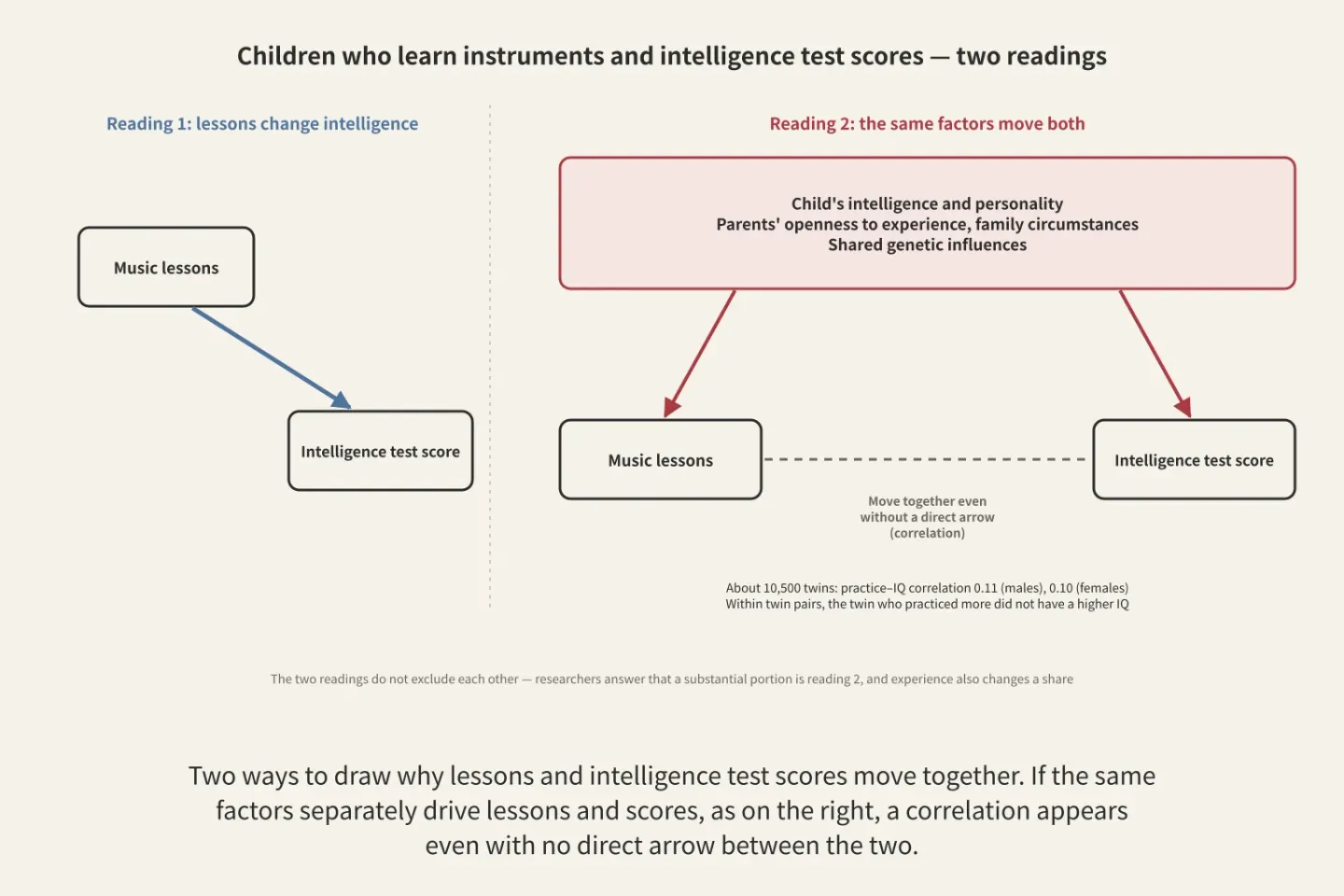
Figure: a diagram Paperis drew using only what the article says
The first is the child themselves. In an initial comparative study of 9- to 12-year-olds, children who took lessons had higher IQs, but the association between lessons and five measures of executive function was minimal. The authors interpreted this, alongside existing literature, as meaning that children with higher IQs are more likely to take lessons and score well on various cognitive tests excluding executive function (PMID 21751987). Other researchers challenged this conclusion. They questioned what actual experiences the two groups of children had, whether the executive function tasks measured properly, and whether the logic moving from data to conclusion was sound (PMID 21751988). Another study published the same year examining children of the same age group reported that the amount of lessons and all five executive function measures were associated, and that executive function partially mediated the association between lessons and intelligence (DOI: 10.1525/mp.2011.29.2.195). The authors interpreted this as a result where lessons fostered executive function, which led to intelligence test scores. However, both studies observed children with a single measurement, so neither could establish the sequence.
The second is personality and parents. In a study examining 170 children aged 7 to 9, the child's personality traits predicted the duration of taking lessons even after statistically fixing demographic variables like family background and intelligence. Parents' openness to experience also predicted the child's lesson duration even after fixing the child's traits (PMID 25852601). At least at a young age, parents mostly decide whether to start lessons, so what kind of parents a child grows up under is connected to how long the child will carry the case. The authors read this as an indication that genetic predisposition influences the experiences a child will encounter.
The third is genetics. In a study analyzing about 10,500 twins, the correlation coefficients between music practice volume and IQ were 0.11 for males and 0.10 for females. The correlation coefficient is a value indicating the degree to which two values move together; it is unrelated if 0, and as it gets closer to 1, they move together. This is a different metric from the effect size mentioned earlier. However, when conducting a within-twin comparison that controlled for the effects of genetics and a shared environment raised together, the twin who practiced more did not have a higher IQ than the one who practiced less, and the relationship between practice and IQ was mostly explained by shared genetic influences. The authors concluded that the association between music practice and IQ in the general population is likely not causal (PMID 25939545). Transposed into a scene, it is like this: among twins raised in the same home, one practiced a lot and the other hardly at all, yet the intelligence test score of the one who practiced more was not higher. The abstract does not state what age or nationality this sample consisted of. This means that the association seen in the general population mainly came from the genetic influences that twins share together. What this study measured is the result of separating where the difference between two traits comes from in a twin sample, not what a single child's practice changes.
These three strands are connected. One review paper summarized that children seek out environments suited to their traits, such as music lessons, and that such environments further widen pre-existing individual differences (PMID 25773632). A textbook chapter also summarized that the association with music training appears to be the result of demographic traits, personality, musical aptitude, and individual differences in cognitive ability influencing who takes lessons, especially for a long time (DOI: 10.1093/oxfordhb/9780198804123.013.26). In the second survey of a two-year music training study, children from music schools recognized vocal emotions better, but once family circumstances or innate musical ability were controlled for, that association disappeared (PMID 40064075).
What to take away from this section is this: A substantial portion of the reason why children who learn instruments are smarter lies in the fact that children who are smarter or possess specific traits, and such parents, choose instruments. There is also a share that experience changes. What the twin study looked at was the association between practice and intelligence, and the closer abilities we will look at in the next section must be examined separately.
What Remains Close By
Even where distant transfer fades, something remains. Earlier, in the piano study, the IQs of all three groups increased equally, but the piano group outperformed the reading training group and the no-treatment group in the ability to distinguish words by consonant sounds and in brain responses to changes in tone and pitch of Mandarin Chinese words. The authors concluded that while they found no distant transfer, the near transfer to speech perception shows potential to help children's language skills (PMID 29941577). An analysis gathering longitudinal data, including British adolescent data, similarly reported that near transfer from musical training to musical ability is substantial, while evidence for distant transfer to cognitive variables is weaker. The same analysis also yielded the result that children with higher intelligence and working memory improved their musical skills more quickly afterward (PMID 36251356).
There are also areas connected to reading. In a meta-analysis gathering 13 musical training trials involving 901 people, phonological awareness—breaking words down into sound units and matching them—increased by an effect size of 0.2, but for reading fluency, which is reading text smoothly, the overall pooled effect was not clear despite some studies reporting large effects (PMID 26648880). A textbook chapter summarized that causal evidence for musical training is largely lacking or weak, while noting that training focused solely on listening and rhythm perception appears to be an exception. Such improved phonological awareness can lead to reading in young children just learning to read or in children with dyslexia (DOI: 10.1093/oxfordhb/9780198804123.013.26). In a randomized trial of 46 children with dyslexia, the musical training group outperformed the control group on rhythm, phonological awareness, and reading tasks (PMID 26407242). This is a single trial with a small sample.
The idea that learning an instrument builds the ability to distinguish sounds is also not yet conclusive. A meta-analysis that independently re-gathered the same question viewed the results as trending in a positive direction, yet noted that evidence is insufficient for a firm conclusion because studies featuring random assignment and active control groups are still rare. It also added the caveat that the gathered studies may have used short-term memory-dependent tests—choosing whether things are the same or different—and thus missed some changes produced by musical experience. The authors added that even so, extreme skepticism is not supported by the evidence (PMID 36252825).
A 2024 review summarizes it like this. Evidence that musical training yields out-of-music benefits is weak or absent, and researchers have exaggerated the contribution of experience while neglecting the contribution of innate factors. Rather than chasing elusive perceptual and cognitive benefits, they suggested that it is more productive to examine the social-emotional effects of musical activities, especially group music-making, and that music-based interventions may be effective primarily in clinical groups or groups with atypical development (PMID 37738514). This suggestion to find the value of music outside of intelligence is the authors' proposal, and the social-emotional effects themselves are not separately verified by the evidence in this article.
So what did we learn?
We return to the child carrying a violin case. On average, these children score slightly higher on intelligence tests than peers who do not take lessons. Much of that difference was already present in the child's abilities and temperament, and in the parents' traits, before they ever picked up the case, and in twin studies, the link between practice volume and IQ came mostly from shared genetic influences. The portion created after carrying the case appears most clearly in domains close to music, such as musical skill, the ear for distinguishing sounds, fingertip dexterity, and auditory memory. However, the side that distinguishes sounds is not yet definitive because studies with random assignment and active control groups are still rare.
It is easy to swing from overturning a common belief straight to the opposite common belief. The conclusion that music education changes nothing does not follow from this evidence. What rigorous meta-analyses have shown is that the far transfer to intelligence and academics is zero or small, and for "small" and "zero" on the intelligence and academic side, researchers differ even when looking at the same data, while executive function yields different effect sizes across meta-analyses depending on what was pooled. The points of divergence are whether random assignment was used, what the comparison group did, and what was counted as an outcome.
Armed with this evidence, when you hear the news that "children who play instruments have higher grades," three questions arise. First, did the children choose the instruments themselves, or were they divided by a lottery? If they chose themselves, pre-existing differences before the start may be mixed into the results, as in comparative studies of 9- to 12-year-olds. Second, what did the comparison group do? In the 2020 meta-analysis, effects around 0.2 appeared only in studies that neither used random assignment nor included an active control group. Individual trials compared against groups doing other activities were mixed. There were trials where verbal intelligence scores rose more than in an art group, and trials where, compared to a basketball group, there was no difference in cognitive ability except for auditory memory. Third, what was measured? Depending on whether the ability is close to music, such as pitch, speech sounds, and phonological awareness, or distant, such as intelligence test scores or grades, the same training yields different answers. The shape commonly drawn by meta-analyses is that the stricter the study design, the smaller the effect on intelligence and academics appeared (PMID 29276344).
The question this article followed was a single one: "Do instruments make you smart?" "Is it worth learning an instrument?" is a different question, and not one that can be answered with this evidence. If there is a place to look further, it is how executive function turns out in long-term trials featuring random assignment and active control groups.
Source Papers
- "Examining the association between music lessons and intelligence." (2011) — PMID 21751987 — Children aged 9–12 who took lessons had higher IQs, but the link to executive functions was minimal, suggesting children with higher IQs are more likely to take lessons.
- "Investigating cognitive transfer within the framework of music practice: genetic pleiotropy rather than causality." (2016) — PMID 25939545 — Over 10,500 twins, r=0.11/0.10, disappeared in within-twin comparisons, shared genetics.
- "Executive functions and music training: A meta-analysis" (2026) — DOI: 10.5964/jbdgm.245 — 72 studies, music training group superior in executive function g=0.59, cross-sectional study so no causality.
- "Music lessons enhance IQ." (2004) — PMID 15270994 — 144 participants randomly assigned, music group IQ increase relatively small, drama group improved social behavior.
- "Two randomized trials provide no consistent evidence for nonmusical cognitive benefits of brief preschool music enrichment." (2013) — PMID 24349171 — Preschool 6-week classes two trials, combined showed no difference.
- "Piano training enhances the neural processing of pitch and improves speech perception in Mandarin-speaking children." (2018) — PMID 29941577 — 74 Mandarin-speaking children quasi-randomized, no differences in IQ, working memory, or attention, near transfer in speech perception.
- "Does music training improve emotion recognition and cognitive abilities? Longitudinal and correlational evidence from children." (2025) — PMID 40064075 — 2 years of music vs basketball vs no training, only motor skills and auditory memory improved, emotion recognition link disappeared when controlling for family background and musical ability.
- "Does Far Transfer Exist? Negative Evidence From Chess, Music, and Working Memory Training." (2017) — PMID 29276344 — Effect size inversely proportional to design quality, far transfer is rare.
- "Cognitive and academic benefits of music training with children: A multilevel meta-analysis." (2020) — PMID 32728850 — 54 studies with 6,984 participants, g≈0 when controlling for design quality, 0.2 only in non-randomized, non-active control studies.
- "It's all in your head: A meta-analysis on the effects of music training on cognitive measures in schoolchildren" (2019) — DOI: 10.1177/0255761419881495 — g=.28, active control .21, .08 non-significant when methodological factors are included.
- "Near and Far Transfer in Cognitive Training: A Second-Order Meta-Analysis" (2019) — DOI: 10.1525/collabra.203 — Far transfer is 0 and near transfer remains when controlling for placebo and publication bias.
- "Near and far transfer: Is music special?" (2022) — PMID 34462895 — Reanalysis of 2020 meta-analysis, g=.234, noting selective exclusion of near transfer.
- "Please don't stop the music: A meta-analysis of the cognitive and academic benefits of instrumental musical training in childhood and adolescence" (2021, preprint) — DOI: 10.31234/osf.io/4bm8v — g=0.24, baseline superiority of self-selected studies g=0.28.
- "Cognitive Training: A Field in Search of a Phenomenon" (2022) — DOI: 10.1177/17456916221091830 — Overall effect of far transfer is 0, criticizing optimism in the field.
- "Does music training improve inhibition control in children? A systematic review and meta-analysis." (2024) — PMID 39197250 — 22 longitudinal studies (8 randomized), improvement in inhibition (medium to large effect in randomized trials), interpretation that music is special compared to other activities.
- "Boosting executive function in children aged 3-12 through musical training: a three-level meta-analysis." (2025) — PMID 40978247 — 46 studies with 3,530 participants, g=0.35.
- "Cultural context and instructional structure in children's music education: An RVE Meta-analysis of executive-function outcomes." (2026) — PMID 42241841 — 29 studies with 3,265 participants, g=0.62, culture × instructional structure sub-patterns are hypothesis-generating.
- "Multimodal music training enhances executive functions in children: Results of a randomized controlled trial." (2022) — PMID 35899371 — 84 participants, music improved pitch accuracy and working memory, Lego improved spatial working memory.
- "Longitudinal Analysis of Music Education on Executive Functions in Primary School Children." (2018) — PMID 29541017 — 147 participants 2.5-year randomized trial, inhibition, planning, and verbal intelligence increased more than art or no treatment, supporting far transfer mediated by executive functions.
- "Effects of Music Training on Inhibitory Control and Associated Neural Networks in School-Aged Children: A Longitudinal Study." (2019) — PMID 31680820 — Compared music, sports, and no activity, superiority found only in some inhibition tasks.
- "How does experience change cognition? Evaluating the evidence." (2011) — PMID 21751988 — Counterarguments to the conclusions of the 2011 IQ study (nature of experience, task validity, logic).
- "Music Lessons and Intelligence: A Relation Mediated by Executive Functions" (2011) — DOI: 10.1525/mp.2011.29.2.195 — Executive functions partially mediate the lesson-intelligence link.
- "Predicting who takes music lessons: parent and child characteristics." (2015) — PMID 25852601 — Child personality and parental openness predict lesson duration.
- "Music training and speech perception: a gene-environment interaction." (2015) — PMID 25773632 — Children seek environments that match their traits, and environments amplify individual differences.
- "Longitudinal Effects of Continuous Music Training on Cognitive Development: Evidence From the Adolescent Brain Cognitive Development (ABCD) Study." (2025) — PMID 41043108 — Observational data, children continuing music had higher scores and greater increases in picture vocabulary, with similar gains regardless of family background.
- "Musical development during adolescence: Perceptual skills, cognitive resources, and musical training." (2022) — PMID 36251356 — Substantial near transfer, weak far transfer, high intelligence and working memory predict subsequent musical growth.
- "Does Music Training Enhance Literacy Skills? A Meta-Analysis." (2015) — PMID 26648880 — 13 studies with 901 participants, phonological awareness d=0.2, no significant overall effect on reading fluency.
- "Music Training and Cognitive Abilities: Associations, Causes, and Consequences" (2018) — DOI: 10.1093/oxfordhb/9780198804123.013.26 — Lack of causal evidence, listening and rhythm training are exceptions, association is the result of individual differences affecting who takes lessons.
- "Music Training Increases Phonological Awareness and Reading Skills in Developmental Dyslexia: A Randomized Control Trial." (2015) — PMID 26407242 — 46 children with dyslexia, music group improved in rhythm, phonology, and reading.
- "Suggestive but not conclusive: An independent meta-analysis on the auditory benefits of learning to play a musical instrument." (2022) — PMID 36252825 — Auditory benefits are suggestive but not conclusive, extreme skepticism is also unsupported.
- "Music Training and Nonmusical Abilities." (2024) — PMID 37738514 — Evidence for non-musical benefits is weak or absent, suggesting social-emotional effects and clinical populations.
Sources (31)
- Examining the association between music lessons and intelligencePMID 21751987
- Investigating cognitive transfer within the framework of music practice: genetic pleiotropy rather than causalityPMID 25939545
- Executive functions and music training: A meta-analysisDOI 10.5964/jbdgm.245
- Music lessons enhance IQPMID 15270994
- Two randomized trials provide no consistent evidence for nonmusical cognitive benefits of brief preschool music enrichmentPMID 24349171
- Piano training enhances the neural processing of pitch and improves speech perception in Mandarin-speaking childrenPMID 29941577
- Does music training improve emotion recognition and cognitive abilities? Longitudinal and correlational evidence from childrenPMID 40064075
- Does Far Transfer Exist? Negative Evidence From Chess, Music, and Working Memory TrainingPMID 29276344
- Cognitive and academic benefits of music training with children: A multilevel meta-analysisPMID 32728850
- It's all in your head: A meta-analysis on the effects of music training on cognitive measures in schoolchildrenDOI 10.1177/0255761419881495
- Near and Far Transfer in Cognitive Training: A Second-Order Meta-AnalysisDOI 10.1525/collabra.203
- Near and far transfer: Is music special?PMID 34462895
- Please don't stop the music: A meta-analysis of the cognitive and academic benefits of instrumental musical training in childhood and adolescenceDOI 10.31234/osf.io/4bm8v
- Cognitive Training: A Field in Search of a PhenomenonDOI 10.1177/17456916221091830
- Does music training improve inhibition control in children? A systematic review and meta-analysisPMID 39197250
- Boosting executive function in children aged 3-12 through musical training: a three-level meta-analysisPMID 40978247
- Cultural context and instructional structure in children's music education: An RVE Meta-analysis of executive-function outcomesPMID 42241841
- Multimodal music training enhances executive functions in children: Results of a randomized controlled trialPMID 35899371
- Longitudinal Analysis of Music Education on Executive Functions in Primary School ChildrenPMID 29541017
- Effects of Music Training on Inhibitory Control and Associated Neural Networks in School-Aged Children: A Longitudinal StudyPMID 31680820
- How does experience change cognition? Evaluating the evidencePMID 21751988
- Music Lessons and Intelligence: A Relation Mediated by Executive FunctionsDOI 10.1525/mp.2011.29.2.195
- Predicting who takes music lessons: parent and child characteristicsPMID 25852601
- Music training and speech perception: a gene-environment interactionPMID 25773632
- Longitudinal Effects of Continuous Music Training on Cognitive Development: Evidence From the Adolescent Brain Cognitive Development (ABCD) StudyPMID 41043108
- Musical development during adolescence: Perceptual skills, cognitive resources, and musical trainingPMID 36251356
- Does Music Training Enhance Literacy Skills? A Meta-AnalysisPMID 26648880
- Music Training and Cognitive Abilities: Associations, Causes, and ConsequencesDOI 10.1093/oxfordhb/9780198804123.013.26
- Music Training Increases Phonological Awareness and Reading Skills in Developmental Dyslexia: A Randomized Control TrialPMID 26407242
- Suggestive but not conclusive: An independent meta-analysis on the auditory benefits of learning to play a musical instrumentPMID 36252825
- Music Training and Nonmusical AbilitiesPMID 37738514