
Paperis Articles
The Mozart Effect — Ten Minutes in the Earphones Before the Test
A 1993 experiment in which college students scored briefly higher on spatial tasks after ten minutes of a Mozart sonata grew into the belief that Mozart makes you smarter. As other labs repeated it, many found that rises could be explained by the listener's arousal and mood, though some results still resist that account.
Your field's papers, as audio
Pick your fields and journals — Paperis summarizes the key papers and turns them into audio. Listen on your commute.
Start Paperis free →The Mozart Effect — Ten Minutes in the Earphones Before the Test
The 10 Minutes Before Getting the Test Paper
There are test-takers who plug in earphones in the hallway of the test venue and play a piece of classical music. This is because they heard somewhere that "listening to Mozart makes your brain work better." The source of this belief is an experimental report published in the 1993 scientific journal Nature (PMID 25060169). It stated that after listening to Mozart's piano music for 10 minutes and then solving three spatial tasks, scores temporarily rose (PMID 11026433).
From this, a name was born. The Mozart effect is the claim that scores on a test measuring spatial ability rise immediately after listening to Mozart's music. Over the next 30 years, this claim sparked many experiments, and outside the laboratory, it grew into a much larger story.
This article follows those 10 minutes. We look in turn at what the 1993 experiment actually measured, how that result grew into "listening to Mozart makes you smart," what happened when other laboratories tried to replicate it, and what appears to have actually moved the scores. The answer lies somewhere between "Mozart raises intelligence" and "music has nothing to do with the brain," and that spot becomes quite concrete when you follow the research design.
What the 1993 Experiment Actually Measured
The piece used in the experiment was Mozart's Sonata for Two Pianos in D major, K.448 (PMID 9656277). As the name implies, it is a piece played together by two pianos.
The participants were college students (PMID 7731551). The problems they solved right after listening to the piece were specific tasks from the Stanford-Binet intelligence test, and the duration for which their scores increased was short (DOI: 10.1177/1749975514557096). Part of the intelligence test was used, and the result concerned the immediate scores on a few spatial tasks among them.
Spatial reasoning is the ability to solve problems by turning, folding, and unfolding shapes in your head. The "paper folding and cutting" problem frequently used in this branch of experiments is a good example (PMID 10407891). It is a problem where you look at a picture of cuts made in a folded paper and choose what shape it will become when unfolded.
The same research team reported in a 1995 follow-up experiment that they obtained the results again (PMID 7731551). A control condition is a condition where something other than music is done to serve as a standard for comparison. In this experiment, "repetitive" music and a short recorded story were played as control conditions, neither of which raised reasoning scores, and short-term memory did not improve after listening to Mozart either (PMID 7731551). The researchers interpreted this as a result of Mozart's music "causally" increasing spatio-temporal reasoning for a short time, and tried to find the basis for it in a model explaining the brain's neural connections (PMID 7731551).
EEG studies followed as well. In a 1997 study measuring the brainwaves of seven people, the specific brainwave pattern that occurred while listening to Mozart carried over to the subsequent spatial task in three people (PMID 9175137). It is a small observation of three out of seven people, and the authors themselves called this the "beginning" of neurophysiological understanding (PMID 9175137).
Gathering the scope that the original study claimed, it is this: college students listened to a specific piece of music for 10 minutes, and their scores on a spatial task solved immediately afterward rose briefly. The researchers themselves wrote in a 1998 article that more research is needed before drawing practical applications (PMID 9656277). What the 1993 experiment showed was short spatial task scores immediately after college students listened to the piece.
From the Lab to the Children's Room
In the 1990s, the United States was called the "Decade of the Brain," with attention focused on neuroscience and early childhood education, and there was also great interest in intelligence tests, ways to raise intelligence, and particularly a child's intelligence (DOI: 10.1177/1749975514557096). A sociology paper analyzes that the Mozart effect meshed with these conditions to become a major cultural phenomenon in the U.S. from the 1990s to the early 2000s, followed by commercial exploitation and even generating political fallout aimed at early childhood education (DOI: 10.1177/1749975514557096). The author calls this a "scientific legend."
Reports that music enhances non-musical abilities received great attention from the mainstream media and influenced public policy (PMID 11458841). A 2016 paper noted that this finding continually fueled the trend encouraging music education over the next 20 years (DOI: 10.1038/srep18744). The subjects and duration of the experiment remained the same, but the story understood by the public and politicians shifted from college students' short task scores to early childhood education (DOI: 10.1177/1749975514557096).
The same name ended up covering even different questions. The term "Mozart effect" actually came to refer to two phenomena. One is the claim that spatial ability briefly increases right after listening to Mozart, and the other is the possibility that formally learning music brings benefits to non-musical abilities as well (PMID 11458841). This article deals only with the former. What relationship learning an instrument has with intelligence is the subject of the installment covering music education and intelligence.
When Other Labs Tried Again
Replication is the process in which other researchers run the same experiment again to see if they get the same results. The results of attempts to re-verify the Mozart effect varied from lab to lab (PMID 9656277).
An experiment in 1995 had 114 college students first solve items from the Raven's Progressive Matrices, which is a reasoning test, and then listen through earphones to either Mozart for 8 minutes, relaxation instructions, or silence, before solving items of the same difficulty again (PMID 8684937). All three groups saw their second scores go up. The practice effect is a phenomenon where scores go up the second time you take the same type of test because you have grown familiar with the questions. The points that went up in this experiment were due to the practice effect and had nothing to do with what the participants listened to (PMID 8684937). This means that if the researchers had compared only the before-and-listening scores without a control condition, they would have mistakenly attributed this rise to the music.
Another experiment that same year divided 51 men and women by a lottery draw to have them solve a spatial task called the paper folding and cutting test after either 10 minutes of a Mozart sonata or 10 minutes of meditation in silence (PMID 7501747). After stripping away the influence of college entrance exam scores and gender, there was no difference in the average scores of the two groups. These authors added that the task they used might have measured a different kind of spatial ability than the task in the original experiment (PMID 7501747).
The original research team pointed to precisely that issue as the reason for the mixed replications. They stated that what task was used to measure scores, in what order the conditions were placed, what piece of music was chosen, and whether another task was inserted in the middle could all dictate the results (PMID 9656277). Experiments that matched the design in response to this answer emerged. An experiment in 2000 matched the three conditions set forth by the original research team and had 36 adults experience classical music, jazz, and silence in turn, but there was no difference in spatial reasoning scores, and even when re-analyzing only the items that best measured spatial reasoning, it was not significant, with the average actually running in the opposite direction of what was expected (PMID 11026433). An unpublished study cited by the original research team as evidence—namely, the result that inserting a verbal task between the pre-test and the music revives the effect—was also tested for with 206 college students, but no difference emerged among the three groups in paper folding and cutting scores (PMID 10407891). Even in a task where participants navigated through rooms on a computer to learn a route instead of solving problems on paper, there was no difference in learning between the side that listened to Mozart and the side that listened to a piece by the American composer Philip Glass, and the authors concluded that the decisive variables governing the relationship between music and spatial reasoning had not yet been uncovered (DOI: 10.1177/0305735604039285).
There are also experiments that succeeded in replication. In a 1997 experiment with 32 undergraduates, spatial task scores were small but significantly higher right after listening to K.448 than after a control procedure (PMID 9293565). In 1998, 16 people who listened to K.448 and another 16 people who listened to a contemporary piece with similar musical characteristics both saw their paper folding and cutting scores go up (PMID 9638749). The control condition for this experiment was a 10-minute relaxation audiotape (PMID 9638749). An effect appeared, but it did not appear for Mozart alone.
Laying out side by side three experiments that compared Mozart with different control conditions shows this. The 1995 experiment compared Mozart with 10 minutes of meditation in silence and found no difference (PMID 7501747). The 1998 experiment compared Mozart with a 10-minute relaxation tape, and the Mozart side was higher (PMID 9638749). However, the 114-college-student experiment also had a relaxation instructions condition, and there, the three conditions of Mozart, relaxation instructions, and silence all went up only as much as the practice effect (PMID 8684937). Experiments that showed an effect when compared to a relaxation procedure and experiments that did not are mixed together, and just like the 1999 experiment we will see later, there are also experiments that showed an effect when compared to silence, so what drove the results cannot be explained by a single control condition.
No effect appeared in any of the three experiments from two papers targeting children. In two experiments that played K.448 and popular dance music to school-aged children, an effect did not appear under any design, and the authors concluded that this effect is too fleeting to doubt whether any real-world applications will come of it. The authors suggested researching arousal and learning transfer going forward (DOI: 10.1348/026151002166433). Arousal is the degree of how awake and excited the body and mind are. Even in an experiment where 136 fifth-graders (average age 10.7 years) experienced K.448, popular music, and silence in turn, there was no evidence of the Mozart effect, and the authors wrote that speculations to apply it to children should be withheld until the effect is stably replicated (DOI: 10.1525/mp.2006.23.4.305).
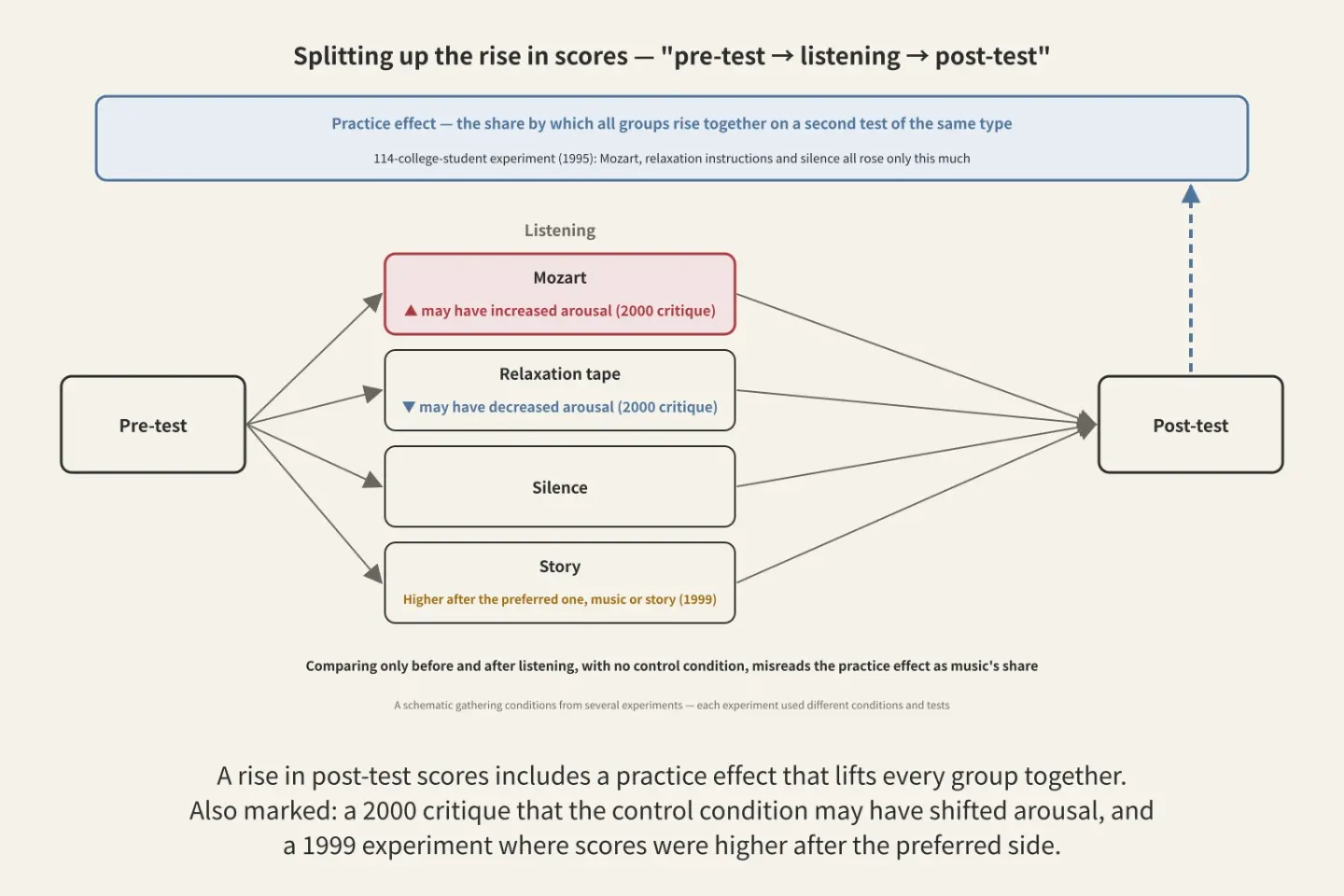
Figure: a diagram Paperis drew using only what the article says
A 2001 review summarized this line of inquiry like this: short listening effects are small and unreliable, and even when they do appear, they can be explained by differences in mood or arousal levels between conditions (PMID 11458841). The experiments that showed an effect and those that did not differed from one another in what was measured, what was compared against, and who was targeted, but they did not neatly sort out by a single comparison target.
What Moved the Scores
Experiments from one laboratory that succeeded in replication compared the Mozart sonata with a relaxation instruction tape (PMID 11011888). This control condition brought up questions about arousal. In 1999, a laboratory that had succeeded in replication using a relaxation control procedure wrote that other researchers' suggestions—that the relaxation procedure suppressed arousal—did not match the data they had published (PMID 10665021). A critique published in 2000 argued that the sonata may have increased the listener's arousal while the relaxation tape may have decreased it, and concluded that arousal differences must be accounted for in Mozart effect research (PMID 11011888).
Around the same time, experiments appeared that changed the control conditions. One 1999 experiment obtained the result that scores on a space-time task were higher after first listening to Mozart or Schubert than after sitting in silence (DOI: 10.1111/1467-9280.00170). However, when the control condition was changed from silence to a read story, the advantage of the music disappeared, and the scores varied depending on whether the listener liked the music or the story more. Scores were higher after listening to the preferred side (DOI: 10.1111/1467-9280.00170). In the original research team's 1995 experiment, recorded stories did not raise scores, so story reading produced different results in the two experiments, and the 1999 experiment was the one that measured listener preference alongside it.
A 2001 experiment pushed the comparison a step further. Participants experienced one of a Mozart sonata (a bright and energetic piece), Italian composer Albinoni's Adagio (a slow and sad piece), or silence before solving a spatial task, and the researchers also measured how much they enjoyed the piece, their arousal, and their mood (PMID 11437309). Spatial task scores were higher than after silence only for those who listened to Mozart, and the two pieces changed enjoyment, arousal, and mood differently. When these differences were statistically equated, the Mozart effect disappeared (PMID 11437309). The authors concluded this as strong evidence that the Mozart effect is a byproduct created by arousal and mood. This is an experiment from a single laboratory. Since the same piece was changing enjoyment, arousal, and mood along with spatial scores, this means that in order to attribute the difference in spatial scores to the structure of the piece, these three differences must first be stripped away.
The following year, an experiment in the same vein tweaked the piece itself. After recording a Mozart sonata performed by a skilled pianist into a computer MIDI file, four versions were created by changing the tempo (the speed at which the beats pass) to fast or slow, and the mode to major or minor (DOI: 10.1525/mp.2002.20.2.151). Spatial task scores were better after listening to the fast version than the slow version, and after listening to the major version than the minor version. Tempo changed arousal but not mood, major and minor changed mood but not arousal, and changes in arousal and mood moved in parallel with changes in spatial task scores (DOI: 10.1525/mp.2002.20.2.151). What makes major and minor different was covered in Major and Minor — When the Third Drops a Half Step. The sound below is not the piece used in the experiment nor K.448, but an example using the first two measures of Mozart's other piano sonata (K.545) with only the tempo and mode changed.
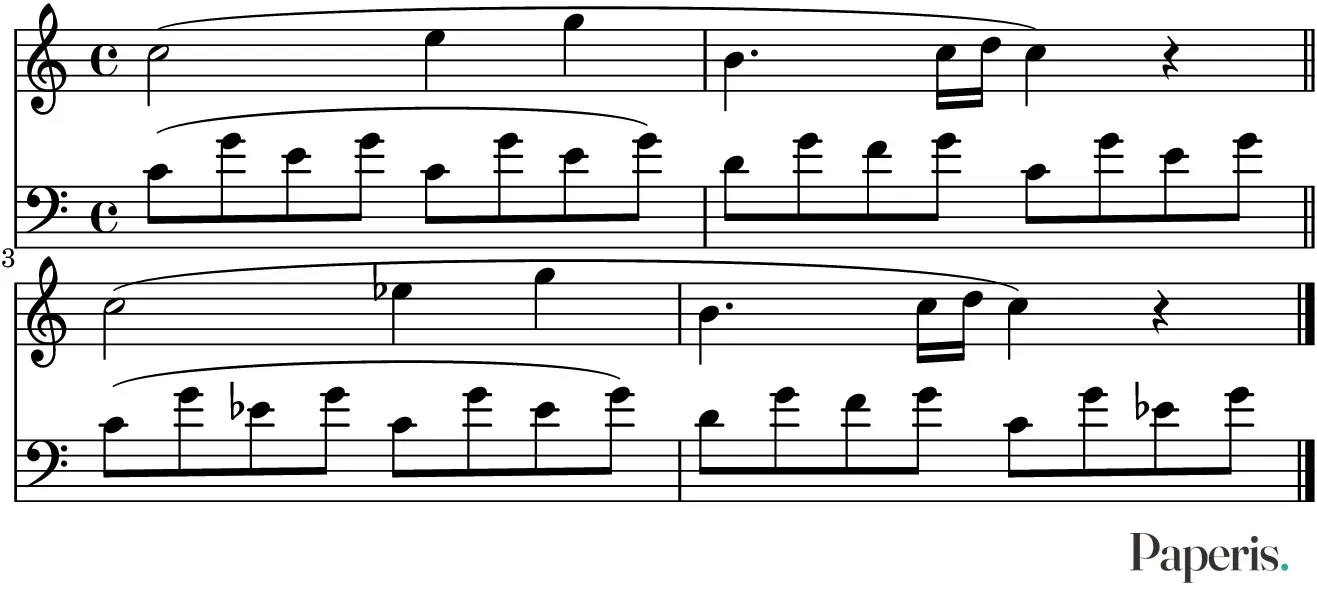
Clip: the first two bars of Mozart's Piano Sonata K.545, fast in major, then slow in minor (synthesized piano; not the piece used in the experiments)
Sounds that were not music did the same thing. In a 2008 experiment where 72 undergraduates were divided and made to listen for 5 minutes and 43 seconds to one of Mozart's piano sonata K.281 first movement, a sound extracting only the rhythm of that piece, a sound extracting only the melody, traffic noise, or silence before solving analytical questions from a graduate school entrance exam, all four groups that listened to sounds had higher average scores than the silence group, and there was no difference among the sounds (DOI: 10.2466/pms.107.2.396-402). The authors interpreted this as a result of simple exposure to sound raising arousal. The task in this experiment was analytical reasoning questions, and the comparison target was silence. In an elementary student experiment published in an undergraduate research journal, children who listened to Mozart and children who did physical play scored similarly on spatial tasks, and both groups scored higher than children who sat in silence (DOI: 10.33697/ajur.2003.019).
Whether participants' expectations moved the scores is mixed. In a 2003 experiment comparing groups matched for musical experience and preference, participants' expectations did not increase spatial reasoning scores, and score increases appeared after various conditions besides Mozart (PMID 15002860). On the other hand, a 2007 experiment told 60 people in advance that Mozart music increases or decreases cognitive ability and then had them solve intelligence tests while listening to a Mozart piano sonata, and the group told it increases answered 14% more items correctly (PMID 17450975). The 2007 experiment differs in design in that it directly changed expectations through statements given in advance, and both are single experiments.
Now we return to the hallway of the test site. There was an experiment where scores were higher after listening to whichever they liked more, whether music or story; fast versions raised arousal and major versions raised mood while simultaneously raising spatial scores; and even traffic noise was better than silence. However, there were several experiments where no difference appeared even with Mozart compared to silence or relaxation instructions. The judgment of a 2001 review was that score increases after short listening were small and erratic, and when they did appear, they could be explained by differences in the listener's arousal and mood (PMID 11458841). A 2014 review surveying music and medical research cites brain imaging results showing that joyful music activates brain regions processing emotion, and views that this emotion can connect with high arousal to temporarily enhance performance in various cognitive domains (PMID 25060169). That review also attached the word "temporary."
Still Debated
Arousal and mood do not tie up every result. A 2010 experiment with 24 young adults again found that spatial reasoning improved after listening to Mozart, and reported that the effect was not due to changes in mood (PMID 20871178). This is an experiment with a small sample.
In 2024, 311 young adults and older adults were played pieces by Mozart, Vivaldi, and Philip Glass, or silence, after which visual working memory was measured with tasks that involved tapping a sequence of blocks backwards or recalling patterns to reconstruct them (PMID 38921689). In both age groups, only Mozart produced a meaningful benefit, and this result was unrelated to how much they liked the pieces. In an earlier experiment by the same researchers, only Vivaldi affected a verbal memory task (PMID 38921689). The authors interpreted that emotional activation and the ability to regulate attention are centrally involved in modulating the effects of music. What this experiment measured was working memory, which is a different ability from the paper-and-pencil spatial task of 1993.
In 2020, 179 college students and 183 older adults were made to listen to K.448, sounds with rising and falling volume, sounds with rising and falling pitch, and white noise for 5 minutes each, and then solve a spatial reasoning task (PMID 30949788). Sounds with repeatedly changing pitch—that is, the Mozart melody or simple sounds with rising and falling pitch—raised scores. This is an attempt to find the cause of the effect in the properties of the sound rather than the title of the piece.
Results targeting older adults sometimes point in the opposite direction instead. In an experiment where 72 people aged 65 to 75 listened to either Mozart's K.448, Albinoni's Adagio, or white noise before every working memory training session, the groups that received training generally outperformed a control group that did the other activity no matter what they listened to, and the white noise group never differed from the two music groups once (PMID 29260315). The transfer to reasoning tasks was greater with the slow and sad Albinoni than with Mozart, and the authors wrote that one must be cautious when interpreting the effects of music before training (PMID 29260315). Emotional working memory tests in young adults and older adults also showed no effect between Mozart and Albinoni, and only among young participants with lower performance was performance lower after Albinoni than after Mozart (PMID 25426064). One study covering both rats and humans claimed that reversed Mozart produced the opposite effect and that rhythm is a core component, but it is a single study and a significant portion of the evidence is animal experiments (DOI: 10.1038/srep18744).
The arousal and mood explanation side is not neat either. A review looking at experiments from the past decade saw that results supporting the arousal and mood explanation and results that do not exist together, and that the results depend heavily on the type of task and individual differences (DOI: 10.70121/001c.121648). This review was published in a journal whose level of peer review has not been verified.
When mixed results are laid out, the places where differences arise become visible. What was measured (paper folding, matrix reasoning, working memory), what it was compared against (silence, relaxation tapes, other music, favorite stories), and who the subjects were (college students, elementary school students, older adults) differed from experiment to experiment. Research playing K.448 to epilepsy patients is a separate branch; a 2023 analysis pooling eight studies saw that the effect was at a trivial or small level that was not statistically significant and that even that may have been inflated, and concluded that music does not appear to provide a benefit for epilepsy (PMID 36878928).
So What Did We Learn?
What these branch experiments measured was the task score immediately after listening to music, and those results do not support the claim that intelligence rises for long. A 2017 journal editorial summarizes that several studies have emerged showing this piece does not necessarily have a magical effect on overall cognitive abilities like general IQ scores (DOI: 10.33225/ppc/17.11.04). What the original study measured was also the immediate scores on a few spatial tasks.
There is no reason to slide to the opposite conclusion either. Music changes the listener's arousal and mood, and that change can carry over into the task performance immediately afterward (PMID 11437309; DOI: 10.1525/mp.2002.20.2.151). In this pathway, Mozart was one of several sounds that altered arousal and mood, and his share also varied depending on what the listener liked (DOI: 10.1111/1467-9280.00170). However, as we saw earlier, there are also experiments where Mozart produced benefits regardless of preference.
Tasks done after listening versus tasks done while listening are a different question. In a 2024 study testing people at home who usually work with music playing, self-chosen background music reduced mind-wandering during an attention task and made responses faster, but it also increased a state of low arousal where attention is easily distracted by outside stimuli, and the pathway of the effect was the elevation of mood and arousal (DOI: 10.1038/s41598-024-60218-z). Meanwhile, a meta-analysis pooling 65 studies on reading found that background noise, speech, and music all consistently impaired reading by a small amount, with intelligible speech and music with lyrics causing the greatest disruption (PMID 29958067). In a college student experiment as well, music with lyrics impaired verbal memory, visual memory, and reading comprehension, while lyric-free lofi hip-hop instrumental tracks neither clearly helped nor harmed, and the authors viewed this result as supporting the general disruptive effect of background music (PMID 37152835). Background sounds mostly disrupted reading, and music with lyrics disrupted memory tasks, but there is also research where self-chosen music quickened responses on attention tasks, so the answer for listening while working varies depending on the task and lyrics.
This is as much as the research can say to a test-taker in a hallway. In the laboratory, there were cases where short task scores rose right after mood and arousal went up, but studies measuring this in real-exam-like situations are absent from the evidence gathered in this article, and in tasks measured closer to reality like learning a path on a computer, there was no difference (DOI: 10.1177/0305735604039285). The evidence that the effect must be Mozart or that it makes you smarter is weak. While the story that a sociology paper called a "scientific legend" grew outside the lab, inside the lab, researchers have narrowed down what those 10 minutes actually do by changing comparisons and measurements one by one.
Source Papers
- "Mozart, music and medicine." (2014) — PMID 25060169 — A review outlining the definition of the Mozart effect and research on music, arousal, and medicine since the initial 1993 report in “Nature”.
- "Another failure to generalize the Mozart effect." (2000) — PMID 11026433 — A repeated-measures experiment with 36 adults matching the original researchers' three conditions, finding no differences among classical music, jazz, and silence.
- "Key components of the Mozart effect." (1998) — PMID 9656277 — The original researchers citing measurement tasks, order, pieces, and intervening tasks as reasons for mixed replications, writing that more research is needed before application.
- "Listening to Mozart enhances spatial-temporal reasoning: towards a neurophysiological basis." (1995) — PMID 7731551 — A replication by the original researchers with college students, finding no effect from repetitive music or story readings, and no improvement in short-term memory.
- "The 'Mozart Effect': A Sociological Reappraisal" (2014) — DOI: 10.1177/1749975514557096 — An analysis of how the short-term improvement results on a specific Stanford-Binet task spread into an American cultural phenomenon, commercialization, and early education policy in the 1990s.
- "Failure to confirm the Rauscher and Shaw description of recovery of the Mozart effect." (1999) — PMID 10407891 — A study of 206 college students finding no difference in paper-folding and cutting scores even when an intervening verbal distraction task was included.
- "Persistent patterns of brain activity: an EEG coherence study of the positive effect of music on spatial-temporal reasoning." (1997) — PMID 9175137 — A study showing that EEG brainwave patterns during Mozart listening carried over into the task in 3 out of 7 participants.
- "Music and nonmusical abilities." (2001) — PMID 11458841 — The conclusion that short-term listening effects are small and unreliable and can be explained by mood and arousal differences, while the effects of music education remain a separate, unresolved question.
- "An experimental test of 'the mozart effect': does listening to his music improve spatial ability?" (1995) — PMID 8684937 — A study of 114 college students using pre- and post-tests of Raven's matrices, showing only practice effects across all three conditions.
- "Listening to Mozart may not enhance performance on the revised Minnesota Paper Form Board Test." (1995) — PMID 7501747 — A randomized assignment of 51 participants finding no difference between Mozart and meditation after adjusting for SAT scores and gender.
- "Enhanced spatial performance following 10 minutes exposure to music: a replication." (1997) — PMID 9293565 — A study of 32 undergraduates showing a small but significant improvement immediately after K.448.
- "Effect of music on spatial performance: a test of generality." (1998) — PMID 9638749 — A study showing improvements from modern pieces similar to K.448, with a relaxation tape as the control.
- "Listening to Mozart does not improve children's spatial ability: Final curtains for the Mozart effect" (2002) — DOI: 10.1348/026151002166433 — Two experiments with school-age children showing no effect and questioning applicability.
- "No Evidence for the Mozart Effect in Children" (2006) — DOI: 10.1525/mp.2006.23.4.305 — A study of 136 fifth-graders using K.448, popular music, and silence, finding no effect and recommending that speculation about applications to children be withheld.
- "Route-Learning and the Mozart Effect" (2004) — DOI: 10.1177/0305735604039285 — A virtual space route-learning task finding no difference between Mozart and Philip Glass.
- "Arousal and mood factors in the 'Mozart effect'." (2000) — PMID 11011888 — A critique suggesting that comparing a sonata to a relaxation tape may have created a difference in arousal.
- "Performance suppression from control procedures is not the basis of the Mozart effect." (1999) — PMID 10665021 — A response from a replication lab stating that criticisms of the relaxation control procedure do not align with their own data.
- "The Mozart Effect: An Artifact of Preference" (1999) — DOI: 10.1111/1467-9280.00170 — A study showing that when story-reading is used as a control, the music's advantage disappears and scores are higher following the preferred condition.
- "Arousal, mood, and the Mozart effect." (2001) — PMID 11437309 — A study comparing Mozart, Albinoni, and silence, where the effect vanished once enjoyment, arousal, and mood were statistically matched.
- "Effects of Musical Tempo and Mode on Arousal, Mood, and Spatial Abilities" (2002) — DOI: 10.1525/mp.2002.20.2.151 — A study showing that tempo alters arousal and mode alters mood, with spatial scores shifting in tandem.
- "The Mozart Effect: Evidence for the Arousal Hypothesis" (2008) — DOI: 10.2466/pms.107.2.396-402 — A study of 72 undergraduates showing that music, rhythm, melody, and traffic noise all score higher than silence.
- "The 'Arousal Effect': An Alternative Interpretation of the Mozart Effect" (2003) — DOI: 10.33697/ajur.2003.019 — An undergraduate research journal paper showing that Mozart and active play score higher than silence and similar to each other in elementary school students.
- "Is listening to Mozart the only way to enhance spatial reasoning?" (2003) — PMID 15002860 — A study showing that expectations did not raise scores and improvements followed multiple conditions.
- "Demand characteristics of music affect performance on the Wonderlic Personnel Test Of Intelligence." (2007) — PMID 17450975 — A study of 60 participants where those who were told to expect positive results answered 14% more questions correctly.
- "Effects of prior exposure to office noise and music on aspects of working memory." (2010) — PMID 20871178 — A replication of the Mozart effect in 24 young adults, showing it is not due to mood changes.
- "Can Brief Listening to Mozart's Music Improve Visual Working Memory? An Update on the Role of Cognitive and Emotional Factors." (2024) — PMID 38921689 — A study of 311 participants where only Mozart improved visual working memory, regardless of preference.
- "Is working memory training in older adults sensitive to music?" (2019) — PMID 29260315 — A study of 72 older adults given Mozart, Albinoni, or white noise prior to training, where reasoning transfer was greater for Albinoni, urging caution in interpretation.
- "Are age-related differences between young and older adults in an affective working memory test sensitive to the music effects?" (2014) — PMID 25426064 — A study finding no effect of Mozart or Albinoni on the affective working memory of young adults and older adults.
- "The effects of music on spatial reasoning." (2020) — PMID 30949788 — A study of 362 participants showing that repeating pitch variations enhance spatial reasoning.
- "Mozart, Mozart Rhythm and Retrograde Mozart Effects: Evidences from Behaviours and Neurobiology Bases" (2016) — DOI: 10.1038/srep18744 — A study in rats and humans arguing that backwards-played Mozart has the opposite effect, and that rhythm is the core component.
- "The Arousal-Mood Theory: Current Research and Limitations" (2021) — DOI: 10.70121/001c.121648 — A paper reviewing mixed results of the arousal-mood theory, driven by task type and individual differences.
- "Unfounded authority, underpowered studies, and non-transparent reporting perpetuate the Mozart effect myth: a multiverse meta-analysis." (2023) — PMID 36878928 — A meta-analysis of 8 studies in epilepsy patients, finding the effect is not significant and ranges from trivial to small.
- "Mozart Effect and Music Psychology: Recent Developments and Future Research" (2017) — DOI: 10.33225/ppc/17.11.04 — A review summarizing research that K.448 excerpts do not exert a magical influence on general intelligence or broader cognitive abilities.
- "The role of mood and arousal in the effect of background music on attentional state and performance during a sustained attention task" (2024) — DOI: 10.1038/s41598-024-60218-z — Two online experiments showing that well-chosen background music reduces mind-wandering and quickens responses, mediated by mood and arousal.
- "Auditory Distraction During Reading: A Bayesian Meta-Analysis of a Continuing Controversy." (2018) — PMID 29958067 — A meta-analysis of 65 studies showing that noise, speech, and music all cause a small but consistent disruption to reading, with lyrics and speech causing the most disruption.
- "Should We Turn off the Music? Music with Lyrics Interferes with Cognitive Tasks." (2023) — PMID 37152835 — A study showing that music with lyrics interferes with memory and reading, while instrumental music without lyrics has no distinct impact.
Sources (36)
- Mozart, music and medicinePMID 25060169
- Another failure to generalize the Mozart effectPMID 11026433
- Key components of the Mozart effectPMID 9656277
- Listening to Mozart enhances spatial-temporal reasoning: towards a neurophysiological basisPMID 7731551
- The 'Mozart Effect': A Sociological ReappraisalDOI 10.1177/1749975514557096
- Failure to confirm the Rauscher and Shaw description of recovery of the Mozart effectPMID 10407891
- Persistent patterns of brain activity: an EEG coherence study of the positive effect of music on spatial-temporal reasoningPMID 9175137
- Music and nonmusical abilitiesPMID 11458841
- An experimental test of 'the mozart effect': does listening to his music improve spatial ability?PMID 8684937
- Listening to Mozart may not enhance performance on the revised Minnesota Paper Form Board TestPMID 7501747
- Enhanced spatial performance following 10 minutes exposure to music: a replicationPMID 9293565
- Effect of music on spatial performance: a test of generalityPMID 9638749
- Listening to Mozart does not improve children's spatial ability: Final curtains for the Mozart effectDOI 10.1348/026151002166433
- No Evidence for the Mozart Effect in ChildrenDOI 10.1525/mp.2006.23.4.305
- Route-Learning and the Mozart EffectDOI 10.1177/0305735604039285
- Arousal and mood factors in the 'Mozart effect'PMID 11011888
- Performance suppression from control procedures is not the basis of the Mozart effectPMID 10665021
- The Mozart Effect: An Artifact of PreferenceDOI 10.1111/1467-9280.00170
- Arousal, mood, and the Mozart effectPMID 11437309
- Effects of Musical Tempo and Mode on Arousal, Mood, and Spatial AbilitiesDOI 10.1525/mp.2002.20.2.151
- The Mozart Effect: Evidence for the Arousal HypothesisDOI 10.2466/pms.107.2.396-402
- The 'Arousal Effect': An Alternative Interpretation of the Mozart EffectDOI 10.33697/ajur.2003.019
- Is listening to Mozart the only way to enhance spatial reasoning?PMID 15002860
- Demand characteristics of music affect performance on the Wonderlic Personnel Test Of IntelligencePMID 17450975
- Effects of prior exposure to office noise and music on aspects of working memoryPMID 20871178
- Can Brief Listening to Mozart's Music Improve Visual Working Memory? An Update on the Role of Cognitive and Emotional FactorsPMID 38921689
- Is working memory training in older adults sensitive to music?PMID 29260315
- Are age-related differences between young and older adults in an affective working memory test sensitive to the music effects?PMID 25426064
- The effects of music on spatial reasoningPMID 30949788
- Mozart, Mozart Rhythm and Retrograde Mozart Effects: Evidences from Behaviours and Neurobiology BasesDOI 10.1038/srep18744
- The Arousal-Mood Theory: Current Research and LimitationsDOI 10.70121/001c.121648
- Unfounded authority, underpowered studies, and non-transparent reporting perpetuate the Mozart effect myth: a multiverse meta-analysisPMID 36878928
- Mozart Effect and Music Psychology: Recent Developments and Future ResearchDOI 10.33225/ppc/17.11.04
- The role of mood and arousal in the effect of background music on attentional state and performance during a sustained attention taskDOI 10.1038/s41598-024-60218-z
- Auditory Distraction During Reading: A Bayesian Meta-Analysis of a Continuing ControversyPMID 29958067
- Should We Turn off the Music? Music with Lyrics Interferes with Cognitive TasksPMID 37152835