
Paperis Articles
Tone Deafness — Is It the Throat or the Ear?
Many people call themselves tone deaf, but an inborn hearing disorder for pitch confirmed by testing is far rarer. Through lab tests, singing experiments, brain imaging and family studies, this piece shows that singing out of tune and failing to hear pitch sometimes overlap but are different things. What training changes in congenital amusia is still debated.
Your field's papers, as audio
Pick your fields and journals — Paperis summarizes the key papers and turns them into audio. Listen on your commute.
Start Paperis free →Tone Deafness — Is It the Throat or the Ear?
The Person Who Passes the Mic at Karaoke
When the microphone makes the rounds after a company dinner, some people immediately wave their hands to refuse it. "I'm tone-deaf." When a Canadian university asked about 2,000 first-year psychology students, nearly 17% answered that they were tone-deaf (PMID 16597781). That is about one in six people.
In everyday life, a tone-deaf person is someone who keeps missing the musical pitch of a song. However, this term actually bundles together two different issues. One is the inability to properly distinguish pitches by ear, and the other is the inability to produce those pitches with the voice even while hearing them. In English, singing out of tune is also commonly called by the single word "tone deafness." While that word implies the cause lies in the ear, the reasons for singing out of tune can lie not only in perception, but also in vocal production, memory, or the process connecting the two (DOI: 10.1525/mp.2007.25.2.95).
This article asks a single question. Among people who call themselves tone-deaf, how many truly cannot hear pitches? And is the problem for those who sing out of tune located in the ear or the throat? Research has looked at these two components within that single word separately, and when separated, different pictures emerge.
First, let us define a few terms. Pitch refers to how high or low a sound is heard. Interval refers to how far apart the pitches of two notes are. The smallest unit used to measure that distance is a semitone. A semitone is one of the twelve divisions into which Western music divides an octave, representing the distance from one key on a keyboard to the immediate neighboring key. How these three terms came to be was covered in "Pitch and Intervals — Raise the Key and It's Still the Same Song; Vibrate Twice as Fast and It Keeps Its Name".
Bringing People Who Call Themselves Tone-Deaf Into the Lab
At the Canadian university mentioned earlier, 100 students who reported being tone-deaf and 100 students who reported not being tone-deaf took the same listening test (PMID 16597781). The testing tool was the standard test most widely used to screen for amusia (PMID 29655041). The Montreal Battery of Evaluation of Amusia is a standard test that plays short melodies and measures across six branches whether someone can recognize the rising and falling, intervals, scale, rhythm, and meter of melodies, and whether they remember the melodies they heard.

Clip: a short melody played twice, the second time with one middle note raised a half step (synthesized piano)
The results leaned toward self-evaluation and test scores not matching up very well. The students also filled out a long questionnaire asking about their musical experiences, and what best predicted their test scores was their self-report on "Do I sing well?" and "Have I received music education?" Combining four factors extracted from the questionnaire explained 27% of the difference in total test scores, and the single answer "I am tone-deaf" explained only 7% (PMID 16597781). Here, 27% and 7% are the share of the variation in people's scores that is explained by those answers. This means the fact that someone answered that they were tone-deaf explained only a small share of the difference in listening scores. The research team noted that the musical difficulties shown in some students were worth looking into further, but concluded that many people who consider themselves tone-deaf may actually have no problem with perception (PMID 16597781).
There are also studies that directly asked people what leads them to judge themselves as tone-deaf. When adults who considered themselves tone-deaf or unmusical were interviewed, performance criteria such as "I cannot sing well" played a large role, and this was the same even for people who said they had no trouble listening and showed no problems on tests (DOI: 10.1196/annals.1360.018). This result was disclosed by the researchers as a "preliminary result." The authors suggested that there are likely many people who are neurologically normal yet believe they lack musicality, and called them "false" amusics (DOI: 10.1196/annals.1360.018).
There were measurable differences even among people who called themselves tone-deaf. In a small study comparing 13 people who said they were tone-deaf and 17 who said they were not through listening, singing, and self-evaluation, the group that answered they were tone-deaf scored significantly lower across all measurements (DOI: 10.1177/102986490801200102). However, that difference fell short of the dense and broad deficits seen in people who are congenitally unable to hear pitches. Both groups sang more accurately when accompaniment was present, and while the group that answered they were tone-deaf rated the accuracy of their own singing low, they did not rate it excessively lower than the actual difference. The authors' conclusion is that they are not experiencing insurmountable difficulties, and that they have a strong possibility of improving with targeted help (intervention) (DOI: 10.1177/102986490801200102).
The one-line takeaway to bring with you is this. The statement "I am tone-deaf" is heavily mixed with the meaning "I am not confident in my singing," and that statement alone does not tell you much about how someone's ears are doing.
How Rare Is It Really Not to Be Able to Hear Pitch?
So, how many people have a genuine problem with their ears? Researchers give these people a specific name. Congenital amusia is a condition where a person struggles throughout their life to understand music—especially pitch—even though this cannot be explained by brain damage, hearing loss, intellectual disability, or a lack of opportunity to encounter music. The first recorded case was a middle-aged woman whose hearing test was normal and whose intelligence, memory, and language abilities were above average, yet she had severe difficulty noticing when pitches changed (PMID 11804567). Although it is just a single case report, it is the first record showing that this condition can appear alongside normal hearing and above-average intelligence.
How common this condition is is measured by its prevalence. Prevalence is the proportion of people in a population who have a given condition. The long-cited figure was 4%. However, that number came from a single estimate relying on a test from 1980 (PMID 28224991). The abstracts collected by this article do not reveal which study or what criteria that estimate came from.
There are studies that have scrutinized this 4%. One analysis examined the Distorted Tunes Test and the Montreal Battery for the Evaluation of Amusia, showing that prevalence estimates depend crucially on what cutoff score is applied to the test and how skewed the score distribution is (DOI: 10.1525/mp.2010.27.5.413). While acknowledging that the Montreal battery is a useful diagnostic tool, the authors concluded that we should be cautious about placing significance on the widely cited 4%. In another study that administered the same test to 228 German university students, the prevalence was heavily influenced by which statistical standard was used as a cutoff score and how many subtests were included in the diagnosis (PMID 25883562). This study also reported that diagnosing based on a single average score can lead to misdiagnoses, and that scores from tests taken at home over the internet differed significantly from those taken in the laboratory (PMID 25883562).
The Distorted Tunes Test itself was also used in 1980. A study that surveyed British adults with this test that year called people who fell below the standard "melodic tone-deaf" and noted that they were only a fraction of the people commonly called tone-deaf (PMID 7396411). The same study reported that scores on this test correlated only weakly with the ability to distinguish between the pitches of two notes. No prevalence figure appears in this abstract.
An answer also came from those who argue for continuing to use this test. Their answer is that the Montreal battery and its online version should be viewed as one step in a screening process rather than as a standalone diagnostic tool, and the research team detailed the full procedure for identifying amusia (PMID 28455794). In a way, the criticisms and the responses point in the same direction. It is difficult to call someone amusical based on a single test and a single score.
The number measured with the largest sample is 1.5%. Obtained using three objective tests and a questionnaire together on 20,000 people who were not just self-selected volunteers, it showed slightly more women than men (PMID 28224991). The 1.5% cannot be directly compared to 17%. The 17% is the response when psychology first-year students were asked "Are you tone-deaf?", whereas the 1.5% is the proportion of people in a general population sample who crossed a test threshold. The two numbers differ even in what they measured. Still, placing the two side by side paints a picture: many people say they are tone-deaf, but innate hearing impairments confirmed by tests are much rarer than that.
People Who Sing Out of Tune: Ears That Hear Just Fine
Many people believe that the ability to sing well is distributed unevenly among individuals. There is research that has put this belief to the test. Sixty-two occasionally singing members of the general public were asked to sing a well-known song in both a laboratory and an everyday setting, with their recordings measured by peer ratings and acoustic analysis (PMID 17348539). The peer ratings formed a normal distribution, clustered tightly in the middle with fewer at either end, and very few people missed the pitch by a wide margin. A significant portion of the differences in singing ability came from tempo. Ordinary people sang faster than professional singers, and missed both notes and beats more often. When 15 of them were asked to sing the same song again at a slower tempo, most of them sang as accurately as professional singers (PMID 17348539).
This result shows that even those who used to sing quickly hit the notes correctly when singing slowly. The abstract of this study did not address accompaniment, and the impact of accompaniment varies across studies. In an experiment where participants sang along to unfamiliar melodies, those who drifted off-pitch appeared to be hindered rather than helped by matching accompaniment (DOI: 10.1525/mp.2007.25.2.95), whereas in a small study where people were asked to sing, both groups were more accurate when accompaniment was present (DOI: 10.1177/102986490801200102). Based on the slow-tempo results, the authors wrote that the ability to sing appears to be a universal capacity that human beings broadly possess (PMID 17348539). In a follow-up study by the same research team, the vast majority of ordinary people sang in tune and on beat, and their accuracy increased further when they were made to sing after listening to a slow tempo set by a metronome (PMID 19673762).
Even so, there are people who consistently sing out of tune. Studies use a specific term for this kind of singing. Out-of-tune singing is singing that visibly deviates from the intended pitch. The boundary for what counts as "visibly" varies by study. Some use half a semitone as the benchmark while others use a full semitone, and the boundary also shifts depending on whether participants are asked to sing from memory or imitate what they hear (DOI: 10.1525/mp.2015.32.3.272). In two experiments where participants listened to an unfamiliar four-note melody and were asked to imitate it, 10 to 15% of the participants drifted by at least a semitone (DOI: 10.1525/mp.2007.25.2.95). These numbers emerge from the specific tasks and criteria of those experiments.
What about the ears of these people? In the same experiment, the people who sang off-pitch showed no difference in pitch discrimination compared to those who sang well (DOI: 10.1525/mp.2007.25.2.95). Pitch discrimination is the ability to figure out whether two pitches are the same, and if different, which one is higher. Their ears could properly tell the two pitches apart, but their throats failed to produce that pitch. The authors viewed this not as a problem with perception, motor control, or memory alone, but rather as a problem of translating pitch into physical action (DOI: 10.1525/mp.2007.25.2.95). In the earlier study of 62 ordinary people, there were two individuals who continued to miss pitches widely even when singing slowly, yet their pitch perception was unimpaired. The authors interpreted this as the possibility of tone deafness residing purely on the vocal side (PMID 17348539).
An experiment that replaced the voice with another tool to make people match pitches pushed this interpretation further. The research team built a new instrument called a slider, allowing participants to match heard pitches without using their voice. Both musicians and non-musicians matched pitches more accurately with the slider than with their voices (PMID 21875245). Even in an experiment modified so that the slider played back a recording of the participant's own voice—eliminating differences in timbre—non-musicians were significantly more accurate when matching their own voice recordings using the slider than when matching them with their throats (PMID 25060548). This implies that the limiting factor is moving the throat to match the pitch, rather than a pure listening deficit. In the same experiments, people sometimes perceived the pitch of actual voices less accurately than that of synthesized sounds, leading the authors to conclude that poor singing may have multiple causes, most of which they attributed to errors in the motor control of sound production and the process of translating timbre, rather than pure perceptual deficits (PMID 21875245). However, studies place different emphasis on whether motor control itself should be considered the primary cause, or if the process bridging hearing and vocalization is the main culprit.
There is a specific name for that process bridging hearing and vocalization. Sensorimotor vocal transformation is the process of translating a pitch grasped by the ear into the throat movements required to produce that pitch. People who sang out-of-tune imitated recordings of themselves better than recordings of others, and this "self-voice advantage" was larger in them than in good singers (PMID 24480454). The authors interpreted this as happening because these individuals lack general rules for translating unfamiliar sounds into throat movements, forcing them to rely on sounds they have produced themselves (PMID 24480454). A review combining multiple studies similarly concludes that the evidence thus far points to deficits in sensorimotor vocal transformation and motor control as more plausible causes of poor singing than perceptual deficits (PMID 21741547).
There is one takeaway here. For a large portion of people who sing off-key, the blockage lies not in their ears but in their throats—or more precisely, in the gap between the two.
People Whose Ears Get It Wrong: Congenital Amusia
Now we look at the other side, people with congenital amusia. Among their difficulties, the most studied is on the pitch side, particularly distinguishing small pitch differences and briefly remembering heard pitches (PMID 25726292). Failing to notice pitch changes of half a semitone or less is even used as a marker for this condition (PMID 17943009).
Clip: two tones a half step apart, then two tones a quarter of a half step apart (synthesized tones; not a test)
Yet their brains do respond to small differences. In a study that repeatedly played the same note and occasionally mixed in notes different by a quarter of a semitone or by two semitones while measuring brain waves, the brains of people with amusia responded normally to small differences before the stage of paying attention. However, the brain wave response that appears when consciously noticing those small differences did not appear, and a normal response appeared for the large difference of two semitones (PMID 23434917). This means that the brain's first gateway for processing sound accepts the difference, but that information does not lead to the conscious realization that it is "different." The hearing area itself looked similar. When brain imaging was used to measure 11 people with amusia and 11 comparison subjects, the size, location, and response selectivity of the brain regions responding to pitch were similar in the two groups (PMID 26961952).
The authors cited abnormalities at the neuron level not caught by brain imaging, changes in the connections between the pitch region and other regions, and abnormalities in outside regions together as reasons why people cannot properly hear pitch relationships even though their hearing area's response is normal (PMID 26961952).
There is a review article that synthesizes the connection side of this. The review synthesizes that in brains with amusia, there are abnormalities in the brain region processing sound and the region just below the front of the forehead, and the connection between the two regions is weakened (PMID 25726292). One of the pathways studied for that connection is the arcuate fasciculus. The arcuate fasciculus is a bundle of nerve fibers that connects the brain region that perceives sound and the brain region responsible for making sound in an arch shape. A 2009 study comparing the brains of people who have difficulty with both hearing and making sounds, known as tone-deaf, and a comparison group using neurofiber imaging reported that the connection of the arcuate fasciculus was abnormally reduced on the tone-deaf side, and that the upper branch of the arcuate fasciculus was related to pitch discrimination ability, while the lower branch was related to the ability in tasks measuring sound making and perception together (DOI: 10.1523/jneurosci.1701-09.2009). The sample size does not appear in the abstract, and the relationship between the connection and ability is a correlation. In the paper's title, the authors asked whether being tone-deaf is a new "disconnection syndrome," presenting the reduced connection linking perception and vocalization as the basis for this.
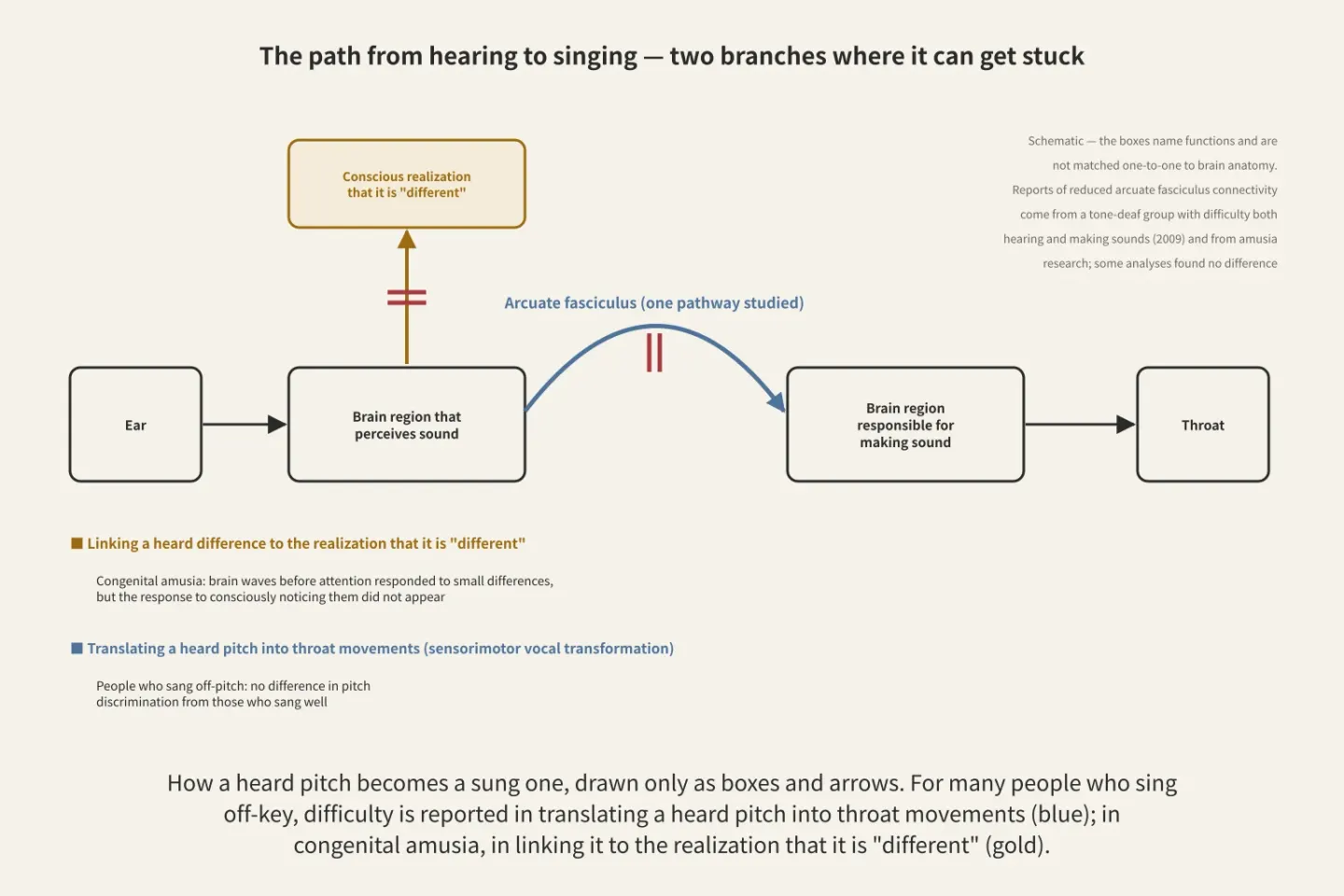
Figure: a diagram Paperis drew using only what the article says
How this connection differs has not yet been unified into a single answer. In a study examining 30 people with amusia who speak Mandarin, the rear part of the right arcuate fasciculus actually had higher connection indices while the front part was smaller in volume, a result that cannot be described simply as reduced on one side (PMID 29322239). Measurement methods also shake the results. Previous studies reported that some comparison subjects and people with amusia had no detectable arcuate fasciculus at all, whereas in a study analyzing diffusion imaging data of amusia and comparison groups with three tracking methods, the arcuate fasciculus was captured in everyone with one method, tracking failed in some with another method, and no difference in arcuate fasciculus volume was found between the two groups (PMID 25653637). This study analyzed its own sample, and the sample size is not stated in the abstract. The authors raised the question that failing to find the arcuate fasciculus in previous studies might be unrelated to actual anatomy or symptoms. Another review summarizes that the processing exchanged between the right lower frontal region and the sound-processing region is important for consciously attending to pitch (PMID 27692992). Although there are multiple reports that "connections are different," studies also exist where no differences emerged depending on the analysis method, and which connections differ and how varies from study to study.
Looking at families reveals traces of inheritance. When direct hearing tests were administered to 71 people from 9 large families with a person with amusia and 75 people from 10 comparison families, 39% of parents, siblings, and children in the amusia families showed the same difficulty, compared to 3% in the comparison families (PMID 17701903). In this study, the difficulty lay in pitch and not in rhythm. A survey of 20,000 people also showed based on self-reported answers that 46% of parents, siblings, and children of people with amusia experience similar difficulties, leading the authors to suggest that amusia is inherited and likely stems from genetic variants specific to musical ability (PMID 28224991). However, clustering in families only suggests a genetic factor, and which gene it is has not yet been found (PMID 34545551).
This condition is also seen in children. Among children aged 10 to 13, those with amusia showed marked difficulty in noticing small pitch differences compared to peers of similar age and intelligence, and their behavior and brain wave profiles did not change even after listening to music every day for 4 weeks (PMID 22606299). This is evidence that simply listening to more music for at least a few weeks does not change it. There is also amusia that develops after brain damage, which is a different branch from amusia present from birth (PMID 35964992).
The one takeaway to bring home is this: congenital amusia is rare but real, and while hearing is normal, abnormalities are reported in the brain regions processing pitch and their connections.
Where the Two Paths Diverge
Now let's place the two people from the karaoke room side by side. One person has normal pitch discrimination, yet sings out of tune. That is what the two ordinary people we saw earlier, who kept singing out of tune even when singing slowly, did (PMID 17348539). The other person cannot tell pitches apart well. When 11 people with congenital amusia were asked to sing familiar songs, 9 of them turned out unable to sing well, and the errors were mainly in pitch (PMID 19603898). The difference in their singing ability was related to their remaining pitch perception ability, so the authors considered that their singing deficits might be the result of perceptual deficits.
However, two of these 11 people sang properly despite having poor listening abilities (PMID 19603898). Their ears were wrong, but their throats were right. The authors considered the results of these two people to be consistent with the idea that listening and sound production follow different neural pathways (PMID 19603898). Putting them together with the two people from the earlier study of ordinary people—whose ears were right, but whose throats were wrong—completes the same picture. One review also concludes that being unable to sing is not a single lump-sum deficit, and that there are multiple "types," including cases with and without co-occurring listening impairments (PMID 20523851). There are studies showing that perception and vocalization are at least partially dissociated even among people with congenital amusia (PMID 25726292).
Singing out of tune and being unable to hear notes overlap at times, but they are different things. Two people called the same "tone-deaf" person in a karaoke room may actually be blocked at different points along the road.
What Practice Changes
We look first at the side where the voice goes wrong. A study measuring singing accuracy in a large internet-collected sample from ages 6 to 99 reported that accuracy rises steeply from childhood to young adulthood and does not drop noticeably with age afterward (PMID 35711077). People who had received singing or instrumental training had significantly higher accuracy, and that difference was especially large in childhood. The abstract refers to a large online sample spanning ages 6–99, and does not state that it followed the same individuals over time. The authors concluded that the results fit the view of singing accuracy as a learned motor skill (PMID 35711077).
There are also experiments directly comparing practice methods. Participants were split into three groups: one practiced hitting pitches in a wide range of one octave, another in a narrow range of seven semitones, and a third control group did a visual imagery task (DOI: 10.1177/10298649241289542). Only the wide-range group improved significantly, and that was for single-note matching, not for four-note melodies. Because all procedures took place within a single visit, this study cannot tell whether the effects are long-lasting, and the authors noted that the results partially support the hypothesis. There are also results showing no improvement from repeating songs multiple times within an experiment or having pitches shown visually (PMID 21875245). Training was not measured over an extended period.
On the side where the ear goes wrong, training for congenital amusia yields mixed results. In a study where 20 participants with amusia and 20 comparison participants were given four sessions of pitch training or a pitch-independent sound-localization training, both groups improved, and after training, 11 of the 20 amusic participants no longer met the diagnostic criteria (PMID 29655041). Thirty-one participants who returned a year later (13 with amusia) maintained their improved level. However, in the same study, people who trained on pitch-independent tasks also improved, and an untrained comparison group improved just as much as the trained comparison group, suggesting that the control group's gains occurred mostly during the initial testing (PMID 29655041). This design makes it difficult to tease apart what actually drove the improvement. The authors' conclusion is that judged by current standard diagnostic criteria, congenital amusia is not always a lifelong deficit (PMID 29655041).
In a study where 10 out of 20 Mandarin-speaking participants with amusia were given ten sessions of training to distinguish rising and falling pitches, the trained group's pitch direction discrimination thresholds improved to the level of the comparison group, but they showed no difference from the 10 untrained amusic participants on the pitch subtest of the Montreal battery (DOI: 10.1525/mp.2017.34.3.335). The trained task improved, but that improvement did not spill over into a test of musical perception. The authors viewed this as the first clear positive evidence that training improves pitch direction processing, while noting that further research is needed to determine what kinds of improvements will aid musical processing. In a small-scale study where a vocal coach ran a workshop with 5 participants with amusia, most showed improvement on perception subtests and singing familiar songs (DOI: 10.1111/j.1749-6632.2011.06404.x). Results showing that imitation helps also came from the amusia side. Eleven adults with congenital amusia sang better when imitating or singing along with a presented song than when singing from memory, with those who had the weakest memory showing the greatest benefit. Even so, pitch deficits remained, and the authors viewed memory as one cause of singing errors and imitation as a potentially helpful method (PMID 21864199).
There are records pointing the other way, too. In a survey of 20,000 people, amusia was not reduced by having received music education (PMID 28224991). Because the abstract does not describe the study design, it is unclear whether this was an intervention experiment, and it appears to be a comparison between individuals with and without educational experience. In a case study of a passionate music lover with amusia who undertook 18 months of formal voice lessons and practice on their own, singing ability improved temporarily but did not reach normal levels, and the gains disappeared once lessons and practice stopped (DOI: 10.32920/25413079). The ability to perceive rhythm and meter remained partially improved. The authors attributed the lack of improvement in pitch to a longstanding and likely irreversible reduction in arcuate fasciculus connectivity, though this is a single-case report published in an institutional repository (DOI: 10.32920/25413079).
In summary, for the voice-side errors, there are findings consistent with the view that it is a learned skill, but experiments directly demonstrating long-lasting training effects remain scarce. For the ear-side errors, while there are results showing improvement on trained tasks, it remains unsettled whether those gains generalize to overall music perception abilities or how to distinguish them from test-familiarization effects.
Still Up for Debate
First, there is the question of how much self-assessment can be trusted. In a study of Canadian college students, the answer "I am tone-deaf" explained only 7% of the difference in listening scores (PMID 16597781). On the other hand, a survey of 20,000 people concluded that self-reported amusia is a reliable indicator (PMID 28224991). The two studies may have asked different questions. The former asked "Are you tone-deaf?", and there are reports that people often use that phrase as a self-judgment of their singing ability (DOI: 10.1177/102986490801200102). Since the abstract does not state what question the latter study used to obtain self-assessments, we cannot confirm whether this difference stems from the wording of the questions.
Second, there are the diagnostic criteria. The prevalence rate varies greatly depending on the cutoff score and the number of subtests (PMID 25883562), and results from training studies showing that participants "no longer meet the diagnostic criteria" also stand upon these same criteria (PMID 29655041). If the same person can be considered to have amusia or not depending on the criteria, the numbers near that boundary should be read with caution.
Third is whether amusia is a single condition. A meta-analysis combining 42 studies found strong evidence that the deficits in amusia stem from broader acoustic pitch processing deficits rather than a processing mechanism exclusive to music (PMID 26079675). The score difference between the amusia and comparison groups varied depending on the magnitude of the pitch change, but did not vary depending on whether the presented sound was a musical tone or speech. At the same time, the authors noted that there is heterogeneity within amusia, as there are individuals with intact acoustic processing but impaired music processing, and vice versa (PMID 26079675). A study of German university students also found three subtypes (PMID 25883562).
So What Did We Learn?
Many people say "I am tone-deaf" at a karaoke room. That statement relies heavily on self-assessment of singing ability, and results show that a significant portion of people who consider themselves tone-deaf may have no trouble listening. Congenital amusia, the inability to truly perceive pitches, is rare at about 1.5% in a survey of 20,000 people, and these prevalence figures usually shift depending on where the cutoff is drawn in tests.
There are also various reasons why singing goes off-key. A significant number of people experience blockages in the process of translating heard pitches into throat movements rather than having trouble with the ears that hear them, and most people become accurate when singing slowly—results that align with the perspective that singing accuracy is a learned skill. Amusia has been reported to be associated with abnormalities in brain regions that process pitch and their connections, tends to run in families, and how much it can change through training is still debated.
Therefore, neither comforting people lumped together under the single word "tone-deaf" by saying "there is no such thing as tone-deafness" nor concluding "you are born tone-deaf so nothing can be done about it" is supported by the evidence. What the research has shown is the fact that there are two different types of people within that single word.
Source Papers
- "Musical difficulties are rare: a study of "tone deafness" among university students." (2005) — PMID 16597781 — Roughly 17% of about 2,000 first-year psychology students self-reported as tone-deaf. The Montreal battery was given to 100 self-reporters and 100 non-tone-deaf individuals, and self-reports accounted for only 7% of score variance. The conclusion is that many people who consider themselves tone-deaf may have no perceptual problems.
- "Quantifying Tone Deafness in the General Population" (2005) — DOI: 10.1196/annals.1360.018 — Preliminary results from interviews with self-defined tone-deaf individuals: singing performance criteria play a major role. Introduces six subtests of the Montreal battery and proposes a distinction between "real" and "fake" amusia.
- "Establishing an empirical profile of self-defined "tone deafness"" (2008) — DOI: 10.1177/102986490801200102 — 13 self-defined tone-deaf individuals versus 17 controls. Lower performance across all measures, but not at the level of true amusia; performance improves with accompaniment, leading to the conclusion that target interventions will help.
- "Prevalence of congenital amusia." (2017) — PMID 28224991 — The 4% figure is an estimate from a single 1980 test. In 20,000 individuals not relying on self-application, the rate is 1.5%, with a 46% similarity in first-degree relatives, and does not decrease with musical training, suggesting genetic variation.
- "On tune deafness (dysmelodia): frequency, development, genetics and musical background." (1980) — PMID 7396411 — Among British adults, "melodic tone-deafness" falling below the threshold on a tune-finding test represents a fraction of people commonly called tone-deaf. Test scores show a weak correlation with pitch discrimination.
- "On the Prevalence of Congenital Amusia" (2010) — DOI: 10.1525/mp.2010.27.5.413 — Prevalence estimates depend on cutoff scores and distribution skewness. Caution is needed in attaching significance to the 4% figure.
- "Revising the diagnosis of congenital amusia with the Montreal Battery of Evaluation of Amusia." (2015) — PMID 25883562 — 228 German university students. Prevalence heavily depends on statistical criteria and the number of subtests, diagnosing via mean scores causes misdiagnosis, differences exist between web and laboratory settings, and there are three subtypes.
- "The Montreal Protocol for Identification of Amusia." (2018) — PMID 28455794 — The Montreal battery is a screening stage rather than a standalone diagnosis, and the full identification procedure is disclosed.
- "Congenital amusia: a disorder of fine-grained pitch discrimination." (2002) — PMID 11804567 — The first recorded case. Normal hearing and intelligence, but severe difficulty in detecting pitch changes.
- "Singing proficiency in the general population." (2007) — PMID 17348539 — 62 members of the general public. Only a minority show frequent pitch errors, differences are mainly due to tempo, and most reach expert levels when singing slowly. Two individuals had normal perception yet persistent errors, suggesting a vocal-only tone deafness.
- "Singing proficiency in the majority: normality and "phenotypes" of poor singing." (2009) — PMID 19673762 — The majority are accurate in pitch and beat, improve with a slower metronome tempo, and display diverse types of singing deficits.
- "Defining Poor-Pitch Singing" (2015) — DOI: 10.1525/mp.2015.32.3.272 — Boundaries shift depending on the task, cutoff criteria (50 or 100 cents), and metrics.
- "Poor-Pitch Singing in the Absence of "Tone Deafness"" (2007) — DOI: 10.1525/mp.2007.25.2.95 — In a four-note imitation task, 10% to 15% deviate by a semitone or more, with no difference in pitch discrimination, indicating a problem in the process of translating pitch into physical action.
- "A frog in your throat or in your ear? Searching for the causes of poor singing." (2012) — PMID 21875245 — Matching via a slider is more accurate than using the voice, contradicting perceptual explanations. Neither repeated singing nor visual aids yield improvement. There are multiple causes, mostly errors in motor control and timbre translation.
- "Singing ability is rooted in vocal-motor control of pitch." (2014) — PMID 25060548 — Matching one's recorded voice using a slider is more accurate than matching with the vocal cords, indicating that vocal-motor control is a limiting factor.
- "Singing with yourself: evidence for an inverse modeling account of poor-pitch singing." (2014) — PMID 24480454 — The benefit of imitating one's own recording is greater in out-of-tune singers.
- "Perception and action in singing." (2011) — PMID 21741547 — Review. Sensory-motor translation and motor control deficits are more plausible causes than perceptual deficits.
- "Congenital amusias." (2015) — PMID 25726292 — Review. Pitch discrimination and memory deficits, reduced connectivity linked to auditory and inferior frontal cortex abnormalities, and a partial separation of perception and vocalization.
- "Congenital amusia: an auditory-motor feedback disorder?" (2007) — PMID 17943009 — Inability to detect pitch changes below a semitone serves as a marker, and left fronto-temporal gray matter volume covaries with test scores.
- "Pitch discrimination without awareness in congenital amusia: evidence from event-related potentials." (2013) — PMID 23434917 — Pre-attentive brainwave responses to quarter-semitone differences are normal, but conscious detection responses are absent.
- "Pitch-Responsive Cortical Regions in Congenital Amusia." (2016) — PMID 26961952 — 11 individuals versus 11 controls show similar range, selectivity, and location of pitch-responsive regions.
- "Tone Deafness: A New Disconnection Syndrome?" (2009) — DOI: 10.1523/jneurosci.1701-09.2009 — Reduced arcuate fasciculus connectivity in tone-deaf individuals, with upper and lower branches related to pitch discrimination and vocal perception, respectively.
- "The lateralized arcuate fasciculus in developmental pitch disorders among mandarin amusics" (2018) — PMID 29322239 — 30 Mandarin-speaking individuals with amusia show increased indices in the posterior right arcuate fasciculus and decreased volume in the anterior part.
- "Detection of the arcuate fasciculus in congenital amusia depends on the tractography algorithm." (2015) — PMID 25653637 — Three tracking methods: a probabilistic two-fiber model detects it in all participants while a deterministic method partially fails, with no group differences. This raises the question of whether the previously reported "absence of the arcuate fasciculus" may be independent of anatomy.
- "Neurobiology of Congenital Amusia." (2016) — PMID 27692992 — Review. Feedback processing in the right inferior frontal cortex and auditory cortex is important for the conscious monitoring of pitch.
- "The genetics of congenital amusia (tone deafness): a family-aggregation study." (2007) — PMID 17701903 — First-degree relatives of families with amusia show a 39% rate compared to 3% in comparison families, involving pitch deficits rather than rhythm.
- "Congenital amusia-pathology of musical disorder." (2022) — PMID 34545551 — Review. Family aggregation and reports related to 22q11.2 deletion, though specific genes have not yet been found.
- "Congenital amusia persists in the developing brain after daily music listening." (2012) — PMID 22606299 — Deficits in detecting small pitch differences in children aged 10 to 13 remain unchanged even after 4 weeks of daily music listening.
- "Music processing and amusia." (2022) — PMID 35964992 — Review. Amusia caused by brain developmental anomalies or brain injury.
- "Singing in congenital amusia." (2009) — PMID 19603898 — 9 out of 11 individuals with amusia cannot sing (primarily in pitch), related to remaining perceptual abilities. Two individuals sing well despite poor perception, indicating a separate pathway.
- "Acquired and congenital disorders of sung performance: A review." (2009) — PMID 20523851 — Review. Most individuals are accurate when singing slowly, and singing deficits fall into multiple types including whether perceptual deficits are present.
- "Singing accuracy across the lifespan." (2022) — PMID 35711077 — Online sample aged 6 to 99, showing a sharp improvement from childhood to early adulthood followed by stabilization, with educational effects particularly prominent in childhood. This aligns with the perspective of singing as a learned motor skill.
- "Effects of pitch range on singing accuracy training" (2024) — DOI: 10.1177/10298649241289542 — Only the wide-range training group shows significant improvement in matching a single tone, but not in a four-note melody. Single session.
- "Singing proficiency in congenital amusia: imitation helps." (2010) — PMID 21864199 — 11 individuals with amusia show improvement in imitation and joint singing (with greater gains the weaker their memory is), though pitch remains deficient. Memory is identified as one of the causes.
- "Learning for pitch and melody discrimination in congenital amusia." (2018) — PMID 29655041 — 20 individuals with amusia improve similarly on control task training, 11 still fall below the threshold after training, and gains are maintained for 1 year. A non-trained control group shows equal improvement.
- "Perceptual Learning of Pitch Direction in Congenital Amusia" (2017) — DOI: 10.1525/mp.2017.34.3.335 — Training in 10 Mandarin-speaking individuals with amusia brings their contour-direction discrimination threshold to the level of control groups, but leaves Montreal pitch subtest scores no different from the untrained group.
- "Is there potential for learning in amusia? A study of the effect of singing intervention in congenital amusia" (2012) — DOI: 10.1111/j.1749-6632.2011.06404.x — A vocal workshop for 5 individuals with amusia shows improvements in perception and familiar song singing for most (small scale).
- "Effects of vocal training in a musicophile with congenital amusia" (2024) — DOI: 10.32920/25413079 — Single case study of 18 months of vocal training, where singing improvements are temporary and fall short of normal levels, while rhythm and beat perception improvements are maintained. Presumed due to reduced arcuate fasciculus connectivity (institutional repository preprint).
- "Meta-analytic evidence for the non-modularity of pitch processing in congenital amusia." (2015) — PMID 26079675 — Meta-analysis of 42 studies showing strong evidence for acoustic pitch processing deficits, where the magnitude of pitch change modulates the gap, and double dissociations in individual cases indicate heterogeneity.
Sources (39)
- Musical difficulties are rare: a study ofPMID 16597781
- Quantifying Tone Deafness in the General PopulationDOI 10.1196/annals.1360.018
- Establishing an empirical profile of self-definedDOI 10.1177/102986490801200102
- Prevalence of congenital amusiaPMID 28224991
- On tune deafness (dysmelodia): frequency, development, genetics and musical backgroundPMID 7396411
- On the Prevalence of Congenital AmusiaDOI 10.1525/mp.2010.27.5.413
- Revising the diagnosis of congenital amusia with the Montreal Battery of Evaluation of AmusiaPMID 25883562
- The Montreal Protocol for Identification of AmusiaPMID 28455794
- Congenital amusia: a disorder of fine-grained pitch discriminationPMID 11804567
- Singing proficiency in the general populationPMID 17348539
- Singing proficiency in the majority: normality andPMID 19673762
- Defining Poor-Pitch SingingDOI 10.1525/mp.2015.32.3.272
- Poor-Pitch Singing in the Absence ofDOI 10.1525/mp.2007.25.2.95
- A frog in your throat or in your ear? Searching for the causes of poor singingPMID 21875245
- Singing ability is rooted in vocal-motor control of pitchPMID 25060548
- Singing with yourself: evidence for an inverse modeling account of poor-pitch singingPMID 24480454
- Perception and action in singingPMID 21741547
- Congenital amusiasPMID 25726292
- Congenital amusia: an auditory-motor feedback disorder?PMID 17943009
- Pitch discrimination without awareness in congenital amusia: evidence from event-related potentialsPMID 23434917
- Pitch-Responsive Cortical Regions in Congenital AmusiaPMID 26961952
- Tone Deafness: A New Disconnection Syndrome?DOI 10.1523/jneurosci.1701-09.2009
- The lateralized arcuate fasciculus in developmental pitch disorders among mandarin amusicsPMID 29322239
- Detection of the arcuate fasciculus in congenital amusia depends on the tractography algorithmPMID 25653637
- Neurobiology of Congenital AmusiaPMID 27692992
- The genetics of congenital amusia (tone deafness): a family-aggregation studyPMID 17701903
- Congenital amusia-pathology of musical disorderPMID 34545551
- Congenital amusia persists in the developing brain after daily music listeningPMID 22606299
- Music processing and amusiaPMID 35964992
- Singing in congenital amusiaPMID 19603898
- Acquired and congenital disorders of sung performance: A reviewPMID 20523851
- Singing accuracy across the lifespanPMID 35711077
- Effects of pitch range on singing accuracy trainingDOI 10.1177/10298649241289542
- Singing proficiency in congenital amusia: imitation helpsPMID 21864199
- Learning for pitch and melody discrimination in congenital amusiaPMID 29655041
- Perceptual Learning of Pitch Direction in Congenital AmusiaDOI 10.1525/mp.2017.34.3.335
- Is there potential for learning in amusia? A study of the effect of singing intervention in congenital amusiaDOI 10.1111/j.1749-6632.2011.06404.x
- Effects of vocal training in a musicophile with congenital amusiaDOI 10.32920/25413079
- Meta-analytic evidence for the non-modularity of pitch processing in congenital amusiaPMID 26079675