
Paperis Articles
Ten Thousand Hours — What the Practice Diary Doesn't Record
Do three hours a day for ten years make a musician? From the deliberate-practice study of conservatory violin students, to meta-analyses that remeasured its size, to twin studies showing that how much people practice is itself partly heritable (with ability measured by listening tests)—and the still-open fight over what counts as practice.
Your field's papers, as audio
Pick your fields and journals — Paperis summarizes the key papers and turns them into audio. Listen on your commute.
Start Paperis free →Ten Thousand Hours — What the Practice Diary Doesn't Record
Three hours a day, for ten years
Let us imagine a child learning the piano has a practice logbook in their bag. Next to the date, they write down how many minutes they played today, and the teacher stamps next to it. Filling those boxes for three hours a day over ten years adds up to roughly 10,000 hours in total. The common saying that "if you fill just 10,000 hours, you become an expert at anything" relies on this round number.
This number does not live only in popular books. A chapter in an academic handbook summarizing expertise research also notes that the idea that becoming an expert requires an average of 10,000 hours—namely, ten years of a specific kind of practice—is widely accepted (DOI: 10.1093/oxfordhb/9780198795872.013.40). The view that differences in skill in music, sports, and gaming are largely differences in the amount of practice has become a regular fixture of popular science writing (PMID 24986855).
Then the question is simple. If you fill 10,000 hours' worth of practice log boxes, do you become a musician? Research has not answered this question with a simple "yes" or "no." The evidence accumulated over the past 30 years or so splits into two branches. Practice time clearly goes hand in hand with musical skill, but skill is not determined by a single time written in the logbook. This article follows in turn what is written in that logbook and what is not.
Violin Students at a Music School
The story begins with a 1993 study published by psychologist K. Anders Ericsson and colleagues who investigated expert practice. They divided violin students at a music school by skill level and had the students estimate and recall the total time they had practiced up to that point. Groups with higher skill levels had higher estimated cumulative practice times in this manner (PMID 31598236). The measurement method itself is worth keeping in mind. That time was recalled and written down by the students from memory, not timed by researchers watching them practice.
What caught the researchers' attention was one specific type of practice among many. Deliberate practice is practice in which a teacher selects tasks tailored to an individual student, with a clear goal, immediate feedback on the results, and repetition. At the music school, teachers instructed students one-on-one, determined what and how to practice until the next lesson, and the students practiced alone in between. The researchers called this solo practice deliberate practice, and reported that its cumulative time separated groups of different skill levels (PMID 31708836). The "specific kind of practice" mentioned by the handbook we saw earlier also refers to this deliberate practice in the original text.
The original researchers stated their conclusion quite broadly. The sentence was "Individual differences in ultimate performance can be largely accounted for by past and present amounts of practice" (PMID 31598236). An article published the same year summarized the same framework like this. International-level skill requires over 10 years of intensive preparation, the cumulative amount of deliberate practice built during that time is closely related to performance even at the highest levels, and "talent" factors predicting skill have not yet been specified or measured by research. That article put forward a framework explaining expert performance as acquired characteristics (PMID 8168368).
This is the shape of the original research conveyed by the evidence literature. The conclusion leaned heavily toward the original study's "practice amount accounts for most skill differences" and the same year's summary of "over 10 years of preparation." How the rounded number of "10,000 hours" connected to these studies does not appear in the evidence gathered by this article. To use a practice diary analogy, the original research collected diaries from students already enrolled in the music school, lined them up by skill order, and viewed that "students who do well have thicker diaries." It was not an experiment that made students fill out thick diaries and then watched how their skills changed.
Pooling and Re-examining the Studies
The conclusion from the music school students' logs was put to the test in dozens of later studies. Each study measured practice time and skill together. A meta-analysis is a method that gathers the results of multiple studies dealing with the same question and recalculates them all at once. To read those results, you need to know two rulers.
Correlation is a number indicating how much two values go up and down together; if it is 0, there is no relationship, and the closer it is to 1, the better you can guess one side by looking at the other. There is a second ruler, too. The variance explained is a ratio showing what percentage moves together with the difference in practice time, when the total degree to which people differ in skill is set to 100. The two rulers are connected to each other, so squaring the correlation gives the variance explained. A correlation of 0.5 sounds like a pretty big relationship, but when converted to variance explained, it is 25%. If you place the two numbers side by side without knowing which ruler measured them, it becomes a nonsensical comparison.
In 2014, psychologists McNamara, Hambrick, and colleagues published a meta-analysis covering all major fields where deliberate practice had been studied. They broadly defined deliberate practice as "structured activity purposely designed to improve performance in a domain," and gathered studies that measured the time spent on such activities. The variance explained by practice time was 26% for games, 21% for music, 18% for sports, 4% for education, and less than 1% for professions. The authors' conclusion was that "deliberate practice is important, but not as important as has been argued" (PMID 24986855). Measured by this definition, the majority of the difference in musical skill was not explained by practice time.
That same year, another meta-analysis came out that looked solely at music. This analysis set narrow criteria. It selected only studies that reported the cumulative time of practice tailored to the relevant task and objectively evaluated musical skill, leaving 13 studies and a total of 788 people. The correlation between task-tailored practice and musical skill was 0.61, and this value is a corrected correlation. The authors concluded that this result supports the view that long-term practice plays a central role in explaining musical skill (PMID 25018742). As calculated by this article, the square of 0.61 is roughly 0.37. However, because 0.61 is a corrected correlation and the preceding 21% is variance explained from a different definition and calculation, the two cannot be compared with the same ruler, and the value reported by the analysis itself is the corrected correlation of 0.61.
The two analyses differed in what they counted as practice and what they counted as skill. One gathered various activity times using a broad definition, while the other left only studies reporting task-tailored practice time and objectively measured skill, and reported a corrected correlation. Which difference widened the numbers by how much does not appear in the abstracts of the two analyses. Proponents of the original definition re-selected the entire body of multi-field data from McNamara's meta-analysis in 2019. That article stated that the original meta-analysis combined fields and reported that practice explained only 14% of the skill variance, and reported that when data not fitting the original criteria were removed and recalculated, the variance explained grew to 29% and 61%. The abstract lists the latter 61% as a value corrected for measurement error (PMID 31708836). This is not a value calculated separately for music. This re-analysis is the result of one faction re-selecting data by their own criteria, and whether those criteria are correct is at the very center of the dispute we will look at just below.
There are also studies that tried to replicate the original research directly. The 2019 replication study followed the methods of the original research, but used a double-blind procedure that masked information capable of swaying the results from both researchers and participants, and used an analysis better suited to the design. The relationship between practice time and skill was quite large, but much smaller than the effect in the original study, and the core result of the original study—that cumulative practice amounts matched up one-to-one across skill levels—was not replicated (PMID 31598236). Looking at sports as a comparison, practice explained 18% of the skill variance, and while the authors called this a "substantial amount," they also noted that a much larger portion remained unexplained, and among athletes who had already reached the very top tier, it explained only 1% (PMID 27217246) (PMID 27217248).
When these results are placed side by side, one commonality emerges. Neither analysis claimed there is no relationship between practice time and skill. The side that used the broad definition also wrote in its conclusion that deliberate practice is "important" (PMID 24986855). What was divided was how large that share is, and whichever side's numbers you accept, the hours written in the logs did not explain all of the skill differences.
The Twin's Practice Diary
Twins were used to look into the remainder that cannot be explained by practice time. Twin research compares how similar identical twins, who share the same genes, are to fraternal twins, who share about half of their genes, to break down how much of the differences among people are accounted for by genetics and environment respectively. The representative number produced by this research is heritability. Heritability is the proportion indicating the share of variation in a trait across a group that goes along with genetic differences. Because heritability is a value calculated from differences within a group, it cannot be read to mean that a certain percentage of an individual's skill comes from their genes.
There is a study from 2014 that surveyed 10,500 Swedish twins. The researchers looked at the relationship between the amount of music practice and musical ability, measured by a test distinguishing rhythm, melody, and pitch by ear. The correlation between practice time and ability scores ranged from 0.18 to 0.36. The heritability of the practice amount itself was substantial at 40-70%, and the relationship where practice and ability go together was primarily mediated through genetic factors. When comparing pairs of identical twins where the practice amounts of the two individuals differed, the ability scores of the two individuals did not differ. The authors interpreted that music practice may not have a causal effect on musical ability, and that genetic differences influence both ability and the propensity to practice (PMID 25079217).
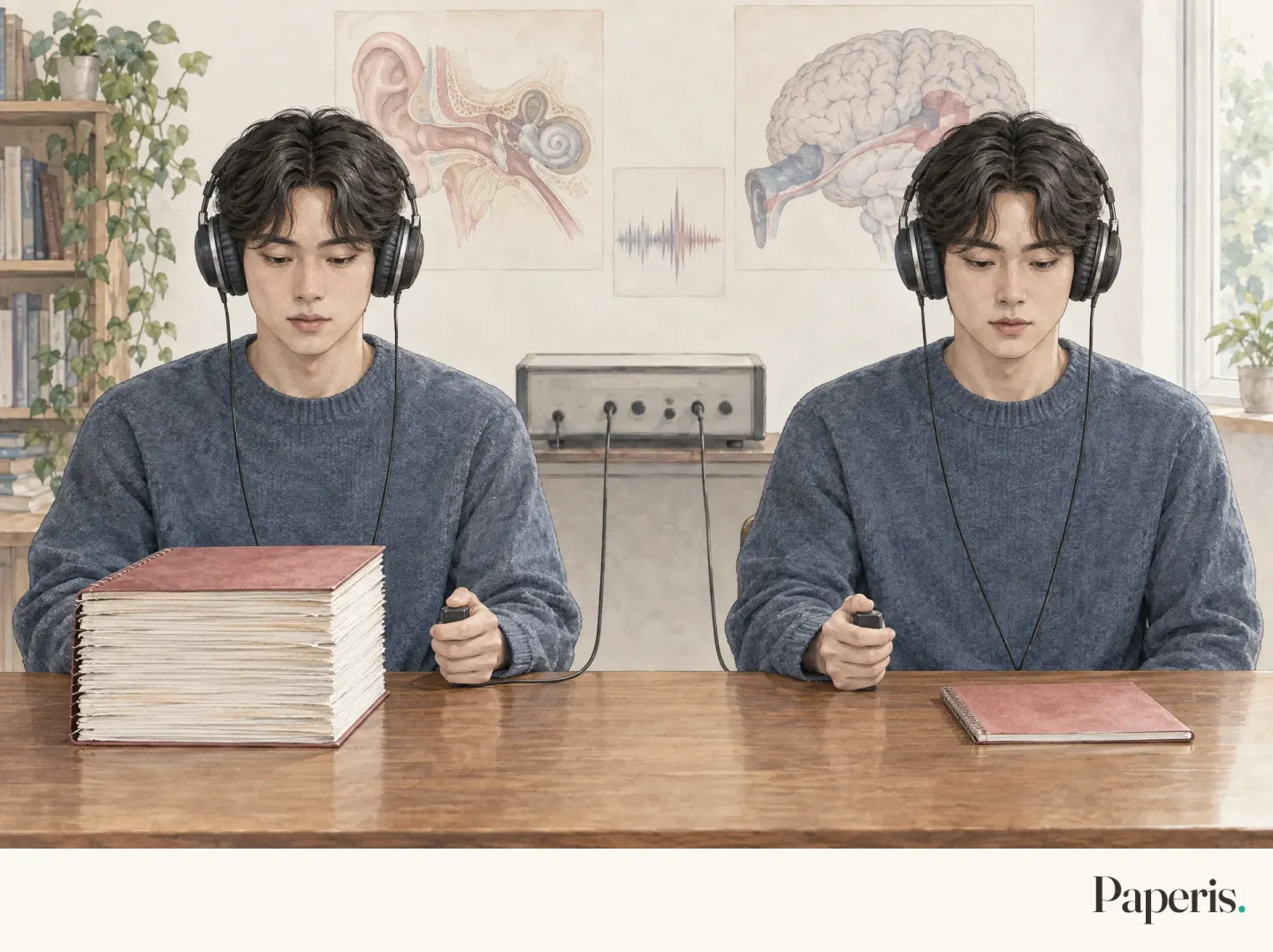
Illustration: Paperis
In this study, musical ability was the score on an auditory discrimination test distinguishing differences in rhythm, melody, and pitch, and did not measure how well one plays an instrument. This study does not directly answer whether practice improves instrument performance score. There are also results showing that such auditory test scores are not determined solely by formal training. When testing 190 adults with no history of formal music education, 12% scored higher than the average of previously tested individuals with 6 years or more of formal training, and the scores were higher along with experience encountering music outside of formal education and cognitive ability (PMID 36114609). Among what the Swedish twin study showed, the newest fact regarding the practice diary is that how thickly one fills out the practice log—in other words, individual differences in the amount of practice—is itself influenced by genetics. The authors interpreted that genetic differences are involved in individual differences in the propensity to practice.
A 2015 study analyzing a sample of over 800 pairs of twins added another layer to the picture. In this study as well, genetics influenced practice amount, but only about a quarter of the genetic effect on music achievement was explained through practice. The authors considered that other factors influenced by genetics besides practice contribute to individual differences in achievement. This study also found an interaction. The genetic effect on music achievement was most pronounced among people who practice music, and the authors interpreted that the genetic potential for skill is most fully revealed and nurtured through practice (PMID 24957535).
A study published in 2024 directly tested one of the predictions of the original theory. Reasoning that if deliberate practice theory is correct, the influence of genetics should decrease among people who practice sufficiently, the researchers tested this prediction. The researchers analyzed the auditory discrimination test scores and lifetime practice hours of 6,471 twins (1,302 complete pairs). On average, 50% of the individual differences in auditory skill were accounted for by genetics, about 25% by the environment of growing up in the same home, and 25% by remaining factors. As practice time increased, the total individual differences in skill decreased, but what decreased were the shares of the same-home environment and remaining factors, while the genetic share remained the same. Therefore, among people with heavy practice, heritability was actually larger. The authors concluded that this result contradicts the prediction of deliberate practice theory, and that genetic predisposition remains important for musical expertise (as measured by auditory tests) even after long practice (PMID 39330466).
The first page of the practice diary—namely, when one started—was also examined in the same way. In a study surveying 310 professional musicians and 7,786 twins, those who started earlier had both higher music aptitude scores and achievement. When lifetime practice hours were taken into account together, the starting age remained related only to aptitude scores, and the relation with achievement disappeared. In the twin analysis, both aptitude and its remaining relation were entirely explained by familial factors, combining genetics and the home environment in which they grew up. The authors considered that this result provides almost no support for the idea that there is a separate critical period for acquiring music exceptionally well in childhood, and that familial factors play an important role in the relationship between starting age and adult skill (PMID 33308000). Since this study also broke down correlations using a twin design, it cannot be read to mean that starting early is harmful or useless.
It is easy to slip in the opposite direction from here. The conclusion that "practice is useless and genetics determine everything" goes beyond what these studies showed. One study took magnetic resonance images of the brains of 9 pairs, 18 individuals, of identical twins where only one person in each pair consistently played the piano. Even though their genes and upbringing environment were identical, the playing side had a thicker cortex in the auditory and motor regions of the left brain, and the brain's connection bundles were more developed. The authors considered this the first clear evidence that a substantial portion of the brain structure differences between experts and non-experts depends on the causal effects of training (PMID 29136105). Although this is a single study with a sample of 9 pairs and measured brain structure so it cannot be directly translated into differences in playing skill, there was clearly a trace left by practice on top of the same genes.
Another branch measured abilities outside of practice together. Working memory is the ability to briefly hold and manipulate what one has just seen or heard in one's head. In a study of people with varying piano skills from beginners to experts who were asked to play unfamiliar sheet music immediately (sight-reading), deliberate practice accounted for nearly half of the variance in sight-reading skill. However, working memory capacity predicted skill on top of that, and no evidence emerged that deliberate practice reduced the effect of working memory (PMID 20534780). It appears that while practice time accounted for nearly half, other factors took charge of the remaining part.
The interpretation of the side that brings these studies together is the multifactor model. While there is broad consensus that prolonged practice is essential for expertise, the argument is that expertise is related to various traits besides practice, as well as genetic factors, and that a model where genes and environment interact with each other adequately explains the current data (PMID 26689084). Conversely, a 2019 paper by those supporting the original definition countered that, aside from height and physical build, the genetic effects discovered so far have explained a surprisingly small amount of variance (PMID 31708836). What twin studies have shown is the fact that genetics and practice are intertwined with each other. The results varied depending on what was measured and with what design. In the study of 10,500 twins comparing identical pairs with differing practice amounts, the relation between auditory test scores and practice disappeared when controlling for genetics, but in the small study imaging the brains of 9 pairs, traces of practice remained even on top of the same genes. In the sight-reading study, which was not a twin study and therefore did not control for genetics, practice accounted for nearly half of the skill variance.
What Counts as Practice
"What counts as practice" is a point of contention that followed the meta-analytic numbers. Ericsson, who established the concept of deliberate practice, published direct rebuttals to the meta-analyses. The deliberate practice he described in his 1993 study is personalized practice chosen by a teacher, with clear goals and immediately useful feedback. In contrast, he pointed out that sports meta-analyses counted almost every activity related to the discipline as practice, including group activities, watching games on television, play, and matches. He argued that the calculation of adding up all kinds of practice time throughout a career assumes that every practice is equally effective for skill, and that assumption does not hold up against evidence (PMID 27217247). In a 2020 reply, he wrote that McNamara's broad definition brought activities into the analysis that failed to meet one or more of the original criteria—such as attending lectures, a student's solo study, and group activities led by a coach—and at the end of the paper, he proposed ways to reconcile the two perspectives (DOI: 10.1007/s00426-020-01368-3).
McNamara and Hambrick's response turned the arrows toward the definition. They reviewed writings by Ericsson and his colleagues spanning more than 25 years, pointing out that there are decisive inconsistencies in the definition of deliberate practice and that the criteria accepted as evidence have also shifted. They considered that in such a state, whether the deliberate practice theory can be tested and falsified becomes the problem (PMID 33013494). In short, one side says, "The explanatory power came out small because practice was counted too broadly," while the other says, "Because the definition keeps changing, the theory can be defended no matter what result comes out."
The 2019 replication study seen earlier added data to this dispute. What the original study actually measured was solo practice, and the definition stated by the theory was teacher-designed practice, which was not measured separately in the original study. In the replication study, violin students considered teacher-designed practice less important for improving violin skill than solo practice, and the amount of teacher-designed practice did not explain the variance in skill more than the amount of solo practice did (PMID 31598236). This is one case where narrowing the definition to measure exactly what the theory stated did not automatically increase explanatory power.
Attempts to directly measure the quality of practice also continued. A study surveying 178 chess players argued that meta-analyses underestimated the effect by ignoring personalization, which is a core feature of practice. At high levels of personalization and practice quality, the effect size of structured practice was more than 3 times that at the average level. Even so, the authors concluded that how important deliberate practice is for individual differences in skill remains an open question (DOI: 10.1007/s12144-021-02326-x). On the music side, a study following participants for 4 months proposed a framework in which practice time predicts musical achievement only when paired with goal-setting and focused practice, reporting that this integrated model predicted achievement better than the traditional method of only counting practice hours (DOI: 10.1177/0305735614534910). There is also a study that created a self-report questionnaire to measure practice quality using data from 1,558 musicians, ranging from amateurs to world-class soloists. Musicians with effective practice habits focused on solving problems in their performance, and musicians with many deliberate practice behaviors often broke long, complex tasks down into short, simple parts (DOI: 10.1177/03057356211065172).
A study looking into musical prodigies points in the same direction. When 19 prodigies who showed exceptional achievement in childhood were compared with 35 musicians who received a similar amount of training and 16 non-musicians, intelligence tests and personality tests failed to distinguish the prodigies. What separated them were the intensity of practice before adolescence, the source of the motivation for first starting the instrument, and the tendency to report experiencing flow during practice. The authors wrote that practice alone does not create a prodigy, and considered the results consistent with a multifactorial model (PMID 33362630). Because it is a small-sample comparison study, it is closer to a record of what failed to distinguish prodigies than an answer to what makes a prodigy.
This dispute is not yet over. However, the arena of the argument has shifted. A 2018 paper argued that the nature-versus-nurture debate in expertise research has ended or should end, and that a multifactorial model looking at genetics and environment together is the direction for the future (PMID 29446457). This claim is the view of researchers on the multifactorial side, whereas Ericsson's side proposed that the next task is research measuring not just practice time, but the quality of practice such as focus, analysis, and problem-solving (PMID 31708836). Both sides start from the point that a single line of time written in a practice log is not enough.
Opening the Practice Journal Again
Now we return to the first practice journal. The journal of a child learning the piano for three years is packed with dates and practice times down to the minute. In light of the studies we have seen so far, we can separate what this journal tells us from what it does not.
The time written in the journal is a number that goes together with skill. Broadly defined practice explained 21% of the difference in musical skill (PMID 24986855), an analysis with a narrower criterion reported an adjusted correlation of 0.61 (PMID 25018742), and there is a broad consensus that long-term practice is essential for expertise (PMID 26689084). In two studies comparing young and older pianists divided into experts and amateurs, general processing speed dropped sharply with age in both experts and amateurs. However, in music-related tasks, while amateurs dropped together, older professional pianists maintained a level slightly lower than young experts, and the degree of that maintenance went together with the amount of deliberate practice in late adulthood (PMID 8945787). The amount of practice went together with the degree of maintaining skill even past the period of building skill.
There are also three blank spaces not written in the journal. The first is what kind of practice that time was. Even for the same 30 minutes, time spent breaking down and fixing a difficult passage and time spent simply playing straight through from beginning to end are written identically in the journal, and this quality is precisely what researchers are currently struggling to measure. The second is who wanted to open the journal. The result of a twin study showing that the amount of practice itself is influenced by genetics and that the link between practice and ability is mediated largely through genetic factors (PMID 25079217) led to the authors' interpretation that the thickness of the journal and ear-training skill may partly share the same roots. The third is the point that the same amount of time can lead to different results for different people. The result showing that genetic effects were most pronounced among those who practice (PMID 24957535) and the result showing that working memory was added onto practice to predict skill (PMID 20534780) lead us to ask whether the same amount of time leads to the same result for everyone. Research answering that question on the unit of an individual person is not among the evidence this article has gathered.
The number 10,000 hours is easy to remember. The concept of deliberate practice that the story relies on got its name from a study that collected journals from music school students and found that "students who do better practiced more," and measurements have accumulated for 30 years regarding the size and meaning of that relationship. Practice is necessary for musical skill, but how far anyone will go is not determined by the single factor of how many hours have been filled. Arguments surrounding what to count as practice are ongoing even now, and what current studies are struggling to measure are the blank spaces next to the time column of the journal.
Source Papers
- "Testing the Deliberate Practice Theory: Does Practice Reduce the Heritability of Musical Expertise?" (2024) — PMID 39330466 — 6,471 twins; individual differences in pitch discrimination skill are 50% genetic, 25% shared environment, and 25% residual. More practice reduces environmental variance while the genetic share remains unchanged, thereby increasing heritability, which contradicts the predictions of deliberate practice theory.
- "The meta-analyses of deliberate practice underestimate the effect size because they neglect the core characteristic of individualization—an analysis and empirical evidence" (2021) — DOI: 10.1007/s12144-021-02326-x — 178 chess players; when individualization and quality are high, the effect of structured practice is more than 3 times the average. The importance of practice remains an open question.
- "The role of deliberate practice in expert performance: revisiting Ericsson, Krampe & Tesch-Römer (1993)." (2019) — PMID 31598236 — Replication of the original study (violin students, retrospective estimated cumulative practice × skill level, "explains most"). Double-blinded; the effect is substantial but much smaller, and the level-by-level correspondence is not replicated.
- "Rethinking expertise: A multifactorial gene-environment interaction model of expert performance." (2016) — PMID 26689084 — Broad consensus that prolonged practice is essential, but regarding non-practice traits and genetic factors, a multifactorial gene-environment interaction model is proposed.
- "Deliberate practice and performance in music, games, sports, education, and professions: a meta-analysis." (2014) — PMID 24986855 — Variance explained by broadly defined deliberate practice: games 26%, music 21%, sports 18%, education 4%, professions less than 1%. Important, but not as much as claimed.
- "Given that the detailed original criteria for deliberate practice have not changed, could the understanding of this complex concept have improved over time? A response to Macnamara and Hambrick (2020)" (2020) — DOI: 10.1007/s00426-020-01368-3 — Ericsson's reply: the broad definition included lectures, solo study, and coach-led group activities.
- "Is the Deliberate Practice View Defensible? A Review of Evidence and Discussion of Issues." (2020) — PMID 33013494 — Over 25 years of literature showing inconsistencies in definitions, shifting evidentiary standards, and issues with testability and falsifiability.
- "Deliberate Practice and Proposed Limits on the Effects of Practice on the Acquisition of Expert Performance: Why the Original Definition Matters and Recommendations for Future Research." (2019) — PMID 31708836 — Solo practice at music school = deliberate practice. Macnamara 14% → reanalysis using original criteria 29%, corrected 61%. Genetic effects are small except for height and physique. Recommends measuring quality.
- "Same Genes, Different Brains: Neuroanatomical Differences Between Monozygotic Twins Discordant for Musical Training." (2018) — PMID 29136105 — 9 pairs of monozygotic twins discordant for piano practice; auditory-motor cortex thickness and white matter development on the playing side → causal effect of training.
- "The Relationship Between Deliberate Practice and Performance in Sports: A Meta-Analysis." (2016) — PMID 27217246 — Sports 18%, 1% among top-tier athletes.
- "Summing Up Hours of Any Type of Practice Versus Identifying Optimal Practice Activities: Commentary on Macnamara, Moreau, & Hambrick (2016)." (2016) — PMID 27217247 — Ericsson: the original definition is individualized practice with teacher-selected tasks, clear goals, and immediate feedback. Summing up all practice hours is an assumption inconsistent with the evidence.
- "Practice does not make perfect: no causal effect of music practice on music ability." (2014) — PMID 25079217 — 10,500 Swedish twins; practice-pitch discrimination ability correlation 0.18–0.36, practice heritability 40–70%, no difference in ability within monozygotic twin pairs discordant for practice.
- "Can we create gifted people?" (1993) — PMID 8168368 — International level requires over 10 years of intensive preparation, cumulative deliberate practice is closely related to skill even at the highest levels, and aptitude factors have never been measured.
- "The genetics of music accomplishment: evidence for gene-environment correlation and interaction." (2015) — PMID 24957535 — Just under 800 twin pairs, genes influence practice, about a quarter of the genetic effect on achievement is mediated through practice, and genetic effects are clearest in those who practice.
- "Deliberate practice is necessary but not sufficient to explain individual differences in piano sight-reading skill: the role of working memory capacity." (2010) — PMID 20534780 — Deliberate practice explains nearly half of the variance in sight-reading skill, working memory adds predictive power, and practice does not reduce that effect.
- "Deliberate practice in music: Development and psychometric validation of a standardized measurement instrument" (2022) — DOI: 10.1177/03057356211065172 — Developed a practice quality questionnaire with 1,558 musicians; effective practice focuses on problem-solving and breaking down tasks.
- "The influence of deliberate practice on musical achievement: a meta-analysis." (2014) — PMID 25018742 — 13 studies, 788 individuals; corrected correlation of 0.61 between task-relevant practice and objective musical achievement, supporting the central role of long-term practice.
- "Learning with Zeal" (2019) — DOI: 10.1093/oxfordhb/9780198795872.013.40 — Handbook chapter stating that the idea of needing an average of 10,000 hours and 10 years of deliberate practice is widely accepted.
- "When quantity is not enough: Disentangling the roles of practice time, self-regulation and deliberate practice in musical achievement" (2014) — DOI: 10.1177/0305735614534910 — 4-month prospective study; practice time predicts achievement only when paired with goal-directed, focused practice, and an integrated model has better predictive power than traditional measures.
- "What Makes Musical Prodigies?" (2020) — PMID 33362630 — 19 prodigies vs. 35 musicians and 16 non-musicians; intelligence and personality do not differentiate them, whereas practice intensity, motivation, and engagement prior to adolescence do. Practice alone does not make a prodigy.
- "Why Is an Early Start of Training Related to Musical Skills in Adulthood? A Genetically Informative Study." (2021) — PMID 33308000 — 310 professional musicians and 7,786 twins; early start is related to aptitude and achievement, but after controlling for practice time, only the relation with aptitude remains, and that relation is entirely explained by familial factors. Weak support for sensitive periods.
- "Individual differences in musical ability among adults with no music training." (2023) — PMID 36114609 — 12% of 190 adults with no formal training scored higher than the average of the group with 6 or more years of training, correlating with informal musical experience and cognitive ability.
- "Maintaining excellence: deliberate practice and elite performance in young and older pianists." (1996) — PMID 8945787 — Older professional pianists maintain musical task performance despite declines in general processing speed; the degree of maintenance is predicted by the amount of deliberate practice in late adulthood.
- "Toward a multifactorial model of expertise: beyond born versus made." (2018) — PMID 29446457 — The nature-versus-nurture debate on expertise is over, or should be; a multifactorial model is proposed.
- "How Important Is Deliberate Practice? Reply to Ericsson (2016)." (2016) — PMID 27217248 — Deliberate practice explains a substantial amount (18%) of the variance in sports performance, but leaves a much larger portion unexplained.
Sources (25)
- Testing the Deliberate Practice Theory: Does Practice Reduce the Heritability of Musical Expertise?PMID 39330466
- The meta-analyses of deliberate practice underestimate the effect size because they neglect the core characteristic of individualization—an analysis and empirical evidenceDOI 10.1007/s12144-021-02326-x
- The role of deliberate practice in expert performance: revisiting Ericsson, Krampe & Tesch-Römer (1993)PMID 31598236
- Rethinking expertise: A multifactorial gene-environment interaction model of expert performancePMID 26689084
- Deliberate practice and performance in music, games, sports, education, and professions: a meta-analysisPMID 24986855
- Given that the detailed original criteria for deliberate practice have not changed, could the understanding of this complex concept have improved over time? A response to Macnamara and Hambrick (2020)DOI 10.1007/s00426-020-01368-3
- Is the Deliberate Practice View Defensible? A Review of Evidence and Discussion of IssuesPMID 33013494
- Deliberate Practice and Proposed Limits on the Effects of Practice on the Acquisition of Expert Performance: Why the Original Definition Matters and Recommendations for Future ResearchPMID 31708836
- Same Genes, Different Brains: Neuroanatomical Differences Between Monozygotic Twins Discordant for Musical TrainingPMID 29136105
- The Relationship Between Deliberate Practice and Performance in Sports: A Meta-AnalysisPMID 27217246
- Summing Up Hours of Any Type of Practice Versus Identifying Optimal Practice Activities: Commentary on Macnamara, Moreau, & Hambrick (2016)PMID 27217247
- Practice does not make perfect: no causal effect of music practice on music abilityPMID 25079217
- Can we create gifted people?PMID 8168368
- The genetics of music accomplishment: evidence for gene-environment correlation and interactionPMID 24957535
- Deliberate practice is necessary but not sufficient to explain individual differences in piano sight-reading skill: the role of working memory capacityPMID 20534780
- Deliberate practice in music: Development and psychometric validation of a standardized measurement instrumentDOI 10.1177/03057356211065172
- The influence of deliberate practice on musical achievement: a meta-analysisPMID 25018742
- Learning with ZealDOI 10.1093/oxfordhb/9780198795872.013.40
- When quantity is not enough: Disentangling the roles of practice time, self-regulation and deliberate practice in musical achievementDOI 10.1177/0305735614534910
- What Makes Musical Prodigies?PMID 33362630
- Why Is an Early Start of Training Related to Musical Skills in Adulthood? A Genetically Informative StudyPMID 33308000
- Individual differences in musical ability among adults with no music trainingPMID 36114609
- Maintaining excellence: deliberate practice and elite performance in young and older pianistsPMID 8945787
- Toward a multifactorial model of expertise: beyond born versus madePMID 29446457
- How Important Is Deliberate Practice? Reply to Ericsson (2016)PMID 27217248