Paperis Articles
Cao Cao — Who Named Him the Treacherous Hero?
From a character appraisal that survives in three versions to the laughingstock of the pansori Jeokbyeokga — how a man called "a hero beyond his age" became the byword for treachery
Your field's papers, as audio
Pick your fields and journals — Paperis summarizes the key papers and turns them into audio. Listen on your commute.
Start Paperis free →Cao Cao — Who Named Him the Treacherous Hero?
"What kind of person am I?"
At the end of the 2nd century, China's Han Dynasty was collapsing. There was an emperor, but he had no power, and generals commanding armies each seized land and fought one another. Among them, the person who united the north and laid the foundation for the state of Wei was Cao Cao, and the person who opposed him and later founded Shu Han was Liu Bei. Today in Korea, the name Cao Cao is commonly uttered together with "treacherous hero." A treacherous hero (姦雄) is a term that combines cunning (姦) and hero (雄) in a single person, referring to a figure who has the talent to accomplish great things yet uses deception.
In the novel, that phrase appears in the first chapter. "Romance of the Three Kingdoms" is a long-form novel that unfurls the history of Wei, Wu, and Shu as a story, which is the very book commonly called "Three Kingdoms" in Korea. In that Chapter 1, a young Cao Cao visits Xu Shao of Runan, who had a reputation for recognizing people, and asks, "What kind of person am I?" When Xu Shao did not answer, Cao Cao asked again, and Xu Shao said: "You are a capable subject in a well-governed world, and a treacherous hero in a chaotic world" (子治世之能臣,亂世之奸雄也). Hearing those words, Cao Cao greatly rejoiced (Romance of the Three Kingdoms, chapter 1).
When you go to look for this sentence in history books, the path splits in two. The official history "Records of the Three Kingdoms" is a book in which Chen Shou of Western Jin recorded the histories of the three states of Wei, Wu, and Shu, and is one of the history books designated as official history by Chinese dynasties. The author is Chen Shou, and the annotations were added by Pei Songzhi. Pei Songzhi's annotations are notes where Pei Songzhi of Liu Song in the Southern Dynasties pulled records from other books and attached them throughout the main text of "Records of the Three Kingdoms". The story comparing the scenes of the two books is in "Three Kingdoms — The Claim That It Is Seven Parts Fact", and this piece is written focusing on Cao Cao alone. After following China's history books and novels, we will even go to how Cao Cao's face changed on the stage of Joseon's pansori.
If you look for Xu Shao's evaluation in Chen Shou's main text, it is not there. That sentence is inside the annotation attached by Pei Songzhi, and even there, it is only one version.
Three Xu Shaos
What kind of person Xu Shao was is recorded in the Book of the Later Han compiled by Fan Ye. According to the "Biography of Xu Shao," Xu Shao "liked evaluating people and recognized many talents," and whenever people spoke of someone in the realm who could recognize talent, they invariably named Xu Shao and Guo Tai (Book of the Later Han, "Biography of Xu Shao"). A character evaluation is an appraisal that captures a person's character and capacity in a few brief words. It was this character evaluation that a young Cao Cao requested of Xu Shao.
The young Cao Cao portrayed in Chen Shou's main text is as follows. In his youth, Cao Cao was quick-witted and resourceful in emergencies, but he acted like a wandering knight, behaved arbitrarily, and did not attend to an occupation, so people of the world did not view him as out of the ordinary. Only Qiao Xuan and He Yong regarded him as exceptional, and Qiao Xuan said, "The one who will bring peace to the realm must be you!" (Records of the Three Kingdoms, Book of Wei, "Annals of Emperor Wu"). Chen Shou's main text includes Qiao Xuan and He Yong, but has no evaluation by Xu Shao.
Xu Shao's words appear in Pei Songzhi's commentary in the same place. The Shiyu, which the commentary cites first, merely records that Qiao Xuan told Cao Cao, "You do not yet have a name; you should befriend Xu Zijiang," and that when Cao Cao went to visit him, "Zijiang accepted him, and through this he became known." Xu Zijiang is Xu Shao's style name. This version contains no sentences of evaluation. Next, the commentary cites Sun Sheng's Yitong Zayu. When Cao Cao asked, "What kind of person am I?", Xu Shao did not answer, but when pressed, he said this: "In a well-governed world you are a capable minister, in a chaotic world you are a treacherous villain" (君治世之能臣,亂世之姦雄). At this, Cao Cao laughed heartily (Records of the Three Kingdoms, Book of Wei, "Annals of Emperor Wu", Pei Songzhi's annotation).
The version in the Book of the Later Han, "Biography of Xu Shao," differs right from the opening scene. When Cao Cao was of humble status, he always spoke humbly, offered generous gifts, and begged to be evaluated, but Xu Shao looked down on his character and refused to answer. When Cao Cao watched for an opening and threatened him, Xu Shao said reluctantly: "In a clear and peaceful world you are a wicked bandit, in a chaotic world you are a hero" (君清平之姦賊,亂世之英雄). Cao Cao was greatly pleased and departed (Book of the Later Han, "Biography of Xu Shao").
In the third version, the speaker changes. In the first entry of the "Appraising Character" chapter of A New Account of the Tales of the World, an anecdote collection compiled by Liu Yiqing of the Liu Song of the Southern Dynasties, the person saying something similar is Qiao Xuan (A New Account of the Tales of the World writes Qiao Xuan as 喬玄). Qiao Xuan first asks, since the realm is chaotic and various heroes are contending, "Is not the one who will govern and set this right you?", and then adds this: "Yet you are truly a hero of a chaotic world and a wicked bandit of a well-governed world" (君實亂世之英雄,治世之姦賊). He then says that he regrets being old and not seeing Cao Cao's wealth and honor, and entrusts his descendants to him (A New Account of the Tales of the World, "Appraising Character"). Liu Xiaobiao, who annotated this book, brought up the records of the Shiyu and Sun Sheng and judged that "What A New Account says is wrong" (“世説”所言謬矣) (A New Account of the Tales of the World, "Appraising Character", Liu Xiaobiao's commentary).
When the three versions are placed side by side, two branches emerge. In Sun Sheng's version, Cao Cao is a capable minister in a peaceful world and a treacherous villain in a chaotic world. In the Book of the Later Han and A New Account of the Tales of the World, he is a wicked bandit in a peaceful world and a hero in a chaotic world. What is diametrically opposed is the peaceful world column: one side is a capable minister, and the other is a wicked bandit. The chaotic world column has "treacherous villain" and "hero," differing only by whether the single character for "crafty" (姦) is attached. The era Cao Cao actually lived in was a chaotic world, so that single character decides whether it is attached to Cao Cao for the era he lived in. The word "treacherous villain" appears only in Sun Sheng's version among the three versions, and it is that version which Chapter 1 of Romance of the Three Kingdoms follows. Which side Xu Shao actually spoke cannot be determined because the three original texts differ from one another.
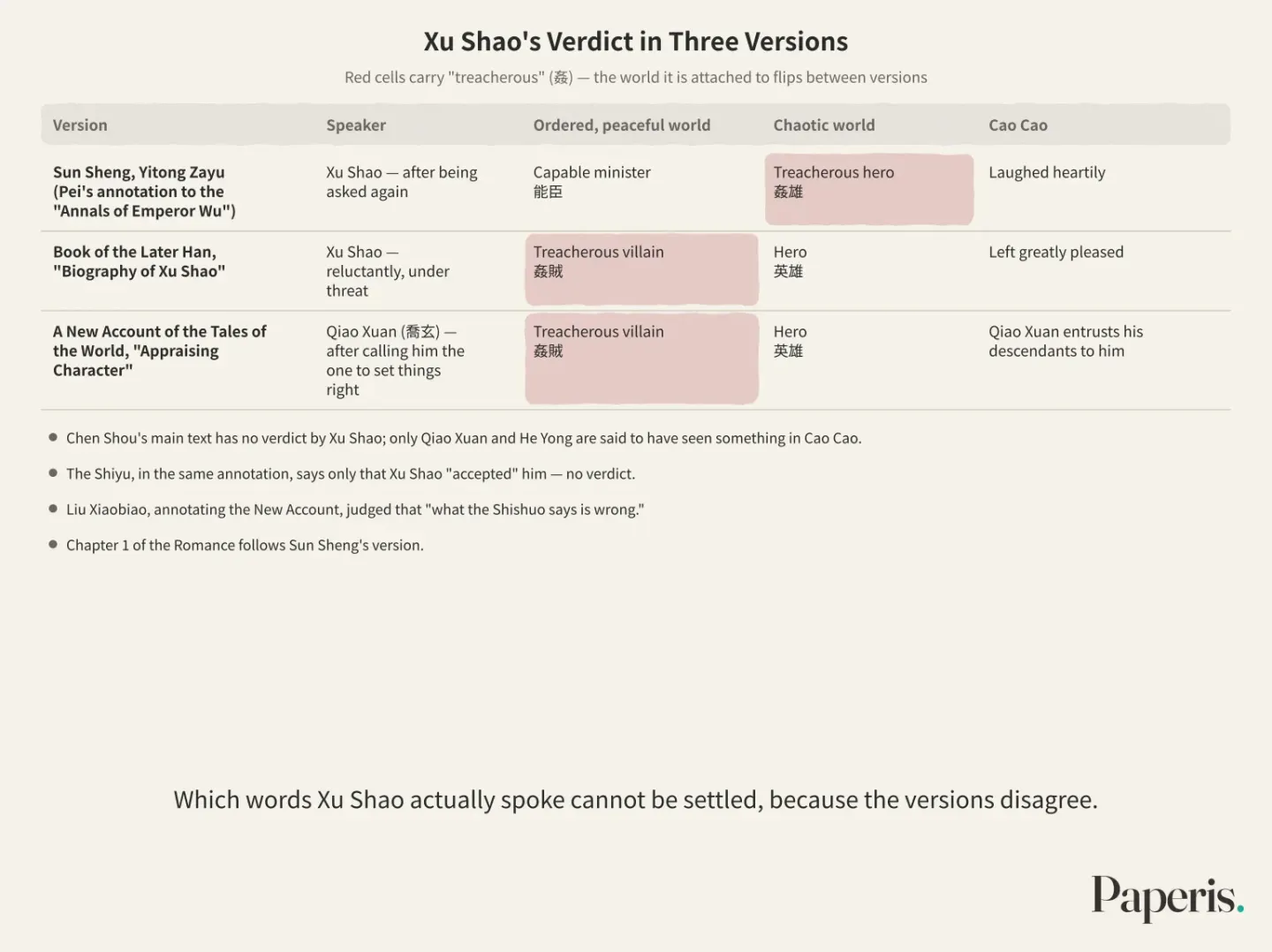
Figure: Xu Shao's verdict in three versions — the world that "treacherous" (姦) attaches to flips between them. (Paperis figure)
Lü Boshe's House
When the general Dong Zhuo, who had taken control of the court, tried to appoint Cao Cao to the office of colonel of the fast cavalry, Cao Cao changed his name and headed east by back roads. Leaving the gate and passing through Zhongmo, he was suspected by a village official named Zhengzhang and captured, but someone in the town secretly recognized him and he was released (Records of the Three Kingdoms, Book of Wei, "Annals of Emperor Wu"). Chen Shou's main text ends the account of this flight here. The name Lü Boshe does not appear in it.
Lü Boshe appears in Pei Songzhi's annotations, and there are three different versions in the annotations. The first is the "Book of Wei" by Wang Chen, a historical record from the Wei side. Cao Cao took a few cavalrymen to visit his old friend Lü Boshe in Chenggong; Lü Boshe was away, and his sons and retainers together tried to threaten Cao Cao to rob him of his horses and goods, so Cao Cao with his own hand cut down and killed several people with his sword. In this version, Cao Cao used his sword to protect himself. Second, the "Accounts of the World" records that Lü Boshe's five sons prepared the courtesies of hosting a guest, but Cao Cao suspected—because he had disobeyed Dong Zhuo's orders—that they meant to harm him, and "at night with his own hand he killed eight people and left." Third, Sun Sheng's Zaji records that Cao Cao heard the sound of bowls, thought they meant to harm him, and killed them at night, and after doing so he said with sorrow: "Better that I should wrong others than that others should wrong me!" (寧我負人,毋人負我) (Records of the Three Kingdoms, Book of Wei, "Annals of Emperor Wu", Pei Songzhi's annotation).
Within the same annotations, the incident splits from self-defense to a murder caused by misunderstanding, and again to a monologue after the misunderstanding. That monologue appears only in Sun Sheng's Zaji, with "with sorrow" (悽愴) attached before it. Pei Songzhi did not judge which version was correct in this place. Sun Sheng's name appears in two places—Yitong Zayu, which contains Xu Shao's appraisal, and this Zaji—and the annotations cite the two books under different names.
Chapter 4 of "Romance of the Three Kingdoms" is the fourth version. The person who released Cao Cao in Zhongmo, who was "someone in the town" in the official history text, becomes the magistrate Chen Gong, who flees together with Cao Cao. Lü Boshe is a sworn brother of Cao Cao's father and goes out to buy wine. Cao Cao overhears the sound of knife-grinding and the words "How about tying them up and killing them?", and "he killed all of them regardless of man or woman, killing eight family members in succession." In the kitchen, a single pig was tied up. Cao Cao even cuts down Lü Boshe with his sword as Lü Boshe is returning from his flight. When Chen Gong says, "Knowing it and killing him on purpose is greatly unrighteous!", Cao Cao replies: "Better that I should wrong the people of the world than that the people of the world should wrong me!" (寧教我負天下人,休教天下人負我) (Romance of the Three Kingdoms, chapter 4). At the end of the chapter, the novel's narrator delivers a judgment with the parallel phrase: "Cao Cao and Dong Zhuo turned out to be in the same gang."
Compared with Sun Sheng's Zaji, three things have changed. "Others" became "the people of the world," "with sorrow" vanished, and a murder done knowingly was added after the murder caused by misunderstanding. The number "eight" is the same in the "Accounts of the World" and the Romance. One study that criticizes certain arguments among discussions on "veracity verification"—arguments that judge the truth or falsity of the Romance—for blindly trusting historical records, relying on unfounded inferences, and showing a tendency toward confirmation bias also deals with this passage of Lü Boshe as a case study (DOI: 10.26586/chls.2016..78.004). Even just looking at the records on the official history side that this article read, they already split into three, so merely comparing the scenes of the Romance against a single official history version does not sort out what is the truth. What was a single remark left behind with sorrow in the annotations of the official history became a declaration directed at "the people of the world" in the novel.
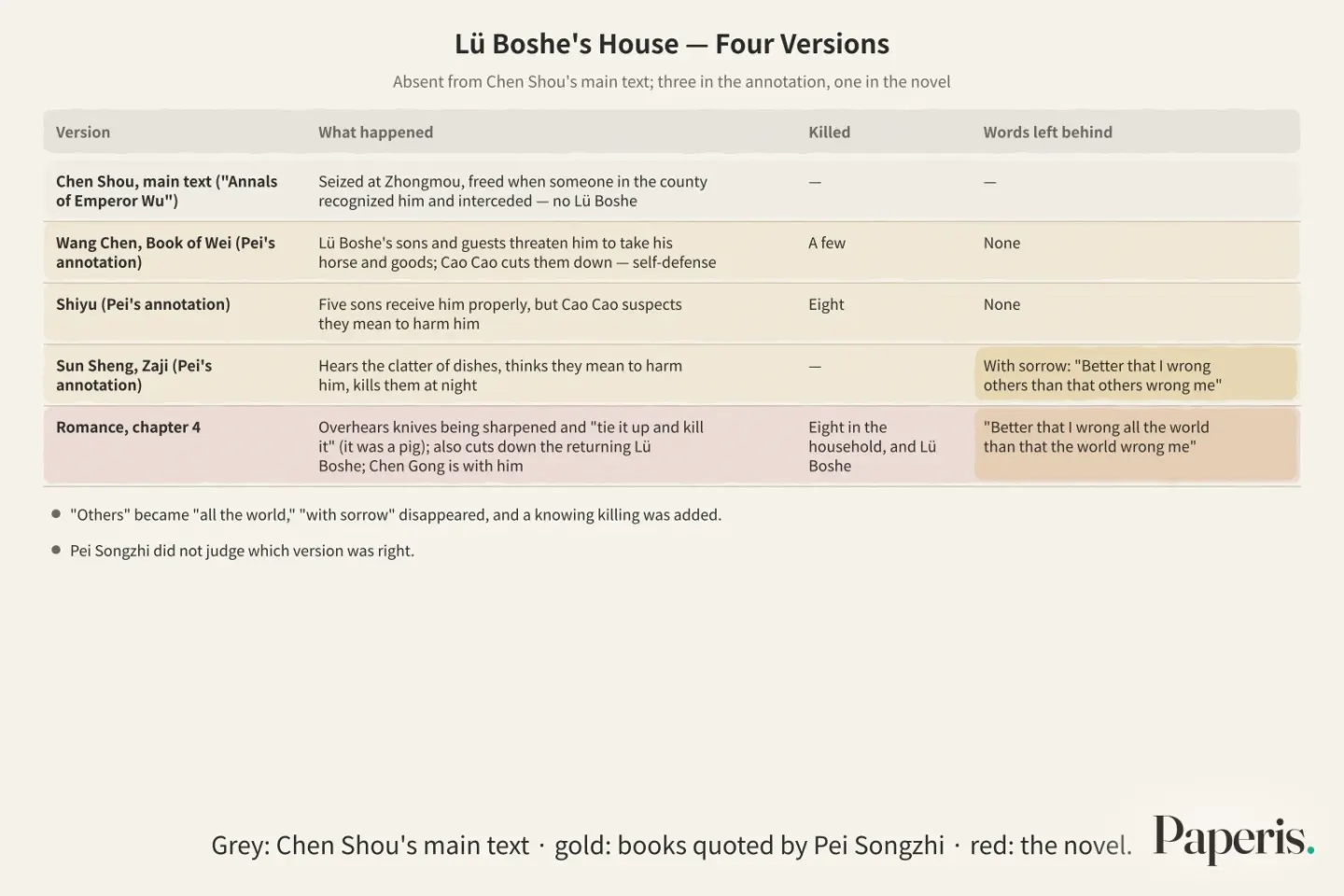
Figure: Lü Boshe's house — absent from Chen Shou's main text, three versions in the annotation, one in the novel. (Paperis figure)
The Numbers of Xuzhou
In 193 and 194, Cao Cao led armies to attack Xuzhou twice. The ruler of Xuzhou was Tao Qian, and behind these campaigns was the death of Cao Cao's father, Cao Song. Chen Shou's main text records that Cao Song "suffered harm at the hands of Tao Qian" (Records of the Three Kingdoms, Book of Wei, "Annals of Emperor Wu"). The accounts brought in by the commentary differ. The Book of the World states that Tao Qian secretly sent thousands of cavalrymen to ambush them, killing Cao Song and his entire household, whereas the Book of Wu states that a commander whom Tao Qian sent to escort them coveted their wealth, killed them, and fled, and "Cao Cao shifted the blame to Tao Qian and attacked him" (Records of the Three Kingdoms, Book of Wei, "Annals of Emperor Wu", Pei Songzhi's annotation). The Book of the Later Han, "Biography of Tao Qian", records that soldiers in a place guarded by Tao Qian's commander coveted Cao Song's wealth, ambushed them, and killed them (Book of the Later Han, "Biography of Tao Qian").
The killings during the expedition are recorded differently across documents. Chen Shou's main text in the "Biography of Emperor Wu" merely states that during the first expedition Cao Cao captured more than ten walled cities, and during the second expedition he "everywhere he passed, largely killed and harmed [people]" (所過多所殘戮) (Records of the Three Kingdoms, Book of Wei, "Annals of Emperor Wu"). Attached to that passage is a criticism by Sun Sheng: "To blame Tao Qian yet harm the common people under his jurisdiction was going too far" (罪謙之由,而殘其屬部,過矣) (Records of the Three Kingdoms, Book of Wei, "Annals of Emperor Wu", Pei Songzhi's annotation). Chen Shou's main text in the "Biography of Tao Qian" records that in the great battle of Pengcheng, "Tao Qian's army was defeated and fled, and those who died numbered in the tens of thousands, so that the Si River could not flow because of them," where the context indicates the dead were Tao Qian's soldiers (Records of the Three Kingdoms, Book of Wei, "Biography of Tao Qian"). The Book of Wu in the same commentary location states that [Cao Cao] "advanced to Pengcheng and killed many common people" (Records of the Three Kingdoms, Book of Wei, "Biography of Tao Qian", Pei Songzhi's annotation).
Where the numbers grow larger is in other documents. In the main text of the "Biography of Xun Yu", Cao Cao's advisor Xun Yu tells him not to attack Xuzhou again, saying that "when you previously attacked Xuzhou, majesty and punishments were actually carried out," so their sons and younger brothers would not have the heart to surrender (Records of the Three Kingdoms, Book of Wei, "Biography of Xun Yu"). The Biography of Caoman, brought in by the commentary at that location, records that upon reaching Pengcheng, Cao Cao "buried tens of thousands of men and women alive in the Si River so that the water could not flow," and subsequently thoroughly slaughtered various districts so that "even chickens and dogs were completely gone" (Records of the Three Kingdoms, Book of Wei, "Biography of Xun Yu", Pei Songzhi's annotation). The Book of the Later Han, "Biography of Tao Qian", records that "in all, he killed hundreds of thousands of men and women" (凡殺男女數十萬人) (Book of the Later Han, "Biography of Tao Qian").
The "numbering in the tens of thousands" in Chen Shou's main text refers to Tao Qian's soldiers, while the Biography of Caoman says tens of thousands of men and women, and the Book of the Later Han says hundreds of thousands of men and women. The number of deaths varies by record, and which number is correct cannot be determined from these documents alone. Neither the claim that "Cao Cao did not commit massacres" nor the claim that "the official Records of the Three Kingdoms recorded hundreds of thousands" aligns with these records. Records unfavorable to Cao Cao existed in the layer of official history before the novels. Chen Shou's main text recorded that "everywhere he passed, largely killed and harmed [people]," and Sun Sheng in the commentary called that "going too far."
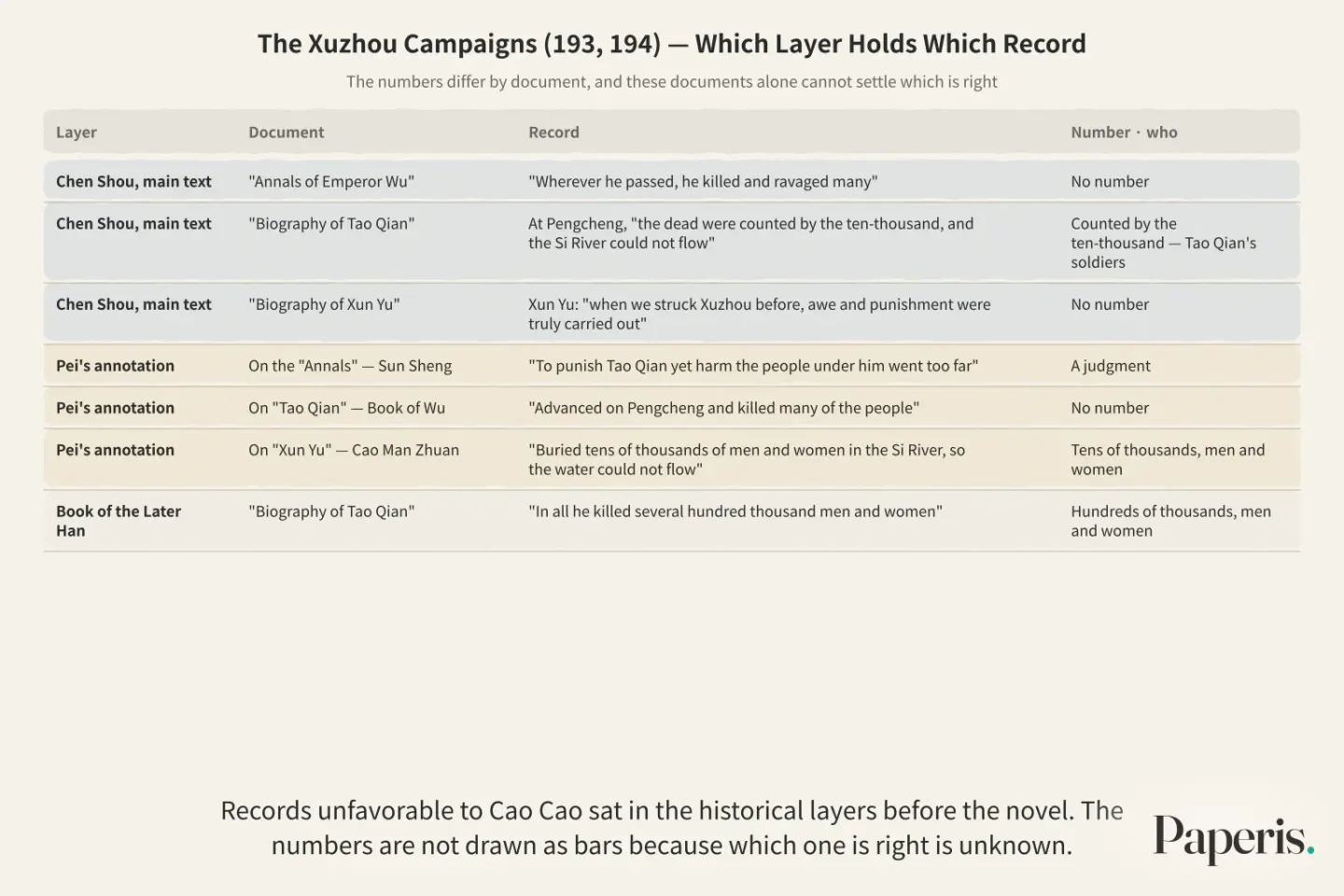
Figure: Which layer holds which record of the Xuzhou campaigns — the numbers differ by document. (Paperis figure)
Two Faces in One Book
In the annotation added by Pei Songzhi at the end of the "Annals of Emperor Wu," a completely opposite Cao Cao sits side by side. The Cao Man Zhuan depicts Cao Cao as frivolous in character and devoid of majesty, keeping jesters by his side and playing constantly from day to night. At the same time, he enforced the law harshly; if any general devised a plan superior to his own, he would immediately have him executed by law, and when putting someone to death by punishment, he would weep and grieve before them, yet he never spared anyone in the end. There is also an anecdote in this book that when grain was scarce, he told the official in charge to distribute it in small measuring cups, and when the crowd complained that "Cao Cao is deceiving us," he said, "I must use your death to appease the crowd," beheaded the official, and posted a notice saying, "Using small measuring cups to steal state grain" (Records of the Three Kingdoms, Book of Wei, "Annals of Emperor Wu", Pei Songzhi's annotation).
Wang Chen's Book of Wei (a different book from Chen Shou's Book of Wei in the Records of the Three Kingdoms) right beside it portrays a different person. According to the Book of Wei, Cao Cao was good at recognizing people and difficult to delude with falsehoods; he picked Yu Jin and Yue Jin from among the ranks and obtained Zhang Liao and Xu Huang from among surrendered prisoners, all of whom performed meritorious service and rose to the ranks of famed generals. He did not let books leave his hand for the roughly thirty years he commanded the army, recording that "whenever he climbed a high place, he would certainly compose poetry," and that he was naturally frugal and did not care for splendor (Records of the Three Kingdoms, Book of Wei, "Annals of Emperor Wu", Pei Songzhi's annotation). The source of these sentences speaking of Cao Cao's poetry and frugality is the Book of Wei, and the main text of the "Annals of Emperor Wu" that this text reads contains no description of Cao Cao composing poetry.
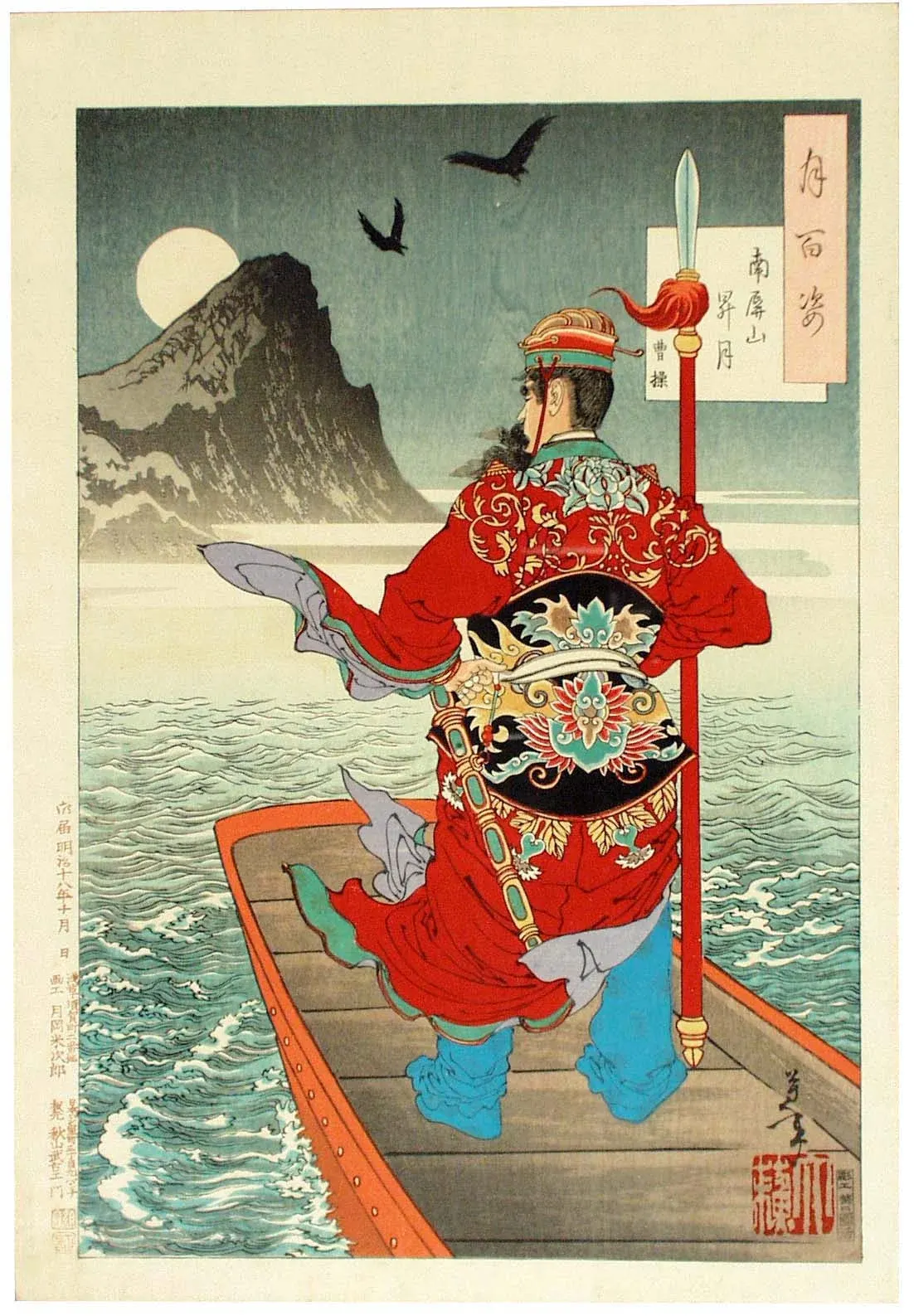
Figure: Tsukioka Yoshitoshi, "Moon over Mount Nanping — Cao Cao" from One Hundred Aspects of the Moon (1885), showing Cao Cao in a boat beneath the moon. · Wikimedia Commons (public domain)
Pei Songzhi also recorded his own judgment in between. Where the Book of Wei records that when Yuan Shao asked him to kill Yang Biao, Kong Rong, and others, Cao Cao refused, saying, "If we remove who, who will not consider themselves imperiled?", Pei Songzhi added his own words. Since Yang Biao had also suffered hardships under Cao Cao and nearly died, and Kong Rong ultimately could not escape being killed, "the saying that knowing is not difficult, but acting is difficult, is truly correct" (Records of the Three Kingdoms, Book of Wei, "Annals of Emperor Wu", Pei Songzhi's annotation). The commentator refuted the records favorable to Cao Cao on the spot.
Chen Shou's main text describes Cao Cao as a person who worked amid those times. While serving as the Chancellor of the Principality of Jinan, he impeached and dismissed eight county magistrates who had attached themselves to the powerful and accepted bribes, and in 196, at the proposals of Suozhi, Han Hao, and others, he initiated agricultural colonies for the first time (Records of the Three Kingdoms, Book of Wei, "Annals of Emperor Wu"). The figure that "one million hu of grain was obtained" through the agricultural colonies is found in the annotation of the Book of Wei (Records of the Three Kingdoms, Book of Wei, "Annals of Emperor Wu", Pei Songzhi's annotation). In an edict of 210, Cao Cao stated, "Recommend solely on the basis of talent" (Records of the Three Kingdoms, Book of Wei, "Annals of Emperor Wu"). A writing penned by Cao Cao himself in the same year states, not knowing how many people would have proclaimed themselves emperor and how many would have proclaimed themselves king if not for him in the country, and records his worry that people might say he had "improper intentions" (Records of the Three Kingdoms, Book of Wei, "Annals of Emperor Wu", Pei Songzhi's annotation). This writing is Cao Cao's own defense.
One study considers that Cao Cao's image was already very complex in the records of historians, and that under the influence of traditional political culture, he gradually changed from a historical hero into a treacherous subject. The same study reads this duality as an example of controversies over legitimacy and the political demands of each era being reflected in historical writing (DOI: 10.23273/cksj.2025..37.004). Another study comparing the official history, Pei Songzhi's annotation, and five fictional editions through numerical analysis traces part of the origins of the treacherous hero image to the Cao Man Zhuan cited in Pei Songzhi's annotation (DOI: 10.26585/chlab.2014..43.006). The materials for the treacherous hero were contained inside a single volume of official history, right alongside the materials for the hero.
Chen Shou's Scale
Where did Chen Shou himself place Cao Cao? The Basic Annals (本紀) are sections in historical books that record the deeds of emperors, and Chen Shou wrote Cao Cao down as "Emperor Wu of Taizu" in the Basic Annals "Biography of Emperor Wu" in the first volume of the Book of Wei (Records of the Three Kingdoms, Book of Wei, "Annals of Emperor Wu"). The appraisal that Chen Shou attached to the end of it is as follows. When the world at the end of the Han dynasty fell into great disorder and heroes rose up all at once, Cao Cao set up plans and spread stratagems to whip the world, appointed officials and employed talented people while matching each to their vessel, “suppressed his emotions and left things to calculation” (矯情任筭), and did not keep old grudges in his heart. That he could accomplish a great enterprise was “solely because his bright resourcefulness was the most outstanding”, and Chen Shou concludes that he “can truly be said to be an extraordinary person, a hero who surpassed the age” (抑可謂非常之人,超世之傑矣) (Records of the Three Kingdoms, Book of Wei, "Annals of Emperor Wu"). The phrase “suppressed his emotions and left things to calculation” can be read either as praise or as a point about his coldness, but the appraisal as a whole is a high evaluation of his resourcefulness.
The appraisal attached to Liu Bei is the other side of the scale. Chen Shou stated that Liu Bei's ambitions were broad and firm, that he was generous and kind, and that he knew people well and treated scholars nicely, possessing “the bearing of Gaozu of Han and the vessel of a hero”. At the same time, he wrote that “his contingency handling and resourcefulness did not reach those of Emperor Wu of Wei, so his country's foundation was also narrow” (機權幹略,不逮魏武) (Records of the Three Kingdoms, Book of Shu, "Biography of the First Sovereign"). Chen Shou placed the two men on the same scale. He weighed virtue and vessel for Liu Bei, and resourcefulness for Cao Cao.
The two men in the official history recognized each other. When Cao Cao said to Liu Bei, "Right now, the only heroes in the world are you and I," Liu Bei, who was just eating a meal, dropped his spoon and chopsticks (Records of the Three Kingdoms, Book of Shu, "Biography of the First Sovereign"). The part where a thunderclap happened to strike so that Liu Bei glossed it over by saying, "The power of a single thunderclap is to this extent!" is in the Chronicles of Huayang brought in by Pei Songzhi (Records of the Three Kingdoms, Book of Shu, "Biography of the First Sovereign", Pei Songzhi's annotation). When the advisor Cheng Yu told him to get rid of Liu Bei early, Cao Cao said, "Now is the time to gather heroes. I cannot lose the heart of the world by killing one person" (Records of the Three Kingdoms, Book of Wei, "Annals of Emperor Wu").
Liu Bei in the official history appears as a person possessing both virtue and calculation. Even though 100,000-odd commoners followed him and he could only go 10-odd li a day, Liu Bei did not abandon them, saying, "To accomplish a great work, one must always take people as the foundation." In Yizhou, at the prompting to suddenly strike Liu Zhang, who had welcomed him, he initially said, "This is a great matter, so we cannot rush," but when a gap opened up later, he summoned Liu Zhang's general Yang Huai, rebuked him for his impoliteness, beheaded him, and took the wives and children of the generals and rank-and-file soldiers as hostages (Records of the Three Kingdoms, Book of Shu, "Biography of the First Sovereign"). Regarding the record in the Book of Wei that Liu Bei declined Jingzhou, Pei Songzhi stated, "This also is not a correct saying," judging even anecdotes advantageous to Liu Bei as false (Records of the Three Kingdoms, Book of Shu, "Biography of the First Sovereign", Pei Songzhi's annotation). The official history records that calculation existed behind the image of virtue as well. Sentences calling this "hypocrisy" are not in the passages of the official history that this article read.
Readings are divided regarding Chen Shou's inner thoughts. Chen Shou's Records of the Three Kingdoms is generally known as a historical book that unavoidably followed Wei as orthodox in accordance with the political climate, much like the commentary in the Siku Quanshu Zongmu Tiyao. One study counters this by viewing that Chen Shou, whose homeland was Shu, placed Basic Annals in the Book of Wei so that it seemingly followed Wei as orthodox on the outside, but embedded hidden intentions of viewing Shu as orthodox within the format such as arranging other biographies before the "Biography of Emperor Liu Bei". The same study notes that the orthodoxy of Shu was actually fragile, that that fragility came from the nature of the Shu regime which was a foreign regime, and that Liu Bei's accession to the throne appears to have been a strategic exploitation of the rumor that Emperor Xian was murdered (KCI ART001529191). Chen Shou's appraisals remain as the original text, while the inner thoughts behind them are read differently by each study.
The Orthodoxy of Scholars, the Side of the Streets
The clouding of Cao Cao's name is intertwined with the question, "Who legitimately succeeded the Han Dynasty?" For over a thousand years, the issue of succession in the Shu-Han of the Three Kingdoms era served as a proxy stage for debate over what constitutes the basis of legitimacy: those who held the territory, those who inherited the bloodline, or those who possessed morality (DOI: 10.1017/s0041977x06000139). The theory of Shu-Han orthodoxy is the perspective that, among Wei, Shu, and Wu, the Shu-Han founded by Liu Bei is viewed as the legitimate successor state to the Han Dynasty.
One study suggests that Cao Cao was recognized as orthodox and revered through the Wei and Western Jin dynasties, but that his image gradually began to shift into that of a treacherous hero starting in the Eastern Jin, became more widely etched by the Northern and Southern Song dynasties, and completely degenerated into a usurper and treacherous hero by the Ming and Qing dynasties. This study suggests that the social conditions, traditional culture, and bloodline theories of those times likely played a significant role in that shift (KCI ART001765356). The Siku Quanshu Zongmu Tiyao, an annotated catalog from the Qing Dynasty cited by another study, records that ever since Xi Zuochi of the Eastern Jin wrote the Han-Jin Chunqiu, historical books advocating for Shu as orthodox have poured out in large numbers, particularly after the Southern Song (KCI ART001529191).
The judgments of Northern Song scholars do not boil down to a single view. One study regards the Northern Song as an era of Cao-Wei orthodoxy that emphasized geopolitical circumstances, noting that Northern Song scholars separated the public from the private and evaluated figures through the lens of utility (DOI: 10.26586/chls.2016..75.008). However, viewed through the standards of orthodoxy established by Ouyang Xiu of the Northern Song—namely, the correctness of succession and whether he united All under Heaven—Wei is also excluded from orthodoxy (DOI: 10.17207/jstc.2022.6.25.2.1). The Zizhi Tongjian, a historical work compiled by Sima Guang of the Northern Song, placed Wei in the position of orthodoxy (DOI: 10.29457/sjh.200706.0001).
Different testimony remains regarding the street storytelling scenes of that same Northern Song. The Northern Song literatus Su Shi recorded the words of his acquaintance Wang Peng in the Dongpo Zhilin as follows.
"When street children behave badly and annoy their households, they are given money to gather around and listen to old stories. When it comes to the Three Kingdoms stories, upon hearing the part where Liu Xuande loses, some children frown and even shed tears, and upon hearing the part where Cao Cao loses, they immediately rejoice and cheer (聞曹操敗,即喜唱快). From this we know that the lingering bounty left behind by gentlemen and petty men is not cut off even after a hundred generations." (Su Shi, Dongpo Zhilin, "Recalling the Past")
Su Shi added that Wang Peng was a military officer and quite literate. Even the conclusion about "gentlemen and petty men" is contained within Wang Peng's words in this version. What this passage demonstrates is a single person's observation. Wang Peng stated that during the Northern Song, there were people telling Three Kingdoms stories on the streets, and within those stories, the children were already on Liu Bei's side. Wang Peng stated that in the Northern Song, when scholars' theories of orthodoxy were divided, children gathered at street storytelling sessions would shed tears when Liu Bei lost or cheer when Cao Cao lost.
Arriving at the Southern Song, the scales of scholars also tipped. According to one study, the Southern Song shifted toward a Shu-Han orthodoxy that valued righteousness and fidelity over geopolitical circumstances, and Southern Song scholars established a framework of good and evil with Liu Bei and Cao Cao, remaining critical even of Xun Yu, who sided with Cao Cao. This study views this as having emerged from the special political environment of the Southern Song (DOI: 10.26586/chls.2016..75.008). The Southern Song ruled only half of China, much like Shu-Han, and in that Southern Song, Zhu Xi authored the Zizhi Tongjian Gangmu, changing Sima Guang's orthodoxy from Wei to Shu-Han, and the history of the Three Kingdoms continued to be repeatedly rewritten in the same manner through the Yuan and Ming dynasties as well (DOI: 10.29457/sjh.200706.0001). After northern China fell in the 12th century, this debate reached a new peak (DOI: 10.1017/s0041977x06000139).
The Face Solidified by Fiction
The Yuan dynasty stage set the people of Shu Han as the protagonists. The main characters of Yuan dynasty Romance of the Three Kingdoms plays centered on figures from the Shu Han camp like Zhang Fei, Guan Yu, Zhuge Liang, Liu Bei, and Ma Chao, and one study connects this with the aspirations of playwrights and common people for the legitimacy of governance and clean politics (DOI: 10.35982/jcs.110.8).
Romance of the Three Kingdoms refined Cao Cao's face upon that foundation. A study comparing five versions—the official history, Pei Songzhi's annotations, the Yuan dynasty Plain Tales of the Three Kingdoms (Sangguo Zhi Pinghua), the late Yuan to early Ming dynasty edition by Luo Guanzhong, and the Qing dynasty edition by Mao Zonggang—concludes that Cao Cao's depiction started from "heroic" (xiong), went through "the reversal of a reversal," and shifted to "treacherous" (jian), with the image of the treacherous hero completed in Luo Guanzhong's conception and polished by Mao Zonggang's brush (DOI: 10.26585/chlab.2014..43.006). The Romance widely read today is this edition by Mao Zonggang.
In the Romance, an anecdote with the same plot as the Biography of Cao Man appears anew, having gained a name. In Chapter 17, when military provisions run short, Cao Cao has Wang Hou, the storehouse officer, distribute them using smaller measuring cups, and when resentment arises, he says, "I intend to borrow your head to show to the army." The lines "I also know you are guilty of nothing. Yet if I do not kill you, the morale of the army will change" were also attached (Romance of the Three Kingdoms, chapter 17). In Chapter 72, Cao Cao says, "I often kill people in my dreams," slays a servant who covered him with a quilt, and after waking up, feigns astonishment, asks who killed him, and weeps loudly. The Chief Clerk Yang Xiu sighs at the funeral, "It was not that the Prime Minister was in a dream, but that you were in a dream!" (Romance of the Three Kingdoms, chapter 72). This dream murder is absent from the main text and annotations of the official history "Chronicle of Emperor Wu" read by this article. In the same chapter, Cao Cao figures out the military order meaning "chicken rib" and has Yang Xiu, who has packed his bags, executed on the spot. Pei Songzhi's annotations, which record the chicken rib anecdote, do not mention that Yang Xiu was put to death.
When fiction begins to portray Cao Cao in a slanted way differs slightly from study to study. One study views that Cao Cao in the Romance leaned toward the treacherous over the heroic up to the Battle of Guandu and leaned toward the treacherous rather than the heroic thereafter, and counts it as an achievement of this novel that it successfully highlights an intelligent character by simultaneously depicting outstanding insight and a broad mind, alongside selfishness and cruelty (KCI ART001765356). Another study views that after Cao Cao's defeat at the Battle of Red Cliffs, the novel treats the Liu Bei camp as loyal subjects of the Han dynasty and Cao Cao as a traitor, and that this is mainly due to the sentiment passed down among the common people honoring Liu Bei and cutting down Cao Cao (DOI: 10.22947/ihmju.2014.35.4.005). Both studies view that the earlier part of the novel did not depict Cao Cao in a one-sided way.
Yongliu Biancao (Supporting Liu and Demoting Cao) is the narrative tendency to uphold Liu Bei and disparage Cao Cao. A study dealing with the issue where fiction and truth diverge between the official history and the Romance cites Yongliu Biancao, which arose during the process of Shu Han orthodoxy, as the greatest cause of that divergence, and additionally lists literary fiction, artistic sublimation, and the reorganization of fiction based on commerciality for profit (DOI: 10.22786/chll.2021..76.003). Like Guan Yu's red face and Zhuge Liang's feather fan, Cao Cao's white face also became a visual sign carrying the character's intent and was connected to complexity and betrayal, and one study writes that such signs can also make complex characters simple (DOI: 10.54097/z4tb5v49). The reasons cited by studies for why Cao Cao was portrayed in a slanted way are manifold, ranging from the novel's conception, orthodox theory, and folk sentiment, to the aspirations of the Yuan dynasty stage.
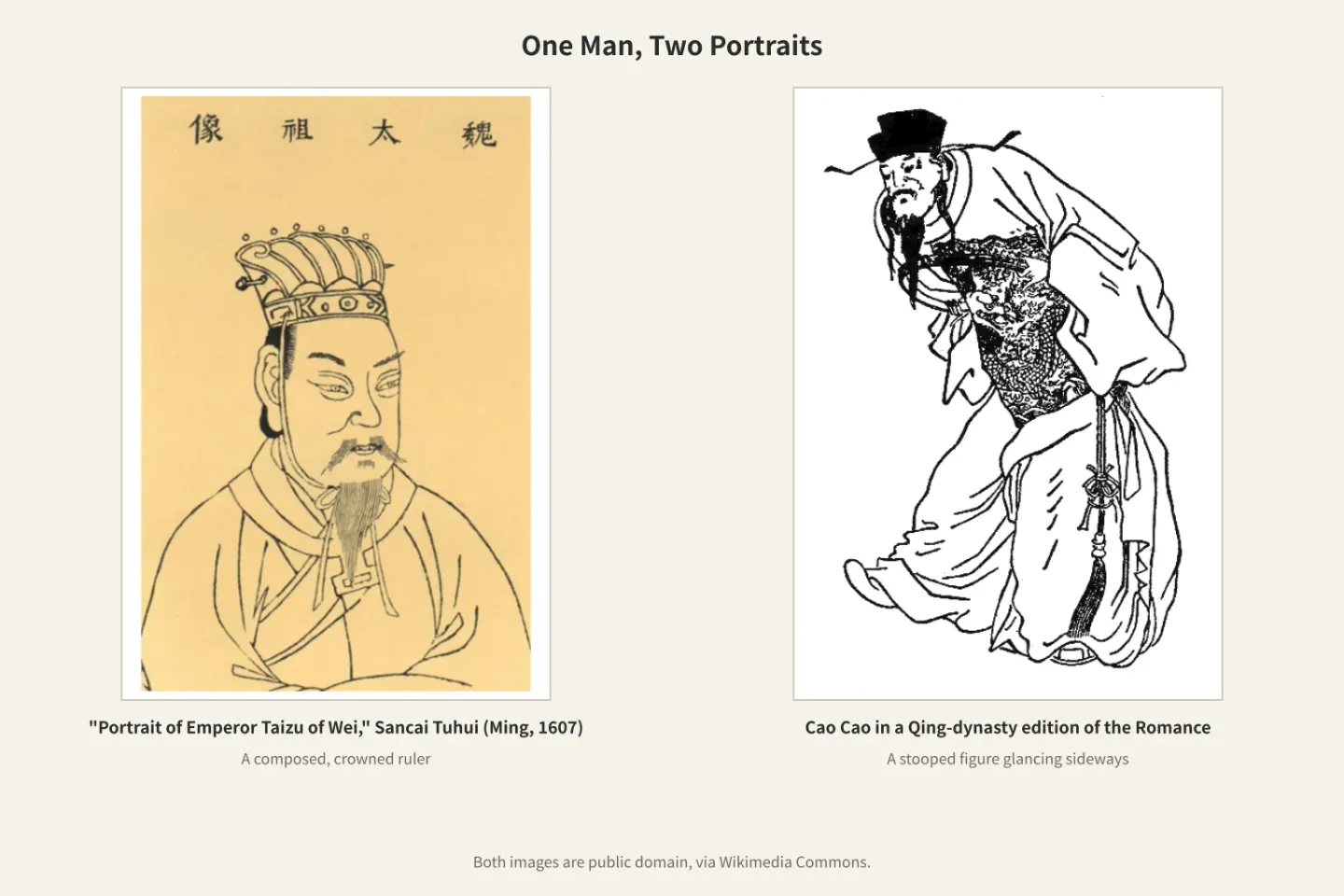
Figure: One man, two portraits — "Portrait of Emperor Taizu of Wei" from the Ming Sancai Tuhui (1607) and Cao Cao in a Qing-dynasty edition of the Romance. · Wikimedia Commons (public domain)
The Joseon Stage — Pansori “Jeokbyeokga”
Romance of the Three Kingdoms entered Joseon in the 16th century, and by the 17th century, Korean translations circulated, spreading the story widely among the common people (KCI ART001871950). A study comparing how Korea and Japan accepted Romance of the Sea suggests that because Korea directly asserted the righteous cause of viewing Shu Han as legitimate within its relationship with China, and because the state ideology of Neo-Confucianism aligned with the thematic consciousness of Romance of the Three Kingdoms, that righteous cause was maintained even in commercial publishing in the late 18th century (KCI ART001779085).
Pansori “Jeokbyeokga” is a pansori created around the Battle of Red Cliffs episode from "Romance of the Three Kingdoms" (KCI ART002704661). One study suggests that as songs based on Romance of the Three Kingdoms transitioned through the 12 japga into pansori, the adaptation of lowering Cao Cao and elevating Guan Yu grew larger. In the 12 japga, a dialogue where "General" and "Prime Minister" exchanged words on equal terms changed into a scene where "Minor General Cao Cao" begs for his life in front of "Your Excellency the General" and words scolding "that fellow Cao Cao" (KCI ART001871950).
Golgye is an expression that evokes laughter through the ludicrous. In “Jeokbyeokga”, this golgye is used to drag down figures in high positions. In most versions of “Jeokbyeokga”, Cao Cao is a villainous character, and in the episode where he flees to Huarong Dao after losing at Red Cliffs, he is thoroughly made into a comic figure and reduced to an ordinary commoner. At the same time, he also shows a human side that embraces the resentment of his soldiers, and the golgye emerging from his actions has a strong character of humorous laughter (KCI ART002014984). Another study suggests that pansori did not accept Cao Cao's heroism from the beginning, portraying Cao Cao before Red Cliffs as more selfish and cruel than in Romance of the Three Kingdoms, whereas Cao Cao after Red Cliffs was portrayed as a conciliatory figure trying to harmonize with Cheng Yu and his soldiers even while being belittled by them. The same study notes that only the Shin Jae-hyo version portrays Cao Cao as an authoritative and cruel, one-dimensional character even after Red Cliffs (DOI: 10.23033/inhaks.2020..56.005). A study that matched the changbon arranged by the late Joseon local official Shin Jae-hyo with Romance of the Three Kingdoms sentence by sentence notes that while the mockery and satire of Cao Cao in the latter half of the Shin Jae-hyo version are prominent, the corresponding passage in Romance of the Three Kingdoms is described briefly and neutrally (DOI: 10.22274/KORALIT.2021.60.009).
Cao Cao on the Joseon stage does not all have the same face. There is a study suggesting that the Gangsan-je style of “Jeokbyeokga”, refined at Unhyeon Palace by the master singer Park Yu-jeon—who was supported by Heungseon Daewongun—has a much weaker level of mockery and belittlement toward Cao Cao than the Dongpyeon-je and Seopyeon-je styles of “Jeokbyeokga” (DOI: 10.35150/korear.2019..38.005). The owner of the voice laughing at Cao Cao is also viewed differently by different studies. There is a study that sees the possibility that the consciousness of lower-class people who experienced upheavals in the 18th and 19th centuries mediated the formation of “Jeokbyeokga” (KCI ART001219469), whereas another study argues that because the consumers of pansori were wealthy men capable of hiring performers, calling it folk literature on the grounds of the soldiers' laments misses the distinct nature of this work. The same study notes that Liu Bei's love for the people is revealed in passages of some changbon (KCI ART002704661). On the pansori stage, Cao Cao became a villain and a laughingstock, but how much he is cut down differs by changbon and genre.
Taking Off the Mask
In the 20th century, Cao Cao was portrayed anew. Research covering the reform of Peking Opera following the establishment of New China in 1949 suggests that starting in the 1950s, the image of Cao Cao in Peking Opera shifted away from a dialectical view of history toward removing the mask of the villain known as the "treacherous hero" and evaluating him objectively. This study points to the 1959 production of "The Battle of Red Cliffs" as the beginning of this image improvement, and the 1988 "Cao Cao and Yang Xiu" as the most prominent artistic achievement (DOI: 10.52743/HR.64.6). Another study notes that while Liu Bei was revered during the dynastic era, in the "democratic era" following the revolution, Cao Cao was reevaluated for his political superiority, raising his stock (DOI: 10.26586/chls.2016..78.004).
A different Cao Cao also stood in English-language academic books. The publisher's blurb for the 2010 English-language biography of Cao Cao, "Imperial Warlord," states that although the traditions of novels and plays portray Cao Cao as cruel and vicious, in reality he was an outstanding strategist and politician who restored a measure of order after the chaos of the late Han dynasty, and introduces that it used Cao Cao's own proclamations and poems as historical sources alongside historical materials (DOI: 10.1163/ej.9789004185227.i-554). The author of a domestic study dealing with Cao Cao's poetry argues that Cao Cao was the first person to adopt folk songs and yuefu poetry as the form of his own verse, as well as a poet who revived the four-character poetic form of the "Classic of Poetry" (DOI: 10.35504/kph.2024..80.011).
In modern Korea as well, Cao Cao wears many faces. A study comparing cartoonist Ko Woo-young's "Three Kingdoms" with Chinese comics suggests that Ko Woo-young depicted Cao Cao and Liu Bei through satirical techniques, revealing the traits of heroes, treacherous heroes, and treacherous subjects known to today's society (KCI ART001720341). Even within pansori, the Boseong-sori version of "The Song of the Red Cliffs" respects Cao Cao's heroism to a certain degree, and a study examining this views the aesthetics of Boseong-sori as having been established after the 20th century, considering its interpretation of Cao Cao to be distant from the worldview and aesthetics of traditional pansori. The National Changgeuk Company's changgeuk "The Song of the Red Cliffs" and creative play "Cao Cao, Hero of Troubled Times" also portrayed Cao Cao as a hero, and the same study notes that while this is a sufficiently grounded interpretation, there is room for discussion when compared with the aesthetic achievement of pansori's "The Song of the Red Cliffs," concluding that Cao Cao is an "open entity" that can be approached with various interpretive perspectives (KCI ART002014984). Reevaluation is also one way an era reads Cao Cao, and the different subjects dealt with by the studies above—such as the Peking Opera stage, the evaluations of the "democratic era," and a single biography—each occupy a different place.
The Names of the Surviving Editions
Returning to the initial scene, that critique comes down in three editions (one of which was spoken by Jiao Xian), and among them, only the Sun Sheng edition called Cao Cao a "treacherous hero." The single line left behind with grief at Lü Boshe's house became a declaration in the novel, and the death at Xuzhou was also in Chen Shou's main text. Within the same book, Chen Shou appraised Cao Cao as "a hero transcending the era," while Pei Songzhi's Cao Man Zhuan recorded that he was "harsh, cruel, fickle, and deceitful."
Subsequent records and stages accumulated words leaning toward cutting Cao Cao down. The orthodoxy that research views as gradually tilting after the Eastern Jin, the street storytelling boards of the Northern Song passed down by Wang Peng, the good-versus-evil framework of Southern Song scholars, the Yuan Dynasty stages that set figures from the Kingdom of Shu-Han as protagonists, the Romance, and Joseon's pansori are those sites. Voices from the opposite side did not stop either. In the Northern Song, there were history books that placed Wei in the orthodoxy, and Joseon's Gangsanje "Red Cliffs" had weak ridicule toward Cao Cao. Within the scope this article confirmed, what Romance Chapter 1 followed was the Sun Sheng edition, and the word commonly called today is also that edition's "treacherous hero." "Treacherous hero" is the name given to Cao Cao by the one among several editions that survived most widely.
The open questions are several. What Xu Shao actually said cannot be sorted out because the three original texts differ. Which country Chen Shou secretly regarded as orthodox, and whose voice it was that mocked Cao Cao on the pansori stage, also have answers that differ by research. It is still unknown what kind of edition today's reassessment, which reads Cao Cao anew, will remain as.
Primary Sources
- “Records of the Three Kingdoms” (by Chen Shou, with annotations by Pei Songzhi) — Book of Wei, "Annals of Emperor Wu" (Volume 1: Main text and Chen Shou's appraisal; Pei Songzhi's annotations quoting “Cao Man Zhuan”, “Shiyu”, Sun Sheng's “Yitong Zayu”, Wang Chen's “Book of Wei”, Sun Sheng's “Zaji”, “Book of Wu”, Sun Sheng's critique, Pei Songzhi's critique, and Cao Cao's Jihai Edict) · Book of Wei, "Biography of Tao Qian" (Volume 8: Main text, with Pei Songzhi's annotation quoting “Book of Wu”) · Book of Wei, "Biography of Xun Yu" (Volume 10: Main text, with Pei Songzhi's annotation quoting “Cao Man Zhuan”) · Book of Shu, "Biography of the First Sovereign" (Volume 32: Main text and Chen Shou's appraisal, with Pei Songzhi's annotations quoting “Chronicles of Huayang” and the “Book of Wei”, along with Pei Songzhi's judgments)
- “Book of the Later Han” (by Fan Ye) — "Biography of Xu Shao" (Biographies of Guo Fu and Xu Shao) · "Biography of Tao Qian"
- “A New Account of Tales of the World” (compiled by Liu Yiqing, with annotations by Liu Xiaobiao) — "Appraising Character" Article 1 (including Liu Xiaobiao's annotations)
- “Dongpo Zhilin” (by Su Shi) — "Recalling the Past" · "塗巷小兒聽說三國語" (Wikisource punctuated version Volume 1, Siku Quanshu version Volume 6)
- “Romance of the Three Kingdoms” (Mao Zonggang edition) — Chapter 1 · Chapter 4 · Chapter 17 · Chapter 72
Source Papers
- "Dualism and Evolution in the Evaluation of Cao Cao: Focusing on Chen Shou's Records of the Three Kingdoms and Pei Songzhi's Annotations" (2025) — DOI: 10.23273/cksj.2025..37.004 — In historians' records, Cao Cao's figure was already very complex, and under the influence of traditional political culture, he gradually transformed from a historical hero into a treacherous subject. This dualism is an example of how legitimacy debates and the political demands of an era are reflected in historical writing.
- "The Origin and Evolution of Cao Cao's Figure as a Treacherous Hero" (2014) — DOI: 10.26585/chlab.2014..43.006 — Quantitatively analyzing five versions—official history, Pei Songzhi's commentary, Pinghua, Luo Guanzhong's edition, and Mao Zonggang's edition—it concludes that Cao Cao's figure started as a "hero" (雄), went through a "reversal of a reversal" (逆轉의 逆轉), and ended up as a "treacherous villain" (姦), with some origins of the treacherous hero figure coming from the Cao Man Zhuan cited in Pei Songzhi's commentary, perfected by Luo Guanzhong, and refined by Mao Zonggang.
- "On Records of the Three Kingdoms and the Theory of Legitimacy in the Three Kingdoms Period" (2011) — KCI ART001529191 — Chen Shou's Records of the Three Kingdoms outwardly follows Wei legitimacy while containing the subtle meaning of Shu legitimacy; that legitimacy theory was objectively weak, its reality stemming from the nature of the external Shu regime, and Liu Bei's accession appears to have strategically utilized the theory of Emperor Xian's assassination. The common consensus is the "Wei legitimacy is unavoidable according to the times" style of the Siku Quanshu Zongmu Tiyao. Siku Quanshu Zongmu Tiyao: Shu-legitimacy history books have poured out since Xi Zuochi's Han Jin Chunqiu, especially after the Southern Song.
- "A Consideration of the Logical Problems in the Theory of Authenticity Verification for Romance of the Three Kingdoms — Focusing on the 'Empty City Strategy'" (2016) — DOI: 10.26586/chls.2016..78.004 — Criticizing some arguments of the authenticity verification theory for showing a tendency toward confirmation bias, it deals with three cases including the murder of Lu Boshe's family. In the dynastic era, Liu Bei was revered, while in the "democratic era," Cao Cao was reevaluated.
- "History repackaged in the age of print: the Sanguozhi and Sanguo yanyi" (2006) — DOI: 10.1017/s0041977x06000139 — The problem of Shu-Han succession was for over a thousand years a proxy debate over whether territory, lineage, or morality was the basis of legitimacy, reaching its peak after the fall of northern China in the 12th century.
- "Aspects of the Transformation of Cao Cao's Figure - Focusing on Characterization Methods and Literary Value -" (2013) — KCI ART001765356 — Cao Cao was revered until the Wei and Western Jin, gradually became a treacherous villain starting from the Eastern Jin, more widely in the Northern and Southern Song, and completely degraded into a usurper and treacherous villain in the Ming and Qing, which is considered to be the effect of social situations, traditional culture, and lineage theory. In the Romance, Cao Cao leans toward a hero (雄) up to the Battle of Guandu, and toward craftiness (奸) afterward, achieving a harmony of hero and craftiness and the highlighting of an intelligent character.
- "A Study of Southern Song Literati's Historical Views on the Three Kingdoms - Focusing on Shu-Han Legitimacy and Character Discourse" (2016) — DOI: 10.26586/chls.2016..75.008 — It shifted from the Northern Song's situation-centered Cao-Wei legitimacy to the Southern Song's righteousness-centered Shu-Han legitimacy, with Southern Song scholars establishing a framework of good and evil through Liu Bei and Cao Cao, which arose from the Southern Song's special political environment.
- "Reading Ouyang Xiu's 'Theory of Legitimacy'" (2022) — DOI: 10.17207/jstc.2022.6.25.2.1 — Ouyang Xiu judged whether legitimacy existed based on the ideal types of zheng (correctness of succession) and tong (unification into one).
- "Xiao Chang's Xu Houhanshu and Its Influence" (2007) — DOI: 10.29457/sjh.200706.0001 — The Southern Song was a partial regime (偏安) like Shu-Han, and Zhu Xi's Zizhi Tongjian Gangmu changed the legitimacy in Sima Guang's Zizhi Tongjian from Wei to Shu-Han, with adaptations of the same method repeating through the Yuan and Ming dynasties via Xiao Chang and Xue Jing's Xu Houhanshu.
- "Study on the Character Setting Characteristics of Protagonists in Yuan and Ming Three Kingdoms Plays" (2024) — DOI: 10.35982/jcs.110.8 — The protagonists of Yuan dynasty Three Kingdoms plays are mostly figures from the Shu-Han camp, which is related to playwrights' and the common people's aspirations for governing legitimacy and clean politics.
- "A Brief Study of Character Figures Depicted in the Poetry of the 'Battle of Red Cliffs' in Romance of the Three Kingdoms" (2014) — DOI: 10.22947/ihmju.2014.35.4.005 — Before the Battle of Red Cliffs, the Romance depicts characters without bias, but after Cao Cao's defeat, it treats the Liu Bei camp as loyal subjects of Han and Cao Cao as a traitor, which is mainly due to the popularly transmitted sentiment of honoring Liu Bei and disparaging Cao Cao.
- "A Study on the Contradictoriness between Fiction and Reality in Romance of the Three Kingdoms" (2021) — DOI: 10.22786/chll.2021..76.003 — The biggest cause of the fiction-versus-reality problem between official history and the Romance is "honoring Liu Bei and disparaging Cao Cao" (擁劉貶曹) derived from Shu-Han legitimacy theory, alongside the reorganization of fiction based on literary fiction, artistic sublimation, and commercialism for profit.
- "Study of Characterization in Romance of the Three Kingdoms from the Perspective of Multimodal Discourse Analysis" (2026) — DOI: 10.54097/z4tb5v49 — Visual signs like Guan Yu's red face, Zhuge Liang's fan, and Cao Cao's white face construct and convey character meaning, with Cao Cao linked to complexity and betrayal, while multimodal communication sometimes simplifies character meaning.
- "Reexamining the Origin and Formation of Jeokbyeokga" (2014) — KCI ART001871950 — The Romance was introduced in the 16th century and circulated in 17th-century Hangul translation editions. Adaptations disparaging Cao Cao and elevating Guan Yu expanded from folk songs (gagog) to 12 japga to the pansori Jeokbyeokga.
- "Two Perspectives on <Romance of the Three Kingdoms> - Traditional Great Righteousness Theory in Korea versus Samurai Loyalty Theory in Japan" (2013) — KCI ART001779085 — Korea directly put forward the righteous cause of Shu-Han legitimacy, and since Neo-Confucian state ideology matched the thematic consciousness of the Romance, that righteous cause was maintained even in commercial publishing in the late 18th century.
- "Revisiting the Formation of Pansori <Jeokbyeokga> and Its Enjoying Class" (2021) — KCI ART002704661 — Jeokbyeokga started from the Battle of Red Cliffs episode of the completed novel, so there were constraints on its modification; its enjoying class was wealthy men, meaning the populist literature theory overlooks specificities, and some deonreum (signature musical passages) in performance texts reveal Liu Bei's love for the people.
- "Figurative Characteristics and Meaning of Cao Cao in Pansori <Jeokbyeokga>" (2015) — KCI ART002014984 — In most Jeokbyeokga, Cao Cao is a villainous figure and thoroughly ridiculed during his rout at Huarong Trail, yet he also embraces the soldiers' grudges. Ridicule (golgye) has a strong character of humorous laughter. Boseong-style pansori respects heroism to some extent, but its aesthetics were established after the 20th century and are distant from traditional pansori, and the heroic characterization in changgeuk and creative drama has grounds for interpretation, but its aesthetic achievement is open to discussion. Cao Cao is an "open existence."
- "Cao Cao in 'Shin Jae-hyo's Edition of Jeokbyeokga' Who Fails to Harmonize with His Soldiers Until the End" (2020) — DOI: 10.23033/inhaks.2020..56.005 — Pansori did not accept Cao Cao's heroism from the beginning, portraying Cao Cao before Red Cliffs as more selfish and cruel than the Romance, and after Red Cliffs as a conciliatory figure trying to harmonize with his soldiers, whereas only Shin Jae-hyo's edition portrayed him as an authoritarian, cruel, one-dimensional figure even after Red Cliffs.
- "A Comparative Study on the Reception Aspects and Affinity of <Shin Jae-hyo's Edition of Jeokbyeokga> and <Romance of the Three Kingdoms>" (2021) — DOI: 10.22274/KORALIT.2021.60.009 — While the mockery and satire of Cao Cao in the latter half of Shin Jae-hyo's edition are prominent, the Romance describes the corresponding passage concisely and neutrally.
- "Daewongun as a Pansori Patron and the Transformation of Park Yu-jeon's <Jeokbyeokga>" (2019) — DOI: 10.35150/korear.2019..38.005 — The Gansan-je style Jeokbyeokga, polished at Unhyeongung by Park Yu-jeon under the patronage of Daewongun, greatly weakened the mockery and disparagement of Cao Cao compared to the eastern and western performance styles.
- "The Formation of Jeokbyeokga and the Experience of War" (2007) — KCI ART001219469 — It raises the possibility that the experience of rebellions and the consciousness of the lower classes in the 18th and 19th centuries mediated the formation of Jeokbyeokga.
- "A Tentative Discussion on the Evolution of Cao Cao's Character Portrayal on the New China Beijing Opera Stage - Taking Beijing Operas <The Battle of Red Cliffs>, <Cao Cao and Yang Xiu>, and <Red Cliff> as Examples-" (2022) — DOI: 10.52743/HR.64.6 — Through Beijing Opera reforms after 1949, Cao Cao's "treacherous hero" mask was removed starting in the 1950s and he was evaluated objectively, with <The Battle of Red Cliffs> in 1959 marking the beginning of image improvement and <Cao Cao and Yang Xiu> in 1988 being the most prominent artistic achievement.
- "Imperial Warlord: A Biography of Cao Cao 155-220 AD" (2010) — DOI: 10.1163/ej.9789004185227.i-554 — (Publisher's introduction) While fiction and theatrical traditions portray Cao Cao as cruel and vicious, in reality he was an outstanding strategist and politician who restored order to some extent after the chaos of the late Han; a biography using official proclamations and poems as historical sources.
- "A Study on the Aesthetic Contribution of Four-Character Poetry through a Literature Review on the Background of Cao Cao's Poetry Composition" (2024) — DOI: 10.35504/kph.2024..80.011 — The author argues that Cao Cao was the first person to adopt folk songs and yuefu into his own poetry format and revived the four-character poetic style of the Classic of Poetry.
- "A Comparative Study on Characterization and Narrative Strategies in the Comic Books <Three Kingdoms> by Ko Woo-young and Chen Weidong" (2012) — KCI ART001720341 — Ko Woo-young depicted Cao Cao and Liu Bei using satirical techniques, revealing the characters of heroes, treacherous heroes, and treacherous subjects in modern society.
Sources (17)
- 조조(曹操) 인물 평가에 대한 이중성과 변천: 진수(陳壽)의 ≪삼국지≫와 배송지(裴松之) 주석을 중심으로DOI 10.23273/cksj.2025..37.004
- 曹操 姦雄 形象의 起源과 變遷DOI 10.26585/chlab.2014..43.006
- ≪三國演義≫ 眞僞檢證論의 論理的 問題點 一考 ― '空城計'를 위주로DOI 10.26586/chls.2016..78.004
- History repackaged in the age of print: the Sanguozhi and Sanguo yanyiDOI 10.1017/s0041977x06000139
- 南宋 문인의 三國 역사관 고찰 - 蜀漢 정통론과 인물 담론을 중심으로DOI 10.26586/chls.2016..75.008
- 구양수의 '정통론' 읽기DOI 10.17207/jstc.2022.6.25.2.1
- 蕭常《續後漢書》及其影響DOI 10.29457/sjh.200706.0001
- 元明三國戲主角人物設定特征研究DOI 10.35982/jcs.110.8
- 『三國演義』 '赤壁大戰' 詩歌에 나타난 人物形象 小考DOI 10.22947/ihmju.2014.35.4.005
- 『三國演義』에 나타난 虛構와 眞實의 矛盾性 硏究DOI 10.22786/chll.2021..76.003
- Study of Characterization in Romance of the Three Kingdoms from the Perspective of Multimodal Discourse AnalysisDOI 10.54097/z4tb5v49
- 끝까지 군사들과 화합하지 못한'신재효본 적벽가'의 조조DOI 10.23033/inhaks.2020..56.005
- <신재효본 적벽가>의 <삼국지연의> 수용양상과 친연성 비교연구DOI 10.22274/koralit.2021.60.009
- 판소리 패트론으로서의 대원군과 박유전 <적벽가>의 변모DOI 10.35150/korear.2019..38.005
- 试论新中国京剧舞臺曹操形象塑造的演变 -以京剧<赤壁之战>、<曹操與杨修>、<赤壁>爲例DOI 10.52743/hr.64.6
- Imperial Warlord: A Biography of Cao Cao 155-220 ADDOI 10.1163/ej.9789004185227.i-554
- 조조(曹操)의 작시 배경에 관한 문헌 고찰을 통한 사언시의 미학적 공헌 연구DOI 10.35504/kph.2024..80.011