Paperis Articles
Guan Yu — What Did Joseon's Kings Bow To at a Defeated General's Shrine?
How a general who lost Jingzhou became a god, and three centuries of Seoul's Guan Yu shrines from King Seonjo's bow in 1598 to the decree of 1908
Your field's papers, as audio
Pick your fields and journals — Paperis summarizes the key papers and turns them into audio. Listen on your commute.
Start Paperis free →Guan Yu — What Did Joseon's Kings Bow To at a Defeated General's Shrine?
A Three-Day Etiquette Debate
In the fifth lunar month of 1598, Seoul was in its seventh year of war. The Imjin War, which began when Japan invaded Joseon in 1592, was not yet over, and generals and soldiers sent by the Ming dynasty to help Joseon were staying in Seoul. The king of Joseon was the 14th monarch, Seonjo (宣祖). In April of that year, a report reached the royal court that a Ming military officer, Chen (陳遊擊), had "built a Gwanwangmyo and placed a clay statue" (立關王廟,設塑像) in an old house in the backyard of his quarters (Veritable Records of King Seonjo, year 31, 4/25). King Guan (Guanwang) is the name given to elevate Guan Yu (關羽), a general of the Shu state during the Three Kingdoms period, to the status of a king, and a sosang is a statue molded from clay. A Gwanwangmyo is a shrine where Guan Yu is elevated as "King Guan" and worshiped as a god.
This piece is about the shrines to Guan Yu built in Joseon, and specifically in Seoul, and the Joseon kings who stood before them. We follow how Guan Yu became a god in China to understand who those kings were bowing to.
Officer Chen stated that two high-ranking Ming officials had each sent 50 nyang of silver to expand the shrine and that other high-ranking officials would do the same, adding that this matter "is not for me, but is precisely a great matter for your honorable country. The king must not be unaware of this meaning" (此事非爲我也,正爲貴國大事。此意國王不可不知). Yi Heul (李忔), a Joseon official who met him, recorded that the officer spoke much of King Guan's numinous power but that it "approached absurdity," and reported that the meaning seemed to be a hope that the king would act as the Ming high official, the Jingli, had done (Veritable Records of King Seonjo, year 31, 4/25).
On May 12, the royal court discussed this issue. The Border Defense Council, which discussed major state affairs during the war, reported that "performing rites at the Gwanwangmyo is an etiquette our country has never had before" (我國前者未有此等禮節). Opinions from the Ming side were also divided. Ming generals such as Peng Zhongjun said that Ming high officials bow four times, so the sovereign should just do the same, while other Ming figures commented that King Guan was only a king in name, so under normal circumstances the sovereign would not need to bow in person, but since it was currently a time of turmoil, it was fine to bend the body once. The conclusion of the Border Defense Council was to "merely arrange the ceremony of burning incense and expressing reverence, and advance or withdraw depending on the situation" (只講燒香致敬之儀,觀勢而進退之), and Seonjo told them to proceed accordingly (Veritable Records of King Seonjo, year 31, 5/12).
May 13 was King Guan's birthday. On this day, the narrator of the Veritable Records wrote, "This shrine exists in China but not in our country. It was not listed in the state sacrificial code, but the Jingli coerced it, so the king had little choice and was about to go burn incense" (非祀典所載,而經理强之,上不得已將往焚香). Just as the carriage was about to depart, a heavy rain poured down, stopping the procession (Veritable Records of King Seonjo, year 31, 5/13).
On May 14, Seonjo went to the Gwanwangmyo. He knelt, burned incense, and successively offered three cups of wine, and the Veritable Records notes that he "performed the rite of bowing twice each before and after" (上前後各行再拜禮). Once the rites concluded, the military officer staged a clown performance in the courtyard and invited the king to watch it together. When the Office of Sa-gan, which pointed out faults to the king, stated that treating a place of worshiping spirits so casually was not a way to show respect to King Guan either, Seonjo replied, "Phrasing it like that before the heavenly generals is not how it should be done. Letting them do as they please, how is that a major matter?" (天將前措辭,不可如是爲之。任其所爲,豈爲大段?) (Veritable Records of King Seonjo, year 31, 5/14).
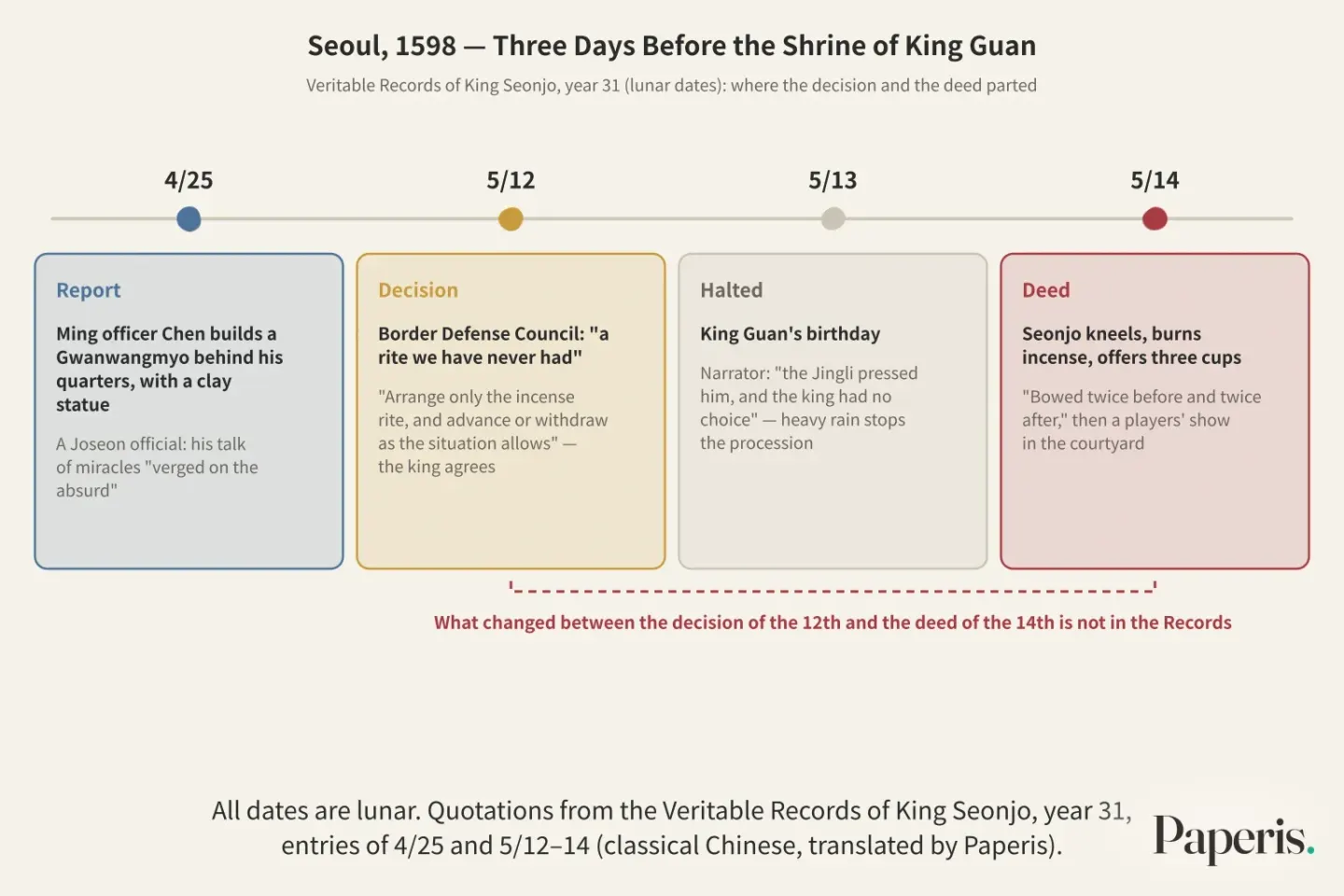
Figure: From the 25th day of the 4th lunar month to the 14th of the 5th, 1598 — where the decision of the 12th and the deed of the 14th parted. (Paperis figure)
The decision on the 12th was to merely arrange the incense-burning ceremony and advance or withdraw depending on the situation, while the entry on the 14th records bowing twice, before and after. What changed between the two days is not recorded in the Veritable Records. What is clear is the sequence. The Joseon king's worship of Guan Yu began amid the requests of the Ming generals and the hesitation of the Joseon court, which viewed it as "etiquette that never existed before."
The General Who Received a Bow — Guan Yu in the Official History
Who the Guan Yu who received that bow was only becomes clear when you read two books apart. The official history Records of the Three Kingdoms is a book in which the Western Jin historian Chen Shou recorded the histories of the three states of Wei, Shu, and Wu, and is one of the history books that Chinese dynasties counted as their official history. The book by the author Chen Shou was later annotated by Pei Songzhi of the Southern Dynasties Song. The Pei Songzhi annotations are notes where Pei Songzhi of the Southern Dynasties Song pulled and attached records from other books to various places in the main text of Records of the Three Kingdoms. The other book is a novel. Romance of the Three Kingdoms is a full-length novel that expands the histories of Wei, Shu, and Wu into a story, and is the very book commonly called "Three Kingdoms" in Korea. The story comparing the scenes of the two books one by one is in "Three Kingdoms — The Claim That It Is Seven Parts Fact", and here we follow only the final year of Guan Yu as an official history.
Guan Yu was a general of Liu Bei, and was entrusted with the defense of Jingzhou. According to the official "Biography of Guan Yu", in the year 219, Guan Yu led his army to attack Cao Ren, a general on the side of Cao Cao who was at Fancheng. Cao Cao's army of Yu Jin, sent as reinforcements, suffered from the event where "in autumn, there was a heavy and continuous rain, the Han River overflowed, and the seven armies commanded by Yu Jin were all submerged" (秋,大霖雨,漢水汎溢,禁所督七軍皆沒). Yu Jin surrendered, and Guan Yu beheaded the general Pang De. The sentence "Guan Yu's might shook the Central Plains" (羽威震華夏) follows, and Cao Cao discussed moving the capital to avoid that momentum (Records of the Three Kingdoms, Book of Shu, "Biography of Guan Yu"). In the official history, what submerged the seven armies was the rain and the overflowing river.
Not even a year passed for things to collapse. When Sun Quan of Wu sent an envoy to propose a marriage between his son and Guan Yu's daughter, the "Biography of Guan Yu" writes that "Guan Yu scolded and insulted the envoy, did not allow the marriage, and Sun Quan became greatly angered" (羽罵辱其使,不許婚,權大怒). The generals on Guan Yu's side who were guarding Jiangling and Gong'an disliked that Guan Yu usually looked down on them, so they welcomed Sun Quan. Guan Yu could not defeat Fancheng and withdrew his army. When Sun Quan took Jiangling and captured all the wives and children of Guan Yu's soldiers, Guan Yu's army scattered, and the official history records that a general sent by Sun Quan "beheaded Guan Yu and his son Guan Ping at Linju" (斬羽及子平於臨沮) (Records of the Three Kingdoms, Book of Shu, "Biography of Guan Yu"). The Wuli brought by Pei Songzhi contains the record that Sun Quan sent Guan Yu's head to Cao Cao, and that his body was buried with the rites of a vassal lord (Records of the Three Kingdoms, Book of Shu, "Biography of Guan Yu", Pei Songzhi's annotation).
A posthumous title is a name bestowed later by the state to honor the life of a deceased person. The official history records that after his death, Guan Yu was "posthumously given the posthumous title of Marquis Zhuangmou" (追諡羽曰壯繆侯) (Records of the Three Kingdoms, Book of Shu, "Biography of Guan Yu"). The title Guan Yu received while alive was Hanshou Tinghou, conferred by Cao Cao through a memorial. In the official history, Guan Yu's title goes up to Hou (Marquis), which is one of the marquis titles.
In the evaluation at the end of the "Biography of Guan Yu", Chen Shou stated that Guan Yu and Zhang Fei were both "tiger-like subjects of their time, each said to rival ten thousand men", but also wrote that "Guan Yu was strong-willed yet boastful of himself" (羽剛而自矜) and "he took defeat because of his shortcomings, which is a regular principle of reason" (Records of the Three Kingdoms, Book of Shu, "Biography of Guan Yu"). In 1598 in Seoul, the figure whom the Ming generals served as a "king" and to whom the Joseon monarch bowed was, in the official history, a marquis (侯) who lost Jingzhou, died, and even had the cause of his defeat evaluated.
From Marquis to Emperor — The Path to Becoming a God in China
On May 12, 1598, the Hongmungwan, which was in charge of court books and scholarship, also reported on the origins of this ancestral rite. It stated that when the founding emperor of the Song dynasty had past meritorious subjects and loyal martyrs graded, “Guan Yu was also among them”(關羽亦在其中), and that “the so-called Temple of King Guan did not need to wait for the Ming dynasty; those rites already existed”, noting that the Ming dynasty sent officials to perform rites in the first month of each season, at the end of the year, and on Guan Yu's birthday. Yet the Hongmungwan added, “As for our country, there is no such ritual propriety” (以我國言之,無此等祀禮) (Veritable Records of King Seonjo, year 31, 5/12, Hongmungwan). The contents regarding Song dynasty affairs and Ming dynasty laws are what the Joseon Hongmungwan stated as such. The Hongmungwan of 1598 reported that these rites were older than those of the Ming dynasty.
The paths traced by studies point in the same direction. China's cult of Guan Yu began during the Song dynasty, and Guan Yu's status rose from marquis (侯) through duke (公) and king (王) to emperor (帝) by the Ming dynasty. The sacrifices at Guan Yu's shrines also rose from a low grade of state sacrifices to a middle grade, and later became equal to the Confucian Munmyo, where Confucius is enshrined (KCI ART002502128). The Song dynasty bestowed upon Guan Yu a noble title—that is, a designation granted by the state—to worship him, and this worship continued during the Yuan dynasty as well. The Mongol ruling class wove this worship together with Buddhism to use it in edifying the common people, and the common people worshipped Guan Yu through their respective rituals. On the stages of Yuan dynasty zaju dramas, Guan Yu appeared as a human, a ghost, and a god (DOI: 10.16874/jslckc.2016..42.014). Qing dynasty emperors raised Guan Yu's noble title from marquis to military emperor and great emperor, and also elevated the grade of the sacrifices; one study views the cult of Guan Yu during the Qing dynasty as the peak of its history (DOI: 10.18212/cccs.2015..27.014).
Guandi is the name used to call Guan Yu, who rose to the title of emperor (帝), and Guansheng Dijun is one of those titles. The titles bestowed upon Guan Yu by the Ming imperial family in the 42nd year of Wanli (1614) also include “Guansheng Dijun” (KCI ART000902189). The Guan Yu of 1598 came to Joseon still as “King Guan”.
Novels lie later along this path. Already during the Song and Yuan dynasties, there was a framework in folk society that viewed Guan Yu as an ideal figure, and Romance of the Three Kingdoms refined Guan Yu from the earlier storybook Sanguozhi Pinghua into a completely ideal figure, influencing later cultures of Guan Yu worship (KCI ART001798151). Sanguozhi Pinghua is a Three Kingdoms storybook published during the Yuan dynasty, and is one form of the stories that preceded the Romance of the Three Kingdoms.
The Romance added scenes from after Guan Yu's death. The Mao Zonggang edition is the Romance of the Three Kingdoms in which Mao Zonggang in the early Qing dynasty comprehensively revised and refined the preceding 120-chapter edition, and the Romance read today is mostly this version. The title of Chapter 77 of the Mao Zonggang edition is “At Yuquan Hill Lord Guan displays his divinity, at Luoyang City Cao Cao responds to the spirit” (玉泉山關公顯聖 洛陽城曹操感神). The ghost of the dead Guan Yu does not scatter and reaches Yuquan Hill, crying out in the middle of the night from the air, “Return my head to me!” (還我頭來!) When Pujing, an old monk of the mountain, asks, “In that case, from whom should the heads of Yan Liang, Wen Chou, and the six generals of the five passes be sought instead?” Guan Yu attains a great realization and bows his head to take refuge in Buddhism. Thereafter, Guan Yu frequently displayed his divinity to protect the people, and the novel records that “the villagers, moved by that grace, built a shrine on top of the mountain and performed sacrifices through all four seasons” (Romance of the Three Kingdoms, chapter 77). The Guan Yu shrine inside the novel begins with a spirit taking refuge in a monk and the gratitude of the villagers, while the actual history of the Yuquan Hill shrine lies outside the records verified by this text.
In the same chapter, the Wu general Lü Meng shouts, “I am Guan Yunchang, Marquis of Hanshou” and then dies bleeding, while Cao Cao, who opens the box containing Guan Yu's head, is startled and collapses upon seeing the mouth open and the eyes move. Upon waking, Cao Cao says, “General Guan is truly a god of heaven!” (關將軍真天神也!) Cao Cao buries him with the ritual propriety of a prince, bows to him in person, and posthumously bestows upon him the title of King of Hening (Romance of the Three Kingdoms, chapter 77). The official history Chronicles of Guan Yu contains no ghost, no possession of Lü Meng, and no moving head. What the main text of the official history leaves behind is the posthumous title of Marquis Zhangmu, and the record that he was buried with the ritual propriety of a feudal lord is in the Wuli cited in Pei Songzhi's annotations.
Although the popularity of the Romance is commonly cited as the reason why Guan Yu, who ended his life as a defeated general, became a “great emperor” and the ultimate war god, one study views that this was not the sole reason, and that the common people, religious figures, and the rulers of each dynasty jointly created that image (KCI ART002035664). Other studies similarly cite the actual appearance in historical texts, novels, folk legends, the three religions of Confucianism, Buddhism, and Taoism, popular arts, and the activities of merchants from Guan Yu's hometown as the causes of Guan Yu worship (KCI ART002088726). The Romance was one of several forces that elevated Guan Yu into a god, and noble titles and folk beliefs had arrived before the novel.
Build It in the East — The Site Chosen by King Seonjo
On the 29th day of the 4th lunar month in 1599, King Seonjo secretly gave an order to the Seungjeongwon, the royal secretariat that conveyed the king's commands. Hearing that a new Gwanwangmyo was about to be built outside the South Gate, he stated, “There is already a Gwanwangmyo outside the South Gate, so we must not build overlapping ones. It must definitely be built outside the East Gate. There is a hidden meaning in doing so” (其所以然者,有微意). Since this site selection originally came from Ye Jingguo (葉靖國), he instructed that he be persuaded, adding that if that failed, the area near the Hullyeonwon, where military officers trained, would also be good because it would then “continue the intent of when the ancient Temple of Wushengwang was established” to honor military figures by China (Veritable Records of King Seonjo, year 32, 4/29). The Dongguanwangmiao is a shrine to Guan Yu that began construction outside the East Gate of Seoul in 1599, and is called Dongmyo for short. What the "hidden meaning" spoken of by King Seonjo was does not appear in the Annals. One study views that the Dongguanwangmiao was established in that spot for reasons of geomancy (KCI ART001367739), while another study notes that the renowned geomancer of King Seonjo's time, Park Sang-ui, chose the site, differing from Ye Jingguo in the Annals, and views that the location embedded a logic that saved the face of the Ming Dynasty while also upholding the pride of Joseon (DOI: 10.34252/acsri.2012.26..010).
The shrine that already existed outside the South Gate was the Namguanwangmiao, called Nammyo for short. Studies note that this originated in 1598 when the Ming general Chen Yin (陳寅) placed a small clay statue of Guan Yu in his residence outside the South Gate and used it as a shrine (DOI: 10.7738/JAH.2013.22.4.073; DOI: 10.17004/jrcn.2015..45.004).
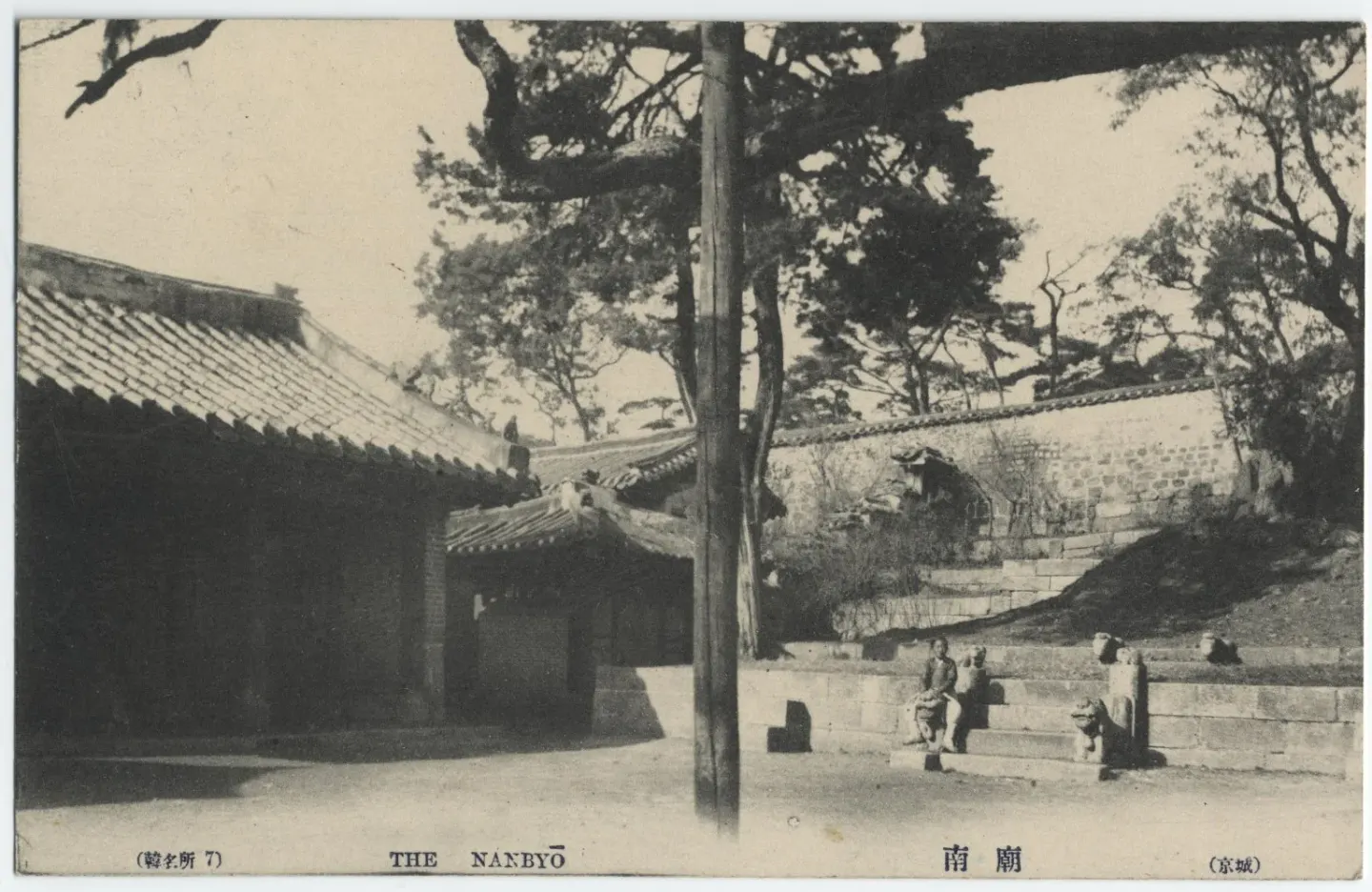
Figure: The South Shrine (Nammyo) on a postcard from around 1904; the card reads "THE NANBYŌ." · Cornell University Library, Willard D. Straight collection, via Wikimedia Commons (no known copyright restrictions)
Two months later, Yun Geun-su, the dangsang (high official) of the Gyeongridogam (temporary bureau for Ming military affairs), reported, “The Gwanwangmyo has been decided near Yeongdogyo bridge outside the East Gate”, and requested that many soldiers be sent, which was granted. In the same entry, the historiographer recorded, “The construction of the Gwanwangmyo is a grossly absurd endeavor. One was already a mistake, yet it could not be stopped and now another major construction is raised in the eastern suburb, so how can the surviving people live? Ah!” (Veritable Records of King Seonjo, year 32, 6/22). In the 6th lunar month of 1601, the Saheonbu (Office of the Inspector General), which investigated official wrongdoing, reported that “building the Dongguanwangmiao came from the decree of the Ming Dynasty, so it is an unavoidable undertaking”, while noting that the construction which began in 1601 (sic) had used over two hundred laborers a month for twenty-some months and still “could not yet announce its completion” (Veritable Records of King Seonjo, year 34, 6/19). The construction took several years, and there are studies that date the current buildings to 1601 (DOI: 10.35150/korear.2012..24.009) and studies that date the founding of Dongmyo to 1602 (KCI ART000902189).
There are several studies that view this shrine as having been established by the demand of Ming, independent of the intent of Joseon. One study views that in the transmission of the cult of Guan Yu, unlike other East Asian countries, Korea had it forced upon it by foreign powers (DOI: 10.16874/jslckc.2022..66.011). Another study views that although the Gwanwangmyo rituals were conducted heteronomously at the request of the Ming Dynasty, kings in the late Joseon period came to perceive Guan Yu as a symbol of loyalty and righteousness, developing it into a symbolic ritual to strengthen royal authority (DOI: 10.35150/korear.2012..24.009). There is also a study suggesting that the Gwanwangmyo was established from the beginning regardless of Joseon's will, and that from after the Jeongyu War until the late 17th century, the Joseon ruling class generally viewed the Gwanwangmyo negatively (KCI ART002147066). Another study notes that for nearly 100 years after the Gwanwangmyo first appeared, it was a place frequented only by individuals seeking personal blessings by borrowing the spiritual efficacy of Guan Yu (DOI: 10.22943/kyujg.2016..49.012). There is also a different perspective. This is a study viewing that among Seoul's Joseon bureaucrats, there was an underlying current that regarded the Ming as unreasonable entities violating propriety, and that the shrine to Guan Yu and its rituals were a site where Ming and Joseon tugged-of-war over the nature of their relationship (DOI: 10.1353/jkr.2014.0020).
There is another picture as well. One study views that although Joseon had to passively accept the demand because it was framed as the grace of Ming for rebuilding the country, King Seonjo and King Gwanghaegun highly evaluated Guan Yu's loyalty and righteousness in not serving two masters and sought to elevate the atmosphere of revering martial arts, accompanied by criticism from the perspective of Neo-Confucianism (DOI: 10.30527/klcc..53.201403.011). How much King Seonjo knew about Guan Yu also differs among studies. One study views that King Seonjo read Romance of the Three Kingdoms before the war and that the loyalty and righteousness of Guan Yu were already widely known due to the popularity of the novel even before the Gwanwangmyo, and guesses that King Seonjo likely utilized the cult of Guan Yu politically amidst the crisis (DOI: 10.23134/nf.2024..49.011). Another study views that Joseon before the Gwanwangmyo knew Guan Yu only as a figure within historical texts (KCI ART002147066).
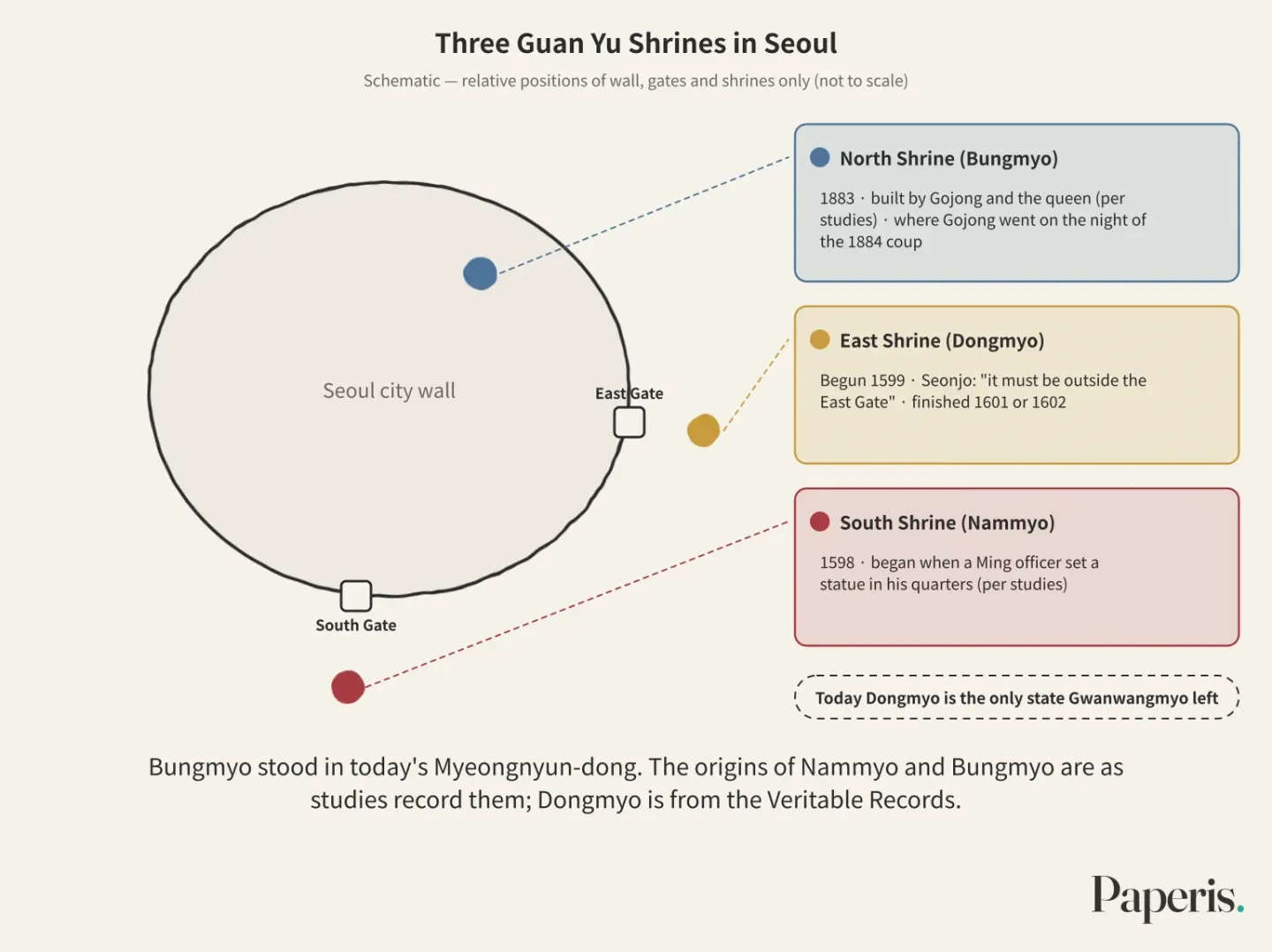
Figure: Where Seoul's three Guan Yu shrines stood (schematic). (Paperis figure)
Two faces exist together even within the Annals. On one side are the words of historiographers and government offices such as “forced by the intendant”, “unavoidable”, and “absurd endeavor”, while on the other side is a king who said “let them be” regarding the festivities staged by a Ming general, and a king who secretly insisted on the east for the shrine's location itself. Reading the 1598 knot by erasing only one side leads to a misreading.
Lowering the Bow — Sukjong a Century Later
In the second lunar month of 1691, King Sukjong, the 19th monarch of the Joseon dynasty, intended to visit a shrine outside the East Gate to see the statue of Guan Yu on his way back from paying respects at the royal tomb of Jeongneung. Around this time, the Annals refer to Guan Yu as the Prince of Wu'an. The precedent Sukjong cited was the Song dynasty Emperor Taizong visiting the shrines of Martial Kings in turn. Regarding what level of ritual courtesy to display, Left State Councilor Mok Rae-seon mentioned the propriety of bowing the upper body while on a carriage. An eup is a courtesy where one joins hands and bows the upper body, which is a lighter form of respect than a prostrating bow. Right State Councilor Min An stated, "One should neither bow nor lean forward on a carriage, but should raise the hands and perform an eup" (不宜拜,且不宜式,當擧手揖), and Sukjong followed Min An's advice. When officials asked him to stop, saying there was no precedent in the country, Sukjong refused, stating, "The loyalty and righteousness of the Prince of Wu'an are something I have always admired throughout the ages. Since I already pass by his gate, feelings naturally arise; what harm is there in going in to see him?" (Veritable Records of King Sukjong, year 17, 2/26).
The next day, Sukjong clarified his intentions in writing. He stated that the loyalty and righteousness of the Prince of Wu'an were rare across the ages, and that catching a glimpse of his statue "arose from the sentiment of resonating with one another across the generations and was meant to encourage warriors, not to enjoy a temporary spectacle," adding, "You generals and soldiers, understand this meaning and strive all the more for loyalty and righteousness to defend the royal house" (益勵忠義,捍衛王室). He also had damaged areas of the eastern and southern Guan Yu shrines repaired and sent officials to perform ancestral rites (Veritable Records of King Sukjong, year 17, 2/27). Sukjong himself revealed that he used the Guan Yu shrines as a place to encourage loyalty and righteousness among warriors and to compel them to protect the royal house.
In 1710, Sukjong asked his officials a question again. Pointing out that he had not bowed but performed an eup at the East Guan Yu Shrine, and had also performed an eup at the South Guan Yu Shrine, he noted that when a Ming general came during King Seonjo's reign, the king personally performed ancestral rites, so those past rites probably were not eup, and asked whether an eup was appropriate according to ritual. Left State Councilor Seo Jong-tae said that because a Ming general was present back then, they might have bowed, but "there is no need to blindly follow that today," and since Guan Yu was "ultimately a famous general of another era," unlike ancient sages like Confucius, bowing to him in person seemed excessive. Yi I-myeong stated, "His royal title was posthumously conferred, and his original title was marquis, so even if he were alive, it would be fitting to accord him equivalent courtesy" (王爵乃追封,本爵則侯). The Office of Special Advisors also reported that an eup was suitable, and that the ritual used when the shrine was first established was "a temporary expedient of the times and should not be dragged out and used as a standard formula" (一時權宜,恐不當援以爲式) (Veritable Records of King Sukjong, year 36, 3/2). The "original title" mentioned by Yi I-myeong is the marquis mentioned in the official history Biography of Guan Yu. King Seonjo's two prostrating bows were sorted out about a hundred years later as "a temporary expedient of the times," and Sukjong's ritual was an eup.
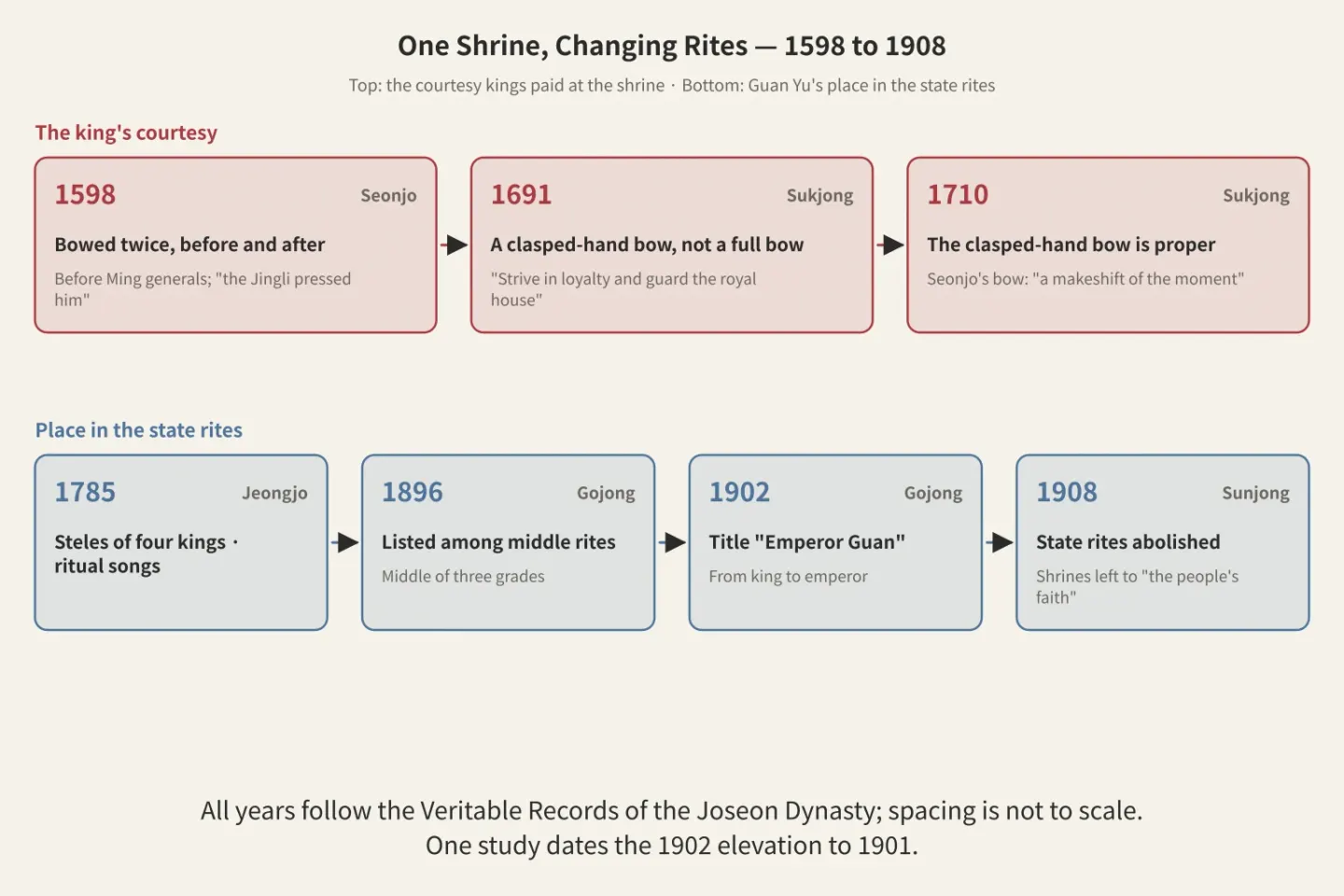
Figure: One shrine, changing rites — top, the courtesy kings paid at the shrine; bottom, Guan Yu's place in the state rites. (Paperis figure)
One study suggests that interest in the Guan Yu shrines, which had faded during the reign of King Hyojong when the Northern Expedition theory aiming to attack the Qing dominated state politics, revived alongside the theory of honoring the Zhou that sought to elevate the orthodox center of civilization during Sukjong's reign. According to the same study, the Guan Yu shrines at this time shed their Buddhist and Taoist colors and were reborn as Neo-Confucian spaces commemorating Guan Yu as a general resembling a Confucian scholar. The same study argues that behind this lay the Joseon monarchs' active determination to strengthen royal authority, and that by visiting the Guan Yu shrines on the way to royal tombs or military processions, they fostered an atmosphere of revering martial arts and emphasized loyalty to the royal house (DOI: 10.30527/klcc..53.201403.011). Another study suggests that Sukjong interpreted Guan Yu as an icon of loyalty, righteousness, and the honoring of Zhou, establishing him as a righteous general who enjoyed reading the Spring and Autumn Annals and as a "symbol of martiality" (DOI: 10.22943/kyujg.2016..49.012). The record that Guan Yu liked the Zuo Zhuan, a commentary on the Spring and Autumn Annals, and memorized almost all of it is found in the Biography of Jiangbiao cited by Pei Songzhi, and is not in Chen Shou's main text (Records of the Three Kingdoms, Book of Shu, "Biography of Guan Yu", Pei Songzhi's annotation).
A study that calls Sukjong "the most fervent Guan Yu fan among Joseon monarchs" views the source of the Guan Yu in Sukjong's writings at Dongmyo as neither the official history nor the Romance of the Three Kingdoms Plain and Simple nor Mao Zonggang's edition, but Luo Guanzhong's Romance of the Three Kingdoms, published during the Jiajing era of the Ming dynasty (DOI: 10.26585/chlab.2022..78.003; DOI: 10.26586/chls.2023..112.010).
Rain and Song — Yeongjo and Jeongjo
In the eleventh month by the lunar calendar of 1785, Jeongjo (正祖), the twenty-second king of the Joseon dynasty, erected the "Stele for King Guan by Four Monarchs' Royal Compositions" at the Eastern Shrine and Southern Shrine. He carved the writings of Sukjong and the writings of Yeongjo (英祖), the twenty-first king of the Joseon dynasty, on one stele, and the writing of his father Crown Prince Sado alongside his own stele inscription on another. The Annals of the Joseon Dynasty record that Jeongjo subsequently "had these writings handed over to the Bureau of Royal Rites to be used as songs for the ritual music welcoming and sending off the spirits" (Veritable Records of King Jeongjo, year 9, 11/15). Research addressing this three-part song suggests that Jeongjo centered Guan Yu on righteousness, loyalty, justice, and martial valor rather than an image of defeating foreign enemies, and that Jeongjo sought to build up his own military force centered around the Jangyongyeong garrison through this song (KCI ART002143351).
Meanwhile, the Gwanwangmyo became an official state ritual. Jungsa refers to the middle rank when Joseon's state rituals are divided into three grades: major rites (daesa), middle rites (jungsa), and minor rites (sosa). The path by which the rank rose is recorded slightly differently across studies. One study states that the ritual revived during the reign of Sukjong was designated as a minor rite under Yeongjo and raised by Jeongjo to a level "comparable to the middle rites" (KCI ART002143351), whereas another study states that it passed through the minor rites under Yeongjo and was elevated to the middle rites under Jeongjo (DOI: 10.35150/korear.2012..24.009). The list of ritual grades submitted by the Royal Household Department in 1896 includes the Gwanwangmyo under the middle rites (Veritable Records of King Gojong, year 33, solar 8/14). The rituals of the Gwanwangmyo, which were organized into a state ritual in the eighteenth century, ultimately became a middle rite.
Yeongjo also visited the Gwanwangmyo. In 1725, Yeongjo sent an official to make offerings at the Gwanwangmyo and stated, "Express my will of longing for loyalty and respecting righteousness," while on the same day he separately offered rituals at another shrine, the Seonmusa, and instructed, "Show your looking up to and following the grand ancestors' righteous cause of honoring the Zhou and rejecting the barbarians" (Veritable Records of King Yeongjo, year 1, 3/24). In this article, "the righteous cause of honoring the Zhou and rejecting the barbarians" is attached to the side of the Seonmusa.
Studies interpreting this worship in the eighteenth century have different points of emphasis. Daemyeong-ui refers to the justification in the late Joseon period of trying to view the Ming dynasty as an object of devotion even after its fall. One study finds the basis of eighteenth-century Gwanwangmyo worship in this daemyeong-ui and the justification of succeeding to the undertakings of earlier kings. However, the same study notes that while the daemyeong-ui emphasized by the monarchs was a memory of the Ming dynasty overlaid onto the Gwanwangmyo, its reality closely resembled the contemporary Qing dynasty's custom of worshipping Guan Yu. This study considers that the monarchs regarded the Gwanwangmyo as a suitable place that would resolve the issues of authority and justification all at once (KCI ART002147066). Another study dealing with Yeongjo suggests that Yeongjo used slogans in his writings about Guan Yu's shrine that yearned for Ming and rejected Qing in court politics, and utilized Guan Yu rituals—alongside the rituals at the Daebodan altar where sacrifices were made to the Ming emperor—as part of establishing the king's moral superiority and legitimacy (DOI: 10.18399/acta.2025.28.1.002).
There are also the eyes of Joseon people who directly saw the Guandi temples of the Qing dynasty. Joseon envoys who went to Qing recalled loyalty to Ming at the Guandi temples while also viewing it negatively due to Buddhist coloring, and the late Joseon writer Park Ji-won (朴趾源) regarded treating Guandi with reverence like Confucius as a custom of barbarians. A study dealing with this suggests that Park Ji-won's criticism was quietly directed not only at Qing's worship of Guandi, but also at Joseon's worship of Guan Yu, which put forward loyalty to Ming and the theory of honoring the Zhou (KCI ART001984847).
Night of the Coup — King Gojong’s Bukmyo Shrine and Guan Di
On the night of the nineteenth day of the tenth lunar month in 1884, Gojong, the twenty-sixth monarch of Joseon, moved his residence to Bukmyo Shrine and then moved again to the military camp of Wu Zhaoyou, a Qing military commander stationed outside Seoninmun Gate (Veritable Records of King Gojong, year 21, 10/19). This night was in the midst of the Gapsin Coup launched by reformist figures like Kim Okgyun and Pak Yonghyo. According to the same record, Kim Okgyun and others followed the Japanese minister, while Hong Yeongsik and others who followed the king all the way to Bukmyo were killed.
Bukmyo was a Guan Yu shrine built in 1883 by King Gojong and Queen Min in Myeongnyun-dong, north of Seoul (DOI: 10.26586/chls.2019..96.009). The text on a stele erected in the courtyard of Bukmyo in 1887 records that the king and queen dreamed of Guan Yu, built Bukmyo, and thanks to Guan Yu's spiritual virtue, the royal family escaped disaster during the Imo Incident stirred up by soldiers in 1882 and the Gapsin Coup in 1884. A researcher who analyzed this stele inscription evaluates that the perception of Guan Yu held by Gojong and the queen was uncritical and very superstitious, and that the salvation Gojong desired was not for the country or the people in a modern sense, but for the royal family (DOI: 10.26586/chls.2019..96.009).
Another paper dealing with this stele inscription, personally composed by Gojong, suggests that the six passages of the Guan Yu story in the inscription are based on Mao Zonggang’s edition of the novel rather than Chen Shou’s official history. Those six passages include the title Marquis of Hanshou, the reading of the Spring and Autumn Annals, and the passage where Guan Yu flooded seven armies (DOI: 10.26586/chls.2018..90.005). Looking back at the official history, the title Marquis of Hanshou is in the main text of the "Biography of Guan Yu," the record that he memorized the Zuo Zhuan is in the "Biography of Jiangbiao" cited in Pei Songzhi's annotations, and the event where seven armies were flooded is also in the main text. However, what flooded the armies in the official history was heavy rain (Records of the Three Kingdoms, Book of Shu, "Biography of Guan Yu"). What the paper calls "based on Mao Zonggang's edition" may be a difference in expression and context (such as who flooded the water) rather than whether the story exists, which cannot be discerned from the abstract alone. The same paper also notes that in 1887 Gojong did not call Guan Yu a title higher than "King" and consciously placed him below the King of Joseon. The interpretation of this study is that for Gojong, who had lived through the Imo Incident and the Gapsin Coup, what was needed above all was a story that would make his subjects feel loyalty (DOI: 10.26586/chls.2018..90.005).
In 1893, former official Ahn Hyoje stated in a memorial that the inclusion of rituals for the Gwanwangmyo among middle-level state sacrifices by past kings was "meant for emulation and honoring, not built solely to pray for blessings and ward off disasters," and impeached the fact that recently, with the spread of shamanistic customs, someone had "falsely claimed to be the daughter of Lord Guansheng, made herself the master of Bukmyo," and arbitrarily received the title of Lord (Veritable Records of King Gojong, year 30, 8/21). This record in the Veritable Records does not write down the name of that female shaman. One study considers that the shamans Jinryeong-gun and Hyeonryeong-gun during Gojong's reign influenced the connection of Guan Yu worship to shamanism (DOI: 10.17004/jrcn.2015..45.004).
The Gwanwangmyo of the same period also has a different face. The Gwanwangmyo shrines in Seoul were places where scriptures written with the help of a deity's brush—in other words, spirit-writing scriptures received through the descent of the pen—were produced and published, and these books came out under the name "Complete Collection of Enlightenment" with Gojong's approval. A study dealing with this views that "enlightenment" at the time meant modernization and religious awakening together (DOI: 10.3390/rel11060273).
After Gojong became emperor in 1897, Guan Yu's status rose as well. On January 27, 1902 by the solar calendar, Chief State Councillor Yun Yongseon received an imperial decree, determined the title elevating King Guan to emperor as "Hyeollyeong Sodeok Uiyeol Muan Gwanje" (顯靈昭德義烈武安關帝 — Manifestly Numinous, Illustrious in Virtue, Righteous and Valiant, Martial and Pacifying Emperor Guan), and reported it, upon which Gojong ordered it to be done as requested (Veritable Records of King Gojong, year 39, solar 1/27). One study records this elevation as having happened in 1901 (KCI ART002784952). In October of the same year, a memorial was submitted suggesting that "let us imitate the rites already practiced by the Qing dynasty" by building a shrine enshrining even Liu Bei and Zhang Fei, and Gojong showed his intent to accept it (Veritable Records of King Gojong, year 39, solar 10/4). According to one study, Gojong, who had placed Guan Yu below the King of Joseon in 1887, called Guan Yu Emperor after becoming emperor.
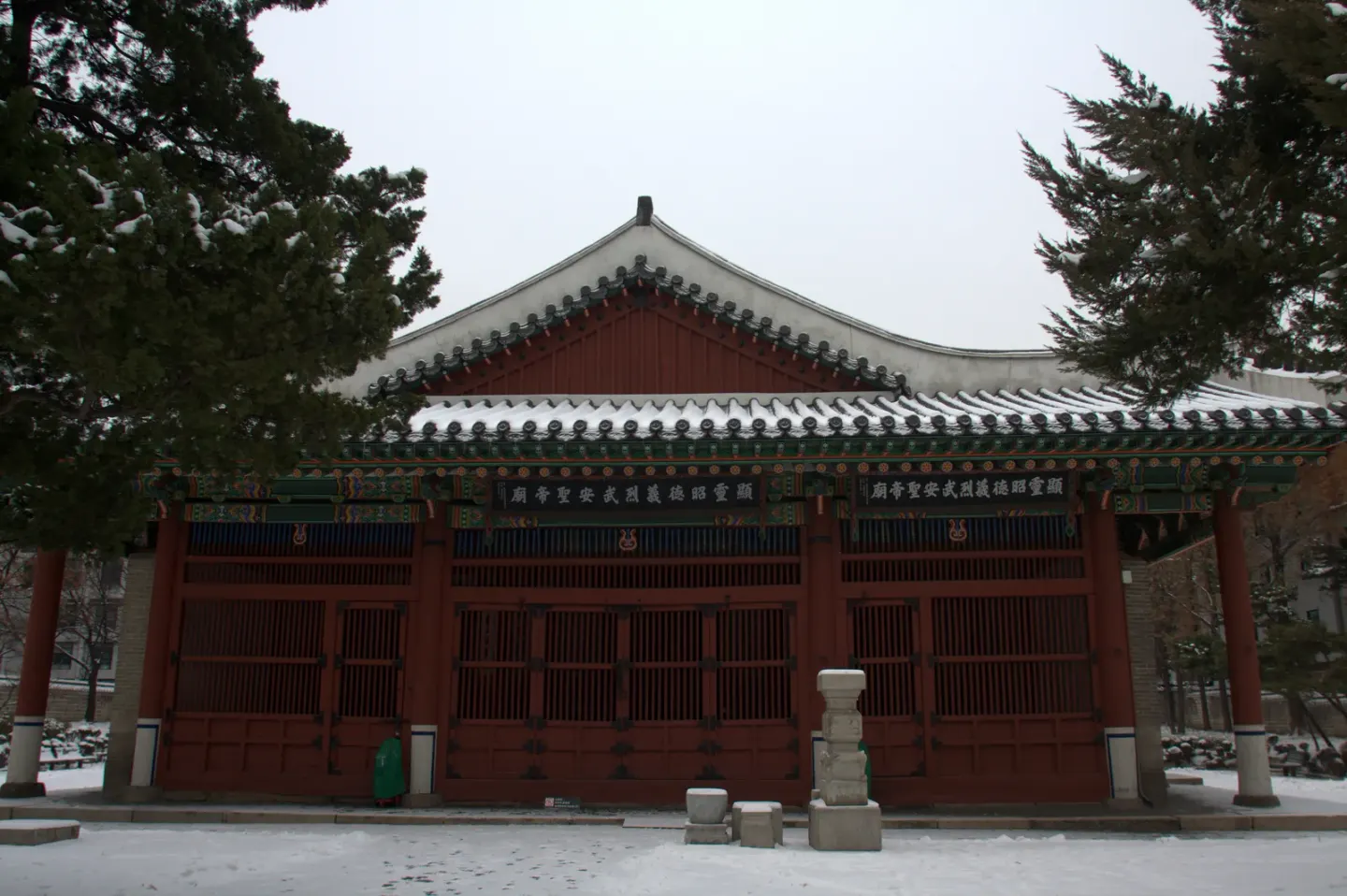
Figure: The main hall of Dongmyo today. Its plaques read 顯靈昭德義烈武安聖帝廟 — the first eight characters match the title fixed in 1902, 顯靈昭德義烈武安關帝. · Photo by Eggmoon, Wikimedia Commons (CC BY-SA 3.0)
In the sacrificial hymns changed by Gojong, Guan Yu was depicted as a heavenly deity who added spiritual mystery to the image of a Joseon king rather than a Han dynasty warrior, and one study views what Gojong desired through these hymns as blocking Japanese influence within the country. The same study evaluates the Gwanwangmyo rituals and hymns of King Jeongjo and Gojong as a facet of inefficient state projects and failed policies that spent a large amount of the national budget yet failed to build a strong nation (KCI ART002143351). A study dealing with the paintings of Guan Yu in the Seoul Gwanwangmyo writes differently. It views the time when Gojong raised the Gwanwangmyo to Gwanjemyo, shrines of Emperor Guan, after becoming emperor and newly composed sacrificial hymns as a period when Guan Yu worship was used as a means to overcome the crisis of a perilous nation. The same study records that by placing a female shaman as the master of rituals at a royal-established Gwanwangmyo, Guan Yu rapidly spread among the common people as an object of praying for blessings such as a martial god, general god, and wealth god (KCI ART002784952). During Gojong's reign, Guan Yu became a god whose stele inscription recorded that he saved the royal family and a god who received the title of Emperor, and his shrine was also a place for shamans and spirit-writing scriptures.
1908, The State's Ancestral Rites End
On July 23, 1908 in the solar calendar, during the reign of Sunjong, the second emperor of the Korean Empire, a royal decree titled "Hangsaijeong" (Reforming Ancestral Rites) was issued under the name of correcting ancestral rites. This decree abolished the ancestral rites at Daebodan and Mandongmyo, which had honored the emperors of the Ming Dynasty, as well as at Donggwanmyo, Namgwanmyo, Bukgwanmyo, and local official shrines. Sunguimyo and Bukgwanmyo were transferred to state ownership, while Donggwanmyo, Namgwanmyo, and local official shrines were handed over to their respective local government offices with the instruction to "determine separate management methods according to the people's beliefs" (人民의 信仰을 從하야 別로히 管理 方法을 定홈) (Veritable Records of Emperor Sunjong, year 1, solar 7/23). The state's ancestral rites for Guan Yu ended with the 1908 decree, and Dongmyo and Nammyo were handed over to the side of "the people's beliefs." The ancestral rites for the Ming emperor also ended in the same decree.
One study views that the state ritual of Guan Yu continued as a folk belief during the colonial period and then rapidly disappeared, citing several backgrounds. Rites that lost state patronage were taken over by Gwanseonggyo, founded by sponsor organizations; symbols rooted in China lost their appeal through the Sino-Japanese and Russo-Japanese wars; and they also lost out in competition with national religions and Christianity. The press criticized Guan Yu worship as superstition, and intellectuals—in line with Japan's policy of eradicating superstition in the 1930s—viewed Guan Yu worship as both a superstition and a product of flunkeyism (DOI: 10.17842/jsa.2016..65.225). Gwanseonggyo, established in 1920, had its headquarters at Donggwanwangmyo, but went into a rapid decline in 1973 when the government designated Dongmyo as a park (KCI ART000902189). One study links the fact that Donggwanwangmyo—unlike Namgwanwangmyo—was designated as a historic site during the Japanese colonial period to the intention of the Japanese authorities to propagate that they had "liberated" Joseon from subordination to China and to commemorate the invasion of 1592 (KCI ART001367739).
What kind of god Guan Yu was in folk belief depends on whose faith one looks at. There is research showing that, unlike in China, Korean new religions did not enshrine Guan Yu as a god of wealth (KCI ART000902189), and there are also cases like Seongjemyo in Bangsan-dong, Seoul, where Guan Yu, originally a god of soldiers, became a god of merchants (DOI: 10.22755/kjchs.2008.41.2.5).
Same Shrine, Different Bows
Today, Dongmyo in Sungin-dong, Seoul, is a shrine designated as a treasure and is the sole surviving state-managed Guan Yu shrine in Seoul. A significant portion of the clay statues and ritual vessels once housed in Seoul's other Guan Yu shrines—namely the West, North, and South shrines—was moved here (DOI: 10.35150/korear.2012..24.009). In Joseon's Guan Yu shrines, Guan Yu was sometimes depicted in the guise of a Joseon king wearing a red dragon robe, fitting the status of "King Guan," and was adorned with the Sun, Moon, and Five Peaks screen, which symbolizes the king. This is a feature absent from Chinese Guan Yu shrines (KCI ART002005261). In the paintings of Guan Yu at Seoul's Guan Yu shrines, the dominant imagery during the first half of the Joseon period was that of a general or loyal subject, whereas closer to the modern era, monarchical portraits depicting him in the attire of an emperor or king became more common (KCI ART002784952). Today's rituals at Korean Guan Yu shrines do not directly continue the norms of the Joseon period, and those who oversee them are generally shamans and merchants (KCI ART002502128).
From 1598 to 1908, people standing before this shrine looked at the same statue while bowing to different things. A memorial in 1893 records that Ming generals stated "Guan Yu revealed his divine efficacy and secretly helped us," which led to the initial establishment of both the East and South shrines (Veritable Records of King Gojong, year 30, 8/21). To them, Guan Yu was a god who aided in warfare. King Seonjo bowed twice back and forth at a shrine he described as featuring "unprecedented protocol," and the following year, he personally chose the site for the new shrine. King 숙종 used that shrine as a place to instruct warriors to protect the royal court, opting for a traditional greeting bow instead of a full prostration. King Jeongjo erected a monument in front of it and composed a song. In the epitaph erected by King Gojong, Guan Yu was a deity who protected the royal court on the night of a coup, and after he became emperor, he was an emperor. After the state abandoned the shrine, it passed into the hands of the Guanseonggyo believers, shamans, and merchants.
A study addressing the mythology of the Chinese god of war, Guan Yu, begins from the perspective that myths and symbols are layered over one another across different eras and groups, with each layer reflecting the interests of its respective time and group (DOI: 10.2307/2057852). Seoul's Guan Yu shrine demonstrates this layering in a single location. Upon a single Marquis who died after losing Jingzhou, different utilities of each era were piled up.
The open question is the name of that utility. While the justification put forth by 18th-century kings was loyalty to the Ming dynasty, studies place varying emphasis on how that justification was used to serve royal authority and how closely it resembled Qing dynasty Guan Yu worship. Opinions also diverge on whether the shrine of 1598 should be viewed merely as a product of foreign coercion or whether we should also recognize the part chosen by the Joseon monarch. Even regarding how well Joseon people knew Guan Yu from novels prior to the war, studies have yet to reach a consensus. The question that remains before Dongmyo is therefore singular: What precisely did each person who bowed at this shrine bow to?
Primary Sources
- Records of the Three Kingdoms (by Chen Shou, annotated by Pei Songzhi) — Wikisource — Book of Shu, "Biography of Guan Yu" (main text and Chen Shou's appraisal; Pei Songzhi's annotation citing Wuli and Jiangbiaozhuan)
- Romance of the Three Kingdoms (Mao Zonggang edition) — Wikisource — Chapter 77
- Veritable Records of the Joseon Dynasty — National Institute of Korean History — King Seonjo: year 31, 4/25 · year 31, 5/12 (Border Defense Council, Hongmungwan) · year 31, 5/13 · year 31, 5/14 · year 32, 4/29 · year 32, 6/22 · year 34, 6/19; King Sukjong: year 17, 2/26 · year 17, 2/27 · year 36, 3/2; King Yeongjo: year 1, 3/24; King Jeongjo: year 9, 11/15; King Gojong: year 21, 10/19 · year 30, 8/21 · year 33, solar 8/14 · year 39, solar 1/27 · year 39, solar 10/4; Emperor Sunjong: year 1, solar 7/23. The originals are in classical Chinese (the 1908 edict in mixed Korean-Chinese script); translations are by Paperis. Dates are those of the Records (lunar before year 33 of Gojong).
Source Papers
- "A Comparative Study on the Guan Yu Rituals in Korea and China" (2019) — KCI ART002502128 — Guan Yu worship in China began during the Song dynasty, and his status rose from Marquis to Duke to King, and finally to Emperor in the Ming dynasty, while sacrifices were elevated from minor to medium status, placing them on par with Confucian shrines. Current Korean Gwanwangmyo rituals do not fully follow Joseon-era norms, and the officiants are mostly shamans and merchants.
- "Guan Yu Worship and the Transformation of Guan Yu's Imagery in the Yuan Dynasty" (2016) — DOI: 10.16874/jslckc.2016..42.014 — Guan Yu, worshipped through conferred titles in the Song dynasty, continued to be worshipped in the Yuan dynasty as well, where the Mongol ruling class combined this with Buddhism as a means of moral transformation, and the Guan Yu of the zaju play "Guan Yu Play" appeared in various forms as a human, a ghost, and a deity.
- "The Phenomenon of Guan Yu Worship in the Qing Dynasty and the Development of Beijing Opera Guan Yu Plays" (2015) — DOI: 10.18212/cccs.2015..27.014 — Qing emperors raised Guan Yu's conferred titles from Marquis to Dajun and Great Emperor, and his sacrifices from military to medium status, bringing Guan Yu worship in the Qing dynasty to its historical peak.
- "The Guandi Faith in Korean Religion" (2003) — KCI ART000902189 — The title of Guansheng Dijun bestowed by the Chinese imperial court in the 42nd year of Wanli (1614) appears in Jeungsangyo incantations, and in 1920 the Guansheng Church was headquartered at the East Gwanwangmyo built in 1602, before declining after the designation of Dongmyo Park in 1973. Korean Guandi faith does not enshrine Guandi as a god of wealth.
- "The Portrayal of Guan Yu in Romance of the Three Kingdoms" (2013) — KCI ART001798151 — An idealized template for Guan Yu already existed among the common people in the Song and Yuan dynasties, and the Romance refined the Guan Yu of the Sanguozhi Pinghua into a flawless ideal figure, influencing later Guan Yu worship culture.
- "From 'Defeated General' to 'Martial God': A Brief Study on the Evolution of the 'Guan Yu Image' in Chinese Dynasties" (2015) — KCI ART002035664 — While the popularity of the Romance is cited as the reason why Guan Yu, who ended his life as a field commander, became a Great Emperor and the supreme war god, it was not the sole reason, as ordinary people, religious figures, and rulers of various dynasties shaped his image together.
- "The Persona of Guan Yu as a Man of Righteousness in Romance of the Three Kingdoms" (2016) — KCI ART002088726 — The causes of Guan Yu worship are multifaceted—including his actual appearance in historical records, novels, folk legends, the Three Teachings, popular arts, and the activities of hometown merchants—and the "righteous man" persona in the Romance is an important part of them.
- "Changes in the Meaning of the Eastern Suburban Altars and Shrines according to Shifts in Power Relations: Focusing on the Modern Sannongdan and East Gwanwangmyo" (2009) — KCI ART001367739 — The East Gwanwangmyo was erected in that location for geomantic reasons during King Seonjo's reign and later symbolized loyalty to the Ming and the memory of the Manchu invasion, while its designation as a historic site during the Japanese colonial period was planned with the intention to propagate propaganda that "liberated" Joseon from Chinese subordination and to commemorate the 1592 invasion.
- "A Geomantic Analysis of the Location of the East Gwanwangmyo" (2012) — DOI: 10.34252/acsri.2012.26..010 — Joseon was unhappy with the Ming's demand to construct the East Gwanwangmyo but could not refuse, and during King Seonjo's reign, the geomancer Park Sang-ui chose the location to accommodate both the Ming's face and Joseon's self-esteem.
- "A Study on the Reconstruction and Architectural Characteristics of the South Gwanwangmyo in the 36th Year of King Gojong (1899)" (2013) — DOI: 10.7738/JAH.2013.22.4.073 — The South Gwanwangmyo originated when the Ming general Chen Yin placed a small statue of Guan Yu in his residence outside the South Gate in the 31st year of King Seonjo (1598) to use as a Gwanwangmyo.
- "A Study on the Current Status and Reception of Guan Yu Shrines in Korea" (2015) — DOI: 10.17004/jrcn.2015..45.004 — The starting point was the Ming general Chen Yin establishing a Guan Yu shrine outside the South Gate in 1598, and during King Gojong's reign, the shamanic figures Jinryeonggun and Hyeonryeonggun influenced the shamanization of the Guan Yu faith, while Guan Yu in legend changed from a guardian deity into an omnipotent deity of wealth, blessings, and healing.
- "Reenactment of Gwanwangmyo Rituals and Methods for Their Performance Art Transformation" (2012) — DOI: 10.35150/korear.2012..24.009 — Gwanwangmyo rituals were conducted heteronomously at the request of the Ming, but late Joseon kings perceived them as symbols of loyalty and righteousness and developed them into symbolic ceremonies to strengthen monarchical power, being elevated to minor sacrifices in the reign of Yeongjo, to medium sacrifices in the reign of Jeongjo, and continuing until their abolition in 1908. Dongmyo is Seoul's only state Gwanwangmyo with its buildings remaining almost intact from 1601.
- "East Asian Guandi Faith and the Modern Significance of the Spirit of Trust and Righteousness" (2022) — DOI: 10.16874/jslckc.2022..66.011 — Unlike other parts of East Asia, the transmission of the Guandi faith in Korea was imposed by foreign powers, spread from top to bottom, was worshipped as different deities depending on social groups, and had believers who were a minority of locals.
- "The Shift in Perception of Gwanwangmyo in the 18th Century and Its Significance" (2016) — KCI ART002147066 — Before the Gwanwangmyo, Joseon knew Guan Yu only as a figure in historical books, and the Gwanwangmyo was established regardless of Joseon's will, being viewed largely negatively by the ruling class until the late 17th century. King's personal sacrifices in the 18th century were based on Ming loyalty and the continuation of state legacies, but in reality, they were very similar to the Qing dynasty's Guan Yu worship customs.
- "Two Aspects of the Enjoyment of Gwanwangmyo in the Late Joseon Dynasty" (2016) — DOI: 10.22943/kyujg.2016..49.012 — The Gwanwangmyo was a place frequented almost exclusively by people seeking personal fortune for nearly 100 years, until King Sukjong reinterpreted Guan Yu as an icon of loyalty, righteousness, and respect for the Zhou, and as a "symbol of martial valor" who read the Spring and Autumn Annals.
- "A Farce that Wounds Both High and Low: The Guan Yu Cult in Chosŏn-Ming Relations" (2014) — DOI: 10.1353/jkr.2014.0020 — Among the Joseon bureaucratic class in Seoul, there was an underlying current that viewed the Ming as irrational and violators of ritual, and in the late 16th century, Guan Yu shrines and rituals served as a discursive space where the Ming and Joseon negotiated the nature of their relationship.
- "The Transition of Ming-Loyalist Ideology and Joseon Gwanwangmyo: Focusing on the Reigns of Seonjo to Sukjong" (2014) — DOI: 10.30527/klcc..53.201403.011 — Joseon passively accepted the Gwanwangmyo under the justification of gratitude to the Ming, but Seonjo and Gwanghaegun highly praised Guan Yu's unwavering loyalty to a single master, though there was also Neo-Confucian criticism. Interest ceased during Hyojong's reign, but it was reborn as a Neo-Confucian representative space along with pro-Zhou ideology during Sukjong's reign, behind which lay the kings' intent to strengthen royal authority.
- "The Influx of Guan Yu Faith Caused by Ming Military Participation during the Imjin War and the Process of Folk Sinicization: Focusing on the 16th–18th Centuries" (2024) — DOI: 10.23134/nf.2024..49.011 — King Seonjo read Romance of the Three Kingdoms before the war, and even before the Gwanwangmyo, Guan Yu's loyalty was known due to the popularity of the Romance, leading to the presumption that Seonjo politically utilized the Guan Yu faith amidst crisis.
- "The Origin of Ideas Concerning Guan Yu in King Sukjong of Joseon's 'Praise Inscription for Wuanwang of the Great Han Dynasty, Loyal and Upright'" (2022) — DOI: 10.26585/chlab.2022..78.003 — King Sukjong was the most ardent Guan Yu fan among Joseon kings, and the source of his perception of Guan Yu was not official histories or Mao Zonggang's edition, but Luo Guanzhong's Romance.
- "Annotations and Translation of King Sukjong of Joseon's 'Praise Inscription for Wuanwang of the Great Han Dynasty, Loyal and Upright': Focusing on the Relationship with Luo Guanzhong's Sanguozhi Tongsu Yanyi" (2023) — DOI: 10.26586/chls.2023..112.010 — By comparing phrases from King Sukjong's royal inscription with official histories, the Pinghua, the Jiading edition, and Mao Zonggang's edition, it was revealed that their source was not official histories, the Pinghua, or Mao Zonggang's edition, but Luo Guanzhong's Romance.
- "The Formation and Revision of Gwanwangmyo Hymns and Their Significance: Focusing on the Reigns of Jeongjo and Gojong" (2016) — KCI ART002143351 — After revival under Sukjong and designation as minor sacrifices under Yeongjo, Jeongjo elevated them to a level comparable to medium sacrifices and composed hymns referencing the poetry of Sukjong, Yeongjo, and Crown Prince Sado. Gojong reorganized them into Gwanjemyo after the Korean Empire and revised the hymns to portray Guan Yu as a heavenly deity, with the author evaluating both kings' Gwanwangmyo systems and hymns as inefficient state projects and failed policies.
- "Rewriting the Symbol: Yŏngjo's Appropriation of Guan Yu Worship in Chosŏn Court Politics" (2025) — DOI: 10.18399/acta.2025.28.1.002 — Guan Yu worship, initially considered a foreign custom, was politically adopted by kings from the late 17th century, and Yeongjo used pro-Ming and anti-Qing slogans in domestic politics, employing Guan Yu rituals alongside Daebudan rituals to secure moral superiority and legitimacy.
- "Perceptions of Guandi Temples in the Jeolha Ilgi and Their Significance" (2015) — KCI ART001984847 — Envoys to Beijing recalled loyalty to the Ming at the Qing Guandi temples while also viewing it negatively due to Buddhist tendencies, and Park Ji-won viewed honoring Guandi like Confucius as a barbarian custom, with that criticism quietly directed at Joseon's own Guan Yu worship, which championed loyalty to the Ming and pro-Zhou ideology.
- "Conservative Ideological Structure, Dreams of Guan Yu, and Self-Esteem in King Gojong of Joseon's 'Bukmyo Mujeongbi Monument' (2019)" (2019) — DOI: 10.26586/chls.2019..96.009 — King Gojong and Queen Min established Bukmyo in 1883 and erected a monument in 1887, and the inscription records a dream of Guan Yu and the belief that they were spared from disaster thanks to Guan Yu's spiritual power during the Imo Incident and Gapsin Coup. The author evaluates this perception as uncritical, superstitious, and desiring salvation solely for the royal family.
- "Records Concerning Guan Yu in the Inscription of the 'Bukmyo Mujeongbi Monument' by King Gojong of Joseon and Mao Zonggang's Commentary Edition of Romance of the Three Kingdoms" (2018) — DOI: 10.26586/chls.2018..90.005 — The 1887 monument inscription composed by Gojong did not refer to Guan Yu higher than a king, and six details regarding Guan Yu were based on Mao Zonggang's edition rather than Chen Shou's official history, as Gojong, having experienced two rebellions, needed a story that could elicit the loyalty of his subjects.
- "Enlightenment on the Spirit-Altar: Eschatology and Restoration of Morality at the King Kwan Shrine in Fin de siècle Seoul" (2020) — DOI: 10.3390/rel11060273 — Seoul's Gwanwangmyo shrines served as places for the production and publication of Gangpil Seonseo, which were published as "Compendiums of Enlightenment" with Gojong's approval, with "enlightenment" at the time meaning modernization and religious awakening together.
- "Divine Statues for Overcoming National Crises in the Joseon Dynasty: <Portrait of Guan Yu> at the Seoul Gwanwangmyo" (2021) — KCI ART002784952 — There were four state-led Gwanwangmyo shrines in Seoul, and following his enthronement as emperor, Gojong upgraded the Gwanwangmyo to Gwanjemyo, shrines of Emperor Guan, in 1901, while portraits of Guan Yu shifted from being predominantly generals and loyal subjects in the first half of the Joseon period to monarchs in the modern era, a period that coincided with times when the Guan Yu faith was used as a means to overcome national crises, and as shamans were appointed as head ritualists at royal Gwanwangmyo, Guan Yu quickly spread among the common people as an object for seeking blessings.
- "The Spread and Decline of Guan Yu Worship in the Late 19th Century and Colonial Period" (2016) — DOI: 10.17842/jsa.2016..65.225 — Guan Yu rituals, having lost state patronage, continued as a folk religion managed by the Guansheng Church before disappearing, against a backdrop that included the loss of appeal of Chinese-themed symbols, the expansion of national religions, competition with Christianity, and the criticism of superstition and flunkeyism by the press and intellectuals in line with Japan's superstition-abolition policy in the 1930s.
- "A Study of the Transmission of Community Religion in Seoul Focussing on the Shrine of the Authorities and the Change" (2008) — DOI: 10.22755/kjchs.2008.41.2.5 — At the Seongjemyo shrine in Bangsan-dong, Guan Yu changed from a god of soldiers to a god of merchants and became a community religion for specific regional merchants.
- "The Expansion and Development of the Role of <Irworobongdo> in the Joseon Dynasty: Focusing on the Gwanwangmyo" (2015) — KCI ART002005261 — Guan Yu in Joseon Gwanwangmyo shrines was perceived in the image of a Joseon king wearing a red dragon robe and was solemnized with Irworobongdo (paintings of the sun, moon, and five peaks), becoming a unique feature absent in Chinese Guandi temples.
- "Superscribing Symbols: The Myth of Guandi, Chinese God of War" (1988) — DOI: 10.2307/2057852 — Departing from the historiographical perspective that the history of myths and symbols takes on a layered character, where each layer reflects the interests of a period or a group.
Sources (20)
- 원대 관우숭배와 관우 형상의 변화DOI 10.16874/jslckc.2016..42.014
- 청대 관우 숭배 현상과 경극 관우극의 발전DOI 10.18212/cccs.2015..27.014
- 동관왕묘 입지의 풍수 분석DOI 10.34252/acsri.2012.26..010
- 고종 36년(1899) 남관왕묘의 중건과 건축 특성 연구DOI 10.7738/jah.2013.22.4.073
- 國內 關羽廟의 現況과 受容에 대한 硏究DOI 10.17004/jrcn.2015..45.004
- 관왕묘 의례의 재현과 공연예술화 방안DOI 10.35150/korear.2012..24.009
- 동아시아의 관제신앙과 신의(信義) 정신의 현대적 의미DOI 10.16874/jslckc.2022..66.011
- 조선 후기 관왕묘 향유의 두 양상DOI 10.22943/kyujg.2016..49.012
- A Farce that Wounds Both High and Low: The Guan Yu Cult in Chosŏn-Ming RelationsDOI 10.1353/jkr.2014.0020
- 對明義理論의 推移와 朝鮮 關王廟-宣祖~肅宗 年間을 中心으로DOI 10.30527/klcc..53.201403.011
- 임진전쟁기 명군 참전에 의한 관우 신앙의 유입과 민속종교화 과정 -16~18세기를 중심으로-DOI 10.23134/nf.2024..49.011
- 조선 숙종 <대한조충절무안왕찬양명(大漢朝忠節武安王贊揚銘)>에 나타난 관우에 관한 의식의 근원DOI 10.26585/chlab.2022..78.003
- 조선 숙종 <대한조충절무안왕찬양명(大漢朝忠節武安王贊揚銘)> 주석과 번역— 나관중의 ≪삼국지통속연의≫와의 관계를 중심으로DOI 10.26586/chls.2023..112.010
- Rewriting the Symbol: Yŏngjo's Appropriation of Guan Yu Worship in Chosŏn Court PoliticsDOI 10.18399/acta.2025.28.1.002
- 조선 고종 <북묘묘정비(北廟廟庭碑)>에 나타난 보수적 의식구조, 관우에 관한 꿈 그리고 자존심DOI 10.26586/chls.2019..96.009
- 조선 고종 <북묘묘정비(北廟廟庭碑)> 비문의 관우(關羽) 관련 기록과 모종강(毛宗崗) 평본(評本) ≪삼국연의(三國演義)≫DOI 10.26586/chls.2018..90.005
- Enlightenment on the Spirit-Altar: Eschatology and Restoration of Morality at the King Kwan Shrine in Fin de siècle SeoulDOI 10.3390/rel11060273
- 19세기 후반 식민지기 관우 숭배의 확산과 쇠퇴DOI 10.17842/jsa.2016..65.225
- A Study of the Transmission of Community Religion in Seoul Focussing on the Shrine of the Authorities and the ChangeDOI 10.22755/kjchs.2008.41.2.5
- Superscribing Symbols: The Myth of Guandi, Chinese God of WarDOI 10.2307/2057852