Paperis Articles
Liu Bei and Sun Quan — Where Did Chen Shou's Scales Tip in the Romance?
A-Dou at Changban, "take it yourself" at Baidi, and the two palaces of Sun Quan's last years — setting Chen Shou's two appraisals, Pei Songzhi's commentary and the Romance side by side, layer by layer
Your field's papers, as audio
Pick your fields and journals — Paperis summarizes the key papers and turns them into audio. Listen on your commute.
Start Paperis free →Liu Bei and Sun Quan — Where Did Chen Shou's Scales Tip in the Romance?
"Because of a Little One Like You"
In the novel, Liu Bei (劉備) throws his son to the ground. When Liu Bei receives his young son A-dou—whom Liu Bei's general Zhao Yun (趙雲) carried in his arms while breaking through an enemy siege—Liu Bei throws the child down to the ground and says, "Because of a little one like you, I almost lost one of my great generals!" (為汝這孺子,幾損我一員大將) Zhao Yun hurriedly picks up the child, weeps, and bows. "Even if Yun's liver and brains were poured out on the ground, I could not repay this!" (Romance of the Three Kingdoms, Chapter 42).
The stage is late-second-century China, when the Han imperial house had lost its power and warlords across the land were fighting for territory. The north was united by Cao Cao (曹操), the chancellor of Han. The region south of the Yangtze River, Jiangdong, was ruled by the Sun family; after the older brother Sun Ce (孫策) laid the foundation and died young, his younger brother Sun Quan (孫權) succeeded him. Liu Bei, who had wandered for a long time, attached himself to Jingzhou, but fled south when Cao Cao's army descended. The scene at Changban is from that flight in the 13th year of Jian'an (208). Liu Bei later entered Yizhou in the west, became the emperor who founded Shu Han, and died in 223; Sun Quan became the emperor who founded Wu and died in 252. The first emperors of two among the three states of Wei, Shu, and Wu are the two protagonists of this piece.
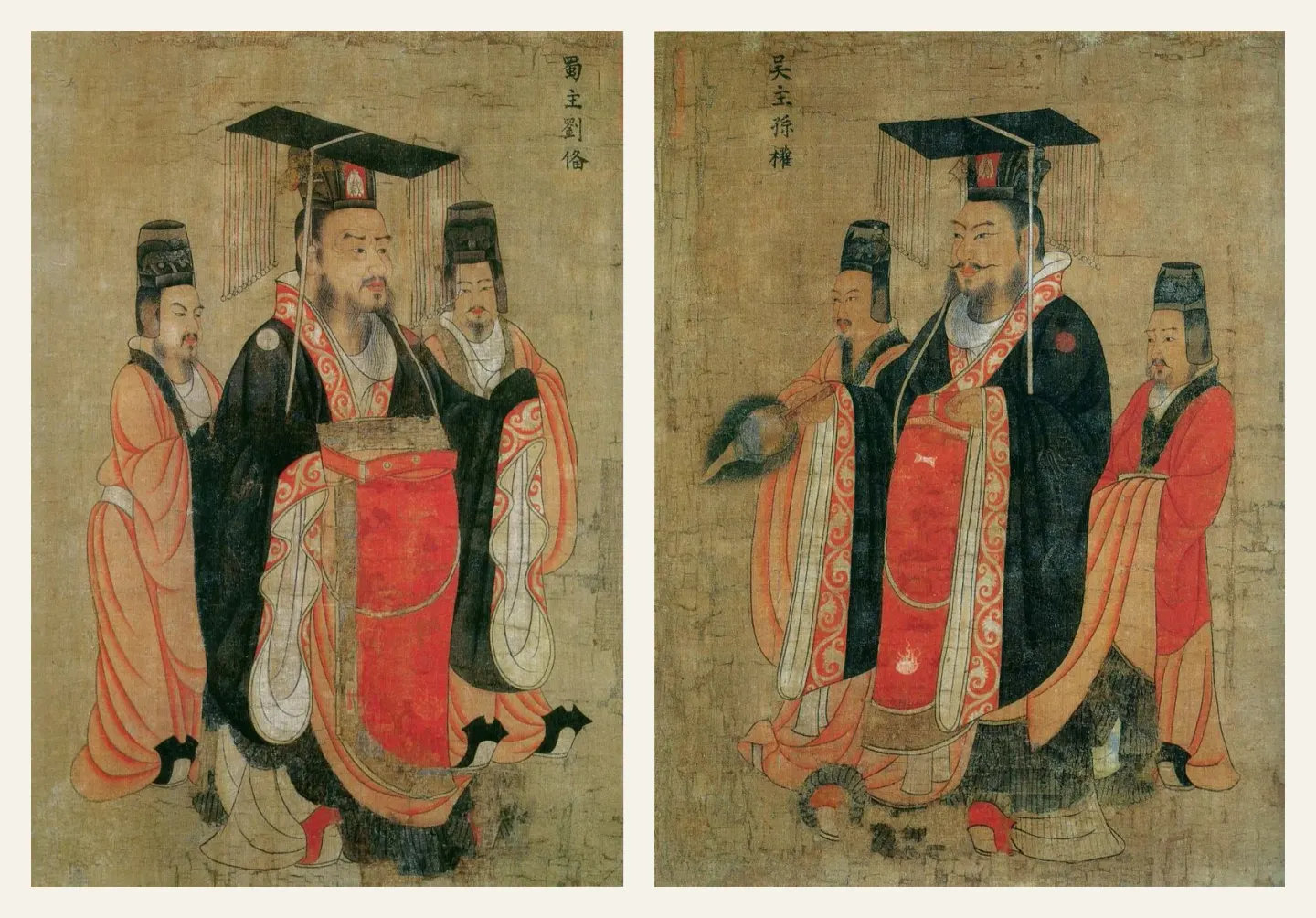
Figure: From the "Thirteen Emperors Scroll," attributed to the Tang painter Yan Liben — left, Liu Bei, ruler of Shu; right, Sun Quan, ruler of Wu, drawn side by side as emperors in the same scroll. · Museum of Fine Arts, Boston, via Wikimedia Commons (public domain)
The book containing the first scene and the books recording the histories of the two monarchs are different books. Romance of the Three Kingdoms is a full-length novel that expands the histories of Wei, Shu, and Wu into a narrative, and is the very book commonly called "Three Kingdoms" in Korea. The Romance widely read today is the 120-chapter edition revised by Mao Zonggang (毛宗崗) in the early Qing dynasty. The official history Records of the Three Kingdoms is a book in which Chen Shou of Western Jin recorded the histories of the three states of Wei, Shu, and Wu, and is one of the history books designated as official history by Chinese dynasties, and its author is Chen Shou (陳壽). Pei Songzhi's commentary is annotations in which Pei Songzhi of Liu Song in the Southern Dynasties brought in and attached records from other books to various places in the main text of Records of the Three Kingdoms, and that commentator is Pei Songzhi (裴松之). This piece reads separately the "main text" written by Chen Shou and the "commentary" brought in or added from other books by Pei Songzhi, and concludes by reading together a leadership study published in Korea.
The official history's account of Changban is two sentences. The main text of the "Biography of Liu Bei," the biography of Liu Bei, records that when Cao Cao's cavalry caught up at Changban, "Liu Bei abandoned his wife and children (棄妻子) and fled with Zhuge Liang, Zhang Fei, Zhao Yun, and dozens of horsemen" (Records of the Three Kingdoms, Book of Shu, "Biography of the First Sovereign"). Liu Bei is the name Chen Shou uses for Liu Bei. The main text of the "Biography of Zhao Yun" records that at that time Zhao Yun "personally held the weak child, who is the Later Lord (身抱弱子,即後主也)," and protected the Later Lord's mother Lady Gan, so that "all escaped hardship and difficulty (皆得免難)" (Records of the Three Kingdoms, Book of Shu, "Biography of Zhao Yun"). The Later Lord is A-dou, who later became emperor—namely, Liu Shan (劉禪). The person holding the child is in the main text, and the scene of throwing the child is outside the scope of the official history main text and Pei Songzhi's commentary read by this piece.
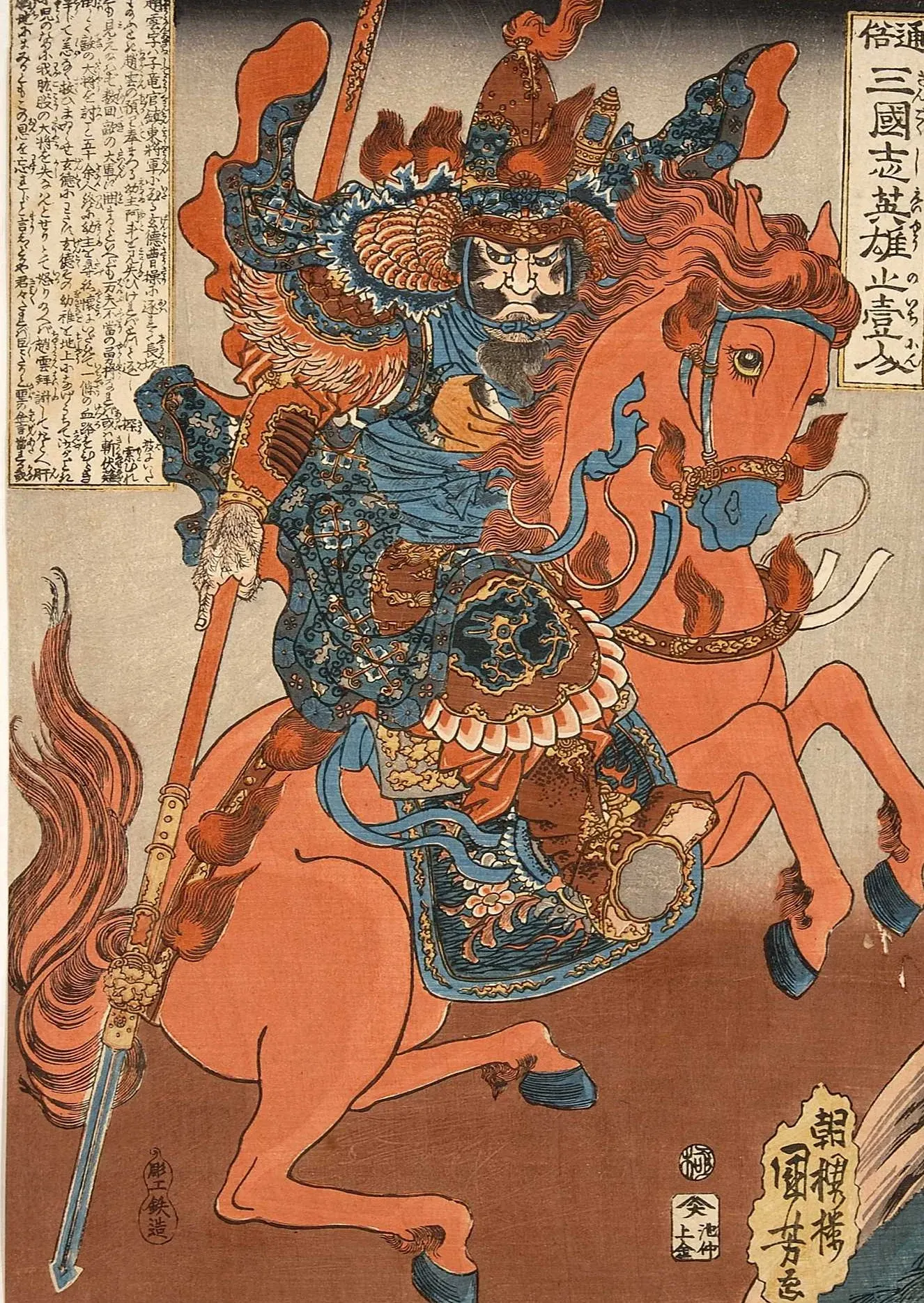
Figure: Utagawa Kuniyoshi, Zhao Yun from "Heroes of the Popular Three Kingdoms" (c. 1838), riding through Changban with A Dou at his chest. · Wikimedia Commons (public domain)
The gesture of throwing appears once in the commentary. In Biography of Zhao Yun of Another Lineage, which Pei Songzhi brings in, when someone says that Zhao Yun has already gone over to Cao Cao's side, Liu Bei throws a short halberd he holds in his hand (手戟) at that person and says, "Zilong will not abandon me and flee." A short time later, Zhao Yun returns (Records of the Three Kingdoms, Book of Shu, "Biography of Zhao Yun", Pei Songzhi's commentary citing Zhao Yun biezhuan). Zilong is Zhao Yun's courtesy name. In the two records, the object thrown is in one case a spear and in the other a child, and the recipient and meaning are also different.
Directly following the scene where he throws A-dou, the Romance attaches a poem to explain it itself. "With no way to soothe and comfort a loyal subject's intent, on purpose I cast my own child in front of the horse" (無由撫慰忠臣意,故把親兒擲馬前) (Romance of the Three Kingdoms, Chapter 42). Because the words "on purpose (故把)" already exist inside the novel, this scene is constructed from the beginning to be read as an intentional gesture.
This piece compares the two monarchs across the layers of records against the original texts to see with what weight they are placed. The starting point is the two evaluations Chen Shou attached to the two men, passing in turn through A-dou at Changban, entrusting the son with his dying words at Baicheng, and the succession struggles of Sun Quan's final years. The circumstances by which Liu Bei seized Yizhou were covered in "Cao Cao — Who Named Him the Treacherous Hero?", and the credit of Wu and Shu surrounding Red Cliffs was covered in "Zhou Yu and Zhuge Liang — Who Got the Credit for Red Cliffs?".
Chen Shou's Scales — Two Sovereigns on the Same Plate
Chen Shou's evaluations are the independent judgments he attached at the end of each volume, beginning with "It is evaluated (評曰)." Liu Bei's "Annals of the First Ruler" and Sun Quan's "Annals of the Ruler of Wu" both end with these evaluations.
Liu Bei's evaluation begins with praise. The First Ruler was "broad-minded, resolute, generous, and kind, capable of recognizing people and treating scholars well (弘毅寬厚,知人待士)," possessing the demeanor of the Gaozu of Han and the vessel of a hero. Then comes the flaw. "His contingency planning and tactical strategy did not reach those of Emperor Wu of Wei (機權幹略,不逮魏武), and therefore his territorial foundation was also narrow." Emperor Wu of Wei is Cao Cao. The final sentence explains why Liu Bei, even when broken, did not yield and ultimately never became subordinate to Cao Cao; Chen Shou writes that this was "not merely a dispute over interest, but also a matter of avoiding harm" (Records of the Three Kingdoms, Book of Shu, "Biography of the First Sovereign", Chen Shou's appraisal). Chen Shou does not explain Liu Bei's persistence through virtue alone, but includes calculations of competing for interest and avoiding harm.
Sun Quan's evaluation follows the same pattern. Sun Quan "lowered his body and endured humiliation, entrusted talented individuals and esteemed strategies (屈身忍辱,任才尚計)," making him an exceptional hero with the strangeness of Goujian, the King of Gou. Goujian is the ancient king who submitted to an enemy state, endured humiliation, and ultimately repaid it. Thus, Sun Quan held the region south of the Yangtze alone and established a state that stood like the leg of a tripod. Then comes the flaw. "His nature was filled with suspicion and aversion, and he was decisive in killing (性多嫌忌,果於殺戮), which became even more severe as he reached his final years (暨臻末年,彌以滋甚)." He also writes that because slanderous words cut off the conduct of gentlemen, leading to the deposition and death of his heirs, it cannot be said he left behind a good plan for his descendants. The final sentence is "It cannot be said that the subsequent decline of later generations and the ultimate overthrow of the state did not necessarily stem from this" (Records of the Three Kingdoms, Book of Wu, "Biography of the Sovereign of Wu", Chen Shou's appraisal).
When the two evaluations are placed side by side, the ancient figures they are compared to are Gaozu of Han, who won the world, and Goujian, who endured humiliation. The praise of "employing people" appears in both evaluations (知人待士 / 任才). Chen Shou recorded both praise and flaws for both sovereigns, and the difference was the type of flaw. Liu Bei's flaw is on the side of ability and is not divided by time. Sun Quan's flaw is on the side of character and is attached to the time of "his final years."
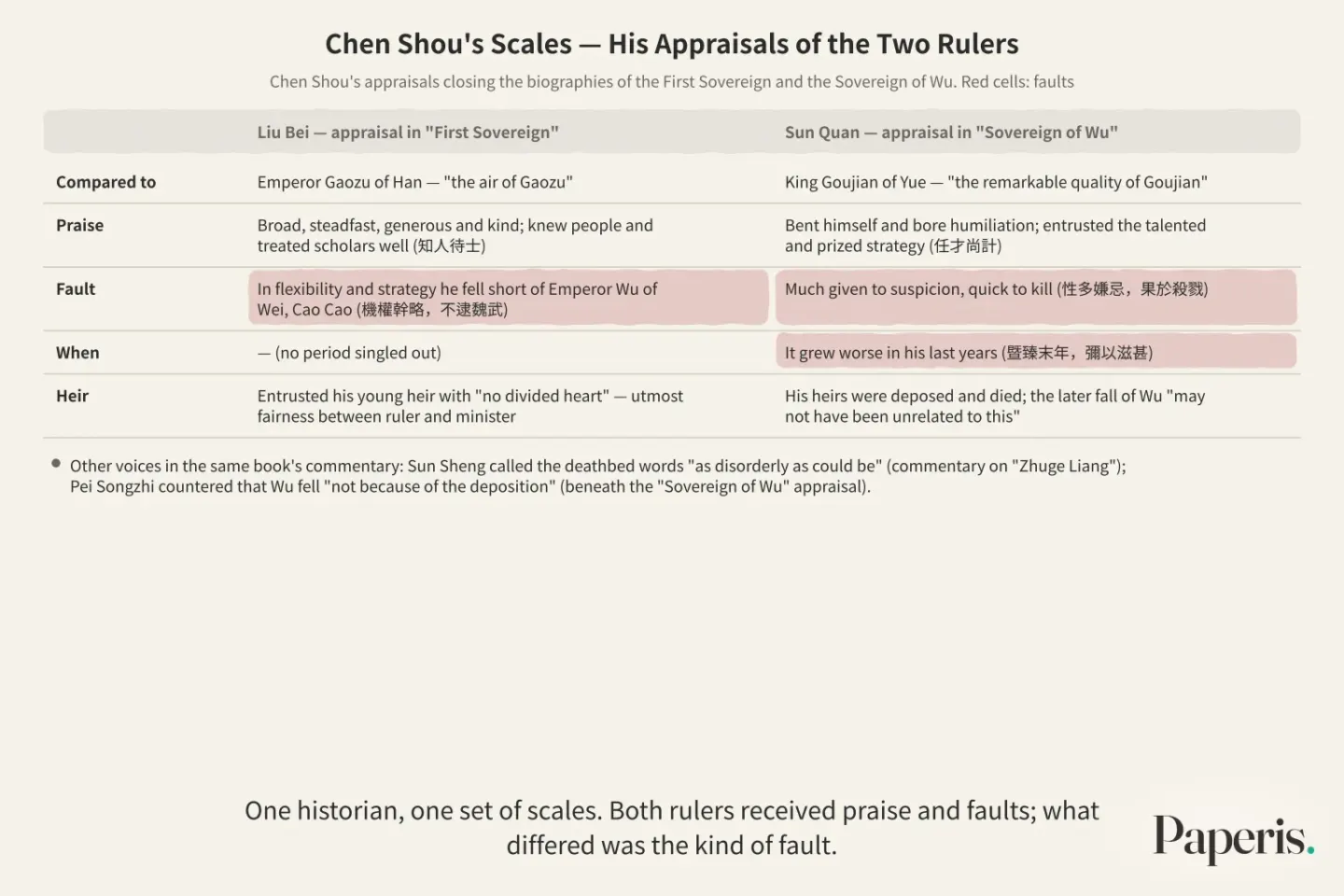
Figure: Chen Shou's scales. Both rulers received praise and faults; Liu Bei's fault lies in ability, Sun Quan's in temperament that grew worse in his last years.
Chen Shou also speaks of Sun Quan in the evaluations of other volumes. In the evaluation of the "Biography of Lu Xun," regarding the event where the young Lu Xun defeated Liu Bei, whom the world feared, Chen Shou writes that he "finds Lu Xun's strategies extraordinary, and moreover admires Sun Quan's ability to recognize talent" (Records of the Three Kingdoms, Book of Wu, "Biography of Lu Xun", Chen Shou's appraisal). In the evaluation of the volume covering Zhang Zhao, the official whom Sun Quan's elder brother Sun Ce entrusted his younger brother to, regarding the fact that Sun Quan did not place Zhang Zhao in the position of chancellor, he writes that "from this it can be known that Sun Quan does not equal Sun Ce" (Records of the Three Kingdoms, Book of Wu, "Biography of Zhang Zhao", Chen Shou's appraisal). If you read only the evaluation of a single volume, you will see only one plate of Chen Shou's scales.
Liu Bei in the Official Histories — A Hand That Gained People and a Hand That Let Them Go
If Liu Bei in Romance of the Three Kingdoms is the "lord of human virtue," much of that material is already present in the main text of the Records of the Three Kingdoms. As a young man, Liu Bei "spoke little, lowered himself readily to others," and liked to associate with knights-errant, causing young people to vie to follow him. When he was in Pingyuan, a person named Liuping who looked down on him sent an assassin, but the assassin could not bring himself to stab him and instead confessed the truth and left. Chen Shou writes that "his winning of people's hearts was like this" (Records of the Three Kingdoms, Book of Shu, "Biography of the First Sovereign").
There are later scenes, too. After he was defeated on an expedition to attack Wu, the general Huang Quan, whose path was cut off, surrendered to the Wei state. When the responsible official proposed arresting Huang Quan's wife and children according to the law, Liu Bei said, "It is I who have failed Huang Quan, not Huang Quan who has failed me," and treated his family as before (Records of the Three Kingdoms, Book of Shu, "Biography of Huang Quan"). When the advisor Pang Tong was killed by an arrow, and when the minister Fa Zheng died, the main text records that Liu Bei shed tears (Records of the Three Kingdoms, Book of Shu, "Biography of Pang Tong" and "Biography of Fa Zheng").
There is also a rough Liu Bei in the same main text. As a young man serving as a county official, when an inspector came and refused to see him, Liu Bei "went straight in, tied up the inspector, and beat him with two hundred strokes of a stick" before abandoning his post and fleeing (Records of the Three Kingdoms, Book of Shu, "Biography of the First Sovereign"). Romance assigns this action to Zhang Fei in the chapter title. The title of Chapter 2 is "Zhang Yide, in a rage, whips the inspector" (Romance of the Three Kingdoms, Chapter 2 (chapter title)). When Liu Bei held a banquet to decide on attacking Liu Zhang, the master of Yizhou, and said, "Today's gathering is joyful," Pang Tong said, "Attacking another's country while rejoicing is not the army of a benevolent person," and Pei Songzhi attached a judgment to this passage stating that "Liu Bei was wrong and Pang Tong was not wrong" (Records of the Three Kingdoms, Book of Shu, "Biography of Pang Tong", Pei Songzhi's commentary). When setting out to attack Wu, many ministers remonstrated, but Liu Bei "did not follow a single one" (Records of the Three Kingdoms, Book of Shu, "Biography of Fa Zheng").
In the commentaries, there is also Liu Bei speaking of human virtue as a strategy. In the Jiuzhou chunqiu cited by Pei Songzhi, Liu Bei says, "When Cao Cao is urgent, I am lenient; when Cao Cao is fierce, I am benevolent; when Cao Cao is deceitful, I am loyal — in everything, one must act opposite to Cao Cao for a matter to succeed". When Pang Tong says they can seize things according to circumstances and repay them with righteousness, Liu Bei finally executes that plan (Records of the Three Kingdoms, Book of Shu, "Biography of Pang Tong", Pei Songzhi's commentary citing Jiuzhou chunqiu). What this record transmits is Liu Bei's words and his subsequent actions, and judgments on Liu Bei's inner thoughts are not contained within it. The evaluation that he "is clumsy at fighting" comes from the mouths of three people. There is Chen Shou's evaluation that his resourcefulness and tactical skill (機權幹略) fell short of Cao Cao's, the words of Zhao Jian (趙戩), a man on the Wei side (Records of the Three Kingdoms, Book of Shu, "Biography of the First Sovereign", Pei Songzhi's commentary citing Fuzi), and the memorial of the enemy general Lu Xun, who viewed Liu Bei's employment of troops as "frequently defeated and achieving little" (Records of the Three Kingdoms, Book of Wu, "Biography of Lu Xun").
Romance amplified one side of this material. In the main text of the official histories, regarding the people who attached themselves to him on his flight, Liu Bei says, "To achieve great things, one must certainly take the people as the foundation," but Chapter 41 of Romance adds "weeping" right before almost the same sentence. In the same chapter, upon seeing the wailing of the people, Liu Bei tries to throw himself into the river only to be held back by those around him, and Zhao Yun kills some fifty renowned generals of Cao Cao's camp (Romance of the Three Kingdoms, Chapter 41). The suicide attempt and the fifty-odd men are outside the scope of the official histories read by this article. A Chinese-language paper comparing Liu Bei's depiction in Romance with the official histories and earlier versions considers that Romance deliberately pared away the ruthless and ambitious warlord demeanor of Liu Bei and endlessly magnified his virtue through fictional plots. This is the interpretation of a short paper whose journal information is absent from the abstract (DOI: 10.66106/aqabaf.20260206). However, the image of "Liu Bei the holy ruler" precedes Romance. Liu Bei in Tang dynasty poetry is already a holy ruler endowed with leniency and righteousness, and together with Zhuge Liang was a model of a "holy ruler and wise minister" (DOI: 10.2478/saec-2025-0007).
"Take It for Yourself" — Two Characters at Baicheng
Tuogu is the act of a dying ruler entrusting an infant heir to a trusted subject. Liu Bei's tuogu took place in the Yong'an Palace in Baicheng, where he had retreated after suffering a major defeat to the Wu forces at Yiling in the third year of Zhangwu. The main text of the "Annals of the First Ruler" records that the First Ruler "entrusted the infant heir to Prime Minister Zhuge Liang and made Director of the Secretariat Li Yan his deputy" (Records of the Three Kingdoms, Book of Shu, "Biography of the First Sovereign"). The names of Prime Minister Zhuge Liang and Director of the Secretariat Li Yan both appear in the main text.
The quote is in the main text of the "Biography of Zhuge Liang." Liu Bei summoned Zhuge Liang from Chengdu, entrusted him with future matters, and said: "Your talent is ten times that of Cao Pi; you will surely stabilize the state and ultimately accomplish the grand enterprise. If the heir is worth helping, help him; if he lacks talent, take it for yourself (如其不才,君可自取)." Cao Pi was Cao Cao's son and the one who became the emperor of Wei. Zhuge Liang shed tears and replied, "I will exhaust the strength of my limbs, offer my loyal and steadfast devotion, and carry it on unto death," and Liu Bei instructed his son to "serve the Prime Minister like a father" (Records of the Three Kingdoms, Book of Shu, "Biography of Zhuge Liang"). The object of "take it for yourself" is not in the original text. Whether it means the state or the throne is filled in by the reader.
Over this single phrase, the verdicts within the official history split into two. In his commentary, Chen Shou wrote of the event—where the entire state was mobilized to entrust the infant heir to Zhuge Liang—that "his mind and spirit had no two paths (心神無貳)," which is "truly the ultimate fairness between ruler and subject, and a glorious model for all times past and present" (Records of the Three Kingdoms, Book of Shu, "Biography of the First Sovereign", Chen Shou's appraisal). Whose mind it is remains unstated in the sentence, and the subsequent mention of "ruler and subject" binds the two together.
Pei Songzhi's commentary, included right alongside that passage in the "Biography of Zhuge Liang," offers the exact opposite evaluation. "Liu Bei's command to Zhuge Liang—could any disorder be greater than this? (備之命亮,亂孰甚焉)." Pei Songzhi goes on to convey another voice from that era. Some in the world, he notes, claimed that Liu Bei's words were meant to solidify his sincerity in entrusting him and to unite the hearts of the people of Shu. Pei Songzhi dismisses this defense. If the person entrusted is loyal and wise, such words are not needed; if they are not such a person, one must not open the path to usurpation; and the fact that things went safely was merely thanks to Liu Shans being dim-witted and Zhuge Liang's majesty being enough to suppress ulterior motives. He concludes by writing, "To call this expedient strategy (quan) — is that not being deluded?!" (Records of the Three Kingdoms, Book of Shu, "Biography of Zhuge Liang", Pei Songzhi's commentary citing the remarks of Sun Sheng).
An expedient strategy is a method where one bends the rules to fit the circumstances rather than upholding principles rigidly, and the "quan" used by Pei Songzhi is this very concept. Already in Pei Songzhi's time, there were people who read the tuogu words as an expedient strategy—that is, calculated words—to defend them, and Pei Songzhi felt that whether calculated or not, such words themselves ran counter to the principles of tuogu. Pei Songzhi does not assert that Liu Bei lied to test Zhuge Liang. The voices defending the tuogu words as a calculated expedient and Pei Songzhi's voice rejecting them exist within the commentaries of the official history even before the Romance, and Chen Shou's commentary called that tuogu the utmost fairness.
Chapter 85 of the Romance amplifies the scene instead of delivering a verdict. Liu Bei speaks while "weeping," and "take it for yourself" becomes "you take it for yourself and become the master of Chengdu (君可自為成都之主)," supplying an object. Zhuge Liang "sweats all over his body and does not know where to place his hands and feet (汗流遍體,手足失措)," prostrates himself on the ground and weeps, and after finishing his words, "knocked his head until it bled (叩頭流血)" (Romance of the Three Kingdoms, Chapter 85). Zhuge Liang's responsive speech is nearly identical to the official history. The narrator of the Romance does not judge whether these words were sincere.
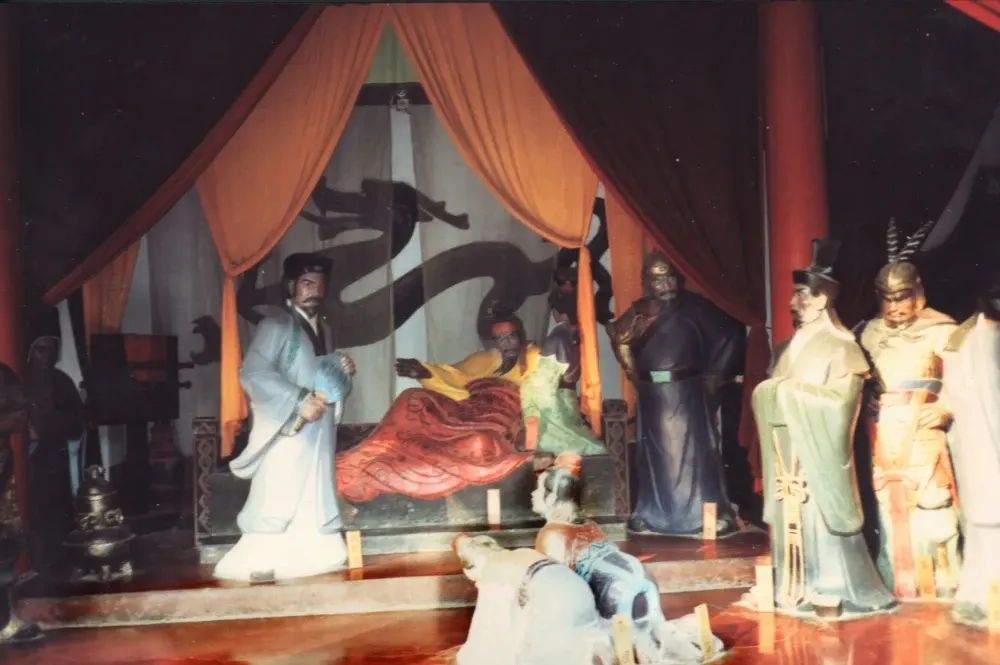
Photo: Statues re-creating the deathbed charge in the Tuogu Hall at Baidicheng (photographed 2006). · Gisling, via Wikimedia Commons (CC BY-SA 3.0)
The two characters "take it for yourself," or ziqu, also appeared in Sun Quan's family. Before his death, Sun Ce handed the seal and ribbon to Sun Quan and said, "To lift the multitudes of Jiangdong and contend with the empire, you are not as good as me; to employ the wise and assign capable men to protect Jiangdong, I am not as good as you" (Records of the Three Kingdoms, Book of Wu, "Biographies of Sun Jian and Sun Ce", section on Sun Ce). The Records of Wu cited by Pei Songzhi contains more of what Sun Ce said to Zhang Zhao. "If Zhongmou cannot handle the affairs, you may take it for yourself (君便自取之)." (Records of the Three Kingdoms, Book of Wu, "Biography of Zhang Zhao", Pei Songzhi's commentary citing Wu li). Zhongmou is Sun Quan's style name. Chapter 29 of the Romance copies Sun Ce's last words almost exactly from the main text of the official history, but the remark telling Zhang Zhao to "take it" is absent in the chapters that readers see (Romance of the Three Kingdoms, Chapter 29). Liu Bei's remark is in the main text and grew larger in the Romance, while Sun Ce's remark is in the commentary and does not appear in that chapter of the Romance.
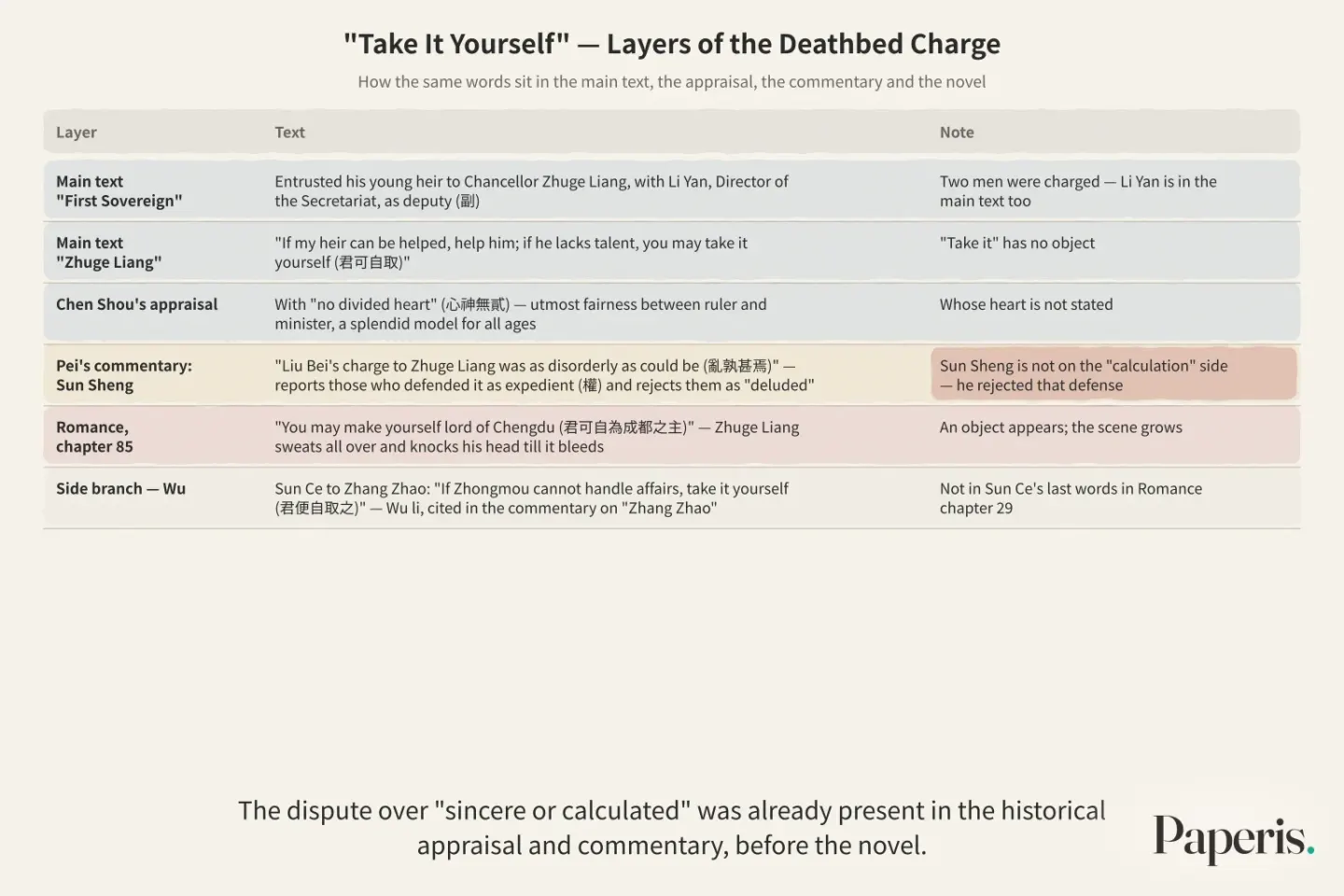
Figure: Layers of the deathbed charge. Voices disputing "sincere or calculated" were already in the historical appraisal and commentary before the novel.
Sun Quan's Scale — Sun Quan as a Judge of Talent
The praise Sun Ce passed down to his younger brother was about "promoting the wise and employing the capable," and Chen Shou's text includes several such scenes. Sun Quan later discussed his generals one by one. He noted that Lu Su's advice to lend land to Liu Bei was a shortcoming, but that it was not enough to outweigh Lu Su's two great strengths, stating, "I forget that shortcoming and cherish his strengths," and Chen Shou recorded that this commentary "fits the weighing of strengths and weaknesses, so it is preserved" (Records of the Three Kingdoms, Book of Wu, "Biography of Lü Meng"; Records of the Three Kingdoms, Book of Wu, "Biographies of Zhou Yu, Lu Su and Lü Meng", Chen Shou's appraisal). When a rumor spread that Zhuge Jin, Zhuge Liang's elder brother who served Wu, was secretly communicating with Liu Bei, Sun Quan declared, "Ziyu does not betray me, just as I do not betray Ziyu" (Records of the Three Kingdoms, Book of Wu, "Biography of Zhuge Jin"). Ziyu is Zhuge Jin's courtesy name. The phrase "does not betray" appears in the main texts of both monarchs, alongside the words Liu Bei spoke to Huang Quan.
Sun Quan as seen from the perspective of an enemy state is also in the text. Zhuge Liang discussed the situation of the world with Liu Bei, noting that Sun Quan had held Jiangdong for three generations and that "the wise and capable work for him; he can be made an ally, but cannot be plotted against" (Records of the Three Kingdoms, Book of Shu, "Biography of Zhuge Liang"). The words of the Wu envoy Zhao Zi before Cao Pi, the emperor of Wei, calling Sun Quan "a wise, benevolent, and clever ruler of grand strategy" and saying that "bowing to Your Majesty is a matter of strategy" are also recorded in the text, spoken by an envoy before the emperor of an enemy state (Records of the Three Kingdoms, Book of Wu, "Biography of the Sovereign of Wu"). Cao Cao's widely known remark, "If you are to have a son, he should be like Sun Zhongmou," does not appear in the main text, but in the Wuli cited by Pei Songzhi (Records of the Three Kingdoms, Book of Wu, "Biography of the Sovereign of Wu", Pei Songzhi's commentary citing Wu li). The author's preface to a research book on the history of Wu's founding notes that it was crucial for his family that Sun Quan had the age and authority to command the loyalty of his brother's generals, and that his exceptionally long reign held great significance for the state (DOI: 10.2307/2760227).
Scenes of flaws are also in the text. When a warlord named Gongsun Yuan offered to submit as a subject of Wu, Sun Quan was overjoyed and tried to enthrone him as king, and though all the ministers from the chancellor down remonstrated, "he ultimately would not listen." Gongsun Yuan duly beheaded the Wu envoys and sent their heads to Wei (Records of the Three Kingdoms, Book of Wu, "Biography of the Sovereign of Wu"). Pei Songzhi attached a judgment to this event, calling it "not only foolish and blocked, but truly devoid of the Dao" (Records of the Three Kingdoms, Book of Wu, "Biography of the Sovereign of Wu", Pei Songzhi's commentary). When Zhang Zhao tried desperately to stop this, Sun Quan rested his hand on his sword in anger, and when Zhang Zhao feigned illness and stopped coming to court, Sun Quan blocked his doorway with mud. After things went wrong, Sun Quan apologized repeatedly, had Zhang Zhao ride in a carriage back to the palace, and deeply reproached himself (Records of the Three Kingdoms, Book of Wu, "Biography of Zhang Zhao"). On this passage, the commentator Xi Zuochi instead rebuked Zhang Zhao for "failing to act as a subject" by closing his door and holding out against a repentant ruler (Records of the Three Kingdoms, Book of Wu, "Biography of Zhang Zhao", Pei Songzhi's commentary citing the remarks of Xi Zuochi).
There were also instances of trusting harsh officials. Sun Quan trusted and relied on the official Lü Yi, whose enforcement of the law was severe; even when Crown Prince Sun Deng remonstrated repeatedly, Sun Quan would not listen. When Lü Yi's crimes were exposed and he was executed, Sun Quan "turned the fault back onto himself in self-reproach," apologized to his various commanders, and asked them how he could correct his ways (Records of the Three Kingdoms, Book of Wu, "Biography of the Sovereign of Wu"). The "suspicion and guardedness" recorded by Chen Shou refer to such scenes, and within those very same scenes are examples of Sun Quan correcting himself.
Two Palaces — Sun Quan's Final Years
If you read only the main text of the "Biography of the Lord of Wu," the succession dispute in his final years takes up just a few lines. In the 5th year of Chiguo, he made his son Sun He the crown prince, and in the same year made another son, Sun Ba, the Prince of Lu. In the spring of the 8th year of Chiguo, "Prime Minister Lu Xun died." In the 13th year of Chiguo, "The Crown Prince Sun He was deposed and placed in Guzhang. Death was ordered for the Prince of Lu, Sun Ba" (Records of the Three Kingdoms, Book of Wu, "Biography of the Sovereign of Wu"). Lu Xun was the general of Wu who defeated Liu Bei at Yiling, and he was the prime minister at this time. The circumstances are in other biographies and commentaries.
The term the original text uses for this dispute is "Two Palaces," meaning the Crown Prince's Palace and the Prince of Lu's Palace. The name "Dispute of the Two Palaces" was attached by later generations and is not in the original text read by this article. Yin Ji's Tongyu, cited by Pei Songzhi, records that at first the two princes lived in the same palace with no difference in honors, but when officials argued that high and low must be distinguished, they divided the palaces and assigned separate subordinate officials, so "from here the rift began to grow." Prime Minister Lu Xun and others supported the crown prince while other senior officials sided with the Prince of Lu, meaning "officials and generals, high and low, inside and out, the whole country was split in half (舉國中分)" (Records of the Three Kingdoms, Book of Wu, "Biographies of the Five Sons of the Sovereign of Wu", section on Sun He, Pei Songzhi's commentary citing Tongyu). In the same place, Pei Songzhi harshly criticized that Sun Quan "set up Sun He and then favored Sun Ba, entangling himself in domestic disaster" (Records of the Three Kingdoms, Book of Wu, "Biographies of the Five Sons of the Sovereign of Wu", section on Sun He, Pei Songzhi's commentary).
The course of events in the main text is as follows. Sun He's mother, Lady Wang, had a falling out with Princess Quan, and when Princess Quan said that the crown prince was not at the ancestral shrine but plotting things at his wife's family home, Sun Quan grew angry. The faction of the Prince of Lu manufactured slanders day after day, and the official Wu Can, who spoke of the righteousness of legitimate and concubine-born lineage, was executed, while Gu Tan was exiled. Sun Quan "hesitated for many years" and finally imprisoned Sun He. Two officials who smeared mud on their heads and bound their bodies to plead for Sun He were dragged to the court and beaten with a hundred strokes of the cane, and two officials who submitted memorials citing ancient precedents had their entire clans put to death. "Among the many officials, those who died or were banished for remonstrating numbered over a dozen, and all of them were considered wronged (衆咸冤之)" (Records of the Three Kingdoms, Book of Wu, "Biographies of the Five Sons of the Sovereign of Wu", section on Sun He).
Lu Xun had died earlier than that. When Lu Xun told Quan Ji—whose father Quan Cong, an official, sided with the Prince of Lu—that "if the forces of the Two Palaces oppose each other, one side and the other will surely emerge, which is something the ancients greatly feared." To Sun Quan, he submitted memorials three or four times, "bashing his head until it bled," stating that "the crown prince is the orthodox lineage and must have rock-solid firmness, while the Prince of Lu is a vassal and there must be a distinction in favor and honors," and he requested to go to the capital to speak in person, but was not permitted. Furthermore, "when Sun Quan repeatedly sent messengers to reprimand Lu Xun, Lu Xun died of anger and grief (遜憤恚致卒)." At the time he was sixty-three years old and left no wealth in his home (Records of the Three Kingdoms, Book of Wu, "Biography of Lu Xun"). The death of Lu Xun recorded in the main text is anger at the end of reprimands, and the record that Sun Quan killed him is outside the scope of what this article reads. The deposition of the crown prince happened five years after that.
The death of Sun He also has an order. The son whom Sun Quan ordered to death was the Prince of Lu, Sun Ba. Sun He was still alive after being deposed, and Sun Jun, who seized power after Sun Quan died, sent a messenger to order his death (Records of the Three Kingdoms, Book of Wu, "Biographies of the Five Sons of the Sovereign of Wu", section on Sun He). The Book of Wu cited by Pei Songzhi records that an ailing Sun Quan "realized quite a bit" and wanted to summon Sun He to reinstate him, but Princess Quan, Sun Jun, and others firmly opposed it and stopped it (Records of the Three Kingdoms, Book of Wu, "Biographies of the Five Sons of the Sovereign of Wu", section on Sun He, Pei Songzhi's commentary citing Wu shu). Both the reprimanding Sun Quan and the repentant Sun Quan are in the main text. After Lu Xun died, Sun Quan sent off his son Lu Kang, crying and saying, "Previously I listened to slander and failed to deepen our great loyalty with your father, so by this I have failed you" (Records of the Three Kingdoms, Book of Wu, "Biography of Lu Xun"). There are also scenes where he did not doubt even in his final years. When officials said Shu Han would break its alliance, Sun Quan said, "I will stake my family on a guarantee," and Shu indeed had no schemes at all (Records of the Three Kingdoms, Book of Wu, "Biography of the Sovereign of Wu").
Whether the succession dispute caused Wu to perish is divided on the very same point. Chen Shou cautiously guessed, "One cannot necessarily say it did not stem from this," and right below that appraisal, Pei Songzhi rebutted, "Losing the state was because of darkness and tyranny, not because of deposition (不在於廢黜也)." Even if Sun He had not been deposed, the later ruler Sun Hao—whom Pei Songzhi called the "tyrannical Sun Hao"—would have inherited it as the legitimate grandson, so how would the result have been any different? (Records of the Three Kingdoms, Book of Wu, "Biography of the Sovereign of Wu", Chen Shou's appraisal and Pei Songzhi's commentary). While Pei Songzhi harshly criticized Sun Quan's handling of the succession, he did not accept Chen Shou's guess that it was the cause of the nation's downfall.
The Scales of Romance — Seventeen to Five
If you count the titles of the 120 chapters of the Romance, known as chapter headings, one side shows where the scales tipped. Counting the chapter headings in the Wikisource table of contents that feature names, courtesy names, or titles like "Imperial Uncle" or "First Lord," Liu Bei appears 17 times (or 18 if you include Chapter 80, which refers to him as the "King of Han"), while Sun Quan appears 5 times. Sun Quan's name does not appear in the heading of Chapter 108, where he dies (Romance of the Three Kingdoms, chapter titles). This is the frequency with which their names appear in the headings, not a measurement of how much the two figures actually appear in the main text.
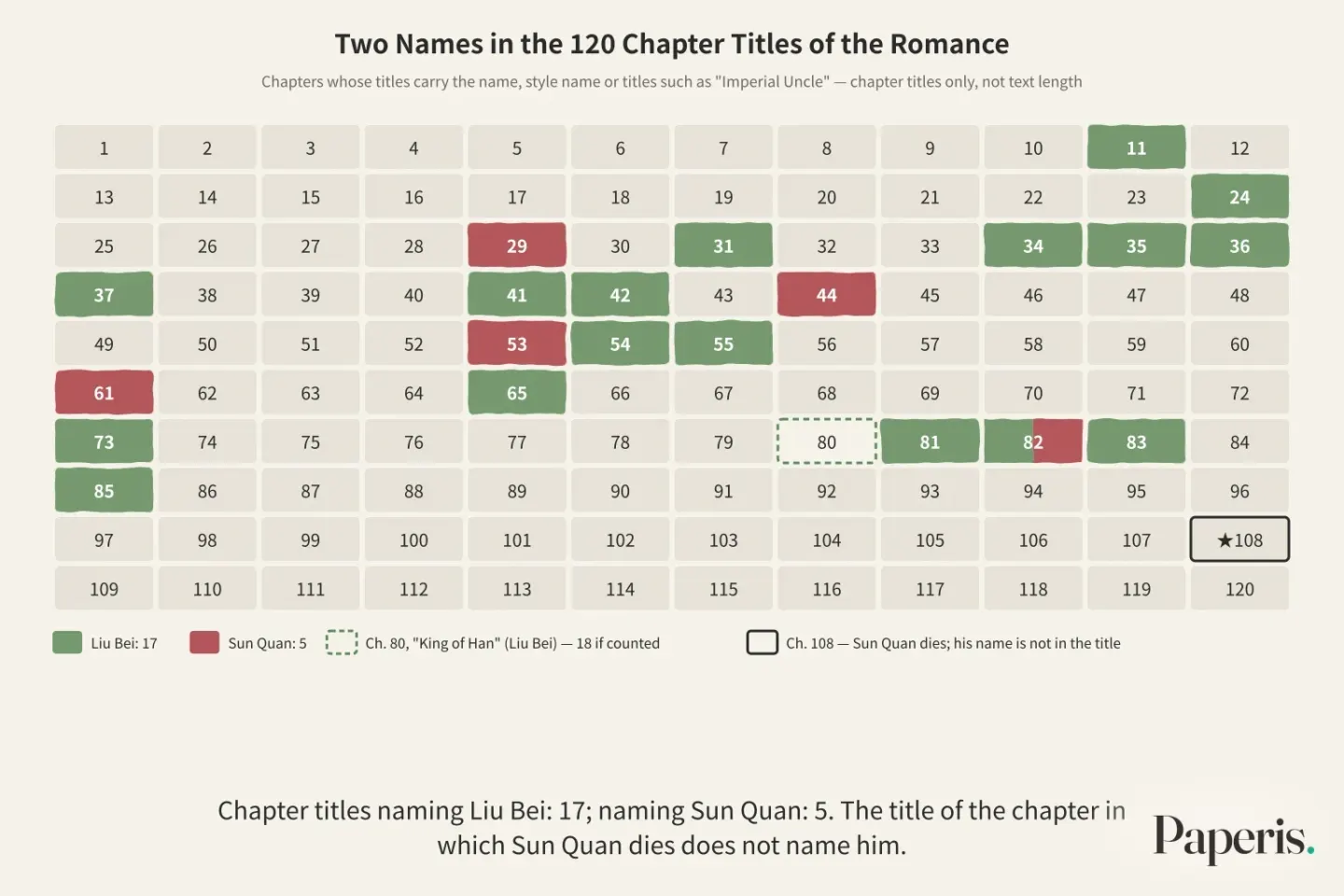
Figure: How often each name appears in the Romance chapter titles (titles only, not text length). Chapter 108, in which Sun Quan dies, does not name him.
The scale of the scenes also differs. Liu Bei's Changban and Baidi Castle were enlarged in the Romance, whereas Sun Quan's final years were reduced to a few lines in Chapter 108. The Romance records in a single line that Sun He was deposed due to Lu Kang's slander and "died of grief and resentment," before moving directly to the scene where Sun Quan is startled by a great gale and falls ill and dies (Romance of the Three Kingdoms, Chapter 108). King Lu Sun Ba, the factional split between the two palaces, the executed remonstrators, and the circumstances under which Lu Xun died "in anger and grief" after being reprimanded by memorials are all absent from this chapter. The chapter merely notes that at that time "both Lu Xun and Zhuge Jin died." This single line, which reads as though Sun He died of anxiety while Sun Quan was still alive, also departs from the sequence of the main text in the Records. The poem at the end of the chapter offers praise: "He knew how to make his ministers loyal to the utmost, and for twenty-four years raised up a great enterprise" (Romance of the Three Kingdoms, Chapter 108).
The Romance also used sentences from the Records for Sun Quan's side. Young Sun Quan in Chapter 29 is constructed from Sun Ce's dying words and physiognomy evaluations found in the main text of the Records; and in Chapter 82, Zhao Zi's remarking to Cao Pi that Sun Quan is "a ruler of heroic strategy who is bright, benevolent, and wise," alongside Sun Quan's statement regarding Zhuge Jin that "I have not failed Ziyu, and Ziyu has not failed me," are nearly identical to the sentences in the main text and commentary of the Records (Romance of the Three Kingdoms, Chapter 29 and Chapter 82). The Romance used sentences from the Records for both rulers, and what tilted was which scenes were enlarged or reduced and which scenes were newly written. Liu Bei's Changban and Baidi Castle were enlarged, while Sun Quan's major scenes in his later years were reduced. There are also scenes newly written for Sun Quan. In Chapter 54, Sun Quan reads the letter detailing Zhou Yu's marriage stratagem and "nods, rejoicing inwardly," tells Liu Bei's envoy that "I merely wish to give my sister in marriage to Xuande and have no other intentions," has people make advance preparations at Ganlu Temple, and when his hidden soldiers are discovered, "feigning ignorance" asks another minister for explanation (Romance of the Three Kingdoms, Chapter 54). In the main text of the Records, Sun Quan did not accept Zhou Yu's memorial suggesting they detain Liu Bei with a palace and beauties (Records of the Three Kingdoms, Book of Wu, "Biography of Zhou Yu"). The Romance showed less of the major scenes from Sun Quan's later years, and newly showed Sun Quan participating in stratagems.
Evaluations of how the Romance portrays Sun Quan vary from study to study. One study suggests that in an effort to portray Liu Bei's faction as heroes, the Romance depicted the factions of Cao Cao and Sun Quan as "insidious and cunning groups" (KCI ART001616055). A study comparing the Romance with the Joseon-era novel Imjinrok suggests that Sun Quan is portrayed with a mix of affection and resentment in the Romance—his competence is praised, but his lack of honesty is not tolerated (DOI: 10.16874/jslckc.2015..37.014). Another study argues that the Romance's political stance rests on loyalty and righteousness rather than lineage or benevolence, evaluates figures from different camps with relative objectivity and neutrality, and shows that both positive and negative figures possess strengths and weaknesses (DOI: 10.1080/02549948.2017.1309106).
There were also scales outside the scales. The orthodox theory of the Shu-Han views the Shu-Han founded by Liu Bei as the legitimate successor to the Han dynasty among Wei, Shu, and Wu. Zhu Xi of the Southern Song changed the orthodoxy that Sima Guang's Zizhi Tongjian had placed with Wei over to the Shu-Han; Xiao Chang of the Southern Song spent 20 years writing his Continued History of the Later Han, establishing the Shu-Han as legitimate while dismissing Wei and Wu as illegitimate; and throughout the Yuan and Ming dynasties, histories of the Three Kingdoms were repeatedly rewritten in this same manner (DOI: 10.29457/sjh.200706.0001). According to the criteria established by Ouyang Xiu of the Northern Song, the split-era states including Wei are all excluded from orthodoxy (DOI: 10.17207/jstc.2022.6.25.2.1). Among the various orthodox theories, none of the studies read in this article establish Wu as legitimate. Yet during that very era, when Sun Quan declared himself emperor, Shu sent congratulatory envoys to forge an alliance dividing the realm, and Zhuge Liang, though viewing Sun Quan's accession as "usurpation," argued that they should overlook the transgression because they needed reinforcements (Records of the Three Kingdoms, Book of Wu, "Biography of the Sovereign of Wu"; Records of the Three Kingdoms, Book of Shu, "Biography of Zhuge Liang", Pei Songzhi's commentary citing Han-Jin chunqiu). One study suggests that this alliance was a complete negation of the orthodoxy theory (KCI ART001529191). While studies note that histories of the Three Kingdoms rewritten to reflect the orthodoxy debates influenced the formation of the new genre of historical fiction (DOI: 10.1017/s0041977x06000139), the scope of literature reviewed for this article provides no basis to link these orthodoxy theories to the reduction of Sun Quan's final years in the Romance.
Which Version's Scale is It?
Ahdou of Changban is on the scale again today. A leadership study published in a Korean academic journal compares Liu Bei and Cao Cao, citing the Three Visits alongside the line "I almost lost my general because of a worthless child" as the basis for Liu Bei's high regard for people, and explaining his behavior of recognizing and trusting subordinates' talent through modern servant leadership. The study's conclusion is that the leadership model demanded by the modern era is the result-oriented Cao Cao type rather than the Liu Bei type. The study itself reveals that its source material is Liu Bei and Cao Cao from Luo Guanzhong's novel (KCI ART002580804).
Measuring leadership using characters from a novel is a legitimate task on the scale of the novel. However, the scene placed on that scale belongs to Chapter 42 of the Romance, and the Romance itself attached a poem reading "deliberately thrown" to that scene. When the same scene is placed on the scale of the official history and Pei Songzhi's annotations, other things come up together. There is Liu Bei fleeing while abandoning his wife and children, Zhao Yun holding the infant, Liu Bei throwing a spear at someone who slandered him, Liu Bei treating the family of a surrendered general just as he did at first, and Liu Bei setting out to attack Wu without heeding a single piece of advice from his ministers. When Wu's Sun Quan is also placed on the same scale, scenes of employing people and scenes of crushing people come up together.
Weight is also loaded onto the scale of the official history. The author of a research book on the history of Wu's founding writes that the stories themselves—passed down by Chen Shou and his competitors and collected by Pei Songzhi—are a mixture of fact and fiction, and that the official history differs more like another story than standing against the Romance in a contest of true or false (DOI: 10.2307/2760227). One study suggests that even apart from the places where Pei Songzhi directly delivered a verdict, he revealed his own judgment simply through the method of annotation without adding a single word of his own (DOI: 10.29991/jhs.201012.0001). Regarding the effort to sort out the truth of the Romance, there is a criticism that during the dynastic era Liu Bei was revered, after the revolution Cao Cao was reevaluated for his political superiority, and that part of the authenticity-verification theory tends toward confirmation bias by blindly trusting historical records, inferring without accurate factual bases, and following prior conclusions without criticism (DOI: 10.26586/chls.2016..78.004).
Chen Shou placed the two monarchs on the same scale, recording flaws in ability for the one and flaws in character that grew worse in his later years for the other. Pei Songzhi raised objections right beneath Chen Shou's evaluation, and Sun Sheng judged the託孤 (entrusting of orphans) in the exact opposite way of Chen Shou. The Romance used the sentences of the official history for both monarchs while altering the scale of the scenes. On Liu Bei's side of the plate, it loaded Liu Bei's tears and Zhuge Liang's bowing until he bled, while on Sun Quan's side of the plate, instead of lowering the large scenes of his later years, it loaded scenes of him participating in schemes. When reading a piece comparing Liu Bei and Sun Quan, the first question to ask is: which version's scale is the piece using to measure?
An open question also remains. Whether the words of the entrustment were sincere was already judged in opposite ways by Chen Shou and Sun Sheng, and who took over afterward and how is not told by the original texts and studies read by this article. Why the Romance reduced Sun Quan's later years to just a few lines cannot be determined within the scope read by this article either.
Primary Sources
- Records of the Three Kingdoms (by Chen Shou, with Pei Songzhi's commentary) — Book of Shu: "Biography of the First Sovereign" (juan 32: main text and Chen Shou's appraisal; Pei Songzhi's commentary citing Fuzi) · "Biography of Zhuge Liang" (juan 35: main text; Pei Songzhi's commentary citing Sun Sheng's remarks and the Han-Jin chunqiu) · "Biography of Zhao Yun" (juan 36: main text; Pei Songzhi's commentary citing the Zhao Yun biezhuan) · "Biography of Pang Tong" · "Biography of Fa Zheng" (juan 37: main text; Pei Songzhi's commentary citing the Jiuzhou chunqiu, and Pei's own judgment) · "Biography of Huang Quan" (juan 43: main text) · Book of Wu: "Biographies of Sun Jian and Sun Ce" (juan 46: main text, section on Sun Ce) · "Biography of the Sovereign of Wu" (juan 47: main text and Chen Shou's appraisal; Pei Songzhi's commentary citing the Wu li, and Pei's own judgment) · "Biography of Zhang Zhao" · "Biography of Zhuge Jin" (juan 52: main text and Chen Shou's appraisal; Pei Songzhi's commentary citing the Wu li and Xi Zuochi's remarks) · "Biographies of Zhou Yu, Lu Su and Lü Meng" (juan 54: main text and Chen Shou's appraisal, including Zhou Yu's memorial) · "Biography of Lu Xun" (juan 58: main text and Chen Shou's appraisal) · "Biographies of the Five Sons of the Sovereign of Wu" (juan 59: main text, sections on Sun He and Sun Ba; Pei Songzhi's commentary citing Yin Ji's Tongyu and the Wu shu, and Pei's own judgment)
- Romance of the Three Kingdoms (Mao Zonggang edition) — Chapter 29 · Chapter 41 · Chapter 42 · Chapter 54 · Chapter 82 · Chapter 85 · Chapter 108 (chapter titles: table of contents of the 120 chapters, Chapter 2)
Source Papers
- "A Brief Analysis of the Image Shaping of Liu Bei in Romance of the Three Kingdoms" (2026) — DOI: 10.66106/aqabaf.20260206 — Comparing the Mao Zonggang edition with official history and family editions, the Romance deliberately pares away Liu Bei's ruthless and ambitious warlord traits, endlessly expanding his virtue of cherishing the people and humility through fictional plots, which fits the stylistic trait of historical fiction that prioritizes moral symbols over realistic human portrayal.
- "A Study on the Image of Liu Bei as a Sage Monarch in Tang Poetry and Its Dissemination" (2025) — DOI: 10.2478/saec-2025-0007 — In Tang poetry, Liu Bei is a sage monarch equipped with generosity, magnanimity, and national righteousness, serving alongside Zhuge Liang as a paradigm of sage ruler and wise minister while also carrying a tragic quality, and his image construction is intertextually intertwined with the political demands of the Tang after the An Lushan Rebellion.
- "Generals of the South: The Foundation and Early History of the Three Kingdoms State of Wu" (1992) — DOI: 10.2307/2760227 — (Author's Preface) The stories transmitted by Chen Shou and his competitors and collected by Pei Songzhi are themselves a mixture of fact and fiction, and the official history differs from the Romance as another story altogether. It was decisive that Sun Quan had the age and authority to command the loyalty of his brother's generals, and his long reign was significant for the state, while Wu possesses a heroism of its own.
- "A Brief Study on the Historical Fact and Fiction of Sanguo Yanyi" (2011) — KCI ART001616055 — The Romance depicts Shu as the orthodox dynasty and Liu Bei, Guan Yu, Zhang Fei, and Zhuge Liang as heroes punishing the villain Cao Cao, portraying the Cao Cao and Sun Quan factions as sinister and cunning to depict the Liu Bei group as heroes.
- "A Study on the Praise-and-Blame View Influenced by Confucianism in Sino-Korean Classical Novels — Focusing on Romance of the Three Kingdoms and Imjinrok -" (2015) — DOI: 10.16874/jslckc.2015..37.014 — Sun Quan in the Romance and King Seonjo in Imjinrok are portrayed with ambivalence; Sun Quan is praised for his ability but shows little patience for his lack of honesty. Such character portrayal is deeply connected to Confucian values emphasizing benevolence, righteousness, and orthodoxy.
- "A Contribution to the Study on Sanguo Yanyi: Its Political Standpoint, Character Evaluation, and Character Development" (2017) — DOI: 10.1080/02549948.2017.1309106 — Challenging the conventional wisdom that the Romance "elevates Liu Bei and disparages Cao Cao," its political standpoint lies in loyalty and righteousness rather than lineage or moral virtue, evaluating characters from different factions relatively objectively and neutrally, with both positive and negative characters having strengths and weaknesses.
- "Xiao Chang's Xu Houhanshu and Its Influence" (2007) — DOI: 10.29457/sjh.200706.0001 — Southern Song Zhu Xi shifted the orthodoxy of the Zizhi Tongjian from Wei to Shu Han, and Xiao Chang established Shu Han as orthodox in his twenty-year Xu Houhanshu, dismissing Wei and Wu as illegitimate regimes, while Three Kingdoms histories were repeatedly rewritten in the same manner during the Yuan and Ming dynasties as well.
- "Reading Ouyang Xiu's 'Discourse on Orthodoxy'" (2022) — DOI: 10.17207/jstc.2022.6.25.2.1 — Ouyang Xiu established the ideal type of orthodoxy through correctness of succession (정) and unification (통), and according to his criteria, fragmented-period states such as Wei, the Five Dynasties, Eastern Jin, and Northern Wei are all excluded from orthodoxy.
- "On Records of the Three Kingdoms and the Discourse on Orthodoxy in the Three Kingdoms Period" (2011) — KCI ART001529191 — Despite the apparent Wei orthodoxy of Chen Shou's Records of the Three Kingdoms, it contains the subtle intent of Shu orthodoxy, yet Shu's legitimacy was fragile, and the pact of territorial division and separate rule made between Zhuge Liang and Sun Quan after Liu Bei's death completely negated the discourse on orthodoxy, stemming from Shu's unstable regime structure.
- "History repackaged in the age of print: the Sanguozhi and Sanguo yanyi" (2006) — DOI: 10.1017/s0041977x06000139 — Reflecting the debate on orthodoxy after the loss of northern China in the 12th century, two revised editions of the Records of the Three Kingdoms devised new narrative strategies, and that innovation influenced the formation of the new genre of historical fiction.
- "A Comparative Leadership Study of Liu Bei and Cao Cao: Focusing on 'Qualities and Capabilities' Analysis" (2020) — KCI ART002580804 — Analyzing the leadership of Liu Bei and Cao Cao in the novel, Liu Bei's three visits to the thatched cottage and his remark that "I almost lost a general because of a worthless child" are explained through servant leadership, Cao Cao is explained through transformational leadership, and the leadership model demanded by the current era is viewed as the results-oriented Cao Cao type.
- "Entitling Judgment in Annotation: Revealing the Subtle Meanings in Pei Songzhi's Annotations to the Records of the Three Kingdoms" (2010) — DOI: 10.29991/jhs.201012.0001 — Pei Songzhi embedded his own judgments within the format of annotations, making them apparent without adding a single word of his own comment.
- "A Consideration of Logical Problems in the Theory of Authenticity Verification for Romance of the Three Kingdoms — Focusing on the 'Empty City Strategy' -" (2016) — DOI: 10.26586/chls.2016..78.004 — In dynastic times Liu Bei was revered, but after the revolution Cao Cao was reevaluated for his political superiority, and some theories of authenticity verification for the Romance show tendencies toward confirmation bias such as blind faith in historical records, baseless deduction, and uncritical following of preconceived conclusions.
Sources (10)
- 浅析《三国演义》中刘备形象的塑造(A Brief Analysis of the Image Shaping of Liu Bei in Romance of the Three Kingdoms)DOI 10.66106/aqabaf.20260206
- A Study on the Image of Liu Bei as a Sage Monarch in Tang Poetry and Its DisseminationDOI 10.2478/saec-2025-0007
- Generals of the South: The Foundation and Early History of the Three Kingdoms State of WuDOI 10.2307/2760227
- 论中韩古典小说儒家思想影响下的扬抑观 - 以DOI 10.16874/jslckc.2015..37.014
- A Contribution to the Study on Sanguo Yanyi: Its Political Standpoint, Character Evaluation, and Character DevelopmentDOI 10.1080/02549948.2017.1309106
- 蕭常《續後漢書》及其影響DOI 10.29457/sjh.200706.0001
- 구양수의 '정통론' 읽기DOI 10.17207/jstc.2022.6.25.2.1
- History repackaged in the age of print: the Sanguozhi and Sanguo yanyiDOI 10.1017/s0041977x06000139
- 寓論斷於注釋-《三國志》裴注表微DOI 10.29991/jhs.201012.0001
- ≪三國演義≫ 眞僞檢證論의 論理的 問題點 一考 ― '空城計'를 위주로DOI 10.26586/chls.2016..78.004