Paperis Articles
Zhou Yu and Zhuge Liang — Who Got the Credit for Red Cliffs?
"Heaven made Zhou Yu — why did it also make Zhuge Liang?" Setting the four records in the official history, Pei Songzhi's verdicts, Yuan storybooks and stage plays, the novel, and Su Shi's song side by side
Your field's papers, as audio
Pick your fields and journals — Paperis summarizes the key papers and turns them into audio. Listen on your commute.
Start Paperis free →Zhou Yu and Zhuge Liang — Who Got the Credit for Red Cliffs?
"Heaven gave birth to Zhou Yu, so why did it have to give birth to Zhuge Liang?"
In the novel, the Wu general Zhou Yu (周瑜) cries out these words and dies at age thirty-six. After reading a letter sent by Liu Bei's advisor Zhuge Liang (諸葛亮), Zhou Yu gathers his generals, tells them to serve their lord well, and faints. Slowly regaining consciousness, he looks up to the heavens and cries out several times, "Having already given birth to Zhou Yu, why did you also have to give birth to Zhuge Liang!" (既生瑜,何生亮), before drawing his final breath (Romance of the Three Kingdoms, Chapter 57).
The stage is set a few years earlier, in the winter of 208, on the Yangtze River. Cao Cao (曹操), the prime minister of Han, brought the north under his wing, took hold of Jingzhou, and came down along the Yangtze River. Sun Quan (孫權), who ruled Jiangdong south of the Yangtze, and Liu Bei (劉備), who had been pushed out of Jingzhou and was staying at Hukou, joined hands to stand against him. Zhou Yu was a general under Sun Quan, and Zhuge Liang was an advisor to Liu Bei. The allied forces defeated Cao Cao at Chibi, breaking Cao Cao's brief grip over most of Jingzhou, and Cao's army ultimately failed to cross the Yangtze (DOI: 10.1163/ej.9789004185227.i-554.39). From then on, China split into three nations: Wei, Shu, and Wu.
The book that houses the first scene and the book that records the battle are different books. Romance of the Three Kingdoms is a long novel that spins the history of Wei, Shu, and Wu into stories, and it is the very book commonly called "Three Kingdoms" in Korea. The Romance widely read today is the 120-chapter edition revised by Mao Zonggang (毛宗崗) in the early Qing dynasty. The official history Records of the Three Kingdoms is a work in which Chen Shou of Western Jin recorded the history of the three states of Wei, Shu, and Wu, and it is one of the history books chosen by Chinese dynasties as official history, and its author is Chen Shou (陳壽). Pei Songzhi's annotations are notes in which Pei Songzhi of the Liu Song of the Southern dynasties brought in and attached records from other books to various places in the main text of Records of the Three Kingdoms, and that annotator is Pei Songzhi (裴松之). This article separates and writes down the "main text" written by Chen Shou and the "annotations" brought in from other books by Pei Songzhi.
In the same Chapter 57, Zhuge Liang smiles upon seeing a general's star fall and says, "Zhou Yu is dead." He then goes to Wu to offer condolences, reads a eulogy stating, "Thinking of you back in those days, your spirited appearance was brilliant," and bows down to the ground, weeping loudly. Seeing this, Sun Quan's subordinate Lu Su (魯肅) thinks to himself: "Kongming is naturally full of affection, but Gongjin's narrow-mindedness simply brought about his own death" (乃公瑾量窄,自取死耳) (Romance of the Three Kingdoms, Chapter 57). Gongjin is Zhou Yu's style name, and Kongming is Zhuge Liang's style name. The novel places the blame for Zhou Yu's death on his narrow-mindedness inside the inner thoughts of Lu Su.
When we move to the official history, those two words are flipped. Chen Shou's main text records that Zhou Yu "was broad in character and disposition, and generally won people's hearts" (性度恢廓,大率為得人), and immediately goes on to note, "Only with Cheng Pu did he not get along well." Cheng Pu (程普) is an older general on Sun Quan's side. His death is recorded as: "He fell ill and died at Baopu on the way back to pack his belongings for Jiangling. At that time, he was thirty-six years old" (病卒,時年三十六) (Records of the Three Kingdoms, Book of Wu, "Biography of Zhou Yu"). His age is the same as in the novel, and neither anger nor an arrow wound is present in that sentence.
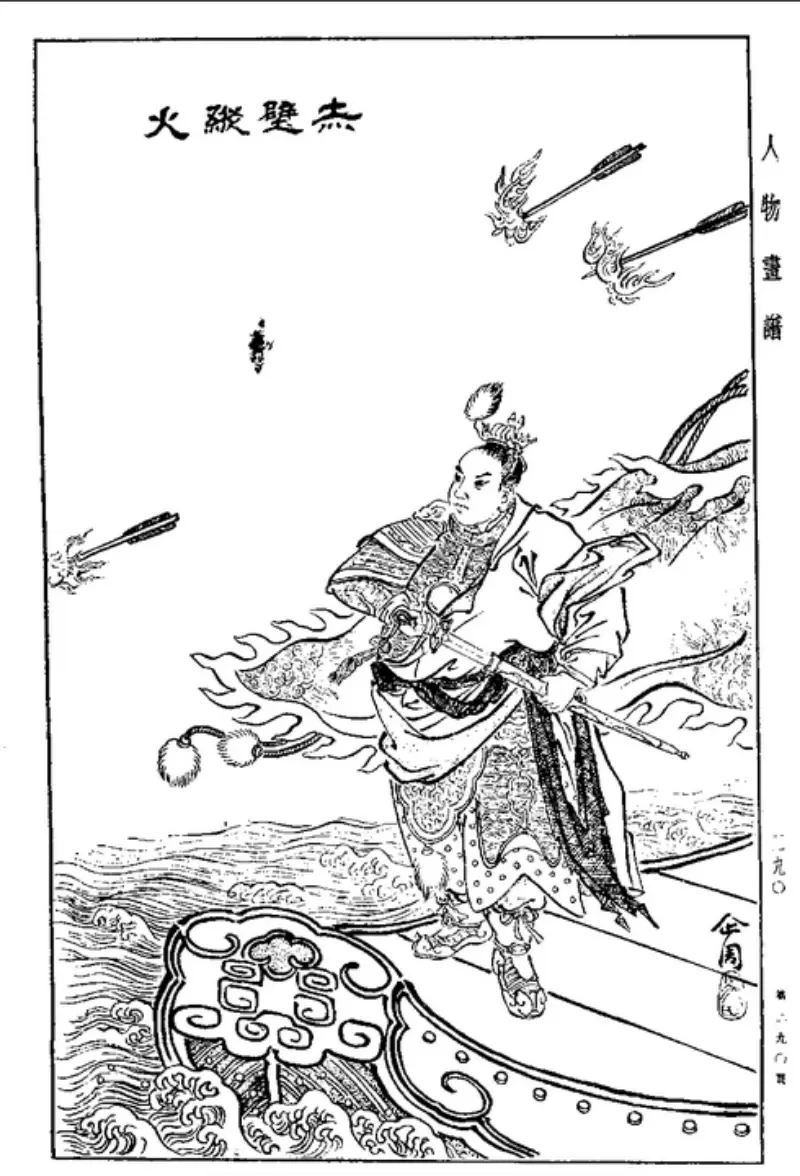
Figure: Ma Tai (馬駘), "Setting Fire at Red Cliffs" (赤壁縱火, 1928), showing Zhou Yu at the prow of a ship. · Wikimedia Commons (public domain)
This article compares the original sources to see whose name the credit for Chibi was placed in at each layer of record and story. Starting from Chen Shou's history book, it passes through the Yuan dynasty storybook, the stage, and the novel, all the way to a Northern Song poet's song. Whether the scene of receiving arrows and the scene of praying for the southeast wind actually happened in history was covered in "Three Kingdoms — The Claim That It Is Seven Parts Fact", and here we only follow whose credit those scenes became.
Red Cliff, Four Records
In Chen Shou's book, Red Cliff appears in several places. Let us place four accounts of the course of the battle side by side. The "Annals of Emperor Wu" on the side of Wei is short. "Cao Gong arrived at Red Cliff and fought with Liu Bei, but it was not favorable (不利). Then a great pestilence broke out, many died, and he turned the army around" (Records of the Three Kingdoms, Book of Wei, "Annals of Emperor Wu"). Cao Gong is an elevated term for Cao Cao. In the "Biography of the First Sovereign" on the side of Liu Bei, tens of thousands of naval soldiers sent by Sun Quan, such as Zhou Yu and Cheng Pu, joined forces with the First Lord to greatly defeat Cao Gong at Red Cliff and burned his ships, and while pursuing, pestilence broke out again and many of the Northern army died (Records of the Three Kingdoms, Book of Shu, "Biography of the First Sovereign"). The First Lord is the name Chen Shou uses for Liu Bei.
In the "Biography of the Sovereign of Wu" on the side of Sun Quan, Zhou Yu and Cheng Pu were the left and right commanders—meaning chief generals who split and took charge of the army on the left and right—each commanding 10,000, and they advanced together with Liu Bei to greatly defeat Cao Gong's army (瑜、普爲左右督). In the same sentence, the person who burned the ships is Cao Cao himself. Cao Gong burned his remaining ships himself and retreated, and half or more of the soldiers died from hunger and pestilence (Records of the Three Kingdoms, Book of Wu, "Biography of the Sovereign of Wu").
The most detailed is the "Biography of Zhou Yu". "At that time, illness was already spreading in Cao Gong's army (已有疾病). In the first engagement, Cao Gong's army lost and retreated to camp on the north bank of the river." Then Zhou Yu's subordinate general Huang Gai says, "Now the enemy is many and we are few, so it is difficult to hold out for long. However, looking at the ships of Cao Cao's army, their heads and tails are linked together, so they can be burned and made to flee (可燒而走也)." After Huang Gai sent a false surrender letter and released fire ships, "at that time the wind was fierce and violent (時風盛猛), spreading to burn everything all the way to the camp on the riverbank," and very many people and horses burned to death or drowned in the water (Records of the Three Kingdoms, Book of Wu, "Biography of Zhou Yu").
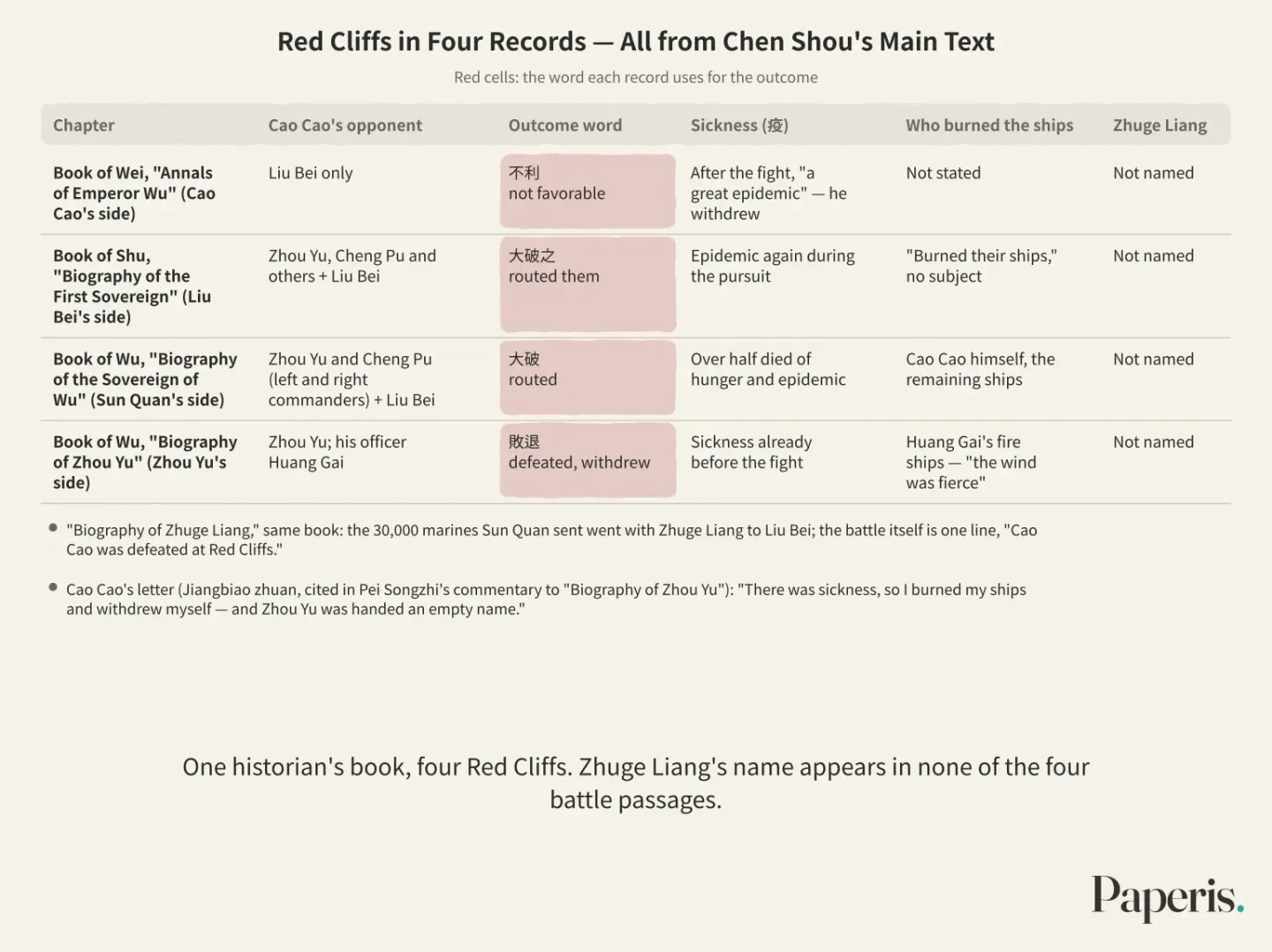
Figure: Red Cliffs in four records. In one historian's book, the outcome word, Cao Cao's opponent, the place of the sickness and who burned the ships differ from chapter to chapter.
When you place the four accounts side by side, three differences are visible. The person appearing as Cao Cao's opponent is only Liu Bei in the Book of Wei, whereas in the Book of Wu, Zhou Yu and Cheng Pu stand at the front and Liu Bei advances alongside them. The cause of the defeat in the Book of Wei is the pestilence that broke out after "it was not favorable," and Cao Cao turns the army around because of that pestilence. In the "Biography of Zhou Yu", Huang Gai's fire is added on top of the illness that was already spreading before the battle. The person who burned the ships is Cao Cao, who burned the remaining ships in the "Biography of the Sovereign of Wu", and Huang Gai in the "Biography of Zhou Yu". Even within the official history, the fact that the Red Cliff records in the Book of Wei, the Book of Wu, and the Book of Shu differ somewhat is a point confirmed by research (DOI: 10.17004/jrcn.2024..74.002). The name of the battle site is also used interchangeably between "Red Cliff" and "Wulin" within the Book of Wu, and one study suggests that later geographical books considered the northern bank of the Changjiang River as Wulin and the southern bank as Red Cliff, and that "Wulin" would be more fitting for the situation where Cao Cao's military camp was unilaterally attacked (DOI: 10.23037/dyn.2019..66.002).
There is a name absent in all four records. In Chen Shou's same book, the victor of Red Cliff is recorded under different names in each account, and Zhuge Liang's name does not appear anywhere in the battle sentences of the four records. If you leave only "won by fire", the pestilence of the Book of Wei is erased; if you leave only "lost to illness", the fire attack of the Book of Wu is erased.
What Zhuge Liang did at Red Cliff in the official history is what happened before the battle. When Liu Bei reached Hukou, Zhuge Liang stepped forward, saying, "The situation is urgent. I will take an order to ask General Sun for rescue." At that time, Sun Quan was leading his army at Xishang and watching to see how things would turn out. Zhuge Liang pushed Sun Quan, telling him to assess his strength and act accordingly—urging that if the forces of Wu and Yue could match the enemy, he should break with Cao Cao early on, and if he could not handle it, he should lay down his weapons and turn north to serve. He also stated that Cao Cao's army was in a situation where "even a strong crossbow at the end of its flight cannot pierce Lu silk," and that northerners were not accustomed to water battles. Sun Quan was greatly pleased and immediately sent 3,000 naval soldiers under Zhou Yu, Cheng Pu, and Lu Su, and that army "followed Liang to see the First Lord and joined forces to resist Cao Gong" (隨亮詣先主,并力拒曹公) (Records of the Three Kingdoms, Book of Shu, "Biography of Zhuge Liang"). This 30,000 is the number in Chen Shou's text, while the Liu Bei side's troop strength of "Guan Yu's 10,000 naval soldiers and Liu Qi's 10,000 soldiers" is the number in Zhuge Liang's words.
After that, the Red Cliff in the main text of the "Biography of Zhuge Liang" is a single line: "Cao Gong was defeated at Red Cliff and led his army back to Ye," and Zhuge Liang becomes a military counselor-general, collecting taxes from three commanderies to replenish military supplies (Records of the Three Kingdoms, Book of Shu, "Biography of Zhuge Liang"). Chen Shou praised this diplomacy in a writing submitted to the emperor: "Zhuge Liang was twenty-seven at the time, and he devised strange strategies (奇策) and went personally as an envoy to Sun Quan to ask for rescue for Wu" (Records of the Three Kingdoms, Book of Shu, "Biography of Zhuge Liang", Chen Shou's memorial included in it). In the official history this writing read, Zhuge Liang does not summon the wind, but instead carries out persuasion to move an army of 30,000 and returns to Liu Bei together with that army.
The Person Whose Credit Overlapped, Lu Su
Pei Songzhi added a judgment to the main text of the "Biography of Zhou Yu": "The plan to block Cao Cao actually started with Lu Su (實始魯肅)." At that time, Zhou Yu was away on an embassy to Poyang, and Lu Su had advised Sun Quan to summon Zhou Yu back. Pei Songzhi writes that when Zhou Yu returned from Poyang, his intentions were secretly the same as Lu Su's, "so they were able to achieve great success together" (瑜使鄱陽還,但與肅闇同,故能共成大勳). However, the main biography only says that Zhou Yu dismissed the discussions of the crowd and stated the plan to fight back alone, with no mention at all that Lu Su devised it first, leading to the remark, "Perhaps this was stealing the credit for Lu Su's good deed (殆為攘肅之善也)" (Records of the Three Kingdoms, Book of Wu, "Biography of Zhou Yu", Pei Songzhi's commentary). The main text of the "Biography of Lu Su" likewise records that Lu Su chased after and advised calling back Zhou Yu, who had gone to Poyang (Records of the Three Kingdoms, Book of Wu, "Biography of Lu Su").
Sun Quan's own words also divide the credit between the two men. Looking back later, Sun Quan cited as Lu Su's "second moment of elation" the fact that Lu Su refuted the arguments for surrender and "advised me to hastily summon Gongjin to take charge of the army and strike back." On the same occasion, he praised Zhou Yu, saying that he was "magnificent, resolute, daring, and resourceful beyond others, and finally smashed Mengde and opened up Jingzhou" (Records of the Three Kingdoms, Book of Wu, "Biography of Lü Meng"). Mengde is Cao Cao's courtesy name. In Sun Quan's words, the proposal to fight belongs to Lu Su, and the credit for defeating Cao Cao belongs to Zhou Yu.
The credit for the alliance was split between Wu and Shu. Pei Songzhi also added a judgment to the "Biography of Lu Su," noting that Liu Bei joining forces with Sun Quan to jointly block the Central Plains was entirely Lu Su's original plan. Yet the "Biography of Zhuge Liang" in the Book of Shu, quoted by Pei Songzhi, states that when Zhuge Liang persuaded Sun Quan using the strategy of the alliance of Yan and Zhao, Sun Quan was greatly pleased, making it sound as if that strategy originated with Zhuge Liang in the first place. Pei Songzhi remarked that even if the historians of the two countries each claimed the credit for their own state, "now these two books come from the same person yet contradict each other like this, this is not the system of recording history" (Records of the Three Kingdoms, Book of Wu, "Biography of Lu Su", Pei Songzhi's commentary). Whose the plans before Red Cliffs and the credit for the alliance were had already conflicted chapter by chapter within Chen Shou's own book, and it was Pei Songzhi who pointed this out. Amidst those contradictions, the Wu figure whose credit overlapped with Zhuge Liang's side was Lu Su.
The commentary also contains records that build up Zhou Yu, most of which are drawn by Pei Songzhi from the Jiangbiao zhuan. Jiang Gan, a persuader sent by Cao Cao, failed to sway Zhou Yu and returned saying that he had "broad-mindedness and lofty elegance (雅量高致), and cannot be alienated by mere words." Cheng Pu, who had looked down on Zhou Yu because of his age, later became deeply impressed, saying, "Associating with Zhou Gongjin is like drinking pure, strong wine; before you know it, you are drunk" (若飲醇醪), while Sun Quan, after becoming emperor, stated, "If not for Zhou Gongjin, I would not have become emperor" (孤非周公瑾,不帝矣) (Records of the Three Kingdoms, Book of Wu, "Biography of Zhou Yu", Pei Songzhi's commentary citing Jiangbiao zhuan). The discord with Cheng Pu is in the main text, while the reconciliation over the "strong wine" is in this commentary.
A different passage in the same Jiangbiao zhuan places things on a scale. The Jiangbiao zhuan records that even when Liu Bei heard Zhou Yu had an army of 30,000, he did not trust that Zhou Yu would definitely defeat the Northern Army, so he brought along only 2,000 men, hung back behind them, and calculated his advance and retreat. Sun Sheng, whom Pei Songzhi included alongside in the commentary, criticized this passage, stating that Liu Bei, having asked Wu for help when he was facing ruin, had no reason to hesitate by the riverbank, and that this was "words by the men of Wu trying to monopolize all the beauty" (吳人欲專美之辭) (Records of the Three Kingdoms, Book of Shu, "Biography of the First Sovereign", Pei Songzhi's commentary). Words from the defeated side are also recorded in the Jiangbiao zhuan. The Jiangbiao zhuan passes down that Cao Cao later wrote a letter to Sun Quan saying, "The Battle of Red Cliffs was simply because a plague broke out and I burned my ships and retreated of my own accord, letting Zhou Yu vainly win an undeserved name" (虛獲此名) (Records of the Three Kingdoms, Book of Wu, "Biography of Zhou Yu", Pei Songzhi's commentary citing Jiangbiao zhuan). Being the explanation of the defeated person, this letter cannot be read as testimony determining whose credit it was.
The Zhou Yu of the main official history text is also a calculating person. After Red Cliffs, Zhou Yu submitted a memorial to Sun Quan arguing that Liu Bei possessed the qualities of a hero and lorded over generals like Guan Yu and Zhang Fei, making him someone who would not bow to others for long; he suggested moving Liu Bei to Wu, building magnificent palaces for him, pleasing his ears and eyes with beauties and toys, and splitting the two generals apart. If they gave him territory, he feared that "a horned dragon will obtain the clouds and rain, and ultimately not be a creature of the pond" (蛟龍得雲雨,終非池中物也), and Sun Quan did not accept this. At Nanjun, he confronted Cao Cao's general Cao Ren for over a year with very heavy casualties and injuries, and Zhou Yu personally fought, taking a flying arrow in his right flank, yet still got up to tour the military camps and encourage his officers and soldiers (Records of the Three Kingdoms, Book of Wu, "Biography of Zhou Yu" and "Biography of the Sovereign of Wu"). Chen Shou's appraisal praises Zhou Yu by pairing him with Lu Su. When everyone was suspicious and harbored divided loyalties, "Zhou Yu and Lu Su alone established the clarity of decisive judgment to rise above the crowd—truly marvelous talents" (Records of the Three Kingdoms, Book of Wu, "Biographies of Zhou Yu, Lu Su and Lü Meng", Chen Shou's appraisal). What Chen Shou praises is the decisive judgment rather than the skill of the fire attack.
The preface to a 1992 English study on the history of Wu notes that the stories handed down by Chen Shou and his competitors and collected by Pei Songzhi are themselves mixtures of fact and fiction, and that the official history differs from historical romance often not by a neat contrast of true and false, but rather like "an alternative form of romance." Its author states an intention to look first at the earliest recorders and ask how things actually happened (DOI: 10.2307/2760227).
When the original texts of this section are placed side by side, the credit for Red Cliffs was already recorded as divided among several people at the level of the official history.
The Recipient of the Arrows Changes
In the Yuan Dynasty storybook, the person who collects the arrows right before the Battle of Red Cliffs is Zhou Yu. “Sanguozhi pinghua” is a Three Kingdoms storybook published during the Yuan Dynasty, representing a form of the story that predates the Romance. In that volume, when Cao Cao orders his archers to fire, Zhou Yu uses a boat covered with curtains to catch arrows on the left side, has the oarsmen turn the boat around, and catches them on the right side as well. In an instant, the boat is full of arrows, and Zhou Yu joyfully shouts, "Prime Minister, thank you for the arrows!" (丞相,謝箭!) (Sanguozhi pinghua, middle volume). In the official history, the person who turns the boat around to evenly collect the arrows is Sun Quan at Ruxu in 213 (Records of the Three Kingdoms, Book of Wu, "Biography of the Sovereign of Wu", Pei Songzhi's commentary citing Weilüe), and in Chapter 46 of the Romance, Zhuge Liang makes the soldiers on the boat shout in unison, "Prime Minister, thank you for the arrows!" (謝丞相箭!) (Romance of the Three Kingdoms, Chapter 46). Pinghua's Zhou Yu says those words with his own mouth, whereas the Romance's Zhuge Liang has his soldiers say them. The events of “Weilüe” belong to a different battle at Ruxu in 213, while the events of Pinghua and the Romance take place right before Red Cliffs.
The wind is already Zhuge Liang's domain in Pinghua. When Zhou Yu has his generals write a strategy on the palms of their hands, they all write "Fire" (火), and only Zhuge Liang's palm has the character "Wind" (風). Zhuge Liang says, "You all use fire; I will assist with the wind," and Zhou Yu retorts that wind and rain are the work of heaven, asking how Zhuge Liang can possibly conjure wind. Then he thinks to himself, "I am going to use a brilliant strategy to prevent a single piece of Cao Cao's army's armor from returning, yet Zhuge Liang is encroaching upon my credit!" (諸葛侵了我功) A few days later, Zhuge Liang puts on a yellow robe, lets down his hair, goes barefoot, holds a sword in his left hand, and performs magic arts to stir up a great wind (Sanguozhi pinghua, middle volume). In the Yuan Dynasty storybook, Zhou Yu already says to himself, "Zhuge Liang is encroaching upon my credit."
The same passage does not assign the credit to just one side. A poem right after the wind rises chants, "People at the time all feared Commander Zhou," and concludes that heaven made known how the events after the tripartite division "all depended upon the loyal efforts of Huang Gai" (Sanguozhi pinghua, middle volume). The figures to whom Pinghua's poem awards the credit for Red Cliffs are Zhou Yu and Huang Gai.
Pinghua's Zhou Yu collapses multiple times. Taunted by Liu Bei's general Zhang Fei, he cries, "This is all Zhuge Liang's doing!", and every time he shouts, blood spurts from his metal wound; this book features at least five scenes of this just focusing on the strong ones. His death comes at Baqiu. Suffering unbearable pain from his wound, Zhou Yu falls ill in Baqiu Castle and cannot get up, unable to swallow food for days while his head and face swell. Sun Quan rebukes Lu Su, saying that Liu Bei "had a bumpkin cause my cherished general Zhou Yu to die of anger" (Sanguozhi pinghua, last volume). Arrow wounds, rage, and illness overlap in a single death, and "Since you gave birth to Yu, why did you have to give birth to Liang?" is nowhere to be found in Volumes 2 and 3 of Pinghua, which this text examines.
On the stage, two men claim the same credit as their own. Zaju is a Yuan and Ming Dynasty theatrical art form that combined songs and spoken dialogue for the stage. In the Yuan or Ming anonymous zaju Two Strategists Matching Wits Across the River (Liang junshi gejiang douzhi), Zhou Yu introduces himself by saying, "Only I, Lord Zhou, make my name ring out across the great river east" (只俺周郎名振大江東), and states that he acted as commander-in-chief while Huang Gai served as vanguard, using a single handful of fire to burn Cao Cao's 830,000 troops so that not a single piece of armor returned (zaju Two Strategists Matching Wits Across the River, act 1). In the next scene, Zhuge Liang introduces himself by claiming that he borrowed the eastern wind for three days and nights atop the Wind-Altar, using a single handful of fire to burn all of Cao Cao's 830,000 troops to death beneath Red Cliffs (zaju Two Strategists Matching Wits Across the River, act 2). The same fire, the same 830,000 troops, but two masters. The 830,000 is the figure spoken by the characters within the play.
The victory on that stage tilts toward Zhuge Liang's side. Zhuge Liang chants, "Zhou Gongjin vainly executed three strategies, only to suffer a fit of rage from me in return" (周公瑾枉施三計,反受我一場嘔氣) (zaju Two Strategists Matching Wits Across the River, act 3), and Zhang Fei taunts, "Do not boast that your brilliant strategies tower over the world; you will merely end up giving away your wife and losing your troops as well" (zaju Two Strategists Matching Wits Across the River, act 2). However, Zhou Yu does not die on stage in this zaju. Yuan Dynasty Three Kingdoms theatrical plays primarily featured characters from the Shu Han faction like Zhang Fei, Guan Yu, Zhuge Liang, Liu Bei, and Ma Chao as protagonists, and one study connects this to the playwrights' and commoners' aspirations for political legitimacy and clean government (DOI: 10.35982/jcs.110.8).
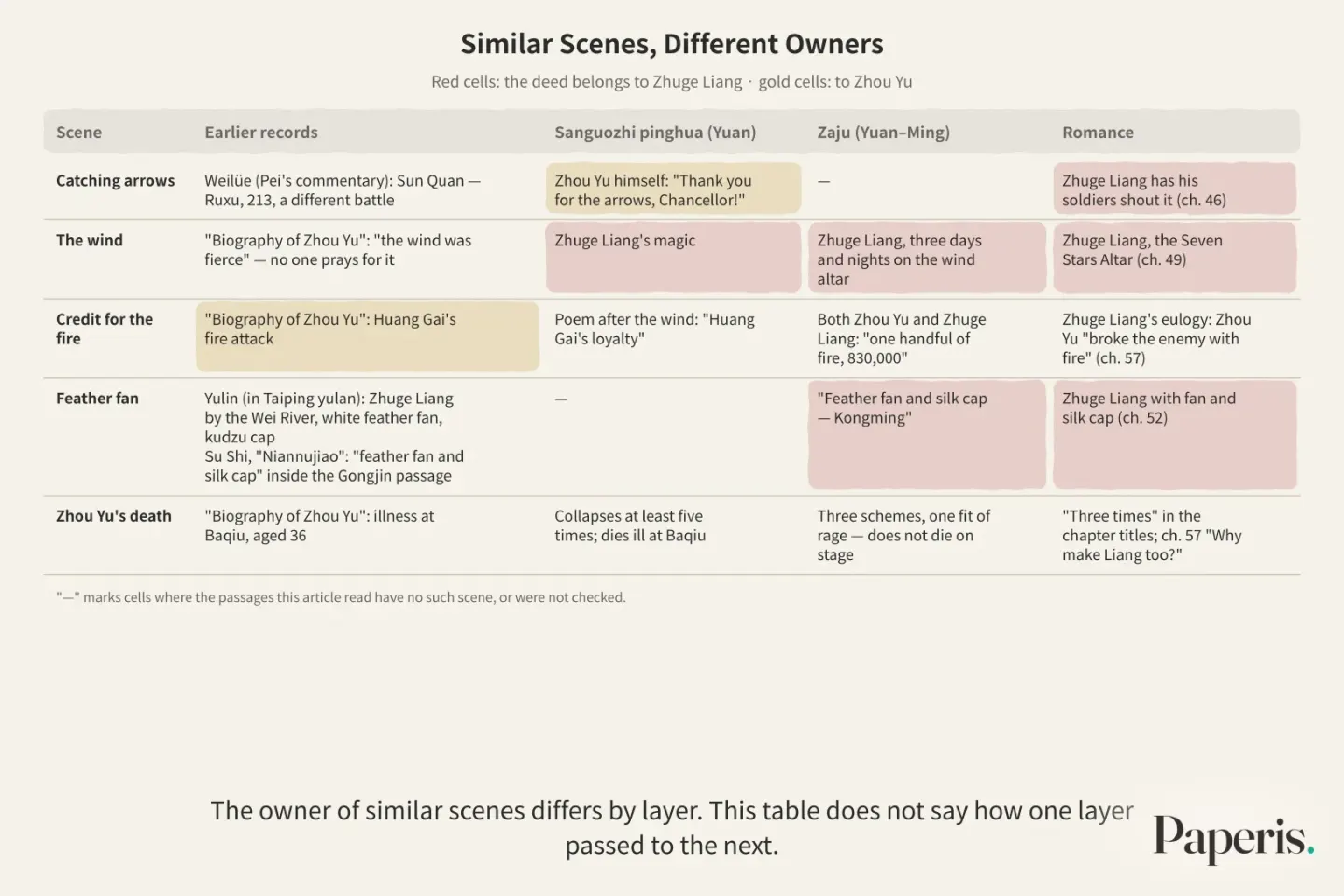
Figure: Similar scenes, different owners. Red cells: the deed is Zhuge Liang's; gold cells: Zhou Yu's. Influence between layers is not drawn.
Across different layers, the owner of a similar scene changes. The person who turns the boat around to receive arrows is Sun Quan in “Weilüe”, Zhou Yu in Pinghua, and Zhuge Liang in the Romance. The wind is Zhuge Liang's domain starting from Pinghua, and the fire is claimed as their own by both men within the plays.
The Romance Knew the Official History
In Chapter 44 of the Romance, Zhou Yu counts Cao Cao’s weaknesses one by one in front of Sun Quan. He points out that the north is not yet pacified, that it is the dead of winter with no grass to feed the horses, and that the Central Plains soldiers are unaccustomed to the water and land, causing widespread illness (Romance of the Three Kingdoms, Chapter 44). This tally is nearly identical to what Zhou Yu says in the main text of the official history (Records of the Three Kingdoms, Book of Wu, "Biography of Zhou Yu"). What stands out are the changes in numbers. Zhou Yu in the official history requests "30,000 elite troops" (精兵三萬人), whereas Zhou Yu in the Romance requests "several thousand elite troops" (精兵數千). Furthermore, the person cited as a rear threat in the north is changed from Ma Chao in the official history to Ma Teng in the Romance. The opponent Cao Cao is fighting is "Wu and Yue" (吳越) in the official history, but "Eastern Wu" (東吳) in the Romance.
Zhou Yu’s scenes in the Romance incorporate several sentences from the official history and its annotations. However, the speakers or recipients are different.
- In Chapter 45, Jiang Gan reports to Cao Cao, using the exact words from the annotations of the official history that "Zhou Yu is broad-minded and of lofty elegance" and cannot be moved by words, before producing a forged letter he stole (Romance of the Three Kingdoms, Chapter 45). In the annotations of the official history, Jiang Gan is the person who fails in his persuasion and praises Zhou Yu.
- In Chapter 55, the letter Zhou Yu sends to Sun Quan—proposing to keep Liu Bei trapped in Wu, build grand palaces for him, and send beauties and trinkets to delight his ears and eyes—uses nearly the same wording as Zhou Yu’s memorial in the main text of the official history (Romance of the Three Kingdoms, Chapter 55). In the official history, the act of sending Sun Quan’s younger sister to Liu Bei is an action from Sun Quan’s side: "Sun Quan gradually grew to fear him, and sent his younger sister to solidify their friendship" (權稍畏之,進妹固好) (Records of the Three Kingdoms, Book of Shu, "Biography of the First Sovereign").
- In Chapter 56, the words Liu Bei tells Zhou Yu through Zhao Yun, the Shu general on the ramparts—"If Eastern Wu truly attacks Shu, I would rather let my hair down and enter the mountains than lose my trustworthiness to the world"—also appear in the Xiandi chunqiu, which is cited in the official history's annotations. The "Yu" (瑜) to whom Liu Bei addresses those words there is Sun Yu (孫瑜), whom Sun Quan had provided with a naval force and sent to Haxia (Records of the Three Kingdoms, Book of Shu, "Biography of the First Sovereign", Pei Songzhi's commentary citing Xiandi chunqiu). The final character of their names is the same.
- In Chapter 57, the letter from Zhuge Liang that Zhou Yu reads before dying—stating that Yizhou has strong people and rugged terrain, so even Wu Qi could not determine its scope and even Sun Wu could not properly finish what followed—is nearly identical to the reply Liu Bei sends to Sun Quan in the same Xiandi chunqiu (Romance of the Three Kingdoms, Chapter 57).
- In Chapter 57, Zhou Yu’s last will and testament shares the exact same wording as a letter from the Jiangbiao zhuan cited in the annotations of the "Biography of Lu Su" (Records of the Three Kingdoms, Book of Wu, "Biography of Lu Su", Pei Songzhi's commentary citing Jiangbiao zhuan), and Sun Quan’s lament that "Gongjin had the foundation to assist a king, but now his life has prematurely ended, whom can I trust?" is likewise identical to the Jiangbiao zhuan version (Records of the Three Kingdoms, Book of Wu, "Biography of Zhou Yu", Pei Songzhi's commentary citing Jiangbiao zhuan; Romance of the Three Kingdoms, Chapter 57).
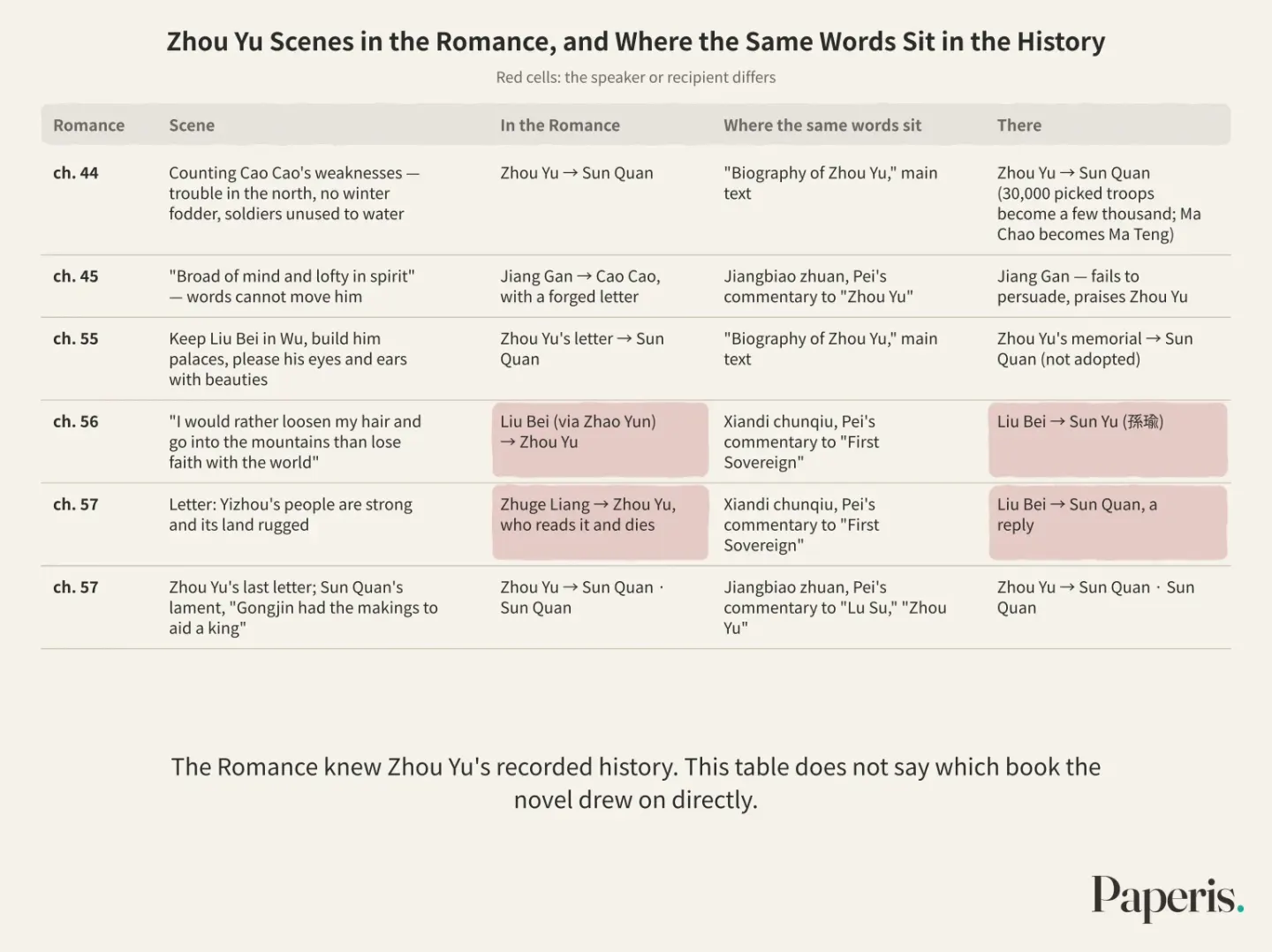
Figure: Zhou Yu scenes in the Romance and where the same words sit in the history. Red cells: the speaker or recipient differs.
The Romance knew Zhou Yu's biographical record from the official history, and those sentences are woven throughout the scenes where Zhou Yu devises strategies and collapses in the Romance. A poem by the narrator in the same chapter illustrates this fact. The narrator's poem in Chapter 57 honors Zhou Yu as having "left magnificent achievements at Red Cliffs... recognized refined meanings in the cadence of songs, and toasted good friends with wine goblets" (Romance of the Three Kingdoms, Chapter 57). The cadence of songs recalls the song from the main text of the official history. From a young age, Zhou Yu poured his heart into music; even after three rounds of wine, if a performance had a mistake, he would invariably notice and look back, leading people of the time to sing, "When a tune has a mistake, Lord Zhou looks back" (曲有誤,周郎顧) (Records of the Three Kingdoms, Book of Wu, "Biography of Zhou Yu"). The wine goblets overlap with the "strong wine" from Jiangnan. Lord Zhou is the name the people of the Wu region used to call the 24-year-old Zhou Yu.
Even within the Romance, judgments of his achievements are mixed. The narrator’s poem in the southeast wind episode of Chapter 49 asks, "Had Kongming not employed wondrous strategies, how could Lord Zhou have displayed his talents?" (不是孔明施妙計,周郎安得逞才能), thus attributing the credit to Zhuge Liang (Romance of the Three Kingdoms, Chapter 49). Yet Zhuge Liang's eulogy for Zhou Yu in Chapter 57 praises Zhou Yu for having "broken the enemy with fire attack (火攻破敵) and made the strong weak" (Romance of the Three Kingdoms, Chapter 57). One study examining this eulogy suggests that despite the hostility of the Wu generals, Zhuge Liang attends the mourning to recount Zhou Yu’s life and achievements in a eulogy, thereby persuading the Wu generals of his own innocence regarding Zhou Yu's death (DOI: 10.54797/tfl.v42i2-3.11698). The mouth recounting Zhou Yu's life and achievements through a eulogy is Zhuge Liang's.
"Three times" is also a calculation made by the novel. The Romance titles Chapters 51, 55, and 56 with "Kongming angers Zhou Gongjin for the first time," "the second time," and "the third time." At the end of Chapter 55, the soldiers on the riverbank cry out, "Lord Zhou's wondrous strategy was supposed to pacify the world, yet he gave away a wife and lost his troops!" whereupon Zhou Yu shouts loudly, bursts his old wound, and collapses onto a boat (Romance of the Three Kingdoms, Chapter 55). However, scenes where Zhou Yu collapses or bursts his wound occur more often in the main text of the Romance than the chapter titles indicate. The Romance counted these various collapses in its main text as three times in the chapter titles. This tally varies by book; in the pinghua versions, there are at least five collapsing scenes, whereas in the zaju plays, the tally holds that three strategies lead him to be angered into death once.
Studies also pinpoint where the Romance begins to tilt. One study suggests that prior to the Battle of Red Cliffs, the Romance depicts Cao Cao, Zhou Yu, Guan Yu, and Kongming in detail without bias, but after Cao Cao's defeat, it treats Liu Bei, Kongming, Guan Yu, and Zhang Fei as loyal subjects of the Han dynasty while treating Cao Cao as a traitor—largely driven by the folk sentiment passed down through generations that glorified Liu Bei and disparaged Cao Cao (DOI: 10.22947/ihmju.2014.35.4.005). Yongliu biancao (擁劉貶曹) is the narrative tendency to support Liu Bei and denigrate Cao Cao. Studies addressing the discrepancies between historical fiction and truth cite yongliu biancao stemming from the perspective that regards Shu-Han as legitimate as the primary historical cause, while also noting literary fiction, artistic sublimation, and commercialism driven by profit (DOI: 10.22786/chll.2021..76.003). Another study suggests that in the Romance, the textual memory of official histories and historical commentary forms the skeleton, while the sentiments of storytellers' storytelling, pinghua, and zaju are absorbed into it and simultaneously kept in check (DOI: 10.33575/KCRR.2026.12.3.219). Zhou Yu's scenes in the Romance contain the sentences of the official history alongside the rancor previously found in pinghua and zaju.
Whose Hand Holds the Feather Fan
There is a ci poem in which Su Shi (蘇軾), a literary figure of the Northern Song, sings of Red Cliffs. A ci is a poetic lyric form where words and rhymes are filled in to fit a fixed tune's melody, and this song is "Thoughts of the Past at Red Cliffs" set to the tune of "Niannujiao". From its very opening lines, the textual editions diverge (between "浪淘盡" and "浪聲沈"), and the phrases stating the owner of Red Cliffs also split into "三國周郎赤壁" and "三國孫吳赤壁". Today's standard text is "What people call the Red Cliffs of Zhou Lang of the Three Kingdoms". According to hearsay recorded by Hong Mai (洪邁) of the Southern Song in his Rongzhai xubi, a copy of Su Shi's song handwritten by the Northern Song literary figure Huang Tingjian (黃庭堅) had it as "the Red Cliffs of Sun's Wu" (三國孫吳赤壁) (Su Shi, "Niannujiao: Meditation on the Past at Red Cliff", version quoted in Rongzhai xubi). Hong Mai himself wrote that he did not know where that handwritten copy by Huang Tingjian, which he heard about from others, is now. From whether the Red Cliffs belong to Zhou Lang or to the Sun family's Wu, Su Shi's song differs across textual editions.
The latter part of the song depicts Zhou Yu in all three editions. "Thinking far back to Gongjin in those days, Xiaoqiao had just been married, and his valiant bearing was brilliant. Amidst laughing and talking while holding a feather fan and wearing a silk turban (羽扇綸巾,談笑處、檣艣灰飛煙滅), masts and oars turned to ashes and flew away, vanishing like smoke." (Su Shi, "Niannujiao: Meditation on the Past at Red Cliff") Xiaoqiao is Zhou Yu's wife, and official history records that Zhou Yu took the younger daughter of Qiao Gong as his wife and writes her surname as "橋" (Records of the Three Kingdoms, Book of Wu, "Biography of Zhou Yu"). In this passage, there is no name of any figure other than Gongjin, and there is no separate subject before the feather fan and the silk turban. What can be said from the context of the original text is only that the feather fan and the silk turban are placed within the passage depicting Gongjin's those days. Chapter 57 of the Romance also contains Zhuge Liang's eulogy with "Thinking of you back then, your valiant bearing was brilliant" (想君當年,雄姿英發), making the four characters "雄姿英發" identical to Su Shi's song.
In other writings by Su Shi as well, the victor of Red Cliffs is Zhou Lang. In "First Rhapsody on Red Cliff", which records a boat excursion beneath Red Cliffs in the autumn of the renxu year (1082) (DOI: 10.15513/jaah.2013.12.31.159), a guest aboard the boat looks toward Red Cliffs and asks, "Is this not the place where Mengde was cornered by Zhou Lang?" (此非孟德之困於周郎者乎) and laments Cao Cao, whose boats once stretched for a thousand li, saying, "Truly he was a hero of an age. Yet where is he now?" (Su Shi, "First Rhapsody on Red Cliff"). That remark is the guest's, and Zhuge Liang does not appear in this piece. One study suggests that Su Shi used Red Cliffs as a background for philosophical reflection rather than the events of 208 (DOI: 10.32657/10356/173171).
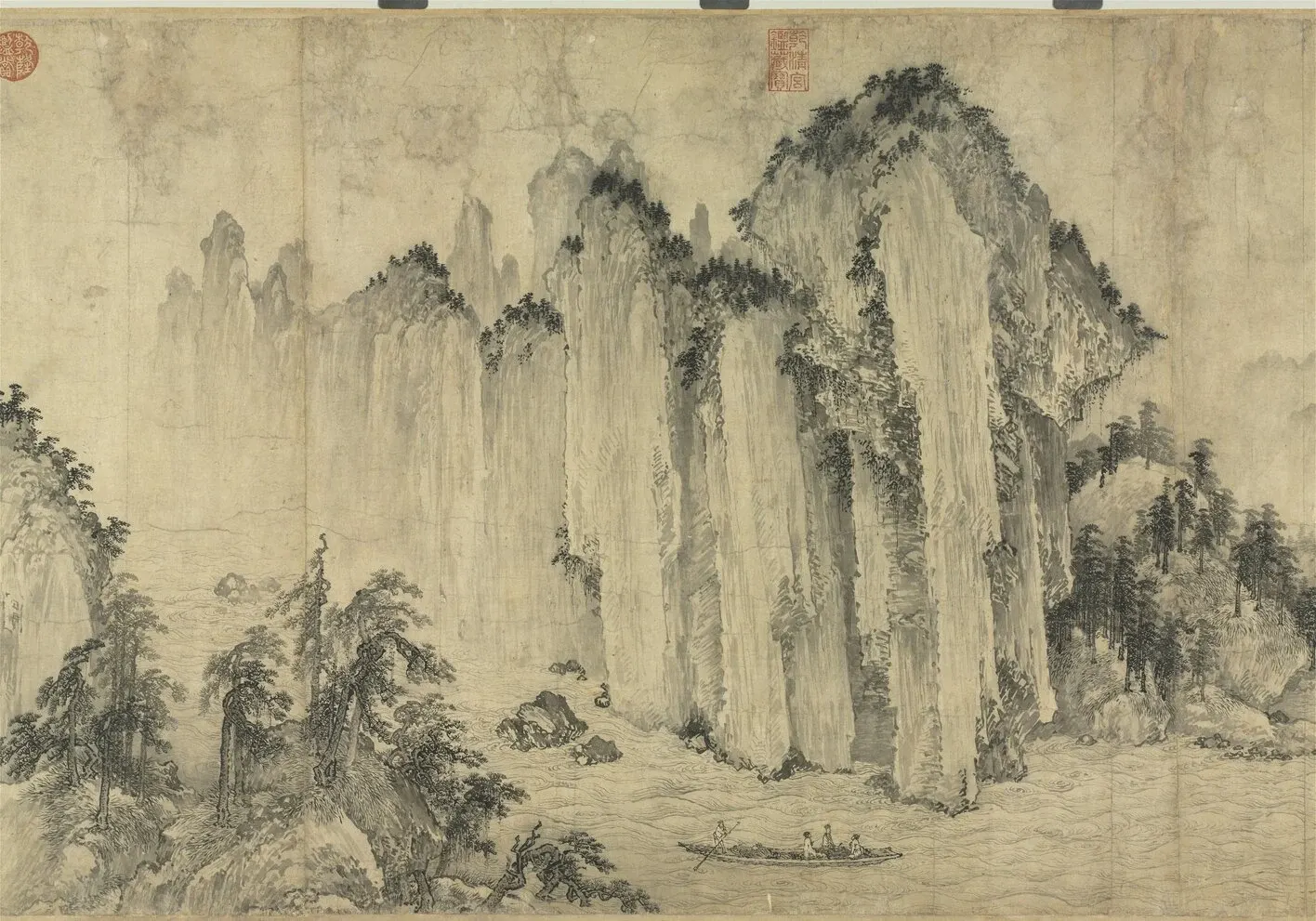
Figure: Detail of "Red Cliff" by the Jin-dynasty painter Wu Yuanzhi (武元直), a handscroll illustrating Su Shi's "Rhapsody on Red Cliff," with Su Shi and his guests in a small boat beneath the cliffs. · National Palace Museum, Taipei, via Wikimedia Commons (CC0)
The feather fan is already in Zhuge Liang's hand in records predating Su Shi's song. The Yulin, cited in the encyclopedic Taiping yulan compiled in the early Northern Song, records that when Zhuge Wuhou was about to fight the Wei general Sima Yi by the Wei River, "he rode a white chariot, wore a ge turban, and directed the three armies with a white feather fan (白羽扇指麾三軍), and the three armies all followed his advancing and halting" (Taiping yulan, juan 702, citing Yulin). Wuhou is Zhuge Liang's posthumous title, and in the same passage recorded in another volume, Sima Yi hears the news and laments, "He may well be called a brilliant strategist!" (Taiping yulan, juan 774, citing Yulin). That headwear is a ge turban, and the scene is a different battle from Red Cliffs—the Wei River facing Sima Yi. What is identical to Su Shi's song is only the "white feather fan".
In later zaju dramas and the Romance, the four characters "羽扇綸巾" are established as Zhuge Liang's attire. The zaju drama The Two armies Battle and Force the Strategy to Halt calls Zhuge Liang "Yingfan-and-turban-wearing Kongming" and sings, "When devising plans within the military camp, he was always in a feather fan and silk turban attire" (zaju Two Strategists Matching Wits Across the River, acts 2 and 4). In Chapter 52 of the Romance, a person wearing a silk turban on his head, draped in a crane-feather cloak, and holding a feather fan in his hand steps forward, declaring, "I am Zhuge Kongming of Nanyang" (Romance of the Three Kingdoms, Chapter 52). One study notes that in paintings, the feather fan and silk turban—the most prominent features of Zhuge Liang's iconography—were established among literati painters from the mid-Ming dynasty onward (KCI ART001502065). Today, Zhuge Liang's feather fan and silk turban are widely recognized cultural symbols carrying wisdom and composure (DOI: 10.54097/z4tb5v49).
Along with his attire, the things Zhuge Liang could do also grew grander. One study considers that Zhuge Liang's image was gradually deified after the Jin dynasty, and especially after the Romance, he became a god-like figure who devised flawless plans and summoned wind and rain, clearly moving away from the Zhuge Liang under the historian's pen (DOI: 10.37134/erudite.vol5.sp.5.2024). The earliest among those historians is Chen Shou's Records of the Three Kingdoms. Chen Shou describes Zhuge Liang as a great talent who knew how to govern, comparable to Guan Zhong and Xiao He, yet he wrote, "Perhaps the military strategy of adapting to changing circumstances was not his strong suit" (應變將略,非其所長歟) (Records of the Three Kingdoms, Book of Shu, "Biography of Zhuge Liang", Chen Shou's appraisal). The final character "歟" carries a tone of conjecture, and in a memorial, Chen Shou jointly cited the reasons why he moved the army year after year without winning: the opponent was occasionally an outstanding figure, the military forces were not on equal terms, and the offensive and defensive positions differed (Records of the Three Kingdoms, Book of Shu, "Biography of Zhuge Liang", Chen Shou's memorial included in it). A study dealing with Zhuge Liang in Ming dynasty Three Kingdoms plays also notes that the Zhuge Liang of historical records was someone better at managing an army than at devising strange stratagems, and better at governing people than playing the general, whereas among the common people he became a figure who devised airtight plans and even summoned wind and rain (DOI: 10.17265/2328-2177/2025.12.004).
Returning to the opening scene, the person reading the eulogy honoring Zhou Yu in Chapter 57 is Zhuge Liang, and that eulogy contains "We broke the enemy with a fire attack." The imperial edict of the same chapter chants, "You left a magnificent achievement at Red Cliffs." In official history, the credit for Red Cliffs was divided among Zhou Yu, Cheng Pu, Huang Gai's fire, Lu Su's persuasion, Zhuge Liang's lobbying, Liu Bei (whom the Book of Wei names as Cao Cao's opponent), and the illness within Cao Cao's army, and Pei Songzhi had already weighed those shares. In vernacular storytelling, Zhou Yu received arrows while Zhuge Liang summoned the wind; in zaju dramas, both burned the 830,000 troops; and the Romance placed Zhou Yu's historical prose passages into scenes where Zhou Yu devises plans and collapses. The feather fan also occupies different positions across levels. In the Yulin, it is in Zhuge Liang's hand at the Wei River; in Su Shi's song, it is within the passage depicting Gongjin; and in zaju dramas, the Romance, and paintings, it is back in Zhuge Liang's attire. The stories did not erase the credit of Red Cliffs. They placed those shares back before different names at each level.
An open question remains. Which side first proposed the alliance strategy cannot be determined from the original texts alone because Chen Shou's two accounts contradict each other, nor can it be decided whether Su Shi's originally written phrase was "Zhou Lang" or "Sun's Wu" since Huang Tingjian's handwritten copy has not survived. How to read the passage in Su Shi's song where there is no subject before the feather fan and silk turban, and what relationship the white feather fan of the Yulin and the later "feather fan and silk turban" bear to each other, are not told by the original texts read here nor by studies.
Primary Sources
- Records of the Three Kingdoms (authored by Chen Shou, annotated by Pei Songzhi) — Book of Wei: "Annals of Emperor Wu" (Volume 1: main text) · Book of Shu: "Biography of the First Sovereign" (Volume 32: main text, Jiangbiao zhuan and Xiandi chunqiu cited in Pei Songzhi's annotations, and Sun Sheng's judgments) · Book of Shu: "Biography of Zhuge Liang" (Volume 35: main text, Chen Shou's appraisal, and Chen Shou's formal memorial) · Book of Wu: "Biography of the Sovereign of Wu" (Volume 47: main text, Weilüe cited in Pei Songzhi's annotations) · Book of Wu: "Biographies of Zhou Yu, Lu Su and Lü Meng" (Volume 54: main text and Chen Shou's appraisal, Jiangbiao zhuan cited in Pei Songzhi's annotations, and Pei Songzhi's judgments)
- Sanguozhi pinghua (Plain Tale of the Three Kingdoms) — middle volume · last volume
- Two Strategists Matching Wits Across the River (Liang junshi gejiang douzhi, zaju, anonymous) — acts 1 · 2 · 3 · 4
- Romance of the Three Kingdoms (Mao Zonggang edition) — Chapter 44 · Chapter 45 · Chapter 46 · Chapter 49 · Chapter 52 · Chapter 55 · Chapter 57 (Chapter titles: Chapters 51, 55, and 56)
- Taiping yulan — juan 702, Clothing and Personal Accessories Section, "Fans" · juan 774, Vehicle Section, "Chariots" (citing Yulin)
- Su Shi — "Niannujiao: Meditation on the Past at Red Cliff" (standard version · version quoted in Rongzhai xubi, juan 8) · "First Rhapsody on Red Cliff"
Source Papers
- "Chapter Six. Red Cliffs 208" (2010) — DOI: 10.1163/ej.9789004185227.i-554.39 — In the winter of 208, Sun Quan's general Zhou Yu and the allied forces defeated Cao Cao at Red Cliffs, breaking Cao Cao's brief grip on Jingzhou and preventing Cao's army from ever crossing the Yangtze River.
- "삼국 이야기 속 赤壁大戰 서사의 변용 양상" (2024) — DOI: 10.17004/jrcn.2024..74.002 — Even in official history, the records of the Battle of Red Cliffs in the Book of Wei, the Book of Wu, and the Book of Shu differ somewhat and are drier and flatter than the novel; the novel gave characters new personalities through divinization and denigration, turning Red Cliffs into a spectacle narrative.
- "“삼국지” 연대·지명의 오류 - 손책·손권전의 시간 오류, 적벽과 오장원 논란 등을 중심으로" (2019) — DOI: 10.23037/dyn.2019..66.002 — The Book of Wu recorded the Battle of Red Cliffs as taking place at Wulin and Red Cliffs, and later geographical texts viewed the northern bank of the Yangtze as Wulin and the southern bank as Red Cliffs, with the designation "Wulin" likely fitting the situation where Cao Cao's military camp was subjected to a unilateral attack.
- "Generals of the South: The Foundation and Early History of the Three Kingdoms State of Wu" (1992) — DOI: 10.2307/2760227 — (Author's Preface) The stories themselves, as passed down by Chen Shou and his rivals and compiled by Pei Songzhi, are a mixture of fact and fiction, and official history is different from the Romance, acting less as a contrast of true and false and more as yet another story. The author considers the earliest recorders first.
- "元明三國戲主角人物設定特征研究" (2024) — DOI: 10.35982/jcs.110.8 — The protagonists of Yuan dynasty Three Kingdoms dramas were mainly figures from the Shu Han camp, linked to the aspirations of playwrights and commoners for legitimate governance and clean politics, whereas Ming dynasty dramas gave greater prominence to Guan Yu and Zhuge Liang, achieving a balance in the ratio of civil and military officials.
- "Vilande drakens elegi: Ett exempel på tillfällesdiktning i Berättelsen om de tre rikena" (2012) — DOI: 10.54797/tfl.v42i2-3.11698 — Zhuge Liang's eulogy for Zhou Yu in the Romance is a fictitious impromptu poem, in which Zhuge Liang goes to offer condolences despite the hostility of Wu generals, retracing Zhou Yu's life and achievements and persuading them of his innocence regarding Zhou Yu's death.
- "“三國演義” '赤壁大戰' 詩歌에 나타난 人物形象 小考" (2014) — DOI: 10.22947/ihmju.2014.35.4.005 — Before the Battle of Red Cliffs, the Romance depicts Cao Cao, Zhou Yu, Guan Yu, and Gongming without bias, but after Cao Cao's defeat, it treats the Liu Bei camp as loyal subjects of Han and Cao Cao as a traitor, driven primarily by popular sentiment honoring Liu Bei and cutting down Cao Cao.
- "“三國演義”에 나타난 虛構와 眞實의 矛盾性 硏究" (2021) — DOI: 10.22786/chll.2021..76.003 — The biggest cause of the contradiction between fiction and truth in official history and the Romance is the pro-Liu, anti-Cao stance derived from the orthodoxy of Shu Han, alongside literary fiction, artistic sublimation, and profit-driven commercialism.
- "집단기억과 영웅 서사의 형성 : “三國演義”와 “水滸傳”을 중심으로" (2026) — DOI: 10.33575/KCRR.2026.12.3.219 — In Romance of the Three Kingdoms, the textual memories of official history and historical commentary provided the skeleton while absorbing and simultaneously reining in the sentiments of storytellers, pinghua, and zaju, and Mao Zonggang's edition did not complete memory so much as remediate it in the direction of reinforcement.
- "Newly Introduced Chong Son's “The Painting Album of the Yon River in the Year of Imsul, Yongang Imsulchob (1742)”: Korean Representation of Su Shi's <Ode to the Red Cliff>" (2013) — DOI: 10.15513/jaah.2013.12.31.159 — Jeong Seon and others' boating trip in 1742 was an event commemorating Su Shi's story from the Year of Imsul (1082) 660 years later.
- "韓國古代赤壁船遊的跨學科研究 = An interdisciplinary study of ancient Korean boating by the Red Cliff" (2023) — DOI: 10.32657/10356/173171 — Su Shi used Red Cliffs as a backdrop for philosophical reflection rather than the event of Jian'an 13 (208), and that work made its way into Goryeo, giving rise to the culture of Red Cliff boating excursions.
- "明, 淸代시각문화를 통해 본 諸葛亮圖像의 전개와 성격 변모" (2010) — KCI ART001502065 — Worship of Zhuge Liang began soon after his death, but his iconography took off after Zhu Xi of the Southern Song established the orthodoxy of Shu Han; after the middle of the Ming dynasty, court production ceased and shifted to literati painters, establishing the feather fan and turban that are the iconography's greatest features.
- "Study of Characterization in Romance of the Three Kingdoms from the Perspective of Multimodal Discourse Analysis" (2026) — DOI: 10.54097/z4tb5v49 — Visual symbols like Zhuge Liang's feather fan and silk turban became widely recognized cultural signs linked to wisdom and calmness, and multimodal delivery sometimes simplifies complex character meanings.
- "On Zhuge Liang's political ethics in the Romance of the Three Kingdoms" (2024) — DOI: 10.37134/erudite.vol5.sp.5.2024 — Zhuge Liang's image was gradually divinized after the Jin dynasty, becoming a godlike figure who summons wind and rain in the Romance, which is clearly distant from the Zhuge Liang under the historian's brush. Zhuge Liang in the Romance looks like a flawless Confucian sage.
- "Study on the Image of Zhuge Liang in Ming Dynasty Opera Adaptations of the Three Kingdoms" (2025) — DOI: 10.17265/2328-2177/2025.12.004 — In historical records, Zhuge Liang was a figure more adept at military administration than bizarre stratagems, and more capable in civil administration than battlefield command, but among the common people he transformed into a figure who devises airtight plans and summons wind and rain, analyzing the image of Zhuge Liang in Ming dynasty Three Kingdoms operas.
Sources (14)
- Chapter Six. Red Cliffs 208DOI 10.1163/ej.9789004185227.i-554.39
- 삼국 이야기 속 赤壁大戰 서사의 변용 양상DOI 10.17004/jrcn.2024..74.002
- 『삼국지』 연대·지명의 오류 - 손책·손권전의 시간 오류, 적벽과 오장원 논란 등을 중심으로DOI 10.23037/dyn.2019..66.002
- Generals of the South: The Foundation and Early History of the Three Kingdoms State of WuDOI 10.2307/2760227
- 元明三國戲主角人物設定特征研究DOI 10.35982/jcs.110.8
- Vilande drakens elegi: Ett exempel på tillfällesdiktning i Berättelsen om de tre rikenaDOI 10.54797/tfl.v42i2-3.11698
- 『三國演義』 '赤壁大戰' 詩歌에 나타난 人物形象 小考DOI 10.22947/ihmju.2014.35.4.005
- 『三國演義』에 나타난 虛構와 眞實의 矛盾性 硏究DOI 10.22786/chll.2021..76.003
- 집단기억과 영웅 서사의 형성 : 『三國演義』와 『水滸傳』을 중심으로DOI 10.33575/kcrr.2026.12.3.219
- Newly Introduced Chong Son's 《The Painting Album of the Yon River in the Year of Imsul, Yongang Imsulchob (1742)》: Korean Representation of Su Shi's <Ode to the Red Cliff>DOI 10.15513/jaah.2013.12.31.159
- 韓國古代赤壁船遊的跨學科研究 = An interdisciplinary study of ancient Korean boating by the Red CliffDOI 10.32657/10356/173171
- Study of Characterization in Romance of the Three Kingdoms from the Perspective of Multimodal Discourse AnalysisDOI 10.54097/z4tb5v49
- On Zhuge Liang's political ethics in the Romance of the Three KingdomsDOI 10.37134/erudite.vol5.sp.5.2024
- Study on the Image of Zhuge Liang in Ming Dynasty Opera Adaptations of the Three KingdomsDOI 10.17265/2328-2177/2025.12.004