Paperis Articles
Three Kingdoms — The Claim That It Is Seven Parts Fact
A Qing scholar called the novel Romance of the Three Kingdoms "seven parts fact, three parts fiction." Set its scenes one by one against the Records of the Three Kingdoms and Pei Songzhi's commentary, and instead of a ratio you find four kinds of source.
Your field's papers, as audio
Pick your fields and journals — Paperis summarizes the key papers and turns them into audio. Listen on your commute.
Start Paperis free →Three Kingdoms — The Claim That It Is Seven Parts Fact
Before the Wine Gets Cold
Anyone in Korea who has read "Romance of the Three Kingdoms" remembers this scene. Before going out to fight Hua Xiong, a general under Dong Zhuo, Guan Yu, a general under Liu Bei, refuses the hot wine poured by Cao Cao—who would later lay the foundations of the Wei state—setting it down and saying, "Just leave the wine poured, I will be back in no time" (酒且斟下,某去便來). And the novel records that when he returned holding Hua Xiong's head, "the wine was still warm" (其酒當溫) (Romance of the Three Kingdoms, Chapter 5).
The death of the same person remains in history books as a different sentence. It is the sentence that Sun Jian fought at Yangren and "greatly defeated Dong Zhuo's army, beheading and displaying his commander Hua Xiong and others" (大破卓軍,梟其都督華雄等) (Records of the Three Kingdoms, Book of Wu, "Biography of Sun Jian"). Sun Jian is the father of Sun Quan, who would later become the king of Wu. In this sentence, it is Sun Jian's army that strikes down Hua Xiong, and Guan Yu does not appear.
The two sentences come from two different books. The stage of the story spans from the end of the second century when the Han dynasty collapsed to the era when the three states of Wei, Shu, and Wu confronted one another. The foundations of Wei were established by Cao Cao, Shu was established by Liu Bei whom Guan Yu served, and Wu was established by the Sun family. The person who wrote the history book recording the period from 220 to 280 when the three states existed together is Chen Shou. Chen Shou was a subject of the state of Shu and later became a subject of the Western Jin dynasty that followed the three states, writing this book. To him, this was the history of his own era (DOI: 10.4000/books.pressesinalco.28936). The official history "Records of the Three Kingdoms" is a book in which the Western Jin historian Chen Shou recorded the histories of the three states of Wei, Shu, and Wu, and is one of the history books counted by Chinese dynasties as official history.
Chen Shou's book received criticism for being too short, and Emperor Wen of the Liu Song dynasty in the Southern Dynasties ordered Pei Songzhi to attach detailed annotations in 429 (DOI: 10.4000/books.pressesinalco.28936). The Annotations of Pei Songzhi are notes where Pei Songzhi of Liu Song in the Southern Dynasties brought in and attached records from other books to various places in the main text of "Records of the Three Kingdoms". These annotations have since been read together as if they were one body with "Records of the Three Kingdoms" (DOI: 10.4000/books.pressesinalco.28936).
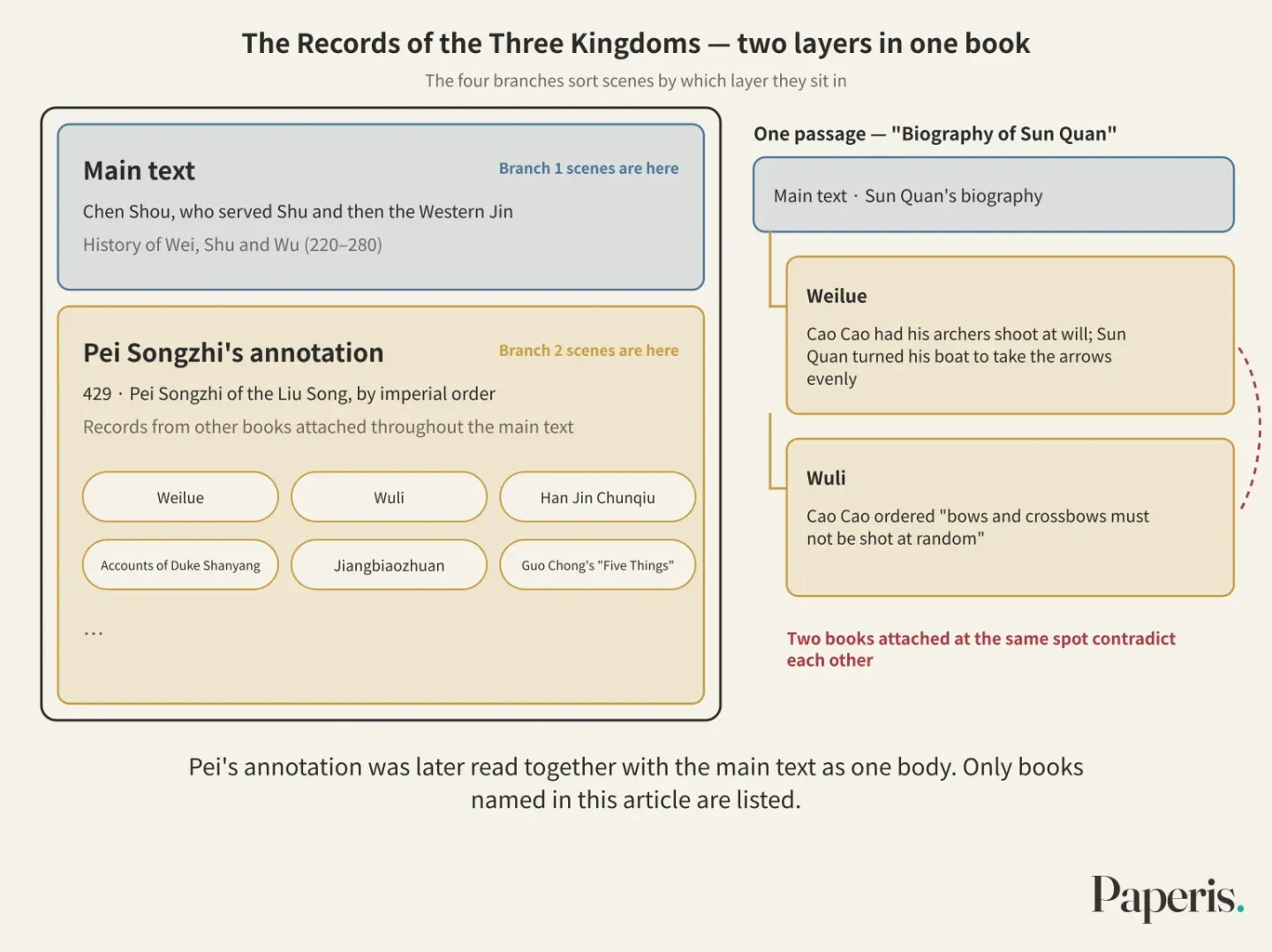
Figure: The two layers of the Records of the Three Kingdoms — Chen Shou's main text and Pei Songzhi's annotation added in 429. On the right, two books attached to one passage contradict each other. (Paperis figure)
And there is the novel. "Romance of the Three Kingdoms" is a full-length novel that unfolds and expands the history of Wei, Shu, and Wu into a story, and is precisely the book commonly called "Samgukji" in Korea. It is transmitted as having been first compiled by Luo Guanzhong in the late Yuan and early Ming dynasties, and its original name was "Sanguozhi Yanyi" (Romance of the Three Kingdoms in Vernacular). The very term "Yanyi" means to explain and expand upon a meaning to tell a story easily (DOI: 10.15818/ihss.2020.21.1.221). The Mao Zonggang edition is "Romance of the Three Kingdoms" broadly revised and polished by Mao Zonggang in the early Qing dynasty from the preceding 120-chapter version, and the Yanyi read today is mostly this edition. The chapter numbers of the Yanyi cited in this article also follow the Mao Zonggang edition.
This article takes scenes from the novel that Korean readers know as "Samgukji" and searches one by one to see where those scenes are located in history books. Hua Xiong's wine is only the first example.
“Seventy percent fact, thirty percent fiction”
How much of a historical romance is true is an old question. The most frequently cited answer is in the writings of the Qing dynasty scholar Zhang Xuecheng (章學誠, 1738–1801), from his book Bingchen Zhaji (丙辰劄記).
凡演義之書,如“列國志”、“東西漢”、“說唐”及“南北宋”,多記實事;“西遊記”、“金瓶梅”之類,全憑虛構,皆無傷也。唯“三國演義”則七分實事,三分虛構,以至觀者往往為之惑亂。
Among books of historical romance, works like The Chronicles of the States, The Eastern and Western Han, The Tale of Tang, and The Northern and Southern Song mostly record actual events; works like Journey to the West and The Plum in the Golden Vase are entirely fabricated, and neither does any harm. Only Romance of the Three Kingdoms has seventy percent actual events and thirty percent fabrication, to the extent that readers are often confused by it. — Zhang Xuecheng, Bingchen Zhaji (Original text · Translated by Paperis)
"Seventy percent fact, thirty percent fiction" is a four-character contraction of Zhang Xuecheng’s assessment that "seventy percent is actual events, thirty percent is fabrication." This phrase is often quoted as if it were the result of measuring a historical romance. But if you read Zhang Xuecheng’s sentence from the beginning, the weight lies behind the numbers. He stated that books that mostly record actual events and books that are entirely fabricated both do no harm. What is harmful is a book where the two are mixed, and the reason was that "readers are often confused by it." Zhang Xuecheng’s "seventy percent" was a complaint that fact and fiction were mixed and confusing, not a value calculated by counting anything. Among the studies gathered in this article, none measured ratios by counting the entire historical romance scene by scene.
The confusion was real. In the early days when Korea and Japan accepted the historical romance, they either failed to distinguish it from history books or read them mixed together (KCI ART001779085). However, there were also cases where people chose the novel side even while reading the official histories. In 1887, north of Seoul in what is now Myeongnyun-dong, an epitaph composed by King Gojong of Joseon was erected in the courtyard of Bukmyo, a shrine to Guan Yu. One study holds that six episodes of the Guan Yu story in that epitaph followed the Mao Zonggang edition of the novel rather than Chen Shou’s Records of the Three Kingdoms (DOI: 10.26586/chls.2018..90.005). King Gojong read the official histories too. There are records in the Diary of the Royal Secretariat showing that he read the novel for entertainment and the official history for deep scrutiny, and King Gojong actively embraced the fiction of the novel in the epitaph. A researcher suggests that King Gojong, having lived through the Imo Incident and the Gapsin Coup, needed a story above all else that could elicit loyalty from his subjects (DOI: 10.26586/chls.2018..90.005). When things are mixed, people get confused, and they also selectively use whichever side they need.
So is seventy percent the right number? To answer that question, there is no choice but to match the scenes one by one against the history books. This article matched eleven famous scenes from the historical romance against the main text and Pei Songzhi’s annotations of the official history. As a result, instead of a ratio, four categories emerged. They are scenes present as-is in the main text of the official history, scenes absent from the main text of the official history but found in other books cited in Pei Songzhi’s annotations, scenes that overlap someone else's credit, and scenes that could not be found in the records matched by this article.
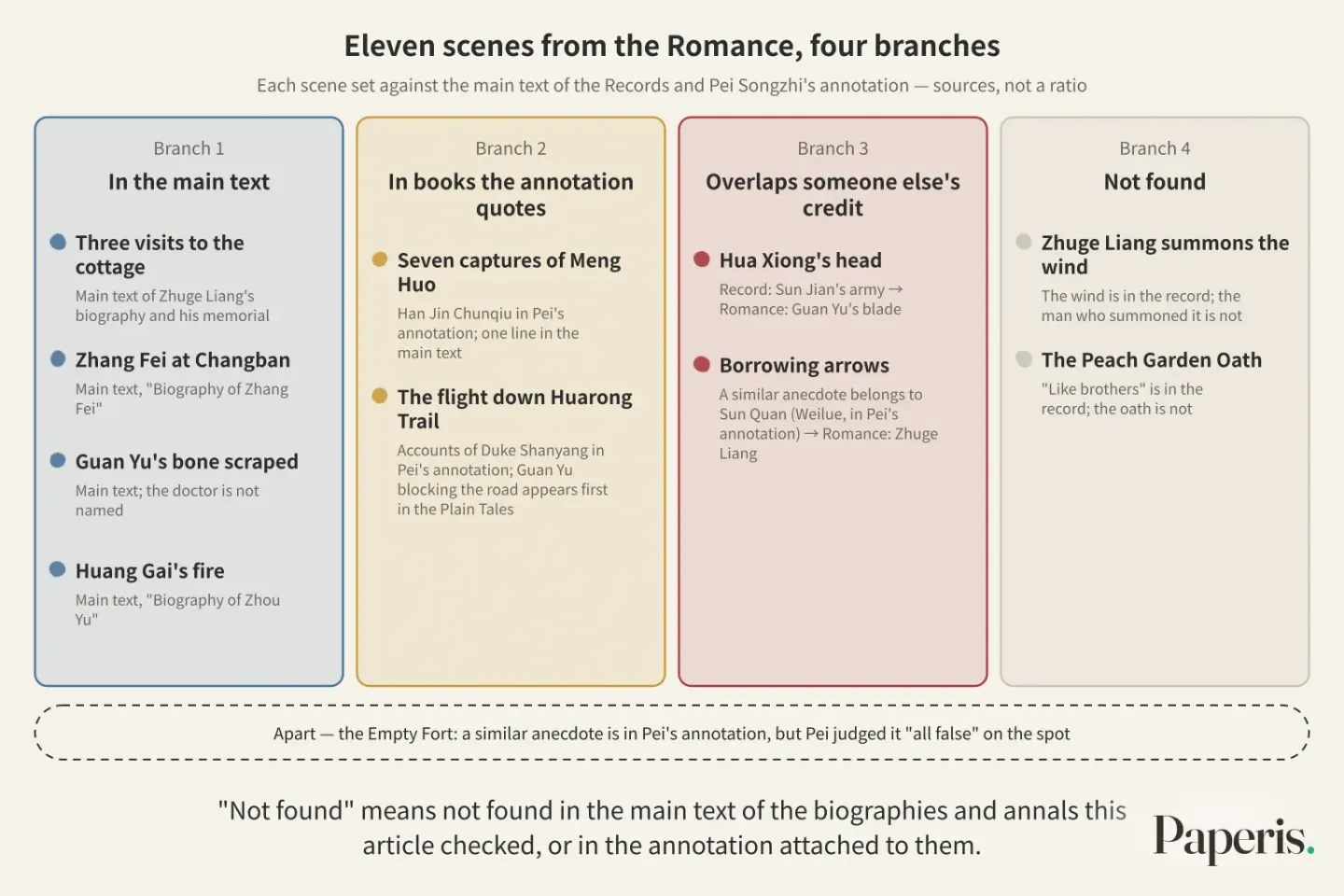
Figure: Eleven scenes, four branches. The Empty Fort is treated apart because the annotator judged it false on the spot. (Paperis figure)
First Branch — Straight from the Main Text of Official History
The Three Visits, in which Liu Bei three times sought out Zhuge Liang—who would later become the chancellor of Shu—are in the main text of official history. The "Biography of Zhuge Liang" records, "So the Former Lord [Liu Bei] finally went to visit Zhuge Liang, and only met him on the very third visit" (凡三往,乃見). The "Memorial on Expelling the Army," written by Zhuge Liang himself and included in the same biography, also writes, "The Late Emperor did not consider your servant lowly, but lowered his body and came to the thatched cottage three times to visit your servant" (Records of the Three Kingdoms, Book of Shu, "Biography of Zhuge Liang"). Chapters 37 and 38 of the Romance followed this record.
Yet a conflicting record is attached to this scene as well. The Weilüe, cited by Pei Songzhi, records the reverse: that Zhuge Liang went north first to meet Liu Bei (亮乃北行見備). Citing the "thatched cottage three times" from the Memorial on Expelling the Army, Pei Songzhi judged, "It is certain that Zhuge Liang did not seek out Liu Bei first," and added, "What is heard differs so that each side arises, but to contradict one another this much is truly strange" (Records of the Three Kingdoms, Book of Shu, "Biography of Zhuge Liang", Pei Songzhi's annotation). Even the scene that is straight from the main text of official history is one that survived by competing with other records inside the commentary.
The thread of the scene where Zhang Fei, a general who followed Liu Bei along with Guan Yu, blocked the enemy at Changban is also in the main text of official history. The "Biography of Zhang Fei" records that after breaking the bridge with the river at his back, Zhang Fei glared with wide eyes, leveled his spear, and shouted, "I am Zhang Yide! Come and try to die together with me!" (身是張益德也,可來共決死), and not a single enemy dared to approach (Records of the Three Kingdoms, Book of Shu, "Biography of Zhang Fei"). Zhang Fei in official history broke the bridge and held his ground.
The scene where Guan Yu had his bone scraped while at a drinking party is also in the main text of official history. After an arrow pierced his left arm, his bones ached when it rained, and when a physician said, "The arrowhead had poison that entered the bone, so we must cut open the arm and scrape the bone to remove the poison" (刮骨去毒), Guan Yu bared his arm. At the time, Guan Yu was drinking with his generals, and the "Biography of Guan Yu" records that "even though the blood from his arm flowed and overflowed basins, Guan Yu carved meat, poured drinks, and laughed and talked as if nothing were the matter" (Records of the Three Kingdoms, Book of Shu, "Biography of Guan Yu"). The main text of official history does not record the name of this physician.
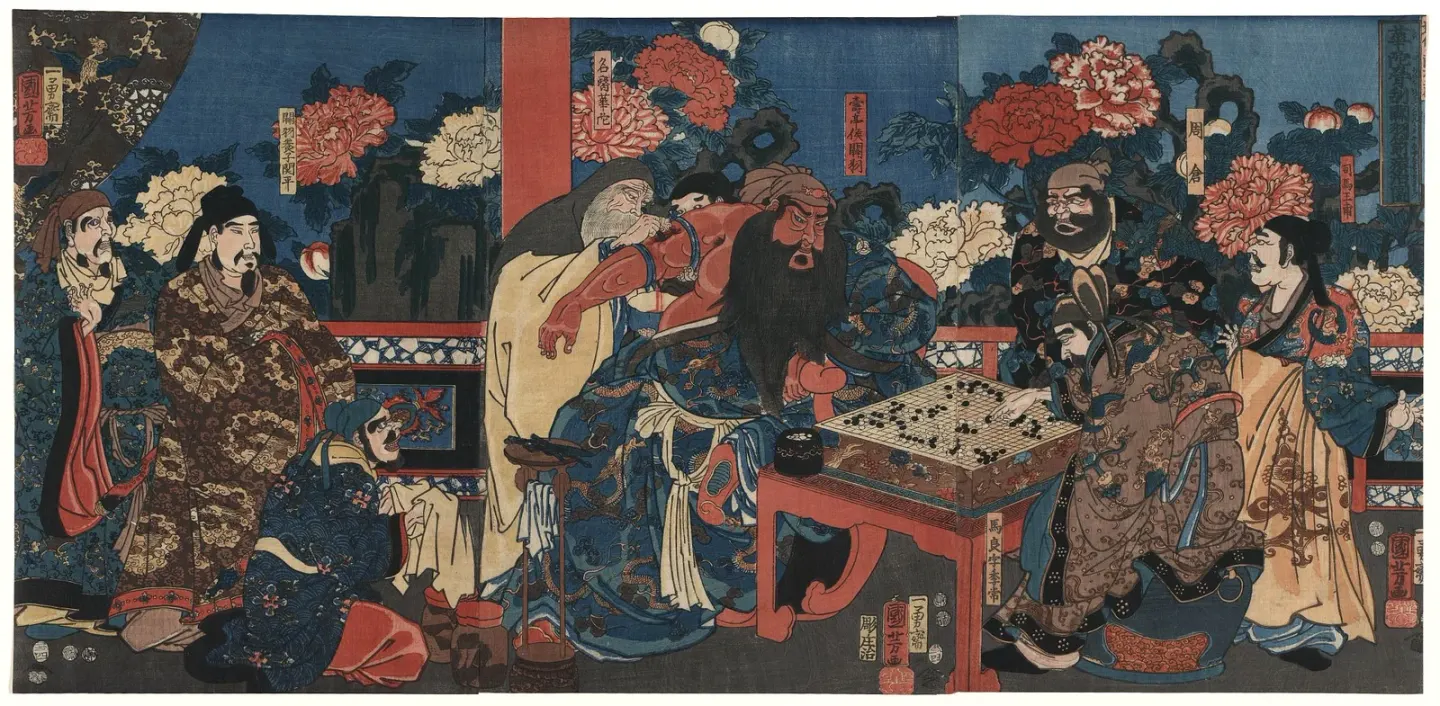
Figure: Utagawa Kuniyoshi, "Hua Tuo Scraping Guan Yu's Bone to Treat an Arrow Wound" (1853, Japanese woodblock print). The physician the official history leaves unnamed is drawn as Hua Tuo, following chapter 75 of the Romance, and Guan Yu is playing go with Ma Liang. · Wikimedia Commons (public domain)
The fire at Red Cliffs is also in the records. Huang Gai, a general of Wu, said, "Now the enemy is many and we are few, making it hard to hold out for long. Yet looking at Cao Cao's army's boats, their heads and tails are linked end to end, so we can burn them and make them run" (首尾相接,可燒而走也), and he filled dozens of ships with brushwood and oil while first sending a fake surrender letter. The same biography also records, "At that time, illness was already sweeping Lord Cao's army" (Records of the Three Kingdoms, Book of Wu, "Biography of Zhou Yu"). The Jiangbiaozhuan, cited by Pei Songzhi, also contains the phrase, "At that time, the southeast wind blew fiercely" (時東南風急) (Records of the Three Kingdoms, Book of Wu, "Biography of Zhou Yu", Pei Songzhi's annotation). The wind is in the records.
These four are among the most celebrated scenes in the Romance, and their skeletons belong to history books. Research likewise considers that the memory of the texts left by official history and historical commentary provides the skeleton for the Romance, while the tales of storytellers and the emotion of stage drama enter into it and are simultaneously controlled (DOI: 10.33575/KCRR.2026.12.3.219). If we brush the Romance aside as "entirely fabricated fiction," we end up throwing away even the major scenes that remain intact in history books.
The Second Branch — Other Books Brought In by the Annotations
To see the second branch, we must first understand what kind of annotation the Pei Songzhi comments are. Pei sought out, supplemented, contrasted, and examined other historical records in many passages that Chen Shou did not capture fully, where arguments conflicted, or which he judged to be wrong (DOI: 10.26585/chlab.2025..90.001). The books he brought in are extremely numerous, and when viewed together with other commentaries published around a similar time, we can today trace the compilers and titles of hundreds of books whose names would not even be known without such annotations (DOI: 10.1215/23290048-7256976). Pei also embedded his personal judgments within the method of laying out commentaries without stating them separately (DOI: 10.29991/jhs.201012.0001). Pei's annotations are comments that add stories, while at the same time being comments that filter them out on the spot as untrustworthy.
The story of the seven captures and seven releases of Meng Huo, the leader of the southern peoples, belongs to this branch. The main text of the "Biography of Zhuge Liang" contains a single line about the southern expedition. "In the spring of the third year [225], Zhuge Liang led his forces to attack the south, and that autumn all was pacified" (三年春,亮率眾南征,其秋悉平) is the entirety of it (Records of the Three Kingdoms, Book of Shu, "Biography of Zhuge Liang"). The story of Meng Huo is found in the Spring and Autumn Annals of Han and Jin (漢晉春秋) brought in by Pei Songzhi. Zhuge Liang showed his military camp to the captured Meng Huo, and, laughing, released Meng Huo—who claimed that victory would be easy—so that he could fight again. After releasing him seven times and capturing him seven times, when they were about to send him away once more, Meng Huo did not leave, saying, "You, sir, possess heavenly majesty; the people of the south will never rebel again" (Records of the Three Kingdoms, Book of Shu, "Biography of Zhuge Liang", Pei Songzhi's annotation). The Spring and Autumn Annals of Han and Jin is a book written by Xi Zuochi of the Eastern Jin, and was written after Chen Shou. The Romance gave Chapter 90 the title "Burning the Vine Armor, Meng Huo is Captured Seven Times" (燒藤甲七擒孟獲).
This story grew outside of novels, even down in the southern lands. The southern expedition, mentioned briefly in historical texts, was widely accepted as the seven captures and seven releases through the Romance and the legends of the ethnic minorities of Yunnan, and customs worshiping Zhuge Liang arose in Yunnan (DOI: 10.32961/jwhc.2025.06.75.93). The stage of the seven captures and seven releases expanded progressively westward over time, and records from the early 9th century, long before the Romance was compiled, already feature a city wall named after Zhuge Liang and a shrine worshiping him in the present-day Baoshan region of Yunnan (DOI: 10.23013/localh.2018.21.1.009). An expedition consisting of only a single line in the official history became, through legend, the name of a ruin upon the earth.
The scene where Cao Cao, defeated at Red Cliffs, flees toward Huarong Trail is also part of this branch. The main text of the "Annals of Emperor Wu" is brief. "Lord Cao arrived at Red Cliffs and fought with Liu Bei, but it was not advantageous. Then a great plague broke out, causing many officials and soldiers to die, whereupon he led his army back" (Records of the Three Kingdoms, Book of Wei, "Annals of Emperor Wu"). The trail name Huarong Trail comes from the Accounts of Duke Shanyang (山陽公載記) brought in by Pei Songzhi. Cao Cao burned his ships and walked back via Huarong Trail, where the road was blocked by a quagmire and a strong wind blew, forcing the weak soldiers to carry grass on their backs and fill it in; many of those soldiers were trampled by people and horses, sinking into the mud and dying. Escaping, Cao Cao laughed heartily and said, "Liu Bei is my peer. He is only a little late in devising his strategy" (劉備,吾儔也。但得計少晚), and although Liu Bei promptly set a fire, he was not in time (Records of the Three Kingdoms, Book of Wei, "Annals of Emperor Wu", Pei Songzhi's annotation).
Guan Yu is absent from this record. In Chapter 50 of the Romance, Guan Yu blocks the road, and when Cao Cao brings up past kindness, Guan Yu turns his horse's head, tells them to "scatter and spread out on all sides," and lets Cao Cao go. The chapter heading is also "Lord Guan in His Righteousness Releases Cao Cao" (關雲長義釋曹操) (Romance of the Three Kingdoms, Chapter 50). The Plain Tales of the Three Kingdoms is a Three Kingdoms storybook published during the Yuan dynasty, representing an earlier form of the story than the Romance. The story of Guan Yu blocking and then releasing Cao Cao is already present in this book. "Five hundred swordsmen and General Guan blocked the road, and Prime Minister Cao appealed to Yunzhang with kind words... Lord Cao charged through the formation and passed. Amidst that, dust and mist rose on his face, and Lord Cao escaped" (Plain Tales of the Three Kingdoms, quoted in Lu Xun's A Brief History of Chinese Fiction). Guan Yu in the Plain Tales missed Cao Cao, while Guan Yu who releases him out of righteousness is found in the Romance. The road and the flight exist in the historical records, and the Guan Yu who stands blocking the path appears first in the storybook.
Third branch — Scenes that overlap someone else's credit
Hua Xiong's cup of wine belongs to this branch. In the official history, it was Sun Jian's army that struck down Hua Xiong. The original text of the "Biography of Sun Jian" reads, "It broke their army, beheaded Hua Xiong and others, and hung their heads up," without recording who actually wielded the sword (Records of the Three Kingdoms, Book of Wu, "Biography of Sun Jian"). The Romance changed that feat into the sword of Guan Yu alone and a cup of wine that had not yet grown cold.
Zhuge Liang's receiving of arrows also overlaps with this branch. In Chapter 46 of the Romance, when the Wu general Zhou Yu tells Zhuge Liang to manufacture 100,000 arrows within ten days, Zhuge Liang sends twenty boats set up with bundles of straw into the fog toward Cao Cao's camp to receive arrows, and the soldiers shout, "Prime Minister, thank you for the arrows!" (謝丞相箭) (Romance of the Three Kingdoms, Chapter 46).
On the side of the official history, a similar anecdote remains as belonging to Sun Quan. The "Weilue" cited by Pei Songzhi in the "Biography of Sun Quan" records events from when they were facing each other at Ruxu in 213 as follows. When Sun Quan came riding in a large boat to inspect the army, Cao Cao had bows and crossbows shoot wildly at it; when arrows lodged in the boat and caused it to tilt to one side as if it would capsize, Sun Quan turned the boat around so that arrows were received on the other side as well, and when the arrows were evenly embedded and the boat leveled out, he turned back (Records of the Three Kingdoms, Book of Wu, "Biography of Sun Quan", Pei Songzhi's annotation). However, the "Wuli" attached to the same spot records conversely that Cao Cao ordered, "Bows and crossbows must not be fired rashly" (弓弩不得妄發) (Records of the Three Kingdoms, Book of Wu, "Biography of Sun Quan", Pei Songzhi's annotation). The two books conflict within the commentary.
If you place the anecdote from the "Weilue" and the scene from the Romance side by side, the protagonist has changed from Sun Quan to Zhuge Liang, the time from Ruxu in 213 to just before the Battle of Red Cliffs in 208, and the purpose from the balance of the boat to the procuring of arrows. However, this article has not found grounds that the Romance took from this anecdote. The extent of what the records permit us to say is that a similar anecdote remains as belonging to Sun Quan. Hua Xiong was an affair of the Sun family's side in the records, and the record resembling the receiving of arrows also belongs to Sun Quan.
The Fourth Branch — Scenes Not Found
We did not find the scene where Zhuge Liang borrows the southeast wind in the records this article compared. In Chapter 49 of the Romance, Zhuge Liang claims he received esoteric arts for summoning wind, builds a Seven-Star Altar on South Screen Mountain, and says he will borrow the southeast wind for three days and three nights (Romance of the Three Kingdoms, Chapter 49). The main text of the "Biography of Zhou Yu" merely states that at that time the wind blew fiercely so that the fire spread to the camps on the riverbank, and the commentary from the Jiangbiao Zhuan attached to it only states that a strong southeast wind blew. The wind is a record, and the person who borrowed the wind is a story.
The Peach Garden Oath, which is the opening scene of the Romance, is the same. In Peach Orchard behind Zhang Fei's house, the three of them form a brotherhood and swear, "Wishing not to be born on the same year, same month, and same day, but only wishing to die on the same year, same month, and same day" (Romance of the Three Kingdoms, Chapter 1). The main text of the "Biography of Guan Yu" records that "Xuanzhu shared a bed with the two men when sleeping, and their kindness was like that of brothers" (恩若兄弟) (Records of the Three Kingdoms, Book of Shu, "Biography of Guan Yu"). What the official history records is that they were like brothers, and the sworn brotherhood ritual was not in the records this article compared. The intimacy is in the record, and the ritual is in the Romance.
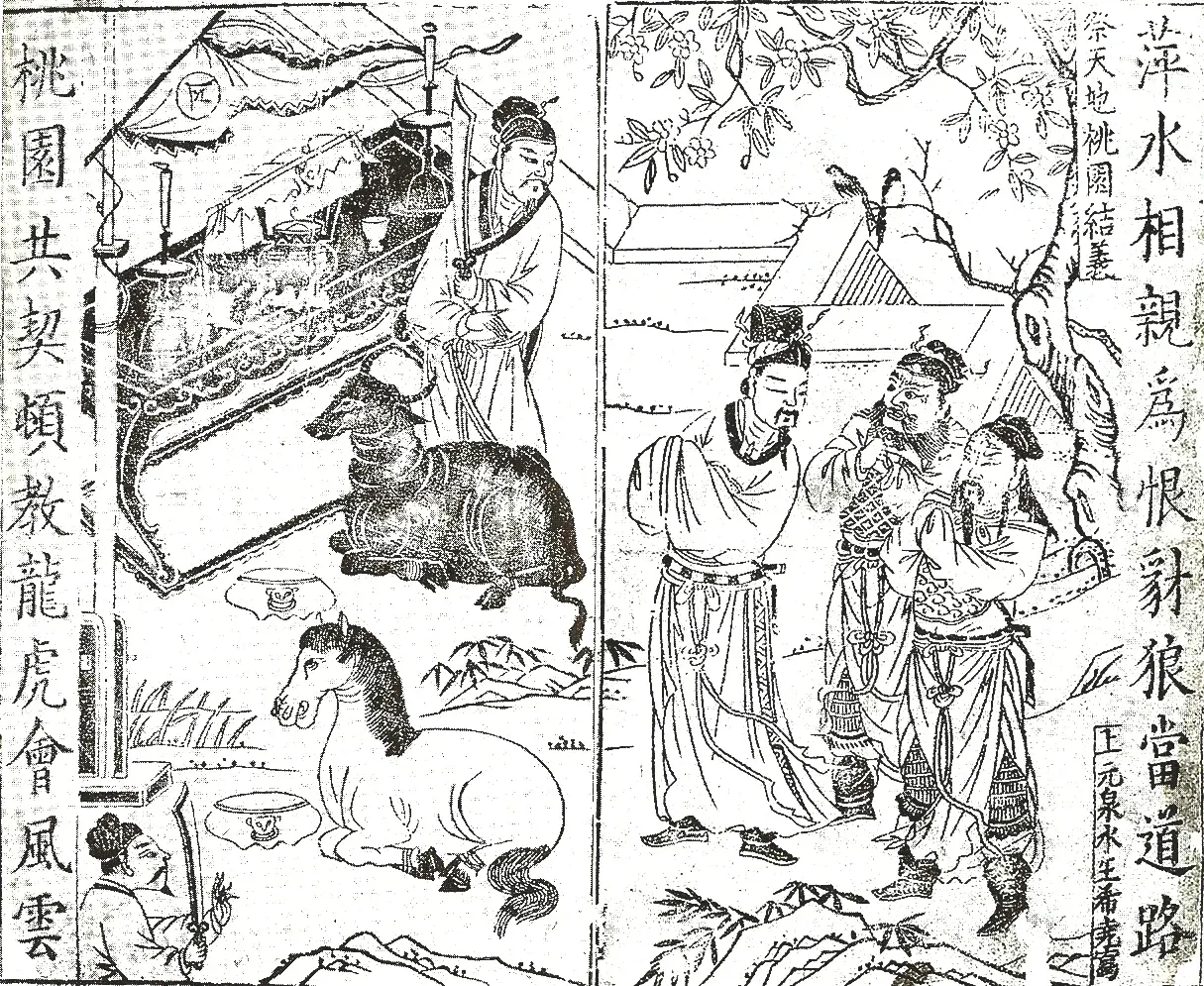
Figure: "Sacrificing to Heaven and Earth, the Oath in the Peach Garden," an illustration from the 1591 Jinling Wanjuanlou edition of the Romance of the Three Kingdoms (Peking University Library). The sworn-brotherhood oath that the records checked here do not contain became a picture in the novel's printed book. · Wikimedia Commons (public domain)
The phrase "did not find" is narrower than the phrase "did not exist." What this article compared are the main texts of the relevant biographies and imperial annals, and the commentaries attached to them.
A Story That a Commentator Called "Entirely False"
If you were to pick the most dramatic stratagem in the Romance of the Three Kingdoms, many people would choose the Empty City Strategy. In Chapter 95 of the Romance, after the Shu general Ma Su loses Jieting, Zhuge Liang sends away most of his troops and faces the massive army of the Wei general Sima Yi in the remaining city of Xicheng. Zhuge Liang hides his banners, opens all four gates wide, disguises twenty soldiers as commoners to sweep the streets, and then sits on the city tower burning incense and playing the qin. Sima Yi suspects an ambush and retreats (Romance of the Three Kingdoms, Chapter 95). The chapter title is "The Martial Marquis Plays the Qin to Force Back Zhongda" (武侯彈琴退仲達). Martial Marquis is a name for Zhuge Liang, and Zhongda is a name for Sima Yi.
This scene is not in the main text of the "Biography of Zhuge Liang." A similar story appears in the third of the "Five Things" by Guo Chong, which Pei Songzhi cites via the Annals of Shu. When Zhuge Liang was stationed at Yangping, had the general Wei Yan take an army and head east, and left behind only ten thousand men, Sima Yi approached with 200,000. Zhuge Liang "ordered everyone in the camp to lay down all banners and stop the drums... and furthermore opened the four city gates wide, sweeping the ground and sprinkling water," and Sima Yi suspected an ambush and retreated toward the mountains (Records of the Three Kingdoms, Book of Shu, "Biography of Zhuge Liang", Pei Songzhi's annotation). The qin is not in this text either.
Pei Songzhi refutes this anecdote right there on the spot where he records it. First, when Zhuge Liang was first stationed at Yangping, Sima Yi was still the Governor of Jingzhou guarding Wancheng, and only faced Zhuge Liang in Guanzhong after the Wei general Cao Zhen died. Second, if he led 200,000 men and knew the opponent was weak, even if he suspected an ambush, he should have prepared for it, so why would he flee? Third, he deemed it unreasonable that Guo Chong exposed the flaws of Sima Yi's father in front of Sima Yi's son, Sima Jun, the Prince of Fufeng. And he reaches a conclusion. "Therefore, we know that what this text cites is entirely false" (Records of the Three Kingdoms, Book of Shu, "Biography of Zhuge Liang", Pei Songzhi's annotation).
The record most similar to the Empty City Strategy in the Romance is an anecdote judged false on the spot by the commentator. In the Romance, the setting is Xicheng and a qin has been added. Military scholars still bring up this story when showing how important deception is in war, and a study analyzing the move with game theory treats it as a "legend" (DOI: 10.1177/0022343310396265). Pei Songzhi's refutation is also the judgment of one person, making it a subject worth scrutinizing. Following the layers of the record is as far as this can be verified. This story is not in the official history's main text, a similar anecdote is recorded in the commentary, and the person who recorded it called it false right there. Whether the Romance took it directly from that anecdote cannot be known from the evidence available to this text. One study dealing with the Empty City Strategy as its main case warns that arguments over the authenticity of the Romance tend to easily fall into confirmation bias by blindly trusting historical records, relying on inference without precise facts, or following prior conclusions without examining them (DOI: 10.26586/chls.2016..78.004).
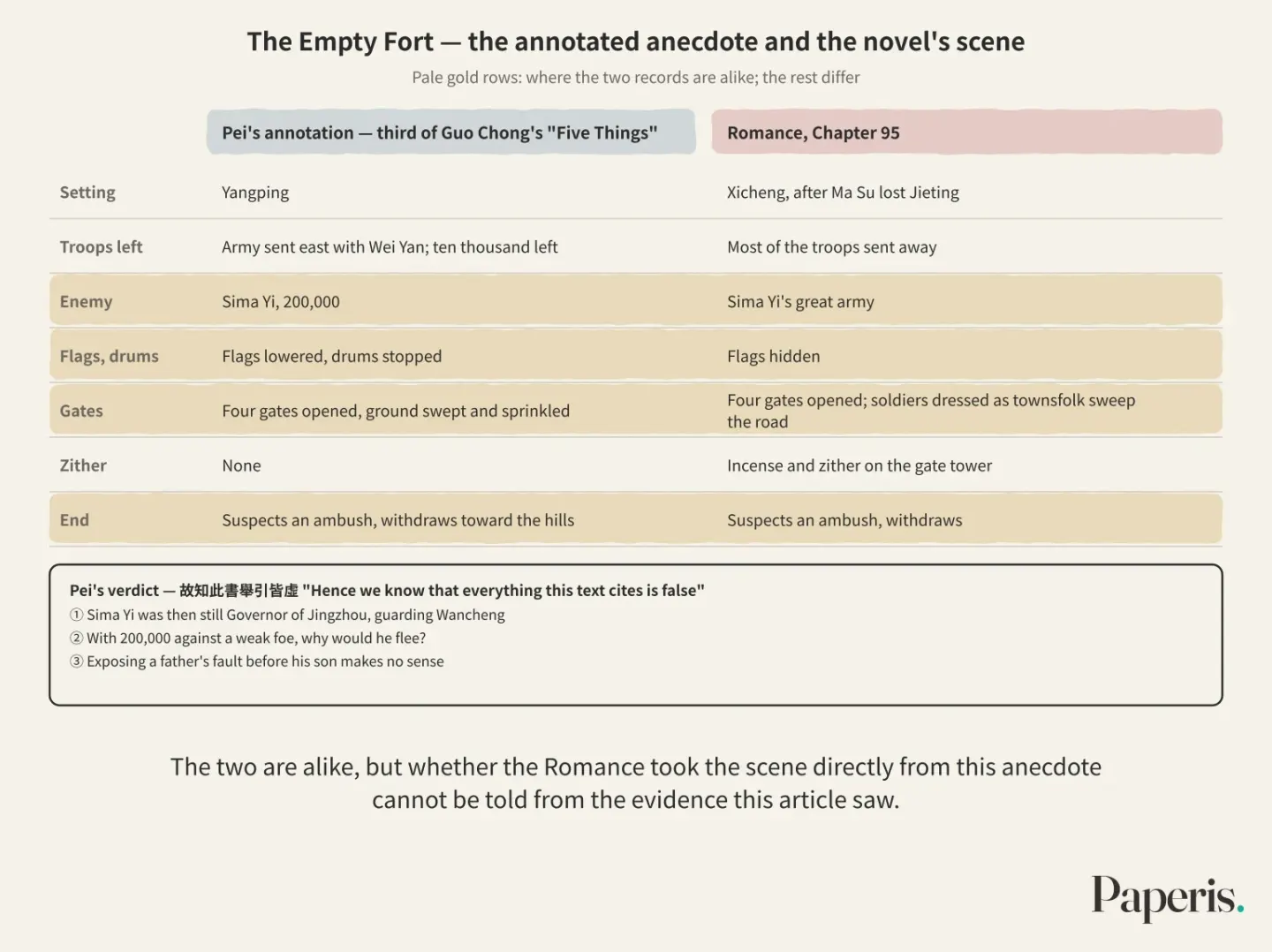
Figure: Two versions of the Empty Fort. Much is alike, but whether the Romance took it directly from this anecdote cannot be told. (Paperis figure)
The Tilted Tale
Passing through four branches, a single direction becomes visible. In the records, the death of Hua Xiong was Mr. Sun's affair, but in the Romance it became Guan Yu's achievement; a scene resembling an anecdote that remained Sun Quan's appears as Zhuge Liang's scene. A scene resembling an anecdote that a commentator included and declared false on the spot is Zhuge Liang's masterpiece in the Romance. That direction was not created by the novel all at once, but solidified over hundreds of years.
Even before the Romance, the Three Kingdoms stories were passed down for a long time by the mouths of storytellers (DOI: 10.15818/ihss.2020.21.1.221). During the Yuan dynasty, "The Sanguozhi Pinghua" came out, which wrote down those stories. On the stage of the Zaju, a theatrical art of the same Yuan dynasty, plays starring Guan Yu became popular enough to be grouped separately, and the Guan Yu of those stages appeared as a human, a ghost, and a god (DOI: 10.16874/jslckc.2016..42.014). Since there are no passages between the Pinghua and the Romance that match verbatim, one study considers that there was a now-lost main text between the two. The same study notes that the Jiajing edition, a printed version from the Jiajing era of the Ming dynasty, appears to be the stage where the old main text was refined and revised (DOI: 10.14989/178000). Afterwards, the Romance was consolidated from Luo Guanzhong's 240-chapter edition through the 120-chapter edition to Mao Zonggang's edition; Mao kept the 120-chapter framework and plot while heavily revising chapter titles, literary style, and inserted poems (DOI: 10.35982/jcs.92.4). Copyright competition among publishers also played a part in this change of the chapter titles (DOI: 10.35982/jcs.92.4).
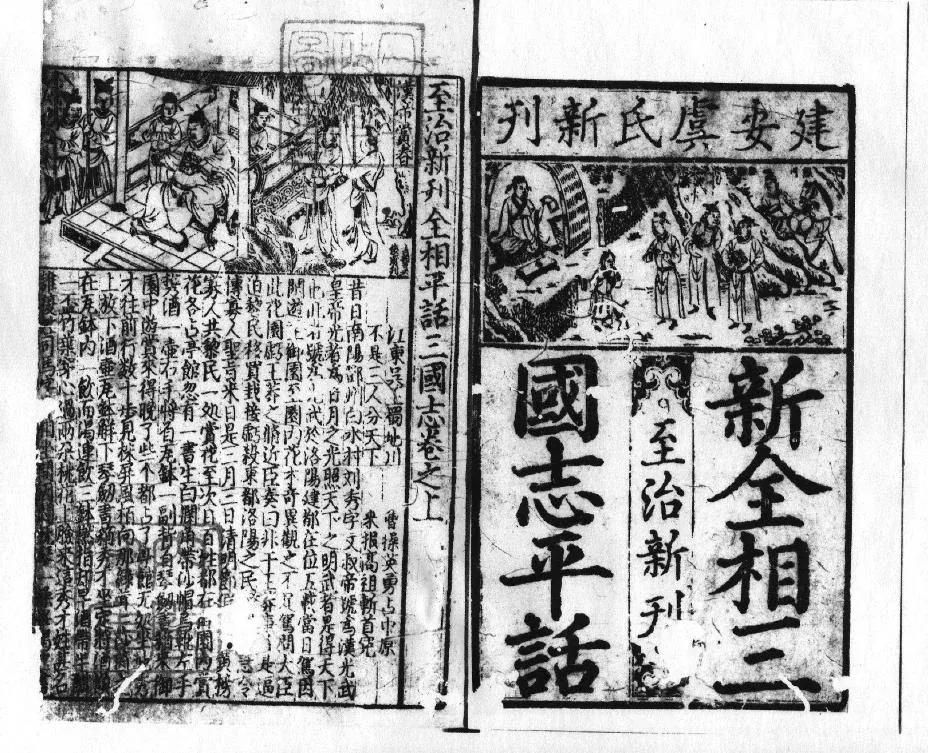
Figure: The title page and first page of the Sanguozhi Pinghua (Zhizhi era of the Yuan dynasty, 1321–1323, printed by the Yu family of Jian'an). Each page has a picture on top and text below. · Wikimedia Commons (public domain)
What set the direction is the perspective of elevating Shu-Han. The Shu-Han legitimacy theory is a viewpoint that, among Wei, Shu, and Wu, regards the Shu-Han founded by Liu Bei as the legitimate successor state to the Han dynasty. The issue of Shu-Han's succession was a proxy war in debates over imperial legitimacy in China for over a thousand years; when northern China collapsed in the 12th century, this debate flared up again, and historical records rewriting the official "Records of the Three Kingdoms" emerged. One study considers that the new narrative methods of those historical records influenced the formation of the new historical fiction genre (DOI: 10.1017/s0041977x06000139). One study dealing with the issue of fiction and truth in the Romance cites the tendency originating from the Shu-Han legitimacy theory to "elevate Liu Bei and disparage Cao Cao" as the greatest cause from a historical perspective, and lists literary fiction and commercial purposes as other causes. The same study notes that there are also discrepancies in many places, such as anachronisms and name confusions caused by the compiler's ignorance or unconscious errors (DOI: 10.22786/chll.2021..76.003). Another study comparing the official history and the Romance by person and event summarizes that the Romance portrayed Shu as the legitimate dynasty, depicted Liu Bei, Guan Yu, Zhang Fei, and Zhuge Liang as extraordinary heroes punishing the villain Cao Cao, and portrayed the sides of Cao Cao and Sun Quan as sinister groups (KCI ART001616055).
This tilt was visible even to the eyes of people of the past. The Chinese writer Lu Xun evaluated in "A Brief History of Chinese Fiction" that the Romance "made Liu Bei's benevolence seem like a lie while trying to reveal it, made Zhuge Liang's wisdom close to a monster while trying to portray it, and was particularly lavish with good words only for Guan Yu" (惟於關羽,特多好語). Lu Xun also noted that Mao Zonggang extensively revised the old editions and that after that, old editions no longer circulated, giving one example of a revision. In the old edition, the Empress of Xian, the last emperor of the Han dynasty and the daughter of Cao Cao, helped her older brother Cao Pi and scolded Xian, whereas the Mao Zonggang edition changed it so that the Empress helped Xian and scolded Cao Pi (Lu Xun, "A Brief History of Chinese Fiction", Chapter 14).
Character portrayals also changed along this path. Cao Cao's face as a "crafty hero" has some of its clues in the "Biography of Cao Man" brought in by Pei Songzhi, was completed by Luo Guanzhong's conception, and was refined by Mao Zonggang's hands (DOI: 10.26585/chlab.2014..43.006). Historical evaluations moved along with it. Cao Cao, who was revered during the Wei and Western Jin dynasties, began to be gradually portrayed as a crafty hero from the Eastern Jin dynasty, and by the Ming and Qing dynasties became completely a usurper. The same study considers Cao Cao in the Romance to be a multi-faceted figure possessing both heroic qualities and craftiness (KCI ART001765356). The publisher's description of a 2010 English-language biography of Cao Cao says that while novels and plays portrayed him as a cruel figure, the actual Cao Cao was an outstanding strategist and politician who restored a degree of order after the chaos at the end of the Han dynasty (DOI: 10.1163/ej.9789004185227.i-554).
Guan Yu went in the opposite direction. Chen Shou wrote in the appraisal at the end of the "Biography of Guan Yu" that while Guan Yu repaid kindness by rendering service to Cao Cao, "Guan Yu was fierce yet boasted of himself, and Zhang Fei was violent yet bestowed no kindness; they were defeated because of their shortcomings, which is logically always the case" (Records of the Three Kingdoms, Book of Shu, "Biography of Guan Yu"). The Guan Yu of official history is a general evaluated even for his flaws. Well over a thousand years after that general died, he came to be worshipped as the "Great Emperor", the supreme god of war. The popularity of the Romance is cited as one of the reasons for this, but it is not the sole reason; commoners, religious people, and the rulers of successive dynasties created that image together (KCI ART002035664).
There are dissenting views as well. A study that re-examined the political stance of the Romance casts doubt on the traditional view itself that it "elevates Liu Bei and disparages Cao Cao". While this study acknowledges that the Romance has a clear political stance, it considers its criterion to lie in loyalty and righteousness rather than bloodline or benevolence, views it as relatively objective and neutral when evaluating figures from different factions, and sees figures from both good and bad sides as possessing both strengths and weaknesses (DOI: 10.1080/02549948.2017.1309106). That the Romance leaned toward the Shu-Han side is the picture seen by many studies, but researchers read differently just how one-sided that tilt is.
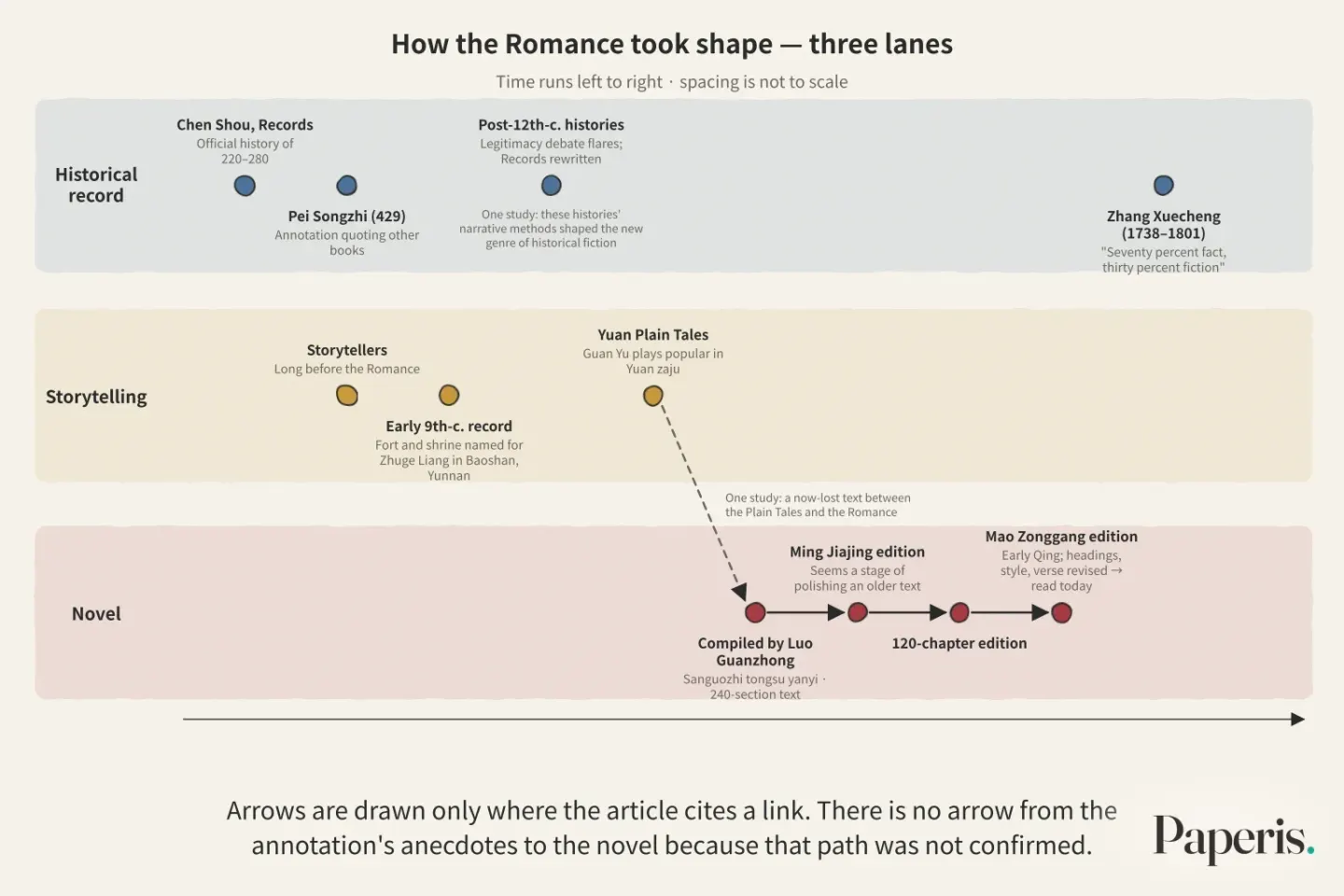
Figure: How the Romance took shape. Spacing is not to scale. (Paperis figure)
The Official History is Also a Record Written by Humans
Once we get this far, we naturally want to place the official history as the yardstick of facts and the Romance as fiction. Both the official history and Pei Songzhi's annotations are records written by humans. One researcher who studied Pei Songzhi's annotations suggests that Chen Shou, who was from the fallen state of Shu Han and lived holding office in Western Jin, tried to curry favor with the Western Jin dynasty, and specifically hid, condensed, and twisted the truth about the Sima clan—who founded Western Jin—usurping the imperial power of Wei (DOI: 10.26585/chlab.2025..90.001). Another study that verified the dates and locations in the official history points out that in the records regarding Sun Quan in the "Book of Wu", there are about 10 instances where the months do not match other records, and that the garrison locations and the place where Zhuge Liang died during his final northern expedition are recorded differently in the Book of Wei, the Book of Shu, and the Book of Wu. That researcher attributes this to Chen Shou's lack of textual criticism skills and his political intentions (DOI: 10.23037/dyn.2019..66.002). Even for just the Battle of Red Cliffs, the records of the Book of Wei, the Book of Wu, and the Book of Shu differ slightly within the same official history (DOI: 10.17004/jrcn.2024..74.002).
The annotations are also not a single voice. Just in the scenes this article has compared, the "Weilue" and the Memorial Outlining the Military Expedition conflicted regarding the thatched cottage visit, and the "Weilue" and the "Wuli" conflicted regarding Sun Quan's arrow. Pei Songzhi himself doubted what true historical records were, and at the same time accepted and transcribed stories about prophecies, ghosts, and Taoist magic (DOI: 10.26585/chlab.2025..90.001). Therefore, what we see when we compare the official history and the Romance is not a single line of fact and a single line of fiction. On one side lie layers of various conflicting records, and on the other side lies a story that embraces scenes resembling those records.
Instead of how many tenths, where from
Zhang Xuecheng spoke of seven parts fact and three parts fiction regarding Romance, but what worried him was not the numbers. It was that when facts and fiction are mixed, readers can no longer tell which is which. The answer to that worry is the source. When we take a scene from Romance, the question to ask is, "Where does this scene come from?"
When you ask that way, each scene yields a different answer. The thatched cottage visits and Zhang Fei’s bridge, Guan Yu’s bone-scraping and Huang Gai’s fire are in the main text of Records. The seven captures of Meng Huo is not in the main text of Records, but in another book cited by Pei Songzhi. For Huarong Trail, the path and Cao Cao’s flight are in another book within the commentary, but Guan Yu blocking the road is not in that record. Hua Xiong’s head belonged to Sun Jian’s army in the records, and an anecdote resembling the arrows-receiving boat remains as Sun Quan’s. The altar for borrowing the southeast wind and the oath in the peach garden were not found in the records this article compared against. And the record most resembling the most famous empty-city strategy is an anecdote that the commentator called false on the spot.
What we take with us are three things. Zhang Xuecheng’s "seven parts" was a complaint about confusion, not a measured value. The scenes compared in this article were divided into four branches: the main text of Records, other books in the commentary, someone else’s credit, and stories whose sources could not be found, and those branches lean toward the side of Shu Han. Because Records and Pei Songzhi’s commentary are records that contradict each other, "it is in Records" is also something that must be questioned once more.
Primary Sources
- Records of the Three Kingdoms (by Chen Shou, annotated by Pei Songzhi) — Wikisource — Book of Wei "Annals of Emperor Wu" (main text · Pei's annotation citing Accounts of Duke Shanyang) · Book of Shu "Biography of Zhuge Liang" (main text · the memorial · Pei's annotation citing Weilue, Han Jin Chunqiu and Guo Chong's "Five Things") · Book of Shu "Biographies of Guan Yu and Zhang Fei" (main text · Chen Shou's appraisal) · Book of Wu "Biography of Zhou Yu" (main text · Pei's annotation citing Jiangbiaozhuan) · Book of Wu "Biography of Sun Jian" · Book of Wu "Biography of Sun Quan" (Pei's annotation citing Weilue and Wuli)
- Romance of the Three Kingdoms (Mao Zonggang edition) — Wikisource — Chapter 1 · Chapter 5 · Chapter 37 · Chapter 38 · Chapter 46 · Chapter 49 · Chapter 50 · Chapter 75 · Chapter 90 · Chapter 95
- Lu Xun, A Brief History of Chinese Fiction, Chapter 14 (including quotations from the Sanguozhi Pinghua) — Wikisource. Zhang Xuecheng's Bingchen Zhaji is quoted from note 〔8〕 of this Wikisource edition.
Source Papers
- "Records of the Three Kingdoms (The) (Sanguo zhi)" (2020) — DOI: 10.4000/books.pressesinalco.28936 — Chen Shou served the state of Shu and then Western Jin, writing history from 220 to 280 AD, and because his account was criticized as too short, Pei Songzhi added detailed annotations by the order of Emperor Wen of Song in 429, which became one body with the main text.
- "“삼국지연의”의 '의로움(義)'이 갖는 복합적 의미" (2020) — DOI: 10.15818/ihss.2020.21.1.221 — The title of the novel first compiled by Luo Guanzhong was "Sanguozhi Tongsu Yanyi", and "Yanyi" means expanding on a meaning to explain it easily.
- "<삼국지연의>를 보는 두 개의 시각" (2013) — KCI ART001779085 — In the early stages of reception, Korea and Japan did not distinguish Yanyi from historical books or read them with confusion, and later Korea split toward the righteousness of the orthodox Shu-Han, while Japan split toward samurai-like loyalty.
- "조선 고종 <북묘묘정비> 비문의 관우 관련 기록과 모종강 평본 ≪삼국연의≫" (2018) — DOI: 10.26586/chls.2018..90.005 — The six passages regarding Guan Yu in the monument inscription of King Gojong of Joseon from 1887 are based on the Mao Zonggang annotated novel rather than official history, and although King Gojong also read official history, he actively accepted the fiction of the novel because he needed a story that would elicit loyalty.
- "집단기억과 영웅 서사의 형성 : “三國演義”와 “水滸傳”을 중심으로" (2026) — DOI: 10.33575/KCRR.2026.12.3.219 — In Yanyi, the textual memories of official history and historical commentaries provided the framework, while the emotions of storytelling, popular storytelling performances, and zaju plays were accommodated and controlled, and the Mao Zonggang edition re-mediated that memory in the direction of reinforcement.
- "배송지 ≪삼국지주≫의 진실 추구와 진실한 역사에 대한 회의 및 미신 수용" (2025) — DOI: 10.26585/chlab.2025..90.001 — Pei Songzhi sought the truth by supplementing, comparing, and arguing with other records while simultaneously doubting what true records were and accepting records of prophecies, ghosts, and Taoist magic. The author views that Chen Shou pandered to Western Jin to conceal, downsize, and distort the usurpation by the Sima clan.
- "Drawing Out the Essentials: Historiographic Annotation as a Textual Network" (2018) — DOI: 10.1215/23290048-7256976 — The sources cited in Pei Songzhi's commentary are extremely diverse, allowing us to trace the compilers and titles of hundreds of texts that might otherwise have been completely unknown.
- "寓論斷於注釋-“三國志”裴注表微" (2010) — DOI: 10.29991/jhs.201012.0001 — Pei Songzhi embedded his own judgments within the method of annotating without stating them separately.
- "雲南의 諸葛亮 -南蠻 정벌 전설의 西進과 南詔國-" (2018) — DOI: 10.23013/localh.2018.21.1.009 — The stage of the Seven Captures and Seven Releases expanded further west over time, and records from the early 9th century already showed a city and shrine bearing Zhuge Liang's name in western Yunnan.
- "운남지역 제갈량 숭배와 중화민족공동체 의식의 형성" (2025) — DOI: 10.32961/jwhc.2025.06.75.93 — The southern campaign briefly mentioned in historical books came to be widely accepted as the Seven Captures and Seven Releases through Yanyi and Yunnan minority legends, creating the worship of Zhuge Liang among ethnic minorities.
- "≪三國演義≫ 眞僞檢證論의 論理的 問題點 一考 ― '空城計'를 위주로" (2016) — DOI: 10.26586/chls.2016..78.004 — Some arguments determining the authenticity of Yanyi display confirmation bias by blindly trusting historical records, relying on baseless inferences, or uncritically following prior conclusions. The Oath of the Peach Garden, the killing of Lü Boshe's family, and the Empty City Strategy are covered as examples.
- "100 Horsemen and the empty city: A game theoretic examination of deception in Chinese military legend" (2011) — DOI: 10.1177/0022343310396265 — The Empty City Strategy is viewed as an example of bluffing within Chinese military "legends" and modeled as a signaling game, and military historians cite this story when demonstrating the importance of deception.
- "원대 관우숭배와 관우 형상의 변화" (2016) — DOI: 10.16874/jslckc.2016..42.014 — "Guan Yu plays" featuring Guan Yu as the main character gained popularity in Yuan dynasty zaju, and that Guan Yu appeared in various forms such as a human, a ghost, and a deity.
- "“三國志演義”の成立と展開について : 嘉靖本と葉逢春本を手がかりに" (2007) — DOI: 10.14989/178000 — Because there are no places where the text corresponds directly between popular storytelling promptbooks and Yanyi, it is viewed that a lost text existed between them, and the Yefengchun edition appears close to the old text while the Jiajing edition appears to be a stage where the sentences were polished.
- "小說“三國志”의 回目變化에 대한 고찰" (2020) — DOI: 10.35982/jcs.92.4 — Following the era of popular storytelling promptbooks, it passed through Luo Guanzhong's 240-chapter edition and Li Zhuowu's 120-chapter edition before being integrated into the Mao Zonggang popular edition, and Mao Zonggang kept the 120-chapter framework and plot while heavily revising the chapter titles, literary style, and inserted poems, with copyright competition being the cause of the changes.
- "History repackaged in the age of print: the Sanguozhi and Sanguo yanyi" (2006) — DOI: 10.1017/s0041977x06000139 — The issue of Shu-Han succession was a proxy war of legitimacy debates for over a thousand years, and the narrative strategies of history books rewriting "Records of the Three Kingdoms" after the 12th century influenced the formation of the new historical fiction genre.
- "“三國演義”에 나타난 虛構와 眞實의 矛盾性 硏究" (2021) — DOI: 10.22786/chll.2021..76.003 — The biggest causes of the contradiction between official history and fiction in Yanyi are the elevation of Shu and denigration of Wei derived from the theory of Shu-Han orthodox rule, alongside literary fiction and commerciality.
- "“三國演義”의 歷史的 虛實 小考" (2011) — KCI ART001616055 — Yanyi depicted Shu as the orthodox dynasty, Liu Bei, Guan Yu, Zhang Fei, and Zhuge Liang as extraordinary heroes punishing the villain Cao Cao, and the Cao Cao and Sun Quan factions as sinister groups.
- "曹操 姦雄 形象의 起源과 變遷" (2014) — DOI: 10.26585/chlab.2014..43.006 — Some origins of the image of Cao Cao as a treacherous hero trace back to "Cao Man zhuan" cited in Pei Songzhi's commentary, and were completed through Luo Guanzhong's conception and polished by Mao Zonggang's hands.
- "曹操形象의 변모 양상 -인물형상화 방식과 문학적 가치를 중심으로-" (2013) — KCI ART001765356 — Cao Cao was revered until the Wei and Western Jin dynasties, gradually transformed into a treacherous hero starting from the Eastern Jin, and completely became a usurper and treacherous hero by the Ming and Qing dynasties.
- "Imperial Warlord: A Biography of Cao Cao 155-220 AD" (2010) — DOI: 10.1163/ej.9789004185227.i-554 — Although novels and plays depict Cao Cao cruelly, the actual Cao Cao was an outstanding strategist and politician who restored order to some extent after the turmoil at the end of the Han dynasty.
- "'패장'에서 '武神'으로: 중국왕조에서 '관우 이미지' 변천사 소고" (2015) — KCI ART002035664 — Guan Yu, who ended his life as a field commander, became a great emperor and supreme war god long afterward, and the popularity of Yanyi was only one of the reasons as commoners, religious figures, and rulers built the image together.
- "A Contribution to the Study on Sanguo Yanyi: Its Political Standpoint, Character Evaluation, and Character Development" (2017) — DOI: 10.1080/02549948.2017.1309106 — The political standpoint of Yanyi is based on loyalty rather than lineage or benevolence, evaluations of characters from different factions are comparatively objective and neutral, and characters possess both strengths and weaknesses.
- "“삼국지” 연대·지명의 오류" (2019) — DOI: 10.23037/dyn.2019..66.002 — Citing the omission of years and months in "Records of Wu" alongside about ten monthly errors and differing notations for Zhuge Liang's final northern expedition garrison and death locations, this points to Chen Shou's lack of textual criticism ability and his political intentions.
- "삼국 이야기 속 赤壁大戰 서사의 변용 양상" (2024) — DOI: 10.17004/jrcn.2024..74.002 — Even within official history, the records of the Battle of Red Cliffs in the books of Wei, Wu, and Shu differ somewhat, and the novel elevated Red Cliffs into a representative scene through mythologization, denigration, and audiovisual descriptions of fire attacks.
Sources (21)
- Records of the Three Kingdoms (The) (Sanguo zhi)DOI 10.4000/books.pressesinalco.28936
- 『삼국지연의』의 '의로움(義)'이 갖는 복합적 의미DOI 10.15818/ihss.2020.21.1.221
- 조선 고종 <북묘묘정비> 비문의 관우 관련 기록과 모종강 평본 ≪삼국연의≫DOI 10.26586/chls.2018..90.005
- 집단기억과 영웅 서사의 형성 : 『三國演義』와 『水滸傳』을 중심으로DOI 10.33575/kcrr.2026.12.3.219
- 배송지 ≪삼국지주≫의 진실 추구와 진실한 역사에 대한 회의 및 미신 수용DOI 10.26585/chlab.2025..90.001
- Drawing Out the Essentials: Historiographic Annotation as a Textual NetworkDOI 10.1215/23290048-7256976
- 寓論斷於注釋-《三國志》裴注表微DOI 10.29991/jhs.201012.0001
- 雲南의 諸葛亮 -南蠻 정벌 전설의 西進과 南詔國-DOI 10.23013/localh.2018.21.1.009
- 운남지역 제갈량 숭배와 중화민족공동체 의식의 형성DOI 10.32961/jwhc.2025.06.75.93
- ≪三國演義≫ 眞僞檢證論의 論理的 問題點 一考 ― '空城計'를 위주로DOI 10.26586/chls.2016..78.004
- 100 Horsemen and the empty city: A game theoretic examination of deception in Chinese military legendDOI 10.1177/0022343310396265
- 원대 관우숭배와 관우 형상의 변화DOI 10.16874/jslckc.2016..42.014
- 「三國志演義」の成立と展開について : 嘉靖本と葉逢春本を手がかりにDOI 10.14989/178000
- 小說『三國志』의 回目變化에 대한 고찰DOI 10.35982/jcs.92.4
- History repackaged in the age of print: the Sanguozhi and Sanguo yanyiDOI 10.1017/s0041977x06000139
- 『三國演義』에 나타난 虛構와 眞實의 矛盾性 硏究DOI 10.22786/chll.2021..76.003
- 曹操 姦雄 形象의 起源과 變遷DOI 10.26585/chlab.2014..43.006
- Imperial Warlord: A Biography of Cao Cao 155-220 ADDOI 10.1163/ej.9789004185227.i-554
- A Contribution to the Study on Sanguo Yanyi: Its Political Standpoint, Character Evaluation, and Character DevelopmentDOI 10.1080/02549948.2017.1309106
- 『삼국지』 연대·지명의 오류DOI 10.23037/dyn.2019..66.002
- 삼국 이야기 속 赤壁大戰 서사의 변용 양상DOI 10.17004/jrcn.2024..74.002