
Paperis Articles
Agatha Christie — Were the Shrinking Words a Trace of Illness?
A 2011 study that computer-counted the novels of a writer suspected of having Alzheimer's answered "probable." Where that "probably" comes from.
Your field's papers, as audio
Pick your fields and journals — Paperis summarizes the key papers and turns them into audio. Listen on your commute.
Start Paperis free →Agatha Christie — Were the Shrinking Words a Trace of Illness?
The Final Manuscripts of a Mystery Writer Past Eighty
The British mystery novelist Agatha Christie was born in 1890 and passed away in 1976. After publishing her first novel in 1920, she spent more than half a century writing mystery novels featuring the detective Hercule Poirot and Miss Marple. Her final novels were published in the early 1970s, after she had passed eighty. The evidence gathered in this article contains no record that Christie was diagnosed with dementia. Yet researchers fed this author's novels into a computer and began counting words. The question is singular: did the hallmarks of dementia remain in Christie's final novels? Dementia is a term for a condition where the capacity to remember and reason declines compared to before, making it difficult to manage daily life independently.
This question has no patient to examine. What remains are the original texts of novels written over decades, and the research team lines up those original texts in chronological order and counts what changed. We trace in turn what was counted, what it was compared with, and how far those counts can speak.
A Conclusion of "Probably"
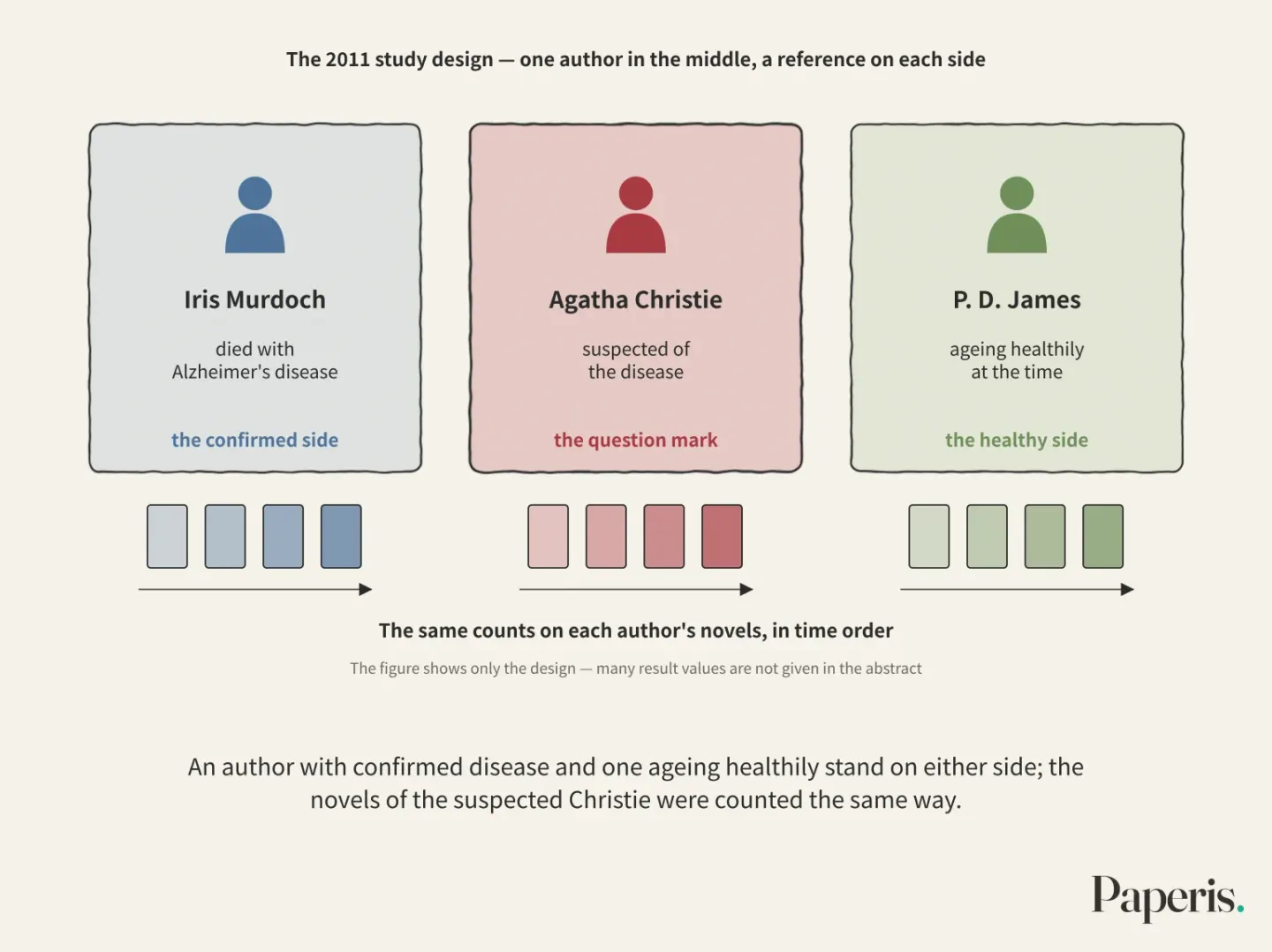
In 2011, novels by three British novelists were fed whole into a computer without cutting the original texts. This study analyzed sentence structure to follow many indices of words and syntax in chronological order (DOI: 10.1093/llc/fqr013). The abstract does not state how many of each author's novels were selected. The three writers were Iris Murdoch, a British novelist who passed away after battling Alzheimer's disease; Christie, who has been suspected of having suffered from the disease; and P. D. James, a British detective fiction writer who was aging healthily. With Christie placed in the middle, the design set an author with confirmed illness on one side and a healthy author on the other.
Among the causes of dementia, Alzheimer's disease is a brain disorder in which nerve cells slowly break down, and it is the most common cause of dementia. The disease itself was covered in "What Is Dementia? — Snow That Settles Without a Sound, a Branch Beginning to Bend".
The conclusion of the 2011 researchers is two-layered. One is general. It is that the results support the hypothesis that "analyzing a patient's writings in chronological order can reveal signs of dementia." The other is the judgment regarding Christie. The researchers wrote that it is "probable" that Alzheimer's disease was actually beginning around the time Christie wrote her last novels (DOI: 10.1093/llc/fqr013). The judgment made about Christie by a study that directly measured her novels is "probably so."
Such work has a name. Retrospective diagnosis is the practice of estimating a disease name using only remaining records such as letters, biographies, and works, without directly examining a person who has passed away. One research letter calls this practice of looking into novel texts "posthumous detective work," and summarizes that in the writings of Murdoch, Christie, and King James I of England, vocabulary size and syntax decreased markedly in later periods compared to earlier periods, and that pattern matches the initial impact of "subsequent dementia" (DOI: 10.1111/j.1532-5415.2011.03531.x). Although this letter is written as if presuming Christie's dementia, it is not a paper that measured Christie with its own data. The manuscripts of a detective novelist thus became the subject of detection. Detective work comes with limitations along with evidence, and in Christie's case, that limitation lies in the fact that the 2011 study also merely introduces her as a "suspected" case, with no records confirming a diagnosis in the evidence (DOI: 10.1093/llc/fqr013).
A book chapter published in 2015 summarizes previous studies as follows: longitudinal studies covering Murdoch and Christie view a sharp reduction in words and an increase in repeated phrases as markers of early-stage dementia, particularly Alzheimer's disease (DOI: 10.1075/impact.37.05lan). A longitudinal study is research that measures the same subject multiple times over a long period, following what changes and how within that subject. Here, the same subject is an author, and the data measured multiple times are the novels published by that author from youth to old age. Regarding Christie, something bearing as much weight as the conclusion is the word "probably" attached to the 2011 study's judgment.
What Was Counted
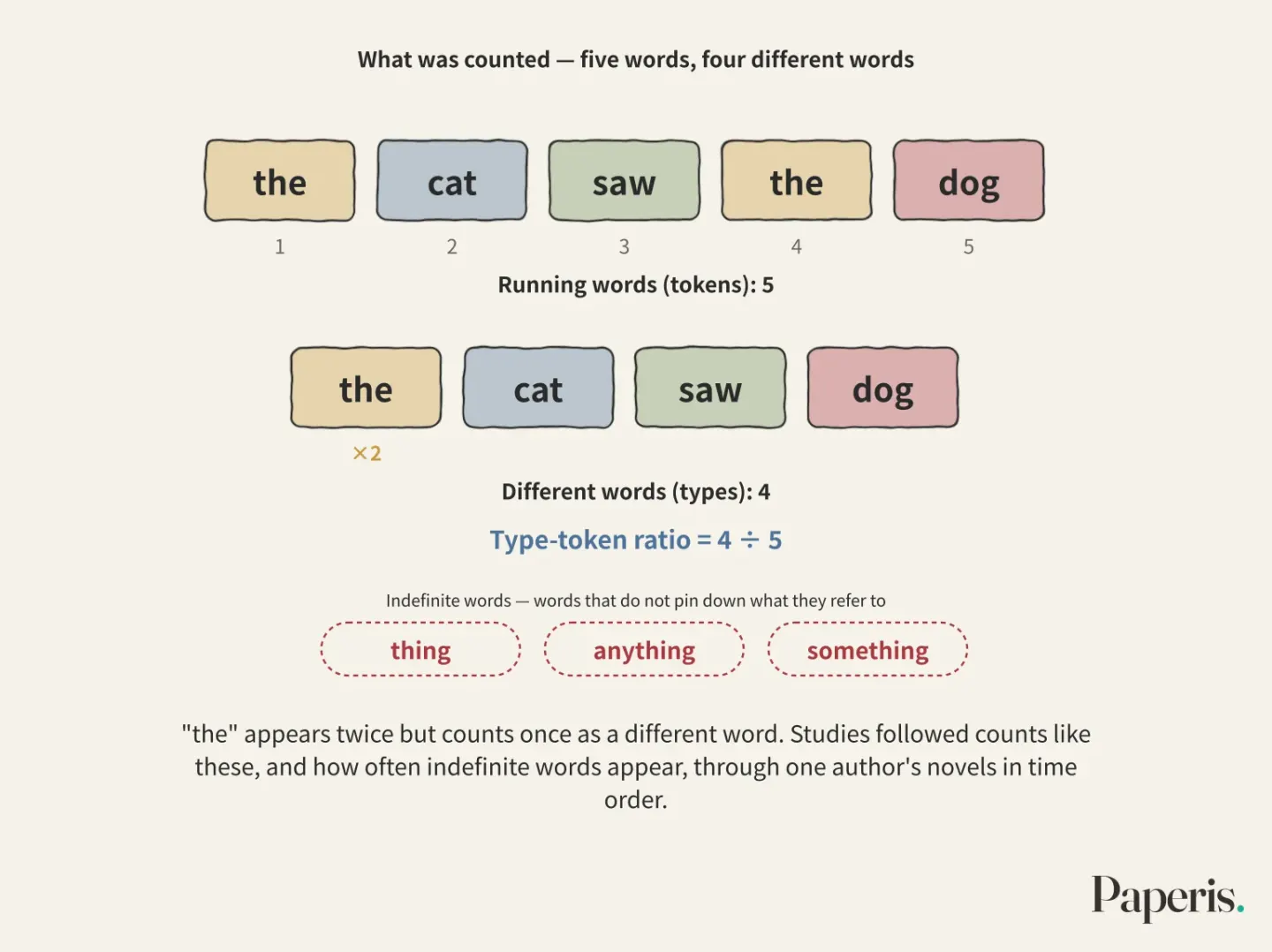
In the English sentence "the cat saw the dog", the word "the" appears twice, so there are four distinct words (types). Text-counting methods start from this difference.
Lexical diversity is the degree to which a piece of writing selects various words without repeating the same ones. The simplest way to measure this is a ratio. The type-token ratio is the value obtained by dividing the number of distinct words in a text (types) by the total number of words (tokens). For the sentence above, it is 4 divided by 5. The ratio of distinct words is a simple yardstick for measuring writing style, and in sufficiently long texts, it also serves as a yardstick for measuring the size of an author's vocabulary (DOI: 10.1111/j.1532-5415.2011.03531.x). However, as a text gets longer, there are more opportunities for previously used words to appear again, which naturally causes the ratio to drop, so a method of adjusting for length is used. A study analyzing the novels of British humorist P. G. Wodehouse counted how many distinct words there were at the 45,000-word mark every time (DOI: 10.1111/j.1532-5415.2011.03531.x).
The second count is vague words. Unspecified words are terms like "thing", "anything", and "something" that do not pinpoint the object they refer to. The Wodehouse study counted how frequently these exact three words appeared, and this count has the same footnote number attached to it as the study covering Christie earlier (DOI: 10.1111/j.1532-5415.2011.03531.x). It is the act of counting a verbal habit in writing where one fills in blanks with "thing" or "something" when the exact right name does not come to mind. A similar count emerged not from novels, but from speech. In a conference abstract analyzing 214 transcribed oral descriptions of a single picture (50 words or more), lower cognitive test scores were associated with more empty words (correlation coefficient $r = -0.25$) (DOI: 10.1017/s1355617723008767). It is not specified how this abstract counted those words. However, this result comes from speech produced in an examination room rather than an author's manuscript, and it is a report at the conference abstract stage.
The third is repetition. A 2015 book chapter summarizing the earlier Murdoch and Christie studies points to an increase in repeating phrases as a sign of dementia (DOI: 10.1075/impact.37.05lan). The Wodehouse study performed a similar count at the word level, measuring whether the 20 most frequently used content words (words carrying meaning, such as nouns, verbs, and adjectives) reappeared within the subsequent 20 words (DOI: 10.1111/j.1532-5415.2011.03531.x).
The fourth is sentence architecture, namely syntax. The same study counted the average number of clauses per sentence and singles out this value as the most useful and reproducible yardstick for measuring differences in linguistic complexity attributable to age and individual (DOI: 10.1111/j.1532-5415.2011.03531.x). The 2011 three-author study also analyzed the sentence structures of the original texts and tracked many indices in chronological order, but which syntactic indices they were is not in the abstract (DOI: 10.1093/llc/fqr013).
None of these four things mean anything by themselves. There are authors with small vocabularies, and there are authors who enjoy short sentences. Numbers acquire meaning when compared against what the same author wrote in the past, which is why studies on authors use a longitudinal design that arranges an author's novels in chronological order.
Iris Murdoch as the Benchmark Writer
To read Christie's results, we first need a case where the answer is known. That benchmark is the British novelist Iris Murdoch. Murdoch was one of the most celebrated writers in postwar Britain, but her final novel, published in 1995, received lukewarm reviews from critics. Soon afterward, she began showing subtle signs of cognitive decline and was diagnosed with Alzheimer's disease; after her death in 1999, brain tissue examination confirmed the diagnosis (DOI: 10.1093/brain/awh341).
The research team that first analyzed this case concluded, based on accounts from people around her and the way the disease progresses, that pathological changes were already taking place in Murdoch's brain when she wrote her final novel. They also determined that the manuscript was unlikely to have been supplemented with dictionaries or thesauruses or edited later by an editor (DOI: 10.1093/brain/awh341). A confirmed diagnosis and the low likelihood that the manuscript was touched up by a dictionary or an editor are the two conditions that made Murdoch the benchmark.
The researchers compared three books—her first novel, a novel from her creative peak, and her final novel—using automated text analysis. There were few differences in overall structure and syntax. In contrast, indices measuring lexical diversity and word characteristics differed markedly and in a consistent direction across the three books (DOI: 10.1093/brain/awh341). In the manuscript from the period when the disease was just beginning, the changes were much greater in the words themselves than in the sentence skeletons. The researchers discussed these findings within the context of the ongoing debate over whether syntax and meaning break down separately or together in Alzheimer's disease (DOI: 10.1093/brain/awh341).
A 2011 study of three authors stated that it avoided the limitations and shortcomings of this prior research, re-analyzing Murdoch's novels in their original text. This revealed a "valley" in which vocabulary and syntax became relatively impoverished in writings from Murdoch's late forties and fifties, which the researchers interpreted as foreshadowing later dementia (DOI: 10.1093/llc/fqr013). This story dates back to her late forties and fifties, long before the final novel compared in the earlier study.
Reports in the same direction followed for other authors diagnosed after Murdoch. The Dutch writer Gerard Reve (1923–2006) wrote his final novel shortly before being diagnosed with Alzheimer's disease; analyzing his three books showed a clear drop in lexical diversity, overlapping with reports that he had experienced "forgetfulness" beginning mid-way through writing that final novel (DOI: 10.1179/174327908x392852). The Dutch-writing author Hugo Claus is recorded as having "(probable) Alzheimer's disease," and a conference abstract reports that his lexical diversity changed in the same pattern as Murdoch's and Reve's, with newly coined metaphors also decreasing toward the end of his life. Metaphors were counted by randomly sampling 2% of the sentences he wrote over 50 years and having 23 literature majors, unaware of the purpose of the experiment, mark them (DOI: 10.1016/j.jalz.2013.08.203). The American mystery writer Ross Macdonald was diagnosed with Alzheimer's disease, and a 2015 analysis revealed the same linguistic impairments (DOI: 10.1075/impact.37.05lan).
The case of British author Terry Pratchett, who wrote the Discworld fantasy series, raised the question of how far ahead of diagnosis counting could begin. Pratchett was diagnosed with posterior cortical atrophy, a form of dementia where the cortex at the back of the brain shrinks, which is typically caused by Alzheimer's disease. Analyzing 33 Discworld novels showed a significant drop in the type-token ratio for nouns and adjectives in his later works. The total word count actually increased, and the point where the type-token ratio for adjectives dropped below a set threshold was about 10 years ahead of his official diagnosis (DOI: 10.3390/brainsci16010094). The researchers wrote that this result "suggests" linguistic changes can precede diagnosis considerably, adding that it needs to be verified in a larger cohort (DOI: 10.3390/brainsci16010094).
The interpretive chain for this passage is laid out directly in the Claus abstract. Based on the hypothesis that there is a period of 10 years or more before symptoms appear in Alzheimer's disease, the fact that two authors with decreased lexical diversity (Murdoch and Reve) both received a diagnosis of (probable) Alzheimer's disease was interpreted as a sign that "a decrease in lexical diversity can be a symptom of cognitive decline" (DOI: 10.1016/j.jalz.2013.08.203). Although changes in the same direction have been repeatedly reported in diagnosed authors, each of those studies looked at a single writer.
Authors Who Aged Well
To determine whether a drop in words is due to illness or simply age, we need authors who grew old without disease. This is why a 2011 three-author study included P. D. James (DOI: 10.1093/llc/fqr013). James was a British mystery writer like Christie, and she was aging healthily at the time of the study. An author from the same country and the same genre entered the comparison group. The abstract does not separately record the numbers for what emerged from James.
More detailed numbers came from the other two authors. P. G. Wodehouse (1881–1975) and Irish playwright George Bernard Shaw (1856–1950) published extensively and successfully well into old age. One research letter analyzed 20 novels by Wodehouse and 21 prefaces to plays written by Shaw after age 50. In writings stretching into their early nineties, no age-related language decline appeared. There were no meaningful changes in distinct words and repetition, and Wodehouse's vocabulary size and Shaw's style remained intact. The number of clauses per sentence stayed the same in Shaw, and actually increased slightly, but significantly, with age in Wodehouse (DOI: 10.1111/j.1532-5415.2011.03531.x).
The same letter also noted the opposite fact. Cross-sectional and longitudinal studies dealing with "normal" healthy aging consistently show that language output decreases with age starting in the mid-seventies, which includes a drop in syntactic complexity and a slight reduction in vocabulary size. The researchers stated that Wodehouse and Shaw are exceptional cases rather than typical examples of cognitive aging (DOI: 10.1111/j.1532-5415.2011.03531.x). Thus, even in healthy old age, words may decrease a little, and these two authors stand at the end where they did not decrease. This report is a short research letter published in a journal, and the syntax scores were graded by a single person.
A 2015 analysis set up three more "healthy" comparison groups. American author of The Wonderful Wizard of Oz Frank Baum, British author of Goodbye, Mr. Chips James Hilton, and R. A. Freeman of the "Dr. Thorndyke" detective fiction series bore no such markers, and the study noted that this shows living to a very old age does not necessarily end in dementia (DOI: 10.1075/impact.37.05lan).
The same analysis includes counterexamples that do not fit. British children's author Enid Blyton (1897–1968) was diagnosed with early-onset dementia rather than Alzheimer's disease, yet her late works showed no word reduction or increased repetition. The study notes alongside this that Blyton originally used a child-level vocabulary (DOI: 10.1075/impact.37.05lan). Meanwhile, the same study reports that all four authors—Murdoch, Christie, Macdonald, and Blyton—struggled to properly handle plot development and tended to transfer autobiographical material into their fiction (DOI: 10.1075/impact.37.05lan). The takeaway from this section is that there are changes not captured by word counting alone, and dementia does not always leave the exact same trace.
Other Explanations Still Remaining
If words shrank in Christie's final novel, what besides illness could have made that happen? We divide the explanations the evidence handles from those it does not.
First is age. As the previous section's letter outlined, even in healthy aging, vocabulary shrinks slightly and syntax simplifies starting in the mid-seventies (DOI: 10.1111/j.1532-5415.2011.03531.x). Christie wrote her final novels past the age of eighty. The 2011 study's use of the healthily aging mystery writer P. D. James as a comparison group is a device to pit against the explanation of age, but the abstract does not state how much comparison with a single person, P. D. James, subtracted the share of age (DOI: 10.1093/llc/fqr013).
Second is the way the manuscripts were produced. The Murdoch researchers highlighted the point that manuscripts would have undergone less vetting by dictionaries or editors as a strength of that case (DOI: 10.1093/brain/awh341). Editing or tools might shake up another writer's word counts, but studies measuring this are not in the evidence this piece gathered. Who touched Christie's final manuscripts and how much, and whether the author wrote them herself or dictated them to someone else, are not in the abstracts we saw.
Third is genre. Both the patient side and the comparison side of the 2015 analysis include mystery writers (MacDonald and Freeman), but the abstract does not state how they handled the influence that genre exerts on counts (DOI: 10.1075/impact.37.05lan).
Fourth is the debate surrounding the measurement target itself. The Murdoch researchers left whether syntax and meaning collapse separately or together in Alzheimer's disease as a debated question (DOI: 10.1093/brain/awh341).
Even past all four, a final difference remains. Murdoch was diagnosed while living, and confirmed through brain tissue after death (DOI: 10.1093/brain/awh341). The evidence this piece gathered has no record that such confirmation existed for Christie, and the 2011 study also introduces her as a “suspected” case. The 2011 researchers' conclusion also stops at “probable”, meaning “high possibility” (DOI: 10.1093/llc/fqr013).
Side-Branch: Writing at Twenty, the Brain in Old Age
There are autobiographies handwritten by 74 nuns between the ages of 19 and 37 (average 23). They are data from the Nun Study that followed the nuns for a long time, used to look at the writings of their youth instead of their writings in late life and ask about decades later. They passed away an average of 62 years later at ages 78 to 97, and their brains were used for neuropathological research (DOI: 10.1111/j.1749-6632.2000.tb06347.x).
The researchers scored how densely thoughts (propositions) were packed into the sentences of the autobiographies. The lower this score in youth, the more severe Alzheimer's disease pathology (tangles) was in the brain in old age. The correlation coefficients were -0.59 for the frontal lobe, -0.48 for the temporal lobe, and -0.49 for the parietal lobe. The same scores were not related to arteriosclerosis of the large arteries at the base of the brain or to cerebral infarction (DOI: 10.1111/j.1749-6632.2000.tb06347.x). The researchers interpreted, attaching "may," that lower linguistic ability in youth might reflect a less developed state of neurocognitive development, making one more vulnerable to pathology later in life (DOI: 10.1111/j.1749-6632.2000.tb06347.x).
There are also studies that checked whether this is a story unique to nuns. From Johns Hopkins University's Precursors Study data, 18 individuals classified with Alzheimer's disease and two matched control subjects per patient by sex and age were selected, and medical school application essays written at an average age of 22 were analyzed using software. Idea density was lower in the patient group at 4.70 per ten words compared to 4.99 in the control group (DOI: 10.1093/geronb/gbq064). The researchers wrote that this score in youth appears to predict Alzheimer's disease later in life not only in women but also in men (DOI: 10.1093/geronb/gbq064).
These two studies are associations observed at the group level. Because they are trends derived from the averages of dozens of people, they cannot be translated to mean that one individual's writing in youth determines that person's old age. Furthermore, no study measuring Christie's writings from her youth in this manner exists in the evidence we have examined.
To Become a Diagnostic Tool
A machine-learning algorithm analyzed 814 texts written by 81 ordinary people (34 with dementia, 47 in a control group) over an average of 28 years per person. This was a 2018 conference abstract that asked whether the findings from individual novelists would also hold true for the writing of ordinary people. Five algorithms were trained using 165 features extracted from parts of speech, vocabulary, syntactic complexity, and emotion (DOI: 10.1016/j.jalz.2018.06.546).
For texts written after the diagnosis, patients and controls were separated with an accuracy of 0.83. For texts written up to 20 years before the diagnosis, accuracy fluctuated and varied depending on how the features were grouped. There was also no clear pattern of features that consistently increased the likelihood of dementia across the entire timeline. The researchers' conclusion was that while Alzheimer's disease pathology may be revealed through computerized analysis of writing, no single feature or group of features pointed to the presence or absence of the disease (DOI: 10.1016/j.jalz.2018.06.546). This report remains at the conference abstract stage.
Placing these results alongside the research on novelists reveals a gap. What the novelist studies showed was a change identified retrospectively within an author who had already been diagnosed, whereas using ordinary people's writing to screen for the disease in advance is still at the research stage. Word counting in writing is not yet a tool for diagnosing an individual's illness, and both the 2018 conference abstract and the Pratchett study on ordinary people's writing frame their conclusions with words like "may" and "suggest," noting that validation in broader populations is needed (DOI: 10.1016/j.jalz.2018.06.546) (DOI: 10.3390/brainsci16010094). Because other explanations seen in the previous section—such as age, editing, and genre—remain, a single number measured from a person's writing cannot take the place of a diagnosis.
So What Do We Know?
We return to the questions surrounding Christie's final novels. The evidence says three things.
First, a 2011 study that measured Christie's original novel texts as wholes, down to their sentence structures, concluded that it was "highly likely" Alzheimer's disease was beginning around the time she wrote her final novels. This study reached this judgment by tracking numerous vocabulary and sentence structure indices in chronological order (DOI: 10.1093/llc/fqr013). A 2015 book chapter summarizes that preceding longitudinal studies covering Murdoch and Christie viewed sharp drops in vocabulary and rising numbers of repeated phrases as markers of early-onset dementia (DOI: 10.1075/impact.37.05lan). Changes in the same direction were also reported for Murdoch (whose diagnosis was confirmed postmortem) and for Lever, Klaus, McDonald, and Pratchett, who were diagnosed.
Second, such markers were not seen in the writings of Wodehouse and Shaw, nor in those of Baum, Hilton, and Freeman, whom the 2015 analysis established as a "healthy" comparison group. What emerged from James, the comparison group in the 2011 study, is not in the abstract. However, vocabulary can shrink slightly even in healthy old age, and there are examples like Blyton who did not show markers despite being diagnosed with dementia (presenile dementia rather than Alzheimer's disease) (DOI: 10.1111/j.1532-5415.2011.03531.x) (DOI: 10.1075/impact.37.05lan).
Third, because the evidence gathered in this article contains no record that Christie was diagnosed, and the 2011 study likewise introduces her as a suspected case, this conclusion remains a posthumous estimation. The evidence covering Christie and the other authors consists entirely of studies examining one author at a time, and screening for illness using the writing of ordinary people is still in the research stage.
The 2011 researchers also noted that this calculation provides a new understanding of the individual works by the authors they studied (DOI: 10.1093/llc/fqr013). What the numbers leave behind is a "perhaps" regarding the time an author in their eighties spent writing their final manuscript, while the worth of the work lies outside what this calculation measures.
Source Papers
- "Longitudinal detection of dementia through lexical and syntactic changes in writing: a case study of three British novelists" (2011) — DOI: 10.1093/llc/fqr013 — Analyzing the entire original texts including syntax for Murdoch (Alzheimer's disease), Christie (suspected), and James (healthy), Christie's Alzheimer's disease likely began around the time she wrote her final novel “probable”, Murdoch's late 40s to 50s “the valley”.
- "The effects of very early Alzheimer's disease on the characteristics of writing by a renowned author" (2004) — DOI: 10.1093/brain/awh341 — Diagnosis confirmed post-mortem in Murdoch, comparison across three novels shows minimal structural and syntactic differences while vocabulary diversity changes distinctly and consistently.
- "Vocabulary and dementia in six novelists" (2015) — DOI: 10.1075/impact.37.05lan — Summarizing previous research on Murdoch and Christie (reduced vocabulary, increased repetitive phrases), similar impairment in MacDonald, no such impairment in Blyton (early-onset dementia), comparison groups for Baum, Hilton, and Freeman show no markers.
- "LANGUAGE CHANGE WITH AGING IN PELHAM GRENVILLE WODEHOUSE AND GEORGE BERNARD SHAW" (2011) — DOI: 10.1111/j.1532-5415.2011.03531.x — Research letter. 20 novels by Wodehouse and 21 prefaces by Shaw, no linguistic decline up to the early 90s, normal aging shows a slight decline starting in the mid-70s.
- "From hindsight to insight – retrospective analysis of language written by a renowned Alzheimer's patient" (2008) — DOI: 10.1179/174327908x392852 — Three novels by Lever, overlapping with reports of forgetfulness during the writing of the final novel, showing a marked decline in vocabulary diversity.
- "P4–369: A way with metaphors: An analysis of literary work produced in early MCI due to Alzheimer's disease" (2013) — DOI: 10.1016/j.jalz.2013.08.203 — Conference abstract. Claus (probable Alzheimer's disease) shows similar vocabulary diversity, with a reduction in novel metaphors.
- "Detecting Dementia Using Lexical Analysis: Terry Pratchett's Discworld Tells a More Personal Story" (2026) — DOI: 10.3390/brainsci16010094 — 33 books of the “Discworld” series, decreased noun and adjective type-token ratio about 10 years before official diagnosis, requiring validation in larger cohorts.
- "18 Automatically calculated lexical and sentential context features of connected speech predict cognitive impairment" (2023) — DOI: 10.1017/s1355617723008767 — Conference abstract. Picture description task with 214 participants, lower cognitive scores correlate with more empty speech lacking substance (r = -0.25).
- "Linguistic Ability in Early Life and the Neuropathology of Alzheimer's Disease and Cerebrovascular Disease: Findings from the Nun Study" (2000) — DOI: 10.1111/j.1749-6632.2000.tb06347.x — 74 nuns, idea density in early-life autobiographies inversely correlates with the number of brain tangles in old age, independent of vascular lesions.
- "Propositional Density and Cognitive Function in Later Life: Findings From the Precursors Study" (2010) — DOI: 10.1093/geronb/gbq064 — 18 individuals with Alzheimer's disease and 2 control subjects each, idea density in 22-year-old medical school applications was 4.70 versus 4.99.
- "P1‐535: PREDICTING DEMENTIA FROM WRITTEN TEXTS USING FEATURE EXTRACTION AND MACHINE LEARNING" (2018) — DOI: 10.1016/j.jalz.2018.06.546 — Conference abstract. 81 individuals, 814 texts, 165 features, classification accuracy of texts written after diagnosis is 0.83, texts before diagnosis fluctuate, no single feature stands out.
Sources (11)
- Longitudinal detection of dementia through lexical and syntactic changes in writing: a case study of three British novelistsDOI 10.1093/llc/fqr013
- The effects of very early Alzheimer's disease on the characteristics of writing by a renowned authorDOI 10.1093/brain/awh341
- Vocabulary and dementia in six novelistsDOI 10.1075/impact.37.05lan
- LANGUAGE CHANGE WITH AGING IN PELHAM GRENVILLE WODEHOUSE AND GEORGE BERNARD SHAWDOI 10.1111/j.1532-5415.2011.03531.x
- From hindsight to insight – retrospective analysis of language written by a renowned Alzheimer's patientDOI 10.1179/174327908x392852
- P4–369: A way with metaphors: An analysis of literary work produced in early MCI due to Alzheimer's diseaseDOI 10.1016/j.jalz.2013.08.203
- Detecting Dementia Using Lexical Analysis: Terry Pratchett's Discworld Tells a More Personal StoryDOI 10.3390/brainsci16010094
- 18 Automatically calculated lexical and sentential context features of connected speech predict cognitive impairmentDOI 10.1017/s1355617723008767
- Linguistic Ability in Early Life and the Neuropathology of Alzheimer's Disease and Cerebrovascular Disease: Findings from the Nun StudyDOI 10.1111/j.1749-6632.2000.tb06347.x
- Propositional Density and Cognitive Function in Later Life: Findings From the Precursors StudyDOI 10.1093/geronb/gbq064
- P1‐535: PREDICTING DEMENTIA FROM WRITTEN TEXTS USING FEATURE EXTRACTION AND MACHINE LEARNINGDOI 10.1016/j.jalz.2018.06.546