Paperis Articles
Proust — Do Smells Really Bring Back Older Memories?
The "Proust phenomenon" named after the madeleine scene — what experiments confirmed, and the distance between a spoonful of tea in a novel and a vial of odor in the lab
Your field's papers, as audio
Pick your fields and journals — Paperis summarizes the key papers and turns them into audio. Listen on your commute.
Start Paperis free →Proust — Do Smells Really Bring Back Older Memories?
In 1913, A Spoonful of Tea
In 1913, the French novelist Marcel Proust published Swann's Way, the first volume of his long novel In Search of Lost Time. This novel is a story told by "I" looking back on his own life, and Part 1 of the first volume, "Combray," contains one of the most famous memory scenes in Western literature (DOI: 10.4148/2334-4415.1000). On a winter day, his mother urges the cold "I" to have some tea, unlike usual, and has a shell-shaped cake called a "petite madeleine" brought out. "I" absentmindedly touches a spoonful of tea soaked with a piece of madeleine to his lips. It was not tea tasted to find a memory.
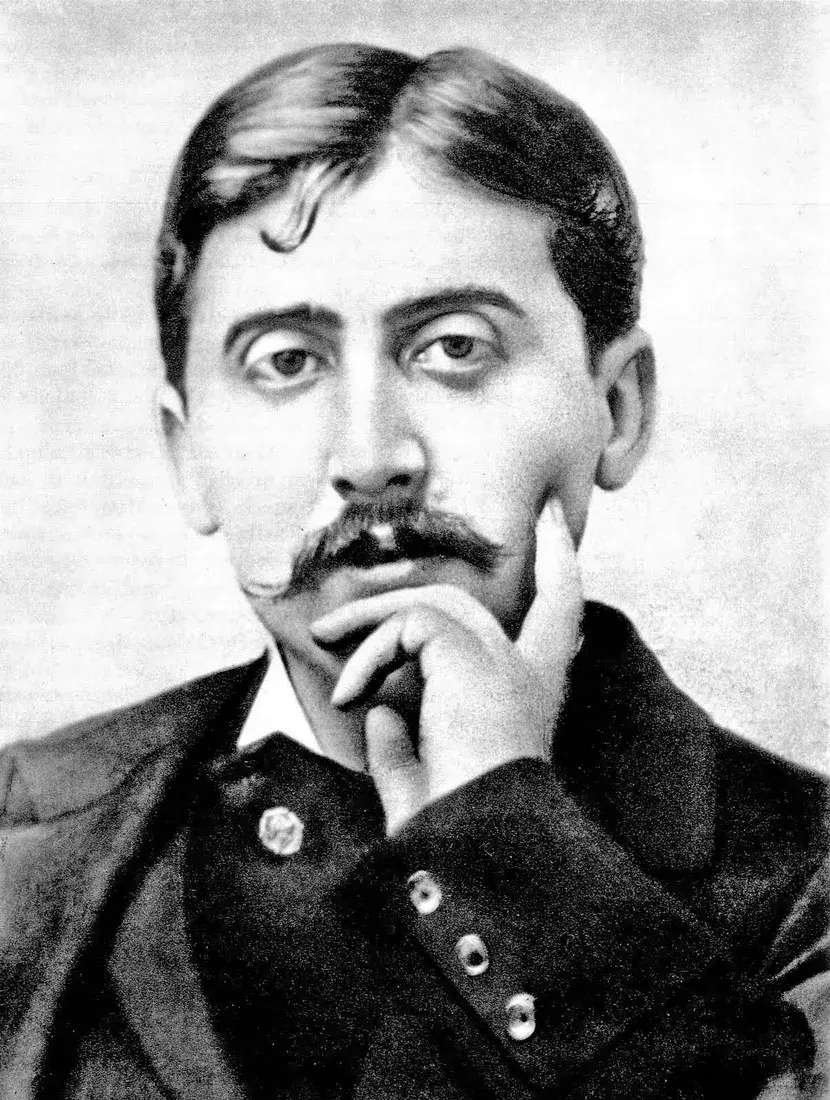
Marcel Proust, photographed by Otto Wegener (1895) · Public domain · Wikimedia Commons
Mais à l’instant même où la gorgée mêlée des miettes du gâteau toucha mon palais, je tressaillis, attentif à ce qui se passait d’extraordinaire en moi.
But at the very instant when the mouthful mixed with crumbs of the cake touched my palate, I shuddered, attentive to the extraordinary thing that was happening inside me.
— Marcel Proust, Swann's Way, Part 1 "Combray" (original · translated by Paperis)
The memory does not rise right on the spot. "I" tries drinking the tea a few more times, composes himself, and struggles for a long time. Then the next sentence comes.
Et tout d’un coup le souvenir m’est apparu.
And all at once the memory appeared to me.
— Marcel Proust, Swann's Way, Part 1 "Combray" (original · translated by Paperis)
What rises is a piece of madeleine that Aunt Léonie used to hand him, dipped in tea or linden blossom tea, every Sunday morning in childhood Combray. Following that single piece, the house and streets of childhood come back to life all at once (DOI: 10.1057/9781137520586_4).
This scene is the experience of "I" inside the novel. First-person narration is a method in which "I", a character in the story, tells about things he experienced or saw close by. A chapter in a psychology book calls this novel an "autobiographical novel" (DOI: 10.1057/9781137520586_4), but there is no record in the evidence gathered by this article that Proust himself literally underwent "I"'s madeleine experience. This scene is also a carefully crafted sentence. One literary study shows that Proust drew on scenes from French novelist Pierre Loti's My Brother Yves, which he enjoyed reading in his youth, to build the madeleine scene and other scenes in "Combray," and adds that this is not meant to cast doubt on Proust's originality (DOI: 10.4148/2334-4415.1000). The issue dividing the "I" of the novel and the author is dealt with separately in "Speaker and Point of View — "Hearken!": A Voice That Begs to Be Believed".
This scene later lends its name to psychological experiments. The question this article will follow is this: Does smell really summon older and more vivid memories than other cues? In memory research, a cue is a clue put forward to draw out a memory, such as words, photographs, sounds, or smells. In the madeleine scene, the cake soaked in tea was that cue. And one more question follows: Is what the laboratory tested the same thing as that scene in the novel?
The Belief That "Smell Is the Strongest Key"
The belief that scent is the most powerful trigger for calling up memories of one's own life is widespread (PMID 42934456). The memories spoken of here are a special kind. Autobiographical memory is the memory of things I have directly experienced, of when, where, and what happened. It is different from knowing multiplication tables or country names; it is a memory like "Grandmother's kitchen that summer."
Psychology has given a name to this belief. In 2000, two researchers, Chu and Downes, introduced Proust's scene as a literary anecdote demonstrating "folk wisdom about the power of smell," and defined the so-called the Proust phenomenon like this (DOI: 10.1093/chemse/bjh043). The Proust phenomenon is a phenomenon where scent spontaneously summons an autobiographical memory, and that memory is exceptionally vivid, colored with emotion, and very old.
Three properties of memory overlap in this definition. The memory called up by scent is ⓐ exceptionally vivid, ⓑ colored with emotion, and ⓒ very old. And one condition is attached: "spontaneously." Reviewing earlier studies, Chu and Downes cited the failure to compare olfactory memories with memories from other cues as one reason they viewed those studies as "partially relevant" (DOI: 10.1093/chemse/bjh043). This article therefore takes "Is it more so than other cues?" as the question for testing, and breaks down the question "Was Proust right?" into these three properties plus "spontaneously"—four in total.
What the Lab Did — Pairing Scents with Other Cues
To test the Proust phenomenon, researchers must present the same object as a scent, a photograph, and a name, and compare the memories that come to mind. If participants are only allowed to smell something, researchers can say “olfactory memories are emotional”, but they cannot say “more so than other cues”.
In one 1984 study, the first experiment presented 15 common objects as scents or names, and the second experiment presented 16 as scents, photographs, or names, asking participants to write down the memories that arose and rate how old, vivid, and pleasant those memories were. Memories summoned by scents were less frequently recalled or talked about before the experiment, and participants more often reported having never recalled them before. Other differences did not appear consistently, showing only a slight hint that scents might evoke more pleasant and emotional memories (DOI: 10.2307/1422158). The one difference for scents that held up steadily across this controlled experiment was “memories rarely recalled or spoken of before”.
A 1992 experiment had 40 men and women smell 20 scents and rate any triggered memories for emotion, vividness, specificity, rarity, and age. The memories were generally rich in emotion, vivid, specific, rare, and relatively old, which the authors noted aligned with popular belief. 32% of the memories were recalled without participants being able to name the scent (DOI: 10.1093/chemse/17.5.519). However, the design described in the abstract lacks a condition comparing them to other cues. It showed “what olfactory memory is like”, but did not test whether “olfactory memory is more so”.
Comparative experiments followed later. A 2002 experiment first had participants recall memories using object names, and then presented the same objects as scents or photographs. Memories recalled in the presence of scents were significantly more emotional than those in the presence of photographs or names, and participants also tended to feel a greater sense of “transportation” back to that time (DOI: 10.2307/1423672). A 2004 experiment presented campfires, freshly cut grass, and popcorn as scents, pictures, and sounds. Memories evoked by scents were more emotional and more transportive, but there were no differences across cue types in content features such as vividness and specificity (DOI: 10.1093/chemse/bjh025). Both experiments found “more emotional”, while the 2004 experiment, which measured vividness, did not find “more vivid”.
In 2026, a calculation combining these experiments was published. A meta-analysis is a method that gathers the results of multiple studies addressing the same question and recalculates them together. Gathering 18 experimental and quasi-experimental studies, researchers compared scent cues against other cues and examined seven characteristics of the evoked memories (specificity, vividness, emotional intensity, pleasantness, rarity, evocation power, and memory age). Scent came out ahead in four: emotional intensity, pleasantness, evocation power, and memory age. Rarity did not show a significant overall effect. The authors concluded that these results “do not fully confirm” the Proust phenomenon, noting that the advantage of scent is “selective rather than universal” and that future work must uncover the conditions under which this advantage appears (PMID 42934456).
That is four out of seven. Translating this back to the question this article posed at the beginning, the evidence has converged on the idea that scent-evoked memories are older and more emotional, while vividness and specificity did not make the list of leading traits.
The Age of Memory — Tilted Before Age Ten
The age of memory is worth looking at on its own. When people are asked to recall memories from across their lives, the ages of the memories that emerge do not spread evenly. The reminiscence bump is the phenomenon where, when people are asked to recall memories from across their lives, an excessive number of memories emerge from adolescence and early adulthood. This skew is commonly observed when memories are triggered by cues such as words, photographs, or sounds (PMID 31923883). In a survey asking 1,241 people aged 20 to 93 at what ages their happiest and most important events occurred, the most important and happiest memories of older respondents were also concentrated in their 20s (DOI: 10.1037/0882-7974.17.4.636).
When smell is provided as a cue, this bump shifts. Memories called forth by word or picture cues typically cluster in the young period of ages 10 to 30, whereas memories called forth by smell cluster before age 10, in the first decade of life (PMID 19686154). In a 2020 study that triggered memories using sounds and smells, the bump for sound-triggered memories spanned the first 20 years of life, while the bump for smell-triggered memories lay once again in early childhood. Because the distribution was similar between people who had lost their sight early in life and those who could see, the authors concluded that this bump remains robust against large differences in sensory experience (PMID 31923883).
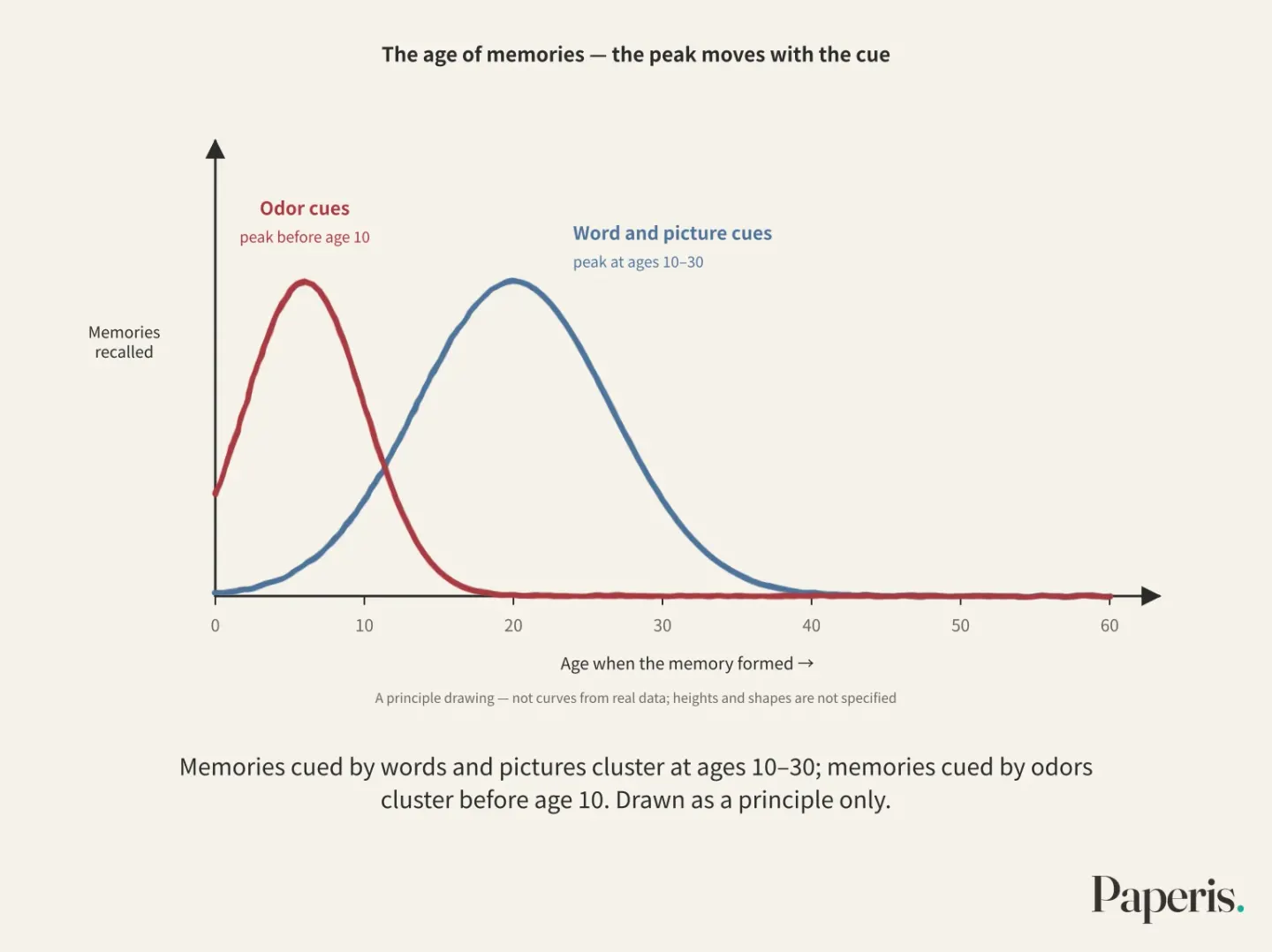
One condition is attached to this. The age distribution of memories and the quality of the memories vary depending on whether the participants know what the smell is (PMID 19686154).
In short, a meta-analysis placing "smell calls forth older memories" among the top four, alongside studies that separately measured the age distribution of memories, all point in the same direction.
"More Vivid" and "More Accurate" Are Two Different Things
The definition of the Proust phenomenon put "very vivid" at the forefront. A 2004 experiment comparing smell to pictures and sounds found no difference in vividness depending on the type of cue (DOI: 10.1093/chemse/bjh025). The abstract of a meta-analysis calculated by comparing it against other cues listed emotional intensity, pleasantness, evoking power, and the age of the memory as the four features where smell leads, and did not include vividness among those four. How the result for vividness turned out is not separately noted in the abstract (PMID 42934456). Meanwhile, a 2014 review summarized that memories evoked by smell differ from those evoked by seeing and hearing, and noted that their core features can be called LOVER, an acronym for "Limbic, Old, Vivid, Emotional, Rare" (PMID 24782810). This review grouped the features of smell memories, whereas the meta-analysis calculated whether smell leads other cues, so the two papers cannot be pitted against each other to decide which one is right.
"Vivid" is also different from "accurate." Most measurements recorded in the abstracts are scores that participants assigned to their own memories—how emotional they are, how clear they are, and when they happened (DOI: 10.2307/1422158) (DOI: 10.3233/jad-200841). Among the abstracts of the evidence gathered for this article, none state that they checked how closely smell-evoked memories matched actually occurring events. The claim that "smell memories are more accurate" is a claim that the abstracts of these pieces of evidence do not address.
The meta-analysis also left several warnings. The smaller the study's sample, the larger the effects appeared for emotional intensity, pleasantness, and rarity. As this article reads it, one must be cautious about accepting a large effect produced by a single small experiment at face value. The higher the proportion of female participants in a study, the smaller the effect of evoking power was; the more recent the study, the smaller the effect of pleasantness was. The superiority of smell in emotional intensity was greater in designs where a single person received both smell and other cues (PMID 42934456).
Which smell is chosen also shakes the results. In a study where 130 young adults were made to smell 64 odors and speak as things came to mind, only a few odors spontaneously evoked high-quality autobiographical memories, while most stopped at trying to name them by thinking "what smell is this" or recalling vague content (PMID 37163884). Not all smells become madeleines.
What Proust Wrote and Experiments Tested
Now let us return to the novel. The original text writes that what awakened the memory was "taste (le goût)". And it adds right away:
La vue de la petite madeleine ne m’avait rien rappelé avant que je n’y eusse goûté;
The sight of the little madeleine had called nothing to mind before I tasted it;
— Marcel Proust, Swann's Way, Part 1, "Combray" (original · translated by Paperis)
Even when nothing is left from the distant past, the words of "I" are as follows:
l’odeur et la saveur restent encore longtemps, comme des âmes, à se rappeler, à attendre, à espérer, sur la ruine de tout le reste
smell and taste remain for a long time, like souls, remembering, waiting, hoping, on the ruins of all the rest
— Marcel Proust, Swann's Way, Part 1, "Combray" (original · translated by Paperis)
The novel takes smell and taste together, and the moment that awakened the memory is the moment the cake dipped in tea was put into the mouth. Regarding this scene and the experiments, there is a writing left by the researcher Jellinek. In a 4-page writing from 2004, he noted that Chu and Downes extracted one paragraph from three pages of Proust's description to define the Proust phenomenon, and asked in the title "Have Proust's descriptions of autobiographical memory cued by odor ever really been investigated?" (DOI: 10.1093/chemse/bjh043). A book chapter published in 2019 notes that the conclusion of Herz and Schooler, who compared smell and photographs, was criticized particularly strongly by Jellinek. According to that chapter, Jellinek's point was that in Proust's story the stimulus spans multiple senses, so when dipping the madeleine in tea, not only smell but also sight, taste, and texture are involved together. In which writing that criticism was published is not in the abstract. The same chapter also notes that recent studies in Lyon, France, seem to confirm Herz's initial conclusion that the richer a smell is emotionally, the better the context attached to that smell is remembered (DOI: 10.1002/9781119687467.ch5). How the brain pieces together what multiple senses receive into a single scene is covered in "Sensation and Perception — Clues Taken at the Door, a Scene Pieced Together by Guesswork".
When you place the two scenes side by side, there are three differences.
| The scene in the novel | The experiments reviewed in this article | |
|---|---|---|
| What awakened it | The taste of the cake dipped in tea; the original text takes smell and taste together | Smells perceived through the nose |
| How it came | The body trembled first at the tea carelessly brought to the mouth, and the memory was grasped with effort afterward | The experimenter presented a smell and mostly asked to try to recall a memory |
| When it came to mind | Suddenly, after tasting many times and struggling for a long time | Right there where the smell was perceived |
The limitations of experiments up to the year 2000 were also pointed out by Chu and Downes themselves. Reviewing the research published up to that point, they noted that except for one paper from 1999, all were only partially related to the Proust phenomenon, and Jellinek noted that this point was correct. The reasons were that they did not deal with true autobiographical memory, did not compare memories called forth by smell with memories called forth by other cues, or were conducted under conditions far removed from everyday life (DOI: 10.1093/chemse/bjh043). Jellinek's writing is 4 pages long, and what this article looked at is its beginning.
The third difference, "after struggling for a long time", has also been addressed in literary studies. A 2013 study that read the madeleine scene against today's cognitive science views that this scene partly matches the reality of memory recorded by science and partly conforms to common expectations about memory. And it argues that the scene itself dismantles the "neat opposition between deliberately recalled memory and spontaneously recalled memory" that the scene initially seems to show (DOI: 10.1177/1750698012468000). In the original text, "I" struggles for a long time to grasp the memory after tasting it.
Memories That Arise on Their Own
There is also a research thread frequently discussed alongside the novel scene. Involuntary memory is a memory of one's own experiences that comes to mind on its own without trying to recall it. This memory was long ignored in modern cognitive psychology (DOI: 10.1177/0963721410370301), which has mainly studied memories that are laboriously recalled in the laboratory (PMID 33308074).
The primary method for measuring this memory is keeping a diary. In a 1996 study, 14 people recorded memories that spontaneously came to mind in daily life, and the recorded memories almost all had recognizable cues and leaned toward recent events, conspicuous events, and events matching their mood at the time (DOI: 10.1002/(sici)1099-0720(199610)10:5<435::aid-acp408>3.0.co;2-l). A 1998 study compared involuntary memories recorded in diaries with memories recalled in the laboratory using word cues. Involuntary memories were more specific, had been rehearsed less beforehand, and were more positive in emotion. They were most frequent when attention was scattered, and surrounding cues that matched the core of the recalled event were usually the trigger (PMID 9640425). A 2021 review notes that such memories are very frequent in daily life and lean distinctly toward recent events and events overlapping with the current situation (PMID 33308074).
There are also diary studies that collected only memories spontaneously brought up by smells. A study published in Japanese in 2008 had 30 people record the contents and circumstances whenever memories spontaneously arose due to smells over the course of a month. Most of the recalled memories were old, pleasant, emotionally intense, specific, and accompanied by the feeling of reliving that time. The authors wrote that this result suggests the emotion evoked by smell influences this phenomenon (DOI: 10.5265/jcogpsy.6.65). Because this study preserves the condition of "spontaneity," it is the closest among the evidence examined in this article to the situation where smell summoned memory in daily life. However, the "inattentiveness" in the novel is the action of putting tea to the lips, and the memory is what was painstakingly caught afterward, so it is not identical to "spontaneity." Here too, the cue was a smell, and the abstract contains no condition comparing it to cues from other senses.
Now, what we have learned is applied to the novel scene once. If "I" had been a experiment participant, the Sunday morning of childhood that he recalled would have resembled the memory "leaning toward early childhood" mentioned by the smell study, and it would also have resembled the "specific" memory mentioned by the involuntary memory study. However, the 1996 diary study and 2021 review covering general everyday involuntary memories note that such memories usually lean toward recent events, so it differs in that regard. In the 2008 study that collected only memories spontaneously recalled by smells, most of the memories were old. Yet he is not an experiment participant but a character in a novel. Moreover, there is no study collected in this evidence that compares the memory summoned with painstaking effort by the taste of a pastry absentmindedly put to the lips against other cues under those same conditions. "Proust must have been like this too" does not step a single foot beyond an assumption with this evidence.
What Brain Scans Showed and Their Scale
An explanation from neuroscience has accompanied the finding that memories recalled by scents are more emotional. Functional magnetic resonance imaging is a scanning test that tracks changes in blood flow across different parts of the brain in units of a few seconds. A 2004 study presented five healthy right-handed women with cues linked to personally meaningful memories in both olfactory and visual forms, alongside comparison cues in the same two formats, and scanned their brains using this test (PMID 14670575). Faced with personally meaningful smells, the amygdala and hippocampal regions showed significantly greater activation than with any other cue, and emotional responses were also greatest for those smells.
The two regions are as follows. The amygdala is a small structure located deep inside the brain on both sides, frequently studied in connection with emotional responses such as fear. The hippocampus is a small structure located deep inside the inner temporal lobe, essential for turning newly experienced events into long-lasting memories. The authors called this result "convincing neurobiological evidence" that the emotional power of odor memories is linked to amygdala activity during recall (PMID 14670575). However, the participants numbered five. Brain imaging serves as a clue pointing in the same direction as the behavioral result of "being more emotional," rather than standing as a sample size capable of supporting that finding on its own.
Dementia Care and Smell — The Results As They Are
If smell summons old memories, might it help a person who is losing their memory? This question leads straight into the caregiving field. Dementia is a name for a condition where the powers of memory and judgment decline compared to before, making it difficult to manage daily life alone. Reminiscence therapy is a caregiving method that helps the mind by bringing up past events. It is one of the most widely used psychosocial interventions in dementia care, and sensory cues are commonly used to evoke memories (DOI: 10.3233/jad-200841). What dementia is is covered in detail in "What Is Dementia? — Snow That Settles Without a Sound, a Branch Beginning to Bend".
A 2021 study presented 60 patients with early to mild Alzheimer's disease, 60 healthy older adults, and 60 healthy young adults with 4 smells, 4 sounds, or 4 photographs, and asked them to recall memories. Overall, no single sense clearly outpaced the others in summoning high-quality memories. For patients, photographs brought up more memories—and memories that were less commonly recalled normally—making them the best, followed by smell. Environmental sounds showed no distinct advantage (DOI: 10.3233/jad-200841). The authors hoped these results would help care professionals use reminiscence therapy more efficiently with sensory cues.
This result does not match the belief that "smell is the ultimate key." This study measured the ability to recall memories, not whether dementia improves through smell. A 2011 study reporting that pleasant memories summoned by nostalgic smells improved mood and changed bodily responses was conducted on healthy volunteers (PMID 22286798). The statement from a 2023 review that nostalgic memories summoned by smells and tastes "could" be used in clinical settings and elsewhere remains a possibility (PMID 36863096).
Still Debated
First, there is the question of where the superiority of smell comes from. The meta-analysis concluded that the superiority is selective, leaving the identification of those conditions as the next task (PMID 42934456). A 2009 review summarized that memories evoked by odors are "different" from those evoked by words or pictures, and also noted that the age distribution and quality of the memories vary depending on whether participants know what the odor is (PMID 19686154). Whether that difference stems from the sensory experience of smell itself or is intertwined with the process of recognizing the odor is a question that cannot be resolved by the evidence gathered in this article.
Second, there is the question of how to read Proust. A 2024 paper (whose type could not be verified from the abstract) views Proust as a "pioneer" who anticipated science—namely, that recollection is a reconstruction, that sensory cues can summon memories, and that voluntary and involuntary memory must be separated—ahead of his time (DOI: 10.3389/fpsyg.2024.1235098). The 2013 literary study we saw earlier read the same scene as dissolving that distinction on its own (DOI: 10.1177/1750698012468000). Both readings exist side by side: one that positions the author as a prophet of science, and one that reads the scene as a text where expectations about memory and reality are mixed together.
Third, there is the question of whether research has directly tested Proust's scene. Jelinek's 2004 paper asked in its title whether Proust's description of recollection triggered by olfactory cues has "really ever been investigated" (DOI: 10.1093/chemse/bjh043). The evidence dealing with taste is not entirely nonexistent. A 2023 review summarized that nostalgia-inducing memories summoned by taste and smell are particularly self-relevant and carry more positive emotions than nostalgia memories evoked in other ways (PMID 36863096). However, this is a review, and its abstract does not mention the condition of "inadvertence," nor does it separate the results for taste and smell. Within the evidence collected in this article, we could not find a study that compared taste cues against other cues under the condition of tasting something inadvertently and then laboring to recall it.
What Do We Know Now
The question left by the madeleine scene in psychology split into three directions. Evidence has gathered around the idea that memories evoked by odors are older and more emotional than those evoked by other cues. The leaning of memory age toward before age ten, deeper emotion, greater pleasure, and a stronger power to evoke are those contents, and a calculation gathering 18 papers picked those four as the advantages of smell (PMID 42934456).
"More vivid" did not make the four advantages of smell picked by the meta-analysis, and "more accurate" has no recorded measurements in the abstracts of these pieces of evidence. And the authors of the meta-analysis themselves wrote that this result does not fully confirm the Proust phenomenon (PMID 42934456).
Lastly, what the laboratory tested was usually odors smelled through the nose, while what Proust's narrator experienced was the taste of a pastry dipped in tea and absentmindedly touched to the lips, followed by the memory he struggled to catch. What experiments have confirmed are several properties of olfactory memory, and studies testing that scene from the novel transferred as is are not found in the evidence gathered by this article. The spoonful of tea from 1913 became the name of an experiment, and an experiment testing the taste of that spoonful as is has not yet been found in this evidence.
Source Papers
- "Is the Proust phenomenon fact or fiction? A systematic review and meta-analysis of odor-evoked autobiographical memory." (2026) — PMID 42934456 — Meta-analysis of 18 experimental and quasi-experimental studies. Odor cues lead in emotional intensity, pleasantness, evoking power, and memory age; rarity is not significant. Smaller samples show larger effects. "Does not fully confirm the Proust phenomenon — superiority is selective."
- "Proust Remembered: Has Proust's Account of Odor-cued Autobiographical Memory Recall Really been Investigated?" (2004) — DOI: 10.1093/chemse/bjh043 — 4-page article (type unconfirmed). Points out that Chu and Downes defined the Proust phenomenon in one paragraph out of three pages of description, and considers Chu and Downes's critique correct that most prior studies are only partially relevant.
- "The Famous Madeleines: The Proust Phenomenon, a Scientific Spoliation?" (2019) — DOI: 10.1002/9781119687467.ch5 — Book chapter. Jelinek's critique of Herz and Schooler's conclusion (scene stimulation involves multiple senses together: sight, taste, texture, and smell), noting that the Lyon study seems to confirm Herz's initial conclusion.
- "Cognitive realism and memory in Proust's madeleine episode" (2013) — DOI: 10.1177/1750698012468000 — Literary study. The scene fits cognitive realism in part and common expectations in part, and deconstructs the voluntary/involuntary distinction on its own.
- "A Significant Source for the Madeleine and Other Major Episodes in Combray: Proust's Intertextual Use of Pierre Loti's My Brother Yves" (2014) — DOI: 10.4148/2334-4415.1000 — Shows that Loti's My Brother Yves was drawn upon to construct the madeleine scene, without intending to cast doubt on its originality.
- "Proust Recalled: A Psychological Revisiting of That Madeleine Memory Moment" (2016) — DOI: 10.1057/9781137520586_4 — Book chapter. Summary of the madeleine scene (Aunt Léonie, childhood home and streets).
- "Olfactory Cuing of Autobiographical Memory" (1984) — DOI: 10.2307/1422158 — Comparison of odor, photograph, and name cues. Odor memories are recalled less often beforehand and talked about less; other effects are inconsistent.
- "An experimental characterization of odor-evoked memories in humans" (1992) — DOI: 10.1093/chemse/17.5.519 — 40 people and 20 odors. Odor memories are emotional, vivid, specific, rare, and relatively old; 32% without names. No comparison cues.
- "A Naturalistic Study of Autobiographical Memories Evoked by Olfactory and Visual Cues: Testing the Proustian Hypothesis" (2002) — DOI: 10.2307/1423672 — Recalled first by name, then odors and photographs presented. Odors are more emotional, tending toward a "transported back" feeling.
- "A Naturalistic Analysis of Autobiographical Memories Triggered by Olfactory Visual and Auditory Stimuli" (2004) — DOI: 10.1093/chemse/bjh025 — Campfire, grass, popcorn. Odor memories are more emotional and evocative; vividness and specificity do not differ.
- "Autobiographical odor memory." (2009) — PMID 19686154 — Review. Odor memories cluster in the first decade (words and pictures are 10–30 years old), are more emotional, give more of a transport-back feeling, and are recalled less; knowing whether it is an odor changes the results.
- "The reminiscence bump is blind to blindness: Evidence from sound- and odor-evoked autobiographical memory." (2020) — PMID 31923883 — Definition of the reminiscence bump. Sound bump in the first 20 years, odor bump in early childhood, similar in blind and sighted individuals.
- "Emotionally charged autobiographical memories across the life span: The recall of happy, sad, traumatic and involuntary memories." (2002) — DOI: 10.1037/0882-7974.17.4.636 — 1,241 people aged 20–93. Older respondents' most important and happy memories cluster in their twenties.
- "Olfactory LOVER: behavioral and neural correlates of autobiographical odor memory." (2014) — PMID 24782810 — Review. Groups the characteristics of odor memories into limbic system, oldness, vividness, emotion, and rarity (LOVER).
- "Odor-evoked memories: The importance of choosing the right odor." (2023) — PMID 37163884 — 130 people and 64 odors. Few odors spontaneously call up good-quality autobiographical memories; mostly they involve name-matching.
- "Sensory Cueing of Autobiographical Memories in Normal Aging and Alzheimer's Disease: A Comparison Between Visual, Auditory, and Olfactory Information" (2021) — DOI: 10.3233/jad-200841 — 60 patients, 60 older adults, and 60 young people each. No clear dominant sense; for patients, photographs were best, followed by odor, with sound offering no advantage. The authors expect this to help improve the efficiency of reminiscence therapy.
- "Neuroimaging evidence for the emotional potency of odor-evoked memory." (2004) — PMID 14670575 — fMRI of 5 women. Amygdala and hippocampal activation is greatest for meaningful odors.
- "The Unbidden Past: Involuntary Autobiographical Memories as a Basic Mode of Remembering" (2010) — DOI: 10.1177/0963721410370301 — Definition of involuntary memories, which have been ignored in modern cognitive psychology and are more specific with larger emotional responses.
- "Involuntary autobiographical memories and their relation to other forms of spontaneous thoughts." (2021) — PMID 33308074 — Involuntary memories are very frequent in daily life and lean toward recent events and those overlapping with the current situation.
- "Involuntary Autobiographical Memories" (1996) — DOI: 10.1002/(sici)1099-0720(199610)10:5<435::aid-acp408>3.0.co;2-l — 14 people's diaries. Almost all have cues and lean toward recent, salient, and mood-congruent events.
- "Voluntary and involuntary access to autobiographical memory." (1998) — PMID 9640425 — Involuntary memories are more specific, less ruminated upon, and more positive; they are frequent when attention wanders, and peripheral cues matching the core act as triggers.
- "The characteristics of involuntary autobiographical memories cued by odor: A diary study of the Proust phenomenon" (2008) — DOI: 10.5265/jcogpsy.6.65 — Japanese paper, 30 people, one-month diary. Memories spontaneously recalled by odor are mostly old, pleasant, emotional, and specific, "suggesting" that emotion influences the phenomenon.
- "Psychological and physiological responses to odor-evoked autobiographic memory." (2011) — PMID 22286798 — Positive memories called up by nostalgic odors in healthy volunteers are accompanied by mood improvements and physiological responses.
- "The proust effect: Scents, food, and nostalgia." (2023) — PMID 36863096 — Review. Nostalgia memories called up by taste and smell have high self-relevance and are more positive than nostalgia memories called up in other ways, and may be used in clinical settings.
- "Proust and involuntary retrieval" (2024) — DOI: 10.3389/fpsyg.2024.1235098 — Type unconfirmed by abstract. Views Proust as a pioneer in memory research.
Sources (25)
- Is the Proust phenomenon fact or fiction? A systematic review and meta-analysis of odor-evoked autobiographical memoryPMID 42934456
- Proust Remembered: Has Proust's Account of Odor-cued Autobiographical Memory Recall Really been Investigated?DOI 10.1093/chemse/bjh043
- The Famous Madeleines: The Proust Phenomenon, a Scientific Spoliation?DOI 10.1002/9781119687467.ch5
- Cognitive realism and memory in Proust's madeleine episodeDOI 10.1177/1750698012468000
- A Significant Source for the Madeleine and Other Major Episodes in Combray: Proust's Intertextual Use of Pierre Loti's My Brother YvesDOI 10.4148/2334-4415.1000
- Proust Recalled: A Psychological Revisiting of That Madeleine Memory MomentDOI 10.1057/9781137520586_4
- Olfactory Cuing of Autobiographical MemoryDOI 10.2307/1422158
- An experimental characterization of odor-evoked memories in humansDOI 10.1093/chemse/17.5.519
- A Naturalistic Study of Autobiographical Memories Evoked by Olfactory and Visual Cues: Testing the Proustian HypothesisDOI 10.2307/1423672
- A Naturalistic Analysis of Autobiographical Memories Triggered by Olfactory Visual and Auditory StimuliDOI 10.1093/chemse/bjh025
- Autobiographical odor memoryPMID 19686154
- The reminiscence bump is blind to blindness: Evidence from sound- and odor-evoked autobiographical memoryPMID 31923883
- Emotionally charged autobiographical memories across the life span: The recall of happy, sad, traumatic and involuntary memoriesDOI 10.1037/0882-7974.17.4.636
- Olfactory LOVER: behavioral and neural correlates of autobiographical odor memoryPMID 24782810
- Odor-evoked memories: The importance of choosing the right odorPMID 37163884
- Sensory Cueing of Autobiographical Memories in Normal Aging and Alzheimer's Disease: A Comparison Between Visual, Auditory, and Olfactory InformationDOI 10.3233/jad-200841
- Neuroimaging evidence for the emotional potency of odor-evoked memoryPMID 14670575
- The Unbidden Past: Involuntary Autobiographical Memories as a Basic Mode of RememberingDOI 10.1177/0963721410370301
- Involuntary autobiographical memories and their relation to other forms of spontaneous thoughtsPMID 33308074
- Involuntary Autobiographical MemoriesDOI 10.1002/(sici)1099-0720(199610)10:5<435::aid-acp408>3.0.co;2-l
- Voluntary and involuntary access to autobiographical memoryPMID 9640425
- The characteristics of involuntary autobiographical memories cued by odor: A diary study of the Proust phenomenonDOI 10.5265/jcogpsy.6.65
- Psychological and physiological responses to odor-evoked autobiographic memoryPMID 22286798
- The proust effect: Scents, food, and nostalgiaPMID 36863096
- Proust and involuntary retrievalDOI 10.3389/fpsyg.2024.1235098