Paperis Articles
Shakespeare — Was He the Man Who Knew the Most Words?
Shakespeare's works have been counted at 31,534 different words, and in 1976 two statisticians borrowed statistical models for estimating numbers of species, concluding that those models were equivalent to supposing he knew at least 35,000 more words. A 2011 study found his overall vocabulary is indeed large, yet compared play for play with contemporary dramatists it falls within the pack. And the list of words he supposedly coined has shrunk as the dictionary searched more early texts. This piece follows what each of those three numbers actually measured.
Your field's papers, as audio
Pick your fields and journals — Paperis summarizes the key papers and turns them into audio. Listen on your commute.
Start Paperis free →Shakespeare — Was He the Man Who Knew the Most Words?
The Number 31,000
The English playwright and poet William Shakespeare was born in Stratford-upon-Avon in 1564 and passed away in 1616. He wrote plays for London theaters from the 1590s to the early 1610s, during which time several other playwrights in London were writing plays for the same stages. One idea that has never been missing from Shakespeare commentaries over the past century or so is that he possessed an unusually large vocabulary (DOI: 10.1353/shq.2011.0002). The story that he coined and added words that did not exist in English has also followed along beside that, and for a while there was even a list of words considered to be his inventions (DOI: 10.4324/9781315303079-5).
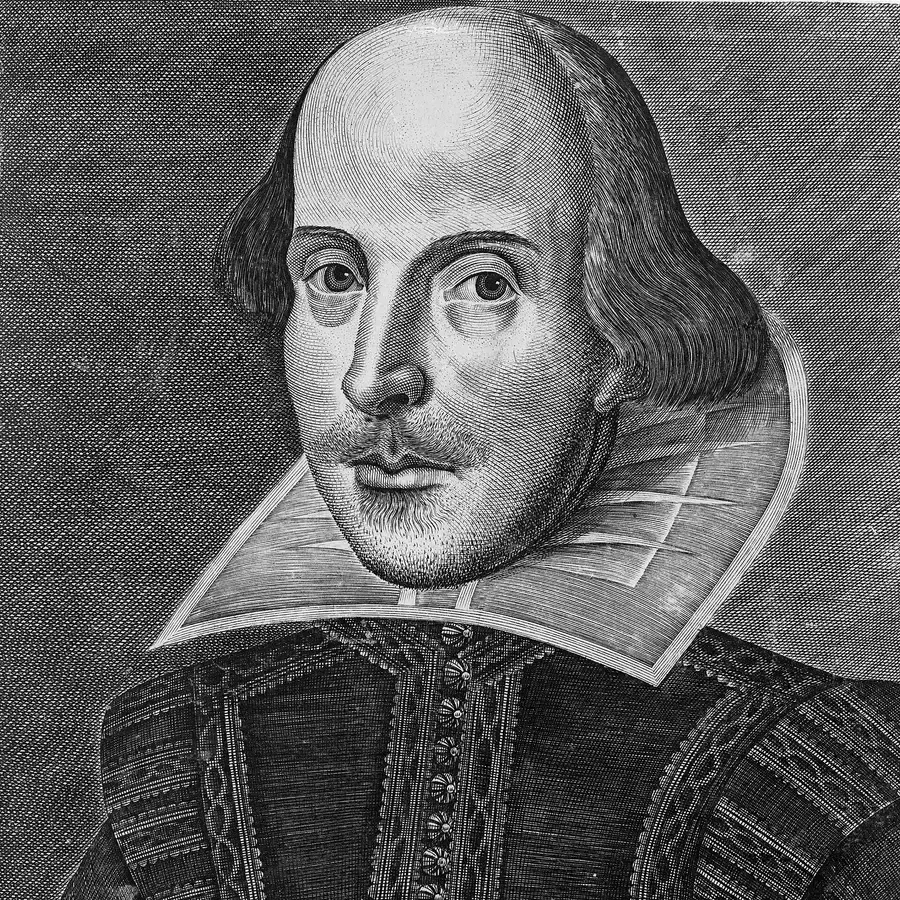
Martin Droeshout, engraved portrait of Shakespeare (First Folio, 1623) · Public domain · Wikimedia Commons
The ones who attached numbers to this idea were statisticians. A paper published in the statistical journal Biometrika in 1976 sets its starting point like this: Shakespeare used 31,534 distinct words, of which 14,376 appeared only once and 4,343 appeared twice (DOI: 10.1093/biomet/63.3.435). Here, the term "number of words" can be counted in two ways. The number of distinct words is the variety of words obtained by counting each word only once no matter how many times it appears. The number of running words is the count of words including every single repetition whenever the same word appears again. Even if "the" appears thousands of times throughout a work, it only adds one to the distinct word count. 31,534 is the former count, and the roughly 14,000 are the words among them that showed their faces only once across the entire corpus.
The number is precise. What this article asks is what that number tells us. Whether it means Shakespeare had many words in his head, whether it means he left behind many manuscripts, and who made the list called "words he coined" and how.
Estimating the Number of Species
Determining how many species live in a region based on the species captured in a sample, or how many species were never caught in the sample at all, is a frequent problem in biology. One starting point in this lineage was a 1943 work where the statistician Ronald Fisher fitted a theoretical distribution to large moth and butterfly collection data gathered by the researcher Williams, and later, the statisticians Good and Toulmin also built models upon assumptions about the frequencies of species. However, the primary purpose of these early works was not to estimate the total number of species (DOI: 10.2307/2531385). Unseen species estimation is a statistical method that calculates how many species have not yet been caught even once, using only the record of how many times each species was caught in the sample.
The two authors of the 1976 paper, statisticians Bradley Efron and Ronald Thisted, transferred this calculation to Shakespeare. They placed "words that Shakespeare knew but did not use in his printed writings" in the place of the species not caught in the sample (DOI: 10.2307/2531385). A single word is a single species, each time it appears in a work counts as that species being caught once, and all remaining works combined are a single sample. The materials of the calculation are the numbers from the previous section, the frequency sequence of how many there are of each, such as about 14,000 words that appeared once and about 4,000 words that appeared twice (DOI: 10.1093/biomet/63.3.435).
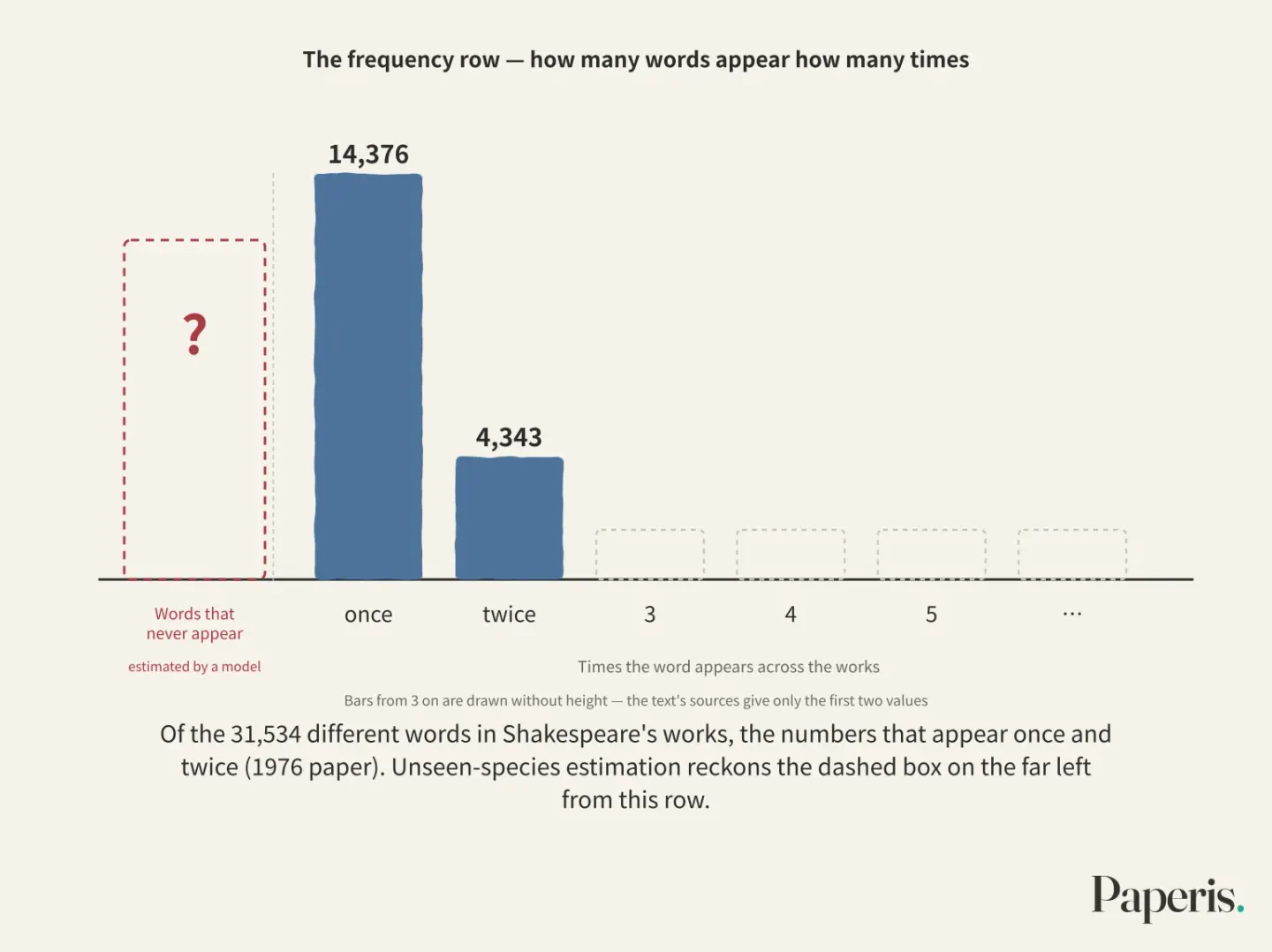
The paper tested two models. One is Fisher's model, and the other is Good and Toulmin's model, which the authors reinforced with an optimization technique called linear programming. The concluding sentence is this: These models are equivalent to assuming that Shakespeare knew at least 35,000 more words (DOI: 10.1093/biomet/63.3.435). "At least" and "equivalent to assuming" form the body of this conclusion. 35,000 is an estimate of "at least" derived under assumptions set by the model, and a value counted by peering inside Shakespeare's mind exists nowhere.
Other statisticians built models on the same data. A 1975 study built a probability model for how the number of distinct words grows as one reads through a text, and calculated approximately how many distinct words would appear for various vocabulary sizes of an author when the total number of running words is a given amount, testing this against the actual figures of three Shakespearean plays (DOI: 10.1017/s0021900200047744). A 1984 study proposed a Bayesian method placing prior distributions of different forms on the species count and separately issued guidelines for choosing the parameters of that distribution (DOI: 10.2307/2531385), and a 1987 study created a two-step procedure to handle constants that cannot be predetermined, applying it to butterfly and insect samples, genetic mutations, and the works of Shakespeare and James Joyce (DOI: 10.1093/biomet/74.4.849). The abstracts of these two studies do not present estimates of Shakespeare's vocabulary. The point that every model has a stage of choosing what to assume, and that estimates emerge through that selection, appears commonly in the 1984 and 1987 abstracts. What we should take away from this section is one thing. Because "words that Shakespeare knew" is a quantity that cannot be counted directly, statisticians gauged that quantity with models resting on assumptions, and the 1976 paper yielded that answer as a lower bound phrased as "at least".
Testing a Poem with the Same Calculation
An unknown nine-stanza poem claimed to be by Shakespeare was put to the test in a 1987 paper in the same journal (DOI: 10.1093/biomet/74.3.445). The question was whether this poem's word usage matched that of Shakespeare's surviving body of work, and the study used a nonparametric empirical Bayes model of the same family as the 1976 paper. Stylometry is a method of counting the habits of word usage left in a text with a computer to gauge who wrote it. This study applied that method using word frequency statistics.
Comparison pieces were also placed alongside it. They included poems by Shakespeare's contemporary playwrights Ben Jonson and Christopher Marlowe, the poet John Donne, and four poems definitely written by Shakespeare. The results are recorded like this. On the whole, this poem matches Shakespeare's previous usage quite well (DOI: 10.1093/biomet/74.3.445). "On the whole" and "quite" are qualifiers chosen by the authors. A match in usage is a judgment that this poem does not contradict Shakespeare's writing, which carries a different weight from proof that he wrote it. The abstract does not record how the poems by Jonson, Marlowe, and Donne fared in the same test.
What to take away from this section is this. Statistics on word frequencies can ask, "Does this writing match that author's habits?", and the answer comes out as a degree of "it matches" or "it clashes."
Play by Play
That idea, which persisted for the past century or so, was put to the direct count in a 2011 study published in the journal Shakespeare Quarterly. The starting point was that electronic texts of early modern English plays had accumulated enough that the claim could now be counted, and they placed Shakespeare's plays side by side with multiple plays by other playwrights of the same period (DOI: 10.1353/shq.2011.0002). The abstract does not state how many plays were compared.
The results are four. First, Shakespeare's vocabulary is indeed large. However, this appears to be solely because he has more plays surviving as sole-authored works than his contemporaries. Second, play by play, the number of distinct words (types) used in his plays fits comfortably within the pattern formed by other playwrights. Third, the same goes for the number of newly introduced words encountered as one continues through the works. Fourth, when measuring how much the proportion of individual word usage deviates from the average, Shakespeare is strikingly close to his peers' usage (DOI: 10.1353/shq.2011.0002). The "newly introduced words" of the third result is a value measured by this study as it followed his works in sequence, and is a quantity distinct from counting words that newly emerged in the English language.
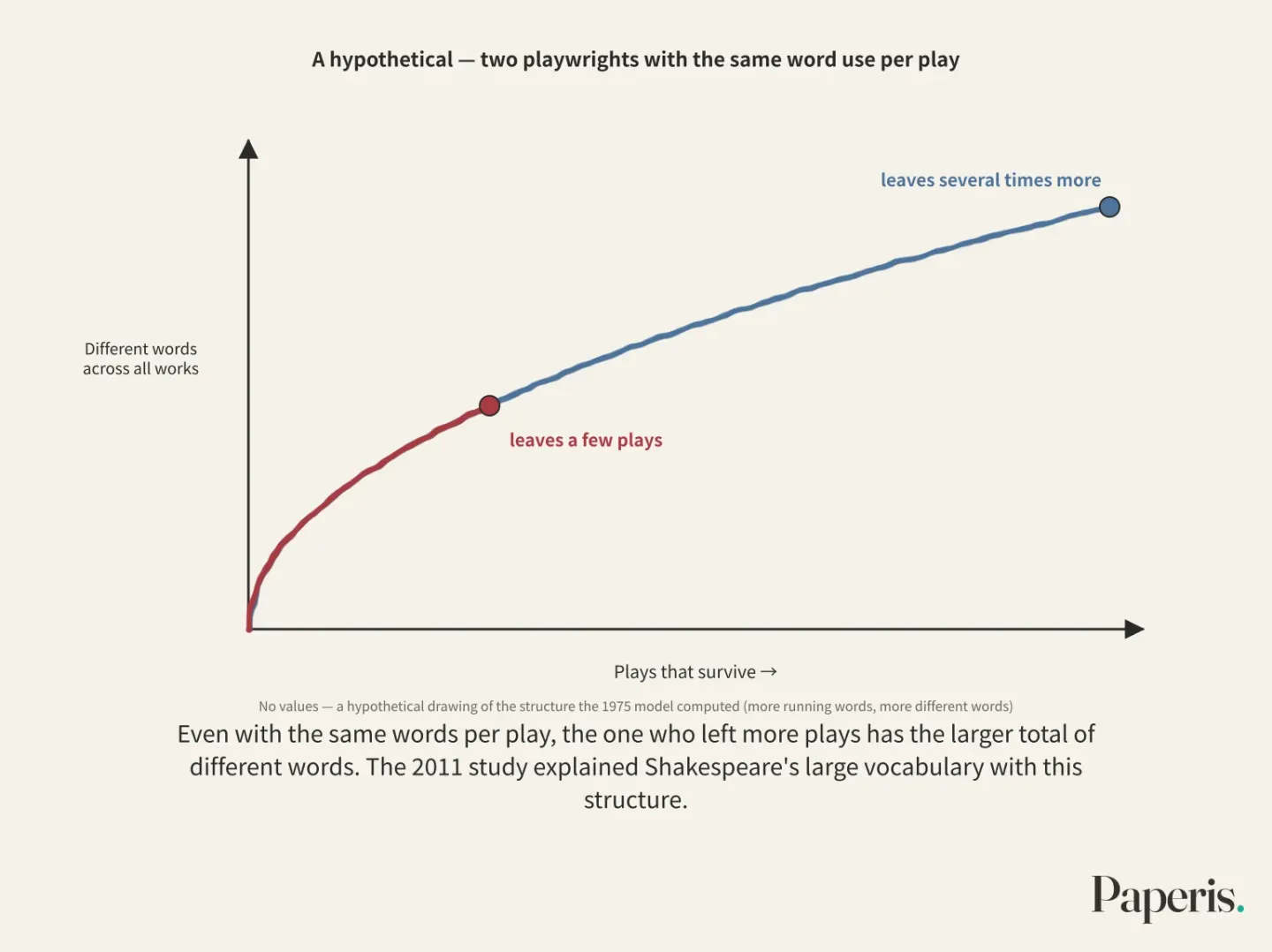
The first result directly answers the question of this essay. The fact that the number of distinct words across the entire body of work is large is difficult to separate from the fact that many manuscripts survive. The 1975 model also calculated the expected value of the number of distinct words separately according to the number of running words (tokens) (DOI: 10.1017/s0021900200047744). Let us suppose two playwrights use the exact same number of distinct words per play. If one person left a few plays and the other left several times that amount, the number of distinct words counted across the entire works combined is larger for the one who left more. This is the structure of the explanation offered by the 2011 study regarding Shakespeare's large vocabulary, suggesting that it "appears to be so for this reason."
A 2021 paper argues that the data from two previous studies attributing Act 4, Scene 1 of Titus Andronicus to Shakespeare are invalid because the surviving work volumes of the two candidate authors differ significantly, and notes that when matching the volumes, the vocabulary of that scene points toward the contemporary playwright George Peele, while explicitly stating that this conclusion runs head-on into the current consensus (DOI: 10.1093/res/hgab032). Studies that have distinguished joint authorship in Shakespeare's plays using stylometry are covered separately in "The Shakespeare Authorship Question — Was the Swan of Avon Alone?".
The concluding sentence of the 2011 study assumes his special status. Whatever numerical metrics reflecting Shakespeare's widely recognized special status may be explored in the future, the evidence of vocabulary size and word usage frequency places Shakespeare not in a position apart from his contemporary writers, but together with them (DOI: 10.1353/shq.2011.0002). What we take away from this section is this: Shakespeare, measured by word counts, is within the crowd, and the metric to measure his specialness has been left by this study as work for the future.
Coined Words, Read Earlier
The Oxford English Dictionary (OED) has re-examined the evidence for the usage of every headword since its comprehensive third edition revision began in 2000, newly incorporating earlier uses wherever possible (DOI: 10.1093/notesj/gjad106). Recording the earliest usage in this dictionary has been considered a point of pride that underpins its authority (DOI: 10.1093/notesj/gjad106). A first citation is the quotation that the dictionary enters as the earliest known instance of a word used in writing. A neologism is a word newly coined that did not exist in the language until that time. If the first citation of a word is in Shakespeare's writing, that word appears as though he used it first, and further, as though he coined it. Yet a first citation is simply the earliest instance the lexicographers have found up to that point.
Retro-dating is the process of finding an earlier use than the first citation listed in a dictionary and moving the word's first date further back. A short paper published in Notes and Queries in 2023 compared the second edition (1989) and the third edition (2022) to count these retro-datings. In the early 2000s, the third edition moved the first date earlier for 38 to 44 percent of revised headwords, and this proportion rose to 66 percent by mid-2013 on a two-year average. The author attributes a large share of this rise to the greatly expanded historical text databases of that time (such as Early English Books Online and Google Books) and improved search methods (DOI: 10.1093/notesj/gjad106).
Shakespeare is part of this trend. Among the headwords whose first citation in the second edition was Shakespeare, the third edition pushed the first date back in 46 percent of cases (excluding instances such as dates changing between his own works), and the paper notes this as about average for his era (DOI: 10.1093/notesj/gjad106). The reasons for a change in the first date include bibliographical adjustments in addition to the discovery of earlier uses, with the adjusted composition dates of several Shakespearean plays being one such example (DOI: 10.1093/notesj/gjad106). There are two takeaways from the figure of 46 percent. Dates shifted in 46 percent of the headwords that used Shakespeare as their first citation, and the same thing happened to a similar degree in other writings of that period.
Other research looks at whose writings the dictionary read more closely. A 2013 study taking John Bunyan as an example argues that volunteer readers for the first edition of the dictionary selected quotations in lesser-known literary works according to stereotypes about the language and its content, and thus such works were less represented in the dictionary than authors of high literary status. According to this study, while the revision process will not erase Shakespeare's unusual usages, it is very unlikely to newly include one-off words by lesser-known authors, thereby perpetuating the literary biases of the first edition (DOI: 10.1353/dic.2013.0018). A book chapter published in 2019 summarizes the same trend from Shakespeare's side. As historical texts became available in bulk, many words previously thought to be Shakespeare's inventions were revealed to have earlier origins (DOI: 10.4324/9781315303079-5).
The list of "words coined by Shakespeare" has shrunk as the dictionary has read historical literature more broadly. The same 2019 chapter also discusses the methods by which Shakespeare coined new words, namely compounding, affixation, and converting words from one part of speech to another (DOI: 10.4324/9781315303079-5). The fact that he coined words remains a subject of study, and what has shrunk is the length of that list. The takeaway from this section is this. When you hear a number like "how many words he coined," you must first ask whether that is the number of first citations found by a particular edition of the dictionary up to that time.
Still Debated
It is not even decided what counts as a single word. A 1987 article in the journal English Today notes that to claim English is particularly rich in vocabulary, we must first figure out how to count words and what counts as a single word (DOI: 10.1017/s0266078400003023). This short piece was written about the English language as a whole. In Shakespeare's case as well, a 2019 chapter notes that there are methodological problems in measuring the size of the vocabulary he actually employed, and also introduces a recent proposal that his vocabulary was not as large as that of several other authors (DOI: 10.4324/9781315303079-5). The word "proposal" shows where that claim still stands.
New meanings attached to old words are even harder to find. A 2012 study cites three instances of words used with new meanings in Shakespeare's plays (one each in Macbeth, Titus Andronicus, and Julius Caesar), and notes that such new meanings are difficult to uncover because they were not recorded at the time, no single-word dictionaries from that period survive, and the meanings soon vanished. This study suggests that as long as we rely on reading literary texts, this problem will remain unsolved for some time (DOI: 10.1163/9789401207935_010). If we only count the number of new words, these usages do not enter the count.
Then where should Shakespeare's uniqueness be measured? A 2011 study left that metric for future work (DOI: 10.1353/shq.2011.0002). A book chapter (2018 edition) offers one direction through the author's evaluation. The author of that chapter considers that the techniques expanding vocabulary, syntax, and rhetoric shown in preceding chapters were far from Shakespeare's invention, that he created better examples than his contemporaries and usually tailored them to the context of the play, and that he pushed the styles that playwrights had been using together since the 1590s to a point that contemporary writers could neither imagine nor express (DOI: 10.4324/9781315844862-14). This is one researcher's reading, not a result obtained by counting words.
So What Did We Learn?
The numbers regarding Shakespeare's vocabulary were three, and each measured a different thing. 31,534 is the count of distinct words in the works he left behind. "At least 35,000 more" is the lower bound produced by models borrowing calculations for biological species estimation on top of that assumption. "A few words he coined" is a figure relying on the dictionary's first usages found up to that point, and the more old documents were searched, the more a good number of those yielded their spot to earlier uses.
When matched one-on-one with a contemporary playwright by play, his vocabulary falls within the group, and the large total count is hard to separate from the fact that more works survive (DOI: 10.1353/shq.2011.0002). The same study acknowledged his special status, left the quantitative measure to demonstrate it as a task for the future, and concluded that the evidence on vocabulary size and word usage frequency places him together with his contemporary writers. The fact that Shakespeare used many distinct words in his works is, according to counts thus far, hard to separate from the fact that many manuscripts survive. The number of words he actually knew has not been measured anywhere in the evidence gathered by this article, and there is only a lower bound of "at least" produced on an assumption by a 1976 model. The number of "words he coined" is a different quantity, and has moved together with how many old documents the dictionary has read.
Source Papers
- "Shakespeare's Vocabulary: Myth and Reality" (2011) — DOI: 10.1353/shq.2011.0002 — Compared with contemporary plays, his vocabulary is large, but this appears to be because of a high number of surviving single-authored plays; play by play, the number of distinct words and newly introduced words falls within the expected range, and word usage proportions are close to those of his peers. Vocabulary evidence places him alongside his contemporary writers.
- "Estimating the Number of Unseen Species: How Many Words Did Shakespeare Know?" (1976) — DOI: 10.1093/biomet/63.3.435 — 31,534 distinct words (14,376 occurring once, 4,343 twice). Using the Fisher and Good-Toulmin models, this is equivalent to assuming that Shakespeare knew at least 35,000 more words.
- "Bayesian Estimation of the Number of Species" (1984) — DOI: 10.2307/2531385 — Species number estimation is a common problem in biology; Fisher's (1943) lepidoptera data and Efron and Thisted's (1976) treat unseen species as words that Shakespeare knew but did not use. Truncated negative binomial prior distributions and parameter selection guidelines.
- "Did Shakespeare Write a Newly-Discovered Poem?" (1987) — DOI: 10.1093/biomet/74.3.445 — Examines the word usage of a newly discovered nine-stanza poem using nonparametric empirical Bayes, comparing it with Johnson, Marlowe, Donne, and four undisputed Shakespearean poems, showing a generally good fit.
- "A Multinomial Bayesian Approach to the Estimation of Population and Vocabulary Size" (1987) — DOI: 10.1093/biomet/74.4.849 — Estimating bin counts and sample coverage using a multinomial Bayesian approach with a two-stage procedure, applied to butterflies, insects, alleles, Shakespeare, and Joyce.
- "Stochastic Models for Type Counts in a Literary Text" (1975) — DOI: 10.1017/s0021900200047744 — A Markov chain model for the number of distinct words, testing expected values by running words and vocabulary size across three Shakespearean plays.
- "The Case for Peele's Authorship of Titus Andronicus 4.1" (2021) — DOI: 10.1093/res/hgab032 — Length imbalances invalidate the data of earlier studies; when lengths are matched, the vocabulary of Act 4, Scene 1 leans toward Peele (contrary to the consensus, as the authors note), highlighting the need to integrate numerical and qualitative methods.
- "Antedating (in) the Oxford English Dictionary" (2023) — DOI: 10.1093/notesj/gjad106 — OED3 antedating rate increased from 38–44% to 66% due to the impact of early text databases, with Shakespeare's first-cited headwords antedated by 46% (around the average level for the period), alongside the effect of bibliographic adjustments.
- "Using Dictionary Evidence to Evaluate Authors' Lexis: John Bunyan and the Oxford English Dictionary" (2013) — DOI: 10.1353/dic.2013.0018 — OED1 readers cited texts along stereotypical lines, leaving lesser-known authors underrepresented; revisions do not erase Shakespeare's unique usages but perpetuate literary biases.
- "From oxcart to computer: Lexical studies" (2019) — DOI: 10.4324/9781315303079-5 — Methodological problems in measuring actual vocabulary size, recent suggestions that it was not larger, earlier origins for words previously thought to be Shakespearean inventions, and word-formation methods such as compounding, affixation, and conversion.
- "How many words?" (1987) — DOI: 10.1017/s0266078400003023 — To claim that someone had a rich vocabulary, we must know what is being counted and what counts as a single word.
- "Semantic drift in Shakespeare, and Early Modern English full-text corpora" (2012) — DOI: 10.1163/9789401207935_010 — Three cases of new meanings in Shakespeare's plays, which are difficult to find because of records, the absence of contemporary monolingual dictionaries, and rapid obsolescence.
- "Register and style" (2018) — DOI: 10.4324/9781315844862-14 — Authorial assessment that techniques for expanding vocabulary, syntax, and rhetoric were not Shakespeare's inventions; rather, he crafted better examples suited to context and pushed contemporary style further.
Sources (13)
- Shakespeare's Vocabulary: Myth and RealityDOI 10.1353/shq.2011.0002
- Estimating the Number of Unsen Species: How Many Words Did Shakespeare Know?DOI 10.1093/biomet/63.3.435
- Bayesian Estimation of the Number of SpeciesDOI 10.2307/2531385
- Did Shakespeare Write a Newly-Discovered Poem?DOI 10.1093/biomet/74.3.445
- A Multinomial Bayesian Approach to the Estimation of Population and Vocabulary SizeDOI 10.1093/biomet/74.4.849
- Stochastic Models for Type Counts in a Literary TextDOI 10.1017/s0021900200047744
- The Case for Peele's Authorship of Titus Andronicus 4.1DOI 10.1093/res/hgab032
- Antedating (in) the Oxford English DictionaryDOI 10.1093/notesj/gjad106
- Using Dictionary Evidence to Evaluate Authors' Lexis: John Bunyan and the Oxford English DictionaryDOI 10.1353/dic.2013.0018
- From oxcart to computer: Lexical studiesDOI 10.4324/9781315303079-5
- How many words?DOI 10.1017/s0266078400003023
- Semantic drift in Shakespeare, and Early Modern English full-text corporaDOI 10.1163/9789401207935_010
- Register and styleDOI 10.4324/9781315844862-14