
Paperis Articles
Dostoevsky — Those Few Seconds Like Lightning: Do They Exist Outside the Novel?
In The Idiot, Prince Myshkin lives through a few ecstatic seconds just before a seizure—moments he feels are worth his whole life. Do such seizures happen to real patients, and did Dostoevsky himself have them? Case reports and brain-stimulation studies answer the first question; only old records speak to the second. We follow them separately.
Your field's papers, as audio
Pick your fields and journals — Paperis summarizes the key papers and turns them into audio. Listen on your commute.
Start Paperis free →Dostoevsky — Those Few Seconds Like Lightning: Do They Exist Outside the Novel?
"For the Sake of This Moment"
From 1868 into the following year, the Russian novelist Fyodor Dostoevsky serialized his novel The Idiot in a magazine. The protagonist Prince Myshkin is a character who suffers from epilepsy. Epilepsy is a brain disorder characterized by a long-standing tendency to recurrent seizures. And a seizure is a symptom that appears and disappears suddenly when the nerve cells of the brain fire signals abnormally, excessively, or all at once together. In Chapter 5 of Part 2 of the novel, the narrator follows the inside of the prince's mind just before a seizure strikes. The prince thinks that his illness had a stage right before the seizure.
Ощущение жизни, самосознания почти удесятерялось в эти мгновения, продолжавшиеся как молния.
In those moments, which lasted like a flash of lightning, the sense of life and of self-awareness grew almost tenfold.
— Fyodor Dostoevsky, The Idiot, Part 2, Chapter 5 (original · translated by Paperis)
The prince even assigns this value to that brief moment.
«Да, за этот момент можно отдать всю жизнь!»
"Yes, for this moment one could give one's whole life!"
— Fyodor Dostoevsky, The Idiot, Part 2, Chapter 5 (original · translated by Paperis)
Dostoevsky himself suffered from epilepsy (PMID 23485902). A study examining records left by himself and people around him, along with his works, suggests that his illness likely began in his mid-twenties (DOI: 10.1159/000085604). Therefore, a double layer of questions is attached to this passage in The Idiot. One is whether seizures like the one Myshkin experienced—seizures where a wave of ecstasy washes over during the first few seconds—actually occur in real patients. The other is whether Dostoevsky himself experienced such seizures. That such seizures exist in patients outside of novels and that Dostoevsky experienced them are distinct questions. The former question is answered by studies that directly examine patients, while the latter question is answered only by records left over 140 years ago. This article follows both questions in turn, without mixing them.
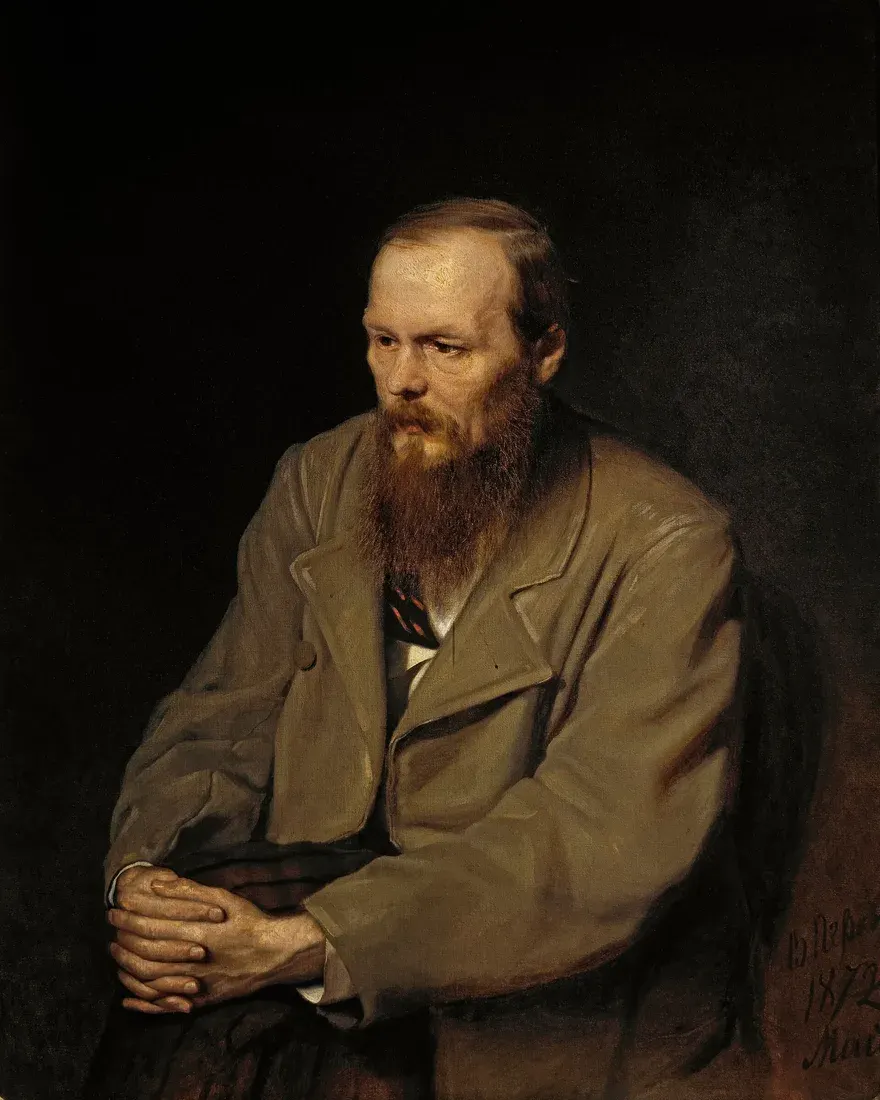
Vasily Perov, Portrait of Fyodor Dostoevsky (1872) · Tretyakov Gallery, Moscow · Public domain · Wikimedia Commons
The Name "Dostoevsky Epilepsy"
A 1980 case report put the novelist's name in its title with the word "so-called." The title was "Temporal lobe epilepsy with ecstatic seizures (the so-called Dostoevsky epilepsy)" (PMID 7439135). Let us unpack two words from the title first. The temporal lobe is the side part of the cerebrum located inside the temples above the ears, and it is involved in hearing sounds and understanding speech. An ecstatic seizure is a rare seizure in which a sense of well-being, deep calm, and a sharpened feeling of self rush in during the first few seconds of seizure onset. During those first few seconds, patients report that comfort, intense peace, supreme joy, and "heightened self-awareness" arrive, accompanied by the impression that time is stretching out (PMID 26924970).
Those "first few seconds" have a name of their own. An aura is a sensation or emotion felt only by the person at the very beginning of a seizure, before it shows outwardly, and that feeling itself is already the start of the seizure. In an ecstatic seizure, this aura is the ecstasy itself. The seizure begins with a state in which the mind clears and something seems certain (PMID 34827383). The Prince regarded that moment as a stage just before the seizure, but in today's terminology it is the onset of the seizure. An essay discussing auras in literature notes that the "ecstatic aura" described by Dostoevsky received particular attention and echoed in several later works (DOI: 10.1111/epi.12051).
The 1980 report captured a single ecstatic seizure with a recording that put down multiple biological signals at once, and the authors wrote that such a recording was a first. And they confirmed that this kind of seizure can be an expression of temporal lobe epilepsy (PMID 7439135). The case of a patient appeared in 1988 as well. They were a patient who experienced ecstatic episodes during seizures, and their electroencephalogram showed a site where strange sharp wave patterns gathered in the temporal lobe of the dominant hemisphere (usually the side responsible for language). The authors concluded that this ecstatic state can be seen as a true epileptic aura starting in or near the temporal lobe (PMID 3339342).
These records carry weight because there was a time when the very existence of ecstatic auras was doubted. An essay summarizing seizures in Dostoevsky's novels notes that this aura is so rare that its existence was once doubted, and therefore Dostoevsky was also thought to have exaggerated his own experiences or those of his characters (PMID 23485902). A 2015 case report writes that Dostoevsky was the first person to describe ecstatic seizures, and added one patient of their own who experienced affect-laden seizures (PMID 26356170). "Described first" is the assessment of the authors of that report. What we should take away from this section is one thing. A scene from a novel became a medical nickname, and the first evidence supporting that nickname came from individual patient cases.
What Patients Said
It was a study in 2003 that consecutively gathered 11 patients who experienced a sense of ecstasy or pleasure as an aura and examined them together. Earlier reports mostly stayed at case descriptions of one person at a time (PMID 14698700). Eight experienced sensory hallucinations, four experienced sexual feelings, and five described it as a "religious or spiritual experience." Several people said it was a symptom incomparable to any other experience a person goes through. Among four whose brain waves were measured during a seizure, seizures started in the right temporal lobe for two and the left temporal lobe for two, while the remaining seven could not have their starting site confirmed (PMID 14698700).
A research team in 2009 closely transcribed the seizures of five patients. All five spoke of intense feelings of happiness and heightened self-awareness (PMID 19836310). A 2009 review noted that a total of 52 patients had been reported by other research teams and themselves over the past few years. Some patients described the experience as a mystical experience (PMID 26924970). Later syntheses group the symptoms into a feeling of bodily comfort, a feeling of mental clarity, a feeling of oneness with the universe, and a feeling of time expanding (PMID 39436631).
Here, the prince's sentences can be placed beside the words of the patients. The novel's line "the sense of life and of self-awareness grew almost tenfold" and the "heightened self-awareness" spoken of by patients resemble each other, and "like a flash of lightning" and "the first few seconds" also resemble each other. Placing these contents side by side is a reading of this article. One analysis looked at the manner of speaking rather than the content when compared to the patients' words. The analysis suggests that when Myshkin and Kirillov in The Devils speak of their auras, the manner of repeatedly restating the same thing and piling up metaphors is a linguistic characteristic of epilepsy patients when describing their auras, and this characteristic is related to experiences that are difficult to put into words (PMID 30979544). What this analysis shows goes only so far as indicating that the novel's sentences take the same shape as actual aura reports.
The prince's second sentence, "Yes, for this moment one could give one's whole life!", also has a place to be put beside the patients. Of the 11 patients in 2003, eight wanted to experience seizures. Five could bring on seizures themselves, and four did not take their medication as prescribed (PMID 14698700). There were also many cases where diagnosis was delayed. The researchers concluded that when a patient who would normally take medication well neglects adherence, physicians are worth considering seizures accompanied by pleasant symptoms (PMID 14698700). This is the researchers' observation directed at treating physicians, and it is not a study used as evidence to explain a sentence in a novel.
What the evidence says about how rare it is is the number of cases. The 2016 review wrote that this seizure is "rare," and the 52 people we saw earlier are the number counted by that review (PMID 26924970). A short letter published in a journal in 1997, taking up preceding reports, noted that spontaneous ecstatic experiences during seizures are very rare, and that strong pleasure is common in self-induced seizures (DOI: 10.1136/jnnp.63.2.273a). There are also case reports stating that emotionally charged seizures usually take on unpleasant feelings, and that ecstatic seizures, especially those with religious colorings, are reported rarely (PMID 21945987). Studies measuring what percentage of epilepsy patients experience ecstatic seizures are not in this article's list of evidence. The answer to the first question is summarized as follows: Seizures like the one Myshkin experienced do exist in actual patients, but they are rare seizures with reported cases numbering in the dozens.
Where They Ignite — The Temporal Lobe and Insula
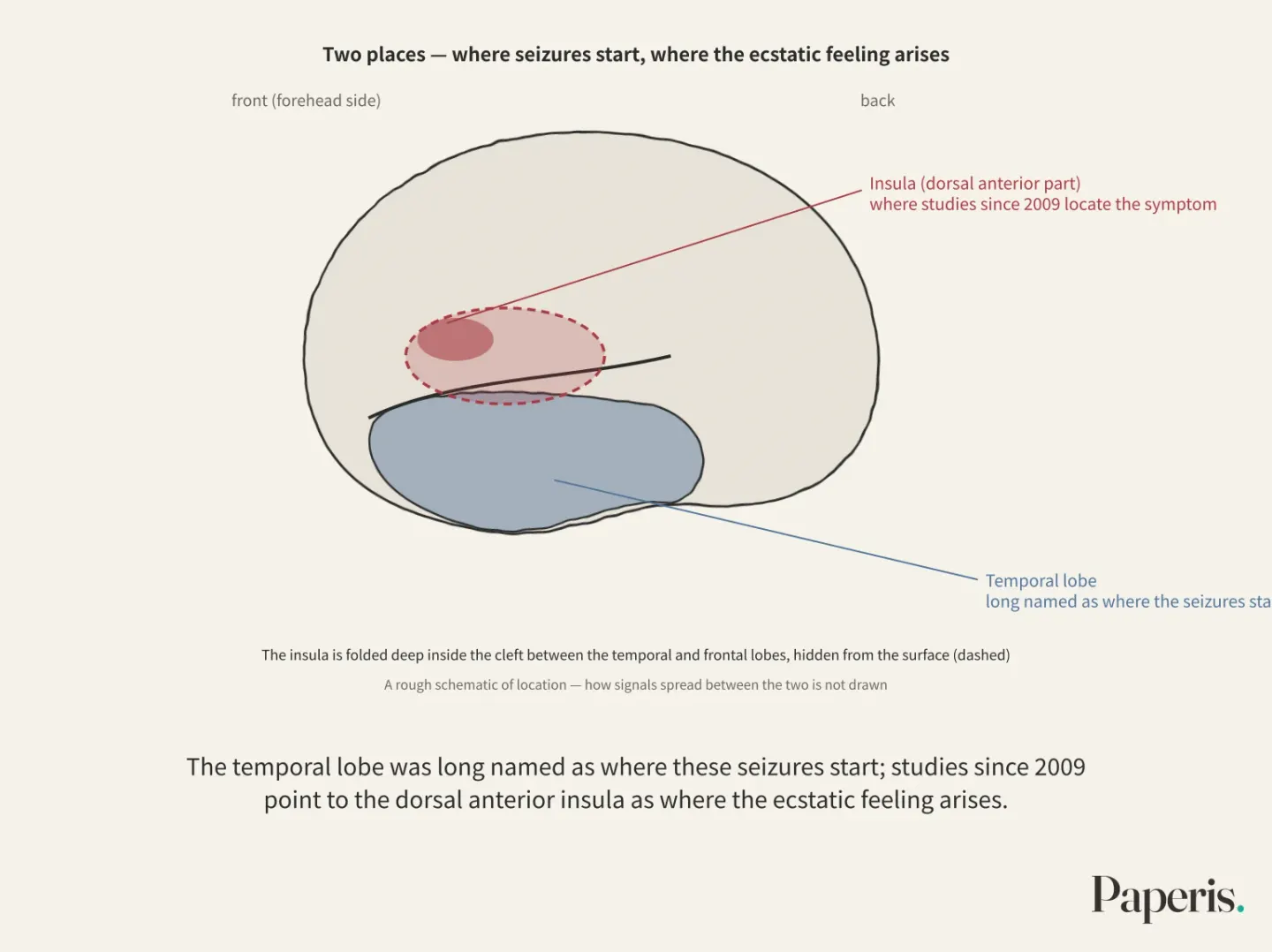
The longstanding answer of the temporal lobe was shaken in 2009 by a report of five patients. Gathering the patients' descriptions along with neurophysiological and imaging evidence, the researchers proposed understanding the ecstatic state as being driven by overactivation of the anterior insula rather than the temporal lobe (PMID 19836310). The insula is a cerebral cortex folded and hidden deep within the lateral sulcus where the temporal and frontal lobes meet, and is considered responsible for weaving signals rising from inside the body together with outside world information and emotion. According to a 2014 review, this proposal rested on three pillars: the results of nuclear medicine imaging performed on three patients during seizures, the first instance of triggering an ecstatic aura via electrical stimulation, and the functions of the anterior insula mapped out by neuroimaging studies (PMID 24436968).
Some studies have re-read older cases. A patient who experienced a "sense of a presence" as an aura was recorded in the initial report as having decreased blood flow in both temporal lobes and increased activity in the left anterior parietal region. In 2011, when blood flow imaging was overlaid onto magnetic resonance imaging using a method unavailable at the time, the strongly activated spot lay directly over the left anterior insula. The researchers concluded that this aura could be reinterpreted as hyperactivation of the left anterior insula (PMID 21440512).
The most direct evidence came from patients who had electrodes implanted in their brains. These were epilepsy patients undergoing preoperative evaluation because their seizures were not well controlled by medication. During preoperative evaluations, weak currents are passed through electrodes placed inside the brain to identify the seizure-onset zone and the areas responsible for critical functions. A 2019 research team selected three patients in whom ecstatic symptoms appeared when the superior-anterior part of the insula was stimulated, and analyzed in detail a single stimulation that triggered the ecstatic shift. The stimulation involved passing a 50-hertz current for 3 seconds, and in all three patients, stimulation of this site alone revived the ecstatic aura. Immediately after stimulation, signal exchange among various brain regions increased markedly, and the superior-anterior insula was most frequently cited as the hub driving that network (PMID 31196836). The researchers' conclusion was that "these findings lend support to the notion that the antero-superior insula plays a major role in ecstatic experiences" (PMID 31196836). The design of selecting patients who showed symptoms from this site, the number of three, and the qualifying phrase "lend support" mark the scale of this result.
In a 2021 synthesis, a research team that has led the insular hypothesis noted that while this seizure has long been considered temporal lobe epilepsy, the evidence they have gathered over the past decade converges the symptom-generating site onto the superior-anterior insula (PMID 34827383). An earlier 2016 review noted that the intracranial site of this seizure remained debated (PMID 26924970). A systematic review published in 2026 split the picture. Out of 926 papers found through searches, 51 patients were culled from 33 papers from which seizure location data could be reliably extracted, and only 9 patients whose seizure-onset zone could be identified with a certainty of "high" or greater were left in the main analysis (PMID 42753166). In 6 of the 9 patients, the seizure-onset zone was located in various parts of the temporal lobe. In a separate analysis looking at the symptom-generating site, 14 locations emerged across the 9 patients, with the most frequent site being the insula—specifically its superior-anterior part, accounting for 9 out of the 14 locations (PMID 42753166). The authors' conclusion is as follows. The seizure-onset zone is either the temporal lobe, or roughly one in three times outside the temporal lobe (around the insula or beneath the frontal lobe right behind the eyes), while electrical stimulation, intracranial recording, and ictal blood flow imaging strongly point to the insula as the site that generates the feeling (PMID 42753166). In ecstatic seizures, the site where the seizure begins and the site that generates the sensation may differ. However, the authors also noted limitations, including the small number of patients with usable data and a high risk of bias in the existing literature (PMID 42753166).
The pathway connecting these two is not yet settled either. There is a report of a single patient whose ecstatic seizures vanished after surgery for a benign tumor (hamartoma) in the hypothalamus, only to return 11 years later. The authors noted that to their knowledge, that site was a newly reported location for ecstatic seizures, and left the idea that a network including the insula was activated together phrased as "we speculate" (PMID 35028554). Explanations for why the feeling is specifically one of ecstasy remain at the hypothesis stage. One hypothesis is that the anterior insula normally processes how much signals entering from inside and outside the body deviate from expectations, and when a seizure halts this processing, it creates a state where the world feels perfectly predictable, evoking a sense of certainty and clarity (PMID 34827383). A 2023 perspective paper put forward the same hypothesis alongside another: that the insula handles surprise processing in general, and that a seizure cuts this off, yielding the sensation that one has grasped everything in the palm of one's hand (PMID 37432752). Both are hypotheses proposed by researchers, and no studies in the evidence base of this article have tested and confirmed them.
Dostoevsky Himself — Divided Retrospective Diagnoses
Now for the second question. Retrospective diagnosis is the process of estimating a disease name using only remaining records such as letters, biographies, and works, without directly examining the person who has passed away. Dostoevsky passed away in 1881, and his brain waves were never recorded once. This is because electroencephalography was only created in 1929 by Hans Berger (DOI: 10.1111/j.1528-1157.1983.tb04628.x).
A 1983 paper attempted to organize his illness like a patient arriving at a clinic for the first time today. It gathered all seizure descriptions, seizure frequency, factors that triggered seizures, the course of the illness, treatment, and family history. The author wrote in this classification that whether or not there was "the so-called ecstatic aura" was decisive. The conclusion was that he was more likely to have suffered from epilepsy starting from one side of the brain, clouding consciousness, and spreading to full-body convulsions, rather than epilepsy starting simultaneously across the entire brain from the beginning, and that most seizures occurred at night (DOI: 10.1111/j.1528-1157.1983.tb04628.x).
A short commentary published the following year, in 1984, left the conclusion open. Considering newly known data on seizure symptoms and interictal behavioral data, whether it was generalized epilepsy from the start or temporal lobe epilepsy remained under debate. The author considered a mixed hypothesis the most plausible. There was a temporal lobe lesion small enough to show no signs between seizures, and combined with a strong innate seizure tendency, that lesion triggered seizures and spread almost immediately to the entire brain with each seizure (DOI: 10.1111/j.1528-1157.1984.tb03435.x).
A 2005 study confirmed that most of his seizures in records were described as full-body convulsions. At the same time, it viewed that ecstatic auras, the turning pale of the face right before convulsions, and particularly the difficulty speaking after seizures pointed to an origin in the inner temporal lobe of the hemisphere responsible for speech (DOI: 10.1159/000085604). A 2021 paper wrote that he is "considered" to have suffered from inner-lower temporal lobe epilepsy accompanied by an ecstatic aura, and noted that this form later came to be named after him (DOI: 10.17650/1683-3295-2021-23-3-113-121). Another paper from the same year wrote that both he and the Brazilian writer Machado de Assis "probably both" had temporal lobe epilepsy (PMID 30979544). The literary side also notes that debates continue over exactly what disease he suffered from (DOI: 10.1353/lm.1999.0009).
What these studies relied upon is the core of this division. The 2005 study examined personal records, records left by others, and his works together. Because he tended to depict not only facts but thoughts autobiographically, that study judged that novels serve as precious material for understanding his illness (DOI: 10.1159/000085604). The 2021 analysis went a step further, viewing that Myshkin and Kirillov speak of the same ecstatic auras that Dostoevsky spoke of privately, and interpreting that the appearance of auras alone in Kirillov would reflect the time when the author's illness was in its early stages (PMID 30979544). Meanwhile, an essay organizing seizure descriptions in novels writes that the terms triggering seizures in novels vary according to 19th-century disease classification concepts, the author's knowledge of those concepts, the author's own experiences, and issues of translation and transliteration (PMID 23485902). Interpretations diverge right from whether novels can be read as the author's medical charts.
And the answer to the first question does not untangle this division. Patient studies since 1980 have shown that ecstatic auras are a real seizure symptom. That means Myshkin's description may not be purely fiction, but it does not tell us what started in Dostoevsky's brain during his lifetime. As the 1983 paper stated, his classification depends on whether there "was" an ecstatic aura, and that answer still splits depending on how one reads the words of the individual and those around him, as well as his novels. This is why the studies above wrote "is likely," "points to," "is considered," and "probably." We also set aside two judgments. Whether seizures started in the temporal lobe and whether an ecstatic aura occurred are separate judgments. The 2005 study and two 2021 papers listed ecstatic auras as his symptoms (DOI: 10.1159/000085604, DOI: 10.17650/1683-3295-2021-23-3-113-121, PMID 30979544), whereas the abstract of the 1983 paper only wrote that they were decisive for classification without clarifying whether they existed. Four out of five medical retrospective estimates cited by this article lean toward seizures starting in one side of the brain (three of them choosing the temporal lobe), while the 1984 commentary viewed the debate as open. All are estimates made using remaining writings without EEG recordings.
When Calling It an Illness
Inside the novel, the person who calls that moment an illness is none other than the prince himself. The prince would later think to himself, when he was feeling well, like this:
что ведь все эти молнии и проблески высшего самоощущения и самосознания, а стало быть и «высшего бытия», не что иное, как болезнь, как нарушение нормального состояния
that all these flashes and glimmers of a higher sense of self and self-awareness, and so of a "higher existence," were nothing but illness, a disturbance of the normal state
— Fyodor Dostoevsky, The Idiot, Part 2, Chapter 5 (original · translated by Paperis)
Even as he calls this moment an illness, the prince, as we saw earlier, assigns it a value worth giving one's whole life for. The name of an illness and the value of that moment sit side by side within a single character. This is the thought of a character in a novel, and we cannot know from this sentence alone how the author regarded his own illness.
The same tension appears on the side of patient studies. Among the 11 people in the 2003 study, 5 called it a religious or spiritual experience (PMID 14698700), and the 2016 review notes that some patients described it as a mystical experience (PMID 26924970). A 2011 case report covered one patient who experienced a religious ecstatic seizure resembling the visions described by Saint Teresa of Ávila. The authors noted that there are individual differences in the interpretation of ecstatic seizures, and suggested that the patient's religious background, alongside a similar seizure location, could explain the resemblance (PMID 21945987).
There are also interpretations that go further. One review presumes that all human experiences, including mystical and religious experiences, are the result of brain activity, and wrote that neuroscience can retroactively explain the events surrounding the Apostle Paul, Teresa, and Dostoevsky (PMID 27340019). A paper in philosophy concluded that the two are the same in the sense that a mystical experience "can occur" during an ecstatic aura (DOI: 10.5840/bjp20191118). These two are the authors' interpretations. What the case reports have directly shown is merely that some patients described their seizures in religious terms. That fact does not mean that religious experiences as a whole are seizures.
The label of illness is also intertwined with stigma. There is an analysis that until the late 19th century, medical narratives and fictional narratives intertwined around epilepsy, and that those stories contributed heavily to the stigma attached to this condition. Myshkin in The Idiot is likewise portrayed as a character surrounded by the stigma of society (DOI: 10.2218/forum.31.5496). Meanwhile, a 2005 study assesses that Dostoevsky's works contributed significantly to lifting the stigma against patients with epilepsy. The same study notes that although he complained of worsening memory in his later years, he wrote with his usual skill until the end of his life, and the cause of his passing was a long-standing pulmonary disease (DOI: 10.1159/000085604). A 2021 analysis records that he did not hide his self-diagnosis (PMID 30979544). Calling that moment an illness, and devaluing that experience or that person, are two different things.
So What Do We Know?
The first question has a relatively solid answer. Seizures that begin with a rush of euphoria, clarity, and heightened self-awareness during the opening seconds—much like what Prince Myshkin experienced—do occur in real patients. A 2016 review gathered 52 patients (PMID 26924970), and a 2026 systematic review included 51 patients whose seizure locations could be determined (PMID 42753166). This means the reported cases number in the dozens. The origin point of the seizure is usually the temporal lobe, and the upper front part of the insula is most frequently pointed to as the site that generates the feeling (PMID 42753166). However, this picture relies on nine patients who could be analyzed with high confidence, and the authors themselves noted a high risk of bias. Why it feels specifically like ecstasy remains a hypothesis.
The second question has no settled answer, but the evidence leans in one direction. Four out of five medical retrospective estimates cited in this article lean toward Dostoevsky's seizures originating in one side of the brain, with three of them specifying the temporal lobe (DOI: 10.1111/j.1528-1157.1983.tb04628.x, DOI: 10.1159/000085604, DOI: 10.17650/1683-3295-2021-23-3-113-121, PMID 30979544). A short 1984 commentary viewed the debate as open, offering a hypothesis that combined a silent lesion in the temporal lobe with an innate predisposition (DOI: 10.1111/j.1528-1157.1984.tb03435.x). Whether there was an ecstatic aura is a separate judgment made independently. Either way, these are retrospective estimates derived from the remaining records and novels without electroencephalogram data. The answer to the first question does not solve the second. What patients have shown is that such seizures can happen, and whether a writer experienced them some 140 years ago still depends on the interpretation of the words and writings he left behind.
If you want to follow from the beginning how epilepsy starts and spreads in the brain, "What Is Epilepsy? — Windows Lit One by One, Lights That Flash All at Once" lays that foundation. The broader question connecting illness and creativity is covered in "Genius and Madness — The Thin Sheet Between Them". What remains are sentences that tried to capture a few lightning-fast seconds in precise words, patients who speak in words that resemble those sentences, and the 140-year distance lying between the two.
Source Papers
- "Epilepsy in Dostoevsky's novels." (2013) — PMID 23485902 — Essay. Dostoevsky (1821–1881) had epilepsy and cataloged descriptions of seizures across five novels. Terms for seizures depended on 19th-century disease concepts, the author's knowledge, experience, and translation issues. Ecstatic auras were so rare their existence was once doubted and attributed to authorial embellishment.
- "Dostoevsky and Epilepsy: An Attempt to Look Through the Frame" (2005) — DOI: 10.1159/000085604 — Autobiographical records, third-party accounts, and literary works suggest epilepsy from his mid-twenties. Most seizures are described as generalized convulsions, but ecstatic auras, pre-ictal pallor, and post-ictal aphasia point to a dominant-hemisphere (mesial) temporal lobe origin. Despite late-life memory complaints, he wrote to the end, dying of chronic pulmonary disease. His work contributed to destigmatization.
- "Temporal lobe epilepsy with ecstatic seizures (so-called Dostoevsky epilepsy)." (1980) — PMID 7439135 — Case report. Recorded polygraphic data of an ecstatic seizure for the first time and confirmed it can be a manifestation of temporal lobe epilepsy.
- "The epileptic aura in literature: Aesthetic and philosophical dimensions. An essay" (2013) — DOI: 10.1111/epi.12051 — Essay. The ecstatic aura described by Dostoevsky received particular attention and echoed in subsequent works.
- "Temporal lobe epilepsy with ictal ecstatic state and interictal behavior of hypergraphia." (1988) — PMID 3339342 — Case report of 1 patient. Dominant-hemisphere temporal lobe EEG spike focus; the ecstatic state can be viewed as a true aura originating in or near the temporal lobe.
- "[Ecstatic seizures]." (2015) — PMID 26356170 — Case report. Ecstatic seizures are a rare epileptic manifestation described first by Dostoevsky, according to the authors, adding 1 patient.
- "Partial epilepsy with "ecstatic" seizures." (2003) — PMID 14698700 — Consecutive series of 11 patients. Sensory hallucinations 8, sexual feelings 4, religious/spiritual experiences 5. Ictal EEG in 4 patients (right temporal 2, left 2), 7 undetermined. Diagnostic delay, 8 patients desired the seizures, self-induction 5, non-compliance 4.
- "Ecstatic epileptic seizures: a potential window on the neural basis for human self-awareness." (2009) — PMID 19836310 — 5 patients, intense euphoria and heightened self-awareness. Proposed a hyperactivation framework centered on the anterior insula rather than the temporal lobe.
- "Ecstatic Epileptic Seizures: A Glimpse into the Multiple Roles of the Insula." (2016) — PMID 26924970 — Rare seizures, first few seconds of happiness, serenity, heightened self-awareness, temporal expansion, described by some as mystical experiences. Cumulative 52 reported patients, neuroanatomy still debated, proposed anterior insula-centered network.
- "Epilepsy and Ecstatic Experiences: The Role of the Insula." (2021) — PMID 34827383 — Review. Auras (seizure onsets) of clarity and certainty. Long considered temporal lobe epilepsy, but evidence over the decade converged on the superior-anterior insula. Interoceptive predictive error suppression hypothesis.
- "Insights from Ecstatic Epilepsy: From Uncertainty to Metacognitive Feelings." (2025) — PMID 39436631 — Review. Symptom bundle of bodily comfort, clarity, oneness with the universe, and temporal expansion.
- "The epileptic experience in the works of Dostoyevsky and Machado de Assis." (2021) — PMID 30979544 — Both authors likely had temporal lobe epilepsy. Myshkin and Kirillov report auras matching what the authors described privately; circumlocution and metaphor are linguistic features of aura self-reports. Dostoevsky was open about his diagnosis.
- "Ecstatic seizures induced by television" (1997) — DOI: 10.1136/jnnp.63.2.273a — Journal letter. Ecstatic experiences during unprovoked seizures are extremely rare, whereas strong pleasure is common in self-induced seizures.
- "St Theresa's dart and a case of religious ecstatic epilepsy." (2011) — PMID 21945987 — Case report of 1 patient. Emotional seizures are usually unpleasant; religious ecstatic seizures are rarely reported. Right temporal lobe lesion. Interpretation varies individually; religious background may explain the resemblance.
- "Localizing value of ecstatic phenomenon in epilepsy surgery: A systematic review." (2026) — PMID 42753166 — Systematic review. 926 papers → 33 papers, 51 patients, primary analysis 9 patients. Onset site temporal lobe in 6 of 9 patients (about one-third extratemporal), symptom site insula in 9 of 14 sites (superior-anterior part). Limitations include small patient numbers and high risk of bias.
- "Insular cortex activation in a patient with "sensed presence"/ecstatic seizures." (2011) — PMID 21440512 — Re-analysis of a case. Perfusion imaging and MRI fusion showed hyperactivation localized superior-anterior to the left insula, supporting reinterpretation.
- "Ictal alterations of consciousness during ecstatic seizures." (2014) — PMID 24436968 — Review. Nuclear medicine imaging in 3 patients and early evidence relying on electrical stimulation suggested the insula; the insula is considered to integrate information from inside the body, the outside world, and emotions.
- "The role of the dorsal anterior insula in ecstatic sensation revealed by direct electrical brain stimulation." (2019) — PMID 31196836 — 3 patients with pre-surgical intracranial electrodes; stimulation of the superior-anterior insula alone (50 Hz, 3 s) reproduced the ecstatic aura with increased connectivity, supporting its primary role.
- "Ecstatic and gelastic seizures related to the hypothalamus." (2021) — PMID 35028554 — Case of 1 patient. Disappeared after hypothalamic hamartoma surgery, recurred 11 years later; first reported location, with presumed involvement of the insular network.
- "Ecstatic or Mystical Experience through Epilepsy." (2023) — PMID 37432752 — Perspective paper. The hypothesis of halted interoceptive predictive errors and an alternative hypothesis of halted surprise processing.
- "The Epilepsy of Fyodor Mikhailovitch Dostoevsky (1821–1881)" (1983) — DOI: 10.1111/j.1528-1157.1983.tb04628.x — Clinical-record-style reconstruction, no EEG (1929 Berger), presence or absence of ecstatic auras crucial for classification. Nocturnal complex partial seizures with secondary generalization more likely than primary generalized epilepsy.
- "New Comments on the Epilepsy of Fyodor Dostoevsky" (1984) — DOI: 10.1111/j.1528-1157.1984.tb03435.x — Short commentary. The debate between primary generalized vs. temporal lobe epilepsy remains open; a compromise hypothesis of a small temporal lobe lesion + constitutional predisposition leading directly to secondary generalization is most plausible.
- "Dostoevsky's epilepsy" (2021) — DOI: 10.17650/1683-3295-2021-23-3-113-121 — Believed to have suffered from mesial inferior temporal lobe epilepsy with ecstatic auras, after which the form is named.
- "Seized by the Muse: Dostoevsky's Convulsive Poetics in The Idiot" (1999) — DOI: 10.1353/lm.1999.0009 — Literary paper. Debates continue over precisely what disease he had.
- "Neurology of ecstatic religious and similar experiences: Ecstatic, orgasmic, and musicogenic seizures. Stendhal syndrome and autoscopic phenomena." (2019) — PMID 27340019 — Review. Premise that all experiences are products of brain activity; anterior insula activation; author interpretation that neuroscience can retroactively explain Paul, Teresa, and Dostoevsky.
- "Ecstatic Aura as Mystical Experience in Dostoevsky's Epilepsy" (2019) — DOI: 10.5840/bjp20191118 — Philosophical paper. Concludes that the two are identical in the sense that mystical experiences can occur during ecstatic auras.
- "Epilepsy in Dostoevsky's The Idiot - Language, Stigma, and Mythology" (2021) — DOI: 10.2218/forum.31.5496 — Until the late 19th century, medical and fictional narratives intertwined to contribute to epilepsy stigma; Myshkin is a figure surrounded by social stigma.
Sources (27)
- Epilepsy in Dostoevsky's novelsPMID 23485902
- Dostoevsky and Epilepsy: An Attempt to Look Through the FrameDOI 10.1159/000085604
- Temporal lobe epilepsy with ecstatic seizures (so-called Dostoevsky epilepsy)PMID 7439135
- The epileptic aura in literature: Aesthetic and philosophical dimensions. An essayDOI 10.1111/epi.12051
- Temporal lobe epilepsy with ictal ecstatic state and interictal behavior of hypergraphiaPMID 3339342
- [Ecstatic seizures]PMID 26356170
- Partial epilepsy withPMID 14698700
- Ecstatic epileptic seizures: a potential window on the neural basis for human self-awarenessPMID 19836310
- Ecstatic Epileptic Seizures: A Glimpse into the Multiple Roles of the InsulaPMID 26924970
- Epilepsy and Ecstatic Experiences: The Role of the InsulaPMID 34827383
- Insights from Ecstatic Epilepsy: From Uncertainty to Metacognitive FeelingsPMID 39436631
- The epileptic experience in the works of Dostoyevsky and Machado de AssisPMID 30979544
- Ecstatic seizures induced by televisionDOI 10.1136/jnnp.63.2.273a
- St Theresa's dart and a case of religious ecstatic epilepsyPMID 21945987
- Localizing value of ecstatic phenomenon in epilepsy surgery: A systematic reviewPMID 42753166
- Insular cortex activation in a patient withPMID 21440512
- Ictal alterations of consciousness during ecstatic seizuresPMID 24436968
- The role of the dorsal anterior insula in ecstatic sensation revealed by direct electrical brain stimulationPMID 31196836
- Ecstatic and gelastic seizures related to the hypothalamusPMID 35028554
- Ecstatic or Mystical Experience through EpilepsyPMID 37432752
- The Epilepsy of Fyodor Mikhailovitch Dostoevsky (1821–1881)DOI 10.1111/j.1528-1157.1983.tb04628.x
- New Comments on the Epilepsy of Fyodor DostoevskyDOI 10.1111/j.1528-1157.1984.tb03435.x
- Dostoevsky's epilepsyDOI 10.17650/1683-3295-2021-23-3-113-121
- Seized by the Muse: Dostoevsky's Convulsive Poetics in The IdiotDOI 10.1353/lm.1999.0009
- Neurology of ecstatic religious and similar experiences: Ecstatic, orgasmic, and musicogenic seizures. Stendhal syndrome and autoscopic phenomenaPMID 27340019
- Ecstatic Aura as Mystical Experience in Dostoevsky's EpilepsyDOI 10.5840/bjp20191118
- Epilepsy in Dostoevsky's The Idiot - Language, Stigma, and MythologyDOI 10.2218/forum.31.5496