Paperis Articles
Lewis Carroll — Did Alice Shrink Out of Her Author's Migraines?
In 1955 a psychiatrist gave Alice's name to a set of symptoms in which sizes feel distorted. The cases gathered since show many causes, not migraine alone—infection, epilepsy, brain lesions, drugs. The story that Carroll wrote from his own migraines remains a retrospective guess, and the one paper among those reviewed here that dates his migraines, from 1982, places their onset more than 25 years after the stories were written.
Your field's papers, as audio
Pick your fields and journals — Paperis summarizes the key papers and turns them into audio. Listen on your commute.
Start Paperis free →Lewis Carroll — Did Alice Shrink Out of Her Author's Migraines?
1865, A Child Folded Like a Telescope
In 1865, a children's book was published in England. The author's name was Lewis Carroll, whose real name was Charles Lutwidge Dodgson (PMID 29151098). Dodgson was a mathematics lecturer at Oxford University, and the book's protagonist, Alice, had a real-life girl he knew named Alice Liddell (DOI: 10.1212/wnl.88.16_supplement.p2.042). In Chapter 1 of Alice's Adventures in Wonderland, Alice drinks a bottle labeled "DRINK ME" and shrinks down to 10 inches tall.
“What a curious feeling!” said Alice; “I must be shutting up like a telescope.”
— Lewis Carroll, Alice's Adventures in Wonderland, Chapter 1
At the opening of Chapter 2, "The Pool of Tears," the opposite happens. Her body stretches until her feet are so far away she can barely see them.
“Curiouser and curiouser!” cried Alice (she was so much surprised, that for the moment she quite forgot how to speak good English); “now I’m opening out like the largest telescope that ever was! Good-bye, feet!”
— Lewis Carroll, Alice's Adventures in Wonderland, Chapter 2
"Curiouser" is a grammatically incorrect comparative, and the original text points this out directly inside the parentheses. Right as the startled child's speech breaks down, her body stretches out like a telescope.
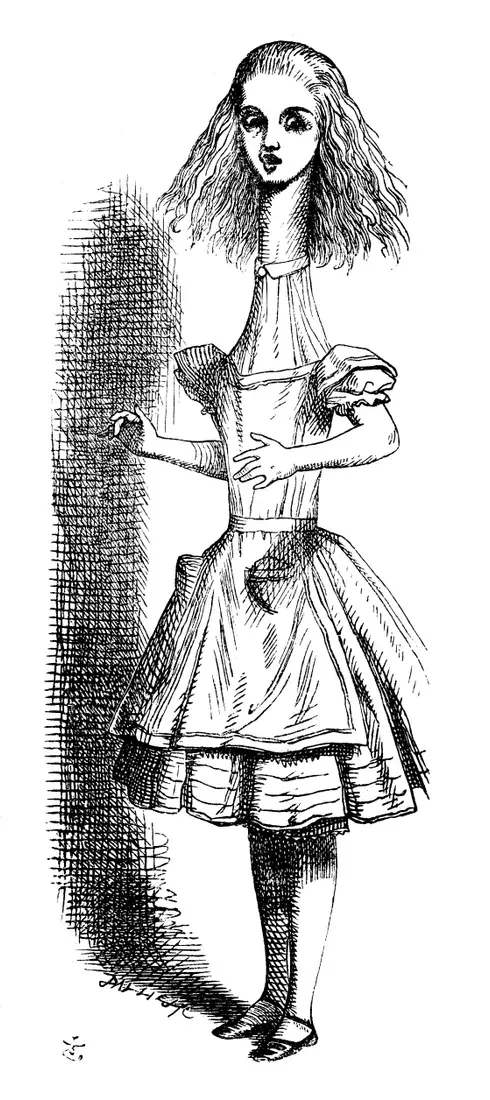
John Tenniel, illustration for Chapter 2 of Alice's Adventures in Wonderland (1865) · Public domain · Wikimedia Commons
A long-standing story has followed this scene. It is said that Carroll suffered from migraines and transferred the strange sensations he experienced into Alice. A primary headache characterized by recurrent throbbing pain on one side of the head, often accompanied by nausea or sensitivity to light and sound, is a migraine. This article follows a single question to the end. Did the scenes of Alice's body shrinking and stretching come from the author's migraines? To find the answer, we must first look at how this scene made its way into the medical clinic. This is because what Alice experienced is the account of a fictional character, and the medical records of the author himself must be sought separately.
Names That Crossed from Books to the Clinic
In 1955, British psychiatrist John Todd reported on six patients (PMID 29151098). All six experienced episodes resembling Alice, feeling that the appearance of their own bodies was distorted. Todd defined this as an illusion in which the body's size, weight, shape, or position is distorted. Todd gave this symptom cluster the name Alice's Adventures in Wonderland. It was because of the resemblance to the bodily changes experienced by Alice (PMID 29151098). Todd portrayed this cluster as symptoms close to migraine and epilepsy (PMID 10767914). Epilepsy is a brain disease with a long-lasting tendency to repeatedly cause seizures.
Alice in Wonderland syndrome is a cluster of symptoms in which the size, shape, or distance of objects or one's own body, as well as the passage of time, momentarily feel different from reality. A syndrome is a term for a group of symptoms that appear together, so the underlying causes can be multiple. What is frequently reported in this cluster is size distortion (DOI: 10.1055/s-0040-1717129). Micropsia is a symptom where objects appear smaller than they actually are, and macropsia is a symptom where objects appear larger than they actually are.
Along with size, time also shakes. A systematic review is a study that gathers all relevant studies on a single topic using a predetermined method and then summarizes them together. A systematic review that found cases experiencing time distortion in this syndrome gathered 168 people across 59 papers, and the most common phenomenon was surroundings appearing to move as if in slow motion or fast-forward (PMID 34025485). The size changes shown in chapters 1 and 2 of Alice are one branch within this broad cluster.
American neurologist Caro Lippman already described the same symptoms in 1952, preceding Todd, though it was Todd's report that had a major influence (PMID 29151098). One of the patients described by Lippman felt as though their body had become short and wide when walking, and likened the feeling themselves to the Alice books, calling it a feeling like "Tweedledum" or "Tweedledee" (DOI: 10.1212/wnl.0b013e31828970ae). Tweedledum and Tweedledee are the chubby twins appearing in Carroll's second Alice book, Through the Looking-Glass. The patient thought of the book before the doctor gave it a name.
There are also records by doctors preceding Todd. One conference abstract tracked down a 1904 report where patients said "everything looks bigger" before a seizure, and a 1907 report where epilepsy patients recorded seeing things "twice their size" around the time of a seizure (DOI: 10.1212/wnl.88.16_supplement.p2.042). As that abstract concluded, even though there were doctors who recorded it first, what survived for a long time was the colorful name attached by Todd (DOI: 10.1212/wnl.88.16_supplement.p2.042).
As the name spread, disputes arose regarding its boundaries. A 2018 review points out that all six of Todd's patients experienced body size distortions, and not a single case showed only objects appearing small or large without body distortions (PMID 29151098). Therefore, this review reports that calling even cases with only visual illusions—where objects appear small or large, distant or close, without body distortions—by this name is "inaccurate and misleading," and notes that such cases differ in age and cause (PMID 29151098). Meanwhile, a 2016 systematic review defined this syndrome broadly as distortions of visual perception, bodily sensation, and the experience of time (PMID 27347442). Thus, the figures below may vary depending on how broadly each study defined this syndrome.
What remains here is the direction. The name of this syndrome crossed from books to the clinic. Todd thought of Alice after seeing patients, and the mere fact that the name was attached does not mean Carroll experienced those symptoms.
What Shakes Size
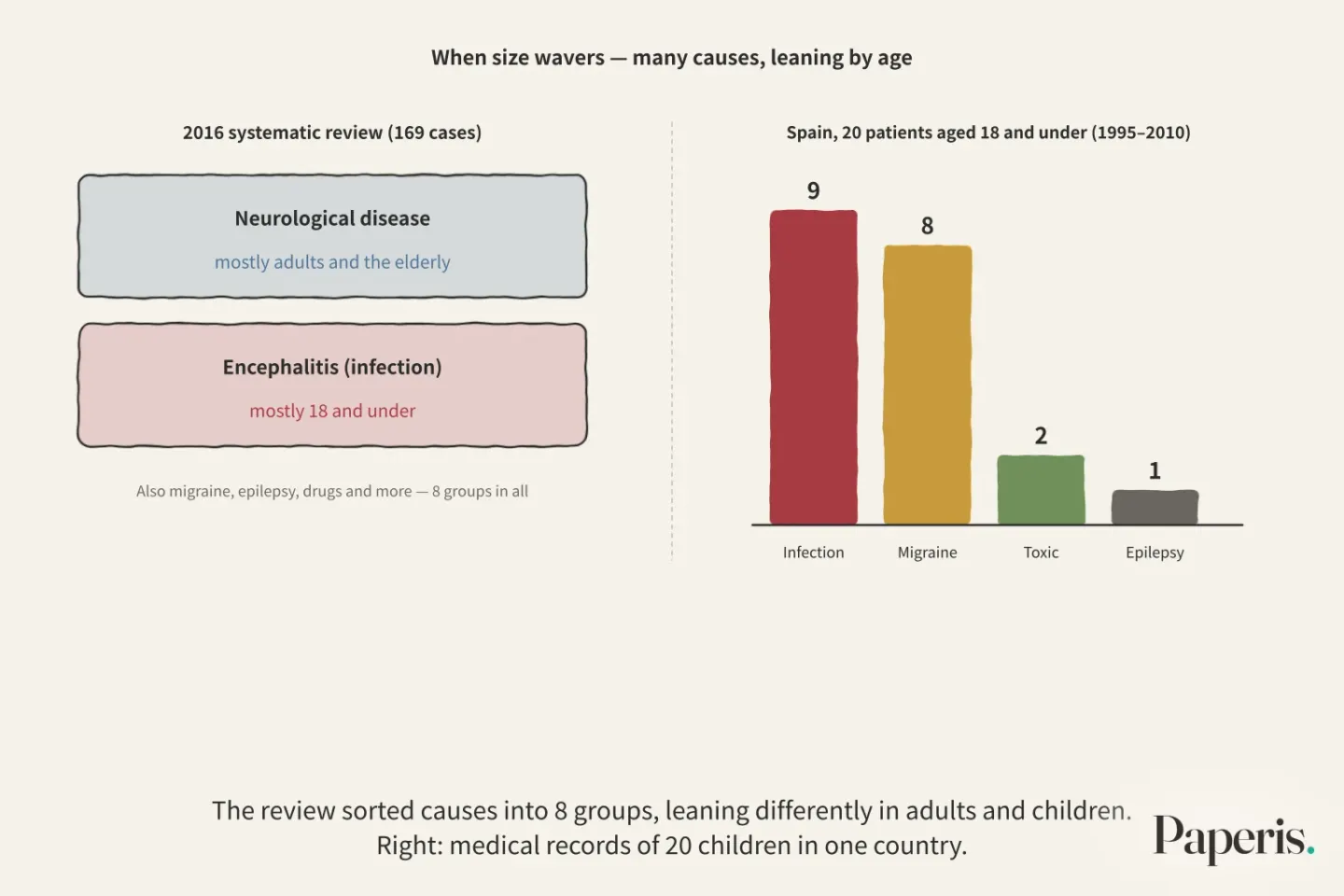
As cases accumulated, it became clear that the causes are multiple. A 2016 systematic review divided the causes into eight branches based on 169 published cases (PMID 27347442). Nervous system disorders appeared mainly in adults and the elderly, while encephalitis appeared mostly in those aged 18 and under (PMID 27347442). Another review from the same year noted that it had gathered 169 cases from 70 papers (PMID 27075220).
According to a case report that transcribed the figures from this review, micropsia was reported in 58.6% and macropsia in 45.0% of the 169 cases (DOI: 10.1055/s-0040-1717129). Among those aged 18 and under, encephalitis caused by infection was the most frequent at 21.6%, and 68.4% of those encephalitis cases were due to the Epstein-Barr virus (DOI: 10.1055/s-0040-1717129). The same paper transcribed that symptoms resolved completely in 46.7% across the entire review regardless of age, and that the prognosis can be poor in cases of encephalitis (DOI: 10.1055/s-0040-1717129). The Epstein-Barr virus (EBV) is a common virus that causes infectious mononucleosis. One clinical review summarized that EBV infection is the most common cause in children, while migraines appear more frequently in adults (PMID 28116304). A review focusing separately on infections noted that, judging by recent reports, infection is the primary cause particularly in children (PMID 34101086).
Other causes exist alongside these. The causes cited in a 2018 review are infection (especially EBV), migraine, epilepsy, depression, and delirium stemming from toxic substances or high fever (PMID 29151098). Medications also make the list. An analysis that found 87 reports of this syndrome in the World Health Organization's adverse drug reaction reporting database found a signal where reports clustered more than expected on a few drugs such as the asthma medication montelukast, but the authors stated that causality cannot be established from these data (PMID 41448101).
The picture becomes more concrete when looking at case series limited to children. When a study published in a Spanish neurology journal reviewed the medical records of 20 patients aged 18 and under diagnosed with this syndrome between 1995 and 2010, the average age was 9.5 years (DOI: 10.33588/rn.5311.2011435). The causes were infection in 9 patients (including 5 with EBV), migraine in 8, toxic substances in 2, and epilepsy in 1. For 90%, objects looked smaller or larger; for 90%, a single episode lasted less than 3 minutes; and for 80%, the symptoms did not appear again (DOI: 10.33588/rn.5311.2011435). Among 20 patients aged 5 to 21 presented as a conference abstract by a university hospital pediatric neurology department, those aged 13 and under presented with infection or fever, while those aged 13 to 21 presented mainly with epilepsy or headache (DOI: 10.1212/wnl.92.15_supplement.p4.6-030).
Following one child illustrates this. A six-year-old boy reported in Spain in 2001 experienced multiple times that the room ceiling and surrounding people and objects looked very small and far away, and he was terrified by those occurrences (DOI: 10.1016/s1695-4033(01)77603-5). Examinations confirmed an EBV infection, symptoms resolved spontaneously within 48 hours, and they did not return four months later. The reporting physicians wrote that having such a diagnosis allows families to be reassured that the symptoms are temporary and benign (DOI: 10.1016/s1695-4033(01)77603-5). Because this is a single case report, it does not represent the clinical course of all children.
There is a medical essay noting that the fact that patients know the state is not normal distinguishes psychosis from this syndrome (DOI: 10.71152/ajms.v14i9.3436). A ten-year-old girl reported in 2025 experienced objects looking small and time feeling distorted immediately after recovering from a febrile illness, and even while the symptoms occurred, she knew where she was and what she was doing, and also knew that the feeling was strange (DOI: 10.7759/cureus.86532). Examinations confirmed a primary EBV infection, and the symptoms subsided over 4 weeks without medication. A 1977 report described three patients in whom visual disturbances preceded other symptoms of infectious mononucleosis, writing that physical causes must be carefully examined before attributing such symptoms to psychiatric problems (DOI: 10.1177/000992287701600205). The review gathering 70 papers also noted that this syndrome should not be confused with conditions like schizophrenia (PMID 27075220). Multiple reports repeat the caution not to hastily read someone describing unfamiliar perceptions as psychosis.
Two sentences appear together in the conclusion of the 2016 systematic review. The authors strongly recommended auxiliary examinations such as blood tests, electroencephalograms, and neuroimaging in actual clinical practice, while noting that reassurance that the symptoms themselves are harmless appeared sufficient in about half of the cases (PMID 27347442). The same review summarized that such symptoms also appear in the general population, with up to 30% of adolescents reporting symptoms that do not lead to medical visits (PMID 27347442). The review gathering 70 papers also noted that these symptoms occur more frequently than previously thought (PMID 27075220). The experience of shaking size straddles the line between a rare diagnosis and a momentary experience that is more common than one might think.
How Close Is It to Migraine?
The connection to migraine also appears in numbers. In a study where a headache specialty center surveyed 808 migraine patients, 133 people, or 16.5%, answered that they had experienced the symptoms of this syndrome at least once in their lifetime (PMID 38822148). The most common was the symptom of objects appearing small or distant (72.9%), lasting an average of about 30 minutes, and 65.1% experienced it along with a headache. Of these people, 53.7% experienced their first symptom at age 18 or younger (PMID 38822148).
The same study looked at whether this symptom is more frequent in migraine with aura. An aura is a phenomenon where neurological symptoms appear gradually around the time of a migraine attack, such as flashing lights in front of the eyes, and then disappear completely. There was a difference, with 19.5% of patients with aura and 14.1% of patients without aura reporting the symptom (PMID 38822148). The authors concluded that this symptom appears to be a common lifetime experience for migraine patients, and that similarities with auras “may suggest” a common mechanism. However, since this study was a cross-sectional survey relying on the memory of patients who visited a specialty center, it cannot be directly transferred to the proportion of general migraine patients.
Other comparisons yield different results. A 2014 study in Hamburg, Germany, surveyed 219 migraine patients and 161 healthy people matched for age and gender to compare momentary sensory symptoms (DOI: 10.1212/wnl.0000000000000337). Symptoms in which the weight and size of the body feel different appeared more frequently in patients with migraine without aura, but micropsia and macropsia—where objects appear small or large—had no clear relation to migraine. The authors wrote that this study is at the hypothesis-generating stage and needs to be reconfirmed through face-to-face interviews (DOI: 10.1212/wnl.0000000000000337). There are also reports that the pattern varies by age. In a study where a university headache clinic examined 14 migraine patients who experienced this syndrome, children and adolescents experienced symptoms as part of an aura or between headaches, while older patients experienced only short, seconds-long symptoms between headaches (DOI: 10.9734/bjmmr/2016/23997). The strength of the connection between migraine and size distortion varies depending on the specific symptom and what it is compared with.
On the interpretation side, there is a trend viewing this syndrome as a form of aura. One clinical review reported that a wealth of data supports a close relationship between migraine and this syndrome, and wrote that in many patients, especially children, this symptom can be seen as an aura or a “migraine equivalent” (PMID 28116304). The same review proposed a model that the symptom depends on changes in the area where the temporal, parietal, and occipital lobes meet—that is, where visual information and bodily sensory information converge (PMID 28116304).
Research locating the brain region found commonalities among lesions scattered across various sites. In a 2024 study that gathered and analyzed 37 cases in the literature where this syndrome occurred due to brain lesions, the lesion sites hardly overlapped with each other (overlap of 33% or less), but more than 85% were connected to the same network (DOI: 10.1002/ana.27015). That network included the right brain region that lights up when viewing body parts and the inferior parietal lobule that judges size and scale. This pattern broadly matched brain imaging results from 5 people who experienced symptoms from non-lesion causes, and the authors interpreted that this perceptual distortion corresponds to a single common brain network (DOI: 10.1002/ana.27015. These results are from patients with lesions and do not serve as data showing the inside of an author's head in 1865.
To summarize, the connection between migraine and this syndrome is real but not one-to-one, infections more frequently precede it in children, and the migraine side is more commonly reported in adults.
Did Carroll Experience It and Write It?
Now we return to the first question. Did Carroll experience this symptom directly? Asking this of someone who passed away in 1898 is a retrospective diagnosis (DOI: 10.1212/wnl.0b013e31828970ae). A retrospective diagnosis is the work of estimating a medical condition without directly examining the deceased person, using only surviving records such as letters, biographies, and works. A 2024 editorial put quotes around the word to write that Carroll was “diagnosed” as a migraine patient after his death (PMID 39003946).
We look first at the writings that see him as having experienced it and the writings around them. A short 1991 neurology journal piece noted that scholars have “conjectured” that Carroll may have experienced the syndrome himself because he suffered from classic migraines (DOI: 10.1001/archneur.1991.00530180107025). The same piece said the symptoms and the book's descriptions match so well that the original illustrator drew the condition accurately. A 2013 history of neurology article wrote that Alice's bodily changes “may have been based in part” on Dodgson's own migraine experiences (DOI: 10.1212/wnl.0b013e31828970ae). A 1993 literary essay in a headache specialty journal does not state whether Carroll experienced it, but reads his descriptions as vivid depictions of symptoms commonly accompanying migraines, such as a blank spot in the center of vision, sensitivity to sound, and distortions of body image (DOI: 10.1111/j.1526-4610.1993.hed3302076.x). The most specific claim appears in a 2017 neurology conference abstract. Based on Dodgson's diary records, the authors wrote that he “likely” recounted the illusions he experienced during migraines to the real Alice, Alice Liddell (DOI: 10.1212/wnl.88.16_supplement.p2.042). Because this claim is from a conference abstract, which diary and which date do not appear in the abstract.
The core of the opposing side is dates. A 1982 neurology paper summarized that Dodgson began experiencing migraines and their resulting visual symptoms “at a late age”, in his mid-fifties (DOI: 10.1017/s0317167100044395). It then concluded that there is no link between the visual symptoms of migraines and the phenomena in the Alice stories, since the stories were written more than 25 years before the author developed migraines (DOI: 10.1017/s0317167100044395). The counterargument of the 1982 paper rests on the fact that Carroll's migraines began more than 25 years after the Alice stories were written.
There are also writings pointing to other illnesses besides migraines. A 2024 editorial wrote that, given Carroll's distinctive personality, he might have suffered from temporal lobe epilepsy (PMID 39003946). This editorial is an estimation starting from personality descriptions, and the abstract presents no new medical records.
When we place the various writings side by side, the weights are uneven. The writings that see him as having experienced it lean on the points that the descriptions resemble the symptoms and that Carroll suffered from migraines. Of the abstracts we examined, only the 1982 paper deals with when the migraines began. The 2017 conference abstract cites diaries as evidence but does not reveal when those events were, and the abstract does not state what evidence the 1982 paper used to determine the onset timing.
Remaining Questions
The remaining question is whether there is any record of Dodgson experiencing these symptoms prior to 1865. A 1982 paper suggests that his migraines only began in his mid-fifties. A 2017 conference abstract relies on diary entries to suggest that he "perhaps" shared his migraine-induced illusions with Alice Liddell, but the abstract does not state when that occurred. Reading that storytelling as having happened before 1865 is a guess that cannot be made from this abstract alone. Since none of the paper abstracts examined here directly show the dates and sentences from the diaries, this primer does not record those dates.
Recent review articles generally repeat this story with qualifying words attached. A 2025 literature review wrote that the author "probably" suffered from migraine with aura and "may" have drawn inspiration from his self-perception abnormalities (DOI: 10.31435/ijitss.4(48).2025.4317). Sentences with qualifiers have been repeated and spread widely, but the number of repetitions does not constitute new evidence.
That does not mean it has been proven that "migraines and Alice are unrelated." The judgment that "there is no connection between the visual symptoms of migraine and the Alice story" belongs to the author of the 1982 paper, and the evidence regarding the onset timing that supports that judgment does not appear in the abstract. The story that Carroll wrote Alice after experiencing migraines is a post-mortem assumption, and the evidence gathered by this primer is weak in support of it. The only abstract addressing the onset timing reports that his migraines began more than 25 years after the Alice story was written, and the 2017 conference abstract using the diaries does not disclose the dates, leaving the conclusion unsettled by the abstracts alone.
So What Did We Learn?
Following this question, what remains is a direction. Alice's name entered the clinic in 1955 when a psychiatrist saw patients and thought of the book, and since then, case reports and systematic reviews have piled up, broadening the causes to migraine, infection, epilepsy, brain lesions, and medication. Within that widened picture, pediatric cases lean toward infection. The course does not close with a single outcome. In 20 Spanish children, 80% did not reappear (DOI: 10.33588/rn.5311.2011435). This is a figure counting recurrences. Separately, a case report conveying the figures of an overall review across all ages noted that symptoms disappeared completely in 46.7% of cases, and that the course can be poor when it is encephalitis (DOI: 10.1055/s-0040-1717129). All of this is knowledge about patients, while knowledge about the author depends on the records left behind.
A study that cast a similar question at a painting shows one way of reading. A 2026 paper that read the Brazilian painter Tarsila do Amaral's "Abaporu" through the lens of migraine aura noted that the giant foot and tiny head in the painting bring micropsia and macropsia to mind, while clarifying that there is no evidence the painter had migraines (DOI: 10.1055/s-0045-1814376). That paper carried two readings along together: the reading that the distortion was an intentional artistic strategy the painter pushed steadily in the 1920s, and the reading that it touches upon sensory abnormalities. The same two forks can be used for Alice. That a scene resembles a symptom is a fact of the work, and whether the author experienced it is a matter of records.
How migraines themselves occur can be pursued further in "Headache and Migraine — A Bell That Rings Easily, a Threshold That Falls as Attacks Grow Frequent", and how the brain guesses and matches the senses it receives in "Sensation and Perception — Clues Taken at the Door, a Scene Pieced Together by Guesswork".
Even without knowing Carroll's illness, the scenes he wrote remain. A child's body folding and unfolding like a telescope became, in 1955, a long-lasting name for the experience of fluctuating size.
Source Papers
- "The Alice-in-Wonderland Syndrome." (2018) — PMID 29151098 — Todd defined and named it in 1955 (6 patients, all with body image distortions), Lippman's prior work in 1952, "Alice" (1865) 10 inches, diagnosis "inaccurate" based solely on visual illusions without body distortions, most frequently reported in children, causes include infection (EBV), migraine, epilepsy, and delirium.
- "[The Alice in Wonderland syndrome]." (1999) — PMID 10767914 — Todd named it in 1955 as a symptom cluster closely related to migraine and epilepsy, Lippman first described it in 1952.
- "Infectious causes of Alice in Wonderland syndrome." (2021) — PMID 34101086 — Defined size distortions (micropsia, macropsia), etc., with recent reports indicating infections as a primary cause, especially in children.
- "Alice in Wonderland Syndrome: Somesthetic vs visual perceptual disturbance" (2013) — DOI: 10.1212/wnl.0b013e31828970ae — Dodgson (1832-1898), bodily changes may have been partly based on his migraine experiences, the "Tweedledum" feeling in Lippman's patient.
- "Alice In Wonderland Syndrome: A History (P2.042)" (2017, conference abstract) — DOI: 10.1212/wnl.88.16_supplement.p2.042 — Prior records from 1904 and 1907, based on diary entries suggesting Dodgson "probably" recounted his migraine illusions to Alice Liddell.
- "Time Distortions: A Systematic Review of Cases Characteristic of Alice in Wonderland Syndrome." (2021) — PMID 34025485 — 59 papers and 168 cases of time distortion, with slow-motion and fast-forward phenomena being the most common.
- "Alice in Wonderland syndrome: A systematic review." (2016) — PMID 27347442 — 169 cases, 8 categories of causes, adults = nervous system, 18 and under = encephalitis, up to 30% of adolescents have non-clinical symptoms, strongly recommends ancillary tests while reassurance is enough for about 50%.
- "[The Alice in Wonderland syndrome. What do we know after 60 years?]." (2016) — PMID 27075220 — 70 papers and 169 cases, causes include nervous system, infection, substances, and psychiatry, prevalence unknown.
- "“Curiouser and Curiouser!”—Macroacusia and Visual Disturbances in Alice in Wonderland Syndrome" (2020, case report) — DOI: 10.1055/s-0040-1717129 — Citing systematic review figures: micropsia 58.6%, macropsia 45.0%, encephalitis in 18 and under 21.6%, of which EBV is 68.4%.
- "Alice in Wonderland Syndrome: A Clinical and Pathophysiological Review." (2016) — PMID 28116304 — EBV in children and migraines in adults are most common, can be viewed as an aura or migraine equivalent in many patients (especially children), temporo-parieto-occipital junction model.
- "Alice in wonderland syndrome: Down the rabbit hole of VigiBase®." (2026) — PMID 41448101 — 87 cases in the WHO adverse event database, disproportionality signals for montelukast, etc., causality cannot be established.
- "Características y evolución de los pacientes con síndrome de Alicia en el País de las Maravillas" (2011) — DOI: 10.33588/rn.5311.2011435 — Retrospective study of 20 patients aged 18 and under in Spain, mean age 9.5 years, infections 9 (EBV 5), migraines 8, toxicity 2, epilepsy 1, 80% with no recurrence, benign course.
- "Alice in Wonderland Syndrome: Case Series and Analysis (P4.6-030)" (2019, conference abstract) — DOI: 10.1212/wnl.92.15_supplement.p4.6-030 — 20 patients aged 5 to 21, infection and fever in those 13 and under, epilepsy and headaches in those 13 to 21.
- "Síndrome de “Alicia en el País de las Maravillas” asociado a infección por el virus de Epstein-Barr" (2001, case report) — DOI: 10.1016/s1695-4033(01)77603-5 — 6-year-old boy, EBV confirmed, spontaneous resolution within 48 hours, asymptomatic at 4 months, explaining to the family that it is temporary and benign.
- "Alice in Wonderland Syndrome in a Child Following Epstein-Barr Virus Infection: A Case Report" (2025, case report) — DOI: 10.7759/cureus.86532 — 10-year-old girl, micropsia and time distortion following initial EBV infection, orientation and insight maintained even during symptoms, resolved without medication at 4 weeks.
- ""Alice in Wonderland" Syndrome as a Presenting Symptom of Infectious Mononucleosis in Children: A Description of Three Affected Young People" (1977, case report) — DOI: 10.1177/000992287701600205 — 3 individuals, visual abnormalities preceded mononucleosis symptoms, physical examination needed before attributing to psychiatric issues.
- "Alice-in-Wonderland Syndrome in Patients with Migraine" (2016) — DOI: 10.9734/bjmmr/2016/23997 — 14 migraine patients, part of the aura in children and adolescents, seconds-long episodes between attacks in older patients.
- "Alice in wonderland syndrome – A medical enigma" (2023, essay) — DOI: 10.71152/ajms.v14i9.3436 — Distinguished from psychosis by the fact that the patient knows the state is not normal.
- "Alice in Wonderland Syndrome (AIWS): prevalence and characteristics in adults with migraine." (2024) — PMID 38822148 — 16.5% lifetime symptoms among 808 migraine patients, aura present 19.5% vs absent 14.1%, common mechanism "could indicate".
- "Migraine trait symptoms in migraine with and without aura" (2014) — DOI: 10.1212/wnl.0000000000000337 — 219 migraine patients vs 161 controls, micropsia and macropsia not associated with migraines, hypothesis-generating stage.
- "Lesions Causing Alice in Wonderland Syndrome Map to a Common Brain Network Linking Body and Size Perception" (2024) — DOI: 10.1002/ana.27015 — 37 lesion cases, 33% or less overlap, 85% or more common network (right body region, inferior parietal lobule).
- "Lewis Carroll's personality and the possibility of epilepsy." (2024, editorial) — PMID 39003946 — Carroll "diagnosed" as a migraine sufferer posthumously, temporal lobe epilepsy possible based on personality.
- "Literary Neurologic Syndromes: Alice in Wonderland" (1991, short article) — DOI: 10.1001/archneur.1991.00530180107025 — Carroll suffered from classical migraine, leading scholars to infer direct experience, original illustrator accurately depicted symptoms.
- "Sometimes Jello Helps: Perceptions of Headache Etiology, Triggers and Treatment in Literature" (1993, essay) — DOI: 10.1111/j.1526-4610.1993.hed3302076.x — Read as Carroll vividly describing symptoms accompanying migraines.
- "The Neurology of Alice in Wonderland" (1982) — DOI: 10.1017/s0317167100044395 — Dodgson developed migraines in his mid-50s, Alice was written more than 25 years prior, showing no connection.
- "ALICE IN WONDERLAND SYNDROME IN THE LIGHT OF THE LATEST REPORTS – A LITERATURE REVIEW" (2025) — DOI: 10.31435/ijitss.4(48).2025.4317 — Author "probably" had migraine with aura, "may have been inspired".
- "A neurological perspective on Tarsila do Amaral's “Abaporu”: migraine aura inspiring art?" (2026) — DOI: 10.1055/s-0045-1814376 — No evidence of migraines in the artist, dual reading of intentional artistic strategy and the resonance of perceptual abnormalities.
Sources (27)
- The Alice-in-Wonderland SyndromePMID 29151098
- [The Alice in Wonderland syndrome]PMID 10767914
- Infectious causes of Alice in Wonderland syndromePMID 34101086
- Alice in Wonderland Syndrome: Somesthetic vs visual perceptual disturbanceDOI 10.1212/wnl.0b013e31828970ae
- Alice In Wonderland Syndrome: A History (P2.042)DOI 10.1212/wnl.88.16_supplement.p2.042
- Time Distortions: A Systematic Review of Cases Characteristic of Alice in Wonderland SyndromePMID 34025485
- Alice in Wonderland syndrome: A systematic reviewPMID 27347442
- [The Alice in Wonderland syndrome. What do we know after 60 years?]PMID 27075220
- Curiouser and Curiouser!DOI 10.1055/s-0040-1717129
- Alice in Wonderland Syndrome: A Clinical and Pathophysiological ReviewPMID 28116304
- Alice in wonderland syndrome: Down the rabbit hole of VigiBase®PMID 41448101
- Características y evolución de los pacientes con síndrome de Alicia en el País de las MaravillasDOI 10.33588/rn.5311.2011435
- Alice in Wonderland Syndrome: Case Series and Analysis (P4.6-030)DOI 10.1212/wnl.92.15_supplement.p4.6-030
- Síndrome deDOI 10.1016/s1695-4033(01)77603-5
- Alice in Wonderland Syndrome in a Child Following Epstein-Barr Virus Infection: A Case ReportDOI 10.7759/cureus.86532
- Alice in WonderlandDOI 10.1177/000992287701600205
- Alice-in-Wonderland Syndrome in Patients with MigraineDOI 10.9734/bjmmr/2016/23997
- Alice in wonderland syndrome – A medical enigmaDOI 10.71152/ajms.v14i9.3436
- Alice in Wonderland Syndrome (AIWS): prevalence and characteristics in adults with migrainePMID 38822148
- Migraine trait symptoms in migraine with and without auraDOI 10.1212/wnl.0000000000000337
- Lesions Causing Alice in Wonderland Syndrome Map to a Common Brain Network Linking Body and Size PerceptionDOI 10.1002/ana.27015
- Lewis Carroll's personality and the possibility of epilepsyPMID 39003946
- Literary Neurologic Syndromes: Alice in WonderlandDOI 10.1001/archneur.1991.00530180107025
- Sometimes Jello Helps: Perceptions of Headache Etiology, Triggers and Treatment in LiteratureDOI 10.1111/j.1526-4610.1993.hed3302076.x
- The Neurology of Alice in WonderlandDOI 10.1017/s0317167100044395
- ALICE IN WONDERLAND SYNDROME IN THE LIGHT OF THE LATEST REPORTS – A LITERATURE REVIEWDOI 10.31435/ijitss.4(48).2025.4317
- A neurological perspective on Tarsila do Amaral'sDOI 10.1055/s-0045-1814376