
Paperis Articles
Contracts — A Knot Tied by Two Hands
A contract is tied when an offer meets an acceptance, and neither side may simply untie it alone. The law sets out the ways to undo it and their price, and some promises are void even when they are written into the contract.
Your field's papers, as audio
Pick your fields and journals — Paperis summarizes the key papers and turns them into audio. Listen on your commute.
Start Paperis free →Contracts — A Knot Tied by Two Hands
An 1.1 Billion-Won Apartment, and the Next Day
On March 25, 2013, two people agreed to buy and sell an apartment in Seocho-gu, Seoul, for 1.1 billion won. The buyer was to hand over 110 million won first, with 10 million won to be sent that day and the remaining 100 million won to be sent to the seller's bank account the next day, March 26. That day, the 10 million won entered the account (Supreme Court 2014Da231378).
The next day, the seller tried to back out of the transaction. They notified the real estate agent that they would call it off and closed the bank account where they were to receive the money. The buyer, who was trying to send the remaining 100 million won, failed to wire it. The following day, the seller deposited 20 million won—double the 10 million won they had received—with the court, and sent a notice stating they were backing out of the promise with this money. The notice only stated "for various reasons" as the cause (Supreme Court 2014Da231378).
The buyer deposited the remaining 100 million won with the court on the grounds that the seller refused to accept it, and on April 24 sent a formal notice stating they would bring the remaining balance on the balance payment day. The seller argued later in court that as long as they returned double the money they received, they could back out of the promise however they pleased. The Supreme Court handed down its ruling on April 23, 2015 (Supreme Court 2014Da231378).
A contract is a promise where two people agree on what to do for each other, and one that the law holds people accountable for if broken. This article pictures a contract as a knot tied together with two people each holding one end of a string. You cannot tie it alone, you cannot untie it alone at will, and the law does not recognize certain strings as knots from the start.
This apartment dispute contains three questions. When is a promise tied? Can anything be put into a tied promise? What remains when a promise is broken? This article examines the Civil Act of South Korea, based on the law in effect as of November 2026. It is an article explaining systems and criteria for judgment, and the outcome of individual cases varies depending on the wording of the contract and the circumstances.
An Extended Hand and a Grasped Hand
Let us suppose someone says, "I will sell this apartment for 1.1 billion won," and the other person answers, "I will buy it at that price." The former statement is a hand extending one end of a rope, and the latter reply is a hand grasping that end.
An offer is a proposal put forward by one party to make a contract, which creates a contract as soon as the other party accepts it. An acceptance is the other party's reply stating that they will accept that offer. A contract is formed when these two meet (KCI ART002393073). The Civil Act defines a sale as a contract that takes effect when one party promises to transfer a property right and the other party promises to pay the price for it (Civil Act, Article 563). What the legal provisions mention are two promises, and neither contract documents nor seals appear in this provision.
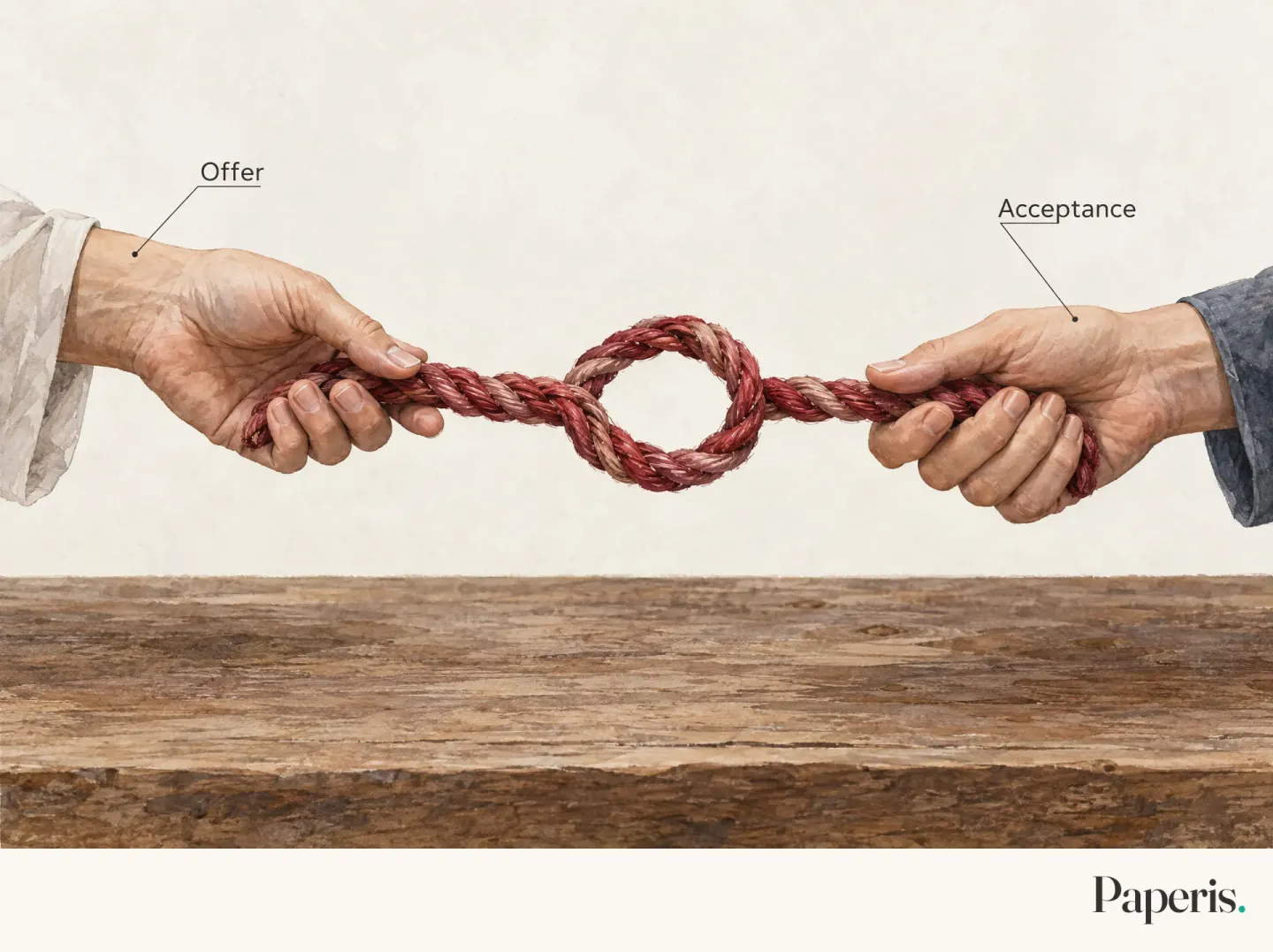
Illustration: Paperis
The extended hand cannot be withdrawn at will. The Civil Act provides that "An offer of a contract may not be withdrawn" (Civil Act, Article 527). This means the proposing party is also bound for a certain time from the moment they make the proposal. Instead, the waiting has an end. If someone makes an offer with a set period for a reply and does not receive notice of acceptance within that period, the offer loses its effect (Civil Act, Article 528, Paragraph 1). Matters change if the reply alters the conditions. If someone accepts with conditions attached or the contents changed, the law views that offer as rejected and newly made (Civil Act, Article 534). A reply stating, "I will buy it if it is 1 billion won," is treated as a new proposal, and this time, the party who originally offered to sell decides whether to accept it.
When people are apart and words do not reach each other immediately, the question becomes when they became bound. The Civil Act provides that "A contract between persons at a distance is formed at the time when the notice of acceptance is dispatched" (Civil Act, Article 531). There is also the view that an acceptance takes effect only when it reaches the other party (KCI ART002393073).
The moment words pass back and forth and minds align, the knot is tied, and the party who extended the hand cannot withdraw it at will even while waiting for a reply.
The Shape of the Knot Is Chosen by the Two People
The price of 1.1 billion won and the order of sending 10 million won first and 100 million won the next day were both decided by the two people in Seocho-gu.
The principle of freedom of contract is a principle that allows the parties themselves to decide whether to enter into a contract, with whom, and with what content. This principle established itself as one of the fundamental principles of modern civil law (DOI: 10.31839/DALR.2026.02.110.129).
If the parties express an intention different from the provisions among laws and regulations that are "unrelated to good morals and other social order," the law follows that intention (Civil Act Article 105). This means that rules unrelated to social order are defaults that step aside if the two people decide otherwise. The analysis that if a clause setting the penalty for backing out of a contract in a widely used real estate sales contract form differs from the Civil Act, the case must be resolved according to the contents of that contract also relies on this idea (DOI: 10.22999/hraj..515.202308.002).
This article limits provisions that the two people can bypass to those unrelated to social order (Civil Act Article 105). At its beginning, the Civil Act states that "the exercise of rights and the fulfillment of obligations shall be performed in accordance with good faith," and adds that rights may not be abused (Civil Act Article 2). Freedom of contract is not a value that must be protected absolutely, and it is also pointed out that when the balance of power between parties is broken, the weaker side's substantive right to self-determination is infringed (DOI: 10.31839/DALR.2026.02.110.129).
Most of the time the two people choose the shape of the knot, but there are places where the law has drawn lines in advance.
A String That the Law Does Not Count as a Knot
In 2019, a tenant leased a house for a deposit of 20 million won and a monthly rent of 600,000 won. On July 8, 2020, during the lease term, the landlord sold this house and its land to a development company for 1.56 billion won, including a special clause stating that if the landlord failed to evacuate the tenants by the balance payment date, the landlord would bear all liability for this contract and even the penalties for the company's other sales contracts. The tenant initially did not respond to the request to vacate the house, but after negotiation, they agreed to receive a settlement payment of 200 million won for handing over the house, 5 million won for moving expenses, and the 20 million won deposit in exchange for handing over the house early (Supreme Court 2023Da301712).
The tenant handed over the house, but the landlord did not pay the 200 million won. When the tenant claimed the money, the landlord's side argued that this agreement was invalid because it was concluded by taking advantage of the landlord's desperate state, which was under the risk of a massive penalty (Supreme Court 2023Da301712).
Anti-social legal acts are promises containing contents that violate good morals or other social order, and the Civil Act renders them void. A legal act is a broad term for an action where a person expresses intent, like a contract, to create legal effects, and the title of the article is “Legal Acts Against Social Order” (Civil Act Article 103). The article does not provide a list of what violates social order.
Unfair legal acts are promises concluded while one party was in a state of desperate distress, recklessness, or lack of experience, where what is given and received remarkably loses fairness, and the Civil Act renders these void as well. (Civil Act Article 104) Precedent defines desperate distress as “urgent poverty” and views that it can arise not only from economic causes but also from mental or psychological causes (Supreme Court 2023Da301712).
In this judgment on March 12, 2024, the Supreme Court summarized, in line with existing precedent, that for an unfair legal act to be established, there must objectively be a remarkable imbalance between what is given and received, and subjectively, the transaction must have been made by taking advantage of the vulnerable party's desperate distress, recklessness, or lack of experience. It stated that the purpose of this provision is “to regulate profiteering behavior that takes advantage of the desperate distress, recklessness, or lack of experience of a person in a weak position” (Supreme Court 2023Da301712). Because the article itself does not contain the word “exploitation”, academic theories have been divided over this point (KCI ART002744095). The side arguing for nullity must allege and prove such circumstances (KCI ART001203265).
The Supreme Court's judgment had two steps. The second instance court added even the 684 million won penalty that the landlord avoided thanks to the tenant handing over the house into what the tenant gave, and judged that there was no imbalance, but the Supreme Court ruled that this was wrong. The reason was that that penalty originated from the sales contract the landlord concluded with the development company and did not constitute the tenant's performance itself stipulated in the agreement with the tenant (Supreme Court 2023Da301712).
Even so, the conclusion was that the agreement was valid. The Supreme Court stated that while there was room to view that the landlord's side was in a somewhat distressed state by bearing an objectively excessive price, it viewed that that distress stemmed from the landlord calculating the profits to be gained from the sale, predicting the risks yet accepting them, and even agreeing to a massive penalty by stating they would kick out the tenant during the term against the lease contract with the tenant. It stated that “one must not easily acknowledge a state of desperate distress under Article 104 of the Civil Act” for a state brought upon oneself in this way, and that considering all circumstances such as the existence of other alternatives like canceling the sales contract with the development company, it could not be concluded that the agreement was concluded in a state of desperate distress. The Justices' opinions were unanimous (Supreme Court 2023Da301712).
The side this provision seeks to protect is the party in a weak position. One study views the intent of this provision as social equity and victim relief, and criticizes precedent for being excessively cautious in declaring nullity and thus failing to sufficiently relieve victims (KCI ART001203265). There is weight pulling in the opposite direction as well. A commentary supporting this judgment views that if even self-inflicted distress is recognized as desperate distress, it could result in the law instead protecting the side that failed to abide by an existing contract for other economic gains (DOI: 10.17248/knulaw..88.202501.209). Conversely, there is also a commentary arguing that even for self-inflicted distress, if the risk of suffering economic loss is great, recognizing desperate distress leniently is rational (DOI: 10.17251/legal.2025.37.3.835).
Not everything written in a contract becomes a knot, but precedent is cautious about rendering promises void through these two provisions, and one study criticizes that as excessive (KCI ART001203265).
A Price Paid to Untie the Knot
We return to the apartment in Seocho-gu. What the seller tried to do—to undo the promise as if it had never been made—has a name. A contract cancellation is an act where one party communicates their intent to the other to treat a concluded contract as though it had never existed from the beginning. Case law considers the effect of cancellation to retroactively reach back to the time the contract was made (KCI ART001835074).
The Civil Act provides that when there is a right of cancellation by contract or provision of law, one may communicate intent to the other to cancel, and once that intent is communicated, it cannot be withdrawn (Article 543 of the Civil Act). Regarding the act of one person changing their mind without such a right, the Supreme Court stated a principle in this judgment: "Once a sales contract has been formed, it is the principle that neither party may unilaterally cancel it at will." (Supreme Court 2014da231378)
The Civil Act leaves open a path by which a sale can be canceled even if the other party has not breached the promise, and that path is connected to the 110 million won that the buyer first agreed to hand over. A down payment is money that one party hands over to the other when concluding a contract. If one party to a sale handed over money or other property under a name like a down payment at the time of the contract, unless there is a different agreement, the party that handed it over may forfeit it and the party that received it may return double that amount to cancel the sales contract until either party begins performance (Article 565, Paragraph 1 of the Civil Act).
A cancellation deposit is a down payment used as the price to dissolve a contract, allowing the party that handed it over to forfeit it and the party that received it to return double it to cancel the contract. This means that the knot can be untied, but its price is predetermined, and that path closes once either party begins performance. When “commencing performance” occurs is not clear from the statutory text alone, making it a site where disputes arise (KCI ART001578646).
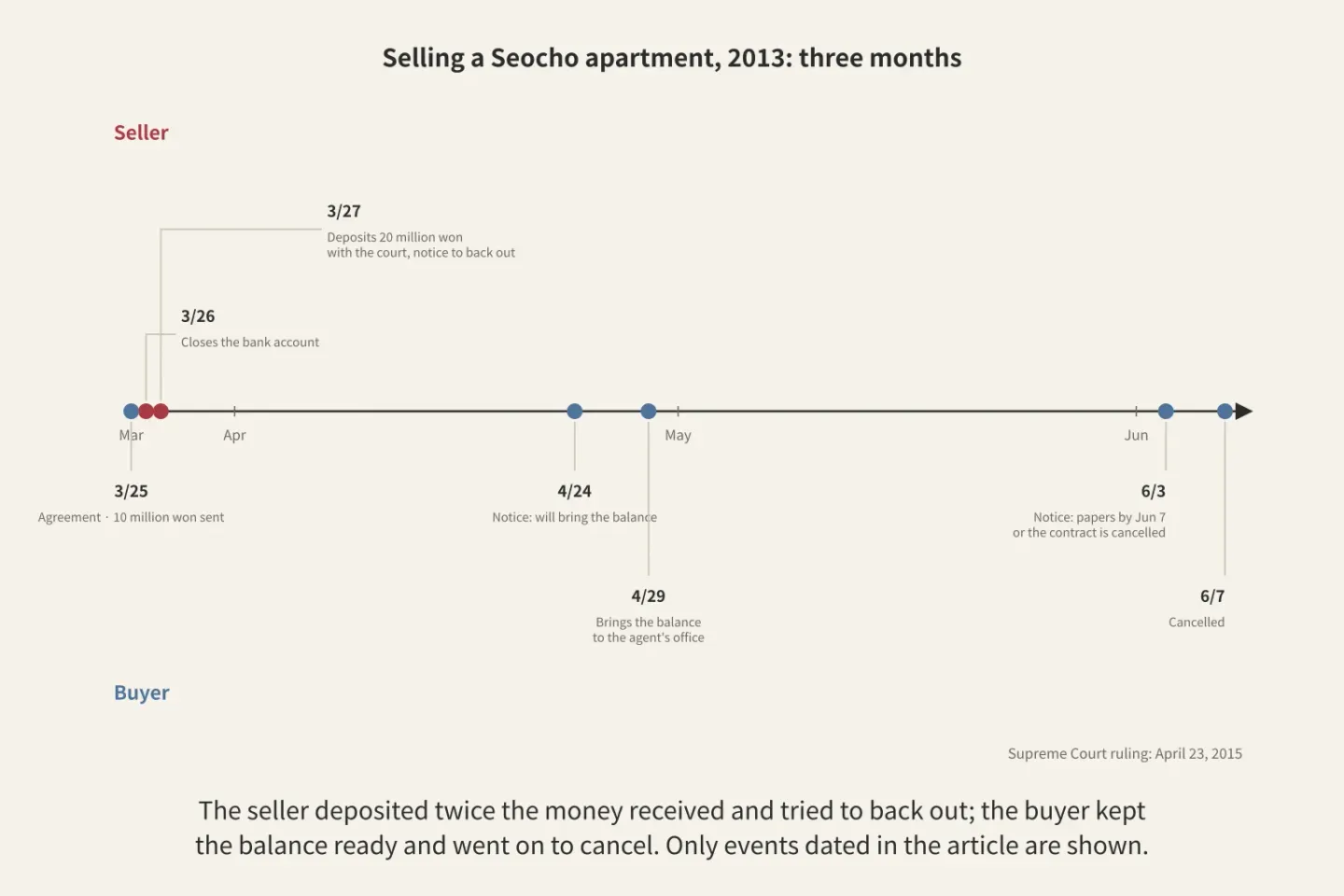
Figure: a diagram Paperis drew using only what the article says
Relying on this provision, the seller argued that because the buyer had not yet paid the full down payment, the contract's binding force was weak, and they could cancel it at any time simply by returning double the 10 million won they had received (Supreme Court 2014da231378). The Supreme Court's answer has three folds.
First, the Supreme Court held that it is reasonable to view the buyer as having paid the entire 110 million won down payment, so the seller must return double that down payment in order to cancel. Next, it added that even assuming only 10 million won had been handed over, the argument was without merit. If only part of the down payment was given first with the rest promised later, the agreement to dissolve by means of the down payment itself is not formed until the remainder is handed over, meaning the contract cannot be canceled at will (Supreme Court 2014da231378).
Finally, it stated that even if that path were open, “it is reasonable to view that the amount serving as the standard for this cancellation deposit is not the 'actually delivered down payment' but the 'agreed down payment.'” Its reasoning was that if a cancellation could be made by returning only double the money actually received, it would run counter to the parties' intent in setting the down payment amount, and when the money received is small, it would practically allow the contract to be freely dissolved, weakening the contract's binding force (Supreme Court 2014da231378). The Supreme Court's conclusion was that this sales contract could not be canceled by returning double the 10 million won received.
Assessments of this ruling's logic are divided. One commentary criticizes that while the premise of using the agreed-upon down payment as the standard is valid, it directly clashes logically with the premise that a down payment agreement is not formed until the full down payment is handed over (KCI ART002077302). Another view suggests that if a down payment is seen as paying part of the purchase price in advance, this kind of dispute itself becomes unnecessary (DOI: 10.17008/skklr.2021.33.2.016).
A contract may also provide terms different from the Civil Act. The contract in this case included a clause stating that until the buyer pays the final balance, the seller may cancel by compensating double the down payment, and the buyer may cancel by forfeiting the down payment (Supreme Court 2014da231378). This is a different deadline from “until the commencement of performance” specified in the Civil Act provision. While some analysis argues that such a clause constitutes a “different agreement” under Article 565 of the Civil Act and must be resolved according to its terms, and that courts should not directly apply Article 565 to such a contract (DOI: 10.22999/hraj..515.202308.002), this judgment did not interpret this clause separately and instead adjudicated based on the legal principles of Article 565 of the Civil Act.
There is research suggesting that the rule treating the mere handover of a down payment as the price to dissolve a contract—even without a separate agreement—was adopted by our Civil Act after being generalized in Japanese civil law (DOI: 10.17008/skklr.2021.33.2.016). Conversely, another view holds that this legal consciousness has been shaped by practices persisting over the past 100 years, and because there is a need to reserve the right of cancellation in exchange for a down payment, there is no reason to view this regulation negatively (KCI ART001544241).
When a Knot Is Untied
On April 29, 2013, the buyer went to a real estate broker's office carrying the remaining balance. The seller did not show up. On June 3, the buyer sent a notice stating that if the documents necessary to transfer ownership were not provided by 10:00 AM on June 7, that notice would serve as the declaration of contract cancellation, and the notice reached the seller the next day (Supreme Court 2014Da231378).
The law calls an obligation assumed through a contract a debt, calling the person who assumed that obligation a debtor and the person who is to receive performance a creditor. Default is when a debtor fails to perform an obligation assumed through a contract according to its terms. The Civil Act allows a creditor to claim damages if a debtor fails to perform in accordance with the terms of the debt, excluding cases where performance has become impossible without the debtor's intent or negligence (Civil Act Article 390).
Default is commonly divided into several branches (DOI: 10.22999/hraj..519.202402.007). Delay in performance is when performance is possible yet not carried out past the promised time.
Impossibility of performance is when what was promised can no longer be performed. Cases where someone expresses an intention not to perform even though performance is possible are also treated separately (DOI: 10.22999/hraj..519.202402.007).
When the other party does not perform, the Civil Act allows one to set a reasonable period and urge performance, and to cancel the contract if performance is not made within that period either. If the debtor has expressed in advance an intention not to perform, that urging is also unnecessary (Civil Act Article 544). In the Seocho-gu case, the appellate court viewed that the seller closed their bank account and sent a notice of cancellation, thereby clearly indicating an intention not to perform the obligation to transfer ownership, and determined that the contract was lawfully canceled on June 7, 2013, by the buyer's notice of cancellation on the grounds of this refusal to perform (Supreme Court 2014Da231378). For impossibility of performance, there is a separate provision which prescribes that when performance has become impossible due to a cause for which the debtor is responsible, the creditor may cancel the contract (Civil Act Article 546). This provision does not mention urging performance by setting a period.
Conversely, the seller argued that the contract had already been canceled in accordance with a special agreement in the contract stating that the contract would be canceled if 100 million won was not deposited by March 26. The Supreme Court stated that the buyer's failure to pay the 100 million won by that day was because the seller had closed their bank account, so there was no cause for which the buyer was responsible, and it could not be viewed that the contract was canceled by that special agreement (Supreme Court 2014Da231378). A special agreement written in a contract could not be used either under circumstances where the party asserting that special agreement prevented the condition from being fulfilled by their own actions.
Upon cancellation, each party bears the obligation to restore the other to their original state, and interest is added to the money to be returned from the day it was received. However, the rights of third parties may not be harmed (Civil Act Article 548). The appellate court saw that the seller had the obligation to return the 10 million won they received (Supreme Court 2014Da231378). Cancellation and a claim for damages can go together (Civil Act Article 551). However, this provision does not apply in cases of cancellation where a deposit is forfeited or twice its amount is returned (Civil Act Article 565 Paragraph 2). This means that damages do not follow a knot that was undone by paying a price.
What and How Much to Pay Back
There is also a limit to the damages that must be compensated. Damages for breach of contract are limited to ordinary damages, and damages arising from special circumstances are compensated only when the obligor knew or could have known of those circumstances (Civil Act Article 393). This means that the damages that normally occur when a contract is broken will be compensated, but the party that broke it is not burdened with damages that grew due to circumstances they could not have known.
There is also an agreement that eases the task of proving one by one how much the damages are. Liquidated damages are an agreement in which the parties predetermine the amount of damages to be paid in the event of a breach of contract. The Civil Act allows the parties to determine this (Civil Act Article 398 Paragraph 1), and an agreement to pay a penalty is presumed to be liquidated damages (Civil Act Article 398 Paragraph 4).
The second instance trial of the Seocho-gu case explained liquidated damages as "an agreement in advance on the amount of damages in order to ease the difficulty of proving the occurrence of damages and the amount of damages, and to prevent disputes in advance" (Supreme Court 2014da231378). The contract in this case had a clause stating that in the event of a breach of contract, damages would follow the standards of the deposit clause unless otherwise agreed.
If the predetermined amount is unduly excessive, the court may appropriately reduce it (Civil Act Article 398 Paragraph 2). The second instance trial stated that the penalty of 110 million won stipulated by this clause was unduly excessive in light of various circumstances, and ordered the payment of 77 million won, reduced to 70%. The Supreme Court did not accept the seller's argument that this penalty clause could not be applied, and the second-instance judgment remained intact (Supreme Court 2014da231378). The court can reduce the compensation amount written in the contract, and even if it was not written in the contract, the party that broke the promise can bear the liability for damages.
The law leaves the knot as it is and places one more box to reduce only the amount written inside it. The picture of the knot cannot hold this box.
A penalty for breach of contract is money agreed to be paid as a punishment for breaking a promise, separate from the share that fills the damages. Since a penalty is presumed to be liquidated damages, special circumstances must exist for it to be recognized as a penalty for breach of contract (DOI: 10.22999/hraj..430.201212.002). Precedents have not applied the reduction provision to penalties for breach of contract, and when they were excessively heavy, they have treated all or part of them as invalid pursuant to Article 103 of the Civil Act, and a 2022 Supreme Court ruling maintained this legal doctrine (KCI ART003403174).
The amendment to the Civil Act proposed by the government in 2025 writes the target of reduction as a "penalty," containing content that makes it possible to reduce even a penalty determined in the sense of a punishment (KCI ART003403174) (DOI: 10.56006/JCL.2026.26.1.1). Studies evaluating the amendment positively also point out that the standard for reduction, "cases where it is unduly excessive," still remains an abstract standard, and add that courts should respect the intentions of the parties and refrain from intervention as much as possible, while increasing the concreteness of the standard in individual cases (DOI: 10.56006/JCL.2026.26.1.1). As of November 2026, the provision in effect writes the target of reduction as the "amount of expected damages" (Civil Act Article 398 Paragraph 2).
As Time Passes
Let us say that a contract was broken and you came to be owed money from the other party, but the person who is to receive it did nothing for a long time. The statute of limitations is a system where, even though a right can be exercised, if it is not exercised for a set period, that right disappears. The Civil Act sets that "a claim is extinguished if not exercised for 10 years" (Civil Act, Article 162, Paragraph 1). Depending on the type of claim, shorter periods may apply (KCI ART002088652).
As the reasons for having this system, people have pointed to stabilizing social order by respecting a factual state that has continued for a long time, easing the difficulty of proving old facts, and not protecting a person who sleeps on their rights (DOI: 10.22999/hraj..478.201812.005). There is also the pointing out that the statute of limitations inevitably conflicts somewhat with the legal ideal of protecting the rights of the true rights-holder (DOI: 10.22999/hraj..478.201812.005). There are studies viewing that the essential function of this system lies in protecting the side of the obligor, who finds it difficult to defend themselves as time passes (DOI: 10.35142/prolaw.41.1.202405.001).
Since a ruling in 1967, a legal doctrine has continued that if a debtor acknowledges a debt after the statute of limitations has run, it is presumed that they gave up that benefit thinking the limitations period had ended. One merchant paid a total of 18 million won in 2016 and 2017—after part of the interest debt on borrowed money had ended due to the statute of limitations—and the appellate court viewed that he gave up the benefit of the statute of limitations under this legal doctrine. On July 24, 2025, the Supreme Court changed the precedent and discarded this legal doctrine (Supreme Court 2023da240299).
The reasoning of the majority opinion is as follows. It is unusual to knowingly give up the benefit of escaping debt after the statute of limitations has run, and it is more likely instead that he acknowledged the debt without knowing that the statute of limitations had ended. Acknowledging that a debt exists is a different matter from expressing an intention to give up the benefit of the statute of limitations, and the intention to give up a right must be interpreted strictly, it stated. It also raised concerns that this legal doctrine could be abused by loan companies or collection agencies to pressure or induce debtors into a partial repayment, causing them to give up the benefit of the statute of limitations. The Supreme Court sent the case back to the appellate court to review again, based on specific circumstances, whether he expressed an intention to give up the benefit while knowing that the statute of limitations had ended (Supreme Court 2023da240299).
Five Supreme Court Justices issued a separate opinion. They agreed with the conclusion that the appellate court ruling should be overturned, but stated that there is no need to change a long-accumulated precedent in a case where the conclusion does not change. Because the idea that "even if a long time has passed, a debt must be paid" is widespread, they said one must be cautious in concluding that paying even while knowing the statute of limitations has ended is unusual, and that without the presumption, it is realistically very difficult for a creditor to prove a debtor's inner thoughts. Regarding concerns of abuse, they stated that if such circumstances exist, the presumption would be overturned, and discarding the legal doctrine does not make those concerns disappear immediately (Supreme Court 2023da240299).
A right that came out of a knot can also disappear if it is not used for a long time.
Can You Back Out, Or Must You Obey Every Rule?
The Seocho-gu apartment case contains two common assumptions people hold about contracts. One is the idea that you can back out at any time simply by returning double the money you received. The Supreme Court wrote that once a contract is established, the general rule is that it cannot be canceled at will, and that even if a way out through the down payment is open, the standard for that price is the agreed-upon down payment (Supreme Court 2014Da231378).
The other is the idea that whatever is written in a contract holds validity as is. In this case, the special stipulation in the contract could not be used by the seller who had blocked that condition themselves, and the 110 million won penalty specified by the contract was reduced to 77 million won in the second trial (Supreme Court 2014Da231378). Promises that run counter to social order, and promises made in a state of distress, rashness, or inexperience that grossly lack fairness, are void even if written in a contract (Civil Act Article 103, Article 104).
The law lays out a path between these two ideas. Unless otherwise specified, you can pay the price of the down payment and back out before embarking on performance (Civil Act Article 565 Paragraph 1), you can cancel after urging the other party if they fail to perform (Civil Act Article 544), and the two parties may also separately stipulate a way to cancel in the contract (Civil Act Article 543 Paragraph 1).
Where to Look Next
Whether a deposit contract is formed, and whether courts should be able to reduce even liquidated damages set as a penalty, are still being sorted out in academia and legislation (KCI ART002077302) (KCI ART003403174).
- "How to Read a Court Judgment — A One-Line Answer and Its Reasons" — What the summary and the reasoning sections at the beginning of a judgment do.
- "How Is a Civil Case Different from a Criminal One? — One Incident, Two Courtrooms" — What kind of place the civil court where contract disputes go is.
- "Korea's Three-Tier Courts and the Supreme Court — The Three Steps a Case Climbs, and Sometimes Comes Back Down" — What it means for a second-instance ruling to remain as is through the Supreme Court.
- Other parts of this series: Leases and deposits are covered in "Renting a Home — The Fences Around a Tenant, and Their Gaps", employment contracts in "Employment Contracts — The Floor Beneath the Contract", and inheritance in "Inheritance — A Bundle That Comes With Its Debts".
Source Papers
- "Civil Act Article 2 (Good Faith)" (Current) — Statutory text — The exercise of rights and performance of duties shall be in accordance with the principle of trust and good faith, and rights shall not be abused.
- "Civil Act Article 103 (Acts Contrary to Good Morals and Social Order)" (Current) — Statutory text — Legal acts whose contents violate good morals or other social order are void.
- "Civil Act Article 104 (Unfair Legal Acts)" (Current) — Statutory text — Legal acts that are significantly lacking in fairness due to distress, recklessness, or inexperience are void.
- "Civil Act Article 105 (Default Provisions)" (Current) — Statutory text — If an intention different from provisions not related to social order is expressed, it shall be governed by that intention.
- "Civil Act Article 162 (Extinctive Prescription of Claims and Property Rights)" (Current) — Statutory text — A claim is extinguished by prescription if it is not exercised for 10 years (Paragraph 1).
- "Civil Act Article 390 (Non-Performance of Obligations and Damages)" (Current) — Statutory text — If an obligation is not performed in accordance with its tenor, damages may be claimed, excluding impossibility of performance without intent or negligence.
- "Civil Act Article 393 (Scope of Damages)" (Current) — Statutory text — Ordinary damages are the limit; damages due to special circumstances are recoverable only if the obligor knew or could have known of them.
- "Civil Act Article 398 (Liquidation of Damages)" (Current) — Statutory text — The amount of damages may be predetermined; if it is unduly excessive, the court may reduce it, and a penalty agreement is presumed to be a predetermination of damages.
- "Civil Act Article 527 (Binding Force of Contract Offer)" (Current) — Statutory text — An offer to contract cannot be withdrawn.
- "Civil Act Article 528 (Contract Offer with Acceptance Period)" (Current) — Statutory text — If notice of acceptance is not received within the acceptance period, the offer loses its effect (Paragraph 1).
- "Civil Act Article 531 (Time of Contract Formation Between Distant Parties)" (Current) — Statutory text — A contract between distant parties is formed when the notice of acceptance is dispatched.
- "Civil Act Article 534 (Acceptance with Modifications)" (Current) — Statutory text — An acceptance subject to conditions or modifications is deemed a rejection of the offer and a new offer.
- "Civil Act Article 543 (Right of Termination and Cancellation)" (Current) — Statutory text — A right of cancellation or termination by contract or law is exercised by a manifestation of intention to the other party, and that intention cannot be withdrawn.
- "Civil Act Article 544 (Delay in Performance and Cancellation)" (Current) — Statutory text — Cancellation after a demand specifying a reasonable period; no demand is required if an intention not to perform in advance is expressed.
- "Civil Act Article 546 (Impossibility of Performance and Cancellation)" (Current) — Statutory text — When performance becomes impossible due to reasons attributable to the obligor, the obligee may cancel.
- "Civil Act Article 548 (Effect of Cancellation, Obligation of Restitution)" (Current) — Statutory text — Obligation of restitution upon cancellation, third-party rights may not be prejudiced, and money to be returned includes interest from the date received.
- "Civil Act Article 551 (Cancellation, Rescission and Damages)" (Current) — Statutory text — Cancellation does not affect claims for damages.
- "Civil Act Article 563 (Meaning of Sale)" (Current) — Statutory text — The effect of a sale arises from an agreement to transfer property rights and an agreement to pay the price.
- "Civil Act Article 565 (Earnest Money)" (Current) — Statutory text — A sale accompanied by the delivery of earnest money can be cancelled before performance begins by the payer forfeiting it or the receiver returning double the amount, in which case Article 551 does not apply.
- "Damages (Ongoing)" (2015) — Supreme Court 2014da231378 — A seller who has received only part of the earnest money cannot cancel the sales contract by returning double the amount actually received (the basis for earnest money is the agreed earnest money). Seller's appeal dismissed.
- "Agreement Amount" (2024) — Supreme Court 2023da301712 — A waived third-party penalty is not a counter-performance from the other party, but self-inflicted distress cannot easily be recognized as distress; thus, a settlement agreement of 200 million won for the delivery of a premise to a tenant with a 20 million won deposit is valid. Appeal dismissed (unanimous).
- "Objection to Distribution" (2025) — Supreme Court 2023da240299 — Discards the legal doctrine that waiver of the benefit of prescription is presumed upon acknowledgment of debt after the completion of prescription, and reverses and remands to the lower court. Separate opinion by 5 Supreme Court Justices (agreeing with the conclusion, arguing for maintaining the presumption doctrine).
- "A Comparative Legal Study on the Effective Date of Offer and Acceptance and the Time of Contract Formation Between Distant Parties - Focusing on Korean Law and the Vienna Convention -" (2018) — KCI ART002393073 — Contracts consist of offer and acceptance, and under Korean law, acceptance becomes effective upon arrival, and once effective, the contract is deemed formed retroactively from the time of dispatch.
- "Limits of Freedom of Contract (Private Autonomy) * - From the Perspective of Protecting Fundamental Rights of Vulnerable Persons -" (2026) — DOI: 10.31839/DALR.2026.02.110.129 — The principle of freedom of contract is a fundamental principle of modern civil law, but it is not an absolute value and can be limited by mandatory laws and the principle of good faith when there is an imbalance of power.
- "A Study on Earnest Money in Real Estate Sales - Focusing on Contract Clauses Prevailing in Transaction Practice and Precedents -" (2023) — DOI: 10.22999/hraj..515.202308.002 — The earnest money clause in standard sales contracts is 'another agreement' under Article 565, Paragraph 1 of the Civil Act, so it must be resolved according to the contract contents.
- "Formation of Unfair Legal Acts and Availability of Conversion of Void Acts - Focusing on the Supreme Court Decision 2023da301712 Decided March 12, 2024 -" (2025) — DOI: 10.17251/legal.2025.37.3.835 — A critique arguing that it is reasonable to relax and recognize distress even if it is self-inflicted if the concern for economic loss is large (partially differing from the target judgment).
- "A Review of the Requirements for the Formation of Unfair Legal Acts - Supreme Court Decision 2023da301712 Decided March 12, 2024 -" (2025) — DOI: 10.17248/knulaw..88.202501.209 — A critique arguing that the target judgment's stance that self-inflicted distress should not be easily recognized as distress is valid.
- "A Study on Unfair Legal Acts" (2007) — KCI ART001203265 — Summarizes the requirements for formation and the burden of proof and criticism that precedents are excessively cautious in declaring nullity, resulting in insufficient relief for victims.
- "Reception of Prohibition of Profiteering Norms and Establishment of the Concept of Unfair Legal Acts" (2021) — KCI ART002744095 — There has been academic controversy over the necessity of explicit provisions regarding 'exploitation' in our Civil Act, which lacks them.
- "Effects of Non-Performance of Obligations – Cancellation of Contract - Focusing on the Amendment Proposal of the Korean Civil Act -" (2013) — KCI ART001835074 — Precedential effects of cancellation are generally retroactive, and the amendment proposal establishes a new provision for prospective effect in the cancellation of continuous contracts.
- "Whether a Seller Can Cancel a Land Sales Contract and Return Double the Earnest Money When Land Transaction Permission Has Been Obtained While Only the Earnest Money Was Exchanged - A Critical Review of Supreme Court Decision 2008da62427 Decided April 23, 2009 -" (2011) — KCI ART001578646 — Raises the issue that 'when performance begins' under Article 565 of the Civil Act is unclear and criticizes the judgment.
- "Legal Nature of Earnest Money Contract - Target Judgment: Supreme Court Decision 2014da231378 Decided April 23, 2015 -" (2016) — KCI ART002077302 — A critique that while the ruling based on the agreed earnest money is valid, it directly contradicts the logic presuming a real contract theory.
- "Reexamining the Civil Law Meaning of the Presumption Rule of Earnest Money - Understanding from History and Legislative Examples -" (2021) — DOI: 10.17008/skklr.2021.33.2.016 — The generalization of earnest money without special agreement originated in Japanese civil law and was adopted by our Civil Act; arguing that if earnest money is viewed as part of the price, real and consensual contract debates are unnecessary.
- "Legal Nature of Earnest Money - Focusing on Earnest Money -" (2011) — KCI ART001544241 — A view that there is no reason to view the presumption rule of earnest money negatively, citing legal consciousness formed by a 100-year practice and the need to reserve the right of cancellation.
- "Is Impossibility of Performance a Ground for Termination of Delay in Performance?" (2024) — DOI: 10.22999/hraj..519.202402.007 — Examines the types of non-performance (delay, impossibility, refusal, imperfect performance) and the damages legal doctrine when impossibility of performance occurs during a delay in performance.
- "A Brief Study on Penalties - Focusing on the Legal Nature of Penalties and Mitigation of Penalty for Breach -" (2012) — DOI: 10.22999/hraj..430.201212.002 — Penalties are presumed to be a predetermination of damages, so special circumstances are required for them to be recognized as punitive penalties.
- "Functional Duality of Penalties and Unification of Mitigation Control - Focusing on Interpretation Theory and Supplementary Tasks of Article 398 of the 2025 Civil Act Amendment Bill -" (2026) — KCI ART003403174 — Precedents control punitive penalties through Article 103 and the 2022 full bench maintained this, while the 2025 amendment bill regulates general penalties as the subject of reduction.
- "A Short Study on the Unification of the Penalty System - Focusing on the Review of the Validity of the Government's 2025 Civil Act Amendment Proposal -" (2026) — DOI: 10.56006/JCL.2026.26.1.1 — While the amendment's unification of penalties and explicit statement of the right to reduce are positive, 'unduly excessive' remains abstract, and courts should exercise restraint in intervention while concretizing criteria.
- "Legal Nature of Penalties" (2016) — KCI ART002088652 — A critique of a judgment applying a 5-year prescription period rather than a 3-year short-term extinctive prescription to a penalty claim under electricity supply terms.
- "A Study on the Significance of the Extinctive Prescription System and Acknowledgment as a Ground for Interruption of Extinctive Prescription" (2018) — DOI: 10.22999/hraj..478.201812.005 — Examines three traditional reasons for the existence of extinctive prescription and how they conflict with the true protection of right holders.
- "An Opinion for the Legislative Improvement of the Extinctive Prescription System" (2024) — DOI: 10.35142/prolaw.41.1.202405.001 — The argument that the essential function of extinctive prescription is the protection of obligors who find it difficult to defend themselves due to the lapse of time, along with 4 legislative improvement proposals.
Sources (10)
- 계약자유(사적 자치)의 제한- 취약자의 기본권 보호의 관점에서DOI 10.31839/dalr.2026.02.110.129
- 부동산 매매에서 해약금에 관한 고찰 - 거래 실무에서 통용되는 계약 조항과 판례의 입장을 중심으로DOI 10.22999/hraj..515.202308.002
- 불공정한 법률행위의 성립과 무효행위의 전환 가부 - 대법원 2024. 3. 12. 선고 2023다301712 판결을 중심으로DOI 10.17251/legal.2025.37.3.835
- 불공정한 법률행위의 성립 요건에 관한 검토 - 대법원 2024. 3. 12. 선고 2023다301712 판결DOI 10.17248/knulaw..88.202501.209
- 계약금의 해약금 추정규정에 관한 민법상 의미 재검토 -연혁과 입법례로부터의 이해DOI 10.17008/skklr.2021.33.2.016
- 이행불능은 이행지체의 종료 사유인가?DOI 10.22999/hraj..519.202402.007
- 위약금에 관한 약간의 고찰 - 위약금의 법적 성질 및 위약벌의 감액을 중심으로DOI 10.22999/hraj..430.201212.002
- 위약금 제도 일원화에 관한 소고- 2025년 정부 민법개정안의 타당성 검토를 중심으로DOI 10.56006/jcl.2026.26.1.1
- 소멸시효 제도의 존재의의 및 소멸시효 중단사유로서의 승인에 대한 소고DOI 10.22999/hraj..478.201812.005
- 소멸시효 제도의 입법적 개선을 위한 소견DOI 10.35142/prolaw.41.1.202405.001