Paperis Articles
Inheritance — A Bundle That Comes With Its Debts
Who inherits and how much, what happens to the debts, and what a will can and cannot change
Your field's papers, as audio
Pick your fields and journals — Paperis summarizes the key papers and turns them into audio. Listen on your commute.
Start Paperis free →Inheritance — A Bundle That Comes With Its Debts
The Bundle Left Behind by a Father
One winter, a father in a family passed away after a long battle with illness. Left behind were his wife, his daughter Sujin, and his son Junho. What stood in the father's name were the apartment they lived in and a bank deposit, which together totaled 700 million KRW. Sujin lived in the same house and took care of her father during his eight years of sickness. This family and story are invented to help understanding.
Three questions remain before the family once the funeral is over. To whom and in what shares do the apartment and the deposit go? If the father had debts, what happens to those debts? If a handwritten note by the father turns up in a drawer, must it be followed as is?
This article depicts what a departed person leaves behind as a single bundle wrapped together with even the debts.
This article is written based on the Civil Act of the Republic of Korea in effect as of November 2026. It is an explanation of how the system is structured, and how the affairs of a given family will actually conclude depends on that family's circumstances.
The Bundle Opens with Death
The moment a father draws his last breath, the bundle is already open. The Civil Act sets it down this way: "Inheritance starts by reason of death" (Civil Act Article 997). Inheritance is the event where, when a person passes away, that person's property and debts pass all at once to the person designated by law.
The decedent is the person who leaves this world and hands down property. The heir is the person who inherits that property.
That it passes all at once is the first property of this bundle. The Civil Act provides that heirs "succeed to comprehensive rights and obligations" concerning the decedent's property from the time the inheritance starts (Civil Act Article 1005). Because this means taking over rights and obligations in one whole piece, when an apartment and savings come over, bank loans come over with them. For this reason, it is pointed out that heirs frequently end up taking on debts they did not expect (DOI: 10.17007/klaj.2023.72.5.013).
Debts do not consist solely of borrowed money. If the departed person had been leasing out a building, the obligation to return the deposit to the tenant is also contained inside the bundle. In a 2024 commercial building lease case, the Supreme Court stated that "the obligation to return a tenant security deposit owed by co-lessors who have jointly succeeded to the status of lessor falls under an indivisible debt by its nature." This means it is not a debt that heirs divide up and pay according to their inheritance shares, and if one person pays, that person can claim their share from the other heirs in proportion to the inheritance shares set by law (Supreme Court 2023Da318857).
Certain things are left out of the bundle as well. The same provision adds, "Things that are exclusively attached to the person of the decedent shall not be so" (Civil Act Article 1005). This means that things attached only to that single individual's body do not carry over.
Who Gets It — The Order Table Set by Law
Where does Sujin’s father’s bundle go? The Civil Act sets a four-line order table. First are the lineal descendants of the decedent, second are the lineal ascendants, third are the siblings, and fourth are collateral blood relatives within the fourth degree of relationship (Civil Act, Article 1000, Paragraph 1). Lineal descendants are bloodlines that run straight down from me, such as children and grandchildren. Lineal ascendants are bloodlines that run straight up from me, such as parents and grandparents. The Civil Act defines "one's siblings, lineal descendants of siblings, siblings of lineal ascendants, and lineal descendants of those siblings" as collateral blood relatives (Civil Act, Article 768), and those who stand on the fourth line are limited to up to the fourth degree among them.
When multiple people stand on the same line, the person with the closest degree of relationship comes first, and if several people share the same degree, they become co-heirs together (Civil Act, Article 1000, Paragraph 2).
A spouse does not stand on a separate line in this order table. If there are lineal descendants or lineal ascendants, the spouse becomes a co-heir with them on the same rank, and if neither exists, the spouse becomes the sole heir (Civil Act, Article 1003, Paragraph 1). This means that if there are no lineal descendants or lineal ascendants left and only siblings remain, the spouse inherits alone. Here, the spouse refers to a legal spouse who has registered their marriage (KCI ART001293930). Since Sujin’s family has two children on the first line, the mother, Sujin, and Junho are three co-heirs together.
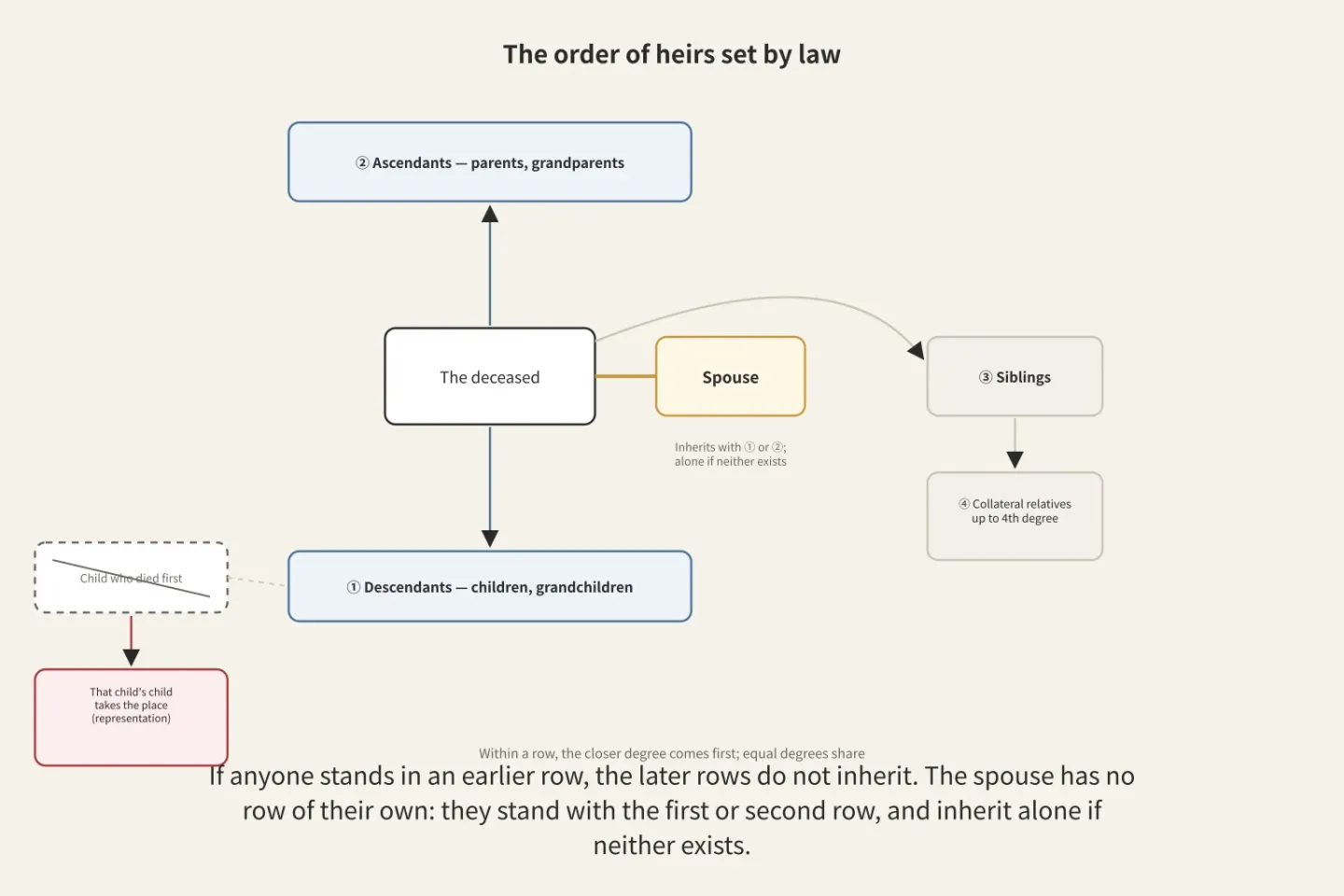
Figure: a diagram Paperis drew using only what the article says
The order table also has rules to fill empty seats. If Junho passed away before his father and Junho had a son, that son steps into Junho’s place. The rule is that grandchildren step in if it is a child's place, and the children step in if it is a sibling's place. Substitute succession is when a child or sibling who is to become an heir passes away first or cannot become an heir due to reasons prescribed by law, and that person's child takes over that place to inherit. Article 1001 of the Civil Act records that case as "when [they] die before the commencement of inheritance or cannot become an heir pursuant to Article 1004 or Article 1004-2" (Civil Act, Article 1001), and the spouse of the person who departed first also becomes a co-heir with those children on the same rank (Civil Act, Article 1003, Paragraph 2).
How Many Shares Are Divided — Statutory Inheritance Shares
Let us suppose that nothing came out of Sujin's drawer. A will is an intention left in a manner prescribed by law so that it takes effect after a person dies. If there is no will, the proportions predetermined by the law are used. The statutory inheritance share is the proportion of the share that each heir is to receive, as determined by the law when there is no will.
If there are multiple heirs of the same rank, the shares are divided "equally," that is, in equal parts (Civil Act Article 1009, Paragraph 1). When a spouse inherits together with lineal descendants, "50 percent is added" to the lineal descendants' share, and when inheriting together with lineal ascendants, 50 percent is also added to the lineal ascendants' share (Civil Act Article 1009, Paragraph 2).
Applied to Sujin's family, the proportions are 1.5 for the mother, 1 for Sujin, and 1 for Junho. Since the sum is 3.5, the mother gets three-sevenths, and the two children get two-sevenths each. If there are 700 million won with no debts and no gifts during life, the mother receives 300 million won, and Sujin and Junho receive 200 million won each.
This proportion is the default calculation used when the person who departed left no separate intention. The departed person could give away property during life or pass it on through a will, and the devices that partially limit that freedom will be seen later (Constitutional Court 2020Hun-Ga4). Property given in advance to one child while alive is treated as that child having received an inheritance share in advance and is factored into the calculation (Civil Act Article 1008; Constitutional Court 2020Hun-Ga4). A path for the heirs to divide among themselves is also open, so barring exceptions set by the provisions, "co-heirs may divide the inherited property at any time by agreement" (Civil Act Article 1013, Paragraph 1). The statutory inheritance share is the starting point, and the agreement of the heirs, lifetime gifts, wills, and the share for caregiving change that calculation.
A Bundle That Includes Debt
Let us change the perspective now. Suppose a father had debts from running a business, and those debts were larger than his apartment and savings deposits. Because the bundle is handed over all at once, leaving it as it is means those debts also pass to the family.
The Civil Act gives heirs three paths. An heir “may make an unconditional acceptance, a qualified acceptance, or a renunciation within 3 months from the day they become aware that the inheritance has commenced” (Article 1019, Paragraph 1 of the Civil Act). Unconditional acceptance means inheriting property and debt together just as they are.
Qualified acceptance means accepting the inheritance on the condition that you will pay the departed person's debts only within the limit of the property inherited. The provision states that an inheritance may be accepted on the condition that the debts, etc., of the decedent are paid “within the limit of the property acquired through the inheritance” (Article 1028 of the Civil Act). If the property is 700 million won and the debt is 1 billion won, the responsibility to pay the debt is borne within the 700 million won inherited.
Renunciation is registering with the family court that you will inherit neither property nor debt. The Civil Act prescribes that renunciation must be reported to the family court within the same 3 months (Article 1041 of the Civil Act).
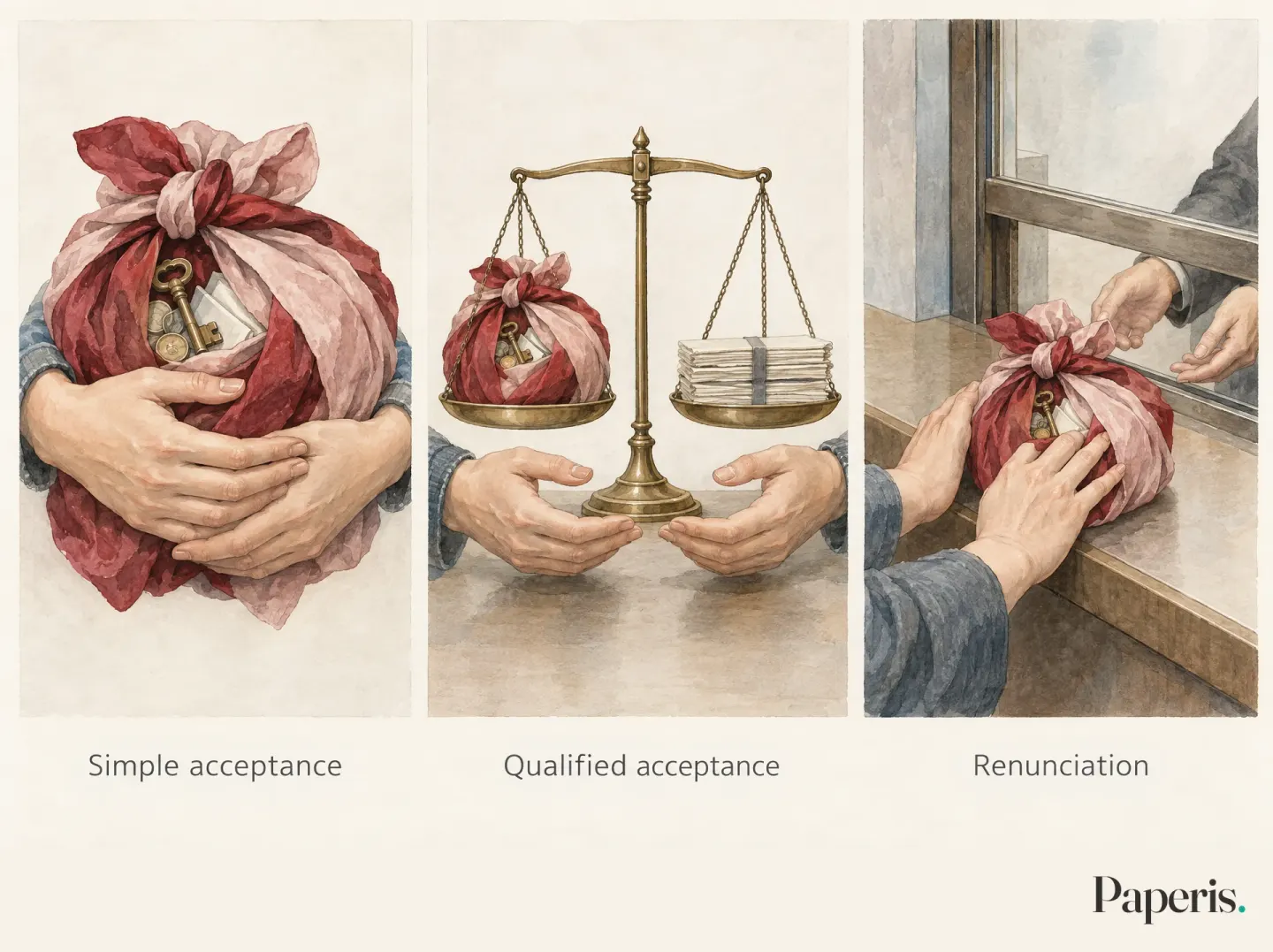
Illustration: Paperis
The starting point for counting the 3 months is the “day they became aware” that the inheritance has started. The family court may extend this period upon the request of an interested party or a prosecutor, and the heir may investigate the inherited property before choosing (Article 1019, Paragraphs 1 and 2 of the Civil Act). If the period passes without choosing anything, it is deemed that unconditional acceptance has been made (Article 1026, Item 2 of the Civil Act). The same applies when the inherited property is disposed of, or when after making a qualified acceptance or renunciation, the inherited property is concealed, used recklessly, or purposely omitted from the property list (Article 1026, Items 1 and 3 of the Civil Act).
For someone who learns of the debt late, there is one more path. An heir who made an unconditional acceptance without gross negligence within 3 months of not knowing the fact that debts exceeded property (including cases deemed to be unconditional acceptance due to disposition or the lapse of time) may make a qualified acceptance within 3 months from the day they became aware of that fact (Article 1019, Paragraph 3 of the Civil Act). In cases where a minor heir makes an unconditional acceptance of an inheritance with heavier debts before becoming an adult, they may make a qualified acceptance within 3 months from the day they become aware of that fact after reaching adulthood (Article 1019, Paragraph 4 of the Civil Act).
Renunciation is also the act of passing the bundle on to the next person. “The renunciation of inheritance shall be retroactively effective as of the time the inheritance commenced” (Article 1042 of the Civil Act). When there are multiple heirs and one person renounces, that share goes to the other heirs in proportion to their inheritance shares (Article 1043 of the Civil Act).
If a spouse and children are co-heirs and all the children renounce, who receives it? The Supreme Court held in 2023 that in this case, “it is reasonable to view the spouse as the sole heir”, changing previous case law which held that a spouse inherited together with grandchildren or lineal ascendants. The majority opinion is the opinion forming the ruling and its reasoning, shared by the greater number of judges among those who participated in the trial. The majority opinion viewed that the share of the children who renounced goes to the spouse, who is the remaining “other heir” pursuant to Article 1043, and stated that it cannot be seen as having been the intent of the children who renounced to avoid debt to pass that debt on to their own children.
A dissenting opinion is an opinion where a judge who does not agree with the conclusion of the judgment writes down and leaves why their own thought is different. Supreme Court Justices Lee Dong-won and Noh Tae-ak's dissenting opinion stated that because of the retroactive effect of renunciation, the children are treated as not having been heirs from the beginning, meaning the spouse becomes an heir together with the grandchildren, and that the previous case law should be maintained. A concurring opinion is an opinion that joins the conclusion while adding to the reasoning, and this decision also includes the concurring opinion of Supreme Court Justice Min You-sik supplementing the majority opinion (Supreme Court 2020Geu42).
There are ways to receive the debt-laden bundle without taking it or by taking responsibility only for the amount contained, and those paths come with a deadline.
How to Repack Your Bundle — Wills
We return to our starting story. There were no debts, and a single sheet of paper written by hand was found in the father's drawer. The content states that both the apartment and the savings are given to Sujin, who cared for him for 8 years, and the date, address, and name are written in handwriting with a personal seal stamped on it.
The law prescribes the methods for a will. "A will shall not take effect unless it is made in accordance with the methods prescribed by this Act" (Civil Act Article 1060). There are five methods: handwritten document, audio recording, notarial document, sealed document, and oral statement (Civil Act Article 1065). This strictness is intended to confirm that the will truly reflects the person's intent, prevent disputes, and ensure the testator thinks deeply before making a will (DOI: 10.15539/KHLJ.60.3.1).
A handwritten will is a will in which the testator writes the entire content, date, address, and name in their own hand and stamps it with their personal seal. The legal provision states that the testator must "write the full text, year, month, day, address, and name in their own hand and affix their seal," and requires that even when inserting, deleting, or modifying characters, it must be written by hand and sealed (Civil Act Article 1066). There is criticism that quite a few cases fail to take effect—even if it is genuinely the person's intent—if a single requirement is missing (DOI: 10.17926/kaolp.2020.20.4.561). At the same time, it is noted that the courts have gradually relaxed the requirements, such as recognizing thumbprints instead of seals or addresses written on envelopes (DOI: 10.17926/kaolp.2020.20.4.561).
Let us assume that Sujin's note met the requirements for a handwritten will. Then the father would have transferred his property to Sujin through a will. A testamentary gift is the act of leaving property to another person without compensation through a will. Does everything go according to the note, then? Here is where the share that must be left in the bundle comes in.
The Share That Must Be Left Behind Even When Repacking — The Forced Share
According to the sticky note, mother and Junho receive nothing. The forced share is the portion that the law guarantees will go to designated close family members, even if the person who passed away handed over their property through a will or a gift during their lifetime. Under the current article, that share is one-half of the statutory inheritance share for lineal descendants and the spouse, and one-third for lineal ascendants (Civil Act Article 1112).
The standard for calculation is the amount obtained by taking the property the deceased person had at the time of death, adding the gifted property, and subtracting all debts (Civil Act Article 1113 Paragraph 1). As a rule, gifts to be added are those made during the 1 year before death, but gifts made even earlier than that—when both the giver and receiver knew it would cause harm to those entitled to the forced share—are also included (Civil Act Article 1114). Gifts deemed as a co-heir receiving their inheritance share in advance are included regardless of when they occurred (Constitutional Court 2020Hun-Ga4). Since Sujin's family had neither gifts nor debts, the standard amount is 700 million won. Junho's statutory inheritance share was 200 million won, so his forced share is half of that, 100 million won, and mother's forced share is half of 300 million won, which is 150 million won.
A person who has received less can demand that the person who received the gift or legacy pay the value of that property "within the limit of the shortfall" (Civil Act Article 1115 Paragraph 1). If Junho makes a claim, the other party is Sujin, and the scope is up to 100 million won. There is a time limit for the claim, and it is extinguished by prescription if 1 year passes from the time one learns that the inheritance has begun and that there was a gift or legacy to be recovered, or if 10 years pass from the time the inheritance began (Civil Act Article 1117). Gifts or legacies that infringe upon the forced share do not become void because of that, and the structure is designed to allow a claim only for the amount of the shortfall (Constitutional Court 2020Hun-Ga4). A will allows a bundle to be repacked, but family members can demand the return of at least the forced share even from the repacked bundle.
The Constitutional Court, which determines whether the law conforms to the Constitution, summarized what this system seeks to protect as "the protection of the right to survival of surviving family members from the property disposal acts of the decedent, the guarantee of contribution to the formation of inherited property and expectations regarding the inherited property, and the prevention of the ultimate severance of the family system" (Constitutional Court 2020Hun-Ga4). The cost is borne by the side that received the gift or legacy. Sujin receiving the claim and Junho making the claim are the positions established by this system.
There is also something that the bundle metaphor misses. The forced share is closer to a right to demand from the person who received the property as much as is lacking after everything has been divided, rather than a name tag attached in advance to a specific item inside the bundle.
The Caregiver's Share — The Contribution Portion
Will Sujin's 8 years of caring for her father be counted in the calculation? The contribution portion is an extra share granted to an heir who specially supported the deceased, or who specially contributed to maintaining or increasing the property. Article 1008-2 of the Civil Act recognizes the contribution portion for a co-heir—meaning someone who has become an heir together with others—who has “specially supported the decedent through cohabitation, nursing, or other means for a substantial period” or specially contributed to the maintenance or increase of the property, and provides that this share shall be determined through consultation among the heirs, or by the Family Court upon the request of the contributor if no consultation is reached or if consultation is impossible (Civil Act Article 1008-2 Paragraphs 1 and 2).
Where disputes arise is over the word “specially”. In a 2019 case where a spouse had lived with and nursed the decedent for a long time, the Supreme Court stated that the contribution portion must be determined by weighing various circumstances, such as whether that nursing went beyond “the fulfillment of the primary duty of support between spouses to reach 'special support'”, who covered the nursing expenses, the size of the inherited property, and the number of other heirs. While living together and nursing alone does not automatically qualify one for a contribution portion, it was viewed as a factor to be actively considered. In a dissenting opinion, Supreme Court Justice Cho Hee-dae stated that if a spouse lived together and nursed for a substantial period, that constitutes special support, so “a contribution portion should be recognized for the spouse barring special circumstances” (Supreme Court 2014Seu44).
However, even after the contribution portion system was introduced in 1990, the forced share provision created in 1977 did not incorporate the contribution portion provision, leaving the two disconnected (Constitutional Court 2020Heon-Ga 4). An example found in the ruling text is as follows: if the decedent gifted their residence to their spouse as a reward for support and no other property remained at the time of death, the children could claim the return of their forced share regarding that residence, and the spouse would bear the obligation to return the entire shortfall (Constitutional Court 2020Heon-Ga 4). This passage leads directly to the decision in the next section.
To the current Article 1008, a proviso not found in the template printed in the ruling has been attached: the sentence stating that when a pre-received gift or testamentary gift “has been made as compensation for special support or a special contribution to the property, it shall not be so within the scope corresponding to the contribution” (Civil Act Article 1008; Constitutional Court 2020Heon-Ga 4). This means that a share received as compensation for special support or contribution is not counted as having received an inheritance portion in advance, to the extent that it matches the contribution. Whether a testamentary gift citing care—like Sujin's note—falls under this proviso is decided at the exact same point where “specially” is scrutinized.
What the Constitutional Court Divided on April 25, 2024
Multiple courts handling forced heirship lawsuits asked during their trials whether the forced heirship provisions aligned with the Constitution, and parties to forced heirship lawsuits also filed constitutional complaints. A case where an unmarried person who passed away left their property to public-interest corporations and their siblings claimed a forced heirship, and a case where the child of a person who left their property to a scholarship foundation made a claim, were bundled together (Constitutional Court 2020Hun-Ga4). The Constitutional Court is an institution that determines whether laws conform to the Constitution and settles disputes surrounding the Constitution. The ruling issued on April 25, 2024, has four dispositions.
- The referral for the 2020Hun-Ga4 case was dismissed. A dismissal is a decision that ends a case without examining its merits, based on the view that the claim is inadmissible because it fails to meet the conditions to receive a review. This is because the plaintiff in that case withdrew the lawsuit, ending the trial (Constitutional Court 2020Hun-Ga4).
- Article 1112, Subparagraph 4 of the Civil Act, which sets the forced heirship for siblings, was ruled to be "in violation of the Constitution" (Constitutional Court 2020Hun-Ga4).
- Article 1112, Subparagraphs 1 through 3 and Article 1118 were ruled to be "all inconsistent with the Constitution," and it was ordered that they continue to apply until the legislature amends them with a deadline of December 31, 2025 (Constitutional Court 2020Hun-Ga4).
- Articles 1113, 1114, 1115, and 1116 were ruled to be "all not in violation of the Constitution" (Constitutional Court 2020Hun-Ga4).
First is the system itself. The Constitutional Court viewed that the purpose of forced heirship examined earlier "can still be accepted," and stated that the law uniformly setting who receives a forced heirship and at what proportion "is hard to conclude as extremely unreasonable" (Constitutional Court 2020Hun-Ga4).
What was deemed unconstitutional is the siblings' share. The Court stated that for siblings, "even though contributions to the formation of the inheritance property or expectations regarding the inheritance property are hardly recognized," restricting the intent of the decedent to grant a forced heirship is difficult to find a justifiable reason for (Constitutional Court 2020Hun-Ga4). Simple unconstitutionality is a decision declaring that a legal provision runs counter to the Constitution and immediately strips it of its effect. Subparagraph 4 received that decision.
What was deemed inconsistent with the Constitution are two things. One is that Subparagraphs 1 through 3 do not have separate grounds for losing a forced heirship. Even if it does not fall under existing grounds for losing inheritance eligibility, acknowledging a forced heirship for an heir who repeatedly commits acts such as abandoning or abusing the decedent over a long period runs counter to the general public's legal sentiment and common sense. The other is that Article 1118 does not carry over the contribution share provision to forced heirship, creating an unfair situation where even gifts received as compensation for contributions must be returned (Constitutional Court 2020Hun-Ga4).
Constitutional incompatibility is a decision stating that a law runs counter to the Constitution while not abolishing its effect right away, but rather keeping it in use for a while until the National Assembly amends it. The reason was that if these provisions were abolished immediately, confusion could arise because "the remaining provisions alone would make it impossible to properly implement the forced heirship system." The legislature has a duty to enact improved legislation as soon as possible, and if there is no improved legislation by December 31, 2025, these provisions will lose their effect starting the following day (Constitutional Court 2020Hun-Ga4).
Reasons were also attached to the provisions left as constitutional. Article 1113, which factors gifted property into the calculation, prevents people from avoiding forced heirship through dispositions during their lifetime, and the first part of Article 1114, which narrows the scope to gifts made within 1 year before inheritance starts, protects people who received gifts in good faith and the safety of transactions. The latter part of Article 1114—which adds gifts from more than 1 year prior if both the giver and receiver acted with the knowledge that it would cause harm to the person entitled to forced heirship—was also seen as not unreasonable. Although Article 1118 as a whole received a ruling of constitutional incompatibility in the disposition, the reasoning judged that looking separately only at the part within it under Article 1008—which requires gifts treated as a co-heir receiving their inheritance share in advance to be included regardless of timing—cannot be seen as unreasonable. Gifts made with the knowledge that they would cause harm "no longer need to be protected," so the person entitled to forced heirship was strongly protected, and valuing the gifted property at the price when inheritance starts was not unfair in the sense that "there is no guarantee that the value will necessarily increase" (Constitutional Court 2020Hun-Ga4).
Opinions were split on this final passage. Among the 9 justices participating in the decision, 4 justices—Lee Young-jin, Kim Ki-young, Moon Hyung-bae, and Kim Hyung-du—issued a dissenting opinion stating that these two parts are also in violation of the Constitution. They wrote that since the value of gifted property is in principle assessed based on the time when inheritance starts, the recipient may have to return a much larger amount than at the time of the gift, and "the practical effects of gifts validly made by the decedent decades ago are denied, greatly threatening legal stability." They also believed that the Court should declare constitutional incompatibility rather than immediately abolishing the effect (Constitutional Court 2020Hun-Ga4).
A separate opinion is an opinion that agrees with the conclusion while stating different reasons for it. Two justices, Lee Young-jin and Kim Hyung-du, issued a separate opinion stating that Article 1112 setting the forced heirship for spouses and lineal descendants identically is also in violation of the Constitution (Constitutional Court 2020Hun-Ga4). The two justices added a supplementary opinion that Article 1113 Paragraph 1—which factors in even public-interest gifts or gifts for family business succession—and Article 1115 Paragraph 1—which requires return in the original form—are also constitutional, but legislative improvement is desirable (Constitutional Court 2020Hun-Ga4).
Following the decision, differing views clashed in academia over how to amend Article 1118, with one paper criticizing both views and proposing an amendment that connects forced heirship and contribution shares more broadly (DOI: 10.31998/KSFL.2025.39.1.193). Another paper criticized the constitutional rationale for the contribution share portion as unconvincing, yet viewed that amendment of the Civil Act is unavoidable because the decision of constitutional incompatibility is binding (DOI: 10.31998/KSFL.2024.38.3.637).
What Is Visible in the Provisions Now
If you open the current Civil Act Article 1112, only the word "Deleted" remains in the spot for item 4 (Civil Act Article 1112). Article 1115, Paragraph 1 is also different from the 1977 provision that the decision judged. Back then, the provision said, "You can claim the return of that property within the deficient limit" (Constitutional Court 2020Hun-Ga4), but the current provision says, "You can claim the payment of the value of that property within the deficient limit," and adds, "Interest is added from the day the payment of the value was claimed" (Civil Act Article 1115, Paragraph 1).
Article 1118 still writes, "The provisions of Article 1001, Article 1008, and Article 1010 apply mutatis mutandis to the legal reserve" (Civil Act Article 1118). Article 1008-2, which is the contribution share provision, is not in this list, and the proviso we saw in the previous section is attached to Article 1008, which is on the list. How the grounds for losing the legal reserve were determined after the decision is not covered in this article.
An article dealing with the change in Article 1115 through the 2026 Civil Act revision explains that the principle of returning the original thing changed to the principle of returning its value. The same article criticizes that because it was unified into returning the value without a buffer, the burden of delayed interest and the like became excessive for the person obligated to make the return who has property but lacks cash (KCI ART003374966).
Where to Look Next
- “What the Constitutional Court Does — Five Windows and Six Votes” — The procedures and voting counts by which unconstitutionality and non-conformity to the Constitution are reached.
- “How to Read a Court Judgment — A One-Line Answer and Its Reasons” — How to read and separate the ordering part, the reasoning, and dissenting opinions.
- “Basic Rights and Their Limits — A Scale Without Markings” — The scale used in this decision to measure limits on property rights.
- Another part of this series, “Contracts — A Knot Tied by Two Hands” — Where the debt left behind by someone who departed first originated, along with contracts and their responsibilities.
Source Papers
- "Civil Act Article 997 (Cause of Commencement of Inheritance)" (Current) — Original statute text — Inheritance commences upon death.
- "Civil Act Article 1000 (Order of Inheritance)" (Current) — Original statute text — Descendants, ascendants, siblings, and collateral blood relatives within the fourth degree in order; closest degree takes priority, equal degrees share jointly; fetuses are deemed born.
- "Civil Act Article 1003 (Spouse's Order of Inheritance)" (Current) — Original statute text — A spouse inherits jointly with descendants or ascendants in the same order, or solely if none exist. In case of substituted inheritance, the spouse of the person who passed away first is the same.
- "Civil Act Article 1005 (Inheritance and Succession of Comprehensive Rights and Duties)" (Current) — Original statute text — Comprehensive rights and duties are succeeded from the moment inheritance commences, excluding those strictly personal to the decedent.
- "Civil Act Article 1009 (Statutory Shares of Inheritance)" (Current) — Original statute text — Equal shares for those in the same order; a spouse's share is increased by 50 percent over the share of descendants or ascendants.
- "Civil Act Article 1019 (Period for Acceptance or Renunciation)" (Current) — Original statute text — Simple acceptance, qualified acceptance, or renunciation within 3 months from the date one becomes aware; period extension, asset investigation, and qualified acceptance for late-discovered debt overhangs and minors.
- "Civil Act Article 1028 (Effect of Qualified Acceptance)" (Current) — Original statute text — Acceptance on the condition of satisfying debts and legacy gifts up to the limit of the property acquired through inheritance.
- "Civil Act Article 1041 (Method of Renunciation)" (Current) — Original statute text — Declaration of renunciation to the family court within the period of Article 1019, Paragraph 1.
- "Civil Act Article 1060 (Formalities of Wills)" (Current) — Original statute text — A will has no legal effect unless made in a manner prescribed by law.
- "Civil Act Article 1065 (Ordinary Methods of Wills)" (Current) — Original statute text — Five types: handwritten documents, audio recordings, notarized documents, secret documents, and oral statements.
- "Civil Act Article 1066 (Wills by Handwritten Document)" (Current) — Original statute text — Handwritten text, date, address, and name with a personal seal affixed; corrections also require handwriting and seal.
- "Civil Act Article 1112 (Persons Entitled to Legitimate Portions and Legitimate Portions)" (Current) — Original statute text — One-half of the statutory inheritance share for descendants and a spouse, one-third for ascendants, item 4 deleted.
- "Civil Act Article 1113 (Calculation of Legitimate Portions)" (Current) — Original statute text — Gifted property is added to the property at the commencement of inheritance, and total debts are subtracted.
- "Civil Act Article 1115 (Preservation of Legitimate Portions)" (Current) — Original statute text — Claim for payment of value up to the deficient limit, with interest added from the date of the claim.
- "Civil Act Article 768 (Definition of Blood Relatives)" (Current) — Original statute text — Collateral blood relatives are siblings and their descendants, and siblings of ascendants and their descendants.
- "Civil Act Article 1001 (Substituted Inheritance)" (Current) — Original statute text — When a descendant or sibling who would become an heir dies before the commencement of inheritance or cannot become an heir pursuant to Article 1004 or Article 1004-2, their descendants take their place.
- "Civil Act Article 1008 (Inheritance Share of Persons Who Received Special Benefits)" (Current) — Original statute text — Co-heirs who received gifts or legacy gifts take their inheritance share within the limit of the deficiency, except that gifts or legacy gifts given as compensation for special support or contribution are excluded within the scope corresponding to the contribution.
- "Civil Act Article 1008-2 (Contribution Share)" (Current) — Original statute text — Contribution share for co-heirs who provided special support or contribution, determined by agreement or family court decision.
- "Civil Act Article 1013 (Division by Agreement)" (Current) — Original statute text Co-heirs may divide the inherited property by agreement at any time.
- "Civil Act Article 1026 (Statutory Simple Acceptance)" (Current) — Original statute text — Disposition acts, failure to make a qualified acceptance or renunciation within the period, or subsequent concealment, fraudulent consumption, or omission from the inventory are deemed simple acceptance.
- "Civil Act Article 1042 (Retroactive Effect of Renunciation)" (Current) — Original statute text — Renunciation is retroactively effective as of the time inheritance commenced.
- "Civil Act Article 1043 (Attribution of Renounced Inherited Property)" (Current) — Original statute text — A renounced inheritance share is attributed to other heirs in proportion to their inheritance shares."
- "Civil Act Article 1114 (Gifts to be Included)" (Current) — Original statute text — Only gifts made within 1 year before the commencement of inheritance are included; gifts made 1 year prior with both parties knowing it would cause damage are also included.
- "Civil Act Article 1117 (Extinctive Prescription)" (Current) — Original statute text — 1 year from the time it becomes known, 10 years from the commencement of inheritance.
- "Civil Act Article 1118 (Mutatis Mutandis Application Provisions)" (Current) — Original statute text — Articles 1001, 1008, and 1010 apply mutatis mutandis to legitimate portions (Article 1008-2 is not on the list).
- "Objection to Grant of Execution with Successive Execution Clause" (2023) — Supreme Court 2020Geu42 — If all children renounce, the spouse inherits alone (change of prior precedent), 2 Supreme Court Justices' dissenting opinion, 1 concurring opinion.
- "Unjust Enrichment" (2024) — Supreme Court 2023Da318857 — The obligation to return lease security deposits of heirs who jointly succeeded to the status of a lessor is by nature an indivisible debt, and the heir who satisfies the debt seeks reimbursement according to statutory inheritance shares.
- "Division of Inherited Property / Division of Inherited Property" (2019) — Supreme Court 2014Seu44 — A spouse's long-term cohabitation and nursing determine whether special support exists by synthesizing all circumstances, 1 Supreme Court Justice's dissenting opinion (recognized unless there are special circumstances).
- "Constitutional Court Referral regarding Civil Act Article 1112 et al." (2024) — Constitutional Court 2020Heon-Ga 4 — Referral in 2020Heon-Ga 4 dismissed, Article 1112 Item 4 unconstitutional, Article 1112 Items 1 to 3 and Article 1118 constitutional nonconformity (continued application until the deadline of December 31, 2025), Articles 1113 through 1116 constitutional. Latter part of Article 1114 and part of Article 1118 concerning Article 1008 4 dissenting opinions, 2 separate and concurring opinions.
- "Legislative Theory on the Succession of Inheritance Debts" (2023) — DOI: 10.17007/klaj.2023.72.5.013 — Suggests turning inheritance debts into natural obligations, noting that unexpected debt burdens are common due to the principle of inheritance debt succession (the author explicitly states this is an independent argument with no legislative precedent).
- "A Review of the Scope of the Spouse as an Heir" (2008) — KCI ART001293930 — Proposes subdivision legislation, noting that the Civil Act requires only that a spouse-heir be a legally married spouse.
- "A Study on the Digitization of Will Methods - Implications from the Electronic Wills System under the Uniform Electronic Wills Act (UEWA) -" (2025) — DOI: 10.15539/KHLJ.60.3.1 — The strict formalities of the five methods are for securing authenticity, preventing disputes, and deliberate reflection (evidentiary, cautionary, and protective functions); review of introducing electronic wills.
- "A Study on Will Methods Following the Advent of the Digital Era - Focusing on Handwritten Wills Using Smart Devices -" (2020) — DOI: 10.17926/kaolp.2020.20.4.561 — Criticizes the excessive strictness of handwritten document wills; precedents have relaxed the requirements by recognizing thumbprints and envelope addresses.
- "Contribution Shares, Compensatory Gifts, and Legitimate Portions — Constitutional, Comparative Legal, and Legislative Considerations —" (2024) — DOI: 10.31998/KSFL.2024.38.3.637 — The constitutional rationale for the constitutional nonconformity of Article 1118 is unpersuasive, but revision is inevitable due to the binding force of the decision.
- "Amendment Plans Concerning the Relationship Between Legitimate Portions and Contribution Shares" (2025) — DOI: 10.31998/KSFL.2025.39.1.193 — Following the constitutional nonconformity of Article 1118 in 2020Heon-Ga 4, views clashed between excluding compensatory gifts from the base assets and deducting contribution shares; the author criticizes both and proposes broad-ranging connected legislation.
- "Revisiting the Legal Nature of the Right to Claim Legitimate Portion Return and Methods of Legitimate Portion Return — Prompted by the 2026 Civil Act Amendment —" (2026) — KCI ART003374966 — Amended Article 1115, Paragraph 1 shifted the principle from return in kind to return of value and added interest from the claim date, but leaving it unified without buffer mechanisms places an excessive burden on obligors of return who lack cash.
Sources (5)
- 상속채무의 승계에 관한 입법론DOI 10.17007/klaj.2023.72.5.013
- 유언방식의 디지털화에 대한 소고 - 미국통일전자유언법(UEWA)상 전자유언 제도로부터의 시사점DOI 10.15539/khlj.60.3.1
- 디지털 시대의 도래에 따른 유언방식에 대한 소고- 스마트 기기를 이용한 자필유언을 중심으로DOI 10.17926/kaolp.2020.20.4.561
- 기여분, 보상적 증여, 유류분 ― 헌법적, 비교법적 및 입법론적 고찰 ―DOI 10.31998/ksfl.2024.38.3.637
- 유류분과 기여분의 관계에 관한 개정 방안DOI 10.31998/ksfl.2025.39.1.193