
Paperis Articles
Renting a Home — The Fences Around a Tenant, and Their Gaps
Korean law tries to protect a renter's deposit and time in the home through opposability, a fixed date with the right of preferential repayment, top-priority repayment, the right to request renewal and the lease registration order. Each fence stands only under its own conditions and from its own date, and gaps open in front of a mortgage registered earlier or a fall in house prices.
Your field's papers, as audio
Pick your fields and journals — Paperis summarizes the key papers and turns them into audio. Listen on your commute.
Start Paperis free →Renting a Home — The Fences Around a Tenant, and Their Gaps
The 200 Million Won Handed Over on Moving Day
Sujin decided to rent a small villa near her office for two years and handed the landlord 200 million won on moving day. It was money made up of her savings plus a bank loan. There was no monthly payment, and she was to get the full 200 million won back when she left the house two years later. This contract between Sujin and the landlord is a made-up scenario to help understanding.
As she unpacked her moving boxes, Sujin had two worries. One is whether this money will really come back two years later. The other is whether she can keep living in this house even if the landlord changes or circumstances shift.
The law builds several layers of fences around these two worries. Each fence has its own conditions and dates for standing guard, and who it blocks for is also fixed. There are gaps somewhere, too.
This article is written based on South Korean law in effect as of November 2026. It is a general explanation of what the system determines, and the outcome of an actual case depends on the contract terms and dates, and other rights tangled up with that house.
There Are Two Laws for Renting a Home
For a contract to rent a home, there is first a general rule called the Civil Act. The Civil Act defines this contract as follows (Civil Act Article 618). A lease is a contract that arises when one party promises to let the other party use an item and obtain benefits from it, and the other party promises to pay for that value. The party lending the home is called the lessor, and the party borrowing it is called the lessee. The lessor has the obligation to hand over the home and maintain it in a usable state while the contract continues (Civil Act Article 623).
Rent is the value paid for borrowing and using something, with monthly rent being its most representative form. In Korean home rentals, one more type of money changes hands. A deposit is money that the lessee entrusts to the lessor at the start of the contract and gets back when the contract ends and they vacate the home.
Jeonse is a lease method established in Korea where people live by entrusting only a large deposit without paying monthly rent, and then get that money back as is when the contract ends. The lessor can use the lump sum entrusted during that time without paying interest (DOI: 10.33097/JNCTA.2024.08.11.2420). Sujin's contract is a jeonse. Jeonse is sometimes explained as a unique lease system found only in our country (DOI: 10.22813/kssi.2023..118.242), and it has been known that way for a long time. Another study reveals that such contracts also exist in Bolivia and India. Bolivia's anticrético shares key characteristics with jeonse, such as having only a deposit and no monthly rent with a standard duration of two years, while differing in that it must be registered in the real estate registry and the deposit is at the level of 25 to 40% of the sale price. This study concludes that jeonse is not a system exclusive to our country (DOI: 10.15793/kspr.2015.85..003).
Deeming that the Civil Act alone is insufficient for a contract that entrusts such a large sum of money, a separate law was created. The Housing Lease Protection Act is a law created to stabilize the residential life of citizens by establishing special rules different from the Civil Act for contracts to rent a home where people live. It was enacted on March 5, 1981 (Constitutional Court 2020Hun-Ma1343), and Article 1 states this purpose directly (Housing Lease Protection Act Article 1).
There is an assessment that Korea's lease deposits are overwhelmingly higher than those in other countries, reaching 60 to 70% of housing prices (DOI: 10.22868/koland.2025.41.1.002). What this law aims to protect are broadly two things: the entrusted money and the time to live in that home.
The First Fence, Even When the Landlord Changes
Let us say that about a year after Sujin moves in, her landlord decides to sell this multi-family villa to someone else. The new landlord has never made a contract with Sujin.
The Housing Lease Protection Act provides that once a tenant receives the handover of a house and completes resident registration, that lease becomes effective against third parties starting from the following day, even without registration. Resident registration is considered completed at the time the transfer of residence is reported (Housing Lease Protection Act Article 3, Paragraph 1). The right to oppose is the power of a tenant who has received the handover of a house and completed resident registration to assert their lease even against a third party like a new landlord starting from the following day.

Illustration: Paperis
The person who bought the house is considered to have succeeded to the position of the lessor (Housing Lease Protection Act Article 3, Paragraph 4). Sujin can live out the remaining period even in front of the new landlord, and because the new landlord succeeds to the lessor's position, the obligation to return the security deposit is also considered to pass to the new landlord.
Two gaps are pointed out in this fence. One is the gap of a day. Because the right to oppose arises only on the day after receiving the handover of a house and completing resident registration, there is criticism that if a security right is established on the house on the same day, the tenant may be pushed to a later priority and result in failing to recover their deposit. Case law is introduced as citing the reasons for establishing this provision as follows: because delivery, resident registration, and the registry are different ledgers, it is difficult to distinguish the priority of rights created on the same day, and a registered rights holder might suffer unexpected harm (KCI ART002069847). While questions have continued to be raised about this "next-day provision" ever since its enactment, it is also pointed out that nothing has changed since the time of enactment (DOI: 10.35148/ilsire.2019..19.149).
The other is that the marker called resident registration is incomplete. This gap also imposes costs on the side buying the house. According to case law conveyed by a study, even if there is no resident registration of the tenant themselves, the right to oppose can arise and continue solely through the resident registration of a person assisting that possession, which points to the possibility that a person buying a house may suffer unexpected harm even though they could not know about that circumstance at all (KCI ART002817973).
The Second Fence, When the House Is Sold Off
This time, the situation is worse. The landlord failed to pay their debts, and this multi-family villa was sent to a foreclosure auction. The money from selling the house is divided among the people who hold rights to it, in order.
The law designates the agencies that grant a confirmed date (Housing Lease Protection Act Article 3-6 Paragraph 1). A confirmed date is the date stamped on a lease contract by a designated office authorized to grant confirmed dates, such as a neighborhood community service center, registry office, or court. The law gives a tenant—who has met the conditions for defensive power: taking over the house and registering their residence, plus obtaining a confirmed date on their contract—the right to be paid their deposit ahead of lower-ranking rights holders or other creditors out of the money raised from selling the house and its land in a foreclosure or public auction (Housing Lease Protection Act Article 3-2 Paragraph 2). The priority repayment right is the right to be paid your deposit out of the proceeds before lower-ranking rights holders or other creditors when a house is sold through a foreclosure or public auction.
The priority repayment right only outranks lower-ranking rights holders and other creditors; it cannot outrank a security right registered earlier. A tenant who completes move-in registration and gets a confirmed date after a bank has already registered a mortgage on the house will get paid from the remaining money after the higher-ranking rights holders receive their distributions first upon the house being successfully auctioned. If the remaining money falls short, you might not get your full deposit back. A study dealing with jeonse fraud damage points out that such victimized tenants virtually end up unable to get their deposits back (DOI: 10.30933/KPLLR.2024.107.49). The law also states that a tenant cannot receive this deposit unless they hand the house over to the buyer (Housing Lease Protection Act Article 3-2 Paragraph 3).
The fence metaphor reaches its limits here. A real fence blocks simply by standing there, but this fence only determines who gets paid first when the house is sold in a foreclosure or public auction; it does not create new money. As one of the main pathways through which financial instability spreads in the jeonse market, cases where house prices drop below the jeonse deposit are pointed out (DOI: 10.30592/KAFC_JFC.15.02.02). If the sale proceeds are insufficient, even if your place in line is ahead, your share may fall short.
A Small Inner Fence
For tenants with a small security deposit, there is one more fence. The law stipulates that a tenant has the right to receive a certain portion of their security deposit in priority to other collateral security holders (Article 8, Paragraph 1 of the Housing Lease Protection Act). The super-priority repayment is a system where a tenant within the scope prescribed by the Presidential Decree receives a certain portion of their security deposit ahead even of someone who registered collateral on the house first. Tenants protected in this way are commonly called small-deposit tenants, and this protection is explained as socio-policy protection (KCI ART002069847).
As a condition for this right, the law requires that the tenant take delivery of the house and complete resident registration before the registration of an application for an auction on the house (Article 8, Paragraph 1 of the Housing Lease Protection Act). Which tenants are eligible and how much is received first are determined by Presidential Decree through deliberation by the Housing Lease Committee, and that certain amount cannot exceed 1/2 of the housing value combining the house and land prices (Article 8, Paragraph 3 of the Housing Lease Protection Act). The threshold amount is determined by Presidential Decree and can change, so it is not written in this article.
The Fences of Time: Two Years and Contracts That Renew Themselves
What happens if Sujin writes a term of one year on her contract? The law provides that a lease where no term was set, or where the term was set at less than two years, is deemed to have a term of two years (Article 4, Paragraph 1 of the Housing Lease Protection Act). However, the tenant may argue that the term set at less than two years is valid (Article 4, Paragraph 1 of the Housing Lease Protection Act). The only party who can choose the short term is the tenant.
Even after the term ends, the lease relationship is deemed to continue until the tenant receives their security deposit back (Article 4, Paragraph 2 of the Housing Lease Protection Act). Until the deposit is returned, the legal basis for living in that house continues alongside it. The deposit to be returned is the remainder after subtracting overdue rent and other items (Supreme Court 2023da258672).
Tacit renewal is a system where, if neither the landlord nor the tenant notifies the other of their intention to terminate or change the conditions within a set period before the contract ends, the contract is deemed to have been renewed under the same conditions. The set period for the landlord is from 6 months to 2 months before the end, and for the tenant, it is up to 2 months before the end. The duration of a lease extended in this manner is deemed to be 2 years (Article 6, Paragraphs 1 and 2 of the Housing Lease Protection Act). However, this rule does not apply to tenants who have fallen behind on rent amounting to two periods' worth or who have significantly violated their duties as a tenant (Article 6, Paragraph 3 of the Housing Lease Protection Act). Even after being renewed in this way, the tenant may notify the landlord of termination at any time, and that termination takes effect 3 months after the day the landlord receives the notice (Article 6-2 of the Housing Lease Protection Act).
The Right to Live One More Time
As the two years come to a close, Su-jin has a way to live there for one more time. This is a safety net created when the law changed on July 31, 2020 (Constitutional Court 2020Hun-Ma1343). Article 6-3 is the provision that came in anew at that time. The right to demand contract renewal is a right that prevents the landlord from refusing, without justifiable grounds, when the tenant demands a renewal from 6 months to 2 months before the contract ends. The period during which this right can be used is the same as the period set for the landlord in a tacit renewal (Housing Lease Protection Act Article 6-3 Paragraph 1). The tenant can use this right only once, and the duration of the renewed lease is considered to be 2 years (Housing Lease Protection Act Article 6-3 Paragraph 2). If the initial contract is 2 years like Su-jin's, 2 years of renewal are added so that the lease ends 4 years after the initial contract started (DOI: 10.15756/dls.2023..81.209).
The cases where the landlord can refuse are also written down as nine items in the law. They include instances where the tenant has fallen behind on rent up to an amount equivalent to 2 months' rent, where the tenant has lent the home to someone else without the landlord's consent, where the tenant has broken the house on purpose or through major fault, where the landlord has provided substantial compensation by mutual agreement, and where the landlord or their lineal ascendants or descendants—such as parents or children—intend to actually live in that house (Housing Lease Protection Act Article 6-3 Paragraph 1). In a case where a person who bought the house made a sales contract and then the tenant demanded a renewal, after which the transfer of ownership registration was completed, the Supreme Court viewed the intent of this law as balancing the stability of the tenant's residential life and the protection of the landlord's property rights, judging that, barring special circumstances, a buyer who has taken over the landlord's position can also assert this ground within the set renewal refusal period if they intend to actually reside in that house (Supreme Court 2021Da266631). There is also critical commentary that finds this judgment difficult to accept, arguing that the right to refuse renewal does not pass to the transferee along with ownership (DOI: 10.36532/kulri.2023.108.125).
The renewed contract is regarded as having the same terms as before, but the rent and deposit can go up and down within the scope of Article 7 (Housing Lease Protection Act Article 6-3 Paragraph 3). The rent and deposit ceiling system is a mechanism that prevents a request to raise the rent or deposit from exceeding one-twentieth of the agreed amount. Along with this ceiling, the law stipulates that no request can be made to raise them within 1 year after a contract or an immediate previous increase. Local governments such as Special Cities, Metropolitan Cities, and Provinces can set different ceilings by ordinance within this scope (Housing Lease Protection Act Article 7). The places where the law has written down this ceiling are when a request is made to raise them while the contract is ongoing, and for contracts renewed through the right to demand contract renewal (Housing Lease Protection Act Article 7, Article 6-3 Paragraph 3). There are opinions that discussion is necessary on whether to place limits on increases for new contracts newly made with a new tenant after a contract ends (DOI: 10.17926/kaolp.2022.22.3.3).
The Supreme Court viewed that, unless there are grounds for the landlord to refuse renewal, the renewal takes effect at the time the tenant's demand reaches the landlord. The Supreme Court judged that even after a renewal, the tenant can notify termination at any time, and even if that notice arrives before the period of the renewed term begins, the termination takes effect 3 months after the notice (Supreme Court 2023Da258672). This is because the termination rules for tacit renewal apply mutatis mutandis to the termination of a renewed lease (Housing Lease Protection Act Article 6-3 Paragraph 4).
If a landlord refuses on the grounds that they will actually live there, yet rents the house to someone else within the period for which it would have been renewed without justifiable grounds, the landlord bears the responsibility to compensate for the damage suffered by the tenant (Housing Lease Protection Act Article 6-3 Paragraph 5). Unless agreed upon in advance, that amount is set as the largest amount among three calculations determined by law (Housing Lease Protection Act Article 6-3 Paragraph 6).
The Fence Goes to the Constitutional Court
Just as the new fence protects the tenant, it narrows the landlord’s yard. Homeowners and those who inherited that status filed a constitutional complaint with the Constitutional Court, arguing that these provisions violated their basic rights (Constitutional Court 2020Hun-Ma1343). The Constitutional Court is the body that decides whether laws conform to the Constitution and settles disputes surrounding the Constitution.
The landlords’ argument went like this. They claimed that when asked for a renewal, the landlord could not choose the tenant, the term, the deposit amount, or the range of the increase, which violated their freedom of contract. They said that even if a landlord refused because they intended to live there themselves, but later could not move in due to a foreign assignment or a long hospitalization, they would still hesitate to rent to someone else out of fear of damages. They also argued that a system where the law pre-determines the amount of damages so the tenant can claim them without proving causation departs from the general principles of civil law. They argued that placing no lower limit on the tenant’s request for a rent reduction while placing an upper limit only on the landlord’s request for an increase violated the principle of equality, and that applying the new provisions even to contracts concluded before the law took effect constituted retroactive legislation (Constitutional Court 2020Hun-Ma1343).
On February 28, 2024, the Constitutional Court ruled that the contract renewal request provision, the rent increase limit provision, the damages provision, and the addendum provision applying these rules to ongoing contracts at the time the law took effect did not violate the Constitution. This was the unanimous opinion of all nine justices, with no dissenting opinions (Constitutional Court 2020Hun-Ma1343).
The Court’s reasoning was as follows. It considered the provisions to have a legitimate purpose and appropriate means, as they lower the residential mobility rate of tenants and limit rent increases to pursue housing stability. It noted that the renewal request is limited in its duration and number of times, and that grounds for refusal exist. Regarding the increase cap, it noted that the cap does not directly control the rent and deposit amounts or block increases altogether, and that in light of the 2019 consumer price inflation rate and the rise in Jeonse prices in the Seoul metropolitan area from 2015 to 2019, one-twentieth is not excessively low. It stated that the "just cause" exempting a landlord from damages can be interpreted as unavoidable circumstances that the landlord could not have foreseen at the time of refusal and that left them no choice but to rent to someone else. It viewed the statutory determination of damages as a measure to prevent tenants from practically giving up on claims due to the burden of proof. It deemed the restrictions placed on landlords to be relatively short-lived and thus not excessively burdensome. It found the placement of a cap only on requests for increases to be reasonable, as the justification for controlling the lower limit of reduction requests is not strong. It stated that the addendum provision is "quasi-retroactive legislation" applied to ongoing relations rather than already concluded ones, and that it does not violate the principle of trust protection (Constitutional Court 2020Hun-Ma1343).
Academic evaluations are divided. Some criticisms argue that the revised law effectively strips landlords of their freedom of contract and thus violates the principle of private autonomy (DOI: 10.21717/ylr.31.2.4), and some evaluations assess that the law leans solely toward the tenant among two competing interests, violating proportionality and instead generating disputes (KCI ART002712026). There are even arguments to abolish both systems entirely (KCI ART002836147). On the other side, proposals suggest that four years is insufficient for housing stability and that renewal requests should be permitted up to three times (DOI: 10.15756/dls.2023..81.209), and even before the introduction, there were arguments that an upper limit on the increase rate should be actively adopted (KCI ART002292260).
There is one empirical observation. An analysis showed that when the contract renewal request right was used for Seoul apartments, the rate of increase in monthly rent and Jeonse prices was on average 12.29 percentage points lower than when it was not used. That effect was largest for Jeonse and varied across regions. The same study points out the potential that a fixed cap of one-twentieth—that is, 5%—will distort the market in the mid-to-long term, and suggests that because effects vary by region and contract type, uniform application of the system has limits, making a differentiated design necessary (DOI: 10.24957/hsr.2025.33.2.133). Looking at cases filed for mediation at the mediation committee, an analysis suggests that after the contract renewal request right was created, related disputes increased significantly and the stages that disputes pass through also increased (DOI: 10.22423/KREUS.2022.14.2.47).
When the Deposit Does Not Return
Two years pass and Sujin needs to move near her new workplace, but the landlord says they cannot return the deposit right away. If she moves her resident registration when moving, she loses the condition for the right to oppose. There is a system created because of this dilemma (KCI ART002411899).
The law provides one path for such a tenant (Housing Lease Protection Act Article 3-3, Paragraph 1). An order for the registration of a leasehold right is a procedure where a tenant who has finished their lease but has not received their deposit back applies to the court to have their leasehold right registered. Once the registration is complete, they obtain the right to oppose and the right to priority repayment, and if they already obtained them before, they are maintained as they are, and even if they leave the house afterward and lose the requirements for opposition, they do not lose the rights they have already obtained (Housing Lease Protection Act Article 3-3, Paragraph 5).
This system was introduced through the amendment of Act No. 5641 on January 21, 1999, after experiencing the damages suffered by tenants who could not get their deposits back during the foreign exchange crisis (KCI ART001777391). There are also gaps. A 2018 study pointed out that it takes at least 1 to 3 weeks or more until the leasehold registration is completed, and even if using the jeonse deposit return guarantee where a guarantee institution pays the deposit on behalf, the deposit can only be received after the registration is completed (KCI ART002411899). Also, a tenant who subsequently rents a house registered in this way does not have the right to receive preferential repayment (Housing Lease Protection Act Article 3-3, Paragraph 6).
The Gaps Exposed by Jeonse Fraud
There is a time when Sujin's first worry became a reality for many people. Since 2022, incidents of failing to get jeonse deposits back and guarantee accidents have emerged as major social problems (DOI: 10.38100/jhuf.2026.11.2.37). The failures to recover deposits involve both fraud and market shocks. A study analyzing monthly data from 2010 to June 2024 showed that interest rate shocks clearly increase the non-return of deposits (DOI: 10.30592/KAFC_JFC.15.02.02). When the real estate market falls or enters a stagnation period, landlords who bought houses with deposits or invested using loans face the risk of being unable to return the deposits (KCI ART003166973).
Jeonse fraud is understood as an act where people related to jeonse contracts, such as landlords, builders, or brokers, deceive tenants and embezzle jeonse deposits (KCI ART002994592). The gaps pointed out by the evidence converge on several points. Tenants find it difficult to know the property's rights relationship, collateral level, and the landlord's financial status, and deposit returns rely excessively on the landlord's financial soundness (DOI: 10.63834/pr.2026.14.70). There have been many cases where tenants who rented houses owned by trust companies were not recognized for opposing power and priority repayment rights due to the trust structure, and the limitations of the fixed-date-centered protection system are pointed out as one of the causes (DOI: 10.38100/jhuf.2026.11.3.41). There is also criticism that the government's massive expansion of jeonse loans and jeonse deposit return guarantees consequently fueled jeonse fraud (DOI: 10.22813/kssi.2023..118.242).
Things have also changed. The government measures on February 2, 2023, proposed lowering the jeonse deposit-to-price ratio subject to return guarantees—in other words, the ratio of the deposit to the house price—from 100% to 90%, and there are assessments that this method of lowering the jeonse deposit-to-price ratio needs to be reconsidered (KCI ART002978711). Current law obligates landlords, when concluding a lease contract, to present information on the fixed date assignment date, rent, and deposits of the house along with a tax payment certificate to the tenant, and allows this to be substituted if the landlord agrees to the information viewing before the contract (Housing Lease Protection Act Article 3-7). A person who intends to conclude a contract may also request that information from the fixed date assigning agency with the landlord's consent (Housing Lease Protection Act Article 3-6 Paragraph 4). Such improvements, which made it possible to know the scale of prior-ranking deposits or the landlord's tax arrears information, are evaluated as still insufficient (DOI: 10.24957/hsr.2024.32.4.29).
There is also a special law that supports tenants damaged by jeonse fraud by granting them special exceptions regarding auction and public sale procedures and tax collection, thereby seeking housing stability (Special Act on Support for Jeonse Fraud Victims and Housing Stability Article 1). In this law, a jeonse fraud victim is a tenant who meets all the requirements set by the law, deliberated and resolved by the Jeonse Fraud Victim Support Committee, and determined by the Minister of Land, Infrastructure and Transport (Special Act on Support for Jeonse Fraud Victims and Housing Stability Article 2). However, there are evaluations that the requirements for victim recognition are excessively strict, leaving many tenants unprotected (DOI: 10.30833/LTPR.2025.11.13.4.283).
How much further to change is under debate. A proposal to make registration mandatory (DOI: 10.24957/hsr.2024.32.4.29) and a proposal to "activate" registration instead of making it mandatory (DOI: 10.17208/jkpa.2026.10.61.5.209) are at odds.
Tracing Sujin's Two Years Again
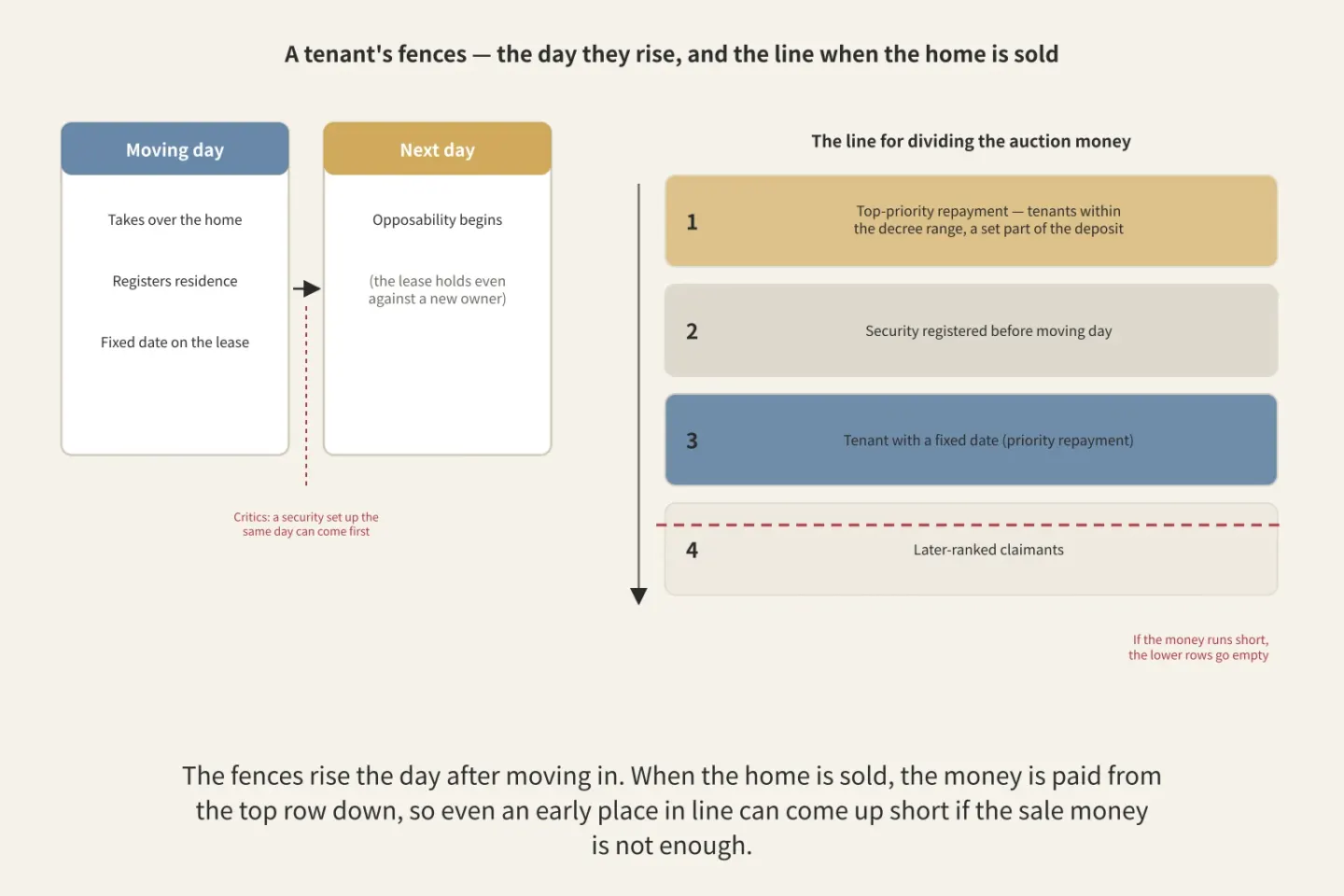
Figure: a diagram Paperis drew using only what the article says
On moving day, Sujin took over the house, filed her move-in report, and received a fixed date on her lease contract. The right to assert her lease against third parties takes effect starting the following day. When the landlord changes, the new landlord steps into the shoes of the previous lessor.
When a house goes to auction, Sujin receives her money from the proceeds of the sale before creditors with a lower priority than her. There is criticism that if there was a mortgage registered before her moving date, that mortgage takes precedence, and because her opposing power only arises the following day, she can even be pushed behind a mortgage established on the very same day as her moving date (KCI ART002069847). If the auction proceeds are insufficient, even if her order is ahead, her share may fall short. Whether Sujin is the target of super-priority repayment depends on the criteria of a Presidential Decree, and this article does not judge that.
Around the end of the two years, Sujin has one opportunity to request a renewal, and the landlord has the refusal reasons specified by the law. If the deposit is not returned even after the lease ends, Sujin can move out while maintaining her priority repayment rights and defense against third parties after completing lease registration (“Contracts — A Knot Tied by Two Hands”).
Where to Look Further
One open question is how much to narrow the landlord's yard and how much to raise the tenant's fence. The Constitutional Court has ruled the current height constitutional, while scholars are divided between those who want to raise it higher and those who want to tear it down.
- What the Constitutional Court Does — Five Windows and Six Votes — The window called a constitutional complaint through which the decision in this article came.
- Basic Rights and Their Limits — A Scale Without Markings — The scale weighing freedom of contract, property rights, and housing stability.
- How Is a Civil Case Different from a Criminal One? — One Incident, Two Courtrooms — The courtrooms where a dispute over returning a deposit and a trial punishing fraud go.
- Contracts — A Knot Tied by Two Hands, another piece in this series — When a contract is formed, the rules for canceling a contract with a down payment, and damages when a promise is broken.
Source Papers
- "Housing Lease Protection Act Article 1 (Purpose)" (current) — Statutory text — Guaranteeing the stability of citizens' housing life by establishing special exceptions to the Civil Act for residential building leases.
- "Housing Lease Protection Act Article 3 (Effect of Opposition, etc.)" (current) — Statutory text — Validity against third parties starting the day after handing over the property and completing resident registration (①), and the successor to the lessor's status assuming that position (④).
- "Housing Lease Protection Act Article 3-2 (Recovery of Deposit)" (current) — Statutory text — Preferential repayment from proceeds realized through auction or public sale for tenants with opposing power and a fixed date (②), and requirement to hand over the property to the transferee in order to receive payment (③).
- "Housing Lease Protection Act Article 3-3 (Lease Registration Order)" (current) — Statutory text — Application when the deposit is not returned after termination (①), acquiring and maintaining opposing power and preferential repayment rights through registration (⑤), and the rule that the tenant is subsequently not entitled to preferential repayment under Article 8 (⑥).
- "Housing Lease Protection Act Article 4 (Lease Period, etc.)" (current) — Statutory text — Leases of less than 2 years are deemed to be 2 years, but the tenant may assert the shorter period (①), and the relationship continues until the deposit is returned (②).
- "Housing Lease Protection Act Article 6 (Renewal of Contract)" (current) — Statutory text — Renewal under the same conditions if no notice is given within the statutory period, with a renewal term of 2 years, excluding tenants who have defaulted for two terms.
- "Housing Lease Protection Act Article 6-3 (Demand for Contract Renewal, etc.)" (current) — Statutory text — Renewal demands made 6 to 2 months in advance cannot be refused without justifiable cause, setting out nine refusal grounds, a limit of once for 2 years, increases or decreases within the scope of Article 7, and liability for damages if the property is rented to a third party after refusing on the grounds of actual residence.
- "Housing Lease Protection Act Article 7 (Right to Claim Increase or Decrease of Rent, etc.)" (current) — Statutory text — A request for an increase cannot exceed one-twentieth of the agreed amount, cannot be requested within 1 year, and may be set differently within that scope by city or provincial ordinance.
- "Housing Lease Protection Act Article 8 (Protection of a Specified Amount of the Deposit)" (current) — Statutory text — First-priority repayment of a specified amount for tenants who secured opposing power before the auction application registration, with the scope and criteria determined by Presidential Decree and capped at half the value of the housing.
- "Housing Lease Protection Act Article 3-6 (Granting Fixed Dates and Providing Lease Information, etc.)" (current) — Statutory text — Fixed dates granted by town, township, or neighborhood administrative welfare centers, branch offices, district courts, registry offices, or notaries (①), and persons intending to conclude a contract may request information with the lessor's consent (④).
- "Housing Lease Protection Act Article 3-7 (Lessor's Obligation to Present Information)" (current) — Statutory text — At the time of contracting, the lessor must present information on fixed date grant dates, rent, and deposits along with a tax payment certificate, which may be substituted by consent to view records.
- "Housing Lease Protection Act Article 6-2 (Termination of Contract in Case of Tacit Renewal)" (current) — Statutory text — After a tacit renewal, the tenant may notify termination at any time, which takes effect 3 months after the lessor receives the notice.
- "Special Act on Assistance for Jeonse Fraud Victims and Stabilization of Housing Article 1 (Purpose)" (current) — Statutory text — Assisting and stabilizing housing for tenants victimized by Jeonse fraud by granting special exceptions regarding auction and public sale procedures and tax collection.
- "Special Act on Assistance for Jeonse Fraud Victims and Stabilization of Housing Article 2 (Definitions)" (current) — Statutory text — A Jeonse fraud victim is a tenant who meets all requirements under Article 3, passed committee deliberations and resolutions, and was determined by the Minister of Land, Infrastructure and Transport.
- "Building Handover" (2022) — Supreme Court 2021Da266631 — A transferee who succeeded to the lessor's status after a renewal demand can also claim ground No. 8 within the renewal refusal period if they intend to reside in the property themselves (remanded).
- "Lawsuit for Return of Lease Deposit, etc." (2024) — Supreme Court 2023Da258672 — Unless there are grounds for refusing renewal, the renewal takes effect when the renewal demand reaches the lessor, the termination of a renewed contract takes effect 3 months after notice (even if the notice arrives before the period starts), and the deposit is returned after deducting unpaid rent and other amounts.
- "The Right to Demand Contract Renewal and the Right to Refuse Contract Renewal under the Housing Lease Protection Act — A Critical Review of the Supreme Court Decision 2021Da266631 Decided December 1, 2022 -" (2023) — DOI: 10.36532/kulri.2023.108.125 — Because the right to refuse renewal is not tied to ownership and does not transfer to a transferee, the Supreme Court's position recognizing the new owner's refusal to renew is difficult to accept.
- "A Brief Essay on Guaranteeing Tenants' Rights under the Current Housing Lease Protection Act" (2022) — DOI: 10.17926/kaolp.2022.22.3.3 — Discussion needed on the possibility of introducing caps on increases when concluding new lease contracts, alongside calls for ordinance enactment activities.
- "Civil Act Article 618 (Significance of Lease)" (current) — Statutory text — Established by agreeing to allow the use and collection of profits from a subject matter in exchange for paying rent.
- "Civil Act Article 623 (Lessor's Obligations)" (current) — Statutory text — The obligation to hand over the subject matter and maintain the state necessary for its use and collection of profits during the term of the contract.
- "Confirmation of Unconstitutionality of Housing Lease Protection Act Article 6-3, etc." (2024) — Constitutional Court 2020Hun-Ma1343 — The provisions on the right to demand contract renewal, rent increase caps, provisions on damages, and Addendum Article 2 are all constitutional (setting an increase cap alone is not unreasonable, and the addendum is quasi-retroactive legislation), with unanimous agreement among the justices.
- "A Study on Methodologies for Preventing Jeonse Fraud" (2024) — DOI: 10.33097/JNCTA.2024.08.11.2420 — Jeonse involves living by depositing a lump-sum deposit without monthly rent and getting the principal back, while the lessor utilizes the large sum interest-free.
- "Analysis of Causes and Exploration of Alternatives for Jeonse Fraud" (2023) — DOI: 10.22813/kssi.2023..118.242 — Explanation that Jeonse is a unique lease system existing only in Korea, arguing that the expansion of Jeonse loans and return guarantees ultimately promoted Jeonse fraud.
- "History of Jeonse and Comparative Analysis of Jeonse Systems in Korea and Bolivia" (2015) — DOI: 10.15793/kspr.2015.85..003 — Jeonse also exists in Bolivia and India, so it is not a uniquely Korean system; anticretico shares the features of deposit-only, no monthly rent, and a 2-year standard, but differs in public registry registration and a deposit ratio of 25 to 40%.
- "Conflicts and Priority of Lease Rights Registered via Lease Registration Orders Claimed Falsely to Establish Opposing Power" (2025) — DOI: 10.22868/koland.2025.41.1.002 — Korea's lease deposit amounts to 60 to 70% of housing prices, which is exceptionally higher than in other countries.
- "The Timing of Opposition Power Generation for Tenants under the Housing Lease Protection Act — Focusing on the Abolition of the Next-Day Provision —" (2015) — KCI ART002069847 — The problem with the next-day provision where a security right established on the same day subordinates the tenant, the legislative intent cited in precedents (separate ledgers and distinguishing priority), and the social policy protection of small-scale tenants.
- "A Study on Opposing Power under the Housing Lease Protection Act" (2019) — DOI: 10.35148/ilsire.2019..19.149 — Despite raising issues with the next-day provision and resident registration publicity, nothing has changed since enactment.
- "A Brief Consideration of the Existence of Opposing Lease Rights and the Security Liability of the Housing Vendor under the Housing Lease Protection Act" (2022) — KCI ART002817973 — Opposing power is recognized based solely on the resident registration of a possession assistant, which can cause unexpected harm to the buyer.
- "A Land Public Law Review on Jeonse Fraud Victim Support Legislation and Policy" (2024) — DOI: 10.30933/KPLLR.2024.107.49 — In cases of Jeonse fraud, tenants who completed move-in reports and fixed dates after a mortgage is set receive only the remainder after senior dividend distributions, effectively failing to get their deposits back, alongside a review of the Jeonse Fraud Victim Act.
- "The Impact of Shocks to Interest Rates, Housing Prices, and Credit Supply on the Korean Housing Rental System" (2025) — DOI: 10.30592/KAFC_JFC.15.02.02 — Monthly SVAR from 2010 to June 2024: interest rate shocks increase non-returns, and risks spread through pathways such as housing prices falling below the deposit.
- "The Housing Lessee's Right to Demand Contract Renewal" (2023) — DOI: 10.15756/dls.2023..81.209 — A single exercise terminating after 4 years is insufficient; a proposal for three exercises guaranteeing 8 years.
- "A Review of Problems in the Revised Housing Lease Protection Act" (2021) — DOI: 10.21717/ylr.31.2.4 — Forcing contract renewals essentially deprives lessors of their freedom of contract, violating the principle of private autonomy.
- "An Evaluation of Several Issues in the Revised Housing Lease Protection Act" (2021) — KCI ART002712026 — Focusing solely on tenant legal interests violates proportionality, leading to the side effect of legislation generating disputes.
- "Contract Renewal Claim Rights and Jeonse-Monthly Rent Ceiling Systems: Problems and Fundamental Solutions" (2022) — KCI ART002836147 — Calls for the complete abolition of both systems due to side effects and price anomaly phenomena.
- "A Study on Sustained Protection of Housing Leases and the Jeonse-Monthly Rent Increase Rate Ceiling System" (2017) — KCI ART002292260 — The possibility of the increase rate ceiling system contracting supply is negligible, and it should be actively introduced.
- "Do Contract Renewal Claim Rights and Jeonse-Monthly Rent Ceiling Systems Suppress Increases in Apartment Jeonse and Monthly Rent Prices?" (2025) — DOI: 10.24957/hsr.2025.33.2.133 — For Seoul apartments, the increase rate upon exercise is on average 12.29%p lower (strongest in Jeonse, varying by region), with potential medium- to long-term distortions from a fixed 5% cap, suggesting limitations to blanket application and proposing differentiated designs.
- "Analysis of Dispute Differences Before and After the Establishment of the Housing Lease Contract Renewal Demand Right" (2022) — DOI: 10.22423/KREUS.2022.14.2.47 — Conciliation committee data show that related disputes increased significantly after establishment, and the stages of dispute pathways lengthened.
- "A Study on the Lease Deposit Return Procedure via Lease Registration Orders" (2018) — KCI ART002411899 — Introduced to prevent the loss of opposing power due to moving resident registrations (as of 2018), taking at least 1 to 3 weeks or more to complete registration, with guarantee institution payouts also occurring after registration completion.
- "Directions for Improving the Lease Registration Order System under the Lease Protection Act" (2013) — KCI ART001777391 — Following the deposit non-return damage of the IMF crisis, the lease registration order system was introduced on January 21, 1999.
- "The Impact of Jeonse Deposit Return Guarantees on the Lease Deposit Ratio: Focusing on Default Cases" (2026) — DOI: 10.38100/jhuf.2026.11.2.37 — Analyzing auction data against the backdrop of deposit return defaults and guarantee accidents highlighted since 2022.
- "Public Law Responses to Prevent Jeonse Fraud" (2024) — KCI ART003166973 — The risk of leveraged investors as lessors failing to return deposits during market downturns, coupled with information asymmetry.
- "Public Law Regulatory Measures Against Large-Scale Jeonse Fraud (Villa King)" (2023) — KCI ART002994592 — Jeonse fraud is the act of individuals related to Jeonse contracts deceiving tenants to siphon off deposits.
- "Measures to Improve the Lease System to Prevent Jeonse Fraud" (2026) — DOI: 10.63834/pr.2026.14.70 — Information asymmetry and a return structure excessively dependent on the lessor's financial soundness.
- "Analysis of Trust Jeonse Fraud Damages and Institutional Improvement Measures" (2026) — DOI: 10.38100/jhuf.2026.11.3.41 — Cases where opposing power and preferential repayment rights were not recognized due to trust structures, highlighting the limitations of a fixed-date-centered protection system.
- "A Study on the Causes of Jeonse Fraud and Legal Prevention Measures" (2023) — KCI ART002978711 — Government measures on February 2, 2023: lowering the Jeonse-to-price ratio target for return guarantees from 100% to 90%, etc., noting that information provision measures are effective while lowering the Jeonse-to-price ratio method warrants reconsideration.
- "A Study on Institutional Improvement Measures to Prevent Jeonse Fraud" (2024) — DOI: 10.24957/hsr.2024.32.4.29 — Improvements regarding senior deposits and tax delinquency information remain insufficient, proposing mandatory registration of Jeonse rights.
- "Jeonse Deposit Return Risks and Improvement of Victim Protection Systems" (2025) — DOI: 10.30833/LTPR.2025.11.13.4.283 — The victim recognition requirements of the Jeonse Fraud Special Act are excessively strict, leaving many tenants unprotected.
- "Mandating Housing Lease Registration as a Means to Prevent Jeonse Fraud: Issues and Alternatives" (2026) — DOI: 10.17208/jkpa.2026.10.61.5.209 — Critically reviewing the operational feasibility of mandating registration and offering registration "activation" as an alternative.
Sources (19)
- 주택임대차보호법상 계약갱신요구권과 계약갱신거절권 - 대법원 2022. 12. 1. 선고 2021다266631 판결의 비판적 검토DOI 10.36532/kulri.2023.108.125
- 현행 주택임대차보호법상 임차권 보장에 관한 소고DOI 10.17926/kaolp.2022.22.3.3
- 전세사기 예방 방법론에 대한 연구DOI 10.33097/jncta.2024.08.11.2420
- 전세 사기의 원인 분석과 대안 탐색DOI 10.22813/kssi.2023..118.242
- 전세의 역사와 한국과 볼리비아의 전세제도 비교분석DOI 10.15793/kspr.2015.85..003
- 거짓으로 대항력을 주장하여 임차권등기명령에 따라 등기된 임차권의 충돌과 우열DOI 10.22868/koland.2025.41.1.002
- 주택임대차보호법상 대항력에 관한 고찰DOI 10.35148/ilsire.2019..19.149
- 전세사기 피해지원 법제 및 정책에 대한 토지공법적 검토DOI 10.30933/kpllr.2024.107.49
- The Impact of Shocks to Interest Rates, Housing Prices, and Credit Supply on the Korean Housing Rental SystemDOI 10.30592/kafc_jfc.15.02.02
- 주택임차인의 계약갱신요구권DOI 10.15756/dls.2023..81.209
- 개정 주택임대차보호법의 문제점 검토DOI 10.21717/ylr.31.2.4
- 계약갱신청구권제와 전월세상한제는 아파트의 전월세가격 상승을 억제하는가?DOI 10.24957/hsr.2025.33.2.133
- 주택임대차 계약갱신 요구권 신설 전⋅후 분쟁차이 분석DOI 10.22423/kreus.2022.14.2.47
- 전세보증금반환보증이 임차보증금 비율에 미친 영향: 채무불이행 사례를 중심으로DOI 10.38100/jhuf.2026.11.2.37
- 전세 사기 예방을 위한 임대차 제도 개선 방안DOI 10.63834/pr.2026.14.70
- 신탁전세사기 피해 분석과 제도개선 방안DOI 10.38100/jhuf.2026.11.3.41
- 전세사기 예방을 위한 제도 개선방안 연구DOI 10.24957/hsr.2024.32.4.29
- 전세보증금 반환위험과 피해자 보호 제도 개선DOI 10.30833/ltpr.2025.11.13.4.283
- 전세사기 예방 수단으로서의 주택 임대차 등기 의무화 : 쟁점과 대안DOI 10.17208/jkpa.2026.10.61.5.209