
Paperis Articles
Employment Contracts — The Floor Beneath the Contract
Who counts as an employee, what minimum standards Korean law lays under wages and hours, and what it requires when the contract ends
Your field's papers, as audio
Pick your fields and journals — Paperis summarizes the key papers and turns them into audio. Listen on your commute.
Start Paperis free →Employment Contracts — The Floor Beneath the Contract
Lecturers Whose Contract Names Changed
There were lecturers who had taught for anywhere from 10 years to up to 15 years in a college entrance academy's general program. They taught 4 to 5 periods a day from the start of classes in mid-February every year until the College Scholastic Ability Test in November, racking up 100 to 110 hours a month and receiving a lecture fee of about 3 million won (Supreme Court 2004Da29736).
In early 1994, the academy changed its policy. It had them sign a contract named a "Lecture Services Provision Contract" every year, made the lecturers register as business owners, and moved their health insurance from being enrolled through the academy as a workplace to being regional subscribers. The taxes deducted from their lecture fees also changed from taxes levied on an employee's salary to taxes levied on money earned from a business. As the judgment states, their actual work appearance had not changed from before (Supreme Court 2004Da29736).

Illustration: Paperis
When the lecturers reached age 60, the academy refused to renew their contracts, and the lecturers filed a lawsuit demanding severance pay. Severance pay is money that a company gives to someone leaving the company based on their years of worked service. The second-instance court viewed that the lecturers were not employees. The Supreme Court overturned that judgment on December 7, 2006, and sent the case back to the second-instance court (Supreme Court 2004Da29736). The question was one: When the name of a contract changes, does a person who was an employee stop being an employee?
This article examines the laws of the Republic of Korea in effect as of November 2026, and covers how the law rewrites the contract between a working person and a company. It proceeds in the order of who is a person protected by the law, what kind of floor the law lays beneath a contract, and what the law demands when a contract ends. This article explains institutions and criteria for judgment, and the conclusion of any single case varies depending on the circumstances of that case.
The Floor the Law Lays Beneath a Contract
An agreement between a worker and a company is still a contract, meaning the two parties determine its terms. However, the law lays down a floor beneath this contract. The Labor Standards Act is a law that sets minimum standards for the conditions agreed upon by a worker and a company, below which they cannot go. The rules for the act of making a contract itself are covered in another installment of this series, "Contracts — A Knot Tied by Two Hands".
The law calls the two parties by separate names. An employee is a person who provides labor to a business or workplace for the purpose of earning wages, regardless of the type of occupation (Labor Standards Act, Article 2, Paragraph 1, Item 1). An employer is a business owner, a person in charge of business management, or a person who acts on behalf of the business owner in matters concerning employees (Labor Standards Act, Article 2, Paragraph 1, Item 2). This means that a person who manages employees on behalf of the boss also counts as an employer.
An employment contract is a contract concluded so that an employee provides labor to an employer, and the employer pays wages in return (Labor Standards Act, Article 2, Paragraph 1, Item 4). Wages refer to all money and valuables that an employer gives in exchange for labor, regardless of what they are called (Labor Standards Act, Article 2, Paragraph 1, Item 5).
Working conditions are the terms of work determined by an employment contract, such as wages, pre-arranged working hours, holidays, and paid leave. The law requires employers to disclose these to workers when concluding an employment contract, and does the same when changing them after the contract is made. A written document stating the wage components, calculation methods, payment methods, working hours, holidays, and paid leave must be delivered to the worker, and electronic documents also count as written documents. When these change due to alterations in the rules of employment or a collective agreement, they are delivered upon the worker's request (Labor Standards Act, Article 17). The law states its own purpose as "ensuring and improving the basic living standards of workers by setting standards for working conditions in accordance with the Constitution, and aiming for the balanced development of the national economy" (Labor Standards Act, Article 1).
What the floor does is found in Article 15. "An employment contract that sets working conditions falling short of the standards set by this Act shall be null and void only to that extent" (Labor Standards Act, Article 15, Paragraph 1). The part that has become null and void follows the standards set by the law (Labor Standards Act, Article 15, Paragraph 2). The contract remains alive as it is, and only the part set lower than the floor rises up to the floor's height. What Article 15 renders null and void is only the part that falls short of the standards.
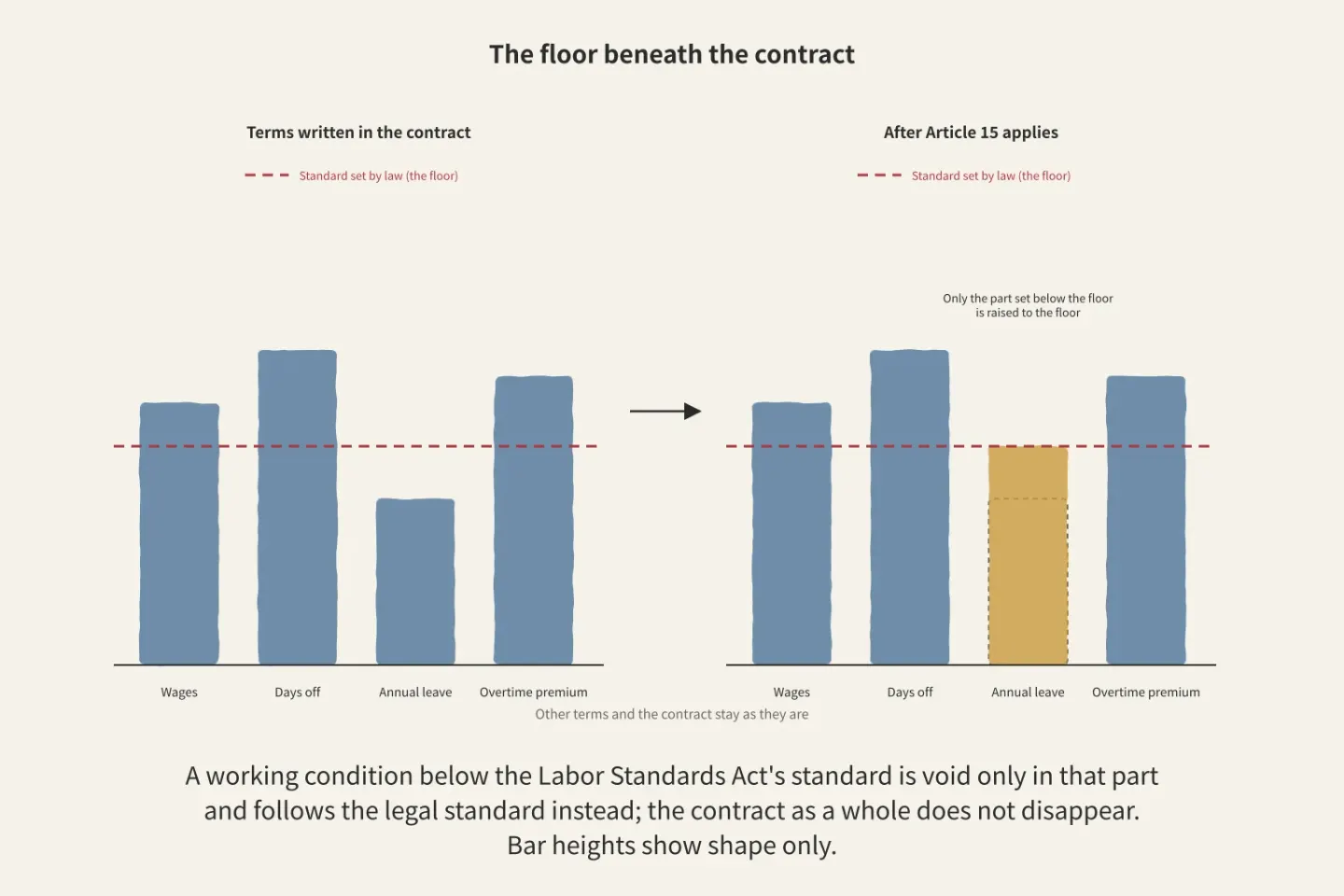
Figure: a diagram Paperis drew using only what the article says (bar heights show shape only)
How You Work Matters More Than Your Name Tag
So, were the instructors standing on the floor? The Supreme Court has stated that whether someone is an employee should be judged not by the form of the contract, but by “whether, in substance, the worker provided labor to an employer in a subordinate relationship for the purpose of earning wages within a business or workplace” (Supreme Court 2004Da29736). Employee status is the quality of whether a person corresponds to a worker protected by the Labor Standards Act.
To determine whether a subordinate relationship exists, various circumstances are examined together. One bundle consists of whether the employer determines the content of the work and exercises substantial direction and supervision, and whether the employer sets working hours and locations, binding the worker to them. Another bundle consists of whether the worker independently equips themselves with work tools or hires others to perform the work on their behalf, and whether they bear the risks of profit and loss themselves. It is also examined whether the remuneration is payment for the work itself, whether a base salary is set, whether earned income tax is withheld, whether the worker remains continuously tied to a single employer, and whether they are recognized as a worker under social security laws. The Supreme Court stated that these are judged by “synthesizing various economic and social conditions” (Supreme Court 2004Da29736).
The Supreme Court added a caveat to this. Given that factors such as the existence of a base salary, the withholding of earned income tax, and recognition as a worker under social security “are highly likely to be arbitrarily determined by the employer using their economically superior position”, one must not easily deny employee status simply because those points are absent (Supreme Court 2004Da29736).
This yardstick was applied to the instructors. The academy set the arrival time, lecture times, and locations, and it was virtually impossible for the instructors to go out and lecture elsewhere during their free time. Homeroom instructors also took on tasks outside of lectures, such as supervising self-study, distributing report cards, and contacting parents. The lecture fees were calculated by multiplying an hourly rate by the designated lecture hours, so they did not change even when the number of students and academy revenue increased or decreased. Bringing these circumstances together, the Supreme Court viewed the instructors as employees (Supreme Court 2004Da29736).
The contract stated that lectures could be refused if there were fewer than 10 students, and that the academy could not raise objections even if the instructors went to lecture at other academies. The Supreme Court judged that such phrasing, along with the business registration and tax method, were “merely contract wording that did not match the actual reality of labor provision” or circumstances that the employer could virtually determine at will, making them insufficient to overturn employee status (Supreme Court 2004Da29736). Employee status is not decided solely by the name attached to the contract or the way taxes are withheld.
The same yardstick works in the opposite direction. Equipping oneself with tools, hiring others to delegate work, and personally bearing profits and losses are factors pointing toward someone running a business independently (Supreme Court 2004Da29736). According to a paper reviewing precedents, the Supreme Court judged in 2018 that study-aid tutors are workers under the Trade Union Act, but not workers under the Labor Standards Act. The same paper criticizes the Supreme Court's yardstick for leaning on traditional employment forms, and proposes presuming a person hired by someone to be a worker first and leaving the burden of proving otherwise to the hiring side (KCI ART002655829). Whether someone is an employee is determined by how they work, and the outcome cuts both ways. A paper raised the critique that as the judgment factors increase, it becomes harder to predict outcomes in advance, and the risk of judgment-making in a way that simply counts the number of factors has grown (KCI ART002860254).
The Floor of Wages, the Minimum Wage
Let us suppose that an employment contract states an hourly wage lower than that year's minimum wage. The minimum wage is the floor of wages, preventing pay from being set below the amount set by law. An employer must pay workers subject to the minimum wage at least the minimum wage amount (Article 6, Paragraph 1 of the Minimum Wage Act). Any part of the contract set lower than that is invalid, and that part is treated as having agreed to pay wages equal to the minimum wage amount (Article 6, Paragraph 3 of the Minimum Wage Act). It looks just like Article 15.
The amount is set anew every year. The Minister of Employment and Labor must determine the minimum wage by August 5 of each year, following a proposal deliberated and resolved upon by the Minimum Wage Commission (Article 8, Paragraph 1 of the Minimum Wage Act). Labor and management have clashed every year over the margin of increase (DOI: 10.20436/OEJ.19.2.043). An employer cannot lower the level of wages previously paid on the grounds of the minimum wage (Article 6, Paragraph 2 of the Minimum Wage Act).
The law also dictates which funds are included in the minimum wage calculation. Wages paid regularly at least once a month are included, but parts specified by law among bonuses and living-support wages such as meal allowances and transportation expenses are excluded (Article 6, Paragraph 4 of the Minimum Wage Act).
The Minimum Wage Act states its purpose as "contributing to the sound development of the national economy by guaranteeing the minimum level of wages, thereby seeking stability in workers' lives and qualitative improvement of the labor force" (Article 1st of the Minimum Wage Act). There is concern that applying the minimum wage too broadly could harm collective labor relations and reduce the autonomy with which employers and workers set working conditions themselves (KCI ART002820198). On the other side, a 2016 paper pointed out the reality that a majority of non-regular workers and part-time workers at small-scale workplaces do not even receive the minimum wage (DOI: 10.20436/OEJ.19.2.043).
The Floor of Time
Weekly working hours cannot exceed 40 hours excluding break times, and a single day cannot exceed 8 hours (Article 50, Paragraphs 1 and 2 of the Labor Standards Act). Time spent waiting under the employer's direction and supervision in order to work is also considered working time (Article 50, Paragraph 3 of the Labor Standards Act). Agreed working hours are the working hours predetermined between the worker and the employer within the range of working hours set by law (Article 2, Paragraph 1, Item 8 of the Labor Standards Act).
People can work more on top of that. Overtime work is working extra beyond the working hours set by law. If the parties agree, up to 12 hours per week are allowed (Article 53, Paragraph 1 of the Labor Standards Act), and exceptions such as a written agreement in a workplace with fewer than 30 regular employees or approval by the Minister of Employment and Labor are set separately by law (Article 53, Paragraphs 3 and 4 of the Labor Standards Act).
For overtime work, at least 50% or more must be added on top of ordinary wages. Night work between 10 PM and 6 AM the next day also receives 50% or more added, and holiday work receives 50% or more added for up to 8 hours, with 100% or more added for the portion exceeding 8 hours (Article 56 of the Labor Standards Act). Ordinary wages serve as the baseline for these calculations. Ordinary wages are wages agreed to be paid regularly and uniformly as compensation for agreed work. This is the definition unpacked from the statutory definition by the Supreme Court in a 2024 ruling (Supreme Court Decision 2023Da302838).
There is also a floor for days off. Employers must guarantee paid holidays averaging at least once per week, and holidays prescribed by Presidential Decree must also be guaranteed as paid time off. These holidays can be changed to another working day through a written agreement with the worker representative (Article 55 of the Labor Standards Act).
Annual paid leave is paid leave that accrues every year based on the worker's period of service and attendance rate. If a worker has an attendance rate of 80 percent or higher over one year, they get 15 days (Article 60, Paragraph 1 of the Labor Standards Act). If they have worked for less than a year or their attendance rate falls short of 80 percent, 1 day accrues for each month of perfect attendance. For those who have worked 3 years or more, 1 day is added for every 2 years of continuous service exceeding the first year, up to a total limit of 25 days (Article 60, Paragraphs 2 and 4 of the Labor Standards Act). Leave must be granted at the time requested by the worker, though the employer may change the timing if it severely disrupts business operations. Unused leave expires after one year, with exceptions made when it could not be used due to the employer's fault (Article 60, Paragraphs 5 and 7 of the Labor Standards Act).
December 19, 2024: The Standard for Ordinary Wages Changes
A company set its bonuses at 750% of ordinary wages, distributing them every two months, during the Lunar New Year and Chuseok holidays, and during the summer vacation. However, they were given only to people who worked 15 days or more during a designated reference period. The appellate court ruled that these bonuses were not ordinary wages on the grounds that it was impossible to know in advance whether the 15-day condition would be met (Supreme Court 2023da302838).
What the appellate court followed was the standard established by the Full Bench ruling of the Supreme Court on December 18, 2013. The Full Bench is a panel of the Supreme Court where at least two-thirds of all Supreme Court justices gather, with the Chief Justice presiding. As summarized in the 2024 ruling, the 2013 ruling made "whether the payment of wages or the payment amount is predetermined in advance, regardless of whether the condition is met"—in other words, fixity—the hallmark that ordinary wages must possess, and viewed wages given only upon fulfilling a certain number of working days as lacking fixity (Supreme Court 2023da302838).
On December 19, 2024, the Full Bench changed this standard. The Supreme Court stated that the concept of fixity "has no basis anywhere in labor relations statutes." It explained that treating fixity as a hallmark narrows the scope of ordinary wages without statutory basis, preventing fair compensation for overtime work and the like, which fails to align with "the intent of the Labor Standards Act to curb overtime work and the like." Another reason was that it would allow parties to easily exclude certain wages from ordinary wages by attaching conditions such as the number of working days. The Supreme Court stated that ordinary wages are "a legal concept and a mandatory concept," and therefore must be interpreted so that the parties cannot alter them at will (Supreme Court 2023da302838).
Under the changed standard, wages designated to be received regularly and uniformly upon fully providing prescribed work are ordinary wages, regardless of any attached conditions. Therefore, if a condition is a number of working days within the prescribed working days, that condition alone does not exclude the wages from ordinary wages. Conversely, wages given on the condition of a number of working days exceeding the prescribed working days are compensation for additional work beyond prescribed work and thus are not ordinary wages (Supreme Court 2023da302838).
In this company, which operates on a five-day workweek, 15 days fell short of the prescribed working days for the reference period. The Supreme Court deemed the bonuses to be ordinary wages, overturned the appellate court's ruling, and sent the case back. The judgment notes that it was the unanimous opinion of the participating judges (Supreme Court 2023da302838). Another ruling handed down by the Full Bench on the same day dealt with bonuses stipulated as "bonuses shall be paid only to employees currently on the payroll as of the payment date." The Supreme Court deemed these bonuses to be ordinary wages despite the employment-status condition, while stating that wages not given solely on the ground of having fully provided prescribed work—such as performance-based pay in the pure sense—are not ordinary wages. This ruling was also the unanimous opinion of the participating judges (Supreme Court 2020da247190).
It was decided that the changed standard would be applied starting from the calculation of ordinary wages after the date the judgment was pronounced, "in consideration of legal stability and the protection of trust," and applied retroactively only to this case and cases litigating the same issue in court at that time (Supreme Court 2023da302838). Therefore, statutory allowances for overtime work and the like provided up to December 18, 2024, are calculated under the previous legal doctrine, excluding this case and parallel cases. The Supreme Court cited the points that the legal doctrine of the 2013 ruling "has been accepted in the labor field virtually like a mandatory legal order regarding ordinary wages" and that there are a very large number of affected parties, while including parties to parallel cases in the retroactive scope on the grounds that they filed lawsuits and thus contributed together to the change in precedent (Supreme Court 2020da247190).
Assessments are divided. There are evaluations that the changed standard aligns with the essence of ordinary wages and is desirable as social policy, along with a suggestion to enumerate in the statute the items to be excluded from ordinary wages in order to end disputes (DOI: 10.22825/juris.2025.1.73.016). While evaluating the abolition of fixity itself as a progressive decision, some papers also criticize that the court's adjustment of the timing of effectiveness without explicit statutory basis leaves room for judicial legislation and risks treating workers in the same situation differently depending on the coincidence of the timing of the trial (DOI: 10.33982/clr.2026.5.31.15.553). There is also research looking at the cost side. An empirical study examining the aftermath of the 2013 ruling notes that the impact on hourly wages and employment was limited and no evidence was found that labor costs per capita increased. The authors trace the reason to companies' adjustment of working hours, reporting that total labor input decreased in the short term and overtime work shifted to prescribed work in the long term (DOI: 10.22841/kjes.2026.74.2.001).
When the Contract Ends, Dismissal
We return to the story of the academy instructors. A fixed-term employment contract naturally ends when the period expires, barring special circumstances. However, the Supreme Court has ruled that if a short contract is repeated over a long period so that the duration becomes merely formal, the employer's refusal to renew it constitutes a dismissal (Supreme Court 2004Da29736). The instructors' contracts had been repeated 6 to 7 times, and their working conditions remained the same. According to the records, the refusal to renew appeared to be solely due to their reaching the age of 60, with no other reasons such as work performance coming to light. The Supreme Court viewed this refusal to renewal as “substantively a dismissal” (Supreme Court 2004Da29736).
Dismissal is when an employer unilaterally terminates an employment contract against the worker's will. The reason the law restricts dismissal is to protect workers who are in a socially and economically vulnerable position (DOI: 10.46329/LLF.2019.02.26.61). The Labor Standards Act stipulates that an employer may not subject a worker to "dismissal, layoff, suspension, transfer, pay cut," or other disciplinary action without “just cause”, and groups these together under the term “unfair dismissal, etc.” (Article 23, Paragraph 1 of the Labor Standards Act).
What the law blocks is dismissal without just cause, not dismissal itself. Because the statute does not write out what constitutes just cause in detail, courts decide on a case-by-case basis. According to a paper summarizing case law, when dismissing someone for a lack of working ability, courts examine whether the deficiency is objectively substantial, whether the evaluation was rational, and whether opportunities for improvement such as retraining or reassignment were provided (KCI ART002079350). The same paper notes that while significantly low performance makes dismissal hard to avoid, it must be a last resort when the contract can no longer be maintained under social norms (KCI ART002079350). The law also mentions dismissal for managerial reasons separately in its advance notice provisions (Article 26 of the Labor Standards Act).
There are also periods during which a worker cannot be dismissed. These are the period during which a worker is taking a leave of absence to receive medical treatment for an occupational injury or illness plus 30 days thereafter, and the period during which a female worker takes leave before and after childbirth in accordance with the law plus 30 days thereafter. However, exceptions are made if the employer has paid the lump-sum compensation specified by law or if it has become impossible to continue the business (Article 23, Paragraph 2 of the Labor Standards Act).
Procedures for Dismissal — Advance Notice, Written Notice, and Application for Relief
To dismiss an employee, the employer must give at least 30 days' advance notice, and if they do not, they must pay at least 30 days' worth of ordinary wages. Exceptions are made when the period of consecutive employment is less than 3 months, when it is impossible to continue the business due to unavoidable causes such as natural disasters, or when the employee has intentionally caused massive disruption to the business or property damage corresponding to the reasons prescribed by Ordinance of the Ministry of Employment and Labor (Labor Standards Act Article 26).
The employer must notify the employee of the grounds for dismissal and the time of dismissal in writing, and a dismissal is effective only when notified in writing (Labor Standards Act Article 27 Paragraph 1 and Paragraph 2). If advance notice was given in writing stating the grounds and time, it is deemed that notice has been given (Labor Standards Act Article 27 Paragraph 3). The written document is explained as a mechanism that facilitates proof when disputes arise and makes dismissals more deliberate (DOI: 10.46329/LLF.2019.02.26.61).
An application for relief from unfair dismissal is a procedure in which a worker who believes they have been dismissed without justifiable reason requests relief from the Labor Relations Commission. If an employer commits an unfair dismissal, etc., the worker may apply for relief to the Labor Relations Commission, and the law sets the application deadline within 3 months from the day the unfair dismissal, etc., occurred (Labor Standards Act Article 28). Korea maintains both relief through the Labor Relations Commission and relief through the courts, and there are criticisms that this operates as if trying a case five times, sometimes delaying relief, as well as proposals to make greater use of monetary compensation because there are cases where it is difficult to return to one's original position even after winning (DOI: 10.35223/GNULAW.30.4.6).
Severance Pay and the Final Settlement
Employers must set up at least one retirement benefit scheme to provide to employees who leave the job. Workers whose continuous employment period is less than 1 year or whose average prescribed working hours per week over a 4-week period are less than 15 hours are exceptions (Article 4, Paragraph 1 of the Employee Retirement Benefit Security Act). An employer wishing to establish a severance pay system must set up a scheme that can provide severance pay equivalent to at least 30 days of average wages per 1 year of continuous employment (Article 8, Paragraph 1 of the Employee Retirement Benefit Security Act). Average wages are the amount obtained by dividing the total wages received during the 3 months preceding the date on which the calculation became necessary by the total number of days in that period, and if that is less than the ordinary wage, the ordinary wage is used (Article 2, Paragraph 1, Item 6 and Paragraph 2 of the Labor Standards Act).
There was one more stumbling block regarding severance pay for instructors. From the CSAT in November of each year to the start of classes in February of the following year, most instructors had neither classes nor lecture fees, raising the question of whether they could be considered to have worked continuously for 1 year or more. The second-instance court made a hypothetical judgment that the continuous employment of some instructors could not be seen as lasting 1 year or more. The Supreme Court ruled that repeated contract periods should be combined, and that if the gap between contracts is not long compared to the entire period, stems from the nature of the work like a vacation, or is a rest period for recharging, and there is a reasonable ground for not working or not paying wages during that time, the employment relationship continues through that period as well. The instructors did work such as solving CSAT problems, essay-writing lectures, and reporting application and admission status even during those periods, and the Supreme Court viewed the employment relationship as having continued (Supreme Court 2004Da29736).
A Shop with Four Employees
The foundation laid by the Labor Standards Act is laid differently depending on the size of the workplace. The Labor Standards Act stipulates that it "shall apply to all businesses or workplaces that customarily employ 5 or more workers," and does not apply to workplaces that use only family members living together and domestic workers (Article 11, Paragraph 1 of the Labor Standards Act). For workplaces employing 4 or fewer workers customarily, it stipulates that "some provisions of this Act may be applied as prescribed by Presidential Decree," and leaves the method of counting the number of customary workers to a Presidential Decree (Article 11, Paragraph 2 and Paragraph 3 of the Labor Standards Act). The Enforcement Decree sets forth those provisions in Attached Table 1 (Article 7 of the Enforcement Decree of the Labor Standards Act). In workplaces employing 4 or fewer workers customarily, only part of the foundation of the Labor Standards Act is laid.
This exception was introduced when the Labor Standards Act was created in 1953, considering the economic conditions of small-scale businesses and the limits of the state's supervisory capacity (KCI ART003347837). One paper points to restrictions on dismissal, working hours and additional allowances, annual paid leave, and the prohibition of workplace harassment as major provisions that do not apply to workplaces with 4 or fewer workers (KCI ART003347837). The same paper notes that while consensus demanding full application has grown, concerns over small business owners' survival and reduced employment are also significant, and proposes expanding application in phases (KCI ART003347837). A study surveying 835 workplaces found that the smaller the workplace, the more negative they were toward expanding application (DOI: 10.23416/klea.2026.49.1.003).
Severance pay has a different standard. The Employee Retirement Benefit Security Act applies to "all businesses or workplaces using workers," excluding only businesses using only family members living together and employment activities within households (Article 3 of the Employee Retirement Benefit Security Act). This provision has no distinction based on the number of customary workers.
What the Floor Does Not Tell You
The picture of a floor only explains that a contract cannot go below the legal standard. Who is standing on that floor and which dismissals have a justifiable reason are judgments that cannot be measured by height, so the courts gather the circumstances to sort them out.
To sum up, there are three. Whether someone is an employee is sorted out by how they work rather than the name on the contract. Beneath the employment contract, the law lays a floor of wages and hours, raising only the parts set lower than that up to the floor's height. When a contract ends, the law does not block dismissal, but in workplaces with a regular workforce of 5 or more, it requires a justifiable reason, advance notice, and a written document, and ensures severance pay is settled.
Where to Look Next
Whether a regular wage counts as compensation for prescribed work remains an ongoing dispute (DOI: 10.22825/juris.2025.1.73.016), and discussions continue on how far to expand the safety net to workplaces with 4 or fewer employees (KCI ART003347837).
- How the same employee determination is applied when apps assign work is covered in "Platform Workers' Employment Status — When the App Gives the Orders".
- How the summary at the beginning of a court judgment differs from the reasoning at the end, and how to read them, is covered in "How to Read a Court Judgment — A One-Line Answer and Its Reasons".
- When the Supreme Court overturns a second-instance judgment and sends it back, and what a full bench does, is covered in "Korea's Three-Tier Courts and the Supreme Court — The Three Steps a Case Climbs, and Sometimes Comes Back Down".
- Why severance pay and wage lawsuits are civil trials is covered in "How Is a Civil Case Different from a Criminal One? — One Incident, Two Courtrooms".
- How contracts are formed and what compensation is owed when they are breached is covered in another installment of this series, "Contracts — A Knot Tied by Two Hands".
Source Papers
- "Labor Standards Act Article 2 (Definitions)" (Current) — Original Statute — Definitions of employee, employer, work, employment contract, wages, average wage, 1 week, prescribed working hours, and part-time worker; if the average wage is less than the ordinary wage, the ordinary wage applies (Paragraph 2).
- "Labor Standards Act Article 11 (Scope of Application)" (Current) — Original Statute — Applies to workplaces with 5 or more regular employees, excluding those employing only cohabiting family members or domestic household employees; certain provisions apply by Presidential Decree to those with 4 or fewer regular employees.
- "Labor Standards Act Article 15 (Employment Contracts Violating This Act)" (Current) — Original Statute — Employment conditions falling short of the standards are null and void only for that part, and the nullified part follows the standards of the Act.
- "Labor Standards Act Article 17 (Specification of Employment Conditions)" (Current) — Original Statute — Specification of wages, prescribed working hours, holidays, and annual paid leave; issuance in writing (including electronic documents).
- "Labor Standards Act Article 23 (Restriction on Dismissal, etc.)" (Current) — Original Statute — Prohibition of dismissal without justifiable grounds; prohibition of dismissal during periods of medical treatment for industrial accidents, maternity leave, and 30 days thereafter (with exceptions).
- "Labor Standards Act Article 26 (Advance Notice of Dismissal)" (Current) — Original Statute — Notice 30 days in advance or ordinary wages for 30 days or more, with three exceptions.
- "Labor Standards Act Article 27 (Written Notice of Reasons for Dismissal, etc.)" (Current) — Original Statute — Written notification of the reasons and timing of dismissal; written notice is required for validity.
- "Labor Standards Act Article 28 (Application for Relief from Unfair Dismissal, etc.)" (Current) — Original Statute — Application for relief to the Labor Relations Commission within 3 months.
- "Labor Standards Act Article 50 (Working Hours)" (Current) — Original Statute — 40 hours per week and 8 hours per day; waiting time under direction and supervision constitutes working hours.
- "Labor Standards Act Article 53 (Restriction on Extended Work)" (Current) — Original Statute — Extension up to 12 hours per week by agreement, with exceptions such as workplaces with fewer than 30 employees or approved extensions.
- "Labor Standards Act Article 55 (Holidays)" (Current) — Original Statute — An average of 1 or more paid holidays per week, with paid guarantees and substitution of holidays prescribed by Presidential Decree.
- "Labor Standards Act Article 56 (Extended, Night, and Holiday Work)" (Current) — Original Statute — Surcharge of 50% or more on ordinary wages for extended and night work, and 50% for up to 8 hours of holiday work and 100% for hours exceeding 8.
- "Labor Standards Act Article 60 (Annual Paid Leave)" (Current) — Original Statute — 15 days for attendance of 80% or more, 1 day per month for less than 1 year, capped at 25 days with additions, timing changes, and expiration if unused for 1 year.
- "Labor Standards Act Article 1 (Purpose)" (Current) — Original Statute — Establishing standards for employment conditions to guarantee and improve the basic livelihood of employees and to pursue balanced development of the national economy.
- "Enforcement Decree of the Labor Standards Act Article 7 (Scope of Application)" (Current) — Original Statute — The legal provisions applied to workplaces with 4 or fewer regular employees are listed in Attached Table 1.
- "Minimum Wage Act Article 1 (Purpose)" (Current) — Original Statute — Ensuring livelihood stability and qualitative improvement of the workforce through the guarantee of minimum wage levels, and sound development of the national economy.
- "Minimum Wage Act Article 8 (Determination of Minimum Wage)" (Current) — Original Statute — Determined by the Minister of Employment and Labor by August 5 each year in accordance with the resolution of the Minimum Wage Commission.
- "Act on the Guarantee of Employees' Retirement Benefits Article 3 (Scope of Application)" (Current) — Original Statute — Applied to all businesses employing workers, excluding businesses employing only cohabiting family members or employment activities within households.
- "Minimum Wage Act Article 6 (Effect of Minimum Wage)" (Current) — Original Statute — Payment of at least the minimum wage amount, prohibition of lowering previous wages, nullification of shortfalls, and inclusion scope.
- "Act on the Guarantee of Employees' Retirement Benefits Article 4 (Establishment of Retirement Benefit Schemes)" (Current) — Original Statute — Obligation to establish a retirement benefit scheme, excluding those with less than 1 year of service or fewer than 15 hours per week.
- "Act on the Guarantee of Employees' Retirement Benefits Article 8 (Establishment of Retirement Allowance Schemes, etc.)" (Current) — Original Statute — Average wage for 30 days or more per year of continuous service.
- "Retirement Allowance" (2006) — Supreme Court 2004Da29736 — Whether someone is an employee is determined by substance rather than contract format; academy instructors who signed a “Lecturing Service Provision Contract” are employees, and refusal to renew after repeated renewals constitutes dismissal, thereby reversing and remanding the original ruling.
- "Wages" (2024) — Supreme Court 2020Da247190 — Bonuses conditional on remaining employed (those currently employed as of the payment date) are ordinary wages, while pure performance bonuses are not ordinary wages. Reasons for limiting retroactive effect and inclusion of parallel cases (Full Bench, participating judges unanimous, appeal dismissed).
- "Wages" (2024) — Supreme Court 2023Da302838 — Excluding fixedness from the requirements of ordinary wages and viewing bonuses conditional on working days within prescribed working days as ordinary wages, reversing and remanding the original ruling (Full Bench, participating judges unanimous). The new legal doctrine applies to calculations from the date of pronouncement onward, while the current and parallel cases apply retroactively.
- "On the Core Elements of Determining an Employee under the Labor Standards Act by the Supreme Court — Centering on the 2018 Learning Material Instructor Ruling and Subsequent Supreme Court Rulings —" (2020) — KCI ART002655829 — In 2018, the Supreme Court ruled that learning material instructors are employees under the Trade Union Act but not under the Labor Standards Act.
- "A New Attitude Toward Determining Employees — Improvements in the Method by Which Case Law Determines Employees under the Labor Standards Act —" (2022) — KCI ART002860254 — Criticism that since 2004Da29736, the number of considerations has increased, reducing predictability and raising the risk of quantitative judgment, along with proposals for improvement.
- "Significance of the Minimum Wage System as a Constitutional Labor Fundamental Right" (2022) — KCI ART002820198 — Pointing out that excessive expanded application may lower labor-management autonomy.
- "Problems and Tasks of the Minimum Wage System" (2016) — DOI: 10.20436/OEJ.19.2.043 — Annual conflict between labor and management over the hike amount, and the reality that many part-time workers do not even receive the minimum wage.
- "Ordinary Wages and Fixedness - Centering on the Full Bench Ruling of the Supreme Court Decided December 19, 2024, 2020Da247190 and the Full Bench Ruling of the Supreme Court Decided December 19, 2024, 2023Da302838" (2025) — DOI: 10.22825/juris.2025.1.73.016 — The modified case law aligns with the essence of ordinary wages and is socially and politically desirable, but issues remain, and a legal revision enumerating excluded items is necessary.
- "Limitation on the Retroactive Effect of Case Law Changes Regarding the Fixedness Requirement for Ordinary Wages : A Critical Review of the Requirements and Scope of Application of the Limitation" (2026) — DOI: 10.33982/clr.2026.5.31.15.553 — Criticism that selective prospective effect risks judicial legislation and may discriminate against workers depending on the timing of the trial.
- "The Impact of the 2013 Ordinary Wage Ruling on the Domestic Labor Market" (2026) — DOI: 10.22841/kjes.2026.74.2.001 — No evidence of increased labor costs per capita following the 2013 ruling, with short-term total labor input decreasing due to working hour adjustments and long-term overtime being replaced by prescribed working hours.
- "Obligation of Written Notice of Dismissal" (2019) — DOI: 10.46329/LLF.2019.02.26.61 — The meaning of dismissal, restriction of freedom of termination to protect the vulnerable, and the evidentiary and deliberative functions of written notice.
- "Job Competency/Performance Deficiencies and Justifiable Grounds for Dismissal - A Review of Related Case Law -" (2016) — KCI ART002079350 — Case law looks at the objective existence of lack of capability, rational evaluation, and opportunities for improvement, and dismissal must be a last resort.
- "A Brief Essay on the Unfair Dismissal Relief System" (2022) — DOI: 10.35223/GNULAW.30.4.6 — The coexistence of administrative and judicial relief operates like a five-tier court system, delaying relief, and proposing the use of monetary compensation when reinstatement is difficult.
- "Legal Tasks Following the Expansion of the Application of the Labor Standards Act to Workplaces with Fewer Than 5 Employees" (2026) — KCI ART003347837 — Exceptions introduced at enactment in 1953, major excluded provisions (dismissal restrictions, working hours and surcharge allowances, annual leave, prohibition of harassment), proposing phased expansion.
- "Acceptability Analysis on the Phased Application of the Labor Standards Act through Typification of Core Working Hours in Workplaces with Fewer Than 5 Employees" (2026) — DOI: 10.23416/klea.2026.49.1.003 — Survey of 835 workplaces, showing that the smaller the business, the more negative it is toward expanding application.
Sources (7)
- 최저임금제도의 문제와 과제DOI 10.20436/oej.19.2.043
- 통상임금과 고정성 - 대법원 2024. 12. 19. 선고 2020다247190 전원합의체 판결과 대법원 2024. 12. 19. 선고 2023다302838 전원합의체 판결을 중심으로DOI 10.22825/juris.2025.1.73.016
- 통상임금의 고정성 요건에 관한 판례변경의 소급효 제한 : 제한의 요건과 적용범위에 대한 비판적 고찰DOI 10.33982/clr.2026.5.31.15.553
- 2013년 통상임금 판결이 국내 노동시장에 미친 영향DOI 10.22841/kjes.2026.74.2.001
- 해고의 서면통지의무DOI 10.46329/llf.2019.02.26.61
- 부당해고 구제제도에 대한 소고DOI 10.35223/gnulaw.30.4.6
- 5인 미만 사업장의 주력근로시간 유형화를 통한 근로기준법 단계적 적용에 대한 수용도 분석DOI 10.23416/klea.2026.49.1.003