Paperis Articles
DNA and Genes — A Manual Written in Four Letters, Two Strands That Are Each Other's Mold
We follow information written in four bases, a copying process in which two paired strands split and each half is rebuilt, the chromosomes that wind two meters of DNA into a nucleus, and how much of the human genome actually carries instructions for making proteins.
Your field's papers, as audio
Pick your fields and journals — Paperis summarizes the key papers and turns them into audio. Listen on your commute.
Start Paperis free →DNA and Genes — A Manual Written in Four Letters, Two Strands That Are Each Other's Mold
Healing Wounds
If your knee is slightly scraped, within a few days that spot is covered with new flesh. The newly grown flesh is the same skin that was there originally. The flesh at the edge of the wound expanded to fill the empty space.
A child resembling their parents is a similar thing. A child inherits the method of making a body from their parents.
Both scenes presuppose two things. The method of making a body must be written down somewhere, and that record must be copied almost without error every time it divides. This article follows what that record is written with, how it is copied, and where it is folded and stored. At the end, we look at how much of that long record is actually the place where the information to make a body is written.
Extracted from the Nucleus
The substance containing that record was first found in the nuclei of white blood cells in the 1860s. The physician Friedrich Miescher extracted a phosphorus-rich substance from nuclei and called it "nuclein," a substance later known as DNA (OpenStax Biology 2e 14.1). DNA is a long molecule where cells store genetic information, and the sequence in which four bases are lined up is that information. A base is a small molecule attached to each compartment of the DNA chain, with four types: adenine (A), thymine (T), guanine (G), and cytosine (C).
Cells read this information to make two molecules. RNA is a molecule similar to DNA that is used to copy down DNA's information or read that information. Proteins are molecules made of amino acids linked together in a chain and folded, which do most of the work inside cells. Organisms live by means of RNA and proteins read from DNA (PMID 31652314). This article calls DNA the instruction manual carried around by cells, RNA the copy transcribed from it, and proteins the workers built according to those instructions. The path from the instruction manual through the copy to the workers is followed by "From Gene to Protein — A Copy Read Three Letters at a Time, and the Pages Each Cell Opens".
The fact that DNA carries information passed down through generations came to light about 80 years after Miescher. In 1944, researchers Oswald Avery, Colin MacLeod, and Maclyn McCarty changed the traits of one strain of pneumonia-causing bacteria using a substance extracted from another strain. Even when proteins or RNA were broken down in that substance, the traits still changed, and they stopped changing only when DNA was broken down (OpenStax Biology 2e 14.1). Subsequent experiments cemented that DNA is the genetic material (OpenStax Biology 2e 14). Nearly all organisms write their instruction manuals in DNA, while some viruses write them in RNA (OpenStax Biology 2e 21.1).
From bacteria to humans, the method for building a body is written in a single molecule called DNA.
Four Letters
One compartment of a DNA chain consists of a sugar, a phosphate, and a single base, and these compartments link long together to form a chain (OpenStax Biology 2e 3.5). The sugars and phosphates link alternately to become the backbone of the chain, and the bases hang one by one from that backbone (OpenStax Biology 2e 14.2).
It is a manual with only four letters. Even so, the content that can be written is vast. Even with the same four letters, "GATTACA" and "ACATTAG" are different lines, and the longer the line gets, the faster the number of possible sequences swells.
Austrian-born biochemist Erwin Chargaff counted the four bases of DNA and found a rule. In the DNA of any organism, the amounts of A and T were equal, and the amounts of G and C were equal. The ratio occupied by the four bases itself differed from species to species (OpenStax Biology 2e 14.1; OpenStax Biology 2e 14). That the ratio differed by species is a clue that the content written in the DNA differs for each living thing. That A and T, and G and C, were always equal amounts was a riddle to be solved in the next section.
The content of the manual is the order in which the four letters A, T, G, and C are lined up.
Two Strands, A Pair
Chargaff's puzzle was solved when the shape of DNA was revealed. The shape was uncovered by James Watson and Francis Crick, researchers at the University of Cambridge in England in the 1950s. Underlying it was data obtained using X-rays by Rosalind Franklin, a researcher in another lab (OpenStax Biology 2e 14.2).
The double helix is a shape where two strands of DNA are wound and twisted around each other. The backbones of the two strands are on the outside, and the bases face inward to meet the bases of the opposite strand (OpenStax Biology 2e 14.2). A base pair is two bases paired with each other from the two strands facing each other, where A always pairs with T, and G always with C. The "equal amounts of A and T" that Chargaff counted comes from this matching of pairs. That is because for every single A, there is a T right across from it (OpenStax Biology 2e 14.2).
There is also a rule of size to the pairs. A and G are large bases with two rings, while C and T are small bases with one ring (OpenStax Biology 2e 3.5). A large base always pairs with a small base so that every pair is the same size, which, along with the two strands being oriented in opposite directions, makes the width of the double helix uniform at 2 nanometers everywhere (OpenStax Biology 2e 14.2). Every time the helix makes a full turn, ten base pairs fit inside (OpenStax Biology 2e 14).
Therefore, even if one of the two strands is lost, nothing is lost. Only A can come opposite a spot where T remains, and only G opposite a spot where C remains, allowing the letters of the missing side to be read back letter by letter from the remaining side (OpenStax Biology 2e 14.3). When you match the facing positions against each other, the opposite of "ATGC" on one side is "TACG". Just as a mold holds the shape of an object in reverse, one strand of DNA is the mold for the opposite strand.
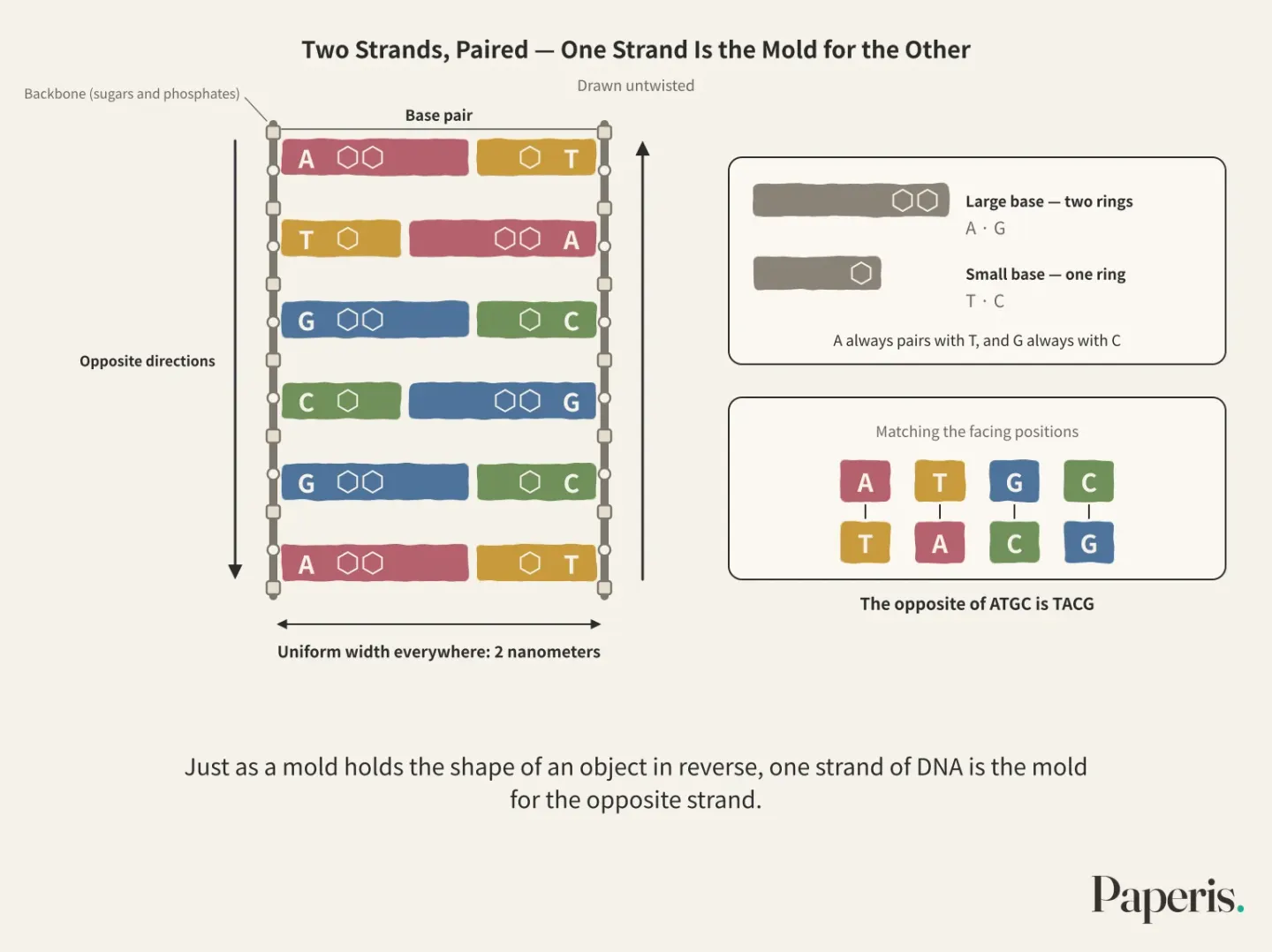
The two strands interlock in predetermined pairs, so that one strand determines the other.
A Pair Reborn from Halves
If you have a mold, you can stamp out the same object over and over again. Cells do the same thing, making a duplicate set of DNA before they divide.
DNA replication is the process by which a cell makes an identical copy of its DNA before it divides. When replication begins, the opposing bases pull apart from one another. The spot opposite each left-behind strand is left empty, and an enzyme that copies DNA fills in each empty spot with the correct matching base one by one (OpenStax Biology 2e 14.3; OpenStax Biology 2e 14.4). The remaining strands act as molds, and in this way one set becomes two.
However, how the old and new strands were distributed into the two new sets was not clear at first, and several methods had been put forward as candidates (OpenStax Biology 2e 14.3). Semiconservative replication is a replication method in which each of the two newly formed DNA sets consists of one original strand and one new strand. What settled this was an experiment on E. coli by researchers Meselson and Stahl. The two grew E. coli—whose DNA was marked with heavy nitrogen—in light nitrogen and measured the weight of the DNA. After one division, all of the DNA had a weight halfway between heavy and light, but this alone could not distinguish whether the old and new strands paired up one-by-one or were mixed in pieces. After two divisions, it split into two groups: intermediate weight and light, and the only method that explained both results together was semiconservative replication (OpenStax Biology 2e 14.3). This is a result from E. coli, and human cells follow the same basic steps (OpenStax Biology 2e 14.5).
The speed of copying varies from one organism to another. E. coli copies its DNA, which is 4.6 million base pairs long, in about 42 minutes, attaching roughly 1,000 bases per second (OpenStax Biology 2e 14.4). Human cells are much slower at about 100 per second. Instead, a single long string of DNA has multiple starting points for copying, reaching up to 100,000 spots across the entire DNA of a human cell. Human cells copy 6 billion base pairs before dividing (OpenStax Biology 2e 14.5).
While copying the 6 billion pairs, errors are caught in three layers. The copying enzyme almost always picks the correct base, when it occasionally attaches an incorrect base it can remove it, and the rare errors that still slip through can mostly be fixed by a repair process that scans the new DNA (PMID 35850061). Proofreading is the process by which the DNA-copying enzyme removes incorrectly attached bases and reattaches them. Human DNA contains instructions for making proteins responsible for proofreading and damage repair in hundreds of places (PMID 37936448).
Changes still remain. A mutation is a change in the DNA base sequence. Human cells can accumulate changes in their DNA throughout life, and some of those arise when cells divide and copy their DNA (PMID 37936448). What those changes bring about is covered in "Heredity and Variation — One Card from Each Pair, a Hand Shuffled Anew".
The strands split in half and each revives its match, turning one set of DNA into two almost flawless sets.
Folding in 2 Meters
If you laid out the DNA in the nucleus of a single human cell in a straight line, it would measure about 2 meters long. That DNA fits inside a nucleus that is 5 to 15 micrometers in diameter, which is around one 100th of a millimeter (PMID 39820859).
To fit this length, DNA must be wound and wound again. Histones are proteins that act as spools around which DNA winds. Most DNA winds around clumps of histones to form a shape like a string of beads, and this string coils into a thicker fiber, which then forms loops and folds. Through this process, the DNA in each chromosome shrinks to roughly one 10,000th of its original length (PMID 1364580).
A chromosome is a package formed when long DNA is folded and bundled together with proteins. A single chromosome contains one very long DNA molecule (PMID 1364580). Cells in the human body have 46 chromosomes, which come in 23 pairs. Of each pair of chromosomes, one came from the mother and one from the father (OpenStax Biology 2e 10.1). The number of chromosomes is fixed for each species, so fruit flies have 8. Bacterial DNA is usually contained in a single circular chromosome (OpenStax Biology 2e 4.3). Instead of winding around histones, bacterial DNA is twisted and folded (OpenStax Biology 2e 14.2).
Only when a cell prepares to divide do chromosomes appear as bundled rod-like shapes under a microscope. Normally, they remain unraveled and spread out inside the nucleus (OpenStax Biology 2e 4.3). What is wound up must be unwound to be copied. During replication, histones must be removed and then rewound, which is one of the reasons human cell replication is slower than that of E. coli (OpenStax Biology 2e 14.5).
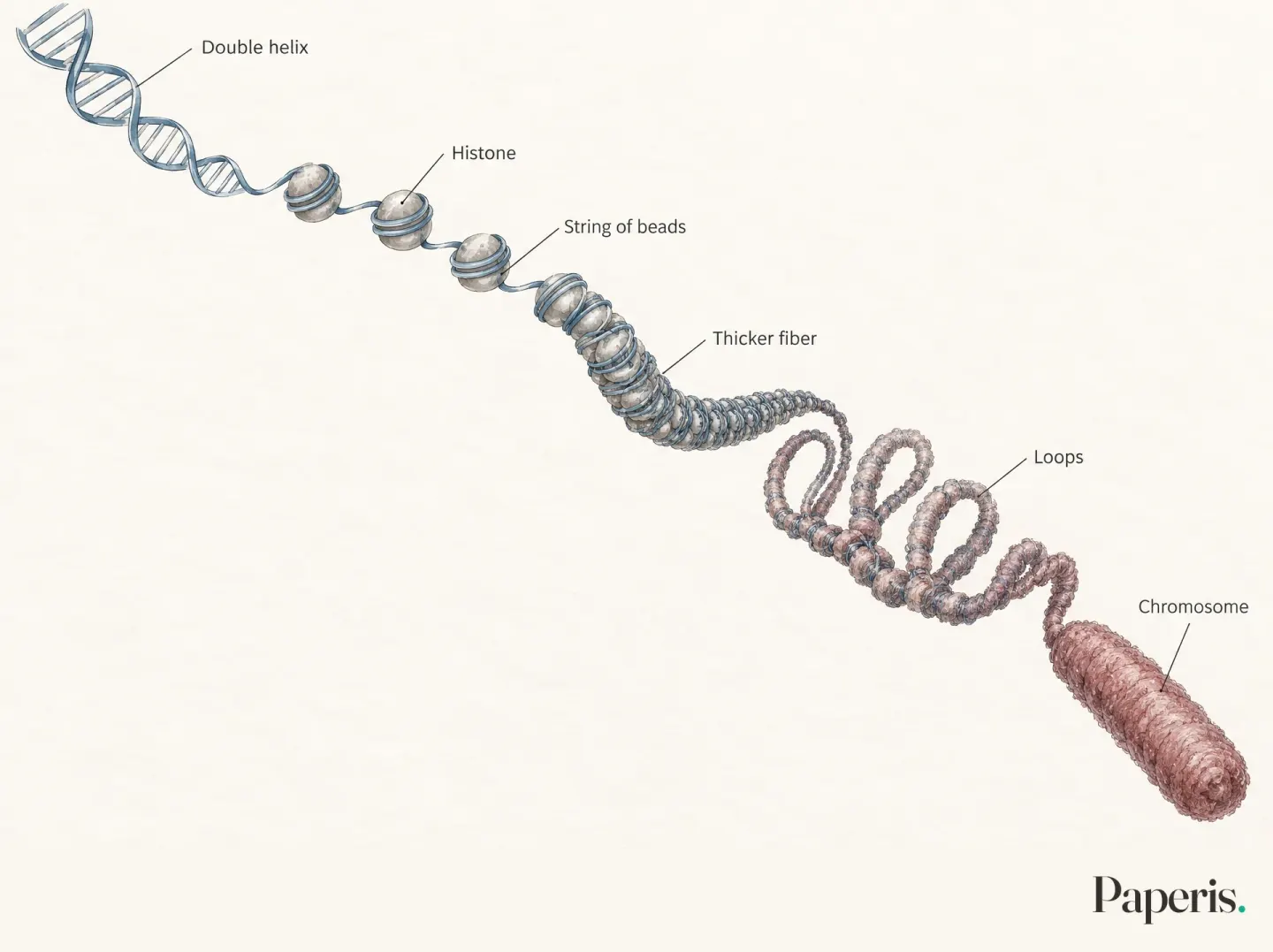
The 2-meter manual winds around histones and folds to fit inside the nucleus as 46 packages.
An Item in the Manual
A gene is a section of DNA containing the information to make a protein or a working RNA. To put it in terms of a manual, a gene is a single item detailing "how to make something."
Scientists are still counting how many protein-making genes humans have. Ever since the first draft of the human DNA sequence came out in 2001, scientists have been adding genes to the list one by one, and it is estimated that there are a little under 20,000 protein-making genes (PMID 37794265). This number is an estimate, and the number of genes that work as RNA instead of protein is growing fast as they are reported (PMID 37794265).
The meaning of the word "gene" is not set in stone either. The meaning of this term has changed over the past 100 years. To the 19th-century Austrian monk Gregor Mendel and researchers after him, it was an invisible unit that caused traits to be passed down, whereas in today's sequence data, it is the DNA section where protein information is written (PMID 17567988). When large-scale surveys in the 2000s revealed that RNA is widely produced all over DNA, this definition was shaken too. A 2007 review paper proposed rewriting a gene as "a collection of DNA sequences that produce working products which can overlap with each other" (PMID 17567988). Because genes that make proteins also put out working products that are RNA instead of protein, it is hard to cleanly divide genes into "things that make proteins" and "things that do not" (PMID 30146915).
A gene is an item in the manual, and it is estimated that humans have a little under 20,000 items that make proteins.
Full Manual
The genome is the complete set of genetic information of an organism, and is also called the genome. A single set of the human genome is roughly 3 billion base pairs. Body cells hold two sets received from the mother and the father, and copy 6 billion pairs when they divide (OpenStax Biology 2e 14.5).
It took a long time to read this manual from start to finish. Even after the first draft, the standard sequence of the human genome had gaps for a long time, and failed to capture the diversity among people. A sequence that seamlessly filled even hard-to-read places like the pinched regions and both ends of chromosomes, together with a pangenome capturing the differences among various populations around the world, has only recently emerged (PMID 38663087). The single human genome sequence released in 2022 that finally filled the roughly 8% of the genome that had been empty until then joined all chromosomes except the Y chromosome without gaps, and its length was 3,055 million base pairs (PMID 35357919).
The number of protein-coding genes in humans is not significantly larger compared to much simpler organisms among eukaryotes (PMID 30146915). And in the human genome, the sites where information to make proteins is written are less than 2% (PMID 24747961). Non-coding DNA is the part of the genome where information to make proteins is not written. More than 98% of the human genome is non-coding DNA (PMID 24747961).
The full manual is around 3 billion letters, and among them, the pages where how to make proteins is written are less than 2%.
The Other 98%
The other 98% was once viewed with suspicion. When it was discovered that non-protein-coding RNA is made in large amounts from this region, worries arose that the RNA might be useless noise, leading this part to be called the "dark matter" of the genome (PMID 27479746).
Transposable elements are DNA fragments that have spread throughout the genome by inserting copies of themselves into new locations. Transposable elements make up about half of the mammalian genome, accounting for a large share of the other 98% (PMID 35228718). Among them, a large group called retrotransposons has often been regarded as parasites that only look out for themselves (PMID 37949723). Yet, even after losing the ability to move around, transposable elements can influence how nearby genes are used. They provide sites that regulate gene use or even become new regulatory genes (PMID 35228718). Studies have emerged showing that in early mammalian embryos, retrotransposons are involved in important processes of early development (PMID 37949723).
Non-coding RNA is RNA that is not used to make proteins, but rather works as RNA itself. Much of this RNA is made from non-coding DNA. Among them, a significant portion of the long ones are made differently depending on cell type and travel to specific locations within the cell, making it difficult to view them as simple noise (PMID 19571179). Sites that alter gene use from a distance also reside within non-coding DNA (PMID 38546891). There are also reports that small proteins are made from sites previously classified as non-coding, blurring the boundary itself (PMID 37897910).
The reverse fact carries equal weight. Most of the reported non-coding RNA genes currently have no clear function (PMID 37794265). Just how many small proteins exist and how many of them do important work remains a mystery (PMID 37897910).
Some of the 98% perform the job of regulating gene use, and just how much of it does actual work has not yet been fully uncovered.
A Single Cell at the Edge of the Wound
Let us return to the first knee. At the edge of the wound, a single skin cell prepares to divide.
Inside that cell's nucleus lies DNA wound and divided across 46 chromosomes. To copy it, the tightly wound DNA must unwind, causing it to detach from its histones (OpenStax Biology 2e 14.5). At multiple points along each chromosome, facing base pairs separate (OpenStax Biology 2e 14.5), and the left-behind single strands serve as molds (OpenStax Biology 2e 14.3). Enzymes fill in T opposite each A on the mold, and C opposite each G, copying all 6 billion pairs (OpenStax Biology 2e 14.4; OpenStax Biology 2e 14.5). Proofreading enzymes remove incorrectly attached bases, and a repair process can fix most rare remaining errors (PMID 35850061). The two copied sets of DNA remain attached before splitting in two, entering two genetically identical cells (OpenStax Biology 2e 10.2).
The newly created skin cell receives the entire instruction manual in this way. Yet the cell does not open up every part of the instructions it receives. A single human brain contains over 3,000 cell types, and each cell type uses a different pattern of genes from the same genome. Processes that alter how genes are used without changing the DNA sequence are involved in shaping these patterns (PMID 39820859).
DNA writes down what can be made, and which parts to open up varies by cell type. Having an instruction manual is different from having everything that will be made already decided.
The metaphor of an instruction manual also has its limits. A paper instruction manual has clear boundaries for each item, but genes produce overlapping products, and the boundary between making proteins and not making them is blurry (PMID 17567988). This metaphor is accurate only up to "information written in a sequence" and "copied and passed down."
Where to Look Further
Among the RNAs made from non-coding DNA, most are still not clear about what they do (PMID 37794265).
Reading the story of our ancestors from the text written in DNA can be seen in "What Genes Can Tell Us — An Old Book Copied Down the Generations". The problem of the sequence written in genes folding into the shape of a protein is covered by "From Sequence to Shape: How AlphaFold Cracked a 50-Year Problem".
The other parts of this series follow the doors opened by this article one by one. "What Is a Cell? — A Small Village Inside a Wall, a Village That Splits in Two" looks at the process of how the nucleus containing DNA and the cell divide, and "From Gene to Protein — A Copy Read Three Letters at a Time, and the Pages Each Cell Opens" looks at the process of genes being transcribed into RNA and turned into proteins. "Heredity and Variation — One Card from Each Pair, a Hand Shuffled Anew" deals with how two sets from parents are mixed and passed down to a child and what changes bring about, and "What Is Evolution? — Branches Split from One Root, New Shoots Still Sprouting" deals with the results of those changes accumulating across generations.
Source Papers
- "Biology 2e — 14.1 Historical Basis of Modern Understanding" (2018) — OpenStax Biology 2e 14.1 — In the 1860s, Miescher isolates "nuclein" from white blood cell nuclei; in 1944, Avery, MacLeod, and McCarty show that bacterial transformation stops only when DNA is destroyed; Austrian biochemist Erwin Chargaff investigates the DNA base composition of different species.
- "Biology 2e — Chapter Summary" (2018) — OpenStax Biology 2e 14 — The Hershey-Chase experiment proves DNA is the genetic material; Chargaff's rules show A=T and C=G with varying ratios across species, and 10 base pairs per helical turn.
- "Biology 2e — 21.1 Viral Evolution, Morphology, and Classification" (2018) — OpenStax Biology 2e 21.1 — Almost all living organisms use DNA as genetic material, while viruses use either DNA or RNA.
- "Biology 2e — 3.5 Nucleic Acids" (2018) — OpenStax Biology 2e 3.5 — Nucleotides consist of a nitrogenous base, a pentose sugar, and a phosphate group; DNA bases are A, G, C, and T, with A and G having a double ring and C and T having a single ring.
- "Biology 2e — 14.2 DNA Structure and Sequencing" (2018) — OpenStax Biology 2e 14.2 — Watson and Crick propose the double helix using Franklin's X-ray data; A-T and G-C pairing is implied by Chargaff's rules; the sugar-phosphate backbone is on the outside and bases on the inside; purine-pyrimidine pairing and antiparallel arrangement maintain a uniform 2 nm width; bacterial DNA is folded by supercoiling.
- "Biology 2e — 14.3 Basics of DNA Replication" (2018) — OpenStax Biology 2e 14.3 — Base-pairing rules dictate that one strand determines the other; several replication models are initially proposed; Meselson and Stahl show that after one generation of intermediate weight, the second generation splits into two bands, leaving only semi-conservative replication.
- "Biology 2e — 14.4 DNA Replication in Prokaryotes" (2018) — OpenStax Biology 2e 14.4 — E. coli replicates its 4.6 million base pairs in about 42 minutes at roughly 1,000 nucleotides per second, with DNA polymerase adding complementary bases one by one.
- "Biology 2e — 14.5 DNA Replication in Eukaryotes" (2018) — OpenStax Biology 2e 14.5 — A single human genome set has 3 billion base pairs, making 6 billion during replication; there are up to 100,000 replication origins operating at about 100 nucleotides per second; replication is slower due to stripping and re-wrapping histones, but the basic steps are the same as in prokaryotes.
- "Extrinsic proofreading." (2022) — PMID 35850061 — The high accuracy of nuclear DNA replication stems from three processes: correct base selection, proofreading, and mismatch repair.
- "Human DNA Mutations and their Impact on Genetic Disorders." (2024) — PMID 37936448 — Hundreds of genes involved in proofreading and damage repair govern replication fidelity, and human cells accumulate DNA changes throughout life, some arising during replication in cell division.
- "Basic Epigenetic Mechanisms." (2025) — PMID 39820859 — 2 meters of human nuclear DNA packs into a nucleus 5 to 15 μm in diameter across 23 pairs of 46 chromosomes, supporting over 3,000 brain cell types, where gene function changes without DNA sequence alterations create cell-type-specific expression patterns.
- "Chromosome structures." (1992) — PMID 1364580 — Each chromosome contains a single long DNA molecule compressed about 10,000-fold through interactions with proteins, forming nucleosomes wound on histone "spools" that fold into 30 nm fibers and loop domains.
- "Biology 2e — 10.1 Cell Division" (2018) — OpenStax Biology 2e 10.1 — Human somatic cells have 46 chromosomes, consisting of 23 pairs of homologous chromosomes inherited from each parent.
- "Biology 2e — 4.3 Eukaryotic Cells" (2018) — OpenStax Biology 2e 4.3 — Prokaryotes have a single circular chromosome, while eukaryotes have a species-specific number of rod-shaped chromosomes (46 in humans, 8 in fruit flies) that become distinct only when preparing for division.
- "Biology 2e — 10.2 The Cell Cycle" (2018) — OpenStax Biology 2e 10.2 — Two replicated copies of DNA remain attached until they separate to form two genetically identical daughter cells.
- "Understanding biochemistry: structure and function of nucleic acids." (2019) — PMID 31652314 — DNA and RNA carry genetic information that cells read to produce RNA and proteins, with the double helix structure enabling information copying.
- "The status of the human gene catalogue." (2023) — PMID 37794265 — Efforts to catalog genes since the 2001 draft suggest fewer than 20,000 protein-coding genes, while reports of non-coding RNA genes have surged, though most have unclear functions.
- "What is a gene, post-ENCODE? History and updated definition." (2007) — PMID 17567988 — The definition of a gene shifts from Mendel and Morgan's abstract units to sequence open reading frames; ENCODE challenges this concept and proposes an updated definition as "the union of genomic sequences encoding a coherent set of potentially overlapping functional products."
- "Non-coding transcript variants of protein-coding genes - what are they good for?" (2018) — PMID 30146915 — The number of human protein-coding genes does not greatly exceed that of much simpler eukaryotes, and protein-coding genes also produce non-coding RNA forms, blurring the strict boundary between coding and non-coding.
- "Beyond the Human Genome Project: The Age of Complete Human Genome Sequences and Pangenome References." (2024) — PMID 38663087 — Standard references have long been incomplete and lacking diversity, but gapless T2T sequences resolve centromeres and telomeres, while pangenomes capture inter-population diversity.
- "The complete sequence of a human genome." (2022) — PMID 35357919 — Filling the remaining 8% left since the initial 2000 release, the T2T-CHM13 human genome sequence provides a gapless assembly of 3.055 billion base pairs across all chromosomes except Y.
- "An expanding universe of the non-coding genome in cancer biology." (2014) — PMID 24747961 — The non-coding genome accounts for more than 98% of the human genome.
- "The bright side of dark matter: lncRNAs in cancer." (2016) — PMID 27479746 — Although non-coding transcription was once feared to be "dark matter" or transcriptional noise, some transcripts have proven functions.
- "Roles of transposable elements in the regulation of mammalian transcription." (2022) — PMID 35228718 — Transposable elements make up about half of the mammalian genome and, even after losing the ability to move around, provide enhancers and promoters while giving rise to new regulatory genes.
- "Retrotransposon renaissance in early embryos." (2024) — PMID 37949723 — Retrotransposons, once dismissed as parasites, participate in zygotic genome activation and cell fate determination in early embryos.
- "Long noncoding RNAs: functional surprises from the RNA world." (2009) — PMID 19571179 — Many long non-coding RNAs exhibit cell-type-specific expression, subcellular localization, and disease associations, making them difficult to dismiss as mere noise.
- "An Emerging Role for Enhancer RNAs in Brain Disorders." (2024) — PMID 38546891 — Enhancers are non-coding DNA elements that drive gene expression changes over long distances.
- "Protein-coding potential of non-canonical open reading frames in human transcriptome." (2023) — PMID 37897910 — Small open reading frames in non-coding regions produce proteins, though how abundant and functional they are remains unknown.
Sources (28)
- Biology 2e — 14.1 Historical Basis of Modern Understanding
- Biology 2e — Chapter Summary
- Biology 2e — 21.1 Viral Evolution, Morphology, and Classification
- Biology 2e — 3.5 Nucleic Acids
- Biology 2e — 14.2 DNA Structure and Sequencing
- Biology 2e — 14.3 Basics of DNA Replication
- Biology 2e — 14.4 DNA Replication in Prokaryotes
- Biology 2e — 14.5 DNA Replication in Eukaryotes
- Extrinsic proofreadingPMID 35850061
- Human DNA Mutations and their Impact on Genetic DisordersPMID 37936448
- Basic Epigenetic MechanismsPMID 39820859
- Chromosome structuresPMID 1364580
- Biology 2e — 10.1 Cell Division
- Biology 2e — 4.3 Eukaryotic Cells
- Biology 2e — 10.2 The Cell Cycle
- Understanding biochemistry: structure and function of nucleic acidsPMID 31652314
- The status of the human gene cataloguePMID 37794265
- What is a gene, post-ENCODE? History and updated definitionPMID 17567988
- Non-coding transcript variants of protein-coding genes - what are they good for?PMID 30146915
- Beyond the Human Genome Project: The Age of Complete Human Genome Sequences and Pangenome ReferencesPMID 38663087
- The complete sequence of a human genomePMID 35357919
- An expanding universe of the non-coding genome in cancer biologyPMID 24747961
- The bright side of dark matter: lncRNAs in cancerPMID 27479746
- Roles of transposable elements in the regulation of mammalian transcriptionPMID 35228718
- Retrotransposon renaissance in early embryosPMID 37949723
- Long noncoding RNAs: functional surprises from the RNA worldPMID 19571179
- An Emerging Role for Enhancer RNAs in Brain DisordersPMID 38546891
- Protein-coding potential of non-canonical open reading frames in human transcriptomePMID 37897910